




 texto em
  Inglês (pdf)
 Artigo em XML
 Referências do artigo
 Tradução automática
 Enviar este artigo por email
 Citado por SciELO
  Similares em
SciELO
Similares em
SciELO 
 Permalink

1. Introduction
Local journalism is a classic form of journalism that plays a key role in responding to the informational needs of local communities (Nielsen, 2015). The concept refers to news focused on specific geographic communities, but digital shifts challenge the boundaries of what “local” means and who produces trusted information. These media have the capacity to shape how community members perceive their nearby area (Weber & Mathews, 2024). Besides that, they not only help citizens to address daily activities but also boost political participation (Park et al., 2023) and civic and community engagement (Hess, 2016).
However, there is an emergence of “news deserts”, understood as the lack of local news provision, in some specific areas (Abernathy, 2020). This issue is multidimensional and has a significant impact, likely due to the use of highly descriptive words: a place that is a desert regarding news. Literature describes a growing concern about the political implications of these places, as other information services do not manage to substitute traditional local news outlets (Barclay et al., 2024). On this matter, the absence of local journalism is not only related to the existence of local media outlets, but also to the regularity of publication of those newsrooms (Jerónimo, Ramos, & Torre, 2022).
The local news provision seems endangered, but at the same time, the purpose of this practice is being valued in the digital age as a continued commitment to the community, which is defined by Gulyas and Hess (2024) as the three “Cs” of digital local journalism (community, commitment, and continuity). Beyond social commitment, technological innovation is essential for public proximity media (López-Golán et al., 2024). Proximity alludes to the closeness between news and audience, traditionally geographic but also social and cultural. All these changes reveal to what extent local journalism is a shifting sector based on a strong relationship with the audience.
Local news production is undergoing transformations as the journalistic practice is reshaped by technology and the emergence of new actors (Holton & Belair-Gagnon, 2018; Negreira-Rey et al., 2024). Previous meta-research on local journalism has extensively investigated the issues and challenges affecting the sector (Mota, 2023), hyperlocals and news deserts (Negreira-Rey & López-García, 2021; Rodríguez-Urra et al., 2024), the notion of local and place in times of technology (Napoli, 2019), or, following the latter, the growing importance of the emotional and cultural ties linked to the concept of “place” (Tampone, 2024). Trends in local journalism due to the impact of digital media have also been studied (Nielsen, 2015), but there is a lack of information on how academia is addressing the changes in digital news production at the local level.
Bearing this in mind, this work aims to provide a systematic literature review on local news production, focusing on research over 10 years, between 2012 and 2022, as that decade was marked by the digitalization of information environments that changed the bond with audiences (Heiselberg & Hopmann, 2024). The importance of local journalism for community well-being and local democracy also highlights the need to understand research trends on this topic. Our review aligns with the growing body of communication research studies (Keating et al., 2022), shedding light on the concerns and practices of academic production.
2. The Adaptation of Local News
Local news outlets bring a key service to the community, which explains their resilience towards the impact of digitization (Hess & Waller, 2017). Local media present an identification with the public by dealing with themes of interest. Furthermore, the focus on helpful close stories ensures a robust tie with the geo-socio-political context (Gulyas & Baines, 2020; Huxford, 2007). Local journalists guarantee access to non-elite sources, helping to expand the plurality of information sources (Splendore, 2020).
Nevertheless, since the consolidation of digital technologies, many news organizations around the world are facing a decline in revenues and readership, putting the business of local journalism at risk (Magasic & Hess, 2021). As the presence of local journalism is becoming scant in some territories, literature pays considerable attention to the appearance of “news deserts”, in which the absence of local information has an impact on the lives of community members (Mathews, 2022). This phenomenon also overlaps with the rise of disinformation in the local sphere. In a digital era, several media outlets resort to unverified content to better reach the public (Jenkins & Jerónimo, 2021).
Previous studies have detected a drop in social cohesion caused by a higher distrust among local communities (Barclay et al., 2024), but some of the problems of local journalism are long-standing. Local news outlets are usually too close to the sources they rely on for reporting and are dependent on institutions, but they also depend on news agencies for other topics (Czarniawska, 2011). Thus, local media face some trouble beyond the disappearance of local news outlets and the transformation of business models due to a pattern of few advertisers and economic revenue.
However, changes in local news production, understood as the process of creating news, are crucial to understanding the current state of local journalism. Local news organizations tend to be innovative and open to experimentation (Leupold et al., 2018), being prone to introducing different formats. It should be noted that these projects are mostly led mainly by entrepreneurs who have a strong commitment to their territories (Wahl-Jorgensen, 2024).
In the same vein, recent studies move between the search for revenue streams and financial resources (Neff & Pickard, 2023) and the analysis of approaching audiences, which may be more available than ever before (Standaert et al., 2023). In this framework, we pose two research questions (RQ) to shape our systematic literature review on digital local news production:
RQ1: how can local news production research be charactherized in terms of the scientific journals in which it is published, the addressed geographical contexts, the authors’ country of origin, and their analytical approach?
RQ2: what are the main topics, approach angles, and methods adopted when delving into the concept of “local journalism”?
3. Method
The Prisma methodology was chosen for this systematic review as it is a method that can help to identify the state of knowledge in a field and recognize future research avenues (Page et al., 2021). Relying on five exclusion criteria, the review focused on two databases: Web of Science Core Collection and Scopus, and comprehended a corpus of 69 papers. These databases were selected because they provide extensive coverage across social sciences and communication studies. Besides that, both of them are recognized for their high quality and offer standardized search strategies. Their broad temporal coverage enables the review of longitudinal research trends as it is performed here.
4. Data Cleaning
A keyword search was carried out, and data were extracted from July 21 to August 29, 2022. Inclusion criteria comprised a good fit to keywords and chosen categories, falling within the proposed time frame (2012-2022), and published in English. Exclusion criteria included duplicated results for both databases and keywords, as well as particular framings (see Table 1).
Table 1 Inclusion and exclusion criteria
| Include if | Exclude if |
|---|---|
| The text discusses and addresses concerns regarding local news production, digitalization in local media, working conditions of journalists in local media, and news production processes being affected by digitalization. | The exact text was found in both databases, being classified as duplicate text. |
| The text fitted the following selected categories: “communication”, “education”, “educational research”, “social sciences interdisciplinary”, “film radio television”. | The exact text was found for more than one keyword, being classified by the best keyword matching (the keyword that suited the publication better). |
| It is published as a journal article, a conference paper, a book, or a book chapter. | The text analyzes other topics related to local news but not local news production. |
| The text was published in the 10-year range chosen (2012-2022). | The text focuses on very specific local realities (e.g., the influence of China in South African local media, the history of the development of Russian local media). |
| The paper is published in English. | The text primarily focuses on specific topics when analyzing local media, such as gender, ethnicity, environment, censorship, among others. |
5. Corpus Construction and Methods for Analysis
A total of 14 keyword combinations were researched in Web of Science and Scopus, resulting in 862 entries. Of this total, 288 references were excluded because they were duplicated. This resulted in 574 references.
The next step was to consider abstracts, as well as a brief, superficial reading. The systematic application of the exclusion criteria significantly reduced the sample to 175 papers. Texts that were relevant to this study but appeared duplicated in search for more than one keyword were also excluded, being considered only one entry that matched the best keyword for that publication. After the application of the exclusion criteria, a total of 69 research articles were produced (Table 2).
Table 2 Research results by database
| Keyword 1/keyword 2 | Inclusion/ Exclusion | Scopus | Web of Science | Total |
|---|---|---|---|---|
| local journalism | Included | 44 | 4 | 48 |
| Excluded | 108 | 114 | 222 | |
| local journalists + working conditions | Included | 0 | 0 | 0 |
| Excluded | 3 | 2 | 5 | |
| local journalists + news production | Included | 0 | 0 | 0 |
| Excluded | 5 | 4 | 9 | |
| local journalists + digital | Included | 1 | 0 | 1 |
| Excluded | 10 | 11 | 21 | |
| local journalism + working conditions | Included | 0 | 0 | 0 |
| Excluded | 0 | 1 | 1 | |
| local journalism + news production | Included | 2 | 0 | 2 |
| Excluded | 7 | 6 | 13 | |
| local journalism + digital | Included | 9 | 6 | 15 |
| Excluded | 24 | 34 | 58 | |
| journalists + proximity journalism | Included | 0 | 0 | 0 |
| Excluded | 1 | 0 | 1 | |
| news production + local media | Included | 0 | 0 | 0 |
| Excluded | 10 | 8 | 18 | |
| working conditions + local media | Included | 0 | 0 | 0 |
| Excluded | 2 | 1 | 3 | |
| digital + local media | Included | 1 | 0 | 1 |
| Excluded | 55 | 61 | 116 | |
| local news + digital | Included | 1 | 0 | 1 |
| Excluded | 83 | 86 | 169 | |
| local news + journalists | Included | 1 | 0 | 1 |
| Excluded | 87 | 66 | 153 | |
| proximity journalism + local media | Included | 0 | 0 | 0 |
| Excluded | 2 | 1 | 3 | |
| Total | Included | 59 | 10 | 69 |
| Excluded | 397 | 395 | 792 |
An analysis model to investigate and understand the concepts, approaches and methodologies of local news production was developed (see Table 3). Content was tackled based on the principles of thematic analysis (Braun & Clarke, 2006), which generates codes and themes after familiarizing with the data.
Table 3 Systematic literature review’s analysis model
| Content | Technical features |
|---|---|
| What is the main topic of the paper? | Year of publication |
| What is the approach angle to the concept of local journalism? | Studies field |
| Which methodologies, methods, and/or techniques are applied in the study? | Name of journal/book/conference |
| Country of publication | |
| Geographical context addressed | |
| Authors |
6. Results
6.1. Distribution of Local News Production Research
In total, our analysis covers 69 articles on local news production published by journals, books, and proceedings indexed in the Web of Science and Scopus. The journals with more published articles are Q1-indexed: Journalism (eight), Journalism Practice (eight), and Digital Journalism (five). However, the sample is very fragmented (Table 4), revealing the extent to which different publications deal with local news production, which seems to be an interesting topic for literature. Moreover, journals on specific geographic areas are also relevant. On this matter, Nordicom Review stands out (four articles), together with Australian Journalism Review (three) and Media International Australia (two). Another notable finding is the presence of books, particularly The Routledge Companion to Local Media and Journalism, which includes four chapters.
Table 4 Published articles by journal/book/proceedings
| Journal/book/proceedings | Number of research items |
|---|---|
| Australian Journalism Review | 3 |
| Brazilian Journalism Research | 1 |
| Digital Journalism | 5 |
| Estudos em Comunicação | 1 |
| European Journal of Communication | 2 |
| Index on Censorship | 1 |
| Journalism & Mass Communication Quarterly | 2 |
| Journal of Applied Journalism and Media Studies | 3 |
| Journal of Information Policy | 1 |
| Journal of Law and Courts | 1 |
| Journal of Media Business Studies | 1 |
| Journal of Urban Affairs | 1 |
| Journalism | 8 |
| Journalistic Metamorphosis. Media Transformation in the Digital Age (book) | 1 |
| Journalism Practice | 8 |
| Journalism Studies | 4 |
| KnE Social Sciences/ICoSaPS Conference Proceedings (proceedings) | 1 |
| Local Democracy, Journalism and Public Relations: The Changing Dynamics in Local Media and Public Sector Communications (book) | 1 |
| Media and Communication | 1 |
| Media History | 1 |
| Media International Australia | 2 |
| Media Trust in a Digital World: Communication at Crossroads (book) | 1 |
| New Media for Educational Change (proceedings) | 1 |
| News Hole: The Demise of Local Journalism and Political Engagement (book) | 1 |
| Nordicom Review | 4 |
| Observatorio | 1 |
| Online Journal of Communication and Media Technologies | 1 |
| Publications | 2 |
| Review of International Geographical Education Online | 1 |
| Revista Latina de Comunicación Social | 1 |
| The Routledge Companion to Local Media and Journalism (book) | 4 |
| The Routledge Handbook of Developments in Digital Journalism Studies (book) | 1 |
| Total Journalism. Models, Techniques and Challenges (book) | 1 |
| WebSci’13: Proceedings of the 5th Annual ACM Web Science Conference (proceedings) | 1 |
The distribution of research items by year was the following: 2013 (n = 2), 2015 (n = 2), 2016 (n = 10), 2017 (n = 3), 2018 (n = 8), 2019 (n = 10), 2020 (n = 11), 2021 (n = 10), and 2022 (n = 13). Hence, published research has increased over time. This probably means greater awareness of local journalism, although the rise of the whole academic production in communication studies could also play a role.
Regarding the affiliation country of the first author, data shows from what academic context attention is paid to local news production (Table 5). Authors from Anglo-Saxon countries (Australia, the United Kingdom, and especially the United States) make up half of the sample, based on the affiliation country of the first author. Likewise, Nordic countries (six articles from Sweden, six from Norway, and one from Finland) and Spain (six) are nations in which academic publishing of local journalism is usual.
Table 5 Articles by affiliation (country)
| Affiliation (country) | Number of research items |
|---|---|
| Australia | 11 |
| Brazil | 1 |
| Finland | 1 |
| Germany | 2 |
| Hong Kong | 1 |
| Indonesia | 2 |
| Italy | 2 |
| New Zealand | 2 |
| Norway | 6 |
| Portugal | 2 |
| Spain | 6 |
| Sweden | 6 |
| Switzerland | 3 |
| The Netherlands | 2 |
| United Kingdom | 7 |
| United States | 15 |
For its part, the addressed geographical context (Table 6) illustrates how crosscomparison analyses are preferred (15 articles), together with the United States (14) as an object of study. Nevertheless, Australia (10) and Nordic countries (12 in total) are also noteworthy. This is aligned with findings on country affiliation. Particularly, the significant number of articles on local news production published by Australian Journalism Review, Media International Australia, and Nordicom Review helps to understand this phenomenon, even though not all research items on these countries are published by those journals. By contrast, Spain is not examined as a single topic. Spanish authors would rather apply cross-comparison analysis, which is also found among scholars from Brazil, Finland, or the Netherlands.
6 Articles by addressed geographical context (country)
| Geographical context (country) | Number of research items |
|---|---|
| Australia | 10 |
| Cross comparison | 15 |
| Czech Republic | 1 |
| Germany | 3 |
| Indonesia | 2 |
| Italy | 1 |
| Korea | 1 |
| New Zealand | 1 |
| Norway | 6 |
| Portugal | 3 |
| Sweden | 6 |
| Switzerland | 1 |
| United Kingdom | 5 |
| United States | 14 |
Regarding the analytical approach, 50 research items were empirical and 19 conceptual. The term “conceptual” refers to papers that discuss theories or trends, without a proper research design. Beyond that, empirical articles could be divided into qualitative (n = 23), quantitative (n = 15), and mixed methods (n = 12). This finding opposes the quantitative research trend that dominates communication studies (Rivas-de-Roca, 2023), showing how in-depth interviews or focus groups are still beneficial to explore local journalism. Carson et al. (2016), Mihailidis and Gamwell (2020), or Jenkins and Graves (2022) have already used these methods. In this sense, newsrooms’ routines are mainly studied through those methods.
7. Research Trends
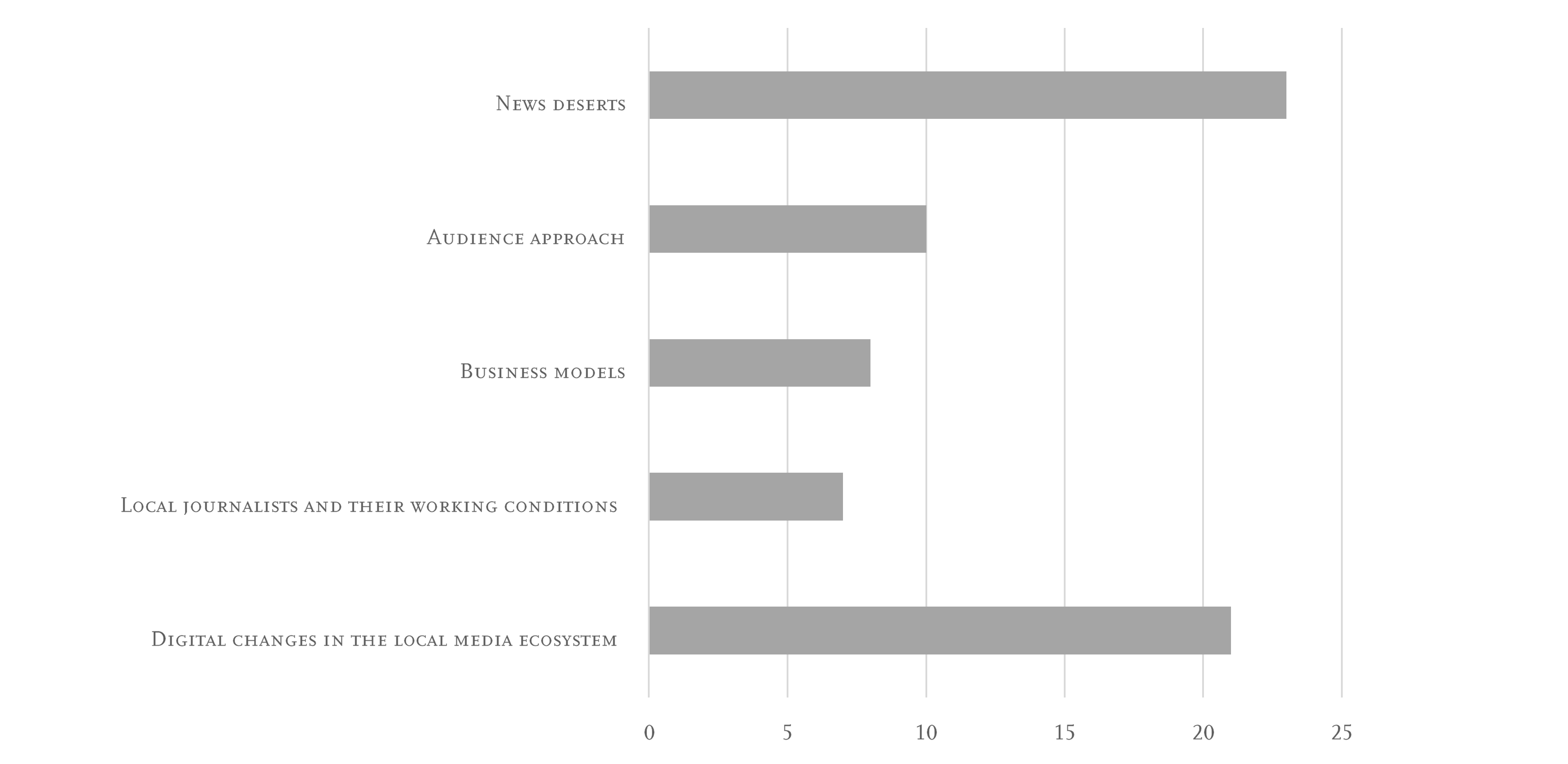
Throughout the sample, five different thematic patterns were identified. This investigation is based on the presence of trends in the literature review, which is in line with prior scholarship that has systematically described the characteristics of research when dealing with some kind of local media (Negreira-Rey & López-García, 2021). According to this review, the thematic patterns are as follows: digital changes in the local media ecosystem, local journalists and their working conditions, business models, audience approach, and social mission and informational gap (“news deserts”). Figure 1 illustrates the frequency of thematic patterns of publication.
7.1. Digital Changes in the Local Media Ecosystem
In recent years, the business of local news has gone through profound changes due to the digital transformation. Social media platforms became an arena for mass communication; meanwhile, new media models emerged on the internet, such as hyperlocal media (Carson et al., 2016). All these changes were analyzed in 21 articles, whose contribution trends are presented below.
First, there is a concern about how the digital wave implies the decline of traditional newspapers (Wood, 2016), but most research items focused on the possibilities allowed by this transformation. Start-ups are identified as the fastest-growing type of news organization (Brouwers, 2018), with hyperlocal media entrepreneurs being one of the primary examples (Hujanen et al., 2021; Stúr et al., 2018). According to qualitative research on this topic, these journalists assess their role as essential for the community since they provide digital information on typically forgotten places (Stúr et al., 2018).
Furthermore, digital technologies are evaluated as an innovation that can reshape the relationship with the public. Specifically, Hess and Waller (2020) develop a framework to understand innovation in rural news organizations. By better connecting with the interests of the population, technologies can enhance the viability of local media outlets.
Another research trend is the study of the adaptation of legacy media to the digital environment (Galletero Campos & Jerónimo, 2019). The adoption of these practices is sometimes slow, but different technologies have entered newsrooms, ranging from geolocation (Santos Gonçalves et al., 2021) to online broadcasting (Jorge & Brito Batista, 2021). Social media platforms have also been considered, but there are ambivalent findings on their capacity to serve as journalistic sources for local newspapers, which can depend on geographical factors (Skogerbø & Krumsvik, 2015).
Following the above, the benefits of technology to journalists’ work should not be taken for granted. A significant study on digital practices of small market newspapers shows how the involved actors have different levels of experience and proximity to citizens (Ali et al., 2019). Hence, the possibilities enabled by the digital wave are not the same for all local media outlets.
This led us to reflect on the tension between digital technologies as an innovation that made the public closer to newsrooms and the erosion of local news outlets due to economic pressures. As stated, the public presents different affordances towards technology. Some communities can be particularly affected, which requires an effort from scholars to understand their characteristics.
7.2. Local Journalists and Their Working Conditions
The changes in the media ecosystem have altered the working conditions of local journalists, which is assessed by some of them as the end of a proper career in local journalism (Morton et al., 2019). Nevertheless, only seven articles within the sample deal with this matter.
Digital technologies generate particular working conditions. Specifically, time pressures of online communication impact the material conditions of journalists’ work (Metyková & Waschková Císařová, 2020). The spaces of their activities are reshaped, contributing to a loss of workplace autonomy. This pessimistic approach is followed by other exploratory papers that use ethnographic views to examine these transformations, such as Wenzel (2020) or Mathews (2022).
Despite digital changes, Jerónimo, Correia, and Gradim (2022) reveal that the actions of local journalists are not as close to the public as expected. Additionally, there is a remarkable job loss in rural and regional communities, to the point that journalists are highly concerned about the quality of the news or the resources of local newsrooms (Zion et al., 2016). Regarding online local media outlets, Splendore (2020) aimed at the dominance of institutional sources, illustrating not only their massive presence, but also some pluralization of the digital news production through non-elite sources.
The opinion of stakeholders is also considered (Firmstone, 2016). Drawing upon in-depth interviews, Firmstone (2016) shows a fragmentation of local journalism, whose normative roles are now developed by many different news providers. However, there is a gap in the literature since little research has addressed the views of these stakeholders or the perceptions of journalists in terms of material conditions and their service to the community. This is relevant since the normative ideals of local journalism as a cornerstone of democracy may collide with real working conditions.
7.3. Business Models
The financing of local news media is usually precarious (Deuze & Witschge, 2020), fostering the need to secure a sustainable business model. On this matter, the eight articles on business models assessed the social value of local news items as crucial when deciding to pay for the news. For instance, Kim et al. (2022) outline the importance of triggering regularity of online news consumption to provide value in topics such as sport. Meanwhile, the willingness to pay is also linked to the nature of stories as they are not available elsewhere (Goyanes, 2015). The relationship between the perceived value of local news and the decision to pay for it was also studied by Olsen (2020).
Moreover, paywall strategies are identified as the primary way for monetization method, but scant research really explores the functioning of this subscription revenue at the local level, compared to huge scholarships on larger national outlets. A qualitative article on local Norwegian newspapers suggested that paywalls are a strategy that targets existing readers, providing differentiated products (Olsen & Solvoll, 2018), but general conclusions cannot be derived from a single study.
Other papers have examined business models from the perspective of innovation. New content strategies, such as multimedia formats, may overlap with payment models to draw a strategy path that generates interest in the public (Wilczek et al., 2021). For its part, Jenkins and Graves (2022) focus on local collaborations. A qualitative case-study is once again applied here to know the types of collaborative practices that define local news, which has been little considered by the literature in relation to competitive positions.
According to the analyzed publications, it is clear that business models are under profound change. Compared to the permanence of standards and practices, Harnischmacher (2015) highlights that the organizational framework of local news media is especially affected by digital transformation. Local outlets seek to ensure their survival through subscription revenues that could link to new content strategies. We found that much research remains anchored in legacy media business models, while insufficient attention is given to the diverse forms local journalism now takes. This limits theoretical development and often leads to a fragmented understanding of what constitutes local journalism.
7.4. Audience Approach
To our knowledge, the local media ecologies are more likely to be audience-oriented since journalists and citizens coexist in the same space. Digital technologies could also be used to enable participatory relationships, which led to 10 articles examining audience perspectives. This support of the public would be key to maintaining the social and economic sustainability of news media.
Based on survey data from the public and local journalists, Nettlefold and Pecl (2022) show how to expand audiences and enhance trust. This sort of audience-led local journalism provides interesting news items that build trust, thanks to high levels of transparency (Nettlefold, 2019). Following this pattern, another survey reveals that the probability of supporting a local news media outlet depends on the presence of community-oriented values such as the feeling of belonging (Park et al., 2022). Likewise, longitudinal research in the Netherlands suggests that specific local topics and approaches shape a “valuable journalism”, boosting an insightful news experience (Costera Meijer, 2020). Therefore, news consumption, and even willingness to pay for local news are determined by this ability to publish relevant issues for the audience.
Regarding the portrait of local news audiences, some qualitative studies have tried to shed light on the characteristics of the local news public. Drawing upon focus groups across communities, McCollough et al. (2017) identified the local individual in the United States as a self-reliant news consumer who still resorts to interpersonal networks. However, there is a lack of citizen journalism. The approach developed by the authors mentioned above means going beyond the impact of technology on local journalism, offering findings on practices and beliefs.
In addition, prior scholarship overlaps with the concept of “participation”. The meaning of “participation” is plural and defined nowadays by social media. An early qualitative study on these platforms shows that the participation allowed by social media did not renew the role of journalists (Carlsson & Nilsson, 2016). The media interviewed professionals point out that social media can include audiences, but they are also evaluated as a threat to the sector.
Literature acknowledges a complex relationship between news media and digital platforms (social media). These contradictions underscore the need for more nuanced research. Nevertheless, Nygren (2019) demonstrated through surveys in Sweden how growing hyperlocal media managed to expand their impact by using Facebook. Although hyperlocal outlets do not have a central position in local media ecologies, they can meet audiences on social media.
7.5. Social Mission and Informational Gap (“News Deserts”)
In a context of wide availability of media, literature pays special attention to the social mission of local media and the emergence of “news deserts”, understood as places whose lifestyles are not addressed by specific media. A total of 23 articles deal with the relationship between this community-oriented mission and the informational gap of “news deserts”, following a theme detected by recent literature reviews (Negreira-Rey & López-García, 2021).
As stated, the role of local outlets has to do with serving the community. In this sense, there are conceptual studies that use qualitative fieldwork to define local journalists as “community caretakers”, who defend the area’s reputation and protect local officials (Mathews, 2022). This corporatism contrasts with the watchdog role. The function of monitoring the power (watchdog) was predominant during the 20th century, but now it is in decline, endangering the democratic accountability of local and regional governments (Clark, 2021).
Linked to the disruption of this social mission, a content analysis carried out on newspapers from German cities (Leupold et al., 2018) noted that the social cohesion provided by local media differs depending on the type of newspaper. This cohesion means that readers feel part of the same community, which is less present in tabloids. Local news provision was also addressed by authors such as Napoli et al. (2018), who employed the media outlet’s homepage as an indicator of its quality. This analytical tool tries to identify the structural factors that correlate with robust local journalism, but this approach was little considered until 2022.
Another outstanding concept developed by literature is “social capital”. Through a pilot study in Australia and Canada, Richards (2013) conceptualizes “social capital” as the result of the connectivity facilitated by local media. Journalists and citizens are embedded in a close relationship in which reliability is key, generating cooperation to improve the future of communities.
Beyond the features that compose the social mission of local journalism, the lack of local media outlets would mean that this service is not fulfilled. There is a growing concern about this matter, especially in the United States, where the concept of “news deserts” arises. Napoli et al. (2019) developed a method to quantify these “news deserts”, categorized as communities with limited access to journalistic information that covers their areas. This problem entails various dimensions, ranging from infrastructure to the availability of journalistic sources or the number of news stories.
Since many different territories worldwide are suffering from informational gaps due to the crisis of the traditional local press, several studies have addressed this problem in other contexts, such as Australia or Sweden. For instance, Magasic and Hess (2021) illustrate how local residents in a town in New South Wales (Australia) miss the newspapers that have closed. Their ethnographic study also shows that social media is not enough to fill this news void, particularly regarding community advocacy and the promotion of political engagement.
In Sweden, Karlsson and Rowe (2019) compared the news coverage of municipalities with and without permanent journalists. Results indicate that the absence of journalists leads to less attention being paid to those communities and their institutional actors. The authors widely discuss the implications of the scarce local news media presence. They reflect on the impact of journalistic absence on citizens’ abilities to remain part of the community; meanwhile, hyperlocal journalism can partially fill the news gap.
According to the literature review, the social mission of local journalism is endangered by the closure of newspapers. In times of fierce media competition, scholars are aware of this problem, but they acknowledge the value of original stories that respond to people’s preoccupations. This is still the purpose of proper local news production, even though factors that foster the existence of local journalism are unevenly theorized.
8. Discussion and Conclusions
Local news production is a topic that received increasing attention during the period from 2012 to 2022. Changes in news production are remarkable, particularly regarding digital transformation. Likewise, the value of local journalism for communities is widely appreciated. On this backdrop, this study aimed to offer a systematic literature review on local news production, exploring its distribution and research trends on Web of Science Core Collection and Scopus. Based on the Prisma methodology, our review provides two interrelated contributions that answer the RQs.
First, we deepen our understanding of how local news production research has been conducted, considering journals, geographical contexts, authors’ country of origin, analytical approach, and methods. Academic articles on this topic have increased during that decade, being published in highly recognized journals, especially Journalism and Journalism Practice. However, the journal sample is fragmented since many different publishers are included. Cross-country comparisons are prioritized, with the United States, Australia, and the Nordic nations being the most covered territories. This finding is related to the country’s affiliation or even the geographical origin of the journal.
Additionally, half of the sample was produced by Anglo-Saxon authors, who mostly come from the United States. Beyond that, the publishing on local news production is also frequent in other contexts, such as the Nordic countries and Spain. All these authors tend to develop empirical articles, in which qualitative approaches are dominant, even though other analytical approaches were also detected.
Our second contribution provides evidence on the presence of five thematic patterns in our literature review: digital changes in the local media ecosystem, local journalists and their working conditions, business models, audience approach, and social mission and informational gap (“news deserts”). These topics are interrelated and we could identify some specific characteristics. Papers on digital changes focus on how digitalization is a way forward to innovation, which also means challenges. Journalists’ working conditions refer to the state of the profession, including newsrooms’ routines and the development of a career in journalism.
For its part, some articles address business models as the mechanism for financing local media, which range from paywall strategies to collaboration. Another key concept in research is audience, examining items such as community-orientation or participation. Lastly, there are a large number of articles on “news deserts”. This lack of local news outlets has consequences for democracy that are widely studied, to the point that it is the most frequent thematic pattern, followed by digital changes in the local media ecosystem. Although this systematic review refers to the period 2012-2022, it is possible to advance that research on “news deserts” has continued to grow through 2023 and 2024. It is currently one of the main research topics in local media, especially in Europe, where it has only begun to be studied in recent years (Verza et al., 2024).
All these approaches tackle the transformation of the sector in a certain way, which is a rising trend in the analyzed decade. Likewise, recent literature also acknowledges the value of local news for the community. This links to classic approaches to how proximity journalism is fueled by a lasting commitment to the territory in which media outlets are located (Camponez, 2002). In a context of information overload, local journalism allows citizens to participate in the issues that shape their daily lives (Engan, 2015), whose importance seems to have increased throughout the decade 2012-2022.
The quality of the published articles is assessed as high, not only because they are published in top journals, but also due to the multiple methods employed (content analysis, ethnography, etc.). Specifically, qualitative methods are preferred throughout the sample, analyzing both journalists and the public.
Future research should expand the scope of this study by using bigger samples, for instance, considering additional databases or papers that examine local news in combination with different practices. Other variables could also be explored, such as the role of journalistic cultures. In this vein, journalists are determined by communities’ experiences (Vos & Hanusch, 2024), which could be analyzed at the local level. Furthermore, the rise of artificial intelligence since 2022 poses some challenges, but the impact of artificial intelligence on the local news landscape is still scarce because of media constraints (Gonçalves & Morais, 2024).
In conclusion, there is a significant academic awareness of local news production in the key databases. Within a situation of change in news production, different thematic patterns were found. Some questions to consider include whether this volume of articles will be sustained over time and to what extent this phenomenon is influenced by the current logic of communication studies. Research trends were identified over a decade, revealing a clear focus on wealthy countries. Hence, there appears to be a blind spot regarding the local journalistic coverage of many territories on a global scale.

