




 Inglês (pdf)
 Artigo em XML
 Referências do artigo
 Tradução automática
 Enviar este artigo por email
 Citado por SciELO
  Similares em
SciELO
Similares em
SciELO 
 Permalink

INTRODUCTION
Ensuring adequate nutrition is among the strategic objectives of the United Nations (UN) agenda for global sustainable development (1). For this purpose, the academic community in nutrition (2) and the UN agency dedicated to Food and Agriculture (FAO) (3) emphasize the importance of interactions among all stakeholders in the global food system, such as the industry and university, to narrow the path towards this goal. By "stakeholder," an agent is defined as one who can impact, be impacted, or feel impacted by decisions, activities, or outcomes of a project, program, or portfolio (4).
Creating projects involving the participation of academic researchers and the private sector is key to the exchange of knowledge, innovation, and development in the field of nutrition (3). Successful collaboration in this realm is based on clear common objectives and the creation of a strategic plan that addresses the demands of both parties involved (5). To achieve this, it is necessary to identify and understand the expectations and needs of these stakeholders, aiming to promote appropriate engagement strategies throughout the project's lifecycle (4).
Although university-industry partnerships are highly encouraged and necessary in the field of Nutrition (1-3, 6), there are still barriers to the widespread implementation of collaborative projects. Specific difficulties encountered are related to academic researchers’ perceptions regarding the food industry, such as mistrust of industry interests (2, 7-9).
In order to make significant progress in the research and development in Nutrition, it is crucial to collaborate with the industry as a part of university projects. To improve this collaboration, it is important to learn from past experiences, both successes and failures (3). This means there is a need to analyze the knowledge gained from past situations that have occurred or may occur in a project, so that we can enhance our performance in the future (4).
OBJECTIVES
The present study aimed to identify, analyze, and describe patterns in the experiences of academic researchers involved in collaborative projects with the food industry.
METHODOLOGY
The study was completed in three phases: identifying academic researchers; administering a questionnaire; and conducting a thematic analysis.
Academic researchers
The identification of researchers from nutrition graduate programs in Brazil and Europe (Hungary and Switzerland) was carried out through electronic databases (official university email addresses), taking into consideration the professional network of the primary author. The inclusion criteria were: (i) being a researcher in the field of interest (nutrition) and (ii) having participated in at least one project in collaboration with the food industry.
Questionnaire
The pre-selected sample was invited to participate in the research individually, anonymously, and voluntarily through an email invitation letter. All participants gave their Informed Consent for completing the questionnaire. The semi-structured questionnaire, adapted from Garnweidner-Holme et al. (2021), was used to collect data on stakeholders’ interests, involvement, interdependence, influence, and potential impact in nutrition partnership projects (7). The original questionnaire was adapted, translated into Portuguese (when necessary), and converted into an electronic questionnaire on the Google Forms platform (in English and Portuguese). This study was submitted and approved by the Research Ethics Committee (Brazil) under registration CAAE No. 58653822.3.0000.9927. Data collection occurred from July to September 2022.
Thematic Analysis
The thematic analysis was done using a latent theoretical approach, which involves interpreting and theorizing the identified patterns beyond the raw description of the data. This approach is aligned with a constructive view, which recognizes that the meaning and experience of the participants are socially produced and reproduced, rather than inherent to the individual (10). The data analysis was conducted following Braun and Clark's (2006) six-step method (10). For the creation of the thematic map in English, the author translated responses from the Portuguese questionnaire into English, and in the Portuguese version the opposite was perform.
RESULTS AND DISCUSSION
Population
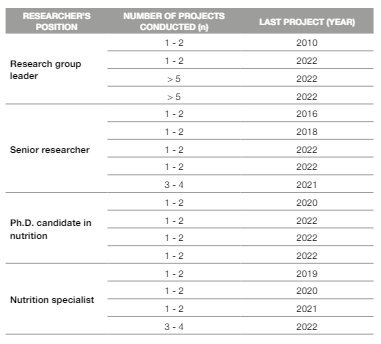
The study involved nutrition academic researchers from four Brazilian universities - the Federal University of Santa Catarina, the Federal University of Paraná, the State University of Rio de Janeiro, and the University of São Paulo - and two European universities, the University of Debrecen (Hungary) and the University of Bern (Switzerland). The sampling method used was convenience sampling, and a total of 17 researchers participated in the survey. Of these, 53% (n=9) were from Brazil, and 47% (n=8) were from Europe. Table 1 describes the characteristics of the respondents, including their appointment at the university, the number of projects they had previously collaborated on with the food industry, and the year of their last project. The respondents held different roles: senior researcher (29.5%, n=5), research group leader (23.5%, n=4), Ph.D. candidates in nutrition (23.5%, n=4), and nutrition specialists (23.5%, n=4).
Thematic map
To prepare for the thematic analysis, the lead researcher conducted a literature review to gain a better understanding of the research topic. This helped to provide a more focused analytical perspective on the actual context of the study population before analyzing their experiences and opinions (11).
After data collection, the lead researcher familiarized herself with the participants' accounts (Stage 1), created initial codes (Stage 2), and identified themes/patterns in the narratives (Stage 3). Subsequently, the thematic map of analysis was structured (Stage 4).
Figure 1 illustrates the extracted codes and perceived themes from the responses of the studied sample. Regarding pros, the following codes were created: 'professional growth,' 'better projects' and 'new products'. Regarding the cons, codes such as 'lack of ethics,' 'lack of credibility,' and 'distinct priorities' were identified.
Themes such as "personal and professional growth", “financial resource for research", and "socioeconomic relevance" were formed from the codes related to the facilitators of this collaboration (Figure 1).
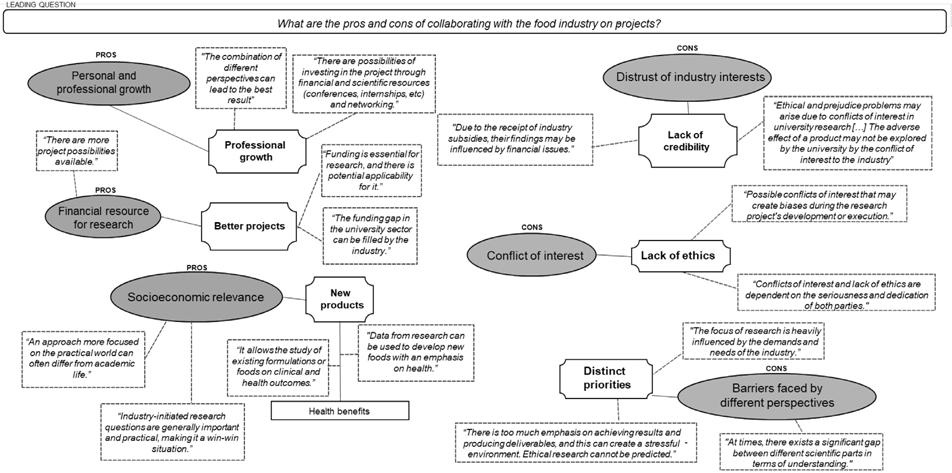
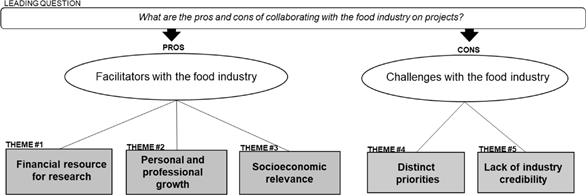
In the realm of challenges, the following themes were established: “Distrust of industry interests", "conflict of interest" and "barriers faced by different perspectives" (Figure 1). Following the refinement of themes and codes generated in the thematic map of analysis (Figure 1), the final thematic map was created (Figure 2) as part of Stage 5.
Figure 2 shows the five themes that emerged from the leading question, with three falling under the "pros" category and two under "cons". "Financial resource for research" (Theme 1), "personal and professional growth" (Theme 2), and "socioeconomic relevance" (Theme 3) were recognized as facilitators of university-industry collaboration, as indicated in Figure 2.
In a pioneering study by Garnweidner-Holme and colleagues (2021), the questionnaire used in the present research was developed (7). The group interviewed senior researchers from universities (n=6) and the food industry (n=6), and identified themes as advantageous/facilitators, such as "Common aims and interests in research activities," "Exchange of knowledge," and "Funding" (7).
In the current study, the investment made by the industry in research projects with the university was reported as advantageous, represented by Theme 1 "financial resource for research." Similarly, the literature suggests that university researchers have a clear understanding of the industry's contribution to research project viability in terms of investment, a positive and recognized aspect of this collaboration (5, 7).
Among the other themes related to advantages, "Exchange of knowledge" from Garnweidner-Holme et al. (2021) was linked to Theme 2 "personal and professional growth" in this study. Participants indicated that this self-declared "growth" was facilitated by the knowledge exchange between the university and industry (7). For this reason, academic researchers in Nutrition (2) and FAO (2018) (3) proposed greater collaboration among different stakeholders in the global food system to promote the interaction of complementary expertise in the food chain and provide projects with sustainable outcomes for the sector and society.
Academic researchers also identified Theme 3 "socioeconomic relevance" as an advantage. According to their accounts, this benefit stems from the importance of generating impactful and practical results for society, aiming to add value to the market and the population, such as by creating innovative and healthy products.This is aligned with what is expected from these projects, that is, the generation of market value along with sustainable benefits for society (3).
The theme "Common aims and interests in research activities" from Garnweidner-Holme et al. (2021) was not found in this study in the "pros" category (7). However, its antagonist was identified in Theme 4 "distinct priorities" in the challenges domain. This divergence of perspectives may be related to the type of population under study.
Garnweidner-Holme et al. (2021) investigated researchers with greater hierarchy within the university and industry (7), a population commonly in project leadership roles, responsible for planning and managing the project. They ensure a clear understanding of all stakeholders in the project's objectives, schedule, deliverables, and especially the responsibilities of each party involved (4). In the present study, 47% (n=8) of the population holds lower positions within the university (students and specialists), whose understanding of the role of the food industry in this partnership (objectives, deliverables, demands, etc.) may not be as clarified compared to project leadership.
Another finding that supports this hypothesis is that "Collaboration agreements (specially to determine the ownership of results)" was listed as an advantage point in collaboration projects by Garnweidner- Holme et al. (2021) (7). This confirms a bias from the perspective of a project leader, as they are responsible for regulatory and legal matters (4). Efficient communication during project execution is the project leader's responsibility, who needs to be attentive to the demands of stakeholders and guide the team regarding the specifics of the collaboration throughout the project's life (4).
Finally, Theme 5 "lack of industry credibility" was identified as a disadvantage in the university-industry partnership among the interviewed academic researchers. Despite this, all participants reported the absence of any ethical issues with the food industry. For this reason, "conflict of interest" (Figure 1) was removed from the final thematic map (Figure 2), as it was a bias linked to Theme 5 " lack of industry credibility", rather than an experienced fact.
The results of the current study are in agreement with those of Garnweidner-Holme et al. (2021), where the theme "Prejudice towards the food industry" was classified as a barrier to this collaboration (7). These results also align with the literature, where one of the main barriers in the university-industry axis is the mental barrier due to academic researchers' lack of trust in the industry. It is necessary to establish clarity from the beginning about the role of each project party to build the necessary trust (2, 5, 7-9). This can be explained by the fact that the industry and the university differ in their intrinsic values, i.e., what they consider valuable or important. While the university prioritizes knowledge generation, the industry aims to profit to ensure its survival in the market, coupled with future investments (12).
The study presented significant limitations, and therefore, the results should be interpreted with caution and not extrapolated due to the convenience sampling of countries with different realities and a small number of participants. Another aspect of attention is the bias related to data interpretation by the lead researcher, a Ph.D. candidate in nutrition. However, efforts were made to minimize this bias by familiarizing her with the overall context of the literature on the subject before data analysis. On the other hand, this study is pioneering in reusing and adapting the questionnaire from Garnweidner-Holme et al. (2021) (7) for thematic analysis and is the first to apply it in Portuguese.
CONCLUSIONS
This study identified and analyzed patterns in the perspectives and experiences of academic researchers in Nutrition regarding collaboration in projects with the food industry. Distinct priorities and a lack of credibility in the food industry were the main reported barriers to this partnership.

