

SciELO - Scientific Electronic Library Online

 
 número36CARATERIZAÇÃO E ANÁLISE DA LITERACIA EM SAÚDE E ADESÃO AO PADRÃO ALIMENTAR MEDITERRÂNICO EM ALUNOS DE UNIVERSIDADES SÉNIORESEFICÁCIA DE INTERVENÇÕES DIETÉTICAS E NUTRICIONAIS NA DIABETES GESTACIONAL - REVISÃO SISTEMÁTICA índice de autoresíndice de assuntosPesquisa de artigos
Home Pagelista alfabética de periódicos  

Serviços Personalizados

Journal

Artigo

Indicadores

Links relacionados

  • Não possue artigos similaresSimilares em SciELO

Compartilhar


Acta Portuguesa de Nutrição

versão On-line ISSN 2183-5985

Acta Port Nutr  no.36 Porto mar. 2024  Epub 04-Out-2024

https://doi.org/10.21011/apn.2024.3606 

Artigo Original

LIFESTYLE IN PEOPLE LIVING WITH HUMAN IMMUNODEFICIENCY VIRUS: A 5 YEAR FOLLOW-UP STUDY

ESTILO DE VIDA EM INDIVÍDUOS COM O VÍRUS DA IMUNODEFICIÊNCIA HUMANA: 5 ANOS DE FOLLOW-UP

1 Faculdade de Medicina da Universidade de Lisboa em associação com a Escola Superior de Tecnologia da Saúde de Lisboa, Avenida Professor Egas Moniz, 1649-028, Lisboa, Portugal

2 Laboratório de Nutrição, Faculdade de Medicina da Universidade de Lisboa, Avenida Professor Egas Moniz, 1649-028, Lisboa, Portugal


ABSTRACT

INTRODUCTION: Antiretroviral therapy and the appearance of comorbidities in people living with human immunodeficiency virus contribute to an increased cardiovascular risk.

OBJECTIVES: Assess the evolution of nutritional status, cardiovascular risk and mediterranean diet and physical activity level in a cohort of infected patients. METHODOLOGY: This is a longitudinal observational study based on a cohort previously evaluated and who maintained regular follow-up. Patients were reassessed after 5 years on anthropometric parameters, dietary intake (food frequency questionnaire, MedDietScore), cardiovascular risk (DAD Risk Tool). Physical Activity data was only obtained in the 5th year (International Physical Activity Questionnaire).

RESULTS: The sample had an average age of 52.0±9.3years, were mostly male with a mean HIV infection time of 17.9±6.9 years. There was a percentual increase regarding baseline of 2% in type 2 diabetes, 11.4% in dyslipidemia, 0.7% in hypertension and 12.5% in metabolic syndrome. After 5 years, mediterranean diet adherence was higher (28.9±5.2 vs. 27.9±5.7); caloric intake was lower (1781±622 vs. 2173±432); 77.6% had a moderate Physical Activity level and a daily sedentary behavior of 244.4±173.9 minutes; 54.7% had a very high 5 year-CVR.

CONCLUSIONS: Aging and the presence of comorbidities are a concern. Lifestyle interventions must be part of the management of the disease.

KEYWORDS: Aging; Dietary pattern; Human Immunodeficiency Virus; Mediterranean diet; Nutritional status; Physical activity

RESUMO

INTRODUÇÃO: A terapêutica antiretrovírica e o aparecimento de comorbilidades em pessoas que vivem com o Vírus da Imunodeficiência Humana têm contribuído para um aumento do seu risco cardiovascular.

OBJETIVOS: Determinar a evolução da adesão à dieta mediterrânica, padrão alimentar e risco cardiovascular em 5 anos de follow-up e avaliar o nível de atividade física.

METODOLOGIA: Estudo longitudinal observacional baseado numa coorte com seguimento regular. A recolha de dados foi efetuada durante 6 meses. A amostra final de 149 pessoas foi reavaliada a nível de parâmetros antropométricos, ingestão alimentar (questionário de frequência alimentar e MedDietScore), risco cardiovascular (DAD Risk Tool) e atividade física (International Physical Activity Questionnaire).

RESULTADOS: A idade média da amostra era de 52,0±9,3 anos, maioritariamente constituída por homens e com um tempo médio de infeção de 17,9±6,9 anos. Verificou-se um aumento percentual de 2% na diabetes mellitus tipo 2, 11,4% na dislipidémia, 0,7% na hipertensão e 12,5% na síndrome metabólica, face à avaliação inicial. A adesão à dieta mediterrânica apresentou um aumento (28,9±5,2 vs. 27,9±5,7); a ingestão calórica foi inferior (1781±622 vs. 2173±432); 77,6% apresentou um nível de atividade física moderado e um comportamento sedentário diário de 244,4±173,9 minutos; 54,7% apresentava um risco cardiovascular a 5 anos muito elevado.

CONCLUSÕES: O envelhecimento e o aumento da prevalência de comorbilidades sugerem que modificações no estilo de vida devem fazer parte gestão clínica da doença.

PALAVRAS-CHAVE: Envelhecimento; Padrão alimentar; Vírus da Imunodeficiência Humana; Dieta mediterrânica; Estado nutricional; Atividade física

INTRODUCTION

An increase in life expectancy was observed in human immunodeficiency virus (HIV) infection due to antiretroviral therapy (ARTc) (1, 2). However, the increase in underlying comorbidities, including cardiovascular disease (CVD), contributes to a high cardiovascular risk (CVR) showed to be 1.5 to 2 times higher, compared to non-infected patient (3-7). Adding, 90% of People living with human immunodeficiency virus (PLWHIV) aged 50 years or higher present at least one associated comorbidity and a modelling study suggests that in 2030, more than half of this group will have CVD (8-10). In addressing lifestyle as a prevention of comorbidities, moderate physical activity (PA) is recommended to decrease chronic inflammation, improving the individual’s metabolic health and survival (11,12). Adequate diet is another essential factor to prevent the onset of these complications, as well as contributing to a correct nutritional status (13). European guidelines show that dietary recommendations for PLWHIV are similar to the Mediterranean diet (MD) pattern, which reduces the risk of coronary disease, as proposed by Ancel Keys (14, 15). However, it has been shown that PLWHIV have a higher intake of total and saturated fat and cholesterol, when compared with uninfected people (16). This pattern, combined with a refined carbohydrate-rich diet, is associated with reduced nutritional quality (17).

OBJECTIVES

The purpose of this study is to assess the evolution of nutritional status, CVR and MD adherence and current PA level in a cohort with a mean follow-up of 5 years.

METHODOLOGY

This is a follow-up study from a cohort previously evaluated (18). Patients who maintained regular follow-up and agreed to participate in the reassessment were eligible for participation, resulting in 26% of the previously assessed. Due to the small sample size obtained, the odds of bias selection is high. Pregnant women, patients hospitalized in the last month or those who, after evaluation required hospitalization, were excluded. This study was conducted during a 6-month period. Data on systolic and diastolic blood pressure, lipid profile and glucose were assessed through the clinical process, as previously described (19). Data on diabetes, hypertension and smoking habits were obtained through personal interviews and the first two were confirmed by the clinical file, as previously described (19). Data on incident cardiovascular events and HIV infection was collected through the 5-year follow-up. All patients signed and the local Ethic Health Committee approved this study protocol. Data on weight and fat mass (FM) was obtained using a single-tetrapolar bioimpedance scale (Omron Body Composition Monitor BF511) (20, 21). FM was classified according to Gallagher and collaborators classification (22). Body mass index (BMI) was obtained taking into account the classification of the World Health Organization (23). Increased waist circumference (WC) was considered when the female sex had a WC≥80 cm and the male sex had a WC≥94 cm (24). Presence of metabolic syndrome (MS) was assessed based on Alberti and collaborators criteria (24). The presence of lipodystrophy was classified as previously (25, 26). A food frequency questionnaire and the MedDietScore were applied to assess food intake and adherence to the MD (baseline and 5th year) (27, 28). The long version of International Physical Activity Questionnaire - IPAQ was applied to assess the level of PA in the study population (5th year) (29). The CVR was assessed through DAD Risk Equation, developed specifically for PLWHIV (30). The data were analyzed both analytically and graphically using simple and comparative exploratory methods, including whisker plots, bar graphs, histograms, scatter diagrams, and calculations of minimum, maximum, mean, standard deviation, asymmetry coefficient, median, and quartiles, in relation to the variables and objectives presented in the study. Categorical variables were expressed as absolute number (percentage) and metric variables as mean ± standard deviation (minimum-maximum), when there was no significant asymmetry. The inferential analysis was based on the chi-square test for independent or homogeneous hypotheses involving the crossing of two categorical variables. To test the conditions of application of the Student T-test and one-way ANOVA and to compare mean values the normality tests were applied, Kolmogorof, with Lilliefors correction for n≥50, or Shapiro Wilks for n<50. Levene's equality of variance test was applied with a significance level of 5%. Bonferroni correction was applied to adjust multiple comparisons. In the event that the variables did not respect a normal distribution or violate the test applicability principles, nonparametric alternatives were used. For this study a significance level of 5% was used. All data were statistically analyzed using SPSS® software (IBM, version 26).

RESULTS

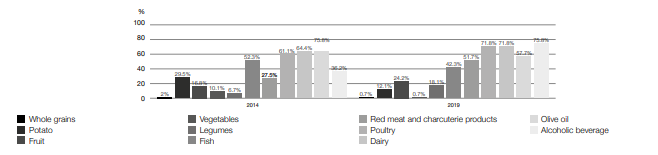
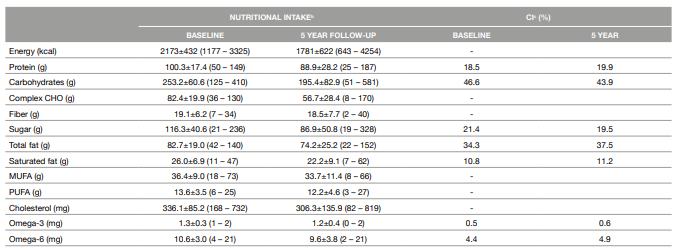
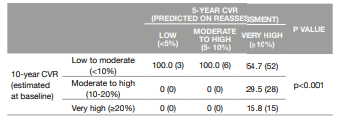
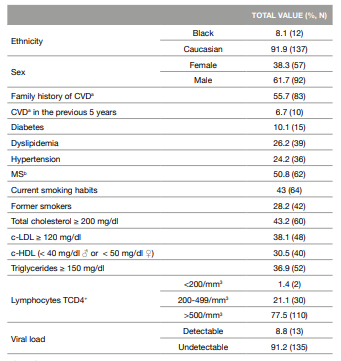
Patients who were submitted to a new nutritional evaluation (n=149) were mostly male Caucasian (61.7%; n = 92; 91.9%; n = 137, respectively) with a mean age of 52.0±9.3 years (Table 1). Regarding the occurrence of CVD there were cases of stroke (n=2), ischemic heart disease (n=2) and acute myocardial infarction (n=2). Patients were infected with HIV for 17.9±6.9 years, and more than half were under ARTc with mean exposure time of 15.8±6.6 years. There was a significant association between CVD and hypertension (p=0.018). Average BMI was 24.8±5.2 kg/m2, WC in female patients was 86.1±13.7 cm and in male patients was 95.2±13.8 cm. Compared with baseline there was a percentual increase in the pre-obesity category and increased WC prevalence (Table 2). Most patients did not present lipodystrophy (71.4%; n=95). The average score of MD adherence was 28.9±5.2 points, higher compared to baseline (27.9±5.7 points; p=0.026). There was an increase in the intake of fruit, fish, red meat and charcuterie products, poultry, dairy and alcoholic beverages (Figure 1). Adherence to whole grains, vegetables, potatoes, legumes, fruit and fish recommendations was less than 50%. The intake of fruit, dairy, fish and poultry did not show significant differences from baseline (p>0.05). There was no significant correlation between adherence to MD and anthropometric parameters. Patients had an average caloric intake (CI) of 1781±622 kilocalories (Kcal) (Table 3). During follow-up period there was a significant increase in protein (p<0.001), total (p=0.014) and saturated fat (p=0.002) intake. Individuals with hypertension presented a tendency to a reduction in cholesterol intake compared with baseline (p=0.054). The presence of dyslipidemia showed a significant positive association with CI (p=0.013) and total (p=0.012), saturated (p=0.012) and monounsaturated fat (p=0.02). Higher adherence to MD was positively correlated with a higher fiber intake (r=0.384; p<0.001). Regarding PA, more than half of the sample had a moderate level of PA (77.6%; n=111). Participants presented a mean daily sitting time of 244.4±173.9 minutes (about 4 hours/ day). There was no significant correlation between sitting time and anthropometric parameters or between sitting time and the PA level. The c-HDL showed an inverse correlation with sitting time (r=-0.252; p=0.004). The triglyceride levels also showed an inverse correlation with PA level (r=-0.183; p=0.033). Regarding CVR, when the baseline predictions were compared with 5 years, more than half of patients was at a very high CVR although the baseline estimation predicted a moderate to high risk (p<0.001) (Table 4). Correlations were found between the current CVR and weight (r=0.274; p=0.006), BMI (r=0.246; p=0.014), visceral fat (r=0.463; p<0.001) and WC (r=0.391; p<0.001). There was an association between 5-year CVR and MS (p=0.001).

There was no association between 5-year CVR and PA and MD (p>0.05). Through logistic regression it was demonstrated that hypertension was a significant predictor of the onset of CVD (OR 0.067; p=0.029; 95% CI, 0.006-0.755).

Table 1 Global characterization, biochemical data and characterization of HIV infection 
aCVD: Cardiovascular disease

bMS: Metabolic syndrome
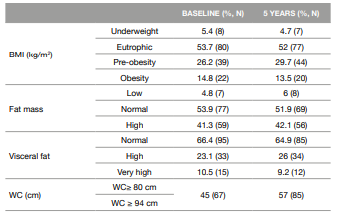
Table 2 Anthropometric data 

BMI: Body Mass Index

WC: Waist circumference

Figure 1 Percentage of individuals complying recommendations of Mediterranean Diet 

Table 3 Daily nutritional intake 

bMean ± standard deviation (min-max)

cCI: Caloric intake

Table 4 Cardiovascular risk 

CVR: Cardiovascular risk

DISCUSSION OF THE RESULTS

This study depicts the longitudinal nutritional status and documents the adherence to MD and PA of PLWHIV, scarcely characterized. Overweight is highly associated with a significant increased risk of developing CVD (31), underlining weight control as a parameter to be taken into account. In this group, 29.7% were overweight, a lower percentage than reported by Nalluga and collaborators (31). An increased WC as shown to be one of the factors that could be associated with an increased risk of CVD (32). Our study revealed a 10% growth in increased WC compared to baseline, higher than previously reported (33). Adherence to the MD showed an average score of 28.9±5.2 points, higher than baseline and previous reports (18, 34). Given that this is a longitudinal study, this group of patients may have increased their adherence due to a higher awareness in the first evaluation. Since the 1960s, adherence to MD pattern has been decreasing, with the exponential growth of the food industry and consequent emphasis on the Western Diet (17). Despite the increase adherence to MD compared with baseline, some groups showed an adherence of less than 50% (whole grains, potatoes, fruit, vegetables and legumes) suggesting an agreement with the Western pattern. The current average CI was 1781±622 Kcal/day, a lower value than demonstrated at baseline and by Hendricks and colleagues (35). This study also revealed that hypertension is a predictor of CVD as recognized by other studies (36, 37). Regarding dyslipidemia and fat intake, a significant positive association was found with total, saturated and monounsaturated fat. These results are in agreement with other studies, where saturated fat intake is a risk factor for the development of this comorbidity and monounsaturated and polyunsaturated fat are protective (38). Also, the significant positive association between dyslipidemia and CI is confirmed by a study of Nouri and colleagues, where the group with the higher ingestion of ultra-processed foods (3091.63±1275.98 kcal) had a higher lipid profile (39). More than half of the sample presented a moderate level of PA, in line with a systematic review where 50.7% reached the guidelines that recommend the practice of moderate PA (40). Since this group was aware of its CVR, it might have been one possible reason to explain this behavior (41). Patients spent a mean of four hours a day in sedentary behavior, a lower value than previously reported (42). The c-HDL showed an inverse correlation with sedentary behavior and triglycerides levels showed an inverse correlation with the PA level. The practice of PA in PLWHIV promotes a reduction in metabolic and CVR factors, improving quality of life (42). Regarding CVR, there was a severe deterioration in most of the individuals. This may be due to the tool calibration, with the addition of TCD4+ lymphocyte count parameter and the elimination of ART exposure (30, 43). Positive correlations were found between CVR and some anthropometric parameters, showing agreement with a recent study, that found an increase in CVR and also in WC and BMI (44). Current CVR and MD had no association. However, studies demonstrated that higher adherence to MD can trigger significant changes in the metabolome, directly related to cardiovascular and metabolic health (45). The disagreement between our results and Li study may be due to the small sample evaluated and to the different tool used to assess adherence to MD. Also, CVR and PA had no association, contrary to what has been shown in a study where moderate to vigorous PA is associated with a better cardiovascular health (46). However, 73.8% of this sample who was at very high CVR showed a moderate PA level, probably due to a recognition of their health and consequent change in behavior to a better health. This study has some limitations. The food frequency questionnaire used in this study refers to last year’s food consumption and requires memory for its complete filling. Also, overweight and obese patients tend to lack precision in measuring self-reported energy consumption (47). Regarding IPAQ, it has been shown that overestimation of the questionnaire’s self-completion in PLWHIV may occur (42). Furthermore, there is a wide variety of tools to assess adherence to PA and it is essential to reach a consensus about its use in PLWHIV (45).

CONCLUSIONS

Due to the comorbidities present in PLWHIV and verified in this group, acting on the modifiable risk factors becomes one of the most important aspects to reduce or prevent their appearance. Although it appears that they are already sensitized to some changes in lifestyle, there are still categories of MD that show low adherence. Therefore, it is essential to reinforce adherence to this dietary pattern and PA.

CONFLICTS OF INTEREST

None of the authors reported a conflict of interest.

AUTHORS’ CONTRIBUTIONS

SP: Designed the study, collected, prepared and conducted analyses of the data in 2014. Also conducted analyses of the data in 2019; APC: Collected the data in 2019 and wrote this manuscript with contributions of SP. Both SP and APC prepared the data in 2023.

REFERENCES

1. Yang H, Beymer MR, Suen S. Chronic Disease Onset Among People Living with HIV and AIDS in a Large Private Insurance Claims Dataset. Sci Rep [Internet]. 2019;1-8. Available from: http://dx.doi.org/10.1038/s41598-019-54969-3. [ Links ]

2. Berenson B, Baillargeon JG, Kuo Y. Assessing comorbidities and survival in HIVinfected and uninfected matched Medicare enrollees. 2022;35(10):1667-1675. [ Links ]

3. Lazzarettti RK, Kuhmmer R, Sprinz E, Polanczyk CA, Ribeiro JP. Dietary Intervention Prevents Dyslipidemia Associated With Highly Active Antiretroviral Therapy in Human Immunodeficiency Virus Type 1 - Infected Individuals. JACC. 2012;59(11):979-988. [ Links ]

4. Loonam CR, Mullen A. Nutrition and the HIV-associated lipodystrophy syndrome. Nutr Res Rev. 2012 Dec 23;25(2):267-287. [ Links ]

5. Zicari S, Sessa L, Cotugno N, Ruggiero A, Morrocchi E, Concato C, et al. Immune Activation, Inflammation, and Non-AIDS Co-Morbidities in HIV-Infected Patients under Long-Term ART. Viruses. 2019 Feb 27;11(3):200. [ Links ]

6. Nguyen KA, Peer N, Mills EJ, Kengne AP. A Meta-Analysis of the Metabolic Syndrome Prevalence in the Global HIV-Infected Population. Menéndez-Arias L, editor. PLoS One. 2016 Mar 23;11(3). [ Links ]

7. Achhra AC, Lyass A, Borowsky L, Bogorodskaya M, Plutzky J, Massaro JM, et al. Assessing Cardiovascular Risk in People Living with HIV: Current Tools and Limitations. 2022;18(4):271-279. [ Links ]

8. Erlandson KM, Campus AM, Karris MY, Diego S. HIV and Aging: Reconsidering the Approach to Management of Co-Morbidities. Infect Dis Clin North Am. 2020;33(3):769-786. [ Links ]

9. Wing EJ. HIV and aging. 2016;53:61-8. [ Links ]

10. Smit M, Brinkman K, Geerlings S, Smit C, Thyagarajan K, Sighem A Van, et al. Future challenges for clinical care of an ageing population infected with HIV : a modelling study. Lancet Infect Dis [Internet]. 2015;15(7):810-818. Available from: http://dx.doi. org/10.1016/S1473-3099(15)00056-0. [ Links ]

11. Chuong P, Wysoczynski M, Hellmann J. Do Changes in Innate Immunity Underlie the Cardiovascular Benefits of Exercise? Front Cardiovasc Med. 2019 May 29;6(May):1-7. [ Links ]

12. Pinckard K, Baskin KK, Stanford KI. Effects of Exercise to Improve Cardiovascular Health. Front Cardiovasc Med. 2019 Jun 4;6(June):1-12. [ Links ]

13. Martín-Cañavate R, Sonego M, Sagrado MJ, Escobar G, Rivas E, Ayala S, et al. Dietary patterns and nutritional status of HIV-infected children and adolescents in El Salvador: A cross-sectional study. PLoS One. 2018;13(5):1-14. [ Links ]

14. European AIDS Clinical Society (EACS). Linhas Orientadoras. 2017;0-101. [ Links ]

15. Davis C, Bryan J, Hodgson J, Murphy K. Definition of the Mediterranean Diet: A Literature Review. Nutrients. 2015 Nov 5;7(11):9139-9153. [ Links ]

16. Marzel A, Kouyos RD, Reinschmidt S, Balzer K, Garon F, Spitaleri M, et al. Dietary Patterns and Physical Activity Correlate With Total Cholesterol Independently of Lipid-Lowering Drugs and Antiretroviral Therapy in Aging People Living With Human Immunodeficiency Virus. Open Forum Infect Dis. 2018 Apr 1;5(4):1-8. [ Links ]

17. D’Innocenzo S, Biagi C, Lanari M. Obesity and the Mediterranean Diet: A Review of Evidence of the Role and Sustainability of the Mediterranean Diet. Nutrients. 2019 Jun 9;11(6):1306. [ Links ]

18. Policarpo S, Rodrigues T, Moreira AC, Valadas E. Adherence to Mediterranean diet in HIV infected patients: Relation with nutritional status and cardiovascular risk. Clin Nutr ESPEN. 2017 Apr;18:31-36. [ Links ]

19. Policarpo S, Rodrigues T, Catarina A, Valadas E. Cardiovascular risk in HIV-infected individuals : A comparison of three risk prediction algorithms. Rev Port Cardiol [Internet]. 2019;38(7):463-470. Available from: https://doi.org/10.1016/j.repc.2019.08.002 [ Links ]

20. Omron. Monitor de composição corporal - Manual de Instruções. 2011;18. [ Links ]

21. Gerrior J, Neff L. Nutrition assessment in HIV infection. Nutrition in clinical care : an official publication of Tufts University. 2005;8(1):6-15. [ Links ]

22. Gallagher D, Heymsfield SB, Heo M, Jebb SA, Murgatroyd PR, Sakamoto Y. Healthy percentage body fat ranges : an approach for developing guidelines based on body mass index 1 - 3. 2000;694-701. [ Links ]

23. World Health Organization. WHO Technical Report Series - Physical Status: The use and interpretation of Anthropometry. 1995. [ Links ]

24. Alberti KG, Eckel RH, Grundy SM, Zimmet PZ, Cleeman JI, Donato KA, et al. Harmonizing the Metabolic Syndrome: A Joint Interim Statement of the International Diabetes Federation Task Force on Epidemiology and Prevention; National Heart, Lung, and Blood Institute; American Heart Association; World Heart Federation; International. 2009;1640-5. [ Links ]

25. Jacobson DL, Knox T, Spiegelman D, Skinner S, Gorbach S, Wanke C. Prevalence of, Evolution of, and Risk Factors for Fat Atrophy and Fat Deposition in a Cohort of HIV-Infected Men and Women. Clin Infect Dis. 2005 Jun 15;40(12):1837-1845. [ Links ]

26. Gerrior J, Kantaros J, Coakley E, Albrecht M, Wanke C. The Fat Redistribution Syndrome in Patients Infected with HIV. J Am Diet Assoc. 2001 Oct;101(10):1175-1180. [ Links ]

27. Lopes C. Reprodutibilidade e Validação de um questionário semi-quantitativo de frequência alimentar. Alimentação e enfarte agudo do miocárdio: um estudo de casocontrolo de base comunitária. (PhD). 2000;79-115. [ Links ]

28. Panagiotakos DB, Pitsavos C, Arvaniti F, Stefanadis C. Adherence to the Mediterranean food pattern predicts the prevalence of hypertension, hypercholesterolemia, diabetes and obesity, among healthy adults; the accuracy of the MedDietScore. Prev Med (Baltim). 2007 Apr 1;44(4):335-340. [ Links ]

29. Dang AK, Nguyen LH, Nguyen AQ, Tran BX, Tran TT, Latkin CA, et al. Physical activity among HIV-positive patients receiving antiretroviral therapy in Hanoi and Nam Dinh, Vietnam: A cross-sectional study. BMJ Open. 2018;8(5):1-11. [ Links ]

30. Friis-Moller N, Thiebaut R, Reiss P, Weber R, Monforte A, De Wit S, et al. Predicting the risk of cardiovascular disease in HIV-infected patients: the data collection on adverse effects of anti-HIV drugs study. Eur J Cardiovasc Prev Rehabil. 2010;17(5):491-501. [ Links ]

31. Nalugga EA, Laker E, Nabaggala MS, Ddungu A, Batte C, Piloya T, et al. Prevalence of overweight and obesity and associated factors among people living with HIV attending a tertiary care clinic in Uganda. 2022;1-7. [ Links ]

32. Woldu MA, Minzi O, Engidawork E. Dyslipidemia and associated cardiovascular risk factors in HIV-positive and HIV-negative patients visiting ambulatory clinics : A hospital-based study. 2022. [ Links ]

33. Møller SP, Amare H, Christensen DL, Yilma D, Abdissa A, Friis H, et al. HIV and metabolic syndrome in an Ethiopian population. Ann Hum Biol [Internet]. 2020;0(0):1-8. Available from: https://doi.org/10.1080/03014460.2020.1781929 [ Links ]

34. Tsiodras S, Poulia K-A, Yannakoulia M, Chimienti SN, Wadhwa S, Karchmer AW, et al. Adherence to Mediterranean diet is favorably associated with metabolic parameters in HIV-positive patients with the highly active antiretroviral therapy-induced metabolic syndrome and lipodystrophy. Metabolism. 2009 Jun;58(6):854-859. [ Links ]

35. Hendricks KM, Mwamburi DM, Newby P, Wanke CA. Dietary patterns and health and nutrition outcomes in men living with HIV infection. Am J Clin Nutr. 2008 Dec 1;88(6):1584-1592. [ Links ]

36. Collaboration PS. Age-specific relevance of usual blood pressure to vascular mortality : a meta-analysis of individual data for one million adults in 61 prospective studies. 2002;360:1903-1913. [ Links ]

37. Marques da Silva P, Lima MJ, Neves PM, Espiga de Macedo M. Prevalência de fatores de risco cardiovascular e outras comorbilidades em doentes com hipertensão arterial assistidos nos Cuidados de Saúde Primários: estudo Precise. Rev Port Cardiol. 2019 Jun;38(6):427-437. [ Links ]

38. Guastadisegni C, Donfrancesco C, Palmieri L, Grioni S, Krogh V, Vanuzzo D, et al. Nutrients Intake in Individuals with Hypertension, Dyslipidemia, and Diabetes: An Italian Survey. 2020;(Cvd):1-11. [ Links ]

39. Nouri M, Eskandarzadeh S, Makhtoomi M, Dehkordi MR, Omidbeigi N, Najafi M, et al. Association between ultra - processed foods intake with lipid profile : a cross - sectional study. Sci Rep [Internet]. 2023;1-8. Available from: https://doi.org/10.1038/ s41598-023-34451-x [ Links ]

40. Vancampfort D, Mugisha J, De Hert M, Probst M, Firth J, Gorczynski P, et al. Global physical activity levels among people living with HIV: a systematic review and meta-analysis. Disabil Rehabil. 2016;40(4):388-397. [ Links ]

41. Lee KS, Feltner FJ, Bailey AL, Lennie TA, Chung ML, Smalls BL, et al. The relationship between psychological states and health perception in individuals at risk for cardiovascular disease. Psychol Res Behav Manag. 2019 May;Volume 12:317-324. [ Links ]

42. Vancampfort D, Mugisha J, De Hert M, Probst M, Stubbs B. Sedentary Behavior in People Living With HIV: A Systematic Review and Meta-Analysis. J Phys Act Heal. 2017 Jul;14(7):571-577. [ Links ]

43. CHIP - Centre of Excellence for Health, Immunity and Infections [Internet]. Available from: https://chip.dk/Tools-Standards/Clinical-risk-scoresLinks ]

44. Liput-sikora A, Cybulska AM, Fabian W, Kamińska MS. The Severity of Changes in Cardiovascular Risk Factors in Adults Over a Five-Year Interval. 2020;1979-1990. [ Links ]

45. Li J, Guasch-ferre M, Chung W, Ruiz-canela M, Corella D, Bhupathiraju SN, et al. The Mediterranean diet , plasma metabolome , and cardiovascular disease risk. 2020;2645-2656. [ Links ]

46. German C, Makarem N, Fanning J, Redline S, Elfassy T, McClain A, et al. Sleep, Sedentary Behavior, Physical Activity, and Cardiovascular Health: MESA. 2022;53(4):724-731. [ Links ]

47. Westerterp KR. Exercise, energy balance and body composition. Eur J Clin Nutr. 2018 Sep 5;72(9):1246-1250. [ Links ]

Received: March 20, 2023; Accepted: March 31, 2024

*Endereço para correspondência: Sara Policarpo Laboratório de Nutrição, Faculdade de Medicina da Universidade de Lisboa, Avenida Professor Egas Moniz, 1649-028, Lisboa, Portugal saraopolicarpo@gmail.com

Creative Commons License This is an open-access article distributed under the terms of the Creative Commons Attribution License