




 Inglês (pdf)
 Artigo em XML
 Referências do artigo
 Tradução automática
 Enviar este artigo por email
 Citado por SciELO
  Similares em
SciELO
Similares em
SciELO 
 Permalink

INTRODUCTION
The Food and Agriculture Organization (FAO) defines sustainable diets as eating patterns that support health and well-being while staying within the limits of nature's ability to renew resources for both present and future generations (1). It's important to note that animal-based foods generally have a greater environmental impact per calorie or gram produced compared to plant-based foods (2). This means that shifting towards diets prioritizing plant protein over excessive animal protein is essential for reducing environmental strain (3).
Legume grains have gained prominence in sustainable diets due to their low environmental impact as a protein source. By substituting animal protein with legume grains, we can alleviate pressure on natural resources like land and water while reducing greenhouse gas emissions (GHG) associated with livestock farming (4). However, despite their significant role in sustainability, legume grain consumption remains low in most European diets (5). Data from the Portuguese Food Balance Sheet (PFBS) indicate that legume grain consumption is nearly six times below the recommended daily intake of 80 grams of cooked legumes (6, 7). The average legume grain consumption among Portuguese children is about 5g daily, only 6% of the recommended amount (7, 8). Given the environmental benefits of legume grains and the discrepancy in consumption rates, promoting their consumption among Portuguese children is crucial.
One promising approach for legume grains promotion is to modify school food environments to ensure physical, financial, political, and sociocultural access to healthy and sustainable foods (1, 9, 10). School meal programs provide a special opportunity to encourage healthy and sustainable eating habits because they foster strong social interactions and serve a large audience, including students, school staff, families, and community members (9, 10). In this regard, Portugal has implemented a legislative framework governing food provision in schools, dictating which foods are promoted or offered within the school environment (10). For instance, a law passed in 2017 mandates including a daily vegetarian (specifically, vegan) option in the public canteen (11), which should make legume grains the primary protein source in these menus (12). However, studies indicate the consumption of legume grains among Portuguese preschools has remained low (13, 14).
The promotion of healthy and sustainable foods like legume grains should be a priority in nurseries and kindergartens since it is during the early years (3-6 years) that children begin to develop their taste preferences (15) and are highly receptive to behavioral influences in groups (16). Early childhood teachers are responsible for ensuring school that meals are a learning opportunity (9). Since teachers are fundamental players in food literacy and the formation of healthy habits, it is essential to know their perceptions about the consumption of legume grains at preschools and what strategies, in their opinion, can promote this food. This information may offer clues that guide actions to encourage the consumption of legume grains in Portuguese kindergartens.
OBJECTIVES
The objective of this study was to investigate the perceptions of early childhood teachers on legume grain consumption among a convenience sample of Portuguese kindergartens and explore the factors influencing this consumption behavior. Additionally, the research aimed to identify barriers or facilitators to legume grain consumption within the kindergarten environment, including menu options, peer influences, and parental attitudes. Ultimately, the findings aimed to provide insights that could inform strategies for promoting healthier and more sustainable dietary habits among young children in Portugal.
METHODOLOGY
Research Design
The study was preliminary participatory research in which researchers and participants discussed solutions to the problems presented. This approach is theoretically supported by the dialectical historical structural perspective, whose main objective is transforming the reality studied (17).
A convenience sample of nine early childhood teachers from the research team's network was invited by phone and email to participate in the study and encouraged to extend the invitation to their colleagues. After this invitation, ten educators interested in participating in the study contacted the research team. All communication regarding the study, including its purpose and participation guidelines, was conducted via email. To be eligible, participants had to be teachers of early childhood education in Portugal and consent to participation by completing a voluntary and informed consent form. Upon agreeing to participate, individuals were directed to a link to sign the consent form and complete a structured questionnaire electronically.
The questionnaire included the following sections:
• A Questions regarding the legal status of the institution where they work (public or private)
• Whether vegetarian meals are offered on the school menu (yes or no)
• What is the frequency of legume grains on the school menu
• If legume grains were well accepted by the children (yes or no)
• Existence of nutritional education activities (yes or no)
Besides the questionnaire, the focus group (FG) was the technical chosen for understanding the perceptions and opinions of the early childhood teachers, as it enables a specific number of participants (typically between 6 and 12) from the research audience to exchange experiences. This method facilitates the capture of participants' expressions, beliefs, and attitudes, thereby enhancing access to information on the proposed theme (18). To accommodate participants with different schedules and geographical locations, online focus groups (OFGs) were conducted using videoconferencing applications as an alternative to traditional face-to-face FG sessions (19). The OFG sessions were conducted using the Zoom© videoconferencing platform. Before the start of the focus group recordings, the participants were informed that they would be recorded, and if they withdrew from the authorization, they would have to leave the meeting. They also were informed that the recordings would be stored on a computer with access restricted to research team members. Once arrangements were made with the teachers, the online focus group (OFG) was conducted and recorded for subsequent analysis, which involved transcribing the interviews. After being transcribed, the interviews were translated into English.
Although eight of the ten educators who completed the questionnaire could participate in the focus group, one had to unexpectedly leave before engaging in the discussion, and another hadn't previously completed the necessary consent form, rendering them ineligible for participation. Consequently, the focus group proceeded with six participants in attendance.
One individual facilitated the OFG while another took field notes to organize and guide the discussion. The focus group lasted an hour and a half and followed a predetermined script, encompassing guiding questions aligned with the study's objectives: 1) Do you think is significant to promote legume grain consumption? How? Ex.: expanding menu options, conducting educational activities, others. 2) From your perspective, what are the primary obstacles to legume grain consumption in schools? These guiding questions were presented as small stimuli to introduce the subject rather than in the form of questions.
This research is part of a more extensive study that, in addition to the objective presented in the current work, aimed to develop and evaluate an educational material (e-book) that encourages legume consumption among preschool children. So, besides these two questions mentioned above, three more questions were asked in the OFG (supplementary material).
Ethical Aspects
The Research Ethics Committee of Universidade Católica Portuguesa approved the research project (N.o 104). All study procedures were conducted in full compliance with the Declaration of Helsinki on ethical principles for research involving human subjects. Upon receiving the invitation to participate in the study, the early childhood teachers completed the informed consent form that presented the objectives and procedures of the study.
Data Analysis
Data analysis was carried out quantitatively and qualitatively. Quantitative data were presented in absolute numbers and by frequencies. Fisher’s exact tests were applied to observe if there were any associations between the independent variables using SPSS 17.0 software (SPSS, Chicago, IL, USA). Statistical significance was defined by a p < 0.05.
The theoretical and methodological framework used for qualitative data analysis was content analysis. The Thematic Content Analysis proposed by Bardin (20) was employed to analyze, interpret, and process the data gathered from the focus group. The analytical process followed the pre-analysis stages, including initial readings and organizing the corpus, consisting of textual and visual transcriptions of the focus group discussions. To maintain anonymity, each participant was assigned a code (e.g., P1, P2, P3) for reference. Subsequently, the data underwent analysis, with relevant excerpts, sentences, or text fragments identified and grouped based on common themes (nuclei of meaning) to form categories. Following categorization, an interpretative synthesis was developed, linking the categories to the research objectives, questions, and assumptions. The researcher who coordinated the study with the help of an external researcher with experience in content analysis carried out the analysis.
RESULTS
The survey questionnaire received responses from ten teachers representing nine institutions. Eight of these schools were in the North of Portugal, and one was from the central region. Out of the ten, six (66.7%) were public schools, and three (33.3%) were private institutions. Notably, all participating teachers were female.
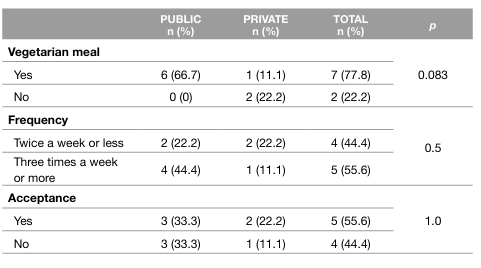
All six public schools reported offering a vegetarian meal, typically once a week. Among the three private ones, two do not, and one provides this meal. Although not all institutions offer a vegetarian meal, all the schools reported that legume grains are regularly on the menu, most of them (n= 5; 55.6%) three times a week. Just over half (n= 5; 55.6%) of schools reported good acceptance. In the present study's sample, no significant associations were observed between the type of institution (public or private) and the provision of vegetarian meals, the frequency, and the acceptance of legume grains. Concerning food education activities, almost all educators (n= 8; 89%) reported that they carried out these actions, except for one private school (Table 1).
Table 1: Provision of the vegetarian meal, frequency of legume grains on the menu, and perceived acceptance by teachers in public and private kindergartens
The content analysis allowed the identification of three categories: 1) Vegetarian Meals, 2) Acceptance of legume grains, and 3) Factors (positives and negatives) that determine consumption.
Discussions among the teachers revealed a sense of uncertainty and divergence regarding the provision of vegetarian meals in kindergartens, often linked to children's reluctance to accept these meals: "I disagree (with offering vegetarian meals) (...) vegetables and everything else, yes, but vegetarian (dishes), no (...)” (P6 - public school); "I think it's very good. But then if there is no continuation of these dynamics at home, or more often at school (...) there are kids who do not eat” (P3 - public school); “I don't disagree. We have experience and kids eat (...) on the vegetarian day they eat” (P4 - public school). Despite this divergence, teachers from one of the private schools that do not offer vegetarian meals on the menu expressed interest in making this option available: “Next year, we are already talking about having a vegetarian day. I don't know if it will go ahead or not” (P2- private school).
Regarding acceptance, data agrees with the quantitative results, which evidenced talks referring to good acceptance (n= 3; 50%) and low acceptance (n= 2; 33.3%) (Table 2). Furthermore, in the discussions on the factors determining children's consumption of legume grains, the main facilitators and barriers were identified, which revealed possible paths to promote the consumption of legumes in kindergartens (Table 3). Family involvement in the food education process was one of the main facilitating factors (n= 2; 33.3%) that had a broader agreement among the educators (observed by the non-verbal expressions of the participants). The other facilitator most cited was knowing how to prepare and cook legume grains (n= 2; 33.3%). For the school food environment, the information was divergent. One of the educators (16.7%) reported that children often did not eat at home but ate at school (Table 3). On the other hand, another educator pointed out that only those children who ate at home also ate at school: “It seems that few used to it (eat legume grains) since they eat at home... Because otherwise, we can't do it” (P1 - private school).

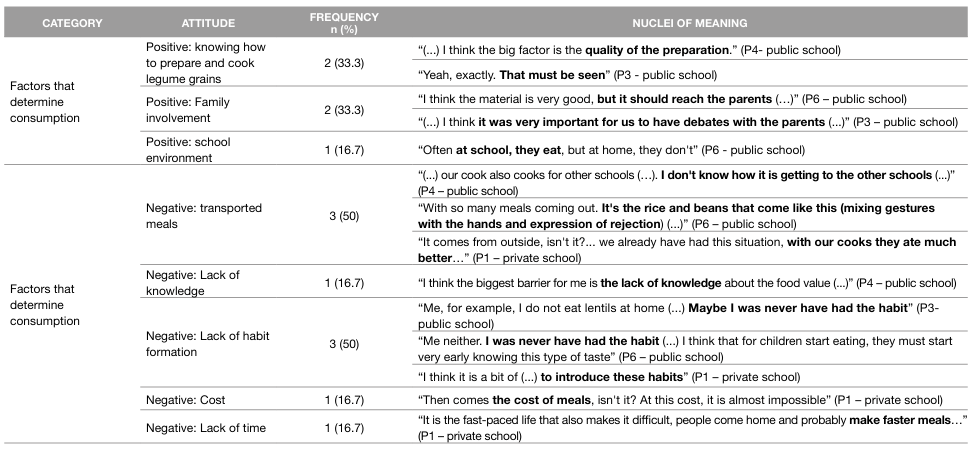
While good preparation and culinary skills were cited as factors that favor the consumption of legume grains, preparing meals in different places from where they will be served (transported meals) was cited as one of the main barriers to their acceptance (n= 3; 50%). Another negative factor mentioned often by the educators was the lack of habit formation of consuming legume grains (n= 3; 50%), evidencing the need to introduce these foods into children's diets as soon as possible. Lack of knowledge (n= 1; 16.7%), cost (n= 1; 16.7%), and lack of time to prepare (n= 1; 16.7%) also were mentioned as barriers (Table 3).
DISCUSSION OF THE RESULTS
Although the law requiring the inclusion of vegetarian meals in Portuguese public schools does not extend to kindergartens, all public kindergartens offer them once a week. Based on the data, pulses are a regular presence on the menu, and most schools serve them three times a week. However, acceptance remains relatively low, at 55.6%. In the perception of teachers, there is uncertainty regarding the provision of vegetarian meals in kindergartens. As for the factors that facilitate consumption, the most cited were family involvement in food education, knowing how to prepare and cook legume grains, and the school food environment. The main barriers were preparing meals in places other than where they would be served and the lack of habit of consuming legume grains.
The adoption of vegetarian meals once a week aligns with the global campaign "Meatless Monday" (or "Free Meat Monday"), which has gained traction worldwide (21). This initiative presents a potential solution to mitigate the environmental impact of school meals without compromising the nutrients provided to children (22). Nevertheless, further studies are warranted to investigate this matter, specifically in Portuguese kindergartens.
The findings revealed that legume grains are consistently featured on the menus of the chosen Portuguese kindergartens, although their acceptance is relatively low. The absence of specific data regarding the serving sizes, coupled with the study's limited scope, underscores the necessity for a more extensive investigation involving a larger and more diverse sample of kindergartens to comprehensively evaluate the frequency of legume grain inclusion in these educational environments. Meal preparation emerges as a critical factor influencing legume grain consumption, according to insights provided by educators. They emphasized that employing effective preparation techniques can enhance acceptance among children. Conversely, meal preparation outside school was identified as a barrier to acceptance. Previous observations have highlighted that Portuguese children prefer meals prepared within the school's kitchen facilities over those prepared elsewhere (23). This preference aligns with recurrent findings in the literature, which suggest that limited cooking skills and unfamiliarity with diverse recipes represent significant obstacles to legume grain consumption (24-26).
Conversely, research indicates that interventions to enhance cooking skills positively impact legume grain consumption. Therefore, training chefs and cooks responsible for school meals on preparing appetizing legume grain dishes could significantly enhance acceptance (26, 27). An illustrative example is the EU project TRUE, which produced a children's cookbook in multiple languages for widespread distribution to schools (28). Additionally, prioritizing food preparation in the school kitchen whenever feasible is advisable. Alternatively, if meals are prepared elsewhere and transported, it's crucial to minimize the time between preparation and distribution while ensuring the visual appeal and temperature of the dishes served.
During the focus group, nearly all participants highlighted family involvement in school food education as a significant factor contributing to legume grain consumption. This finding is consistent with previous studies indicating that parental engagement plays a vital role in the success of dietary interventions to improve children's eating habits (29). Additionally, participants cited the school food environment as another facilitating factor. Research suggests that school meals are pivotal in shaping children's diets (9). However, it's worth noting that this influence wasn't observed in the reality described by one educator (P1). Upon closer examination of this educator's school context, it becomes apparent that legume grain acceptance is low, meal preparation occurs outside the school (transported meal), and notably, this was the only school that didn't implement food education activities. These factors collectively may explain the limited influence of the school food environment on legume grain acceptance in this particular case.
One commonly cited barrier to legume grain consumption is the lack of established habits. A study conducted in Poland identified this factor as the primary obstacle to legume grain intake (24). To cultivate healthy eating habits, legume grains should be introduced into infant diets before the age of one (30). Additionally, a lack of awareness regarding the nutritional value of legume grains and insufficient time for preparation were identified as barriers in this study, consistent with f indings from other research on this topic (24, 25, 27).
However, it's important to acknowledge several limitations in the present study. Firstly, the sampling method relied on the research team's network, resulting in relatively few participants. Another notable limitation was the execution of only one focus group. Ideally, multiple focus group discussions should be conducted with various groups to identify trends and patterns in participants' perceptions regarding the study's focus (31). These limitations challenge the representativeness of the data and constrain the ability to generalize the results.
CONCLUSIONS AND IMPLICATIONS FOR RESEARCH AND PRACTICE
The study found that legume grains were consistently featured on the menus of the examined kindergartens, albeit with relatively low acceptance among the children. Results indicated that factors such as legume preparation methods, parental involvement in food education, and early establishment of legume grain-eating habits significantly influenced children's acceptance of legume grains. Therefore, implementing culinary workshops to educate and train school cooks on preparing appealing legume grain dishes and sharing recipes could be effective strategies to enhance acceptance of legume grain-containing meals. Additionally, it's important to prioritize food preparation in the school kitchen whenever possible and introduce legume grains into the nursery menu early on.
To further validate the findings of this study, future research should expand the investigation to include a larger number of kindergartens, ideally representing the entire country. This broader scope would provide more comprehensive insights into the factors influencing legume grain consumption in kindergarten settings.

