




 Inglês (pdf)
 Artigo em XML
 Referências do artigo
 Tradução automática
 Enviar este artigo por email
 Citado por SciELO
  Similares em
SciELO
Similares em
SciELO 
 Permalink

INTRODUCTION
The Mediterranean dietary pattern describes the traditional dietary habits found in the olive-growing regions along the Mediterranean coastline in the late 1950s and early 1960s (1), and has consistently been shown to provide a degree of protection against cardiovascular and major chronic degenerative diseases (2) due to its high fibre and polyphenols content and specific lipid profile (3). Since its early characterization a large number of indexes have been proposed to quantify and assess its adherence by individuals or populations (4). Many of these indexes includes a low intake of lean meat, including rabbit meat on a weekly basis. The Mediterranean region has been always characterised by its gastronomic heritage in rabbit dishes, which frequently features in celebratory dishes and local specialities (5).
The nutritional value of meat has an increasing importance among factors determining consumer acceptability. Rabbit meat is appreciated for its nutritional characteristics. From this point of view, rabbit meat has a low energy value (117 kcal/100g (6)) and is a good source of high energy protein (20.3g/100g (6)), constituted by essential amino acids. In addition to its low caloric, the total fat content is also low (4g/100g (6)), namely the amount of saturated fatty acids (1.3 g/100g (6)) and cholesterol (48 mg/100g (6)), and is, therefore, considered a lean meat. This composition of fatty acids is due to the animal's diet and the fact that it does not perform biohydrogenation in the rumen, influencing the saturation of fatty acids. Rabbit meat is also known for its high content of B vitamins (B2, B3, B12) and minerals, such as iron (heme iron), phosphorus, zinc, copper, and magnesium. It is important to note that sodium levels in rabbit meat are low (7). Despite this, the information available on the chemical composition of rabbit meat is very variable, especially with regard to fat content which varies depending on the part of the carcass studied. Generally, with increasing age and weight of the animals, the protein and fat content increases and the water content decreases (8). Some factors as sex, age and nutrition have impact on quality of rabbit meat including its final nutritional composition (9-13).
Cooking of rabbit meat is an essential process to allow its consumption and helps in the production of pleasant characteristic taste, flavour and tenderness, and increases its food safety (14, 15). On the other hand, cooking decreases some vitamins and minerals content of the meat, denaturing muscle proteins and changing the structure of myofibrillar and connective tissue, and promotes lipid oxidation (16). These cooking changes vary greatly according to the method of heat treatment including the cooking environment (dry or moist), cooking temperature and cooking time (17).
Although most of the previous researches focused on studying the effect of cooking methods on the muscular structure and cooking losses (17, 18), very few studies have concentrated on the impact of three most popular cooking methods (boiling, frying and oven-roasting) in different pieces of rabbit meat. These data are of the utmost importance for scientific applications, gastrotechnics, culinary management, dietetics purposes and actualizations of food tables composition (19).
In 2018, the top 5 export destinations of rabbit meat were Germany, Belgium, Italy, Portugal and France and major exporters are China, Spain, Hungary, France and Italy (20). The importance of Mediterranean diet and gastronomic culture could be an important driver on rabbit meat trade (Portugal, Spain and Italy). Despite its longstanding culinary value, an overall decline in the consumption of rabbit meat is discernible, and the plausible reasons is related to meat’s organoleptic characteristics, its appeal to emotions (animal perceived cuteness) and lack of consumption habit (21-24).
It is of great significance to study the cooking loss and edible qualities of rabbit meat to encourage an increasing number of chefs, food service industry and consumers to understand and consume rabbit meat. Therefore, the current study was conducted to clarify the effect of different cooking methods such as boiling, oven-roasting and frying on the cooking loss and edible weight of rabbit meat.
METHODOLOGY
Slaughter of Rabbits
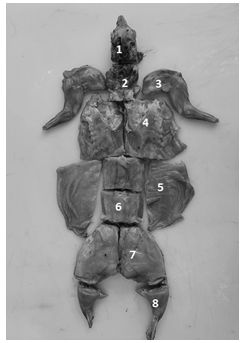
At slaughter age, 6 rabbits males (live weight variation 1892 to 4445g), were slaughtered by sudden cervical dislocation, without fasting, which is the method accepted by Portuguese law on animal welfare in experimental research (25). The animals were slaughtered under veterinary supervision at the experimental abattoir of the university and did not undergo transport. After the slaughter, the skin, external genital organs, stomach, and small and large intestines were removed. Carcasses containing the thoracic viscera (thymus, lungs, heart, and oesophagus), liver, kidneys, and head were suspended from the calcaneus tendon for 60 min in a ventilated area and then cooled at 3ºC for 24 h. At this time, after removal of the liver, head, kidneys, thoracic viscera and dissectible fat, the carcasses obtained were dissected according methodology proposed by Blasco et al. (26) (Figure 1).
Sample Preparation
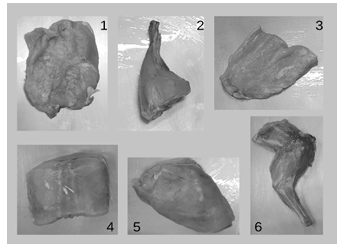
Given the gastronomic value, six different pieces obtained in duplicate of each animal (Figure 2), were immediately transported to the kitchen laboratory to be stored at refrigeration (5 ºC) before cooking (within 24 h).
Cooking Treatments Design
Cooking methods were performed according to some previous descriptions with minor modification: boiling in water, oven-roasting and frying, 12 samples each (15, 16, 18). Boiled: the samples were dipped in boiling water (90 ºC) in cooking assistant (iVario 2-XS, Rational®), and heated until the internal temperature 75 °C was reached. Oven-roasted: the samples were placed in a heatproof dish and cooked at 180 ºC in a preheated oven with air circulation (iCombi, Rational®) with the program to finish cooking when the food's internal temperature reaches 75 ºC (core probe inserted in larger piece). Frying: deep frying was carried out in a cooking assistant (iVario 2-XS, Rational®) by using 100% vegetable cooking oil (with refined vegetable oils) at 180 °C. The final temperature of boiling and frying treatment was determined by inserting needle thermocouple (HI-151 Checktemp® 4, Hanna Instruments) into the approximate geometric center of each piece cooked. The time of cooking was registered with a chronometer.
Determination of Cooking Loss and Edible Weight
After cooking, the samples were cooled at room temperature for 30 min and then the percentage of cooking loss was recorded. Cooking loss was calculated as the percent of the difference between raw weight (Wr) and cooked weight (Wc) of the samples relative to the weight of raw samples (Wr) (27):
After the measurement of cooked weight (Kesper Digital Kitchen Scales 5 kg, Germany), the samples were deboned and the edible weight was calculated as percentage:
Yield factor was also calculated for different cooking methods:
DATA ANALYSIS
Statistical data descriptive analysis for all measurements of the three independent experimental cooking treatments was carried out using IBM SPSS Statistics 20.0 (IBM Corporation, Somers, NY, USA) and expressed as mean and standard deviation. Kolmogorov Smirnov test was used to test the normality of variables, and the Kruskal-Wallis H and ANOVA tests were used to test differences between cooking methods. Differences were considered significant at p < 0.05.
RESULTS
Regarding the cooking time of rabbit meat pieces (Table 1), the frying method is the fastest (from 4.8 minutes to 13.6 minutes, according to the pieces) and the boiling method is the longest (from mean 26.9 minutes to 33.9 minutes). After cooking, the mean edible weight was higher in saddle hindquarter (86.7±12.4 g) and saddle loin (52.7±10.1 g) and lower in hind leg (17.8±2.8 g) and belly (13.5±4.6 g).

The cooking performance was different according to the total rabbit meat pieces (Table 2) and for some individual pieces (Table 3). The boiling method present lower cooking losses than the other methods and higher edible weight than frying method.
Table 2: Cooking loss (%) and edible weight (%) of all pieces of rabbit meat exposed to different methods of cooking (n=72)
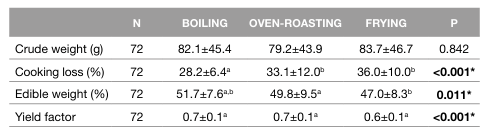
Values expressed as mean±standard deviation
Kruskal-Wallis H test
*significant differences p<0.05
a,b Different superscript letters indicate a significant difference among different methods of cooking
Table 3: Cooking loss (%) and edible weight (g and %) of pieces of rabbit meat exposed to different methods of cooking (n=12 for each cooking method)
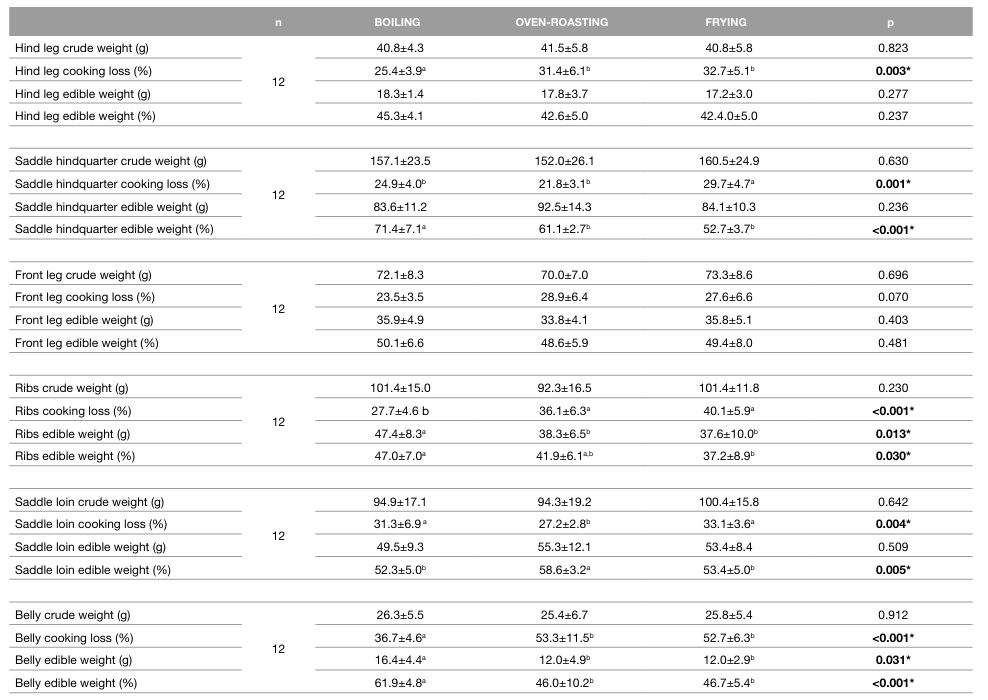
Values expressed as mean±standard deviation
Kruskal-Wallis H test
*significant differences p<0.05
a,b Different superscript letters indicate a significant difference among different methods of cooking
The piece that presented the highest cooking loss (%) was the belly (in oven-roasting and frying methods cooking loss was higher than 50%) and the ones that presented the lowest cooking loss were the saddle hindquarter and the front leg (Table 3). The cooking loss (%) was significantly higher in the frying method to hind legs (32.7±5.1%; p=0.003), saddle hindquarters (29.7±4.7%; p=0.001), ribs (40.1±5.0%; p<0.001).
DISCUSSION OF THE RESULTS
The study concludes that cooking loss, edible weight, and yield factor are influenced by the piece of rabbit meat and the cooking process. Meat and meat-based products must be cooked before being eaten, because this procedure is necessary for destroying foodborne pathogens, assuring microbial safety and achieving meat quality. Cooking also has an important effect on the nutritional properties and become meat more digestible (28). Consumer motivations for meat consumption were good taste, usual habit and the perception of meat as a healthy and satiable food (29), and nowadays consumers are increasingly awareness for qualitative attributes of meat such as food safety, country of origin, organic production, environmental impact and animal welfare (30). Cooking process consumes large amount of energy and releases greenhouse gas emissions (31), and innovative methods like microwave cooking can reduce the energy requirement compared to traditional cooking methods.
In our study, boiling seems to be the cooking method with best performance (lower cooking loss (%) and higher edible weight (%)) in the majority of pieces of rabbit meat, however, is the method that consumes more time to cook.
Boiling can be less efficient than other cooking methods since it uses large amount of water to cook small amount of meat product and the large heat is loss to the environment (32), these limitations can be outdated if pressure cooker was used, diminished the time and water necessary to cook (33). Boiling is also seen as healthy cooking method, because is a fat-free cooking method (34), typically used in Mediterranean cuisine (35).
Cooking loss in boiling found in the present study (average loss was 28.3%) was lower than the value found by Abdel-Naem et. al (36.98%) (18) and by Combes et al. (reached a maximum of 30.8%) (17), however after 120 min of cooking. In fact, some authors reported higher losses of weight in wet cooking than in dry cooking, because during wet cooking losses occur by evaporation and also by exudation and diffusion (36). During boiling, cooking losses can be induced by temperature and/ or by reduced pressure, that causes myofibrillar proteins to shrink, a process that starts at 40 ºC and becomes more intense with increased temperatures, consequently decreases the interfibrillar volume, which in turn leads to a reduction in the myofibril's ability to hold water. In other hand, temperatures between 56 ºC and 62 ºC, a contraction of the perimysial connective tissue causes compression of the muscle fibre bundles, which in turn encourages water to be released (36). The increasing of cooking time has been also reported to increase the shrinkage of the connective tissues and the increased myofibrillar hardening (37).
In the present study, values of cooking loss in oven-roasting (33.1%) and frying (36.0%) were similar to data found in the study by Abdel Naeem et al. (18), showing an average loss of 33.9% in oven-roasting and an average loss of 36.5% in frying.
Oven cooking can provoke meat surface dehydration and higher cooking loss, which can be attenuated by using forced air convection method coupled with steam injection in the oven chamber (31). Frying method uses fat or oil as the heat transfer medium, in direct contact with the food, which promotes a number of chemical changes, such as moisture loss, oil uptake, crust formation, gelatinization of starch, aromatization, protein denaturation and colour change via maillard reactions, hydrolysis or oxidation, and oil polymerization (31). In frying cooking loss is provoked by dehydration of meat that can be partially replaced by oil.
Saddle hindquarter was the piece of rabbit with higher edible weight and belly and hind leg with lower edible weight. The surface area per unit volume can have impact on cooking loss values, since thicker cuts have higher losses (38).
Rabbit meat cooking loss and yield factor data are absent or incomplete in many national food composition databases, and it are important to allow the calculation of nutrient retention of cooked foods without food chemical analysis and the calculation of nutritional composition of a dish (19). These data are also important for dietitians to help in the estimation of edible weight of raw meat before its consumption (comparing to recommended portion to eat) and for food service operators helping in the management of catering units with economic impact.
From the present study, we can conclude that the value of cooking loss, edible weight and yield factor depends on piece of rabbit meat and cooking process. In the future research can evaluate the impact of these cooking methods on other physicochemical (tenderness, colour, nutrients) and sensorial characteristics of meat.
CONCLUSIONS
In this study, boiling seems to be the cooking method with lower relative cooking loss and higher relative edible weight in the majority of pieces of rabbit meat, however, it is the method that consumes more time to cook. While the frying seems to be the cooking method with the worst performance. This study may provide valuable information on the performance of different methods of cooking rabbit meat for consumers and industrial practices.
FUNDING
This study was funded by Project “UTAD FOOD ALLIANZ: Research Infrastructure in Nutrition and Food. The link with the Animal Science.”, operation n.º NORTE 01-0145-FEDER-072687, financed by the European Regional Development Fund (ERDF) through NORTE 2020 (North Regional Operational Program 2014/2020). The CECAV is supported by FCT/UIDB/CVT/00772/2020. The CITAB is supported by FCT/UIDB/04033/2020.
AUTHORS’ CONTRIBUTIONS
CG, DOM, VP: Conceptualization; CG: Methodology; CG, VP: Formal analysis; CG, TSS, IS, MS, PN, JT, VP, DOM: Investigation; CG, DOM, VP: Resources; CG: Data curation; CG, TSS: Writing-original draft preparation; DOM, VP: Writing-review and editing; LF: Funding acquisition and project administration.

