




 Inglês (pdf)
 Artigo em XML
 Referências do artigo
 Tradução automática
 Enviar este artigo por email
 Citado por SciELO
  Similares em
SciELO
Similares em
SciELO 
 Permalink

INTRODUCTION
Every year, 42% of adults worldwide attempt to lose weight, and 23% endeavour to maintain weight loss (1). However, although weight loss programs centred on reducing food intake and increasing physical activity can effectively promote weight loss, the rate of program abandonment is high, and sustaining treatment adherence is limited (1, 2). While individual awareness is a crucial component of successful weight reduction initiatives, awareness of the importance of weight reduction does not consistently translate into behavioural change (2, 3). The Transtheoretical Model of change posits that changes in health related behaviours evolve through various stages of an individual's readiness to initiate and solidify changes until a complete behaviour shift is accomplished (4, 5). In the Pre-contemplation, Contemplation, and Preparation stages, individuals progress from not recognising the relevance of certain changes for specific aspects of their lives to making a firm commitment, as evidenced by the intention to alter their behaviour soon. During the Action stage, individuals make decisions and actively strive to implement new behaviours and attitudes to overcome perceived obstacles for at least six months. In the Maintenance stage, individuals aim to consolidate the changes achieved over six months (4, 5).
Understanding individuals' perceptions of control over their behaviour, particularly their health status, is crucial since Locus of Control is among the most significant determinants of individual attitudes toward health (6, 7). However, locus of control should not be considered the only cognitive construct for predicting health-related behaviours, and the perception of competence is vital for mobilising personal resources to control health (8, 9). This highlights the relevance of studying more specific constructs for a given behaviour, such as Self-Efficacy (10). This concept represents an individual's perception, belief, or conviction regarding their ability to mobilise the skills or knowledge necessary for successfully executing specific behaviours (10), subsequently extending from beliefs to the ability to organise and implement the essential action plans required to achieve desired outcomes in each context (11). Although its definition implies specificity for each task, some degree of generalisation exists (9). The General Eating Self-Efficacy Scale assesses the overall perceived control towards eating (12).
Given that many studies on overweight have not explored in depth the combined capacity of locus of control and self-efficacy to explain change towards healthy eating, the contribution of this study concerns the possible influence of these characteristics on the processes underlying changes in eating habits.
OBJECTIVES
This study aims to assess the relationships of locus of control, general self-efficacy, and dietary self-efficacy, as well as sociodemographic and clinical variables, with the perception of adherence to healthy eating among patients undergoing treatment for overweight.
METHODOLOGY
Recruitment of Participants and Sample
This study is part of the project “Aspectos cognitivos e comportamentais da alimentação: Elementos para uma compreensão integrada”, approved by the Ethics Committee of the Centro Hospitalar Universitário de São João (CHUSJ). Informed consent was obtained after explaining the study’s aims, methods and ethical issues. Participants were recruited between May 2011 and September 2013.
We analysed a convenience sample of overweight individuals (Body Mass Index (BMI) ≥ 25.0 kg/m2) undergoing treatment at the Nutrition outpatient clinic of CHUSJ, with the inclusion criteria being an age between 18 and 65 years. The exclusion criteria were the presence of pathologies requiring dietary therapy other than that recommended for the treatment of excess weight. A total of 185 potential participants were contacted, and there were no refusals to participate. Among those who agreed to participate, 86 individuals (46.5% of the initial participants) returned the second part of the survey. Of these, 12 questionnaires (14.0% of the participants who returned the second part) were excluded due to incomplete or incorrect completion.
Data Collection
Sociodemographic and clinical data were collected from each participant's file, including sex, age, years of schooling, weight on the date of the first consultation, and number of previous consultations. Each participant reported their desired weight, and anthropometric assessment (weight and height) according to standardized procedures (no shoes, heavy clothing or objects, looking straight-ahead and standing still with arms hanging loosely at their sides) was conducted after they completed the survey. The proportion of weight lost relative to desired weight was calculated as: (Initial weight - Current weight) / (Initial weight - Desired weight) x 100%.
Participants were provided with the second part of the questionnaire to f ill out and return in a prepaid envelope. The sections in this second part of the survey included items for evaluating stages of change towards healthy eating, health locus of control, general self-efficacy, and eating self-efficacy.
An exploratory analysis was conducted to examine possible relationships between initially collected sociodemographic and clinical characteristics and the return of the second part of the protocol. No significant relationships in both bivariate and multivariate analysis were found.
The classification of individuals into the Stages of Change towards healthy eating was conducted using the Portuguese version of the questionnaire and items developed by Kearney et al. (13), adapted specifically for adopting healthy eating. After characterising the sample based on the five stages of change, these were combined into “Pre action” (including individuals in the pre-contemplation, contemplation and preparation stages) or “Action/Maintenance”.
The Health Locus of Control Scale (14) was used to assess locus of control, being the only scale currently validated for the Portuguese population measuring this construct. Its 14 items are divided into two factors: “locus of control” (8 items) and “other powerful” (6 items). The scores range from 14 to 98 for the total scale, 8 to 56 for factor “locus of control” and 6 to 42 for factor “other powerful”. Higher scores in the total scale or in each factor correspond to internal locus of control.
The Self-Concept Clinical Inventory (15) aims to record individuals' perceptions of themselves. For this study, only the score obtained in factor 2 of this scale (range: 6 to 30), referred to as the “self-efficacy” factor, was considered. This factor corresponds to the individual's perception of their ability to confront and resolve problems and difficulties. For the sake of clarity and differentiation from another construct, the term “general self-efficacy” is used to denote the results of this factor.
General aspects of self-efficacy regarding eating were assessed using the General Eating Self-Efficacy Scale (12). This scale was developed based on factor 2 of the Self-Concept Clinical Inventory, resulting from adapting its items to specifically address eating. In this study, the results of the General Eating Self-Efficacy Scale (range: 0 to 20) will be referred to as “eating self-efficacy”.
Statistical Analysis
Statistical analyses were performed using the IBM SPSS Statistics program, version 28.0 for Windows. Descriptive statistics included absolute (n) and relative (%) frequencies, means and standard deviations (SD), or medians and percentiles (P25; P75). The normality of the distribution of quantitative variables was assessed using skewness and kurtosis.
Binary logistic regression models (unadjusted and adjusted) were employed to study the predictors of being in the action/maintenance stage towards healthy eating. The independent variables entered in these models were: sex (reference: female), age (years), education (years), number of previous consultations, lost weight relative to desired weight (%) and the scores for locus of control, eating self-efficacy and general self-efficacy. The absence of multicollinearity was checked computing VIF values for all quantitative variables, with values ranging from 1.15 to 1.76. The null hypothesis was rejected when p < 0.05.
RESULTS
Data from 74 participants were analysed, most female (77.0%; n = 57). Table 1 displays the characterisation of the sample in terms of sociodemographic and anthropometric characteristics, stages of change towards healthy eating, health locus of control and self-efficacy.
Table 1: Sample characterisation (n = 74)
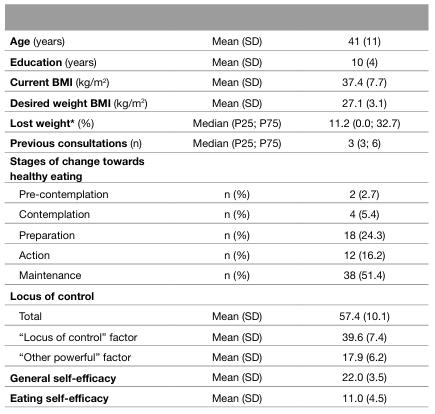
* relative to desired weight. Total locus of control ranges from 14 to 98, factor “locus of control” from 8 to 56, factor “other powerful” from 6 to 42, general self-efficacy from 6 to 30, and eating self-efficacy from 0 to 20.
BMI: Body Mass Index
Their average age and education level were 41 (SD = 11) and 10 (SD = 4) years, respectively. On average, they had a BMI corresponding to their current weight of 37.4 kg/m2 (SD = 7.7) and a BMI corresponding to their desired weight of 27.1 kg/m2 (SD = 3.1). The proportion of lost weight (relative to desired weight) had a median of 11.2% (P25 = 0.0%; P75 = 32.7%), while the median weight loss consultations was 3 (P25 = 3; P75 = 6).
Approximately two-thirds (67.6%; n = 50) were in the "Action/ Maintenance" stage (67.6%; n = 50). In the total locus of control scale, general self-efficacy and eating self-efficacy participants showed average scores slightly higher than the midpoint of the respective scales. However, the "Other powerful" factor, unlike the "Locus of control" factor, showed an average score below the midpoint of this sub-scale.
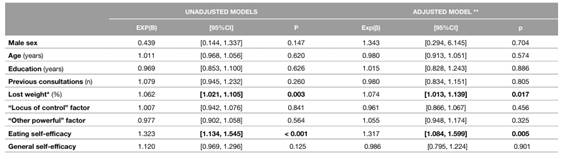
As for the results obtained through binary logistic regression (Table 2), in both the unadjusted and adjusted models, the chance of being in the “Action/Maintenance” stage towards healthy eating was significantly predicted by the proportion of lost weight and eating self-efficacy. Higher weight loss and higher eating self-efficacy were significantly associated with higher odds of being in the “Action/Maintenance” stage. A one-unit increase in the eating self-efficacy score was independently associated with a 31.7% increase in the odds of adhering to a healthy diet, while a 1% increase in the percentage of weight loss (relative to the desired weight) is independently associated with a 7.4% increase in those odds. Sociodemographics (sex, age, education), number of previous consultations, health locus of control and general self-efficacy were not significantly associated with the stage of change towards healthy eating. Overall, the independent variables included in the adjusted model (sex, age, education, number of previous consultations, lost weight relative to desired weight, locus of control, eating self-efficacy and general self-efficacy) significantly (p < 0.001) explained almost half of the dependent variable (Nagelkerkle’s R2 = 48.4%).
DISCUSSION OF THE RESULTS
The main aim of this study was to identify the relationships of locus of control, general self-efficacy, dietary self-efficacy, sociodemographic and clinical variables with the perception of adherence to healthy eating among patients undergoing treatment for overweight. Our main finding was that, in a binary regression model, higher eating self-efficacy was that strongest predictor of being in the “Action/Maintenance” stage towards healthy eating, and greater weight loss was also a significant predictor.
Most of our sample comprised women, with an average age of 41 years and a median weight loss of 11.2% compared to what they would like to lose, thus mostly maintaining the desire to reduce their weight. Analysing the results on the stages of change towards healthy eating, we can see that most of the individuals attending nutrition consultations considered to have already changed their diet and maintained this change for at least six months, seeking to consolidate the eating habits they had achieved. Conversely, although 32.4% of the participants had not yet committed to altering their dietary intake, falling within the Pre-action stage, the majority had reached a stage where they had acknowledged the necessity of behaviour change and were committed to doing so soon.
In the current study on the relationships with the perceived adherence to a healthy diet in the treatment of overweight, we found that eating self-efficacy and the percentage of weight lost relative to the desired weight were the only characteristics significantly associated with being in the "Action/Maintenance" stage. The fact that general self-efficacy lacked significant association with the adherence to healthy eating choices underscores the potential relevance of assessing self-efficacy in a more specific context, particularly eating habits. This specificity is further supported by results from Sekula et al. (16), where, like our sample, participants with obesity exhibited levels of general self-efficacy above the midpoint of the scale. Yet, no association was found between general self-efficacy and BMI. On the other hand, Menéndez-González et al. (17) demonstrated that individuals with higher BMI had lower beliefs about overcoming difficulties in the eating domain.
These results, and their possible implications to practice, should also be interpreted considering the relationships between (eating) self efficacy and weight loss, namely the role of eating self-efficacy in fostering changes in eating habits, thereby favouring balanced food choices tailored to individual needs and consequent weight loss. Flølo et al. (18) investigated eating self-efficacy as a predictor of long-term weight loss among individuals undergoing bariatric surgery and found that a greater increase in the level of eating self-efficacy between the initial assessment and after 16 months was associated with a higher percentage of weight loss at 55 months. Also, Hansen et al. (19) found no significant association between eating self-efficacy and weight loss, attributing this result to the notion that changes in self-efficacy throughout the weight loss intervention may better predict treatment success than initial levels of this feature. We may thus hypothesise about the role of eating self-efficacy as a mediator between individuals' actual abilities (knowledge and skills) and their performance in adhering to a healthier diet. The fact that most participants in the current study had attended three or more nutrition consultations had been modifying their food choices for at least six months, and presented a balanced duality in terms of beliefs about their own control and the control of health professionals may reinforce the conclusions of the authors mentioned above and may reveal the nutritionist’s role in promoting an increase in eating self-efficacy over time.
To our knowledge, this study is pioneering in its simultaneous assessment of the relationships between sociodemographic and clinical features, locus of control, general self-efficacy and eating self-efficacy and the perceived adherence to a healthy diet in treating overweight through nutritional intervention. Additionally, we emphasise that the exploratory analysis revealed no evidence of bias associated with the two steps of participation. Nevertheless, this study has limitations that should be considered when interpreting the results (including the ones from the exploratory analysis), notably the use of a small convenience sample, which limits statistical power and makes generalisation challenging. This limitation, however, is common in studies characterised by this type of data collection. Furthermore, in terms of future work, since this is an observational, analytical, and cross-sectional study, it is confined to generating hypotheses of association; hence, conducting a prospective observational, analytical, and cohort study would be beneficial to establish cause-effect relationships.
CONCLUSIONS AND FINAL REMARKS
Approximately two-thirds of participants attending nutrition consultations to treat overweight considered to follow a healthy diet. Higher eating self-efficacy and greater weight loss presented significant relationships with being in the “Action/Maintenance” stage towards healthy eating. Considering these findings, it is worth emphasising the importance nutritionists can play in enhancing individuals’ eating self efficacy by imparting knowledge, providing positive reinforcement and defining strategies for individuals to overcome difficulties in acquiring and maintaining healthy eating choices. This, in turn, can help promote weight reduction, thereby reinforcing feelings of success and adherence to overweight treatment.

