




 texto em
  Inglês (pdf)
 Artigo em XML
 Referências do artigo
 Tradução automática
 Enviar este artigo por email
 Citado por SciELO
  Similares em
SciELO
Similares em
SciELO 
 Permalink

1. Introduction
Migration has emerged as one of the defining issues of our time, shaping political discourse, cultural landscapes, and individual lives across the globe. As societies grapple with the complexities of migration, one arena stands out as a vital site of exploration, advocacy, and dialogue: migration film festivals. These unique cultural events provide a platform for filmmakers to share stories of migration, displacement, and belonging, offering audiences a window into the diverse and often overlooked experiences of migrants and refugees (Global Migration Film Festival)1. A few examples come to mind, such as the Global Migration Film Festival, organized by the International Organization for Migration (IOM) and held annually in multiple countries. It screens films that capture the promise and challenges of migration and aim to influence perceptions and attitudes towards migrants. The Refugees Welcome Film Festival takes place in various cities across Europe, including Berlin, Germany. It focuses on films that portray the lives and struggles of refugees, aiming to foster empathy and understanding. The London Migration Film Festival showcases films that explore themes of migration, displacement, and the broader human experience of moving from one place to another. The Migrant Voices Film Festival is based in Singapore and features films made by or about migrant workers. It seeks to amplify the voices of those often marginalized in society. The Cinema of Migration Film Festival, hosted in Milan, Italy, screens films that focus on the narratives of migrants and refugees, exploring the complexities of migration in the contemporary world. Last but not least, the New York African Film Festival. While not exclusively about migration, the New York African Film Festival often includes films that deal with themes of migration, displacement, and diaspora, especially within the African context.
This paper aims to explore the multifaceted realm of migration film festivals, examining their significance, impact, and potential for social change. We take CineMigrante, Festival de Cine y Formación en Derechos Humanos (CineMigrante, Film Festival and Training in Human Rights), as a case study since it brings together a disruptive array of curational and programming authorship, challenging dominant narratives and disrupting conventional understandings of migration. Since 2010, the CineMigrante International Film Festival has been held in Buenos Aires, attracting more than 95,000 people in its past editions, and has been replicated in other countries such as Colombia, Spain, Italy, and England. According to Yanil (2023),
CineMigrante is much more than a film festival; it is a movement that seeks to explore and give voice to the narratives of the peripheries, the stories of those who have emigrated or been displaced from their places of origin. It is a space where cinema becomes a powerful tool to reflect on the experience of migration, diaspora, and cultural diversity (p. 11).
At the heart of migration film festivals lies a commitment to amplifying marginalized voices and reclaiming narratives of migration from the confines of mainstream media (de Valck, 2016). Through documentary films, narrative features, and experimental works, filmmakers illuminate the human stories behind the statistics, capturing the complexities of migration with nuance and empathy (Trencsényi & Naumescu, 2021). Moreover, migration film festivals serve as more than just platforms for cinematic storytelling. They are dynamic spaces for dialogue, exchange, and activism, where filmmakers, scholars, activists, and community members engage with pressing social and political issues (Ozduzen, 2020). Panel discussions, workshops, and community events complement film screenings, creating opportunities for reflection, education, and collective action.
For Marijke de Valck (2013), film festivals can serve various agendas or interests - geopolitical, economic, as well as cultural. As we navigate a world marked by increasing displacement and division, the importance of migration film festivals cannot be overstated. In the face of fear, prejudice, and misinformation, these festivals offer counter-narratives and activities that can contribute to sanitizing the predominant discourses in the dominant narratives.
From a conceptual point of view, we examine migration film festivals through the lens of authorship. In the realm of film festivals, authorship can be defined as the creative and organizational agency exercised by individuals or groups in curating, programming, and presenting films within the festival context (Simmonds, 2018). Authorship in film festivals encompasses several dimensions:
curatorial authority: film festival programmers and organizers exercise curatorial authority in selecting and arranging films for presentation; they shape the festival’s thematic focus, aesthetic sensibility, and overall programming strategy, thereby exerting authorial control over the festival’s artistic direction (Rastegar, 2012);
creative vision: when creative films are showcased at festivals, they contribute to the festival’s overall narrative and aesthetic identity, embodying the authorial voice of their creators;
collaborative endeavors: collaborative authorship recognizes the collective contributions of individuals and groups in shaping the festival experience and generating meaning through shared cultural practices (Morgan & Castel, 2024).
cultural context: authorship in film festivals is situated within broader cultural contexts, encompassing social, political, and economic dimensions (Rüling & Pederson, 2010);
audience engagement: authorship extends to the role of festival audiences in interpreting and engaging with the films presented. Audience members actively contribute to the authorial process by interpreting cinematic texts, forming critical opinions, and participating in discussions and debates surrounding the festival’s programming (Dickson, 2014).
Mark Cousins, a renowned critic, curator, and filmmaker, has contributed significantly to the discourse surrounding film festivals and authorship. In his writings, as quoted by Dovey (2015), Cousins argues for authorship within film festivals. He suggests that we should view film festivals as authored entities, akin to how individual films are authored. Cousins’ assertion challenges the notion that film festivals are merely platforms for the screening of films, suggesting instead that they possess their distinct narratives and artistic visions.
By framing film festivals as authored narratives, we aim to emphasize the curatorial choices, thematic coherence, and overall artistic direction that festival organizers bring to the event. This perspective encourages us to consider film festivals not only as spaces for the exhibition of individual films but also as curated experiences that shape audience perceptions and interpretations. By recognizing the authorial role of festival organizers, we gain a deeper understanding of the creative and curatorial labor involved in shaping the festival’s identity and programming.
The exploration of film festivals has undergone substantial development over time, with key scholars contributing fundamental perspectives and frameworks that persistently influence research within this domain. Two such influential figures are Janet Harbord and Marijke de Valck. In her seminal work Film Cultures, Harbord (2002) explores the cultural significance of film festivals as sites of collective experience and engagement with cinema. She examines the ways in which festivals construct and negotiate identities, both at the local and global levels. Harbord’s analysis delves into the complex interplay between film, place, and audience, highlighting how festivals mediate between the global circulation of films and the specificity of local contexts. Her conceptualization of film festivals as cultural phenomena underscores their role in shaping cinematic practices, tastes, and meanings within diverse cultural landscapes.
De Valck’s (2007) groundbreaking book Film Festivals: From European Geopolitics to Global Cinephilia offers a comprehensive analysis of the historical, geopolitical, and cultural dimensions of film festivals. Drawing on extensive research and case studies, she traces the evolution of film festivals from their origins in Europe to their proliferation and diversification on the global stage. De Valck examines how festivals negotiate power dynamics, foster transnational networks, and promote cultural exchange within the context of globalization. Her interdisciplinary approach illuminates the multifaceted roles that festivals play in shaping film culture, identity, and industry practices across borders.
In recent years, scholars have continued to explore the multifaceted phenomenon of film festivals, offering fresh perspectives and insights into their cultural, social, and economic significance (Dovey, 2015; Johnson, 2020, 2022; Tascon, 2015; Vallejo, 2020). Thus, building on her earlier contributions, Film Festivals: History, Theory, Method, Practice, de Valck (2021) offers a comprehensive overview of the historical development, theoretical frameworks, methodological approaches, and practical considerations shaping the study of film festivals today. Skadi Loist’s (2023) research sheds light on the opportunities and challenges presented by digital disruptions, highlighting how festivals adapt and innovate in response to changing technological paradigms.
It is also worth highlighting the important contribution of Dina Iordanova, who, in collaboration with different authors, has coordinated the Yearbook project, which every year since 2009 publishes a monograph on a specific aspect of film festivals (Iordanova & Rhyne, 2009, Iordanova & Cheung, 2010, Iordonova & Cheung, 2011, Iordanova & Torchin, 2012, Iordanova & Marlow-Mann, 2013, Iordanova & Van de Peer, 2014). Similarly, the Palgrave Macmillan series “Framing Film Festivals”, launched in 2015, aims to explore various aspects of film festivals, including their history, organization, impact, and cultural significance (Berry & Robinsons, 2017; de Valck & Damiens, 2023; Dovey, 2015; Richards, 2016; Vallejo & Winton, 2020a, 2020b). The two last contributions to the series are Toward Decolonized Film Festival Worlds (Dovey, 2023) and Migration Film Festivals: Social Functions, Expectations and Challenges (Peralta Garcia & Simour, in press).
The work of all these authors has significantly enriched our understanding of film festivals as dynamic and complex phenomena. Their insights continue to inform current research and debates in the field, providing valuable frameworks for analyzing the cultural, social, and economic dynamics of festivalization in contemporary cinema. Other researchers have focused more specifically on migration film festivals, providing valuable insights into the role of migration film festivals in challenging dominant narratives, fostering cross-cultural dialogue, and empowering migrant communities (Daniels, 2013; Iordanova & Torchin, 2012).
This paper, building on the insights from this literature review, seeks to address a gap by exploring the factors that contribute to the success of a migration-themed film festival. Specifically, it focuses on festivals that have demonstrated longevity, secured institutional backing, maintained consistent public engagement, and introduced innovative, disruptive concepts in curation and programming. Our main research question is: What are the main characteristics in the dynamics and internal functioning of CineMigrante that allow us to conclude the keys to its success? To answer this question, we rely on the following study variables: curation criteria, programming activities, relations with the media and the city’s associative fabric, corporative image, and communication strategies. A formal content analysis of the festival catalog and the reading of structural, visual, and para-visual analysis of the website, media, and texts are implemented.
2. Results
2.1. A Festival Designed as a Space for Training in Human Rights
The International Film Festival and Training in the Human Rights of Migrants was established in Argentina in 2010 by CineMigrante, a non-governmental organization dedicated to advancing human rights and fostering cultural integration across various spaces, regions, and territories within Argentina, Latin America, and globally. It disseminates cinematographic works that portray the social reality of those who, for various reasons, had to move, migrate, or inhabit other territories. Recognizing that mobility is an inherent aspect of human social existence, CineMigrante endeavors to challenge the fixed identities upon which contemporary society is often constructed. It seeks to create a space for interaction and exchange among diverse cultures, thereby fostering a deeper understanding of the multifaceted social fabric that shapes our reality.
CineMigrante sees migration as a dynamic state of the body in movement - an act of traversing territories in search of sustenance. It represents a departure from zones of war and conflict and entails crossing physical or even imaginary borders. Migration, for CineMigrante, involves inhabiting new spaces, actively occupying them, and effecting changes along the way. For this reason, CineMigrante strengthens the ties in the historical dialogue of identities and shapes mutual recognition of cultures through Latin American identities. As the 2010 catalogue highlights,
carrying out this festival in Argentina is an even deeper challenge. The history and identity of this country have always been under permanent review. Being an indigenous land, populated later by a huge European migration that brought with it forced migration from Africa, later permeated by migration flows from Latin American countries, our practices are constantly nurtured and merged, building an identity that is necessary to be elaborated collectively. (CineMigrante’s catalog, 2010, p. 11)2
Florencia Mazzadi has directed the event since its establishment in 2010. Trained as a historian, filmmaker by passion, and African dance enthusiast, she is also a human rights advocate with a personal connection to Argentina’s political history of exile and disappearances in the 1970s. Her experiences as a woman living globally further shape her perspective. Mazzadi’s diverse background has given CineMigrante a distinct identity infused with feminism, postcolonialism, disruption, and deconstruction. The festival’s genesis, according to Mazzadi, stemmed from the need to provide Argentina with films that had not reached the country despite winning awards at Cannes and Locarno. These films, beyond their accolades, intrigued her for their potential to build connections, seek integration, and challenge identity constructs. As she explains:
national states and their borders were built by modern man, who did not put the axis on the human being but in the reproduction of capital or merchandise. It is time to think differently. This land is for everyone, and this implies the possibility of diversity in construction. We have to generate this diversity precisely so as not to die as a species (Con la mirada sobre los desplazados, 2010).
The approach of the festival is intersectional and transversal, a fact that also exists in the design of activities and the selection of films. Thus, the various national and international migration organizations are a constitutive part of the content development and direction of their actions. Liliana Mazure, a festival organizer, conveys it in this way:
what makes us most proud is that cinema is serving us as a tool to articulate all these issues with society in general, and, in turn, cinema is an expression of this society and an expression of migrants, emigrants, and immigrants circulating the world today across all the borders that actually falsely separate and divide us (Liliana Mazure presentó el Anuario de Cine 2010, 2011).
CineMigrante also offers a research and training initiative entitled “Human Rights Through the Cinema and Migration”. The Human Right Center provides films, reference materials, and educational resources for secondary and higher education, along with non-profit training by various organizations. The training material encompasses a comprehensive understanding of migration, spanning from the evolution of the migration concept to international laws, agreements, and various formal and informal aspects. Moreover, the film festival, a carrier of identity symbols, receives backing from a sixmember honor committee.
2.2. Itinerant Shows
One of the strongest initiatives of CineMigrante involves arranging the Muestras Itinerantes (Itinerant Shows) based on a sample of films from past editions, which travels around the world. The sample can be requested by government agencies, educational and training institutions in human rights, non-governmental organizations (NGOs), civil associations, cultural institutions, cooperatives, migrant organizations, and other groups interested in promoting intercultural values, combating discrimination, xenophobia or racism and training in the human rights of migrants through the language of cinema.
Venice was one of the traveling venues for CineMigrante in 2011, organized by the Università Ca’ Foscari Venezia and Casa Del Cinema Videoteca Pasinetti. Barcelona has also hosted four editions of CineMigrante. During the four editions held in the city, the event has reached 6,846 participants, thanks to the support of some local institutions. In the last edition of 2017, CineMigrante Barcelona’s proposal showcased 32 films from five continents; 1,836 people attended the event, and 23 film sessions were developed over six days. Bogotá joined the initiative in 2017 with 35 performances, adding to its central programming, the thematic section “Creative Resistance” and the central section “The Movement of the Body as an Insurrectionary Act” curated by director Clarisse Hahn (France) and the political scientist Sandro Mezzadra (Italy). Other traveling venues have been in Mexico and Costa Rica.
Another outstanding initiative is the Online Mediateca (Media Library), which intends to generate access and massive dissemination of its audiovisual documents in order to collaborate distinctively in the processes of developing knowledge about human mobility. The objective of Mediateca is to deepen the understanding of the migration processes through a universal and historical journey of mobility, contributing to building critical thinking and acting as a hub for a new differential process of meaning and sensitive reflection. As of the time of writing, the Media Library consisted of 8,618 films. The collection compiles all the audiovisual works that have been curated and showcased, as well as those that the CineMigrante International Festival has not exhibited. More than 700 audiovisual authors apply annually to the open call, most of whom have become part of the general collection since the first edition.
2.3. A Systematized and Indexed Archive as a Field of Exploration
To systematize and contribute to the search opportunities, CineMigrante has indexed the entire collection through geographic and thematic catalogs. The web also suggests outstanding movies to watch. In addition, a curatorial index is also deployed (central sections, thematic sections, special sections, focuses, and retrospectives to directors). The organizers use this search index to document their annual programming work.
The archive can be explored, thus, in many different ways, according to preferences. The thematic and geographical axes are intermixed, allowing for multiple selections. The dropdown menus can be combined simultaneously with axis choices. Filters can be used as search engines. When the filter aligns with a film stored in the media library, complete access is given to the file. The archive allows analysis of images, aesthetics, and the development of audiovisual language, and it is intended to serve the following:
researchers and specialists in social sciences (human rights, international politics, migration, law) and audiovisual arts, including film critics, researchers, and communication experts. Students and educators at all levels;
government actors within rights enforcement, such as access to residence, equal treatment, education, health, work, housing, and due process. National and local public defense organizations, rights promotion and discrimination prevention groups, and cultural and public communication organizations;
NGOs focused on human rights and migration policies, strengthening migrant organizations, nonformal education, civil society organizations, cultural centers, film clubs, and groups interested in cinema and migration;
general public interested in independent cinema and migration, as well as attendees of CineMigrante events and associated activities.
2.4. An Anti-Essentialist Commitment With the Curation of Films
CineMigrante firmly embraces an anti-essentialist stance, challenging oppressive identities and embracing the freedom of people’s mobility. Each edition of the festival follows a carefully curated programming structure, featuring a blend of films and activities categorized into central sections, thematic sections, special sections, and retrospectives dedicated to directors. The work undertaken by CineMigrante highlights titles from Africa, Asia, Europe, the United States, and Latin America, divided along geographical axes, which they call “Dialogues”.
Furthermore, CineMigrante aims to deeply explore the perspective of human mobility, uniting migrants’ motivations for seeking new horizons and the diverse challenges they face as individuals. This fresh approach is achieved through thematic sections. Collectively, these sections provide insights into how migration processes have sparked debates and reflections of shared concern. In its inaugural edition, CineMigrante highlighted African cinema as a means of fostering mutual understanding and connections through film.
Over the years, we have seen the attention and centrality that CineMigrante pays to the role of curators. The name of Olivier Marboeuf can be cited to illustrate this point. He was the curator of the 2023 edition. A storyteller, curator, researcher, and film producer from France, Marboeuf is known for his deep commitment to film production and reflection on narratives from the peripheries. He has worked as a curator at renowned contemporary art biennials such as Documenta and Berlin, demonstrating his influence in the world of art and film. His work is characterized by exploring the intersection between poetic fiction and speculative theories. He is interested in the concept of place as a form of presence and the body as a landscape. Inspired by the imagery and literature of the Caribbean, as well as the mythologies of the suburbs, Marboeuf seeks to empower the expression of stories narrated by minorized groups.
From an evolutionary perspective, in 2010, a special section was devoted to Africa, therefore setting a predominance of African-themed films through documentaries and fiction that portray perilous forms of migration. These include Absent, Present (Angelina Leve, 2010; Germany), Comme un Uomo Sulla Terra (Like a Man on Earth; Andrea Sege, Dagmawi Yimer, Riccardo Biadene, 2008; Italy), Victimes de Nos Richesses (Victims of Our Wealth; Kal Touré, 2007; France-Mali), Barça o Barzak (Idrissa Guiro, 2008; Senegal), Dem Walla Dee (Leave or Die; Rodrigo Sáez, 2008, France), and Harraga (Eva Fernández, Mario de la Torre, 2008; España), among others.
While many of the films within the collection address the often harrowing aspects of African migration processes, there is a deliberate attempt to present nuanced and less sensationalized perspectives through works where art and intercultural viewpoints take center stage. These include Nora (Alla Kowgan, David Hinton, 2008; Mozambique, USA) mentioned above or Princesa de África (The Princess of Africa; Juan Laguna, 2008; Spain).
Similarly, the 2011 edition also centered on Africa and showcased a notable abundance of films addressing the experiences of individuals in pursuit of asylum or refugee status. This is reflected in films such as The Fortress (Fernand Melgar, 2008; Switzerland), Les Arrivants (The Newly Arrived; Claudine Bories y Patrice Chagnard, 2009; France), or Los Ulises (The Ulysses; Agatha Maciaszek and Alberto García, 2011; Spain), among others.
This category of films tries to show the effects of refugee policies in Europe through personal stories, as can be seen in Nowhere in Europe (Kerstin Nickin, 2009; Germany and Poland), Haiti: Apocalypse Now (Arnold Antonin, 2011; Haiti), Niguri (Antonio Martino, 2010; Italy), Transitland (Anna Lozano and Alexander Hick, 2008; Jordan, Germany, Spain) or A Day in Smara (Fany de la Chica, 2010; Spain), among others.
The limited representation of African filmmakers in the catalog highlights a significant gap in the diversity and inclusiveness of the collection. This absence is particularly relevant because African filmmakers bring unique and essential perspectives that are crucial for a comprehensive understanding of the continent’s diverse narratives, cultures, and socio-political contexts. Their voices are not just additional viewpoints; they are vital for capturing the complexities and nuances of African experiences that might otherwise be overlooked or misrepresented. African filmmakers often work within contexts marked by specific historical, social, and economic challenges, and their films can provide valuable insights into how these factors shape identities, cultures, and everyday life. Their stories can challenge dominant narratives and offer counternarratives that resist stereotypes and broaden global understanding.
By underrepresenting African filmmakers, the catalog misses the opportunity to engage with these diverse perspectives, which are critical for fostering a more nuanced and accurate global dialogue about Africa and its diaspora. This lack of representation not only limits the scope of the catalog but also perpetuates a one-dimensional view of African experiences, which can contribute to the marginalization of these voices in the global cinematic landscape. Among these is the Senegalese El Hadji Samba Sarr, who tackles perilous migration experiences for Senegalese children in his Seeds That the Sea Drags (2008) or Bayiri: Homeland (Sean Pierre Yameogo, 2011; Burkina Faso, Congo, France).
Being held in Buenos Aires, CineMigrante is sensitive to the programming of films from Latin America. As in the case of African productions, the curation work shows a combination of themes based on perilous migrations with a visible commitment to incorporate less-provoking themes as well. The first category includes films such as La Frontera Infinita (The Infinite Border; Juan Manuel Sepúlveda, 2007; Mexico), Los que se Quedan
(Those Who Stay; Juan Carlos Rulfo y Carlos Hagerman, 2009; Mexico), Which Way Home (Rebecca Cammisa, 2009; USA), Desplazados (Displaced; Josep Lluís Penades, 2008; Spain) or 400 Maletas (400 Suitcases; Fernanda Valadez, 2014; Mexico).
In the second category, we highlight works such as Bienvenido a Tu Familia (Welcome to Your Family; Diego Ortuño, 2009; Ecuador), Cinco Caminos a Darío (Five Ways to Darío; Darío Aguirre, 2010; Germany, Ecuador), Tambores de Agua (Water Drums; Clarissa Duqe, 2009; Venezuela) or Return to Bolivia (Mariano Raffo, 2009; Argentina), to cite but a few. In the third edition of 2012, the festival dedicated a special section to the idea of “City and Migration,” which seeks to go through the multiple subjects that make up the city while observing people’s practices and ways of shaping territories. The city is a territory, understood as a space of habitat, transit, community, sociability, and political conformation, but where equality (which is the same essential quality of the subjects in any territory) is questioned by the ways of access to the rights that come from inhabiting the city. This special section features documentaries such as Ekumenopolis, A City Without Limits (Imre Azem, 2010; Turkey), or Errantes (Wanderers; Lisandro González and Diego Carabelli, 2012; Argentina).
The main section of the 2014 edition was titled “Borders and Necropolitics”. For Florencia Mazzadi, borders are omnipresent in our current culture. The films selected for the festival demonstrate the presence of symbolic and mental borders along with physical ones. Thus, Pierre-Yves Vandeweerd focuses on the 2,400 km wall built by the Moroccan army along the Sahara borders in Territoire Perdu (The Lost Land; 2011; Belgium). In Terras (Lands, Maya Da-Rin, 2009; Brazil), the focus is on the Amazon forest, which knows no borders. A groundbreaking idea emerges in the short animation Stories of Walls (Maysun Cheickh Ali Mediavilla, 2010; Spain) by proposing the disappearance of borders.
The 2015 edition, whose central section was called “Bodies that Matter”, values the body, the corporeal, as the sustenance of the political subject in a continuous movement towards an anti-patriarchal and anti-colonial identity. According to Ricardo Forster (2015), Secretary of Sociocultural Policies of the Ministry of Culture, “bodies, identities and cultures have been and are territories of combat in the conflicts of the present” (p. 7). Florencia Mazzadi expresses herself in the following terms: “movement seems then to be essential to establish what our bodies are, while simultaneously suggesting that ‘being’ itself is elusive as its essence lies in constant transformation” (CineMigrante’s catalog, 2015, p. 11).
This section is illustrated with documentaries such as Hoja Santa (Saint Leaf; Cesar Salgado, 2015; Mexico), Those Who Feel the Fire Burning (Morgan Knibbe, 2014; The Netherlands), and Who is Dayani Cristal? (Marc Silver, 2012; Mexico). This last film tells the story of an emigrant who died in the border desert between Mexico and the USA, known as “death row”, bearing witness to the United States’ war against immigration.
In 2016, the thematic section was called “The Movement of the Body as an Insurrectionary Act’, and it proposes short films such as Sísifo: Repetición del cuerpo (Sisifo: Repetition of the Body; Colectivo Los Ingrávidos, 2103; Mexico). This seventh edition also had an urgent section on “Detention Centers” and another special section on “Creative Resistance”.
The central section of the eighth edition of CineMigrante in 2017 was titled “Black Lives Matter,” along with a special section on “Migration and Work in a Precarious World”. The objective of this edition was to illustrate that though Argentina had taken significant steps forward with the approval of the Migration Law and the Gender Identity Law, it had not fully addressed a long-standing issue: the deep-rooted conflict based on a colonial racial template. Despite this, the marginalized youth, who had historically been excluded from shaping national identities, emerged as key figures in social uprisings, challenging the simplistic multicultural narrative of modern Western societies. This is how the director of the festival puts it in the introductory text to the 2017 catalog:
women, queers, trans, femmes, gender non-conformists, Muslims, Mapuche like so many other native peoples, people deprived of liberty, poor people, people with different abilities, undocumented immigrants, we are all subjects of a contrast created historically in the dispossession of a colonial wound. And here we are, and as James Baldwin says, ‘we can’t be pessimistic. Because we are alive. (CineMigrante’s catalog, 2017, p.11)3
In its ninth edition in 2018, CineMigrante focused on exploring the concept of futurity through a thought-provoking central section. This section aimed to address various questions: how can territories and individuals born out of the historical wounds of colonialism envision their future? To achieve this goal, CineMigrante introduced an experimental exercise titled “ReBack to the Future. Negro Shot Towards the Sun”. This unique endeavor engaged diverse mediums such as technology, cinema, literature, virtual reality, music, and performativity in a collaborative dialogue. The objective was to recover and showcase visions of the future originating from the margins of the Western narrative, providing fresh perspectives and creative insights into the concept of futurity. In this section, short fiction films were screened, including Hello, Rain (C.J. Obasi, 2018; Nigeria), which involves the blending of magic and technology by three witches to create powerful wigs, resulting in an exhilarating mix of witchcraft, science fiction, and brotherhood.
The year 2019 marks the 10-year milestone of CineMigrante’s existence, and a wide variety of institutions and supporters joined in to support that year’s catalog. Due to the situation caused by the COVID-19 pandemic, 2020 did not generate a specific catalog.
In 2021, the festival set out to confront and disrupt the prevailing Eurocentric nar ratives often reinforced by official historiography. By embracing a decolonial perspective, the festival aimed to reframe history and cultural discourse through the lens of those historically marginalized. The festival’s panorama section became a key platform for this mission, curating a selection of films that celebrated movement-not just in the physical sense but as a symbolic act of resistance against oppressive structures. These films highlighted how movement, migration, and the fluidity of identities serve as potent tools for challenging established power dynamics, fostering a deeper understanding of social resistance beyond traditional Eurocentric viewpoints.
Throughout the twelve analyzed editions, CineMigrante has made it a point to honor and recognize directors through its focuses and retrospectives segment. Noteworthy among the focuses are those dedicated to esteemed filmmakers and collectives, such as the Black Audio Film Collective, Los Ingravidos Collective, Jean-Pierre Bekolo, Peter Schreiner, and Sky Hopinka. In addition, since its second edition, CineMigrante has been incorporating critical interpretations of reality under the capitalist system, which is often identified as the fundamental source of various social injustices that underscore the need for migration.
2.5. The Scope of Migration-related Topics: A Quantitative Overview
Figure 1 shows a general thematic classification of 1,678 films taken from CineMigrante’s catalog. The analysis was conducted based on the internal classification of the festival’s website search engine. It shows the topics represented in descending order.
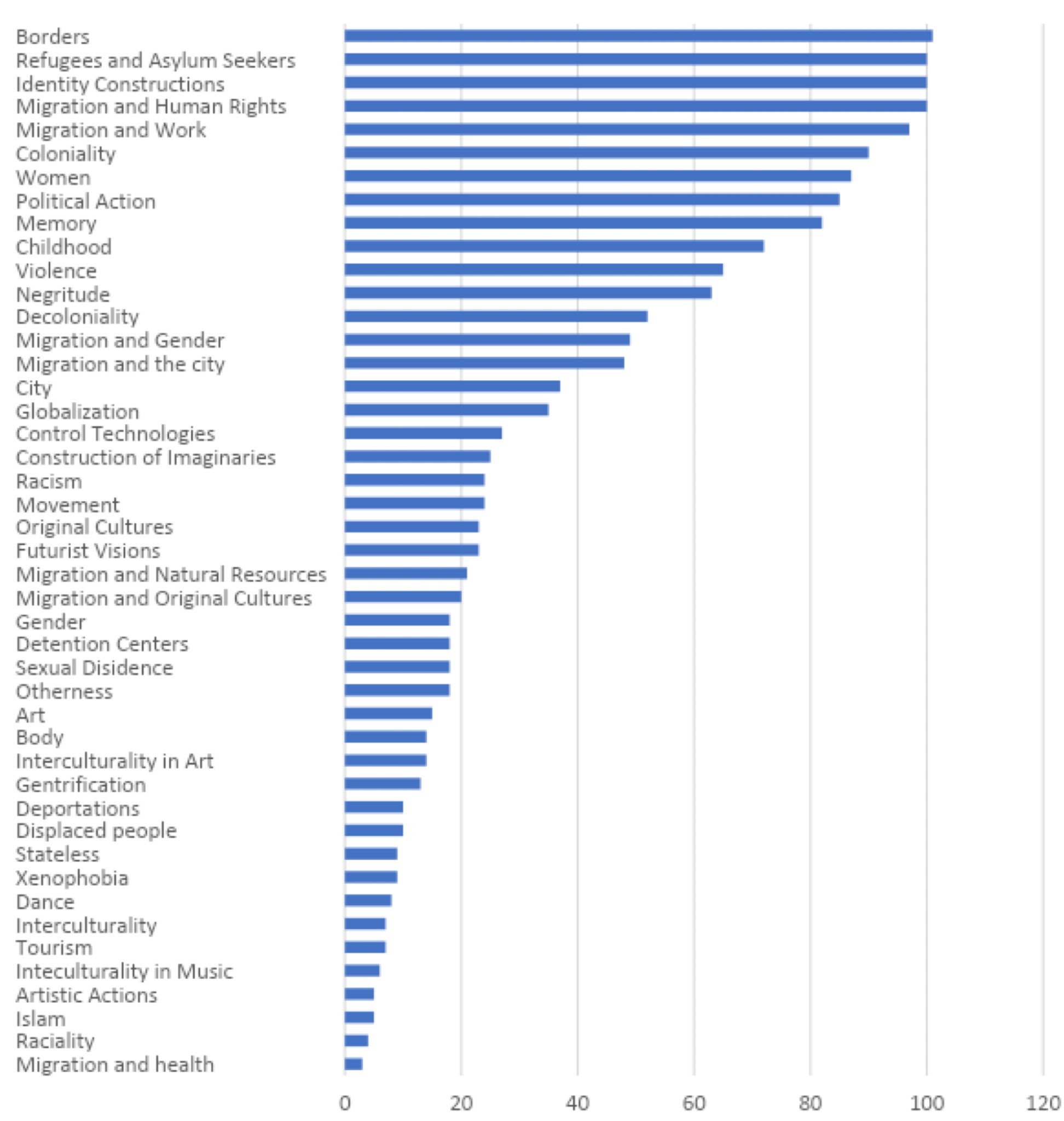
Over the years, the festival has been showcasing diverse themes, according to the internal tags used by the festival’s website. The graph (Figure 1) illustrates the main topics suggested by the films, which have also been discussed in the festival’s Q&A and parallel activities. As the figure shows, the appealing general topics are border crossing, identity constructions, migration and work, women, memory, violence, decoloniality and migrations, and the city, among others.
The lower categories of the graph (Figure 1) invoke issues that might still be underrepresented. The lowest position in the chart underscores the relationship between migration and health issues. Indeed, there are not many documentaries or films that address this topic despite its importance. Citizens, in general, are unaware of the bureaucratic-administrative problems faced by the migrant community in accessing public health systems in certain environments and countries. Other residual topics, as showcased by CineMigrante, are racial issues, Islam, artistic actions, and interculturality in music.
This figure and the conclusions it leads to are made possible thanks to the systema tized and indexed archive we previously mentioned. We find it relevant indeed to monitor and systematize information through internal tags as this activity can provide a clearer overview of the thematic spectrum proposed by film festivals. However, there is a great dispersion of labels, some of which have almost synonymous meanings. A greater effort in the systematization of categorizations would be consequently desirable.
2.6. A Strong Set of After-Screening and Parallel Activities
The festival excels in activity organization, best illustrated in the 5th edition (2014) up to the 12th edition (2021):
conferences, presentations, talks, master classes, round tables, dialogues, and interviews. CineMigrante has tackled numerous topics that contribute to expanding knowledge about the complex issues around migration processes. Political, legal, economic, cultural, artistic, sociological, or media perspectives have been considered over the years. These include the visions and paradigms around the journalistic construction of the figure of migrants, the migration public policies and the national security paradigms, or the issue of Palestine, among so many others;
workshops and laboratories - the practice of cinema and other audiovisual arts. CineMigrante’s organizers have emphasized practical engagement with cinema as an integral part of the festival’s parallel activities. Particularly notable was the “Audiovisual Arts Laboratory”, organized in collaboration with Argentina’s National School of Cinematographic Experimentation and Production under the National Institute of Cinema and Audiovisual Arts. This lab aimed to provide a platform for experimentation through interactions with international directors, targeting Argentine novice audiovisual creators;
artistic interventions. CineMigrante is not only showcased in movie theatres but also conducts annual artistic interventions in public spaces as they believe that artistic creation and reflection are fundamental to democratic processes of inclusion and equality. That is why the intervention transforms these into territories of constant reconstruction, participation, and urgent inclusion. In this sense, the festival is committed to street and urban art and a new generation of young artists from Mexico, Colombia, Chile, Brazil, and Argentina;
exhibitions. In 2006, the festival launched the exhibition “Continuous Session: Memories and Forgetting on Both Sides of the Atlantic” by the Spanish artist María Ruido, born in Orense (Galicia, Spain) in 1967. She produced a film in two parts and authored a book to reflect on the recent (mis) memory of the Spanish State and create a critical mapping of the politics of memory;
video and audio installations. As part of the festival’s artistic approach towards migration topics, video installations also play a role in CineMigrante. In 2016, “Stanze” by Gianluca and Massimiliano De Serio proposed a play performed by some young Somali political refugees in Turin (Italy) inside what was their last “home”, “La Marmora” barracks on Asti Street. The barracks were recently used as a reception center for Somali political refugees, the protagonists of “Stanze”. In 2018, virtual reality technology broke into the festival with the installation of “Future Dimensions VR/ Reality Beyond the Sun”, intended to be a tribute to the Afrofuturist movement. The participants’ experience in the laboratory was described as a profound sensory immersion into the time and space of Africa’s musical pioneers, feminist manifestos, and dystopian landscapes. In 2019, the video installations titled “Post-Colonial Bodies I and II” established a dialogue between two artists, Kader Attia and Onieka Igwe, both proposing to rethink the notion of post-colonial bodies;
concerts. CineMigrante has also organized concerts as a parallel activity. The combination of film screenings and concerts has proved to be very appropriate in this context. In 2017, the screening of the French feature film Allah Bénisse la France! (May Allah Bless France!; 2014), by the hip-hop musician and filmmaker Abd al Malik, was followed by a Q&A and a concert by the artist. The film is a dramatization of his childhood memoir Qu’Allah Bénisse la France, which was first published in 2004. The film stars Marc Zinga as the young Abd Al Malik;
book presentations. CineMigrante demonstrates a strong commitment to cultural activities. These unique events make the festival stand out, as they are rarely seen at other film festivals. By incorporating book presentations, CineMigrante upholds its tradition of innovative ideas, selecting books that aim to broaden understanding. These books are not limited to new releases; for instance, Brighter Than the Sun delves into Afrofuturism’s history and implications through music. This 1998 work by British essayist and artist Kodwo Eshun had a transformative impact on music critique and cultural studies. The festival’s cultural activities span various public spaces in Buenos Aires, like the Cultural Center of Spain, Contemporary Art Center, Kirchner Cultural Center, and more. This reflects their commitment to engaging the entire city. Since 2018, there has been a remarkable surge in activities. Despite their diversity, CineMigrante maintains a consistent identity: feminist, decolonial, and receptive to emerging cultures.
2.7. Sustaining Migrants’ NGOs, Other Institutions, and Media Support for Long-Term Sustainability
A strong aspect of CineMigrante’s programming strategies is the growing and constant collaboration of relevant public organizations that work for migrants. Thus, since the 2011 edition, UNICEF has collaborated with the event by awarding a prize for the best production advocating for the rights of migrant children. Moreover, the IOM has also collaborated since the first editions of the festival.
In its second edition, the IOM partnered with the Ibero-American Program IBERRUTAS to offer an award recognizing the most outstanding film production of Latin American directors, honoring their talent in promoting cultural diversity and protecting migrants’ rights. Furthermore, the United Nations Refugee Agency and the National Refugee Commission joined forces to grant the United Nations Refugee Agency/National Refugee Commission Award, which distinguishes the director of the film that best addresses the refugee issues and promotes respect for cultural diversity and human rights.
Other relevant collaborators of CineMigrante are the National Institute of Cinema and Visual Arts, the Interdisciplinary School of Advanced Social Studies, Experimenting in Social Sciences, the National Institute against Discrimination, Xenophobia, and Racism; Canadian 80; Spanish Cooperation + Embassy of Spain in Argentina; Camões - Instituto da Cooperação e da Língua, Portugal; Goethe Institute; Ambassador of France in Argentine; Institut Français; The Cultural Center San Martin; Apple of Lights; Bicentennial House; Cultural Center of Memory Haroldo Conti; Luminton; Vicente López Culture + Let’s Live Vicente López; DocLisboa: International Film Festival; Cinema Ar: Argentine Contents; Material; Patronage Cultural Participation Buenos Aires City. As a whole, these organizations and institutions, many of which are dedicated to safeguarding migrant rights, ensure the event’s long-term viability and underscore the trust in its artistic and programming excellence.
The media also plays a key role in promoting such events. Since its first edition, which attracted over 5,000 attendees, CineMigrante has garnered interest through coverage in mainstream media, magazines, blogs, and collaborations with institutions. In our analy sis, we have recorded thirty media outlets that regularly publish about CineMigrante.
Among them are prestigious newspapers such as El Argentino.com, Clarín, and Página 12 or TV channels such as Channel 7, Télam, Subway Channel, and Vision 7 International. As a testament to CineMigrante’s diligent efforts, the audio from news coverage and interviews was transcribed and uploaded to the press kit for each edition. Compared to the first edition, the 2021 CineMigrante experienced a notable increase in media coverage, with many new outlets joining the existing ones. The international media presence was also more pronounced: 83 different media sources covered the 2021 edition, and the festival’s website organized them into various categories, including television, radio, digital media, websites, and YouTube channels.
2.8. An Updated, Engaging, and Systematic Website as a Key Element for Recognizing Artistic and Program Quality
Curation and programming are undoubtedly two fundamental axes for the success of a cultural event such as a migration film festival. However, we also believe that other elements contribute to the sustainability and recognition of the artistic and program quality. How the official website represents the event, for example, must also be considered.
CineMigrante stands out for effectively systematizing its activities on its website and providing transparent and comprehensive information. Unlike many festivals, it consolidates details like presentations, sections, collaborators, past editions, and catalogs in one place. This structure extends to consistent catalog formats each year. The website also covers itinerant exhibitions, monitoring their impact in various cities beyond Buenos Aires, including Venice, Bogotá, and Barcelona.
In addition, the historical tab allows access to audiovisual spots created by the festival, photographs, videos, graphics, catalogs of each edition, press releases, and awards. Finally, the media library gives access to the films, as specified in a previous section. It also has a main news page of its own.
CineMigrante joined Twitter (now X) in June 2010, shortly after its inaugural edition. By 2022, it garnered 3,967 followers and followed 2,919 users. Its Facebook page, established on February 20, 2011, boasted 29,406 followers. On Instagram, 323 posts garnered 9,250 followers, while its YouTube channel featured 96 subscribers and 27 videos. Across its initial twelve editions, CineMigrante drew over 92,000 participants to both cinematic venues and human rights initiatives. The 13th edition, analyzed here, took place between September 20 and 27, 2022. Throughout all editions, festival activities have remained free of charge.
Another element that contributes to CineMigrante’s high quality is the careful design of the posters, which are crafted with an artistic commitment that has maintained a consistent identity over the years, aligning perfectly with the festival’s distinctive and groundbreaking brand. Not only the posters but also the overall communication design could be the subject of an article, as it plays a crucial role in shaping the festival’s visual narrative and reinforcing its thematic focus on innovation and social impact.
3. Conclusions
The International Film Festival and Training in the Human Rights of Migrants, organized by CineMigrante in Argentina, serves as a crucial platform for promoting human rights, cultural integration, and social awareness. Since its inception in 2010, the festival has been dedicated to showcasing cinematic works that portray the social realities of migrants and refugees, aiming to challenge prevailing narratives and foster dialogue among diverse communities. CineMigrante’s vision extends beyond merely presenting films; it aims to challenge fixed identities and create a space where diverse cultures converge, fostering mutual recognition and understanding among individuals and communities. Overall, CineMigrante serves as a valuable case study for understanding the role of film festivals in promoting social justice, fostering community engagement, and advocating for migrant rights. Its innovative approach and potential impact make it an important model for similar initiatives around the world.
This study allows us to confirm that CineMigrante shows compelling organizational dynamics that lead to internal coherence, sustainability, and innovation. It represents a particular case in the group of migration film festivals scattered around the world such as MIRADASDOC - held in Tenerife, Spain; AegeanDocs International Documentary Film Festival - based in Lesbos, Greece; Migration Film Festival in Tijuana - held in Tijuana, Mexico; Migrant Film Festival in Ljubljana, Slovenia; International Migration and Environmental Film Festival dedicated to films that explore the intersection of migration and environmental issues, highlighting how climate change and environmental degradation are driving forces behind global displacement. Firstly, because it was one of the first film festivals in Argentina dedicated specifically to migration issues. To this day, it continues to highlight migration-related topics in a country with a complex history of immigration and emigration. In the coming years, this long-standing event may have to face unpredictable challenges due to President Javier Milei’s restrictive policies on immigration, but also in the lack of explicit support for cultural industries.
The festival shares characteristics with other related festivals, such as its focus on social justice and human rights, using film as a tool for advocacy and raising awareness about migration issues. It aims to promote empathy, understanding, and solidarity with migrants and refugees through the power of storytelling. It also shows intersectionality as a key characteristic of the event, recognizing the multiple dimensions of identity and experience that intersect with migration status. It explores issues such as race, ethnicity, gender, sexuality, and socioeconomic status within the context of migration.
Additionally, CineMigrante exhibits unique characteristics that likely contribute to its personality and are key to its success. These include structural aspects, formal elements, and a strong capacity for innovation. Among them,
community engagement: the festival actively engages with migrant communities, NGOs, grassroots organizations, and academic institutions to ensure that migrant voices are heard and represented. It provides a platform for marginalized communities to share their stories and experiences with a wider audience;
international scope: while based in Buenos Aires, CineMigrante has an international outlook, featuring films from around the world that tackle a wide range of migration-related topics. This global perspective fosters cross-cultural dialogue and understanding, highlighting the interconnectedness of migration experiences globally;
educational programs: in addition to film screenings, CineMigrante offers educational programs, workshops, and discussions that deepen understanding of migration issues and promote critical thinking. These programs engage audiences in meaningful conversations and empower them to take action on migration-related issues;
policy impact: CineMigrante’s advocacy efforts have contributed to policy discussions and initiatives related to migration in Argentina and beyond. By bringing attention to pressing migration issues through film, the festival has helped shape public discourse and influence policy decisions at local, national, and international levels;
among the formal innovations, we highlight the following: the festival has invested efforts in creating a systematic and indexed archive, which is crucial for research and innovation; it also demonstrates an anti-essentialist approach in film curation; it features a robust range of after-screening and parallel activities; and it is dedicated regularly to updating its website, systematically delivering web content and ensuring coherent visibility through graphic designing of posters and related materials.
While migration presents challenges and complexities, acknowledging its positive aspects can inform policies and practices that harness its potential benefits while addressing associated concerns. It is essential to consider a holistic understanding of migration that recognizes both its challenges and opportunities for individuals, communities, and societies. Film festivals can play a crucial role in this function.

