


SciELO - Scientific Electronic Library Online

 
vol.11 número4Síndrome de Ramsay-Hunt com Polineuropatia Craniana e Disfagia Grave: Uma Entidade Rara e MultidisciplinarFenómeno Harlequin: um Recém-Nascido com Duas cores índice de autoresíndice de assuntosPesquisa de artigos
Home Pagelista alfabética de periódicos  

Serviços Personalizados

Journal

Artigo

Indicadores

Links relacionados

  • Não possue artigos similaresSimilares em SciELO

Compartilhar


Gazeta Médica

versão impressa ISSN 2183-8135versão On-line ISSN 2184-0628

Gaz Med vol.11 no.4 Queluz dez. 2024  Epub 27-Dez-2024

https://doi.org/10.29315/gm.v1i1.716 

Caso clínico

A Case of Lime-Induced Phytophotodermatitis

Um Caso de Fitofotodermatite Após Exposição à Lima

1. ACeS Porto Oriental, ARS Norte, Porto, Portugal.

2. Department of Dermatovenereology of Centro Hospitalar, Universitário de São João EPE, Porto, Portugal


Abstract

Phytophotodermatitis is a phototoxic reaction caused by combined skin exposure to photosensitizing plants and ultraviolet radiation. Despite being rare, its incidence has increased. We describe a lime-induced phytophotodermatitis case.

A 6-year-old girl presented with a 5-day history of brownish linear plaques on the skin. After careful history taking, it was found the child had been cooking a lime pie and got posterior sun exposure. Her brother had similar lesions. Both family members lesions healed after a month.

Lime-induced phytophotodermatitis is still weakly recognized. Its bizarre configurations and the agents ubiquity can lead to misdiagnosis of child abuse. Exhaustive history and physical examination are crucial. It is required to raise awareness of this disease, so physicians can be prepared to identify it, to ensure the safety of the patients and to tranquilize the family.

Keywords: Child; Citrus/adverse effects; Dermatitis, Allergic Contact/etiology; Furocoumarins/adverse effects; Photosensitivity Disorders/diagnosis

Resumo

A fitofotodermatite consiste numa dermatose por exposição combinada a uma planta fotossensibilizante e a radiação ultra-violeta. Embora seja rara, a sua incidência tem aumentado. Este relato ilustra um caso de fitofotodermatite pós-exposição à lima.

Doente do sexo feminino, 6 anos. Quadro de placas lineares hiperpigmentadas, com 5 dias de evolução. Após colheita de anamnese exaustiva, apurou-se que a criança havia cozinhado uma tarte de lima, com conseguinte exposição solar. O seu irmão apresentava lesões semelhantes. Houve resolução do quadro após um mês.

A fitofotodermatite induzida pela lima é ainda pouco reconhecida. As conformações peculiares na pele e a ubiquidade dos agentes envolvidos podem levar a um diagnóstico errado de abuso infantil. Uma anamnese e exame físico exaustivos são cruciais. Importa consciencializar os médicos acerca desta patologia, para garantir a segurança dos pacientes e tranquilização da família.

Palavras-chave: Criança; Citrinos/efeitos adversos; Dermatite de Contacto Alérgica/etiologia; Furocumarinas/efeitos adversos; Perturbações de Fotossensibilidade/diagnóstico

Introduction

Phytophotodermatitis is a nonimmunologic, phototoxic reaction caused by topical or oral exposure to photosensitizing plant-derived agents, followed by exposure to long-wavelength ultraviolet radiation (UVA).1

This dermatitis is most often seen after exposure to furocoumarins, which are potentially photosensitizing substances, also known as psoralens (mostly 5-methoxypsoralen).

They consist of botanical compounds constitutively present in certain plants, including fruits, leaves and roots.2 The most involved families are Compositae, Umbelliferae, and Rutaceae families, with the most frequent fruits causing this dermatitis including Persian limes and lemons (Rutaceae family); celery, parsley, carrots (Umbilliferae family) a nd fi gs (Moraceae family).3,4 It was described that the main psoralens present in limes are bergapten and psoralen and that the rind includes a greater amount, when compared to the pulp.5,6 When alone, they are innocent but might induce dermatitis if combined with sunlight exposure.

After experiencing UVA radiation, the photosensitizing agents are capable of inducing cell damage in the epidermis, resulting in photosensitive dermatitis. These photochemical reactions may appear in all skin types and are typical in gardeners, as well as in bartenders who manipulate limes while working.3 Although photosensitivity induced by topical agents is relatively rare in the pediatric population, its frequency has increased in the last few years due to the widespread use of those agents in the ecosystem. Plant-induced photosensitivity is the most important type involving children.7

We describe a lime-induced phytophotodermatitis case, appearing in two siblings.

Case report

A 6-year-old girl presented with a 5-day history of brownish linear plaques on the left side of her face, abdomen and knees (Figs. 1 and 2). The lesions were not pruritic and the patient experienced a mild burning sensation. The patient had no history of medication intake or similar episodes. After careful history taking, it was found that the child had been squeezing limes while cooking a lime pie and got posterior UVA radiation exposure, as they had been on a beach vacation.
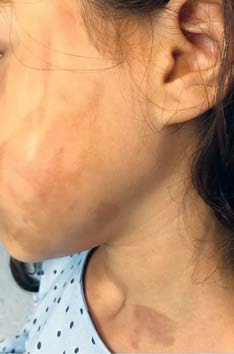
Figure 1: The affected area exhibits an erythematous patch with linear streaks, which later leads to hyperpigmentation, as observed on the face and neck. 
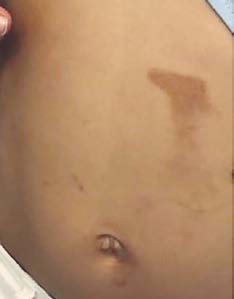
Figure 2: Hyperpigmented lesions on the abdomen. 

Her brother had similar lesions, after the same type of exposure. Since there were only mild symptoms, the diagnostic hypothesis and its expected course were explained to the child and her parents. Moisturizing cream application and reinforced sun protection were recommended, together with covering the affected skin for the next 2-3 days and washing any clothes in contact with the limes. Both family members lesions healed spontaneously after nearly a month, with no scars or hyperpigmentation.

Discussion

Phytophotodermatitis should be hypothesized in the case of a child with a burn reaction, eruption and swelling of the sun-exposed skin, after short-term sun exposure. Clinical manifestations normally include erythema, edema, and blisters 12 to 36 hours after exposure to trigger compounds. Lesions are more frequently nonpruritic and may be associated with pain or burning sensation. The eruptions then place post-inflammatory hyperpigmentation that can take a few days to years to resolve spontaneously. Systemic symptoms are rare and may normally be due to sunburn.8,9 The bizarre configurations of the injuries, reflecting how the juice has dripped on the skin, can mimic a burn-like wound and also be categorized as trauma or child abuse in younger patients.10,11 On behalf of this, proper identification of the lesions nature becomes essential. To access accurate diagnosis, exhaustive history, and physical examination are crucial.

The skin examination should contain details concerning the lesions’ distribution, morphology, timing of onset and duration, as well as a history of interaction with potential photosensitizers and a family history of photosensitivity. It is also important to do the differential diagnosis between this disease, being nonimmunologic and arbitrary, and allergic contact or photoallergic contact dermatitis, which are immunologic responses, only present when there is previous sensibilization. In the latter, unexposed areas tend to be saved.12 A skin biopsy or phototesting is generally not necessary.

In this case, there was no severe reaction and slightly symptomatic hyperpigmentation happened instead, a clinical presentation that was consistent with previous reports. It looks like this happens especially in lime-induced phytophotodermatitis, according to the extent of both fruit and sun exposure, as well as in darker skin, which was also the case (the patient had a skin type IV, according to the Fitzpatrick Scale).13

The treatment depends on the severity of the skin damage, but it mostly relies on discontinuing the exogenous agent exposure, avoiding the sun for 8 to 72 hours and the use of a broad-spectrum sunscreen. After contact with the plants, immediate washing should be performed and emollients should be applied. In moderate to severe cases, topical or systemic steroids may be required.14

Conclusion

Lime-induced phytophotodermatitis is a self-limited phototoxic inflammatory eruption that is still weakly recognized. The diagnostic approach in children is frequently determined by meticulous history and objective examination. The onset of a rash in sun-exposed areas, following direct contact with both potentially photosensitizing substances and UV radiation, should create the hypothesis of phytophotodermatitis.

Should the disease go unrecognized, and given the agents' ubiquity, it can lead to a delayed diagnosis. It is required to raise awareness of this disease, so we ensure the safety of gardeners, chefs, and children. The typical clinical manifestations can allow for a diagnosis based solely on the physical exam. Early acknowledgment is crucial to diminish longstanding complications, often related to insufficient sun protection. Additionally, the tranquilization of the child’s family is extremely important, regarding the potential misdiagnosis of any kind of physical abuse. Physicians should be prepared to identify this illness.

References

1. Bolognia JL, Schaffer JV, Cerroni L. Dermatology. 4th ed.London: Elsevier; 2018. [ Links ]

2. Kullavanijaya P, Lim HW. Photoprotection. J Am Acad Dermatol. 2005;52:937-58. doi: 10.1016/j.jaad.2004.07.063. [ Links ]

3. Fisher AA. Contact dermatitis. Philadelphia: Lea & Febiger; 1986. [ Links ]

4. Goskowicz MO, Friedlander SF, Eichenfield LF. Endemic ‘‘lime’’ disease: phytophotodermatitis in San Diego County. Pediatrics. 1994;93:828-30. [ Links ]

5. Nigg HN, Nordby HE, Beier RC, Dillman A, Macias C, Hansen RC. Phototoxic coumarins in limes. Food Chem Toxicol. 1993;31:331-5. doi: 10.1016/0278-6915(93)90187-4. [ Links ]

6. Wagner AM, Wu JJ, Hansen RC, Nigg HN, Beiere RC. Bullous phytophotodermatitis associated with high natural concentrations of furanocoumarins in limes. Am J Contact Dermat. 2002;13:10-4. doi: 10.1053/ajcd.2002.29948. [ Links ]

7. Bowers AG. Phytophotodermatitis. Am J Contact Dermat. 1999; 10:89-93. doi: 10.1016/s1046-199x(99)90006-4. [ Links ]

8. Webb JM, Brooke P. Blistering of the hands and forearms. Phytophotodermatitis. Arch Dermatol. 1995;131:834-35,7-8. [ Links ]

9. Chantorn R, Lim HW, Shwayder TA. Photosensitivity disorders in children: part I. J Am Acad Dermatol. 2012;67:1093. e1-18; quiz 1111-2. doi: 10.1016/j.jaad.2012.07.033. [ Links ]

10. Coffman K, Boyce WT, Hansen RC. Phytophotodermatitis simulating child abuse. Am J Dis Child. 1985;139:239-40. doi: 10.1001/archpedi.1985.02140050033015. [ Links ]

11. Swerdlin A, Berkowitz C, Craft N. Cutaneous signs of child abuse. J Am Acad Dermatol 2007;57:371-92. doi: 10.1016/j.jaad.2007.06.001. [ Links ]

12. Lim HW. Abnormal responses to ultraviolet radiation: photosensitivity induced by exogenous agents. In: Goldsmith LA, Katz SL, Gilchrest BA, Paller AS, Leffell DJ, Wolff K, editors. Fitzpatrick’s dermatology in general medicine. 8th ed. New York: McGraw-Hill; 2012. p. 1066-74. [ Links ]

13. Choi JY, Hwang S, Lee SH, Oh SH. Asymptomatic Hyperpigmentation without Preceding Inflammation as a Clinical Feature of Citrus Fruits-Induced Phytophotodermatitis. Ann Dermatol. 2018;30:75-8. doi: 10.5021/ad.2018.30.1.75. [ Links ]

14. Bosch JJ. Phytophotodermatitis. J Pediatr Health Care. 1997;11:84, 97-8. doi: 10.1016/S0891-5245(97)90006-7. [ Links ]

Declaração de contribuição/Contributorship statement

JS: Conception of the article, writing and final approval.

AN: Conception of the article, review and final approval.

JS: Conceção do artigo, escrita e aprovação final.

AN: Conceção do artigo, revisão e aprovação final.

Responsabilidades éticas

Conflitos de interesse: Os autores declaram a inexistência de conflitos de interesse na realização do presente trabalho.

Fontes de financiamento: Não existiram fontes externas de financiamento para a realização deste artigo.

Confidencialidade dos dados: Os autores declaram ter seguido os protocolos da sua instituição acerca da publicação dos dados de doentes.

Consentimento: Consentimento do doente para publicação obtido.

Proveniência e revisão por pares: Não comissionado; revisão externa por pares.

Ethical disclosures

Conflicts of interest: The authors have no conflicts of interest to declare.

Financing support: This work has not received any contribution, grant or scholarship.

Confidentiality of data: The authors declare that they have followed the protocols of their work center on the publication of patient data.

Patient consent: Consent for publication was obtained.

Provenance and peer review: Not commissioned; externally peer-reviewed.

Received: October 12, 2023; Accepted: September 11, 2024

Autor Correspondente/Corresponding Author: Joana Sousa; joanaptsousa@gmail.com ORCID ID: https://orcid.org/0000-0001-6023-9089

Creative Commons License This is an open-access article distributed under the terms of the Creative Commons Attribution License