




 Inglês (pdf)
 Artigo em XML
 Referências do artigo
 Tradução automática
 Enviar este artigo por email
 Citado por SciELO
  Similares em
SciELO
Similares em
SciELO 
 Permalink

Introduction
Contraceptive counselling holds significance as a crucial aspect of family planning in Primary Care (PC). This medical consultation aids women in making informed decisions regarding pregnancy preparations, as well as in the selection, discontinuation, or switch of contraceptive methods. The decisions are based on a thorough assessment of the patient’s needs and preferences.1
According to the latest update from the Gynaecology and Obstetrics Portuguese Societies Guidelines, combined hormonal contraceptives (CHC) are recommended for: 1) all women who prefer a reversible, safe, and coitus-independent method; 2) women in whom the benefits of CHC continue to outweigh the risks; and 3) women in whom the non-contraceptive benefits of CHC could provide a therapeutic advantage and enhance the patient’s quality of life.2
According to the World Health Organization (WHO) eligibility criteria for contraceptive method use, Combined Hormonal Contraceptives (CHC) are contraindicated in situations classified as Category 4, and alternative contraceptive methods are recommended in Category 3 cases. In contrast, when no restrictions apply to CHC use, it is classified as Category 1. If the benefits of using CHCs outweigh the known or potential risks, the method falls under Category 2. Both Category 1 and 2 permit the use of CHCs.2,3 The eligibility criteria generally remain consistent across different routes of CHC administration, including oral, vaginal, and transdermal methods.2,3
Consequently, specific clinical conditions, such as diagnosed migraines (with or without aura), warrant the avoidance of CHC use, with a recommendation for alternative contraceptive methods.2
Migraine constitutes a significant health concern, being a prevalent neurological disorder in Primary Care (PC).4 According to the latest Global Burden of Disease study, migraine ranks as the second leading cause of disability globally and the primary cause of disability among young women.5-7 In 2019, an estimated 35.41% of women in Portugal, aged 15 to 49, were reported to have migraines.8
Migraine episodes usually involve self-limited headaches lasting 4 to 72 hours, characterized by moderate to severe intensity, typically unilateral. In 25% of cases, migraines are accompanied by aura, presenting as reversible neurological symptoms preceding the headache, such as visual disturbances, paraesthesia, speech impairments, confusion, ataxia, or obtundation.
In addition to aura, migraines may manifest with other symptoms, including nausea (80%), vomiting (40%-50%), photophobia (60%), phonophobia (50%), and osmophobia (10%).4,9,10
The diagnosis of migraine primarily relies on clinical evaluation; therefore, a comprehensive history, coupled with a thorough central nervous system examination, is imperative. The detailed patient history assumes an important role in the diagnostic process for migraine, and the physician's primary objective is to discern any additional factors that might contribute to the patient's heightened susceptibility to migraines.6,11,12
CHC have the potential to trigger or exacerbate pre-existing migraines in women with a predisposition, and they may even initiate the emergence of aura in women experiencing migraines without aura.1 This effect is also observed in cyclical (menstrual) migraines.
Numerous studies have indicated an elevated risk of stroke in individuals with migraines, particularly those with aura, although this risk is not consistently demonstrated in individuals without aura.7,13-15 Consequently, in such cases, it is advisable to consider the use of progestin-only contraceptives or nonhormonal methods..
Progestin-only pills (POP) appear to be associated with a reduction in migraine frequency (with and without aura), as well as in the duration of migraines and the use of analgesics and triptans.1
In our clinical practice, instances of non-compliance with the latest recommendations were identified.
The primary objective of our project was to ensure the appropriate prescription of contraceptive methods for women currently diagnosed with migraine, with or without aura, in accordance with the most recent guidelines. Secondary objectives included enhancing the quality of clinical records related to contraceptive usage among patients with migraines and emphasizing the significance of diagnostic and therapeutic reviews conducted by family physicians.
Our study holds particular importance and relevance as no studies have been found to support or shape the status of this issue at the national level. Therefore, our work is deemed relevant, offering clear benefits to the population, and contributing valuable insights to the field.
Material and methods
We conducted a retrospective and continuous quality improvement study involving patients registered in Unidade de Saúde Familiar Faria Guimarães, in Porto, Portugal. Patients with a clinical diagnosis code “N89 - Migraine”, as per the International Classification of Primary Care 2nd Edition (ICPC2) were selected. Our study focused on women diagnosed with migraine, whether with or without aura, and those currently using Combined Hormonal Contraceptives (CHC) or with outdated contraception records (last updated more than 3 years ago), irrespective of the method.
Exclusions comprised women below 15 or above 54 years of age, pregnant individuals and postmenopausal women.
Electronic health records from the Information and Monitoring Module of Functional Units (MIM@UF) were utilized for data collection across two stages.
In the initial phase, we collected study variables from the “Family Planning Program” and “List of Problems” within the SClinico® application, including women's age, the contraceptive method in use, and the presence of a migraine diagnosis. MIM@UF and SClinico® facilitated the identification and validation of the target population by applying inclusion and exclusion criteria. Analysis of the first-phase results confirmed the necessity for intervention to enhance prescription quality. Subsequently, a clinical session was conducted by the project authors aiming the medical and nursing team to address the issue and propose corrective strategies. Eligible women were identified and provided to corresponding family doctors.
Clinical secretaries undertook the responsibility of contacting patients to arrange appointments, while both family doctors and nurses conducted individual appointments for eligible patients.
Subsequently, patients were evaluated during consultations, and based on each case, contraceptive counselling was provided, including recommendations for changing contraceptive methods if necessary. The different options, risks, and benefits of each method were discussed.
In the second phase, we re-evaluated the initially collected data, performing a comparative analysis between the two study phases using descriptive statistics
(Excel®). We compared the percentage of women diagnosed with migraine using CHC, before and after the intervention carried out by each family doctor and analyzed the new contraceptive methods they adopted. We anticipated that the intervention's effectiveness would manifest in an increased absolute number of women diagnosed with migraine, with or without aura, correctly medicated with progestin-only contraceptives or nonhormonal methods. We considered a 70% correct medication rate as “desired” and 95% as “optimum/excellent”, while a value below 70% was deemed “insufficient”.
Finally, we presented the data to the team. The project obtained approval from the Ethics Committee of the North Regional Health Administration (ARS), accompanied by authorizations from the Executive Board and Clinical Council of the Health Center Group (ACeS). Furthermore, the study received the coordinator's approval from the Family Health Unit to proceed.
Confidentiality for participants was rigorously maintained throughout the data collection process, ensuring that information remained inaccessible to external parties. The researchers committed to utilizing the data exclusively for the study's intended purpose and refrained from any alternative use. Presentations of results were aggregated at the functional unit level, with no individualization for each doctor. Importantly, the study incurred no costs to the ACeS.
Results
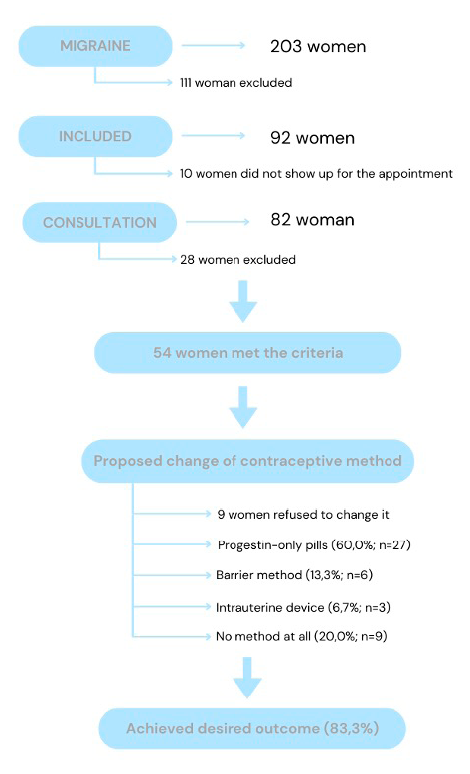
From an initial pool of 203 eligible women with documented migraine diagnoses in their medical records, 92 individuals were identified as having both a confirmed diagnosis of migraine and utilizing combined hormonal contraceptives (CHCs) or lacking an update on their current contraceptive method within the past three years. Subsequently, these individuals were contacted, and appointments were scheduled.
Following the summons for a face-to-face consultation, 10 women did not respond to the consultation request. Subsequently, a total of 82 women were present for the consultation.
Post-consultation, the family doctor deactivated or eliminated the codified diagnosis of migraine from the list of problems for 14 women. This decision was based on the determination of misdiagnoses or migraine not presently afflicting these individuals. A significant proportion of these diagnoses were likely coded during acute situations in consultations with other healthcare providers, rather than the family physician. Some diagnoses corresponded to headache complaints that did not meet the criteria for migraine. Additionally, in other cases, there was no record of headache complaints in the medical records, suggesting potential coding errors.
Therefore, no proposal for contraceptive method change w as made for t hese women. Moreover, the current contraceptive methods were verified for women whose records lacked updates within the past three years. This verification excluded 14 women who were already with an adequate contraceptive method or were not using contraception at all. In these women, the method in use was confirmed and validated. In the final sample, 54 women possessed a confirmed diagnosis of migraine and were using validated combined hormonal contraception within the past three years. Among them, 12 women (22%) were diagnosed with migraine with aura.10 Of the 54 women, 40 were actively undergoing medication to control migraine - 34 with SOS therapy and 6 with prophylactic therapy.
The remaining 14 women were not undergoing any form of therapy.
A proposal was put forth to change the contraceptive method for all these women based on the eligibility criteria outlined by the World Health Organization.3
Following an explanation of the associated benefits and risks, 45 women agreed to the change methods, while 9 women opted to retain their current contraceptive method. The primary reasons cited for refusing the change were a successful adaptation to the current method, non-contraceptive benefits (such as acne and hirsutism control, and relief from dysmenorrhea), infrequent migraine episodes, previous difficulties with non-combined hormonal contraceptive methods, a desire to discuss the decision with a gynecologist, or medical indications due to associated comorbidities (e.g., hyperprolactinemia). The methods used by these women included oral combined hormonal contraceptives (=8) and a vaginal ring (=1).
As for the remaining sample, 45 women accepted the contraceptive change. The methods in use in these women corresponded to oral combined hormonal contraceptives (=44) and vaginal rings (=1). After reviewing the different contraceptive options, most women opted for the oral progestin hormonal contraceptive (60,0%; n=27) and the remainder chose other methods, such as the barrier method (13,3%; n=6) an intrauterine device (6,7%; n=3) or no method at all (20,0%; n=9), which can be explained considering some women were sexually inactive or simply because it was a personal preference.
Conforming to the established quality pattern, a value of 83.3% was attained, aligning with the desired result range of 70%-94% (Fig. 1).
Discussion
It has been established that the contraceptive strategy for women with migraine shall avoid the use of estrogen-based hormonal methods, either choosing a sole progestin hormonal method or a non-hormonal contraception strategy. Despite the solid and growing evidence of its deleterious effects, the use of oestrogen-based hormonal contraceptives in women with migraine is still a reality by several factors, including medical inertia, patient resistance to changes in long-term contraception strategies, and limited tolerability or intolerable adverse reactions to alternative methods.
The main goal of this project was to evaluate and guarantee the adequate prescription of contraceptive methods in women with an active diagnosis of migraine, with or without aura, following current therapeutic recommendations.
During routine consultations, especially those concerning family planning, recalling contraindications for combined hormonal contraception can be challenging.
Given the high prevalence of migraine in our patient population, we identified an opportunity to address this issue. Through collaborative efforts, we not only undertook a comprehensive review of specific indications for contraceptive use in patients with a migraine diagnosis but also emphasized the importance of considering other specific conditions that require extra caution in contraceptive decision-making, as outlined in the Guidelines of the Portuguese Societies of Gynaecology and Obstetrics.2
Importantly, for individuals who chose not to pursue contraception and were at risk of unintended pregnancy, it is crucial to note that they received thorough counselling regarding the inherent risks associated with pregnancy. This comprehensive counselling aimed to ensure that each participant was well-informed and empowered to make decisions aligned with their circumstances and preferences.
While the project proved successful, it is crucial to ongoingly monitor the targeted population, evaluate their adaptation to the new contraceptive method, and foresee the potential necessity for further adjustments. Optimal contraceptive selection should align with patient values and preferences.16 It is essential to bear in mind the dynamic nature of this population, necessitating flexibility in adapting the contraceptive method whenever a new migraine diagnosis arises.
The main limitations of the project included the option of maintaining the combined-contraceptive method despite the associated explained risks and the fact that not all the women summoned attended the consultation, leaving, however, the possibility of addressing the issue in a subsequent query.
Conclusion
Migraine stands out as a prevalent diagnosis, emphasizing the importance of considering the appropriateness of contraception methods for women with this condition. This project effectively showcased that, with a motivated and well-informed professional team, it is possible to significantly enhance the care provided to the studied population.
Despite the acknowledged limitations, the authors assert that the benefits were evident not only for the present population but also in reinforcing the medical team's awareness of the therapeutic significance when dealing with migraine, shaping their future practices.
Additionally, there were notable gains in health liter-acy as the foundational aspects of the project were explained to the participating women.
The authors, therefore, view the project's outcome as positive, deeming it an innovative initiative that contributed to promoting an improvement in the quality of health services. Exploring the application of the same intervention in other healthcare centers could offer valuable insights into its potential positive outcomes.
A future reassessment of the population would be intriguing, providing an opportunity to validate the longterm effectiveness of the project.

