




 Inglês (pdf)
 Artigo em XML
 Referências do artigo
 Tradução automática
 Enviar este artigo por email
 Citado por SciELO
  Similares em
SciELO
Similares em
SciELO 
 Permalink
Introduction
Sports practice has been recognized as a crucial factor in children and youth’s positive development, offering benefits across multiple domains: physical (e.g., healthy growth, improved motor skills, enhanced muscular strength), psychological/emotional (e.g., increased self-esteem and confidence), social (e.g., positive peer relationships, leadership skills) and intellectual (e.g., improved academic performance) (Bean & Forneris, 2016; Dorsch et al., 2022; Fraser-Thomas et al., 2005). However, for these benefits to be achieved and the likelihood of dropout reduced, athletes must feel motivated in their practice (Balish et al., 2014).
Indeed, motivation plays a central role in enabling athletes to experience these benefits fully, as it drives the initial decision-making process to pursue a goal or satisfy a need and sustains their engagement over time (Gopalan et al., 2017). The literature offers several theories that explain the influence of motivation on sustained practice. According to the goal-orientation theory (Ames, 1992; Dweck, 1986; Elliot & Harackiewicz, 1996), an individual’s goals can be mastery-orientated (focused on learning and personal improvement) or performance-orientated (focused on demonstrating skills or gaining approval) (Cook & Artino Jr, 2016). Athletes with mastery-orientated goals who believe abilities can be developed tend to experience greater enjoyment in sports practice, which promotes their intention to continue participation (Gardner et al., 2017). Additionally, self-determination theory (Ryan & Deci, 2000) posits that intrinsic motivation develops when three basic psychological needs are satisfied: perceived competence, autonomy, and sense of belonging. When these factors are present, individuals are more likely to engage in activities voluntarily and feel intrinsically motivated (Cook & Artino Jr, 2016). To better illustrate the interconnection of perceived competence, autonomy, and sense of belonging and their influence on motivation, Eccles and Wigfield (2002) proposed the expectancy-value theory. Drawing on Atkinson’s foundational work (1957), this theory links performance, persistence, and achievement-related choices to an individual’s beliefs about task value (Eccles & Wigfield, 2002), explaining how expectations of success and the value attributed to an activity influence the achievement of objectives.
Expectations of success refer to a person’s belief in their ability to succeed (Muenks et al., 2018; Wigfield & Eccles, 2000). According to Fredericks and Eccles (2005), expectations of success and perceptions of competence are closely related. Young individuals with higher perceived competence are more likely to exhibit stronger expectations of success, persistence, effort, and intrinsic motivation (Bortoli et al., 2011; Harter, 1978). Additionally, young athletes’ perception of how their parents evaluate their competence, known as reflected appraisals, can mediate the relationship between parental assessments and their children’s motivation (Bois et al., 2005; Harwood et al., 2019). These perceptions influence self-esteem (O’Rourke et al., 2012), behaviour towards teammates and opponents (Danioni & Barni, 2019), as well as goal orientation, which subsequently impacts perceived competence and enjoyment in sports (Atkins et al., 2015; Nicholls, 1984). The value attributed to sport, the other dimension of expectancy-value theory, reflects how much an individual value or enjoys the activity. While external factors play an important role in shaping the subjective value of a task, self-perception ultimately serves as the most critical determinant of this value and subsequent behaviour (Eccles & Wigfield, 2002).
Several authors have applied the expectancy-value theory to sports (e.g., Boiché et al., 2011; Fredricks & Eccles, 2005; Simpkins et al., 2012) to explore athletes’ actions, motivation, and frustration. Research has primarily focused on how the theory influences athletes’ performance throughout their development (e.g., Boiché et al., 2011; Knight et al., 2016; Rouquette et al., 2020), aiming to explain the transfer of value and expectations of success/perception of competence to sports performance. Collectively, these studies have concluded that the value attributed to sports, alongside expectations of success/perception of competence, significantly impacts the development of motivation, sustained engagement in sports, and a reduced likelihood of sports dropout (Boiché et al., 2011; Guillet et al., 2006; Straub, 2019).
Building on applying the expectancy-value theory in sports, it is important to highlight parents’ crucial role in shaping young athletes’ expectations, values, and motivation. Their influence extends beyond logistical support, as they often act as role models through their involvement in sports as coaches, directors, or former athletes (Dorsch et al., 2022). Parents can reinforce the value of sports and sports participation by providing opportunities and emotional support, contributing to positive and meaningful experiences (Fredricks & Eccles, 2005). Moreover, the motivational climate created by parents, reflected in their support and behaviours, directly influences young athletes’ perceptions of competence (Sari & Bizan, 2022). The literature has consistently demonstrated that a parental motivational climate that emphasizes learning and intrinsic motivation fosters greater self-esteem, social competence, enjoyment of sports, and sustained engagement in sport; conversely, a results-oriented environment focused on comparison and criticism can increase anxiety and reliance on extrinsic motivation (Ames, 1992; Atkins et al., 2015; Hardwood et al., 2019; Spittle & Byrne, 2009).
For example, in a study of athletes aged 12 to 16, Boiché et al. (2011) found that fathers who stressed the importance of sports tended to exhibit praise and understanding behaviours but were also more directive and pressuring. Mothers’ directive behaviours were associated with lower perceptions of competence, whereas praising and understanding behaviours positively predicted intrinsic motivation. Furthermore, athletes who perceived higher levels of maternal praise and understanding, alongside active paternal involvement, reported attributing greater value to sports. Supporting these findings, Wagnsson et al. (2016) showed that young athletes who experienced a supportive and enjoyable climate were less prone to engage in unsportsmanlike conduct, with maternal influence playing a particularly significant role. Meanwhile, Appleton et al. (2011), in a study of 10- to 18-year-old athletes investigating the motivational climate associated with the development of perfectionist cognitions, identified a parental climate focused on concern, particularly from same-sex parents, as the strongest predictor. In other words, athletes who perceived a climate emphasising mistakes and constant criticism were likelier to develop perfectionist cognitions.
However, despite clear evidence that the parental motivational climate directly influences young athletes’ perceptions of competence and the value they attribute to sports - impacting their enjoyment, intrinsic motivation, and long-term involvement (Appleton et al., 2011; Wagnsson et al., 2016) -, studies in Portugal analysing athletes’ perceptions of parental behaviour in sports practice remain scarce (Coutinho et al., 2018). Such research is essential, as cultural, social, and economic contexts distinctly influence these dynamics (Simpkins et al., 2012). In this regard, studying the motivational climate induced by parents, perceptions of competence (self-perceptions and reflected appraisals) and the value attributed to sport is essential for understanding family and cultural dynamics on youth sports development. Exploring these variables in Portuguese can reveal cultural nuances and identify factors that promote healthy behaviours (Boiché’ et al., 2011; Gao et al., 2024; O’Rourke et al., 2012). These insights are fundamental for improving educational and intervention projects in youth sports, providing athletes with better support, and reducing sports dropout.
Considering the above, this study explored the relationships between the parental motivational climate, perceived competence (self-perceptions and reflected appraisals), and the value attributed to sports in young athletes practising different team sports. The analyses were designed to examine linear and more complex relationships among these variables and assess their predictive influences using a combination of bivariate and canonical correlations and regression approaches.
Methods
Participants
A total of 643 male players, aged between 10 and 16 years (M = 13.4 ± SD = 1.28), participated in this study. All players were affiliated with sports clubs in the northern region of Portugal and competed in handball (n = 100; 15.6%), basketball (n = 219; 34.1%), soccer (n = 175; 27.2%), water polo (n = 63; 9.8%), and volleyball (n = 86; 13.4%).
Instruments
The questionnaires used to assess perceived competence and value attributed to sport were based, respectively, on the Child’s Perception of Sport Competence and Child’s Perception of Sport Value scales, initially developed by Fredricks and Eccles (2005) and translated and adapted into Portuguese by Dias and Fonseca (2009a). The perceived competence instrument comprised five items, answered on a 5-point Likert scale ranging from 1 (Very Poor) to 5 (Very Good), with higher values indicating greater levels of perceived competence. The instrument assessing the value attributed to sport consisted of seven items assessing dimensions such as liking and importance of sport, also rated on a 5-point Likert scale, with higher values reflecting a greater appreciation of sport.
To assess parental reflected appraisals, we used a questionnaire based on the Perceptions Mirroirs des Parents, initially developed by Bois (2003) and translated and adapted into Portuguese by Dias and Fonseca (2009b). This instrument consists of two scales, one assessing the father’s reflected perceptions and the other the mother’s, each comprising three items. Items were rated on a 5-point Likert scale ranging from 1 (Very Poor) to 5 (Very Good), with higher scores indicating higher levels of perceived competence.
We used the Portuguese version of the Parent Initiated Motivational Climate Questionnaire (PIMCQ2; White et al., 1992) to assess the parental motivational climate. Santana et al. (2010) translated and validated the instrument into Portuguese. This instrument consists of 36 items divided into three dimensions: pleasure in learning (9 items), emphasis on mistakes (5 items), and valuing success without effort (4 items). Of these, 18 items pertain to the father and 18 to the mother. Participants responded using a 5-point Likert scale ranging from 1 (Strongly Disagree) to 5 (Strongly Agree).
Procedures
Data collection was carried out as part of the In Search of Excellence - A Mixed-longitudinal Study in Young Athletes (INEX) project run by the Centre for Research, Training, Innovation, and Intervention in Sport (CIFI2D) at the Faculty of Sport of the University of Porto. The institution’s Ethics Committee (CEFADE 13.2017) approved the study, and the clubs formally permitted data collection. Participants and guardians were informed about the study’s aims, their involvement, and the right to withdraw at any time. The confidentiality of the data was ensured, and both signed an informed consent form.
Statistical Analysis
Preliminary Analyses
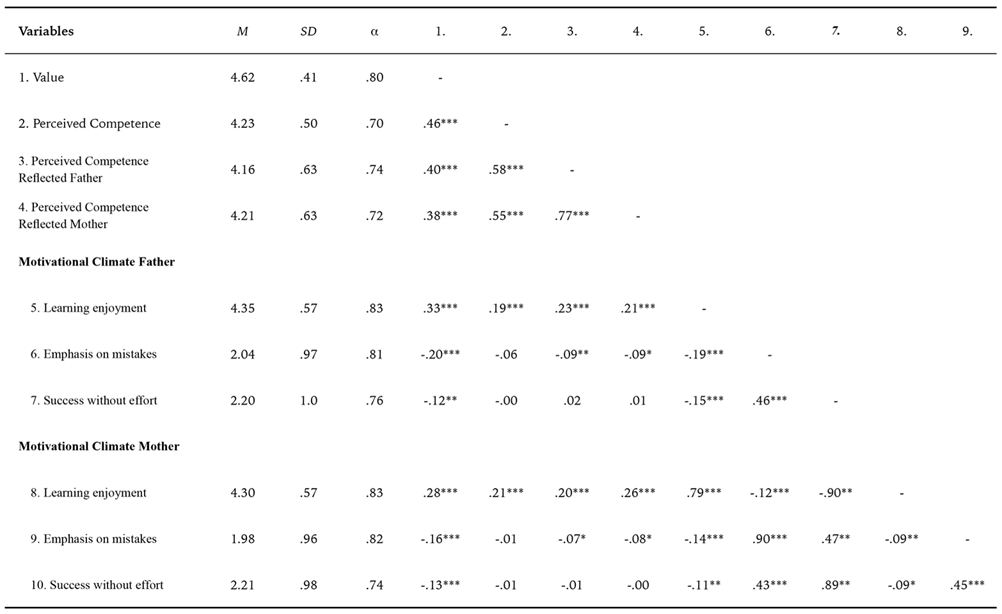
The data was analysed using SPSS, 29.0 software. First, the existence of missing values was examined. The missing values for the items in the scales used in this study ranged from 0 to 2.6%. Tabachnick and Fidell (2007) suggested that when missing values in research data are less than 5%, mean substitution should be used. Mean substitution is a procedure used in statistical analysis to replace missing values in a data set with the average of the valid values for that indicator in the data set (Hair et al., 2017). Accordingly, this study used mean substitution to deal with missing values. The data was then examined for possible univariate and multivariate outliers. Fourteen extreme outliers were identified through boxplots, and by calculating the limits Q1 - 3 * IQR and Q3 + 3 * IQR, concerning multivariate normality, the Mahalanobis distance (D2) revealed significant deviations in 28 subjects, which were eliminated. The number of participants, which was initially 685, stood at 643. Cronbach’s (1951) alphas were calculated to assess the reliability of the instruments’ sub-scales, and most of the alpha coefficients showed values above the criterion of .70 proposed for the psychological domain (Nunnally & Bernstein, 1994) (Table 1).
Main Analyses
Descriptive statistics were used to summarise the main characteristics of the data set, providing insight into the central tendencies and variability of the variables. Correlation analysis was then carried out to examine the linear relationships between various pairs of variables. In addition, canonical correlation analyses were performed to examine the pattern of relationships between two sets of variables. The first set included reflected perceptions of competence and the parental motivational climate, while the second set comprised perceptions of competence and the value attributed to sport. Subsequently, two multiple hierarchical regressions were conducted to explore the impact of the parental motivational climate and reflected appraisals on perceived competence and the value attributed to sport. In the first step, the motivational climates initiated by the father and mother were included, followed by the reflected appraisals for both parents in the second step.
Results
Descriptive and Correlational Analysis
Descriptive and correlational statistics are provided in Table 1. The analysis revealed that positive parental reflected appraisals and motivational climates focused on learning and enjoyment were consistently associated with higher perceived competence and the value young athletes attributed to sport, whereas climates emphasizing mistakes or success without effort showed negative associations.
Canonical correlations
A canonical correlation analysis examined the multivariate relationships between the variables (Table 2). The first canonical variable combined motivational climates and reflected perceptions of competence, while the second combined perceptions of competence and value. Two canonical functions emerged: Function 1 (Wilks’ Λ = .55, F (16, 1266) = 27.922, p < .001) accounted for 41% of the variance (rc = .64), while Function 2 (Wilks’ Λ = .93, F (7, 634) = 7.102, p < .001) accounted for only 7% of the variance (rc = .27).
Although both canonical functions were statistically significant, Function 2 accounted for a small proportion of variance and had low redundancy indices, indicating limited practical relevance. Specifically, the redundancy index for Function 1 showed that approximately 10.6% of the variance in parental motivational climate and reflected appraisals (set 1) was explained by the canonical variable in set 2., while 29.1% of the variance in perceived competence and value (set 2) was explained by the canonical variable in set 1. set 1. In contrast, for the second canonical function, the redundancy index for parental motivational climate and reflected appraisals (set 1) showed that only 1.8% of the variance in set 1 was explained by the canonical variable in set 2; additionally, the redundancy index for perceived competence and value (set 2) indicated that only 2.1% of the variance in set 2 was explained by the canonical variable in set 1. This suggests that Function 2 may have limited practical relevance. Therefore, we primarily focus on the first canonical function, which accounted for a larger percentage of variance and provided more meaningful insights.
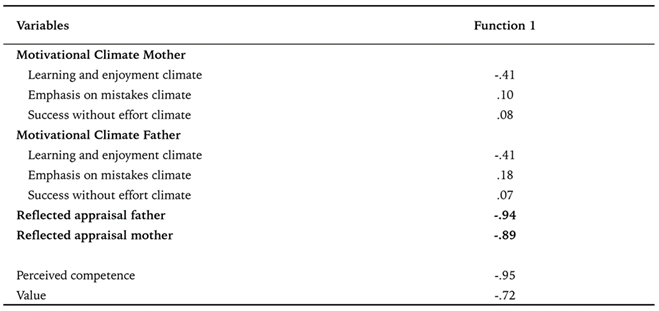
An analysis of the canonical loadings for Function 1 revealed that the fathers’ (rs = -.94), and mother’ (rs = -.89) reflected appraisals, along with a motivational climate emphasizing pleasure in learning from both parents (rs = -.41 for both mother and father) were the main contributors to the first canonical variable. Both perceived competence (rs = -.95) and value (rs = -.72) contributed to the second canonical variable. The negative loadings across all variables suggest that positive motivational climates and higher reflected appraisals are associated with greater levels of perceived competence and value attributed to sports.
Regression analyses
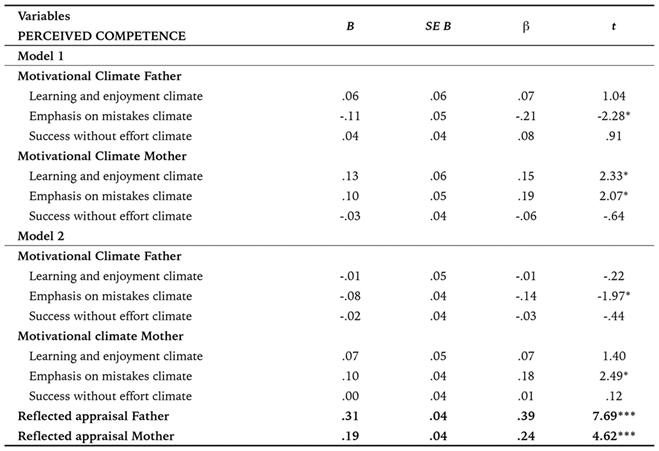
Multiple hierarchical regression was conducted to analyse the relationship between the predictor variables (motivational climate and reflected appraisals) and perceived competence (Table 3). In model 1, the motivational climates initiated by the father and mother were included, explaining 5% of the variance in perceived competence (F (6, 642) = 6.02, p < .001). When reflected appraisals were added in Model 2, the total variance explained increased substantially to 38% (F (8, 642) = 48.02; p < .001). In the final adjusted model, four predictors emerged as statistically significant. The father’s (ß = .39, p < .001) and mother’s (ß = .24, p < .001) reflected appraisals had the strongest predictive values, followed by the father’s (ß = -.14, p = .049) and mother’s (ß = .18, p = .013) emphasis on mistakes. These findings indicate that high levels of reflected appraisals by both parents, combined with a less mistake-focused climate from the father and a slightly more mistake-oriented climate from the mother were associated with higher levels of perceived competence.
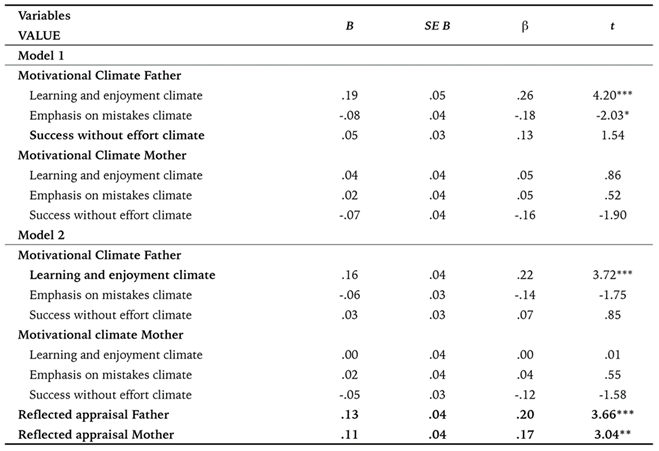
Regarding the value athletes attributed to sport, the multiple hierarchical regression performed to examine how the predictor variables - parental motivational climate and reflected appraisals - were associated with this outcome showed that, in Model 1, which included both parents’ motivational climates as predictors, was statistically significant (F (6, 642) = 16.09, p < .001) and explained 13% of the variance. When the parents’ reflected appraisals were added in Model 2, the total variance explained increased to 25% (F (8, 642) = 25.97, p < .001). In the final adjusted model, three predictors proved to be statistically significant: the father’s learning and enjoyment climate (β = .22, p < .001), the father’s reflected appraisals (β = .20, p < .001) and the mother’s reflected appraisals (β = .17, p < .002). These findings suggest that higher levels of reflected appraisals from both parents, as well as a motivational climate where the fathers emphasised learning and enjoyment, were associated with greater value attributed to sport (Table 4).
Discussion
This study investigated the relationships between parental motivational climate, reflected appraisals, perceived competence, and the value young athletes assign to their activity. Overall, the results suggest that the combined role of parental reflected appraisals and parental motivational climates highlights a complex but essential dynamic in shaping how young people perceive their competence and the value of practicing sports. These factors (i.e., parental reflected appraisals and motivational climates) do not act in isolation but interact to play a critical role in understanding motivational processes in young athletes. However, despite this interconnected dynamic, it is important to analyse certain variables and results separately to better understand their unique contributions and the specific mechanisms through which they influence athletes’ perceptions and behaviours. Next, three key findings from the results will be discussed in detail.
The Importance of Reflected Appraisals
The first aspect to highlight is the significant association between parental reflected appraisals - individuals’ perceptions of their parents’ evaluations of their abilities-and their own perceived competence. This relationship was evident in both the bivariate and canonical correlations, with higher levels of perceived competence reported by athletes who not only perceived a stronger parental emphasis on learning and enjoyment but also believed their parents considered them competent in sport (i.e., reflected appraisals). Moreover, the lack of noticeable differences between father and mother perceptions aligns with Bois et al. (2005), who found that both mothers’ and fathers’ evaluations of their children’s competencies were strongly correlated. This suggests that athletes who perceive one parent as viewing them as competent often generalize this belief to the other parent, which may explain the results observed in this study.
The hierarchical regression analyses further reinforced the importance of reflected appraisal, indicating that these variables played a significant role in predicting both the value given to sport and perceived competence. Studies have further demonstrated that parental modeling behaviours, such as encouragement and constructive feedback, are critical in shaping children’s perceptions of competence and enthusiasm for sports (Power & Woolger, 1994). Thus, young athletes must feel that their parents consider them competent, as this perception strongly influences their sense of competence.
The Importance of an Emphasis on Mistakes Parental Climate
A second key finding was the negative association between perceived competence and a motivational climate where the father emphasized mistakes less while the mother focused on them. The contrasting effects of an emphasis on mistakes climate from fathers and mothers on athletes’ perceived competence may be explained by the different parenting styles and roles typically assumed by each parent in youth sports. Research suggests that fathers often adopt a more directive or authoritarian approach, focusing on criticism and the correction of errors, which can create a pressurized environment and hinder athletes’ self-confidence and perceived competence by emphasizing external evaluation and fear of failure rather than personal growth (Bois et al., 2005; Fredricks & Eccles, 2005). In contrast, mothers tend to use a more assertive yet supportive approach, where pointing out mistakes is often balanced with encouragement and positive reinforcement. This style can lead athletes to view their mothers’ feedback as constructive and indicative of care and attention, fostering a stronger sense of competence (Coroa et al., 2011; Gryczkowski et al., 2010). These gendered differences in parenting styles are further supported by evidence suggesting that mothers often engage in more nurturing and emotionally supportive behaviours compared to fathers, whose stricter and more punitive approaches may heighten athletes’ anxiety and diminish their perceived competence (Atkins et al., 2015; Boiché et al., 2011; Yaffe, 2023). These findings highlight how the same emphasis on mistakes can be perceived differently depending on the parent’s communication style, emotional connection, and the broader context of their involvement in the athlete’s development.
The Importance of a Learning and Enjoyment Climate
A third central aspect to underline is that, alongside parental reflected appraisals, a motivational climate focused on learning and enjoyment was strongly associated with perceived competence and the value attributed to sport. This finding is consistent with previous studies. For example, Coroa et al. (2011) found that a motivational climate emphasizing learning and enjoyment was positively associated with enjoyment, fun, and perceived competence while being negatively associated with anxiety. According to the authors, such a climate conveys to athletes that their parents are attentive, value their progress, and are motivated to support their improvement, fostering the perception that they see them as competent. Along the same lines, Atkins et al. (2015) and Vasconcelos-Raposo et al. (2012) emphasized the role of parental focus on pleasure in learning for promoting task orientation and enhancing perceived competence. When parents, particularly fathers, fostered a motivational climate centred on enjoyment and individual progress, children reported feeling more competent, as the reduced focus on external comparisons and greater emphasis on individual progress helped them feel more positive and confident in their sporting experiences. Furthermore, these findings align with the broader evidence provided by Rourke and Smith (2013), who reported that athletes thriving in a mastery-oriented climate - where success is defined by enjoyment, self-improvement, and effort - exhibited higher levels of intrinsic motivation. Conversely, ego-oriented climates, which focus on ability comparisons and avoiding mistakes, were linked to lower intrinsic motivation. Together, these studies highlight how parental behaviours that prioritize learning, enjoyment, and individual growth play a crucial role in fostering competence and valuing sport.
Conclusion
This study reinforces the critical role parents play in the sport development of young athletes, emphasizing the importance of a motivational climate focused on learning and enjoyment, with minimal emphasis on mistakes and positively reflected appraisals, as key factors associated with athletes’ perceived competence and the value they attribute to the sport. This study provides valuable insights for parents, coaches, and professionals involved in youth sports. These findings can guide efforts to foster a supportive and encouraging environment that enhances young athletes’ motivation and commitment to their sport. Moreover, sports organizations and clubs can use this knowledge to promote positive parental influence through initiatives such as parent training programs, athlete education, and professional development for coaches. Future research should explore these dynamics in female athletes, as well as examine differences across sports, including individual sports and cultural contexts. Longitudinal studies could also provide deeper insights into how these variables evolve over time, offering a clearer understanding of how parental behaviours and athletes’ perceptions of competence and value attributed to sport influence performance throughout a sporting season.

