




 Inglês (pdf)
 Artigo em XML
 Referências do artigo
 Tradução automática
 Enviar este artigo por email
 Citado por SciELO
  Similares em
SciELO
Similares em
SciELO 
 Permalink
Introduction
The psychological components of athletic participation are recognized as critical determinants of performance, development, and well-being. Among the most vital mental skills is imagery, a process of mental rehearsal that encompasses both the cognitive strategies of a sport and the kinesthetic feeling of movement (Ezumah, 2022). This skill, often referred to as visualization, allows athletes to learn and refine motor skills, manage competitive anxiety, and enhance motivation (Janjigian, 2024). Complementing this cognitive tool is an athlete’s self-image, or athletic self-image, which is the degree to which an individual defines their sense of self through the athletic role (Brewer et al., 1993). A strong athletic self-image is linked to commitment, confidence, and motivation, but its development and influence can be complex (Pottratz, n.d.). The efficacy and prevalence of these psychological constructs are not uniform across all athletes; the literature suggests that variables such as sex, competitive experience, level of schooling, and sport type may play a significant role. The existing research on these factors provides a rationale for further investigation into their impact on a cohort of student-athletes.
The Role and Function of Imagery in Sport
Imagery is a multisensory cognitive process where athletes create or recreate experiences in their minds, involving visual, kinesthetic, and emotional components to simulate real-life scenarios (Ezumah, 2022). The applied model of imagery use posits that the function of imagery (why it is used) and its characteristics are influenced by the situation and by individual differences (Martin et al., 1999). Research distinguishes between cognitive functions, such as rehearsing specific skills (Cognitive Specific) and strategies (Cognitive General), and motivational functions, which include visualizing goals (Motivational Specific), mastering challenges (Motivational General-Mastery), and managing arousal (Motivational General-Arousal) (Hall et al., 1998). The kinesthetic modality, or the imagined feeling of movement, is a particularly powerful component for motor skill execution (Ezumah, 2022).
The literature exploring sex differences in imagery use presents a nuanced and sometimes contradictory picture, justifying further inquiry. Some studies have reported that male athletes use imagery more frequently overall, particularly in competitive contexts (Lovell et al., 2024; Smith, 2015). In contrast, other research suggests that female athletes may engage in more detailed and vivid imagery practices and use them for a wider array of purposes, including emotional regulation (Lovell et al., 2024). A recent study on elite runners found no significant imagery differences between sexes concerning low, medium, or high performance, yet noted that imagery levels were a significant differentiator for high-performing female athletes, but not for males (Yildiz et al., 2024). This complexity suggests that simple frequency measures may not capture the whole picture and that differences may lie in the context and purpose of imagery use.
The type of sport (individual versus collective) has also been examined as a potential moderator of imagery use. The findings here are also inconsistent. Some studies report that team-sport athletes use more motivational mastery imagery, while individual-sport athletes may use more imagery for arousal regulation (Di Corrado et al., 2019). Conversely, other research has found that athletes in individual sports report higher vividness of visual imagery than their team-sport counterparts (Di Corrado et al., 2019). Many studies, however, find no significant main effect for sport type on overall imagery use, suggesting that other factors may be more influential (Kizildag & Tiryaki, 2012).
Athletic Self-image and Its Development
Athletic self-image refers to the strength and exclusivity with which a person identifies with the athlete role (Brewer et al., 1993). This component of self-concept is developed through skill acquisition, social interactions, and personal investment in sport (Pottratz, n.d.). A strong athletic self-image is associated with higher self-confidence and commitment to training (Vella et al., 2021).
A consistent finding in the literature is the powerful influence of experience and developmental level on psychological attributes. More experienced, elite-level athletes tend to use imagery more frequently and effectively than their novice or younger counterparts (Hall et al., 1990; Nezam et al., 2014, as cited in Di Corrado et al., 2019). This progression is logical, as imagery is a skill that improves with deliberate practice and cognitive maturity. This developmental trend extends to athletic self-image. The transition from high school to university, for instance, represents a critical period where athletes face increased training demands and a more professionalized environment, which can solidify their self-image (Yukhymenko-Lescroart, 2014). Unsurprisingly, years of competitive practice are strongly correlated with a more robust athletic self-image, as prolonged commitment reinforces the centrality of the athlete role to one’s self-concept (Ronkainen et al., 2024).
However, the relationship between athletic self-image and academic level can be complex. For student-athletes, a strong athletic self-image can sometimes exist in tension with their academic self-image, with some research indicating a negative relationship between a strong, exclusive athletic self-image and academic outcomes or overall well-being (Ballesteros et al., 2022; Settles et al., 2014).
Investigating how both imagery and athletic self-image manifest across the transition from secondary to university education is therefore crucial for understanding student-athlete development.
Rationale for the Present Study
The existing body of literature confirms that imagery and athletic self-image are vital psychological constructs in sport. However, there remain inconsistencies and gaps in understanding how these constructs vary across key demographic and contextual factors. The research on sex differences in imagery is inconclusive, with different studies reporting conflicting results. Similarly, while the type of sport is often considered an important variable, its direct impact on imagery and self-image is not clearly established. In contrast, the influence of developmental level and years of experience appears more robust, yet the specific changes that occur as athletes transition from secondary to university-level competition warrant further examination. Therefore, the present study aims to clarify these relationships by investigating differences in kinetic imagery, mental imagery, and self-image as an athlete based on sex, level of schooling (university vs. 12th grade), sport type (individual vs. collective), and years of competitive practice.
Methods
This study employed a quasi-experimental, cross-sectional design to investigate differences in psychological attributes among pre-existing groups of student-athletes. This design is appropriate as the independent variables, sex, level of schooling, type of sport, and years of competitive practice, are inherent subject variables that cannot be randomly assigned or manipulated by the researcher. While this precludes the establishment of direct causal relationships, it allows for a robust examination of the associations between these characteristics and the dependent variables of interest.
Participants
The sample consisted of 366 student-athletes recruited based on their availability and appropriateness for the study’s objectives. The sample included 152 females and 214 males, with a mean age of 20.29 years (SD = 2.60).
Participants were categorized into groups based on the independent variables. For level of schooling, 205 participants were university students from the north of Portugal (50 female, 155 male), and 161 were 12th-grade, pre-university students (102 female, 59 male). For type of sport, 143 athletes competed in individual sports (31 female, 112 male), and 117 competed in collective (team) sports (44 female, 73 male). The sample was further stratified by years of competitive practice into three groups: 0 to 5 years (Group 1, n = 129), 6 to 10 years (Group 2, n = 117), and 11 or more years (Group 3, n = 24).
Measures
Imagery. Visualization abilities were assessed using the Portuguese translation and adaptation (Vasconcelos-Raposo & Costa, 1997) of the Movement Imagery Questionnaire (MIQ; Hall & Pongrac, 1983). The MIQ is an 18-item instrument designed to measure two dimensions of imagery. The odd-numbered items form the 9-item Kinetic Imagery subscale, which assesses an individual’s ability to imagine the physical sensations of movement. The even-numbered items form the 9-item Mental Imagery subscale, which assesses the ability to visually imagine the same movements. For each item, participants first perform a simple motor action and are then asked to mentally reproduce it, first visually and then kinesthetically. They then rate the ease or difficulty of creating the mental representation on a 7-point Likert-type scale, where 1 corresponds to very easy to represent and 7 corresponds to very difficult to represent. Total scores for each subscale can range from 9 to 63, with lower scores indicating greater ease and proficiency in imagery.
Athletic Self-Image. A measure of self-image as an athlete (referred to as “I, athlete”) was included as a dependent variable. The specific item and scaling for this measure were not detailed but were treated as a continuous variable for statistical analysis, with higher scores presumably indicating a stronger athletic self-image. For analyses involving this variable, only participants who were active athletes were included.
Procedures
Data collection was conducted in a gymnasium to minimize environmental distractions that could interfere with participant concentration. An experimenter, familiar with the instrument and visualization practice, guided the participants through the questionnaire. The items were presented in their standardized order, and the experimenter ensured that participants were allocated sufficient time to perform the physical task and subsequently engage in the mental and kinetic imagery tasks. Immediately following each imagery task, participants recorded their rating on the provided 7-point scale. No significant difficulties were reported during the data collection process.
Data analysis
Statistical analyses were performed using SPSS software, version 29. Independent samples t-tests were used to compare mean scores between two independent groups (e.g., male vs. female). For comparisons across the three groups based on years of competitive practice, a one-way analysis of variance (ANOVA) was employed, with post hoc tests used to identify specific inter-group differences.
To examine the combined influence of sex, sport modality, and level of schooling, a General Linear Model (GLM) was utilized. In this model, sex, modality, and schooling were entered as fixed factors, while age and years of practice were included as covariates to control for their potential confounding effects. The dependent variables for all analyses were kinetic imagWery, mental imagery, and athletic self-image. Non-parametric statistics were designated for use in cases where assumptions of parametric tests were not met, particularly for comparisons involving groups with unequal and small sample sizes (n < 12), although specific applications were not detailed.
Results
This section presents the results of the statistical analyses conducted to examine the differences in athletic self-image, kinetic imagery, and mental imagery across the independent variables of sex, sport type, level of schooling, and years of competitive practice. Descriptive statistics and the results of inferential tests are detailed below. For the imagery scales, lower mean scores indicate greater ease and proficiency.
Differences by Sex
A series of independent samples t-tests were conducted to compare male and female athletes on the three dependent variables. The results are summarized in Table 1.
For athletic self-image, there was no significant difference in scores between females (M = 6.78, SD = 1.24) and males (M = 6.82, SD = 1.41), t (258) = -.22, p = .844, Cohen’s d = .03. Similarly, the difference in kinetic imagery between females (M = 19.53, SD = 7.27) and males (M = 18.31, SD = 6.66) was not statistically significant, t (364) = 1.67, p = .096, Cohen’s d = .18.
A significant difference was found for the mental imagery dimension. Male athletes (M = 18.29, SD = 6.85) reported significantly greater ease with mental imagery (i.e., lower scores) than female athletes (M = 19.92, SD = 7.36), t (364) = 2.18, p = .030, Cohen’s d = .23.

Differences by Type of Sport
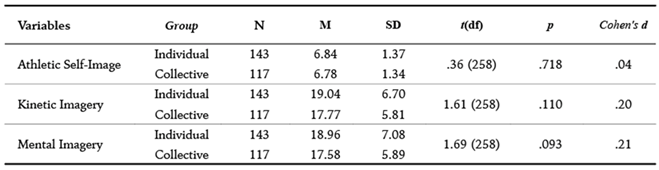
Independent samples t-tests revealed no significant differences between athletes in individual and collective sports on any of the dependent measures (see Table 2). There were no significant differences for athletic self-image (p = .718), kinetic imagery (p = .110), or mental imagery (p = .093). The effect sizes for all comparisons were small.
Differences by Level of Schooling
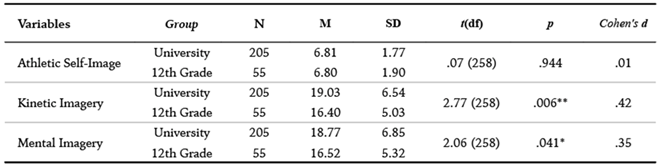
As shown in Table 3, independent samples t-tests were used to compare university-level athletes with 12th-grade athletes. No significant difference was found for athletic self-image (p = .944).
However, significant differences emerged for both imagery dimensions. University athletes (M = 19.03, SD = 6.54) reported significantly more difficulty with kinetic imagery than 12th-grade athletes (M = 16.40, SD = 5.03), t (258) = 2.77, p = .006, Cohen’s d = .42. Similarly, university athletes (M = 18.77, SD = 6.85) reported significantly more difficulty with mental imagery compared to 12th-grade athletes (M = 16.52, SD = 5.32), t (258) = 2.06, p = .041, Cohen’s d = .35.
Differences by Years of Competitive Practice
A one-way analysis of variance (ANOVA) was conducted to evaluate the effect of years of competitive experience on the three dependent variables.
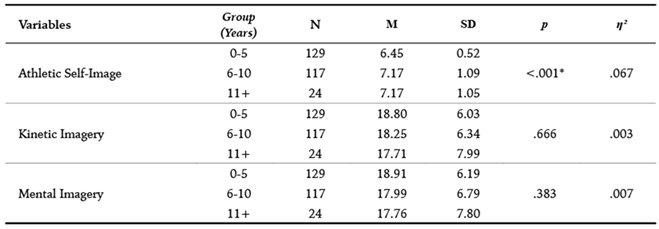
The ANOVA revealed a statistically significant difference in athletic self-image based on years of practice, F (2, 267) = 9.66, p < .001, with a medium effect size (η² = .067). Post hoc comparisons using the Scheffé test indicated that the mean score for the 0-5 years group (M = 6.45, SD = .52) was significantly lower than the 6-10 years group (M = 7.17, SD = 1.09). No significant difference was found between the 6-10 years group and the 11+ years group (M = 7.17, SD = 1.05).
In contrast, there were no significant effects of years of practice on kinetic imagery, F (2, 267) = .41, p = .666, or mental imagery, F (2, 267) = .96, p = .383.
Discussion
This study aimed to investigate the influence of sex, sport type, level of schooling, and years of competitive practice on student-athletes’ kinetic imagery, mental imagery, and athletic self-image. The findings provide a multifaceted view of the psychological
of this study is the strong, positive relationship between years of competitive practice and athletic self-image. Athletes with six or more years of experience reported a significantly stronger self-image than their less experienced peers. This result aligns perfectly with the foundational literature on athletic self-image, which posits that self-image is a developmental construct forged through sustained commitment, skill acquisition, and social integration into the athletic role (Brewer et al., 1993; Ronkainen et al., 2024). The data clearly indicate that after an initial period of about five years, athletic self-image solidifies and remains high. This underscores the notion that long-term engagement is a primary mechanism through which the “athlete” role becomes central to an individual’s self-image. Interestingly, years of practice had no discernible effect on either kinetic or mental imagery ability. This suggests that while self-image is cumulative, the fundamental ability to generate mental representations, as measured by the MIQ, may not necessarily improve with experience alone, or it may plateau after a certain level of proficiency is reached.
The analysis of sex differences yielded nuanced results. In line with some previous research that suggests male athletes may report higher imagery use (Lovell et al., 2024; Smith, 2015), this study found that males reported significantly greater ease with mental (visual) imagery than females. However, this finding, while statistically significant, had a small effect size, and no differences were found for kinetic imagery or athletic self-image. The lack of difference in self-image is particularly noteworthy, as it contrasts with literature that often reports female athletes facing greater challenges with body image and self-perception. The current finding may suggest that within this specific cohort of dedicated athletes, the shared experience of sport participation mitigated potential sex-based differences in athletic self-image. The difference in mental imagery could be attributed to the nature of the MIQ, which focuses on simple motor tasks; it is possible that males and females differ not in fundamental ability but in the application or content of their imagery in more complex, ecological settings (e.g., emotional regulation vs. strategy rehearsal), a dimension not captured by the instrument used.
Perhaps the most unexpected finding was the influence of schooling level on imagery. Contrary to the established literature, which indicates that older, more experienced athletes typically exhibit superior imagery skills (Di Corrado et al., 2019; Hall et al., 1990), this study found that university athletes reported significantly more difficulty with both kinetic and mental imagery than their 12th-grade counterparts. This counterintuitive result demands careful interpretation. One possible explanation is metacognitive: older, more advanced athletes may be more self-critical and possess a higher internal standard for what constitutes a “vivid” or “easy” image, leading them to give themselves harsher ratings. In contrast, younger athletes may be less discerning in their self-assessment. Alternatively, the increased academic and athletic pressures faced by university students could create greater cognitive load, making it more difficult to focus on the specific, controlled tasks of the MIQ compared to the younger students.
Finally, the absence of any significant differences between athletes in individual and collective sports aligns with a portion of the literature that suggests sport type is not a primary determinant of imagery ability (Kizildag & Tiryaki, 2012). While other studies have found differences in the type or purpose of imagery used (Di Corrado et al., 2019), the fundamental capacity to generate visual and kinesthetic representations appears to be consistent across sport structures in this sample. This suggests that individual factors like developmental stage and experience are more influential than the team-versus-individual context.
Limitations
Several limitations should be considered when interpreting these findings. First, the quasi-experimental, cross-sectional design precludes any inference of causality. A longitudinal study would be necessary to truly understand the developmental trajectory of imagery and self-image. Second, the reliance on self-report measures, particularly for imagery, captures only the athlete’s perception of ease, not the objective quality, frequency, or content of their imagery. The “I, athlete” measure was not clearly defined, limiting the interpretability of that specific finding. The use of a validated, multi-dimensional instrument like the Athletic Self-image Measurement Scale (AIMS) would have provided a more robust assessment. Finally, the sample was one of convenience from specific institutions, which may limit the generalizability of the findings to the broader student-athlete population.
Conclusion
In conclusion, this study contributes valuable insights into the psychological profiles of student-athletes. The findings reaffirm that a strong athletic self-image is a developmental outcome, forged over years of consistent participation. The relationships between imagery ability and demographic factors, however, are more complex. While males reported a slight advantage in mental imagery, the most surprising finding was that younger, pre-university athletes reported greater ease with imagery than their university counterparts, challenging conventional wisdom and suggesting that factors like metacognitive awareness or cognitive load may influence self-reported imagery ability.
Ultimately, this research highlights that a “one-size-fits-all” approach to mental skills training is insufficient. The results underscore the need for coaches, educators, and sport psychologists to consider an athlete’s years of experience, developmental stage, and potentially their sex and educational context when designing psychological support programs. By understanding these distinct influences, practitioners can better tailor interventions to foster both robust athletic self-image and effective mental skills, thereby optimizing performance and promoting holistic athlete development.

