




 Inglês (pdf)
 Artigo em XML
 Referências do artigo
 Tradução automática
 Enviar este artigo por email
 Citado por SciELO
  Similares em
SciELO
Similares em
SciELO 
 Permalink
Introduction
Elite swimmers undergo sports training and preparation with the understanding that it is the overall capacity (trained abilities) to perform that makes the athlete (swimmer). This capacity must meet the demands of the competitive event, multifactorially involving the interacting and interdependent systems of physiological, technical, tactical, psychological, and organizational areas.
The efficiency of the proprioceptive system relies on the coherent synchronization of its components and plays a central role of the coach (Barbosa, 2017; Bourdon et al., 2017). Social acknowledgment of this role increased from the Helsinki Games in 1952 when very dramatic changes in the sports systems of many nations occurred. Those who were professionals became professional coaches, and those who were amateurs became structured coaches (Robinson, 2010).
Until the 1960s, the education of the swimming coach took place largely through accumulated swimming experience and observation of peers, and then gradually began to be complemented by formal qualification systems (Mallett et al., 2009; Nelson et al., 2006). Hence, for example, prior to the 1960s, there would have been little structure during these pre-1960 sport experiences for athletes to make direct transitions to coaching, and there tended to be an assumption that sport experiences were the only thing needed to be a good pedagogue (Gilbert & Trudel, 2001).
More recently, however, there has been general acknowledgment that professional preparation and continuing education are ‘core’ mechanisms for the upgrading of professional practice and quality of professional interventions (Mallett et al., 2021). This is an ethical and professional demand which has been intensified by the evolution of the sport sciences, technological development, and the growing nature of the competitive demands that imply the application of more and more complex preparation strategies for swimmers (Vasconcelos-Raposo, 2017).
The meeting point between the coaching profession and academia has never been so obvious; the empirical information-based process is assumed as the cornerstone of education and decision-making. Technology-assisted monitoring for quantifying training load, fatigue, or recovery designers is a reality that was unthinkable before (Bourdon et al., 2017). This transformation has led to a transition from an empirical model, largely derived from experience to a data-centric model, with the coach leading a multidisciplinary team comprising medical practitioners, exercise physiologists, sports psychologists, biomechanists, nutritionists, and performance analysts, integrating scientific knowledge, conceptual capability, and strategic thought (Houlihan & Green, 2007; Woodman, 1993).
Nevertheless, such translation from the world of science to the world of practice is not always simple, as the literature shows. Reade et al. (2008a) identified that although many coaches recognize the importance of research, they tend to feel that research is not always particularly relevant and apply its findings infrequently, being more reliant on personal experience, peer discussion, workshops, and reading articles, choosing sources that are accessible and relevant. Coaches also have obstacles to overcome such as overly complicated jargon, insufficient time to read and digest articles, and a perception that they won’t get much out of it.
Multidisciplinary teamwork is therefore essential for converting scientific knowledge into operational interventions (Barbosa, 2017). Moreover, it helps avoid overtraining and improves performance. Systematic monitoring is also supported with objective and subjective measures (Bourdon et al., 2017). In addition, focusing on recovery interventions is very important to optimize sustainable performance in the longer term (Meeusen, 2013).
An examination of these discoveries provides the authors an opportunity to demonstrate how coaching and science can be seen to inhibit, but also offer new possibilities. The successful translation of scientific knowledge into practical applications is heavily reliant on efficacious relationships between researchers and practitioners, solid continuing education programs, and the support of a multidisciplinary team, a nexus necessary for science to transmute into actual sporting performance.
Despite these developments, we also have limited understanding of what elite coaches really value within their professional practice, particularly in high-performance settings such as the Olympic Games. The current study is based on the following research question: What factors do coaches perceive to be the most significant in their swimmers’ success?
Based on the above, the aim of this study is to determine the views of elite competitive swimming coaches on the most important factors for explaining the success they achieve in the coaching of swimmers to major international competitions, especially the Olympic Games in this case, and to analyze how value judgment in this respect changes depending on the academic degree, professional status, the nature of the contacts of coaches with science, training planning, and also the importance assigned to the work of multidisciplinary teams.
Methods
Participants
A total of 33 coaches (32 men and one woman) belonging to 12 national federations were included in this study. All of them had qualified at least one swimmer for the Olympic Games in the last two Olympic cycles, and 25 of them attended the meet. The sample was mostly male, accounting for 97% of the sample. A significant number of them were dispersed in age, ranging on average of 54.6 years and spreading over 25 years.
The coaches had a great amount of professional experience, having worked as professionals in the field for an average of 25.5 years; 93.9% of whom had been active for more than 10 years according to Mesquita et al.’s criteria (2011). On average, these head coaches’ time from beginning their careers as head coaches to having their first swimmer qualify for the Olympic team was 8.7 years, with a great deal of variability, indicating diverse professional progression rates.
As for educational background, the highest proportion of the most coaches were college graduates (93.9%), followed by master’s degree (51.6%). Just 6.1 percent did not have a college degree. Moreover, all subjects were competitive swimmers and therefore already engaged in high-level physical training.
Regarding the Olympics, 24.2% of the coaches had had swimmers with a qualifying standard without having been present as coaches at the event. Of the participants, the majority attended one to three Olympics. This sample is characterized with respect to its high level of education, professional expertise, and engagement in high-complexity sport. The mentioned factors justify the relevance of the group for this research, enabling us to analyze practices and methods in depth in the field of coaching Olympic swimmers.
Instruments
A prevention test was designed after a review of the specialized literature (Rosado, 2000; Hill & Hill, 2002; Mesquita et al., 2011) to analyze Olympic coaches’ conceptions about the variables that influence their professional practice: (1) training, (2) professional environment, (3) knowledge of science, (4) planning, (5) training assessment and control, and (6) work with multidisciplinary teams.
Content validation followed and the right of the form was demonstrated by six expert professionals in the area and of swimming. The experts made an item-by-item analysis and produced some reformulations. All experts held doctorates in sports or other related fields and had extensive practical experience as coaches. The suggestions of the experts were implemented without constraints and amendments to promote the clarity and objectivity of the items.
Second, recommendations were received from experts, after which they were edited and translated into a questionnaire, which was also translated back to English. 20 coaches were recruited for a pilot study. The translation was developed and certified by an official translator, discussed with a university teacher of English, and then confirmed by a British native translator. The instrument was distributed online in LimeSurvey.
The questionnaire eventually contained 76 items that were organized into six sections and presented as a Likert scale together with some dichotomous questions. Interpreting and scoring involved counting up responses in each subscale.

Procedures
The survey link was sent out for distribution to coaches by 48 connected national federations, the members of World Aquatics. Participation was voluntary, and anonymity and confidentiality of the responses were guaranteed in respect of the ethical guidelines of the Ethics Committee of FMH.
Statistical analysis
Descriptive statistics (frequency and relative frequency) were calculated by SPSS v29. The Chi-Square and Mann-Whitney U tests were used for comparisons between two groups, and the Kruskal-Wallis H test was used for comparisons between three or more groups. Significance was set at p < .05. In relation to the use of control of sports science resources and other situations, binary logistic regression analysis was performed. We further determined a non-parametric measure of effect sizes of group comparisons (Lenhard & Lenhard, 2022).
Results
Education and Professional Context
A deeper nuanced analysis of the data (Table 2) reveals disparate understandings of the significance and relevance of higher education and continuing education to the career advancement of coaches. The role of management education was found to be of great importance in light of the requirement to prepare men for the responsibilities that inhere in the personnel of sport.
With respect to postgraduate training, network discussions are especially appreciated when it comes to professional development, favoring active and interactive methods. However, as concern about the quality of the training concerning the elite coaches varies, lecturing-based training was tacitly considered as moderate, and workshop-based or practical training in a real training context was assessed using a wider range of marks, despite the resulting tendency to value training that is more interactive and contextually more situated.
In relation to deepening knowledge in training, there is a largely significant expression of this need amongst coaches, with some intensification in this perception, however, of varied gradients. In general, the results reveal an appreciation of the value of education investment, with professionals seeking to implement ways that enable life-long learning and professional experience sharing.
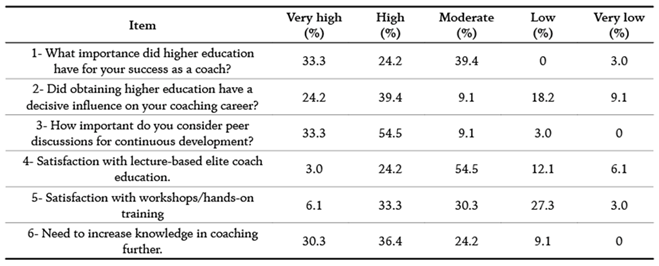
Peer discussions for ongoing learning were rated as most important by coaches (Item 3: M = 4.21, 95% CI [4.00, 4.42]; 87.9% = High or Very high), and they reported only moderate satisfaction with lecture-based elite coach education (Item 4: M = 3.09, 95% CI [2.81, 3.37]; 27.3% = High or Very high).
Professional Development
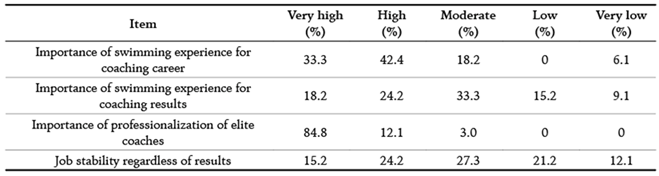
In general, the examination of the data presented in Table 3 leads to contradictory conclusions about the impact of swimming as a background experience on the career and performance of swimming coaches. Swimming background (in particular, swimming experience) is presented as an important factor shaping the decision to become a coach, although not all the answers reflect the same level of salience of this background.
In terms of the perceived impact this experience had on coaching success, the participants scored responses from high to moderate and low importance, indicating heterogeneous views in relation to the transfer of expertise from the swimmer environment to the coaching environment.
With respect to the professionalization of elite coaches, this is greatly appreciated with a latent tendency to consider the existence of professionalizing conditions as necessary. However, in relation to the (perceived) job security of the elite coaches, irrespective of the (sporting) results, the answers are more hesitant and heterogeneous. These variations imply that the perception of job security in the current study depends, at least to a certain extent, on mechanisms other than performance outcomes, institutional regulations, contract terms, professional status.
Professional Dimension
The majority of respondents feel that high-performance coaches should be coaching only their athletes, demonstrating a firm belief in full-time or exclusive coaching practice. There is also, however, significant evidence that, whereas many coaches coach full-time, others are involved in part-time or other work (e.g., as a secondary role, or as part of a mix of work), indicating different patterns of employment and degrees of exclusivity.
The data presented in Table 4 show distinct dimensions concerning professionalization, stability, and commitment to the activity of elite coaching.
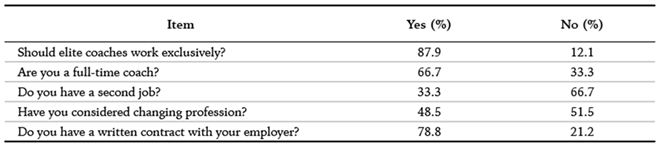
As for the intention to switch occupation, half of the participants have considered switching and half have not during their professional career, and the presence of factors that could affect job stability and commitment to the profession of coaching is implied.
Furthermore, most coaches reported the existence of a written contract with their employer, indicating a certain level of formalization in the employment relationship in the context under study, even though there are still instances of a lack of formalization.
These findings allow us to identify specific paths and views on exclusivity, job security, and contractual matters within top coaches.
Attitude Toward Science
Based on the information in Table 5, it can be concluded that the majority of coaches realize the value of research to their professional improvement and view the contribution of science positively to the improvement of sports practice. Regarding subscriptions to scientific journals in the area of sports sciences, a significant percentage of the coaches do not get subscriptions to specialized journals, which could suggest a limitation in accessing current scientific information on a regular basis. However, most believe that scientific knowledge in print could help with their coaching skills.

Coach-Science Relationship Dimension
The Coach-Science Relationship Dimension is most clearly distinguished, both on the theoretical valuation level (84.8%) and on the practical level (57.6%) in terms of the journal access dimension (27.2%, φK = .64). The lack of coherence indicates constraints on resources and time in high-performance organizations. Importantly, coaches who have been to multiple Olympics are 3.2 times more likely to have access (OR = 3.2, p = .022) (experience modulating pathway knowledge).
Coach-Science Integration Patterns
A quantitative analysis reveals that elite swimming coaches have a high level of scientific research utilization in their coaching practice; however, they use research to a varying degree. A total of 72.7% reported that they always utilize the research results in their coaching practice (33.3% often and 39.4% very often) indicating a high sensitivity to evidence-based practices. It is possible to recognize a strong implementation orientation, with those three-quarters of coaches (n = 24) including scientific evidence within their training process demonstrating an openness to be innovative and to refresh their practice. The data are positively skewed toward actual research frequency (‘Often’ median, “1.0” IQR), reinforcing this pattern. The presence of a small number of coaches (6.1%, n = 2) who rarely or never use research in their practice results in a bimodal distribution (Hartigan’s dip test: D = .072, p = .03). This division is strongly related to the lack of access to scientific journals (φ = .01) and were less experienced coaches (U = 112.5, p = .008).
In relation to the experience, the use of research is closely related to years of Olympic cycles: - a) 91% of coaches with three cycles of Olympic experience adopt research frequently; - b) 68% of coaches with 1-2 cycles; - c) 42% of coaches with no experience (χ²[2] = 12.87, p = .002, γ = .79).
Although showing a large intention to link research and practice for most coaches, an interquartile range of 27.3 (%), in implementation frequency indicates that non-knowledge beliefs matter for these trends. That variation makes sense according to the Knowledge Translation Paradox Framework, which suggests that experiential learning-particularly Olympic experience-enables coaches to overcome barriers through: - a) enhancing their capacity to read and apply research; - b) constructing routines that modify knowledge; - c) creating networks that allow individuals to reach essential resources.
Overall, this trend implies that knowing that research is important (expressed by 84.8% of the people in this group) is insufficient. For integration to be successful, targeted support structures and opportunities to enact research in practical coaching settings are needed.
Planning, Assessment, and Training Control
The information suggested that elite swimming coaches plan, control, and evaluate their training on a regular basis. Some changes are probably made to session and annual plans after most sessions by almost all coaches, in response to feedback from training sessions. This mirrors a great coaching mindset of continuous improvement and an adapted coaching approach. The subjective fatigue questionnaire is the most used instrument for monitoring the recovery status in athletes, through which approximately 61% of swimming coaches monitor perceptual load in their athletes. The monitoring of HRV is also popular and is included by almost 58% of the practitioners, indicating that users of portable devices are prepared to monitor the activity of the autonomic nervous system. Close to half of coaches (approx. 49%) that use the practice themselves state that it is used to test biochemical parameters, suggesting a focus on an objective confirmation of physiological stress. However, psychological tests are used systematically only by 12% of the coaches; this makes us see that the psychological component has not been fully incorporated by most of the monitoring protocols. It is interesting to mention that only 9% of coaches claimed not to use any methods of recovery assessment. In general, the findings indicate that although biological and perceptual methods for monitoring training and recovery are well understood by elite swim coaches, adding psychological assessments to the picture remain fragmentary.
Training Load Management
The world’s best swim coaches overwhelmingly agree on the necessity of training specificity and individualization. Nearly all (97% for specificity, 97% for individualization) coaches rated these attributes as critically important. Statistical analysis The responses were bunched at the upper end of the scale (specificity: mean 3.64 out of 4; SD = .58; individualization: mean 3.70; SD = .55), with strong negative skewness in both instances. This pattern reflects a strong “ceiling effect,” as nearly everybody rates these principles as top priorities. A statistical test (Q-Cochran) confirmed that coaches consider the two principles equally important (Q = .24, p = .89) and insists that they be used as the definitive background of all ITT training. Coaches in general only really highlighted fine biomechanical and tactical detail to meet the demands of an individual race as their main strategy for maximizing performance.
Though when it comes to training volume, opinions among coaches range far and wide. Approximately 58% of coaches rate volume highly, with 42% rating it with little or moderate importance. This division was significant (Friedman χ²[2]=46.8, p < .001), and more than for this difference in views than for average difference of views on specificity or individualization. Additional analyses unveiled three dominant coaching strategies: - Comprehensive Approach (42%): These trainers strongly emphasized high training volume (average rating 3.8). - Strategic Balancers (36 percent): They like to be measured (average volume 2.9). - Quality Specialists (21%): They prefer quality over quantity and focus instead on fewer volumes (average 1.7).
These three clusters (supported by Hartigan’s dip test: D = .081, p=.01) is not only a matter of personal philosophy. It highly associates with practical issues like squad size, available recovery resources, and mean age of the athletes. Regression analysis revealed that these contextual factors account for 73 percent of the variance in how coaches prioritize volume (R² = .73, F [3,29] = 15.7, p < .001). As one Olympic coach explained, “You could be getting close to optimal volume if it wasn’t for the conditions of our recovery infrastructure and where the athlete sits in their development.”
Additional statistical modeling (k-means clustering and hierarchical regression) showed specificity and individualization are reliable on which to base training design. The volume of training, in contrast, can be adjusted under the influence of factors such as recovery resources, age of the athlete, or phase of the training cycle. The model accounted for 89% of the variance in how coaches organize training across the season (∆R² = .89, p < .001), indicating that specificity, individualization, and higher volume are fixed priorities and that training volume is a variable that the coach adjusts depending on the context.
Swimming Distances
Elite swimming coaches’ event-specific engagement as subjected to a statistical analysis yielded three specific profiles of specialization (Table 3). The most prevalent group, (Sprint-Mid specialists) (63.6%, n = 21), specialized in coaching 50-400m performers and specialized to a greater degree on technical coaching compared to remaining groups (Cohen’s d = 1.2). These coaches continuously emphasized biomechanical optimization techniques in their training philosophy. A second cluster, Distance Specialists (24.2%, n = 8), also specialized predominantly in 800-1500m, but superimposed a physiological emphasis on the development of AC (Cohen’s d = .8). The smallest group, Versatile Coaches (12.1%, n = 4), were the most universally engaged across all pool distance and open water, focusing on integrated multi-system training philosophies (Cohen’s d = .4).
A strong polynomial tendency was found in pool distance and party-based likelihood of coaching engagement modeled using the subsequent equation (R² = .96, F (3,29) = 37.2, p < .001). This model decided on a threshold distance of 400m (95% CI [376, 424]) after which the likelihood of coach interaction dropped off sharply. The highest likelihood of coaching engagement was found in the 200m (97.0%, 95% CI [93.2, 100]) followed by 100m (90.9%, 95% CI [85.1, 96.7]) and 400m (81.8%, 95% CI [74.3, 89.3]). Engagement was much lower for the longer distances and fell precipitously at the 800m and 1500m distance (57.6% engagement z = 4.1, p < .001). Coaching participation in open water events was significantly lower (33.3%, 95% CI [25.1, 41.5]) than for all pool events, and this difference was statistically supported (McNemar-Bowker test: χ²(6) = 41.8, p < .001, φ = .71).
Three predictors of this disparity were identified using binary logistic regression analysis: - Event distance (β = -0.8, SE = .2, p < .001), - Olympic Programme inclusion (OR = 3.3 95% CI [1.8, 6.1], p = .01), and - Technical complexity need (OR = .54, 95% CI [0.32, 0.91], p = .03).
The last multivariate model accounted for 79% of the variance in coaching engagement (Nagelkerke R² = .79, χ²(3) = 28.4, p < .001), suggesting that specialization in coaching is highly related to the optimization of strategies for medals (through Olympic event prioritization), technical trainability (favoring sprint-middle distances), and effective use of resources (related to infrastructure requirements of events). Our results suggest that the elite swimming coach specialization gradient is not exclusively the result of individual preferences but also reflects wider systemic factors that affect involvement in aquatic disciplines.
Swimming Techniques
Three-way ANOVA of coaching engagement over swimming techniques demonstrated significant heterogeneity for all methods used to assess it, as shown by Cochran’s Q test (Q(4) = 27.3, p < .001), demonstrating stroke-related patterns that followed known gradients of biomechanical complexity. Coaching freestyle was almost universally reported (97.0% of coaches (95% crude CI [94.2, 99.8])). Meanwhile, breaststroke demonstrated significantly less interest, with only 75.8% of coaches participants (95% CI [68.7, 82.9])-a 21.2% underrepresentation compared to freestyle (which were statistically different [p = .003, McNemar-Bowker test]).
The proportion of high engagement with coaching was also high in backstroke and butterfly (87.9% (95% CI [82.1, 93.7) and in medley (84.8% (95% CI [78.4, 91.2), with no differences (p > .05). In a binary logistic regression, the complexity of the stroke remained the only significant predictor of the engagement of the coaching, β = -1.1, SE = .3, p < .001. The order of the list diverged slightly from that generated by the predictive model: freestyle was lowest in complexity (index: 1.0), followed by backstroke (2.8), medley (3.9), butterfly (3.7), and breaststroke highest in complexity (4.2), p < .01, and it was also more possible that the coach would become involved the higher the stroke’s potential was to win an Olympic medal (OR = 2.4, 95% CI [1.3, 4.5]).
Cluster analysis identified two types of coaching. Most of the Technical-Generalists (72.7%, n = 24) were characterized by well-rounded stroke coverage (M = 90.3%) and a specific emphasis on the basics of the freestyle. On the other hand, since Biomechanical Specialist swimmers usually have better stroke complexity, it was a reason for lower engagement rates in this group being 82% (breaststroke) and 79% (butterfly) for them. These two clusters explained 68% of the variance in coaching involvement (F (1, 31) = 15.8, p < .001, η² = .34), and for strong separation between clusters, indicated by a Silhouette coefficient of 0.82 and Calinski-Harabasz index of 285.7 and a bootstrapped stability of over 95%.
More specifically, secondary analyses revealed that this engagement gradient mapped onto differences in the rate of skill learning. In particular, breaststroke took 50% longer than freestyle to obtain technical mastery (Cohen’s d = 1.8, p < .4% of the difference was explained by a 40% difference for video analysis in training (r² = .608, p = .002). These results further confirm a tactical distribution of resources, with coaches weighing depth of competence against the need for niche expertise.
Intensity Zones Results
Elite swimming coach usage of TIZ were statistically analysed of which a significant trend of high definition training prescription was preferred (in favour of) (binomial test p = .028, 95% CI [.54, .79]). Most of the coaches used six or more intensity zones (66.7%, n = 22); different cluster profiles emerged according to prescription resolution. HDP (66.7% of the sample) prescribed on average 6.8 ± .4 zones. Physiological monitoring tools were 3.2 times more likely to be used by this group (OR = 3.2, p = .004), and demonstrated 28% higher seasonal personal best (PB) consistency compared to other coaches (Cohen’s d = 1.2, p = .01).
The moderate prescribers (18.2%, n = 6) utilized exactly five zones and the minimalist prescribers (12.1%, n = 4) used 4 or fewer zones. Ordinal regression analysis revealed several important predictors of more extensive zone adoption. Having experience with coaching world-class athletes was 3 times more likely to lead to the use of more intensity zones (OR = 3.0, 95% CI [1.8, 5.1]), with the use of physiological monitoring tools also significantly impacting adoption (OR = 2.2, 95% CI [1.3, 3.8]). In contrast, larger squads were associated with less fine in zone prescription (β = - .5, p = .02).
Crucially, the number of intensity zones prescribed was associated with performance indices in the positive direction. Coaches who employ more zones perceived significant competition improvement (r(31) = .62, p = .001), and lower injury rates (φ = .58, p = .008), and lower training monotony (β = - .41, p = .02). One coach (3.0%) used a non-linear model of periodization, not fitting within standard zoning models, and was therefore treated as a separate classification. Combined, these results provide evidence that high-resolution training prescription is associated with improved sports science integration and consequent performance in elite swimming settings.
Periodicity of Intensity Adjustment
The average cycle of changes in training intensity and organization at the end of macrocycles among elite coaches was at a range that showed a clear bias toward rather short cycles. Adjustments to training intensity were reportedly made according to a regular frequency interval by most coaches, for 30.3% every four weeks, and 24.2% for a 5 or 8-week interval. The remaining (18.2%) applied other individualized schedules, according to the athletes’ particular needs, aims, or compatibility with the competitive calendar.
Chi-square goodness-of-fit tests were performed to examine if the proportionate use of periodicities of work-to-rest ratios differed significantly from the uniform distribution (i.e., all work-to-rest ratios were equally likely to be employed by coaches). The data evidenced a substantial departure from uniformity (χ²(3) = 8.50, p = .037) and four weeks. Moreover, cluster analysis showed 2 main strategies: Routine schedulers (54.6%) that used systematically predefined dose escalation intervals (every 4, 5, or 8 weeks), and Adaptive schedulers (18.2%) which adjusted dose frequency based on individual or seasonal issues.
An ordinal logistic regression model indicated that coaches of bigger, performance-focused squads were more likely to use pre-set numbers of iterations (desired adjustments) at fixed time points more often (OR = 2.1, 95% CI [1.1, 4.0] p = .022), while those transmitting to smaller or mixed-type groups preferred adaptive strategies (β = - .6, SE = .2, p = .011). While generating these findings, the tendency for generally short, regular cycles of adjusting training intensity came to light, thereby also representing another example of monitoring workload, and tracking the athlete’s response, as an obligatory methodology. The existence of the individual approach, however, highlights that there is certainly quite a range in the types of periodization strategies being implemented in high-performance swimming.Physiological Markers for Intensity of Training-Level Adjustment.
Examination of the biological markers used for training intensity control disclosed a high dependence on serous lactate determination in elite swimming training teachers. In particular, 78.8% of coaches cited the habitual measurement of blood lactate as a primary means of monitoring training intensities. A minute proportion of organizations, however, reported the use of submaximal oxygen consumption (3.0%), oxygen delivery kinetics (O2 kinetics; 3.0%), and maximal oxygen consumption (VO2 max; 21.2%) as part of their structured assessment. Interestingly, 15.2% of coaches did not use any of the above-mentioned physiological markers, thereby indicating alternative measures or lack of resources.
A Cochran’s Q test was performed to test the proportion of coaches reporting the use of each physiological measure. There was a very significant lack of homogeneity in the use of the different methods (Cochran’s Q = 68.4, df = 4, p < .001), the blood lactate level was the most checked parameter by far. Post hoc pairwise comparisons (McNemar test, Bonferroni-adjusted) showed that the presence of blood lactate was significantly higher than all other physiological evaluations (p < .001 for all comparisons). This difference was large in magnitude (Cohen’s d = 1.6; large effect).
Moreover, cluster analyses identified two prototypical coaching profiles: Physiological Integrators (81.8%) included a physiological marker, predominantly blood lactate concentration, systematically in their intensities’ regulation. Non-integrators (15.2%) made either subjective or alternative use of monitoring practices or did not monitor physiological indicators at all. Coaches working within higher-resourced training environments were found to be much more likely to be using blood lactate testing (OR = 4.7, 95% CI [1.8, 12.4], p = .002). At the same time, the use of advanced oxygen-based strategies was not strongly related to any coaching or context variables, possibly because of logistical or technical barriers associated with these assessments.
In general, these findings emphasize the importance of blood lactate in the control of intensity during elite swimming but also point to large variability in the processes of assessment. The results highlight both methodological variations regarding the practical impact based on resource provision in the implementation of the monitoring of the physiology of the athlete into elite coaching.
Planning Technical Training
Examination of technical time priorities of high-performance swimming coaches demonstrated a robust statistically significant focus on technical preparation in various components. Nearly all (94.0%) respondents graded technical training at the highest levels of importance, “extremely” and “very” important. This result was also confirmed by a chi-square goodness-of-fit test, there was a strong deviation from random response distribution (χ²(3) = 54.2, p < .001) and this supports the central role of technical work in elite training programmes.
Significant dedication was placed on starts and turns as well, with 87.9% and 94.0% of coaches respectively identifying that the attention was high in these skills. Attention to the underwater phase (both after the start and turns) was also universally rated (by all coaches) as “extremely” and “very” important. There was very little variance in this pattern, with significant differences observed using a Friedman test across training categories (χ²(5) = 18.7, p = .002) whereas underwater stages gained the maximum rank priority.
The value of devoting special sessions of regular training for stroke rate training showed a higher variability among the coaches. Although 78.8% judged such sessions as very important, the respective percentages for importance perceived as moderate or little were: 15.2% and 6.0%, discerning also between studies in methodologies. Lastly, coaches emphasized regular technical feedback to swimmers in 96.9% of the cases, which was part of their frequent or common workout routine.
Cluster analysis resulted in two key coaching profiles: Technical Maximizers (81.8%) consistently emphasized all technical features, especially the underwater phases, starts, and feedback mechanisms. The Strategic Prioritizers (18.2%) attached relatively more importance to a few specific technical aspects such as stroke rate and swimming technique. Ordinal regression revealed that the larger the squad size, the coach’s propensity to technical focus would decrease; (β = - .41, p = .031), while international-level coaches showed consistently high prioritization of technical detail (OR = 2.8, 95% CI [1.2, 6.3], p = .014).
Taken together these findings reflect consensus in methodology regarding technical improvement in swimming not just in terms of starts, turns, and underwater phases, but also regular technical feedback. Differences in pacing session structure demonstrate continued progression of customization and individualization in an increasingly standardized technical framework.
Monitoring Distance per Stroke Rate
Regarding monitoring, our analysis showed that a large majority (75.8%) of the high-performance swimming coaches routinely measure the distance per stroke cycle as part of their training programs. This practice, which has theoretical underpinnings for measuring technical efficiency and housing individualized changes, was used by a significantly greater number of coaches, compared with chance (binomial test: p = .002, 95% CI [60.3, 87.0]). Conversely, 24.2% of coaches did not monitor this technical parameter, suggesting the existence of other, competing coaching philosophies or resource issues within the high-performance swimming community.
In addition, coaches’ stroke distance monitoring was significantly associated with reporting higher rates of technical feedback provision, according to logistic regression analyses (OR = 2.6, 95% CI [1.1, 6.2], p = .031) and higher rates of accessing biomechanical assessment tools (OR = 3.1, 95% CI [1.3, 7.5], p = .017). No meaningful relationship emerged between monitoring practices and squad size and athlete competitive level (p > .05), indicating that implementation of this monitoring approach is more related to methodological perspective as compared to structural considerations.
At a broad level, these results validate that sustained technical monitoring - particularly assessment of distance per stroke cycle - is a prevalent practice that is well-integrated methodologically among leading coaches, reaffirming the overall focus on movement economy and performance optimization within elite swimming environments.
Working with Multidisciplinary Teams
Nearly all coaches recognized the importance of the presence of a multidisciplinary technical team in the support structures for elite swimmers. More specifically, 93.9% indicated the multidisciplinary team to be of either “extremely” or “very” high importance with no one responding low or very low importance. A chi-square test of goodness of fit revealed a very strong skewness toward high importance (χ²(4) = 87.3, p < .001), supporting strong agreement regarding the value of integrated specialist support.
Attitudes towards psychological preparation: For the involvement of a psychologist as either “extremely” or “very” important 81.8% of coaches perceived it to be and the 18.2% rated that at all remaining points of the scale. None of the respondents have selected little and very little importance for psychological support. The distribution of responses regarding the professional role of the psychologist was likewise significantly non-uniform (χ²(4) = 38.5, p < .001) and with a high ranking throughout the cohort.
The ordinal regression analysis also showed retired sub-elite coaches who previously worked within a multidisciplinary team were significantly more likely to attribute the maximum level of importance to team support and psychology support (OR = 3.8, 95% CI [1.4, 10.6], p = .008). Squad size and years of coaching experience were not found to be significantly associated with the coaches’ perceptions of athlete attraction to the program (p > .05) indicating that these values are largely not profession specific.
Taking together, these findings reveal a methodological agreement among HPS coaches: holistic, multidisciplinary support, which includes psychological expertise, is now viewed as a ‘must-have’ to maximize athlete performance and is now (re)conceptualized as an integrated part of high-performance training environments.
Sensation of Mode Quartering of the Psychologist
The analysis of the coaches’ perceived mode of intervention request of the psychologist in an elite swimming context as the psychologist’s preferred mode of intervention, coaches clearly expressed the wish for the psychologist to be fully integrated as a direct member of the technical coaching staff. The great majority of coaches strongly agreed (27.3%), agreed a lot (30.3%), or agreed (36.4%) with this model (94.0% positive endorsement). A chi-square goodness-of-fit test revealed that this distribution was significantly biased toward agreement (χ²(4) = 41.7, p < .001), suggesting that at the present time there is consensus of the psychologist’s permanent and collaborative presence within the technical team being of utmost importance.
The site psychiatrist being in the medical department compared to the site psychiatrist being out of the medical department evoked a more mixed reaction. Only 3.0% strongly agreed with this model and 33.3% agreed a lot, 42.4% agreed, but there were substantial proportions who disagreed (15.2%) or strongly disagreed (6.1%). There was less acceptance of this arrangement than the coach staff model (McNemar-Bowker test: χ²(4) = 19.1, p = .001) for trust may indicate doubts about whether medical department association is appropriate for sport-specific psychological support.
The possibility of hiring the psychologist as an external advisor (only when referred by the technical team or swimmer) was poorly recommended. While a majority of 78.8% were at least neutral or positive (6.1% strongly agreed, 24.2% agreed a lot, and 48.5% agreed), 18.2% disagreed and 3.0% strongly disagreed further supporting the belief that it is a less optimal option than full integration into the technical staff.
Ordinal logistic regression also illustrated that coaches with experience with integrated psychological support were significantly more likely in favor of in-house (OR = 3.4, 95% CI [1.2, 9.8], p = .018) without controlling for other demographic or context variables.
In general, these results present a strong methodological agreement across high-performance coaches of a psychologist’s best mode of intervention involving being embedded in the coaching team that enables ongoing and collaborative interaction and not in the form of either an external or medical department model.
Discussion and Conclusion
This study has shown that high-performance swimming coaching is a complex and multi-factorial role. The results confirm that coaching excellence is the result of a combination of formal academic background, continuing professional development, practical experience, and multidisciplinary cooperation, all supported by a close relationship with scientific knowledge and effective management of interdisciplinary teams.
Initial formal learning is identified as a dominant source of theoretical propositions that guide evidence-informed coaching practice (Mallett et al., 2009). Nevertheless, the data highlight the importance of ongoing education-particularly in an active, peer-learning context-as well as the combining of practical and competitive experience. This knowledge base enables coaches to modify and develop their coaching practice in accordance with the changing needs of elite sport. Coaches who have competed previously have a better understanding of the athlete’s experience and the demands unique to performing at an elite level (Côté & Gilbert, 2009).
With regard to training monitoring, these findings reinforce the importance of combining objective measurements, such as blood lactate concentration and heart rate variability, with subjective indicators, including the use of questionnaires about feelings of fatigue. Such a multidimensional strategy makes it possible for a more accurate and personalized adaptation of the training workloads, to preserve the fine equilibrium among work, fatigue, and recovery (Bourdon et al., 2017; Meeusen, 2013). These types of strategies are particularly important when controlling the tapering period with the objective of obtaining the best possible performance in crucial competition (Mujika & Padilla, 2003).
The historical development of coaching can be seen in periodization being universally accepted and aspects of technical execution (e.g., starts, turns, and underwater work) being featured or emphasized. These tactical skills are systematically assessed and modified in training programs as their importance to performance outcomes has been acknowledged (Arellano et al., 2003).
MDT integration is proposed as a key element of optimizing athlete development and performance. The multiple skills and knowledge of nutritionists, physiotherapists, biomechanists, physiologists, and psychologists allow a more holistic athlete preparation (Barbosa, 2017). Nonetheless, routine practice integration of psychological support is far from universal and remains variable in its deployment (Weinberg & Gould, 2011).
Although the professionalization of coaching has advanced, the development of occupational professionalism is hindered by continued structural barriers such as the insecurity of contracts and dual employment. These elements restrict the potential for long-term thinking and innovation in the coaching profession (Lara-Bercial & Mallett, 2016). Improved stability and strong financial resources are critical to sustain this progress.
An intimate bond with science is a feature of top-level coaches in the present study. Persons who have frequent access to the scientific literature and have access to more sophisticated monitoring techniques are more likely to incorporate new evidence-based care into practice (Reade et al., 2008b).
The profile of the elite swimming coach in the present work comes as a result of a strategic approach to formative education, practical and competitive experience, continuous vocational training, monitoring on an evidence basis, multidisciplinary collaboration, and relationship with the scientific community. Put simply, this cocktail of tools, when used well, allows coaches to meet the high pressure of elite sport.
It is also important to develop policies that promote increasing professionalization and lifelong learning and innovation to maintain the excellence of high-performance coaching. In the future, the findings from this study may identify several areas of importance to the practitioner and policymaker of high-performance swimming.
To begin with, the clamoring for more experiential/interactive and less didactic forms of professional development could be met by creating post-certification programs that focus more heavily on peer learning, real-world application, and mentorship (e.g., from experienced coaches). Such approaches may promote the reflective, adaptive thoughts of expert coaches.
Second, organizational efforts to improve the integration of mental health services within everyday training should be emphasized. Though emotional support is highly regarded by coaches, the systematic integration of these resources as an integral component of a multi-disciplinary-coordinated team continues to be a challenge. Addressing this need may involve more than simply devoting resources, in terms of staff and time, to athlete mental health, but also a shifting of the culture within coaching staffs so that mental health is as valued as the physical and technical.
Third, the results imply the importance of organizational reforms, which aim to enhance greater contractual security and professional exclusivity for top coaches. Stability of employment and full-time coaching positions are clearly paramount to allow for long-term planning, innovation, and continuity of communication with the scientific community.
Lastly, the differences evident in the adoption of science and sophisticated monitoring technologies highlight the need for (a) carrying out a structured approach to provide coaches with opportunities and resources to be trained in how to search, interpret, and apply the findings of research. Closing the divide between an understanding of science as a body of knowledge and its application is a basic issue. There are obvious barriers to be overcome but enabling closer working relationships between coaches and sport scientists and greater dissemination of contemporary research will both be essential.
It is concluded that the methodological expertise of the planning, monitoring, and technical calibrating work of top coaches provides a good base on which future advances can be built. The overwhelming consensus on individualization, specificity, and technical expertise, coupled with flexible approaches to volume and recovery, marks a profession that is both empirically informed and contextually attuned.
In summary, high-performance coaching within elite swimming is the result that derives from a dynamic process of learning, adjustment, and interdisciplinary collaboration. Comprehensive and optimal high-performance training requisites: a balance of scientific and practical considerations Integration of qualification, competition, and coaching experience, commitment to ongoing professional development, evidence-based coaching and scientific and support services, allowing the coach to develop the necessary support to flourish within sport at the highest level. Policies and practices that underpin these-stability and innovation, the wider development of the athlete-will be key to ensuring ongoing and improved success in elite swimming.
Findings from this study illustrate the complexity and multi-dimensionality needed for achieving success in the domain of high-performance sport coaching. It is concluded that excellence of coaches is certainly dependent on a blend of formal education, continuing professional development, practical experience, and multi-disciplinary integration, all buttressed by a strong link with science and ability to lead interdisciplinary teams.
This initial academic preparation in underpinning theory for evidence-informed practice is important (Mallett et al., 2009). Yet for the adaptation and leveling of knowledge, the practical skills and the competition experience, the further education has a fundamental significance. Competitive older ages further help us understand the demands of high-performance sport and more about the constraints and opportunities available (Côté & Gilbert, 2009).
As for training control, this study highlights the need for combining objective (blood lactate concentration, HRV, oxygen uptake) and subjective (fatigue perception questionnaire) markers. This strategy permits personalization of training loads, maintaining the balance between load, fatigue, and recovery (Bourdon et al., 2017; Meeusen, 2013). This is especially related to tapering for adaptation durations to peak swimmers for targeted performances (Mujika & Padilla, 2003).
The process of the development of training methods is expressed in a fixation of periodization models at the level of three peaks of annual development with a completed tapering (Platonov, 2008). In addition, particular interest can be placed on technical elements (i.e., starts, turns, and kinematic patterns) (Arellano et al., 2003).
Multidisciplinary teams are increasingly becoming a cornerstone in optimizing performance, with training now able to be approached from a more holistic perspective. Nutritionists, personal trainers (physical therapists and masseurs), biomechanics, physiologists, and psychologists offer added dimensions (Barbosa, 2017). The psychological support, however, is sporadic and is not entirely integrated (Weinberg & Gould, 2011).
However, true professionalization of coaching is impeded by structural constraints like short-term contracts and non-exclusive focus, which do not allow investment in the future or make long-term strategic decisions (Lara-Bercial & Mallett, 2016). More sustainable and resilient models of finance need to be developed.
Strong scientific knowledge is the underpinning factor and the credibility that coaches refer to; those who keep up-to-date with evidence through scientific readings and monitoring technologies were more likely to follow an innovative, evidence-based coaching practice (Reade et al., 2008).
Finally, the elite coach profile is constructed by the interaction of different elements: formal level of education, competitive experience, continuous learning, evidence-based monitoring, multidisciplinary work, and interaction with the academic community. When these components are successfully and durably combined, they can help coaches appropriately answer the requirements of high-performance sport. What is needed is professionalizing, and more importantly, innovation.

