




 Inglês (pdf)
 Artigo em XML
 Referências do artigo
 Tradução automática
 Enviar este artigo por email
 Citado por SciELO
  Similares em
SciELO
Similares em
SciELO 
 Permalink
Introduction
The use of social networks has become one of the most widespread phenomena in contemporary society, especially among adolescents and young adults (Armaza, 2023). These platforms enable synchronous and asynchronous interactions, helping preserve social ties regardless of users’ spatial locations. The popularity of networks such as “Facebook”, “Instagram”, “X”, and “TikTok”, among others, has been solidified by the massification of internet services and the universalization of mobile devices. The latter constitute an essential artifact for social participation, access to information, and the execution of commercial, banking, and administrative procedures with public and private institutions (García & Rincón, 2021). However, despite the benefits that digitalization brings to society, the unrestricted and excessive use of some technologies can have potentially negative impacts on individuals’ psychosocial well-being (Martínez et al., 2022).
Given the emerging phenomenon of digitalization, Psychology has been establishing new lines of research that emphasize the conjunction of technological variables with human behaviors, cognitions, and emotions, as well as the effects these technologies have on mental health. The psychological study of social networks has received particular attention because, while they constitute a source of recreation and leisure, providing a space for the socialization and interaction of digital communities, they are also a catalyst for new problems arising from their abuse and misuse. Social networks can extend the dynamics of harassment and bullying, undermine human relationships in face-to-face settings, induce addictive behavior patterns (Pellegrino et al., 2022), and foster emotional responses of excessive dependence on mobile devices, a phenomenon that has been coined as nomophobia.
Some studies indicate that the excessive use of social networks is associated with higher levels of anxiety and depression, greater problems of emotional dysregulation (Castillo-Riquelme et al., 2023), high levels of FoMO (Fear of missing out) (Brailovskaia & Margraf, 2024), and greater difficulties in falling asleep (Tandon et al., 2020). In turn, these platforms promote idealized images that reflect unrealistic social standards for most users, so prolonged exposure to such content would negatively influence identity formation and self-esteem, cementing a sense of failure in the face of heightened success in the digital community (Sherlock & Wagstaff, 2019). Furthermore, when social media use becomes addictive, users adopt maladaptive behaviors that alter the rhythm of their daily lives, affecting their sleep habits, increasing procrastination time, and neglecting other responsibilities (Carbonell et al., 2021).
In school and university populations, the adoption of technologies can often be a double-edged sword. On the one hand, it has been observed that smartphones can play a positive role in the teaching-learning process. The main advantage of a smartphone lies in its ability to connect to the internet, providing the user with an inexhaustible network of resources potentially useful for their formative process (Amez & Baert, 2020). Specific applications have even been developed to achieve pedagogical objectives through smartphones, thereby opening up space to exploit educational creativity and innovation across a wide range of topics, from language teaching to the teaching and identification of emotions. Likewise, these devices can foster collaborative environments that encourage interaction between students and teachers.
On the other hand, the unrestricted use of smartphones is counterproductive to learning objectives, becoming a disruptive factor in academic activities by fragmenting students’ attention and distracting them from the educational focus. Indeed, significant associations have been found between problematic smartphone use and attentional control problems (Choi et al., 2021). Other studies have concluded that mobile devices, and particularly the use of social networks, are compulsively used to evade academic responsibilities, increasing procrastination behavior and decreasing cognitive functioning (Amez & Baert, 2020). Thus, the chronification of this problematic use is accompanied by a significant decline in learning. Even at a neurobiological level, smartphone addiction alters brain activity, triggering greater neuronal deactivation in the prefrontal cortex (Anbumalar & Binu, 2024), with corresponding correlates in cognitive capacity (Ward et al., 2017). As a corollary, academic performance is strongly affected, making the need to intervene on the appropriate use of technologies within educational settings even more imperative.
The problems derived from the abuse of smartphones and social networks have become an increasingly frequent reason for medical and psychological consultation. For the treatment of social media addiction, strategies based on different approaches have been proposed, ranging from digital detoxification to psychotherapeutic intervention. Psychological studies exploring the impact of these interventions primarily focus on therapies based on the cognitive-behavioral approach (Sinchi, 2023), which has also shown favorable evidence in the treatment of other addictions. However, a perspective centered on the psychopathological conception of problematic interaction with mobile devices prevails.
Most studies addressing problematic smartphone use do so from a perspective that emphasizes impulsivity traits (Sánchez-Kuhn et al., 2024), thereby creating a significant gap with the reflexivity-based approach. Some research has evaluated the effects of digital detoxification programs, defined as a period of abstinence from applications, platforms, and other technological devices. These programs include, for example, outdoor activities and camps that prohibit the use of technological devices, with tourism objectives prevailing over therapeutic objectives (Gong et al., 2023). According to some systematic reviews, the effects of this type of program have been contradictory (Radke et al., 2021; Ramadhan et al., 2024). Some digital detoxification experiences have induced modest improvements in aspects associated with mental health, especially in depressive symptomatology (Ramadhan et al., 2024). In turn, favorable outcomes have been observed, including reduced screen time and increased body satisfaction (Heselle & Montag, 2024). Other studies, however, reveal that participants in digital detox programs tend to experience symptoms like withdrawal syndrome, such as recurrent cravings, boredom, and a tendency to relapse into social media use during the intervention phase (Stieger & Lewetz, 2018). In general, although the digital detox approach may have positive effects for specific segments of the population, social pressure to use digital networks and habituation to a highly technologized environment make it practically unsustainable to advocate its implementation for prolonged periods.
Recently, the concept of Reflective Smartphone Disengagement (RSD) has been proposed as an alternative to address technology use from a perspective primarily supported by emotional regulation mechanisms (Matthes et al., 2022). This concept was developed under the assumptions of the Reflective-Impulsive Processing model, which posits that social behavior results from the interaction of two parallel information-processing systems. On the one hand, the reflective system gathers all deliberately planned behaviors and reasoned decisions for which conscious information is available, while on the other hand, the impulsive system comprises affective reactions, automatic behaviors, and spontaneous decision-making (Bellini-Leite, 2022). The central idea of RSD is that, beyond the type and frequency of smartphone use, people can develop an awareness of when it is appropriate to use a mobile device. In this way, the therapeutic objective of RSD shifts to promoting and stimulating the reflective system through self-regulation and responsibility, thus not necessarily implying the abandonment or absolute desertion of digital technologies.
RSD aligns theoretically with other approaches, such as mindfulness. This consists, broadly speaking, of practicing full attention, focusing the senses on the present with an attitude free of judgments and evaluations (Kabat-Zinn, 2023). Some meta-analyses suggest that mindfulness-based interventions are effective across a wide range of outcomes, including reductions in clinical symptoms of psychiatric disorders and positive psychological effects in non-clinical settings (Goldberg et al., 2018). In the university population, mindfulness has been integrated as a strategy to address mental health needs, with promising moderate-intensity effects observed in key aspects of academic well-being (Yosep et al., 2024).
Given the ubiquitous role technology plays in people’s lives, proposals have emerged that transfer the principles and objectives of mindfulness into the digital sphere. Digital mindfulness seeks to establish a balance in how people relate to technologies, implying, on the one hand, knowing how to use devices and applications in the healthiest way possible, with calm and awareness, and, on the other hand, knowing when to abstain from their use.
In recent years, some research has examined the impact of mindfulness on aspects of technological interaction. In an experimental study conducted by Khurun et al. (2020), it was found that participation in a combined mindfulness and digital detox intervention managed to reduce anxiety caused by separation from mobile devices (nomophobia) in a sample of adolescents. Likewise, in another investigation, it was found that trait mindfulness negatively correlated with nomophobia scores and positively with a measure of academic adjustment in a sample of university students (Şakiroğlu et al., 2017). Correlations between mindfulness and nomophobia are also supported by Arpaci and Gundogan’s (2020) results. Trait mindfulness has also shown negative correlations with smartphone addiction, and a moderating effect on the link between nomophobia and problematic smartphone use has also been attributed to it (Regan et al., 2020). The relationship between mindfulness and digital technology addiction has also been studied in specific usage contexts, such as before bedtime, and it has been hypothesized that its effects may be positively mediated by self-control capacity and negatively by ruminative thoughts (Cheng et al., 2020). From an experimental perspective, a single mindfulness workshop can reduce the tendency towards smartphone addiction by increasing self-control (Liu et al., 2022). Finally, it has also been reported that mindfulness significantly mediates the relationship between anxiety/self-esteem and problematic smartphone use (Hallauer et al., 2022).
While the state of the art shows growing academic interest in studying various problematic aspects of technology use and in intervention methods to address them, significant gaps remain, especially in research on the Spanish-speaking population. Likewise, methodological approaches based on manipulative strategies have been scarce, and none of them have considered mindfulness-based interventions with explicit adaptations to address concepts such as reflective smartphone disengagement. Considering the above, this research seeks to analyze the effects of implementing a digital mindfulness program on reflective smartphone disengagement, academic procrastination, anxious symptomatology, and time spent on social media in a sample of university students. For this purpose, a quasi-experimental approach is proposed based on a six-session program, enabling inference of causal effects from digital mindfulness while validating the intervention’s impact and efficiency.
Methods
Design
The research was a quasi-experimental study using a non-equivalent control group design with pretest and posttest measures. This type of design considers intragroup and intergroup variations arising from the independent variable. For this study, the independent variable was the brief digital mindfulness intervention. The dependent variables were reflective smartphone disengagement, anxious symptomatology, academic procrastination, and time spent on social media.
Participants
The sample initially consisted of 72 students, who provided information for the baseline measurement. For the posttest, 56 participants provided valid responses, of whom 28 were in the experimental group. All participants were first-year Psychology students at a private university in south-central Chile. The mean age was 19.48 (SD = 2.39) within a range of 17 to 26 years. For the posttest, the experimental group comprised 5 men and 23 women, while the control group comprised 16 men and 12 women.
Instruments
Ad-hoc questionnaire included sociodemographic questions (e.g., age and gender) and questions about social media use. Participants were asked to identify the applications in which they have an active account, the social media platform they use most, and, finally, the average daily usage time of the social network they use most, suggesting they review this information in the report integrated into the applications themselves.
Reflective Smartphone Disengagement Scale: this instrument was developed by Matthes et al. (2022) and consists of a battery of 6 items presented in a Likert scale format, with five response options ranging from “strongly disagree” to “strongly agree”. In the original study by Matthes et al. (2022), the scale demonstrated favorable psychometric properties across validity and reliability. In the present study, however, the scale showed Cronbach’s alphas of .50 in the pretest and .57 in the posttest.
Academic Procrastination Scale (EPA): for the purposes of this research, the abbreviated version developed by Trujillo-Chumán and Noé-Grijalva (2020) was used. This adaptation consists of 8 items, each on a Likert scale with response options ranging from “never” to “always”. In this version, the scale demonstrated favorable psychometric properties across validity and reliability. In the present study, the scale obtained a Cronbach’s alpha of .87 in both the pretest and posttest measurements.
Generalized Anxiety Scale (GAD-7): For the purposes of this research, the Spanish translation, psychometrically validated in Chile by Crockett et al. (2022), was used. It consists of seven items presented in a Likert scale format, whose response alternatives range from “never” to “almost every day”. In the present study, the scale had a Cronbach’s alpha of .87 during the pretest and .89 in the posttest.
Procedures
The Reflective Smartphone Disengagement Scale (Matthes et al., 2022) was translated into Spanish, with prior authorization from the corresponding author. Then, a back-translation into English was conducted and compared with the original version to verify the semantic content of the items.
A study presentation session was held for first-year Psychology students. During the session, the study’s objectives and the benefits and risks of participating in the research were explained. Students had the opportunity to ask questions and take home an informed consent and assent form. Then, based on participants’ voluntary participation, the experimental and control groups were formed.
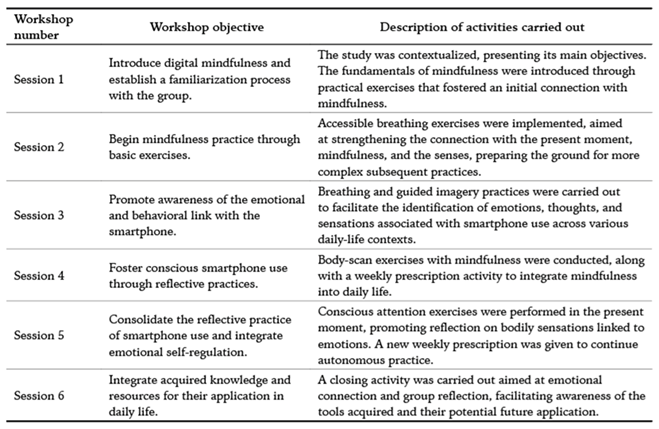
The intervention in the experimental group consisted of six digital mindfulness sessions delivered in workshop format, held between March and May 2025. The objectives of each session and the activities carried out are detailed in Table 1.
Data analysis
A preliminary analysis was performed to evaluate the fulfillment of the parametric assumptions of normality and homoscedasticity. Normality was tested with the Shapiro Wilk test. All variables adjusted to normality except for the measurement of usage time in social media; however, by eliminating the outliers in this variable, its distribution could be approximated to a normal one. Outliers were identified from box-and-whisker plots. Homoscedasticity was evaluated using Levene’s test, which indicated equal variances across all variables for the experimental and control groups. To analyze the effects of the digital mindfulness intervention, intragroup and intergroup comparisons were performed. The significance of intragroup differences was evaluated using Student’s t-test for related samples, while the significance for intergroup differences was evaluated using the t-test for independent samples. The effect sizes were calculated using Cohen’s d. Likewise, under the difference-in-differences model, the delta between the “pre” and “post” measurements was calculated, and then the pre-post differences were analyzed to determine whether they varied by group (control vs. experimental). A 5% significance level was used, and all mean comparisons were expected to be performed with one-sided contrasts. To strengthen the analyses, ANCOVAs were conducted using the pre-intervention measures and gender as covariates.
Results
Table 2 presents the correlations for the “pre” and “post” intervention periods, including responses from both the control and experimental groups. During the “pre” measurement, only one significant correlation was found between the variables of Reflective Smartphone Disengagement and Time on Social Media [r(52) = -.386, p = .004]. For the “post” period, greater Reflective Smartphone Disengagement was associated with less time spent on social media [r(48) = -.524, p < .001] and less academic procrastination [r(53) = -.521, p < .001]. Additionally, minutes on social media correlated positively with Academic Procrastination [r(49) = .361, p = .009].
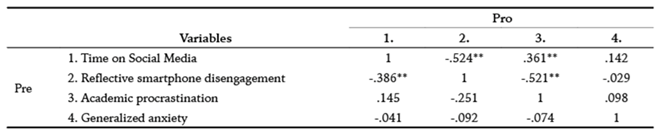
Table 3 shows the results of the pre-post mean comparisons in the control and experimental groups. For the control group, no differences were found in the analyzed variables. For the experimental group, however, a significant increase was found in Reflective Smartphone Disengagement [t(27) = -2.925, p = .003, d = .553], a significant decrease in the average daily minutes on social media [t(23) = 2.060, p = .025, d = 0.421], and a significant decrease in scores on the Generalized Anxiety Scale [t(25) = 3.518, p < .001, d = .690]. Thus, the experimental group increased from a mean of 20.17 to 22.07 on the Reflective Smartphone Disengagement scale and from 17.96 to 15.53 on the Generalized Anxiety scale. The experimental group registered a decrease of 49 minutes in usage time, while the control group increased by 5 minutes. On the other hand, no significant differences were found for Academic Procrastination.
Table 3: Means pre and post digital mindfulness sessions in control and experimental groups.
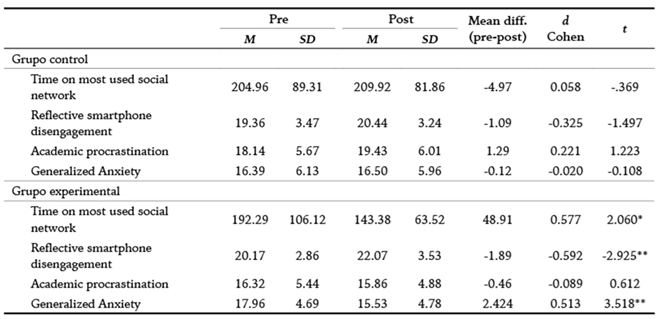
* p < .05; ** p < .01. The experimental group shows moderate effects in reducing social network time (d = .58) and anxiety (d = .51), and a moderate-large effect in improving smartphone disengagement (d = -.59). Control group effects are generally small (|d|< .33). Negative values indicate decreases in the construct (e.g., less anxiety), while positive values in procrastination indicate increases. increases. Effects ≤|.2| are small, ~|.5| medium, ≥|.8| large.
Intergroup comparisons showed that during the “post” measurement, the experimental group obtained a higher mean (M = 22.07, SD = 3.53) in Reflective Smartphone Disregulation than the control group (M = 20.44, SD = 3.24) [t(53) = 1.780, p = .040, d = .480]. Similarly, the experimental group scored significantly lower on the Academic Procrastination scale than its control group [t(54) = 2.427, p = .009, d = .649] and showed significantly less time spent on social media [t(49) = 3.125, p = .001, d = .904].
Since intragroup and intergroup differences alone are insufficient to verify a causal effect attributable to the intervention, a difference-in-differences analysis was performed. This analysis takes into consideration the differences in the “pre” measurement and subtracts them from the “post” measurement. Under this approach, significant effects of the digital mindfulness intervention were found only in anxiety symptomatology scores [t(50) = 1.998, p = .026, d = .554] and in time spent on social media [t(48) = 2.013, p = .025, d = .570].These results suggest that variations between “pre” and “post” measurements of these variables depended on the participant’s intervention condition. In other words, an interaction was found between the condition (control vs. experimental) and the measurement time (pre vs. post).
In the case of generalized anxiety, although pre-existing differences between the experimental and control groups were observed at the initial measurement, the gap between the groups was reversed after the digital mindfulness intervention, positioning the experimental group as the group with the lowest average anxiety and showing a significant decrease compared to its baseline. Based on Figure 1, in a counterfactual scenario in which the experimental group had shown the same trend as the control group, the final anxiety measurement would have reached 11.1 points. This figure contrasts with the empirical score for the experimental group at the end of the intervention, which was 8.54 points.
Regarding the average time spent on social media, a decrease was also observed, attributable to the impact of digital mindfulness. Figure 2 shows that in the “pre” measurement, the average time spent on social media was around 190-200 minutes, with no significant differences observed between the groups. After the intervention, the control group’s scores remained stable, while the experimental group showed a significant decrease in usage time. In a counterfactual scenario, that is, in the absence of a digital mindfulness program, the experimental group would have obtained an average of 197 minutes of daily social media use, contrasting with the value empirically achieved by the participating group, whose average use was 143 minutes daily.
Regarding Reflective Smartphone Disengagement, although significant differences were found in the pre-post comparison of the experimental group and significant intergroup differences in the “post” measurement, the results were not statistically significant under the differences-in-differences model [t(53) = 1.270, p = .105]. As shown in Figure 3, both the control and experimental groups tended to increase scores on Reflective Smartphone Disengagement, with the increase in the experimental group greater, suggesting no significant causal effect of the digital mindfulness intervention program. Finally, comparisons for Academic Procrastination were also not significant [t(54) = -1.263, p = .106] nor did they show improvements in the intragroup analysis.
Table 4: ANCOVA for Post-Intervention Measures as a Function of Group (Control Vs. Experimental), Controlling for Pre-Intervention Measures and Gender.
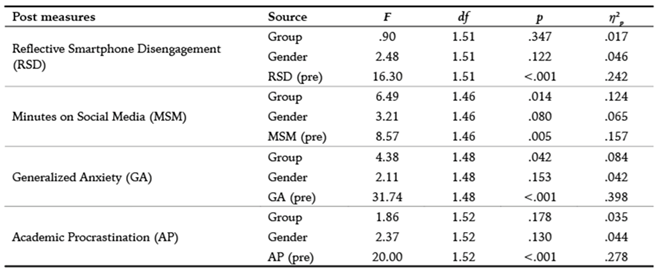
Table 4 presents the results of the ANCOVAs. These findings confirm the significant effects of the Digital Mindfulness intervention on generalized anxiety scores and minutes spent on social media. Specifically, significant differences in post-intervention social media use were observed between the control and experimental groups, even after controlling for pre-intervention measures and gender [F(1,46) = 6.49, p = .014, η 2 p = .124]. Likewise, significant differences were also found for generalized anxiety [F(1,48) = 4.38, p = .042, η 2 p = .084] That is, even when considering gender as a potential confounding factor, differences between the control and experimental groups remained significant for both minutes spent on social media and generalized anxiety scores. Participation in the Digital Mindfulness workshop accounted for approximately 12% of the variance in social media use time and 8% of the variance in generalized anxiety scores. In contrast, for Reflective Smartphone Disengagement and Academic Procrastination, the workshop effects were not significant, even after controlling for gender and pre-existing differences in baseline scores.
Discussion
Mindfulness-based interventions are widely documented in academic literature (Zhang et al., 2021). The accumulated evidence supports the impact of these interventions across a wide range of variables, particularly stress and anxiety (Parsons et al., 2022), and emotional regulation (Bockmann & Yu, 2023). This research approached mindfulness from a new perspective, focusing on balancing interactions with people’s technological environment, including mobile devices, computers, and the range of gadgets typical of the modern technological landscape. To study the effects of digital mindfulness, an intervention program based on workshops was designed and evaluated using a quasi-experimental design. The objective of the study was to determine the effectiveness of a brief digital mindfulness workshop on reflective smartphone disengagement, academic procrastination, time spent on social media platforms, and anxious symptomatology. Thus, this study is the first to provide causal evidence of the effects of digital mindfulness on psychological and behavioral variables among university students.
The results showed that the digital mindfulness intervention had significant effects on the study variables, particularly on anxious symptomatology and time spent on social media. It was observed that participation in digital mindfulness workshops significantly reduced anxiety scores, while for the control group, such scores remained constant over time. This result was consistent with previously reported literature. Multiple studies have found that mindfulness positively impacts well-being by fostering actions that connect with the present moment and lead to a greater state of consciousness (Parsons et al., 2022). Previous studies have indicated that mindfulness generates activation in brain areas starting eight weeks after the practice begins (Gotink et al., 2016); however, shorter interventions have also shown significant changes in anxiety levels (Bruna et al., 2023). While the effect of mindfulness on anxious symptomatology is supported by empirical evidence, its approach from a perspective focused on the relationship with technologies is still in a seminal phase. The effectiveness of digital mindfulness in reducing anxiety cannot be attributed solely to the actions performed during the workshops, but also to the prescriptions given to participants. These prescriptions enabled the use of the acquired tools outside the workshop context, thereby contributing to the integration of mindfulness into daily activities.
A second area in which digital mindfulness proved effective was reducing time spent on social media platforms. In absolute terms, this decrease was 49 minutes, representing a 25% drop between the pretest and posttest measurements of the experimental group. This gap was significant, given that the control group’s usage time remained relatively unchanged between the two measurements. This result is important because it demonstrates that digital mindfulness not only reduces participants’ anxiety, as any other mindfulness-based intervention would, but also affects behavioral aspects of the relationship between technology users and their social media platforms. Furthermore, this result constitutes an effect independent of that observed in anxious symptomatology, because bivariate results showed that social media usage time did not correlate significantly with anxiety. In summary, the digital mindfulness intervention produces at least two independent positive effects.
Contrary to expectations, the digital mindfulness intervention did not have a significant effect on reflective smartphone disengagement; however, this result must be qualified by several methodological factors. Although a significant increase in reflective smartphone disengagement was observed in the experimental group, this difference did not persist when controlling for the control group’s measurements. However, one would expect that, with a larger sample, the overall effect of digital mindfulness would reach statistical significance. On the other hand, the reflective smartphone disengagement scale showed poor reliability in the participant sample, suggesting that the construct was measured with a high degree of error. This limitation implies that inter- and intra-individual variations in reflective smartphone disengagement are largely random.
With the current results, it is not appropriate to rule out eventual effects of digital mindfulness on reflective smartphone disengagement. Future research can improve the approach to this concept by conducting a more exhaustive calibration of the psychometric properties of the reflective smartphone disengagement scale and by examining its relationship with mindfulness across both intervention and non-experimental studies. In particular, the concept of reflective disengagement could be useful for understanding the mechanisms underlying digital mindfulness’s impact on reducing time spent on social media. In fact, reflective smartphone disengagement showed an inverse, statistically significant correlation with time spent on social media, suggesting that its consideration in future studies can help clarify its role and its eventual causal link. Assuming that reflective smartphone disengagement plays a relevant role in how digital mindfulness achieves significant effects on social media usage time, this assumption can be supported by previous studies such as Terzimehić et al. (2022). This study designed a mobile application based on the principles of mindful attention and reflectivity. The application prompts the user when unlocking their mobile device, helping them become more aware of the purpose of its use. Such an application demonstrated a reduction in distracted smartphone use and contributed to a faster reincorporation into real-world activities, suggesting that mechanisms based on use reflectivity can mediate the effect of interventions to reduce device usage time.
Finally, regarding academic procrastination, although no significant effects attributable to the digital mindfulness intervention were observed, it can be hypothesized that the time required to effect a change in procrastination habits exceeds the scope of the proposed intervention. However, it should be noted that previous studies have indeed found impacts on procrastination from mindfulness-based interventions, although none of them have done so by adapting it to purposes related to the link with technologies.
Conclusion
The results of this research suggest that digital mindfulness can be an effective strategy for improving the balance between users and technologies. The digital mindfulness workshops reduced anxiety and social media use time, providing evidence of their usefulness as a preventive tool in educational contexts. Although no effects were found on academic procrastination and reflective smartphone disengagement, potential effects could emerge with a larger sample and more robust instruments.
This study underscores the importance of developing interventions that promote conscious, self-regulated use of technology, especially in contexts where its presence is constant and inevitable. Unlike proposals advocating total disconnection, the digital mindfulness approach offers a realistic and sustainable alternative that fosters healthy habits and reflective decisions about device use. In a hyperconnected world, this study is not claiming that people should completely disconnect, though it suggests that the practice of digital mindfulness in university contexts could contribute to greater awareness of the world and of themselves, using technology in balance and with consciousness. This opens new lines of research and application in the fields of mental health, higher education, and cyberpsychology, where the balance between well-being and technology can be achieved without sacrificing the benefits of the digital environment.

