




 texto em
  Inglês (pdf)
 Artigo em XML
 Referências do artigo
 Tradução automática
 Enviar este artigo por email
 Citado por SciELO
  Similares em
SciELO
Similares em
SciELO 
 Permalink

1. Introduction
How may artistic practices help us intervene and reconsider the structures and visual taxonomies present in colonial imagery and their afterlives? This question served as the starting point for a symposium organised by the three authors at Erasmus University Rotterdam, during which we invited two artists-researchers whose work critically engages with photographic legacies and their ongoing effects on contemporary identity formation. Dzifa Peter’s and Nurul Huda Rashid’s practices demonstrate how the artistic and scholarly intervention has the potential to reconfigure visual regimes that once sought to define, classify, or contain racialised and colonised bodies.
Dzifa Peter’s work draws on her own bicultural background as a German-Ghanaian artist and scholar, navigating between colonial and diasporic contexts and between vernacular and institutional photographic archives. In doing so, she adopts photography, photomontage, and installation to reveal the tensions between the private and the public; between institutional structures and intimate, sometimes traumatic family narratives; and between history and the imagination.
Nurul Huda Rashid’s work centres on the production and algorithmic circulation of images of Muslim women, and traces how search engines and archival infrastructures reproduce older colonial and patriarchal tropes. Through the practice of annotation and working with Muslim women during workshops, Rashid explores how we may intervene in the structures that classify, order, and reproduce hegemonic imagery through different modes of opacity and (in)visibility.
In the following interview, we ask the two artists-researchers how historical images continue to influence the ways people see themselves and others, and what role artistic practice may play in challenging these visual legacies. They discuss how they mitigate the colonial gaze, how their reworking of existing photographs creates new forms of meaning, care, or refusal, and how the research community can critically engage with the hegemonic structures that sustain dominant ways of seeing.
2. Interview
Lise Zurné (LZ): Just to start off, how would you both describe the way you work, specifically how your artistic work intervenes or intersects with your scholarly work?
Dzifa Peters (DP): As a young person, I faced many contradictions and prejudices, thoughts that were very concerning at the time for me, because I lived in two countries and noticed how each side thought about the other in very obscure ways. I started integrating that aspect more and more into my artistic work, where I used biographical material from my own life and my family in a more autofictional manner. The topics that arose from that dealt with post-colonial discourses, questions of cultural identity and memory, and visual culture. That automatically led me to want to know more about these research fields, which is why I actually started my PhD. At first, I wasn’t really convinced I could actually do that, integrating my own artistic practice as a kind of hybrid methodology, and whether it was allowed. But over the years, even though I was initially hesitant, it became clearer that this was what I had to do, next to engaging with existing artworks and visual culture. So it’s a journey, a malleable journey, and we have a part in adapting it; we can make changes.
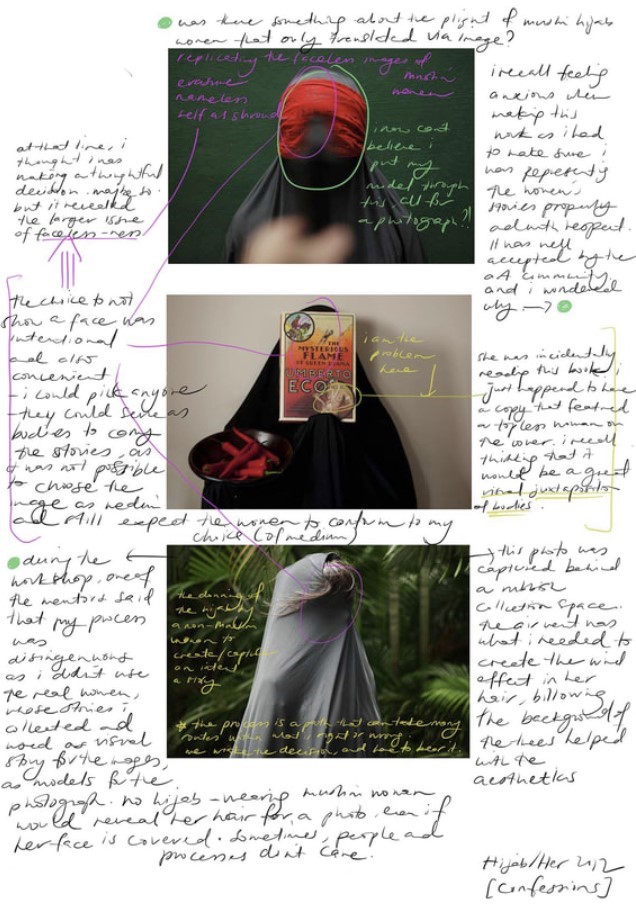
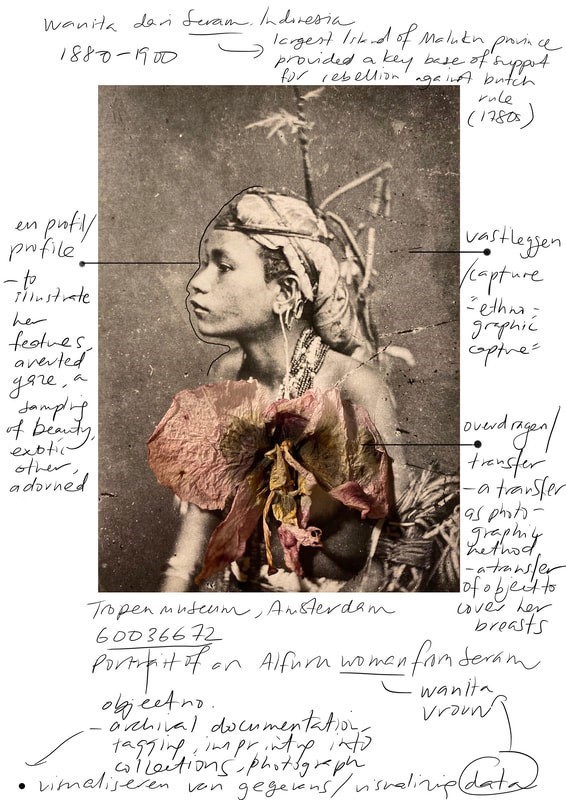
Nurul Huda Rashid (NHR): For me, it has always been this conversation between art and academia. They kind of work in tandem, as I always had an art practice, from which some work stemmed out of disenchantment with academia, particularly how it is about a community but never gives back to the community. So, I started thinking about what it would mean to use the image as a medium that could perhaps better speak to that community. And when I started my hijab series (Figure 1), it was also autobiographical, because it was me, as a Muslim woman, trying to understand the experiences of visibly Muslim women in Singapore. So I started with photography as a kind of democratic medium. But then I also realised the limits of the image, and that’s when I jumped back into academia as an introspection to see how historical research in archives (Figure 2) will give me a certain articulation of the gaze and the politics of refusal, and to think, what is omitted or saved? So, at least for me, there is no hierarchy between art and academia. I think they borrow the same strategies. It’s just a matter of what the final form or modality is and what kinds of audiences it moves towards.
Charlotte Bruns (CB): The symposium was called “Visual Legacies: Colonial Photographic Archives and the Self”. In what ways does the self play a role in your work, and maybe even a racialised self?
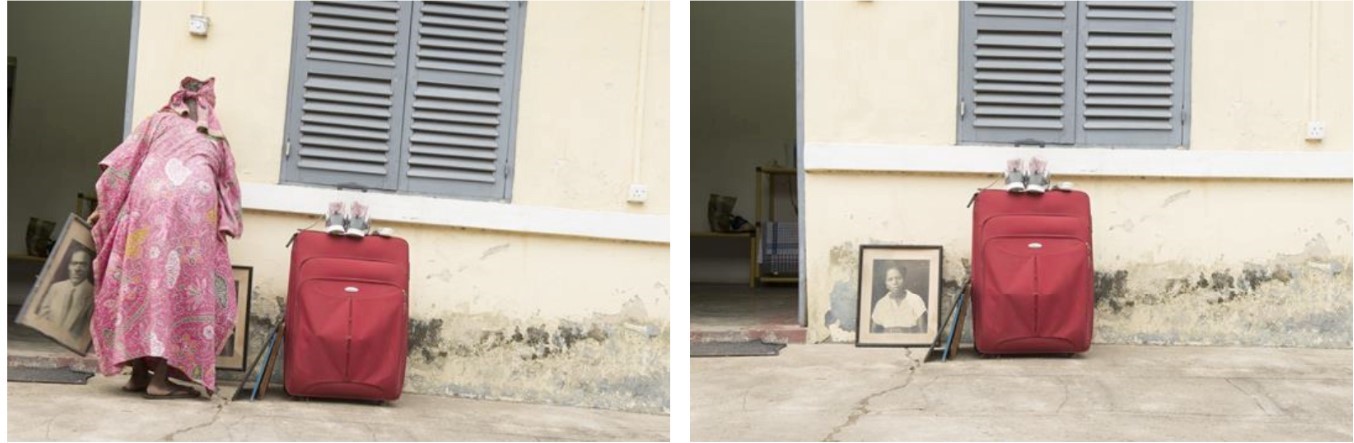
DP: For me, how I started this work, the question is: who am I? Like, who am I really? Engaging with these vernacular photographs of my mother and my grandmother (Figure 3), I tried to understand them, which helped me build up a relationship to the different challenges I was facing myself. It was almost therapeutic in that sense. And in that way, the auto-fictional mode helps you to really go into the imaginative. You can go to things of concern and visions of the future; it is in those places where you truly engage with yourself. For me, issues of tropes and representation weren’t a starting point; they came as a second journey, which allowed me to enter theory and discourse.
NHR: For me, the self is built on the idea of violence. In the colonial archive, the imprint or the categorical fixedness of race is part of that violence because it removes the self from it. The images of women in the archives, they do not mention their names, which already removes a certain familiarity. There is no credit, so you don’t know what brought these women into these photographic studios and what happened to them. At the same time, in my work, the reading of the self is twofold. On the one hand, it begins with looking for both my grandmothers in all these women. That is the search for a certain kind of self, a self I recognise. Not necessarily myself, but my grandmothers’ selves based on their stories and on my memories and experiences of them. In that sense, it is a kind of restoration: how do we give a self back to these women who have been made into “non-selves” because they just become an image?
On the other hand, when I started the hijab series, that was definitely me trying to use the camera as a way to understand myself as a visible Muslim woman. But I also slowly moved away from that because I realised that I was contributing my whole sense of being to an image that would become part of a trope. Then, to “de-trope” is to read or write ourselves back into it. The pace of making the images, the materials and annotation to choose, the layers to introduce, these are all acts of speaking about self. By nesting them in my grandmothers’ stories, they embody the visual markers of the stories of the women in my life.
CB: In the symposium, both of you mentioned an auto-fictional manner that you developed over time in your practices. I was wondering how you both use the arts to create knowledge. Using the arts as practice allows for fiction, in the first place, and allows for different sorts of fiction where research and academia might not have a place for it. So what role does fiction play for both of you?
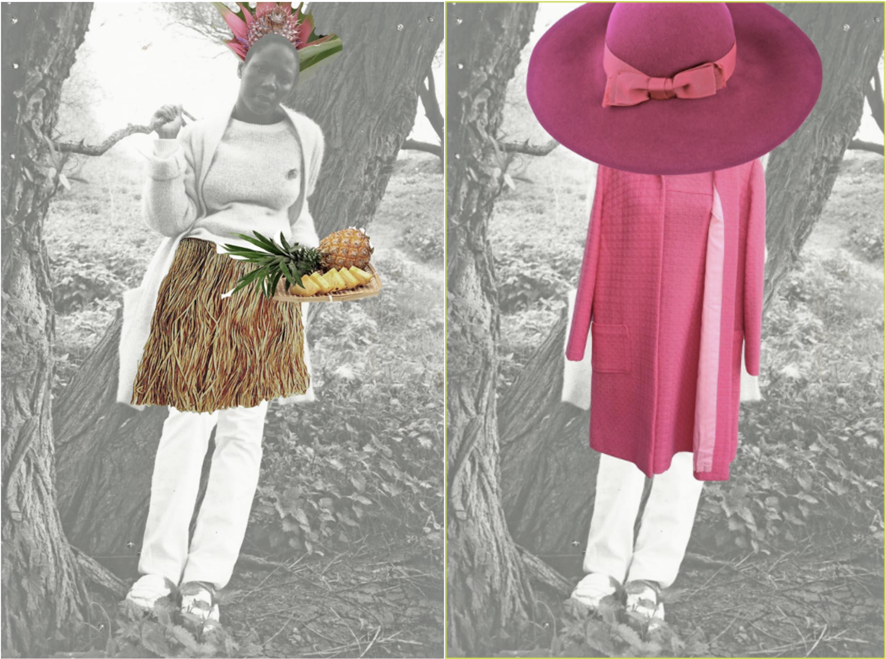
DP: I think it plays a huge role in my work, especially in the photo montage of my mother in the project I called You and We. The fictional aspect is where I intervene in the archival footage I had of my mother and dress her in different dresses. One of the images was taken after her arrival in Germany at the age of 19. Her first job was to promote pineapples, and this was at a time, when people weren’t familiar with the fresh fruit. They knew them from tins, cooked with sugar. So that’s what people had in mind when they actually saw her in malls, fairs, and on different occasions promoting the fruit. Many people saw a Black person for the first time in their lives. So they were a bit hesitant and shy to approach her, but also curious. She told me that many people said that they couldn’t believe that fresh pineapple was edible.
Because my mother had told me these stories so many times, I created my own images in my head, and they shaped my ideas about what it was like in Germany in the 1970s as a Black person. The fictional aspect of the photo montage, where I dressed her in this very exotic appearance with the fresh fruit (Figure 4), allowed me to go into a place that, of course, is also shaped by the different visual regimes that we’ve all been exposed to over time. This place is where it actually, up until this day, really hurts. It hurts me to look at the images because something about them is so disturbing. I’m speaking of a visual regime which comes from the colonial times. So I think that fictionality gives you the possibilities to go into unknown places, discover new things, where sticking to the mere facts will not allow you to do. It wouldn’t give you the range of space to do so.
NHR: I also just wanted to add that the aspect of fiction goes both ways, because it is in the image itself as well as in how and when audiences view it. There is a certain ephemerality to what they are experiencing. And in that sense, it becomes a kind of fiction for them, as they can only understand what they see in that mode based on not having a background to it. And this is where I started to write the image as text as a way to introduce a different kind of immersion, so it allows you that breadth of time to really see or read the image.
Fiction for me also then is about the whole craftsmanship of storytelling, and I think that’s why I really love how you, Dzifa, weave the different kinds of features in the work, because then it also becomes a way to not just look at the image, but also to introduce a different pace. I think fiction allows for a new pace for understanding or decoding the images, rather than just seeing them for what they appear to be.
LZ: You’re both relying on family archives, but that also requires some emotional labour, as Dzifa mentions that working with it “hurts”. How do you deal with the emotional aspects of having to navigate both family history and audiences - whether they’re for your artistic practice or for academic audiences?
DP: I think it has a lot to do with the concept of the trope, which is influenced in so many ways, and it also internalises fictionality, but then it is also born out of representation. It is a challenge. Over the years, I grew more and more comfortable just seeing myself as a mediator between these different contexts, whether it is culturally or whether it is academic versus artistic.
During the symposium, I also mentioned the concept of “postmemory” (Hirsch, 2012) in the context of emotional labour, which I also use in my dissertation. It allowed me to go back to all these stories I heard from my mother growing up: memories that are not your own, but ones you have internalised as someone who grew up hearing them from your parents or your grandparents. These stories about my mother were not harmless either. They may seem funny today, but at that moment, she was really isolated and going through years of crisis. Of course, “postmemory” as a concept was initially connected to Holocaust studies and traumatic events. Here, I use postmemory in a broader way; I think it’s a useful tool.
NHR: In my academic work, I look at all these colonial archives of images of women in the Maghrib, and then there are all these paradigms of exploitation that happen, all the tropes. And that is also emotional labour: having to look at it and then having to consume it. That is why I differentiate between the looking and the making in the artwork. This is like when Dzifa mentions having to reacquaint herself with her mother’s photographs and then her stories. The emotional labour then becomes more fulfilling when you are trying to identify different visual strategies. I’m going to sit down with this image. I’m going to write on it. I’m going to somehow paste something on it. I’m going to put stuff alongside it, and I feel that this emotional labour is, albeit at times difficult, so important.
I also differentiate between academic research and artistic practice. A lot of my academic research involves having to delve into these images, which, in a way, are violent or violating. The artistic practice allows me the space to use it differently. So there is that productive duality between the two.
CB: The role memory plays in your work is interesting, as is the tension between public and private in relation to images. When you deal with family photographs, and you put them out there, they become public. In both of your practices, when you rework these personal and archival images, how does it relate to your personal memory and collective history, as your own works also become new objects of memory?
NHR: I like to tease these boundaries of between public and private because it then goes back to the discussion of ownership: who owns these images? There is institutional ownership and, within that, there’s also a colonial ownership, a colonial paradigm within which these images are located. I try to elude the binary of public and private through annotation. In the act of writing over the images, I conceal parts of my grandmothers in the photos to avoid showing too much of them, using the story’s annotations. So it is a way to create layers while still making them private.
Especially in the photographs of my grandmothers, neither of them was wearing their hijab. So, for me, writing over them was also a way to conceal, so that when they’re shown in public, I’m still concealing some parts and respecting their boundaries. With images from the colonial archives, I also try to ask what can be concealed while still critiquing the colonial paradigm, so that there is still a certain kind of privacy, or modesty, that can be afforded to the images of the women from the archives. For me, annotation is a way to mediate between public and private while still retaining some ownership.
DP: When working with colonial, vernacular archives or family photographs, there are different stories surrounding the images: what happened before and after the image? What is the context? The way I worked with the photographic material I used from the Basel Mission Archive in Ghana, I called “photographic reversion” (Peters, 2023). It means you actually go back, and the image will tell you a completely different story than how it was perceived at the time the photograph was taken. That’s also why, right now, the work I’m doing focuses on going into different vernacular archives, because I see so much potential in giving voice to archives that just aren’t out there, not the institutionalised visuality that we all are exposed to.
CB: This also touches upon the notion of the gaze. Of course, the colonial gaze is often understood as a mechanism of control. But recent scholarly and artistic practise also suggests that the gaze can be contested or reversed, just as you mentioned. How does your work engage with this tension between being seen and looking back?
DP: In my dissertation, I refer to John Berger (1972), who in 1972 spoke about the dialogical constitution of the visual. So seeing is also being seen: it’s this constant backand-forth. It’s an exchange. And then Tina Campt (2017) also writes about how visuality is completely changed by Afro-descendant artists. Multiplying artistic and scholarly work has this quality of challenging visuality.
NHR: For me, my reference would be my grandmothers who taught me the beautiful “anti-gaze” of jeling. It’s kind of like an eye roll, and there’s a bit of aggression in it. It means that you are directly contesting the person who’s looking at you. If the colonial camera already embeds a dominant gaze onto how women are photographed, part of my work is to then look at how their faces are portrayed and jeling at that. I think that was when I started actually seeing a lot of semi-angry or just indifferent looks in the archive’s photographic images. I use that as an entry point to then speak about a new way of seeing, where I use the annotated text to redirect how you read certain images.
LZ: Building on that, can you say something about the visual strategies you both use, with annotation or collage, which also reconfigures the relation between the subject and the backdrop? Could you explain why you’ve chosen these approaches?
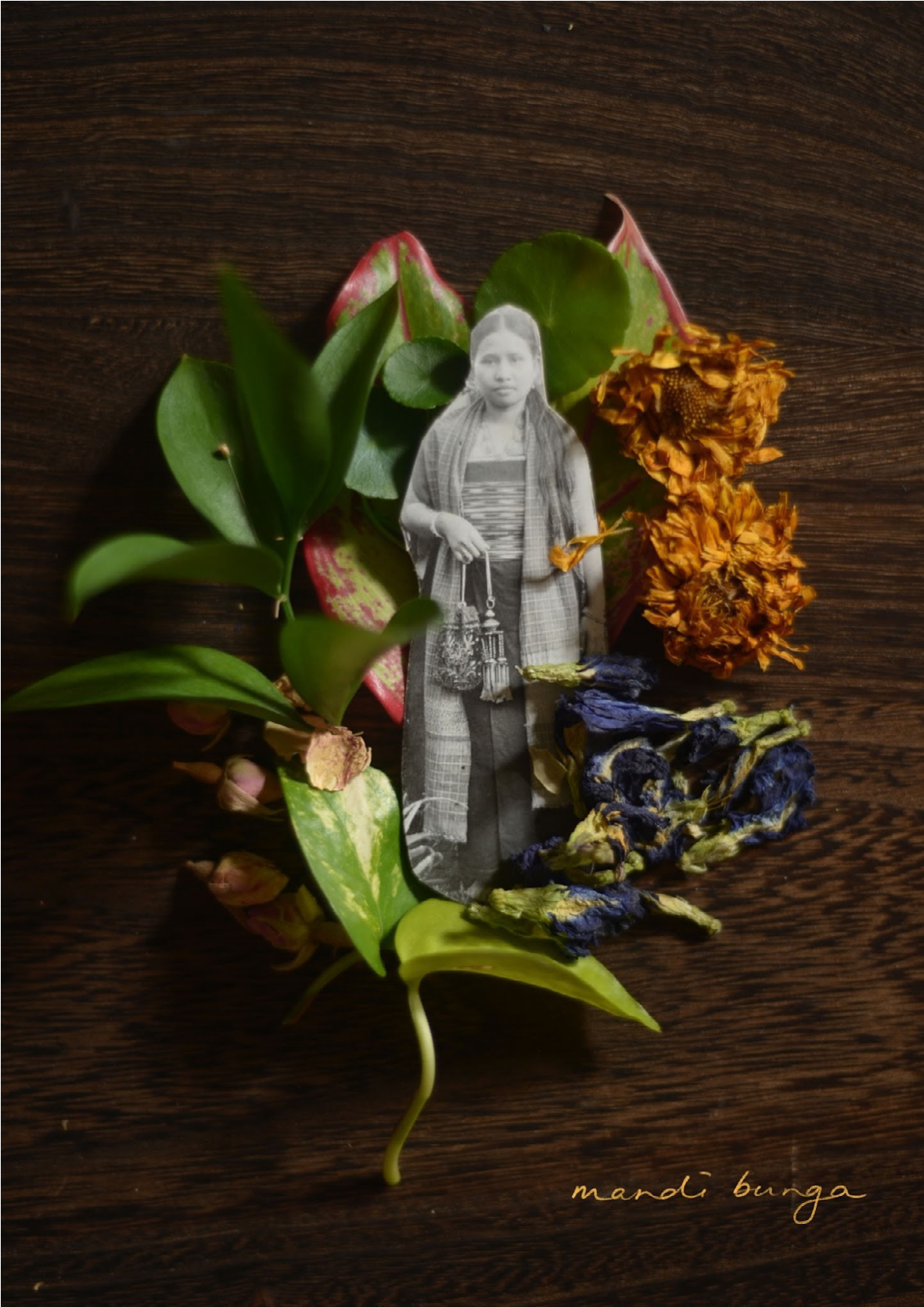
NHR: A lot of my work does look at the body, but also more in terms of what the camera’s technology does to the body. When I look at the archival image, there are different parts of it that make up its composition. This relates to archive fever (Derrida, 1995), in which he speaks about the exergue and how it is the different layers that make up the object in terms of its background, its paratext and so forth. So I tried to use that same analogy to shift this into a kind of visual strategy that would allow me to abstract things and make it opaque. So in the photographic images from the archives, all the women are in studios. In Mandi Bunga (Figure 5), I wanted to bring the women out of the backdrop because the photographic studio is part of the colonial coding. Taking women out, cutting them from it, becomes part of the strategy of annotating by releasing them. So that was a way to remove a certain layer and embed it within different, new layers. Because mandi bunga [Malay: flower bath] is a cleansing ritual, but also a beautification ritual. Placing her against a backdrop of flowers is a way to rehabilitate her from the colonial backdrop, then nestle her into the safety of a mandi bunga ritual. This also creates a new aesthetic for seeing. And annotating, on the other hand, is more directed at guiding the audience. Like, how do I correct certain things? What do I want to share? Because different communities have different levels of access or familiarity. So, for me, that relates to the public and private. How can something public also still have its private moments?
DP: For me, I rework images especially for my mother and my grandmother. I always found the images to be very beautiful in black and white. It communicates that it is a long time ago, right? But as beautiful as they were, they were also translated in a way that is much too harmless. I wanted to speak about the pain and, you know, the stories behind it. So I made sure once I started interfering in the images, that if you paid closer attention to the images, you could really see the external material, the cheapest pixelated images I could find. So, I interfered with these images in almost an unprofessional way. Technically, the way I did it is a very easy change. But the violence is not really in the change itself. It is more in the details that I chose, because I really wanted to bring out the present and contrast it with the archival. And even though the series is from 2024, and it is now 2026, it is still painful for me to look at them. It also relates to the institutionalisation of photography in the archive, where it doesn’t really interfere with us or cause us too much trouble. I really wanted to create a disturbance. This could be understood as what Brenda Bikoko (Brussels University) calls “reparation through violence”.
LZ: Based on your work and experience with colonial archives, do you have advice for the research community on how to work with and in them? We know that archives, digital platforms, and the search engines that we all use are also based on colonial taxonomies. How can we work with them more critically or reflexively?
NHR: Within the field of visual culture, the question is how do we bring the colonial archives back to communities? What are the historical contexts of the image, and how do we unpack that? Often, the entry point is a visual object. From there, we can trace it back and try to understand how it results from an intersection of geography, technology and ideology. Within studies of visual culture, we need a better understanding of that trio: how the camera moves differently across different places and how its technology operates alongside other mechanisms, such as algorithms and mass media. Even the political governance of a colonial archive is a form of technology. And since these technologies operate at such an expansive and fast pace, it becomes important to slow down the pace of our experience with the image. This involves understanding the different parts: the history of this particular image, what kinds of moments can be read into it, where it circulates, and how do we read it. So the gist of it would be to ask how you introduce a new pace of encountering the image.
DP: For me, it really has to do with the question of coherence, really. I think that when we engage with these archives that are so bold, we have to adapt. For example, I loved how Ariella Aïsha Azoulay (curator, filmmaker, and professor at Brown University) changed her name after engaging with her Arabic heritage [a part of the family’s origins that her Jewish father had purposely hidden; see also Azoulay, 2019]. Meaning, we can always go back and make changes that contradict what we said before. I know that sounds not, you know, scientific, but it’s a very honest way to go about it. The same applies to Paul Jenkins, the historian who actually discovered images in archives which contradicted the information he received from other scholars. It could always be added or contradicted in the end. So yeah, the question of coherence. I think artistic practices finding their way into academia allow for different ways of thinking.
NHR: Just to add, I like that you mentioned editing. When I did my Hijab/Her series, I found that my first academic articulation of it was problematic, and I realised that it was easier for me to do it as an artistic practice. In academia, if your journal article is out, it is “finished”. If you want to change something, you’d have to write a whole other journal article. That’s the malleability of the visual strategies, which is easier to change. Academia and the arts are very distinct fields or practices. In the classroom, for example, you can update your curriculum, but when it comes to [academic] writing, it is a decision. How do you write a retraction? The artistic process is more varied because it gives me more room to move, and I love the term Dzifa used, coherence and the space to be incoherent.
CB: Thank you. This is a great concluding statement.

