




 Inglês (pdf)
 Artigo em XML
 Referências do artigo
 Tradução automática
 Enviar este artigo por email
 Citado por SciELO
  Similares em
SciELO
Similares em
SciELO 
 Permalink

INTRODUCTION
Understanding the development of technologies, innovation and evaluation of the implementation of health strategies in the Unified Health System as priorities in the 2030 National Agenda of Health Research Priorities, it is understood that all technical skills are fundamental to nurses. However, the main skills that make you capable of solving complex scenarios require critical thinking and the ability to lead your team(1).
In this sense, both teaching and research in Nursing have sought to adapt to advances in technology in education. However, educational materials, such as hypermedia, protocols, and booklets confirmed for the Brazilian public, are not always available, making it impossible for people from various Brazilian locations to democratize information(2,3). In addition, the number of nurses trained to guide and promote health education with a focus on rehabilitation is still scarce(4,5).
Based on this context, the Associate Graduate Program in Nursing at the University of Pernambuco (UPE), and, the Associate Graduate Program in Nursing at the University of Ribeirão Preto da University of São Paulo (EERP/USP), developed the educational technology "Neurogenic Bowel Rehabilitation Protocol" for use in a virtual environment as a teaching-learning strategy.
The Neurogenic Intestine (NI) is characterized by a dysfunction in the colon that results in a lack of control in the Central Nervous System capable of altering developed the educational technology "Neurogenic Intestine Rehabilitation Protocol" for use in a virtual environment as a teaching-learning strategy.
The NI is characterized by a dysfunction in the colon that results in a lack of control in the Central Nervous System. In addition, these tools, together with health education, enable greater success and safety in the rehabilitation of NI(6,7,8,9). The creation of a protocol for the rehabilitation of people with NI is important because it allows the use of educational technology (ET) in nursing care, in view of its repercussions on the health system. In this sense, this study is relevant because it updates and awakens in nurses the knowledge necessary for the rehabilitation of NI.
Considering the above, we aim to collaborate with the development of an innovative strategy focused on NI rehabilitation through the construction of interactive educational material that encourages the active participation of nursing professionals, caregivers and people with NI in the learning process. Thus, this study aims to: Describe the process of development of an educational technology, focusing on the rehabilitation of the neurogenic intestine, for use in the teaching-learning process.
METHODOLOGY
This is a methodological study(10) that presents the first stage of the research "Construction and validation of the Neurogenic Intestine Rehabilitation Protocol", approved by the Research Ethics Committee of the University Hospital Oswaldo Cruz (CEP-HUOC) under Opinion No. 4,643,887, according to Resolution 510/16 and 466/12, of the National Council for Ethics in Research of the Ministry of Health, and in compliance with the guidelines for research procedures with any stage in a virtual environment of February 24, 2021.
The ET entitled "Neurogenic Intestine Rehabilitation Protocol" was elaborated in a methodological study of development and validation, with a quantitative approach, carried out in two sequenced stages: ET development (focus of this article) and ET validation.
The development of ET was carried out in four phases, as shown in Figure 1.
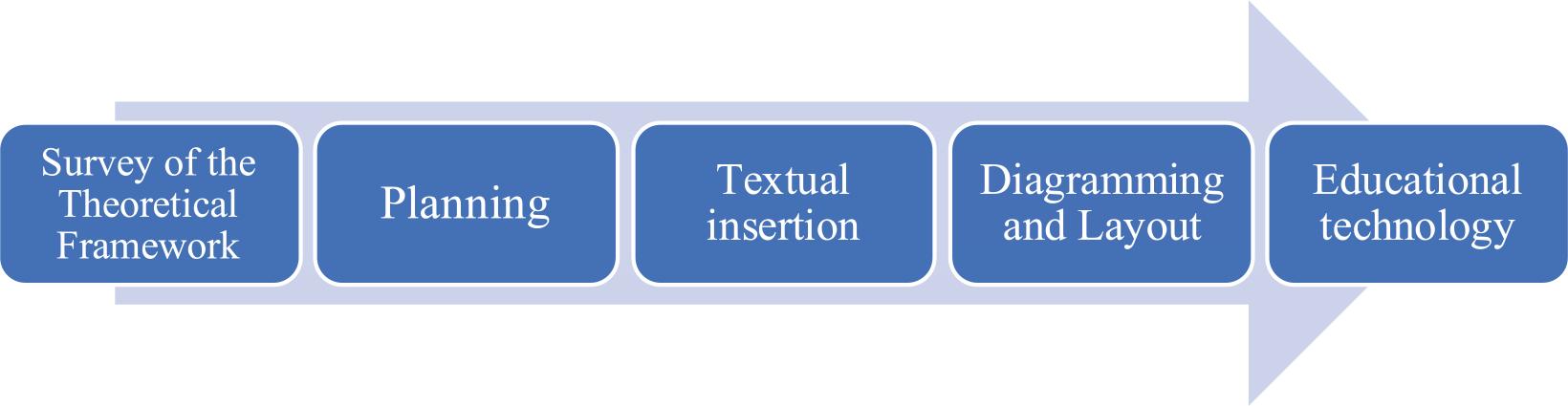
Source: Authors' elaboration, 2024.
Figure 1 Phases of the development ET. Recife, PE, Brazil, 2024.
In order to make this study operational, it was necessary to carry out a review of the scientific literature in order to synthesise the results of research into nursing care for the rehabilitation of SCI. To do this, the study followed the following required stages: (i) identification of the problem and elaboration of the guiding question; (ii) search and selection of publications; (iii) evaluation of the data; (iv) analysis of the data; and (v) presentation of the results. Initially, in order to answer the proposed objective, a guiding question was drawn up based on the PICOT strategy: In people with Neurogenic Bowel (P), what nursing care (I), through intestinal rehabilitation (C), is capable of contributing to an improvement in the pattern of intestinal eliminations? (O) The study was based on the observation of publications from the last ten years (T).
The search was carried out between April and June 2021 by two researchers who, after standardising the stages of the search, carried it out separately and then compared the results obtained. The databases used were: LILACS (Latin American and Caribbean Health Sciences Literature), PubMed (Public/Publish Medline), Scopus Nursing Database (BDENF) and SciELO (Scientific Electronic Library Online), combining the Health Sciences Descriptors (DeCS): ‘Neurogenic Bowel’; “Constipation” and “Nursing”; and the Medical Subject Headings (MESH): “Neurogenic Bowel”; “Constipation” and “Nursing”, with the Boolean operator “AND” between the terms with combinations in pairs and triads, thus enabling a broad search of the studies.
Full research articles published in Portuguese, English or Spanish in the last ten years (2011 - 2021) on the subject of the study were included. Repeated papers, review and opinion articles, course completion papers, theses, dissertations and abstracts were excluded. To help understand the selection process, the stages were organised according to PRISMA.
In the third phase, the data was evaluated and made available in tables to extract the most relevant information from the selected articles, including: identification of the main author, year, journal, Qualis, level of evidence, objective, methodology, main results and conclusions found.
When analysing the articles, the findings were classified according to the level of scientific evidence. To do this, we used a classification system made up of seven levels: Level I - evidence from systematic reviews or meta-analysis of relevant clinical trials; Level II - evidence derived from at least one well-designed randomised controlled clinical trial; Level III - well-designed clinical trials without randomisation; Level IV - cohort and case-control studies; Level V - systematic review of descriptive and qualitative studies; Level VI - evidence derived from a single descriptive or qualitative study; and Level VII - opinion of authorities or expert committee reports.
The convergences and divergences between the authors and the methods and techniques used to empty the bowels of people with IN were then analysed.
Finally, in phase five, the presentation of the data and the discussion of the articles were related to intestinal emptying practices, as well as their effectiveness and safety for patients. A flow was organised focusing on the objectivity and clarity of the articles, which implies their validation.
Educational materials created and validated by the Neuropsychomotor Rehabilitation Research and Care Centre (Neurorehab) at EERP-USP for neurogenic bowel were consulted as a basis for structuring the proposed guidelines and the care offered by nurses, available at the following link: http://eaulas.usp.br/portal/video.action?idItem=8104
Data from similar subjects was analysed and brought together in order to include as much important information as possible. It is important to note that the educational technology was developed between June and August 2021.
The text was inserted in accordance with ABNT Brazilian Standards No. 6029 and organised in such a way as to include the External Part, containing the Cover, Back Cover and Internal Part, subdivided into: (i) Pre-Textual Elements, which include the title page, authors, titles and qualifications, title, place, year and acknowledgements; (ii) Textual Elements, consisting of presentation and content; and (iii) Post-Textual Elements: containing the references.
Both the text and the images were implemented on the Canvas virtual platform. Canvas® is a web-accessible platform that enables the creation of applications, solutions, educational programmes, folders, booklets, protocols and teaching materials that are creative and attractive to readers.
After the technology was built, it was validated by expert judges in the field of rehabilitation nursing using the Content Validation Index, obtaining a score greater than 0.80 in all the items assessed. The data collected during validation was transferred and analysed using the Statistical Package for the Social Sciences® - SPSS base for Windows® 20.0 and Microsoft Office Excel® 2010.
For the descriptive analysis, frequency and percentage were calculated, as well as the mean and standard deviation, taking into account the 95% confidence intervals (p<0.05).
RESULTS
Initially, a survey of the theoretical framework was carried out through an integrative literature review(11), followed by the improvement of ET, 12 more scientific articles, one books, a technical manual and a website found by the researcher were selected, as shown in Chart 1. For the normative database, national resolutions were accessed, as well as those of the Federal Council of Nursing.
Chart 1 References for the elaboration of the Neurogenic Bowel rehabilitation protocol. Recife, Pernambuco, Brazil, 2024.
| TEXTBOOKS |
|---|
| Herdman TH, Kamitsuru S, Takáo C. Learning to care in nursing: specific learning situations. 12th ed. Brasil: Artmed; 2021. 2021-2023. |
| SCIENTIFIC ARTICLES |
| Alencar D, Andrade E, Rabeh S, Araújo T. Effectiveness of distance education in nurses' knowledge of intestinal ostomies of elimination. Rev Gaucha Enferm. 2018;39. Available at:
https://www.scielo.br/j/rgenf/a/FtxntjDNJRWfmPyHYn44B3s/?lang=pt
Andrade LT, Favoretto NB, Souza DRP, Gimenes FRE, Faleiros F. PRONANDA: Programa de Atualização em Diagnósticos de Enfermagem, ciclo 6. [S.l.: s.n.]; 2018. Bardsley A. Approaches to managing chronic constipation in older people in the community setting. JCN. 2015;20(9):444-450. Available from: https://pubmed.ncbi.nlm.nih.gov/26322992/ Clares J, Fernandes B, Guedes M, Freitas M. Specialized nursing terminology for the care of people with lesion medullaris. Rev Esc Enferm USP. 2019;53:1-6. Available at: https://www.scielo.br/j/reeusp/a/n7mDp8XNRc69W5ZSLJkhxhH/?lang=pt Coggrave M, Norton C, Cody JD. Management of fecal incontinence and constipation in adults with central neurological diseases. Cochrane Database Syst Rev. 2014;(1). Available at: https://www.cochrane.org/pt/CD002115/INCONT_manejo-da-incontinencia-fecal-eda-constipacao-intestinal-em-adultos-com-doencas-do-sistema-nervoso Espejo A, Villén R. Revisión narrativa sobre estrategias de control intestinal en pacientes lesionados medulares. Rev Mex Med Fis Rehab. 2020;31(3-4):51-59. Available at: https://www.medigraphic.com/pdfs/fisica/mf2019/mf193_4e.pdf Goldstine J, Knox K, Beekman J, Cobussen-Boekhorst H, Conti A, Gray M. A Patient-Centric Tool to Facilitate Goal Attainment Scaling in Neurogenic Bladder and Bowel Dysfunction: Path to Individualization. Value Health. 2021;24(3):413-420. Available at: https://www.sciencedirect.com/science/article/pii/S1098301520345046 Li Q, Shen YL, Jiang YL, Li DS, Song J. The effect of the therapy of “combination 3 methods progression” in patients with neurogenic bowel dysfunction (constipated type). Medicine Open. 2021;100. Available at: https://journals.lww.com/md-journal/Fulltext/2021/02190/The_effect_of_the_therapy_of__combination_3.42.aspx Martinez AP, Azevedo GR. Translation, cultural adaptation and validation of the Bristol Stool Form Scale for the Brazilian population. Rev Latino-Am Nursing. [7 screens]. Available at: https://www.revistas.usp.br/rlae/article/view/48582/52549 Miranda F, Henriques S, Abrahão C, Gonçalves N, Tannure M. Diagnoses and nursing interventions identified in patients with spinal cord injury: literature systematic review. Rev Enferm UFPE Online. 2010;4(3):1101-1109. Available at: https://periodicos.ufpe.br/revistas/revistaenfermagem/article/view/6265 Nielsen SD, Faaborg PM, Finnerup NB, Christensen P, Krogh K. Ageing with neurogenic bowel dysfunction. Spinal Cord 2017;55(8):769-773. Available at: https://pubmed.ncbi.nlm.nih.gov/28290468/ Santos ACL, Leite NL, Gomes ET, Cavalvanti ATA, Vieira JCM. Elaboration of a hospital protocol for nursing care of patients with intestinal stomata. Rev Enferm UFPI. 2019;8(4):34-40. Available at: https://ojs.ufpi.br/index.php/reufpi/article/view/9562 |
| TECHNICAL MANUAL |
| Brazil. Ministry of Health. Secretariat of Science, Technology and Strategic Inputs. Department of Science and Technology. *Agenda of Research Priorities of the Ministry of Health - APPMS* [electronic resource]. Brasília: Ministry of Health; 2018:26. Available at: http://bvsms.saude.gov.br/bvs/publicacoes/agenda_prioridades_pesquisa_ms.pdf |
| SCIENTIFIC WEBSITES |
| https://demaisinformacao.com.br/ |
Source: Prepared by the authors, 2024.
The texts inserted in the TE were written using the font: Times New Roman, size 12, 14 and 16, ideal for reading from about 30 centimeters away. A summary has been inserted for better guidance of the reader. Then, there was a brief presentation of the protocol, contextualizing the theme in rehabilitation care for people with NI. For this, the presentation was organized, informing about the institutions involved, the content, the objectives that are intended to be achieved with ET, in addition to the presentation of the authors.
The content of the topics initially focused on the legal support for nursing care. Aiming at a playful and inviting organization, the following sequence of information was chosen in the material:
- Presentation and objectives of the Protocol;
- Presentation of the Theory of Basic Human Needs (BHN);
- Definition of NI;
- Classification of the NI;
- Physical examination of the patient with NI;
- Intestinal Reeducation Program and;
- Systematization of Nursing Care (SNC) mapped people with NI considering the BHN 12 Theory.
The illustrations used came from three sources: photographs by the main researcher of the study in the Semiology and Semiotechnics laboratory, mannequin and figures available for free on the Canva® Platform (Figure 2).
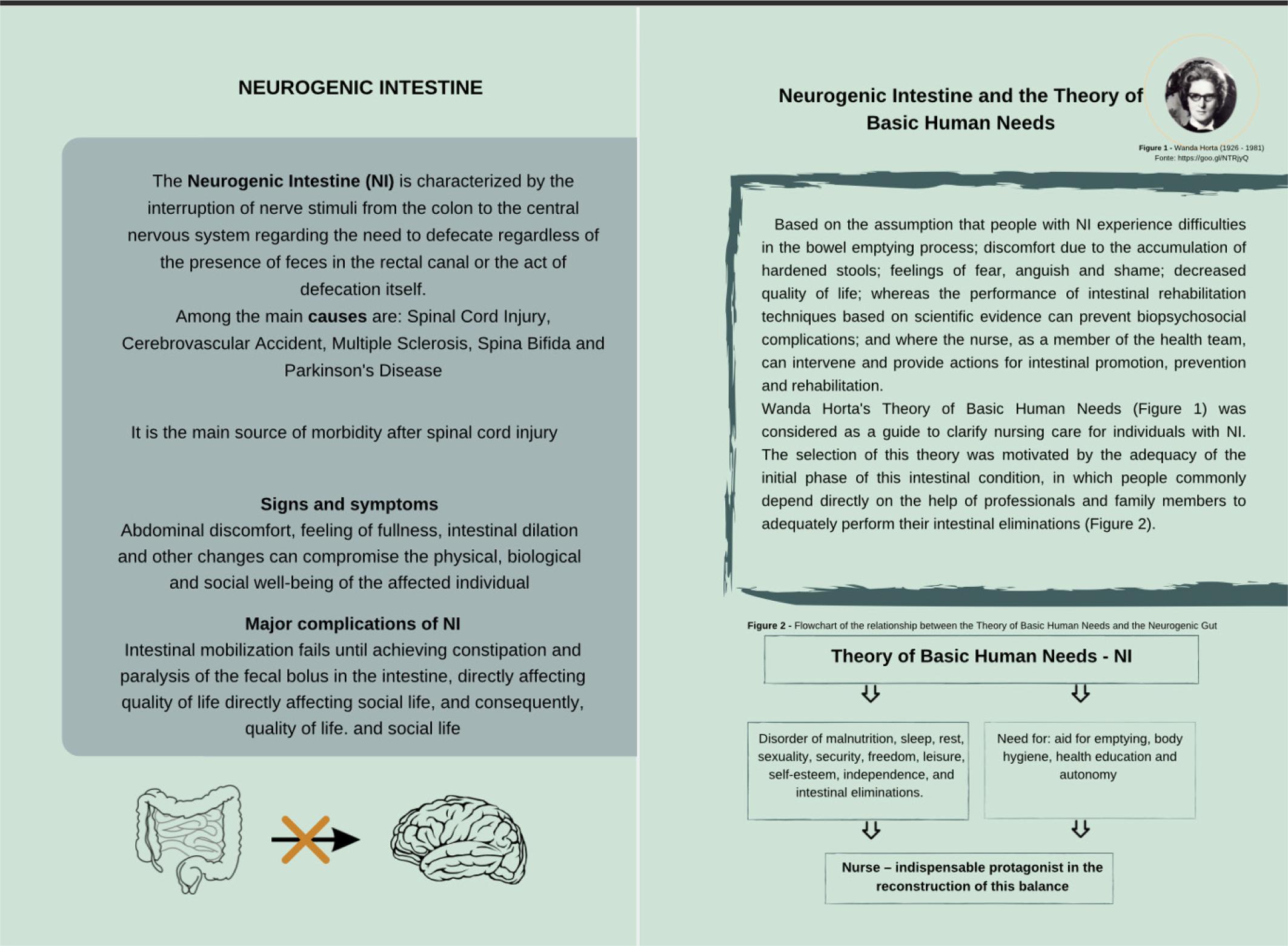
Source: Assistance Protocol, 2024.
Figure 2 Textual presentation with the concept, signs and symptoms, main complications and the Theory of Basic Human Needs by Wanda Horta, Recife, PE, Brazil, 2024.
Regarding conservative maneuvers for NI rehabilitation, it was pointed out that it is a strategy that brings together several actions aimed at promoting the autonomy and independence of individuals, preventing complications and facilitating intestinal elimination, as shown in Figure 3.
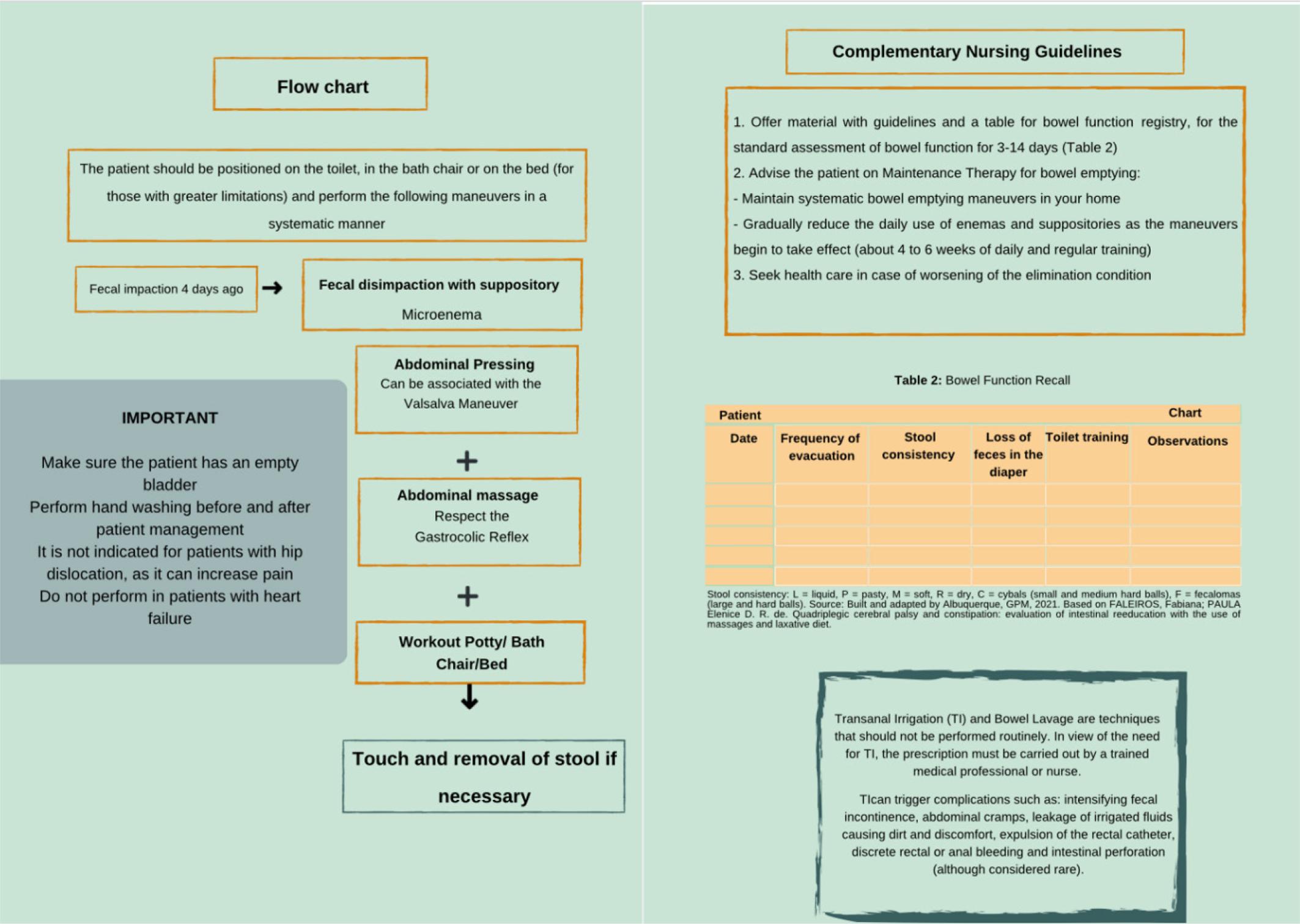
Source: Assistance Protocol, 2024.
Figure 3 Physical examination and flowchart with the maneuvers that facilitate bowel emptying, Recife, PE, Brazil, 2024.
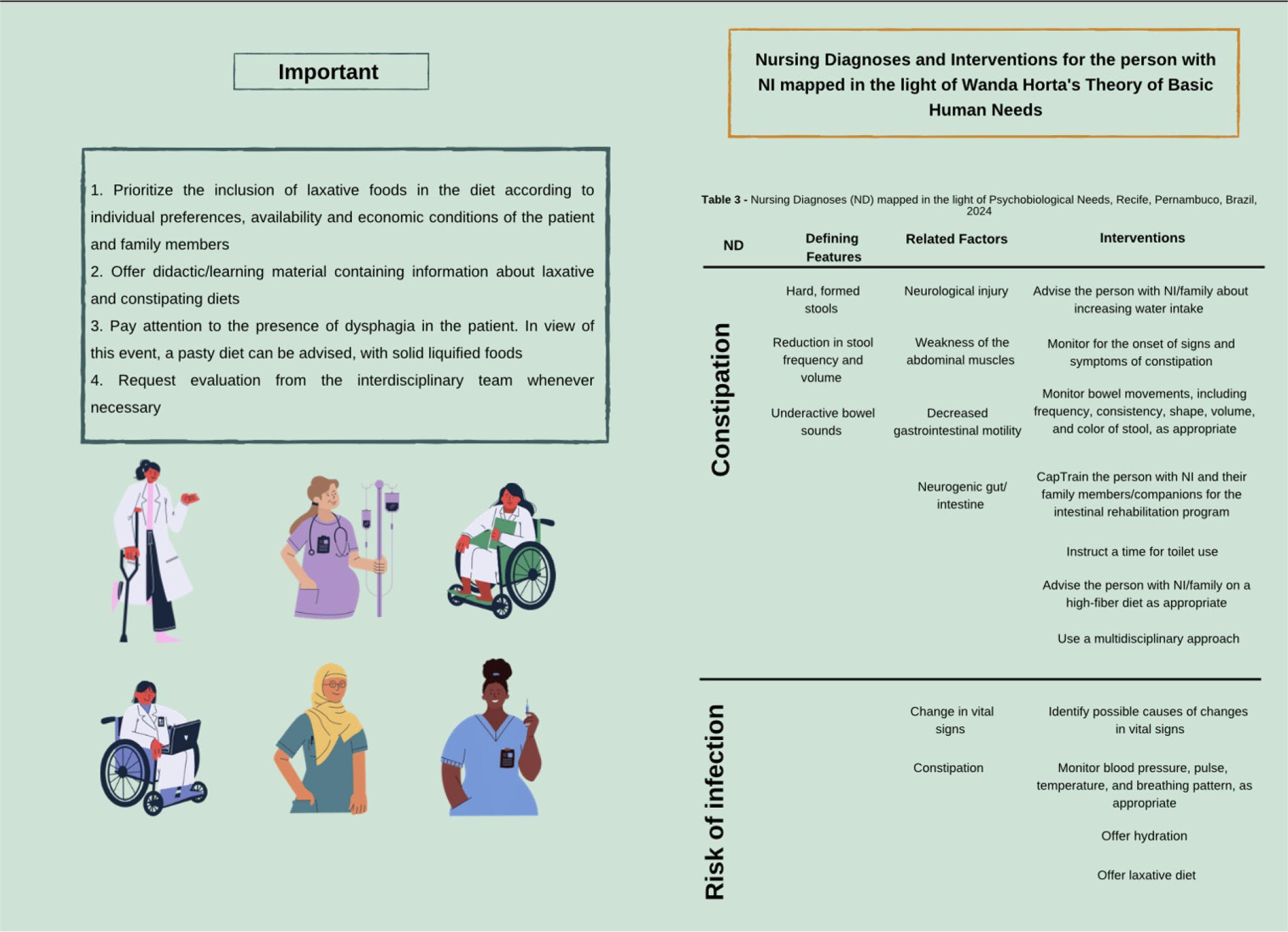
To intensify the process of interaction between nurses and patients, the Bristol Scale, characterized by the assessment of stool consistency, and a Bowel Function Recall model 13 were inserted, together with guiding questions about diet, water intake and physical activity, to enable interaction and dialogue between nurses. Collaborating with learning and strengthening nursing care, at the end of the protocol, the table containing the diagnoses, defining characteristics, related factors and nursing interventions mapped in the light of Wanda Horta's Theory of Psychobiological Needs was inserted (Figures 4).
In order to deepen nurses' knowledge on the subject, hyperlinks were inserted that direct Portal D+ Information. In addition, the educational technology will be inserted in the website to provide the dissemination of the material and reading reach by nurses in all regions of the country.
DISCUSSION
Authors should discuss the results and how they can be interpreted from the perspective of previous studies and of the working hypotheses. The findings and their implications should be discussed in the broadest context possible. Future research directions may also be highlighted. Developing an ET that is appropriate to the objective and object of study requires time, dedication and knowledge(11,12,13,14). In addition, the cost of construction can be onerous and intimidate the production of materials in the field of nursing. In this sense, the elaboration of an ET does not consist only of textual writing, since the resources for didactic materials have their own expression, principles and methods to make the teaching-learning process dynamic, up-to-date and inviting(15,16,17).
The process for the construction of the ET showed that nursing care guided by promotion, prevention, re-education and rehabilitation actions carried out in the face of an NI rehabilitation program can improve their autonomy and reduce discomfort during defecation. In addition, it is highlighted that the nurse's referred and efficient care is capable of establishing flexible conducts, encouraging self-care and routine defecation practices, ensuring respect and individuality in the face of physiological releases(14,15).
The information related to the presence of abdominal distension, fecal incontinence, pain, appearance and frequency of feces, collaborates in directing the nursing consultation with a focus on individualized care and greater chances of promoting a successful intestinal program.
For this reason, guidance for the correct execution of maneuvers is essential for intestinal rehabilitation to be considered effective. In addition, they are related to Quality of Life (QoL) and to the recovery of bowel function in patients with neurogenic bowel dysfunction after spinal cord injury, as observed in a randomized controlled clinical study conducted with 50 individuals. The authors identified that individualized nursing interventions containing guidance on diet and water intake; abdominal massages; training of the intestine/bowl associated with the Valsalva maneuver; and when possible, anal contraction facilitates intestinal reeducation and increases patient satisfaction(15).
Existing evidence recommends that bowel emptying maneuvers, composed of fecal disimpaction, abdominal massage, abdominal press, and toilet/toilet training with Valsalva maneuver, can be associated with diet and physical exercises, facilitating the organization of an intestinal schedule(7). These facts ratify the magnitude of the ET developed in this study, having contemplated a flowchart for each maneuver, detailing the care techniques, to enable greater comfort and reduce fecal incontinence.
In this sense, nursing protocols have the ability to recommend nursing actions and care in a systematized manner based on scientific evidence, in order to promote greater quality and guarantee of health care16. In addition, the early initiation of education and reorientation of the individual to intestinal care, soon after the stabilization of spinal cord shock, aiming at an evacuation pattern that reduces incontinence and fecal impaction and interferes as little as possible in activities of daily living(17,18).
Nursing ETs direct professionals to plan actions that include diagnoses, care, interventions and evaluations based on scientific evidence. Thus, the protocols are relevant, as they have the function of cognitive stimulators, attract attention for their flowchart schemes and facilitate nurses' learning. However, it is necessary to consider the quality of the images used and the messages used(19,20).
From this perspective, organizing a protocol that connects the objective and the object of study requires knowledge and commitment. Sometimes, nurses are intimidated in the preparation of didactic material due to the onerous cost of production and dissemination, limiting the expansion of improvement in work processes and articulation between teams(21,22,23).
It is ratified that rehabilitation nurses contemplate care in all life cycles (from newborn to elderly) and in all health-disease processes of the person, family and community. In addition, they have the particularity of promoting changes in lifestyle and adapting individuals to their current vital condition, contributing to their autonomy, strengthening their social relationships, inserting them in the labor market and improving their QoL(24).
It is also emphasized that the use of continuing education strategies with nursing professionals is essential to have access to health updates. In this context, methodological research can enrich and innovate nursing educational actions, promoting an environment conducive to the teaching and learning of assistive interventions(25).
Musco et al., (2020) report that the systematic use of assistive interventions does not reduce the need for conservative approaches based on bowel reeducation protocols with non-invasive measures, and the evaluation and long-term care of patients who have complications secondary to NI is essential, as occurred in the elaboration of the flowcharts of this research(26).
Therefore, the effective use of the developed ET will depend on the nurse, in the sense of recognizing the nursing process as an indispensable methodology for systematic and safe care(27). Thus, it favors the reflection of their pedagogical practice in the planning of the intestinal schedule and in the education of the patient and family, enabling comfort and fecal continence(28). In view of this, the importance of this study in the promotion and rehabilitation of intestinal health in people with NI is confirmed.
Among the limitations of this study were the lack of accessible material for people with visual impairments, difficulties for health services in adopting new educational materials and training nurses on the basis of newly developed materials, and difficulties in getting quick responses from the expert judges.
Even though it has educational content to reach an intense number of people, new studies are needed to improve ET and identify the real impacts on theoretical, practical and motivational knowledge by readers.
The ET is deposited at the link: https://demaisinformacao.com.br/protocolo-de-reabilitacao-do-intestino-neurogenico-para-enfermeiros/ enabling the democratization of information for people from various Brazilian locations.
The creation of this ET for the rehabilitation of people with NI may be important because it allows the use of nursing care, in view of the repercussion of NI in the health system. In this sense, this study is relevant because it updates and awakens in nurses the knowledge necessary for the systematization of the flow of bowel emptying methods in increasing order of complexity.
The use of the protocol will contribute to the scientific development of nursing and its praxis, since the learning ETs created and validated can facilitate the NI rehabilitation process and enable nurses to plan actions that foster a better QoL for people affected by this health problem. In addition, the dissemination of ET can contribute to the strengthening of other support networks for people with NI, creating strategies to qualify care through permanent education.
CONCLUSIONS
The ET developed is characterized by a constructivist proposal that aims to provide the main references on the subject as well as to use interactive didactic resources to support the teaching-learning process. Both the verification of the care offered by the nurses and the maneuvers for the clinical management of NI found in the literature were essential for the identification of the gaps and main demands of the target audience regarding the needs of intestinal rehabilitation. In this way, it corroborated with a better direction on the development of the ET content.
With the help of ET, the technical, scientific, cultural, personal and social impacts can add segments of the teaching-learning process to the clinical practice and social reality of people with NI. It is intended that nurses are able to welcome and guide individuals with NI, so that the risks are supplanted by the positive results of care. In addition, by implementing evidence-based practices, nurses provide people with NI and their families with the opportunity to promote health education, increase autonomy and independence and, consequently, the QoL of individuals, making them protagonists of their own care.

