




 Inglês (pdf)
 Artigo em XML
 Referências do artigo
 Tradução automática
 Enviar este artigo por email
 Citado por SciELO
  Similares em
SciELO
Similares em
SciELO 
 Permalink
Introduction
Following 14 years of conflict, Syria continues to face an urgent need for a ceasefire and increased humanitarian assistance. Throughout these years, over 7 million Syrian children have needed humanitarian aid, with more than 6 million facing an urgent need for protection from the impacts of war (UNICEF, n.d.). The long duration of the conflict has increased the number of victims, the demand for humanitarian aid, and the need for reconstruction. Furthermore, the conflict has negatively impacted the delivery of aid and continuity of services. For instance, a recent report revealed that of the four original UN-authorised aid crossing into Syria, only one remains in the northwest of the country (Humanity & Inclusion, 2022). Moreover, in February 2023, the devastating impact of the 2023 earthquake has further worsened the situation. According to Save the Children (2023), the disaster resulted in the highest levels of child stunting and maternal malnutrition, as well as the displacement of 665,000 persons into hunger.
Although overwhelming, international governmental and non-governmental organizations have worked tirelessly to provide minimum basic needs - such as food, health, and shelter. However, this is not enough to minimize the consequences of the war in children’s lives. Many Syrian children were born in the middle of the conflict, and therefore, they do not know what it means to live in peace. The rights of these children were compromised from birth, particularly their right to education, leaving little hope for a brighter future. The situation of Syrian refugees in Lebanon illustrates a critical issue, as 52% of all surveyed children who are currently out of learning have never participated in a formal or non-formal educational programme (Norwegian Refugee Council [NRC[, 2020). This means that over half of out-of-learning children have never learned in a structured environment since they arrived in Lebanon.
The destruction of schools is one of the most devastating violations of human rights, as it compromises the safety and well-being of children, in addition to compromising education. The places where children should be safe and protected are also under attack. According to Al-Samarai (2021), based on a report from the United Nations Office for the Coordination of Humanitarian Affairs (OCHA), approximately 180,000 teachers have stopped working in the education sector, and around 40% of schools have been damaged or destroyed, with many of them being used as shelters for internally displaced persons.
Although humanitarian initiatives play an important part in the reconstruction of the lives of many families, a few questions remain: How can we provide safety and the minimum of normality for children to survive and live their lives even during a conflict? How is it possible to protect them and minimize the drastic consequences of war? How to guarantee them a healthy mental and cognitive environment, despite the recurrent humanitarian crises and rights violations?
The solutions may not always be straightforward, yet there remains a glimmer of hope when we recognize those children as human beings rather than mere victims of conflict. As individuals who have the opportunity to create a more promising future for themselves and, as a result, to transform their lives. For that purpose, finding alternatives and implementing initiatives to uphold the Sustainable Development Goal 4, Education for All, even in emergencies, is extremely necessary. As research shows, “Creative activities in a school setting or in informal learning spaces improve children's emotional and behavioral well-being.” (Burde et al., 2017) Therefore, education plays a significant role in strengthening resilience and helping such populations overcome adversity.
Moreover, investing in education is the key to upholding fundamental aspects of humanitarian principles, as it enables children to rebuild their lives while reinforcing the concept of social cohesion and a hopeful future.
The Humanity Principle
Humanity, albeit often controversial in its meaning, is still regarded as the foundational principle for our humanitarian action. Jean Pictet (1980), credited for the formulation of the Red Cross Fundamental Principles, refers to the humanity principle as the “basis of the institution, [providing[ at the same time its ideal, its motivation, and its objective”. He sets this human impetus as the most relevant drive for the humanitarian movement, both individually and organizationally. Guided by the two main commitments, to prevent and alleviate suffering and to protect life and health, this principle recognizes every human's inherent worth and dignity and, by extension, each one’s access to their human rights. The humanity principle, which is universally and uncritically accepted, is the foundation upon which the remaining humanitarian principles, impartiality, neutrality, and independence, are to be applied (Fast, 2015). While most principles determine how to act in humanitarian relief, humanity determines why we do it.
Education is related to this cornerstone principle, as it plays a central role in maintaining the dynamic by preserving human dignity, resilience and, most importantly, agency. On a more basic level, education, as well as the social systems that are built around it, create the support for the main commitments through learned skills, social cohesion, better health practices, safe spaces, capacity building, and resilience development for the prevention of suffering and the protection of life. The International Committee of the Red Cross (1996) states that the protection of a person means not just shelter from attack or injury but also “to frustrate efforts to destroy him or make him disappear”.
However, this destruction can be achieved not only by physical means but also through the erasure of identity, culture, self-expression, and knowledge transmission (Iriqat et al., 2025). Arguably, education is the most effective method of safeguarding against this harm. On the other hand, we can understand that humanity also relies on the preservation and building of individual agency and capacity. Three transformative practices and everyday actions, as identified by Fast (2015), have the potential to mitigate the inherent tensions of humanity: affirming local context and capacity, embracing vertical and horizontal accountability, and prioritizing proximity and presence. Fast (2015) views these forms of integration not only as codes of ethical conduct but also “manifestations of the principle of humanity”.
Although the preservation of life is vital in humanitarian aid, sometimes the root reason that moved humanitarian workers in the first place seems to be forgotten. One cannot sustain humanity without acknowledging what makes us human, and with that comes the duty to secure our human rights as much as we are able to.
“It is aware that humanitarian work is difficult. Its greatest enemies may well be neither weapons nor disaster, but selfishness, indifference and discouragement. It is for this reason that the movement has not based its activities on dry principles, but on service to suffering humanity, to life, often fragile and vulnerable. This is how we understand the principle of humanity.” (ICRC, 1996).
How Does War Affect Children?
The UN Security Council, and the consequently established Office of the Special Representative of the Secretary-General for Children and Armed Conflict (OSRSG/CAAC), identified the “Six Grave Violations Against Children in Armed Conflict”: recruitment and use of children in hostilities; killing and maiming of children; sexual violence against children; attacks against schools and hospitals; abduction of children; denial of humanitarian access to children (Office of the Special Representative of the Secretary-General for Children and Armed Conflict, 2013). All of these violations, prohibited under International Humanitarian Law (IHL), International Human Rights Law (IHRL) and international case law, are continuously present in the Syrian conflict.
From all the complex and intersecting consequences to Syrian children, it is possible to identify three relevant ones whose risk can directly correlate with education access:
1 - Psychological and Emotional distress.
Exposure to ongoing violence, loss and displacement, often resulting in transgenerational trauma, have significantly impacted their perspectives on the world, life and hope for a future.
Some Syrian children have difficulty in judging reality, and in assessing right and wrong; they lack maturity for their age. Others struggle to look at life from a child’s perspective. Some children who are victims, or who are witnesses to the violence, experience strong feelings of guilt and shame, and a heavy burden of responsibility about what happened to them and their families, about what they did or did not do (Brooks, 2017).
When left unmanaged through, for example, positive coping strategies and resilience building, this level of distress can evolve to mental health conditions, as well as be conducive to detrimental and long term effects on an individual and community level (Brooks, 2017).
2 - Increased Vulnerability to Recruitment into Armed Groups.
Adding a disruptive social context and permanent material insecurity to an already fragile psychological and emotional scenario, creates the conditions for children and adolescents to become more vulnerable to recruitment from extremist violent groups, perpetuating the cycles of violence and vulnerability. For instance, The United Nations`s report submitted to the Security Council in 2021, which covered the years from 2018 to 2020, stated that “recruitment and use of children continued to be widespread and systematic, with 1,423 verified cases (1,306 boys, 117 girls), comprising 274 in the second half of 2018, 837 in 2019 and 312 in the first half of 2020. Some 1,388 of the children (98 per cent) served in a combat role. At the time of recruitment, 250 children (18 per cent) were under 15 years of age.” (United Nations, 2021, p. 3)
In the same way, the degradation of education infrastructures and opportunities creates “a gap that armed groups have been able to fill by establishing their own education systems.” (International Alert, 2016b). Brooks (2017) goes further into the understanding of this profile, “including the need for a sense of significance, purpose, and belonging; a desire for revenge; coercion; the need to make a living and gain access to resources that are controlled by armed groups; a sense of duty and moral or religious obligation; and the influence of social networks and peer groups”.
3 - Child Labour and Child Marriage.
All of the risk factors above, on top of the breakdown of social structures and community safety nets created by the loss of friends and family, displacement, and prolonged insecurity, create a fertile ground for the justification of both child labour and child marriage. Limited access to education and the permanent context of violence shape the misperception of their own rights and dignity, supported by a normalization of negative coping mechanisms. Not only children become vulnerable to exploitation and abuse but, on the other side of the struggle, families facing prolonged economic hardship may see child labour and child marriage as a means to ensure survival or even offer perceived protection to young girls (The Alliance for Child Protection in Humanitarian Action, 2019).
The United Nations High Commissioner for Refugees (UNHCR, 2021) published a report focused on the Regional Refugee and Resilience Plan of Jordan, Iraq, Lebanon, Turkey and Egypt. According to the document, the majority of child labourers are Syrian. In Lebanon, for instance, children are often found working in street-based activities, workshops, restaurants, hairdressing, construction, and garbage collection and the majority are in the agricultural sector. In 2019, in Turkey, from 720.000 of refugees, 45.5 per cent are in the service sector, 30.8 per cent in agriculture; and 23.7 per cent in industrial manufacturing, particularly in small and medium scale enterprises.
The same happens in Iraq where public awareness of their rights is relatively low. In Egypt, the situation is not different. In 2019, 17 per cent of Syrians were identified as having specific needs, including children at risk: children exposed to child labour, child spouses, child-headed households, child parents and 4,067 unaccompanied and separated children.
When it comes to child marriage, according to Tasker (2018), in Jordan, the cases of child marriages involving Syrians rose from 12% in 2011 to 36% in 2018. In Lebanon, 41% of married women were married before turning 18 years old. The rising is a significant concern for international and local actors who work in favor of children rights.
These serious violations of children's rights force them to enter adulthood in order to survive. They are, in fact, a trigger for other consequences that affect not only their overall lives but also their emotional, cognitive, and psychological development. As Catani (2018) states, “The detrimental effects of war trauma are not restricted to specific mental health diagnoses, but include a broad and multifaceted set of developmental outcomes that compromise family and peer relations as well as school performance and general life satisfaction.”. Those situations are the core of severe traumas that if unaddressed, will further affect their development, leaving them unable to have a healthy and peaceful life.
According to a report published by the International Rescue Committee (2017), “Neuroscience has shown that children who experience the types of adversity common in crisis settings can have a physiological ‘toxic stress’ response that inhibits their brain development, impacting their physical and mental health, behavior, relationships, and ability to learn.”. However, despite being more vulnerable to trauma and Posttraumatic Stress Disorder, children have demonstrated a remarkable capacity to overcome adversity through the development of resilience. For that reason, understanding and identifying the definition of resilience in such a context is crucial in order to explain how children still thrive despite being in a crisis context.
Although young children's brains are indeed highly plastic, this does not mean that early traumatic experiences are always erased or without consequence. As stated by Cordon et al. (2003), “some stressful and traumatic memories appear to be long-lived in childhood and perhaps adulthood, although the accuracy and cues required to elicit these memories may change over time.” Moreover, studies reveal that the early years of childhood represent the ‘window of opportunity’ that shapes the child’s whole development experience throughout life (Hall et al., 2022). Psychological disorders can significantly impact children's development, particularly in cognitive and social skills. Refugee children are, therefore, exposed to a large array of secondary trauma, such as parental psychopathology, maltreatment, and inadequate cognitive stimulation (Hazer & Gredebäck, 2023).
The comparison of the early years to a window of opportunity underscores that children’s brains are particularly susceptible to learning and development based on the surrounding circumstances. Consequently, they absorb vast amounts of information, and in the case of refugee children, their brains are even more receptive to new experiences due to displacement. The forced necessity of rebuilding life in a new country, along with the challenges of adapting to an unfamiliar culture, significantly contributes to feelings of insecurity among these children. These stressors can severely hinder their ability to engage in learning in the same manner as their peers, as their cognitive development may already be compromised. Such traumatic experiences further reduce their capacity to process new information and acquire essential skills.
Furthermore, the psychological well-being of parents or caregivers - who may themselves be experiencing mental health challenges - can exacerbate the child’s developmental difficulties. Young Children`s development, typically referring to those up to 8 years old, consists in a healthy interaction between them and their primary caregivers. When these interactions fail or are disrupted, the body perceives their absence as a serious threat, and activates its stress response systems. If this activation is excessive or prolonged, it can cause physiological changes that negatively affect the developing brain. [...[ (National Scientific Council on the Developing Child, 2015, p. 2)
Education in Emergencies: a tool for strengthening resilience
The right to education, as recognized by international legal frameworks such as Article 26 of the Universal Declaration of Human Rights (United Nations, 1948) and Articles 28 and 29 of the Convention on the Rights of the Child (United Nations, 1989), should still stand in crisis contexts. However, life-saving priorities often disrupt or overtake access during emergencies such as armed conflict, natural disasters, or public health crises. The concept of Education in Emergencies (EiE), which encompasses the “provision of equitable, inclusive, and quality learning opportunities for people of all ages in situations of crisis, from preparedness to response, and through to recovery” (INEE, 2024) emerged as a response to the evolution of interstate armed conflicts towards longer lasting protracted scenarios, displacing and killing a larger number of people, including children. The EiE concept emerged from the necessity to reevaluate humanitarian frameworks, guaranteeing not only fundamental life-saving requirements but also the safeguarding of human rights.
The chosen term of EiE not only linked education as one of the forms of relief aid in humanitarian action (Burde et al., 2017) but also defined it as a separate category from development action. The term "emergencies" encompasses three defining characteristics: its urgency and significance to humanitarian response; its capacity to be provided alongside other forms of packaged aid (e.g., “School in a Box” (UNICEF UK, n.d.); and its detachment from political influences, aligning with core humanitarian principles (Burde et al., 2015).
In 2000, a group of educators, primarily associated with UN agencies and the International Rescue Committee, established the Interagency Network for Education in Emergencies (INEE) in response to the need to increase awareness of education. They argued that education is both life-sustaining and life-saving, as it offers physical, psychosocial, and cognitive protection, as also recognized in the United Nations General Assembly Resolution (2010) on resolution 64/290: the Right to Education in Emergency Situations. This commitment reaffirmed education as a fundamental human right and a humanitarian necessity (Burde et al., 2017).
The INEE Minimum Standards for Education in Emergencies (EiE) emerged as the primary framework for ensuring safe, equitable, and quality education, focusing on the key outcomes of access, learning, and the protection of children in educational environments. These physical spaces, either school, child-friendly spaces, or other non-formal environments, are often at the hearts of communities (INEE, 2024), providing parallel protection, be it from physical violence, abuse, exploitation, and recruitment to armed groups or by supporting other humanitarian sectors such as health and nutrition while promoting social cohesion, belonging, hope and strengthening the resilience of the community involved.
According to UNICEF (2019) resilience is “the ability of children, communities, and systems to anticipate, prevent, withstand, adapt to, and recover from stresses and shocks while advancing the rights of every child.” INEE (2024) adds that resilience “encompasses different dimensions including social, emotional, physical, and cognitive resilience”. Playing a role in all stages of an emergency, resilience becomes a determinant of the success of other measurements, both at the individual and social levels. Individually, it becomes the scale on which people can cope and manage the impact and trauma of the emergency while maintaining their own humanity.
Education not only provides direct cognitive and emotional tools and support but also brings a structured routine in dedicated spaces, creating a type of normalcy - or at the very least hope for future normalcy - where people, particularly children, can get the needed conditions to make their resistance possible. At the social level, education mobilizes families and communities that are committed to safeguarding children and their access to education. This fosters crucial social cohesion, thereby constructing systems that can easily adapt and prepare to withstand the effects of crises.
In the case of Syrian children, resilience helps them to endure the resistance to being recruited by armed groups and the effects of continued violence. A study by International Alert (2016a) suggests that the main resilience strengths come from:
1) Alternative and respected sources of livelihood outside of armed groups give individuals a sense of purpose and dignity.
2) Access to comprehensive, holistic, and quality education in Syria and
neighbouring countries.
3) Access to supportive, positive, and inclusive social networks and institutions, which can provide psychosocial support, mentors, role models, and options for the development of nonviolent social identities.
4) Alternative avenues for exercising agency and nonviolent activism that provide individuals with a sense of autonomy and control over lives and a way to make sense of their experiences.
Consequently, education and child-friendly environments have the potential to provide safe, supportive, and protective environments where resilience is built and maintained, allowing for the breaking of cycles of vulnerability. Education in Emergencies constitutes both the process and the result of resilience (Van Breda, 2018).
INEE Minimum Standards for Education: Preparedness, Response, Recovery
For the purpose of this paper, we explore and frame the INEE minimum standards not just as an actionable guide for quality education in EiE but as a reference on where, why, and how to prioritize education and child-friendly spaces outcomes for sustainable protection of human rights. The INEE standards are directly linked to other main humanitarian standards, such as Minimum Standards for Child Protection in Humanitarian Crises (CPHS), but are particularly symbiotic with the Sphere Handbook (Sphere Association, 2018), where INEE is the foundation for their Humanitarian Education Standards, while always referring back to other Sphere Standards for its development and maintenance. Their main purpose is to improve and monitor education preparedness, response, and recovery, ensuring access, opportunities, and accountability “in ways that assert [the student's[ agency and dignity” (INEE, 2024).
The Minimum Standards are divided into five domains, from which we will be focusing on the number two: Access and Learning Environment. This domain is particularly relevant for protracted conflict situations, such as Syria, that are commonly characterised by political and social instability, continuous displacement, damaged infrastructure, and ongoing threats to safety and security. It requires collaboration with other sectors to identify the main risks and prevent abuse, exploitation and violence against children.
The Access and Learning Environment Domain includes Standards 8 to 10.
Standard 8: Equal and Equitable Access requires that protracted issues are addressed in regards to continuous barriers to education, not only in a short-term emergency response, but in a long-term inclusion capacity. Displacement, security risks, and marginalization of communities are obstacles to education that keep growing with time and must be fought through adequate and flexible equitable accessibility structures.
Standard 9: Protection and Wellbeing is probably the most reflective of Child Friendly Space`s (CFS) importance. It is dedicated to the promotion of the psychosocial well-being of both students and teachers, as well as the guarantee of safe and secure learning environments. It aims to integrate psychosocial and trauma support, as well as social and emotional learning into educational programs in safe and inclusive environments. Additionally, it advocates for risk reduction in spaces that are often targeted by violence and forced gang groups recruitment, involving the community in making schools and CFS into safe physical zones.
Finally, Standard 10: Facilities and Services, sustains the previous standard by addressing the reconstruction or rehabilitation of damaged infrastructure and the flexible adaptation of alternative buildings, while linking education facilities with essential services, such as health, nutrition and WASH. It also refers to shelter and camp management strategies to guarantee adequate temporary learning spaces. Collaboration between sectors ensures an overall view on the needs and safety of the children and teachers involved.
In the 2024 edition, the INEE MS highlights cross-cutting issues that once again point to the need to perceive intersectionality characteristics in risk assessment, prevention, and response. These issues include protection, gender, disability, mental health and psychosocial support, disaster risk reduction and resilience, conflict-sensitive education, climate crisis, and centering equity in EiE. With this integration, a complete and comprehensive context can be analysed to develop adequate and efficient educational tools and understand how education access is inseparable from the access and efficiency of other sectors' aid and responses. From mitigation of risks to developing individual and community resilience to building long-term positive peace through education, “quality education can help learners and their families assert their dignity and build the life and the future they aspire to” (INEE, 2024).
Child-Friendly Spaces: a study case of how international and local actors can address children's needs through education
Child-friendly spaces are constructed to enhance the inherent capacity for recovery by fostering an environment that encourages normalcy to the greatest extent possible. These spaces encourage children to continue their development, learning while encouraging their social interaction through educational activities that intentionally integrate learning with psychosocial support. The type of activity to be planned in such places relies entirely on the current situation, local culture, needs of the children, and available resources (Save the children, 2008). Save the Children Sweden (2007) argued that the activities in these spaces are carefully planned and grounded in the five types of play: creative, imaginative, physical, communicative, and manipulative. Games and exercise activities are designed to promote child development, psychosocial well-being, and coping skills while fostering social interaction, cognitive growth, physical development, and, most importantly, essential life skills.
The humanitarian action is therefore developed through a careful repertory of activities that aim to address each of the mentioned skills. For instance, creative activities such as painting, collage, and other art expressions are fundamental to helping children work on their emotions. To achieve this, Save the Children employs the Healing and Education through the Arts (HEART) methodology, which harnesses the power of artistic expression to assist children in need globally, enabling them to cope with trauma and acquire essential skills to realize their full potential (Save the Children, n.d.). In addition, activities often culminate in exhibitions, which foster a sense of connection among humanitarian actors, local communities, and the children themselves. Additionally, these activities restore a sense of normalcy and belonging, reinforcing the humanitarian principle of humanity, dignity, and inclusion.
Social, physical, and cognitive skills are developed through activities such as collective sports, which promote teamwork, rule adherence, motor skill development, and coordination. Manipulative activities, including board games, building blocks, and puzzles, enhance children's cognitive abilities, problem-solving skills, and cooperation. Life skills are enhanced by engaging in activities such as health education, problem-solving games, and communication exercises. Children learn essential skills like literacy and numeracy while also raising awareness about landmine safety. Such activities boost resilience, improve cognition, and involve parents and caregivers, strengthening the humanitarian action chain to provide a safer, more supportive environment for children’s growth.
Public awareness is another type of activity that involves the community and reinforces the importance of the relationship between organization and society. Save the Children utilizes Open Days at Child-Friendly Spaces, radio broadcasts, and community events for advocacy and information dissemination from the outset, ensuring effective communication of key messages and active community engagement on critical issues (Save the Children, 2008)
Overall, it becomes clear that the Child-Friendly Spaces, managed by Save the Children, have a solid structure and play a vital role in placing education as a first and essential pillar for children in strengthening their resilience and overcoming suffering. Furthermore, these spaces exemplify the importance of recognizing children as human beings in their own right rather than merely viewing them as extensions of the consequences of war or the decisions of parents and caregivers.
While international actors, such as Save the Children, have a wide-reach, local organizations also succeed in supporting sustainable education through CFSs. When local efforts take the lead in assisting their own community, they reinforce a strong sense of cooperation and resilience among victims even when external help is necessary in times of war. The Hurras Network exemplifies how regional actions are essential in providing education and safety and fostering a sense of belonging within the affected community while adapting the INEE Minimum Standards to specific cultural and community needs, providing context-sensitive humanitarian assistance.
The Syrian Child Protection Network - Hurras Network - was established in 2013 with the aim of providing critical protection to its children as a response to the Syrian war. The success of the first workshop for child protection awareness in 2012, created by a group of activists and social initiatives, led to a series of activities that included the organization’s own magazine “Tayyara Waraq”. The network has since grown to become “the loudest voice in advocating for the protection of Syrian children from the effects of the conflict and in providing them with the urgently needed support” (Hurras Network, 2021). Their mission is to protect children from all forms of violence and exploitation by mainly providing education, advocacy, training, and psychosocial support.
These goals are supported by several programs such as Case Management, which provides support and monitoring for vulnerable children; Capacity Building, which offers technical support and training to other NGOs and communities on child protection; Monitoring and Documentation, by recording incidents that impact children directly; Protection Messages through sharing awareness campaigns on children’s rights and services available; Child-Friendly Spaces which ensures safe environments with psychosocial support and activities for children; and Education Programs, that provide formal and non-formal education. Hurras Network also has different initiatives such as The National Program for Education and Child Protection, Save the Rest, Landmines and Unexploded Ordnances, Forced Displacement, No Coercion, and Back to School, which are critical in protecting children.
In this context, the Child Friendly Space managed by this local organization is supported by a chain of child protection to ensure the rights of Syrian children and quality education and, like Save the Children, psychological support. As stated by the organization, their 387 child-friendly spaces within two provinces in Syria aim to help children return to their normal lives by offering them professional support, fun activities and non-formal education. The spaces are the first response to children's needs and when the initiative takes place in one of the schools, it works as a bridge between immediate response and long term development. In this sense, it helps children to go back to school while working in mitigating their traumas and likely sufferings.
For better management of the multiple and diverse cases of children in need, the institution has created a child-friendly space framework which consists in three different spaces to address specific cases: Standalone and Integrate Child-friendly Spaces and the mobile library that although doesn't care the name Child-friendly has a vital role in offering informal education for children in rural areas. It consists of a van with many books for children accompanied by a team of professional psycho-social support providers that offers activities and identifies children that might need to be referred to the case management department.
Standalone and Integrated Child-friendly Spaces have physical spaces to receive children. On the one hand, The Standalone, as the name suggests, are specific spaces designed to receive children from their own community and/or indicated by the case management teams. In this setting, children receive psychosocial support through educational activities based on UNICEF self-learning guides - an initiative specially designed to support children out of school through a self learning program. In Aleppo, for example, UNICEF supported in 2020, 14,250 out-of-school children with contributions from the European Civil Protection and Humanitarian Aid Operations (ECHO) (UNICEF, 2020).
On the other hand, the Integrate spaces are located in public schools and provide extracurricular activities which in a conflict area are essential to protect children from other violations and consequences of war.
Hurras (n.d.) has reported that it is currently reaching over 732,200 children. The table below presents a detailed overview of their last available annual reports (2021-2023), regarding their programs, initiatives, and direct impact (see table 1).
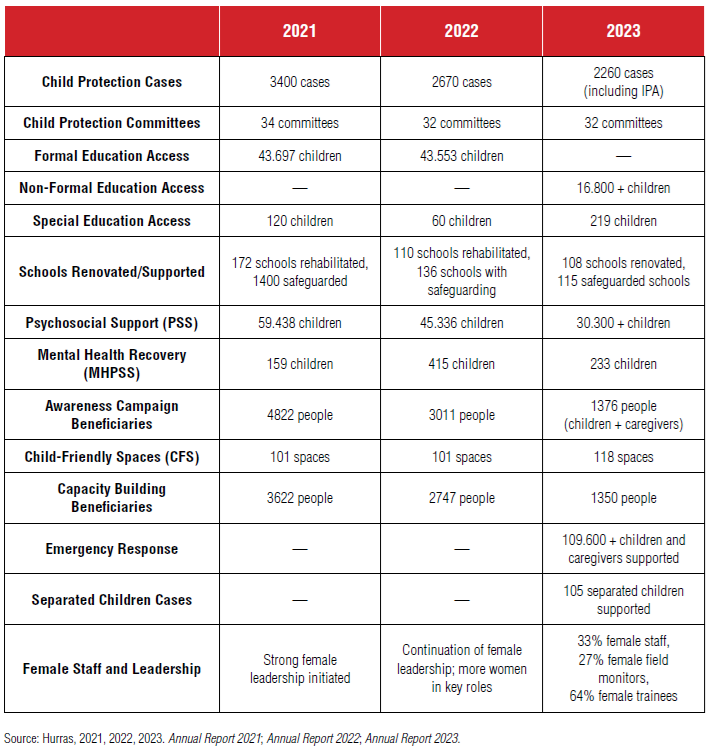
The data presented in Table 2 indicates a commitment to resource constraints, evidenced by a decline in child protection cases. It also reflects a shift in priorities concerning formal and non-formal education and emergency response, alongside a consistent increase in gender inclusion, albeit with opportunities for further enhancement. Despite not having an official certification, an overview analysis can be made on the alignment of Hurras' main action with the INEE Minimum Standards through available programmatic data and publicly accessible sources (Hurras Network, nd; Hurras Network, 2021-2023; INEE, 2024).
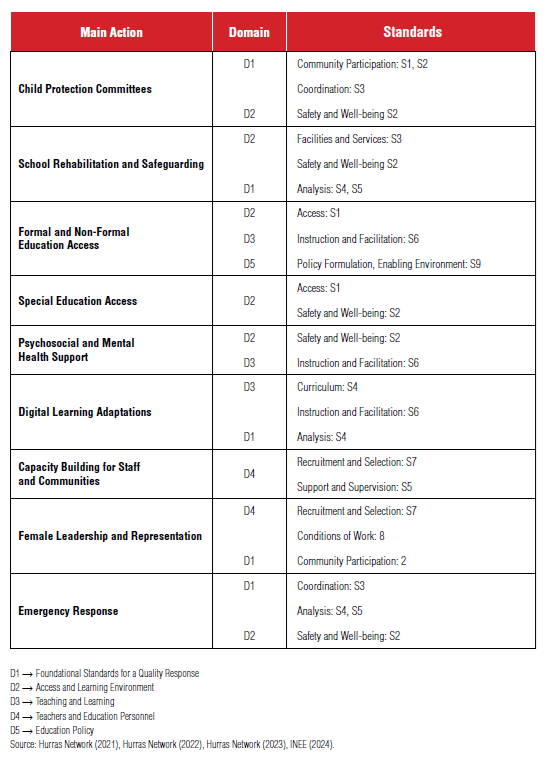
It indicates that the Hurras Network demonstrates significant alignment with the domains of the INEE MS and several cross-cutting issues from the 2024 edition, including protection, gender, and disability, which are central to the organization’s objectives.
Conclusion
To ensure that children's needs are addressed, and their rights are respected, international and national humanitarian actors must recognize them as individuals with specific rights, rather than passive victims of war and events that affect parents or caregivers. For that reason, it is essential to understand that children`s rights cannot be protected by simply including them within a broad human rights framework. They have their own distinct rights such as: the right to have access to quality education, to play, to learn, to develop and to receive protection tailored to their unique vulnerabilities.
Consequently, education should be addressed as one of the central pillars of recovery, rather than a secondary concern within the humanitarian sector. As previously mentioned, education strengthens resilience and supports the mental, emotional and cognitive well being of children, helping to mitigate the long-term impact of traumatic experiences.
Education is not solely an isolated sector but a specific component that links and aligns child protection, development and learning to guarantee that children's needs are tackled while ensuring the respect of their rights.
The CFSs serve as a pathway to lead children toward a better future, bridging immediate response with long-term development, and are key to ensuring that these specific needs are addressed in a focused manner. They exemplify how education is crucial as a starting point for recovery and rebuilding, with an emphasis on strengthening resilience, mitigating trauma, and fostering development. These settings demonstrate the importance of seeing every child first and foremost as a child, not only to understand but to internalize the significance of the rights mentioned, thus enabling children to be themselves even amid a crisis context.
Such an initiative truly reflects the principle of humanity from a practical perspective rather than merely theorizing it. It represents a stand against a form of acceptance often framed as the principle of neutrality, emphasizing that even in the most extreme situations, the humanitarian sector must not only deliver aid but also recognize each individual with their own specificities and needs. Children, indeed, are a critical group in society that must be prioritized in humanitarian responses. Their importance does not stem solely from their vulnerability as dependents but from a recognition of their vital role in shaping the next generation.
Ultimately, by promoting dignity, well-being, and the restoration of hope, Child-Friendly Spaces highlight the value of every child despite social, economic, and contextual crises whilst uphold the very essence of the principle of humanity.

