




 Inglês (pdf)
 Artigo em XML
 Referências do artigo
 Tradução automática
 Enviar este artigo por email
 Citado por SciELO
  Similares em
SciELO
Similares em
SciELO 
 Permalink

Introduction
Rapid urbanization and population aging constitute global dynamics that place pressure on urban management and the formulation of inclusive policies. It is estimated that by 2050, 65% of the world's population will live in urban areas and that the proportion of people aged 60 or older will reach unprecedented levels (Dikken et al., 2020; United Nations, 2021). In China, this group could reach 500 million individuals, of whom approximately 20% will face physical and cognitive limitations (Pan et al., 2024). In Romania, the population over 80 years old is expected to triple (Plouffe et al., 2010), while in Organisation for Economic Co-operation and Development OECD countries, one quarter of the population will be in this age group within the next three decades (Dikken et al., 2020). Aging, therefore, is a global phenomenon with unequal territorial impacts.
In Latin America, accelerated urbanization combined with historical inequality produces exclusionary urbanism. Precarious infrastructure, low walkability, and absence of redistributive policies compromise the autonomy and quality of life of the elderly population (Ulloa-Leon et al., 2023; Tupasela et al., 2023; Côté-Boucher et al., 2024). Aging, in this context, amplifies inequalities and reflects the fragility of public policies.
The debate on smart cities rarely incorporates the aging perspective. The literature prioritizes technological efficiency and digital governance but neglects territorial inequalities and age diversity (Nam & Pardo, 2011; Helbing et al., 2021). This approach reduces urban complexity to technical solutions and empties social debate. By adopting the World Health Organization (2022) definition, which considers an older adult to be an individual aged 60 or older, this study differentiates population aging, understood as a collective and demographic phenomenon, from individual aging, understood as a process linked to the life course.
This distinction allows us to understand how the urban environment influences the experience of aging and how public policies can promote or restrict the inclusion of this population. Given this scenario, the objective is to examine scientific production on aging in urban contexts mediated by technology, seeking to answer the question: Does the smart cities paradigm incorporate the demands of the elderly population or reproduce patterns of social and territorial exclusion? The aim is to identify predominant methodological and theoretical approaches, map the geographic and institutional distribution of knowledge, analyze epistemological gaps, and propose a model that articulates technology, territory, and social justice.
The relevance of the study lies in shifting the focus from technical efficiency to generational and territorial equity. Scientometric analysis allows us to identify concentrations of epistemic power, geographic asymmetries, and conceptual dependencies that shape knowledge production on urban aging. By integrating the age dimension into technological agendas, the study offers theoretical and empirical support for public policies oriented by social justice and the right to the city, thereby strengthening the construction of truly smart and inclusive cities.
Methodological procedures
The Scopus database was chosen for its greater article retrieval capacity and more consistent thematic alignment with the research object. However, this decision limits access to productions from peripheral contexts not indexed in Global North databases. The search articulated two axes: (a) population aging, including barriers, well-being, and quality of life; and (b) smart cities and urban environments oriented toward autonomy and inclusion of older adults.
The search terms used were (elderly OR “elderly population” OR “active aging” OR accessibility OR mobility OR “challenge of the elderly” OR “physical barriers” OR “digital barriers” OR "social barrier” OR “well-being” OR “life factors of elderly” OR “quality of life”) AND (“smart cit*” OR “friendly city” OR “age-friendly city”)) with Boolean operators OR to connect keywords and AND to link the two groups.
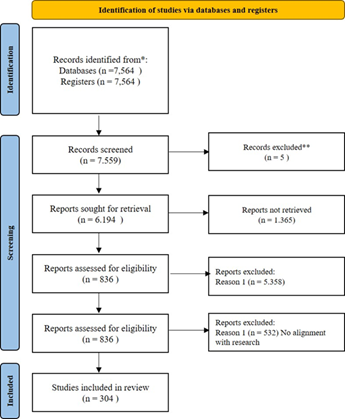
The initial search, conducted on January 5, 2025, retrieved 7,564 documents. A temporal filter (2007-2024) was applied, yielding 7,559 records. Filtering by document type (scientific articles and conference papers) resulted in 6,194 records, excluding five duplicate documents, for a total of 7,559 records to screen. After reading titles and abstracts, 836 articles were considered eligible. Of these, 5,358 were excluded for not meeting thematic relevance criteria, and 532 for lack of alignment with the research object. The final sample comprised 304 documents (224 scientific articles and 80 conference papers), representing a rejection rate of 63.6%.
All 304 articles were read in full and cataloged according to criteria of thematic relevance, methodological approach, and conceptual contribution. Data were exported in CSV format and processed using CiteSpace, Bibliometrix (RStudio), and Excel software for mapping collaboration networks, analyzing keyword co-occurrence, and identifying trends (Chen, 2020; Aria & Cuccurullo, 2017). Studies addressing aging in urban contexts, with an emphasis on digital technologies or smart cities, and dealing with urban policies, accessibility, or social inclusion, were included. Works of exclusively biomedical character without urban dimension, research conducted in rural areas, and texts without relevant conceptual or empirical contribution to the study's objective were excluded. Figure 1 synthesizes the study selection process.
Scientometric analysis
Analysis of scientific production on aging and cities
“Epistemological dependence” is understood as the structural subordination of peripheral regions to conceptual and methodological frameworks produced in hegemonic centers, limiting local theoretical autonomy (Santos, 2018). “Structural asymmetries” refer to the unequal distribution of resources, visibility, and power of scientific legitimation between Global North and South countries (Bourdieu, 2001).
Between 2007 and 2009, only two publications were recorded; between 2010 and 2014, the number rose to 21; between 2015 and 2019, it reached 117; and between 2020 and 2024, it attained 164 articles. This evolution demonstrates the field's maturation but reveals that 92.44% of studies are concentrated in the last decade, signaling a delayed reaction to demographic and technological transformations. The production growth, therefore, reflects more an adaptation to international agendas than the autonomous creation of conceptual frameworks.
Despite quantitative expansion, the field lacks theoretical and territorial diversification. Only 25.88% of publications involve international collaboration, indicating the existence of networks concentrated in Global North countries. This concentration limits the exchange of experiences and restricts the circulation of perspectives from peripheral contexts. The average of 17.4 citations per article and the mean age of 4.6 years confirm that production is recent but with low practical impact, especially in the formulation of urban public policies. The predominance of scientific articles (73.68%) over conference communications (26.32%) consolidates the theoretical field, although it reduces dialogue with urban management and social practice.
Table 1 reveals three relevant patterns. First, temporal concentration: seven of the ten most cited articles were published between 2010 and 2016, a period of consolidation of WHO guidelines on age-friendly cities. Second, the discrepancy between total citations and citations per year: Rudnicka et al. (2020) accumulate 448 citations in only five years (89.6/year), while Plouffe and Kalache (2010) have 258 citations in 15 years (17.2/year). This difference indicates that recent studies on healthy aging, linked to biomedicine, have a greater immediate impact than work on urban planning.
Third, journal diversity: although there is concentration in public health (Maturitas, IJERPH), the presence of Cities and Critical Social Policy demonstrates limited interdisciplinary reach. Technological articles (Hussain et al., 2015) have an intermediate impact, indicating that the integration between IoT and aging remains at the conceptual validation stage.
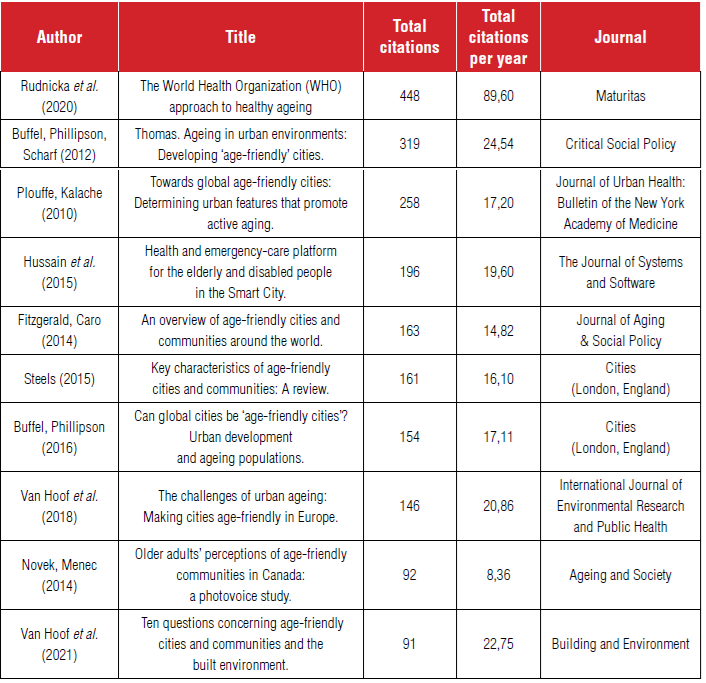
The ten most cited articles account for 38.33% of the 5,291 citations analyzed, configuring an oligarchy of scientific legitimacy that establishes the field's primary references. This core, although consolidated, reinforces a biomedical and technocratic model in which the smart city is reduced to a digital apparatus and technology is conceived as an instrument of efficiency rather than social mediation. The influence of Plouffe and Kalache (2010) remains hegemonic, sustaining the standardization of “age-friendly city” guidelines, while Buffel and Phillipson (2016) introduce the social dimension of exclusion, but still from European urban contexts.
Buffel et al. (2020) demonstrate that age-friendly policies can reproduce exclusion when they do not transcend the consultative level, transforming participation into administrative rhetoric. Li (2024) proposes shifting the debate from “transport equity” to “accessibility capability,” emphasizing that mobility depends on infrastructure and individuals' economic and cognitive resources. Ulloa-Leon et al. (2023) argue that the “15-minute city” concept can benefit older people by reducing distances but requires redistribution of services in peripheral territories. Van Hoof and Dikken (2024) identify six sustainability profiles among older people, suggesting that environmental policies must consider heterogeneity of values and capabilities. Although these studies advance thematically, they maintain a focus on high-income contexts, limiting applicability in cities with precarious infrastructure.
While these topics represent advances, most studies remain at the diagnostic level, without proposing structural mechanisms for urban transformation. This pattern reflects a cognitive hierarchy in which Global North researchers produce theory and methodologies, while those in the Global South apply external models. The result is replicative and minimally innovative knowledge, distant from the most unequal territorial realities.
After 2020, an increase in publication volume is observed, accompanied by a 78.5% drop in average citations, revealing thematic saturation and analytical dispersion. The emphasis on technological metrics weakens the field's critical potential and reduces its capacity to articulate technology, inequality, and aging. The recent expansion may highlight both the institutional consolidation of the topic and pinpoint limitations of a science shaped by epistemological dependencies and universalizing normative patterns that are not sensitive to the urban experiences of the Global South.
Analysis of geographic distribution and institutions
The co-authorship mapping (Figure 2A) reveals geographic concentration: the United Kingdom (0.32) and China (0.19) lead, followed by the United States and Italy (0.14). This configuration demonstrates structural asymmetry, in which a few countries control collaboration networks and define research agendas. The concept of “geopolitics of knowledge” refers to the unequal distribution of epistemic power in the global scientific system, where certain countries and institutions define what counts as legitimate knowledge (Mignolo, 2011). This hierarchy does not stem from intellectual superiority but from historical advantages in funding, collaboration networks, and editorial control.
The observed centrality does not reflect theoretical density but inequality in access to funding, cooperation networks, and high-impact journals. In British studies, for example, the limitation lies not in methodology but in the assumption of consolidated governance and structured civil society, conditions rare in peripheral contexts. Buffel et al. (2020) warn that participatory models can be captured by privileged groups when redistributive mechanisms are lacking.
Chinese production concentrates on large-scale technological solutions such as sensors, big data, and artificial intelligence, sustained by strong state investment and robust digital infrastructure. Campisi et al. (2020) analyze walkability in Rijeka (Croatia). Both contexts share the absence of reflection on technological sovereignty and implementation costs in dependent economies. The smart city model, in this framework, assumes a technocratic and universalist character, transforming technology into a symbol of power and distinction.
Among the 54 countries identified, China (159 publications), the United Kingdom (111), the United States (100), and Canada (75) account for 39.49% of production, confirming Anglophone hegemony. The exclusion of peripheral countries stems less from methodological limitations and more from linguistic and editorial barriers. The “Global South” is not homogeneous: China and India, although epistemologically peripheral, possess technological capabilities that differentiate them from Latin America and Africa. China occupies an intermediate position (conceptually peripheral but economically and technologically central), requiring cautious reading of inequalities.
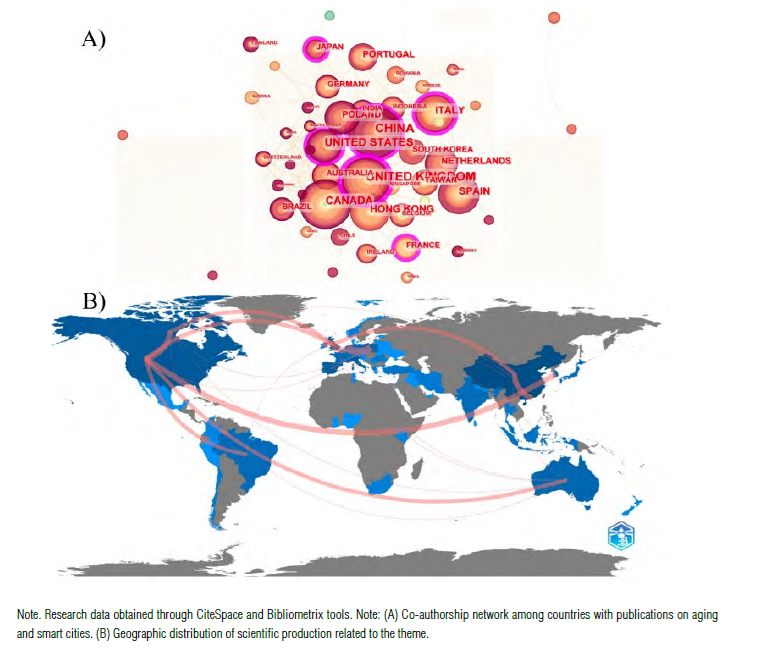
Note. Research data obtained through CiteSpace and Bibliometrix tools. Note: (A) Co-authorship network among countries with publications on aging and smart cities. (B) Geographic distribution of scientific production related to the theme.
The discrepancy between volume and impact is significant: although China leads in publications, the United Kingdom and Canada concentrate 52% of citations, reaffirming the selectivity of recognition and epistemological hierarchy. Poland (10.44%) and the Netherlands (8.54%) stand out as exceptions due to alignment with World Health Organization (WHO) guidelines and European sustainability policies.
Figure 2B shows that the United Kingdom and the United States have maintained continuity since 2009, while China, India, and Brazil entered after 2018, but with limited impact due to their dependence on international calls and the absence of regional journals with high impact factors. Nepal and Nigeria (2024) expand geographic reach but reproduce Western techno-solutionism in low-infrastructure contexts.
At the institutional level, Figure 3 reveals intense concentration: The Hague University of Applied Sciences and Vrije Universiteit Brussel (19 articles each) lead, followed by Universidad Politécnica de Madrid, Heriot-Watt University, University of Hong Kong, Hong Kong Polytechnic University, and Universiti Teknologi Mara. Together, they represent 35.22% of global production and may configurate an academic oligopoly that may define agendas and may limit interpretative autonomy over urban aging.
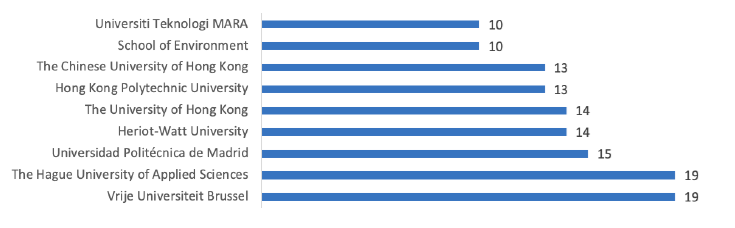
The absence of Latin American, African, and South Asian universities among the most productive institutions reveals structural exclusion precisely in regions where urban aging is most unequal and accelerated. This gap is epistemological: the scarcity of situated approaches prevents the construction of urban models sensitive to territorial diversity and local socioeconomic conditions. European and high-income Asian protagonism reflects an epistemology of efficiency, sustained by standardized metrics and certifications such as those from the Academy on Age-Friendly Environments in Europe (AFEdemy). While promoting advances in measurement and comparability, these centers reduce aging to a technical indicator, emptying its political and civic dimension. The resulting production privileges replicability and performance, but it ignores the structural inequalities that shape urban aging.
Recent interdisciplinary initiatives, such as the Department of Mental Health and the Climate Mental Health Network in 2024, integrate mental health, environment, and aging under a biopsychosocial perspective. However, the hegemony of engineering departments (School of Computer Science and Engineering and the Department of Software Engineering) maintains the primacy of automation and the technocratic bias of the literature.
Institutional analysis confirms that knowledge about urban aging is concentrated and geopolitically asymmetric. Overcoming this dependence requires autonomous funding in the Global South, strengthening of regional journals, and formulation of contextualized theoretical models that articulate technology, territory, and social justice (Buffel et al., 2020). Only the redistribution of epistemic power and recognition of territorial diversity can transform urban aging into a critical and emancipatory field.
Most relevant authors in the portfolio
The co-authorship network reveals a high concentration of scientific influence in the production of urban aging. The scientific field operates as a space of disputes over so-called “scientific capital”, where accumulated prestige determines who has the authority to establish problems and methods considered legitimate (Bourdieu, 1984). The prior recognition of certain researchers generates the “Matthew effect”, a phenomenon in which visibility and credit concentrate on those already established, perpetuating oligopolies of legitimacy (Merton, 1973). Both phenomena are observable in the field of urban aging, where a limited group of European authors concentrates citations, a pattern commonly associated with emerging research areas and the consolidation of conceptual influence.
The authorial concentration in Figure 4 among few European researchers, responsible for 14.47% of total production, evidences a scientific oligarchy that defines global agendas and universalizes aging models based on welfare state contexts and high infrastructure, ignoring regional inequalities (Buffel, Phillipson & Scharf, 2012; Del Barrio et al., 2018; Van Hoof et al., 2018; Dikken et al., 2020).
Buffel presents intermediate centrality (38.25) and a relevant role in disseminating approaches on social cohesion and urban belonging (Buffel, Phillipson, & Scharf, 2012; Buffel et al., 2020). His production emphasizes social justice and territorial vulnerability but maintains focus on high-income cities, limiting applicability in Latin American and African contexts. His focus on the technologization of aging may expand individual autonomy but may reinforce digital dependencies and technocratic bias by prioritizing efficiency over equity (Campisi et al., 2020; Côté-Boucher et al., 2024). The partnership between Buffel and Van Hoof expresses the convergence of sociological and technoscientific approaches, articulating active aging and urban innovation (Buffel & Phillipson, 2016; Van Hoof et al., 2021).
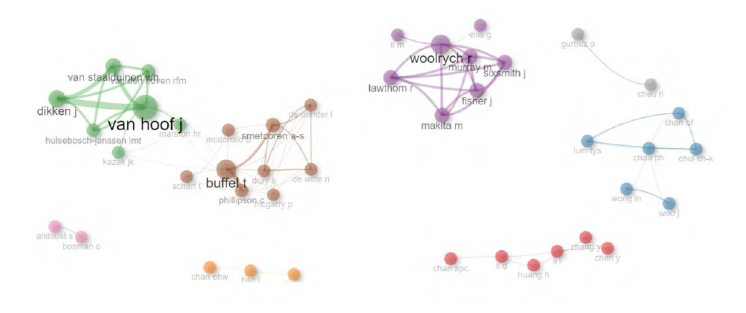
This synthesis remains under tension, as Buffel privileges social inclusion while Van Hoof emphasizes technical solutions, situating the city between coexistence and technological experimentation (Rudnicka et al., 2020). Peripheral authors such as Lee and Chan present high structural proximity (0.333) but low relational impact, reflecting dependent networks and institutional fragmentation. The field remains in thematic islands, with fragile inter-regional cooperation and conceptual dependence on the Global North (Santos, 2018; Côté-Boucher et al., 2024).
This structure points to two dynamics: consolidation of a transnational elite with theoretical power and peripheral dispersion that reproduces models without epistemological autonomy. The verticalization of networks reinforces cognitive asymmetry and restricts innovation, as prestige derives from indexing metrics rather than social relevance (Bourdieu, 2001; Santos, 2018). The absence of Global South researchers renders local experiences invisible (McDonald et al., 2023). Overcoming these gaps requires South-South cooperation, stimulus for regional publication, and valorization of territorial and intergenerational knowledge, the foundation for urban epistemologies grounded in diversity and spatial justice (Harvey, 2008; Lefebvre, 1968).
Analysis of journals and impact factor
Analysis of the most cited journals reveals a concentration of production in public health and environmental journals, notably the International Journal of Environmental Research and Public Health (IJERPH), leading with 28 articles (9.21%) and an impact factor of 4.6. Following are Ageing and Society (9 articles; 2.3) and Cities (8; 6.0), while Sustainability (Switzerland) presents the same volume but lower impact (3.3). Journal of Aging and Social Policy (5; 2.0), Journal of Aging Studies (4; 1.8), and Journal of Urban Health (3; 4.3) occupy intermediate positions.
Figure 5 synthesizes this distribution, showing the hierarchy of the most cited journals and their respective impact factors. This concentration indicates the predominance of international journals focused on public health and sustainability, reinforcing the interdisciplinary character and centrality of health and environmental sciences in the debate on aging and smart urbanism.
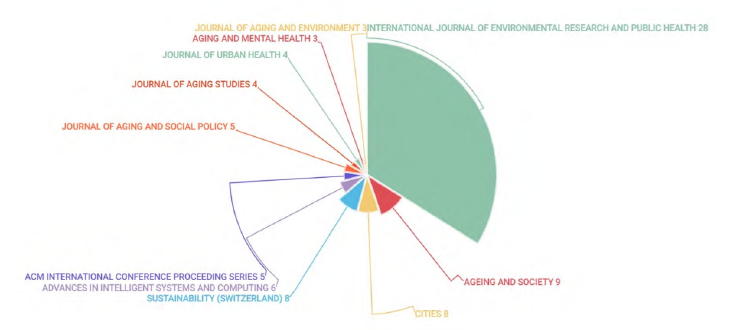
This panorama confirms the dominance of biomedical and environmentalist approaches in the discussion of urban aging. IJERPH's leadership reflects the weight of health and well-being determinants, indicating a medicalization process that marginalizes political, social, and economic dimensions of urban aging. The presence of Cities shows progress in integrating urbanism and aging, although their limited production demonstrates the topic's peripheral position in central debates of urbanism (Van Hoof et al., 2018; Buffel; Phillipson, 2016). Despite having the highest impact factor (6.0), the journal maintains limited contributions, indicating theoretical recognition without establishing a research line. Sustainability exemplifies the thematic dispersion of generalist journals, hindering the construction of cohesive frameworks.
Specialized aging journals (Ageing and Society, Journal of Aging and Social Policy, and Journal of Aging Studies) total 18 articles and present low impact (1.8 to 2.3), signaling reduced international visibility. In terms of content, they preserve conceptual rigor and thematic specialization (Buffel et al., 2020; Rudnicka et al., 2020). The data set reveals a dual dependence: on health and environmental sciences, which dominate the narrative, and on interdisciplinarity, which remains fragmented. Field consolidation requires a greater presence of the topic in urban planning, public policy, and social innovation journals, favoring the construction of integrated and interdisciplinary frameworks.
Keyword analysis
Keyword analysis reveals a conceptual structure and thematic priorities of production on urban aging. The portfolio assembles 4,716 interconnected terms, demonstrating breadth but also theoretical fragmentation. Although the field reveals dynamism, biomedical and technological influence predominates, with little dialogue with critical approaches to inequality and territory.
The terms aged (3.52%), aging (2.21%), and elderly population (1.08%) form the demographic core with 321 occurrences, expressing a tendency toward biologization of aging and neutralization of structural inequalities (Rudnicka et al., 2020; Buffel; Phillipson, 2016). In the urban axis, city, urban planning, and smart city total 135 repetitions, reflecting growing integration of urbanism but with prevalence of techno-solutionist discourses that treat social problems as technical challenges (Nam; Pardo, 2011; Helbing et al., 2021).
Figure 6 presents the keyword co-occurrence map. In it, “aged” and “aging” appear as central nodes connected to multiple clusters, while “smart city” emerges as a secondary node with low articulation with demographic descriptors, signaling conceptual fragmentation. On the left, biomedical terms concentrate (health, quality of life, well-being), and on the right, technological terms (IoT, sensors, technology), separated by a few connections.
The technological block (smart city, IoT, technology) registers 101 occurrences, confirming the centrality of digital innovation. However, it lacks terms such as digital divide or technological governance, revealing an instrumental view of technology (Campisi et al., 2020; Guimarães et al., 2020). The health-autonomy axis, composed of quality of life, healthy aging, and independent living, reinforces the individualization of well-being, aligned with the self-care logic promoted by the World Health Organization (Plouffe; Kalache, 2010). In contrast, the group accessibility, social participation, and inclusive design (51 occurrences) appear marginally, confirming the low priority attributed to equity and community participation (Van Hoof et al., 2018; Woolrych; Li, 2024).
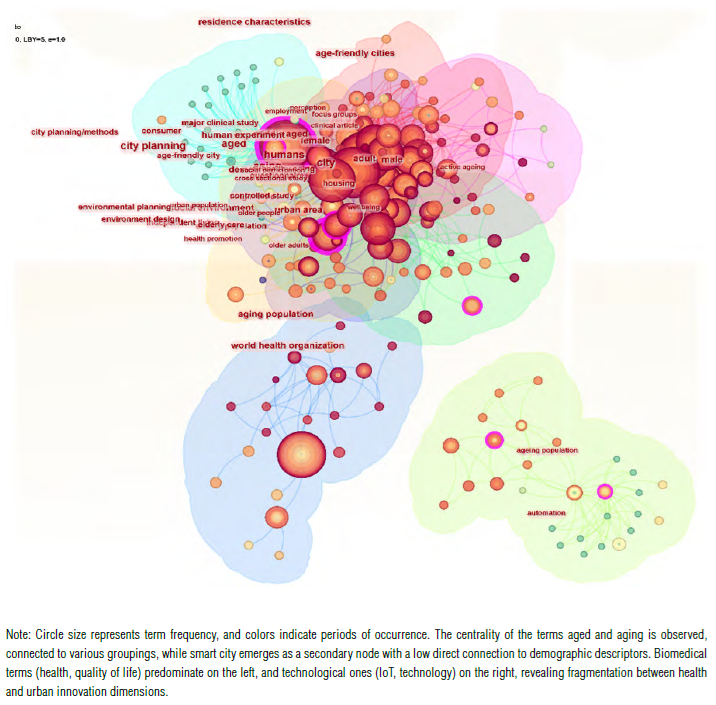
Clustering analysis identified eight thematic groupings with silhouettes between 0.577 and 0.952. Only five (#0, #2, #4, #5, #6) exhibit satisfactory coherence. Cluster #0 addresses the residential environment with good cohesion but low theoretical content; #1 on development indicators is heterogeneous and foundational; #2, focused on automation and robotics, maintains technocentric bias; #4 emphasizes governance and territorial coordination; #5 deals with smart cities with generalist discourse; and #6 gathers studies on the urban environment. Centrality metrics indicate a predominance of descriptive terms, a lack of integration between axes, and disarticulation among technology, urbanism, and social justice.
Thematic gaps include digital exclusion, political economy, intersectional inequalities, Global South representations, and the climate crisis. Three evolutionary phases can be observed: (1) 2011-2012, marked by governance and indicators; (2) 2014-2017, by disciplinary fragmentation; and (3) 2019, by attempts to converge age-friendly and smart cities without consolidating a new paradigm. The panorama reveals a field in maturation, yet it remains dependent on normative and universal categories. The absence of descriptors such as equity, justice, and citizenship indicates that scientific debate has not fully incorporated principles of spatial justice and right to the city (Lefebvre, 1968; Harvey, 2008).
Although the field advances by recognizing technology as a mediator of urban policies, it still faces a critical deficit in addressing inequality and exclusion. Future research development requires articulating digital innovation and social justice, understanding aging not as a technical challenge but as a political process of urban life.
Discussion of results
The scientometric analysis points to a field that is quantitatively expanding but theoretically and territorially fragmented. Three central findings support this reading: (1) concentration of knowledge in the Global North: the United Kingdom, China, and Canada account for 39% of production and 52% of citations; (2) coexistence of dissociated paradigms (age-friendly and smart cities) without consistent conceptual synthesis; and (3) technological incorporation oriented toward efficiency without mediation by social justice, perpetuating a technocratic bias.
The growth of publications after 2015 indicates consolidation but remains strongly dependent on normative agendas from the WHO and the United Nations, based on “smart city” and “active aging.” Such expansion confirms the gap between technological innovation and social inclusion: digital solutions advance more rapidly than intersectoral policies. Knowledge circulates predominantly in the Global North, while Latin America and Sub-Saharan Africa maintain a peripheral role, reproducing cognitive coloniality (Buffel et al., 2020; Côté-Boucher et al., 2024).
The centrality of the United Kingdom, China, and Canada contributes to the formation of scientific oligarchies that define the field's legitimate vocabulary. The predominance of quantitative methods and biomedical approaches converts aging into a technical question, distancing it from urban and political determinants. The city becomes a management system, not a space of social dispute. This fragmentation between age-friendly cities, oriented toward participation, and smart cities, centered on automation, prevents the formation of an integrated agenda of equity and technology. Keywords prioritize smart city, IoT, and technology over justice, inclusion, and rights, revealing the technification and depoliticization of aging.
There are, however, signs of progress. Research on sustainable mobility, accessibility, and inclusive design points toward greater integration between urban and social dimensions (Van Hoof et al., 2021; Campisi et al., 2020). Emerging themes such as ambient intelligence and community participation signal a transition toward collaborative approaches, although they lack empirical validation in unequal contexts.
The field remains dominated by biomedical and technological rationalities, with the political dimension at an incipient stage. Scientific advancement depends on consolidating the latter, integrating technology, democratic governance, and spatial justice (Lefebvre, 1968; Harvey, 2008). Building age-sensitive smart cities requires overcoming techno-solutionism and adopting an ethical, participatory, and territorialized perspective capable of transforming efficiency into equity.
Figure 7 presents an integrated conceptual diagram for the development of smart and inclusive cities, represented by five overlapping lenses expressing the interdependence among technology, social participation, mobility, health, and sustainability. This visual form, based on interconnected ellipses, symbolizes the relational and dynamic nature of urban dimensions, illustrating that urban intelligence emerges from the interaction between technical and social aspects, rather than from the supremacy of one over the other.
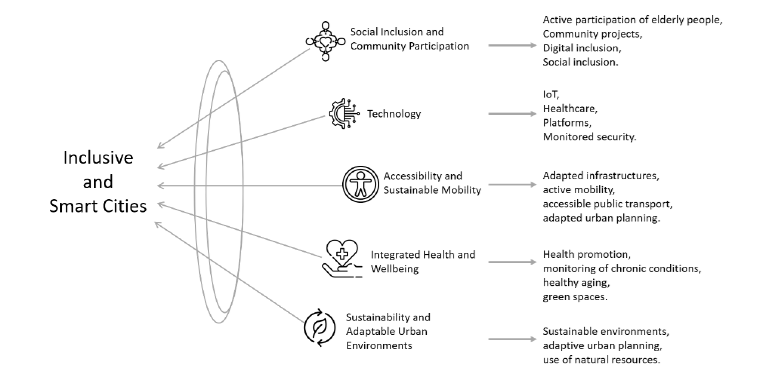
At the center of the diagram, the concept “Inclusive and Smart Cities” serves as an axis of convergence, indicating that a smart and inclusive city results from the integration of the five domains. The representation breaks with hierarchical planning models and adopts a relational geometry in which each dimension influences and is influenced by the others, with intersection zones representing the most fertile spaces for urban transformation.
The first lens, Social Inclusion and Community Participation, positions public deliberation as a structuring principle. The participation of older people and digital inclusion must involve co-management and autonomy (Neves & Caetano, 2020) and avoid the technological solutionism criticized by Morozov (2013). Thus, social participation ceases to be an accessory component and becomes a transversal element that reconfigures policies on technology, mobility, and health.
The Technology lens encompasses IoT, digital health, and monitored security, expressing the tension between autonomy and surveillance. Its intersections with participation and accessibility define whether innovation will serve citizen emancipation or corporate and state control. As Morozov (2013) highlights, technology only acquires democratic meaning when guided by public debate and regulatory frameworks that ensure informational sovereignty.
In Accessibility and Sustainable Mobility, the diagram incorporates universal design as an urban principle. The mobility of older people depends on safe infrastructure, accessible sidewalks, adequate lighting, and inclusive transportation, which contradict car-centric urbanism and reinforce social and intergenerational vitality. The Integrated Health and Well-being lens expands the concept of active aging by associating health, urban space, and environment. Green spaces, active mobility, and territorial care configure integrated well-being systems, moving beyond the individualizing biomedical focus and updating the age-friendly cities proposal (World Health Organization, 2007).
Sustainability and Adaptable Urban Environments insert aging into the ecological horizon, proposing responsible use of resources and spatial flexibility. The overlap with technology and mobility shows the challenge of balancing efficiency, inclusion, and environmental conservation. The analytical potency lies precisely in the intersection zones: when technology meets participation, processes of democratic innovation emerge; when mobility crosses with health, active transportation policies emerge; and when sustainability intersects participation, environmental co-management practices are consolidated.
This visual representation complements the scientometric analysis by graphically translating the field's gaps and potentialities: the theoretical fragmentation between age-friendly and smart cities can be overcome through articulation among the five axes. The conceptual diagram, therefore, proposes a theoretical-practical synthesis in which the smart and inclusive city is conceived as a political and relational project capable of integrating technological innovation, social justice, and the right to the city in an intersectoral and democratic vision.
Conclusion
The scientific field of urban aging and smart cities is undergoing a transitional phase: it is growing in volume and methodological sophistication but still maintains epistemological dependence and strong territorial asymmetries. The analysis of 304 articles demonstrates the concentration of production in Global North institutions, the hegemony of biomedical and technocratic approaches, and the reproduction of normative models that universalize solutions without considering structural inequalities. The fragmentation between age-friendly and smart cities paradigms highlights the lack of a theoretical synthesis that aligns technological innovation with principles of social justice.
The contribution of this study is to construct a critical and geopolitically situated diagnosis that shows how scientific knowledge reflects power hierarchies and renders Global South experiences invisible. The proposed integrated model articulates five interdependent axes (technology, mobility, public policies, participation, and governance), positioning older people as mediators between efficiency and inclusion. This conceptual structure offers municipal administrations an instrument to evaluate urban policies under the criteria of generational and territorial equity.
The study reveals low international collaboration, with European authorial concentration and the absence of critical terms such as technological justice, digital sovereignty, and right to the city in the dominant vocabulary. This exposes structural dependencies that limit theoretical autonomy and social innovation capacity. The main limitations stem from using the Scopus database, which restricts the visibility of regional and non-indexed productions, especially from Latin America, Africa, and Asia.
Furthermore, the emphasis on macro-level analyses limits understanding of local dynamics and older people's perceptions. Field advancement requires new research agendas oriented toward decolonization of urban knowledge, technological governance, and evaluation of the social impact of policies and technologies. Future studies can strengthen epistemologies of the South, expand comparative studies in peripheral cities, discuss data sovereignty and digital exclusion, and evaluate policies under the criteria of power redistribution and belonging. Additionally, they should consider the effects of the climate crisis on aging populations. Urban aging must be understood as a political rather than technical process. Brilliant cities emerge when technology is subordinated to social justice, territorial diversity, and democratic governance.

