SciELO - Scientific Electronic Library Online

 
vol.32 número5Resposta mantida a nivolumab por cinco anos no carcinoma hepatocelular após hepatite imunomediada grave índice de autoresíndice de assuntosPesquisa de artigos
Home Pagelista alfabética de periódicos  

Serviços Personalizados

Journal

Artigo

Indicadores

Links relacionados

  • Não possue artigos similaresSimilares em SciELO

Compartilhar


GE-Portuguese Journal of Gastroenterology

versão impressa ISSN 2341-4545versão On-line ISSN 2387-1954

GE Port J Gastroenterol vol.32 no.5 Lisboa out. 2025  Epub 27-Fev-2025

https://doi.org/10.1159/000544834 

Endoscopic Snapshot

Endoscopic Treatment of Early Rectal Cancer after Multiple Surgical Approaches: Endoscopic Intermuscular Dissection to the Rescue

Tratamento endoscópico de neoplasia precoce do recto submetido a múltiplas abordagens cirúrgicas: disseção endoscópica intermuscular de resgate

Pedro André Lima1 

Raquel R. Mendes1 

Pedro Barreiro1  2 

Rui Mendo1  2 
http://orcid.org/0000-0001-6641-2647

Cristina Chagas1 

1Serviço de Gastrenterologia, Unidade Local de Saúde Lisboa Ocidental, Lisbon, Portugal;

2Centro de Endoscopia Avançada de Lisboa, Hospital Lusíadas Lisboa, Lisbon, Portugal


A 68-year-old woman with a prior history of rectal adenocarcinoma (T3N1M0) in 2007, treated with neoadjuvant chemoradiotherapy, followed by anterior rectal resection (R0 resection) in Belgium, lost follow-up after returning to Portugal. In 2022, a surveillance colonoscopy revealed an extensive polypoid lesion in the middle and distal rectum, without suggestive signs of deep submucosal invasion (JNET 2a). Biopsies revealed a tubulovillous adenoma with low-grade dysplasia. Staging with the pelvic magnet resonance imaging suggested a rectal cancer cT3bN0. After a multidisciplinary discussion, due to the endoscopic findings, lesion resection via transanal minimally invasive surgery (TAMIS) was proposed. However, TAMIS only achieved piecemeal resection, with a non-evaluable base of insertion (Rx). Histopathology revealed a tubulovillous adenoma with low-grade dysplasia. In 2023, a surveillance colonoscopy showed, in the lower rectum, a 4 cm residual lesion of the mixed granular LST type, involving 70% of the rectum cir-cumference, associated with pseudodiverticula and fibrotic areas, continuing to show no signs of deep submucosal invasion (JNET2A) (Figure 1a and b).
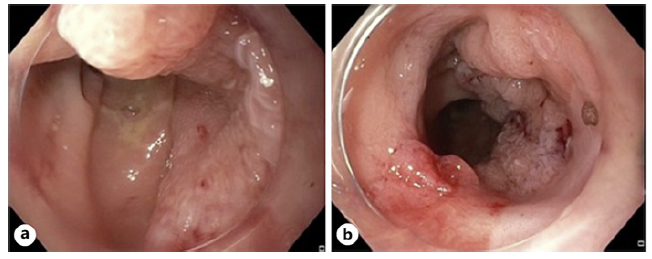
Fig. 1 a, b Laterally spreading tumor with involvement of 70% of the rectum circumference. 

She was then referred to our center for endoscopic resection by endoscopic submucosal dissection (ESD). The procedure was performed with anesthetic support, using 1.5 mm Flush Knife® (Fujifilm). During the procedure, extensive areas of severe fibrosis were identified, as well as multiple surgical clips (Fig. 2), making it impossible to identify a clear dissection plane of the submucosa. Due to these facts, segmental endoscopic intermuscular dissection (EID) was performed to achieve en bloc resection (Fig. 3). During the procedure, two perforations (2 and 3 mm) were identified that were successfully treated with TTS clips. The procedure lasted 114 min, and the patient was discharged 24 h later without complications under antibiotics. Histopathology showed a tubulovillous adenoma with low-grade dysplasia, with focal cauterized tissue at the lateral margin (HMx). Endoscopic reevaluation was performed 6 months later, showing no evidence of local recurrence (Fig. 4).
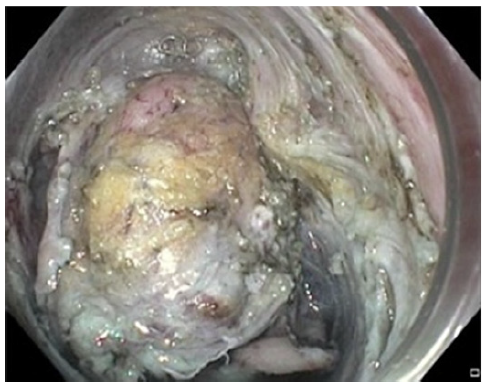
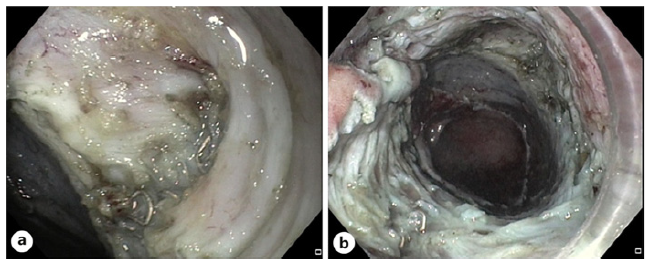
Fig. 2 Severe submucosal fibrosis with identification of surgical clips. 

Fig. 3 a, b Intermuscular dissection in areas with severe fibrosis and surgical clips. 

Fig. 4 Rectal lesion after EID. 

Discussion

ESD, EID, and TAMIS are effective and safe techniques for the treatment of early rectal cancers [1, 2]. Frequently, ESD is performed to achieve en bloc resections allowing perfect histopathological assessment and a lower risk of recurrence [3, 4]. However, in cases with severe and extensive fibrosis, commonly after endoscopic or surgical approaches, a clear identification of the submucosal plane during ESD is frequently impossible. In these cases, in the rectum, EID can be considered as a rescue technique. This technique involves the dissection of the tissue between the muscular layers of the rectal wall (intermuscular space) to facilitate better access and ensure complete resection of the lesion, being an alternative and attractive endoscopic resection technique [5].

The key point is that endoscopic resection remains a valuable and safe procedure for managing particularly challenging rectal lesions, especially those with local recurrence after endoscopic or surgical approaches and those with severe submucosal fibrosis. In these cases, EID should be considered to achieve R0 resection and reduce the local recurrence risk. This case further highlights the importance of appropriate endoscopic staging, as magnet resonance imaging staging often overstages early rectal neoplasms, potentially leading to increased risk of inappropriate therapeutic options.

References

1. Ferreira MF, Marques M, Morais R, Lemmers A, Macedo G, Santos-Antunes J. Endoscopic submucosal dissection is safe and effective for lesions located at the anorectal junction: analysis from two referral European centers. GE Port J Gastroenterol. 2024;31(1):41-7. https://doi.org/10.1159/000528107 [ Links ]

2. Moreira P, Cardoso PM, Macedo G, Santos-Antunes J. Endoscopic submucosal dissection, endoscopic mucosal resection, and transanal minimally invasive Surgery for the management of rectal and anorectal lesions: a narrative review. J Clin Med. 2023;12(14):4777. https://doi.org/10.3390/jcm12144777 [ Links ]

3. Probst A, Ebigbo A, Märkl B, Schaller T, Anthuber M, Fleischmann C, et al. Endoscopic submucosal dissection for early rectal neoplasia: experience from a European center. Endoscopy. 2017;49(3):222-32. https://doi.org/10.1055/s-0042-118449 [ Links ]

4. Mendes RR, Barreiro P, Mascarenhas A, Franco AR, Carvalho L, Chagas C. Endoscopic submucosal dissection for resections larger than 10 cm: outcomes from a Portuguese center. GE Port J Gastroenterol. 2024;31(1):33-40. https://doi.org/10.1159/000528102 [ Links ]

5 5. Tribonias G, Komeda Y, Leontidis N, Anagnostopoulos G, Palatianou M, Mpellou G, et al. Endoscopic intermuscular dissection (EID) for removing early rectal cancers and benign fibrotic rectal lesions. Tech Coloproctol.2023;27(12):1393-400. https://doi.org/10.1007/s10151-023-02862-7 [ Links ]

1Statement of Ethics Written informed consent was obtained from the patient for publication of this case report and any accompanying images. This type of manuscript, case report, does not require an ethical approval according to national laws.

2Conflict of Interest Statement Pedro Barreiro was a member of the Journal’s Editorial Board at the time of submission.

3Funding Sources There was no grant support for this study.

4Author Contributions Data collection was performed by Pedro André Lima and Raquel R. Mendes. Draft of the article was performed by Pedro André Lima. Article review was performed by Rui Mendo, Pedro Barreiro, and Cristina Chagas.

5Data Availability Statement The authors confirm that the data supporting the findings of this study are available within the article.

6© 2024 The Author(s). Published by S. Karger AG, Basel

7This article is licensed under the Creative Commons Attribution-NonCommercial 4.0 International License (CC BY-NC) (https://www.karger.com/Services/OpenAccessLicense). Usage and distribution for commercial purposes requires written permission.

Received: December 18, 2024; Accepted: February 10, 2025

Correspondence to: Pedro André Lima, pedro.lima97doc@gmail.com

Creative Commons License This is an open-access article distributed under the terms of the Creative Commons Attribution License