




 Inglês (pdf)
 Artigo em XML
 Referências do artigo
 Tradução automática
 Enviar este artigo por email
 Citado por SciELO
  Similares em
SciELO
Similares em
SciELO 
 Permalink
Since its establishment in 1948 as a specialized UN agency with the aspirational objective consisting of the “attainment by all peoples of the highest possible level of health” (WHO Constitution, Preamble) 1, the World Health Organization (WHO) has acted as the directing and coordinating authority on international health work, collaborating with the UN, governments, and relevant organizations to strengthen health services, provide technical and emergency assistance, and advance disease prevention and control (WHO Constitution, article 2) 1. Furthermore, the functions of the WHO also include promoting research, education, public health standards, mental and maternal health, environmental hygiene, as well as proposing conventions, agreements and regulations, and making recommendations with respect to international health matters 1.
Fast-forward to the present day, years after the pandemic phase of COVID-19 was declared over, vaccination numbers remain unevenly distributed between low- and high-income countries. As of August 2024, the proportion of the population in Sub-Saharan countries that has received at least one dose of the vaccine varies between 10% and 40%, compared to around 80% in Europe 2. Therefore, it is not without reason that COVID-19 has been called an inequality virus as it has exposed, exploited, and exacerbated existing inequalities of wealth, gender, and race 3.
On a global scale and since its inception, the WHO has played a crucial role in preventing and responding to global pandemics 4. In line with this role, and considering the lessons learned from the COVID-19 pandemic, the necessity to strengthen the global health architecture and address gaps in preventing and responding to health emergencies has been acknowledged by the WHO. Such gaps include the timely and equitable development and distribution of vaccines, therapeutics, and diagnostics, as well as the reinforcement of health systems in pursuit of universal health coverage. Therefore, in 2021, the WHO decided to establish an intergovernmental negotiating body (INB) to draft and negotiate a WHO convention, agreement or other international instrument on pandemic prevention, preparedness, and response, with a view to being adopted under Article 19 or other provisions of the WHO Constitution (Decision SSA2(5)).
After several years of effort, numerous consultations with experts and stakeholders, and a challenging negotiating process involving various drafts and a mandate extension (Decision WHA77(20)), the INB reached consensus on a final draft of the “WHO Pandemic Agreement,” which was subsequently submitted to the 78th World Health Assembly for potential formal adoption. In a plenary session of this Assembly held on 20 May 2025 in Geneva, marking a landmark decision, the Member States of the WHO formally adopted, by consensus, the first Pandemic Agreement 5. The now-adopted Pandemic Agreement comprises a preamble and 35 articles, organized into three chapters, including various key elements (Table 1) 6.
Table 1 WHO Pandemic Agreement: organization, general content, and key elements
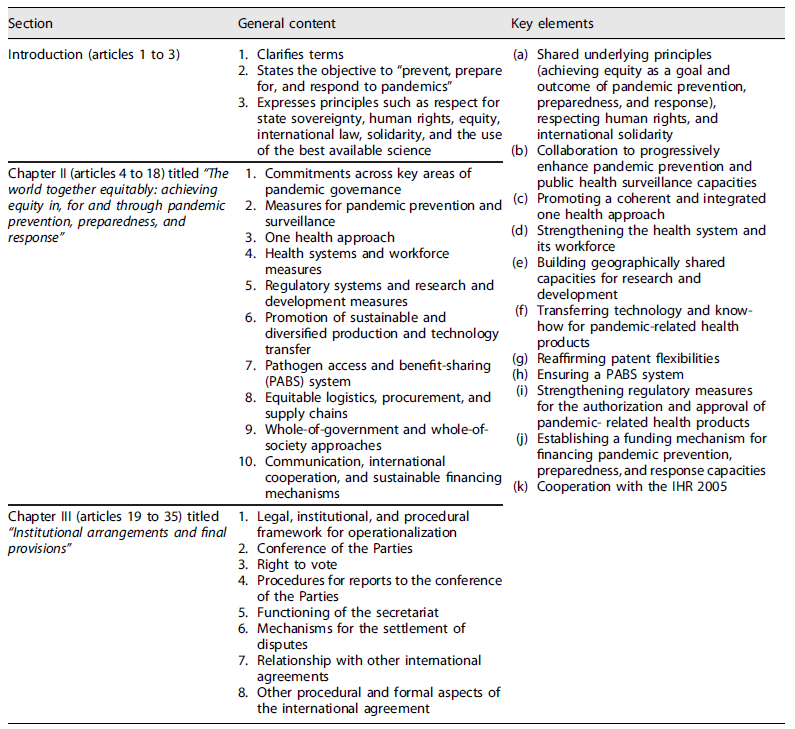
Source: Adapted from the WHO Pandemic Agreement; 2025 6.
Overall, according to the official WHO announcement, “the WHO Pandemic Agreement sets out the principles, approaches and tools for better international coordination across a range of areas, in order to strengthen the global health architecture for pandemic prevention, preparedness and response” 5. Notably, despite its broad and ambitious objectives, the Agreement remains carefully clear of impeding national sovereignty and enforcement mechanisms 7, by expressly stating that “Nothing in the WHO Pandemic Agreement shall be interpreted as providing the Secretariat of the World Health Organization, including the Director-General of the World Health Organization, any authority to direct, order, alter, or otherwise prescribe the national and/or domestic law, as appropriate, or policies of any Party, or to mandate or otherwise impose any requirements that Parties take specific actions, such as ban or accept travelers, impose vaccination mandates or therapeutic or diagnostic measures or implement lockdowns” (Article 22) 5.
While the adoption of the Pandemic Agreement represents a significant step toward achieving its stated objectives of equitable prevention, preparedness, and response to future pandemics, several serious issues still need to be resolved before Member States’ ratification 8. For starters, some may question the necessity of a new Agreement text, given that the International Health Regulations (IHR) 2005 9 already address key elements of the Agreement, such as pandemic prevention and monitoring. Nonetheless, it can be argued that the Agreement secures several substantive gains previously absent from the IHR 10. Furthermore, a critical element of the Agreement concerns the proposed PABS instrument (Article 12), which consists of a multilateral mechanism for the safe, transparent, and accountable sharing of materials and sequence information on pathogens with pandemic potential, aiming to ensure fair and equitable distribution of benefits arising from its use. Issues that remain to be resolved regarding PABS relate to its operationalization, including global access, considering in particular the specificities of developing countries and potentially conflicting interests arising from the pharmaceutical industry 11.
Another issue requiring attention is the transfer of technology and knowledge, which is vital for expanding local production and enhancing pandemic preparedness. Here, a stalemate might affect technology transfers based on mutually agreed-upon terms. Relying solely on the technology holder for the transfer is not optimal under unfavorable conditions, especially during a health emergency 12. This narrowing would exclude other non-voluntary measures when voluntary measures are either unavailable or inadequate. Instead, it was previously suggested by some experts to use the terminology recently agreed upon in the context of marine technology transfer: “for this Agreement, transfer of technology is understood to be on fair and most favorable terms, including concessional and preferential terms, and under mutually agreed terms and conditions and the objectives of the Agreement.” 13. Whether this could cover other (non-voluntary) measures under international law to facilitate technology transfer remains uncertain.
Finally, another major issue requiring attention is the funding mechanism, which was discussed and adopted (Coordinating Financial Mechanism, Article 18). Rather than providing direct funding, this mechanism aims to enhance the transparency, coordination, and accessibility of existing financing sources, particularly for parties in developing countries. While improving the financing process is a commendable objective, it does not address the ongoing shortfall of funds required for strengthening pandemic prevention, preparedness, and response 14,15. Nonetheless, it is a positive development that low-income countries are included in the decision-making processes of the funding mechanism.
As the announcement of the adoption of the Pandemic Agreement by the 78th World Health Assembly came through, Dr. Tedros Adhanom Ghebreyesus, WHO Director-General stated that “The world is safer today thanks to the leadership, collaboration and commitment of our Member States to adopt the historic WHO Pandemic Agreement,” adding that “The Agreement is a victory for public health, science, and multilateral action. It will ensure we, collectively, can better protect the world from future pandemic threats. It is also a recognition by the international community that our citizens, societies, and economies must not be left vulnerable to again suffer losses like those endured during COVID-19” 5.
Whether such an enthusiastic proclamation can fulfill its promise remains to be seen. In an era marked by eroding multilateralism and globalism, it is commendable that, despite its shortcomings, representatives from around the world have come together following a lengthy and comprehensive hearing and drafting process to support a common Agreement of principles, strategies, and tools designed to prevent, prepare for, and respond to pandemics. It is yet to be determined if the lessons from the recent COVID-19 pandemic have been learned and if this instrument will provide an effective platform for enhancing the global public health response to future pandemics. Realizing this potential will require prioritizing the needs of the most vulnerable, maintaining a sustained commitment to multidisciplinary implementation strategies, and reaffirming the crucial role of international cooperation in global health governance.
Acknowledgments
The authors would like to express their gratitude to all speakers and participants of the conference “The Pandemic Treaty: A New Global Public Health Instrument,” held at Nova School of Public Health, Lisbon, on May 9th, 2025, in collaboration with Erasmus University Rotterdam. We are also thankful to those who provided technical and institutional support in organizing this event. The conference, held in the context of ongoing deliberations surrounding the adoption of the WHO Pandemic Agreement, highlighted the complexity and challenging nature of this agreement, affirmed the critical importance of a multidisciplinary approach for its effective implementation, and underlined the central role of international cooperation in global health governance.
Conflict of Interest Statement
The authors have no conflicts of interest to declare. André den Exter and João V. Cordeiro were members of the journal’s Editorial Board at the time of submission.
Author Contributions
A.E. drafted the initial manuscript. P.L.F. and J.V.C. contributed to the critical revision of the manuscript for important intellectual content. All authors made substantial contributions to the conception and design of the work, reviewed and approved the final version of the manuscript, and agree to be accountable for all aspects of the work.

