




 Inglês (pdf)
 Artigo em XML
 Referências do artigo
 Tradução automática
 Enviar este artigo por email
 Citado por SciELO
  Similares em
SciELO
Similares em
SciELO 
 Permalink

Introduction
Among the themes highlighting Portuguese participation in the international scenario is its Atlantic representation. The dynamics that allow such place reach links between Portugal and the ongoing international system frameworks that are rarely visible. Although considered a small country and, as so, a small power, Portugal is cited as a stable country and a contributor to international peace (do Céu Pinto, 2014).
Portugal’s presence in the international system is marked by the conditions of its various interfaces, whether built upon the colonization processes of more than five centuries or those that constituted the multiple phases of migration of the Portuguese-speaking populations.[1] Its strengths include important societal networks, such as within the Portuguese-speaking community of about 240 million people, of whom just 5% are in Europe (and 20% of the 5% are out of Portugal).
Among its geostrategic conditions, it is one of the Atlantic main entrances for continental Europe, in addition to the Madeira and Azores islands, the last which had served as a military base for the United States and NATO operations from 1953 to 2004. Despite its history and natural conditioners of interaction in the international arena, Portugal has become more devoted to domestic politics and market pressures during the xx Century, and its regional and international engagement is back recently (de Vasconcelos, 1991; Teixeira, 1999). The transformation of the Portuguese position as a coloniser is particularly connected to how the dictatorship has been surpassed and the EU membership engagement has been deepened.
On the other side, Portugal has also been critically seen as a weak actor in the international system. Raimundo (2014) considered its path realist-based and distant to a human-rights and democracy approach towards its former colonies, especially in Africa. Norrie MacQueen (2020), in a study about the Timor-Leste recent peace process, states that the Portuguese decolonization process in the country was chaotic and led to the institutional power imbalances that prevailed.
But things had changed since the Portuguese political transition to a democracy in 1974. Although we can recognize that part of the discourse on the Portuguese conditions to integrate the EU was built upon its imperial toils despite its low level of development (Ribeiro, 2002), the view presented here is characterised as opposed to the strengths guaranteed by its colonization ties such as the discourse on Pan-Lusitanism (Matos, 2018) or the Salazarism dictatorship markable domestic propaganda (Pinto, 2022). It is constituted, though, by Portugal’s need for reforming the strategic thinking towards a future of decolonized relations through its most valued assets and within renewed paradigms of international participation.
The strategic position of Portugal may represent the first conditioner of its economic value, which is not seen by the macroeconomic standards regularly used, such as the GDP, the population or territorial strength.
This work aims to pose together the conditioners of Portugal’s renewed international system participation based on selected variables that can make robust its view as a player through its maritime assets, despite the limits of its territorial and populational nature. The argument lies on the maritime strengths as an expressive route for the security of the cooperation frameworks that links the Western nation’s various subsystems. The sentiment surrounding this belong as a western country is synergic to its positioning as a bridging actor from the South to the North, from peripheries to the center of the international system.
Materials and Methods
This study adopts a multidisciplinary approach, integrating historical, socio-economic, and geopolitical analyses to examine Portugal’s role in the international system, particularly through its Atlantic maritime assets. The study explores Portugal’s historical evolution from a colonial power to a small yet strategically significant state within global cooperation frameworks. The research builds on Portugal’s complex history of colonization, decolonization, and its subsequent integration into the European Union (EU) and NATO. This historical context is essential to understanding the country’s current international position and its strategic use of maritime resources.
A thorough literature review forms the backbone of the study, drawing on key works by scholars such as Carvalho (2018), Clarence-Smith (1979), and more recent studies on maritime studies such as Bueger & Liebetrau (2021) and Carvalho & Leira (2022). The literature review addresses Portugal’s historical and contemporary geopolitical strategies, its colonial legacies, and its participation in international frameworks. The study lays on the recognition of an International Relations Theory gap in terms of the seas, as proposed by Carvalho & Valença (2024), a Maritime Aaphasia, for the understanding of the Portugal’s role and its eventual neglection.
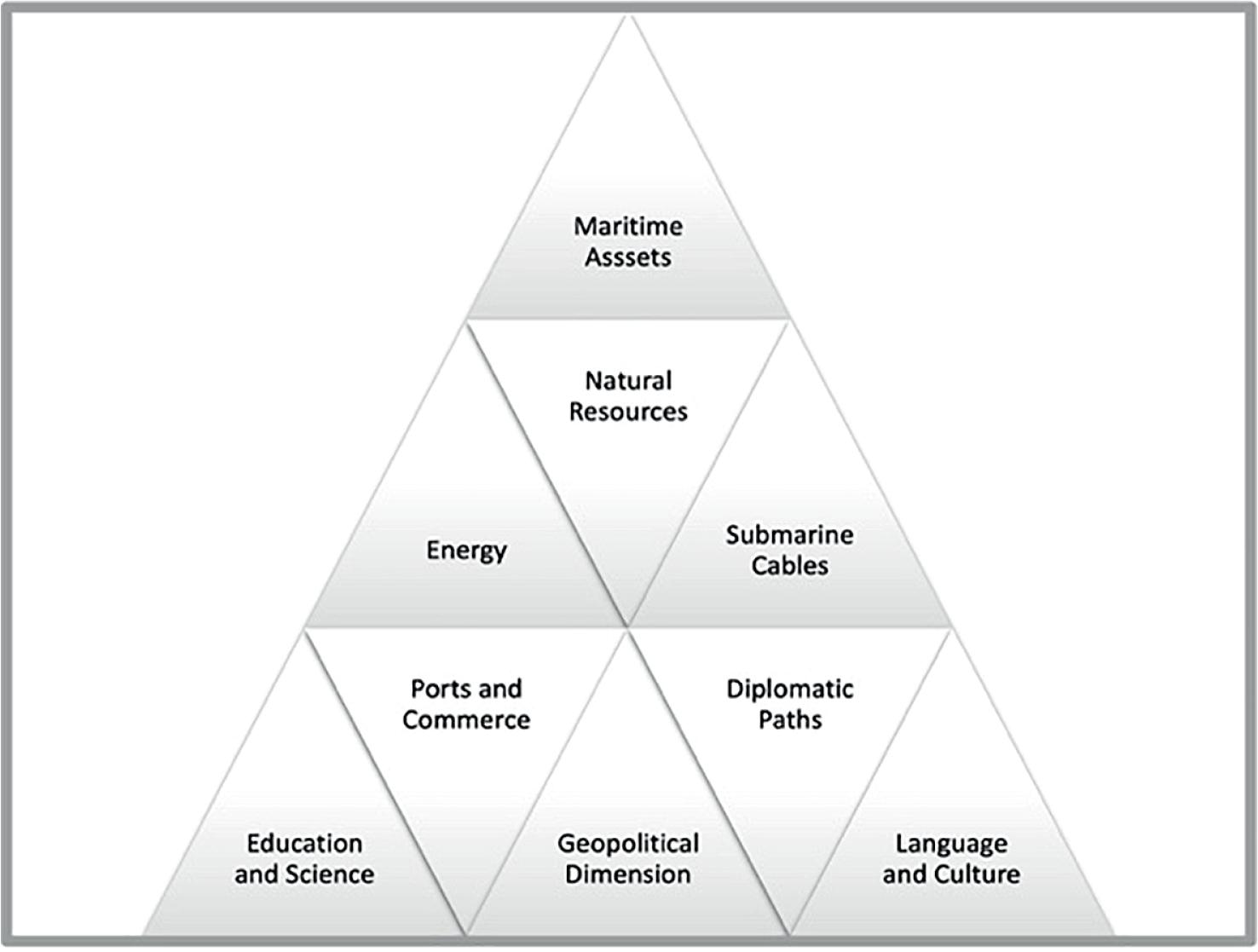
The study also incorporates recent strategic documents such as the National Strategy for the Sea (2021) and the Strategic Vision for Portugal’s Economic Recovery Plan (2020-2030). These sources provide critical insights into the ongoing evolution of Portugal’s maritime and geopolitical strategies. Data was collected from a variety of sources, including historical documents, policy papers, and economic reports, focusing on Portugal’s maritime economy, geopolitical strategies, and international relations. The analysis employs a triangular hierarchical diagram to visualize the relationships between Portugal’s natural resources, diplomatic paths, and maritime infrastructure. The framework emphasizes the indirect influence of these assets on Portugal’s international participation, especially within European and transatlantic contexts, including the South Atlantic relations.
The study acknowledges potential limitations inherent in qualitative historical analysis, particularly the reliance on published literature, which may overlook undocumented influences on Portugal’s maritime and geopolitical strategies. Additionally, the interpretation of historical and geopolitical data is dependent on the sources and analytical lens employed.
A decolonial approach to analyzing Portugal’s power challenges the traditional narrative that views the country primarily through the lens of its colonial past and subsequent decline. Rather than focusing on Portugal as a former colonial power that lost its empire and, consequently, its influence, this perspective emphasizes the nation’s cooperative assets and strategic positioning in the modern international system. This approach highlights how Portugal has redefined its role through collaborative frameworks and multilateral engagements, shifting the focus from colonial loss to the potential embedded in Portugal’s maritime and scientific diplomacy. The approach recognizes Portugal’s ability to leverage the importance of its geographic position, historical ties, and linguistic connections to foster trust and cooperation across diverse international networks, thus reshaping its identity as a significant player in global affairs. This paradigm shift underscores the importance of viewing Portugal’s power not in terms of what it once had but in terms of how it effectively engages with the world today, emphasizing cooperation, connectivity, and innovative diplomacy.
Results
The study confirms that Portugal’s strategic Atlantic position is a central asset in its international participation, serving as a crucial gateway to Europe. The maritime economy, while not dominant in traditional macroeconomic terms, plays a significant role in Portugal’s geopolitical strategy, as well as Portugal’s involvement in the EU’s blue economy initiatives and its emphasis on sustainable development and carbon neutrality highlight the importance of its maritime assets. These assets, though not always directly commodifiable, underpin Portugal’s broader influence in international relations.
Portugal’s active engagement in scientific diplomacy, particularly through initiatives like the All-Atlantic Ocean Research Alliance, demonstrates its commitment to global cooperation on sustainable resource management. The Atlantic Center initiative also calls for the Portuguese bridging Atlantic cooperation through maritime knowledge exchange, which is represented by other frameworks such the Community of Portuguese-Speaking Countries and related agendas. This diplomatic approach, which intertwines science and international relations, has strengthened Portugal’s global standing, particularly within the EU and other transatlantic frameworks.
The study also highlights Portugal’s critical role in global digital communications through its extensive network of submarine cables. As a key hub for data transfer between Europe, Africa, and the Americas, Portugal’s responsibility for maintaining these cables underscores its importance in global cybersecurity. The research emphasizes the need for continued investment in protecting these vital infrastructures, given their role in global communications and financial stability.
Portugal’s strategic integration into the EU and NATO reflects its dual role as both a central and peripheral player in international security frameworks. The study highlights Portugal’s contributions to NATO, particularly in the context of emerging technologies and defense innovation, and its participation in EU defense initiatives such as PESCO. This is because, despite its small size, Portugal leverages its strategic location and historical ties to maintain relevance in these broader frameworks, which bridges and interfaces with the South Atlantic.
The study identifies key challenges for Portugal, including the need to accelerate digitalization and enhance cybersecurity measures. The Interoperable Europe program presents opportunities for Portugal to enhance its role as a hub for international cooperation, particularly by aligning national and local governance initiatives with broader EU modernization efforts. Portugal exemplifies how small states can navigate complex international systems by leveraging strategic assets such as maritime infrastructure and historical ties. The study concludes that Portugal’s role in global security and cooperation is characterized by its ability to maintain trust networks and contribute to international stability, despite the inherent limitations of its size and power.
The findings suggest that Portugal’s continued focus on enhancing its maritime and cyber infrastructure, bridging the Atlantic and coupled with its strategic engagement in EU and NATO initiatives, will be crucial in sustaining its influence in global governance. Future research should explore how these developments impact Portugal’s long-term strategic positioning and its role in addressing evolving security challenges.
Discussion
The Portuguese Atlantic interface with the Mediterranean is part of its development as a long-distance maritime community many centuries Before Christ (BC) (Carvalho, 2018). After the period of the Great Navigations, between the 15th and the 16th centuries, Portugal established itself as a sovereign country, paving the way to other state formations after years of bloody religious wars in Europe. Its royal family links with various other European royal families (Rubin & Stuart, 2008) and its ties to the colonies between the 16th and the 20th centuries guaranteed the Portuguese maritime economy, which was made of goods circulations and exogenous exploitation (Clarence-Smith, 1979).
Otherwise, it is pertinent to say that the Portuguese Lusophonic relations were marked by the British-Portuguese relations, which had intensively conditioned the Portuguese-Brazilian relations. Since the Portuguese Royal family went to Brazil and transformed it into part of the Portuguese United Kingdom (Reino Unido a Portugal e Algarves), with Rio de Janeiro as the headquarters (1808), the British influence has increased.
That happened through the military regence of Portugal by the British national William Beresford (Owen & Williams, 2020), but also on the transnational traffic of African slaves, prohibited in the British UK one year before (1807, Slavery Trade Act). After a full prohibition of slave work in the British UK (1833, Slavery Abolition Act), as they were competing slave traders in the previous centuries, Portugal was under pressure to resignify its Atlantic commercial bridges (Drescher, 2018).
Despite the intense commerce associated with the Portuguese colonial ties formed by the political bridges that moved the Portuguese international resignification after the independence of Brazil in the xIx Century, the Portuguese international identity suffered from the domestic constraints of a unique dictatorship in the xx Century.
During the Salazar dictatorship government, Salazarism (1933 to 1974) played on Portugal’s neutrality to guarantee its political isolation from the democratization processes pressured by the post-war Western Powers (Pinto, 2022). Even during years of recognized isolation whilst marked by the authoritarian regime, Portugal used its maritime vocation to conceal its strength by denying being a small country, including the “portugueseness of overseas Portugal”, which were represented by the lasting colonies, the Ultramarines (Cairo, 2006). As so, Atlantic relations are commonly convened and limited by the Portuguese colonialist past and the recent dictatorship.
The culture widely called through the Lusophony is regularly dismissed due to the complex terminology associated with colonial thinking built upon the identity of a vast interface between different continents. Owen & Williams (2020) point out that the diversity of the Portuguese language and the Portuguese nation formation through various centuries of diasporas and influences (Germanic, Arabic, Celtic) form what is Portugal’s primary identity roots. For the authors, the changes in the post-dictatorship period (1974) happened through political elites’ willingness to integrate, upholding an already existing Europhilic sense.
Its transition to democracy marks contemporary Portugal, with periods of progress and recession, both before and after its European Union integration in 1986. After the democratization process, Portugal is progressively seen as a contributor to the deepening of the regional integration process and the enlargement of the NATO trust system (Teixeira, 1999).
The Portuguese European integration process had even been initiated regardless of fears of the Portuguese poor economic participation by its cheap labor force (Reis, 2007). The current Portuguese participation in the European integration program is largely associated with its condition as an Atlantic hub due to the sea infrastructure already in place and the possible investments associated with energy, technology, and logistics. Thus, the efforts associated with building a common foreign and security policy “(…) appear to have put some pressure on Portugal’s traditional position on political conditionality, particularly at the EC/EU level”, leveraging the Portuguese commitment to internationally reinforce the democracy and human-rights values associated to its renewed path (Raimundo, 2014: 596).
As part of the local development and regional integration status, the Portuguese- Spanish border is considered a dimension still to develop. However, significant regimes are emerging, such as the cities association for the Atlantic Axis or the Eurocities program as part of the territorial European cooperation (Lois-González, 2004). Within the European Union cities network and development program, Portugal has been marked by local efforts from the North identitarian connection to the Spanish Galiza region and the South connection through the Atlantic.[2]
Contemporarily, Portugal has been one of the axes to the Portuguese-speaking countries and the community, which built a triangular route between Europe, African Portuguese former colonies and Brazil. Data shows that Portugal growth was by 6.8% in 2022 - even though there was a reduction of its expectations and the numbers after the war in Ukraine - representing the largest among members of the European Union in the same year [3]. The country’s axels of cooperation may pose a relevant way out from sources of risk of economic stagnation in the face of war, offering alternatives to supplying the energy and food chains through the country’s prioritization in the face of commodities’ higher demands.
In addition to a dedicated ministry in the Portuguese political framework, the sea economy has interfaces with the European economic clusterisation project that is multisectoral and is part of complex logistics chains initiated by the ports structure. The Specialized Committee on Coastal and Sea Zones is working with 2030 as a target, including modernization, digitization, and port decarbonization to benefit the substantive increase in maritime transport and employability by transferring the concept of a single port window to a single logistics window. [4][5] Floating wind farms also can represent an alternative to the dependence on fossil fuels since Portugal has committed to achieving carbon neutrality by 2050. The energy security standard achieved is also among the most important energy transition nations.
Portugal is among the top five (5) countries in Europe in terms of clean energy, with a corresponding share of 34% in the total amount of energy consumption.[6][7]
Together with Greece, Italy, France, Spain and Croatia, Portugal has an Exclusive Economic Zone that includes a great part of the lines of communication with the African continent and the Americas from continental Europe, represented by one of the most prominent EEZ bands in the world. The capabilities of the Portuguese Exclusive Economic Zones are in force in the Portuguese National Strategy for the Sea (2021), which has gained new components from the UN Sustainable Development Goals (Agenda 2030), among other directives from the European Union agencies in this regard.[8]
The Strategic Vision for Portugal’s Economic Recovery Plan 2020 -2030, which includes the oceans as the central value of the country’s sustainable growth program, called blue growth, also contributes to the concentration of efforts at sea. In this regard, ocean observation systems are created to comply with international demands for the controlling of living marine resources and to assure greater maritime security. Maritime security allows the continuity of economic flows by sea, which represent a share of about 90% of the volumes in circulation and 40% in global trade value[9].
Given the volume, the low value in circulation refers to the processes of digitization of the global economy, which also has the most important physical component in the seas. In terms of the economy of the seas, the Portuguese Ministry of the Seas states that it had reached around 5% of the GDP in 2018, and around 1.5 billion euros, counting on the fisheries, aquaculture, entertainment, and tourism[10].
Before the Portuguese inclusion in the European Union, prospects of the Portuguese and other states’ inclusion were published by Keeble, Owens and Thompson (1982) regarding its possible economic potential. The study marks the importance of the “economic accessibility” variable, calculated based on how the investments dedicated to the integration can be directed to the more commercially viable zones.
Although with lower rates than some states such as Greece, the coastal zone of Portugal is seen as an asset for commercial facilitation onward to Europe’s main industrial centers. It is also worth noting that the index indicates that the low-potential peripheries versus the high-potential central zones have the seas as indicative for further consideration in terms of the access it could promote to those higher-level centers (Keeble et al., 1982).
It is worth noting that the correspondence of scientific diplomacy to agendas such as sustainable development, carbon neutrality and the blue economy is another source of the Portuguese international footprint. Kett & Mazomba (2002) mark that science diplomacy has been essential to sustainable resource management and countries’ development. According to the authors, the Azores Declaration[11], as part of the All-Atlantic Ocean Research Alliance, was signed in the context of the Highlevel Ministerial and Stakeholder Forum in 2021 as a more profound commitment which follows the previous All-Atlantic Research. It has been considered one of the leading initiatives encompassing a European academic space for transferring knowledge that can be a step up for external partners’ and researchers’ collaboration.
In this regard, the contributions from the creation of the Atlantic Center had been largely felled by partners that integrate the most important maritime cooperative and knowledge framework in place integrating the South and the North Atlantic nations, coordinated by Portugal[12].
Submarine Cables and Cyber Connections
The maritime value of a country should consider all kind of assets and resources from the sea to the land (Carvalho & Leira, 2022). The assets of a country are particularly associated with logistics, but this is rather calculated in terms of the value of the resources that transit within its wet borders. Submarine cables are resources that make the seas a short frontier for the transferring of resources, but their value is associated beyond the limits of a country’s inland borders.
Submarine cables are the essential source of digital communications, accounting for 99% of network traffic worldwide and estimated financial volumes in transit of around 10 trillion dollars[13]. In terms of Atlantic Communications, Portugal comprises sixteen (16) subsea cable interfaces towards the European continent in the southwest, compared to eleven (11) interfaces with France and three (3) + eleven (11) with Spain in the West and South, respectively[14]. This means that Portugal is responsible for the security of the area where those cables are established into the continent through its territorial waters, and its private stakeholders are for maintaining the information flows through their infrastructures (Bernardino, 2024).
The private contract obligations associated do not cover the states’ responsibilities, and when it comes to the overlapping governances, there is a lot to evolve regarding the effects on the regional security of the possible interruption of the submarine cables’ informational flows. Considering that the circulation of information through submarine cables includes transactions of large financial volume, the interruption of these communications can be vital for the continuing financial market relations, as well as the supply of energy and the stability of critical infrastructures (Medeiros & Ayres Pinto, 2022).
A hundred submarine cables are hit annually worldwide, approximately. If the sources of communication by sea represent the way relations take place, rather, these relations are represented by cooperation agreements where multiple stakeholders should be engaged. Those agreements are in place for transferring goods and services, training and interoperability, or regimes, from higher diplomatic initiatives to intersectoral agreements, although eventually less visible. Therefore, physical assets are also cyber-domain vulnerabilities that are representative of the need for leveraging the protection models governed by collaborative and multistakeholder cooperation (Medeiros & Ayres Pinto, 2022).
The submarine cable investments point to a permanent consortium among multiple stakeholders connecting tech development, energy and maritime-based infrastructures. With a friendly ambience for innovation, Portugal is marking its international footprint by facilitating the entrance of qualified migrant workers and establishing fiscal incentives for enterprises and entrepreneurs. This is a determinant of how it has been prepared for dealing with a great number of resources through data in circulation, which includes sensitive data under important security and regulation-demanding pressures (Medeiros & Ayres Pinto, 2022).
The recently launched study led by Christian Bueger and Tobias Liebetrau (2021) for the European Parliament characterizes the first recognized need for establishing the agenda crossing new security paradigms and the ongoing mechanisms of economic development international concurrence. This aspect transfers a group of values normally not associated with or represented by the seacoast lines, which already account for around 95% of international commerce.
Spreading the European Union and NATO frameworks
Portugal represents one of the closest NATO members to the USA and Canada outside the American continent and in the Atlantic. But the US - Portugal foreign relations were not always considered synergic, but a balanced equilibrium emerged through inevitable interdependencies between them that developed after the II Word War (Marcos, 2014).
In this sense, given the risks associated with the uncertainties that disrupt the various sources of interdependence among actors, the presence of an actor like Portugal within the dynamics of trust contraction can uniquely uphold regional and international security.
The growing interest of the European Union (EU) in amplifying trust schemes out of its borders can be seen through the regime’s bilateral support to developing countries as well as through the characterised triangular cooperation, serving as a supporting member for the benefit of South-South cooperation. Besides the mentioned efforts, the individual members of the EU compose regimes of cooperation extending the European state’s participation beyond the continent. The participation of many EU members as associate members at the Portuguese-Speaking Countries Community (CPLP) permits the Portuguese language can spread and help the alignment of the common interest’s knowledge in one of the EU’s official languages but outside it.
On the other side, Robinson (2016) offers a critical view of the Portuguese strategic and historical Atlantic preference for the strengthening of the European security frameworks through its Atlantic Relations. In his analysis, the Portuguese option for its post-colonial enlaces is a way to interpose its preferences within NATO, the EU and the Lusophone world in a way one effort can add to the other. The 2022 NATO Strategic Concept particularly addresses the need to incorporate the most decisive technological developments, such as those associated with artificial intelligence and cybersecurity, but also the broad and complex regime of cooperation necessary for the stability of the West in the face of Russian or Chinese presence on the international scene (Becker et al., 2022; Gottemoeller et al., 2022). Pedro Costa Pereira, a Permanent Representative at the NATO Portuguese Delegation, states that the institutional differences between NATO and the UE do not oppose them but rather may promote useful complementarities (Pizarro et al., 2022).
The ongoing challenges fear the lack of trust and coordinated collaboration, which is in line with the efforts made through the Structured Cooperation Program within the framework of the European Defence Agency. The PESCO, as the program is called, guarantees a group of co-development defense projects with a high level of autonomy from the NATO structure. However, it does not include European non-members. The new European Union Strategic Compass reveals how strategic and military robustness can be built upon the significance of autonomous military power and a reviewed civil normative power structure (Pizarro et al., 2022).
In terms of participation in the PESCO program, besides its engagements in an important group of selected projects, Portugal is a lead of some projects: EU Cyber Academia and Innovation Hub (CAIH); the Maritime Unmanned Anti-Submarine Systems (MUSAS); and the Automated Modelling, Identification and Damage Assessment of Urban Terrain (AMIDA-UT).
Despite the poor relationship between NATO and EU development programmes, NATO continues to benefit from the PESCO projects, with the United States and Canada as invitees and collaborators. The relations between NATO and the European Union frameworks had suffered from tensions and back-and-forths. But as the war in Ukrainian advanced, the scene of tensions had stepped back again. As a general mistrust has advanced caused by geopolitical repositioning in Europe after Russia invaded Ukraine, the system of mutual trust created around the axes of Atlantic cooperation gains even greater relevance.
The challenges associated with technological development in defense led the EU and NATO to redraw their strategic documents sharpening their capacities to deal with efficiency and innovation to the new prospects for the security of the international system. With the launching of the Charter of the Defense Innovation Accelerator for the North Atlantic (DIANA) with the new NATO Strategic Concept (June 2022), Portugal was chosen as one of nine accelerator sites for emerging and disruptive technologies. Biotechnology, information and communications technology, advanced materials, renewable energies are included in the DIANA Portuguese program.
In December 2022, the Portuguese 2030 Cooperation Strategy (ECP 2030) was published, guaranteeing that the Portuguese Speaking countries’ Community is under its first-level priorities regarding the three main types of cooperation: cooperation for development, education for development and humanitarian crisis and emergencies. Complementarily, the European Union is seen as decisive, whereas Portugal is an important representation of the cooperation plan. In the same document, aligned with its second strategic objective, there is the commitment to promote a more “interventionist” international participation connected to its multilateral, bilateral, or trilateral politics.
Strengthening Security
Portugal is part of a complex of interdependent relations, and its significance is qualified by different variables which are partially seen. Portuguese participation in the international arena can boost aspects such as network trust, even if its strength cannot shape its relations through a regular leading position. Detecting the above scheme of interdependent relations and crossing paradigms permits us to understand that small powers mark ways of guaranteeing that networks of trust can be sustained.
Despite the differences within the different regimes that interface through those countries, the sense that interdependencies are built upon ties of diminished tensions reinforces the idea of a broader role for small powers within trust regimes. That is why it is important to observe trust and interdependencies through a lens that can better fit the understanding of why states cooperate.
That has been a large path in the literature associated with diversified knowledge about the power conditions or the norms controlling the international system. Besides this, there is the approach to how the reputational value conditions cooperation frameworks, in which states may build upon either a cooperative reputation, which is constituted by its cooperative paths, or a leadership reputation (Medeiros, 2011). Regarding the defense alliances, it is also important to understand how bandwagon and balancing are perceived (Sweeney & Fritz, 2004), despite recognizing that the broader the group, the less incentive to cooperate proportionally is provoked (Olson, 2009).
The missing approach to how small states can face and disrupt the system can be partially diagnosed by the rare view of the value of their interdependencies and ties, as opposed to assets represented by power (Sweeney & Fritz, 2004). Combined forces of interdependencies can disrupt systems even with a low level of previewing it. In this regard, the visibility of security frameworks’ interoperable communication is a way to understand and estimate the expansion and robustness of the ongoing security frameworks. Thus, interoperability represents the capacities and movements that transfer resources and knowledge between different systems. As the Interoperable Europe program evolves, Portugal guarantees amplified channels to enhance its prospects as a European Union international hub with extra-regime partners. Indicators from the 2022 report show that the Portuguese public administration’s efforts to modernize were huge. However, there is still space to accelerate the pace regarding the schemes that interface internationality, such as progress on the efficiency of foreign relations and security bureaucracies. This is the case related to digitalization and simplification in areas where the index showed a lower curve than the UE curve since 2016[15].
This way, it was possible to select the main areas where Portuguese performance determines its regional or international participation, according to its current and renewed strategic documents and an analysis of prospects for its future. Considering the maritime assets as the historical determinant of Portuguese international expansion, combining the associated values or variables into a triangular hierarchical diagram led us to the scheme below.
As it is posed, the natural resources are not exactly pure assets that can be extracted or of direct commodity value, but how its natural condition can uphold Portuguese international participation. As so, energy prospects associated with the Portuguese position or its seas, as well as the submarine cables infrastructures connections, are assets by the indirect aspects of their presence in greater influence spaces. Complementarily, are the Portuguese recent diplomatic paths and Portugal’s direct participation as an entrance for commerce and energy supply onward Europe. All the cited elements connect with Portugal’s geopolitical dimension, which also lies in its language or education and international science participation.
Conclusions
This chapter aimed to show assets related to the Portuguese participation in the international system due to the current global challenges and its repositioning in the global cooperation architecture. In terms of International Relations contributions, as Swoden-Carvalho & Valença states, a multidisciplinary age of approaches includes a variety of significant that involve the oceans as the main component of the (liberal) international order, as to Keep the stability of the international order (Swoden-Carvalho & Valença, 2024). Within this interpretation, Portugal’s role has been dynamically driven, but its Atlantic assets are still to bridge those multifaceted internationalization efforts.
As a case study, Portugal may represent how small powers can be represented in the international cooperation and security-enablers architectures triangulating regimes and identities that can foster trust among partners. The imbalances in power relations evoked by small states such as Portugal can commonly underpin the analysis of the strengths associated with other conditioners than power.
Those political decisions shaping a new paradigm for democratic Portugal permit us to detect that combining a bottom-up approach to the subsequent waves of modernization from outside may create a renewed face to Portugal’s international participation. The local dimension of the paradiplomatic and local development projects that associate municipalities is also a new boundary for Portugal’s engagement (Silva et al., 2018; González-Gómez, 2016).
Some of the modernization processes that the European Union is pushing regarding the national public governance capacities and a human-centered approach can make room for international engagement at an upper level. Combining national assets with local governance initiatives may be a way to mark new routes to internationalization.

