




 Inglês (pdf)
 Artigo em XML
 Referências do artigo
 Tradução automática
 Enviar este artigo por email
 Citado por SciELO
  Similares em
SciELO
Similares em
SciELO 
 Permalink

Introduction
The death of George Floyd on May 25, 2020, ignited widespread social unrest, highlighting systemic racism and police brutality. Floyd’s death brought issues like racial profiling, excessive force, and lack of accountability in policing to the forefront, sparking movements for comprehensive reforms. This incident became a global rallying point against racism and injustice, with social media amplifying awareness and protests amid the COVID-19 pandemic.
In the wake of Floyd’s death, monuments and memorials in public spaces were targeted by movements due to their symbolic and historical significance. Many monuments, especially those of Confederate leaders and colonial figures, are seen as symbols of racism, oppression, and white supremacy, celebrating individuals who played significant roles in slavery, segregation, and the marginalization of minority groups. The protests prompted a reassessment of who is publicly commemorated, with activists arguing that honouring controversial figures perpetuates historical narratives that glorify oppression.
Toppling these statues is seen as a step towards social justice and equality, challenging systemic racism embedded in societal structures and creating a more inclusive public space. In Europe, similar actions occurred, driven by colonial histories marked by exploitation, violence, and racism, reflecting a demand to confront and reassess colonial legacies.
The politics of heritage, memory, and monumentality in public spaces are inherently complex, involving top-down and bottom-up processes, competing narratives, and the struggle to shape collective identity and historical consciousness. If communities or social movements are denied a role in shaping commemorative landscapes, monuments often become sites of contestation and conflict. The topdown imposition of commemorative interventions by political elites, without consulting diverse stakeholders, can exacerbate social divisions and undermine efforts to foster inclusive and democratic public memory. Fostering collaborative, community-driven approaches to the representation of heritage, memory, and monuments in public spaces is therefore crucial.
Two historical moments in the United States (U.S.) frame this analysis of the complex and territorially dispersed process of reassessing public monuments:
i) The murder of George Floyd on May 25, 2020, and the subsequent Black Lives Matter protests that erupted across the country and the western world;
ii) The “Proclamation on Establishment of the Emmett Till andesed Mamie Till-Mobley National Monument” signed by President Joseph Biden on July 25, 2023, representing a significant milestone in the ongoing battles over public memory and commemorative landscapes in the U.S.
The protests following Floyd’s death revealed the deep-seated tensions and power dynamics underlying the representation of history, identity, and memory in the public sphere. The creation of the Emmett Till (1941-1955) and Mamie Till-Mobley (1921-2003) National Monument represents a symbolic intervention by the federal government to formally commemorate and recognize a pivotal moment in the civil rights movement that has long been marginalized in dominant historical narratives.
Historical and comparative analyses as qualitative methodologies in political science illuminate the complex social, political, and cultural dynamics of monuments and memorials. Historical analysis tracks the evolution of political systems, revealing patterns and changes that shape contemporary issues. Comparative analysis examines similarities and differences between political entities or events, uncovering broader trends and causal mechanisms. This approach is crucial for developing theories and generalizations. The comparative historical method offers detailed case explanations and broader insights, informing both theory and practice in political dynamics (Mahoney & Thelen, 2015; Mahoney & Rueschemeyer, 2003).
Taking all the above into account, this paper has the following internal structure: Introduction; 1-The Role of Heritage, Memory, and Monuments in Public Space; 2-Framing an Ongoing Culture War in the United States; 3-Updates From an Expanding and Evolving Global Movement; 3.1-Protesting, Vandalising, and Beheading; 3.2-Fostering Collaborative, Participatory, and Community-Driven Approaches; Conclusion; Acknowledgements; References.
1. The Role of Heritage, Memory, and Monuments in Public Space
The complex relationship between heritage, memory, and monuments in public space shapes our understanding of the past, our connection to the present, and our vision for the future. Monuments and memorials, often in prominent locations, embody a society’s collective memory and official historical narratives. They articulate national politics of memory and identity, allowing political elites to legitimize their power and influence discourse.
However, these monuments become social properties, subject to reinterpretation by the public, diverging from their original intent, which underscores the fragile nature of legitimacy through collective memory (Osborne, 2017; Assmann, 2011; Forty & Küchler, 1999; Connerton, 1989; Halbwachs, 1997 [1950]).
Monumental landscapes are built with layers from different generations, each reflecting their significant values (Cudny & Appelblad, 2019). Thus, a monument’s significance evolves with the social, political, and cultural context in which it is observed (Federico & Panico, 2016). A community’s monumental landscape is a multi-layered repository of values, identities, and emotions, constantly renegotiated as society’s collective memory shifts (Cudny & Appelblad, 2019; Alderman & Dwyer, 2009).
The distinction between monuments symbolizing triumph and memorials embodying loss is unhelpful, as both are material sites of memory entwined with power, identity, and social control. Monuments are not just aesthetic objects but political tools, communicating official narratives while also serving as platforms for reinterpretation and the expression of alternative memories and identities. Studying heritage, memory, and monuments in public space is crucial for understanding how the past is represented, contested, and shaped to serve present interests (Lafont, 2022; Béghain, 2012).
Historians critically reflect on how monuments and memorials have been used to legitimize power, while also acknowledging their potential as sites of resistance and alternative histories (Santos, 2022; Federico & Panico, 2016). European historians particularly emphasize that collective memory is crucial for community identity and belonging (Halbwachs, 1997), making monuments key in preserving and transmitting cultural heritage and values (Choay, 2007; Babelon & Chastel, 1994). Emphasising these ideas, Pierre Nora proposed the operative concept “places of memory”.[2]
Social cohesion and national identity, alongside the idea of cultural community, rely heavily on how the past is memorialized in public spaces. In the U.S., debates over Confederate statues and other monuments have intensified, highlighting the struggles over historical representation and the legacy of oppression.
In this context, resistance plays a crucial role in shaping memory and heritage. Marginalized communities and social movements challenge dominant narratives embodied in these monuments, seeking to erect new symbols that better reflect their experiences and perspectives. Activism around heritage, memory, and monuments is thus a vital part of the broader struggle for social justice, cultural representation, and the democratization of public spaces.
Monuments, memorials, and statues in public spaces reflect ongoing struggles for power and the demands of those excluded from power for rights and access. These struggles persist today, with marginalized communities and social movements asserting alternative visions of the past, present, and future that better reflect their diverse experiences.
In Europe, rising nationalism and populism have sparked debates about monuments’ roles in shaping collective memory and national identity. These tensions underscore the complex politics of heritage, memory, and monumentality. Post-colonial perspectives highlight the enduring impact of colonial legacies, evident in the monumental landscapes of formerly colonized societies and within Europe, with monuments dedicated to controversial figures.
These changes create internal tensions, often visible in public spaces as national institutions and political powers struggle to lead these processes. Consequently, counter-monumentalities may emerge as forms of resistance, reflecting the fragility of official memory narratives and the ongoing struggle for updated representations of the past (Osborne, 2017; Lowenthal, 2015).
Toppling monuments has become a common form of protest, illustrating the failure of dominant institutions to address contested monumental landscapes and historical narratives (Frank & Ristic, 2020). While urban violence and vandalism towards monuments are longstanding, their symbolic significance makes them prime targets for public protest (Kopp, 2021). Monuments serve as focal points for struggles over collective memory and historical narratives, justifying political vandalism as counter-speech (Lai, 2020).
Monuments and memorials hold different meanings for people: some view them as representations of past wrongdoings, justifying their removal or vandalism, while others see them as vital expressions of collective identity and heritage, warranting preservation (Federico & Panico, 2016). This divergence complicates social cohesion and turns the representation of the past into a matter of continuous negotiation and conflict. Balancing these competing visions is a political priority to manage tensions and ensure public spaces reflect societal diversity.
Monuments and memorials mirror broader social and political challenges, highlighting efforts to collectively remember and represent the past (Câmara, 2022). Recognizing that these sites can affirm or contest historical narratives is crucial for developing inclusive and democratic approaches to heritage and public memory. This process involves not just top-down policies but also the active participation and deliberation of diverse communities.
Bottom-up, locally driven processes involving various stakeholders are likely to create more balanced and meaningful commemorative landscapes, fostering social cohesion by reflecting the diversity of experiences within a society. Allowing communities and social movements to jointly design public spaces and memory transformations is key to successfully negotiating the politics of heritage, memory, and monumentality in the 21st century.
2. Framing an Ongoing Culture War in the United States
On 26 June 2020, the 45th President of the United States, Donald J. Trump (b. 1946), signed the Executive Order 13933-Protecting American Monuments, Memorials, and Statues and Combating Recent Criminal Violence, through which he limited the power of state and local authorities regarding the possible removal of statues in their jurisdictions, criminally penalising anyone who favours such decisions:
Key targets in the violent extremists’ campaign against our country are public monuments, memorials, and statues. Their selection of targets reveals a deep ignorance of our history, and is indicative of a desire to indiscriminately destroy anything that honors our past and to erase from the public mind any suggestion that our past may be worth honoring, cherishing, remembering, or understanding.[3]
The United States federal administration was thus responding to a wave of violence and protest that was sweeping across part of U.S. territory at the time, following the massacre in Charleston, South Carolina (2015), the acts of violence in Charlottesville, Virginia (Peters & Besley, 2017), on the occasion of the Unite the Right rally (2017)[4], and the long aftermath of the murder of George Floyd (1973-2020) in Minneapolis, Minnesota, on May 25, 2020 (Blout & Burkart, 2021; Apata, 2020).[5] The ensuing protests, in the context of multiple demonstrations, often targeted many of the Confederate memorials and monuments that colour the cities of the southern states in the United States (Smethurst, 2021, pp. 13-14).
A few months earlier, on August18, 2019, The New York Times Magazine had launched a new initiative in the opposite direction, named “1619 Project”, with the aim of marking the 400th anniversary of the first landing of slaves from Africa and the significance of slave culture in the foundation of U.S. society.[6]
Although he never mentioned the 1619 Project, on November 2, 2020, President Donald J. Trump signed the Executive Order 13958 - Establishing the President’s Advisory 1776 Commission, with the aim of promoting patriotic education around the values of white supremacy, while rejecting narratives that identify slavery and racism as the founding matrices of the U.S. history.[7]
These two distinct visions of U.S. history, exacerbated by the growing affirmation of Critical Race Theory (Murray, 2021; Pluckrose & Lindsay, 2020; Bridges, 2019; Delgado & Stefancic, 2017), remained unchanged in various quadrants of American society, particularly in many of its southern states, and materialised, in the second half of the 19th century and the first half of the 20th century, in numerous memorials and monuments erected in public spaces, notably through the concerted action of The United Daughters of Confederacy (Cox, 2003), an association founded in 1894, dedicated to promoting Confederate values and the Lost Cause (Domby, 2020; Gallagher & Nolan, 2000).[8]
In fact, hundreds of Confederate memorials and monuments, dedicated to the memory of general-heroes and their deeds, have been erected since 1865[9], remaining at the centre of the struggle for white supremacy, as well as at the heart of the struggle for civil rights and racial justice (Cox, 2021, p. 8; Brown, 2019, p. 283). Karen L. Cox, in choosing the expression “no common ground” for the title of her book on Confederate monuments (Cox, 2021), emphasised the historical importance of the struggle between these two visions, which have remained irreconcilable to this day and which continue to fuel an increasingly radicalised conflict between white and white supremacists generations of black southerners.[10]
In turn, Thomas J. Brown (Brown, 2019) had already identified the existence of a relationship between the construction of monuments dedicated to soldiers and a phenomenon of extensive militarisation in the U.S., since the Mexican American War (1846-1848), but also in the context of the Union’s continuous economic development and the significant expansion of its cities (Brown, 2019, p. 15).
The Reconstruction Era (1865-1877) followed the U.S. Civil War and was marked by violence and political turbulence. Abraham Lincoln, the 16th President, was assassinated in April 1865, intensifying the period’s instability. Federal troops were stationed in former Confederate states to ensure the abolition of slavery, the freedom of the enslaved, and the guarantee of voting and citizenship rights (Cox, 2021, p. 18). However, starting in 1877, states like Mississippi began to reverse many civil rights gains from the Reconstruction (Cox, 2021, p. 19).[11]
Jim Crow laws established the principle of “separate but equal” (Plessy v. Ferguson, 1896) across American society. It wasn’t until 1954 that the U.S. Supreme Court ruled racial segregation in public schools unconstitutional (Brown v. Board of Education). The Civil Rights Act of 1964 and the Voting Rights Act of 1965 were necessary to abolish Jim Crow laws nationwide.
During this prolonged struggle for civil rights, campaigns emerged to build memorials and monuments for Confederate dead and heroes. Initially placed in cemeteries, these monuments later appeared in courthouse gardens and state capitols, promoting values that had been defeated during the Civil War.
With the inaugurations of the Augusta Confederate Monument in Augusta, Georgia (1878), the Robert E. Lee Monument in New Orleans, Louisiana (1884) and the Robert E. Lee Monument in Richmond, Virginia (1890) (Figure 1), among hundreds of others, a gallery of general heroes was consolidated, the myth of the Lost Cause was promoted and the inaugural rituals and annual Confederate Memorial Day celebrations were largely established.
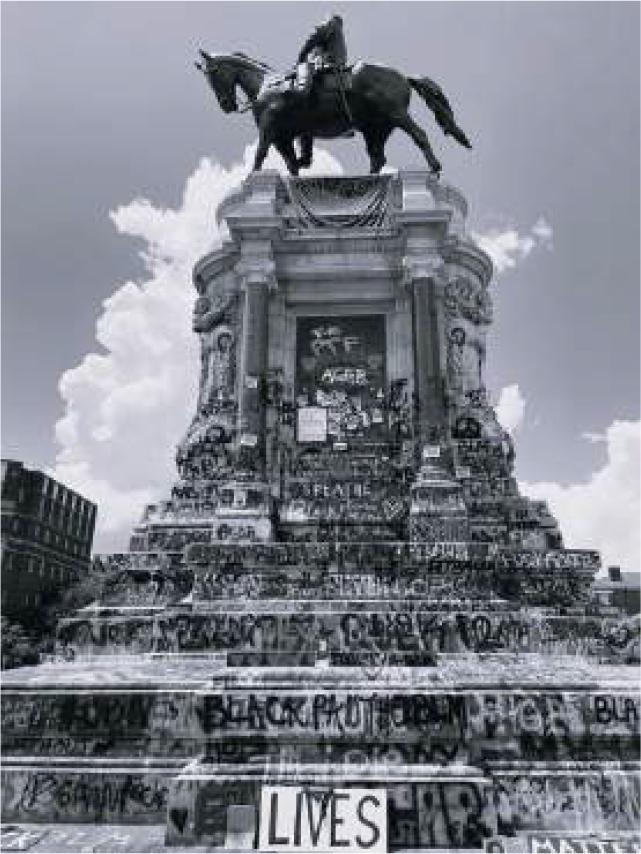
Figure 1 Robert E. Lee monument in Richmond, Virginia, United States, July 1, 2020, following the protests over the murder of George Floyd. Photo: Mk17b, Wikipedia. CC BY-SA 4.0.
The rituals and celebrations around Confederate monuments persist in many cities and states[12], making these statues focal points for mobilizing support for white supremacy and social inequality. This movement gained momentum in the 1890s with the formation of the United Daughters of the Confederacy. They used new pretexts for military heroism, particularly during World War I, leading to the erection of about 20 monuments annually. Between 1910 and 1920, 205 statues were unveiled, followed by 75 in the 1920s, 76 in the 1930s, and around 34 new statues in the 1950s and 1960s (Cox, 2021; Brown, 2019).
Meanwhile, the U.S.A. were simultaneously experiencing extreme eruptions of violence, multiple racially motivated massacres - the Elaine Massacre, Arkansas, which took place during Red Summer[13] in September 1919 (Lancaster, 2018; Krugler, 2015), the Ocoee Massacre, Florida, in November 1920[14], or the Tulsa Massacre, Oklahoma, in June 1921 (Ellsworth, 2021; Madigan, 2001), among many others, by individual and collective lynchings, by the unpunished and protected actions of the Ku Klux Klan, and by the reinstatement of racial segregation mechanisms through state legislative action - the Jim Crow laws - and successive confirmations by U.S. state and federal courts.
Within this context, monuments built in public spaces have historically served as mechanisms for perpetuating segregationist values and symbols of cultural, social, and political violence against African Americans, despite the principle of “separate but equal” being later declared unconstitutional. The African American community has long denounced the systematic construction of these memorials and monuments as part of the white supremacist movement. Following World War II and during the Korean War, racial tensions in the U.S., particularly in the South, intensified, and the civil rights movement condemned the symbolic violence of these memorials, often accompanied by the Confederate flag, used as an intimidation tool (Cox, 2021, p. 91; Talbert & Patterson, 2020; Emert, 2015).
Throughout the 20th and into the 21st century, a narrative exposing the symbolic violence of Confederate flags and monuments has gained prominence, demanding their removal from public spaces (Brown, 2019, p. 288). This movement has been paralleled by the recognition and commemoration of other heroes in U.S. history, promoting a more inclusive narrative. President Joseph Biden’s decision to dedicate a monument in Washington D.C. to Emmett Till and his mother Mamie Till-Mobley reinforced this shift by acknowledging the human tragedy of civil rights struggle victims.[15] This act transformed past victims into national heroes with a collective symbolic dimension.[16]
This evolution has paralleled increased access and participation of African American communities in social dynamics, particularly in government roles at municipal, state, and federal levels. This social transformation has gained visibility with the development of movements such as Black Power and Black Arts (Smethurst, 2021) and the explosive growth of the #BlackLivesMatter movement (Figure 2) (Lebron, 2017).
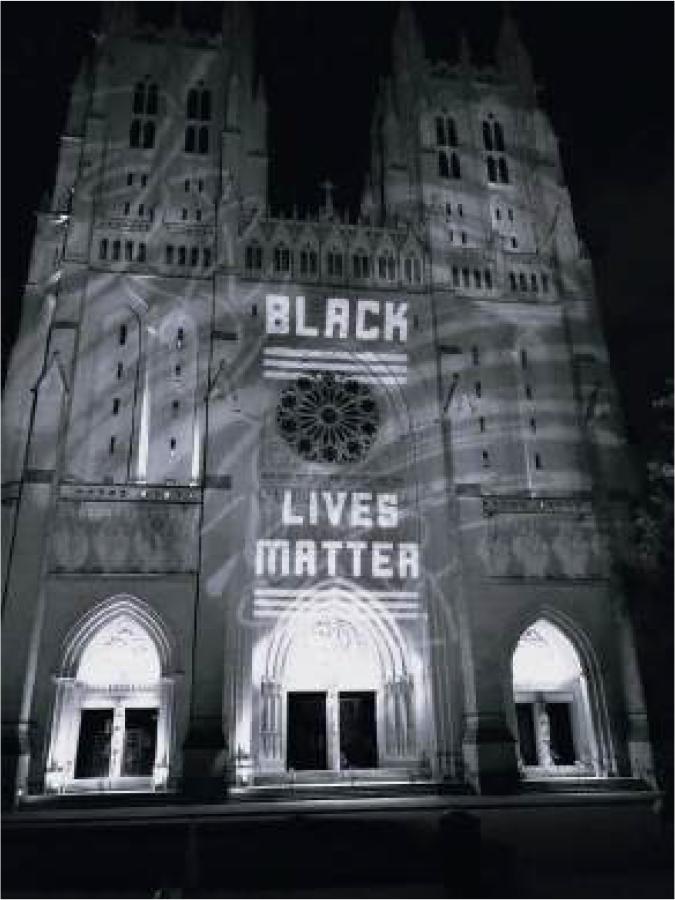
Figure 2 Projection on the main façade of the National Cathedral in Washington D.C., United States, June 10, 2020. Photo: Cosal, Wikipedia. CC BY-SA 4.0.
The long process of recognising the symbolic violence perpetuated by Confederate monuments and flags, alongside the public affirmation of a more inclusive historical narrative, reflects a significant shift in U.S. society. This shift is embodied in the removal of these symbols from public spaces and the heritagisation of civil rights heroes, showcasing a more comprehensive and equitable understanding of history.
3. Updates From an Expanding and Evolving Global Movement
Over the last decade, we have seen a growing and generalised demand for the removal of many of these monuments, but also movements to the contrary.[17] However, the massacre at Emanuel African Methodist Episcopal Church in Charleston, South Carolina, on June 17, 2015 (Gates, 2021, p. 182; Brown, 2019, p. 291), further exacerbated the idea of an ongoing culture war and reinforced the need to remove the symbols of violence and appeal to racist and supremacist ideals that persisted in the monumental landscape of the South.
The Confederate flag was formally removed from public spaces in South Carolina in July 2015, and other states have already gone ahead with the same process. The removal of statues was given new impetus with the effective dismantling and removal of the monuments dedicated to General Robert E. Lee in New Orleans, Louisiana (2017) (Brown, 2019, p. 292), the founder of the Ku Klux Klan, Nathan Bedford Forrest (1821-1877), in Memphis, Tennessee (2017)[18], and the one dedicated to Thomas Jonathan “Stonewall” Jackson and Robert E. Lee, in Baltimore, Maryland (2017), while the statue of Robert E. Lee, in Richmond, Virginia, is currently awaiting the conclusion of a court case in order to eventually remove it (Cox, 2021).
Meanwhile, on July 9, 2021, following a decision by the Virginia State Supreme Court (Hannon, 2021), the city of Charlottesville, Virginia, announced the start of the process to remove the equestrian statues of Robert E. Lee (1924)[19], located in Market Street Park, and “Stonewall” Jackson (1921), in Court Square Park.[20]
The complex historical context that frames the nature of all these monuments and memorials together with the successive decisions we have been describing, many obtained in the courts, allows us to assert that processes such as “questioning historical narratives and their supporting infrastructure” (Rivas, 2017), “derecognizing past honours” (Gusejnova, 2020), “decolonisation in public space” (Abraham, 2021), and “toppling monuments in public spaces” (Frank & Ristic, 2020) have collectively evolved into a pantheon of acts of “historical redemption” (Acaroglu, 2020). And by doing so, those actions have seemingly reinstated a long-sought vision of justice and republican ethics, countering the rejections of such ideals by previous generations.
3.1. Protesting, Vandalising, and Beheading
Postmodern fragmentation reveals the necessity for many communities to negotiate their histories and protagonists. A mimetic and accelerated phenomenon against monuments has spread globally, manifesting around diverse circumstances and demands. The paralysis of public authorities and cultural institutions’ inability to foster community debate have led to protests and vandalism across Europe, driven by globalised movements reacting to local tensions. Examples from the United Kingdom (2020), Belgium (2020), Portugal (2020, 2021, 2023), and Canada (2020, 2021) highlight these dynamic processes and the institutional voids allowing agile and ideologically motivated actors to take action.
Following a #BlackLivesMatter demonstration, the statue of Edward Colston (1636-1721), a merchant and slave trader, was toppled in Bristol, United Kingdom, on June 7, 2020, and thrown into the River Avon (Figure 3). The statue has been retrieved and is now displayed at the M Shed Museum (Cole, 2023).[21] This exhibition serves as a catalyst for community discussions about the future of both the statue and its pedestal at The Centre in Bristol (Welch, 2021).

Figure 3 Empty plinth of the Edward Colston statue, Bristol, United Kingdom, June 7, 2020. Photo: Caitlin Hobs, Wikipedia. CC BY 3.0.
On June 9, 2020, the statue of slaver Robert Milligan (1746-1809) outside the Museum of London Docklands was removed (Figure 4). That same day in Antwerp, Belgium, a statue of King Leopold II (1835-1909) was removed from its pedestal and placed in the Musée Middelheim after being painted over and set on fire the previous week.[22] There were also vandalism incidents against other statues of Leopold II in Ghent and Auderghem (Casert, 2020).
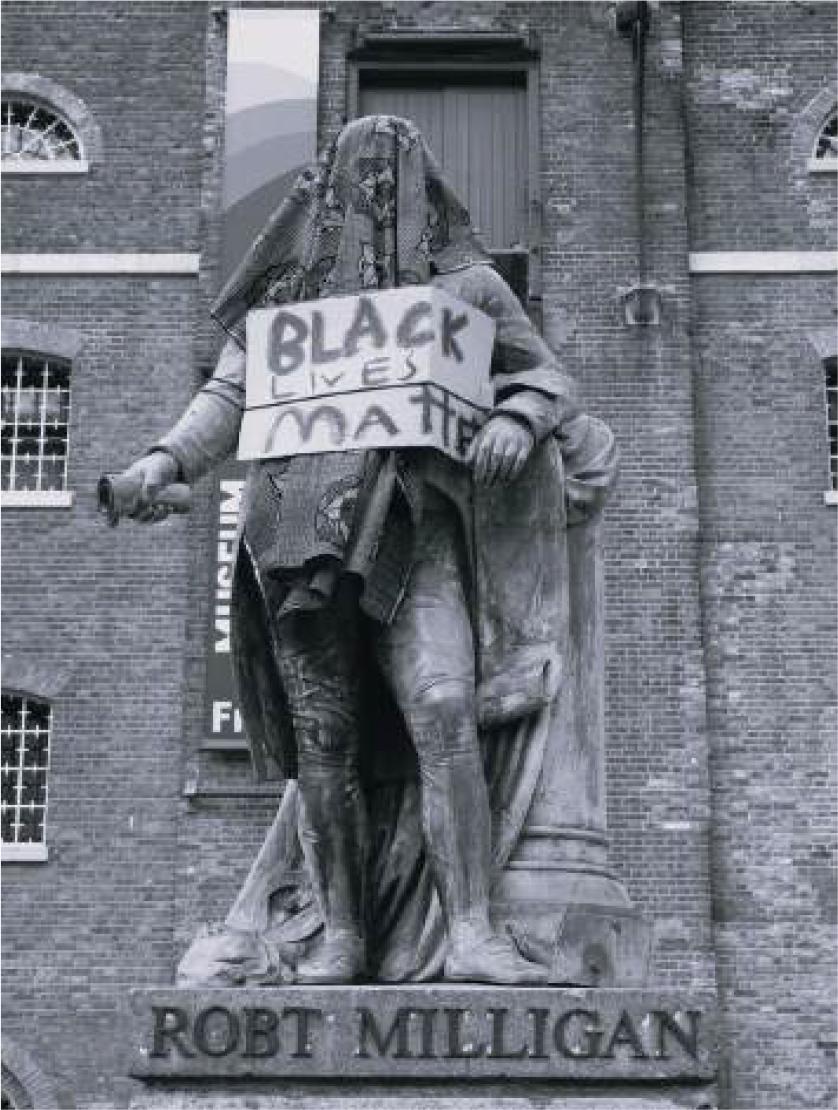
Photo: Chris McKenna, Wikipedia. CC BY-SA 4.0.
Figure 4 Robert Milligan, holding a sign with the inscription “Black Lives Matter”, Museum of London Docklands, London, United Kingdom, June 9, 2020.
In Portugal, in February 2020, in the city of Porto, several sculptures were dyed blue (Rocha, 2020) and, in Lisbon, on June11, 2020, the statue dedicated to writer and priest António Vieira (1608-1697) was painted red with the word “Descoloniza” [Decolonise] (Moreira, 2020). In Coimbra, a bust dedicated to Robert Baden-Powell (1857-1941) was beheaded on June20, 2020.[23] Also in Coimbra, in September 2020, the statue dedicated “Aos Heróis do Ultramar” [To The Heroes of Overseas Territories] was painted red at its base, with the word “Heroes” crossed out and replaced with the word “Assassinos” [Assassins]. The words “Fachos da m****” [Fu***** fascists] were written on one of the sides of the plinth of the same statue (Torres, 2020). And in the city of Braga, the statue dedicated to the priest Eduardo Melo (1927-2008), a figure associated with the Salazar dictatorship, has been graffitied in red with the words “assassin” [murderer], “Abril” [April] and “facho” [fascist] (Machado, 2020).
In the summer of 2021, the Padrão dos Descobrimentos [Monument to the Discoveries] located in Belém, Lisbon, was vandalised and the following phrase was inscribed on the stone in red and blue paint: “Blindly sailing for monney [sic], humanity is drowning in a scarllet [sic] sea lia [sic]’. The Monument to the Discoveries, built during the 1940 Exhibition of the Portuguese World amid a fascist dictatorship, commemorates the heroes and the era of Portuguese expansion that began in the 15th century. In February 2021, the Portuguese Parliament deputy Ascenso Simões (b. 1963) had suggested the monument’s destruction (Dinis, 2021), while the deputy Joacine Katar Moreira (b. 1982) posted an image on social media of the monument taking off from Earth “in rocket mode” (Figure 5).[24]
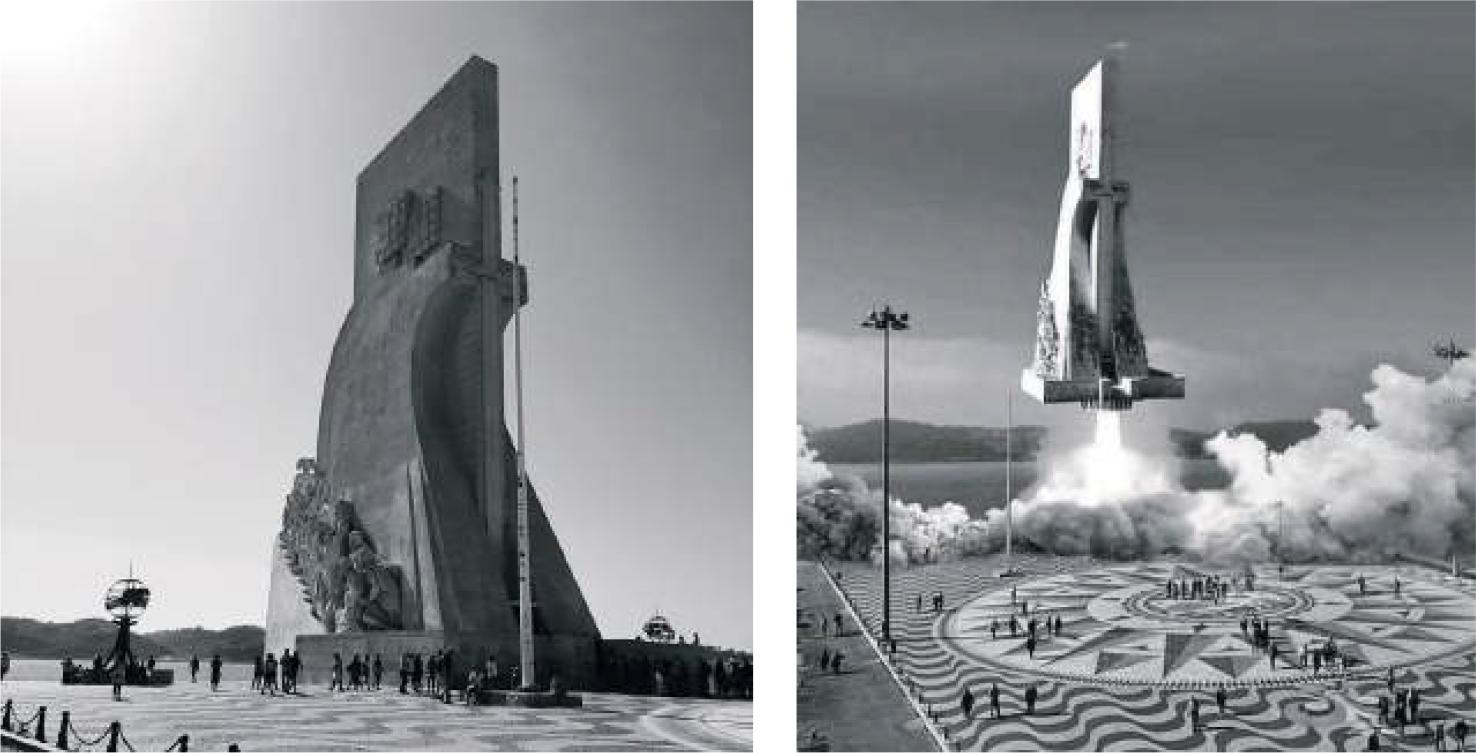
Figure 5 The Monument to the Discoveries, in Belém, Lisbon, Portugal. Photo: Carlos Vargas, October 8, 2023. (left) The Monument to the Discoveries in a creative interpretation in “rocket mode”. Photo: unidentified author, 2021. (right)
Still in Portugal, a statue dedicated to Santo António de Lisboa [St Anthony of Lisbon] by Esperança Matos, inaugurated in the neighbourhood of the same name in the city of Torres Novas on July 8, 2023, was beheaded in August 2023 during the “Jornadas Mundiais da Juventude” [The World Youth Days] in Lisbon, which were attended by Pope Francis (b. 1936). On the ground next to the pedestal, posters were found with the expressions “Deus está morto” [God is dead] and “seus pedófilos” [you paedophiles].[25]
In Canada, on June 6, 2021, the statue of Methodist pastor Egerton Ryerson (1803-1882) at Ryerson University in Toronto was pulled down and beheaded. Ryerson had designed Canada’s public education network, including schools for assimilating children from Canada’s Amerindian nations from the 1840s onwards.[26] On July 1, 2021, during National Day, protestors toppled statues of Queen Victoria (1819-1901) and Queen Elizabeth II (1926-2022) in the gardens of the Legislative Building in Winnipeg, Manitoba (Cecco, 2021), protesting the historical treatment of Indigenous children in public schools.[27]
Additionally, in Canada, a controversy arose over the statue of Portuguese navigator Gaspar Corte-Real (c.1450-1501), gifted by the Portuguese government in 1965 and located near the Confederation Building in St John’s, Newfoundland and Labrador. This highlights once again the ongoing re-evaluation of historical figures and their legacies within public spaces (Hawthorn, 2020).
These social movements, with their varied motivations and contexts, share a passionate desire to restore justice, often operating on the margins of institutions. They respond urgently to political, religious, social, and cultural tensions, identifying memorials and monuments as symbols of historical aggressions to abolish and repair, thereby paradoxically legitimising violence against these symbols. A lack of discussion has often legitimised acts of vandalism and violence against monuments, which historically have preceded violence against individuals.
In this context, new instruments and renewed cultural and political commitments are needed to build governance models that address white fear and fragility (DiAngelo, 2018) and concerns about cancel culture (Donnelly, 2021). These models should also channel and frame the justice-focused message of the woke movement (Bunyasi & Smith, 2019; Murray, 2021), the historical dimension of Critical Race Theory (Peller, 1995), and its radically egalitarian discourse, which is expanding in a postmodern world (Lee, 1995).
3.2. Fostering collaborative, participatory, and community-driven approaches
The possibility of developing collaborative and participatory projects around the discussion of the community’s collective memory, involving not only leading cultural institutions but also associative and community movements, brings together a number of experiences and good practices, particularly in the United States.
The American Museum of Natural History announced on June 24, 2021, its plan to remove the equestrian statue of Theodore Roosevelt (1858-1919), the 26th President of the United States (1901-1909), by sculptor James Earle Fraser (1876-1953), inaugurated on October 27, 1940, located outside the museum’s west entrance in Central Park, New York (Figure 6). The museum justified its decision on the grounds that the statue perpetuates a racist vision of American society, a vision considered incompatible with the values of equality and justice, against racism.[28]
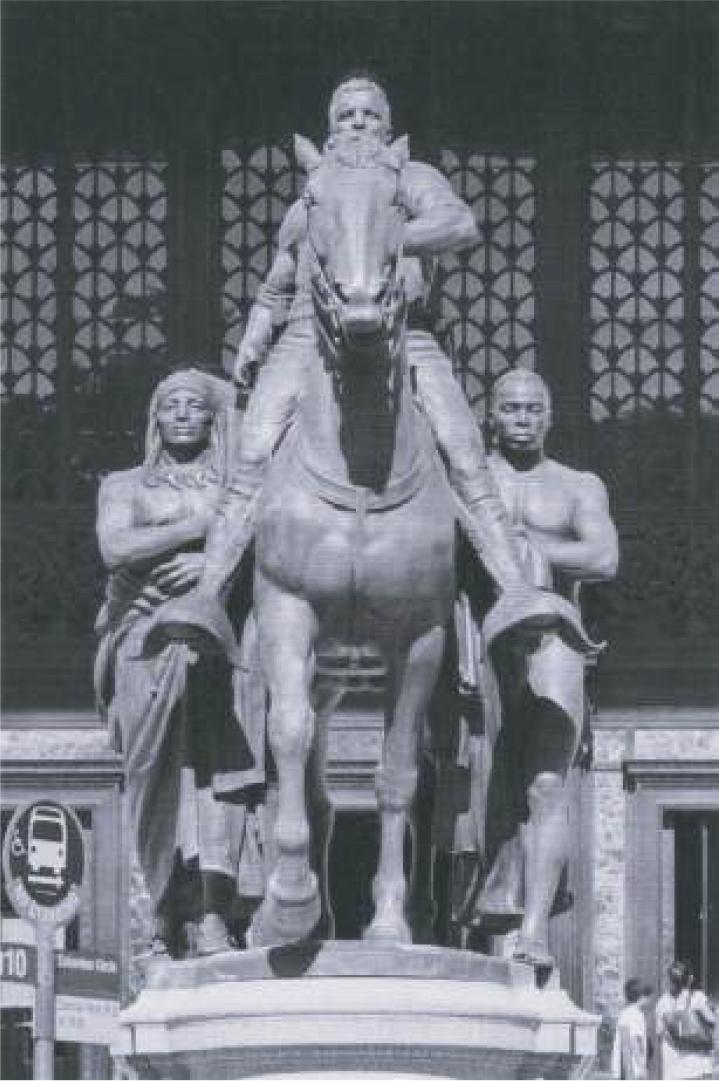
Figure 6 The equestrian statue of Theodore Roosevelt located at the west entrance to the American Museum of Natural History, in Central Park, New York, United States. Postcard, PostcardsAndMore. Private collection, Lisbon.
However, this was not a unanimous view in American society. In fact, as recently as June 2021, the National Review was reflecting on the removal of the Roosevelt statue, and these different views reveal, once again, the very deep divide that exists in the United States when it comes to reading its country’s history:
Citizens, young and old, would admire their former president, flawed as he may have been, acknowledging the complex, often contradictory, views he held in office and throughout his life, while celebrating the statue’s august, progressive depiction of Native Americans and Africans. (Loftus, 2020)
On that occasion, Theodore Roosevelt’s family published a statement in which they supported the decision.[29] As part of an effort to contextualise the debate and make it accessible to the public, the American Museum of Natural History presented the “Addressing the Statue” exhibition to the public between July 2019 and January 2022:
To understand the statue, we must recognize our country’s enduring legacy of racial discrimination - as well as Roosevelt’s troubling views on race. We must also acknowledge the Museum’s own imperfect history. Such an effort does not excuse the past but it can create a foundation for honest, respectful, open dialogue. We hope this exhibition, together with other efforts to address cultural representation at the Museum, will inspire such discussion.[30]
Another transformative example seeks to turn traumas into positive values by de-emphasizing destruction in favour of the transformative possibilities that the decision to melt down an equestrian statue entailed. The Robert E. Lee statue, which had been removed from Market Street Park, Charlottesville, Virginia, was transported to a foundry and melted down in October 2023, by decision of the Black History Museum of Charlottesville (Schmidt, 2021).
Under the “Swords Into Plowshares Project”, presented by The Jefferson School African American Heritage Center to the Charlottesville City Council in October 2021, the bronze resulting from the casting of the statue will in future be used to make a new piece of public art.[31] In that proposal, the various signatory organisations rejected the idea of destruction, stressing the opportunity to “transform trauma into healing and renewal through art”.[32]
Fostering collaborative, participatory, and community-driven approaches to representing heritage, memory, and monuments in public spaces creates inclusive historical narratives. Involving diverse community members in decision-making ensures multiple perspectives are honoured, reflecting a comprehensive collective memory. This inclusive approach promotes ownership, connection, and ongoing dialogue, addressing historical injustices and power imbalances, making public spaces more equitable and representative of the community’s cultural and historical diversity.
Conclusion
From 2020 to 2023, social unrest and urban violence surged in Western countries due to complex socioeconomic, political, and cultural factors. Monuments in urban spaces became focal points for these tensions, symbolising power dynamics and collective memories. Social movements and marginalised communities increasingly challenged certain monuments, viewing them as symbols of oppression and historical injustices. In response, local organisations and grassroots initiatives sought to transform public spaces through murals, temporary installations, and other community-driven projects to create more inclusive urban landscapes.
Protests and demonstrations highlighted monuments as contested sites of memory, where competing visions of history, identity, and social justice play out. Ignoring their political dimensions overlooks their significance in the socio-spatial dynamics of contemporary cities. Urban protests and politically motivated vandalism challenge established narratives and power structures represented by monuments, emphasising their role in shaping social and political dynamics.
Cultural heritage and its visual representation in public spaces remain crucial for policymakers, urban planners, and community stakeholders. In the United States, associative movements often involve the removal of monuments and frequently resort to the courts to mediate debates between communities. This contrasts with European social movements, often associated with political vandalism and less organised political struggle.
Cultural institutions play a key role in framing public debate. The National Museum of Natural History in New York has been proactive, unlike cultural organisations in Bristol, United Kingdom, which failed to pre-emptively promote debate around Edward Colston. Conversely, the Padrão dos Descobrimentos in Lisbon, Portugal, has addressed colonialism, racism, and post-colonialism through cultural programming, despite being targeted by political vandalism.
Recognising the complex path ahead, communities must engage in continuous dialogue to better understand each other’s histories and perspectives. Constructive dialogue, policy reforms, and collaborative approaches are essential to addressing social unrest and urban violence, while acknowledging the pivotal role monuments and memorials play in shaping collective memory, cultural identity, and power dynamics in the urban realm.

