SciELO - Scientific Electronic Library Online

 
 número21O Poder dos Monumentos: Da Agitação Social à Violência Urbana (2020-2023)Cidades Criativas nas Regiões Periféricas da UE: Do Empreendedorismo Cultural às Políticas Culturais índice de autoresíndice de assuntosPesquisa de artigos
Home Pagelista alfabética de periódicos  

Serviços Personalizados

Journal

Artigo

Indicadores

Links relacionados

  • Não possue artigos similaresSimilares em SciELO

Compartilhar


Political Observer

versão impressa ISSN 2795-4757versão On-line ISSN 2795-4765

Political Observer  no.21 Lisboa jun. 2024  Epub 30-Set-2024

https://doi.org/10.59071/2795-4765.rpcp2024.21/pp.109-117 

Articles

The “Great Municipalities to Live” Project: Measuring and Ranking Quality of Life in Portuguese Municipalities

O Projeto "Grandes Municípios para Viver": Medição e Classificação da Qualidade de Vida nos Municípios Portugueses

Miguel Pereira Lopes1 

MIGUEL PEREIRA LOPES is an Associate Professor with Aggregation at the School of Social and Political Sciences of the University of Lisbon. He is currently a member of the School Council at the same institution. In the past, he was President of the Center for Administration and Public Policies (CAPP) at the University of Lisbon He was also the Portuguese National Representative at EURAM - European Academy of Management. He is a member of the Scientific Board of the IMSErt Center of Excellence, at the Nicolaus Copernicus University, in Poland.


http://orcid.org/0000-0002-7720-8657

Patrícia Jardim Da Palma2 

PATRICIA JARDIM DA PALMA is an Associate Professor with Aggregation at the School of Social and Political Sciences of the University of Lisbon. Patricia was the coordinator of the PhD program in Development Policies of Human Resources and she is the author of several scientific papers published in international journals and technical books about entrepreneurship. Patricia is currently the Coordinator of the School of Leadership and Innovation, which has organized diverse projects of entrepreneurship and training in several Municipalities.


http://orcid.org/0000-0003-0759-5011

Susana Dias3 

SUSANA DIAS is a PhD student in Sociology at ISCTE, supported by a doctoral scholarship from FCT in partnership with INTEC - Institute of Behavioral Technology and HEI-Lab: Digital Human-environment Interaction Lab. She holds a master’s degree in Business Economics and Competition from ISCTE Business School. Her research focuses on quality of life, well-being, migration, and labor dynamics.


http://orcid.org/0000-0001-9547-1785

Luís Aguiar4 

LUíS AGUIAR holds a bachelor’s degree in psychology from the University of Azores and a Post-Graduate diploma in Social and Organizational Psychology from ISPA. Currently pursuing studies in Data Analysis in Social Sciences at ISCTE. Luís has over two years of experience working with INTEC where his work involves data analysis, report creation, and contributing to the management of various projects within the organization.


http://orcid.org/0000-0003-1483-0470

1University of Lisbon, Portugal;

2University of Lisbon, Portugal;

3INTEC - Instituto de Tecnologia Comportamental, Portugal;

4INTEC - Instituto de Tecnologia Comportamental, Portugal;


Abstract

The “Great Municipalities to Live” project, developed by INTEC since 2008, aims to measure and rank the quality of life in Portuguese municipalities. While international comparisons of quality of life do exist, this initiative focuses on the local level, where public policies impact citizens’ lives more directly. The project combines both subjective and objective indicators, addressing aspects such as health services, education, housing, and employment. The framework includes 10 domains of quality of life, such as environment, economy, health, culture, and security, among others. Objective data is sourced

from public databases such as INE (Instituto Nacional de Estatística), while subjective data is collected through large-scale national surveys, with over 4,000 participants in the 2022 edition.

The 2022 results identified key predictors of well-being: satisfaction with professional life, purchasing power relative to the cost of living, and housing quality. These findings are particularly relevant in the context of Portugal’s current economic challenges, including high inflation and a significant rise in housing prices. Job satisfaction emerged as the most predictive factor, highlighting the need for public policies that address employment conditions and economic stability. This study emphasizes the importance of material and financial factors in shaping citizens’ perceptions of well-being, suggesting targeted actions to improve living conditions and support sustainable local development.

Keywords: quality of life; local governance; well-being indicators; portuguese municipalities.

Resumo

O projeto “Melhores Municípios Para Viver”, desenvolvido pelo INTEC desde 2008, tem como objetivo medir e classificar a qualidade de vida nos municípios portugueses. Embora existam comparações internacionais sobre a qualidade de vida, esta iniciativa foca-se no nível local, onde as políticas públicas influenciam diretamente a vida dos cidadãos. O projeto combina indicadores subjetivos e objetivos, abordando aspetos como serviços de saúde, educação, habitação e emprego, entre outros. A estrutura inclui 10 domínios da qualidade de vida. Os dados objetivos são recolhidos de bases de dados públicas como o INE (Instituto Nacional de Estatística), enquanto os dados subjetivos são obtidos através de inquéritos nacionais de grande escala, com mais de 4.000 participantes na edição de 2022.

Os resultados de 2022 identificaram como sendo os principais preditores de bem-estar: satisfação com a vida profissional, poder de compra face ao custo de vida e qualidade da habitação. Estes resultados são especialmente relevantes no contexto dos atuais desafios económicos de Portugal, incluindo a alta inflação e o aumento significativo dos preços das habitações. A satisfação profissional emergiu como o fator mais preditivo, reforçando a necessidade de políticas públicas que abordem as condições de trabalho e a estabilidade económica. Este estudo destaca a importância dos fatores materiais e financeiros na perceção do bem-estar dos cidadãos, sugerindo ações direcionadas para melhorar as condições de vida e apoiar o desenvolvimento local sustentável.

Palavras-chave: qualidade de vida; governança local; indicadores de bem-estar; municípios portugueses.

1. Introduction

What makes a place a good place to live? This was the main question that drove the creation of the “great municipalities to live in Portugal” initiative. Since 2008, INTEC, the behavioral technology institute, has been measuring quality of life at the municipal level. There are several international measures of quality of

life that compare different countries. However much of the public policies and public government that impacts citizens life is done at the local level. As such, it becomes relevant to have a framework to measure and compare the quality of life in different municipalities.

Measuring quality of life at the local level brings relevant information for social political and economic actors and ultimately for society in general. citizens can become aware of the features of different places to live and work and make more informed choices about their lives. Local government authorities are provided with a blueprint of indicators that can evaluate the progress of their government and provide the accountability about their action. economic agents can guide their investments.

In the following pages we will describe the great municipalities to live in Portugal initiative and present the real results of a past edition of this initiative. We first present the theoretical and conceptual roots of our framework and methodology to measure quality of life at the local level, including the 10 domains of our quality-of-life assessment. We then provide examples of specific indicators for each of the quality-of-life domains. We finish with a presentation of the main results of the quality-of-life assessment for a sample of Portuguese municipalities.

2. A framework for assessing quality of life at the municipal level

Before outlining a framework to measure quality of life one needs first to define what quality of life is. For some quality of life is in the eye of the beholder. This means that ultimately quality of life is a subjective matter and can only be assessed by asking citizens to provide their opinion about their lives. this is the case of the European survey on quality of life that is run each few years by the European foundation for the improvement of living and working conditions (EUROFOUND).

However, some authors have questions whether there should also be considered the more objective perspective of quality of life sometimes also named living conditions. For instance, the objective availability of cultural facilities medical treatment or educational establishments are also relevant indicators about the quality of life of a place even if quality of life is ultimately how citizens feel about their lives. Objective and infrastructure indicators of quality of life are also of particular importance if one wants to assess quality of life for public policy purposes since it can guide local government investments.

Since both subjective and objective issues are relevant in defining and measuring quality of life at the municipal level the framework developed by INTEC for the great municipalities to live initiative considers both types of indicators. For example, we consider both the number of doctors per 1000 inhabitants in each municipality and the subjective evaluation of those citizens regarding the availability and quality of health services. We consider both the number of students per teacher as well as the quality of the learning system according to citizens evaluations.

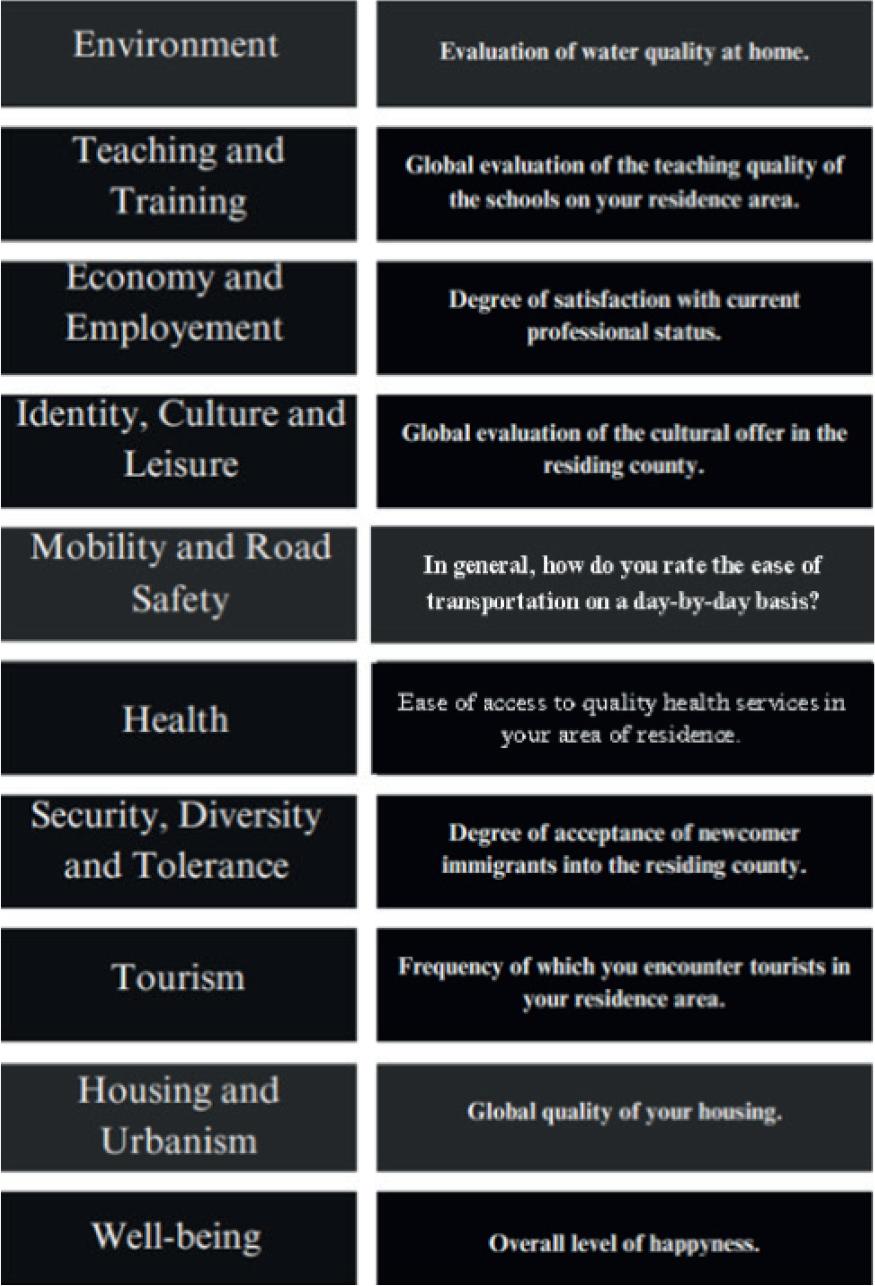
Based on the previous work of international institutions such as the European foundation for the improvement of living and working conditions and the OECD, our framework considers 10 quality of life domains, namely: environment, economy and jobs, education and training, culture and leisure, mobility, health, security, urbanism and housing, end well-being (Figure 1). For each of these domains we collect and measure a series of indicators. Objective indicators are collected from public institutions databases whereas subjective indicators are collected from a big national telephone questionnaire survey that inquires about 4000 citizens (3961 inquired people in the 2022 edition). Examples of objective indicators for each of the dimensions are presented in Table 2. Examples of subjective questionnaire indicators are presented in Table 3.
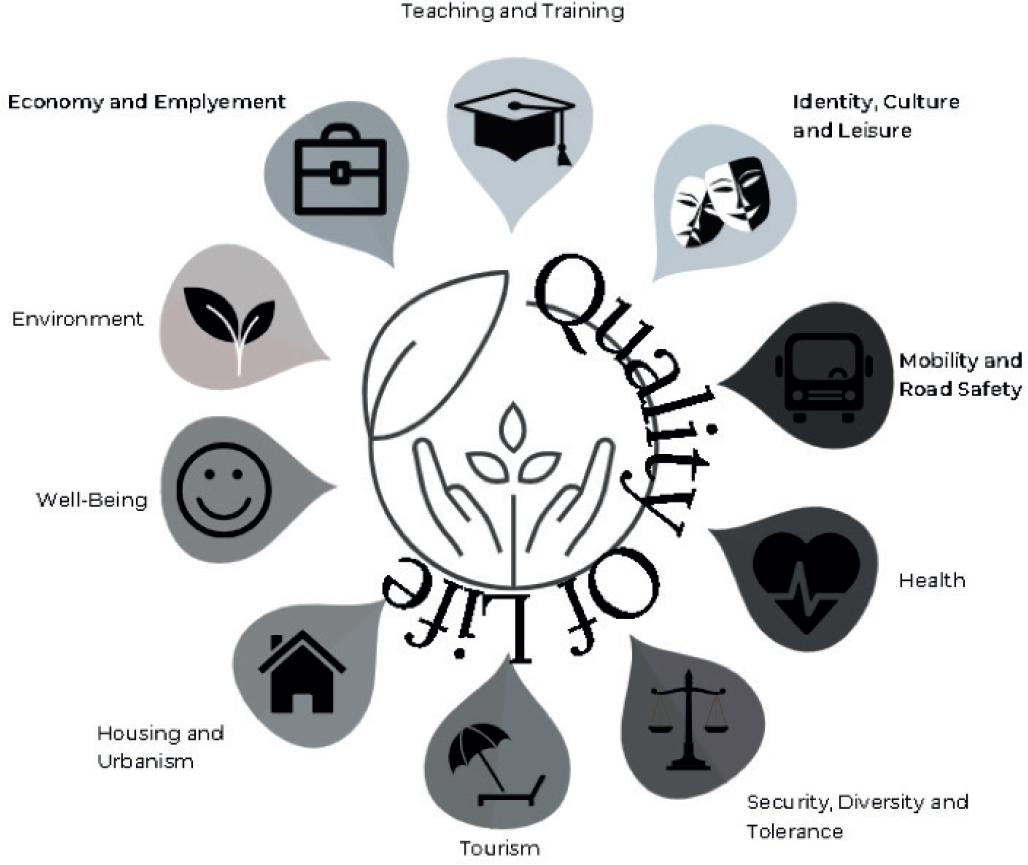
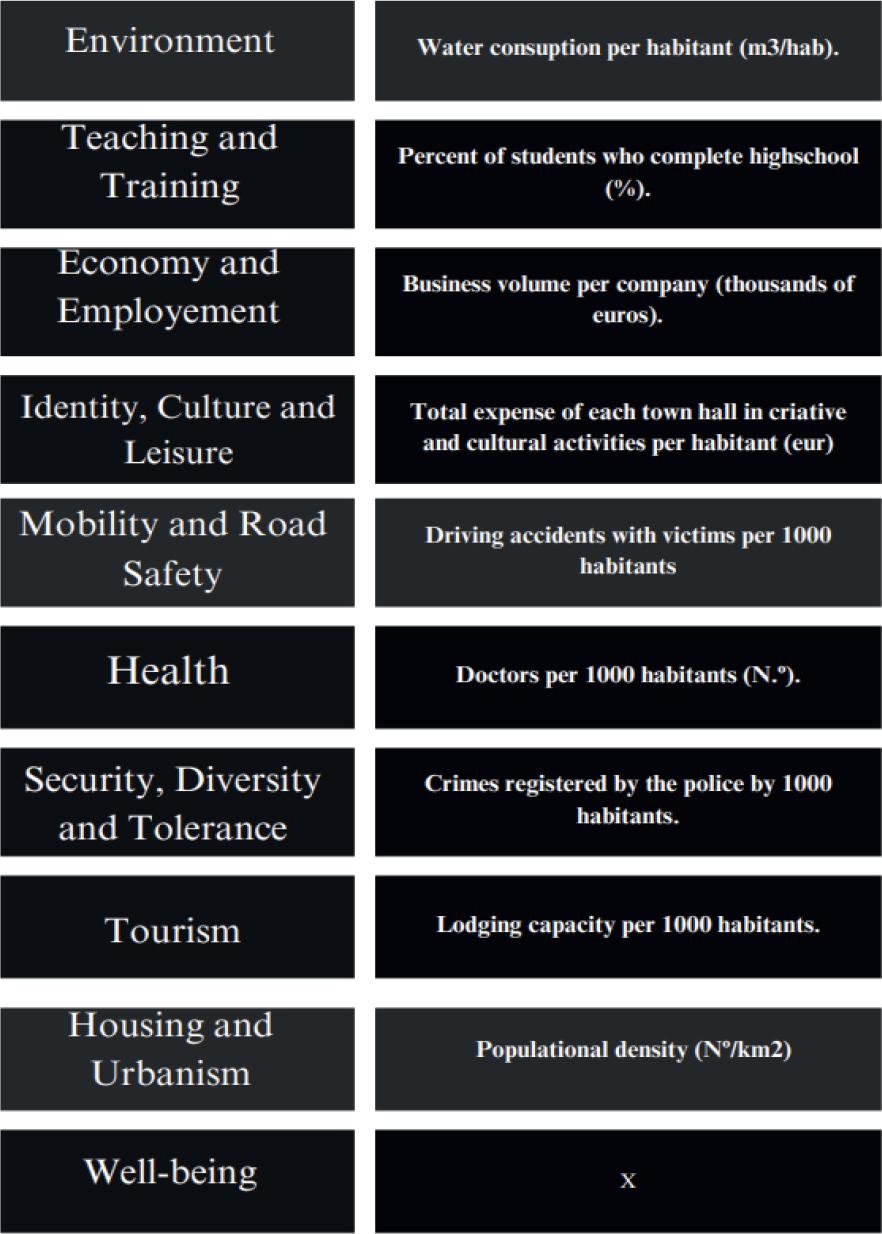
Figure 1 The 10 Dimensions of Quality of Life 

Figure 2 Examples of Objective Indicators 

Figure 3 Examples of Subjective Indicators 

3. The quality of life in Portuguese municipalities in 2022: A snapshot

In this last section, we present a snapshot of the main features of quality of life in Portugal from the data of the 2022 edition.

During this study, we aimed to identify the indicators which are most predictive of well-being in each dimension studied, i.e., to identify which indicators have the greatest influence on the well-being perceived by the public in general.

Based on the results of this study conducted by INTEC in the context of “The Great Municipalities to Live in Portugal 2022”, which surveyed 4053 Portuguese, revealed the following indicators as the most predictive of well-being: (i) Satisfaction with the professional situation is the factor that most explains the well-being of the Portuguese; (ii) The evaluation of the purchasing power in relation to the cost of living is the second factor that best explains the well-being of the Portuguese; (iii) The evaluation of the quality of housing is the third best factor that explains the well-being of the Portuguese. The most predictive items of each dimension are shown in Figure 4.
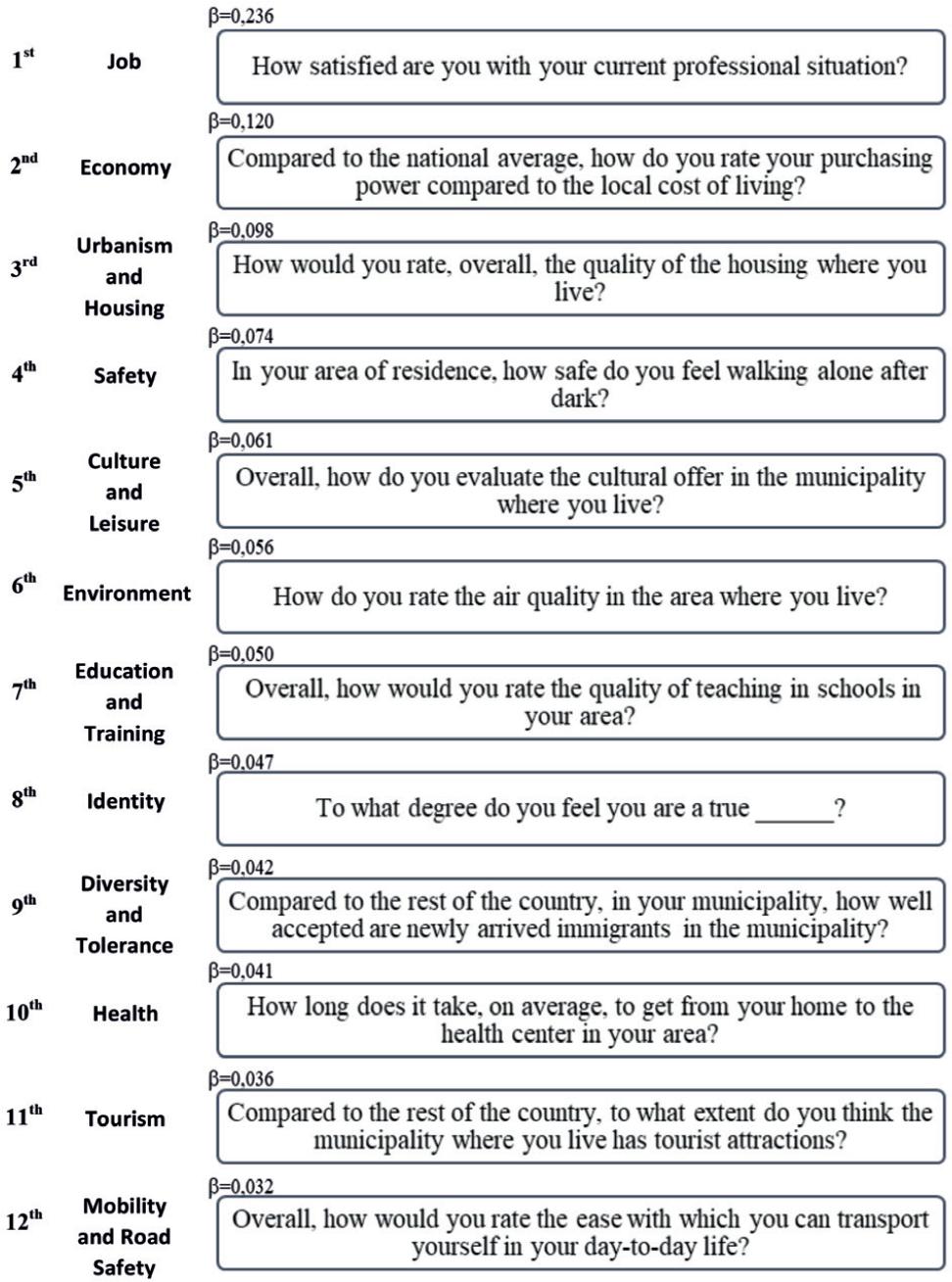
Model explained in 35%

Figure 4 Well-being predictive items of each dimension 

The results of the indicators that have the greatest influence on well-being are particularly interesting considering the current Portuguese economic situation, which is experiencing the highest inflation rate in the last 30 years (Banco de Portugal, 2022; PORDATA, 2022a), as well as the high valuation of homes in Portugal, which have increased by 70% over the past 12 years (Eurostat, 2022). Considering that job satisfaction is one of the most predictive measures of well-being in Portugal, and there are no official Portuguese statistics on this indicator, it is of vital importance to measure and monitor it as a tool for public measures and policies designed to enhance citizen’s well-being. It is interesting to note that the financial and material factors play a significant role in determining respondents’ perception of well-being. According to data produced by the National Institute of Statistics (Instituto Nacional de Estatística [INE], 2022), Portugal’s Wellbeing Index decreased in 2020 and 2021, with material living conditions being the most affected (PORDATA, 2022a). In addition, data from the Organization for Economic Cooperation and Development (OECD) shows that the average rating of general satisfaction with life made by Portuguese citizens is 6.7, lower than the average rating of the OECD, which is 7.4. (OECD, 2020).

These results allow us to reflect on the question: “What can increase the well-being of the Portuguese at the present time?”. The data answers: (i) Professional fulfilment; (ii) Greater purchasing power and lower inflation; (iii) Better and affordable housing.

References

Banco de Portugal. (2022). Séries estatísticas: Índice de preços no consumidor. https://bpstat.bportugal.pt/dados/series?mode=graphic&svid=tE1XAAAAAAA.zk1XAAAAAAA.!ll!B!C!10!!!False!24!:1ho57r:LUV7m4jVqql7KmOlsbYaFDRxYQE&series=5721524,5721550Links ]

Eurostat. (2022). Rents up by 17%, house prices by 45% since 2010. https://ec.europa.eu/eurostat/web/products-eurostat-news/-/ddn-20220708-1Links ]

OECD. (2020). “How’s Life in Portugal?” In How’s Life? 2020: Measuring Well-being. OECD Publishing, Paris. https://doi.org/10.1787/6574492c-enLinks ]

PORDATA. Índice de bem-estar. https://www.pordata.pt/portugal/indice+de+bem+estar-2578PORDATA. [ Links ]

PORDATA. (2022). Taxa de inflação. https://www.pordata.pt/portugal/taxa+de+inflacao+(taxa+de+variacao+do+indice+de+precos+no+consumidor)+total+e+por+consumo+individual+por+objetivo-2315Links ]

Received: July 15, 2024; Accepted: September 05, 2024

Creative Commons License This is an article published in open access under a Creative Commons license.