




 Inglês (pdf)
 Artigo em XML
 Referências do artigo
 Tradução automática
 Enviar este artigo por email
 Citado por SciELO
  Similares em
SciELO
Similares em
SciELO 
 Permalink

Introduction
Social media platforms have significantly reshaped political discourse and democratic participation. Facebook is a platform that people broadly use to engage with political content, connect with other users, and navigate intricate networks of information during election campaigns (M. Alodat, Al-Qora’n, & Hamoud, 2023). As political actors and parties increasingly utilize social media to engage with voters and shape political narratives, it is essential to understand how Facebook influences public opinion to enhance decision-making, democratic accountability, and civic engagement.
This study addresses existing literature gaps by providing empirical insights into the dynamics of political communication and public opinion formation within the Bangladeshi context. This research explores Facebook’s impact on political discourse, focusing on its connections to democracy and citizen engagement in the digital age. Using a multidimensional mixed-method approach that includes quantitative and qualitative analyses, this study examines how political actors utilize Facebook, their content and messaging strategies, the demographic factors that affect user engagement, and the broader implications for democratic governance.
(Heatherly, Lu, & Lee, 2016) states that many Facebook users regularly obtain their news from the Facebook Feed. Furthermore, according to Khan (2017) People use social media mainly to receive news and interact with friends. Sharing and commenting on news articles are popular activities on Facebook (Lee & Ma, 2016). This has made it possible for news organizations to share their content on digital platforms like Facebook in several ways Napoli (2015), including live broadcasts, straight content uploads to social media (like news posts on Facebook), and brief, enticing hyperlinks from their websites to their Facebook pages.
Definition of Public Opinion:
Public opinion is broadly defined as the collective attitudes, beliefs, and preferences of a population or a specific group toward issues, individuals, or events expressed explicitly or implicitly. (Lippmann, 1922, p. 427) described public opinion as being shaped by mediated perceptions, where stereotypes and simplified images heavily influence collective thought, emphasizing the role of media and elites in guiding public views. In contrast, public opinion is viewed as a dynamic and democratic process emerging through informed discussion and collective problem-solving, underlining the active role of citizens in its formation (Dewey, 1927).
Modern theorists expand on these foundational ideas by integrating insights from communication and media studies. (Noelle-Neumann, 1993) posits that individuals are less likely to express views perceived as unpopular, reinforcing dominant opinions. Similarly, Habermas’s concept of the Public Sphere (1989) highlights the necessity of rational-critical discourse in forming legitimate public opinion, emphasizing its democratic potential when free from distortion by power or media biases.
In the digital age, online platforms have significantly influenced the formation and dynamics of public opinion. Research, including studies conducted by Sunstein (2001) on “echo chambers” and Pariser (2011) on “filter bubbles” illustrate how algorithms and personalized content can polarize public opinion by limiting exposure to diverse perspectives. These developments underscore the evolving nature of public opinion in contemporary societies, shaped by both traditional and digital media.
Public Opinion Formation and Dynamics:
Public opinion is shaped by various interrelated factors, including family, religion, customs, education, political systems, media, and social groups, influencing individual beliefs and tendencies in society (Al-Dbeisi, Ali, Al-Tahaat, & Yassin, 2013). Public opinion formation now involves new dynamics due to the rise of social media platforms. Research has demonstrated that social media is a powerful forum for political mobilization, opinion expression, and discussion (Alodat, Al-Qora’n, & Hamoud, 2023). Information flows are defined as the phenomena in which people quickly spread information within a network by adopting the beliefs or actions of others (Bikhchandani, Hirshleifer, & Welch, 1992).
According to (Barberá, Jost, Nagler, Tucker, & Bonneau, 2015), social media amplifies information cycles, which may result in the creation of echo chambers and the polarization of opinions. Individuals’ susceptibility to media influence and their engagement with political content on social media are influenced by demographic factors, including age, education, income, and political ideology (Bode & Vraga, 2015). Users engage with political content on Facebook through various behaviors, such as liking, sharing, commenting, and reacting to posts (Gil de Zúñiga, Weeks, & Ardèvol-Abreu, 2017).
Facebook and Forming Public Opinion:
Social media platforms have transformed political communication, providing new channels for political actors to connect with citizens, rally support, and influence public opinion. Social media platforms have transformed traditional political communication approaches by enabling citizens and political actors to communicate directly and instantly (Bennett & Segerberg, 2012). Social media platforms, like Facebook, Twitter, and Instagram, allow for networked forms of engagement, real-time communication, and user-generated content, in contrast to traditional media channels (Calderaro, 2018). According to (Bennett & Segerberg, 2012), these platforms have enabled new forms of political activism and participation and democratized access to political information.
A dynamic and varied information ecosystem is created by users exchanging news articles, videos, memes, and personal viewpoints (Hargittai & Hsieh, 2010). However, social media is decentralized, and it can be challenging to confirm the authenticity and accuracy of information, which raises concerns about the spread of false information and echo chambers (Woolley & Howard, 2017).
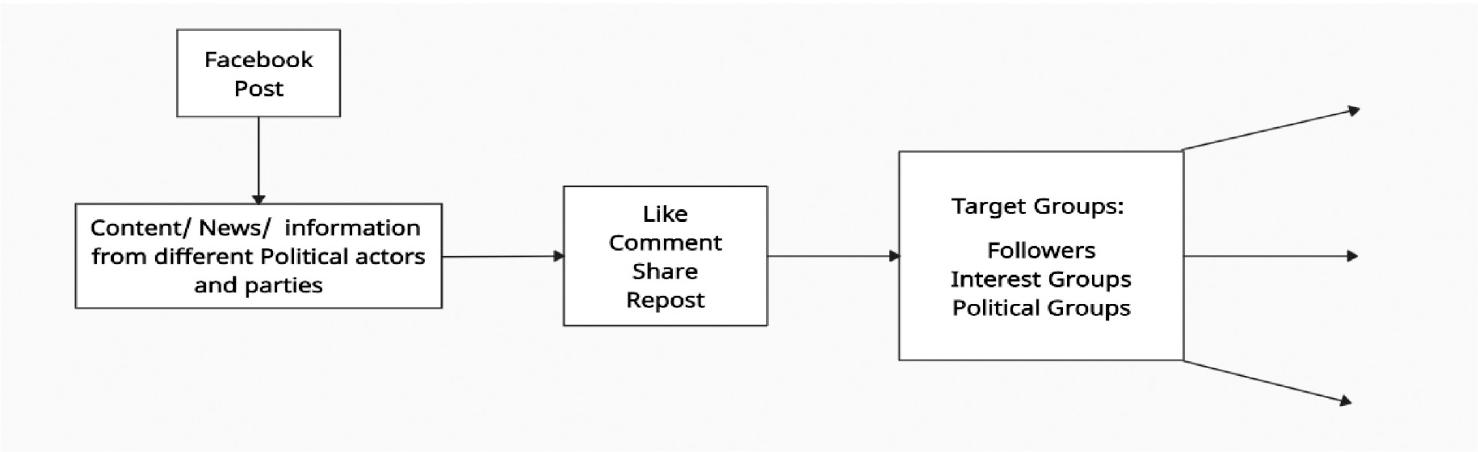
Figure 1 illustrates how political posts on Facebook initiate the spread of information. User interactions, such as likes, comments, and shares, enhance the visibility and impact of these posts. The figure also demonstrates how political organizations target specific user groups to influence public opinion, emphasizing Facebook’s crucial role in contemporary public discourse.
Facebook Usage Patterns and Trends:
The user base on Facebook is diverse, spanning age groups, educational backgrounds, and geographic locations, according to research by (Duggan & Smith, 2014). Analyzing Facebook users’ demographics helps evaluate its representation in shaping public opinion across various societal segments. Research has revealed that Facebook users use the site in different ways, visiting it several times a day and devoting a significant amount of time to content consumption (Ellison, Steinfield, & Lampe, 2007). Facebook usage frequency and duration influence political exposure and online discussions, shaping opinions and attitudes toward political issues. (Bode & Vraga, 2015) emphasize the importance of analyzing the content shared on social media platforms to understand its impact on public opinion formation. Exposure to diverse viewpoints and narratives on Facebook can influence individuals’ attitudes, beliefs, and behavioral intentions, shaping the broader public discourse.
Facebook’s Role in Electoral Campaigns: A Review of Recent Literature
Algorithmic biases in Facebook’s advertising platform, evident during the 2021 German federal elections when political ads reached unintended audiences, underscore the urgent need for transparency in ad delivery systems (Bär, Pierri, Morales, & Feuerriegel, 2023). Research on the 2020 U.S. presidential election demonstrates that exposure to political content on Facebook and Instagram significantly influences voter behavior, shaping political beliefs and turnout and underscoring their impact on electoral outcomes (Fujiwara, Müller, & Carlo, 2024). Facebook has proven effective in engaging younger demographics during Pakistan’s 2018 general election; the platform played a significant role in shaping the political opinions of young voters and a tool for engaging politically less-active demographics (Sajid, Javed, & Warraich, 2024). Populist parties have effectively used Facebook to disseminate issue-focused messages, as seen in the 2019 European Parliamentary elections, where they captured a disproportionate share of ad impressions, highlighting the platform’s competitive advantage for such groups (Capozzi, Morales, Mejova, Monti, & Panisson, 2023).
Conceptual Framework
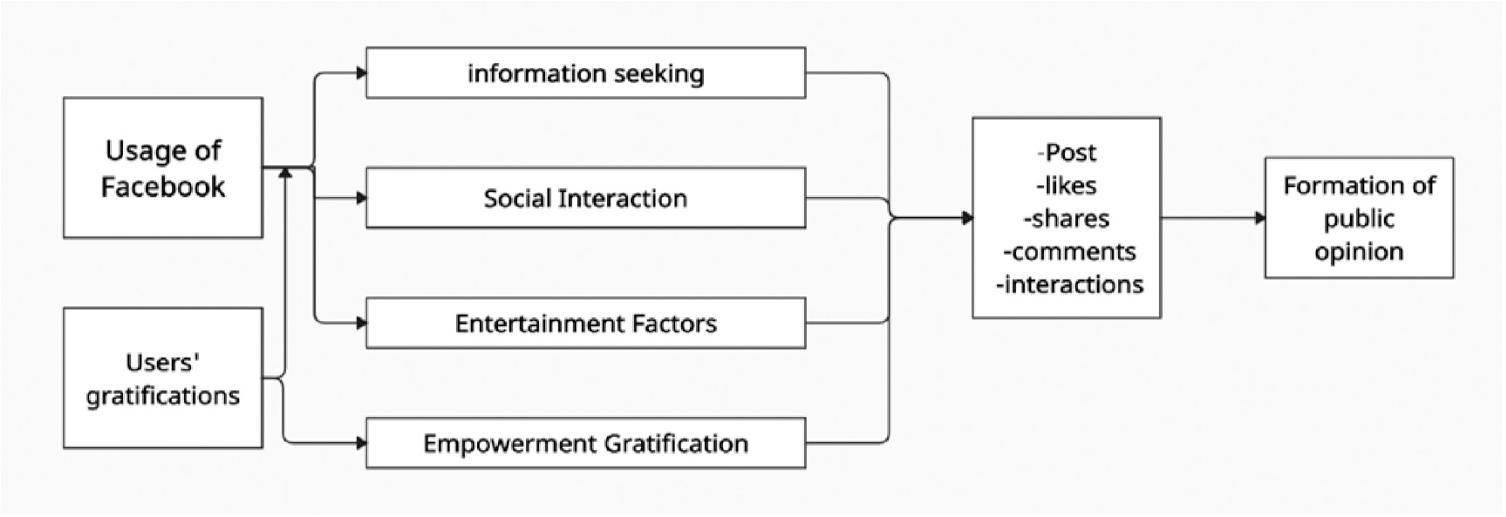
The theoretical framework integrates the Theory of Social Influence and the Uses and Gratifications Theory to examine how social interactions and individual motivations shape behavior and opinion on social media platforms like Facebook. The Theory of Social Influence explains how individuals’ opinions, attitudes, and behaviors are influenced by their social environment. This theory emphasizes that individuals frequently modify their beliefs and behaviors in response to social interactions and pressures, as outlined by Kelman (1958), who identified processes like compliance, identification, and internalization in attitude change. On platforms like Facebook, social influence is evident through phenomena such as polarization, where opinions diverge within echo chambers because of selective exposure to similar views. (Sunstein, 2001). Conformity significantly influences individuals as they adjust their opinions to match group norms, fueled by a desire for social acceptance and belonging (Asch, 1951). Furthermore, selective reinforcement occurs when users prioritize information that aligns with their preexisting beliefs, which further solidifies existing biases and contributes to the fragmentation of public discourse (Festinger, 1957). These dynamics underscore the profound impact of social influence on online behaviors and opinion formation in digital environments.
Since its inception in the late 1940s, the Uses and Gratification (U&G) approach to media use has sought to understand why people use media and how they use it to satisfy their needs (Blumler & Katz, 1974). According to U&G theory, media users make choices and get gratification from the media because they are conscious of their needs, motives, and expectations of the medium. The U&G theory has been widely applied to various media, including newspapers (Elliott & Rosenberg, 1987), Television (Rubin, 1981), smartphones (Dimmick, Sikand, & Patterson, 1994), and internet options (Papacharissi & Rubin, 2010), to measure the reasons behind people’s media use.
The theoretical framework for studying the formation of public opinion through Facebook during the 2024 general election campaign in Bangladesh will be based on the Uses and Gratifications Theory (UGT). This theory posits that individuals actively seek media content to satisfy specific needs and gratifications. Here is how the UGT can be applied:
Information Seeking
To keep up with political candidates, party platforms, and campaign events, Facebook users can interact with political content. To make well-informed choices regarding their political inclinations, they search for information (Gil de Zúñiga, Weeks, & Ardèvol-Abreu, 2017). (hypothesis 1)
Social Interaction
Users use Facebook to interact with peers, candidates, and political parties, have political conversations, and exchange opinions. They look for interaction with like-minded people, social validation, and support (Valenzuela, Piña, & Ramírez, 2017).(hypothesis 2)
Entertainment Factor
Facebook users can find entertaining political content with humorous stories, captivating images, and information about the election campaign. With political content, users aim to engage and have fun (Bakshy, Messing, & Adamic, 2015). (hypothesis 3)
Empowerment Gratification
Users convey their identities, values, and political beliefs by engaging with political content on Facebook. Within their social networks, they look for validation and strengthening of their political identities (Chadwick & Stromer-Galley, 2016).
Engaging with political content on Facebook can empower users. By participating in discussions and rallying support for causes, they feel they can influence change and decision-making (Valenzuela, Piña, & Ramírez, 2017). Users actively participate in political discourse on Facebook to influence public opinion and significantly contribute to democracy. (hypothesis 4)
Materials and Methods
This study examines Facebook’s influence on the formation of public opinion during Bangladesh’s 2024 General Election campaign. Specifically, it seeks to address the following research questions:
What role does Facebook play in disseminating political information during election campaigns?
How does Facebook usage influence political engagement and empowerment among its users? iii) What patterns shape public opinion formation through Facebook during elections?
A mixed-method approach was employed to address these questions. This design captures the complexity of public opinion formation, integrating quantitative data from surveys with qualitative insights from semi-structured interviews. The sequential methodology ensures that qualitative data enriches the interpretation of quantitative findings, aligning with the principles outlined by (Schoonenboom & Johnson, 2017).
Quantitative Data Collection
Target Population and Sampling
The study targeted citizens aged 18 to 50 residing in five parliamentary constituencies in Bangladesh. A purposive sampling technique was used for both paper-and-pencil and online questionnaires. This approach was chosen based on its effectiveness in reaching specific subgroups relevant to the research objectives. According to (Prior, Campbell, Greenwood, & Shearer, 2020) Purposive sampling allows researchers to intentionally select participants who can provide valuable insights based on their understanding of the population. This method is particularly useful for exploratory studies where detailed, context-specific information is prioritized over representativeness.
Data Collection
Respondents provided socio-demographic information, including gender, age, educational qualification, occupation, and parliamentary constituency. Data on Facebook usage patterns, exposure to political content, and political engagement were also collected. Surveys were administered using a combination of paper-andpencil and online formats to maximize participation.
Data Analysis
SPSS version 22.0 was employed for quantitative data analysis. Statistical methods included:
Descriptive Statistics: Summarizing demographic data, Facebook usage, and political engagement patterns.
Pearson Correlation Coefficient: Exploring relationships among variables.
Multiple Linear Regression: Assessing the impact of Facebook usage on public opinion formation.
Scales for each variable were created by normalizing and averaging responses, with higher scores indicating greater levels of the respective variables.
Qualitative Data Collection
Semi-structured interviews were conducted through Facebook to delve deeper into the nuances of public opinion formation. This flexible format allowed participants to share their perspectives in a conversational style, fostering authentic and reflective responses (Morris, 2015). The interviews concentrated on key topics such as political information-seeking, social interactions, and the empowerment experienced through Facebook during the election campaign.
Recruitment of Interviewees
Purposive sampling was also used for the qualitative phase, as it enabled the selection of participants representing a range of perspectives and experiences. As (Dudovskiy, 2022) states that the purposive sampling method utilizes researchers’ judgment to identify individuals who can offer diverse insights into the phenomenon being studied.
Table 1 Profiles of the interviewees
| Interviewees | Gender | Facebook Usage | Political Information Seeking on |
Social Interaction on |
Political Entertainment Factor on |
Political Empowerment Factor on |
|---|---|---|---|---|---|---|
| A | Female | 3.50 | 2.50 | 2.00 | 2.33 | 1.87 |
| B | Male | 4.00 | 2.50 | 1.33 | 2.67 | 2.47 |
| C | Male | 4.00 | 1.50 | 1.67 | 1.33 | 2.47 |
| D | Female | 3.00 | 1.50 | 1.67 | 1.00 | 2.20 |
| E | Male | 3.50 | 3.58 | 4.33 | 3.33 | 3.27 |
| F | Male | 3.00 | 3.33 | 3.00 | 3.00 | 3.27 |
| G | Female | 4.00 | 2.08 | 1.67 | 2.67 | 2.00 |
Seven participants, aged 25 to 45, were recruited, ensuring a balance in gender and variation in Facebook usage and political engagement levels. This sampling approach was not intended to produce generalizable trends but to explore the depth and diversity of experiences.
Results
The socio-demographic characteristics of the samples
The survey was conducted between March and April 2024, with data collection spanning approximately one month. The result was 307 valid questionnaires.
Table 2 displays the sociodemographic characteristics of the sample. Among the respondents, 57% are males and 43% are females, with an average age of 28.31 years (SD = 6.263). The participants, aged 18 to 50 with an average age of 28.39 years, represent a diverse age range, highlighting significant engagement from a younger demographic in Facebook-based political discourse. Educationally, 58.3% hold at least a bachelor’s degree, suggesting enhanced critical thinking and understanding of politics. Occupationally, the sample includes students (26.7%), social workers (15.6%), private sector employees (15.1%), government workers (10.4%), business owners (6.5%), and others (25.7%), reflecting varied perspectives and influencing factors in political opinion formation during the election campaign.
Table 2 Demographic of the Respondent
| Demographics | Study (n=307) Frequency (%) | |||
|---|---|---|---|---|
| Gender Male Female |
175 (57.00%) 132 (43.00%) |
|||
| Age 18-21 Years 22-25 Years 26-29 Years 30+ Years |
22 (7.20%) 94 (30.60%) 88 (28.70%) 103 (33.60%) |
|||
| Educational Qualification <Secondary School Certificate Secondary School Certificate Higher Secondary Certificate Bachelor’s Degree Master’s Degree or above |
17 (5.5%) 14 (4.6%) 97 (31.6%) 113 (36.8%) 66 (21.5%) |
|||
| Occupation Student Social Worker Private Job Government Job Business Others |
82 (26.7%) 48 (15.6%) 46 (15.1%) 32 (10.4%) 20 (6.5%) 79 (25.7%) |
|||
| Age | Minimum | Maximum | Mean | SD |
| 18 | 50 | 28.39 | 6.263 |
*Source: Computed Primary Data Using SPSS 22 Version
Table 3 Regression Diagnostic Tests
| Regression Model | Independence of Residuals | Homoscedasticity | Normality of Residuals |
|---|---|---|---|
| Information Seeking (IS) | Durbin-Watson test: 1.886 (no significant autocorrelation) |
Residuals spread consistently across predicted values (no rejection of null hypothesis). |
Histogram and Q-Q plot: Residuals approximately follow normal distribution; Shapiro-Wilk test: p =. .931, Kolmogorov-Smirnov test: p = .103 (no rejection of null hypothesis) |
| Social Interaction (SI) | Durbin-Watson test: 1.862 (no significant autocorrelation) |
The dispersion of residuals remains uniform across predicted values (no rejection of the null hypothesis). |
Histogram and Q-Q plot: Residuals tend to conform to a normal distribution roughly; Shapiro-Wilk test: p =. .936, Kolmogorov-Smirnov test: p = .134 (no rejection of null hypothesis) |
| Entertainment Factors (ENF) | Durbin-Watson test: 1.767 (no significant autocorrelation) |
The spread of residuals is consis- tent throughout the predicted values (no rejection of null hypothesis) |
Histogram and Q-Q plot: Residuals tend to conform to a normal distribution; Shapiro-Wilk test: p =. .792, Kolmogorov-Smirnov test: p = .093 (no rejection of null hypothesis) |
| Empowerment Gratification (EMG) |
Durbin-Watson test: 1.803 (no significant autocorrelation) |
Residuals spread consistently across predicted values (no rejection of null hypothesis). |
Histogram and Q-Q plot: Residuals tend to conform to a normal distribution roughly; Shapiro-Wilk test: p =. .935, Kolmogorov-Smirnov test: p = .139 (no rejection of null hypothesis) |
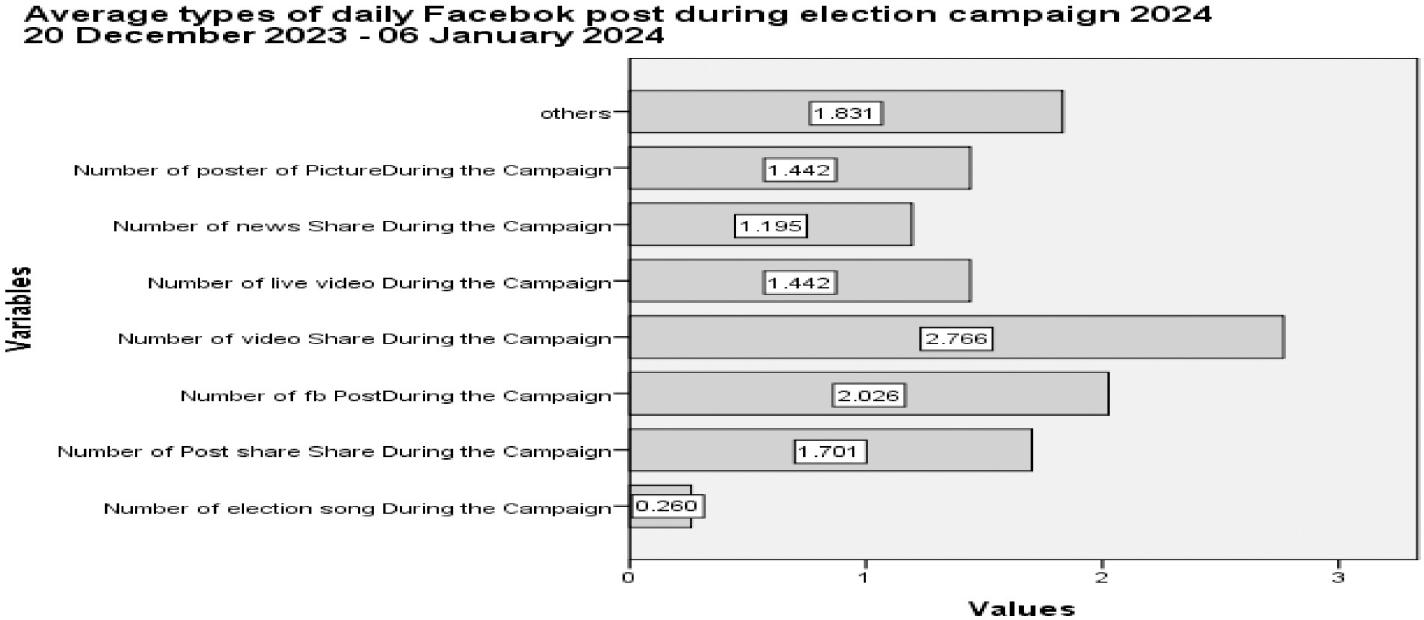
The dataset shows diverse political posts: election songs (0.26), video shares (2.77), live streams (1.44), news shares (1.19), and picture posts (1.44). Analyzing these types and their engagement can reveal their impact on public opinion and voter perceptions during the election campaign. The study reveals diverse patterns in Facebook use related to political communication. Most respondents (59.3%) use Facebook multiple times daily, with 34.9% spending 15-30 minutes per session. Regarding political engagement, 24.8% search for political information a few times a week, while 37.8% rarely engage in political discussions or debates. Sharing political content is also infrequent, with 43.0% seldom or never sharing such posts.
News articles are the most engaged content type (89.9%), indicating their importance in shaping public opinion. Videos (36.2%), expert opinions (58.3%), and live streams (24.8%) are less engaging but still relevant. Notably, 47.9% of users do not engage with specific political content, though political event announcements (14.0%) and campaign updates (8.8%) are relatively more popular. This data highlights Facebook’s role in political engagement and suggests that the type of content consumed can significantly influence public opinion during elections.
Hypothesis Testing
Analysis Using Linear Regression
The Durbin-Watson test was utilized to evaluate the independence of residuals. This assessment is vital as it verifies a key assumption in regression analysis (refer to Table 4). The results from the Durbin-Watson test for each model are as follows: IS (1.886), SI (1.862), ENF (1.767), and EMG (1.803). The values, close to the benchmark of 2, indicate no significant autocorrelation in the residuals, suggesting that residuals from one prediction do not influence another. This supports the validity of the models and confirms that they effectively capture data patterns without bias from data point ordering, indicating reliable analysis of the factors’ impact.
Table 4 Summary of the findings of Linear Regression
| Hypothesis | Regression Weights | Beta Coefficient | R2 | F | t-value | p-value | Hypotheses Supported |
|---|---|---|---|---|---|---|---|
| H1 | IS → FPO | .723 | .523 | 333.871 | 18.272 | .000 | Yes |
| H2 | SI → FPO | .682 | .733 | 835.336 | 28.902 | .000 | Yes |
| H3 | ENF→FPO | .486 | .302 | 132.081 | 11.493 | .000 | Yes |
| H4 | EMG→FPO | .806 | .650 | 565.832 | 23.787 | .000 | Yes |
Note:
*p < 0.05. IS: Information seeking, SI: Social Interaction, ENF: Entertainment Factor, ENG: Entertainment Gratification, FPO: Formulation of Public opinion
Table 5 Mean, Standard Deviation, and Correlation for Research Model
| Variables | Mean | SD | 1 | 2 | 3 | 4 | 5 | 6 7 |
|---|---|---|---|---|---|---|---|---|
| 1. Facebook Usage | 4.35 | 0.93 | - | |||||
| 2. Information Seeking | 2.43 | 0.78 | .12* | - | ||||
| 3. Social Interaction | 2.57 | 1.04 | .13* | .56** | - | |||
| 4. Entertainment Factor | 2.21 | 0.93 | .26** | .29** | .26** | - | ||
| 5. Empowerment Gratification | 2.14 | 0.69 | .18** | .55** | .61** | .36** | - | |
| 6. Political Engagement | 2.13 | 0.82 | .30** | .69** | .84** | .48** | .69** | - |
| 7. Public Opinion Formation 3.05 0.83 * Correlation is significant at the 0.05 level (2-tailed). ** Correlation is significant at the 0.01 level (2-tailed). |
.21** | .72** | .86** | .55** | .81** | .86** - | ||
Table 6 Hypotheses and the results
| Hypothesis | Result |
|---|---|
| H1: Facebook users’ seeking information has a significant impact on the formulation of public opinion. | Supported |
| H2: Facebook users’ social interaction positively impacts the formulation of public opinion. | Supported |
| H3: Entertainment Factors associated with political content on Facebook impact the formulation of public opinion. | Supported |
| H4: Empowerment Gratification has significant positive effects on the formulation of public opinion. | Supported |
The regression models were tested for homoscedasticity, confirming that the variance of residuals remains consistent across predicted values, indicating no significant heteroscedasticity. This supports the validity of the models by ensuring unbiased standard errors and reliable hypothesis testing. Additionally, residuals adhere to a normal distribution, as confirmed by Shapiro-Wilk and KolmogorovSmirnov tests (p-values: 0.792-0.975 and 0.093-0.134, respectively), affirming the robustness of parametric tests. These findings validate the models’ reliability in analyzing how Facebook user factors influence public opinion formulation.
The findings from the regression analysis have significant implications in the socio-political context, highlighting the various factors that influence the formulation of public opinion (FPO). The strong influence of Information Seeking (IS) suggests that when individuals actively engage with information, they are more likely to form informed opinions on political and social issues, which is crucial for democratic participation and decision-making. Similarly, Social Interaction (SI) underscores the importance of social networks, as conversations and group discussions often shape individuals’ opinions, influencing voting behavior and policy support.
The Entertainment Factor (ENF) demonstrates that entertainment media, including television, films, and online content, can significantly alter perceptions of political figures or issues, often contributing to public discourse. Furthermore, Entertainment Gratification (EMG) shows that people derive emotional or psychological satisfaction from entertainment, which can align their political views with the content they consume, such as in political satire or drama.
These findings suggest that media, social networks, and entertainment all play essential roles in shaping public opinion. Politicians, policymakers, and advocacy groups can strategically use these factors to influence public discourse, while media literacy programs are necessary to ensure that citizens critically engage with information. However, these factors also highlight the potential risks of political polarization, as ideologically homogeneous networks and entertainment sources could deepen societal divisions. Overall, the trends indicate the need for a balanced media ecosystem that fosters informed and diverse public opinion, essential for a healthy democracy.
Correlation for Research Model
The statistical analysis of Facebook usage and its impact on political engagement and public opinion formation reveals several key insights.
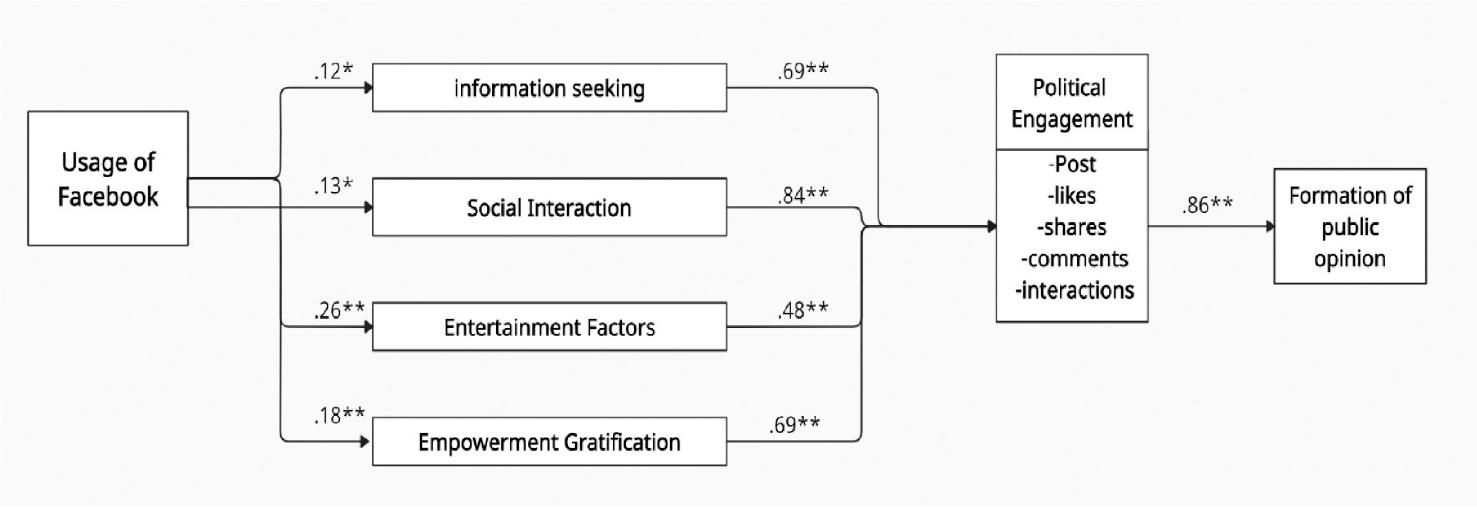
Significant correlations were found in the study, notably between political engagement and public opinion formation (0.86). This indicates that higher political engagement on Facebook has a strong impact. The average Facebook usage is high at 4.35, with a standard deviation of 0.93, indicating that most users actively engage with the platform. Information-seeking and social interaction have moderate average scores of 2.43 and 2.57, respectively, with social interaction showing the highest variability among users. influences public opinion. Information Seeking is also strongly correlated with Political Engagement (0.69) and Public Opinion Formation (0.72), suggesting that active information seekers are more politically engaged and influential. Although primarily for leisure, the Entertainment Factor moderately correlates with Political Engagement (0.48), implying some political impact. Empowerment Gratification correlates strongly with Political Engagement (0.69) and Public Opinion Formation (0.81), highlighting Facebook’s role in empowering users to engage in political discourse and opinion shaping. These correlations demonstrate Facebook’s complex role in boosting political engagement and shaping public opinion through information-seeking, social interaction, and empowerment.
Based on the findings from the questionnaire survey, Hypotheses 1, 2, 3, and 4 find support. These findings suggest that engagement with Facebook contributes to the formation of public opinion, particularly concerning Bangladesh’s 2024 General Election Campaign. Facebook users who actively seek information, engage in social interactions, derive entertainment gratification from political content, and feel empowered through their interactions on Facebook are more likely to shape their public opinion.
According to the questionnaire’s survey findings, hypotheses 1, 2, 3, and 4 receive support, indicating that Facebook use plays a significant role in forming public opinion.
Findings of the Interview
A common opinion expressed by the interviewees is that Facebook provides a range of perspectives on political issues, leading to a more well-rounded understanding of these topics. Interviewee F highlights the platform’s ability to present uncensored and diverse viewpoints, mentioning that it allows access to voices that may not be featured in traditional media.
“You have access to diverse voices on the platform (Facebook), providing various perspectives for a deeper understanding of any topic, without censorship.” - Interviewee F
Facebook is an alternative to traditional media, offering users a broader spectrum of political information, which can lead to a more diverse political perspective. Interviewee C shares this view of Facebook’s direct information with the filtered content of traditional media.
“Conventional media... may struggle to provide information as directly as available on platforms like Facebook.”-Interviewee C
Facebook is known for promoting lively political discourse. It allows users to discuss, debate, and influence one another’s views. Another important aspect is the role of social interaction in shaping political opinions. Interviewee F states how interactions in Facebook groups and comment sections contribute to opinion formation, particularly during election campaigns.
“Parliamentary candidates for my constituency conduct their campaigns on Facebook, where a diverse range of political interactions occurs in the comments section, within their groups, and on their pages. I believe these interactions are crucial in shaping opinions about how we vote.”-Interviewee F
While interviewees value Facebook’s interactivity, opinions on politicians’ platform use vary. Interviewee D criticizes their one-sided communication.
“Politicians, in my opinion, ignore what people have to say online. They created a Facebook page only to raise awareness and get support.
To achieve this, they have admin.”- Interviewee D
Emotional and rational factors influencing political opinions often diverge. Several interviewees noted that emotional appeals, like music or nationalistic messages, significantly shape political sentiment. For example, Interviewee D described a video of the Padma Setu inauguration paired with a patriotic song, illustrating content designed to evoke emotional responses.
“A political party and its supporters have circulated a video of the Padma Setu inauguration on social media, pairing it with an emotive song. The caption underscores the party’s dedication to advancement and stability, appealing to voters’ patriotism and optimism for the future.”-Interviewee D
This emotional strategy is a standard tool used in political campaigns, as it appeals to feelings of national pride and civic duty to generate support. However, some interviewees emphasize the importance of rational, fact-based engagement. For example, Interviewee B values factual information and actively challenges misinformation in posts from opposing political groups.
“I have liked the Facebook pages of individuals from various political affiliations, including rival parties or those with opposing political views. Sometimes, their posts... are humorous and entertaining. However, there are times when I comment against any misinformation or falsehoods presented in their posts.”-Interviewee B
This suggests that while emotional appeals effectively engage users, rationality-primarily through fact-checking and discussions-also influences interactions with political content on Facebook.
Facebook shapes political opinions by offering access to diverse political perspectives and fostering real-time discussions. Emotional messaging resonates with users’ feelings, motivating political action and voting. At the same time, rational engagement encourages critical evaluation of information. Ultimately, Facebook blends emotional and logical elements, leading to varying user responses to political content.
Discussion
This study aligns with Social Influence Theory, which posits that social interactions within networks shape political opinions. The data indicates that 65% of participants felt influenced by Facebook during the 2024 election, highlighting the effect of online political discussions on personal beliefs (Lazer, Rubineau, Chetkovich, Katz, & Neblo, 2012). Facebook’s role in fostering engagement with political figures supports the theory by enhancing users’ political efficacy and participation, as users are exposed to persuasive, mobilizing content (Tang & Lee, 2013).
Additionally, Facebook enables expressive political engagement, allowing users to post, comment, and share political opinions, which influences their networks, consistent with Mahmud’s (2017) argument. The study also highlights Facebook’s ability to activate weaker ties, expanding political engagement through indirect exposure to diverse viewpoints, echoing the findings of (Barberá, Jost, Nagler, Tucker, & Bonneau, 2015). Passive exposure to political content on Facebook further supports the theory, as users’ political awareness is shaped by observing friends’ posts and reactions, a trend also observed by (Cantijoch, Cutts, & Gibson, 2015). Overall, the study demonstrates how Facebook facilitates the spread and reinforcement of political opinions through direct and indirect social interactions, embodying the principles of Social Influence Theory.
Social scientists suggest that social interactions and discussions partly shape political opinions (Dahl, 1991). People in this study are more involved in expressing their political views. Survey respondents indicated that Facebook offers users ample opportunities to share their opinions through activities like posting, commenting, and sharing political content, which aligns with (Tufekci, 2017) findings. These activities take less labor than formalized political activity, such as working for political organizations and organized interest groups or personally contacting politicians (Gil de Zúñiga, Weeks, & Ardèvol-Abreu, 2017).
This research indicates a positive correlation between Facebook use and interaction with political actors on the platform. The trends stand by those of earlier studies (Calderaro, 2018), which explain that digital media features enhance political participation by providing users with opportunities to interact with politicians. The individuals sampled in this study agree that Facebook allows them to access opinions from political figures (77.9%) and comprehend their stance on social problems (63.1%). Only 33.1% of respondents believe that Facebook helps people connect directly with political figures, indicating a lack of closeness to political leaders.
An exploratory lens was adopted to understand Facebook’s multifaceted role in shaping public opinion during a specific electoral context. While the findings offer valuable insights, they are not intended to be generalizable to all populations or contexts. Instead, they provide a foundation for further research into the intersection of social media and political behavior. The study’s focus on the 2024 election campaign highlights how Facebook influences political opinions, mainly through interactions with political figures and the sharing of political content (Lazer, Rubineau, Chetkovich, Katz, & Neblo, 2012). However, due to limitations in sample size, diversity, and geographical representativeness, the findings may not fully capture the breadth of political engagement across different demographics or regions (Mahmud, 2017).
Furthermore, this study highlights a positive association between utilizing Facebook and encountering political content on the platform. Supported by insights from interviews, it suggests that using Facebook may inadvertently expose individuals to political information. As users scroll through their newsfeeds and observe the activities of others in their networks, such as friends’ comments and reactions, they are more likely to come across political content passively. Consequently, Facebook as platforms facilitate the dissemination of public opinion strengthens passive political communication among users and influences users’ perceptions within the socio-political landscape.
Conclusion
Facebook plays an increasingly vital role in shaping public opinion and enhancing political engagement in Bangladesh, particularly during significant events like the 2024 General Election campaign. Its ability to disseminate diverse political content, provide real-time updates, and enable dialogue between citizens and political figures underscores its importance as a tool for political communication. By broadening access to political discourse and amplifying marginalized voices, Facebook has made the political process more inclusive and participatory.
However, challenges such as the spread of misinformation, political polarization, and superficial interactions with political actors hinder its transformative potential. A collaborative effort involving policymakers, platform authorities, and users is essential to address these issues. Initiatives like strengthening fact-checking mechanisms, promoting digital literacy, and ensuring transparency in political content can mitigate these drawbacks. By fostering respectful discourse and authentic engagement, Facebook can continue to empower citizens, encourage meaningful political discussions, and contribute to a more informed and democratic society in Bangladesh.

