




 Inglês (pdf)
 Artigo em XML
 Referências do artigo
 Tradução automática
 Enviar este artigo por email
 Citado por SciELO
  Similares em
SciELO
Similares em
SciELO 
 Permalink

Introduction
The third wave of democratization, which took place in the 1990s (Huntington, 1994), brought about substantial changes in the paradigm of women’s inclusion in political and economic life and opened up space in the Southern African Development Community (SADC), mechanisms for ending discrimination against women and shape a society based on equality and equity. Since then, there has been an almost gradual increase in the presence of women in decision-making bodies, especially legislative bodies, placing the region in third position in terms of female parliamentary representation globally, after Europe and North America (Freedom House, 2024). The Republic of Seychelles, South Africa, Namibia, and Mozambique appear at the top of the gender ranking of the 15 most represented nations in the world (SADC, 2016).
Despite this increase, countries like Mauritius and Botswana, which although their recognized high level of democracy, measured in terms of respect for freedom of expression, the electoral process and party pluralism, political participation, political culture and civil liberties (Freedom House, 2024), are identified as the worst countries in terms of female representation within the SADC region. This controversy does not fail to raise questions in academic circles. The most burning and complex question surrounding the debate is: To what extent does high female representation in national parliamentary assemblies reflect a high or low level of democracy in a country?
This article seeks to understand the relationship between female representation in legislative bodies and the level of democracy in SADC member countries.
To deepen the debate, the article argues that democracy is a regime hostile to women. In an attempt to prove the argument formulated and to achieve the objective proposed, the study uses the qualitative method, based on a literature review (books and academic articles) and data from the Inter-Parliamentary Union, Freedom House and SADC monitor gender platforms.
Therefore, it is justified to address this issue in order to better understand the relationship between democracy and the participation of women in parliament, as well as to contribute to the literature on international relations and political science around this debate, as a mechanism to sensitize leaders and the international community to gender parity not only in parliaments but in all spheres of decision-making.
In terms of organization, apart from this introductory part, the article comprises four sections. The first section discusses the representative democratic theory. The second briefly reviews the literature on democracy and women’s parliamentary representation. To this end, it starts with a global overview of the debates that revolve around the authors who defend democracy as a factor that influences representativeness and those who oppose this thesis. The third section examines women’s representation in the parliaments of SADC member states, analyzing the relationship between each country’s level of democracy and the degree of female participation in its legislative body. The fourth section discusses the ambiguity of democracy itself in shaping women’s political representation within the region. This is followed by the final consideration and bibliographical references.
Representative democratic Theory
As its name implies, to represent means to be an image, to symbolize, to serve as a substitute or agent for another, that is, to delegate powers or competences to another. The idea begins with Thomas Hobbes, in his work Leviathan, where he extensively and systematically discusses the concept of representation (Hobbes, 2014). In his approaches, the author starts from the notion of a social contract, with which individuals found the state. Hobbes (2014) sees representation as authorization to act, an operation whereby the represented party is emptied in favour of the representative party, with the representative being in control of the action, acting as he or she wishes, without worrying about responding in any way to those represented.
In Political Science, representative democracy refers to the way in which political power is exercised, in which the people of a given country elect their representatives by voting in elections (Urbinati, 2006). Lima Júnior (1997) defines representation as authorization and delegation, which bind the individual to the instituted power. This act, according to the author, lies in the transfer of authority to the representative, in which the latter receives the right to act as if he were the represented (ibid.). For his part, Bobbio (2015) defines the concept of representation as one thing representing another, something that is not, however, literally or actually present.
Although the definition of the concept may itself include some normative content, the concept of representation takes on various forms and connotations, all of which refer to a normative choice regarding the role and function of representatives. As Almeida and Lavalle (2020) point out, representative democracy is essentially defined by participation through voting in the choice of representatives committed to certain diagnoses and solutions to relevant social problems.
However, advocates of classical democracy are skeptical of representative democracy and support self-representation as the ideal model of democracy. Jean-Jacques Rousseau (1999), an 18th-century Swiss philosopher, for example, argues that the true form of democracy is direct democracy (Rousseau, 1999). In his view, popular sovereignty refers to the exercise of legislative power, i.e. the power to make laws, the direct participation of the people in assemblies, without the presence of the element of representativeness (Rousseau, 1999).
Rousseau (1999) goes further in his arguments. For the author, sovereignty is inalienable and indivisible, as expressed in different Constitutions of the Republic, i.e. the act of making laws is precisely the non-transferable aspect of political life, which cannot be exercised by representatives, but by the people themselves gathered in assembly. Thus, the assembled people - by legislating - become sovereign. In other words, sovereignty or the people’s act of legislating means the affirmation of their will, and the people cannot give this up, otherwise, they could become slaves or sign up to their own servitude.
Jean-Jacques Rousseau (1999) defends self-representation as a fundamental condition for the legitimacy of political action. According to him, the individual cannot be represented; consequently, he rejects political representation as a valid component of democracy (Rousseau, 1999). Rousseau further argues that people are truly free only when they govern themselves, that is, when they make their own laws without any form of mediation.
Although direct democracy has as its main value the participation of as many citizens as possible in making substantive decisions on issues that affect them, this emphatic version of inclusive participation brings with it some limitations today. The first limitation is related to the availability of time. Unlike the “Greek citizens” who had slaves working for them and the time to discuss and participate in their society through direct democracy, not all citizens have the time today. The second limitation is linked to the size of the population and the geographical extension of modern states, which would make it impossible to bring all the citizens of a country together to an assembly at the same time.
Based on the limitations noted and exposed above, several authors who endorse democratic representation argue that a true democracy governed by direct participation in decision-making is almost unlikely today, on the one hand, as mentioned above, due to the existence of geographically large political units and, on the other, because the post-Westphalian states are characterized by the existence of a large population (Bobbio, 2015).
In the same vein, Pitkin (1967) argues that direct democracy is only possible in a small society. In this context, the author advocates representative democracy with a small assembly (Pitkin, 1967). Such an assembly should cover the whole nation and accurately reflect the various segments of the population that make up the country, involving both men and women. It is from this perspective that Mill (2004), points to representation as the central model and the best political regime and unavoidable in contemporary democracies, due to the impossibility of contemplating in person all the citizens who live in countries in the same geographical space and at the same time.
Although the understanding of representative democracy seems to provide a conception that establishes a technical and institutional basis that accepts the current conditions of politics and decision-making mechanisms in the modern era, based on the normative and ideological assumption that representative democratic participation is only about choosing and not deciding, Miller considers this conception to be minimalist. According to him, in order to become democratic, representation must be coupled with a deliberative culture that encourages citizens in political affairs (Mill, 2004).
On this basis, Bobbio (2015) describes representative democracy as a political model that takes the form of a parliamentary government based on political parties that function mainly through elected representatives. However, Pitkin (1967) distinguishes between two types of representation: descriptive representation and substantive representation. The first concerns the number or ratio of representatives elected to political institutions who represent different sections of society, such as women, ethnic and religious minorities, and ideologies. The second representation, is allied to the effects and active roles played by representatives in decision-making processes and policymaking. In this vein, Pitkin uses the term responsiveness to refer to the fact that both the representative and the represented must have a certain amount of autonomy. Genuine democratic representation occurs when the representative acts on behalf of the represented.
In this sense, a similar line can be drawn between the “substantive notion of representation” and authorized and accountable representatives. Political representatives can answer to their voters without necessarily being accountable to them or explaining their actions. This last argument leads to questions about the role of the representative. Azambuja (2005) considers the representative to be a defender of their particular constituency. This view argues that representatives are guardians, promoting neither their own interests nor those of their constituents, but rather the wider interests of society as a whole.
In other words, since the representative owes a judgement to the constituents, the constituents can ask for that judgement during the electoral process, and therefore this means that (i) accountability to the voters is not necessary between elections; and (ii) representatives can behave more independently (ibid). Moreover, being a representative does not automatically mean being authorized. Furthermore, according to Azambuja (2005) some perspectives, a representative should not be accountable or answerable to their constituents or act solely on the basis of their particular interests.
However, for Schumpeter (1984), representative democracy should be seen as an inescapable and unavoidable compromise for political parties in modern democracies, since, as he has mentioned, regularly consulting the people as a whole would be practically impossible. In fact, under modern conditions, only representation can make democracy possible. In fact, according to the author in question, representative democracy is the idea that the whole people or a large part of them exercise the power of final control through periodically elected deputies. In the same vein, representative democracy allows citizens to govern themselves in policies that go beyond the smallest communities, allowing leaders to mobilize opinions that facilitate consensus and enable them to implement policies.
Schumpeter (1984)) considers representative democracy to be one of the most dominant ideas today. At the same time, Dahl (2001) takes indirect democracy for granted. In this vein, he emphasizes the competition for power and stresses the importance of elections and voting. However, Dahl (2001) proposes two additional conditions to complete the list of requirements for a representative democracy. Dahl’s first condition is that officials elected by the people must be able to exercise their constitutional powers without being subject to dominant opposition. Secondly, politics must be autonomous; in other words, it must be able to act independently of the constraints imposed by other overarching political systems.
In short, democratic representation has now become one of the most common and accepted models in political science and modern democratic regimes, and the starting point and foundation of the theory of democratic representativeness. In contrast to classical Greek direct democracy, in which all the citizens of a city (polis) came together in an assembly to debate and deliberate on matters of public life, i.e., a democracy in which every citizen had direct political participation, without intermediation, it has been sidelined in modern democracies.
The relationship between democracy and female representation
The relationship between democracy and female representation in parliaments gives rise to controversial debates in the literature ( Walby 2000, Tremblay 2007). One of the controversies present in the debate, which calls for an explanation, is based on the paradox between the principles of equal rights for men and women to participate in the political sphere, rhetorically postulated by democratic regimes as the basic assumptions that guide them, and the gender imbalance in favour of men witnessed in the majority of legislative bodies in modern democratic states, diverging the analyses and conclusions of researchers on the subject (Sacchet, 2012).
Several studies, such as Ballington et al. (2005), define democracy as a regime that has historically excluded women from political life. The rationale for this structural lethargy is reflected in the persistent gender representation gap within decision-making processes globally. Ballington et al. (2005) substantiate this argument by examining ancient Greek democracy, social contract theories, and the earliest democratic experiences in France, England, and the United States. In Ancient Greece, often regarded as the “cradle of democracy,” women were not recognized as citizens. Citizenship was reserved exclusively for free, property-owning Athenian men. Within this restrictive normative framework, Ballington et al. (2005) and Tremblay (2007) concur in asserting that slaves, foreigners, children, and women were formally excluded from acquiring Athenian citizenship, regardless of birthplace or socio-economic status, and were therefore unable to participate in political processes, including the right to vote.
Furthermore, theorists of the “social contract” and popular sovereignty- such as Hobbes (1588-1679), Grotius (1583-1645), Locke (1632-1704), Madison (1751-1836), Pufendorf (1632-1694), and Rousseau (1712-1778), who laid the philosophical foundations for the legitimacy of modern governments, also contributed to the political exclusion of women. According to Tremblay (2007), these thinkers, at best, overlooked women and, at worst, legitimized their confinement to the private and familial spheres.
The major world revolutions that paved the way for modern representative democracy, those in England (1688), the United States (1775-1783), and France (1789), likewise proved hostile to women’s participation in political decision-making and leadership (Ritter et al. 2000; Jenson et al. 2009). For example, during the French Revolution, despite its initial proclamation of universal principles in the “Rights of Man and of the Citizen,” which upheld equality, liberty, and fraternity, these rights were not extended to women. On the contrary, the post-revolutionary government enacted decrees that explicitly barred women from voting and from taking part in political deliberation (Jenson et al. 2009). In James Holston’s view (2008), a democratic regime that segregates its population based on gender or social status is a disjunctive democracy, also dubbed by Robert Dahl (1971) as a polyarchy, since it points to an internal fissure by placing a segment of the population on its margins. Therefore, as can be seen in the literature, even in consolidated democratic environments, rather than obliterating the gender differences articulated in the past, they continue to discriminate against women in the political arena. On the other hand, some studies are skeptical of the argument that democracy is preventing women from participating in political life. For this literature, democracy is a regime that is behind the promotion of equality in parliamentary gender representation.
Authors such as Reynolds (1990) and Došek et al. (2017), who hold this position, rely on data compiled by the Inter-Parliamentary Union-an association of national legislatures worldwide, along with various case studies. According to Došek et al. (2017), since the introduction of competitive multi-party elections in 1945, the proportion of women in national parliaments has increased significantly, rising from 3% in 1945 to 10.9% in 1975, 13.2% in 1999, 19.3% in 2010, and 24.4% in 2023.
This increase in the percentage of women in parliaments, according to Reynolds (1999), is due to three intrinsic factors: the first is related to the maturing of democratic regimes, which opened up space for the emergence of the “second wave of feminism”[1] (1960s and 1970s); the second factor is allied to the emergence of the “third wave of democratization” in the 1990s (Huntington, 1994), which gave breastfeeding the demands of feminist movements for access to equal rights and opportunities for men and women in all spheres of political, economic and social life, challenging the long tradition of political thought of the marginalization of women; and the last factor is the introduction of gender quotas, constitutional and electoral reforms, changes in party structures and processes, training, parliamentary reform, the holding of international conferences calling on world leaders for gender parity in the political arena and the signing of international documents, such as the Convention on the Elimination of All Forms of Discrimination against Women, signed in 1979 by the United Nations, which directs countries to create mechanisms that guarantee women’s participation in all spheres of society.
Elizabeth Martyn (2005) emphasizes the importance of democracy as a regime that gives women opportunities to act as citizens in politics, respecting the values and principles of equal rights for each individual. In this respect, Pateman (1989) and Maloutas (2006) suggest open democracies that work to guarantee women’s rights and opportunities to participate in decision-making. In the words of Maloutas (2006), support for gender equality in parliaments is not just a consequence of democratization, but a central component of the democratization process itself and is also considered a prerequisite for the creation of a sustainable democratic system.
Moreover, as Rmola Ramtohul (2020) notes, after most African countries adopted democratic rule in the 1990s as a model to follow after the end of the Cold War, the continent became a haven for women’s representation in politics, leading the world, with Rwanda topping the table with 61.3 per cent of women in the lower house of parliament and 38.5 per cent in the upper house.
Reversing the vectors of cause and effect, Caroline Beer (2009), who has studied democracy and gender equality, sees equal female parliamentary representation as a factor that strengthens democracy. To the extent that, for her, democracy is related to men and women in decision-making bodies and not to other measures of women’s status. This understanding is echoed by Maloutas (2006), who describes the relationship between democracy and gender as “uncomfortable”. Because, according to her, it shouldn’t be the subject of debate, given that democracy in itself is based on the premise that it guarantees the equality of citizens, without distinguishing between sex, race, or social status.
Similarly, the author sees women’s political participation not only as a question of democracy, but also of respect for the human rights enshrined in various international instruments, including the International Covenant on Civil and Political Rights, the Convention on the Elimination of All Forms of Discrimination against Women, adopted by General Assembly of the United Nations on 16 December 1966 under resolution 2200A ( XXI) and most national constitutions.
Therefore, in the light of the spirit of the work, Beer (2009) summarizes the debate by stating that in countries where women are excluded from political life, they tend to be less democratic and prone to authoritarianism when compared to those that have greater female parliamentary participation. However, reality always shows signs of being a little more complicated than just “black and white”. It is around this debate that the next section reserves itself to discuss.
Women in SADC parliaments
Inspired by the “democratizing winds of the third wave” in the 1990s (Huntington 1994) and the end of conflicts in many African countries toward the end of the twentieth century and into the twenty-first, the Southern African Development Community (SADC), a regional body comprising South Africa, Angola, Botswana, Lesotho, Madagascar, Malawi, Mauritius, Mozambique, Namibia, the Democratic Republic of Congo, Seychelles, Swaziland, Tanzania, Zambia, and Zimbabwe, began a process of democratic and multiparty reform, including the restructuring of national constitutions to accommodate the requirements of multiparty systems (Guy 2003; SADC 2016).
In addition, this period witnessed the emergence of several women’s movements that demanded institutional spaces for women in government, such as the creation of women’s commissions or ministries dedicated to women’s issues (Ramtohul 2020). These dynamics contributed to the rise of the African feminist movement, especially in Southern Africa, where feminists from various backgrounds began advocating for women’s empowerment and gender parity across all political, economic, and social spheres (Guy-Sheftall 2003).
After more than three decades of democratization and the growth of the African feminist movement, SADC currently presents an ambivalent picture, marked by wide disparities in respect for democratic principles. Some countries have made significant progress in holding regular multiparty elections, cultivating a democratic political culture that supports civil liberties, protecting minority rights, and upholding human rights, while others have far weaker democratic records, characterized by a lack of respect for fundamental human rights, weak governance, and limited civil liberties (Freedom House 2023).
In view of the above, and based on Freedom House (2023), an international platform that assesses countries’ levels of democracy worldwide, the SADC region can be stratified into four groups of countries. The first group consists of full democracies. Countries in this category “embody the best practices of liberal democracy,” although they may still face challenges such as corruption. They feature strong democratic institutions, robust protection of civil liberties, and an effective rule of law. Within SADC, this category includes only Mauritius. The second group comprises imperfect democracies. This group is characterized by electoral democracies that meet relatively high standards for the selection of national leaders but show weaknesses in the protection of political rights and civil liberties. These countries conduct competitive elections but may experience institutional or governance limitations. This group includes Botswana, South Africa, Lesotho, Namibia, and Seychelles.
The third group is composed of hybrid regimes. This type of regime is characterized by fragile democratic institutions and faces “substantial challenges in the protection of political rights and civil liberties.” These countries are often in transition and may display inconsistent adherence to democratic norms. In SADC, this group includes Zambia, Malawi, Tanzania, and Madagascar.
The last group comprises authoritarian regimes. Authoritarian regimes restrict political competition and civil liberties to varying degrees, tend to mask authoritarianism or rely on informal power structures, and demonstrate limited respect for democratic institutions. In their most consolidated form, they are closed societies in which “dictators prevent political competition and pluralism, and widespread violations of civil, political, and human rights occur.” This group includes Angola, Mozambique, Swaziland, Zimbabwe, and the Democratic Republic of Congo (Fig. 1)
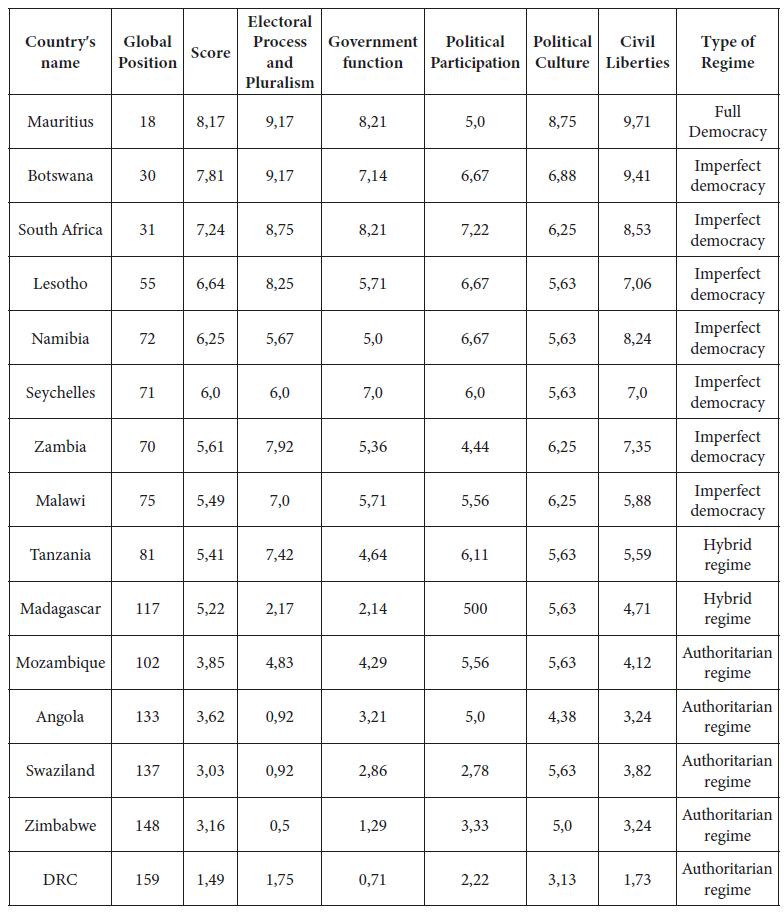
Source: Adapted by the author based on Freedom House Democracy index 2023.
Fig. 1: Table classifying levels of democracy in SADC
As with the discrepancy in the levels of democracy of the SADC member states, as shown in the table, figure 1, the representation of women in the national parliaments of the SADC member countries is also heterogeneous in its composition. The heterogeneity of women’s representation in SADC varies from over 40 per cent in the Seychelles, South Africa, Namibia, and Mozambique to less than 10 per cent in Botswana, the Democratic Republic of Congo (DRC), and Swaziland (Fig. 2).
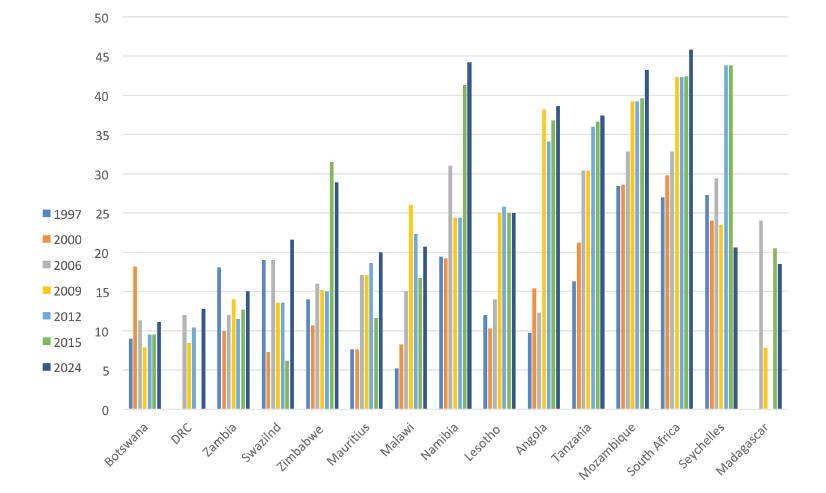
Source: Adapted by the author based on data’s of IPU (2024) and SADC (2016).
Fig. 2: Percentage representation of women in SADC parliaments 1997 to 2024
The figure 2 shows that the Seychelles, South Africa, Namibia and Mozambique are the four SADC countries with the highest rates of female representation in their national parliaments, surpassing not only the quota rate set by SADC leaders at the summit held in Gaborone in 1995 which established by 2015, all SADC member countries should have a minimum of 30 per cent representation in their National Assembly - but also, the world average rate of female parliamentary representation, which is 24.4 per cent, according to the IPU (2024). At a global level, the Seychelles, South Africa, Namibia, and Mozambique are classified as the 15 best countries with female representation in parliament (IPU 2024).
South Africa, for example, which started timidly with 27 per cent representation of women in parliamentary members in 1997; 29.8 in 2000; 32.8 in 2006; 42.3 in 2012, currently has 45.8 per cent of women in parliament, which in numerical terms, the data shows that of the 400 mandates, 181 seats are occupied by women, as illustrated in figure 3 , table 2. Mozambique, for its part, which started with 28.4 per cent in 1997, has contributed greatly to the upward increase in its representation, rising to 28.6 in 2000, 32.8 in 2006 and 39.2 in 2009. It currently has 43.2 per cent women in parliament, which means that of the 250 seats, 108 are held by women, as shown in figure 3 , table 2 (SADC 2022, IPU, 2024).
Namibia has achieved impressive results at the regional level. Since 2014, the country has adopted the principle of gender parity based on the “zebra system”, which alternates male and female candidates in its proportional electoral system. With this method, Namibia has almost doubled female representation in the Lower House, reaching 44.2 per cent compared to 19.4 in 1997 (Fig.2). This percentage corresponds to 46 women in parliament against 58 seats held by men, according to the elections of November 2019 (Fig.3).
The Seychelles, on the other hand, reached 27.3 per cent of women in parliament in 1997, when the country joined SADC as a full member. Since then, the Seychelles have continued their upward trajectory towards gender equality, reaching 43.8 per cent after the 2011 elections. However, after the October 2020 election, the representation of women in Parliament in the Seychelles dropped significantly by less than half from 43.8 per cent to 20 per cent (fig.2). In other words, of the 34 mandates, 7 seats are currently held by women and 27 by men, as shown in figure 3 (IUP, 2024). Countries such as Zimbabwe, Tanzania, Angola, and Zambia have levels of female representation in parliaments above 40 per cent. Zimbabwe, whose mandate is 270, doubled the percentage through changes to the electoral system in 2013, by including proportional representation based on the total number of votes per party per province. In this way, data from the IPU (2024) and SADC (2022) illustrate a significant increase in female representation in Parliament, from 14 per cent in 1997 to 28.9 per cent today.
Like Zimbabwe, Tanzania has also been increasing its female representation rates in parliament, from 16.3 per cent in 1997 to the current female representation rate of 37.4 per cent. This increase of women in the parliament is the result of the election held in February 2022, as shown in figure 3, as well as the presidency of Samia Hassan Suluhu, the first woman President of Tanzania and the second in SADC region, after Joyce Banda in Malawi.
Meanwhile, Angola has around 220 seats and, according to graph 2, in 2009 women won 38.2 per cent, corresponding to 82 seats, against 62.73 per cent, corresponding to 138 seats won by men. In the 2012 elections, the Angolan parliament increased the number of seats in the Assembly from 190 to 220, and in those elections, women won 34.08 per cent and currently female parliamentary representation in Angola is 38.6 per cent, according to the election held in August 2022.
Lesotho, Madagascar, Malawi, Zambia and Mauritius have a percentage of female parliamentary representation that varies between 25 and 15 per cent. In Lesotho the percentage level of female representation in parliament was 12 in 1997. Currently the country has 25 per cent of women in parliament, while Madagascar, which started with 24 per cent in 2006, dropped to 7,87 in 2009, 20.5 in 2019 and currently has 18.5, according to the election of December 2020. According to IPU data, of the 151 mandates, 28 seats are currently held by women compared to 123 for men, fig. 3 below.
Malawi, for its part, had a 5 per cent female representation rate in 1997, 8.3 in 2000, 15 in 2006, 26 percent in 2009, 22.3 in 2012, 16.3 percent in 2015 and 20.7 percent in 2024. Finally, women constitute 12 percent of the parliament in Zambia and 11 percent in Mauritius (IPU 2024).
The figures 2 and 3 also show that countries such as Botswana, Swaziland and the Democratic Republic of Congo (DRC) have a very low level of female parliamentary representation within SADC. Botswana, for example, which despite revising its laws and amending its constitution to promote greater inclusion of women, has not seen the results. Until 1997, the country had 9 per cent, 18.2 in 2000, 11.3 in 2006, 7, 9 in 2009 and from 2009 to 2023 the country maintained a constant 9.5 per cent representation of women in parliament, which corresponds to 6 mandates compared to 57 for men. In other words, 90.5 per cent of the seats in Botswana’s National Assembly are occupied by men. Alongside Botswana, Swaziland and the DRC also have low levels of female representation in parliament, with 7% and 8.9% respectively.
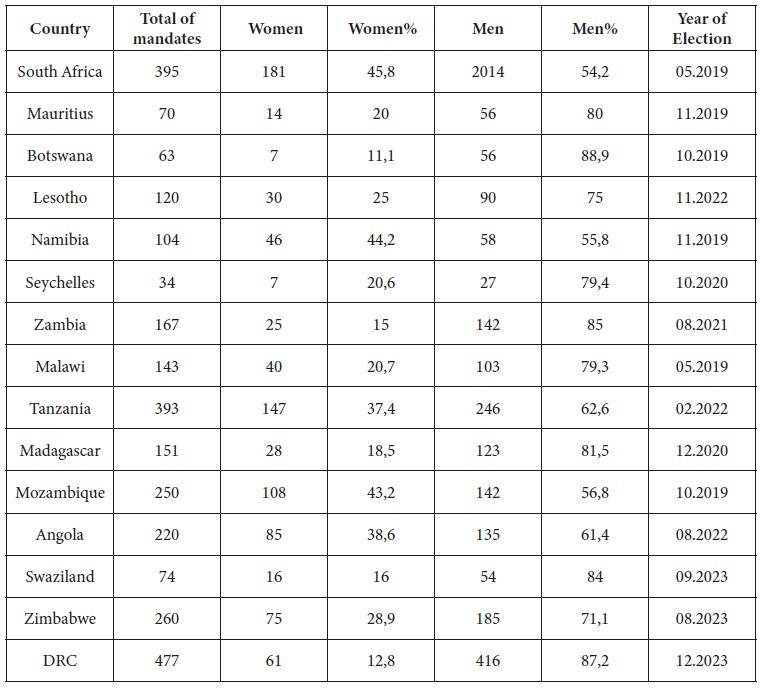
Source: Adapted by the author based on data’s of IPU (2024)
g. 3: Table representing number of parliamentary members by gender and country
Therefore, from the analysis in figure 2, it can be assumed that women in parliament in the SADC member states are well represented in some countries. However, there are still many barriers to women’s representation in some countries in the region, some of which have high levels of democracy, which encourages debate on the correlation between democracy and women’s representation in parliaments.
Ambiguity of democracy in SADC
A possible direct or inverse linear correlation between democracy and female representation in the parliaments of SADC member states seems ambiguous. Countries such as Mauritius and Botswana (fig. 1), which rank first and second respectively in terms of democracy, are positioned in tenth and eleventh place among the worst countries with a low rate of women’s parliamentary representation in SADC, with 9.5% for Botswana and 11.6% for Mauritius (IUP 2024), as illustrated in figure 3 below.
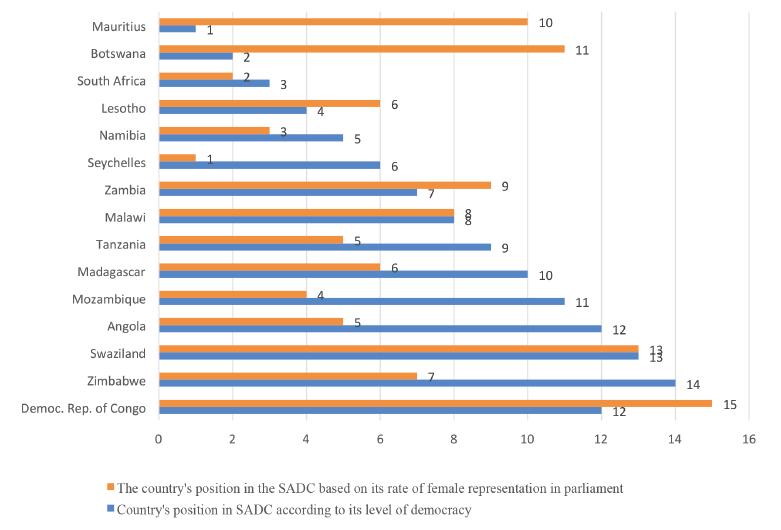
Source: Made by the author using data from IPU (2024) and Freedom House (2024).
Fig.4 The country's position in female parliamentary representation and its democracy index in SADC
The lower number in graphic means that the country is in a better ranking position, in terms of democracy and female representation in parliament. On the other hand, the higher the number represents the worse index of democracy and female representation in the country’s parliament at SADC. For instance, South Africa, which in terms of respect for democratic principles, assessed by Freedom House (2024) is in third place as one of the best countries in SADC, ranks first among the best countries with a high rate of female parliamentary representation in 2024. Similarly, the Seychelles, which presents itself as the best country in terms of democracy, is the second best country in terms of female representation in the SADC (IUP 2024).
However, Swaziland and the Democratic Republic of Congo, which have low democratic indices (fig.1), also appear in the IUP 2024 ranking barometer as the worst countries in the SADC region in terms of women’s representation in parliament, with 7% and 8.9%. One of the unanswered questions is: is this just a coincidence? However, given the prevailing democratic stagnation in these countries, it seems to confirm the premise that democracy promotes gender equality in access to politics and, since these two countries have low levels of democracy, there would be little likelihood that they would perform differently in terms of women’s parliamentary representation.
In fact, Freedom House’s 2024 report on the state of democracy in Swaziland points out that there is no democracy and no democratization process, despite the elections held in 2013 and 2018. Alongside the image of the Kingdom of Swaziland, the Freedom House report (2024) also states that since the end of the dictatorial regime in the Democratic Republic of Congo, the state has seen a slight opening towards democracy, with the approval of a new constitution and the holding of four elections, in 2006, 2011, 2018 and the last in 2023.
Despite the elections, the Freedom House platform (2024) reveals the violation of civil liberties and the high level of corruption in the DRC. It is under this perception that the article agrees with Beer (2009), when he points out that countries where women are excluded from political life tend to be less democratic and authoritarian. Analyzing Figure 1 and Figure 2, we see countries that show a certain degree of convergence in a positive direction, in terms of the indices of parliamentary representation of women and the index of democracy. This is the case of South Africa and Namibia, although they are considered imperfect democracies, assessed by the fact that electoral processes involve the participation of more than one political party, a political culture that allows civil liberties and political participation, they are considered to be the four best SADC countries with the highest parliamentary representation of women (SADC 2016).
Assuming that democracy is a regime that respects gender equality, civil liberties and grants equal opportunities to men and women in all political, economic and social spheres, this does not seem to be a sufficient or necessary condition in SADC. This calls into question some of the indices that assess and categorize democracies, not only in the SADC region but also worldwide. This questioning also extends to states known as hybrid and authoritarian regimes, such as Mozambique, Zimbabwe and Angola which have considerable female representation in their parliaments. Furthermore, how can we explain, for example, that countries such as Mauritius and Botswana, despite having high democratic indices (Freedom House 2024), have low levels of female representation in their National Assemblies?
One of the most convincing possible explanations for the high rates of women’s parliamentary representation in emerging democratic regimes or new democracies comes from Tripp et al (2009), who claim that their leaders place the representation of women in parliaments as “credentials” to gain a good image in the international community that their states are democratic, but in fact it is a descriptive representation.
In light of the above, it seems clear that the representation of women in parliament does not necessarily mean that a country is democratic or undemocratic. In other words, democracy is a necessary but not sufficient condition to justify the greater or lesser presence of women in parliament. Therefore, an explanation of the high or low parliamentary representation of women is related to various factors, such as institutional factors, the country’s level of development, cultural values, adherence to international regimes such as the 1995 Beijing Platform, which institutionalized the quota system, the Convention on the Elimination of All Forms of Discrimination against Women (1979), the Universal Declaration of Democracy (1997), pressure from multilateral international organizations (such as the United Nations), liberation movements and the political demands of women’s movements.
Final considerations
This article has examined the complex relationship between democracy and female parliamentary representation in SADC countries. The central finding is that democratization, although vital for creating political environments that are more open, inclusive, and gender-sensitive, is not sufficient on its own to guarantee higher levels of women’s representation in national legislatures. While democratic systems are expected to enhance equality, promote political competition, and broaden opportunities for historically marginalized groups, evidence from SADC countries shows that the relationship between democratic quality and women’s political representation is far more nuanced than is commonly assumed in mainstream democratic theory.
This complexity becomes especially visible when comparing Botswana and Mauritius. These countries consistently rank among the most democratic within the SADC region according to the 2024 Freedom House assessments, exhibiting strong civil liberties, vibrant multiparty systems, and stable democratic institutions. Yet, paradoxically, they register some of the lowest levels of women’s representation in parliament, as documented by Gender Monitor and Development (2016). This contradiction challenges the assumption that democratic consolidation naturally leads to gender inclusion. Instead, it suggests that even robust democracies may retain deeply rooted patriarchal norms, cultural beliefs, and electoral systems that obstruct women’s access to political leadership.
A contrasting pattern emerges in countries such as Mozambique, Zimbabwe, Tanzania, and Angola, generally classified as authoritarian. Despite weak democratic credentials, these states have achieved comparatively higher levels of women’s parliamentary representation. This appears to result from deliberate institutional measures, including legislated gender quotas, party-mandated candidate requirements, or the historical legacies of liberation movements that integrated women into political structures. These cases demonstrate that non-democratic or hybrid regimes can, under certain conditions, advance descriptive gender representation. They also underscore the decisive influence of political will and party strategy, which may, in some contexts, outweigh regime type in shaping gender outcomes. However, interpreting these patterns as a simple inversion, democracies with low female representation and authoritarian regimes with high representation, oversimplifies a diverse regional landscape. Additional cases complicate this binary. The Democratic Republic of Congo and Swaziland, for instance, remain authoritarian systems with persistently low levels of women’s representation, illustrating that authoritarianism does not inherently facilitate gender inclusion. Conversely, South Africa, Namibia, and the Seychelles, classified as incomplete or hybrid democracies, show substantially higher levels of female representation. These variations indicate that regime classification alone cannot reliably predict women’s parliamentary representation and that additional explanatory factors must be considered.
The experiences of South Africa and Namibia offer compelling evidence of the importance of these variables. In both countries, political parties have played a pivotal role in advancing gender equality. The African National Congress (ANC) in South Africa and the Southwest Africa People’s Organization (SWAPO) in Namibia have adopted voluntary gender quotas, parity commitments, and “zebra” candidate lists that alternate male and female candidates. These mechanisms significantly increase women’s chances of election. Both countries have also demonstrated sustained commitment to international gender equality frameworks, including the SADC Protocol on Gender and Development and several United Nations conventions. The alignment of domestic institutions with global norms highlights how political leadership and institutional design can be as influential as democratic depth in shaping women’s representation.
The case of the Seychelles further expands the analytical perspective by demonstrating the importance of socio-cultural contexts. As a predominantly matriarchal society, the Seychelles has historically assigned women strong roles in family, community, and economic spheres. These cultural dynamics reduce barriers to women’s political participation and ensure that legal rights are more fully realized in practice. The Seychelles illustrates that cultural conditions can either reinforce or undermine formal democratic structures, and that societal attitudes are crucial for understanding variations in women’s representation.
Taken together, these findings show that parliamentary representation in SADC countries cannot be understood through a simple dichotomy between democratic and authoritarian regimes. Representation emerges from a dynamic interaction of multiple factors, including electoral systems, party ideologies, gender policies, cultural norms, historical legacies, and adherence to international commitments. These factors differ significantly across countries and interact in ways that may either foster or constrain women’s political advancement.
Given this complexity, the study highlights a critical direction for future research: the need to rethink the frameworks used to evaluate democratic quality in Africa and beyond. Traditional democratic assessments prioritize civil liberties, political pluralism, participation, and political culture. While these dimensions remain important, they inadequately capture the extent to which political systems include or exclude women. A democracy that marginalizes half of its population cannot be considered fully consolidated, regardless of its performance on other indicators. Future research should therefore explore the integration of gender representation indicators into democratic assessment frameworks, both as descriptive measures and as normative standards of democratic performance.
Such a shift would enrich both theory and practice. Theoretically, it would promote a more substantive understanding of democracy, one that views equitable participation as a foundational principle rather than a secondary goal. Practically, it would encourage governments, political parties, and civil society organizations to implement measures that support women’s political empowerment, including legislative quotas, leadership training programs, civic education initiatives, and efforts to transform discriminatory social norms.
In conclusion, this article demonstrates that the relationship between democratization and women’s parliamentary representation in SADC countries is neither linear nor predictable. It is shaped by a complex interplay of political, institutional, and socio-cultural factors. While democracy can create openings for inclusion, these openings do not automatically translate into meaningful gains for women without deliberate institutional support, strong political will, and favorable cultural contexts. Advancing gender equality in parliamentary representation therefore requires comprehensive and integrated strategies that merge political reform with social transformation. Ultimately, such efforts challenge us to refine our understanding of what constitutes a genuinely democratic political system, one that is inclusive not only in form, but also in practice.

