




 Inglês (pdf)
 Artigo em XML
 Referências do artigo
 Tradução automática
 Enviar este artigo por email
 Citado por SciELO
  Similares em
SciELO
Similares em
SciELO 
 Permalink
Introduction
Acne vulgaris is a multifactorial, chronic inflammatory disorder of the pilosebaceous unit. Pathogenesis involves an interplay of factors, including hyperkeratinization of the follicular ostium, increased sebum production, bacterial colonization (primarily by Cutibacterium acnes), inflammation, hormonal influences, diet, and genetic predisposition. While many patients with acne present with normal androgen levels, conditions such as polycystic ovarian syndrome (PCOS) and congenital adrenal hyperplasia may lead to androgen excess and acne exacerbation1.
Metabolic syndrome is a cluster of interrelated conditions, including insulin resistance, central obesity, dyslipidemia, and hypertension, and has been increasingly associated with chronic inflammatory skin disorders, including acne. Both conditions share common pathophysiological mechanisms, such as chronic inflammation, oxidative stress, and hormonal dysregulation2.
Metabolic syndrome is driven by insulin resistance in muscle, fat, and liver cells, exacerbated by visceral obesity and elevated free fatty acids. This leads to increased glucose, triglycerides, and very low-density lipoproteins, creating a vicious cycle of insulin oversecretion and lipolysis. Oxidative stress from impaired sebum scavenging mechanisms further links lipid abnormalities to metabolic syndrome. Hormonal imbalances secondary to hyperinsulinism and insulin resistance can trigger androgen-dependent skin conditions such as acne and hirsutism. Inflammatory cytokines such as interleukin-17 and Tumor Necrosis Factor alpha (TNF-α) that are implicated in psoriasis and atopic dermatitis3 may also possibly contribute to a metabolic syndrome in acne. While some studies have reported a higher prevalence of metabolic syndrome among acne patients4, the overall evidence remains inconsistent. Notably, the role of dietary factors, particularly high glycemic index diets, in acne remains a subject of ongoing debate, with conflicting findings in the literature. In North-Eastern India, where rice and carbohydrate-rich staples predominate, the possibility of this association warrants a closer investigation. There is a lack of data from this geographically and ethnically distinct region of India, where unique dietary patterns and lifestyle factors may influence the development of acne and its potential systemic associations. Understanding and evaluating the relationship between acne and metabolic syndrome in this context may aid in early diagnosis and provide opportunities for integrated treatment strategies targeting both cutaneous and systemic aspects of the disease.
Methods
A cross-sectional observational study was conducted over a period of 1 year in the dermatology outpatient department of a tertiary care teaching hospital in North-Eastern India, after receiving approval from the Institutional Ethics Committee. All eligible adult patients presenting with acne vulgaris and/or truncal acne were recruited through consecutive sampling after obtaining written informed consent. The exclusion criteria involved patients who were diagnosed with PCOS, female patients with irregular menstruation history, amenorrhea or oligomenorrhea, hirsutism, associated male pattern baldness, pregnancy, and acne patients who have taken isotretinoin in the last 3 months.
A detailed assessment of the patient’s demographic profile, clinical history, and clinical evaluation was done based on a predefined pro forma. Dietary practices were assessed using a structured 7-day recall method, wherein participants were asked to report the number of servings per week for common food items such as vegetables, fruits, chicken, pork, beef, and fish. Participants also provided information on the primary type of cooking oil used at home (e.g., refined oil, mustard oil). The recall focused solely on weekly serving frequency and oil type; detailed portion sizes or nutrient quantification were not assessed. No validated dietary assessment tool was used, which is acknowledged as a limitation. Physical activity was similarly evaluated using a 7-day recall approach. Patients were asked to report engagement in moderate-intensity activities such as brisk walking, cycling at a regular pace, gardening, vacuuming, and doubles tennis. Data were recorded in terms of frequency (days per week) and approximate duration (minutes or hours per day), based on patient-reported estimates. Body mass index (BMI) was calculated and graded according to the recommendations of the Asia-pacific task force: underweight (< 18.5 kg/m2), normal weight (18.5-22.9 kg/m2), overweight (23.0-24.9 kg/m2), and obesity class I (25.0-29.9 kg/m2), and obesity class II (≥ 30.0 kg/m2).
Severity of acne was calculated using the global acne grading system5 by a single dermatologist, which involves dividing the face (including the forehead, both cheeks, the nose, and the chin), chest, and back into six specific regions. The severity of lesions in each area is rated on a scale from 0 to 4, where 0 indicates no lesions, 1 represents comedones, 2 denotes papules, 3 signifies pustules, and 4 corresponds to nodules. After assigning scores for all six regions, the total score is calculated, which is then used to classify acne severity as mild (1-18), moderate (19-30), severe (31-38), or very severe (> 39). Assessment of laboratory parameters was done after overnight fasting for 8 h and included measurement of blood sugar, lipid profile (cholesterol, triglycerides, and high-density lipoprotein [HDL]), uric acid, thyroid profile (thyroid-stimulating hormone [TSH]), vitamin D3, testosterone, dehydroepiandrosterone sulfate (DHEAS), estradiol, and insulin.
Insulin resistance was defined using the Homeostasis Model Assessment of Insulin Resistance (HOMA-IR) using the formula: fasting insulin (in micro-units per milliliter) multiplied by fasting glucose (in milligrams per deciliter), then divided by 405. Values exceeding 2.5 were considered to be suggestive of insulin resistance6.
Metabolic syndrome was diagnosed using the guidelines established by the modified National Cholesterol Education Program Adult Treatment Panel III (NCEP-ATP III)7. The criteria include the presence of any three or more of the following five risk factors:
– Central obesity, indicated by a waist circumference of at least 102 cm for men and 88 cm for women (adjusted for Asian populations to > 90 cm and 80 cm, respectively)
– Triglyceride levels of 150 mg/dL or higher, or the use of medication for elevated triglycerides
– HDL cholesterol levels below 40 mg/dL, or medication for low HDL levels
– A blood pressure of 130/85 mmHg or above, or the use of antihypertensive medication
− A fasting plasma glucose level of 100 mg/dL or higher, or the use of medication to treat diabetes mellitus.
It is important to note that fasting insulin levels are not included in the NCEP-ATP III criteria. Instead, waist circumference is utilized as a surrogate marker, given its strong correlation with insulin resistance8.
The data were entered in a Microsoft Excel sheet (Microsoft® Excel for Mac Version 16.98 [25060824]) and analyzed using Jamovi software (version 2.6.25.0)9. Categorical variables were expressed as absolute frequencies and relative frequencies (percentages), whereas continuous variables were summarized as mean ± standard deviation or median with interquartile range, depending on data distribution. Associations between grades of acne or BMI with categorical variables such as metabolic syndrome and insulin resistance were assessed using the Mann-Whitney U test. Fisher’s exact test was employed to evaluate associations between binary variables due to the small number of positive outcomes. Comparisons of continuous biochemical parameters across acne severity grades were performed using the Kruskal-Wallis test. While logistic and ordinal regression models were considered to explore adjusted associations, they were not performed due to the limited number of outcome events. A p < 0.01 was considered statistically significant.
Results
A total of 73 adult patients were included in the study. The patients ranged from 18 to 35 years with a median age of 21 years (interquartile range: 19-25 years) and a mean age of 22.2 ± 3.85. Approximately 70% (n = 51) of the patients were female, with a M:F ratio of 0.43. The majority (82.2%, n = 60) of patients belonged to an urban background.
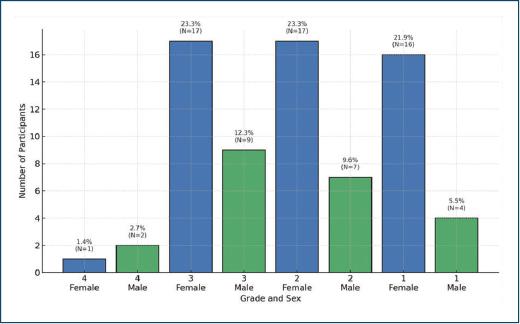
Acne vulgaris was seen in 50.7% (n = 37), followed by 37% (n = 27) having both acne vulgaris and truncal acne, and the remaining 12.3% (n = 09) had isolated truncal acne. Out of all, the majority (35.6%, n = 26) had a severe grade of acne (Fig. 1). The duration of the disease ranged from 1 month to 15 years, with a median duration of 3 years (interquartile range: 2-5 years).
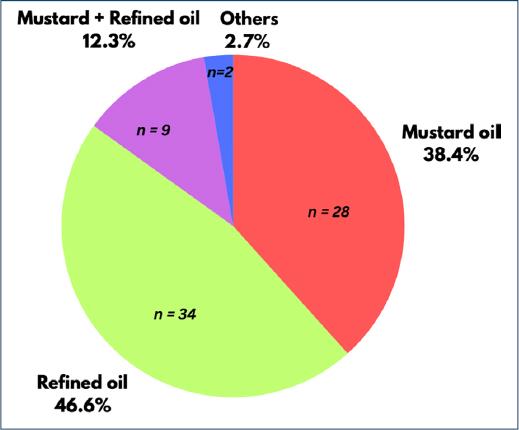
A positive family history of chronic non-communicable diseases (including diabetes mellitus and hypertension) was found in 39.7% (n = 29). Furthermore, 21.9% (n = 16) and 11% (n = 8) patients gave a history of chronic alcohol consumption and smoking, respectively.Almost 50.7% (n = 37) of patients gave a history of consumption of home-cooked food, out of which 54.8% (n = 40) had three servings and 43.8% (n = 32) had at least two servings. The majority of patients had vegetables on all days of the week with occasional servings of non-vegetarian meals (Table 1). Refined oil and mustard oil were commonly used for home-based cooking (Fig. 2).
Table 1 Distribution of weekly servings of major food groups by sex
| Servings | Sex | n | Mean | Standard deviation | Minimum | Maximum |
|---|---|---|---|---|---|---|
| Vegetables | Female | 51 | 6.176 | 1.466 | 2 | 7 |
| Male | 22 | 5.636 | 1.891 | 1 | 7 | |
| Fruits | Female | 51 | 3.176 | 2.260 | 0 | 7 |
| Male | 22 | 2.591 | 1.894 | 0 | 7 | |
| Chicken | Female | 51 | 2.157 | 1.901 | 0 | 7 |
| Male | 22 | 2.136 | 1.521 | 0 | 6 | |
| Pork | Female | 51 | 1.176 | 1.852 | 0 | 7 |
| Male | 22 | 0.227 | 0.528 | 0 | 2 | |
| Beef | Female | 51 | 1.078 | 1.440 | 0 | 7 |
| Male | 22 | 0.909 | 1.688 | 0 | 7 | |
| Fish | Female | 51 | 1.588 | 1.663 | 0 | 7 |
| Male | 22 | 1.682 | 1.729 | 0 | 7 |
Mean moderate physical activity was 1.27 days/week and 11.37 min spent/day (Table 2).
Table 2 Distribution of physical activity and anthropometric variables by sex
| Variable | Sex | n | Mean | Standard deviation | Minimum | Maximum |
|---|---|---|---|---|---|---|
| Moderate physical activity (minutes/day) | Female | 51 | 3.333 | 10.280 | 0 | 60 |
| Male | 22 | 30.000 | 50.710 | 0 | 180 | |
| Moderate physical activity (days/week) | Female | 51 | 0.765 | 1.830 | 0 | 7 |
| Male | 22 | 2.455 | 3.080 | 0 | 7 | |
| 10 min walk (days/week) | Female | 51 | 4.157 | 3.100 | 0 | 7 |
| Male | 22 | 5.182 | 2.920 | 0 | 7 | |
| Walks (minutes/day) | Female | 51 | 36.275 | 47.460 | 0 | 180 |
| Male | 22 | 55.682 | 70.670 | 0 | 240 | |
| Leisure/sitting in a week (hours/day) | Female | 51 | 5.784 | 2.370 | 1 | 12 |
| Male | 22 | 6.364 | 2.340 | 1 | 12 | |
| Waist circumference (in centimetres) | Female | 51 | 80.200 | 10.690 | 63 | 116 |
| Male | 22 | 78.700 | 9.320 | 63 | 93 | |
| Hip circumference (in centimetres) | Female | 51 | 90.700 | 8.250 | 73 | 121 |
| Male | 22 | 91.400 | 8.160 | 73 | 104 | |
| Weight (in kilograms) | Female | 51 | 53.500 | 10.930 | 39 | 99 |
| Male | 22 | 59.500 | 9.700 | 41 | 79 | |
| Height (in centimetres) | Female | 51 | 155.100 | 5.460 | 143 | 168 |
| Male | 22 | 167.300 | 5.900 | 149 | 178 | |
| Systolic blood pressure (mmHg) | Female | 51 | 111.800 | 9.260 | 90 | 138 |
| Male | 22 | 121.100 | 16.130 | 100 | 180 | |
| Diastolic blood pressure (mmHg) | Female | 51 | 73.500 | 7.490 | 60 | 90 |
| Male | 22 | 80.400 | 10.320 | 60 | 100 |
Anthropometry revealed 35.29% (n = 18) of females and 13.63% (n = 3) of males had a waist circumference of > 80 cm and > 90 cm, respectively. Furthermore, 12.32% (n = 9) of patients had a blood pressure of > 130/85 mmHg (Table 2).
The median BMI was 20.93 kg/m2 (interquartile range: 19.27-23.99 kg/m2). Among female participants (n = 51), 7 (13.7%) were underweight, 27 (52.9%) had normal weight, 6 (11.8%) were overweight, 9 (17.6%) were classified as Obesity Class I, and 2 (3.9%) as Obesity Class II. Among males (n = 22), 3 (13.6%) were underweight, 13 (59.1%) had normal weight, 2 (9.1%) were overweight, and 4 (18.2%) were classified as Obesity Class I, with none in Obesity Class II. Overall, 8 participants (11.0%) were overweight and 15 (20.5%) were obese, resulting in a combined prevalence of 31.5% with elevated BMI.
The biochemical profile of participants was comprehensively evaluated across acne severity grades. No consistent or clinically meaningful differences were observed in serum uric acid, TSH, DHEAS, insulin, fasting blood glucose, total cholesterol, triglycerides, HDL, estradiol, or testosterone levels (all p > 0.01, Kruskal-Wallis test). Only serum vitamin D levels approached statistical significance (p = 0.011, Kruskal-Wallis test), though this did not meet the predefined threshold of p < 0.01 (Table 3). When categorized using clinical reference standards, vitamin D deficiency (< 20 ng/mL) was observed in 52 participants (71.2%), insufficiency (20-29 ng/mL) in 18 participants (24.7%), and sufficiency (≥ 30 ng/mL) in only 3 participants (4.1%). No cases of vitamin D toxicity were noted.
Table 3 Distribution of biochemical parameters by sex with corresponding p-values (Kruskal-Wallis test)
| Biochemical parameter | Sex | n | Mean | Standard deviation | Minimum | Maximum | p |
|---|---|---|---|---|---|---|---|
| Uric acid (mg/dL) | Female | 51 | 4.939 | 0.913 | 2.700 | 7.300 | 0.727 |
| Male | 22 | 6.473 | 1.669 | 2.900 | 9.500 | ||
| TSH (mU/mL) | Female | 51 | 2.115 | 1.231 | 0.790 | 6.870 | 0.693 |
| Male | 22 | 1.668 | 0.921 | 0.040 | 4.530 | ||
| Vit. D (ng/mL) | Female | 51 | 17.160 | 5.382 | 7.700 | 34.210 | 0.011 |
| Male | 22 | 18.153 | 6.637 | 10.600 | 34.210 | ||
| Estradiol (pg/mL) | Female | 51 | 129.843 | 96.615 | 28.000 | 506.000 | 0.778 |
| Male | 22 | 53.364 | 23.114 | 20.000 | 123.000 | ||
| Testosterone (ng/dL) | Female | 51 | 0.974 | 1.467 | 0.130 | 6.790 | 0.154 |
| Male | 22 | 4.183 | 2.747 | 0.190 | 7.870 | ||
| DHEAS (mcg/dL) | Female | 51 | 202.625 | 86.982 | 54.900 | 404.900 | 0.744 |
| Male | 22 | 271.777 | 171.668 | 77.300 | 832.400 | ||
| Total cholesterol (mg/dL) | Female | 51 | 141.588 | 32.344 | 76.000 | 231.000 | 0.152 |
| Male | 22 | 133.455 | 25.069 | 73.000 | 176.000 | ||
| Triglycerides (mg/dL) | Female | 51 | 77.980 | 27.335 | 37.000 | 170.000 | 0.989 |
| Male | 22 | 102.818 | 40.086 | 43.000 | 169.000 | ||
| HDL (mg/dL) | Female | 51 | 49.392 | 8.300 | 32.000 | 69.000 | 0.099 |
| Male | 22 | 42.773 | 9.938 | 27.000 | 62.000 | ||
| FBS (mg/dL) | Female | 51 | 82.588 | 7.052 | 70.000 | 110.000 | 0.769 |
| Male | 22 | 83.000 | 8.608 | 61.000 | 101.000 | ||
| Insulin (mIU/L) | Female | 51 | 5.749 | 2.891 | 1.710 | 14.920 | 0.628 |
| Male | 22 | 5.642 | 0.913 | 1.260 | 7.300 | ||
| HOMA-IR score | Female | 51 | 1.184 | 1.669 | 0.312 | 9.500 | - |
| Male | 22 | 1.208 | 1.231 | 0.236 | 6.870 |
TSH: thyroid-stimulating hormone; DHEAS: dehydroepiandrosterone sulphate; HDL: high-density lipoprotein; FBS: fasting blood sugar; HOMA-IR: homeostasis model assessment of insulin resistance.
According to the HOMA-IR criteria, 6.85% (n = 5) of patients had insulin resistance, out of which three were female and had a severe grade of acne. In line with the NCEP-ATP III criteria, 5.47% (n = 4) of patients had metabolic syndrome, out of which half had insulin resistance. However, no statistically significant association was found between acne severity and either metabolic syndrome or insulin resistance (Table 4). A statistically significant association was observed between BMI and the presence of metabolic syndrome (p = 0.007, Mann-Whitney U test), with higher BMI values noted among participants with metabolic syndrome. In contrast, the association between BMI and insulin resistance did not reach the predefined threshold for statistical significance (p = 0.026), though a trend toward higher BMI in insulin-resistant individuals was noted.
Table 4 Statistical associations between clinical variables and metabolic outcomes
| Association tested | Statistical test | p |
|---|---|---|
| Grade versus metabolic syndrome | Mann-Whitney U | 0.069 |
| Grade versus insulin resistance | Mann-Whitney U | 0.305 |
| BMI versus metabolic syndrome | Mann-Whitney U | 0.007 |
| BMI versus insulin resistance | Mann-Whitney U | 0.026 |
| Sex versus metabolic syndrome | Fisher’s Exact | 0.579 |
| Sex versus insulin resistance | Fisher’s Exact | 0.634 |
BMI: body mass index.
Discussion
Acne vulgaris and metabolic syndrome may share overlapping pathogenic mechanisms, including chronic inflammation, oxidative stress, hormonal dysregulation, and nutrient-sensing pathway disturbances such as elevated mechanistic target of rapamycin complex 1 (mTORC1) activity. Increased mTORC1 signaling, observed in acne-prone skin, has been linked to insulin resistance and obesity, underscoring the complex interplay between dermatological and metabolic pathways10.
In our study, a total of 73 patients were included. 70% of our patients were female, which was akin to other studies showing a female preponderance11. The mean age of our patients was 22.2 ± 3.85, which is similar to another study by Chandak et al., where the mean age was 23.43 ± 3.99 years with predominantly mild to moderate grades of acne; however, in our study, the majority of patients had severe acne (grades 3 and 4)12. The predominance of severe acne in this study population may be partly shaped by the nature of a tertiary care setting, where individuals with persistent, distressing, or treatment-refractory acne are more inclined to seek specialized help either through formal referral or personal initiative. In the context of North-Eastern India, this could also reflect broader patterns, where access to early dermatological care is uneven, over-the-counter remedies are commonly used, and visible skin conditions carry a social weight that quietly urges people to seek help only when the burden becomes too much. These are possibilities that merit deeper, community-rooted inquiry.
According to the seven-day recall method, half of our study participants gave a history of consumption of home-cooked meals with a predominant component of vegetables and chicken. Refined oil and mustard oil were the most commonly used oils for the preparation of food. According to a study by Bansal et al., 23.33% of females gave a history of oily food intake regularly13. A high glycemic diet may trigger acne through disrupted nutrient signaling, leading to hyperkeratosis, hyper-seborrhea, and mTORC1 activation, alongside elevated androgen levels14. The mean waist circumference in our patients was 79.8 cm, which was comparable to another study by Kaya et al.15. Acne in industrialized countries signals aberrant nutrient-driven mTORC1 activation, linked to chronic diseases. Therefore, dermatologists should leverage dietary interventions to mitigate acne and prevent mTORC1-driven conditions16,17.
The mean moderate physical activity duration in our study participants was approximately 80 min/week, which is inconsistent with the recommended World Health Organization 2020 guidelines on physical activity and sedentary behavior18. In the present study, the median BMI of participants was 20.93 kg/m2 (interquartile range: 19.27-23.99 kg/m2), with 11.0% classified as overweight and 20.5% as obese, reflecting a combined prevalence of elevated BMI in 31.5% among the participants. Importantly, BMI demonstrated a statistically significant association with metabolic syndrome (p = 0.007) and a suggestive trend with insulin resistance (p = 0.026), reinforcing the metabolic implications of higher BMI even in a young population. In our study, serum biochemical parameters, including uric acid, TSH, testosterone, estradiol, DHEAS, lipid profile, fasting glucose, and insulin, were largely within normal physiological ranges across both sexes. Notably, no participants demonstrated thyroid dysfunction, suggesting a predominantly euthyroid status in contrast to findings by Bungau et al.19, where hypothyroidism or autoimmune thyroiditis was frequently observed among acne patients. However, vitamin D levels were generally low in our study population, with only three participants falling within the normal range. This aligns with a recent meta-analysis by Hasamoh et al.20, which found significantly lower serum vitamin D levels in acne patients compared to healthy controls and a negative correlation between vitamin D levels and acne severity. While these findings suggest a potential role of vitamin D in acne pathogenesis, our results highlight the importance of interpreting laboratory data within a broader clinical and contextual framework, especially in populations where baseline hypovitaminosis D may be widespread due to lifestyle or geographic factors, rather than assuming direct causality.
As per the HOMA-IR criteria and NCEP-ATP III, 7% patients had insulin resistance and 5.47% had metabolic syndrome, respectively; however, there was no significant association with acne severity. It was albeit not in consonance with other studies, which showed a statistically significant association between acne, metabolic syndrome, and/or insulin resistance21-24. However, this may be attributed to the overall low prevalence of metabolic syndrome in the north eastern part of India, which is supported by a study by Meher and Sahoo, revealing the states of Meghalaya and Assam to have the lowest prevalence of metabolic syndrome in the case of females (0.5%) and males (0.4%) respectively. In the same study, overall north-eastern India showed a prevalence of metabolic syndrome to be 0.7% in females and 0.5% in males25.
Several limitations must be acknowledged when interpreting our findings. First, the heterogeneous distribution of acne severity among participants may have diluted potential associations, especially in the absence of a control group. Second, the dietary data were collected using a 7-day recall period without a validated assessment tool, introducing potential recall bias and limiting the precision of dietary intake estimates. Third, the lack of age- and sex-matched healthy controls restricts our ability to draw definitive comparisons. These factors, combined with the cross-sectional design and relatively small sample size, suggest that our findings should be interpreted with caution and not extrapolated beyond the studied population. Future longitudinal studies with standardized dietary assessments and appropriate control groups are warranted to provide deeper insights into the metabolic underpinnings of acne, especially within diverse regional populations such as those in North-East India.
Conclusion
In this study from a tertiary care centre in North-Eastern India, no significant association was found between acne severity and metabolic syndrome or insulin resistance. Although over 30% of participants were overweight or obese, and vitamin D deficiency was widespread, these factors did not show a consistent association with acne severity. These findings highlight the multifactorial nature of acne, shaped by intricate metabolic and nutritional influences that may vary across populations. Given the study’s cross-sectional design, modest sample size, and absence of validated dietary tools or matched controls, the results should be interpreted within the unique clinical and nutritional landscape of North-Eastern India, without extrapolation to broader populations. Further longitudinal research is warranted to unravel these associations in more depth, especially in under-represented regions.
What does the study add?
This study contributes to evaluating the relationship between acne vulgaris and metabolic syndrome in patients from North-Eastern India, a population largely under-represented in dermatologic-metabolic research. Even though many participants presented with severe acne, the study did not identify a meaningful link with metabolic syndrome or insulin resistance. These findings challenge assumptions of universal dermato-metabolic linkage and emphasize the influence of regional variables, including diet, physical activity, and metabolic profile, on systemic inflammatory pathways in acne, along with underscoring the importance of conducting broader, multi-regional studies across ethnically and culturally diverse populations to better understand the potential metabolic underpinnings of acne.

