




 Inglês (pdf)
 Artigo em XML
 Referências do artigo
 Tradução automática
 Enviar este artigo por email
 Citado por SciELO
  Similares em
SciELO
Similares em
SciELO 
 Permalink
Introduction
Confluent and reticulated papillomatosis (CRP) of Gougerot and Carteaud is a rare dermatosis characterized by hyperpigmented papules with a slightly verrucous surface, which tends to coalesce into a reticulated pattern. This condition predominantly affects young individuals, with a higher prevalence in women and people with darker skin tones1. The lesions are commonly located on the upper trunk, particularly in the interscapular, sternal, and inframammary areas, but may extend to the neck and other regions.
Although the exact etiology of CRP is not yet fully understood, genetic, environmental, and hormonal factors are believed to play significant roles. The disease is chronic and usually asymptomatic, although some patients may report mild pruritus in the affected areas2. Histologically, CRP is characterized by acanthosis, papillomatosis, and mild hyperkeratosis without significant inflammatory changes.
The diagnosis is generally clinical, based on the characteristic appearance of the lesions. Dermoscopy and skin biopsy can be helpful in atypical cases to confirm the diagnosis and rule out other pigmented dermatoses, such as acanthosis nigricans and pigmented lichen planus3. Treatment options for CRP include topical agents, such as retinoids and keratolytics, as well as systemic therapies for more extensive cases, although treatment response can be variable, and recurrence is common.
Azithromycin, a macrolide widely used in bacterial infections, has shown potential for improving CRP symptoms due to its ability to modulate the inflammatory response. Studies and case reports have demonstrated that azithromycin can provide significant relief of papillomatous lesions and improve the quality of life of patients affected by this condition4.
In this context, this study reviews the use of azithromycin in the treatment of CRP of Gougerot and Carteaud, highlighting its efficacy and outcomes in patients who did not respond adequately to conventional therapies. The approach aims to provide a comprehensive perspective on the effectiveness of azithromycin as a therapeutic alternative for managing this challenging dermatological condition.
Case report
A 19-year-old obese male patient presented with a 3-year history of brownish plaques, initially appearing on the anterior trunk and progressively spreading to the back, neck, and cubital fossae. The patient denied pruritus, pain, or other associated symptoms, as well as any prior treatments. On dermatological physical examination, plaques composed of punctate, brownish papules, confluent at the center with a reticulated peripheral pattern, were observed on the anterior and posterior neck, intermammary region, epigastrium, back, and bilateral cubital fossae (Figs. 1 A and B).
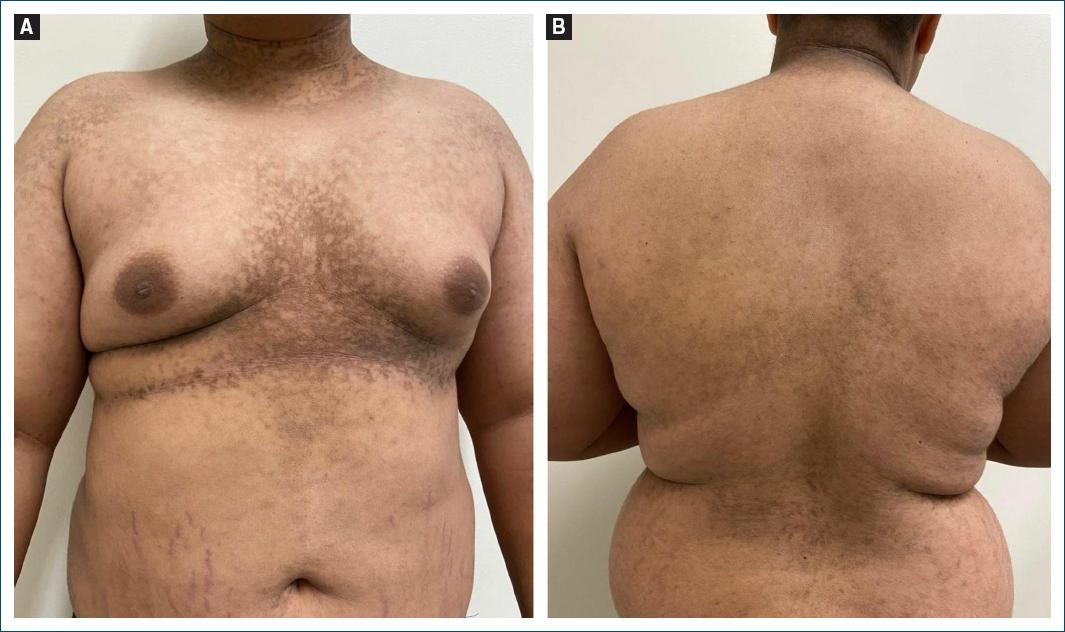
Figure 1 A: brownish papules, more grouped in the center and scattered on the periphery, located on the anterior trunk of an untreated patient. B: brownish papules, more grouped in the center and scattered on the periphery, located on the posterior trunk of an untreated patient.
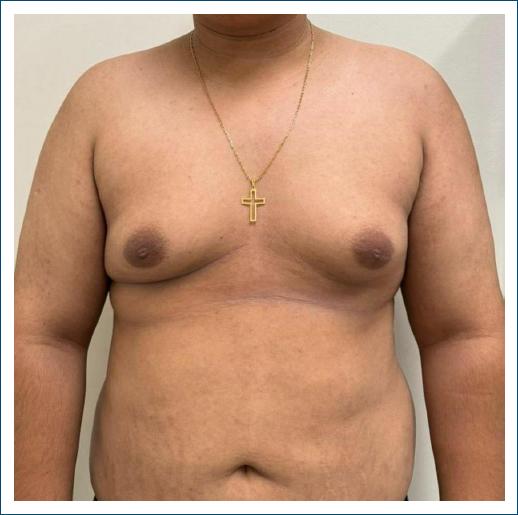
The primary diagnostic hypothesis was CRP of Gougerot-Carteaud. Treatment was initiated with azithromycin 500 mg orally once daily for three consecutive days per week, with a pause for the remaining days, over a total duration of 6 weeks. The condition showed complete resolution within 3 months (Fig. 2A). The patient was followed for a period of approximately 12 months, without recurrences.
Discussion
Conventionally, the management of CRP involves the use of topical treatments, such as retinoids and keratolytics, but the response to these therapies can be inconsistent, with frequent recurrences3. In recent years, azithromycin, a macrolide antibiotic, has emerged as an effective option for the treatment of CRP, likely due to its anti-inflammatory and immunomodulatory properties, in addition to its antimicrobial activity. The use of azithromycin in intermittent doses has shown promising results, with reports of significant clinical improvement in patients refractory to other forms of treatment4.
Studies suggest that azithromycin may reduce inflammation and inhibit bacterial proliferation, which hypothetically could contribute to the pathogenesis of CRP. Furthermore, azithromycin’s prolonged action, due to its long half-life, allows for convenient dosing regimens, such as weekly administration, improving treatment adherence4.
A study conducted by Engin et al. reported that patients treated with azithromycin experienced significant improvement in skin lesions after a short treatment period, with few side effects. This makes azithromycin an attractive alternative, especially in cases where topical treatments are ineffective or poorly tolerated. However, it is important to note that treatment responses may vary, and recurrence, though less common, can still occur, suggesting the need for long-term follow-up4.
Other case studies report successful treatment of CRP of Gougerot-Carteaud with azithromycin. In Brazil (2008), a 28-year-old male patient was treated with 500 mg of azithromycin for three consecutive days in weekly cycles for six weeks, showing satisfactory improvement5. In 2021, another Brazilian case involving a 19-year-old male patient treated with CRP with the same regimen combined with topical urea and ammonium lactate, resulting in complete remission after 8 weeks6. In Turkey (2013), a 16-year-old female patient used 250 mg of azithromycin daily for 12 days, with significant improvement in lesions and no recurrence after 3 months7.
Conclusion
Despite promising results, the use of azithromycin for CRP still requires further controlled studies to establish its long-term efficacy and determine the optimal dosage regimen. Moreover, since the exact mechanism by which azithromycin benefits CRP patients is not fully understood, additional research is necessary to better understand the disease’s pathophysiology and optimize therapeutic approaches8,9.

