


SciELO - Scientific Electronic Library Online

 
vol.83 número3A perplexidade diagnóstica da metástase cutânea zosteriforme no carcinoma de mamaPatergia cutânea e carcinoma espinocelular: relato de dois casos índice de autoresíndice de assuntosPesquisa de artigos
Home Pagelista alfabética de periódicos  

Serviços Personalizados

Journal

Artigo

Indicadores

Links relacionados

  • Não possue artigos similaresSimilares em SciELO

Compartilhar


Portuguese Journal of Dermatology and Venereology

versão impressa ISSN 2795-501Xversão On-line ISSN 2795-5001

Port J Dermatol Venereol. vol.83 no.3 Lisboa set. 2025  Epub 30-Set-2025

https://doi.org/10.24875/pjdv.25000007 

CASE REPORT

Punctate palmoplantar keratoderma type I: the clinical and genetic features of two family members with AAGAB gene mutation

Queratodermia palmoplantar punctata do tipo I: as características clínicas e genéticas de dois membros familiares com mutação do gene AAGAB

Lanyu Sun1  * 

Leonor Lopes1 

Pedro de Vasconcelos1 

Luís Soares-de-Almeida1  2 

Gabriel Miltenberger-Miltenyi3 

João Ferreira1  2  3 

Paulo Filipe1  2  3 

1Serviço de Dermatologia, Unidade Local de Saúde Santa Maria

2Clínica Universitária de Dermatologia, Faculdade, Medicina da Universidade de Lisboa

3IMM João Lobo Antunes, Faculdade de Medicina, Universidade de Lisboa. Lisbon, Portugal


Abstract

Hereditary punctate palmoplantar keratoderma type I (PPPK1) is a rare autosomal dominant disorder characterized by hyperkeratotic papules on the palms and soles, typically appearing in adolescence but occasionally manifesting later in life. We describe two family members, an African woman (61 years old) and her daughter (29 years old), presenting with multiple asymptomatic hyperkeratotic papules on the palms and soles. Histopathology revealed orthohyperkeratosis, acanthosis, hypergranulosis, and elongated rete ridges. Genetic analysis identified a heterozygous c.535+1G>A mutation in the AAGAB gene. Despite topical salicylic acid, urea, and tretinoin treatment, only minimal improvement was observed. PPPK1 pathogenesis involves genetic factors, with AAGAB being a major contributor, although other loci may be implicated. These cases highlight the phenotypic variability and delayed disease onset in some individuals, underscoring the need for further investigation into the underlying genetic mechanisms and effective treatment strategies.

Keywords Punctate palmoplantar keratoderma; Hereditary keratodermas; AAGAB mutation

Resumo

A queratodermia palmo-plantar punctata do tipo I (PPPK1) é uma doença autossómica dominante rara, caracterizada por pápulas hiperqueratósicas nas palmas e plantas, que geralmente surgem na adolescência, mas podem manifestar-se mais tarde na vida. Descrevemos dois membros de uma mesma família, uma mulher africana de 61 anos e a sua filha de 29 anos, ambas com múltiplas pápulas hiperqueratósicas assintomáticas nas palmas e plantas. A histopatologia revelou hiperqueratose ortoqueratósica, acantose, hipergranulose e cristas epidérmicas alongadas. A análise genética identificou uma mutação heterozigótica c.535+1G>A no gene AAGAB. Apesar do tratamento tópico com ácido salicílico, ureia e tretinoína, foi observada apenas uma melhoria mínima. A patogénese da PPPK1 envolve fatores genéticos, sendo o AAGAB um contributo importante, embora outros loci possam estar envolvidos. Estes casos destacam a variabilidade fenotípica e o início tardio da doença em alguns indivíduos, sublinhando a necessidade de mais estudos sobre os mecanismos genéticos subjacentes e estratégias de tratamento eficazes.

Palavras-chave Queratodermia palmo-plantar punctata; Queratodermia hereditária; Mutação AAGAB

Introduction

Hereditary palmoplantar keratodermas (PPK) are a heterogeneous group of rare skin disorders characterized by thickening of the epidermis of palms and soles1. PPK can be classified by the pattern of lesions into four clinical subtypes: diffuse, punctate, focal, and striate1,2. Isolated punctate PPK can be further subdivided into three variants: punctate PPK type 1 (Buschke-Fischer-Brauer disease), punctate porokeratosis (type 2), and acrokeratoelastoidosis (type 3)3. Herein, we describe the clinical and genetic features of two family members with punctate palmoplantar keratoderma type I.

Clinical case

A 61-year-old African woman presented with a 10-year history of multiple, small (0.3-1 cm), circular hyperkeratotic papules and plaques on the palms and soles (Figs. 1A and B). These skin abnormalities were asymptomatic and irregularly distributed. There were no additional complaints, such as keratoderma transgrediens, and no history of arsenic exposure, immunosuppression, or malignancy. Notably, her 29-year-old daughter also exhibited a similar dermatosis (Figs. 1 C and D). A skin biopsy revealed marked orthohyperkeratosis overlying acanthotic epidermis with elongated and curved rete ridges (Fig. 2A) with prominent, coiled and dilated acrosyringia (Fig. 2B) and hypergranulosis, with no cytologic features of HPV infection (Fig. 2C). A computed tomography body scan ruled out malignancy. Based on the clinical and histological features, a diagnosis of type I hereditary punctate keratoderma was established. Genetic study of the AAGAB gene in both the mother and daughter identifies a heterozygous mutation in intron 5: c.535+1G>A. Subsequent mRNA analysis confirmed that the splicing mutation led to the deletion of exon 5, resulting in decreased protein levels. Notably, the mother reported that her sister and nephew had similar manifestations. As they both live abroad, they did not undergo genetic testing. The patients were treated with salicylic acid 30%, urea 40%, and tretinoin; however, only minimal clinical improvement was observed in both cases. Acitretin treatment was proposed to the mother, but the patient ultimately did not proceed with it. Over 5 years of follow-up, neither patient developed a history of neoplasia.
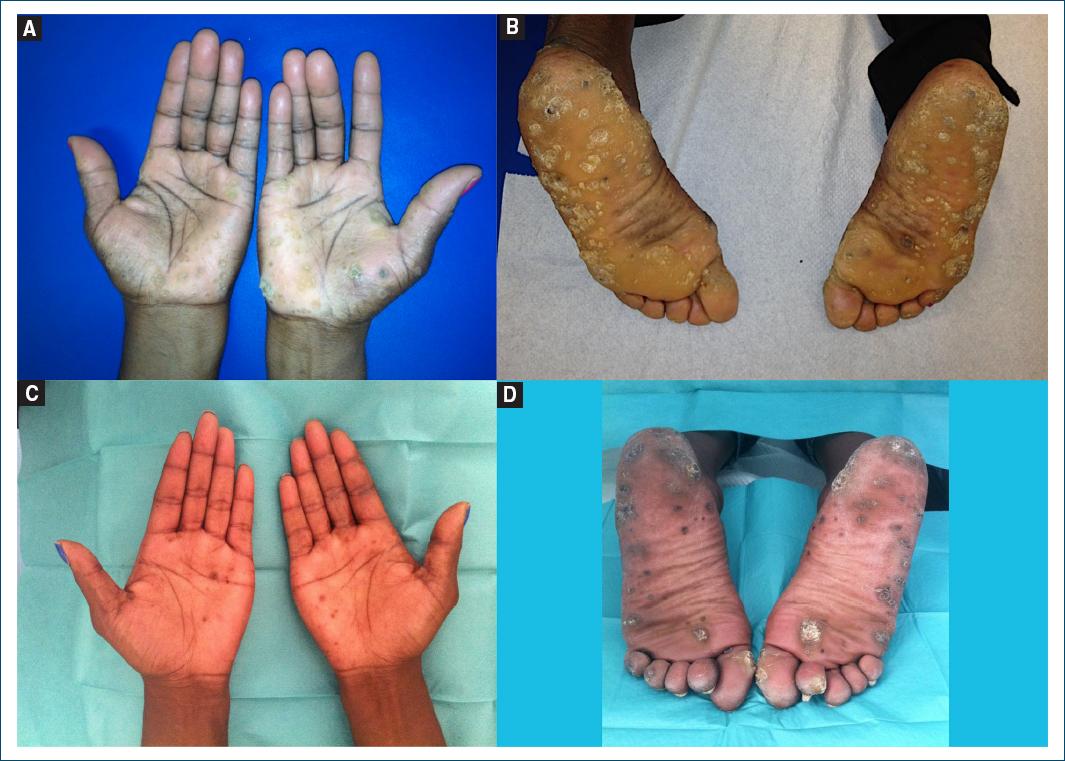
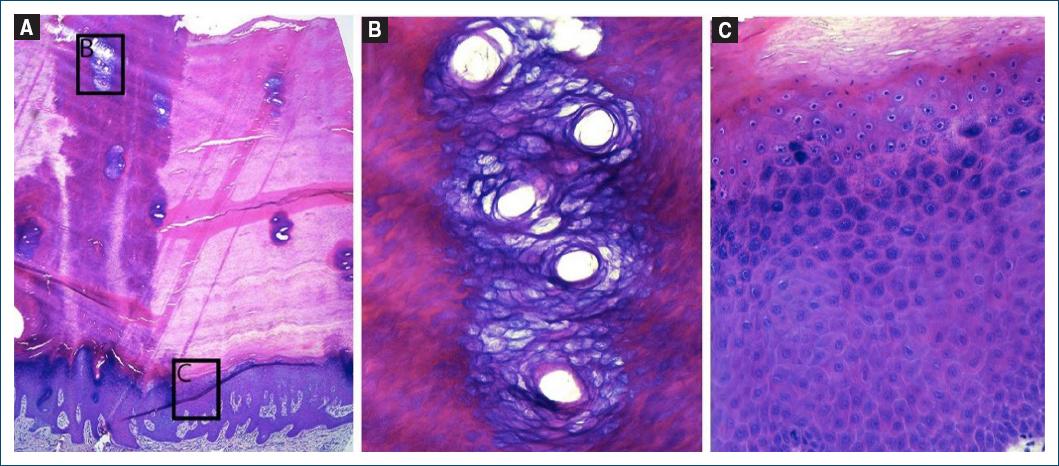
Figure 1 Clinical presentation: multiple small, circular hyperkeratotic papules and plaques on the palms and soles of both mother (A and B) and daughter (C and D). 

Figure 2 Histopathological examination: marked orthohyperkeratosis overlying acanthotic epidermis with elongated and curved rete ridges (A, H&E ×25); Prominent, coiled and dilated acrosyringium (B, H&E ×200); hypergranulosis with no cytologic features of HPV infection (C, H&E ×200). 

Discussion

Punctate palmoplantar keratoderma type I (PPPK1), first described in 1910, is a rare autosomal dominant inherited disorder characterized by multiple tiny punctate keratoses on the palms and soles2. Its estimated prevalence is approximately 1.17/100,000 individuals4. Lesions typically begin to develop in early adolescence but can also manifest later in life, as late as the fifth decade, as observed in our patient. PPPK1 is distinguished by numerous pinpoint, firm papules, 2-8 mm in diameter, which may progress to become translucent, opaque, or verrucous over time4. The papules gradually increase in number and size with age, and often coalesce in pressure-bearing areas of plantar skin2. The exact etiology of PPPK1 is not fully understood, but it is believed to involve a combination of genetic and environmental factors3,4. Several loci have been reported in the literature, with AAGAB being considered a major genetic factor3. This gene encodes the alpha- and gamma-adaptin binding protein, also known as p34. Mutations in this gene can increase epidermal growth factor receptor protein expression and tyrosine phosphorylation, resulting in cellular hyperproliferation2,5. To date, at least 50 different AAGAB mutations have been reported1, including the c.535+1G>A mutation identified in our patient, which has been previously documented only once in a sporadic case within the Chinese population6. In addition, not all patients with a PPPK1 phenotype have an identified variant in AAGAB, suggesting the potential involvement of other, yet-to-be-identified causative genes3. Histological examination of PPPK1 typically reveals hyperkeratosis, unspecific changes such as acanthosis, parakeratosis (in some cases) and hypergranulosis. The dermis is usually normal and devoid of inflammatory infiltrate4. Clinically, PPPK1 can exhibit varying degrees of severity between families, though the genotype-phenotype correlation remains poorly defined2. In the cases described, both the mother and daughter exhibited similar clinical severity, despite their symptoms starting 20 years apart. Although there have been reports suggesting an association between PPPK1 and malignancy, this link remains somewhat controversial3. Differential diagnoses to consider include verruca vulgaris, arsenic keratosis, punctate porokeratosis, acrokeratoelastoidosis, and focal acral hyperkeratosis4. The treatment for PPPK1 is primarily symptomatic, and typically involves topical keratolytics such as lactic acid, urea, and salicylic acid. Additional treatment options include phototherapy, systemic retinoids (such as acitretin and alitretinoin), and surgical interventions. These therapies generally lead to temporary reductions in skin thickness and improvement in skin softness4.

Conclusion

This case report highlights the clinical, histological, and genetic findings of two family members with PPPK1. The clinical similarity between mother and daughter, despite differing ages of onset, illustrates the variable expressivity of the condition. Histopathological and genetic analyses played a key role in confirming the diagnosis. Continued research into the molecular mechanisms of PPPK1 is essential to idevelop more effective therapies.

REFERENCES

1. Harjama L, Karvonen V, Kettunen K, Elomaa O, Einarsdottir E, HeikkiläH, et al. Hereditary palmoplantar keratoderma - phenotypes and mutations in 64 patients. J Eur Acad Dermatol Venereol. 2021;35:1874-80. [ Links ]

2. Dinani N, Ali M, Liu L, McGrath J, Mellerio J. Mutations in AAGAB underlie autosomal dominant punctate palmoplantar keratoderma. Clin Exp Dermatol. 2017;42:316-9. [ Links ]

3. Gram SB, Bjerrelund J, Jelsig AM, Bygum A, Leboeuf-Yde C, Ousager LB. Is punctate palmoplantar keratoderma type 1 associated with malignancy?A systematic review of the literature. Orphanet J Rare Dis. 2023;18:290. [ Links ]

4. Oztas P, Alli N, Polat M, Dagdelen S, Ustün H, ArtüzArt F, et al. Punctate palmoplantar keratoderma (Brauer-Buschke-Fischer syndrome). Am J Clin Dermatol. 2007;8:113-6. [ Links ]

5. Pohler E, Mamai O, Hirst J, Zamiri M, Horn H, Nomura T, et al. Haploinsufficiency for AAGAB causes clinically heterogeneous forms of punctate palmoplantar keratoderma. Nat Genet. 2012;44:1272-6. [ Links ]

6. Cui H, Gao M, Wang W, Xiao R, Chen G, Zhang Q, et al. Six mutations in AAGAB confirm its pathogenic role in Chinese punctate palmoplantar keratoderma patients. J Invest Dermatol. 2013;133:2631-4. [ Links ]

FundingNone.

Ethical considerations

Protection of humans and animals. The authors declare that no experiments involving humans or animals were conducted for this research.

Confidentiality, informed consent, and ethical approval. The authors have followed their institution’s confidentiality protocols, obtained informed consent from patients, and received approval from the Ethics Committee. The SAGER guidelines were followed according to the nature of the study.

Declaration on the use of artificial intelligence. The authors declare that no generative artificial intelligence was used in the writing of this manuscript.

Received: January 29, 2025; Accepted: February 26, 2025

*Correspondence: Lanyu Sun E-mail: lanyusun@gmail.com

Conflicts of interest

None.

Creative Commons License Portuguese Society of Dermatology and Venereology. Published by Permanyer. This is an open access article under the CC BY-NC-ND license