Cláudio DeNipoti
University Estadual de Ponta Grossa, Paraná - Brazil.
E-mail: denipoti@yahoo.com
Abstract
A number of papers belonging to Marino Miguel Franzini, a man closely connected both with the Liberal Revolution and with nineteenth-century Portuguese political history who was also a scientist and a naval officer and who was educated under the influence of the thought and institutions of the Enlightenment, provide important clues as to how books circulated in Europe in the nineteenth century and how they were perceived by Franzini (in particular) and by his contemporaries. A catalog of his library can help us understand how knowledge itself was being reorganized, while his letters and the commercial papers that he exchanged with several agents from the book trade (bookstore owners, literary agents, ship’s captains, and so on) can shed light on some trade practices that enabled him (and others) to have access to and to read the main body of Enlightened and Liberal thought.
Keyword
Book history, Portugal, Libraries, book trade
]]>Resumo
Alguns papéis, que pertenceram a Marino Miguel Franzini, um homem profundamente ligado à Revolução Liberal e à história política portuguesa do século XIX, bem como um cientista, e um oficial naval de carreira, educado sob a influência do pensamento e de instituições iluministas, podem fornecer pistas importantes sobre a circulação de livros na Europa, e como eles eram percebidos por Franzini em particular e por seus contemporâneos. Um catálogo de sua biblioteca pode nos auxiliar a compreender como o próprio conhecimento foi reorganizado e suas cartas e papéis comerciais, trocados com diversos agentes do comércio do livro (livreiros, agentes, capitães de navios, etc.) podem ilustrar as práticas de comércio que capacitavam-no (e a outros) a ter e ler o corpo principal de ideias do pensamento Iluminista e Liberal.
Palavras-chave
História do livro, Portugal, Bibliotecas, Comércio livreiro
This article is an attempt to contribute to an understanding of the ways in which books circulated and were used, kept, sold, etc., in Portugal at the turn of the eighteenth and nineteenth centuries. It involves searching for the meanings that books might have had beyond their written contents and discovering how such meanings were conveyed in documents relating to books, the book trade, and the organization of libraries.
A remarkably large set of manuscripts has been consulted. The papers of Marino Miguel Franzini (s.d.), kept at the National Library in Lisbon, offer over 270 pages of rich documentation about books in the past, containing several catalogs, both of Franzini's books and of booksellers around Europe. They also include a record of purchases and commercial papers—receipts, letters, and several other documents, containing information on the book trade in nineteenth-century Europe.
The first of these papers to be analyzed here is a catalog of books that Franzini compiled at the turn of the century. One can easily find several such catalogs, both in Portugal and elsewhere in Europe, written for a variety of purposes (the sale of books, the keeping of records, donations, censorship control, etc.) throughout the eighteenth and nineteenth centuries. The work with catalogs is, therefore, not a new phenomenon within the historiography of books (or the history of the written word as some historians prefer to call it). A number of examples can be given, ranging from Ana Cristina Araújo (1999), writing about the library of Sergeant Major José da Silva Pais in the early eighteenth century, to Edward Jacobs (2003) in his study of the catalogs of British circulating libraries of that same period.
Franzini's originality lies in his organization of the over 800 books listed in his catalog, for he does so in the best traditions of the “tree of knowledge,” which can be traced back to the Discours Préliminaire de l’Encyclopédie and other seminal works from the period of the Enlightenment (Darnton, 1986b, pp. 247-275). As this article seeks to argue, Franzini compiled his catalog according to enlightened and liberal ideas of how knowledge (and life, for that matter) should be organized. The other papers are also unique, since there are very few registers left of how books were sold to individual readers, let alone a written journal describing when, where, and how books were bought and transported from the bookseller to the owner/reader. They enable us to have a clearer view of the many agents involved in the trading of books in Europe, thus complementing the historiographic effort that seeks to discover “how books and papers, both national and foreign, circulated among us” (Domingos, 2000: 54; see also Domingos, 2002). The last part of this text will be about the ways in which Franzini (regularly) acquired his books during the first decades or the 1800s, despite the pressure of the Napoleonic wars and their spread across Portugal, as well as the policies of censorship and the control exercised over ideas and thinking.
]]> Marino Miguel FranziniMarino Miguel Franzini was born in Lisbon on January 21, 1779, the son of the Venetian mathematician Miguel Franzini, who in turn came to Portugal during the process of the “Portuguese acquisition of the Italian Enlightenment,” carried out by the Marquis of Pombal in his university reform (Nunes, 1988: 21).
The younger Franzini built up quite a remarkable career for himself in nineteenth-century Portugal, in several respects. As a military man, he started out as a student at the Real Academia de Guardas Marinha, created in the late eighteenth century (with the participation of his father, among others) as a means of modernizing the Portuguese navy through the scientific “institutionalization” that had been introduced by Pombal and his successors (Nunes, 1988: 29). Before 1807, he successively became First Lieutenant in the Royal Navy, Major of the Royal Engineer Corps and Director of the Military Archives. His naval career continued until he became a full Brigadier, a magistrate of the Military Justice system, and a peer of the realm decorated with the Order of Christ (Nunes, 1988).
He also became a leading scientist in nineteenth-century Portugal, being a pioneering meteorologist, as well as a geographer responsible for the first complete map of the coastal areas of Portugal. With Jose Bonifácio de Andrada e Silva, he helped to create the Sociedade Real Marítima Militar e Geográfica [the Royal Military and Geographic Maritime Society] in 1798. He also created the statistical office of the Military Archives, and began to take meteorological notes and make observations that are considered to be amongst the first ones ever made in Portugal. In 1814, he was elected as a member of the Academia das Ciências de Lisboa [the Lisbon Science Academy].
The books he wrote include a chart of the coast of Portugal, published in 1811, a lengthy reflection upon the 1816 army statutes drawn up under the supervision of the British General Beresford (but only published after Beresford had left Portugal, in 1820) and a number of economic analyses of the public debt and gross national income (Franzini, 1811; 1812, 1820, 1826, 1843, 1848). He also published statistical, meteorological and geological works in various periodicals, such as the Revista Universal Lisbonense and the Lisbon Almanach, up to the mid-nineteenth century (Portugal, 2009).
There was also a political dimension to his biography, since he became involved in the 1820 liberal movement from the very beginning. He was a member of parliament in the constitutional legislatures of 1820 and 1837, and in the ordinary legislature of 1822. Under the liberal regime, he became Minister of Finance in 1847 and Minister of Justice in 1851 (Urban, 1847: 412; Nunes, 1988). Due to his notoriety, he was able to transfer the image he had created as a competent and impartial scientist to the field of politics, thus becoming a “well-known symbol of ‘progress’ and a paradigm of science’s utility” (Nunes, 1988: 17).
Franzini's Library catalog; a way to organize books and the world
This article is about Franzini and his books. Although a lot more could be said about the military man/scientist/politician as portrayed through the books he wrote, we are interested here in the books that he acquired, borrowed or was given throughout the late eighteenth and early nineteenth centuries, according to the documentation at hand. So, the following clarifications should first be made about Franzini as a book collector and (probably) as a reader.
First, we can be absolutely certain about our knowledge of some of the books that he owned due to the detailed notes that he kept on this subject. A number of his papers, particularly those relating to his library (although not the library itself) or to book deals in which he was the buyer, are kept at the Lisbon National Library, under the code number of BN COD 12934 (Franzini, s./d.). By examining these papers, it is possible to put forward some ideas about how he organized his books, about the nature of his life centered around books, and how he traded books and exchanged ideas through the maze of Ancien Régime censorship and patronage, amid the turmoil of revolutionary wars (DeNipoti, 2008).
It is also possible to form certain ideas about the centrality of books in eighteenth-century Western societies, pursuing the general objective that Roger Chartier set out for historians of the printed word, “that is to understand how in the societies of the Ancien Régime between the 16th and 18th centuries the increasing circulation of printed writing transformed the modes of social interaction (sociabilité), permitted new ways of thinking, and modified power relations” (Chartier, 2002: 48).
]]> We can begin with one document that is extremely rich in information. The Catálogo da Livraria de Marino Miguel Franzini, handwritten, probably by Franzini himself, between 1799 and 1811, lists 816 titles in 949 volumes, which he collected during his early years as a scientist, military man and politician. More than just simply stating the number of books, the Catálogo is interesting due to the way in which Franzini arranges the books into categories that exclude, for example, any reference to religion or metaphysics. He kept a rather neat register of his books, since he began writing the catalog in his early twenties, fresh out of the Real Academia de Guardas Marinha.The Catálogo can thus be used to paint a picture of what kind of books and ideas young science-based Portuguese intellectuals were interested in at the turn of the century. It can also give us a few clues as to what kind of books made up book history in Portugal, helping to contribute to a field of research that is currently being undertaken in Portuguese historiography (Lisboa, 1991: 21-38; Curto, 2007).
A simple quantitative analysis gives us a first clear idea of the predominance of the French language and publishing industry. Of the books listed, 432, or 51.8%, were in French, with Portuguese language books amounting to only 9.9%, the remainder being divided into Italian (7.7%), Spanish (3.7%) and English (2.7%) with a few Latin and Greek books completing the total (see Table 1). Of those books in French, not all were published in France since, as book historians have already shown, there was an important industry of counterfeit editions of forbidden books, printed in Holland or Switzerland and smuggled into France (Darnton, 1995) or Portugal, for that matter. But even so, about 40% of the books that Franzini listed as being his were published in France, the great majority of which (361 books) were printed between 1751 and 1800, amounting to a sizeable proportion of the total of 494 books published in that half century (see Table 2).
Table 1—Editions (Language/Publication date)
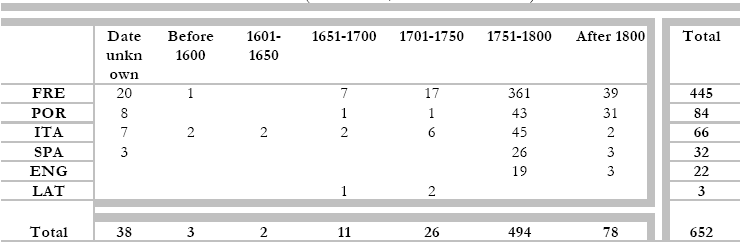
164 books were not considered in the preparation of this table, because they were either bilingual, works of reference (such as dictionaries) or indicated more than one place of publication. Source: Biblioteca Nacional. Lisboa. BN COD. 12934
Table 2—Country of publication/Number of books printed “Catálogo da Livraria de Marino Miguel Franzini”
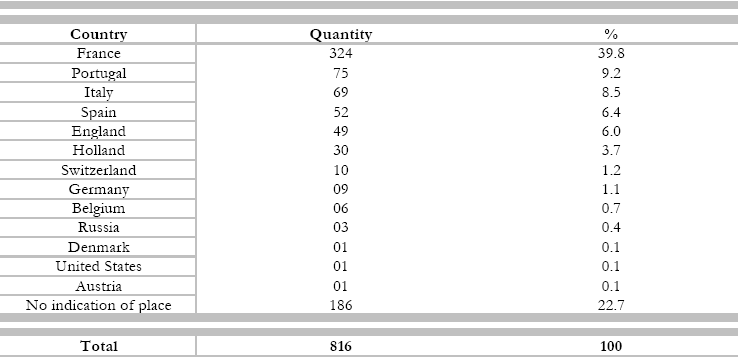
Source: Biblioteca Nacional. Lisboa. BN COD. 12934
]]> So, most of the books that Franzini claimed to own were in French, published during the golden years of the editorial boom during the French Enlightenment (Darnton, 1995). This information should come as no surprise to those acquainted with the impact of the Enlightenment or the influence of the French language and etiquette. But it does confirm that these books were entering Portugal in comparatively large numbers (Guedes, 1987: 104). This is an important consideration when we take into account the tight control that censors and inquisitors were trying to exercise over these very same books. But, for now, let us consider which books he listed, and how.
Again, Franzini compiled his catalog in the form of a “tree of knowledge,” very similar to the models contained in the Discours préliminaire of the Encyclopédie, or Condorcet’s Esquisse d’un tableau historique des progrès de l’esprit humain, which helped to organize other libraries of the time, including the one at the Real Academia de Guardas Marinha (Nunes, 1988: 31).
Franzini starts his catalog with a section on the “Arts,” which were at the center of the attempt made by French encyclopedists to redefine philosophy, sciences and the arts, the latter receiving subtle new distinctions between “liberal, mechanical and Belles” (Baumer, s./d.: 167). Franzini lists here 31 titles (3.8% of the catalog) about several aspects of these distinct arts. It is no surprise, although it is certainly curious, to see that the first three books listed were Encyclopédies. This section opens with the volume Arts et Metiers mécaniques of the Encyclopédie Méthodique, in a Parisian edition from 1782 published by Panckouke (Darnton, 1986). Then comes an unspecified volume of the Encyclopédie Pratique, printed in Liège in 1772, and another volume of the Encyclopédie Méthodique,written by Duhamel du Monceau, the Dictionnaire de toutes les espèces de pêches, in a 1782 edition printed in Padua.
After these books, the first three columns of Franzini’s neat handwriting show works devoted to various arts and crafts (such as Richard Brookes’ The Art of Angling, Rock and Sea Fishing, published in 1740), perfumery, practical chemistry for women, spirit distillation, metalwork, mining, painting and the use of a steam cooker, as well as an improbable volume on prestidigitation. There was also evidence of a concern with the practical application of science, related to strategic or “national” matters, such as the use of chemistry by the Navy in the desalinization of water, in Etienne Hales’ Instructions pour les mariniers, from 1740, or Edme Beguillet’s treatise on grinding and storing grains, printed in 1786 (in a Spanish translation).
The next section in the Catálogo is “Classical Authors” with 25 book titles listed. It begins with Caesar’s Commentaires translated into French by M. D’Ablancourt in 1771, followed by Cicero’s 3 books on civil obligations (in a 1766 Portuguese translation), On Old Age in an undated Lyon edition and the Tusculanae, in a 1733 French translation printed in Paris. The list fills the whole two columns of the page, including the inevitable works of Homer, but also books by Marcus Aurelius, Lucretius, Petronius, Pindar, Plutarch, Virgil and Xenophon, many in bilingual Latin/French editions. The outstanding item to be found under this heading is a copy of the Bible, in the Italian vernacular, printed in Dresden in 1757.
A translated Bible (printed in Germany) could only be a Protestant book and, in early nineteenth-century Portugal, a pious Catholic nation, such translations of the Bible were classified as heretical and to be punished accordingly. In fact, owning such a translation would be a clear sign of heresy, and the Portuguese clergy had been working in close conjunction with the Crown, since at least the mid-eighteenth century, to censor or silence books that they considered heretical, blasphemous or merely inconvenient (Tavares, 1999; Belo, 2004). It is quite strange that Franzini would list such books under the heading of “Classical Authors,” for it gives us clues both about his attitude towards religion in general and towards the Catholic Church in particular.
Next comes the section on “Agriculture” with 29 books. The opening title is De Groot’s Agréments de la campagne, published in 1750, which is a manual for building rural houses, followed by the yearly rural almanac written by Jean Paul d’Ardennes (the 1769 French edition printed in Florence). Included among the remaining titles are classical Latin works translated into French and published in 1773 by Saboureux de La Bonnetrie. These “classical” texts, along with those listed under the previous heading, give us further clues about the intellectual universe that Franzini lived in. At the turn of the eighteenth to the nineteenth century, practical and scientific thought found in the classics the basis for modern applications, and Europeans considered Roman art, agriculture, military techniques and even medicine as a model for their own interests in these fields, not yet discarding references to the classics only because of the “latest” scientific trend (Hobsbawm, 1988: 47). The remaining books in this section deal with gardening, vineyard management, olive growing and ways to get rich quickly through agriculture.
On page five of Franzini’s catalog, there are 13 “Botanic” works, the majority of which are concerned with the detailed description of nature, such as Felix Brotero’s 1788 Compendio de Botanica. Brotero, as well as Marino Miguel's father, had helped to create the Real Academia de Guardas Marinha, where, as we have seen, Franzini studied (Nunes, 1988: 25-27). The library of the Real Academia was composed of such books as Brotero's and several other Portuguese science manuals, and we can imagine that this was the blueprint that Marino Miguel used for the formation of his own library described in the Catálogo, but this is something that can only be discovered for certain through further research.
The next section is “Commerce” and it also lists 13 works about the economic questions which occupied the minds of eighteenth and nineteenth-century men. The subjects of these works range from Portuguese colonial trade, with Joaquim José Coutinho’s 1784 book on the topic, to didactic manuals such as La banque rendue facile, by Pierre Girardeu in a 1793 edition, and encyclopedic works containing conversion tables for the foreign exchange market. This section is immediately followed by “Statistics,” which means, in this case, the (scientific) forms of state management. This becomes clearer when we see that Franzini included here such works as the North American and French Constitutions, Necker’s Compte rendu (for 1781 and 1785), and his De l’administration des finances de la France, Adam Smith’s The Wealth of Nations (in a French translation from 1781), Calone’s De L’Etat de la France, and books on population studies, political economy and a few which could best be described as “public administration” manuals.
“Statistics” is followed by “Philosophy” with fifteen book titles that are dissociated from metaphysics and associated with the search for human improvement. As such, it was not exactly the definition that Encyclopedia writers had in mind, since philosophy, for them, meant “simply the sum of knowledge resulting from human reason, including metaphysics, theology” and all sciences (Baumer, [s./d.]: 170). For Franzini, philosophy includes works on marriage, education, citizen’s obligations, and the progress of the human spirit as well as Condillac’s Oeuvres diverses (a 1732 edition), and Logique (an 1800 edition). It also includes John Locke’s An Essay Concerning Human Understanding (a 1758 French translation), Rousseau’s Du contrat social, Volney’s Les ruines, Mary Wollstonecraft’s Vindication of the rights of woman, (also in a French translation, from 1792). This section ends with a comparative study of the founders of the main eastern religions. Its inclusion here can be thought of in the same sense as the Bible mentioned above, and the Koran, which we will find below.
]]> We can briefly abandon Franzini’s own classification and group some of his categories together. Geography, hydrography and voyages (which is, in turn, divided into sea and land voyages) make his library seem quite global, in the sense that this word must have had in the late-eighteenth century, when large parts of the planet were unknown to the Europeans. Franzini’s own interests were shown here, since his early works were included in these areas of knowledge (Franzini, 1911; 1912). He listed 73 books under these headings, which become even more significant if we consider the three and a half pages of an appendix to the catalog, listing 101 maps and atlases. They allow us to understand how his own interests (and those of his contemporaries) were centered around the detailed description of the exotic or the unknown, in the name of science and/or Western Civilization.This can be seen in the many descriptions of sea and land routes both to and across various continents, in the descriptions of European countries and cities, in the narratives of trips to the Polar regions, to Russia, China, Australia and the South Pacific Islands, but also in the detailed texts and maps about Napoleon’s campaigns. Franzini had, in his library, all those books that made it possible to form a whole new set of scientific ideas with which to see the world (Denipoti, 2007-2008). Such ideas, according to Gibbon, made Europeans of the late-eighteenth century in general, feel a collective “intellectual superiority” in Europe in relation to the rest of the world, which, in turn, was created and fueled by “a landslide of information about places overseas” (Baumer, [s./d.]: 181-82). We can only imagine that, when he became the reader of such books and not just the catalog writer, Marino Miguel shared these ideas about science, and probably about the intellectual superiority of Europeans, in the same way as he was himself thought of as a model of progress and a paradigm of the utility of science, as we have seen (Nunes, 1988: p. 17).
Another group of headings can be brought together under “History” (28 titles) and “Military History” (20 titles). Here, a number of documents can be found about the politics of Franzini’s own time, such as British and French newspapers bound together by year, and (again) the description of Napoleonic battles and campaigns, such as, for example, Stutterheim’s 1806 description of the Austrian Campaign, or Isidore Langlois and Alexandre Berthier’s Relation des campagnes du général Bonaparte en Egypte et Syrie from 1800. Such an interest could be related to Franzini’s own experience as a soldier both in the Napoleonic Portuguese Legion and the British-led Portuguese Army, which later fought against the French. Given both the time and the events of his own life, it is not surprising that he had almost 10% of his books listed under “Military” and “Navy” headings, ranging from General Beresford’s Instructions and Von Bülow’s Esprit du système de guerre moderne, to works on military topography, artillery tactics and shipbuilding. Through this particular feature of the document, Franzini and his library show the result of a long process of military enlightenment in Portugal, which began in the eighteenth century as “an emanation of the absolute monarchy” by individuals who were “open to the demands of the spirit and conscious of the need for enlightenment” (Ramos, 1988:20).
Returning to the sequence of headings in the catalog, we find that “Literature” comprises 34 works—with an extra 19 books of poetry under an additional subheading—and includes literary works which became well-known in the 18th century, such as Fénelon’s Telemaque (of which Franzini had a copy of the last edition still revised by the author in 1715 and an English translation published in 1798), Goethe’s Werther (an English translation from 1795), Rousseau’s La Nouvelle Heloíse, in a 1794 edition, and a French translation from 1800 of Robinson Crusoe, as well as two different editions of the Lusiad—curiously enough a Spanish and an English translation—among others. Under this heading, he also lists books related to civility, such as Prévost’s Eléments de politesse from 1766 and Dalla Casa’s Galateu. The latter, originally published in the 16th century (but listed as a 1751 edition), was a model for a large number of European books designed to inculcate “at one and the same time a knowledge of how to live, and a knowledge of how to be in society” (Chartier, 2002b: 56). The inclusion of a French translation of the Koran (published in Amsterdam in 1775) underlines Franzini’s concern with humanizing religious thought, at least within his own library.
The remaining pages of the catalog are devoted to a wide range of scientific works, arranged under the heading of “Mathematics” (80 books), which is further subdivided into astronomy, architecture, geodesy, hydraulics, machines, optics, tables and “sundry items.” “Medicine” comes next, with 39 books, distributed into the subheadings of “Pharmacopoeiae,” “Thermal waters and baths” and “Boys.” “Physics, Volcanoes and Meteorology” is the next section, with 19 titles. We can find in the headings clues about the utilitarian aspects of Franzini’s books, and about the Portuguese Enlightenment, for that matter, which aimed quite objectively at disseminating practical knowledge to be used in the administration of the Empire (Portella, 2006: 25-44).
Last, but not least, Franzini ends his catalog with a section of forbidden books, much like the “inferno” of the National Library of France, where pornographic works were hidden throughout the 19th century (Darnton, 1995). Seven books listed on one of the final pages, not following the careful alphabetical order shown previously, under the heading “Gallantry” [Galant.a]. Most of the books listed have been studied at length by Robert Darnton (1995) in many of his works on readers and reading in eighteenth-century France. Franzini’s list starts with a 1793 edition of L’académie des dames, a 1798 edition of Le compère Mathieu, Lelland’s La fille de joie, also a 1798 edition, Le diable boiteux (1789), Diderot’s La religieuse (1797), L’enfant du carnival (1798) and Thérèse Philosophe, of which Franzini indicated a 1784 edition, published in Brussels. What the author of the catalog categorizes as gallantry, printers, writers and readers of the eighteenth century referred to as Philosophical Books, meaning not the Enlightenment itself, but the universe of the forbidden, the illegal, the taboo (Darnton, 1987: 14). It is an indication of the kind of reader that Franzini was—devoted to owning the books, related to the many aspects of his own life, professional or otherwise, which were considered “necessary” for any self-respecting modern intellectual (in the purest sense of the word). Although only a pale idea of the books he listed is given here, we can see that, as a reader, he was concerned with information that was essential, in his own time, for acquiring a knowledge of science, politics and social life. In the next part of this article, we will examine how he managed to acquire such books, considering both when and where he lived.
Book purchases, delivery routes and agents
One first and obvious explanation as to how Marino Miguel came across the books that he listed in the catalog (and other papers) is the matter of inheritance. His father came to Portugal to teach in Coimbra and to tutor the young princes D. José and D. João. We can assume that a number of the books Marino Miguel listed came from his father’s library—particularly those printed in the late-seventeeth/early-eighteenth centuries, either in Italian or Latin (about 19 titles fit into this category). Marino Miguel even noted, in his catalog, that Grisley’s 1661 edition of Viridarium Lusitanum colectae had his father’s notes in it. Besides this, we can only speculate that other books might have been handed down from father to son, which is a likely assumption, but one which there is no hard evidence to support.
During the 1830s, he was able to (and did) borrow books from the Library of the Academia Real de Sciencias de Lisboa, of which he was a full member. The few records remaining from that time show that he regularly borrowed books, and sometimes did not return them until he was reminded by the Academy’s secretary (Academia das Ciências de Lisboa, s.d.). In any event, this library would be complementary to his own, just as the maps of the Sociedade Real Marítima, Militar e Geográfica (which he helped to create, along with D. Rodrigo de Souza Coutinho and José Bonifácio de Andrada e Silva) would complement his own map collection.
We also know that Marino Miguel had close links with the European book trade, in the sense that he was able to acquire the books he wanted, even when such books were forbidden. Among his papers, he left lists of books that he had either ordered or received from booksellers, catalogs, invoices, letters exchanged with people connected to the book trade, etc. These papers can be divided into two groups. The first is a list of the books he bought from 1798 onwards [Ról dos livros que comecei a comprar em 1798], in which he wrote down where and when each purchase was made, including his yearly expenses with books from 1798 to 1807, information on binders, freight, taxes, etc.
]]> The second group of documents includes lists of ordered or actually purchased books, booksellers’ catalogs and reading suggestions. Dating from between 1814 and 1824, these documents also comprise a varied supply of information about the book trade in Europe, with letters from ship captains, booksellers and agents who were responsible for the acquisition and transport of books from several parts of Europe to Portugal. Analyzing such material might give us some clues not only as to how Marino Miguel obtained the books he listed in his catalog, but also as to how the European trade in legal and illegal books actually operated.The Ról… lists a total of 277 books purchased between 1798 and 1805, while, from the other documents (since most of them refer to boxes or packages of books), we can infer another 409 book titles (760 volumes) bought between 1814 and 1825.
Table 3—Number of books acquired by Marino Miguel Franzini

Source: Biblioteca Nacional. Lisboa. BN COD. 12934
The Ról… gives detailed information about the place of origin of each book listed. The first entry is “Books acquired in the Molini Business, in Florence,” followed by a “Venice, 1798” subheading. Here, he wrote the titles of 27 French books, the first one being Traité du Calcul Différentiel by Cousin, published in 1796 in Paris, which was followed by a number of voyage and battle narratives, including David Samwel’s A Narrative of the Death of Captain James Cook in a French translation from 1786, and a few “science” books, such as Samuel Tissot’s Onanisme, dissertation sur les maladies produites par la masturbation. These last two titles were also listed in Franzini’s catalog, the first under “Voyages” and the second under “Medicine.”
This list of books is quite detailed in showing us the routes via which the books were conveyed from the printer (normally in France) to this Lisbon reader. Let us look, for example, at James Cook and Michel Lane’s Le pilote de Terre Neuve, published in Paris, in 1784. Franzini noted the following expenses with this book:
Cost in Paris ……………………………………………………........................... L. 58:12
Stagecoach from Paris to Genoa …..............…...................... L 9:7 ]]>
Packing in Paris ............................................................... L. 6:4Box made in ................................................................... L 3:2
Freight from Genoa to Venice, via Parma and Boulogne. …… … L. 21:9
Total ……………………………………………………………................................ L.98:13
All the other books listed in this section of the Ról... followed similar paths, leaving France for Venice or Florence, and passing through Milan, Genoa or Parma. Connaissanse des temps pour l’année VII de la Repúblique was sent from Paris to Genoa, where it was packed and taken to Florence, from where in turn it was posted to Venice. Carte générale de l’Océan Atlantique ou Occidental, published in 1786 in Paris, was taken from Paris to Genoa by stagecoach, packed together with other books, sent by mail to Milan, and from there to Venice. We can assume that from Venice to Lisbon the books were shipped on one of the many vessels that had already been used in trade with Portugal for several centuries (Trivellato, 2003).
The purchases continued in June 1799, with three books being acquired from the Soapin bookseller, in Padua, and one from the bookstore of Theodoro Viero, in Venice. In October of that same year, three books were purchased from the “Molini Business” in Florence and two maps from Theodoro Viero. In June 1800, 11 books were acquired in Siena, including Rousseau’s Emile and Volney’s Méditations. In August of that same year, six titles were bought in Lisbon, all on military or legal topics. Then there followed a purchase made in “P.to Mahon” (Maó, in Menorca) in January 1801, comprising six books in Italian and two grammars of the French language, written in English and published in London. In March, Franzini bought three books, in Lisbon, about the English language (grammars and learning methods), and a shorthand manual.
In May, 1801, he listed 32 books purchased in L’Orient, Switzerland, a city about 170 kilometers from Monestier de Briançon – the birthplace of most booksellers working in Lisbon since the 18th century, notably Bertrand, Chardron and Guérin, among others (Guedes, 1987: 15; Curto, 2007:222-226; Domingos, 2000:34). This particular part of the list is quite remarkable. On the one hand, it has fewer details than the previous pages, which carefully mention the name, title, place and year of publication, as well as the transportation details mentioned above. Here, only the titles of the books are written. On the other hand, it contains all those books listed as “gallantry” in his catalog, and a few other literary works which were forbidden in Portugal, such as Rousseau’s La nouvelle Heloise. Many of the books mentioned in Franzini’s papers were forbidden, and subject to censorship from the institutions of control created during the rule of the Marquis of Pombal (Villalta, 1999: 198ss). Notwithstanding, such books were available in Lisbon, Porto or Coimbra from a variety of sources, such as booksellers who kept forbidden books hidden and gave them only to special clients, sailors, travelers or diplomats who could smuggle copies on request, or the personal libraries of foreign officers in the Portuguese Army, which could eventually be consulted (Ramos, 1988:137). In June 1801, a dozen maps were acquired in La Coruña from the bookstore of D. Manoel de Soto, who, much to Franzini’s disappointment, didn’t have another dozen maps that he was looking for. 1802 recorded various expenses in Lisbon with books bought during the previous years, as well as bindings and “associations” (the binding together of several works in one volume). According to the list, the purchases were less frequent (only 5 books, bought on July 29th and October 27th). The remainder of the list shows all the purchases he made from 1803 to 1807, frequently indicating the days, but no longer the place or the bookseller, listing 13 titles in 1803, 17 in 1804, 4 in 1805, 28 in 1806 and 13 in 1807. These 13 books (and three maps) make up the last entry in the Ról.
We can now analyze the documents that were not written by Franzini himself, but by a number of agents from the European book trade. Although the information is less quantifiable, they allow us to understand the strategies and workings of such trade much better. This is best illustrated by the example of the Borel brothers, booksellers of French origin (specifically, from Monestier de Briançon), with whom Franzini dealt throughout the early 1820s (see Table 4 and Guedes, 1987: 37)
Table 4—Marino Miguel Franzini's purchases at the BOREL & BOREL bookstore. 1821-1823
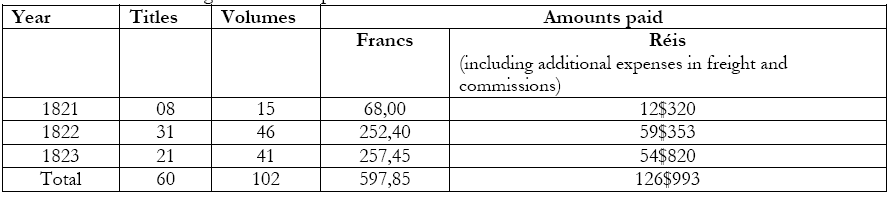 ]]>
Source: Biblioteca Nacional. Lisboa. BN COD. 12934
]]>
Source: Biblioteca Nacional. Lisboa. BN COD. 12934
Borel & Borel, and other Lisbon booksellers, were the final destination on a shorter and more direct maritime route from France to Portugal (given the fact that the books did not need to go to Italy in order to avoid Napoleonic blockades and other wartime difficulties). We can visualize this route by following the journey of a “case of books” in reverse, using the documents as a guide. This case had 55 titles (88 volumes), with the usual emphasis on books about voyages (such as the Parisian edition of Voyage en Egipte par Vivant Demon from 1802), natural sciences (such as Horace Saussure’s Agenda du Voyageur Geologue, printed in Geneva in 1796), meteorological tables, and practical manuals (such as André Beaumont’s 1816 guide to the preparation of potato flour), including also a pair of Lunettes périscopiques for a certain Mr. Travassos.
The case of printed books was cleared through the customs by Franzini on November 8, 1820, at the Desembargo do Paço, in Lisbon, after he had paid 780 réis for “charges… duties… unloading… storage… registration… and for those who organized the books and fixed the case… opening… and external transportation to the Customs.” Two days later, Franzini paid 612.13 francs (133$330, according to Franzini’s own notes) to the bookseller P. Le Fèvre, who, in turn, paid 3$089 to someone named Francisco Profumo “lessee of the ship Jupiter” for the freight of “one volume,” on October 16, in that same year. Franzini had written on the back of P. Le Fèvre’s bill that those books were sent from Paris in October of that year, on the Jupiter. Finally, there are four handwritten pages from S. D. Mascarenhas & Co., of Paris (from whom Franzini had bought 34 books - 84 volumes - the previous year, in a transaction that also involved Francisco Profumo, this time responsible for the ship Trois Soeurs Unis). These pages, entitled Fourni à Monsieur Marino Miguel Franzini le 25 juillet 1820, list the books purchased and are completed with a list of those that they couldn’t find, and which were therefore not included in the case sent to the main French port, to be placed on board the Jupiter. The timeline of the transaction is:
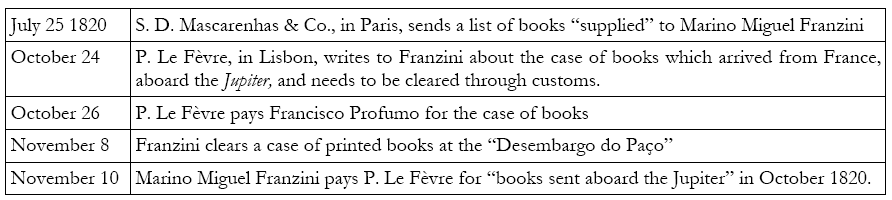
We therefore have a Portuguese bookseller in Paris, who sent the books that Franzini had ordered to Le Havre. From there, on the Jupiter, under Profumo’s responsibility, the books were delivered to a bookseller of French origin in Lisbon (P. Le Fèvre) with whom, probably, Marino Miguel had placed the original order. After paying the respective fees and taxes, Franzini reached the conclusion that “the expenses with transportation amount[ed] to 12% of the original cost of the books” and that he could enjoy the new additions to his library exactly 105 days after they left Paris.
Similarly, on November 13, 1824, the Venetian bookseller Andrea Santini Figlio sent a case with 24 titles and 84 volumes “ordered by … the Comendador Marino Franzini,” which included the complete works of Goldoni, Plutarch’s Opusculi and several Italian books on geography and agriculture. The case was sent on board the “Austrian vessel l’Arpocrate” and was accompanied by “two hats… a necklace and a string of pearls”, which the Countess “Ana Frangini” [sic] or the widow Anneta Gervasoni, born Franzini, a Portuguese subject, sent to the Countess Sebastiana Franzini, in Lisbon. Both packages were given to Alessandro Gililieb, Captain of the l’Arpocrate, to insure their safe arrival in Lisbon against the amounts paid to Santini.
One final example of the commercial networks used by Franzini (and his contemporaries, both in Europe and – probably – in the European colonies and former colonies) can be found in the largest documented purchase recorded in Franzini’s papers. The “Invoice of the books bought on account and by order of the Illustrious Mr. Marino Miguel Franzini, Lt. Colonel. of the Royal Navy in Lisbon” lists 190 titles, with 390 volumes, bought in Paris at a cost of 1,328.25 francs. Even though the content of these books deserves to be studied in detail, we will focus on the (unfortunately) unnamed agent who acquired the books and shipped them from Paris. In the letter at the end of the invoice, dated March 30, 1816 and received by Marino Miguel on April 19 of the same year, the Parisian agent explains (in clear Portuguese) that he made every effort to follow the instructions of the purchase order, and that he tried to tell Franzini this in a number of unanswered previous letters.
Once he had gathered together all the books that had been ordered, the agent delivered them to “G.me de Rouve,” who paid the cost of transporting the books to Le Havre and, from there, to Lisbon. Although there are no Lisbon-based booksellers named in this document, we can assume that the route taken by this order and the procedures that were followed were similar to the ones described above. And, to further enrich our understanding of the book trade, this agent gives us extremely valuable details about the handling of the books during the voyage:
]]>I hope that [the case] arrives safely and well treated. It has the mark M.M.F Libri. I took particular care in packing it, and had the smaller books and leaflets wrapped twice in paper, with an indication of the works that were inside the package. I do hope that the Customs will not ruin this work, which Your Grace will find helpful in order to verify what I have sent.
After listing the books he couldn’t find, the agent explained that he included the modern catalogs “of the most highly respected booksellers in Paris,” so that Franzini could make future orders without running the risk of ordering books that were no longer available. He ended the letter by stating that he had taken the initiative of sending him three unrequested books, which Franzini could either keep or return to the agent’s son in Lisbon, and be reimbursed for the respective cost.
Conclusion
We conclude this text by providing a few more answers to the question posed by Manuela Domingos (2000: 54) as to how books and papers circulated in Portugal. In fact, from this Portuguese example, we are able to derive important clues about the ways in which books circulated in Europe, and add evidence to the central importance of the eighteenth-century French book trade. Either by following the Italian routes of the early nineteenth century (which were most likely used because of the political instability of that time) or through direct trade with France a few decades later, books were exchanged on a frequent basis and in quantities that have yet to be comparatively measured.
But Franzini’s papers also show us that he was able to acquire almost everything he wanted—whether forbidden or not. And his few failures to do so were market-related—books that were either out of print or out of stock at a given moment and in a given place. In fact, we can see that he always had access to the essential books related to the many aspects of his life. A scientist, sailor, military man and liberal politician, Franzini organized his catalog and pursued the books listed there almost as a mirror of his own life, even subtly criticizing the prevailing religious influence over Portuguese life in the late eighteenth and early nineteenth centuries.
Books played a central role in Franzini's life and such centrality and importance can be seen in his papers, as he detailed, organized, listed, wrote and received letters about them. Involved in complex networks of thought, which culminated in the Liberal Revolution of 1820, Franzini was also involved in the complex networks of the book trade, which ranged from personal relationships, social patronage and family ties to simple business transactions. Franzini constantly used such networks, which benefited both readers and book trade agents in general, since they helped to establish a hierarchy among them (Curto, 2007: 237). They also helped to circumvent censorship, since a large number of the books he listed in his catalog, or in other papers, were to be found in most indexes of forbidden books. Franzini’s name was not found in any of the requests to have or to read such books from 1790 to 1820 (ANTT, s.d). One possible conclusion is that Portuguese censorship was hindered by patronage and social hierarchy, and Franzini never bothered to ask for such a license, buying (and receiving) the books all the same. This can only be confirmed by further studies of similar cases.
The clues provided by the Franzini papers also reinforce the idea that, in Portugal, the Enlightenment and liberal philosophical literature—a concept which has been explored by the historiography of the book as well as that of ideas—were widely disseminated, despite the efforts to censor such books and ideas (Villalta, 1999).
The circulation of both books and ideas was a key factor for the liberal movement of 1820, as it shaped the individual participants into modern political and scientific beings, who could try to change the status quo of the Ancien Régime. Further analysis of Franzini’s own work can provide us with extra clues to support this conclusion, but it is something that will require further research.
]]> References
Academia das Ciências de Lisboa (s.d). Manuscritos. Ref 811.
ANTT (s.d), Real Mesa Censória, Requerimentos, Caixas 112 e 113; Provisões. Livro 13 e 14.
Araújo, Ana Cristina (1999). Livros de uma vida; critérios e modalidades de constituição de uma livraria particular no século XVIII. Revista de História das Ideas, 20, 149-185. [ Links ]
Baumer, Franklin (s./d). O pensamento europeu moderno 2 v. Lisboa: Edições 70.
Belo, André (2004). Notícias impressas e manuscritas em Portugal no século XVIII: horizontes de leitura da Gazeta de Lisboa. Horizontes antropológicos, Porto Alegre,v. 22, n. 10, pp. 15-35, jul./dez.
Chartier, Roger (2002). Labourers and voyagers; from text to the reader. In: Finkelstein, David; Mccleery, Alistair (eds.) Book history reader. New York: Routledge, pp. 47-58.
Chartier, Roger (2002b). À beira da falésia, a história entre incertezas e inquietudes. Porto Alegre, EDUFRGS.
Curto, Diogo Ramada (2007). Cultura escrita – séculos XV a XVIII. Lisboa: Imprensa de Ciências Sociais.
Darnton, Robert (1986). The business of Enlightenment; A Publishing History of the Encyclopédie, 1775-1800. Harvard: Harvard University Press.
]]> Darnton, Robert (1986b). O grande massacre de gatos; e outros episódios da história cultural francesa. Rio de Janeiro: Graal, 1986.Darnton, Robert (1987) Boemia literária e revolução: o submundo das letras no Antigo Regime. São Paulo: Companhia das Letras, 1987.
Darnton, Robert (1995). The forbidden best sellers of pre-revolutionary France. New York: W.W. Norton.
DeNipoti, Cláudio (2007-2008). O mundo organizado em um catálogo de biblioteca. Conhecimento, livros e pensamento em Portugal no início do século XIX. Arquipélago – História. 2ª Série, XI-XII, pp. 163-190.
DeNipoti, Cláudio (2008). Comércio e circulação de livros entre França e Portugal na virada do século XVIII para o XIX ou quando os ingleses atiraram livros ao mar. Revista Brasileira de História, vol. 28, núm. 56, pp. 431-448.
Domingos, Manuela (2000). Livreiros de Setecentos. Lisboa: Edição da Biblioteca Nacional.
Domingos, Manuela (2002). Estudos sobre História do Livro e da Leitura em Portugal 1995-2000. Lisboa: Edição da Biblioteca Nacional.
Franzini, Marino Miguel (s./d.) [Papéis que pertenceram a Marino Miguel Franzini] [Manuscrito] 1792-1832. Biblioteca Nacional. Lisboa. BN COD. 12934.
Franzini, Marino Miguel (1811). Chart of the coast of Portugal from Cape Silleiro to Huelba Bar/ Carta reduzida da Costa de Portugal desde o cabo Silleiro até a Barra de Huelba. London: A. Arrowsmith.
Franzini, Marino Miguel (1812). Roteiro das costas de Portugal, ou instrucções náuticas pra intelligencia e uso da carta reduzida da mesma costa, e dos planos particulares dos seus principaes portos. [Lisboa]: Na Impressão Régia.
]]> Franzini, Marino Miguel (1820). Reflexões sobre o actual regulamento do Exército de Portugal publicado em 1816; ou análise dos artigos essencialmente defeituosos e nocivos à nação: com um projecto de um plano de organização para o mesmo exército, ilustrados com mapas do estado da povoação do reino, e sua classificação segundo as idades, sexo, estudo e profissões, enviado para a corte do Rio de Janeiro em 1816.Lisboa: Impressão Régia.Franzini, Marino Miguel (1826). Ensaio sobre o orçamento da dívida pública, receita e despesa do tesouro do Reino de Portugal, no ano de 1826, e reflexões sobre o déficit e a dívida existente, comparada à de outras nações, com o resumo do estado pessoal do Exército e Marinha, e algumas considerações sobre objectos de economia. Lisboa: Impressão Régia.
Franzini, Marino Miguel (1843). Considerações acerca da renda total da nação portuguesa, e a sua distribuição por classes com algumas reflexões sobre o imposto da décima.Lisboa: Imprensa Nacional.
Franzini, Marino Miguel (1848). Reflexões acerca dos prejuízos que resultariam ao tesouro, e a seus credores, alterando-se as disposições do decreto de 9 de Dezembro 1847, que fixou o valor das notas do Banco de Lisboa pelo seu preço no mercado.Lisboa: Tipografia de V. J. de Castro e Irmão.
Guedes, Fernando (1987). O livro e a leitura em Portugal; subsídios para a sua história; séculos XVIII e XIX. Lisboa, Verbo.
Hobsbawm, Eric (1982). A era das revoluções: 1789-1848. Rio de Janeiro, Paz e Terra.
Jacobs, Edward. (2003). Eighteenth-Century British Circulating Libraries and Cultural Book History. Book History 3. 1-22.
Lisboa, João Luis (1991). Ciência e política; ler nos finais do antigo regime. Lisboa: Instituto Nacional de Investigação Científica.
Nunes, Maria de Fátima (1988). O liberalismo português: ideário e ciências: o universo de Marino Miguel Franzini (1800-1860). Lisboa: Centro de História da Cultura da Universidade Nova de Lisboa.
Portella, José Roberto Braga. Descripções, memmórias, noticias e relações: administração e ciência na construção de um padrão textual iluminista sobre Moçambique, na segunda metade do século XVIII. Curitiba, 2006. Tese (Doutorado em História), Universidade Federal do Paraná.
]]> Portugal (2009), Dicionário Histórico. Available at http://www.arqnet.pt/dicionario/franzinima.html. Consulted on June 24, 2009.Ramos, Luís A. de Oliveira (1988). Sob o signo das “luzes”. Lisboa: Imprensa Nacional.
Tavares, Rui (1999). Lembrar, esquecer, censurar. Estudos Avançados, São Paulo, v. 13, n. 37, pp. 125-154, set./dez.
Trivellato, F (2003). Juifs de Livourne, Italiens de Lisbonne, Hindous de Goa; réseaux marchands et échanges interculturels à l’époque moderne. Annales; Histoire, Sciences Sociales 58 (3), pp. 581-604. mai-juin.
Urban, Sylvanus. Gentleman’s Magazine. London: Bowyer Nichols and Son, 1847.
Villalta, L. C (1999). Reformismo Ilustrado, censura e práticas de leitura: usos do livro na América Portuguesa. Tese (Doutorado em História). Faculdade de Ciências Humanas, Letras e Artes. Universidade de São Paulo, São Paulo.
]]>