<?xml version="1.0" encoding="ISO-8859-1"?><article xmlns:mml="http://www.w3.org/1998/Math/MathML" xmlns:xlink="http://www.w3.org/1999/xlink" xmlns:xsi="http://www.w3.org/2001/XMLSchema-instance">
<front>
<journal-meta>
<journal-id>1646-107X</journal-id>
<journal-title><![CDATA[Motricidade]]></journal-title>
<abbrev-journal-title><![CDATA[Motri.]]></abbrev-journal-title>
<issn>1646-107X</issn>
<publisher>
<publisher-name><![CDATA[Edições Desafio Singular]]></publisher-name>
</publisher>
</journal-meta>
<article-meta>
<article-id>S1646-107X2012000100005</article-id>
<article-id pub-id-type="doi">10.6063/motricidade.8(1).237</article-id>
<title-group>
<article-title xml:lang="en"><![CDATA[Perceived quality of life and physical activity in Brazilian older adults]]></article-title>
<article-title xml:lang="pt"><![CDATA[Percepção da qualidade de vida e atividade física em idosos brasileiros]]></article-title>
</title-group>
<contrib-group>
<contrib contrib-type="author">
<name>
<surname><![CDATA[Porto]]></surname>
<given-names><![CDATA[D.B.]]></given-names>
</name>
<xref ref-type="aff" rid="A01"/>
</contrib>
<contrib contrib-type="author">
<name>
<surname><![CDATA[Guedes]]></surname>
<given-names><![CDATA[D.P.]]></given-names>
</name>
<xref ref-type="aff" rid="A01"/>
</contrib>
<contrib contrib-type="author">
<name>
<surname><![CDATA[Fernandes]]></surname>
<given-names><![CDATA[R.A.]]></given-names>
</name>
<xref ref-type="aff" rid="A02"/>
</contrib>
<contrib contrib-type="author">
<name>
<surname><![CDATA[Reichert]]></surname>
<given-names><![CDATA[F.F.]]></given-names>
</name>
<xref ref-type="aff" rid="A03"/>
</contrib>
</contrib-group>
<aff id="A01">
<institution><![CDATA[,Universidade Estadual de Londrina Centro de Educação Física e Esporte ]]></institution>
<addr-line><![CDATA[Londrina PR]]></addr-line>
<country>Brasil</country>
</aff>
<aff id="A02">
<institution><![CDATA[,Universidade Estadual Paulista Departamento de Educação Física ]]></institution>
<addr-line><![CDATA[Rio Claro SP]]></addr-line>
<country>Brasil</country>
</aff>
<aff id="A03">
<institution><![CDATA[,Universidade Federal de Pelotas Escola Superior de Educação Física ]]></institution>
<addr-line><![CDATA[Pelotas RS]]></addr-line>
<country>Brasil</country>
</aff>
<pub-date pub-type="pub">
<day>00</day>
<month>00</month>
<year>2012</year>
</pub-date>
<pub-date pub-type="epub">
<day>00</day>
<month>00</month>
<year>2012</year>
</pub-date>
<volume>8</volume>
<numero>1</numero>
<fpage>33</fpage>
<lpage>41</lpage>
<copyright-statement/>
<copyright-year/>
<self-uri xlink:href="http://scielo.pt/scielo.php?script=sci_arttext&amp;pid=S1646-107X2012000100005&amp;lng=en&amp;nrm=iso"></self-uri><self-uri xlink:href="http://scielo.pt/scielo.php?script=sci_abstract&amp;pid=S1646-107X2012000100005&amp;lng=en&amp;nrm=iso"></self-uri><self-uri xlink:href="http://scielo.pt/scielo.php?script=sci_pdf&amp;pid=S1646-107X2012000100005&amp;lng=en&amp;nrm=iso"></self-uri><abstract abstract-type="short" xml:lang="en"><p><![CDATA[The purpose of this study was to investigate the association between self-perceived quality of life and physical activity in Brazilian older adults. We investigated 199 individuals (117 men and 82 women) aged between 60 to 70 years old, employees of a public university. Physical activity was estimated by the short version of the International Physical Activity Questionnaire (IPAQ). Self-perceived quality of life was assessed using the World Health Organization Quality of Life (WHOQOL-Bref) questionnaire composed of four domains: physical, psychological, social relationship and environment. There was no difference in self-perceived quality of life between men and women. In contrast, quality of life was associated with physical activity even after adjustment for gender, schooling and income. The physical domain presented the strongest association with physical inactivity (Odds Ratio = 2.70, 95% CI 1.87-3.52). Only the environment domain evaluated by WHOQOL-Bref was not associated to physical inactivity. Among the older, improved self-perceived quality of life is positively associated to physical activity.]]></p></abstract>
<abstract abstract-type="short" xml:lang="pt"><p><![CDATA[O objetivo deste estudo foi investigar a associação entre autopercepção da qualidade de vida e atividade física em idosos brasileiros. Foram investigados 199 indivíduos (117 homens e 82 mulheres) com idade entre 60 a 70 anos, funcionários de uma universidade pública. A atividade física foi estimada pela versão curta do Questionário Internacional de Atividade Física (IPAQ). A autopercepção da qualidade de vida foi avaliada utilizando o questionário World Health Organization Quality of Life (WHOQOL-Bref) composto por quatro domínios: físico, psicológico, relações sociais e meio ambiente. Não houve diferença na autopercepção da qualidade de vida entre homens e mulheres. Em contrapartida, a qualidade de vida foi associada com atividade física quando ajustada pelo sexo, escolaridade e renda. O domínio físico foi o que apresentou a associação mais elevada com a atividade física (Odds Ratio = 2.70, IC 95% 1.87-3.52). Apenas o domínio meio ambiente avaliado pelo WHOQOL-Bref não foi associado com inatividade física. Em sujeitos idosos, a melhoria da autopercepção da qualidade de vida está significativamente associada à atividade física.]]></p></abstract>
<kwd-group>
<kwd lng="en"><![CDATA[quality of life]]></kwd>
<kwd lng="en"><![CDATA[physical activity]]></kwd>
<kwd lng="en"><![CDATA[aging]]></kwd>
<kwd lng="en"><![CDATA[lifestyle]]></kwd>
<kwd lng="pt"><![CDATA[qualidade de vida]]></kwd>
<kwd lng="pt"><![CDATA[atividade física]]></kwd>
<kwd lng="pt"><![CDATA[envelhecimento]]></kwd>
<kwd lng="pt"><![CDATA[estilo de vida]]></kwd>
</kwd-group>
</article-meta>
</front><body><![CDATA[ <p> 	<b>Perceived quality of life and physical activity in Brazilian older adults</b> </p>     <p>&nbsp;</p>      <p> 	<b>D.B. Porto<sup>I</sup>;</b> 	<b>D.P. Guedes<sup>I</sup>;</b> 	<b>R.A. Fernandes<sup>II</sup>;</b> 	<b>F.F. Reichert<sup>III</sup></b> </p>      <p> 	<sup>I</sup>Centro de Educação Física e Esporte, Universidade Estadual de Londrina, Londrina-PR, Brasil <br /> 	<sup>II</sup>Departamento de Educação Física, Universidade Estadual Paulista, Rio Claro/SP, Brasil. <br /> 	<sup>III</sup>Escola Superior de Educação Física, Universidade Federal de Pelotas, Pelotas/RS, Brasil. </p>      <p><i><a name="top0"></a><a href="#0">Endereço para Correspondência</a></i></p>     <p>&nbsp;</p>      <p><b>ABSTRACT</b></p>     <p> 	The purpose of this study was to investigate the association between self-perceived quality of life and physical activity in Brazilian older adults.  	We investigated 199 individuals (117 men and 82 women) aged between 60 to 70 years old, employees of a public university. Physical activity was estimated by  	the short version of the International Physical Activity Questionnaire (IPAQ). Self-perceived quality of life was assessed using the World Health Organization  	Quality of Life (WHOQOL-Bref) questionnaire composed of four domains: physical, psychological, social relationship and environment. There was no difference in  	self-perceived quality of life between men and women. In contrast, quality of life was associated with physical activity even after adjustment for gender,  	schooling and income. The physical domain presented the strongest association with physical inactivity (Odds Ratio = 2.70, 95% CI 1.87-3.52).  	Only the environment domain evaluated by WHOQOL-Bref was not associated to physical inactivity. Among the older, improved self-perceived quality of life is  	positively associated to physical activity. </p>     <p> 	<i>Keywords:</i> quality of life, physical activity, aging, lifestyle </p>     <p>&nbsp;</p>      ]]></body>
<body><![CDATA[<p><b>Percepção da qualidade de vida e atividade física em idosos brasileiros</b></p>     <p><b>RESUMO</b></p>     <p> 	O objetivo deste estudo foi investigar a associação entre autopercepção da qualidade de vida e atividade física em idosos brasileiros. Foram investigados 199  	indivíduos (117 homens e 82 mulheres) com idade entre 60 a 70 anos, funcionários de uma universidade pública. A atividade física foi estimada pela versão curta  	do Questionário Internacional de Atividade Física (IPAQ). A autopercepção da qualidade de vida foi avaliada utilizando o questionário World Health Organization  	Quality of Life (WHOQOL-Bref) composto por quatro domínios: físico, psicológico, relações sociais e meio ambiente. Não houve diferença na autopercepção da  	qualidade de vida entre homens e mulheres. Em contrapartida, a qualidade de vida foi associada com atividade física quando ajustada pelo sexo, escolaridade e  	renda. O domínio físico foi o que apresentou a associação mais elevada com a atividade física (Odds Ratio = 2.70, IC 95% 1.87-3.52). Apenas o domínio meio  	ambiente avaliado pelo WHOQOL-Bref não foi associado com inatividade física. Em sujeitos idosos, a melhoria da autopercepção da qualidade de vida está  	significativamente associada à atividade física. </p>     <p> 	<i>Palavras-chave:</i>qualidade de vida, atividade física, envelhecimento, estilo de vida </p>      <p>&nbsp;</p>     <p>&nbsp;</p>      <p> 	Despite the worldwide increase in life expectancy, the negative impact of the biological ageing process may affect, directly or indirectly, the individual  	perception of quality of life in advanced ages. Therefore, in addition to the traditional information provided by morbidity and mortality indices, the evaluation  	of individual and subjective indicators of quality of life among older adults has been the focus of many public health policies. This is largely related to the  	concept that a favorable self-perception of quality of life may help minimizing the limitations resulting from the ageing process (Elavsky et al., 2005). </p>      <p> 	Evidence in the literature suggests that physical activity decreases the risk of several chronic degenerative disorders (Babic et al., 2004; Bassuk &amp; Manson,  	2005; Paffenbarger, 2000; Pitanga, Almeida, Freitas, Pitanga, &amp; Beck, 2010), increases the capacity for physical labor (Aidar et al., 2006; Amara et al.,  	2000; Mao, Pan, Wen, &amp; Johnson, 2003; Puggaard, Larsen, Stovring, &amp; Jeune, 2000), and well-being (McAuley, Elavsky, Jerome, Konopack, &amp; Marquez,  	2005; Netz, Wu, Becker, &amp; Tenenbaum, 2005), improves self-esteem and self-efficacy (McAuley, Blissmer, Katula, Duncan, &amp; Mihalko, 2000) and reduces  	eventual problems associated to the lack of physical 	autonomy (Vita, Terry, Hubert, &amp; Fries, 1998). Most studies were carried out in high-income countries, 	and whether their findings can be extrapolated to other settings remains to be determined. Another issue to be investigated is whether the magnitude of the  	association between physical activity and health outcomes observed in rich countries is similar in poorer settings. </p>      <p> 	Public health policies have sought to encourage a physically active lifestyle, as an attempt to prevent potential outcomes that may affect quality of life in all  	age groups. According to Lee, Paffenbarger e Hennekens (1997), this is especially true for older ages, when risks associated with insufficient and inadequate  	physical activity are increased, affecting working years of life. </p>      <p> 	However, data supporting the positive association between a physically active lifestyle and indicators related to quality of life may be hindered by differences in  	the nature and specifications of the instruments to measure physical activity and/or quality of life. Hence, since the late 1990’s, groups of specialists have  	focused on the elaboration and dissemination of internationally validated and standardized instruments to investigate physical activity and quality of life. </p>      ]]></body>
<body><![CDATA[<p> 	However, data supporting the positive association between a physically active lifestyle and indicators related to quality of life may be hindered by differences  	in the nature and specifications of the instruments to measure physical activity and/or quality of life. Hence, since the late 1990’s, groups of specialists have  	focused on the elaboration and dissemination of internationally validated and standardized instruments to investigate physical activity and quality of life. </p>      <p> 	The aim of the present study was to investigate the association between self-perceived quality of life and physical activity in Brazilian older adults using the  	above mentioned instruments. </p>      <p>&nbsp;</p>     <p><b>METHOD</b></p>     <p><b>Sample</b></p>      <p> 	The study participants were all employees aged between 60 and 70 years of the State University of Londrina. Londrina has &tilde;500 000 inhabitants and is the  	third most populous city of the South of Brazil </p>      <p> 	The universe of eligible subjects (382 subjects) was identified through a registry containing identification, date of birth, work sector, and professional position  	including all the institution’s employees. The sample was randomly selected stratified by sex and work sector of the employees. Sampled individuals were contacted  	and, prior to the instrument administration, agreed and signed an informed consent form. </p>      <p> 	The study protocol was approved by the Research Ethics Committee of the Universidade Estadual de Maringá and conducted according to the standards of the Helsinki  	Declaration. </p>      <p>&nbsp;</p>     <p><b>Instruments</b></p>     ]]></body>
<body><![CDATA[<p><i>Physical activity</i></p>      <p> 	Information regarding physical activity was obtained using the short version of the IPAQ, based on a 7-day recall period (Craig et al., 2003). The IPAQ was developed  	to collect information on the frequency (days/week) and duration (minutes/day) of walking and other moderate and vigorous physical activities, in addition to the  	daily time (minutes/day) spent sitting. The IPAQ investigates all domains of physical activity (i.e. leisure-time or exercises, occupation, commuting or household  	chore activities). </p>      <p> 	Physical inactivity was defined as less than 150 minutes/week of moderate to vigorous of physical activities. This classification is in accordance with current  	guidelines for physical activity (Haskell et al., 2007). </p>      <p>&nbsp;</p>     <p><i>Quality of life</i></p>      <p> 	To assess self-perceived quality of life, the Portuguese version of the WHOQOL-Bref was used. This instrument comprises 24 items related to four domains: physical,  	psychological, social relationships, and environment. It also includes two items that were not included in the analysis model, related to the global perception  	of quality of life and health (Fleck et al., 2000). The information presented here refer to the 15 days before the interview, and each domain was analyzed apart  	by grouping responses according to a specific mathematical model based on a crude score (4-20), in which higher scores correspond to better self-perceived quality 	of life. We further dichotomized quality of life at the mean score of each domain to classify individuals with lower (below the mean) perception of quality of life 	for specific analyses. </p>      <p> 	It is important to highlight that in the present study the WHOQOL-Old model was not used because it was not available as the time of data collection. Furthermore, 	a study using the WHOQL-Old found the psychometric characteristics in the Brazilian population to be inconsistent, requiring further investigations (Fleck,  	Chachamovich, &amp; Trentini, 2006). In contrast, the WHOQOL-Bref has been shown to be valid and reliable among Brazilian older (Chachamovich, Trentini, &amp;  	Fleck, 2007). </p>      <p>&nbsp;</p>     <p><b>Procedures</b></p>      <p> 	Both instruments were administered individually, by a single researcher, at the subject’s place of work and during work hours, between March and June of 2006.  	Subjects were handed the questionnaires along with instructions and recommendations regarding their completion. There was no time limit for completing the  	questionnaires. The researcher in charge of data collection was allowed to explain the questionnaire if necessary. Besides the application of the IPAQ and the  	WHOQOL-Bref, socioeconomic information was collected (years of formal education; monthly income (collected in R$ and then converted into U$) and job classification 	(professor or non-professor). </p>      ]]></body>
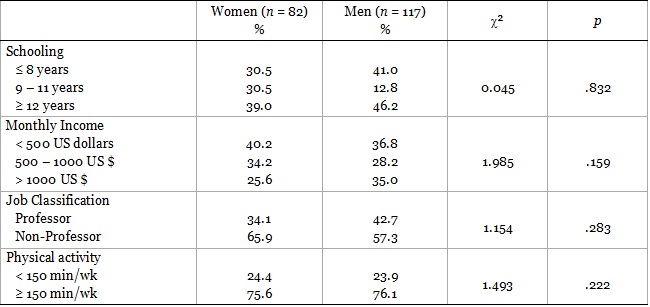
<body><![CDATA[<p>&nbsp;</p>     <p><b>Statistical Analysis</b></p>      <p> 	Continuous variables presented normal distribution according to the Kolmogorov-Smir-nov test with significance level at 5%. Scores of perceived quality of life  	were analyzed using means &plusmn; standard deviations and, afterwards, Student’s t test was used to detect possible differences between genders. The categorical  	variables (schooling, income, job classification and physical activity) were analyzed using the Chi-Square (&chi;<sup>2</sup>) test. We further explored the  	association between each domain of self-perceived quality of life (physical, psychological, social relationships, and environment) with physical inactivity.  	Thereby, each domain of quality of life was categorized into tertiles and compared with the physical activity level. </p>      <p> 	The odds ratios (OR) were measured by binary logistic regression. In the multivariable model, the domains of quality of life were included as independent variables 	and physical activity as dependent variable. All statistical analyses were carried out using the Statistical Package for the Social Sciences (SPSS), version 17.0. </p>      <p>&nbsp;</p>     <p><b>RESULTS</b></p>      <p> 	Two hundred individuals were sampled to take part in the study and only one refused to participate. Table 1 describes the sample in terms of schooling, income,  	job classification and physical activity. Most participants were men (58.8%), and non-professor (60.8%). Physical inactivity was observed in approximately one  	quarter of the sample. There was no significant association between gender and schooling, income, job classification and physical inactivity. </p>      <p>&nbsp;</p>     <p>Table 1</p>     <p> 	<i>Characteristics of the sample in terms of schooling, income, job classification and physical activity level</i> </p>     ]]></body>
<body><![CDATA[<p><img src="/img/revistas/mot/v8n1/8n1a05t1.jpg"/></p>     
<p>&nbsp;</p>      <p> 	Table 2 presents the mean scores obtained for each WHOQOL-Bref domain in men and women separately. In both genders, the median scores slightly varied (between  	14.4 and 16.5). There were no statistical differences between mean scores for men and women in any of the four quality of life domains, except for psychological  	domain, in which men presented higher scores. </p>      <p>&nbsp;</p>     <p>Table 2</p>     <p> 	<i>Mean, standard deviation, and t statistic for each domain of self-perceived quality of life score</i> </p>     <p><img src="/img/revistas/mot/v8n1/8n1a05t2.jpg"/></p>     
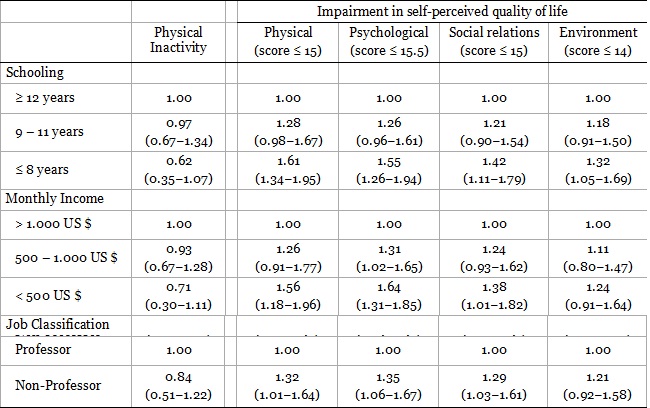
<p>&nbsp;</p>      <p> 	Table 3 presents the association between schooling, income and job classification with physical activity and self-perceived quality of life, controlled for gender. 	Physical activity was not associated with any of the exposures. In contrast, subjects with lower schooling, lower income and non professor were more likely to  	present poorer self-perceived quality of life. In the present sample, subjects reporting &le; 8 years of schooling showed between 32% (environment domain: OR = 1.32, 	95% CI 1.05- 1.69) and 61% (physical domain: OR = 1.61, 95% CI 1.34-1.95) greater chance of presenting lower self perceived quality of life when compared to their 	peers with = 12 years of schooling. With respect to income, subjects who reported &lt; 500 US Dollars/month presented between 38% (social relationships domain: OR 	= 1.38, 95% CI 1.01-1.82) and 64% (psychological domain: OR = 1.64, 95% CI 1.31-1.85) greater chance of showing lower self-perceived quality of life than peers  	earning &gt; 1000 US Dollars/month. Non-professor subjects demonstrated between 29% (social relationship domain: OR = 1.29, 95% CI 1.03-1.61) and 35% ( 	psychological domain: OR = 1.35%, 95% CI 1.06-1.67) more chance to present a lower self-perceived quality of life compared to professors. </p>      <p>&nbsp;</p>     ]]></body>
<body><![CDATA[<p>Table 3</p>     <p> 	<i>Association of schooling, income and job classification with the outcomes physical inactivity and self-perceived quality of life (Values are Odds Ratios (95% CI)  	adjusted for gender)</i> </p>     <p><img src="/img/revistas/mot/v8n1/8n1a05t3.jpg"/></p>     
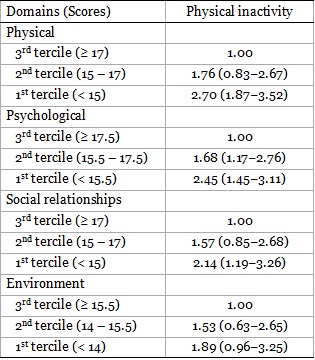
<p>&nbsp;</p>      <p> 	Table 4 presents the multivariable analyses for the association between self-perceived quality of life and physical inactivity. Subjects with lower scores in  	self-perceived quality of life were more likely to be inactive than subjects with higher scores for self-perceived quality of life. The strongest association was  	observed for the physical domain (OR = 2.70, 95% CI 1.87-3.52), whereas only the environment domain (OR = 1.89, 95% CI 0.96-3.25) did not presented a significant  	association with physical inactivity. </p>      <p>&nbsp;</p>     <p>Table 4</p>     <p> 	<i>Multivariable analyses for the association between physical inactivity and quality of life (Values are Odds Ratios (95% CI) controlling for gender, schooling,  	and income)</i> </p>     <p><img src="/img/revistas/mot/v8n1/8n1a05t4.jpg"/></p>     
<p>&nbsp;</p>      ]]></body>
<body><![CDATA[<p>&nbsp;</p>     <p><b>DISCUSSION</b></p>      <p> 	This study presents data about physical activity and self-perceived quality of life from a sample of Brazilian older adults evaluated with the short version of the 	IPAQ and WHOQOL-Bref. The main finding of the study was that higher levels of habitual physical activity were associated with higher self-perceived quality of live 	scores. </p>      <p> 	The relationship between physical activity and self-perceived quality of life in different population groups has been studied (Aidar et al., 2006; Bernstein,  	Costanza, &amp; Morabia, 2001; Gómez, Duperly, Lucumi, Gómez, &amp; Venegas, 2005; Matsudo et al., 2002; Rütten &amp; Abu-Omar, 2004; Sarkisian, Prohaska, Wong,  	Hirsch, &amp; Mangione, 2005). However, none of these studies used internationally recognized instruments to measure both physical activity and quality of life.  	This drawback has hindered comparison across studies and limited the confidence to generalize their findings. Thus, we believe our data are important and provide  	reliable estimates of the association between physical activity and self-perceived quality of life.  </p>      <p> 	The physical activity level found in this study is in agreement with other studies that applied the IPAQ (Gómez et al., 2005; Matsudo et al., 2002; Rütten &amp;  	Abu-Omar, 2004). Our results indicate that, after the age of 60 years, despite the slightly greater proportion of women classified as inactive, both genders  	present similar behavior in terms of physical activity level. Our data indicate a lower proportion of inactivity than those reported in European (Rütten &amp;  	Abu-Omar, 2004), South American (Gómez et al., 2005), and other Brazilian studies (Matsudo et al., 2002). The reason for these differences is likely to be related 	to the characteristics of the participants. In the present study, the sample was composed by employees of a public university. The activities performed by these  	subjects include teaching, administration, maintenance, gardening, security, etc. Some of the tasks demand occupational physical activity and, as the short version 	of the IPAQ evaluates all-domains of physical activity, a lower proportion of inactivity is expected. Furthermore, the sample is somehow biased when compared to  	the Brazilian population as a whole, since it oversampled individuals from higher socioeconomic status than the average Brazilian population. </p>      <p> 	The evaluation of self-perceived quality of life using WHOQOL-Bref showed similar patterns of mean scores across the four domains and among men and women,  	indicating an important reciprocal influence among domains. These data are in agreement with those obtained in the original multicenter study that evaluated the  	instrument (WHOQOL Group, 1998). Nonetheless, it is important to analyze each domain of quality of life separately, because quality of life is considered a  	multidimensional construct (WHOQOL Group, 1998).  </p>      <p> 	Other studies with elderly (60 to 90 years) evaluated the contribution of physical, psychological, social and environmental domains on the overall quality of life. 	The results indicate that the relative contribution of the four domains on global quality of life was approximately 36%, with larger participation of the physical 	domain (28%). The results also revealed that the different domains have limited participation on the explanatory capacity of the global quality of life scores.  	Therefore, data must be interpreted separately when the analysis of life quality in older subjects is the outcome (Pereira et al., 2006). </p>      <p> 	The mean scores for the dimensions of quality life found in this study are similar to those found in a sample of employees from the Federal University of Rio  	Grande do Sul (Brazil), except for the physical domain (Fleck et al., 2000). The lower score found for the physical domain in the present study may be due to  	differences in the age of subjects included in the two studies. In our study, subjects were 60 years and older, while the mean age among subjects from the  	Federal University of Rio Grande do Sul was 45 years.  </p>      <p> 	Self-perceived quality of life is affected by organic, social, cognitive, and mental factors. Thus, it is highly dependent on the environment of the individual  	(Rejeski, Brawley, &amp; Shumaker, 1996). The advanced age of the subjects evaluated in the present study may have had greater negative effect on the physical  	domain of self-perceived quality of life. In contrast, this effect can be minimized when physical activity is increased. An experimental study carried out by  	Aidar et al. (2006) showed significant improvements on indicators of quality of life and VO<sub>2</sub>max in the subjects that underwent a physical activity  	program. Such an association was not observed in the control group. </p>      <p> 	An important contribution of the present study is the evaluation of associations. Lower perceived quality of life was associated with lower schooling, income and  	job classification whereas no association was found for physical activity. The physical and the psychological domains showed the strongest association with these  	three indicators. In the present study, schooling &le; 8 years or earnings &lt; 500 US dollars/month or the performance of a non-teacher function increased the  	odds of lower scores in the evaluation of self-perceived quality of life by 32-64%, respectively. The non-significant association between physical activity and  	schooling and income was also observed in other studies using the IPAQ and employing binary logistic regression (Gómez et al., 2005; Rütten &amp; Abu-Omar, 2004). 	However, when using instruments other than the IPAQ (Bernstein et al., 2001), or other types of statistical analysis (Matsudo et al., 2002), physical activity  	was not always unrelated to schooling and income. </p>      ]]></body>
<body><![CDATA[<p> 	The association between physical activity and mental health has been previously studied. Based on a similar criteria to classify individuals' physical activity  	levels, a study with Portuguese elderly (<i>n</i> = 168, mean age = 72 years) found that 41.1% were considered physically inactive. In addition, when physical  	activity participation was increased, higher levels of life satisfaction, self-esteem and personal growth were verified, being this effect superior in the elderly 	people who practiced at least 30 min/day of moderate-to-vigorous physical activities on five or more days in a week (Fernandes, Vasconcelos-Raposo, Pereira,  	Ramalho, &amp; Oliveira, 2009). </p>      <p> 	Original aspects of the present study include the assessment of the relationship between quality of life and physical activity among subjects aged 60-70 years,  	using the IPAQ and WHOQOL-Bref, respectively. Subjects with lower scores in self-perceived quality of life were more likely to be inactive than subjects with  	higher scores for self-perceived quality of life. Certain limitations should be considered when interpreting the results of the present study. First, although  	the psychometric indicators of the IPAQ fulfill the proposed acceptance criteria (Craig et al., 2003) it is still a subjective measure and its accuracy depends  	on the respondent. Further studies could use objective measures such as accelerometers to confirm our associations. Second, in light of the reports provided by  	the subjects of the present study, we found that self-perceived quality of life reflects individual responses, which depend exclusively on the subject’s attitude  	toward different daily life situations and above all how he/she perceives the older age. Thus, considering that the study sample was composed of a universe of  	subjects with highly diverse life experiences, ranging from university teachers with post-graduate education to employees whose function requires minimal  	schooling, one cannot discard the possibility of bias in the subjects’ interpretation of the questions included in WHOQOL-Bref. Moreover, because the sample  	included only employees of a given university the generalization of our findings shall be made with prudence. </p>      <p> 	In conclusion, our results suggest that improved self-perceived quality of life is significantly associated to physical activity among older adults. Despite the  	methodological difficulties inherent to studies aimed to investigate this issue, an improved understanding of the relationship between the physical activity and 	quality of life is important to formulate recommendations regarding modifications in lifestyle, mainly among those that have not been affected by disabling  	diseases and that are physically independent. </p>      <p>&nbsp;</p>     <p><b>REFERÊNCIAS</b></p>      <!-- ref --><p> 	Aidar, F. J., Carneiro, A., Silva, A., Reis, V., Novaes, G. S., &amp; Pains, R. (2006). A prática de atividades físicas e a relação da qualidade de vida com o  	VO<sub>2</sub> máx. predito. <i>Motricidade</i>, 2(3), 167-177.    &nbsp;&nbsp;&nbsp;&nbsp;&nbsp;&nbsp;&nbsp;&nbsp;[&#160;<a href="javascript:void(0);" onclick="javascript: window.open('/scielo.php?script=sci_nlinks&ref=000088&pid=S1646-107X201200010000500001&lng=','','width=640,height=500,resizable=yes,scrollbars=1,menubar=yes,');">Links</a>&#160;]<!-- end-ref --> </p>      <!-- ref --><p> 	Amara, C. E., Koval, J. J., Johnson, P. J., Paterson, D. H., Winter, E., &amp; Cunningham, D. A. (2000). Modelling the influence of fat-free mass and physical  	activity on the decline in maximal oxygen uptake with age in older humans. <i>Experimental Physiology</i>, 85(6), 877-886.    &nbsp;&nbsp;&nbsp;&nbsp;&nbsp;&nbsp;&nbsp;&nbsp;[&#160;<a href="javascript:void(0);" onclick="javascript: window.open('/scielo.php?script=sci_nlinks&ref=000090&pid=S1646-107X201200010000500002&lng=','','width=640,height=500,resizable=yes,scrollbars=1,menubar=yes,');">Links</a>&#160;]<!-- end-ref --> </p>      <!-- ref --><p> 	Babic, Z., Deskin, M., Muacevic-Katanec, D., Erdeljic, V., Misigoj-Durakovic, M., &amp; Metelko, Z. (2004). Estimation of physical activity by different  	questionnaires in overweight subjects and patients with Type 2 diabetes mellitus: Relationship with anthropometric and metabolic variables. <i>Diabetes,  	Nutrition &amp; Metabolism</i>, 17(5), 280-289.    &nbsp;&nbsp;&nbsp;&nbsp;&nbsp;&nbsp;&nbsp;&nbsp;[&#160;<a href="javascript:void(0);" onclick="javascript: window.open('/scielo.php?script=sci_nlinks&ref=000092&pid=S1646-107X201200010000500003&lng=','','width=640,height=500,resizable=yes,scrollbars=1,menubar=yes,');">Links</a>&#160;]<!-- end-ref --> </p>      <!-- ref --><p> 	Bassuk, S. S., &amp; Manson, J. E. (2005). Epidemiological evidence for the role of physical activity in reducing risk of type 2 diabetes and cardio-vascular  	disease. <i>Journal of Applied Physiology</i>, 99, 1193-1204.    &nbsp;&nbsp;&nbsp;&nbsp;&nbsp;&nbsp;&nbsp;&nbsp;[&#160;<a href="javascript:void(0);" onclick="javascript: window.open('/scielo.php?script=sci_nlinks&ref=000094&pid=S1646-107X201200010000500004&lng=','','width=640,height=500,resizable=yes,scrollbars=1,menubar=yes,');">Links</a>&#160;]<!-- end-ref --> </p>      <!-- ref --><p> 	Bernstein, M. S., Costanza, M. C., &amp; Morabia, A. (2001). Physical activity of urban adults: A general population survey in Geneva. <i>Sozial und  	Präventivmedizin</i>, 46(1), 49-59. doi: 10.1007/BF 01318798	 &nbsp;&nbsp;&nbsp;&nbsp;&nbsp;&nbsp;&nbsp;&nbsp;[&#160;<a href="javascript:void(0);" onclick="javascript: window.open('/scielo.php?script=sci_nlinks&ref=000096&pid=S1646-107X201200010000500005&lng=','','width=640,height=500,resizable=yes,scrollbars=1,menubar=yes,');">Links</a>&#160;]<!-- end-ref --><!-- ref --><p> 	Chachamovich, E., Trentini, C., &amp; Fleck, M. P. (2007). Assessment of the psychometric performance of the WHOQOL-BREF instrument in a sample of Brazilian older 	adults. <i>International Psychogeriatrics</i>, 19(4), 635-646. doi: 10.10 17/S1041610206003619 &nbsp;&nbsp;&nbsp;&nbsp;&nbsp;&nbsp;&nbsp;&nbsp;[&#160;<a href="javascript:void(0);" onclick="javascript: window.open('/scielo.php?script=sci_nlinks&ref=000097&pid=S1646-107X201200010000500006&lng=','','width=640,height=500,resizable=yes,scrollbars=1,menubar=yes,');">Links</a>&#160;]<!-- end-ref --><!-- ref --><p> 	Craig, C. L., Marshall, A. L., Sjostrom, M., Bauman, A. E., Booth, M. L., Ainsworth, B. E. … Oja, P. (2003). International Physical Activity Questionnaire:  	12-Country Reliability and Validity. <i>Medicine &amp; Science in Sports &amp; Exercise</i>, 35(8), 1381-1395. doi: 10.1249/01.MSS.0000078924. 61453.FB &nbsp;&nbsp;&nbsp;&nbsp;&nbsp;&nbsp;&nbsp;&nbsp;[&#160;<a href="javascript:void(0);" onclick="javascript: window.open('/scielo.php?script=sci_nlinks&ref=000098&pid=S1646-107X201200010000500007&lng=','','width=640,height=500,resizable=yes,scrollbars=1,menubar=yes,');">Links</a>&#160;]<!-- end-ref --><!-- ref --><p> 	Elavsky, S., McAuley, E., Motl, R. W., Konopack, J. F., Marquez, D. X., Hu, L. ... Diener, E. (2005). Physical activity enhances long-term quality of life in  	older adults: Efficacy, esteem, and affective influences. <i>Annals of Behavioral Medicine</i>, 30(2), 138-145. doi: 10.1207/s15324796abm30 02_6 &nbsp;&nbsp;&nbsp;&nbsp;&nbsp;&nbsp;&nbsp;&nbsp;[&#160;<a href="javascript:void(0);" onclick="javascript: window.open('/scielo.php?script=sci_nlinks&ref=000099&pid=S1646-107X201200010000500008&lng=','','width=640,height=500,resizable=yes,scrollbars=1,menubar=yes,');">Links</a>&#160;]<!-- end-ref --><!-- ref --><p> 	Fernandes, H. M., Vasconcelos-Raposo, J., Pereira, E., Ramalho, J., &amp; Oliveira, S. (2009). A influência da actividade física na saúde mental positiva de idosos. 	<i>Motricidade</i>, 5(1), 33-50.    &nbsp;&nbsp;&nbsp;&nbsp;&nbsp;&nbsp;&nbsp;&nbsp;[&#160;<a href="javascript:void(0);" onclick="javascript: window.open('/scielo.php?script=sci_nlinks&ref=000100&pid=S1646-107X201200010000500009&lng=','','width=640,height=500,resizable=yes,scrollbars=1,menubar=yes,');">Links</a>&#160;]<!-- end-ref --> </p>      <!-- ref --><p> 	Fleck, M., Chachamovich, E., &amp; Trentini, C. (2006). Development and validation of the Portuguese version of the WHOQOL-OLD module. <i>Revista de Saúde  	Pública</i>, 40(5), 785-791.    &nbsp;&nbsp;&nbsp;&nbsp;&nbsp;&nbsp;&nbsp;&nbsp;[&#160;<a href="javascript:void(0);" onclick="javascript: window.open('/scielo.php?script=sci_nlinks&ref=000102&pid=S1646-107X201200010000500010&lng=','','width=640,height=500,resizable=yes,scrollbars=1,menubar=yes,');">Links</a>&#160;]<!-- end-ref --> </p>      <!-- ref --><p> 	Fleck, M., Louzada, S., Xavier, M., Chachamovich, E., Vieira, G., Santos, L., &amp; Pinzon, V. (2000). Aplicação da versão em português do instrumento abreviado de  	avaliação da qualidade de vida “WHOQOL-Bref”. <i>Revista de Saúde Pública</i>, 34(2), 178-183. doi: doi.org/10.1590/S 0034-89102000000200012 &nbsp;&nbsp;&nbsp;&nbsp;&nbsp;&nbsp;&nbsp;&nbsp;[&#160;<a href="javascript:void(0);" onclick="javascript: window.open('/scielo.php?script=sci_nlinks&ref=000104&pid=S1646-107X201200010000500011&lng=','','width=640,height=500,resizable=yes,scrollbars=1,menubar=yes,');">Links</a>&#160;]<!-- end-ref --><!-- ref --><p> 	Gómez, L. F., Duperly, J., Lucumi, D. I., Gómez, R., &amp; Venegas, A. S. (2005). Nível de actividad física global en la población adulta de Bogotá (Colômbia):  	Prevalência y factores asociados. <i>Gaceta Sanitaria</i>, 19(3), 206-213.    &nbsp;&nbsp;&nbsp;&nbsp;&nbsp;&nbsp;&nbsp;&nbsp;[&#160;<a href="javascript:void(0);" onclick="javascript: window.open('/scielo.php?script=sci_nlinks&ref=000105&pid=S1646-107X201200010000500012&lng=','','width=640,height=500,resizable=yes,scrollbars=1,menubar=yes,');">Links</a>&#160;]<!-- end-ref --> </p>      <!-- ref --><p> 	Haskell, W. L., Lee, I. M., Pate, R. R., Powell, K. E., Blair, S. N., Franklin, B. A., ... Bauman, A. (2007). Physical activity and public health: Updated  	recommendation for adults from the American College of Sports Medicine and the American Heart Association. <i>Circulation</i>, 116(9), 1081-1093.  	doi: 10.1161/CIRCULATI ONAHA.107.185649 &nbsp;&nbsp;&nbsp;&nbsp;&nbsp;&nbsp;&nbsp;&nbsp;[&#160;<a href="javascript:void(0);" onclick="javascript: window.open('/scielo.php?script=sci_nlinks&ref=000107&pid=S1646-107X201200010000500013&lng=','','width=640,height=500,resizable=yes,scrollbars=1,menubar=yes,');">Links</a>&#160;]<!-- end-ref --><!-- ref --><p> 	Lee, I. M., Paffenbarger, R. S., &amp; Hennekens, C. H. (1997). Physical activity, physical fitness and longevity. <i>Aging (Milano)</i>, 9(1/2), 2-11.    &nbsp;&nbsp;&nbsp;&nbsp;&nbsp;&nbsp;&nbsp;&nbsp;[&#160;<a href="javascript:void(0);" onclick="javascript: window.open('/scielo.php?script=sci_nlinks&ref=000108&pid=S1646-107X201200010000500014&lng=','','width=640,height=500,resizable=yes,scrollbars=1,menubar=yes,');">Links</a>&#160;]<!-- end-ref --> </p>      <!-- ref --><p> 	Mao, Y., Pan, S., Wen, S., &amp; Johnson, K. (2003). Physical activity and the risk of lung cancer in Canada. <i>American Journal of Epidemiology</i>, 158(6),  	564-575. doi: 10.1093/aje/kwg186 &nbsp;&nbsp;&nbsp;&nbsp;&nbsp;&nbsp;&nbsp;&nbsp;[&#160;<a href="javascript:void(0);" onclick="javascript: window.open('/scielo.php?script=sci_nlinks&ref=000110&pid=S1646-107X201200010000500015&lng=','','width=640,height=500,resizable=yes,scrollbars=1,menubar=yes,');">Links</a>&#160;]<!-- end-ref --><!-- ref --><p> 	Matsudo, S. M., Matsudo, V., Araújo, T., Andrade, D., Andrade, E., Oliveira, L., &amp; Braggion, G. (2002). Nível da atividade física da população do Estado de  	São Paulo: Análise de acordo com o gênero, idade, nível socioeconômico, distribuição geográfica e de conhecimento. <i>Revista Brasileira de Ciência &amp;  	Movimento</i>, 10(4), 41-50.    &nbsp;&nbsp;&nbsp;&nbsp;&nbsp;&nbsp;&nbsp;&nbsp;[&#160;<a href="javascript:void(0);" onclick="javascript: window.open('/scielo.php?script=sci_nlinks&ref=000111&pid=S1646-107X201200010000500016&lng=','','width=640,height=500,resizable=yes,scrollbars=1,menubar=yes,');">Links</a>&#160;]<!-- end-ref --> </p>      ]]></body>
<body><![CDATA[<!-- ref --><p> 	McAuley, E., Blissmer, B., Katula, J., Duncan, T. E., &amp; Mihalko, S. L. (2000). Physical activity, self-esteem, and self-efficacy relationships in older adults 	: A randomized controlled trial. <i>Annals of Behavioral Medicine</i>, 22(2), 131-139. doi: 10.100 7/BF02895777 &nbsp;&nbsp;&nbsp;&nbsp;&nbsp;&nbsp;&nbsp;&nbsp;[&#160;<a href="javascript:void(0);" onclick="javascript: window.open('/scielo.php?script=sci_nlinks&ref=000113&pid=S1646-107X201200010000500017&lng=','','width=640,height=500,resizable=yes,scrollbars=1,menubar=yes,');">Links</a>&#160;]<!-- end-ref --><!-- ref --><p> 	McAuley, E., Elavsky, S., Jerome, G. J., Konopack, J. F., &amp; Marquez, D. X. (2005). Physical activity-related well-being in older adults: Social cognitive  	influences. <i>Psychology and Aging</i>, 20(2), 295-302. doi: 10.1037/0882-7974.20.2.295 &nbsp;&nbsp;&nbsp;&nbsp;&nbsp;&nbsp;&nbsp;&nbsp;[&#160;<a href="javascript:void(0);" onclick="javascript: window.open('/scielo.php?script=sci_nlinks&ref=000114&pid=S1646-107X201200010000500018&lng=','','width=640,height=500,resizable=yes,scrollbars=1,menubar=yes,');">Links</a>&#160;]<!-- end-ref --><!-- ref --><p> 	Netz, Y., Wu, M. J., Becker, B. J., &amp; Tenenbaum, G. (2005). Physical activity and psychological well-being in advanced age: A meta-analysis of intervention  	studies. <i>Psychology and Aging</i>, 20(2), 272-284. doi: 10.1037/0882-7974.20.2. 272  &nbsp;&nbsp;&nbsp;&nbsp;&nbsp;&nbsp;&nbsp;&nbsp;[&#160;<a href="javascript:void(0);" onclick="javascript: window.open('/scielo.php?script=sci_nlinks&ref=000115&pid=S1646-107X201200010000500019&lng=','','width=640,height=500,resizable=yes,scrollbars=1,menubar=yes,');">Links</a>&#160;]<!-- end-ref --><!-- ref --><p> 	Paffenbarger, R. (2000). Physical exercise to reduce cardiovascular disease risk. <i>The Proceedings of the Nutrition Society</i>, 59(3), 421-422.    &nbsp;&nbsp;&nbsp;&nbsp;&nbsp;&nbsp;&nbsp;&nbsp;[&#160;<a href="javascript:void(0);" onclick="javascript: window.open('/scielo.php?script=sci_nlinks&ref=000116&pid=S1646-107X201200010000500020&lng=','','width=640,height=500,resizable=yes,scrollbars=1,menubar=yes,');">Links</a>&#160;]<!-- end-ref --> </p>      <!-- ref --><p> 	Pereira, R. J., Cotta, R. M., Franceschini, S. C., Ribeiro, R. C., Sampaio, R. F., Priore, S. E., &amp; Cecon, P. R. (2006). Contribuição dos domínios físico,  	social, psicológico e ambiental para a qualidade de vida global de idosos. <i>Revista de Psiquiatria do Rio Grande do Sul</i>, 28(1), 27-38. doi:  	10.1590/S0101-81082006000100005 &nbsp;&nbsp;&nbsp;&nbsp;&nbsp;&nbsp;&nbsp;&nbsp;[&#160;<a href="javascript:void(0);" onclick="javascript: window.open('/scielo.php?script=sci_nlinks&ref=000118&pid=S1646-107X201200010000500021&lng=','','width=640,height=500,resizable=yes,scrollbars=1,menubar=yes,');">Links</a>&#160;]<!-- end-ref --><!-- ref --><p> 	Pitanga, F. J., Almeida, L. A., Freitas, M., Pitanga, C. P., &amp; Beck, C. C. (2010). Padrões de atividade física em diferentes domínios e ausência de diabetes  	em adultos. <i>Motricidade</i>, 6(1), 5-17.    &nbsp;&nbsp;&nbsp;&nbsp;&nbsp;&nbsp;&nbsp;&nbsp;[&#160;<a href="javascript:void(0);" onclick="javascript: window.open('/scielo.php?script=sci_nlinks&ref=000119&pid=S1646-107X201200010000500022&lng=','','width=640,height=500,resizable=yes,scrollbars=1,menubar=yes,');">Links</a>&#160;]<!-- end-ref --> </p>      <!-- ref --><p> 	Puggaard, L., Larsen, J. B., Stovring, H., &amp; Jeune, B. (2000). Maximal oxygen uptake, muscle strength and walking speed in 85-year-old women: Effects of  	increased physical activity. <i>Aging (Milano)</i>, 12(3), 180-189.    &nbsp;&nbsp;&nbsp;&nbsp;&nbsp;&nbsp;&nbsp;&nbsp;[&#160;<a href="javascript:void(0);" onclick="javascript: window.open('/scielo.php?script=sci_nlinks&ref=000121&pid=S1646-107X201200010000500023&lng=','','width=640,height=500,resizable=yes,scrollbars=1,menubar=yes,');">Links</a>&#160;]<!-- end-ref --> </p>      ]]></body>
<body><![CDATA[<!-- ref --><p> 	Rejeski, W. J., Brawley, L. R., &amp; Shumaker, A. S. (1996). Physical activity and health-related quality of life. <i>Exercise and Sport Sciences Reviews</i>, 24(1),  	71-108.    &nbsp;&nbsp;&nbsp;&nbsp;&nbsp;&nbsp;&nbsp;&nbsp;[&#160;<a href="javascript:void(0);" onclick="javascript: window.open('/scielo.php?script=sci_nlinks&ref=000123&pid=S1646-107X201200010000500024&lng=','','width=640,height=500,resizable=yes,scrollbars=1,menubar=yes,');">Links</a>&#160;]<!-- end-ref --> </p>      <!-- ref --><p> 	Rütten, A., &amp; Abu-Omar, K. (2004). Prevalence of physical activity in the European Union. <i>Sozial und Präventivmedizin</i>, 49(4), 281-289. doi: 10.10  	07/s00038-004-3100-4 &nbsp;&nbsp;&nbsp;&nbsp;&nbsp;&nbsp;&nbsp;&nbsp;[&#160;<a href="javascript:void(0);" onclick="javascript: window.open('/scielo.php?script=sci_nlinks&ref=000125&pid=S1646-107X201200010000500025&lng=','','width=640,height=500,resizable=yes,scrollbars=1,menubar=yes,');">Links</a>&#160;]<!-- end-ref --><!-- ref --><p> 	Sarkisian, C. A., Prohaska, T. R., Wong, M. D., Hirsch, S., &amp; Mangione, C. M. (2005). The relationship between expectations for aging and physical activity  	among older adults. <i>Journal of General Internal Medicine</i>, 20(10), 911-915. doi: 10.1111/j.1525-1497.2005.0204.x &nbsp;&nbsp;&nbsp;&nbsp;&nbsp;&nbsp;&nbsp;&nbsp;[&#160;<a href="javascript:void(0);" onclick="javascript: window.open('/scielo.php?script=sci_nlinks&ref=000126&pid=S1646-107X201200010000500026&lng=','','width=640,height=500,resizable=yes,scrollbars=1,menubar=yes,');">Links</a>&#160;]<!-- end-ref --><!-- ref --><p> 	Vita, A. J., Terry, R. B., Hubert, H. B., &amp; Fries, J. F. (1998). Aging, health risks, and cumulative disability. <i>The New England Journal of Medicine</i>,  	338(15), 1035-1041.    &nbsp;&nbsp;&nbsp;&nbsp;&nbsp;&nbsp;&nbsp;&nbsp;[&#160;<a href="javascript:void(0);" onclick="javascript: window.open('/scielo.php?script=sci_nlinks&ref=000127&pid=S1646-107X201200010000500027&lng=','','width=640,height=500,resizable=yes,scrollbars=1,menubar=yes,');">Links</a>&#160;]<!-- end-ref --> </p>      <!-- ref --><p> 	WHOQOL Group (1998). Development of World Health Organization WHOQOL-Bref Quality of Life Assessment. <i>Psychological Medicine</i>, 28(3), 551-558.    &nbsp;&nbsp;&nbsp;&nbsp;&nbsp;&nbsp;&nbsp;&nbsp;[&#160;<a href="javascript:void(0);" onclick="javascript: window.open('/scielo.php?script=sci_nlinks&ref=000129&pid=S1646-107X201200010000500028&lng=','','width=640,height=500,resizable=yes,scrollbars=1,menubar=yes,');">Links</a>&#160;]<!-- end-ref -->  </p>      <p>&nbsp;</p>     <p> 	<i><a name="0"></a><a href="#top0">Endereço para correspondência</a>:</i> 	Denilson Braga Porto, Centro de Educação Física e Esporte, Campus Universitário –  	Rodovia Celso Garcia Cid, PR 445, Km 380, CEP: 86051-980 Londrina, Paraná, Brasil. 	<i>E-mail:</i><a href="mailto:dbporto@hotmail.com">dbporto@hotmail.com</a> </p>     ]]></body>
<body><![CDATA[<p>&nbsp;</p>     <p>Submetido: 15.12.2010 &brvbar; Aceite: 22.01.2011</p>      ]]></body><back>
<ref-list>
<ref id="B1">
<nlm-citation citation-type="journal">
<person-group person-group-type="author">
<name>
<surname><![CDATA[Aidar]]></surname>
<given-names><![CDATA[F. J.]]></given-names>
</name>
<name>
<surname><![CDATA[Carneiro]]></surname>
<given-names><![CDATA[A.]]></given-names>
</name>
<name>
<surname><![CDATA[Silva]]></surname>
<given-names><![CDATA[A.]]></given-names>
</name>
<name>
<surname><![CDATA[Reis]]></surname>
<given-names><![CDATA[V.]]></given-names>
</name>
<name>
<surname><![CDATA[Novaes]]></surname>
<given-names><![CDATA[G. S.]]></given-names>
</name>
<name>
<surname><![CDATA[Pains]]></surname>
<given-names><![CDATA[R.]]></given-names>
</name>
</person-group>
<article-title xml:lang="pt"><![CDATA[A prática de atividades físicas e a relação da qualidade de vida com o VO2 máx. predito]]></article-title>
<source><![CDATA[Motricidade]]></source>
<year>2006</year>
<volume>2</volume>
<numero>3</numero>
<issue>3</issue>
<page-range>167-177</page-range></nlm-citation>
</ref>
<ref id="B2">
<nlm-citation citation-type="journal">
<person-group person-group-type="author">
<name>
<surname><![CDATA[Amara]]></surname>
<given-names><![CDATA[C. E.]]></given-names>
</name>
<name>
<surname><![CDATA[Koval]]></surname>
<given-names><![CDATA[J. J.]]></given-names>
</name>
<name>
<surname><![CDATA[Johnson]]></surname>
<given-names><![CDATA[P. J.]]></given-names>
</name>
<name>
<surname><![CDATA[Paterson]]></surname>
<given-names><![CDATA[D. H.]]></given-names>
</name>
<name>
<surname><![CDATA[Winter]]></surname>
<given-names><![CDATA[E.]]></given-names>
</name>
<name>
<surname><![CDATA[Cunningham]]></surname>
<given-names><![CDATA[D. A.]]></given-names>
</name>
</person-group>
<article-title xml:lang="en"><![CDATA[Modelling the influence of fat-free mass and physical activity on the decline in maximal oxygen uptake with age in older humans]]></article-title>
<source><![CDATA[Experimental Physiology]]></source>
<year>2000</year>
<volume>85</volume>
<numero>6</numero>
<issue>6</issue>
<page-range>877-886</page-range></nlm-citation>
</ref>
<ref id="B3">
<nlm-citation citation-type="journal">
<person-group person-group-type="author">
<name>
<surname><![CDATA[Babic]]></surname>
<given-names><![CDATA[Z.]]></given-names>
</name>
<name>
<surname><![CDATA[Deskin]]></surname>
<given-names><![CDATA[M.]]></given-names>
</name>
<name>
<surname><![CDATA[Muacevic-Katanec]]></surname>
<given-names><![CDATA[D.]]></given-names>
</name>
<name>
<surname><![CDATA[Erdeljic]]></surname>
<given-names><![CDATA[V.]]></given-names>
</name>
<name>
<surname><![CDATA[Misigoj-Durakovic]]></surname>
<given-names><![CDATA[M.]]></given-names>
</name>
<name>
<surname><![CDATA[Metelko]]></surname>
<given-names><![CDATA[Z.]]></given-names>
</name>
</person-group>
<article-title xml:lang="en"><![CDATA[Estimation of physical activity by different questionnaires in overweight subjects and patients with Type 2 diabetes mellitus: Relationship with anthropometric and metabolic variables]]></article-title>
<source><![CDATA[Diabetes, Nutrition & Metabolism]]></source>
<year>2004</year>
<volume>17</volume>
<numero>5</numero>
<issue>5</issue>
<page-range>280-289</page-range></nlm-citation>
</ref>
<ref id="B4">
<nlm-citation citation-type="journal">
<person-group person-group-type="author">
<name>
<surname><![CDATA[Bassuk]]></surname>
<given-names><![CDATA[S. S.]]></given-names>
</name>
<name>
<surname><![CDATA[Manson]]></surname>
<given-names><![CDATA[J. E.]]></given-names>
</name>
</person-group>
<article-title xml:lang="en"><![CDATA[Epidemiological evidence for the role of physical activity in reducing risk of type 2 diabetes and cardio-vascular disease]]></article-title>
<source><![CDATA[Journal of Applied Physiology]]></source>
<year>2005</year>
<volume>99</volume>
<page-range>1193-1204</page-range></nlm-citation>
</ref>
<ref id="B5">
<nlm-citation citation-type="journal">
<person-group person-group-type="author">
<name>
<surname><![CDATA[Bernstein]]></surname>
<given-names><![CDATA[M. S.]]></given-names>
</name>
<name>
<surname><![CDATA[Costanza]]></surname>
<given-names><![CDATA[M. C.]]></given-names>
</name>
<name>
<surname><![CDATA[Morabia]]></surname>
<given-names><![CDATA[A.]]></given-names>
</name>
</person-group>
<article-title xml:lang="en"><![CDATA[Physical activity of urban adults: A general population survey in Geneva]]></article-title>
<source><![CDATA[Sozial und Präventivmedizin]]></source>
<year>2001</year>
<volume>46</volume>
<numero>1</numero>
<issue>1</issue>
<page-range>49-59</page-range></nlm-citation>
</ref>
<ref id="B6">
<nlm-citation citation-type="journal">
<person-group person-group-type="author">
<name>
<surname><![CDATA[Chachamovich]]></surname>
<given-names><![CDATA[E.]]></given-names>
</name>
<name>
<surname><![CDATA[Trentini]]></surname>
<given-names><![CDATA[C.]]></given-names>
</name>
<name>
<surname><![CDATA[Fleck]]></surname>
<given-names><![CDATA[M. P.]]></given-names>
</name>
</person-group>
<article-title xml:lang="en"><![CDATA[Assessment of the psychometric performance of the WHOQOL-BREF instrument in a sample of Brazilian older adults]]></article-title>
<source><![CDATA[International Psychogeriatrics]]></source>
<year>2007</year>
<volume>19</volume>
<numero>4</numero>
<issue>4</issue>
<page-range>635-646</page-range></nlm-citation>
</ref>
<ref id="B7">
<nlm-citation citation-type="journal">
<person-group person-group-type="author">
<name>
<surname><![CDATA[Craig]]></surname>
<given-names><![CDATA[C. L.]]></given-names>
</name>
<name>
<surname><![CDATA[Marshall]]></surname>
<given-names><![CDATA[A. L.]]></given-names>
</name>
<name>
<surname><![CDATA[Sjostrom]]></surname>
<given-names><![CDATA[M.]]></given-names>
</name>
<name>
<surname><![CDATA[Bauman]]></surname>
<given-names><![CDATA[A. E.]]></given-names>
</name>
<name>
<surname><![CDATA[Booth]]></surname>
<given-names><![CDATA[M. L.]]></given-names>
</name>
<name>
<surname><![CDATA[Ainsworth]]></surname>
<given-names><![CDATA[B. E.]]></given-names>
</name>
<name>
<surname><![CDATA[Oja]]></surname>
<given-names><![CDATA[P.]]></given-names>
</name>
</person-group>
<article-title xml:lang="en"><![CDATA[International Physical Activity Questionnaire: 12-Country Reliability and Validity]]></article-title>
<source><![CDATA[Medicine & Science in Sports & Exercise]]></source>
<year>2003</year>
<volume>35</volume>
<numero>8</numero>
<issue>8</issue>
<page-range>1381-1395</page-range></nlm-citation>
</ref>
<ref id="B8">
<nlm-citation citation-type="journal">
<person-group person-group-type="author">
<name>
<surname><![CDATA[Elavsky]]></surname>
<given-names><![CDATA[S.]]></given-names>
</name>
<name>
<surname><![CDATA[McAuley]]></surname>
<given-names><![CDATA[E.]]></given-names>
</name>
<name>
<surname><![CDATA[Motl]]></surname>
<given-names><![CDATA[R. W.]]></given-names>
</name>
<name>
<surname><![CDATA[Konopack]]></surname>
<given-names><![CDATA[J. F.]]></given-names>
</name>
<name>
<surname><![CDATA[Marquez]]></surname>
<given-names><![CDATA[D. X.]]></given-names>
</name>
<name>
<surname><![CDATA[Hu]]></surname>
<given-names><![CDATA[L.]]></given-names>
</name>
<name>
<surname><![CDATA[Diener]]></surname>
<given-names><![CDATA[E.]]></given-names>
</name>
</person-group>
<article-title xml:lang="en"><![CDATA[Physical activity enhances long-term quality of life in older adults: Efficacy, esteem, and affective influences]]></article-title>
<source><![CDATA[Annals of Behavioral Medicine]]></source>
<year>2005</year>
<volume>30</volume>
<numero>2</numero>
<issue>2</issue>
<page-range>138-145</page-range></nlm-citation>
</ref>
<ref id="B9">
<nlm-citation citation-type="journal">
<person-group person-group-type="author">
<name>
<surname><![CDATA[Fernandes]]></surname>
<given-names><![CDATA[H. M.]]></given-names>
</name>
<name>
<surname><![CDATA[Vasconcelos-Raposo]]></surname>
<given-names><![CDATA[J.]]></given-names>
</name>
<name>
<surname><![CDATA[Pereira]]></surname>
<given-names><![CDATA[E.]]></given-names>
</name>
<name>
<surname><![CDATA[Ramalho]]></surname>
<given-names><![CDATA[J.]]></given-names>
</name>
<name>
<surname><![CDATA[Oliveira]]></surname>
<given-names><![CDATA[S.]]></given-names>
</name>
</person-group>
<article-title xml:lang="pt"><![CDATA[A influência da actividade física na saúde mental positiva de idosos]]></article-title>
<source><![CDATA[Motricidade]]></source>
<year>2009</year>
<volume>5</volume>
<numero>1</numero>
<issue>1</issue>
<page-range>33-50</page-range></nlm-citation>
</ref>
<ref id="B10">
<nlm-citation citation-type="journal">
<person-group person-group-type="author">
<name>
<surname><![CDATA[Fleck]]></surname>
<given-names><![CDATA[M.]]></given-names>
</name>
<name>
<surname><![CDATA[Chachamovich]]></surname>
<given-names><![CDATA[E.]]></given-names>
</name>
<name>
<surname><![CDATA[Trentini]]></surname>
<given-names><![CDATA[C.]]></given-names>
</name>
</person-group>
<article-title xml:lang="en"><![CDATA[Development and validation of the Portuguese version of the WHOQOL-OLD module]]></article-title>
<source><![CDATA[Revista de Saúde Pública]]></source>
<year>2006</year>
<volume>40</volume>
<numero>5</numero>
<issue>5</issue>
<page-range>785-791</page-range></nlm-citation>
</ref>
<ref id="B11">
<nlm-citation citation-type="journal">
<person-group person-group-type="author">
<name>
<surname><![CDATA[Fleck]]></surname>
<given-names><![CDATA[M.]]></given-names>
</name>
<name>
<surname><![CDATA[Louzada]]></surname>
<given-names><![CDATA[S.]]></given-names>
</name>
<name>
<surname><![CDATA[Xavier]]></surname>
<given-names><![CDATA[M.]]></given-names>
</name>
<name>
<surname><![CDATA[Chachamovich]]></surname>
<given-names><![CDATA[E.]]></given-names>
</name>
<name>
<surname><![CDATA[Vieira]]></surname>
<given-names><![CDATA[G.]]></given-names>
</name>
<name>
<surname><![CDATA[Santos]]></surname>
<given-names><![CDATA[L.]]></given-names>
</name>
<name>
<surname><![CDATA[Pinzon]]></surname>
<given-names><![CDATA[V.]]></given-names>
</name>
</person-group>
<article-title xml:lang="pt"><![CDATA[Aplicação da versão em português do instrumento abreviado de avaliação da qualidade de vida “WHOQOL-Bref”]]></article-title>
<source><![CDATA[Revista de Saúde Pública]]></source>
<year>2000</year>
<volume>34</volume>
<numero>2</numero>
<issue>2</issue>
<page-range>178-183</page-range></nlm-citation>
</ref>
<ref id="B12">
<nlm-citation citation-type="journal">
<person-group person-group-type="author">
<name>
<surname><![CDATA[Gómez]]></surname>
<given-names><![CDATA[L. F.]]></given-names>
</name>
<name>
<surname><![CDATA[Duperly]]></surname>
<given-names><![CDATA[J.]]></given-names>
</name>
<name>
<surname><![CDATA[Lucumi]]></surname>
<given-names><![CDATA[D. I.]]></given-names>
</name>
<name>
<surname><![CDATA[Gómez]]></surname>
<given-names><![CDATA[R.]]></given-names>
</name>
<name>
<surname><![CDATA[Venegas]]></surname>
<given-names><![CDATA[A. S.]]></given-names>
</name>
</person-group>
<article-title xml:lang="es"><![CDATA[Nível de actividad física global en la población adulta de Bogotá (Colômbia): Prevalência y factores asociados]]></article-title>
<source><![CDATA[Gaceta Sanitaria]]></source>
<year>2005</year>
<volume>19</volume>
<numero>3</numero>
<issue>3</issue>
<page-range>206-213</page-range></nlm-citation>
</ref>
<ref id="B13">
<nlm-citation citation-type="journal">
<person-group person-group-type="author">
<name>
<surname><![CDATA[Haskell]]></surname>
<given-names><![CDATA[W. L.]]></given-names>
</name>
<name>
<surname><![CDATA[Lee]]></surname>
<given-names><![CDATA[I. M.]]></given-names>
</name>
<name>
<surname><![CDATA[Pate]]></surname>
<given-names><![CDATA[R. R.]]></given-names>
</name>
<name>
<surname><![CDATA[Powell]]></surname>
<given-names><![CDATA[K. E.]]></given-names>
</name>
<name>
<surname><![CDATA[Blair]]></surname>
<given-names><![CDATA[S. N.]]></given-names>
</name>
<name>
<surname><![CDATA[Franklin]]></surname>
<given-names><![CDATA[B. A.]]></given-names>
</name>
<name>
<surname><![CDATA[Bauman]]></surname>
<given-names><![CDATA[A.]]></given-names>
</name>
</person-group>
<article-title xml:lang="en"><![CDATA[Physical activity and public health: Updated recommendation for adults from the American College of Sports Medicine and the American Heart Association]]></article-title>
<source><![CDATA[Circulation]]></source>
<year>2007</year>
<volume>116</volume>
<numero>9</numero>
<issue>9</issue>
<page-range>1081-1093</page-range></nlm-citation>
</ref>
<ref id="B14">
<nlm-citation citation-type="journal">
<person-group person-group-type="author">
<name>
<surname><![CDATA[Lee]]></surname>
<given-names><![CDATA[I. M.]]></given-names>
</name>
<name>
<surname><![CDATA[Paffenbarger]]></surname>
<given-names><![CDATA[R. S.]]></given-names>
</name>
<name>
<surname><![CDATA[Hennekens]]></surname>
<given-names><![CDATA[C. H.]]></given-names>
</name>
</person-group>
<article-title xml:lang="en"><![CDATA[Physical activity, physical fitness and longevity]]></article-title>
<source><![CDATA[Aging (Milano)]]></source>
<year>1997</year>
<volume>9</volume>
<numero>1/2</numero>
<issue>1/2</issue>
<page-range>2-11</page-range></nlm-citation>
</ref>
<ref id="B15">
<nlm-citation citation-type="journal">
<person-group person-group-type="author">
<name>
<surname><![CDATA[Mao]]></surname>
<given-names><![CDATA[Y.]]></given-names>
</name>
<name>
<surname><![CDATA[Pan]]></surname>
<given-names><![CDATA[S.]]></given-names>
</name>
<name>
<surname><![CDATA[Wen]]></surname>
<given-names><![CDATA[S.]]></given-names>
</name>
<name>
<surname><![CDATA[Johnson]]></surname>
<given-names><![CDATA[K.]]></given-names>
</name>
</person-group>
<article-title xml:lang="en"><![CDATA[Physical activity and the risk of lung cancer in Canada]]></article-title>
<source><![CDATA[American Journal of Epidemiology]]></source>
<year>2003</year>
<volume>158</volume>
<numero>6</numero>
<issue>6</issue>
<page-range>564-575</page-range></nlm-citation>
</ref>
<ref id="B16">
<nlm-citation citation-type="journal">
<person-group person-group-type="author">
<name>
<surname><![CDATA[Matsudo]]></surname>
<given-names><![CDATA[S. M.]]></given-names>
</name>
<name>
<surname><![CDATA[Matsudo]]></surname>
<given-names><![CDATA[V.]]></given-names>
</name>
<name>
<surname><![CDATA[Araújo]]></surname>
<given-names><![CDATA[T.]]></given-names>
</name>
<name>
<surname><![CDATA[Andrade]]></surname>
<given-names><![CDATA[D.]]></given-names>
</name>
<name>
<surname><![CDATA[Andrade]]></surname>
<given-names><![CDATA[E.]]></given-names>
</name>
<name>
<surname><![CDATA[Oliveira]]></surname>
<given-names><![CDATA[L.]]></given-names>
</name>
<name>
<surname><![CDATA[Braggion]]></surname>
<given-names><![CDATA[G.]]></given-names>
</name>
</person-group>
<article-title xml:lang="pt"><![CDATA[Nível da atividade física da população do Estado de São Paulo: Análise de acordo com o gênero, idade, nível socioeconômico, distribuição geográfica e de conhecimento]]></article-title>
<source><![CDATA[Revista Brasileira de Ciência & Movimento]]></source>
<year>2002</year>
<volume>10</volume>
<numero>4</numero>
<issue>4</issue>
<page-range>41-50</page-range></nlm-citation>
</ref>
<ref id="B17">
<nlm-citation citation-type="journal">
<person-group person-group-type="author">
<name>
<surname><![CDATA[McAuley]]></surname>
<given-names><![CDATA[E.]]></given-names>
</name>
<name>
<surname><![CDATA[Blissmer]]></surname>
<given-names><![CDATA[B.]]></given-names>
</name>
<name>
<surname><![CDATA[Katula]]></surname>
<given-names><![CDATA[J.]]></given-names>
</name>
<name>
<surname><![CDATA[Duncan]]></surname>
<given-names><![CDATA[T. E.]]></given-names>
</name>
<name>
<surname><![CDATA[Mihalko]]></surname>
<given-names><![CDATA[S. L.]]></given-names>
</name>
</person-group>
<article-title xml:lang="en"><![CDATA[Physical activity, self-esteem, and self-efficacy relationships in older adults: A randomized controlled trial]]></article-title>
<source><![CDATA[Annals of Behavioral Medicine]]></source>
<year>2000</year>
<volume>22</volume>
<numero>2</numero>
<issue>2</issue>
<page-range>131-139</page-range></nlm-citation>
</ref>
<ref id="B18">
<nlm-citation citation-type="journal">
<person-group person-group-type="author">
<name>
<surname><![CDATA[McAuley]]></surname>
<given-names><![CDATA[E.]]></given-names>
</name>
<name>
<surname><![CDATA[Elavsky]]></surname>
<given-names><![CDATA[S.]]></given-names>
</name>
<name>
<surname><![CDATA[Jerome]]></surname>
<given-names><![CDATA[G. J.]]></given-names>
</name>
<name>
<surname><![CDATA[Konopack]]></surname>
<given-names><![CDATA[J. F.]]></given-names>
</name>
<name>
<surname><![CDATA[Marquez]]></surname>
<given-names><![CDATA[D. X.]]></given-names>
</name>
</person-group>
<article-title xml:lang="en"><![CDATA[Physical activity-related well-being in older adults: Social cognitive influences]]></article-title>
<source><![CDATA[Psychology and Aging]]></source>
<year>2005</year>
<volume>20</volume>
<numero>2</numero>
<issue>2</issue>
<page-range>295-302</page-range></nlm-citation>
</ref>
<ref id="B19">
<nlm-citation citation-type="journal">
<person-group person-group-type="author">
<name>
<surname><![CDATA[Netz]]></surname>
<given-names><![CDATA[Y.]]></given-names>
</name>
<name>
<surname><![CDATA[Wu]]></surname>
<given-names><![CDATA[M. J.]]></given-names>
</name>
<name>
<surname><![CDATA[Becker]]></surname>
<given-names><![CDATA[B. J.]]></given-names>
</name>
<name>
<surname><![CDATA[Tenenbaum]]></surname>
<given-names><![CDATA[G.]]></given-names>
</name>
</person-group>
<article-title xml:lang="en"><![CDATA[Physical activity and psychological well-being in advanced age: A meta-analysis of intervention studies]]></article-title>
<source><![CDATA[Psychology and Aging]]></source>
<year>2005</year>
<volume>20</volume>
<numero>2</numero>
<issue>2</issue>
<page-range>272-284</page-range></nlm-citation>
</ref>
<ref id="B20">
<nlm-citation citation-type="journal">
<person-group person-group-type="author">
<name>
<surname><![CDATA[Paffenbarger]]></surname>
<given-names><![CDATA[R.]]></given-names>
</name>
</person-group>
<article-title xml:lang="en"><![CDATA[Physical exercise to reduce cardiovascular disease risk]]></article-title>
<source><![CDATA[The Proceedings of the Nutrition Society]]></source>
<year>2000</year>
<volume>59</volume>
<numero>3</numero>
<issue>3</issue>
<page-range>421-422</page-range></nlm-citation>
</ref>
<ref id="B21">
<nlm-citation citation-type="journal">
<person-group person-group-type="author">
<name>
<surname><![CDATA[Pereira]]></surname>
<given-names><![CDATA[R. J.]]></given-names>
</name>
<name>
<surname><![CDATA[Cotta]]></surname>
<given-names><![CDATA[R. M.]]></given-names>
</name>
<name>
<surname><![CDATA[Franceschini]]></surname>
<given-names><![CDATA[S. C.]]></given-names>
</name>
<name>
<surname><![CDATA[Ribeiro]]></surname>
<given-names><![CDATA[R. C.]]></given-names>
</name>
<name>
<surname><![CDATA[Sampaio]]></surname>
<given-names><![CDATA[R. F.]]></given-names>
</name>
<name>
<surname><![CDATA[Priore]]></surname>
<given-names><![CDATA[S. E.]]></given-names>
</name>
<name>
<surname><![CDATA[Cecon]]></surname>
<given-names><![CDATA[P. R.]]></given-names>
</name>
</person-group>
<article-title xml:lang="pt"><![CDATA[Contribuição dos domínios físico, social, psicológico e ambiental para a qualidade de vida global de idosos]]></article-title>
<source><![CDATA[Revista de Psiquiatria do Rio Grande do Sul]]></source>
<year>2006</year>
<volume>28</volume>
<numero>1</numero>
<issue>1</issue>
<page-range>27-38</page-range></nlm-citation>
</ref>
<ref id="B22">
<nlm-citation citation-type="journal">
<person-group person-group-type="author">
<name>
<surname><![CDATA[Pitanga]]></surname>
<given-names><![CDATA[F. J.]]></given-names>
</name>
<name>
<surname><![CDATA[Almeida]]></surname>
<given-names><![CDATA[L. A.]]></given-names>
</name>
<name>
<surname><![CDATA[Freitas]]></surname>
<given-names><![CDATA[M.]]></given-names>
</name>
<name>
<surname><![CDATA[Pitanga]]></surname>
<given-names><![CDATA[C. P.]]></given-names>
</name>
<name>
<surname><![CDATA[Beck]]></surname>
<given-names><![CDATA[C. C.]]></given-names>
</name>
</person-group>
<article-title xml:lang="pt"><![CDATA[Padrões de atividade física em diferentes domínios e ausência de diabetes em adultos]]></article-title>
<source><![CDATA[Motricidade]]></source>
<year>2010</year>
<volume>6</volume>
<numero>1</numero>
<issue>1</issue>
<page-range>5-17</page-range></nlm-citation>
</ref>
<ref id="B23">
<nlm-citation citation-type="journal">
<person-group person-group-type="author">
<name>
<surname><![CDATA[Puggaard]]></surname>
<given-names><![CDATA[L.]]></given-names>
</name>
<name>
<surname><![CDATA[Larsen]]></surname>
<given-names><![CDATA[J. B.]]></given-names>
</name>
<name>
<surname><![CDATA[Stovring]]></surname>
<given-names><![CDATA[H.]]></given-names>
</name>
<name>
<surname><![CDATA[Jeune]]></surname>
<given-names><![CDATA[B.]]></given-names>
</name>
</person-group>
<article-title xml:lang="en"><![CDATA[Maximal oxygen uptake, muscle strength and walking speed in 85-year-old women: Effects of increased physical activity]]></article-title>
<source><![CDATA[Aging (Milano)]]></source>
<year>2000</year>
<volume>12</volume>
<numero>3</numero>
<issue>3</issue>
<page-range>180-189</page-range></nlm-citation>
</ref>
<ref id="B24">
<nlm-citation citation-type="journal">
<person-group person-group-type="author">
<name>
<surname><![CDATA[Rejeski]]></surname>
<given-names><![CDATA[W. J.]]></given-names>
</name>
<name>
<surname><![CDATA[Brawley]]></surname>
<given-names><![CDATA[L. R.]]></given-names>
</name>
<name>
<surname><![CDATA[Shumaker]]></surname>
<given-names><![CDATA[A. S.]]></given-names>
</name>
</person-group>
<article-title xml:lang="en"><![CDATA[Physical activity and health-related quality of life]]></article-title>
<source><![CDATA[Exercise and Sport Sciences Reviews]]></source>
<year>1996</year>
<volume>24</volume>
<numero>1</numero>
<issue>1</issue>
<page-range>71-108</page-range></nlm-citation>
</ref>
<ref id="B25">
<nlm-citation citation-type="journal">
<person-group person-group-type="author">
<name>
<surname><![CDATA[Rütten]]></surname>
<given-names><![CDATA[A.]]></given-names>
</name>
<name>
<surname><![CDATA[Abu-Omar]]></surname>
<given-names><![CDATA[K.]]></given-names>
</name>
</person-group>
<article-title xml:lang="en"><![CDATA[Prevalence of physical activity in the European Union]]></article-title>
<source><![CDATA[Sozial und Präventivmedizin]]></source>
<year>2004</year>
<volume>49</volume>
<numero>4</numero>
<issue>4</issue>
<page-range>281-289</page-range></nlm-citation>
</ref>
<ref id="B26">
<nlm-citation citation-type="journal">
<person-group person-group-type="author">
<name>
<surname><![CDATA[Sarkisian]]></surname>
<given-names><![CDATA[C. A.]]></given-names>
</name>
<name>
<surname><![CDATA[Prohaska]]></surname>
<given-names><![CDATA[T. R.]]></given-names>
</name>
<name>
<surname><![CDATA[Wong]]></surname>
<given-names><![CDATA[M. D.]]></given-names>
</name>
<name>
<surname><![CDATA[Hirsch]]></surname>
<given-names><![CDATA[S.]]></given-names>
</name>
<name>
<surname><![CDATA[Mangione]]></surname>
<given-names><![CDATA[C. M.]]></given-names>
</name>
</person-group>
<article-title xml:lang="en"><![CDATA[The relationship between expectations for aging and physical activity among older adults]]></article-title>
<source><![CDATA[Journal of General Internal Medicine]]></source>
<year>2005</year>
<volume>20</volume>
<numero>10</numero>
<issue>10</issue>
<page-range>911-915</page-range></nlm-citation>
</ref>
<ref id="B27">
<nlm-citation citation-type="journal">
<person-group person-group-type="author">
<name>
<surname><![CDATA[Vita]]></surname>
<given-names><![CDATA[A. J.]]></given-names>
</name>
<name>
<surname><![CDATA[Terry]]></surname>
<given-names><![CDATA[R. B.]]></given-names>
</name>
<name>
<surname><![CDATA[Hubert]]></surname>
<given-names><![CDATA[H. B.]]></given-names>
</name>
<name>
<surname><![CDATA[Fries]]></surname>
<given-names><![CDATA[J. F.]]></given-names>
</name>
</person-group>
<article-title xml:lang="en"><![CDATA[Aging, health risks, and cumulative disability]]></article-title>
<source><![CDATA[The New England Journal of Medicine]]></source>
<year>1998</year>
<volume>338</volume>
<numero>15</numero>
<issue>15</issue>
<page-range>1035-1041</page-range></nlm-citation>
</ref>
<ref id="B28">
<nlm-citation citation-type="journal">
<collab>WHOQOL Group</collab>
<article-title xml:lang="en"><![CDATA[Development of World Health Organization WHOQOL-Bref Quality of Life Assessment]]></article-title>
<source><![CDATA[Psychological Medicine]]></source>
<year>1998</year>
<volume>3</volume>
<page-range>28</page-range><page-range>551-558</page-range></nlm-citation>
</ref>
</ref-list>
</back>
</article>