Clusters of religiosity of Portuguese population
Clusters de religiosidade da população portuguesa
José Pereira Coutinho*
*MENA (Centre of Research in Social and Human Sciences), Park, Núcleo Central, 379 2740-122 Porto Salvo, Portugal. E-mail: jose.coutinho@numena.org.pt
ABSTRACT
]]> This article, based on EVS 2008, presents clusters of religiosity regarding the Portuguese population. The author based his research on multiple correspondence analysis and clusters analysis, using one indicator for each dimension of religiosity (belief, practice, and attitude). Five clusters of religiosity were found: non-practicing heterodox believers, occasional practicing heterodox believers, skeptical Catholics, intermediate Catholics, and observant Catholics. These clusters were crossed with socio-demographic indicators and indicators to assess individualization.
KEYWORDS: religiosity; individualization; Portugal; Catholicism.
RESUMO
Este artigo, baseado no EVS 2008, apresenta clusters de religiosidade da população portuguesa. O autor baseou a sua pesquisa na análise de correspondências múltiplas e na análise de clusters, usando um indicador por cada dimensão de religiosidade (crença, prática e atitude). Foram encontrados cinco clusters: crentes heterodoxos não praticantes, crentes heterodoxos praticantes ocasionais, católicos cépticos, católicos intermédios e católicos observantes. Estes clusters foram cruzados com indicadores sociodemográficos e de aferição da individualização.
PALAVRAS-CHAVE: religiosidade; individualização; catolicismo; Portugal.
INTRODUCTION
]]> Since the emergence of Portuguese religious sociology in the 1950s, the amount of sociological studies produced in the domain of religion has not been considerable, even less for studies about religious clustering. Despite the undeniable quality and interest of his study, using for instance indicators as frequency of Holy Communion and confession, Teixeira (2013) did not inquire about beliefs and values, two essential dimensions of religiosity, and did not gauge individualization. Similarly only few studies have characterized the Portuguese population using religious practice, religious affiliation, religious belief, religious attitude and/or religious feeling (Duque, 2014; Toldy, 2013; Teixeira, 2012; Duque, 2009; Cabral, 2001; Vilaça, 2001; Antunes, 2000; Lages, 2000; Pires and Antunes, 1998; França, 1981; Falcão, 1957). Until now only two studies clustered the entire Portuguese population using multivariate techniques of multiple correspondence analysis and clusters analysis. While Oliveira (1995) established seven clusters grounded on three dimensions (beliefs, practices, and moral attitudes); based on much more than these dimensions, Pais (2001) generated only three clusters. Besides obtaining different results, these two studies used dissimilar indicators and are relatively outdated.
There is therefore an opportunity to study the Portuguese religious field, assuming the following changes: more recent database, fewer and more suitable indicators. The European Values Study (EVS) is chosen, since it presents more interesting indicators of beliefs, practices, and moral attitudes, than the International Social Survey Program (ISSP) or the European Social Survey (ESS).
Since almost the entire population with religious affiliation is Catholic and the percentage of other religions is tiny, this study will cluster only the Catholic religious field. Moreover, not only has the non-Catholic religious field already been analyzed by others (Vilaça, 2006 and 2013; Monteiro, 2012), but also the Portuguese non-Catholic sample considered in EVS (2010) is too small to be analyzed. Thus, in this article, based on indicators of beliefs, practices, and attitudes, I intend to generate clusters of Catholic religiosity and to characterize them.
PLURALIZATION AND INDIVIDUALIZATION
In the beginning of the twentieth century, the Portuguese were generally rural, feebly schooled, and poor. 1960s shook Portuguese society, bringing mobility in the wake of emigration, overseas war, and economic growth. This social transformation was multiplied by the political revolution of 1974 and the adherence to the European Economic Community in 1986. These two events, along with democratic consolidation and globalization, changed Portugal dramatically over these last decades. In fact, data about economy, wealth, and schooling show this. First: the agricultural society of Salazar’s regime became a tertiary society. In 1974 the three sectors had practically the same weight (primary – 34.9%, secondary – 33.7%, and tertiary – 31.4%), while in 2014 the percentages were respectively 8.7%, 23.9%, and 67.5% (Source: PORDATA). Second: the average individual wealth grew substantially. The gross domestic product (GDP) per capita at constant prices (2011) doubled between 1974 and 2013: from 8.098€ to 16.067€, in spite of its decrease during the most recent years (Source: PORDATA). Third: from poorly to almost totally schooled (children and youth). The actual schooling rate grew from 8.3% (pre-school), 84.9% (1st cycle), 26% (2nd cycle), 17.8% (3rd cycle), and 4.9% (upper-secondary) in 1974 to respectively 88.5%, 100%, 91.9%, 87.5%, and 73.6% in 2013 (Source: PORDATA).
The societal transformation of these last decades paved the way to Portugal’s late modernity and consequently the expansion of pluralization and individualization. Pluralization is the process by which religious and non-religious agencies in a free market compete for consumers’ consciousness by offering products of ultimate meaning (Berger, 1990; Luckmann, 1970). For the North-Americans, religious competition is a key issue, based on a rational choice approach, as Iannaccone (1992, p. 124) explains: religion is chosen as any other product, evaluating costs and benefits, in order to maximize net benefits. For the majority of Europeans, however, the presence of a religious market does not influence their religious attitudes, since they look to the churches as useful social institutions (Berger, Davie and Fokas, 2010, pp. 35-36). Also, diffused religion is something of an embarrassment to both Christian and non-Christian proselytism and to the grand narratives of secular voices. In fact, in spite of secularization, religious culture has a major impact on each nation, shaping its system of values and beliefs (Inglehart and Welzel, 2005, p. 20; Norris and Inglehart, 2004, p. 17).
In Portugal the Catholic culture is undoubtedly the most influential, despite the creation of an official religious market through the Law of Religious Freedom (2001). Although religious minorities are growing, also with the help of immigration1, Portugal stands out as a Catholic country. In 1900, 0.09% (5,012) had other religion and 99.87% was Catholic; in 1960 0.44% (39,747) had other religion and 97.89% was Catholic; in 2011 3.87% (347,756) had other religion and 81% was Catholic (Source: INE). This official pluralistic situation was preceded by the challenge of non-religious worldviews or grand narratives since the end of the Ancien Régime, such as liberalism, socialism, or nationalism, which had major impacts on Portuguese society, mainly after the 1974 revolution.
This pluralization (religious and non-religious), stimulated by mass media, is today provoking major changes in people’s minds, and is one of the factors underlying the fragmentation of beliefs and the respective bricolage. For Hervieu-Léger (2005, p. 48), the best sign of institutional deregulation comes with individual re-composition out of any institutionalized set of beliefs. Hence, individualization is the transformation of religiosity from something controlled no longer by the religious institution but now by the individual. There is now a spiritual revolution, a turn from transcendent to inner sources of significance and authority: life-as religion decreases, while subjective-life spirituality increases (Heelas and Woodhead, 2005). In other words, from traditional religions people pass to non-institutionalized forms of religion (Inglehart and Welzel, 2005, pp. 31-32). This deinstitutionalization is so important that Davie (2006, pp. 277-278) characterizes Europe with ‘vicarious religion’, in which an active minority performs religion on behalf of a passive majority. Religious splintering or heterogeneity, due to deregulation, is of central concern for today’s sociologists. Davie (1990) used the term ‘believing without belonging’ to express the different speed of believing and belonging in Britain, meaning that belonging could be lower than believing for the same person. By the contrary, for the Nordic countries the expression ‘belonging without believing’ shows an inversion, meaning a formal belonging to Lutheran Churches without sharing beliefs (Hervieu-Léger, 2005, pp. 59-60). Curiously, Bréchon (2009, p. 173) showed that for Western Europe, including Portugal, belonging without believing and believing without belonging are minority groups, while believing and belonging is the dominant group.
]]> Portuguese society has been pervaded by individualization. In the past the parochial civilization dominated Portugal (at least north of the Tagus River), where orthodoxy of belief, practice, and moral attitude were maximal, though superficially, since they were not firmly confronted with other alternatives. The quiet and motionless rural society was dominated by a ‘sacred canopy’, where other narratives hardly permeated individual consciousness. This society was characterized by collective memory that easily passed from generation to generation. On the other hand, our post-industrial society is amnesic, since the chain of memory is much harder to build, breaking the continuation of lineages of belief (Hervieu-Léger, 2005, pp. 70-71). Innovation is now the main feature, which means permanent individual shaping of religious identity based on four axes: communitarian, ethical, cultural, and emotional (Hervieu-Léger, 2005, pp. 74-80). Though the classic clusters of convinced Catholics or atheists are expected in every Catholic country, the probability of there being more different clusters in-between is growing. De facto, the fragmentation of identity elements, formerly all mingled, allows multiple combinations in terms of content and degree.The impact of individualization is more pronounced in younger people than in older people, as argued by many scholars (e.g. Collins-Mayo and Dandelion, 2010; Duque, 2007; Bréchon, 2004; Davie, 2002; Lambert et al., 1997). Teixeira (2013, p. 202) showed that the age effect is not linear, however, despite the fact that generally the ‘most Catholic’ people are older than the ‘least Catholic’ ones. Generally, younger generations are more educated and have higher standards of living than their parents or grandparents. Also, Information and Communication Technologies (ICT), mainly developed in the last two decades and widely used by young people, are undermining religious authority: not only by helping to turn relationships increasingly discontinuous and unengaged, but also by spreading contents and lifestyles opposed to religious norms. Also, upper classes, with more financial and educational capital, are probably more permeated by individualization. As Weber (2006, p. 169) argued, religiosity of upper classes is distinguished by redemption of internal affliction, while of lower classes is based on redemption of external affliction. I agree with Costa (2006, p. 71), for whom there is no determinism that allows for clearly drawing religiosities of class, but also there is no neutral religiosity. In fact, belonging to a certain class, with its proper lifestyle and capital, certainly helps to shape worldviews and beliefs. However, Teixeira (2013, p. 202) found that neither schooling nor professional occupation were significantly different between clusters.
Gender and religiosity is another important aspect to discuss in terms of individualization. The fact that women are more religious than men is one of the most consistent findings of sociology of religion (Collett and Lizardo, 2009, p. 213), and is confirmed by Teixeira (2013, p. 201). Five theories are proposed to explain this: structural location, gender orientation, gender role socialization, personality differences, and risk-aversion theory. However, the social and cultural mutations of our late modernity have changed male and female socialization roles, blurring the differences between sexes. The higher presence in the labor market of younger women in detriment to older women also is probably inducing less religious involvement from the female group. Finally, individualization differs throughout the Portuguese territory. Since the beginning of Portuguese religious sociology it has been undisputed that the North is more religious than the South (Falcão, 1957, p. 26; Lages, 1965, pp. 227-229; Sousa, 1974, p. 482; França, 1981, pp. 53-67; Vilaça, 2006, p. 165; Teixeira, 2013, pp. 130-131, 193). In fact, according to Census 2011, Catholics are more represented in absolute and relative terms in the North and in the Center, in other words, to the north of the Tagus River, while atheists and agnostics live mainly in Lisbon2 (INE, 2012). Nevertheless, this dichotomy is not clear cut, as França (1981, pp. 53-67) and Falcão (1957, p. 26) showed in their studies. Although the South is clearly less religious than the North, presenting distinct religious behavior areas, there is heterogeneity in joining areas.
METHOD3
From the available sample of EVS (2010), I consider the Catholic field composed of those who regard themselves Catholics and those without religion. People without religion come from the Catholic field, since people from other religions always regard themselves affiliated to their respective religions, due to the recent evolution of the Portuguese non-Catholic field. In addition, religious affiliation is a subjective concept, which depends on the interpretation given by each person: a person who considers herself/himself to be Catholic can be less religious than a person who considers herself/himself non-Catholic. Therefore, in order to embrace the entire Catholic field, I include these two types of affiliation.
The results were produced in two phases. First: the Catholic field was clustered, applying multiple correspondence analysis (MCA) with cluster analysis (CA). Second: each cluster was crossed with indicators of socio-demography and of individualization, to better characterize and differentiate them. The first task was to define the key dimensions of religiosity from which I selected empirical indicators. Religiosity comprises the belief in and relationship with a transcendent being, which is mediated through a community and expressed in institutionalized practices, attitudes, and behaviors (Fernandes, 1972, pp. 18-19). The four axes of today’s individual religiosity (communitarian, ethical, cultural, and emotional) (Hervieu-Léger, 2005, pp. 74-80) can be converted into five dimensions, respectively: communal, ritualistic, consequential, ideological, and experiential. The experiential and communal dimensions are not considered, since EVS (2010) has no suitable indicators for them. Moreover, belonging to a religious denomination (the indicator eventually used for communal dimension) was already employed to filter the sample, as mentioned above. Prayer could possibly be used as an indicator of experiential dimension, but it expresses only the ritual side of the practice, not the emotional side. However, it is applied in order to characterize the clusters. Both Fichter (1969, p. 176) (who in the 1950s developed the first multidimensional approach to religiosity) and Glock and Stark (1969, pp. 20-21) (who presented one of the most important viewpoints about this issue) had in common the ideological, ritualistic, and consequential dimensions – in other words beliefs, practices, and attitudes. Also, in his seminal study about the Portuguese religious field, Oliveira (1955) presented these three dimensions.
The second task was to choose the indicators. Unfortunately, EVS (2010) does not have indicators exclusively concerning Catholicism, such as belief in Jesus as God, belief in Mary as mother of God, belief in resurrection, frequency of Holy Communion, or frequency of confession. EVS has five possible indicators for Catholic beliefs (belief in God, life after death, heaven, hell, and sin), three possible indicators for Catholic practices (frequency of religious services attendance; moments of prayer, meditation, or contemplation; frequency of prayer to God outside religious services), and a few possible indicators for moral attitudes (e.g. justification of homosexuality, abortion, and euthanasia).
I consider that simplicity and equilibrium should rule these analyses in order to lighten interpretation and allow equal consideration for each dimension. The fewest number of indicators produces a simpler graph which is of utmost importance for the multivariate techniques used. Beliefs, practices, and attitudes are equally important to characterize religiosity, as argued above. I therefore opted to choose the minimum indicators and the same amount of indicators from each dimension. In other words, I opted for one indicator per dimension.
]]> From the existing indicators I selected those that could produce more distinct clusters or, in MCA language, indicators that discriminate more. In fact, studying the fragmentation of the Portuguese Catholic field is the main goal of this study (of course, with the limitations imposed by EVS). Because of this, the chosen indicators have to reflect the maximum possible number of clusters. They must be clear cut and induce straightforward answers from respondents with the minimum ambiguity. In other words, they should reflect the exact Catholic religiosity of each respondent to the greatest extent possible. From the five available beliefs, I opted for ‘belief in heaven’, for empirical and theoretical reasons. Applying MCA with ten indicators (five beliefs, two practices, and three attitudes) or six indicators (two indicators per dimension), ‘belief in heaven’ had the highest scores of inertia, meaning that it discriminates more4. Heaven, like hell, with its historical imagery, is more distinct as a collective representation, as a symbol and belief almost exclusive to Catholic tradition in the Portuguese context. Life after death, sin, and God are vaguer or less disruptive concepts, and their capacity to differentiate respondents is therefore reduced. God is a very subjective concept, meaning that each respondent interprets it in his/her own way. In fact, even for non-believers, belief in God is high, as shown by later results, since everyone has a different perspective of God. On the other hand, personal God is undoubtedly clearer, since it is strongly linked with Christianity.In terms of practices, frequency of religious services attendance is one of the main parameters of religiosity and the first to be used in religious sociology both in Portugal in the 1950s and in Europe in the 1930s. For instance, Teixeira (2013) used only this single indicator to cluster the Catholic field. Prayer, composed of two indicators, is always subsidiary to service attendance. Actually, due to the time and the ritual imposed, unlike prayer, the service attendance can more easily separate the most religious from the least religious, as well as produce many more different possibilities regarding people in-between. In other words, ‘prayer’ is more inert and more ambiguous, so the probability of having fewer and less clear clusters is greater.
In terms of attitudes, the indicators of sexuality and life (e.g. justification of homosexuality, abortion, and euthanasia) are the most appropriate to measure religiosity, because they are frequently the most controversial within religious fields. The Catholic Church champions not only responsible sexuality, especially heterosexuality, as the means for procreation and coupling, but also life, as the gift of God, the almighty creator and sole giver/taker of life. From the same applications of MCA with ten and six indicators, ‘justification of abortion’ had the highest scores in both, and is thus the indicator selected for attitudes5.
The third task was to apply MCA and CA. MCA is a topological method that converts multidimensional space into a two-dimensional one in which the categories of input variables are grouped. It is an alternative to Principal Components Analysis (PCA) whenever variables are qualitative, or both qualitative and quantitative that can be transformed into qualitative as in this study. Dimensions are the structural axes of the space in analysis and they have some variables with stronger explanatory powers, that is, variables that better differentiate the objects (respondents) between them. As in PCA, a dimension can be seen as a new variable that brings together the input variables. The degree of differentiation or discrimination of objects is measured by the inertia, which varies between zero and one. The most interesting variables have a value closer to one and are greater than or equal to the inertia. If the topological graph of MCA shows distinct types, then the final step is to implement cluster analysis to MCA in order to create and quantify them. To determine the number of clusters I applied Ward’s method, one of the most-used hierarchical methods, by reading the graph of agglomeration coefficients, and I resorted to the non-hierarchical method K-means method to optimize the solution found.
There is a crucial issue pertaining to the application of MCA regarding the inclusion/exclusion of ‘don’t know’ (DK) responses. Unlike questions about practices, questions about beliefs or attitudes are usually more susceptible to query, which encourages DK responses. Questions regarding practices consider features that are more tangible and/or measurable. This tangibility can be enhanced by providing a suitable range of response alternatives. Beliefs and attitudes are different, since they consider intangible aspects, and are therefore less measurable. Not only is the unambiguousness of a concept or issue in the respondents’ minds, but a suitable range of response alternatives, helps to dissuade DK responses. When the range is dichotomous the probability of DK responses increases, unlike when the range comprises three or more possible answers.
The exploratory study of the sample showed that DK responses were 13.1%, 0.7%, and 5.2% for ‘belief’, ‘practice’, and ‘attitude’ respectively. I decided to include the DK category in MCA for ‘belief’ but not for ‘attitude’, for two reasons. First, DK is a category by itself for this belief, in other words, it is a characterizing category, while it is not so characterizing for the attitude. Second, different graphs with different clusters were produced when comparing MCA with and without DK category for the indicator of ‘belief in heaven’6. In fact, according to Carvalho (2008, p. 128), the decision of including or excluding missing values in MCA can be made by applying exploratory MCA with and without them. If graph representations of categories are about the same, missing values can be excluded, helping to increase graphic distinctness.
I also checked if the number of chosen indicators influences the quantity and content of clusters when applying MCA and CA to ten and six indicators. For both analyses, five clusters is always the best option and the defined positions (observant Catholics and convinced heterodox believers) are included. Changes exist in-between these positions, deriving from the combinations between the different categories of the indicators selected. Skeptical Catholics are always the lowest group (between 10% and 15% in the three alternatives), while most Catholics and heterodox believers share the dominion, varying the weight with the number of indicators.
This solution has some advantages. First, it is much more graphically clear, which allows for better interpretation of results, essential when applying MCA. Second, it presents much more realistic clusters, with three well defined clusters of Catholics. On the contrary, the three Catholic clusters of the other two alternatives are less defensible. In fact, they have two skeptical clusters (with prominent DK categories for some beliefs) with low percentages, eroding theoretical pertinence. Finally, clusters of heterodox believers are also more realistic, since the combination of categories of belief, practice, and attitude is more theoretically coherent and consistent.
The fourth and final task was to characterize each cluster with three types of indicators. First: I used six indicators of religiosity, two per dimension, the three indicators used to cluster and the other most discriminating indicators. Instead of using only the three clustering indicators, I added another indicator per dimension to reinforce the analysis. The other three indicators are ‘belief in hell’, ‘prayer to God outside religious services’, and ‘justification of homosexuality’. Second: I used indicators of individualization, including ‘belief in spirit or life force’/‘personal God’, ‘belief in reincarnation’, ‘importance of religion’, and ‘confidence in the Church’. The indicators ‘belief in spirit or life force’ and ‘reincarnation’ are usually used to characterize the impact of non-Catholic beliefs on orthodoxy or the degree of bricolage. The other two indicators measure the level of religious institutionalization, in other words, the authority and the importance of traditional religion in individual lives. Third: I used socio-demographic indicators, which include gender, age group, education, income, and region. Other indicators could be used to show their influence on religiosity. Still, since the space is limited, I chose the most usual indicators plus ‘region’ due to its relevance in Portugal. For instance, I did not apply ‘political position’ as an indicator, since its understanding is much too complex for this study and its significance not overly relevant, as Freire (2001) showed7. When crossing variables, usually a number of tests can be applied to evaluate the relationship between them. When both variables are nominal, or at least the dependent variable is nominal, Chi-square test (χ2) is used. In fact, the dependent variable (clusters of religiosity) used for all the tests in this article is nominal. To apply this test there are some premises that have to be followed: population larger than 20, all expected frequencies higher than 1, at least 80% of expected frequencies equal to or higher than 5 (Maroco, 2010, p. 107). When at least one of these premises is not adopted, Fisher’s test (Phi) is applied as a replacement (Maroco, 2010, pp. 111-112).
]]> RESULTS AND DISCUSSION
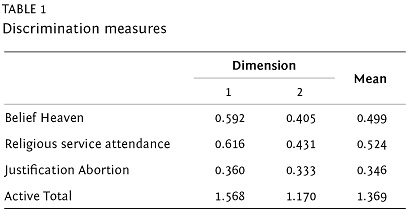
The first step is to compare discrimination measures (Table 1) with the mean values of inertia, since the most interesting indicators have a value closer to one and are greater than or equal to the inertia, as mentioned above. The mean values of inertia are 0.523 and 0.390 for dimension 1 and dimension 2 respectively. The indicator of practices (‘religious services attendance’) is the most discriminant, followed by the indicator of beliefs (‘belief in heaven’). The indicator of attitudes (‘justification of abortion’) scored below the mean values of inertia. Although the values of this indicator are low, they are central for characterizing clusters, as shown by their theoretical importance.
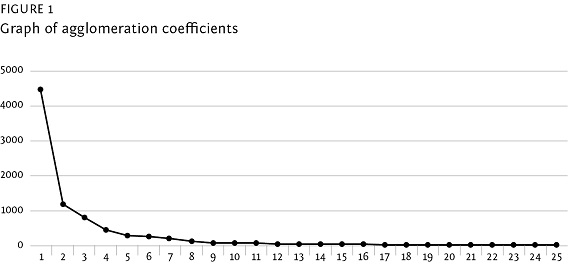
The second step is to select the number of clusters. Looking at the graph of agglomeration coefficients (Figure 1), the recommended number is five. The third step is to characterize the clusters. The first characterization includes six indicators of religiosity, two per dimension, the three indicators used to cluster, and the other most discriminating indicators.
]]> Table 2 shows the results for beliefs. For both beliefs, clusters 2 and 4 have non-belief scores over 80%, although cluster 4 believes slightly more than cluster 2. Cluster 1 is characterized by agnosticism, in which DK responses are higher than 75% in both beliefs. In both beliefs cluster 3 scores more than cluster 5 due to the higher skepticism prevailing in this cluster. In short, from the highest non-believing to the highest believing clusters, the order is: cluster 2 ≤ cluster 4 < cluster 1 < cluster 5 < cluster 3. Clusters can be classified as follows: clusters 2 and 4 as non-believers, cluster 1 as agnostics, cluster 5 as believers, cluster 3 as strong believers.
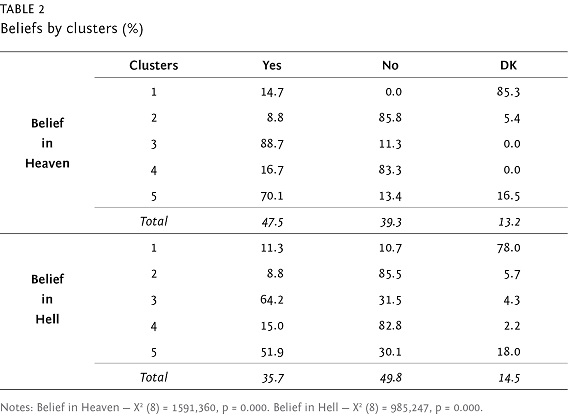
Table 3 shows the results for practices. For ‘religious services attendance’ cluster 3 has the highest values for ‘>OW’ (15%) and ‘OW’ (54%), reaching almost 70% for at least ‘OW’. Cluster 5 has a small value for ‘>OW’ (2.7%), the second highest value in ‘OW’ (26%), and the highest value in ‘OM’ (49%). Cluster 1 has the second highest value for ‘OM’ (23%) and the highest value in ‘LO’ (42%). Cluster 4 has the highest values in ‘OSHD’ (45%) and ‘NPN’ (43%). Cluster 2 has the second highest values in ‘LO’ (33%) and ‘NPN’ (37%). For ‘prayer’, both clusters 3 and 5 for at least ‘OW’ add up to about 79%. However, cluster 3 prays more than cluster 5: cluster 3 has the highest value in ‘ED’ (52%), while cluster 5 has the highest values for ‘>OW’ (22%) and ‘OW’ (17%). Cluster 1 totals 66% for at least ‘OW’ and 26% for ‘LO’ in maximum. Clusters 4 and 2 are very similar: their percentages total about 33% and 52% for at least ‘OW’ and for ‘LO’ in maximum respectively. For practices the classification of each cluster is less clear cut than for beliefs, not only because the two indicators have dissimilar results by cluster, but also because the higher number of categories clouds the analysis.
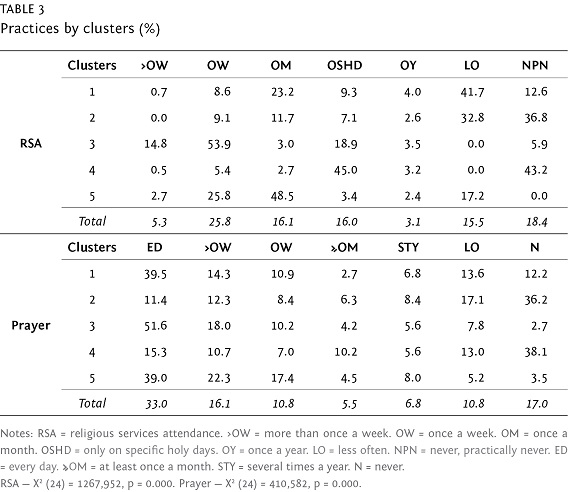
Prayer is not helpful for differentiating cluster 2 from cluster 4, since their results are very close. Cluster 2 is defined by non-practice since they practically never attend Mass (categories ‘LO’ and ‘NPN’ total 70%). Cluster 4 is characterized by occasional practice, since the majority (88%) attends religious services ‘OSHD’ or ‘NPN. Cluster 1 also has occasional religious services attendance, although focused on ‘OM’ and mainly on ‘LO’, which is higher than cluster 4. Prayer is clearly higher in cluster 1 than in cluster 4, and is close to clusters 3 and 5. Cluster 5 is characterized by regular practice, since more than 75% attend religious services ‘≥OM’ and pray ‘≥OW’. Cluster 3 is defined by observant practice, since at least ‘OW’ more than 2/3 attend religious services and more than ¾ pray. In short, from the lowest practicing to the highest practicing clusters, the order is: cluster 2 < cluster 4 < cluster 1 < cluster 5 < cluster 3.
Table 4 shows the results for attitudes. For ‘justification of abortion’, the negative attitudes (from ‘never’ to ‘4/5’) are the following: 88% (cluster 1), 68% (cluster 2), 81% (cluster 3), 23% (cluster 4), and 94% (cluster 5). Cluster 3 has the highest values in ‘never’ and ‘2/3’, which total 74%. Cluster 5 has the second highest values in ‘never’ and ‘2/3’, which add up to 63%, and with ‘4/5’ total 94%. Cluster 1 has the third highest value in ‘never’ (25%) and the highest value in ‘4/5’ (57%). Cluster 2 has the second lowest value in ‘never’ (15%), the lowest value in ‘2/3’ (4.1%), and the second highest value in ‘4/5’ (49%). Cluster 4 has the lowest values in ‘never’ (10%) and ‘4/5’ (0%), the highest values in ‘6/7’ (49%) and ‘always’ (24%).
]]>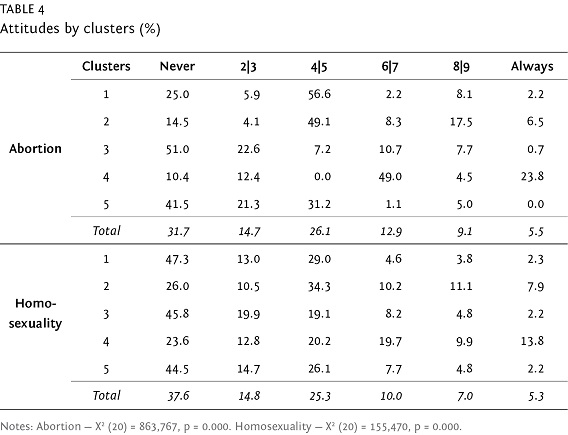
For ‘justification of homosexuality’, the negative attitudes (from ‘never’ to ‘4/5’) are the following: 89% (cluster 1), 71% (cluster 2), 85% (cluster 3), 57% (cluster 4), and 85% (cluster 5). Clusters 1, 3, and 5 have similar results, as well as clusters 2 and 4, although cluster 2 has more negative attitude, while cluster 4 has more positive attitude. For both indicators, cluster 4 is composed of the non-followers or the strongest opponents to Catholic norms, since its negative attitude toward abortion is much below 50% and toward homosexuality is close to 50%. Cluster 2 is the cluster of the weakest followers of Catholic norms, since the negative attitudes of both indicators are above 50%. The other clusters are followers of Catholic norms, although to different degrees. Since clusters 1, 3, and 5 have similar results for ‘justification of homosexuality’, it is necessary to look to ‘justification of abortion’ to distinguish them. Cluster 1 is defined by weak followers, cluster 5 by intermediate followers, and cluster 3 by the strongest followers. In short, from the non-following (positive attitudes – from ‘6/7’ to ‘always’) to the following (negative attitudes – from ‘never’ to ‘4/5’) clusters, the order is: cluster 4 < cluster 2 < cluster 1 < cluster 5 < cluster 3.
Table 5 shows the results for the four indicators of individualization. For conceptions of God, clusters 3 and 5 have similar results, as well as clusters 2 and 4; cluster 1 is in-between, but near the first two. For all clusters, ‘personal God’ is clearly the most followed category, mainly in cluster 3 (85%) and cluster 5 (82%), but also in cluster 1 (75%), while ‘spirit or life force’ is the second most chosen category, where clusters 4 and 2 stand out (32%/29%). Still, almost half of clusters 2 and 4 believe in ‘personal God’, which is their most important category. The ‘agnostic’ and ‘atheistic’ categories are the lowest, being most salient in clusters 2 and 4 (26%/22%), while in clusters 3 and 5 are very low (4% for both). In sum, clusters 2 and 4 are the most heterogeneous in terms of conceptualizing God.
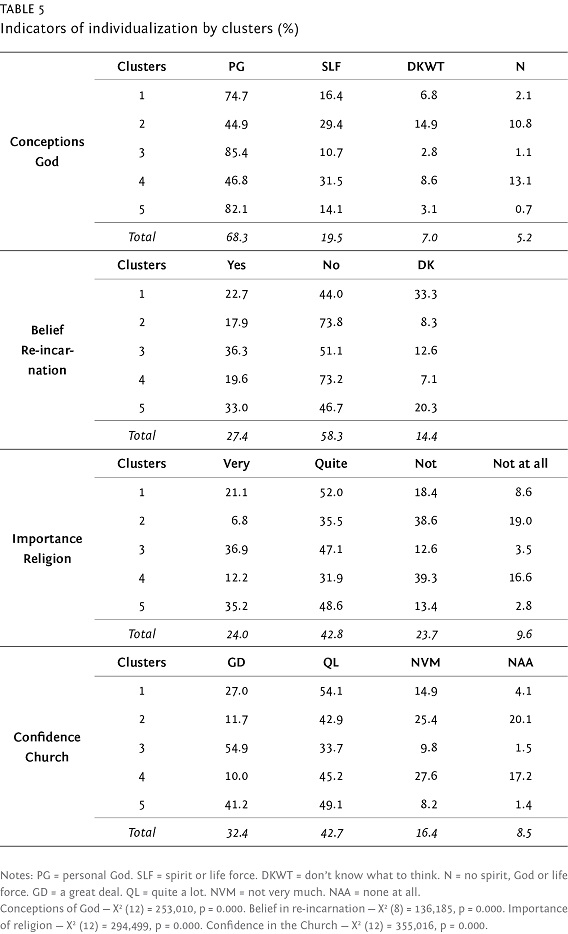
For ‘belief in re-incarnation’, like the previous indicator, clusters 3 and 5 have similar results, as well as clusters 2 and 4, and cluster 1 is in-between. For all clusters, ‘non-believing in re-incarnation’ is the most chosen category, mainly in clusters 2 and 4, which is about 74%, while the other three clusters got percentages about 47%. The most believers in re-incarnation are cluster 3 (36%) and cluster 5 (33%), followed by cluster 1 (23%). The most ‘unsure’ is clearly cluster 1 (33%), although cluster 5 (20%) scored well in this category.
For importance of religion, once again, clusters 3 and 5 have similar results, as well as clusters 2 and 4, while cluster 1 is in-between. For clusters 3 and 5 religion is essentially ‘very/quite’ important (84% for both), but mainly ‘quite’ important. For cluster 1 religion is clearly ‘quite’ important (52%), but also ‘very’ and ‘not’ important, although with much lower values (21%/18%). For clusters 2 and 4 religion is ‘quite/not’ important (about 73%), although category ‘not at all’ has the highest values (about 18%) in these clusters.
]]> For confidence in the Church, cluster 3 is the cluster that confides more (‘GD’) in the Church (55%), followed by cluster 5 (41%). In category ‘QL’, cluster 1 (54%) and cluster 5 (49%) are the most important. In categories ‘NVM’ and ‘NAA’ clusters 2 and 4 are the most important, both totaling almost 50%.In terms of socio-demographic indicators, I begin with gender and age8. The female representation is higher in clusters 3 and 5 (65%), followed by cluster 1 (59%), cluster 4 (55%), and cluster 2 (49%). Comparing the percentages of each cluster with the percentages of the sample, cluster 1 has the same distribution as the sample; in clusters 2 and 4 male gender is overrepresented and female gender is underrepresented mainly in cluster 2; in clusters 3 and 5 male gender is underrepresented and female gender is overrepresented. In terms of age, the mean of year of birth is lower in cluster 3 (1950), cluster 5 (1951), and cluster 1 (1953), while is higher in clusters 2 and 4 (1962/1961).
Table 6 shows the other three socio-demographic indicators. For education, there are two groups composed of similar clusters: the group of clusters 1, 3, and 5, and the group of clusters 2 and 4. The lowest levels of education (pre-primary and 1st cycle) are higher in the first group, while the upper levels (2nd/3rd cycles, secondary, and tertiary) are higher in the second group. For the two lowest levels of education, clusters 1, 3, and 5 are overrepresented while clusters 2 and 4 are underrepresented, and the opposite is true for the other three levels.
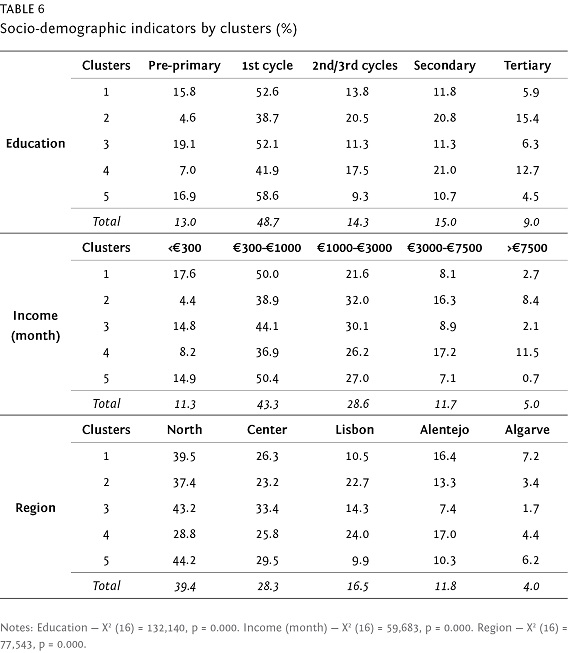
For income, these two groups are the same: the lowest levels of income (<€300 and €300-€1000) are higher in the first group, while the highest levels (€3000-€7500, >€7500) are higher in the second group. For the two lowest levels of income, clusters 1, 3, and 5 are overrepresented while clusters 2 and 4 are underrepresented, and the opposite is true for the two highest levels; for the middle level, clusters 2 and 3 are overrepresented and clusters 1, 4, and 5 are underrepresented.
For region, clusters 3 and 5 are the highest in ‘North’ and ‘Center’, and the lowest in ‘Alentejo’. Clusters 2 and 4 are the lowest in ‘North’ and ‘Center’, and the highest in Lisbon. Cluster 1 is in-between these two groups, closer to clusters 3 and 5 in ‘North’ and ‘Lisbon’, and to clusters 2 and 4 in ‘Center’ and ‘Alentejo’. Comparing to the sample, the percentages of each cluster are the following: for cluster 1 they are above for ‘Alentejo’ and ‘Algarve’, and below for ‘Lisbon’; for cluster 2 they are above for ‘Lisbon’ and below for ‘Center’; for cluster 3 they are above for ‘North’ and ‘Center’, and below for ‘Lisbon’, ‘Alentejo’ and ‘Algarve’; for cluster 4 they are above for ‘Lisbon’ and ‘Alentejo’, and below for ‘North’ and ‘Center’; for cluster 5 they are above for ‘North’ and ‘Algarve’, and below for ‘Lisbon’. In sum, ‘North’ is overrepresented in clusters 3 and 5, and underrepresented in cluster 4; ‘Center’ is overrepresented in cluster 3, and underrepresented in clusters 2 and 4; ‘Lisbon’ is overrepresented in clusters 2 and 4, and underrepresented in clusters 1, 3 and 5; ‘Alentejo’ is overrepresented in clusters 1 and 4, and underrepresented in cluster 3; ‘Algarve’ is overrepresented in clusters 1 and 5, and underrepresented in cluster 3.
After characterizing the clusters, the next step is to analyze their distribution on the plan (Figure 2). The topological attribute of MCA implies that good distribution and differentiation of categories on the plan reflect the existence of distinct clusters. In this graph the clusters are well defined, since the categories of the indicators are well discriminated on the graph. In fact, some categories define each cluster, since they belong to a specific cluster only. Cluster 1 is defined by category DK in belief, cluster 2 by category ‘8/9’ in attitude, cluster 3 by category ‘>OW’ in practice, cluster 4 by category ‘OSHD’ in practice, categories ‘6/7’ and ‘always’ in attitude, while cluster 5 does not have any exclusive category. However, at the same time, some clusters share some categories, which shows their heterogeneity. Clusters 4 and 2 share non-believing and non-practicing; clusters 2 and 1 share categories ‘LO’ in practice and ‘4/5’ in attitude; clusters 1 and 5 have in common category ‘OM’ in practice; clusters 5 and 3 share believing, practicing (category ‘OW’), and following Catholic norms (categories ‘never’ and ‘2/3’). In short, clusters 3 and 5 are quite close, since they share four categories, while category ‘>OW’ is the only differentiating issue; clusters 2 and 4 are close, since they have in common two categories, although cluster 4 presents three exclusive categories (two in attitude and one in practice).
]]>
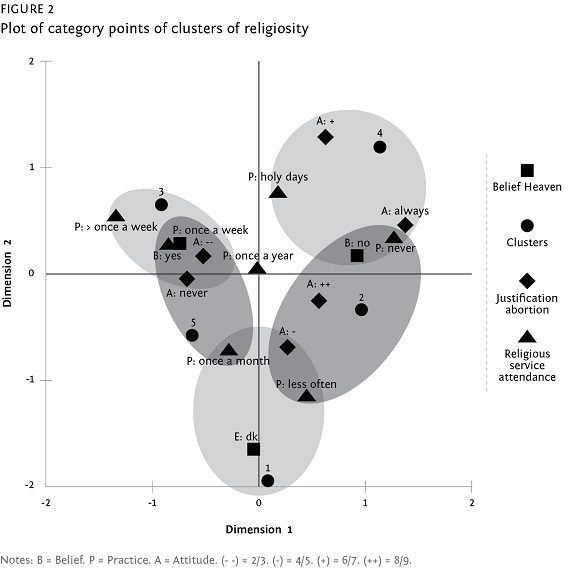
Figure 2 illustrates well that clusters 3 and 5 are opposed to clusters 2 and 4, and cluster 1 is like a link between these two groups, sharing categories with cluster 5 and cluster 2. Looking at dimension 1 it is clear that the category of ‘non-belief’ is on the right (clusters 2 and 4) and category of ‘belief’ is on the left (clusters 3 and 5), while category DK is in the middle or in a zero position (cluster 1). Also, categories of ‘non-practicing’ and ‘non-following’ are on the right, categories of ’practicing and following’ are on the left, while the most extreme categories are further from the origin; cluster 1 is in-between them. Dimension 2 shows that on the top near the origin are the two types of categories of belief (‘believing’ and ‘non-believing’) and at the extreme bottom is the middle category (DK). Also, the extreme categories of ‘practice’ and ‘attitude’ are near the origin, while the middle categories are further from the origin. The more extreme the category is, the closer it is to the center.
From these analyses there emerge three groups of clusters: one composed of clusters 3 and 5, another by clusters 2 and 4, and cluster 1 in-between them, usually closer to the first group. Thus, I consider clusters 1, 3, and 5 to be composed of Catholics, since they believe, practice, and follow Catholic norms. Even cluster 1, although completely skeptical in terms of belief in heaven and hell, strongly believes in personal God, which inclines it toward the Catholic group. On the contrary, clusters 2 and 4 include heterodox believers and people who ‘do not practice and do not follow at all’ or ‘practice or follow very little’. Therefore, they belong to the same group of heterodox believers. I did not consider them as atheists, since their belief in God is considerable, although they clearly include the non-believers in God9. Looking at the indicator of ‘self-affiliation’, it is also clear that clusters 1, 3, and 5 are composed only of self-affiliated Catholics, while clusters 2 and 4 include the people without religion10. Curiously, the practices and the attitudes do not entirely match, since the cluster of the lowest practitioners does not correspond to the cluster of the lowest followers of Catholic norms. In sum, the clusters are:
Cluster 1 (skeptical Catholics – 10%). They are skeptical (since they do not know whether or not to believe in heaven and in hell but they believe in personal God), occasional attendants and regular prayers, and weak followers. For them, religion is clearly quite important and they confide quite a lot in the Church. They quite believe in personal God and they are unsure about believing in re-incarnation. It is slightly more feminine and older, with less education and income. They are overrepresented south of the Tagus River (Alentejo and Algarve), and underrepresented in Lisbon.
Cluster 2 (non-practicing heterodox believers – 24%). They are heterodox believers, non-practitioners, and the lowest followers. For them, religion is not important, but they confide somewhat in the Church (with cluster 4). They are the highest believers in spirit or life force, non-believers in re-incarnation, but also the most heterogeneous in terms of conceptualizing God (with cluster 4). In terms of gender, although balanced, males are overrepresented and they are the youngest, with more education and income (with cluster 4). They are overrepresented in Lisbon and underrepresented in the Center.
Cluster 3 (observant Catholics – 31%). They are strong believers, observant practitioners, and the strongest followers. For them, religion is very/quite important and they confide a great deal in the Church. They are the highest believers in personal God and the greatest believers in re-incarnation (with cluster 5). They are mainly female and the oldest, with less education and income (with cluster 5). They are overrepresented in the North and Center, and underrepresented in Lisbon, Alentejo, and Algarve.
Cluster 4 (occasional practicing heterodox believers – 15%). They are heterodox believers, occasional practitioners, and non-followers. For them, religion is not important, but they confide to a limited degree in the Church (with cluster 2). They are the highest believers in spirit or life force, non-believers in re-incarnation, but also the most heterogeneous in terms of conceptualizing God (with cluster 2). In terms of gender, although more feminized, males are overrepresented and they are the youngest, with more education and income (with cluster 2). They are overrepresented in Lisbon and Alentejo, and underrepresented north of the Tagus River (North and Center).
]]> Cluster 5 (intermediate Catholics – 20%). They are believers, regular practitioners, and intermediate followers. For them, religion is very/quite important and they confide quite a lot in the Church. They are the greatest believers in personal God and the greatest believers in re-incarnation (with cluster 3), although more unsure. They are mainly female and the oldest, with less education and income (with cluster 3). They are overrepresented in the North and Algarve, and underrepresented in Lisbon.
Does individualization apply in our religious context? Do these clusters evince individualization? First, it is useful to recall its meaning: the passage of religious authority from religious institutions to the individual. What these clusters show is that individualization is not a straightforward process, but instead takes into account the idiosyncrasies of each person. Indeed, since individualization derives from modernity – and this is not unique, but multiple (Eisenstadt, 2000) – individualization is also multiple. Enlightenment predicted that all people, with the worldly spreading of luminous rationality, would develop through the same path and rhythm, and would think similarly. Contrarily, contemporary history has shown that progress is not equal for everyone and that Protagoras could be right when affirming that the person is the measure of all things.
However, people have similar patterns of thinking and behaving, which makes the very existence of clusters possible. From the results we notice that the greater the distance from Catholic observance, the greater the levels of individualization. In fact, the search for meaning beyond Catholicism increases when the feeling of self-fulfillment inside the Church is less accomplished. Therefore, the least religious are the most heterodox, whose bricolage is greater than that of others. Unfortunately the indicators are not enough to really test individualization in all of its extension. Nevertheless, the way people conceive of God is very appropriate. Curiously, the least religious reveal a considerable belief in personal God, meaning that diffused religion has its importance. Also the deinstitutionalization is not as great as what might be expected, as the importance of religion and confidence in the Church is noticeable, which reinforces the latter. These results show that besides levels of low religiosity (the diffused religion), the Catholic culture still influences the beliefs of the Portuguese people, which agrees with Inglehart and Welzel (2005), and Norris and Inglehart (2004).
The levels of religiosity and individualization seem to be influenced by socio-demographic factors such as gender, age, and region, confirming the findings reported in earlier research. First, more feminized and older clusters, like clusters 3 and 5, are the most religious and least individualized, and the contrary is true for more masculinized and younger clusters, like clusters 2 and 4. Second, comparing the North to the South of Portugal, the most religious and least individualized are more in the North, while the least religious and most individualized are mainly in the South, including Lisbon.
What about the effect of social class (education and income) on religiosity and individualization? This study shows that the clusters of the heterodox and least religious are clearly more educated and wealthier. Clusters 2 and 4 have the highest belief in spirit or life force and the highest atheistic (and also agnostic) positions, as well as considerable percentages of belief in personal God. For these clusters the importance of religion and confidence in the Church is the lowest, meaning the highest religious deinstitutionalization or the lowest levels of external authority dependence. Nevertheless, there are some aspects to discuss. First, the fact of being more schooled and wealthier does not automatically imply religion a la carte or lower religiosity. In Portugal there are many people from upper classes, highly schooled and/or wealthy, who are strongly Catholic. The extensive databases, like EVS, have the disadvantage of producing an overall image of a certain population, omitting important niches inside it. In fact, the best way of analyzing these groups is through qualitative studies, with an anthropological perspective, as did Costa (2006) and Teixeira (2005). Second, several studies showed (to the contrary) that popular religiosity is superficial (e.g. Sanchis, 1992; Cutileiro, 2004), which means that the probability of losing religiosity when confronted with modern life is stronger. Calisto de Barbuda, the main character of ‘The fall of an angel’, written by Camilo Castelo Branco, expresses extremely well the effect of modernity on Portuguese people. Although a caricature, the traditional Catholic, settled in the province, is corrupted after arriving in modern Lisbon, losing his religiosity. Perhaps the clusters 3 and 5, composed of many older and less schooled people (and perhaps their children), if more exposed to modernity might weaken in their faith over time. Third, the highest belief in re-incarnation for clusters 3 and 5 is noteworthy. This can result from its misinterpretation, an eventual acceptance of re-incarnation as resemblance of resurrection due to lower levels of cultural capital and older ages. Also, the not insignificant percentage of belief in spirit or life force can derive from misinterpretation or it can reveal hidden beliefs, passed through generations, which were never questioned during the ‘sacred canopy’.
Finally, late modernity brought the continuous questioning and searching for truth mediated now always by the individual. The passive and resigned way of following Catholic beliefs, practices, and norms gave place to a more active and inquiring manner. The II Vatican Council opened the doors to laity, giving them the power that they never had. The obedient and faithful Catholic of the past became a distant image. Now, to obey is chosen and not imposed, so the convinced Catholics, as newly converted, are Catholics because they choose to be and not because they cannot believe in anything else. This is mainly the case among the youngest ones.
CONCLUSIONS
]]> The aim of this article was to produce clusters of the Portuguese Catholic religious field. Five clusters were found: three clusters of Catholics (60%) and two clusters of heterodox believers (40%). The Catholic clusters are divided into three types that are internally consistent: the observant Catholics are the greatest believers, practitioners, and followers; the skeptical Catholics practice and follow the least amount, and are unsure about their beliefs; the intermediate Catholics are in the middle. Unlike the group of Catholics, the heterodox believers are not internally consistent: while one is composed of occasional practitioners and non-followers, the other includes non-practitioners and those who follow the Church to the least degree.
These clusters show that individualization is a multiple process for four reasons. First, each person is differently influenced by late modernity: the greater the distance from Catholic observance, the greater are the levels of individualization. Second, religious deinstitutionalization depends on a country’s religious culture or diffused religion: my results demonstrate that Catholic culture still influences the beliefs of the Portuguese people. Third, gender, age, and region influence religiosity, confirming earlier studies: women, older people, and the North are more religious and less individualized than men, youth, and the South. Fourth: social class is a more ambiguous factor. Although the results show that upper classes are more heterodox and less religious, this issue is debatable for two main reasons: there are many Portuguese who are strongly Catholic, highly schooled, and wealthy; popular religiosity is superficial, meaning that the probability of losing it when confronted with modern life is stronger.
These clusters and respective percentages are not the ultimate truth, but an approximation to religious reality made through multivariate techniques, with theoretical and methodological options. In fact, the clusters and their quantification depend on the indicators and their categories. Still, comparing with the other two analyses (ten and six indicators), Catholics and heterodox believers share the dominion. Although in this study, the Catholics are more represented, reality is always more complex than the straightforward solutions that statistics may show. Another feature emerging from these comparisons is that the opposite extremes of beliefs, practices, or attitudes are never in the same cluster. The combinations are among middle and non-extreme positions. For instance, a strong believer is not a non-follower and non-practitioner, or a non-believer is not a follower and practitioner.
I consider the pertinence of this study from three perspectives. First: it used the most recent database available (EVS 2008), producing a current picture of Portuguese religiosity. Second: unlike other studies using many indicators, this study used only three, which greatly simplifies the analysis while retaining all of its theoretical and statistical reliability. This simplicity is essential to properly apply MCA. In fact, with many categories of indicators, it would be quite impossible to read the graph and consequently to interpret each cluster. The interest of this technique comes mainly for its qualitative approach, in which the position of each category determines the interpretation of the clusters. Third: with this methodological simplicity, it is easier to replicate this analysis in applications to other religions, countries, and regions. For further extensive studies, it could be interesting to include indicators of the five dimensions of religiosity (ideological, ritualistic, consequential, experiential, and communal), as well as of individualization (bricolage and deinstitutionalization).
REFERENCES
ANTUNES, M.M. (2000), “Catolicismo e cultura na sociedade portuguesa contemporânea”. In M.B. Cruz e N.C. Guedes (orgs.), A Igreja e a Cultura Contemporânea em Portugal, 1950-2000, Lisboa, Universidade Católica Editora, pp. 437-456. [ Links ]
BERGER, P.L. (1990), Sacred Canopy. Elements of a Sociological Theory of Religion, Nova Iorque, Anchor Books. [ Links ]
BERGER, P., DAVIE, G., FOKAS, E. (2010), Religious America, Secular Europe? A Theme and Variations, Farnham, Ashgate. [ Links ]
BRÉCHON, P. (2004), “L’héritage chrétien de l’Europe Occidentale: qu’en ont fait les nouvelles générations?”. Social Compass, 51 (2), pp. 203-219. [ Links ]
BRÉCHON, P. (2009), “La mesure de l’appartenance et de la non-appartenance confessionnelle dans les grandes enquêtes européennes”. Social Compass, 56 (2), pp. 163-178. [ Links ]
CABRAL, M.V. (2001), “Prática religiosa e atitudes sociais dos portugueses numa perspectiva comparada”. In J.M. Pais, M.V. Cabral, J. Vala, (orgs.), Religião e Bioética, Lisboa, ICS, pp. 21-71. [ Links ]
CARVALHO, H. (2008), Análise Multivariada de Dados Qualitativos. Utilização da Análise de Correspondências Múltiplas com o SPSS, Lisboa, Sílabo. [ Links ]
COLLETT, J.L., LIZARDO, O. (2009), “A power-control theory of gender and religiosity”. Journal for the Scientific Study of Religion, 48 (2), pp. 213-231. [ Links ]
COLLINS-MAYO, S., DANDELION, P. (2010), Religion and Youth, Farnham, Ashgate. [ Links ]
COSTA, J. (2006), Sociologia dos Novos Movimentos Eclesiais. Focolares, Carismáticos e Neocatecumenais em Braga, Porto, Afrontamento. [ Links ]
CUTILEIRO, J. (2004), Ricos e Pobres no Alentejo, Lisboa, Livros Horizonte. [ Links ]
DAVIE, G. (1990), “Believing without belonging: is the future of religion in Britain?”. Social Compass, 37 (4), pp. 455-469. [ Links ]
DAVIE, G. (2002), “Praying alone? Church-going in Britain and social capital. A reply to Steve Bruce”. Journal of Contemporary Religion, 17 (3), pp. 329-334. [ Links ]
DAVIE, G. (2006), “Religion in Europe in the 21st century: the factors to take into account”. European Journal of Sociology, 47 (2), pp. 271-296. [ Links ]
DUQUE, E. (2007), Os Jovens e a Religião na Sociedade Actual, Braga, IPJ. [ Links ]
DUQUE, E. (2009), El Fenómeno Religioso y suas Influencias Sociales: Perfiles y Tendencias del Cambio Religioso en Portugal. Tesis doctoral en Sociología, Madrid, Universidad Complutense de Madrid – Facultad de Ciencias Políticas y Sociología. [ Links ]
DUQUE, E. (2014), Mudanças Culturais, Mudanças Religiosas: Perfis e Tendências da Religiosidade em Portugal Numa Perspectiva Comparada, Vila Nova de Famalicão, Húmus. [ Links ]
EISENSTADT, S. (2000), “Multiple modernities”. Daedalus, 129 (1), pp. 1-29. [ Links ]
EVS (2010), European Values Study 2008, 4th wave, Portugal. GESIS Data Archive, Cologne, Germany, ZA4757 Data File Version 1.1.0 (2010-11-30) doi:10.4232/1.10154. [ Links ]
FALCÃO, M.F. (1957), “Aspectos da situação moral e religiosa em Portugal”. In Organismos Agrários da Acção Católica, Semana de Estudos Rurais, Fátima, Direcções Gerais de L.A.C. – L.A.C.F. – J.A.C. – J.A.C.F, pp. 17-34. [ Links ]
FERNANDES, A. (1972), A Religião na Sociedade Secularizada. Factores Sociais na Transformação da Personalidade Religiosa, Porto, Livraria Civilização. [ Links ]
FICHTER, J. (1969), “Sociological measurement of religiosity”. Review of Religious Research, 10 (3), pp. 169-177. [ Links ]
FRANÇA, L. (1981), Comportamento Religioso da População Portuguesa, Lisboa, Moraes Editores/IED. [ Links ]
FREIRE, A. (2001), “Religião e política em Portugal, na Irlanda e na Noruega”. In J.M. Pais, M.V. Cabral, J. Vala, (orgs.), Religião e Bioética, Lisboa, ICS, pp. 129-184. [ Links ]
GLOCK, C., STARK, R. (1969), Religion and Society in Tension, Chicago (IL), Rand McNally & Co. [ Links ]
HEELAS, P., WOODHEAD, L. (2005), The Spiritual Revolution: Why Religion is Giving Way to Spirituality, Oxford, Blackwell Publishing. [ Links ]
HERVIEU-LÉGER, D. (2005), O Peregrino e o Convertido: a Religião em Movimento, Lisboa, Gradiva. [ Links ]
IANNACCONE, L.R. (1992), “Religious markets and the economics of religion”. Social Compass, 39 (1), pp. 123-131. [ Links ]
INE (2012), Censos – Resultados Definitivos. Portugal – 2011, Lisboa, INE. [ Links ]
INGLEHART, R., WELZEL, C. (2005), Modernization, Cultural Change, and Democracy. The Human Development Sequence, Nova Iorque, Cambridge University Press. [ Links ]
LAGES, M. (1965), “Elementos para uma tipologia sociológica do Cristianismo português”. Ora et Labora, 3, pp. 200-231. [ Links ]
LAGES, M. (2000), “A religiosidade popular na segunda metade do século XX”. In M.B. Cruz e N.C. Guedes (orgs.), A Igreja e a Cultura Contemporânea em Portugal, 1950-2000, Lisboa, Universidade Católica Editora, pp. 379-436. [ Links ]
LAMBERT, Y. (coord.) et al. (1997), “Les croyances des jeunes européens”. In R.J. Campiche (dir.), Cultures jeunes et religions en Europe, Paris, Cerf, pp. 97-166. [ Links ]
LUCKMANN, T. (1970), The Invisible Religion. The Problem of Religion in Modern Society, Londres, The Macmillan Company. [ Links ]
MAROCO, J. (2010), Análise Estatística – com Utilização do SPSS, Lisboa, Sílabo. [ Links ]
MONTEIRO, T.L. (2012), “Dinâmica social e religião”. In A. Teixeira (org.), Identidades Religiosas em Portugal: Ensaio Interdisciplinar, Lisboa, Paulinas, pp. 69-129. [ Links ]
NORRIS, P., INGLEHART, R. (2004), Sacred and Secular. Religion and Politics Worldwide, Nova Iorque, Cambridge University Press. [ Links ]
OLIVEIRA, C.A.M. (1995), Atitudes e Comportamentos Religiosos dos Portugueses na Actualidade. Tese de doutoramento em Sociologia, Évora, Universidade de Évora. [ Links ]
PAIS, J.M. (2001), “O que explica a religiosidade dos portugueses? Um ensaio de análise tipológica”. In J.M. Pais, M.V. Cabral, J. Vala (orgs.), Religião e Bioética, Lisboa, ICS, pp. 185-235. [ Links ]
PIRES, M.L., ANTUNES, M. (1998), “Vida religiosa”. In J.M. Pais et al. (coord.), Gerações e Valores na Sociedade Portuguesa Contemporânea, Lisboa, ICS/SEJ, pp. 469-518. [ Links ]
SANCHIS, P. (1992), Arraial: Festa de um Povo, Lisboa, Publicações Dom Quixote. [ Links ]
SOUSA, M.L.A. (1974), “Análise sociológica do Catolicismo português”. Igreja e Missão, 70, pp. 476-495. [ Links ]
TEIXEIRA, A. (2005), Entre a Exigência e a Ternura, Lisboa, Paulinas. [ Links ]
TEIXEIRA, A. (2012), “Catolicismo – entre o território e a rede”. In A. Teixeira (org.), Identidades Religiosas em Portugal: Ensaio Interdisciplinar, Lisboa, Paulinas, pp. 147-253. [ Links ]
TEIXEIRA, A. (2013), “A eclesiosfera católica: pertença diferenciada”. Didaskalia, XLIII (1/2), pp. 115-205. [ Links ]
TOLDY, T. (2013), “A secularização da sociedade portuguesa no contexto das modernidades múltiplas”. Didaskalia, XLIII (1/2), pp. 23-55. [ Links ]
VILAÇA, H. (2001), “Identidades, práticas e crenças religiosas”. In J.M. Pais, M.V. Cabral, J. Vala, (orgs.), Religião e Bioética, Lisboa, ICS, pp. 73-128. [ Links ]
VILAÇA, H. (2006), Da Torre de Babel às Terras Prometidas. Pluralismo Religioso em Portugal, Porto, Afrontamento. [ Links ]
VILAÇA, H. (2013), “Novas paisagens religiosas em Portugal: do centro às margens”. Didaskalia, XLIII (1/2), pp. 81-114. [ Links ]
WEBER, M. (2006), Sociologia das Religiões, Lisboa, Relógio d’Água. [ Links ]
Recebido a 17-02-2014. Aceite para publicação a 10-04-2015.
]]> NOTAS
1 The
number of legal foreign population grew from 32.057 in 1974 to 398.268 in 2013.
By far the most important group is composed by Brazilians (91.238), followed by
Cape Verdeans (42.011), Ukrainians (41.074), and Romanians (34.204) (Source:
PORDATA). These immigrants bring, besides Catholicism, other Christian
affiliation like Orthodoxy and Evangelism.
2 Population: North (36.6%), Center (23.5%), Lisbon (27.8%), Alentejo (7.6%), Algarve (4.5%). Catholics: North (40.2%), Center (24.9%), Lisbon (23.8%), Alentejo (7.3%), Algarve (3.8%). Without religion: North (18.6%), Center (15.0%), Lisbon (49.2%), Alentejo (10.3%), Algarve (7.0%). No answer: North (24.6%), Center (20.0%), Lisbon (40.0%), Alentejo (10.0%), Algarve (6.0%).
3 I would like to thank the contribution of Rui Brites on methodology.
4 Inertia (mean) scored 0.724 and 0.786 for ten and six indicators respectively (0.666 and 0.739 for belief in hell, the indicator of beliefs with the closest values).
5 Inertia (mean) scored 0.106 and 0.142 for ten and six indicators respectively (0.088 and 0.116 for justification of homosexuality, the indicator of attitudes with the closest values).
6 Without the DK category the best option is four clusters, while with DK category it is five clusters.
7 To confirm my decision, I calculated the mean and it effectively ranges from 4.65 to 5.31 (1-10), showing that Portuguese people are in general in the middle-left, despite their religious position.
8 Gender: χ2 (4)=30,313, p=0.000. Age: Phi=0,529, p=0.000.
]]> 9 Belief in God has the lowest level of DK (3.4%) and the highest level of believing (87%).10 Catholic/without religion: cluster 1 (91.4%/8.6%), cluster 2 (73.4%/26.6%), cluster 3 (95.9%/4.1%), cluster 4 (70.7%/29.3%), cluster 5 (96.6%/3.4%).
]]>