<?xml version="1.0" encoding="ISO-8859-1"?><article xmlns:mml="http://www.w3.org/1998/Math/MathML" xmlns:xlink="http://www.w3.org/1999/xlink" xmlns:xsi="http://www.w3.org/2001/XMLSchema-instance">
<front>
<journal-meta>
<journal-id>0003-2573</journal-id>
<journal-title><![CDATA[Análise Social]]></journal-title>
<abbrev-journal-title><![CDATA[Anál. Social]]></abbrev-journal-title>
<issn>0003-2573</issn>
<publisher>
<publisher-name><![CDATA[Instituto de Ciências Sociais da Universidade de Lisboa]]></publisher-name>
</publisher>
</journal-meta>
<article-meta>
<article-id>S0003-25732016000100001</article-id>
<title-group>
<article-title xml:lang="en"><![CDATA[The impact of an ageing population on economic growth: an exploratory review of the main mechanisms]]></article-title>
<article-title xml:lang="pt"><![CDATA[O impacto do envelhecimento da população sobre o crescimento económico: uma análise exploratória dos principais mecanismos]]></article-title>
</title-group>
<contrib-group>
<contrib contrib-type="author">
<name>
<surname><![CDATA[Nagarajan]]></surname>
<given-names><![CDATA[N. Renuga]]></given-names>
</name>
<xref ref-type="aff" rid="AFF"/>
</contrib>
<contrib contrib-type="author">
<name>
<surname><![CDATA[Teixeira]]></surname>
<given-names><![CDATA[Aurora A. C.]]></given-names>
</name>
<xref ref-type="aff" rid="AFF"/>
</contrib>
<contrib contrib-type="author">
<name>
<surname><![CDATA[Silva]]></surname>
<given-names><![CDATA[Sandra T.]]></given-names>
</name>
<xref ref-type="aff" rid="AFF"/>
</contrib>
</contrib-group>
<aff id="AF1">
<institution><![CDATA[,Universidade do Porto Faculdade de Economia ]]></institution>
<addr-line><![CDATA[Porto ]]></addr-line>
<country>Portugal</country>
</aff>
<aff id="A">
<institution><![CDATA[,ateixeira@fep.up.pt  ]]></institution>
<addr-line><![CDATA[ ]]></addr-line>
</aff>
<aff id="A">
<institution><![CDATA[,sandras@fep.up.pt  ]]></institution>
<addr-line><![CDATA[ ]]></addr-line>
</aff>
<pub-date pub-type="pub">
<day>00</day>
<month>03</month>
<year>2016</year>
</pub-date>
<pub-date pub-type="epub">
<day>00</day>
<month>03</month>
<year>2016</year>
</pub-date>
<numero>218</numero>
<fpage>4</fpage>
<lpage>35</lpage>
<copyright-statement/>
<copyright-year/>
<self-uri xlink:href="http://scielo.pt/scielo.php?script=sci_arttext&amp;pid=S0003-25732016000100001&amp;lng=en&amp;nrm=iso"></self-uri><self-uri xlink:href="http://scielo.pt/scielo.php?script=sci_abstract&amp;pid=S0003-25732016000100001&amp;lng=en&amp;nrm=iso"></self-uri><self-uri xlink:href="http://scielo.pt/scielo.php?script=sci_pdf&amp;pid=S0003-25732016000100001&amp;lng=en&amp;nrm=iso"></self-uri><abstract abstract-type="short" xml:lang="en"><p><![CDATA[Although a myriad of important theoretical and empirical contributions on ageing populations exist, these are diffuse and lack an integrated vision of the distinct mechanisms through which ageing populations affect economic growth. This being the case, in this paper we survey the literature that provides insights regarding the ageing population and its effect on economic growth. In particular, we seek to uncover the main mechanisms by which ageing affects economic growth.]]></p></abstract>
<abstract abstract-type="short" xml:lang="pt"><p><![CDATA[Apesar de existir uma infinidade de importantes contribuições teóricas e empíricas sobre o envelhecimento da população, tais contribuições surgem de forma difusa, carecendo de uma visão integrada dos mecanismos através dos quais o envelhecimento da população influencia o crescimento económico. No presente estudo, realizamos um estado-de-arte sobre esta questão, o qual fornece pistas importantes sobre os efeitos do envelhecimento da população acerca do crescimento económico. Em particular, procuramos descobrir os principais mecanismos através dos quais o envelhecimento influencia o crescimento económico.]]></p></abstract>
<kwd-group>
<kwd lng="en"><![CDATA[ageing]]></kwd>
<kwd lng="en"><![CDATA[economic growth]]></kwd>
<kwd lng="en"><![CDATA[mechanisms]]></kwd>
<kwd lng="en"><![CDATA[literature review]]></kwd>
<kwd lng="pt"><![CDATA[envelhecimento]]></kwd>
<kwd lng="pt"><![CDATA[crescimento económico]]></kwd>
<kwd lng="pt"><![CDATA[mecanismos]]></kwd>
<kwd lng="pt"><![CDATA[revisão de literatura]]></kwd>
</kwd-group>
</article-meta>
</front><body><![CDATA[ 

    <p align="right"><b>ARTIGO</b></p>

    <p><b>The impact of
an ageing population on economic growth: an exploratory review of the main
mechanisms</b></p>
    <p><b>O impacto do envelhecimento da
população sobre o crescimento económico: uma análise exploratória dos
principais mecanismos</b></p>

    <p>&nbsp;</p>

    <p><b>N. Renuga Nagarajan</b>*, <b>Aurora A. C. Teixeira</b>* e <b>Sandra T. Silva</b>*</p>


    <p>*Universidade do Porto, Faculdade de Economia, CEF.UP, INESC TEC, OBEGEF, Rua Dr. Roberto Frias - 4200-464 Porto, Portugal. E-mails: 
<a href="mailto:renuga.phd@fep.up.pt">renuga.phd@fep.up.pt</a>, <a href="mailto:ateixeira@fep.up.pt">ateixeira@fep.up.pt</a> 
e <a href="mailto:sandras@fep.up.pt">sandras@fep.up.pt</a> </p>

    <p>&nbsp;</p>

    <p><b>ABSTRACT</b></p>

    <p>&nbsp;</p>

    ]]></body>
<body><![CDATA[<p>Although
a myriad of important theoretical and empirical contributions on ageing
populations exist, these are diffuse and lack an integrated vision of the distinct
mechanisms through which ageing populations affect economic growth. This being
the case, in this paper we survey the literature that provides insights
regarding the ageing population and its effect on economic growth. In
particular, we seek to uncover the main mechanisms by which ageing affects
economic growth.</p>

    <p><b>KEYWORDS</b>:
ageing; economic growth; mechanisms; literature review.</p>

    <p>&nbsp;</p>

    <p><b>RESUMO</b></p>

    <p>&nbsp;</p>

    <p>Apesar de existir uma
infinidade de importantes contribuições teóricas e empíricas sobre o
envelhecimento da população, tais contribuições surgem de forma difusa,
carecendo de uma visão integrada dos mecanismos através dos quais o
envelhecimento da população influencia o crescimento económico. No presente
estudo, realizamos um estado-de-arte sobre esta questão, o qual fornece pistas
importantes sobre os efeitos do envelhecimento da população acerca do
crescimento económico. Em particular, procuramos descobrir os principais
mecanismos através dos quais o envelhecimento influencia o crescimento
económico.</p>

    <p><b>PALAVRAS-CHAVE</b>: envelhecimento; crescimento
económico; mecanismos; revisão de literatura.</p>

    <p>&nbsp;</p>

    <p><b>INTRODUCTION</b></p>

    <p>&nbsp;</p>

    ]]></body>
<body><![CDATA[<p>Many developed countries are approaching an era of ageing populations
due to an increase in longevity and decrease in fertility rates (Harper and
­Leeson, 2009). The decline in population growth has been noticeable since the
mid-1970s, when the adult working-age population in several countries overtook
child population (Mason and Lee, 2011).<sup><a href="#1">1</a></sup><a name="top1"></a> According to the World Health
Organization (WHO),<sup><a href="#2">2</a></sup><a name="top2"></a> the proportion of people aged 65
and above in Europe is predicted to increase from 14% in 2010 to 25% in 2050.
Hence, it is expected that in the near future, the prime working age group will
be smaller than the old age group.</p>

    <p>The
involvement of women in the labor force is also considered to be negatively
related to the fertility rate (Becker <i>et al.</i>, 1990; Yong and Saito,
2012). In developed countries, more women have been actively participating in
the labor market (Börsch-Supan, 2013). For instance,
the growth rate of female employment in the Euro area (17 countries) increased
from 1.3% in 1996 to 2.3% in 2007.<sup><a href="#3">3</a></sup><a name="top3"></a> Considering this scenario, whether
or not to have a child has become a choice for female employees of the
industrialized countries (Alders and Broer, 2004). As
we know that human capital and the fertility rate are negatively correlated
(Alders and Broer, 2004), the increasing trend among
women to be better educated will in fact further decrease the fertility rate.</p>

    <p>Alders and Broer (2004) also argue that the current demographic
transfer faced by developed countries is no longer an exogenous shock. The
authors stress that the increase of female capital in the labor market has led
to a decrease in the fertility rate. Given this critical situation, they go on
to suggest that the altruistic behavior of married couples will be a key factor
in building future human capital. Additionally, it is argued that the current
financial crisis is not helping to promote altruistic behavior in/among couples
– which is essential.</p>

    <p>A falling
fertility rate leads to populations with many working age individuals and fewer
children to succeed them (Weil, 2006; Lee <i>et al</i>., 2011; Alam and Mitra, 2012; Navaneetham and Dharmalingam,
2012). For a highly developed country, the “ideal” fertility rate is associated
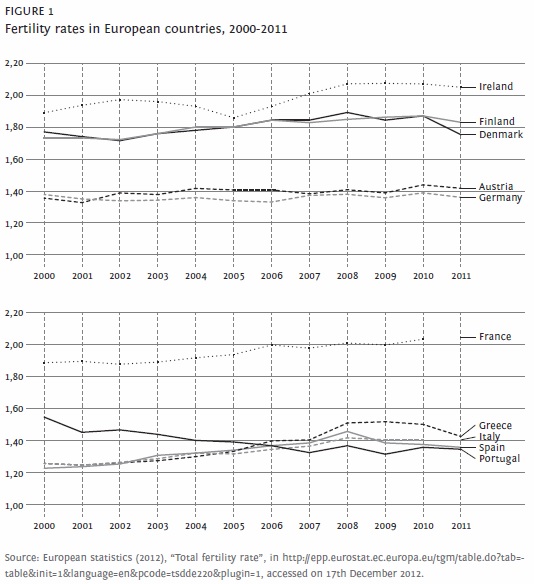
with the 2.1 replacement level (Nimwegen and Erf, 2010). In 2011 the fertility
rates of almost all the European countries had fallen below the replacement
level (<i>cf.</i> <a href="#f1">Figure 1</a>). In particular, for Portugal, Spain, Italy,
Austria, and Greece, the fertility rate is now far below the replacement level.
The average fertility rate for these five countries is below 1.5.</p>

    <p>&nbsp;</p>
<a name="f1">
    <p><img src="/img/revistas/aso/n218/n218a01f1.jpg"></p>
    
<p>&nbsp;</p>

    <p>It is
important to note that a decrease in the fertility rate alone will not turn a
country into an ageing country. Along with a lower fertility rate, a decrease
in the mortality rate and increase in life expectancy have also played an
important role (Dalgaard, 2012; Yong and Saito,
2012).</p>

    <p>This structural ageing of the population has profound consequences on a
country’s (and its regions’) economic growth (Albuquerque and Ferreira, 2015).
Most economists argue that a country with a higher proportion of inhabitants in
the old age group tends to be associated with decreasing productivity levels,
lower savings, and higher government spending (Fougère
<i>et al</i>., 2009; Bloom <i>et al</i>., 2010; Sharpe, 2011; Walder and Döring, 2012). The
demographic transition makes room for an increase in the old age dependency
ratio, meaning that the smaller working age group will be obliged to care for
the older age group (Lindh, 2004; Navaneetham and Dharmalingam, 2012).</p>

    <p>Although there
are a myriad of important theoretical and empirical contributions on the ageing
population, these are diffuse and lack consensus on the various mechanisms
through which an ageing population affects economic growth. Thus, the main goal
of this paper is to provide an in-depth literature survey on the interacting
mechanisms between population ageing and economic growth.</p>

    ]]></body>
<body><![CDATA[<p>Our paper is
structured as follows. In Section 2 we provide a general overview of the
literature on population ageing and economic growth, giving an account of the
main mechanisms through which this influence occurs. Section 3 details the
empirical studies in the area and Section 4 offers some concluding remarks.</p>

    <p>&nbsp;</p>

    <p><b>THE IMPACT OF AN AGEING POPULATION ON ECONOMIC GROWTH: MAIN MECHANISMS</b></p>

    <p>&nbsp;</p>

    <p><b>AN OVERVIEW OF THE INTERACTION BETWEEN AGEING AND
GROWTH</b></p>

    <p>&nbsp;</p>

    <p>Often in the past, demographic transition was considered to have a
positive effect on economic growth as the proportion of the active working age
group was greater than the non-working group (Lee <i>et al</i>., 2011).
However, more recently many authors have revealed that the working population
group has become smaller than that of retired people. As a result, this
situation has transformed most countries into ageing countries (Weil, 2006;
Bell and Rutherford, 2013; Börsch-Supan, 2013).
Indeed, the European Commission (EC) (2006) highlights the fact that the
majority of developed countries face a relatively greater proportion of inhabitants
(especially retirees) in the non-working group than in the working group. Lopes
and Albuquerque (2014) also demonstrate that population ageing is changing the
age structure of the Portuguese workforce with considerable regional
heterogeneity.</p>

    <p>According to
Bloom <i>et al</i>. (2010), the current global life expectancy is 65 years, and
this is projected to increase to 75 years by 2050. In fact, some authors have
even revealed that life expectancy in Japan has been the highest in the world
since 2000 (Weil, 2006; Lee <i>et al</i>., 2011).</p>

    <p>Most of the
literature argues that there is a negative relationship between population
ageing and economic growth (Narciso, 2010; Bloom <i>et
al</i>., 2010; Lisenkova <i>et al</i>., 2012; Walder and Döring, 2012).
According to these authors, individuals’ physical capacity, preferences, and
needs will change in line with their advancing age. Hence, the inequality in
age structure (a greater proportion in the old age group) is believed to affect
a country’s productivity level. Analyzing the economic consequences of ageing
in Portugal and focusing on multi-sectoral (or inter-industry) relationships,
Albuquerque and Lopes (2010) uncovered a negative influence on the value added
and employment of Portuguese industries due to the change in the consumption
structure derived from ageing.</p>

    <p>Even so, some
authors, such as Prettner (2012) and Lee <i>et al</i>.
(2011), claim that a positive interaction exists between ageing and economic
growth. According to Prettner (2012), older
individuals tend to save more. As a result, they provide more resources for
investment, which positively affects economic growth. In fact, the rise in
longevity will positively influence investment, particularly in R & D, which
is generally recognized as an engine for economic growth (Aghion
and Howitt, 1992).</p>

    ]]></body>
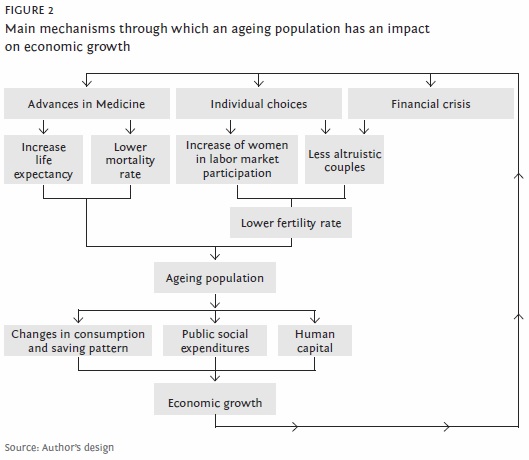
<body><![CDATA[<p><a href="#f2">Figure 2</a> highlights the fact that the increase in the ageing population <i>via</i>
medical advances and couples’ less altruistic behavior will affect economic
growth mainly through three mechanisms: consumption and saving patterns, public
social expenditure, and human capital (Bakshi and
Chen, 1994; Tosun, 2003; Alders and Broer, 2004; Elmeskov, 2004; Lee
and Mason, 2007; Mason and Lee, 2013; Meijer<i> et al</i>., 2013). The
following section looks at these mechanisms in more detail. However, it is also
important to acknowledge that a reverse causality exists between these two
phenomena (in other words, economic growth may also influence the determinants
of an ageing population).<sup><a href="#4">4</a></sup><a name="top4"></a></p>

    <p>&nbsp;</p>
<a name="f2">
    <p><img src="/img/revistas/aso/n218/n218a01f2.jpg"></p>
    
<p>&nbsp;</p>

    <p><b>CONSUMPTION AND SAVING PATTERNS</b></p>

    <p>&nbsp;</p>

    <p>The behavior of households in terms of consumption and savings may
differ substantially between individuals’ working and retirement periods (­Samuelson, 1958; Albuquerque and Lopes, 2010). 
The rise in
population ageing will lead to changes in households’ consumption patterns.
Some authors believe that ageing will to some extent change overall preferences
and household needs (Walder and Döring,
2012; Velarde and Hermann, 2014). In fact, consumption patterns are alleged to
be affected by ageing, through disposable income. Authors even stress that the
increase in the elderly population will reduce the <i>per capita</i> income of
all three generations (child, working group, and retiree) and lead to a net
decrease in the family’s total consumption (Lee and Mason, 2007). To some
extent, the increase in the old age dependency ratio is expected to reduce the
disposable income of the working population and lead to a further decline in
the fertility rate (Hock and Weil, 2012).</p>

    <p>Despite these
negative effects, authors such as Aguila (2011) argue
that the personal retirement account (PRA) systems followed by many countries
will enable retirees to be more independent. Using PRA instead of pay-as-you-go
systems will provide financial sustainability for retirees. Hence, the rise in
population ageing will not affect the total consumption of the family if the
retirees have opted for the PRA system. In line with this argumentation, it is
considered that the ageing population will not affect the consumption level of
the working group in a family. Nevertheless, Davies and Robert III (2006) argue
that the savings rate of retirees will decrease as savings become their source
of spending. Thus, with the rise in life expectancy, PRA systems are unable to
assure financial sustainability for retirees till the end of their lives.</p>

    <p>Private
consumption has a considerable influence on demand (Walder
and Döring, 2012). Some authors believe population
ageing will prompt changes in household demand for certain goods (Bakshi and Chen, 1994; Mérette
and Georges, 2009; Aguiar, 2011; Walder
and Döring, 2012). Changes in the demand for goods and
services will undoubtedly influence the total productivity level of a country.
In fact, the demand for goods and services is crucial for defining both the
production structure and the labor market, which are directly influenced by the
age composition of a country’s population.</p>

    <p>A country with
an elderly population will face falling or stabilizing demand for property
(housing) and higher demand in the stock markets, as older people are bigger
risk-takers (Bakshi and Chen, 1994). Bakshi and Chen (1994) stressed that the retired age group
will have fewer responsibilities as they are already in the later stages of
life. Therefore, they will use their income to invest more heavily in risky
assets.</p>

    ]]></body>
<body><![CDATA[<p>Mérette
and Georges (2009) argued that an ageing population will lead to higher demand
for health services and a lower demand for housing. Even though a country with
an ageing population tends to face a general decline in the demand for housing,
Chen <i>et al</i>. (2012) argue that in Scotland the problem of ageing is not
yet seen as a main determinant for changes in house prices. Therefore, for
countries like Scotland there is no direct correlation between changes in the
demand for housing and the rise in population ageing.</p>

    <p>In addition to
consumption of durable goods, households’ consumption in relation to
non-durable goods is also expected to drop significantly during the retirement
and unemployment period (Aguiar, 2011). Among
perishable goods, food expenditure is one of the major forms of expenditure
that declines after retirement (Aguiar, 2011; Aguila <i>et al</i>., 2011). The authors stress that the
expenditure on food eaten outside the home will fall once an individual leaves
their employment. In fact, retirees will replace their outside food consumption
with home-cooked food as they have more leisure time after retirement.</p>

    <p>There are some authors who are more positive about this ageing trend.
They believe that population ageing will not affect consumption and household
saving patterns, especially those of the working group (Alders and Broer, 2004; Hock and Weil, 2012). According to these
authors, the decrease in the labor supply due to ageing tends to raise the wage
rates of all generations and will increase the cost of having children.
Therefore, in order to maintain its consumption level, the working age group
must be willing to forgo having children.</p>

    <p>&nbsp;</p>

    <p><b>PUBLIC SOCIAL EXPENDITURE</b></p>

    <p>&nbsp;</p>

    <p>The old age dependency ratio is expected to increase in the near future
(­Díaz-Giménez and Díaz-Saavedra,
2009). The most common pay-as-you-go system is considered completely
unsustainable due to the ageing phenomenon (Díaz-Giménez
and Díaz-Saavedra, 2009; Aguila,
2011). Several authors predict that the current pay-as-you-go system will
provoke an increasing deficit in government budgets (Tosun,
2003; Elmeskov, 2004; Díaz-Giménez
and Díaz-Saavedra, 2009; Yong and Saito, 2012;
Park-Lee <i>et al</i>., 2013). In fact, some authors consider that the rise in
the government deficit has been due to the retirement of more educated workers
(Díaz-Giménez and Díaz-Saavedra,
2009). For these authors, the more educated workers are, the higher the payroll
taxes they pay during their working lives and the greater the pensions they
will receive when they retire. Hence, a rise in retirement among educated
workers is expected to double the government’s expenditure on retirement. It
largely depends on what types of retirement policies governments (or government
agencies) adopt, as some policies may be able to offset the problem of
increasing deficits in government budgets.</p>

    <p>In fact, Aguila (2011) suggests that by following the PRA (personal
retirement account) retirement plan, it is possible to avoid many of the
limitations of pay-as-you-go systems and even be able to reduce the budget
deficit. Government agencies raise taxes to accommodate the rise in welfare
expenditure on ageing societies. This is assumed to affect the disposable
income of the working group to some extent, and thus tends to cause a decline
in the fertility rate (Hock and Weil, 2012). Subsequently, this type of response
will further enhance the ageing phenomenon.</p>

    <p>However, in
the case of New Zealand, population ageing is believed to exert a positive
influence on the government budget (Creedy and
­Scobie, 2002). Creedy and Scobie (2002) attest that
the country’s percentage of gross domestic product (GDP) is predicted to
increase from 22.7% in 2001 to 31.0% by 2051 due to ageing. <i>Per se</i>,
population ageing tends to cause significant changes in government budget
allocations. However, Eiras and Niepelt
(2012) and ­Lisenkova <i>et al</i>. (2012) argue that
population ageing will increase the allocation of government spending more to
social security than to education and infrastructure investment. According to
these authors, the changes in government priority will ultimately impact (negatively)
the economic development of the country. Nevertheless, to some extent, the
continuous rise in immigration will make it possible to mitigate the rise in
government spending. Therefore, population ageing is believed not to have a
negative impact on economic growth as long as there is a continuous flow of
immigration (Blake and ­Mayhew, 2006).</p>

    <p>Regarding
population ageing, some authors have even proposed postponing the retirement
age of an employee (Finch, 2014; Díaz-Giménez and Díaz-Saavedra, 2009). To a certain degree, prolonging the
working life of an individual can overcome the pressure on the pension system.
In fact, raising the retirement age is considered to
be one of the European Union’s (EU) policies (Finch, 2014).</p>

    ]]></body>
<body><![CDATA[<p>Overall, the
degree of negative effect of ageing on public expenditure depends on the type
of government policy. Hence it is believed that the effect of population ageing
makes it possible to mitigate the rise in public expenditure as long as
retirement policies can be adjusted (by moving them to private pension schemes
and raising the retirement age) and provided that the number of immigrant
workers can be increased to compensate for the shortfall in the labor force.</p>

    <p>&nbsp;</p>

    <p><b>HUMAN CAPITAL</b></p>

    <p>&nbsp;</p>

    <p>Rises in population ageing tend to decrease the weight of the working
group (Alam and Mitra,
2012; Bell and Rutherford, 2013; Börsch-Supan, 2013;
Wu, 2013). Fougère <i>et al</i>. (2009) argue that
the decline in the working population in Canada was due purely to the ageing
population. The huge baby boom population that emerged between 1947 and 1966
started to retire at the age of 65 in 2012, leading to a larger ageing
population in Canada (Sharpe, 2011). However, authors claim that countries can
sustain economic growth despite the ageing population problem. According to
some authors, such as Bloom <i>et al</i>. (2010) and Peng and Fei (2013), the increase in the retirement age and
immigration will in fact help to overcome the decrease in the labor force.
Furthermore, Elgin and Tumen (2010) state that with a decline in human capital,
the economy will switch from traditional production (that employs young
workers) to new human capital oriented production (that employs elderly
workers). Therefore, according to this line of argument an ageing population
will affect neither production nor growth dynamics. Elgin and Tumen (2010) also
stressed that modern economies rely more on machines than the labor force.
Thus, a fall in the labor force will have no significant effect on
productivity. According to these authors, labor can be replaced by machines.
This means that a decrease in the young working group has no effect on economic
growth.</p>

    <p>However, Lisenkova <i>et al</i>. (2012) hold a contrasting view of
this phenomenon. Even though an increase in the retirement age will help to
offset a decreasing labor market, workers of different ages are not perfect
substitutes and so there will definitely be a decline in productivity <i>per
worker</i> (Lisenkova <i>et al</i>., 2012). Thus,
authors reveal that population ageing will decrease a country’s stock of human
capital and subsequently exert a negative influence on its economic growth (Narciso, 2010; Lisenkova <i>et al</i>.,
2012). Furthermore, an ageing population expected to reduce the labor force is
assumed to affect economic growth due to the lower productivity levels. Even
though the higher participation of women in the labor force increases labor
productivity, this participation will further lower the fertility rates, which
will eventually lead back to the initial problem (Alders and Broer, 2004).</p>

    <p>There is also
the argument that, apart from the increase in the retirement age, greater
immigration is unable to help much with overcoming public spending due to this
problem of ageing, as immigrants will also have rights under the pension and
health care system (Elmeskov, 2004). Despite the
negative effect on human capital accumulation identified by Lindh (2004),
Ludwig <i>et al</i>. (2011) and other authors stressed that in relation to the
US economy the increase in human capital investment will reduce the impact of
an ageing population. The endogenous human capital acquired through formal
schooling and on-the-job training programs will positively influence human
capital technology (Ludwig <i>et al.,</i> 2011). Hence in the case of the US,
Ludwig <i>et al</i>. (2011) report that when we allow for endogenous human
capital accumulation, the welfare losses in terms of lifetime consumption will
be only about 8.7%, whereas when human capital is assumed as exogenous, these
losses will rise to 12.5% (assuming that replacement rates to the pension
system are constant).</p>

    <p>&nbsp;</p>

    <p><b>SURVEYING THE EMPIRICAL STUDIES THAT ASSESS THE IMPACT OF AGEING ON
ECONOMIC GROWTH</b></p>

    <p>&nbsp;</p>

    ]]></body>
<body><![CDATA[<p><b>SOME BRIEF METHODOLOGICAL ASPECTS</b></p>

    <p>&nbsp;</p>

    <p>Although high quality empirical research on the impact of population
ageing on countries’ economic growth does exist, (this latter often proxied by GDP growth rates), such literature is still
relatively scarce. The following section summarizes some of the most relevant
studies in this area, highlighting the main mechanisms through which ageing
affects economic growth: consumption and saving patterns, public social
expenditure, and human capital. The criteria for selecting the relevant papers
involved an in-depth search within the blue ribbon journals (<i>The American
Economic Review; Econometrica; The International
Economic Review; The Journal of Economic Theory; The Journal of Political
Economy; The Quarterly Journal of Economics; Review of Economic Studies; </i>and
<i>Review of Economics and Statistics), </i>followed by an extensive search in
specialized journals relating to ageing <i>(such as: The European Journal of
Ageing; The Journal of Economics of Ageing; The Journal of Population Ageing;
Research on Aging; Ageing International; </i>and <i>The Journal of Aging and
Social Policy</i>), and through a snowball method, some selected articles in
other journals considered as well <i>(The Journal of Population Economics;
Economic Modelling; De Economist; </i>and <i>Applied Economics</i> ). We used a
time span of five years (2010 – 2014) in our search procedure for all the
journals, except for <i>The Journal of Economics of Ageing, The Journal of
Population Ageing, Economic Modelling, </i>and<i> Applied Economics.</i> For<i>
The Journal of the Economics of Ageing,</i> we carried out our search from the
year 2013 – 2014, as their first volume was published only in 2013.</p>

    <p>For <i>The Journal of Population Ageing</i>, and since there were few
articles published between the years 2013 - 2014, we decided to consider a
larger period, 2008 to 2014. The journals <i>Economic Modelling</i> and <i>Applied
Economics</i> include a wide range of issues in the field of economics, and
thus a vast amount of articles. The search in these two journals was undertaken
only from 2013 to 2014.</p>

    <p>For all types,
the search procedure involved the consideration of exclusive “empirical
studies” on “economic growth” and “ageing”. Particular attention was given to
those articles assessing the possible distinct impact of ageing on economic
growth by the main mechanism, estimation techniques, and ­countries. From the
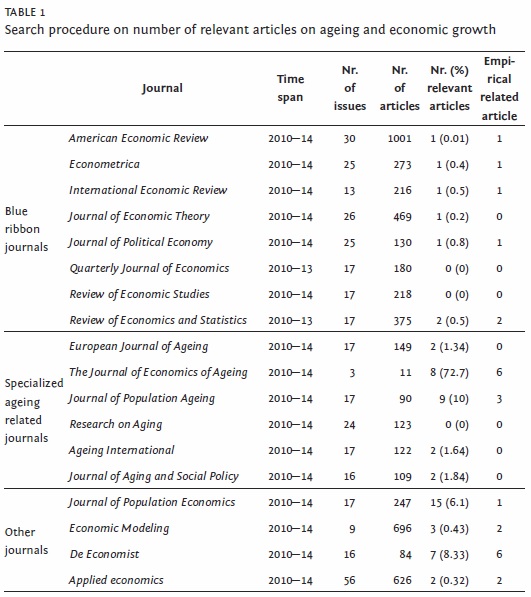
search, 54 articles considered the impact of ageing on economic growth. Of
these 54 articles, 23 focus exclusively on empirical studies (<i>cf.</i> <a href="#t1">Table
1</a>).</p>

    <p>&nbsp;</p>
<a name="t1">
    <p><img src="/img/revistas/aso/n218/n218a01t1.jpg"></p>
    
<p>&nbsp;</p>

    <p>Of the articles identified, there were 7 studying the impact of ageing
on economic growth through consumption and saving patterns, 10 through public
expenditure, and 10 through human capital. In the following section, a further
review will be carried out in relation to the empirical articles.</p>

    <p>&nbsp;</p>

    ]]></body>
<body><![CDATA[<p><b>THE EFFECT THAT AN AGEING POPULATION HAS ON
CONSUMPTION AND SAVING PATTERNS</b></p>

    <p>&nbsp;</p>

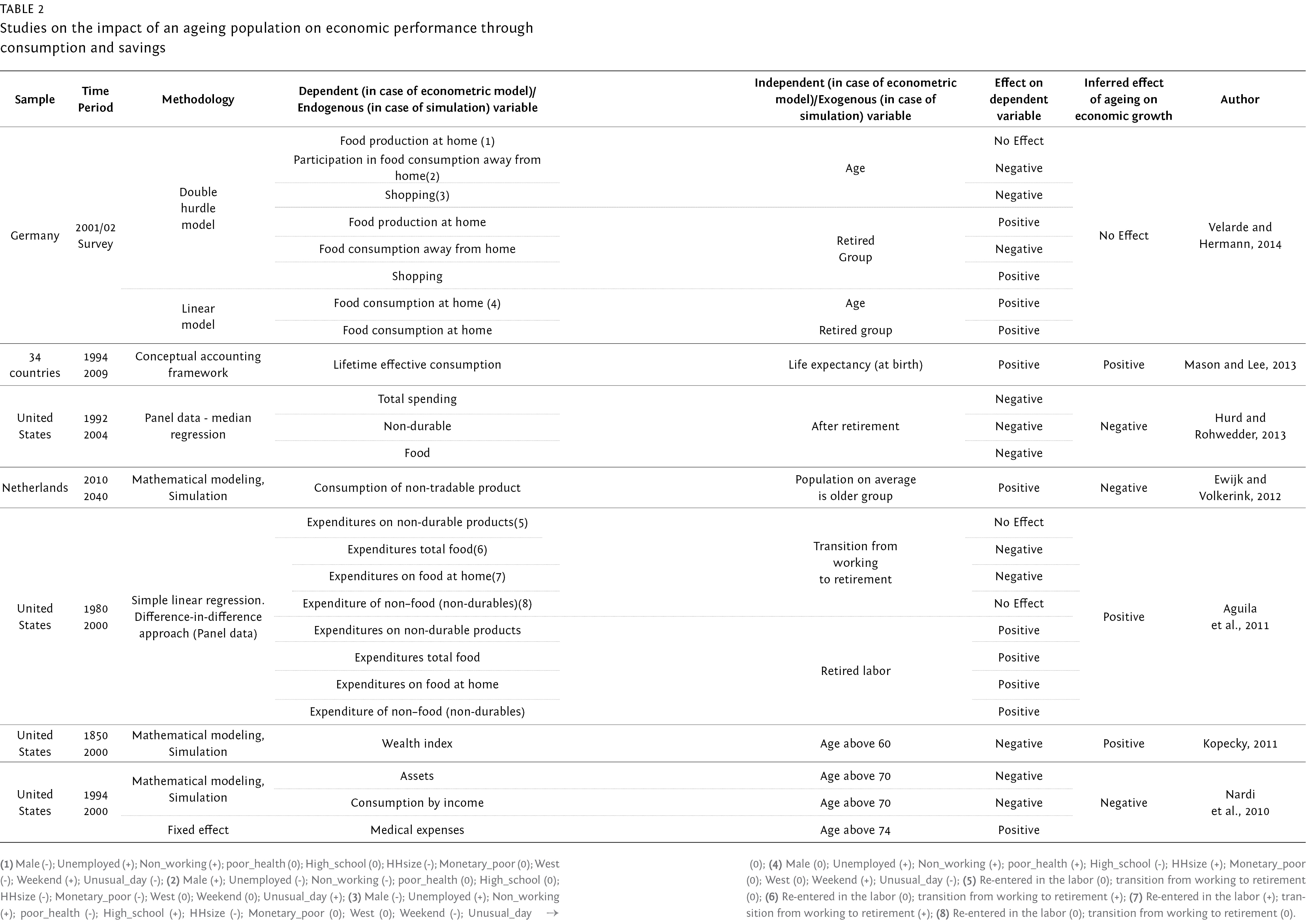
    <p>Few empirical studies have addressed the impact of ageing on growth
through consumption and saving patterns. Seven selected papers summarized in
<a href="#t1">Table 1</a> considered the influence of population ageing on both developed and
­developing countries. Since we know that the effect of ageing depends on
countries’ policies and household behavior, the results (<a href="#t1">Table 1</a>) show both
positive (Kopecky, 2011; Mason and Lee, 2013) and
negative (Nardi <i>et al</i>. 2010; Aguila <i>et al</i>. 2011; Ewijk
and Volkerink, 2012; Hurd and Rohwedder,
2013) impacts on economic growth.</p>

    <p>The needs and
preferences of households will change depending on people’s ages and their
financial capacity. Analyzing the expenditures of households from developed
countries (such as the USA, the Netherlands, and Germany), Nardi
<i>et al</i>. (2010), Aguila <i>et al</i>. (2011), Ewijk and Volkerink (2012), Hurd
and Rohwedder (2013) and Velarde and Hermann (2014)
demonstrate a decreasing trend in the consumption patterns of the elderly. The
fall in income after retirement has enabled households to adjust their
consumption according to their financial capacity. Hence, an elderly household
will alter its consumption substantially after retirement (<i>e.</i><i>g</i>., Nardi <i>et al</i>.,
2010; Aguila <i>et al</i>., 2011; Velarde and
Hermann, 2014).</p>

    <p>In the case of the USA, the
empirical studies conducted by Aguila <i>et al</i>.
(2011) and Hurd and Rohwedder (2013) show similar
results. According to these authors, the food consumption of a
household will decline after the retirement of its members. In fact,
considering a linear model, Velarde and Hermann (2014) also found a similar
result for households in Germany. According to the authors, retired members of
German households behave in ways similar to those of USA
households in terms of food consumption. Furthermore, their studies reveal that
food expenditure will be the major category that is reduced after the
retirement of inhabitants of these developed countries.</p>

    <p>Nevertheless,
in the case of the Netherlands, Ewijk and Volkerink (2012) find contradicting results. According to
these authors, the rise in the elderly population in the Netherlands will
increase the demand of non-tradable products (especially of services) in the
long run. The authors believe that the consumption pattern of elderly
households will only affect tradable goods. As a result of the ageing
population, the Netherland’s GDP share of the trade balance is projected to
decrease to 4% in 2015. Moreover, Ewijk and Volkerink’s (2012) simulation predicts a 3% rise in the
budget deficit when ageing reaches its peak for that country in 2040.</p>

    <p>Unlike Velarde
and Hermann (2014), Hurd and Rohwedder (2013), Ewijk and Volkerink (2012) and Aguila <i>et al</i>. (2011), the empirical studies
undertaken by Mason and Lee (2013) and Kopecky (2011)
demonstrate a positive impact of ageing on economic growth through consumption
and savings. Analyzing 34 countries (including developed and developing), Mason
and Lee (2013) justify this positive relationship in mathematical terms.</p>

    <p>According to
these authors, a rise in life expectancy will prolong the capacity of an
individual to continue in the labor market. Hence, the authors
stress that extending a person’s working life will increase a household’s
income and consumption. In analyzing the relationship between the wealth index
and the elderly (the over-60), Kopecky (2011)
demonstrated that there was an increase in the consumption of retirees in the
US from 1850—2000. According to the author the total savings of an old age
group will decline as its members’ consumption on leisure activities increases
upon retirement. In fact, the author stresses that men aged 65 and above spend
approximately 43% more time on recreation than men aged 25–54. Nardi <i>et al</i>. (2010) believe that to some extent
households’ medical expenses grow throughout their lives. The higher the
survival rate, the higher the medical expenses. For these authors, US
households above the age of 70 face a decrease in their savings and income in
order to compensate for their rising health care expenses. Hence, increase in
life expectancy will augment households’ medical expenses and decrease their
savings.</p>

    <p>&nbsp;</p>

    <p><b>THE EFFECT OF AGEING ON ECONOMIC GROWTH THROUGH PUBLIC
SOCIAL EXPENDITURE</b></p>

    ]]></body>
<body><![CDATA[<p>&nbsp;</p>

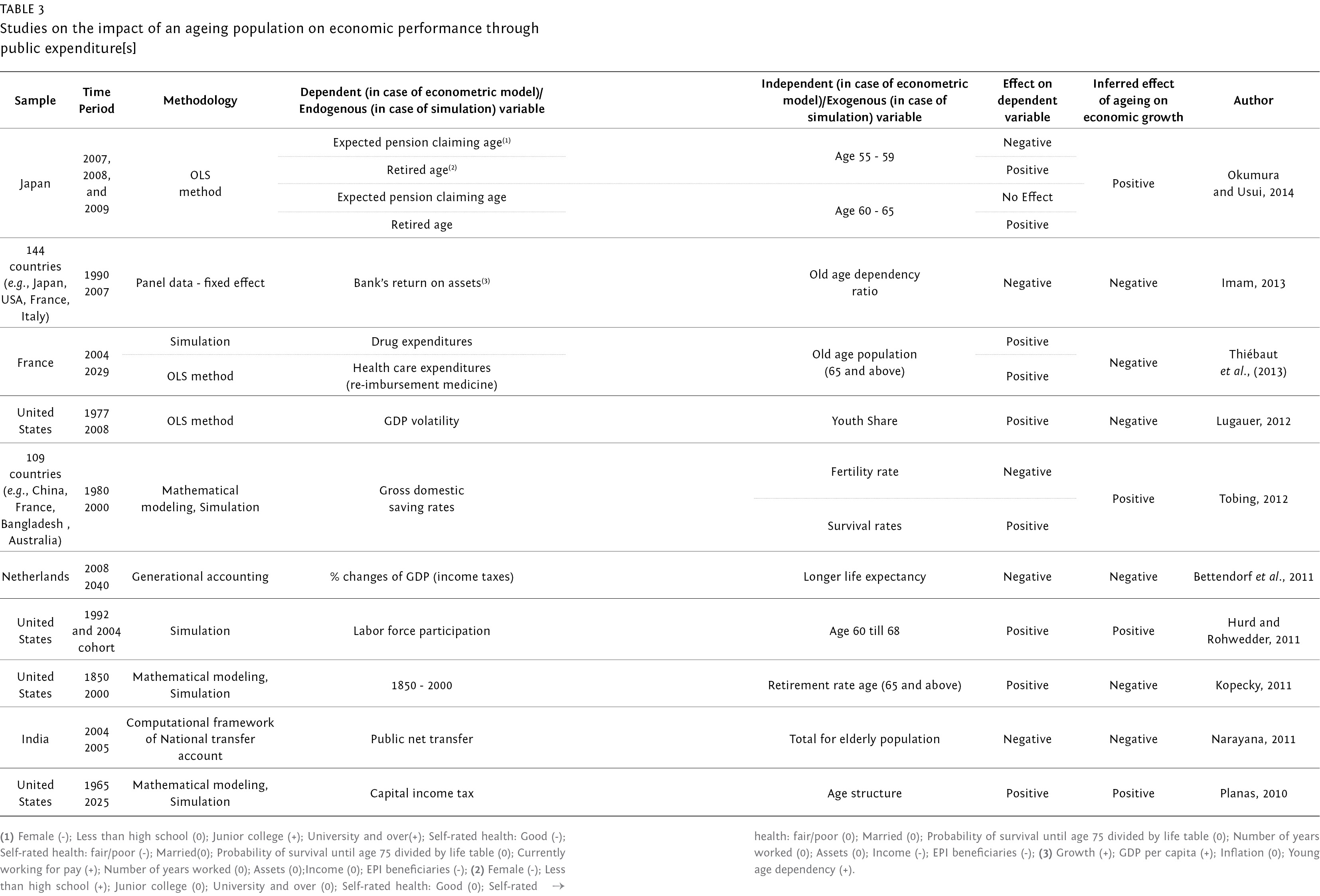
    <p>Ageing populations affect the government’s
earning and expenditure in many ways. Empirical analysis has been carried out
to identify the influence of ageing populations through social expenditure (Thiébaut <i>et al</i>., 2013 and ­Okumura and Usui, 2014), GDP (Bettendorf <i>et al</i>. 2011; Tobing, 2012, and Lugauer, 2012),
taxation (Planas, 2010), and the financial sector
(Narayana, 2011 and Imam, 2013).</p>

    <p>In a similar
manner to households, the rise in population ageing is believed to influence
the expenditure pattern of government agencies. Using France as a sample for
their analysis, Thiébaut <i>et al</i>. (2013)
underline the fact that the rise in the elderly population will increase demand
for health care. As a result, this will increase the government’s budget
allocation to health care expenditure. Unlike Mason and Lee (2013), Thiébaut <i>et al</i>. (2013) argue that the rise in life
expectancy will not guarantee a healthy old age group unless there is
­continuous demand for medical consumption. Therefore, in the
case of France, ­Thiébaut <i>et al</i>. (2013) stress
that a healthy ageing scenario will not be “cost-saving”. Hence the
authors project that a rise in the number of elderly will not be able to
support the country’s economic growth.</p>

    <p>&nbsp;</p>
    <p><a href ="/img/revistas/aso/n218/n218a01t2.jpg ">Table 2</a></p>
    
<p>&nbsp;</p>

    <p>Along with Thiébaut <i>et al</i>. (2013), there are still authors who
provide empirical evidence that ageing has a negative impact on economic growth
through public social expenditure. Bettendorf <i>et al</i>. (2011) showed that
the rise in life expectancy will negatively affect the percentage contribution
of income tax to the GDP of the Netherlands. The authors stress that the rise
in population ageing will reduce the tax income of the country. Even though the
ageing population negatively affects income tax, the rise in the capital
taxation is believed to positively affect the GDP of a country (Planas, 2010).</p>

    <p>In fact, Planas (2010) demonstrates that the rise in the population
ageing is expected to increase the capital taxation of the US. According to the
author, younger decisive voters tend to support a higher tax rate on capital.
The current demographic transition will lead voters to increase their saving
and thereby shift the political preferences against capital taxation. In fact,
in the case of the US, authors have proved that the imbalance in age structure
will provide a reduction in business cycle fluctuations (Lugauer,
2012). According to the author the rise in the percentage of the old aged
population and the decline in the percentage of the youth population will lead
to GDP volatility in that country. Using standard panel data with lagged birth
rates as an instrument, Lugauer (2012) finds a strong
statistical relationship between the percentage of youth and GDP volatility for
the United States.</p>

    <p>Narayana
(2011) also demonstrates that apart from the developed countries, the rise in
the old age population will negatively affect the public net transfer of India.
According to the author government spending on the elderly population is
greater than the payment for previously accumulated public debt and interest.
Nonetheless, Tobing (2012) believes that the rise in
life expectancy will increase the gross domestic saving rate. For the author
the lower fertility rate and higher survival rate will increase household
savings. The changes in households’ behavior regarding savings are expected to
increase the percentage contribution of savings to GDP.</p>

    <p>Even though
ageing increases the gross domestic saving rate, authors such as Imam (2013)
feel that the rise in the ageing population will affect the banking industries.
The author stresses that the rise in the proportion of the old age population
will lead to financial instability for the banking sectors.</p>

    ]]></body>
<body><![CDATA[<p>His simulation
result shows a negative relationship between the old age dependency ratio and
the banks’ returns on assets. For the author households tend to shrink their
balance sheet once members are above a certain age, thus bringing about a
negative wealth effect.</p>

    <p>The US faced a
continuous rise in the old age population (over 65) from 1850 to 2000 (Kopecky, 2011). However, Kopecky
(2011) identified a continuous fall in the participation of the workers over 65
in the labor force during this period. According to the author, life expectancy
did not increase the life span of the labor force. In fact the rise in life
expectancy increased the life span of retirees.</p>

    <p>Taking this
into consideration, there are authors who believe that government policies
regarding retirement play a vital role in enabling ageing employees to prolong
their life span in the workforce (Okumura and Usui,
2014; Hurd and Rohwedder, 2011). The Japanese pension
reforms in 1994 and 2000 have increased the pensionable age from 60 to 65
(Okumura and Usui, 2014). Furthermore, Okumura and Usui (2014) furnished empirical proof that in Japan
individuals in their late 50s and early 60s expected to retire at a later age.
The authors also demonstrate that individuals with lower incomes and education
levels who expect to survive until 75 will retire at a later age. Hence, the
increase in government spending on public pensions is able to be mitigated
through government policies such as pension plans. Like Okumura and Usui, (2014), even in the case of the US, Hurd and Rohwedder, (2011) have shown similar behavior among elderly
employees when there is a shift in the pension plan. The authors stressed that
the shift in the pension plan from a defined contribution plan (DC<sup><a href="#5">5</a></sup><a name="top5"></a>) 
to a defined benefit plan (DB<sup><a href="#6">6</a></sup><a name="top6"></a>) will increase participation of
older aged employees in the labor force and delay their retirement.</p>

    <p>&nbsp;</p>

    <p><b>THE EFFECT OF AN AGEING POPULATION ON HUMAN CAPITAL</b></p>

    <p>&nbsp;</p>

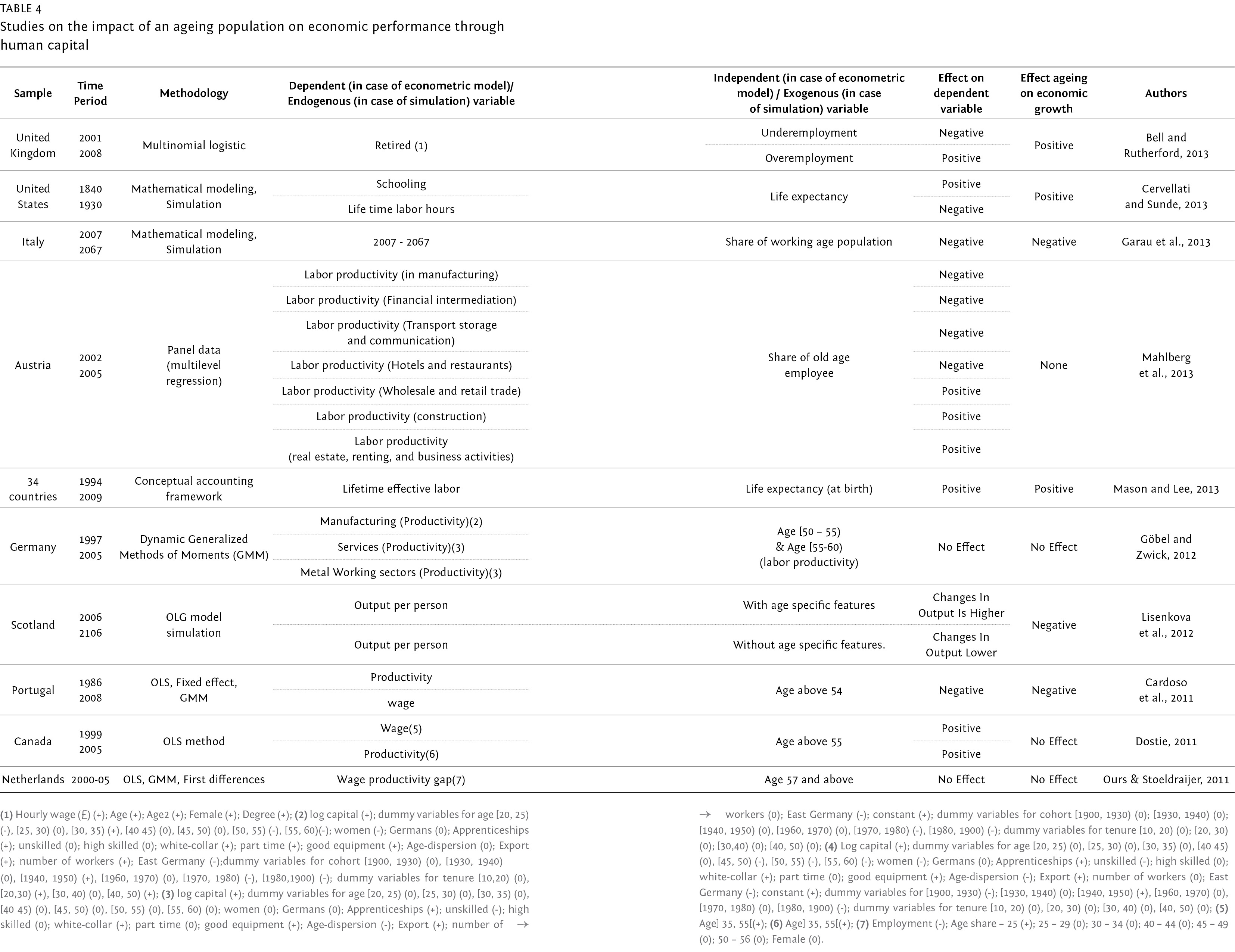
    <p>If workers of different ages are not perfect substitutes, in an ageing
population the productivity level of any particular worker will be lower taking
into account their diminishing physical ability to actively participate in the
labor market (Dostie, 2011; Göbel
and Zwick, 2012; Lisenkova <i>et al</i>., 2012; Mahlberg <i>et al</i>., 2013; Mason and Lee, 2013).</p>

    <p>The rise in
the proportion of the elderly in a population is thought to decrease the labor
supply of that country. Garau <i>et al</i>. (2013)
emphasize that the rise in the proportion of elderly employees in relation to
younger people will negatively influence the Italian GDP and employment
conditions. The authors predict that for Italy, as a consequence of a
demographic transition, the fall in GDP will be greater than that in
employment.</p>

    <p>&nbsp;</p>
    <p><a href ="/img/revistas/aso/n218/n218a01t3.jpg ">Table3</a></p>
    
]]></body>
<body><![CDATA[<p>&nbsp;</p>

    <p>Some authors
feel that the changes in the retirement plan will prolong the participation of
older employees in the labor force (Okumura and Usui,
2014; Hurd and Rohwedder, 2011). However, unconnected
with the pension plan, Bell and Rutherford (2013) argued that the preference
and willingness of the elderly employee to remain in the labor force is thought
to be a reason for the rise in the retirement age. According to these authors,
employed workers who prefer to work fewer hours are significantly more likely
to retire than those who do not. In the case of the UK, the author demonstrated
that there is a significant increase in the proportion of older workers who are
willing to work more hours. This means that older workers in the UK are willing
to prolong their participation in the labor force.</p>

    <p>However, Lisenkova <i>et al</i>. (2012) explain that in general,
regardless of the sector under scrutiny, the age-specific effect will influence
productivity in Scotland. Their aim was to ascertain whether age-specific
features significantly influence output productivity in Scotland. The authors
predict Scotland’s output level for the period 2006 – 2106, based on a
simulation exercise. The results show that when age-specific features are not
taken into account, the changes in the output level will be lower, whereas when
age-specific effects are considered, these changes will be higher. According to
these authors, given that the physical strength of human beings begins to
decline as they get older, the increase in the retirement age will mean a
higher presence of more elderly people in the labor market, which will
definitely have a negative effect on the productivity level. Furthermore, as an
employee gets older, his/her average productivity will decline and possibly
influence his/her standards of living (Dostie, 2011).
Hence, the scenario could also have a negative impact on governments’ ability
to ensure the funding of pension systems.</p>

    <p>Even Göbel and Zwick (2012) and Lisenkova <i>et al</i>. (2012) agree that in general the
impact of an ageing population on labor productivity is negative. Based on an
empirical study, Göbel and Zwick (2012) state that
the influence of this effect will differ according to the sectors analyzed. 
Göbel and Zwick (2012) analyzed the differences in the age
productivity profiles between the metal manufacturing sector and the service
sector in Germany for the period 1997–2005. Using the generalized method of
moments (GMM) as an estimation tool, the authors obtained results showing that
for the 55–60 working age group, there is no significant effect on productivity
in the metal manufacturing and service sectors. Hence, the study concludes that
an increase in the old-age group in Germany has no effect on the productivity
level of the metal manufacturing and service sectors. However, in the case of
Austria, Mahlberg <i>et al</i>. (2013) obtain
contradicting results in analyzing the productivity level of elderly employees.
Considering similar econometric methods (OLS, Fixed effect, Random effect, and
GMM for the time period 2002 to 2005), the authors
stress that there is a significant effect for the manufacturing and service
­sectors.</p>

    <p>The authors
showed that the productivity level of old age employees for Austria in the
manufacturing, financial intermediation, transport, and communication sectors
shows a negative effect. On the other hand, for construction, real estate,
hotels, and restaurants the productivity level of elderly employees of that
country reveals a positive significant relationship. Taking into account the
empirical result of these authors (Göbel and Zwick,
2012; Mahlberg <i>et al</i>., 2013), it is obvious
that the productivity level of old aged employees varies among sectors and
countries.</p>

    <p>As with
Scotland, the productivity level of old age employees in ­Portugal
also shows a declining pattern. Even though the elderly employee makes a
smaller contribution to the firm’s productivity level in the case of Portugal,
Cardoso <i>et al.</i> (2011) stressed that the wages of more elderly employees
still remain below their productivity level. Therefore, increasing the participation
of elderly employees will not raise the production cost(s) of a firm (in terms
of their wage).</p>

    <p>Moreover, in
the case of Canada empirical studies demonstrate that the productivity level
and the wage of a laborer over 55 were significantly positive during the period
1999 to 2005 (Dostie 2011). The empirical studies by Dostie (2011) not only demonstrate positive productivity
levels among old age employees, but the author further showed that there is a
huge gap between productivity and wages. Therefore, in hiring old aged workers,
the firm will not face a rise in production costs (Ours and Stoeldraijer,
2011).</p>

    <p>By no means do
all the empirical studies demonstrate that the rise in population ageing has a
negative impact on labor productivity. Even though an increase in life
expectancy is thought to exert a negative influence on public expenditure (Thiébaut et al., 2013), authors such as Mason and Lee
(2013) believe that medical benefits provided by the government will improve
the fitness of the old age group and prolong the period in which they are able
to participate in the labor market. Hence, by applying a simple conceptual
accounting framework for the period 1994 – 2009, Mason and Lee (2013)
demonstrate that life expectancy has extended the participation in the labor
market in developed and developing countries. However, in the case of the US, Cervellati and Sunde (2013)
discovered that the rise in the survival rate will lead to an increase in full
time schooling and decrease in lifetime labor hours. According to these
authors, an increase in the hours of schooling is associated with higher life
time earnings.</p>

    <p>&nbsp;</p>
    <p><a href ="/img/revistas/aso/n218/n218a01t4.jpg ">Table4</a></p>
    
]]></body>
<body><![CDATA[<p>&nbsp;</p>

    <p><b>SOME FINAL REMARKS ON THE RELATIONSHIP BETWEEN AGEING AND ECONOMIC
GROWTH</b></p>

    <p>&nbsp;</p>

    <p>The demographic dividend resulting from
industrialization has improved the economic growth of developed countries
(Bloom and Williamson, 1998). The imbalance in age structure (a higher
proportion of the old aged group in the population) has led to many developed
countries being dubbed “ageing countries” (Bloom and Williamson, 1998).
Population ageing and its impact on economic growth through the main mechanisms
has been discussed in some depth above. The current ageing problem faced by
many developed countries is unprecedented (Börsch-Supan,
2013). Therefore, these ageing impacts can be considered a new experience and
challenge for the world.</p>

    <p>Our review of
the literature has led us to conclude that an ageing population has affected
economic growth through three main mechanisms: consumption and saving patterns,
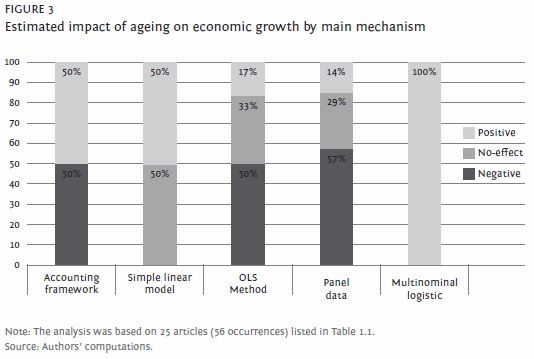
public social expenditure, and human capital. This literature review shows that
the impact of ageing on countries’ performances is intimately related to the
mechanism. Indeed, almost all the empirical studies that have focused on
“public social expenditure” convey a negative impact of ageing, whereas the
majority (36%) of empirical studies that focus on human capital do not find any
statistically significant relationship between ageing and the economic growth
proxy, while the positive impact is much more related to the “consumption and
saving patterns” mechanism (<i>cf</i>. <a href="#f3">Figure 3</a>). In short, the mechanism seems
to have a non-trivial impact on the estimated relationship between ageing and
economic growth.</p>

    <p>&nbsp;</p>
<a name="f3">
    <p><img src="/img/revistas/aso/n218/n218a01f3.jpg"></p>
    
<p>&nbsp;</p>

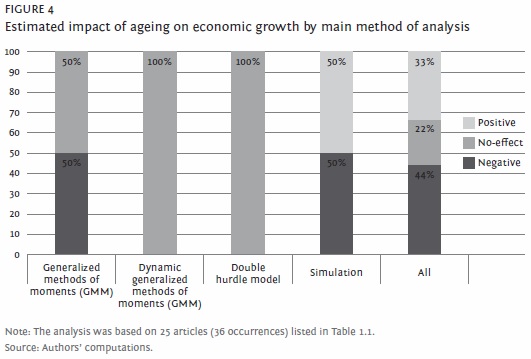
    <p>Estimation methodologies also seem to be associated with distinct
effects of ageing on economic growth. Indeed, <a href="#f4">Figure 4</a> shows that the most
frequent empirical methods (<i>i</i><i>.</i><i>e</i>., simulation,
OLS, and panel data) are most often associated with negative correlations,
whereas the simple linear model, multinomial logistic model, dynamic
generalized methods of moments (GMM), and double hurdle model are more likely
to generate positive or no significant effects.</p>

    <p>&nbsp;</p>
<a name="f4">
    ]]></body>
<body><![CDATA[<p><img src="/img/revistas/aso/n218/n218a01f4.jpg"></p>
    
<p>&nbsp;</p>

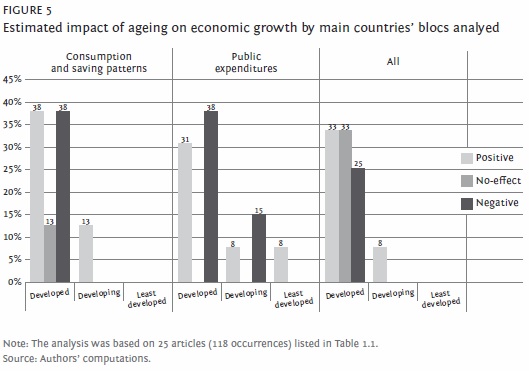
    <p>The evidence
gathered does little to help in assessing the extent to which the impact of
ageing on growth varies according to the mechanisms and countries analyzed. The
bulk of the empirical evidence is concerned more with developed countries (see
<a href="#f5">Figure 5</a>).</p>

    <p>&nbsp;</p>
<a name="f5">
    <p><img src="/img/revistas/aso/n218/n218a01f5.jpg"></p>
    
<p>&nbsp;</p>

    <p>Among the
analyses, “public expenditure” and “consumption and saving pattern” mechanisms
indicate more negative and significant relationships between ageing and growth.
It is important, however, to acknowledge that developed, developing, and even
the least developed countries are affected by the ageing population phenomenon.
As Börsch <i>et al</i>. (2002) state, ageing
population patterns are similar in most countries; the only observable
difference concerns the timing. Furthermore, an ageing population’s influence
on economic growth has been labelled “remarkable”, especially during the
current financial and economic crisis (Lee <i>et al</i>., 2011). Several
economic studies (<i>e.</i><i></i><i>g</i>., Creedy and Scobie, 2002; Alders and Broer, 2004; Weil, 2006; Sobotka <i>et
al</i>., 2010; Börsch-Supan, 2013; and Albuquerque
and Ferreira, 2015) not only confirm the existence of ageing populations all
over the world, but also document and analyze the mechanisms that influence
economic growth, as well as propose possible remedies for solving the problem.</p>

    <p>The changes that both developed and developing countries are currently
undergoing, leading to an era of global ageing populations, have their own
consequences for economic growth dynamics through the distinct mechanisms
detailed above: consumption and saving patterns (Fougère
<i>et al</i>., 2009; ­Albuquerque and Lopes, 2010; Li <i>et al</i>., 2012; Walder and Döring, 2012; Mason
and Lee 2013), human capital (Elgin and Tumen, 2010; Sharpe, 2011; Göbel and Zwick., 2012), and public social spending (Creedy and Scobie, 2002; Tosun,
2003; Elmeskov, 2004; Hock and Weil, 2012; Yong and
Saito, 2012).</p>

    <p>Realizing the
gravity of the issues raised by population ageing, policy makers are desperate
to find ways of tackling the issues. Policy implications such as the “Blue
card” system introduced by European countries to encourage foreign immigration
in order to overcome labor shortages, increasing the retirement age so as to
lower government expenditure, increasing the working group’s income tax and
social planning, whereby couples are encouraged to have more children, are
considered to be the major ones. However, for some reason, general policy plans
are not yet regarded as an effective way of solving the problem. Knowing the
degree to which the influence of ageing varies from country to country, and
through which mechanisms, is essential for identifying adequate policies.</p>

    <p>&nbsp;</p>

    ]]></body>
<body><![CDATA[<p><b>REFERENCES</b></p>

    <p>&nbsp;</p>

    <!-- ref --><p>AGHION, P. and HOWITT, P. (1992), “A model of growth through creative
destruction”. <i>Econometrica</i><i>, </i>60, pp. 323-351.    &nbsp;&nbsp;&nbsp;&nbsp;&nbsp;&nbsp;&nbsp;&nbsp;[&#160;<a href="javascript:void(0);" onclick="javascript: window.open('/scielo.php?script=sci_nlinks&ref=075034&pid=S0003-2573201600010000100001&lng=','','width=640,height=500,resizable=yes,scrollbars=1,menubar=yes,');">Links</a>&#160;]<!-- end-ref --></p>

    <!-- ref --><p>AGUIAR, M. (2011), “Consumption versus expenditure”. <i>Journal of Political Economy</i>,
113, pp. 919-948.    &nbsp;&nbsp;&nbsp;&nbsp;&nbsp;&nbsp;&nbsp;&nbsp;[&#160;<a href="javascript:void(0);" onclick="javascript: window.open('/scielo.php?script=sci_nlinks&ref=075036&pid=S0003-2573201600010000100002&lng=','','width=640,height=500,resizable=yes,scrollbars=1,menubar=yes,');">Links</a>&#160;]<!-- end-ref --></p>

    <!-- ref --><p>AGUILA,
E. (2011), “Personal retirement accounts and saving”. <i>American Economic
Journal: Economic Policy</i>, 3, pp. 1-24.    &nbsp;&nbsp;&nbsp;&nbsp;&nbsp;&nbsp;&nbsp;&nbsp;[&#160;<a href="javascript:void(0);" onclick="javascript: window.open('/scielo.php?script=sci_nlinks&ref=075038&pid=S0003-2573201600010000100003&lng=','','width=640,height=500,resizable=yes,scrollbars=1,menubar=yes,');">Links</a>&#160;]<!-- end-ref --></p>

    <!-- ref --><p>AGUILA,
E., ATTANASIO, O. and MEGHIR, C. (2011), “Changes in consumption at retirement:
evidence from panel data”. <i>The Review of Economics and Statistics</i>, 93,
pp. 1094-1099.    &nbsp;&nbsp;&nbsp;&nbsp;&nbsp;&nbsp;&nbsp;&nbsp;[&#160;<a href="javascript:void(0);" onclick="javascript: window.open('/scielo.php?script=sci_nlinks&ref=075040&pid=S0003-2573201600010000100004&lng=','','width=640,height=500,resizable=yes,scrollbars=1,menubar=yes,');">Links</a>&#160;]<!-- end-ref --></p>

    ]]></body>
<body><![CDATA[<!-- ref --><p>ALAM,
M. and MITRA, A. (2012), “Labour market
vulnerabilities and health outcomes: older workers in India”. <i>Journal of
Population Ageing</i>, 5, pp. 241-256.    &nbsp;&nbsp;&nbsp;&nbsp;&nbsp;&nbsp;&nbsp;&nbsp;[&#160;<a href="javascript:void(0);" onclick="javascript: window.open('/scielo.php?script=sci_nlinks&ref=075042&pid=S0003-2573201600010000100005&lng=','','width=640,height=500,resizable=yes,scrollbars=1,menubar=yes,');">Links</a>&#160;]<!-- end-ref --></p>

    <!-- ref --><p>ALBUQUERQUE,
P.C. and FERREIRA, J. (2015), “Envelhecimento,
emprego e remunerações nas regiões portuguesas:
uma análise shift-share –
Ageing, employment and remunerations in Portuguese regions: a shift-share
analysis”. <i>EURE</i>, 41 (122), pp. 239-260.    &nbsp;&nbsp;&nbsp;&nbsp;&nbsp;&nbsp;&nbsp;&nbsp;[&#160;<a href="javascript:void(0);" onclick="javascript: window.open('/scielo.php?script=sci_nlinks&ref=075044&pid=S0003-2573201600010000100006&lng=','','width=640,height=500,resizable=yes,scrollbars=1,menubar=yes,');">Links</a>&#160;]<!-- end-ref --></p>

    <!-- ref --><p>ALBUQUERQUE,
P.C. and LOPES, J.C. (2010), “Economic impacts of ageing: an
inter-industry approach”. <i>International Journal of Social
Economics</i>, 37 (12), pp. 970- 986.    &nbsp;&nbsp;&nbsp;&nbsp;&nbsp;&nbsp;&nbsp;&nbsp;[&#160;<a href="javascript:void(0);" onclick="javascript: window.open('/scielo.php?script=sci_nlinks&ref=075046&pid=S0003-2573201600010000100007&lng=','','width=640,height=500,resizable=yes,scrollbars=1,menubar=yes,');">Links</a>&#160;]<!-- end-ref --></p>

    <!-- ref --><p>ALDERS, P. and BROER, D.P. (2004), “Ageing, fertility, and
growth”. <i>Journal
of Public Economics,</i> 89, pp. 1075-1095.    &nbsp;&nbsp;&nbsp;&nbsp;&nbsp;&nbsp;&nbsp;&nbsp;[&#160;<a href="javascript:void(0);" onclick="javascript: window.open('/scielo.php?script=sci_nlinks&ref=075048&pid=S0003-2573201600010000100008&lng=','','width=640,height=500,resizable=yes,scrollbars=1,menubar=yes,');">Links</a>&#160;]<!-- end-ref --></p>

    <!-- ref --><p>BAKSHI, G.S. and CHEN, Z. (1994), “Baby boom, population aging
and capital markets”. <i>Journal of Business</i>, 67 (2), pp. 165-202.    &nbsp;&nbsp;&nbsp;&nbsp;&nbsp;&nbsp;&nbsp;&nbsp;[&#160;<a href="javascript:void(0);" onclick="javascript: window.open('/scielo.php?script=sci_nlinks&ref=075050&pid=S0003-2573201600010000100009&lng=','','width=640,height=500,resizable=yes,scrollbars=1,menubar=yes,');">Links</a>&#160;]<!-- end-ref --></p>

    ]]></body>
<body><![CDATA[<!-- ref --><p>BECKER, S.G., MURPHY, M.K. and TAMURA, F.R. (1990),
“Human capital, fertility, and economic growth”. <i>NBER Working paper</i>
No. 3414.    &nbsp;&nbsp;&nbsp;&nbsp;&nbsp;&nbsp;&nbsp;&nbsp;[&#160;<a href="javascript:void(0);" onclick="javascript: window.open('/scielo.php?script=sci_nlinks&ref=075052&pid=S0003-2573201600010000100010&lng=','','width=640,height=500,resizable=yes,scrollbars=1,menubar=yes,');">Links</a>&#160;]<!-- end-ref --></p>

    <!-- ref --><p>BELL, D.N.F. and RUTHERFORD, A.C. (2013), “Older
workers and working time”. <i>The Journal of the Economics of Ageing</i>, 1-2, pp. 28-34.    &nbsp;&nbsp;&nbsp;&nbsp;&nbsp;&nbsp;&nbsp;&nbsp;[&#160;<a href="javascript:void(0);" onclick="javascript: window.open('/scielo.php?script=sci_nlinks&ref=075054&pid=S0003-2573201600010000100011&lng=','','width=640,height=500,resizable=yes,scrollbars=1,menubar=yes,');">Links</a>&#160;]<!-- end-ref --></p>

    <!-- ref --><p>BETTENDORF, L., <i>et al.</i> (2011), “Ageing and the conflict of
interest between generations”. <i>De Economist</i>, 159, pp. 257-278.    &nbsp;&nbsp;&nbsp;&nbsp;&nbsp;&nbsp;&nbsp;&nbsp;[&#160;<a href="javascript:void(0);" onclick="javascript: window.open('/scielo.php?script=sci_nlinks&ref=075056&pid=S0003-2573201600010000100012&lng=','','width=640,height=500,resizable=yes,scrollbars=1,menubar=yes,');">Links</a>&#160;]<!-- end-ref --></p>

    <!-- ref --><p>BLAKE, D. and MAYHEW, L. (2006), “System in the light of population
ageing and declining fertility”. <i>The Economic Journal</i>, 116, pp. 286-305.    &nbsp;&nbsp;&nbsp;&nbsp;&nbsp;&nbsp;&nbsp;&nbsp;[&#160;<a href="javascript:void(0);" onclick="javascript: window.open('/scielo.php?script=sci_nlinks&ref=075058&pid=S0003-2573201600010000100013&lng=','','width=640,height=500,resizable=yes,scrollbars=1,menubar=yes,');">Links</a>&#160;]<!-- end-ref --></p>

    <!-- ref --><p>BLOOM, D.E., CANNING, D. and FINK, G. (2010), “Implications of
population ageing for economic growth”. <i>Oxford Review of Economic Policy</i>, 26,
pp. 583-612.    &nbsp;&nbsp;&nbsp;&nbsp;&nbsp;&nbsp;&nbsp;&nbsp;[&#160;<a href="javascript:void(0);" onclick="javascript: window.open('/scielo.php?script=sci_nlinks&ref=075060&pid=S0003-2573201600010000100014&lng=','','width=640,height=500,resizable=yes,scrollbars=1,menubar=yes,');">Links</a>&#160;]<!-- end-ref --></p>

    ]]></body>
<body><![CDATA[<!-- ref --><p>BLOOM, E.D. and WILLIAMSON, G.J. (1998), “Demographic
transition and economic miracles in emerging Asia”. <i>The World Bank Economic Review</i>,
12, pp. 419-455.    &nbsp;&nbsp;&nbsp;&nbsp;&nbsp;&nbsp;&nbsp;&nbsp;[&#160;<a href="javascript:void(0);" onclick="javascript: window.open('/scielo.php?script=sci_nlinks&ref=075062&pid=S0003-2573201600010000100015&lng=','','width=640,height=500,resizable=yes,scrollbars=1,menubar=yes,');">Links</a>&#160;]<!-- end-ref --></p>

    <!-- ref --><p>BÖRSCH-SUPAN,
A. (2013), “Myths, scientific evidence and economic policy in an aging world”. <i>The
Journal of the Economics of Ageing</i>, 1-2, pp. 3-15.    &nbsp;&nbsp;&nbsp;&nbsp;&nbsp;&nbsp;&nbsp;&nbsp;[&#160;<a href="javascript:void(0);" onclick="javascript: window.open('/scielo.php?script=sci_nlinks&ref=075064&pid=S0003-2573201600010000100016&lng=','','width=640,height=500,resizable=yes,scrollbars=1,menubar=yes,');">Links</a>&#160;]<!-- end-ref --></p>

    <!-- ref --><p>BÖRSCH-SUPAN,
A., LUDWIG, A. and WINTER, J. (2002), “Aging and international capital flow”, <i>MEA
Discussion paper series</i> 02010, Munich Center for the Economics of Aging
(MEA) at the Max Planck Institute for Social Law and Social Policy.    &nbsp;&nbsp;&nbsp;&nbsp;&nbsp;&nbsp;&nbsp;&nbsp;[&#160;<a href="javascript:void(0);" onclick="javascript: window.open('/scielo.php?script=sci_nlinks&ref=075066&pid=S0003-2573201600010000100017&lng=','','width=640,height=500,resizable=yes,scrollbars=1,menubar=yes,');">Links</a>&#160;]<!-- end-ref --></p>

    <!-- ref --><p>CARDOSO, A.R., GUIMARÃES, P. and VAREJÃO, J. (2011), “Are older
workers worthy of their pay? An empirical investigation of age-productivity and
age-wage nexuses”. <i>De Economist</i>, 159, pp. 95-111.    &nbsp;&nbsp;&nbsp;&nbsp;&nbsp;&nbsp;&nbsp;&nbsp;[&#160;<a href="javascript:void(0);" onclick="javascript: window.open('/scielo.php?script=sci_nlinks&ref=075068&pid=S0003-2573201600010000100018&lng=','','width=640,height=500,resizable=yes,scrollbars=1,menubar=yes,');">Links</a>&#160;]<!-- end-ref --></p>

    <!-- ref --><p>CERVELLATI,
M. and SUNDE, U. (2013), “Life expectancy, schooling, and lifetime labor
supply: theory and evidence revisited”. <i>Econometrica</i>,
8, pp. 2055-2086.    &nbsp;&nbsp;&nbsp;&nbsp;&nbsp;&nbsp;&nbsp;&nbsp;[&#160;<a href="javascript:void(0);" onclick="javascript: window.open('/scielo.php?script=sci_nlinks&ref=075070&pid=S0003-2573201600010000100019&lng=','','width=640,height=500,resizable=yes,scrollbars=1,menubar=yes,');">Links</a>&#160;]<!-- end-ref --></p>

    ]]></body>
<body><![CDATA[<!-- ref --><p>CHEN,
Y., et al. (2012), “The impact of population ageing on house prices: a
micro-simulation approach”. <i>Scottish Journal of Political Economy</i>, 59,
pp. 523-542.    &nbsp;&nbsp;&nbsp;&nbsp;&nbsp;&nbsp;&nbsp;&nbsp;[&#160;<a href="javascript:void(0);" onclick="javascript: window.open('/scielo.php?script=sci_nlinks&ref=075072&pid=S0003-2573201600010000100020&lng=','','width=640,height=500,resizable=yes,scrollbars=1,menubar=yes,');">Links</a>&#160;]<!-- end-ref --></p>

    <!-- ref --><p>CREEDY,
J. and SCOBIE, G.M. (2002), “Population ageing and social expenditure in
New Zealand: stochastic projections”. <i>New Zealand Treasury Working Paper</i>
02/28.    &nbsp;&nbsp;&nbsp;&nbsp;&nbsp;&nbsp;&nbsp;&nbsp;[&#160;<a href="javascript:void(0);" onclick="javascript: window.open('/scielo.php?script=sci_nlinks&ref=075074&pid=S0003-2573201600010000100021&lng=','','width=640,height=500,resizable=yes,scrollbars=1,menubar=yes,');">Links</a>&#160;]<!-- end-ref --></p>

    <!-- ref --><p>DALGAARD,
C.D. (2012), “Metabolism and longevity”. <i>In</i> H. Strulik, C.D., <i>et al.</i> (eds),
<i>Long-Run Economic Perspectives of an Ageing Society</i>, LEPAS. Grant
Agreement: SSH-2007-3.1.01- 217275.    &nbsp;&nbsp;&nbsp;&nbsp;&nbsp;&nbsp;&nbsp;&nbsp;[&#160;<a href="javascript:void(0);" onclick="javascript: window.open('/scielo.php?script=sci_nlinks&ref=075076&pid=S0003-2573201600010000100022&lng=','','width=640,height=500,resizable=yes,scrollbars=1,menubar=yes,');">Links</a>&#160;]<!-- end-ref --></p>

    <!-- ref --><p>DAVIES, R.B. and REED, R.R. (2006), “Population aging,
foreign direct investment, and tax competition”. <i>SAID Business School</i>, 1HPWP 07/10.    &nbsp;&nbsp;&nbsp;&nbsp;&nbsp;&nbsp;&nbsp;&nbsp;[&#160;<a href="javascript:void(0);" onclick="javascript: window.open('/scielo.php?script=sci_nlinks&ref=075078&pid=S0003-2573201600010000100023&lng=','','width=640,height=500,resizable=yes,scrollbars=1,menubar=yes,');">Links</a>&#160;]<!-- end-ref --></p>

    <!-- ref --><p>DÍAZ-GIMÉNEZ, J. and DÍAZ-SAAVEDRA, J. (2009), “Delaying retirement in
Spain”. <i>Review
of Economic Dynamics</i>, 12, pp. 147-167.    &nbsp;&nbsp;&nbsp;&nbsp;&nbsp;&nbsp;&nbsp;&nbsp;[&#160;<a href="javascript:void(0);" onclick="javascript: window.open('/scielo.php?script=sci_nlinks&ref=075080&pid=S0003-2573201600010000100024&lng=','','width=640,height=500,resizable=yes,scrollbars=1,menubar=yes,');">Links</a>&#160;]<!-- end-ref --></p>

    ]]></body>
<body><![CDATA[<!-- ref --><p>DOSTIE,
B. (2011), “Wages, productivity and aging”. <i>De Economist</i>, 159, pp. 139-158.    &nbsp;&nbsp;&nbsp;&nbsp;&nbsp;&nbsp;&nbsp;&nbsp;[&#160;<a href="javascript:void(0);" onclick="javascript: window.open('/scielo.php?script=sci_nlinks&ref=075082&pid=S0003-2573201600010000100025&lng=','','width=640,height=500,resizable=yes,scrollbars=1,menubar=yes,');">Links</a>&#160;]<!-- end-ref --></p>

    <!-- ref --><p>EIRAS, G.M. and NIEPELT, D. (2012), “Ageing, government budgets,
retirement and growth”. <i>European Economic Review</i>, 56, pp. 97-115.    &nbsp;&nbsp;&nbsp;&nbsp;&nbsp;&nbsp;&nbsp;&nbsp;[&#160;<a href="javascript:void(0);" onclick="javascript: window.open('/scielo.php?script=sci_nlinks&ref=075084&pid=S0003-2573201600010000100026&lng=','','width=640,height=500,resizable=yes,scrollbars=1,menubar=yes,');">Links</a>&#160;]<!-- end-ref --></p>

    <!-- ref --><p>ELGIN, C. and TUMEN, S. (2010), “Can sustained
economic growth and declining population coexist? Barro-Becker
children meet Lucas”. <i>Economic Modelling</i>, 29, pp. 1899-1908.    &nbsp;&nbsp;&nbsp;&nbsp;&nbsp;&nbsp;&nbsp;&nbsp;[&#160;<a href="javascript:void(0);" onclick="javascript: window.open('/scielo.php?script=sci_nlinks&ref=075086&pid=S0003-2573201600010000100027&lng=','','width=640,height=500,resizable=yes,scrollbars=1,menubar=yes,');">Links</a>&#160;]<!-- end-ref --></p>

    <!-- ref --><p>ELMESKOV, J. (2004), “Aging, public budgets, and the need for policy
reform”. <i>Review
of International Economics</i>, 12, pp. 233-242.    &nbsp;&nbsp;&nbsp;&nbsp;&nbsp;&nbsp;&nbsp;&nbsp;[&#160;<a href="javascript:void(0);" onclick="javascript: window.open('/scielo.php?script=sci_nlinks&ref=075088&pid=S0003-2573201600010000100028&lng=','','width=640,height=500,resizable=yes,scrollbars=1,menubar=yes,');">Links</a>&#160;]<!-- end-ref --></p>

    <!-- ref --><p>EUROPEAN
COMMISSION, (2006), <i>The</i><i> Demographic Future
of Europe – From Challenge to Opportunity,</i> Directorate-General for
Employment, Social Affairs and Equal Opportunities Unit E.1.    &nbsp;&nbsp;&nbsp;&nbsp;&nbsp;&nbsp;&nbsp;&nbsp;[&#160;<a href="javascript:void(0);" onclick="javascript: window.open('/scielo.php?script=sci_nlinks&ref=075090&pid=S0003-2573201600010000100029&lng=','','width=640,height=500,resizable=yes,scrollbars=1,menubar=yes,');">Links</a>&#160;]<!-- end-ref --></p>

    ]]></body>
<body><![CDATA[<!-- ref --><p>EWIJK,
C.V. and VOLKERINK, M. (2012), “Will ageing lead to a higher real
exchange rate for the Netherlands?”. <i>De Economist</i>,
160, pp. 59-80.    &nbsp;&nbsp;&nbsp;&nbsp;&nbsp;&nbsp;&nbsp;&nbsp;[&#160;<a href="javascript:void(0);" onclick="javascript: window.open('/scielo.php?script=sci_nlinks&ref=075092&pid=S0003-2573201600010000100030&lng=','','width=640,height=500,resizable=yes,scrollbars=1,menubar=yes,');">Links</a>&#160;]<!-- end-ref --></p>

    <!-- ref --><p>FINCH, N. (2014), “Why are women more likely than men to extend paid
work? The impact of work-family life history”. <i>European Journal
of Ageing</i>, 11, pp. 31-39.    &nbsp;&nbsp;&nbsp;&nbsp;&nbsp;&nbsp;&nbsp;&nbsp;[&#160;<a href="javascript:void(0);" onclick="javascript: window.open('/scielo.php?script=sci_nlinks&ref=075094&pid=S0003-2573201600010000100031&lng=','','width=640,height=500,resizable=yes,scrollbars=1,menubar=yes,');">Links</a>&#160;]<!-- end-ref --></p>

    <!-- ref --><p>FOUGÈRE,
M., <i>et al.</i> (2009), “Population ageing, time allocation and human
capital: a general equilibrium analysis for Canada”. <i>Journal of Economic
Modelling</i>, 26, pp. 30-39.    &nbsp;&nbsp;&nbsp;&nbsp;&nbsp;&nbsp;&nbsp;&nbsp;[&#160;<a href="javascript:void(0);" onclick="javascript: window.open('/scielo.php?script=sci_nlinks&ref=075096&pid=S0003-2573201600010000100032&lng=','','width=640,height=500,resizable=yes,scrollbars=1,menubar=yes,');">Links</a>&#160;]<!-- end-ref --></p>

    <!-- ref --><p>GARAU,
G., LECCA, P. and MANDRAS, G. (2013), “The impact of population ageing on
energy use: evidence from Italy”. <i>Economic Modelling</i>, 35, pp. 970-980.    &nbsp;&nbsp;&nbsp;&nbsp;&nbsp;&nbsp;&nbsp;&nbsp;[&#160;<a href="javascript:void(0);" onclick="javascript: window.open('/scielo.php?script=sci_nlinks&ref=075098&pid=S0003-2573201600010000100033&lng=','','width=640,height=500,resizable=yes,scrollbars=1,menubar=yes,');">Links</a>&#160;]<!-- end-ref --></p>

    <!-- ref --><p>GÖBEL,
C. and ZWICK, T. (2012), “Age and productivity: sector differences”. <i>De
Economist,</i> 160, pp. 35-57.    &nbsp;&nbsp;&nbsp;&nbsp;&nbsp;&nbsp;&nbsp;&nbsp;[&#160;<a href="javascript:void(0);" onclick="javascript: window.open('/scielo.php?script=sci_nlinks&ref=075100&pid=S0003-2573201600010000100034&lng=','','width=640,height=500,resizable=yes,scrollbars=1,menubar=yes,');">Links</a>&#160;]<!-- end-ref --></p>

    ]]></body>
<body><![CDATA[<!-- ref --><p>HARPER,
S. and LEESON, G. (2009), “Introducing the journal of population ageing”, <i>Journal
of Population Ageing</i>, 1, pp. 1-5.    &nbsp;&nbsp;&nbsp;&nbsp;&nbsp;&nbsp;&nbsp;&nbsp;[&#160;<a href="javascript:void(0);" onclick="javascript: window.open('/scielo.php?script=sci_nlinks&ref=075102&pid=S0003-2573201600010000100035&lng=','','width=640,height=500,resizable=yes,scrollbars=1,menubar=yes,');">Links</a>&#160;]<!-- end-ref --></p>

    <!-- ref --><p>HOCK, H. and WEIL, D.N. (2012), “On the dynamics of the age
structure, dependency and consumption”. <i>Journal of Population Economics</i>, 25,
pp. 1019-1043.    &nbsp;&nbsp;&nbsp;&nbsp;&nbsp;&nbsp;&nbsp;&nbsp;[&#160;<a href="javascript:void(0);" onclick="javascript: window.open('/scielo.php?script=sci_nlinks&ref=075104&pid=S0003-2573201600010000100036&lng=','','width=640,height=500,resizable=yes,scrollbars=1,menubar=yes,');">Links</a>&#160;]<!-- end-ref --></p>

    <!-- ref --><p>HURD,
M.D. and ROHWEDDER, S. (2011), “Trends in labor force participation: how
much is due to changes in pensions?”. <i>Journal of
Population Ageing</i>,<i> </i>4, pp. 81-96<i>.    &nbsp;&nbsp;&nbsp;&nbsp;&nbsp;&nbsp;&nbsp;&nbsp;[&#160;<a href="javascript:void(0);" onclick="javascript: window.open('/scielo.php?script=sci_nlinks&ref=075106&pid=S0003-2573201600010000100037&lng=','','width=640,height=500,resizable=yes,scrollbars=1,menubar=yes,');">Links</a>&#160;]<!-- end-ref --></i></p>

    <!-- ref --><p>HURD,
M.D. and ROHWEDDER, S. (2013), “Heterogeneity in spending change at retirement”. <i>The Journal of the Economics of
Ageing</i>, 1-2, pp. 60-71.    &nbsp;&nbsp;&nbsp;&nbsp;&nbsp;&nbsp;&nbsp;&nbsp;[&#160;<a href="javascript:void(0);" onclick="javascript: window.open('/scielo.php?script=sci_nlinks&ref=075108&pid=S0003-2573201600010000100038&lng=','','width=640,height=500,resizable=yes,scrollbars=1,menubar=yes,');">Links</a>&#160;]<!-- end-ref --></p>

    <!-- ref --><p>IMAM,
P. (2013), “Demographic shift and the financial sector stability: the case of
Japan”. <i>Journal of Population Ageing</i>, 6, pp. 269-303.    &nbsp;&nbsp;&nbsp;&nbsp;&nbsp;&nbsp;&nbsp;&nbsp;[&#160;<a href="javascript:void(0);" onclick="javascript: window.open('/scielo.php?script=sci_nlinks&ref=075110&pid=S0003-2573201600010000100039&lng=','','width=640,height=500,resizable=yes,scrollbars=1,menubar=yes,');">Links</a>&#160;]<!-- end-ref --></p>

    ]]></body>
<body><![CDATA[<!-- ref --><p>KOPECKY, K.A. (2011), “The trend in retirement”. <i>International
Economic Review</i>, 52, pp. 287-316.    &nbsp;&nbsp;&nbsp;&nbsp;&nbsp;&nbsp;&nbsp;&nbsp;[&#160;<a href="javascript:void(0);" onclick="javascript: window.open('/scielo.php?script=sci_nlinks&ref=075112&pid=S0003-2573201600010000100040&lng=','','width=640,height=500,resizable=yes,scrollbars=1,menubar=yes,');">Links</a>&#160;]<!-- end-ref --></p>

    <!-- ref --><p>LEE, S.H. and MASON, A. (2007), “Who gains from the demographic
dividend? Forecasting income by age”. <i>International Journal Forecast</i>,
23, pp. 603-619.    &nbsp;&nbsp;&nbsp;&nbsp;&nbsp;&nbsp;&nbsp;&nbsp;[&#160;<a href="javascript:void(0);" onclick="javascript: window.open('/scielo.php?script=sci_nlinks&ref=075114&pid=S0003-2573201600010000100041&lng=','','width=640,height=500,resizable=yes,scrollbars=1,menubar=yes,');">Links</a>&#160;]<!-- end-ref --></p>

    <!-- ref --><p>LEE, S.H., MASON, A. and PARK, D. (2011), “Why does population
aging matter so much for Asia? Population aging, economic security and economic
growth in Asia”. <i>ERIA Discussion Paper Series</i>,
ERIA-DP-2011-04.    &nbsp;&nbsp;&nbsp;&nbsp;&nbsp;&nbsp;&nbsp;&nbsp;[&#160;<a href="javascript:void(0);" onclick="javascript: window.open('/scielo.php?script=sci_nlinks&ref=075116&pid=S0003-2573201600010000100042&lng=','','width=640,height=500,resizable=yes,scrollbars=1,menubar=yes,');">Links</a>&#160;]<!-- end-ref --></p>

    <!-- ref --><p>LI, X., LI, Z. and CHAN, L.W.M. (2012), “Demographic
change, savings, investment and economic growth, a case from China”. <i>The Chinese Economy</i>, 45, pp.
5-20.    &nbsp;&nbsp;&nbsp;&nbsp;&nbsp;&nbsp;&nbsp;&nbsp;[&#160;<a href="javascript:void(0);" onclick="javascript: window.open('/scielo.php?script=sci_nlinks&ref=075118&pid=S0003-2573201600010000100043&lng=','','width=640,height=500,resizable=yes,scrollbars=1,menubar=yes,');">Links</a>&#160;]<!-- end-ref --></p>

    <!-- ref --><p>LINDH,
T. (2004), “Is human capital the solution to the ageing and growth dilemma?”, <i>OeNB</i><i> workshop</i>,
2/2004.    &nbsp;&nbsp;&nbsp;&nbsp;&nbsp;&nbsp;&nbsp;&nbsp;[&#160;<a href="javascript:void(0);" onclick="javascript: window.open('/scielo.php?script=sci_nlinks&ref=075120&pid=S0003-2573201600010000100044&lng=','','width=640,height=500,resizable=yes,scrollbars=1,menubar=yes,');">Links</a>&#160;]<!-- end-ref --></p>

    ]]></body>
<body><![CDATA[<!-- ref --><p>LINDH, T. and MALMBERG, B. (2009), “European union economic growth and
the age structure of the population”. <i>Economic Change and Restructuring</i>, 42,
pp. 159-187.    &nbsp;&nbsp;&nbsp;&nbsp;&nbsp;&nbsp;&nbsp;&nbsp;[&#160;<a href="javascript:void(0);" onclick="javascript: window.open('/scielo.php?script=sci_nlinks&ref=075122&pid=S0003-2573201600010000100045&lng=','','width=640,height=500,resizable=yes,scrollbars=1,menubar=yes,');">Links</a>&#160;]<!-- end-ref --></p>

    <!-- ref --><p>LISENKOVA,
K., MÉRETTE, M. and WRIGHT, R. (2012), “Population ageing and the labour market: modelling size and age-specific effects”. <i>Economic
Modelling</i>,<i> </i>35, pp. 981-989.    &nbsp;&nbsp;&nbsp;&nbsp;&nbsp;&nbsp;&nbsp;&nbsp;[&#160;<a href="javascript:void(0);" onclick="javascript: window.open('/scielo.php?script=sci_nlinks&ref=075124&pid=S0003-2573201600010000100046&lng=','','width=640,height=500,resizable=yes,scrollbars=1,menubar=yes,');">Links</a>&#160;]<!-- end-ref --></p>

    <!-- ref --><p>LOPES, J. and ALBUQUERQUE, P.C. (2014), “The characteristics and
regional distribution of older workers in Portugal”. <i>Revista</i><i> Portuguesa de Estudos Regionais</i>, 35, pp.
39-57.    &nbsp;&nbsp;&nbsp;&nbsp;&nbsp;&nbsp;&nbsp;&nbsp;[&#160;<a href="javascript:void(0);" onclick="javascript: window.open('/scielo.php?script=sci_nlinks&ref=075126&pid=S0003-2573201600010000100047&lng=','','width=640,height=500,resizable=yes,scrollbars=1,menubar=yes,');">Links</a>&#160;]<!-- end-ref --></p>

    <!-- ref --><p>LUDWIG, A., SCHELKLE, T. and VOGEL, E. (2011), “Demographic change,
human capital and welfare”. <i>Review of Economic Dynamics</i>, 5, pp. 94-107.    &nbsp;&nbsp;&nbsp;&nbsp;&nbsp;&nbsp;&nbsp;&nbsp;[&#160;<a href="javascript:void(0);" onclick="javascript: window.open('/scielo.php?script=sci_nlinks&ref=075128&pid=S0003-2573201600010000100048&lng=','','width=640,height=500,resizable=yes,scrollbars=1,menubar=yes,');">Links</a>&#160;]<!-- end-ref --></p>

    <!-- ref --><p>LUGAUER,
S. (2012), “Estimating the effect of the age distribution on cyclical output
volatility across the United States”. <i>The Review of Economics and Statistics</i>,
94, pp. 896-902.    &nbsp;&nbsp;&nbsp;&nbsp;&nbsp;&nbsp;&nbsp;&nbsp;[&#160;<a href="javascript:void(0);" onclick="javascript: window.open('/scielo.php?script=sci_nlinks&ref=075130&pid=S0003-2573201600010000100049&lng=','','width=640,height=500,resizable=yes,scrollbars=1,menubar=yes,');">Links</a>&#160;]<!-- end-ref --></p>

    ]]></body>
<body><![CDATA[<!-- ref --><p>MAHLBERG,
B., <i>et al.</i> (2013), “The age-productivity pattern: do location and sector
affiliation matter?”. <i>The Journal of the Economics
of Ageing</i>, 1-2, pp. 72-82.    &nbsp;&nbsp;&nbsp;&nbsp;&nbsp;&nbsp;&nbsp;&nbsp;[&#160;<a href="javascript:void(0);" onclick="javascript: window.open('/scielo.php?script=sci_nlinks&ref=075132&pid=S0003-2573201600010000100050&lng=','','width=640,height=500,resizable=yes,scrollbars=1,menubar=yes,');">Links</a>&#160;]<!-- end-ref --></p>

    <!-- ref --><p>MASON, A. and LEE, R. (2011), “Population aging and
the generational economy: key findings”. <i>In</i> R. Lee, A. Mason (eds), <i>Population Aging And
Generational Economy Project</i>. <i>A Global Perspective</i>, Cheltenham, UK,
and Northampton, MA, USA, Edward Elgar<i>, </i>pp. 3-31.    &nbsp;&nbsp;&nbsp;&nbsp;&nbsp;&nbsp;&nbsp;&nbsp;[&#160;<a href="javascript:void(0);" onclick="javascript: window.open('/scielo.php?script=sci_nlinks&ref=075134&pid=S0003-2573201600010000100051&lng=','','width=640,height=500,resizable=yes,scrollbars=1,menubar=yes,');">Links</a>&#160;]<!-- end-ref --></p>

    <!-- ref --><p>MASON, A. and LEE, R. (2013), “Labor and consumption across the
lifecycle”. <i>The
Journal of the Economics of Ageing</i>, 1-2, pp. 16-27.    &nbsp;&nbsp;&nbsp;&nbsp;&nbsp;&nbsp;&nbsp;&nbsp;[&#160;<a href="javascript:void(0);" onclick="javascript: window.open('/scielo.php?script=sci_nlinks&ref=075136&pid=S0003-2573201600010000100052&lng=','','width=640,height=500,resizable=yes,scrollbars=1,menubar=yes,');">Links</a>&#160;]<!-- end-ref --></p>

    <!-- ref --><p>MÉRETTE,
M. and GEORGES, P. (2009), “Demographic changes and the gains from globalisation: a multi-country overlapping generations CGE
model”, <i>Department of Economics Working Papers</i> No. 0903, University of
Ottawa.    &nbsp;&nbsp;&nbsp;&nbsp;&nbsp;&nbsp;&nbsp;&nbsp;[&#160;<a href="javascript:void(0);" onclick="javascript: window.open('/scielo.php?script=sci_nlinks&ref=075138&pid=S0003-2573201600010000100053&lng=','','width=640,height=500,resizable=yes,scrollbars=1,menubar=yes,');">Links</a>&#160;]<!-- end-ref --></p>

    <!-- ref --><p>MEIJER,
C., <i>et al.</i> (2013), “The effect of population aging on health expenditure
growth: a critical review”. <i>European Journal of Ageing</i>, 10, pp. 353-361.    &nbsp;&nbsp;&nbsp;&nbsp;&nbsp;&nbsp;&nbsp;&nbsp;[&#160;<a href="javascript:void(0);" onclick="javascript: window.open('/scielo.php?script=sci_nlinks&ref=075140&pid=S0003-2573201600010000100054&lng=','','width=640,height=500,resizable=yes,scrollbars=1,menubar=yes,');">Links</a>&#160;]<!-- end-ref --></p>

    ]]></body>
<body><![CDATA[<!-- ref --><p>NARCISO,
A. (2010), “The impact of population ageing on international capital flows”, <i>MPRA
Paper</i>, 26457.    &nbsp;&nbsp;&nbsp;&nbsp;&nbsp;&nbsp;&nbsp;&nbsp;[&#160;<a href="javascript:void(0);" onclick="javascript: window.open('/scielo.php?script=sci_nlinks&ref=075142&pid=S0003-2573201600010000100055&lng=','','width=640,height=500,resizable=yes,scrollbars=1,menubar=yes,');">Links</a>&#160;]<!-- end-ref --></p>

    <!-- ref --><p>NARDI, M.D., FRENCH, E. and JONES, J.B. (2010), “Why do
the elderly save?
The role of medical Expenses”. <i>Journal of Political
Economy</i>, 118, pp. 39-75.    &nbsp;&nbsp;&nbsp;&nbsp;&nbsp;&nbsp;&nbsp;&nbsp;[&#160;<a href="javascript:void(0);" onclick="javascript: window.open('/scielo.php?script=sci_nlinks&ref=075144&pid=S0003-2573201600010000100056&lng=','','width=640,height=500,resizable=yes,scrollbars=1,menubar=yes,');">Links</a>&#160;]<!-- end-ref --></p>

    <!-- ref --><p>NARAYANA,
M.R. (2011), “Lifecycle deficit and public age reallocations for India’s
elderly population: Evidence and implications based on national transfer
accounts”. <i>Journal of Population Ageing</i>, 4, pp. 207-230.    &nbsp;&nbsp;&nbsp;&nbsp;&nbsp;&nbsp;&nbsp;&nbsp;[&#160;<a href="javascript:void(0);" onclick="javascript: window.open('/scielo.php?script=sci_nlinks&ref=075146&pid=S0003-2573201600010000100057&lng=','','width=640,height=500,resizable=yes,scrollbars=1,menubar=yes,');">Links</a>&#160;]<!-- end-ref --></p>

    <!-- ref --><p>NAVANEETHAM,
K. and DHARMALINGAM, A. (2012), “A review of age structural transition and
demographic dividend in South Asia: opportunities and challenges”. <i>Journal
of Population Ageing</i>, 5, pp. 281-298.    &nbsp;&nbsp;&nbsp;&nbsp;&nbsp;&nbsp;&nbsp;&nbsp;[&#160;<a href="javascript:void(0);" onclick="javascript: window.open('/scielo.php?script=sci_nlinks&ref=075148&pid=S0003-2573201600010000100058&lng=','','width=640,height=500,resizable=yes,scrollbars=1,menubar=yes,');">Links</a>&#160;]<!-- end-ref --></p>

    <!-- ref --><p>NIMWEGEN,
V.N. and ERF, D.V.R. (2010), “Europe at the crossroads:
demographic challenges and international migration”. <i>Journal of Ethnic and
Migration Studies</i>, 36, pp. 1359-1379.    &nbsp;&nbsp;&nbsp;&nbsp;&nbsp;&nbsp;&nbsp;&nbsp;[&#160;<a href="javascript:void(0);" onclick="javascript: window.open('/scielo.php?script=sci_nlinks&ref=075150&pid=S0003-2573201600010000100059&lng=','','width=640,height=500,resizable=yes,scrollbars=1,menubar=yes,');">Links</a>&#160;]<!-- end-ref --></p>

    ]]></body>
<body><![CDATA[<!-- ref --><p>OKUMURA, T. and USUI, E. (2014), “The effect of pension reform on
pension-benefit expectations and savings decisions in Japan”. <i>Applied
Economics</i>, 46, pp. 1677-1691.    &nbsp;&nbsp;&nbsp;&nbsp;&nbsp;&nbsp;&nbsp;&nbsp;[&#160;<a href="javascript:void(0);" onclick="javascript: window.open('/scielo.php?script=sci_nlinks&ref=075152&pid=S0003-2573201600010000100060&lng=','','width=640,height=500,resizable=yes,scrollbars=1,menubar=yes,');">Links</a>&#160;]<!-- end-ref --></p>

    <!-- ref --><p>OURS, J.C.V. and STOELDRAIJER, L. (2011), “Age, wage and
productivity in Dutch manufacturing”. <i>De Economist</i>, 159, pp. 113-137.    &nbsp;&nbsp;&nbsp;&nbsp;&nbsp;&nbsp;&nbsp;&nbsp;[&#160;<a href="javascript:void(0);" onclick="javascript: window.open('/scielo.php?script=sci_nlinks&ref=075154&pid=S0003-2573201600010000100061&lng=','','width=640,height=500,resizable=yes,scrollbars=1,menubar=yes,');">Links</a>&#160;]<!-- end-ref --></p>

    <!-- ref --><p>PARK-LEE,
E., <i>et al.</i> (2013), “Oldest old long-term care recipients: findings from
the national center for health statistics’ long-term care surveys”. <i>Research
on</i> <i>Aging, </i>35, pp. 296-321.    &nbsp;&nbsp;&nbsp;&nbsp;&nbsp;&nbsp;&nbsp;&nbsp;[&#160;<a href="javascript:void(0);" onclick="javascript: window.open('/scielo.php?script=sci_nlinks&ref=075156&pid=S0003-2573201600010000100062&lng=','','width=640,height=500,resizable=yes,scrollbars=1,menubar=yes,');">Links</a>&#160;]<!-- end-ref --></p>

    <!-- ref --><p>PENG,
D. and FEI, W. (2013), “Productive ageing in China: development of concepts and
policy practice”. <i>Ageing International</i>, 38, pp. 4-14.    &nbsp;&nbsp;&nbsp;&nbsp;&nbsp;&nbsp;&nbsp;&nbsp;[&#160;<a href="javascript:void(0);" onclick="javascript: window.open('/scielo.php?script=sci_nlinks&ref=075158&pid=S0003-2573201600010000100063&lng=','','width=640,height=500,resizable=yes,scrollbars=1,menubar=yes,');">Links</a>&#160;]<!-- end-ref --></p>

    <!-- ref --><p>PLANAS,
X.M. (2010), “Demographics and the politics of capital taxation in a
life-cycle economy”. <i>American Economic Review</i>, 100, pp. 337-363.    &nbsp;&nbsp;&nbsp;&nbsp;&nbsp;&nbsp;&nbsp;&nbsp;[&#160;<a href="javascript:void(0);" onclick="javascript: window.open('/scielo.php?script=sci_nlinks&ref=075160&pid=S0003-2573201600010000100064&lng=','','width=640,height=500,resizable=yes,scrollbars=1,menubar=yes,');">Links</a>&#160;]<!-- end-ref --></p>

    ]]></body>
<body><![CDATA[<!-- ref --><p>PRETTNER,
K. (2012), “Population aging and endogenous economic growth”. <i>Journal of
Population Economics</i>, 26, pp. 811-834.    &nbsp;&nbsp;&nbsp;&nbsp;&nbsp;&nbsp;&nbsp;&nbsp;[&#160;<a href="javascript:void(0);" onclick="javascript: window.open('/scielo.php?script=sci_nlinks&ref=075162&pid=S0003-2573201600010000100065&lng=','','width=640,height=500,resizable=yes,scrollbars=1,menubar=yes,');">Links</a>&#160;]<!-- end-ref --></p>

    <!-- ref --><p>SAMUELSON,
A.P. (1958), “An exact consumption-loan model of interest with or
without the social contrivance of money”. <i>Journal of Political Economy</i>,
66, pp. 467-482.    &nbsp;&nbsp;&nbsp;&nbsp;&nbsp;&nbsp;&nbsp;&nbsp;[&#160;<a href="javascript:void(0);" onclick="javascript: window.open('/scielo.php?script=sci_nlinks&ref=075164&pid=S0003-2573201600010000100066&lng=','','width=640,height=500,resizable=yes,scrollbars=1,menubar=yes,');">Links</a>&#160;]<!-- end-ref --></p>

    <!-- ref --><p>SHARPE,
A. (2011), “Is ageing a drag on productivity growth? A review article on
ageing, health and productivity: the economics of increased life expectancy”. <i>International
Productivity Monitor</i>, 21, pp. 82-94.    &nbsp;&nbsp;&nbsp;&nbsp;&nbsp;&nbsp;&nbsp;&nbsp;[&#160;<a href="javascript:void(0);" onclick="javascript: window.open('/scielo.php?script=sci_nlinks&ref=075166&pid=S0003-2573201600010000100067&lng=','','width=640,height=500,resizable=yes,scrollbars=1,menubar=yes,');">Links</a>&#160;]<!-- end-ref --></p>

    <!-- ref --><p>SOBOTKA, T., SKIRBEKK, V. and PHILIPOV, D.
(2010), “Economic recession and fertility in the developed world literature
review”. European Commission, Directorate-General Employment,
Social Affairs and Equal Opportunities Unit E1 – Social and Demographic
Analysis.    &nbsp;&nbsp;&nbsp;&nbsp;&nbsp;&nbsp;&nbsp;&nbsp;[&#160;<a href="javascript:void(0);" onclick="javascript: window.open('/scielo.php?script=sci_nlinks&ref=075168&pid=S0003-2573201600010000100068&lng=','','width=640,height=500,resizable=yes,scrollbars=1,menubar=yes,');">Links</a>&#160;]<!-- end-ref --></p>

    <!-- ref --><p>THIÉBAUT,
S.P., BARNAY, T. and VENTELOU, B. (2013), “Ageing, chronic conditions
and the evolution of future drugs expenditure: a five-year micro-simulation
from 2004 to 2029”. <i>Applied Economics</i>, 45, pp.
1663-1672.    &nbsp;&nbsp;&nbsp;&nbsp;&nbsp;&nbsp;&nbsp;&nbsp;[&#160;<a href="javascript:void(0);" onclick="javascript: window.open('/scielo.php?script=sci_nlinks&ref=075170&pid=S0003-2573201600010000100069&lng=','','width=640,height=500,resizable=yes,scrollbars=1,menubar=yes,');">Links</a>&#160;]<!-- end-ref --></p>

    ]]></body>
<body><![CDATA[<!-- ref --><p>TOBING,
E. (2012), “Demography and cross-country differences in savings rates: a new
approach and evidence”. <i>Journal of Population Economics</i>, 25, pp.
963-987.    &nbsp;&nbsp;&nbsp;&nbsp;&nbsp;&nbsp;&nbsp;&nbsp;[&#160;<a href="javascript:void(0);" onclick="javascript: window.open('/scielo.php?script=sci_nlinks&ref=075172&pid=S0003-2573201600010000100070&lng=','','width=640,height=500,resizable=yes,scrollbars=1,menubar=yes,');">Links</a>&#160;]<!-- end-ref --></p>

    <!-- ref --><p>TOSUN,
M.S. (2003), “Population aging and economic growth political economy and
open economy effects”. <i>Economics Letters</i>, 81, pp. 291-296.    &nbsp;&nbsp;&nbsp;&nbsp;&nbsp;&nbsp;&nbsp;&nbsp;[&#160;<a href="javascript:void(0);" onclick="javascript: window.open('/scielo.php?script=sci_nlinks&ref=075174&pid=S0003-2573201600010000100071&lng=','','width=640,height=500,resizable=yes,scrollbars=1,menubar=yes,');">Links</a>&#160;]<!-- end-ref --></p>

    <!-- ref --><p>VELARDE,
M. and HERRMANN, R. (2014), “How retirement changes consumption and household
production of food: lessons from German time-use data”. <i>The Journal of
Economics of ­Ageing</i>, 3, pp. 1-10.    &nbsp;&nbsp;&nbsp;&nbsp;&nbsp;&nbsp;&nbsp;&nbsp;[&#160;<a href="javascript:void(0);" onclick="javascript: window.open('/scielo.php?script=sci_nlinks&ref=075176&pid=S0003-2573201600010000100072&lng=','','width=640,height=500,resizable=yes,scrollbars=1,menubar=yes,');">Links</a>&#160;]<!-- end-ref --></p>

    <!-- ref --><p>WALDER,
A.B. and DÖRING, T. (2012), “The effect of population ageing on private
consumption – a simulation for Austria based on household data up to 2050”. <i>Eurasian
Economic Review</i>, 2, pp. 63-80.    &nbsp;&nbsp;&nbsp;&nbsp;&nbsp;&nbsp;&nbsp;&nbsp;[&#160;<a href="javascript:void(0);" onclick="javascript: window.open('/scielo.php?script=sci_nlinks&ref=075178&pid=S0003-2573201600010000100073&lng=','','width=640,height=500,resizable=yes,scrollbars=1,menubar=yes,');">Links</a>&#160;]<!-- end-ref --></p>

    <!-- ref --><p>WEIL, D.N. (2006), “Population Aging”. <i>NBER working
paper</i>, 12147.    &nbsp;&nbsp;&nbsp;&nbsp;&nbsp;&nbsp;&nbsp;&nbsp;[&#160;<a href="javascript:void(0);" onclick="javascript: window.open('/scielo.php?script=sci_nlinks&ref=075180&pid=S0003-2573201600010000100074&lng=','','width=640,height=500,resizable=yes,scrollbars=1,menubar=yes,');">Links</a>&#160;]<!-- end-ref --></p>

    ]]></body>
<body><![CDATA[<!-- ref --><p>WU,
L. (2013), “Inequality of pension arrangements among different segments of the
labor force in China”. <i>Journal of Aging and Social Policy</i>, 25, pp.
181-196.    &nbsp;&nbsp;&nbsp;&nbsp;&nbsp;&nbsp;&nbsp;&nbsp;[&#160;<a href="javascript:void(0);" onclick="javascript: window.open('/scielo.php?script=sci_nlinks&ref=075182&pid=S0003-2573201600010000100075&lng=','','width=640,height=500,resizable=yes,scrollbars=1,menubar=yes,');">Links</a>&#160;]<!-- end-ref --></p>

    <!-- ref --><p>YONG,
V. and SAITO, Y. (2012), “National long-term care insurance policy in Japan a
decade after implementation: some lessons for aging countries”. <i>Ageing International</i>, 37, pp. 271-284.    &nbsp;&nbsp;&nbsp;&nbsp;&nbsp;&nbsp;&nbsp;&nbsp;[&#160;<a href="javascript:void(0);" onclick="javascript: window.open('/scielo.php?script=sci_nlinks&ref=075184&pid=S0003-2573201600010000100076&lng=','','width=640,height=500,resizable=yes,scrollbars=1,menubar=yes,');">Links</a>&#160;]<!-- end-ref --></p>

    <p>&nbsp;</p>

    <p>Received 12-01-2015. Accepted for publication 02-11-2015.</p>

    <p>&nbsp;</p>

    <p><b>NOTAS</b></p>

    <p><sup><a name="1"></a><a href="#top1">1</a></sup>The
authors would like to thank two anonymous reviewers for the constructive and
thoughtful comments. We are responsible for any errors or omissions.</p>

    <p><sup><a name="2"></a><a href="#top2">2</a></sup>World Health Organization, “Healthy Ageing”, in
<a
href="http://www.euro.who.int/en/what-we-do/health-topics/Life-stages/healthy-ageing" target="_blank">http://www.euro.who.int/en/what-we-do/health-topics/Life-stages/healthy-ageing</a>,
accessed on 28th November 2012.</p>

    ]]></body>
<body><![CDATA[<p><sup><a name="3"></a><a href="#top3">3</a></sup>European statistics (05-11-2012), “Employment growth by sex”, in
<a
href="http://epp.eurostat.ec.europa.eu/tgm/refreshTableAction.do;jsessionid=9ea7d07d30dcf6332e333a1e44eaacb69590a71ad79c.e34MbxeSaxaSc40LbNiMbxeNb3qSe0?tab=table&amp;plugin=1&amp;pcode=tps00180&amp;language=en0" target="_blank">http://epp.eurostat.ec.europa.eu/tgm/refreshTableAction.do;jsessionid=9ea7d07d30dcf6332e333a1e44eaacb69590a71ad79c.e34MbxeSaxaSc40LbNiMbxeNb3qSe0?tab=table&amp;plugin=1&amp;pcode=tps00180&amp;language=en</a>,
accessed on 17th December 2012.</p>

    <p><sup><a name="4"></a><a href="#top4">4</a></sup>Given
that this paper focuses on the impact of ageing on growth, the important issue
of reverse causality will not be developed. There are some contributions that
study the causes of an ageing population (e.g., Bloom and Williamson, 1998;
Alders and Broer, 2004; Elgin and Tumen, 2010; Dalgaard et al., 2012). Alders and Broer
(2004) and Elgin and Tumen (2010) argue that a country’s economic growth
negatively affects its population growth and its fertility rate. Specifically,
Alders and Broer (2004) show that the fertility rate
tends to decline when there is a positive productivity shock – this shock
increases the cost of having children and creates a substitution effect between
children and the consumption of goods. Moreover, increasing returns on human
capital will increase investment and raise labor force participation, inducing
a decline in fertility rates, since couples now choose to allocate their time
resource between child bearing, investment in human capital, and work; this
means fewer children. The international financial and economic crisis also has
an important impact on demographic variables. The significant increase in
unemployment rates and the income reduction observed during the crisis is
contributing to a reduction in the fertility rate, especially for developed
countries, since families have a greater role in supporting children than in
supporting the elderly (Weil, 2006; Sobotka et al.,
2010).</p>

    <p><sup><a name="5"></a><a href="#top5">5</a></sup>Hurd
and Rohwedder, (2011) defined DC as a stock of
pension wealth at retirement. They do not focus on retirement at any particular
age.</p>

    <p><sup><a name="6"></a><a href="#top6">6</a></sup>Hurd
and Rohwedder, (2011) defined DB as a pension plan
that provides an annuity in retirement. They typically
focus on retirement at particular retirement ages.</p>

    <p>&nbsp;</p>


     ]]></body><back>
<ref-list>
<ref id="B1">
<nlm-citation citation-type="journal">
<person-group person-group-type="author">
<name>
<surname><![CDATA[AGHION]]></surname>
<given-names><![CDATA[P.]]></given-names>
</name>
<name>
<surname><![CDATA[HOWITT]]></surname>
<given-names><![CDATA[P.]]></given-names>
</name>
</person-group>
<article-title xml:lang="en"><![CDATA[A model of growth through creative destruction]]></article-title>
<source><![CDATA[Econometrica]]></source>
<year>1992</year>
<volume>60</volume>
<page-range>323-351</page-range></nlm-citation>
</ref>
<ref id="B2">
<nlm-citation citation-type="journal">
<person-group person-group-type="author">
<name>
<surname><![CDATA[AGUIAR]]></surname>
<given-names><![CDATA[M.]]></given-names>
</name>
</person-group>
<article-title xml:lang="en"><![CDATA[Consumption versus expenditure]]></article-title>
<source><![CDATA[Journal of Political Economy]]></source>
<year>2011</year>
<volume>113</volume>
<page-range>919-948</page-range></nlm-citation>
</ref>
<ref id="B3">
<nlm-citation citation-type="journal">
<person-group person-group-type="author">
<name>
<surname><![CDATA[AGUILA]]></surname>
<given-names><![CDATA[E.]]></given-names>
</name>
</person-group>
<article-title xml:lang="en"><![CDATA[Personal retirement accounts and saving]]></article-title>
<source><![CDATA[American Economic Journal]]></source>
<year>2011</year>
<volume>3</volume>
<page-range>1-24</page-range></nlm-citation>
</ref>
<ref id="B4">
<nlm-citation citation-type="journal">
<person-group person-group-type="author">
<name>
<surname><![CDATA[AGUILA]]></surname>
<given-names><![CDATA[E.]]></given-names>
</name>
<name>
<surname><![CDATA[ATTANASIO]]></surname>
<given-names><![CDATA[O.]]></given-names>
</name>
<name>
<surname><![CDATA[MEGHIR]]></surname>
<given-names><![CDATA[C.]]></given-names>
</name>
</person-group>
<article-title xml:lang="en"><![CDATA[Changes in consumption at retirement: evidence from panel data]]></article-title>
<source><![CDATA[The Review of Economics and Statistics]]></source>
<year>2011</year>
<volume>93</volume>
<page-range>1094-1099</page-range></nlm-citation>
</ref>
<ref id="B5">
<nlm-citation citation-type="journal">
<person-group person-group-type="author">
<name>
<surname><![CDATA[ALAM]]></surname>
<given-names><![CDATA[M.]]></given-names>
</name>
<name>
<surname><![CDATA[MITRA]]></surname>
<given-names><![CDATA[A.]]></given-names>
</name>
</person-group>
<article-title xml:lang="en"><![CDATA[Labour market vulnerabilities and health outcomes: older workers in India]]></article-title>
<source><![CDATA[Journal of Population Ageing]]></source>
<year>2012</year>
<volume>5</volume>
<page-range>241-256</page-range></nlm-citation>
</ref>
<ref id="B6">
<nlm-citation citation-type="journal">
<person-group person-group-type="author">
<name>
<surname><![CDATA[ALBUQUERQUE]]></surname>
<given-names><![CDATA[P.C.]]></given-names>
</name>
<name>
<surname><![CDATA[FERREIRA]]></surname>
<given-names><![CDATA[J.]]></given-names>
</name>
</person-group>
<article-title xml:lang="pten"><![CDATA[Envelhecimento, emprego e remunerações nas regiões portuguesas: uma análise shift-shareAgeing, employment and remunerations in Portuguese regions: a shift-share analysis]]></article-title>
<source><![CDATA[EURE]]></source>
<year>2015</year>
<volume>41</volume>
<numero>122</numero>
<issue>122</issue>
<page-range>239-260</page-range></nlm-citation>
</ref>
<ref id="B7">
<nlm-citation citation-type="journal">
<person-group person-group-type="author">
<name>
<surname><![CDATA[ALBUQUERQUE]]></surname>
<given-names><![CDATA[P.C.]]></given-names>
</name>
<name>
<surname><![CDATA[LOPES]]></surname>
<given-names><![CDATA[J.C.]]></given-names>
</name>
</person-group>
<article-title xml:lang="en"><![CDATA[Economic impacts of ageing: an inter-industry approach]]></article-title>
<source><![CDATA[International Journal of Social Economics]]></source>
<year>2010</year>
<volume>37</volume>
<numero>12</numero>
<issue>12</issue>
<page-range>970- 986</page-range></nlm-citation>
</ref>
<ref id="B8">
<nlm-citation citation-type="journal">
<person-group person-group-type="author">
<name>
<surname><![CDATA[ALDERS]]></surname>
<given-names><![CDATA[P.]]></given-names>
</name>
<name>
<surname><![CDATA[BROER]]></surname>
<given-names><![CDATA[D.P.]]></given-names>
</name>
</person-group>
<article-title xml:lang="en"><![CDATA[Ageing, fertility, and growth]]></article-title>
<source><![CDATA[Journal of Public Economics]]></source>
<year>2004</year>
<volume>89</volume>
<page-range>1075-1095</page-range></nlm-citation>
</ref>
<ref id="B9">
<nlm-citation citation-type="journal">
<person-group person-group-type="author">
<name>
<surname><![CDATA[BAKSHI]]></surname>
<given-names><![CDATA[G.S.]]></given-names>
</name>
<name>
<surname><![CDATA[CHEN]]></surname>
<given-names><![CDATA[Z.]]></given-names>
</name>
</person-group>
<article-title xml:lang="en"><![CDATA[Baby boom, population aging and capital markets]]></article-title>
<source><![CDATA[Journal of Business]]></source>
<year>1994</year>
<volume>67</volume>
<numero>2</numero>
<issue>2</issue>
<page-range>165-202</page-range></nlm-citation>
</ref>
<ref id="B10">
<nlm-citation citation-type="">
<person-group person-group-type="author">
<name>
<surname><![CDATA[BECKER]]></surname>
<given-names><![CDATA[S.G.]]></given-names>
</name>
<name>
<surname><![CDATA[MURPHY]]></surname>
<given-names><![CDATA[M.K.]]></given-names>
</name>
<name>
<surname><![CDATA[TAMURA]]></surname>
<given-names><![CDATA[F.R.]]></given-names>
</name>
</person-group>
<source><![CDATA[Human capital, fertility, and economic growth]]></source>
<year>1990</year>
<volume>3414</volume>
</nlm-citation>
</ref>
<ref id="B11">
<nlm-citation citation-type="journal">
<person-group person-group-type="author">
<name>
<surname><![CDATA[BELL]]></surname>
<given-names><![CDATA[D.N.F.]]></given-names>
</name>
<name>
<surname><![CDATA[RUTHERFORD]]></surname>
<given-names><![CDATA[A.C.]]></given-names>
</name>
</person-group>
<article-title xml:lang="en"><![CDATA[Older workers and working time]]></article-title>
<source><![CDATA[The Journal of the Economics of Ageing]]></source>
<year>2013</year>
<volume>1-2</volume>
<page-range>28-34</page-range></nlm-citation>
</ref>
<ref id="B12">
<nlm-citation citation-type="journal">
<person-group person-group-type="author">
<name>
<surname><![CDATA[BETTENDORF]]></surname>
<given-names><![CDATA[L.]]></given-names>
</name>
</person-group>
<article-title xml:lang="en"><![CDATA[Ageing and the conflict of interest between generations]]></article-title>
<source><![CDATA[De Economist]]></source>
<year>2011</year>
<volume>159</volume>
<page-range>257-278</page-range></nlm-citation>
</ref>
<ref id="B13">
<nlm-citation citation-type="journal">
<person-group person-group-type="author">
<name>
<surname><![CDATA[BLAKE]]></surname>
<given-names><![CDATA[D.]]></given-names>
</name>
<name>
<surname><![CDATA[MAYHEW]]></surname>
<given-names><![CDATA[L.]]></given-names>
</name>
</person-group>
<article-title xml:lang="en"><![CDATA[System in the light of population ageing and declining fertility]]></article-title>
<source><![CDATA[The Economic Journal]]></source>
<year>2006</year>
<volume>116</volume>
<page-range>286-305</page-range></nlm-citation>
</ref>
<ref id="B14">
<nlm-citation citation-type="journal">
<person-group person-group-type="author">
<name>
<surname><![CDATA[BLOOM]]></surname>
<given-names><![CDATA[D.E.]]></given-names>
</name>
<name>
<surname><![CDATA[CANNING]]></surname>
<given-names><![CDATA[D.]]></given-names>
</name>
<name>
<surname><![CDATA[FINK]]></surname>
<given-names><![CDATA[G.]]></given-names>
</name>
</person-group>
<article-title xml:lang="en"><![CDATA[Implications of population ageing for economic growth]]></article-title>
<source><![CDATA[Oxford Review of Economic Policy]]></source>
<year>2010</year>
<volume>26</volume>
<page-range>583-612</page-range></nlm-citation>
</ref>
<ref id="B15">
<nlm-citation citation-type="journal">
<person-group person-group-type="author">
<name>
<surname><![CDATA[BLOOM]]></surname>
<given-names><![CDATA[E.D.]]></given-names>
</name>
<name>
<surname><![CDATA[WILLIAMSON]]></surname>
<given-names><![CDATA[G.J.]]></given-names>
</name>
</person-group>
<article-title xml:lang="en"><![CDATA[Demographic transition and economic miracles in emerging Asia]]></article-title>
<source><![CDATA[The World Bank Economic Review]]></source>
<year>1998</year>
<numero>12</numero>
<issue>12</issue>
<page-range>419-455</page-range></nlm-citation>
</ref>
<ref id="B16">
<nlm-citation citation-type="journal">
<person-group person-group-type="author">
<name>
<surname><![CDATA[BÖRSCH-SUPAN]]></surname>
<given-names><![CDATA[A.]]></given-names>
</name>
</person-group>
<article-title xml:lang="en"><![CDATA[Myths, scientific evidence and economic policy in an aging world]]></article-title>
<source><![CDATA[The Journal of the Economics of Ageing]]></source>
<year>2013</year>
<volume>1-2</volume>
<page-range>3-15</page-range></nlm-citation>
</ref>
<ref id="B17">
<nlm-citation citation-type="book">
<person-group person-group-type="author">
<name>
<surname><![CDATA[BÖRSCH-SUPAN]]></surname>
<given-names><![CDATA[A.]]></given-names>
</name>
<name>
<surname><![CDATA[LUDWIG]]></surname>
<given-names><![CDATA[A.]]></given-names>
</name>
<name>
<surname><![CDATA[WINTER]]></surname>
<given-names><![CDATA[J.]]></given-names>
</name>
</person-group>
<source><![CDATA[Aging and international capital flow]]></source>
<year>2002</year>
<volume>02010</volume>
<publisher-name><![CDATA[Munich Center for the Economics of Aging (MEA) at the Max Planck Institute for Social Law and Social Policy]]></publisher-name>
</nlm-citation>
</ref>
<ref id="B18">
<nlm-citation citation-type="journal">
<person-group person-group-type="author">
<name>
<surname><![CDATA[CARDOSO]]></surname>
<given-names><![CDATA[A.R.]]></given-names>
</name>
<name>
<surname><![CDATA[GUIMARÃES]]></surname>
<given-names><![CDATA[P.]]></given-names>
</name>
<name>
<surname><![CDATA[VAREJÃO]]></surname>
<given-names><![CDATA[J.]]></given-names>
</name>
</person-group>
<article-title xml:lang="en"><![CDATA[Are older workers worthy of their pay?: An empirical investigation of age-productivity and age-wage nexuses]]></article-title>
<source><![CDATA[De Economist]]></source>
<year>2011</year>
<volume>159</volume>
<page-range>95-111</page-range></nlm-citation>
</ref>
<ref id="B19">
<nlm-citation citation-type="journal">
<person-group person-group-type="author">
<name>
<surname><![CDATA[CERVELLATI]]></surname>
<given-names><![CDATA[M.]]></given-names>
</name>
<name>
<surname><![CDATA[SUNDE]]></surname>
<given-names><![CDATA[U.]]></given-names>
</name>
</person-group>
<article-title xml:lang="en"><![CDATA[Life expectancy, schooling, and lifetime labor supply: theory and evidence revisited]]></article-title>
<source><![CDATA[Econometrica]]></source>
<year>2013</year>
<volume>8</volume>
<page-range>2055-2086</page-range></nlm-citation>
</ref>
<ref id="B20">
<nlm-citation citation-type="journal">
<person-group person-group-type="author">
<name>
<surname><![CDATA[CHEN]]></surname>
<given-names><![CDATA[Y.]]></given-names>
</name>
</person-group>
<article-title xml:lang="en"><![CDATA[The impact of population ageing on house prices: a micro-simulation approach]]></article-title>
<source><![CDATA[Scottish Journal of Political Economy]]></source>
<year>2012</year>
<volume>59</volume>
<page-range>523-542</page-range></nlm-citation>
</ref>
<ref id="B21">
<nlm-citation citation-type="">
<person-group person-group-type="author">
<name>
<surname><![CDATA[CREEDY]]></surname>
<given-names><![CDATA[J.]]></given-names>
</name>
<name>
<surname><![CDATA[SCOBIE]]></surname>
<given-names><![CDATA[G.M.]]></given-names>
</name>
</person-group>
<source><![CDATA[Population ageing and social expenditure in New Zealand: stochastic projections]]></source>
<year>2002</year>
<volume>02/28</volume>
</nlm-citation>
</ref>
<ref id="B22">
<nlm-citation citation-type="">
<person-group person-group-type="author">
<name>
<surname><![CDATA[DALGAARD]]></surname>
<given-names><![CDATA[C.D.]]></given-names>
</name>
</person-group>
<article-title xml:lang="en"><![CDATA[Metabolism and longevity]]></article-title>
<person-group person-group-type="editor">
<name>
<surname><![CDATA[Strulik]]></surname>
<given-names><![CDATA[H.]]></given-names>
</name>
</person-group>
<source><![CDATA[Long-Run Economic Perspectives of an Ageing Society, LEPAS.]]></source>
<year>2012</year>
</nlm-citation>
</ref>
<ref id="B23">
<nlm-citation citation-type="book">
<person-group person-group-type="author">
<name>
<surname><![CDATA[DAVIES]]></surname>
<given-names><![CDATA[R.B.]]></given-names>
</name>
<name>
<surname><![CDATA[REED]]></surname>
<given-names><![CDATA[R.R.]]></given-names>
</name>
</person-group>
<source><![CDATA[Population aging, foreign direct investment, and tax competition]]></source>
<year>2006</year>
<publisher-name><![CDATA[SAID Business School]]></publisher-name>
</nlm-citation>
</ref>
<ref id="B24">
<nlm-citation citation-type="journal">
<person-group person-group-type="author">
<name>
<surname><![CDATA[DÍAZ-GIMÉNEZ]]></surname>
<given-names><![CDATA[J.]]></given-names>
</name>
<name>
<surname><![CDATA[DÍAZ-SAAVEDRA]]></surname>
<given-names><![CDATA[J.]]></given-names>
</name>
</person-group>
<article-title xml:lang="en"><![CDATA[Delaying retirement in Spain]]></article-title>
<source><![CDATA[Review of Economic Dynamics]]></source>
<year>2009</year>
<volume>12</volume>
<page-range>147-167</page-range></nlm-citation>
</ref>
<ref id="B25">
<nlm-citation citation-type="journal">
<person-group person-group-type="author">
<name>
<surname><![CDATA[DOSTIE]]></surname>
<given-names><![CDATA[B.]]></given-names>
</name>
</person-group>
<article-title xml:lang="en"><![CDATA[Wages, productivity and aging]]></article-title>
<source><![CDATA[De Economist]]></source>
<year>2011</year>
<volume>159</volume>
<page-range>139-158</page-range></nlm-citation>
</ref>
<ref id="B26">
<nlm-citation citation-type="journal">
<person-group person-group-type="author">
<name>
<surname><![CDATA[EIRAS]]></surname>
<given-names><![CDATA[G.M.]]></given-names>
</name>
<name>
<surname><![CDATA[NIEPELT]]></surname>
<given-names><![CDATA[D.]]></given-names>
</name>
</person-group>
<article-title xml:lang="en"><![CDATA[Ageing, government budgets, retirement and growth]]></article-title>
<source><![CDATA[European Economic Review]]></source>
<year>2012</year>
<volume>56</volume>
<page-range>97-115</page-range></nlm-citation>
</ref>
<ref id="B27">
<nlm-citation citation-type="journal">
<person-group person-group-type="author">
<name>
<surname><![CDATA[ELGIN]]></surname>
<given-names><![CDATA[C.]]></given-names>
</name>
<name>
<surname><![CDATA[TUMEN]]></surname>
<given-names><![CDATA[S.]]></given-names>
</name>
</person-group>
<article-title xml:lang="en"><![CDATA[Can sustained economic growth and declining population coexist?: Barro-Becker children meet Lucas]]></article-title>
<source><![CDATA[Economic Modelling]]></source>
<year>2010</year>
<volume>29</volume>
<page-range>1899-1908</page-range></nlm-citation>
</ref>
<ref id="B28">
<nlm-citation citation-type="journal">
<person-group person-group-type="author">
<name>
<surname><![CDATA[ELMESKOV]]></surname>
<given-names><![CDATA[J.]]></given-names>
</name>
</person-group>
<article-title xml:lang="en"><![CDATA[Aging, public budgets, and the need for policy reform]]></article-title>
<source><![CDATA[Review of International Economics]]></source>
<year>2004</year>
<volume>12</volume>
<page-range>233-242</page-range></nlm-citation>
</ref>
<ref id="B29">
<nlm-citation citation-type="book">
<collab>EUROPEAN COMMISSION</collab>
<source><![CDATA[The Demographic Future of Europe: From Challenge to Opportunity]]></source>
<year>2006</year>
<publisher-name><![CDATA[Directorate-General for Employment, Social Affairs and Equal Opportunities Unit E.1.]]></publisher-name>
</nlm-citation>
</ref>
<ref id="B30">
<nlm-citation citation-type="journal">
<person-group person-group-type="author">
<name>
<surname><![CDATA[EWIJK]]></surname>
<given-names><![CDATA[C.V.]]></given-names>
</name>
<name>
<surname><![CDATA[VOLKERINK]]></surname>
<given-names><![CDATA[M.]]></given-names>
</name>
</person-group>
<article-title xml:lang="en"><![CDATA[Will ageing lead to a higher real exchange rate for the Netherlands?]]></article-title>
<source><![CDATA[De Economist]]></source>
<year>2012</year>
<volume>160</volume>
<page-range>59-80</page-range></nlm-citation>
</ref>
<ref id="B31">
<nlm-citation citation-type="journal">
<person-group person-group-type="author">
<name>
<surname><![CDATA[FINCH]]></surname>
<given-names><![CDATA[N.]]></given-names>
</name>
</person-group>
<article-title xml:lang="en"><![CDATA[Why are women more likely than men to extend paid work?: The impact of work-family life history]]></article-title>
<source><![CDATA[European Journal of Ageing]]></source>
<year>2014</year>
<volume>11</volume>
<page-range>31-39</page-range></nlm-citation>
</ref>
<ref id="B32">
<nlm-citation citation-type="journal">
<person-group person-group-type="author">
<name>
<surname><![CDATA[FOUGÈRE]]></surname>
<given-names><![CDATA[M.]]></given-names>
</name>
</person-group>
<article-title xml:lang="en"><![CDATA[Population ageing, time allocation and human capital: a general equilibrium analysis for Canada]]></article-title>
<source><![CDATA[Journal of Economic Modelling]]></source>
<year>2009</year>
<volume>26</volume>
<page-range>30-39</page-range></nlm-citation>
</ref>
<ref id="B33">
<nlm-citation citation-type="journal">
<person-group person-group-type="author">
<name>
<surname><![CDATA[GARAU]]></surname>
<given-names><![CDATA[G.]]></given-names>
</name>
<name>
<surname><![CDATA[LECCA]]></surname>
<given-names><![CDATA[P.]]></given-names>
</name>
<name>
<surname><![CDATA[MANDRAS]]></surname>
<given-names><![CDATA[G.]]></given-names>
</name>
</person-group>
<article-title xml:lang="en"><![CDATA[The impact of population ageing on energy use: evidence from Italy]]></article-title>
<source><![CDATA[Economic Modelling]]></source>
<year>2013</year>
<volume>35</volume>
<page-range>970-980</page-range></nlm-citation>
</ref>
<ref id="B34">
<nlm-citation citation-type="journal">
<person-group person-group-type="author">
<name>
<surname><![CDATA[GÖBEL]]></surname>
<given-names><![CDATA[C.]]></given-names>
</name>
<name>
<surname><![CDATA[ZWICK]]></surname>
<given-names><![CDATA[T.]]></given-names>
</name>
</person-group>
<article-title xml:lang="en"><![CDATA[Age and productivity: sector differences]]></article-title>
<source><![CDATA[De Economist]]></source>
<year>2012</year>
<volume>160</volume>
<page-range>35-57</page-range></nlm-citation>
</ref>
<ref id="B35">
<nlm-citation citation-type="journal">
<person-group person-group-type="author">
<name>
<surname><![CDATA[HARPER]]></surname>
<given-names><![CDATA[S.]]></given-names>
</name>
<name>
<surname><![CDATA[LEESON]]></surname>
<given-names><![CDATA[G.]]></given-names>
</name>
</person-group>
<article-title xml:lang="en"><![CDATA[Introducing the journal of population ageing]]></article-title>
<source><![CDATA[Journal of Population Ageing]]></source>
<year>2009</year>
<volume>1</volume>
<page-range>1-5</page-range></nlm-citation>
</ref>
<ref id="B36">
<nlm-citation citation-type="journal">
<person-group person-group-type="author">
<name>
<surname><![CDATA[HOCK]]></surname>
<given-names><![CDATA[H.]]></given-names>
</name>
<name>
<surname><![CDATA[WEIL]]></surname>
<given-names><![CDATA[D.N.]]></given-names>
</name>
</person-group>
<article-title xml:lang="en"><![CDATA[On the dynamics of the age structure, dependency and consumption]]></article-title>
<source><![CDATA[Journal of Population Economics]]></source>
<year>2012</year>
<volume>25</volume>
<page-range>1019-1043</page-range></nlm-citation>
</ref>
<ref id="B37">
<nlm-citation citation-type="journal">
<person-group person-group-type="author">
<name>
<surname><![CDATA[HURD]]></surname>
<given-names><![CDATA[M.D.]]></given-names>
</name>
</person-group>
<source><![CDATA[Journal of Population Ageing]]></source>
<year></year>
<volume>4</volume>
<page-range>81-96</page-range></nlm-citation>
</ref>
<ref id="B38">
<nlm-citation citation-type="journal">
<person-group person-group-type="author">
<name>
<surname><![CDATA[HURD]]></surname>
<given-names><![CDATA[M.D.]]></given-names>
</name>
<name>
<surname><![CDATA[ROHWEDDER]]></surname>
<given-names><![CDATA[S.]]></given-names>
</name>
</person-group>
<article-title xml:lang="en"><![CDATA[Heterogeneity in spending change at retirement]]></article-title>
<source><![CDATA[The Journal of the Economics of Ageing]]></source>
<year>2013</year>
<volume>1-2</volume>
<page-range>60-71</page-range></nlm-citation>
</ref>
<ref id="B39">
<nlm-citation citation-type="journal">
<person-group person-group-type="author">
<name>
<surname><![CDATA[IMAM]]></surname>
<given-names><![CDATA[P.]]></given-names>
</name>
</person-group>
<article-title xml:lang="en"><![CDATA[Demographic shift and the financial sector stability: the case of Japan]]></article-title>
<source><![CDATA[Journal of Population Ageing]]></source>
<year>2013</year>
<volume>6</volume>
<page-range>269-303</page-range></nlm-citation>
</ref>
<ref id="B40">
<nlm-citation citation-type="journal">
<person-group person-group-type="author">
<name>
<surname><![CDATA[KOPECKY]]></surname>
<given-names><![CDATA[K.A.]]></given-names>
</name>
</person-group>
<article-title xml:lang="en"><![CDATA[The trend in retirement]]></article-title>
<source><![CDATA[International Economic Review]]></source>
<year>2011</year>
<volume>52</volume>
<page-range>287-316</page-range></nlm-citation>
</ref>
<ref id="B41">
<nlm-citation citation-type="journal">
<person-group person-group-type="author">
<name>
<surname><![CDATA[LEE]]></surname>
<given-names><![CDATA[S.H.]]></given-names>
</name>
<name>
<surname><![CDATA[MASON]]></surname>
<given-names><![CDATA[A.]]></given-names>
</name>
</person-group>
<article-title xml:lang="en"><![CDATA[Who gains from the demographic dividend?: Forecasting income by age]]></article-title>
<source><![CDATA[International Journal Forecast]]></source>
<year>2007</year>
<volume>23</volume>
<page-range>603-619</page-range></nlm-citation>
</ref>
<ref id="B42">
<nlm-citation citation-type="">
<person-group person-group-type="author">
<name>
<surname><![CDATA[LEE]]></surname>
<given-names><![CDATA[S.H.]]></given-names>
</name>
<name>
<surname><![CDATA[MASON]]></surname>
<given-names><![CDATA[A.]]></given-names>
</name>
<name>
<surname><![CDATA[PARK]]></surname>
<given-names><![CDATA[D.]]></given-names>
</name>
</person-group>
<source><![CDATA[Why does population aging matter so much for Asia?: Population aging, economic security and economic growth in Asia]]></source>
<year>2011</year>
</nlm-citation>
</ref>
<ref id="B43">
<nlm-citation citation-type="journal">
<person-group person-group-type="author">
<name>
<surname><![CDATA[LI]]></surname>
<given-names><![CDATA[X.]]></given-names>
</name>
<name>
<surname><![CDATA[LI]]></surname>
<given-names><![CDATA[Z.]]></given-names>
</name>
<name>
<surname><![CDATA[CHAN]]></surname>
<given-names><![CDATA[L.W.M.]]></given-names>
</name>
</person-group>
<article-title xml:lang="en"><![CDATA[Demographic change, savings, investment and economic growth, a case from China]]></article-title>
<source><![CDATA[The Chinese Economy]]></source>
<year>2012</year>
<volume>45</volume>
<page-range>5-20</page-range></nlm-citation>
</ref>
<ref id="B44">
<nlm-citation citation-type="">
<person-group person-group-type="author">
<name>
<surname><![CDATA[LINDH]]></surname>
<given-names><![CDATA[T.]]></given-names>
</name>
</person-group>
<source><![CDATA[Is human capital the solution to the ageing and growth dilemma?]]></source>
<year>2004</year>
<volume>2/2004</volume>
</nlm-citation>
</ref>
<ref id="B45">
<nlm-citation citation-type="journal">
<person-group person-group-type="author">
<name>
<surname><![CDATA[LINDH]]></surname>
<given-names><![CDATA[T.]]></given-names>
</name>
<name>
<surname><![CDATA[MALMBERG]]></surname>
<given-names><![CDATA[B.]]></given-names>
</name>
</person-group>
<article-title xml:lang="en"><![CDATA[European union economic growth and the age structure of the population]]></article-title>
<source><![CDATA[Economic Change and Restructuring]]></source>
<year>2009</year>
<volume>42</volume>
<page-range>159-187</page-range></nlm-citation>
</ref>
<ref id="B46">
<nlm-citation citation-type="journal">
<person-group person-group-type="author">
<name>
<surname><![CDATA[LISENKOVA]]></surname>
<given-names><![CDATA[K.]]></given-names>
</name>
<name>
<surname><![CDATA[MÉRETTE]]></surname>
<given-names><![CDATA[M.]]></given-names>
</name>
<name>
<surname><![CDATA[WRIGHT]]></surname>
<given-names><![CDATA[R.]]></given-names>
</name>
</person-group>
<article-title xml:lang="en"><![CDATA[Population ageing and the labour market: modelling size and age-specific effects]]></article-title>
<source><![CDATA[Economic Modelling]]></source>
<year>2012</year>
<volume>35</volume>
<page-range>981-989</page-range></nlm-citation>
</ref>
<ref id="B47">
<nlm-citation citation-type="journal">
<person-group person-group-type="author">
<name>
<surname><![CDATA[LOPES]]></surname>
<given-names><![CDATA[J.]]></given-names>
</name>
<name>
<surname><![CDATA[ALBUQUERQUE]]></surname>
<given-names><![CDATA[P.C.]]></given-names>
</name>
</person-group>
<article-title xml:lang="en"><![CDATA[The characteristics and regional distribution of older workers in Portugal]]></article-title>
<source><![CDATA[Revista Portuguesa de Estudos Regionais]]></source>
<year>2014</year>
<volume>35</volume>
<page-range>39-57</page-range></nlm-citation>
</ref>
<ref id="B48">
<nlm-citation citation-type="journal">
<person-group person-group-type="author">
<name>
<surname><![CDATA[LUDWIG]]></surname>
<given-names><![CDATA[A.]]></given-names>
</name>
<name>
<surname><![CDATA[SCHELKLE]]></surname>
<given-names><![CDATA[T.]]></given-names>
</name>
<name>
<surname><![CDATA[VOGEL]]></surname>
<given-names><![CDATA[E.]]></given-names>
</name>
</person-group>
<article-title xml:lang="en"><![CDATA[Demographic change, human capital and welfare]]></article-title>
<source><![CDATA[Review of Economic Dynamics]]></source>
<year>2011</year>
<volume>5</volume>
<page-range>94-107</page-range></nlm-citation>
</ref>
<ref id="B49">
<nlm-citation citation-type="journal">
<person-group person-group-type="author">
<name>
<surname><![CDATA[LUGAUER]]></surname>
<given-names><![CDATA[S.]]></given-names>
</name>
</person-group>
<article-title xml:lang="en"><![CDATA[Estimating the effect of the age distribution on cyclical output volatility across the United States]]></article-title>
<source><![CDATA[The Review of Economics and Statistics]]></source>
<year>2012</year>
<volume>94</volume>
<page-range>896-902</page-range></nlm-citation>
</ref>
<ref id="B50">
<nlm-citation citation-type="journal">
<person-group person-group-type="author">
<name>
<surname><![CDATA[MAHLBERG]]></surname>
<given-names><![CDATA[B.]]></given-names>
</name>
</person-group>
<article-title xml:lang="en"><![CDATA[The age-productivity pattern: do location and sector affiliation matter?]]></article-title>
<source><![CDATA[The Journal of the Economics of Ageing]]></source>
<year>2013</year>
<volume>1-2</volume>
<page-range>72-82</page-range></nlm-citation>
</ref>
<ref id="B51">
<nlm-citation citation-type="book">
<person-group person-group-type="author">
<name>
<surname><![CDATA[MASON]]></surname>
<given-names><![CDATA[A.]]></given-names>
</name>
<name>
<surname><![CDATA[LEE]]></surname>
<given-names><![CDATA[R.]]></given-names>
</name>
</person-group>
<article-title xml:lang="en"><![CDATA[Population aging and the generational economy: key findings]]></article-title>
<person-group person-group-type="editor">
<name>
<surname><![CDATA[Lee]]></surname>
<given-names><![CDATA[R.]]></given-names>
</name>
<name>
<surname><![CDATA[Mason]]></surname>
<given-names><![CDATA[A.]]></given-names>
</name>
</person-group>
<source><![CDATA[Population Aging And Generational Economy Project: A Global Perspective]]></source>
<year>2011</year>
<page-range>3-31</page-range><publisher-loc><![CDATA[Cheltenham^eMANorthampton MA]]></publisher-loc>
<publisher-name><![CDATA[Edward Elgar]]></publisher-name>
</nlm-citation>
</ref>
<ref id="B52">
<nlm-citation citation-type="journal">
<person-group person-group-type="author">
<name>
<surname><![CDATA[MASON]]></surname>
<given-names><![CDATA[A.]]></given-names>
</name>
<name>
<surname><![CDATA[LEE]]></surname>
<given-names><![CDATA[R.]]></given-names>
</name>
</person-group>
<article-title xml:lang="en"><![CDATA[Labor and consumption across the lifecycle]]></article-title>
<source><![CDATA[The Journal of the Economics of Ageing]]></source>
<year>2013</year>
<volume>1-2</volume>
<page-range>16-27</page-range></nlm-citation>
</ref>
<ref id="B53">
<nlm-citation citation-type="book">
<person-group person-group-type="author">
<name>
<surname><![CDATA[MÉRETTE]]></surname>
<given-names><![CDATA[M.]]></given-names>
</name>
<name>
<surname><![CDATA[GEORGES]]></surname>
<given-names><![CDATA[P.]]></given-names>
</name>
</person-group>
<source><![CDATA[Demographic changes and the gains from globalisation: a multi-country overlapping generations CGE model]]></source>
<year>2009</year>
<volume>0903</volume>
<publisher-name><![CDATA[University of Ottawa]]></publisher-name>
</nlm-citation>
</ref>
<ref id="B54">
<nlm-citation citation-type="journal">
<person-group person-group-type="author">
<name>
<surname><![CDATA[MEIJER]]></surname>
<given-names><![CDATA[C.]]></given-names>
</name>
</person-group>
<article-title xml:lang="en"><![CDATA[The effect of population aging on health expenditure growth: a critical review]]></article-title>
<source><![CDATA[European Journal of Ageing]]></source>
<year>2013</year>
<volume>10</volume>
<page-range>353-361</page-range></nlm-citation>
</ref>
<ref id="B55">
<nlm-citation citation-type="">
<person-group person-group-type="author">
<name>
<surname><![CDATA[NARCISO]]></surname>
<given-names><![CDATA[A.]]></given-names>
</name>
</person-group>
<source><![CDATA[The impact of population ageing on international capital flows]]></source>
<year>2010</year>
<volume>26457</volume>
</nlm-citation>
</ref>
<ref id="B56">
<nlm-citation citation-type="journal">
<person-group person-group-type="author">
<name>
<surname><![CDATA[NARDI]]></surname>
<given-names><![CDATA[M.D.]]></given-names>
</name>
<name>
<surname><![CDATA[FRENCH]]></surname>
<given-names><![CDATA[E.]]></given-names>
</name>
<name>
<surname><![CDATA[JONES]]></surname>
<given-names><![CDATA[J.B.]]></given-names>
</name>
</person-group>
<article-title xml:lang="en"><![CDATA[Why do the elderly save?: The role of medical Expenses]]></article-title>
<source><![CDATA[Journal of Political Economy]]></source>
<year>2010</year>
<volume>118</volume>
<page-range>39-75</page-range></nlm-citation>
</ref>
<ref id="B57">
<nlm-citation citation-type="journal">
<person-group person-group-type="author">
<name>
<surname><![CDATA[NARAYANA]]></surname>
<given-names><![CDATA[M.R.]]></given-names>
</name>
</person-group>
<article-title xml:lang="en"><![CDATA[Lifecycle deficit and public age reallocations for India’s elderly population: Evidence and implications based on national transfer accounts]]></article-title>
<source><![CDATA[Journal of Population Ageing]]></source>
<year>2011</year>
<volume>4</volume>
<page-range>207-230</page-range></nlm-citation>
</ref>
<ref id="B58">
<nlm-citation citation-type="journal">
<person-group person-group-type="author">
<name>
<surname><![CDATA[NAVANEETHAM]]></surname>
<given-names><![CDATA[K.]]></given-names>
</name>
<name>
<surname><![CDATA[DHARMALINGAM]]></surname>
<given-names><![CDATA[A.]]></given-names>
</name>
</person-group>
<article-title xml:lang="en"><![CDATA[A review of age structural transition and demographic dividend in South Asia: opportunities and challenges]]></article-title>
<source><![CDATA[Journal of Population Ageing]]></source>
<year>2012</year>
<volume>5</volume>
<page-range>281-298</page-range></nlm-citation>
</ref>
<ref id="B59">
<nlm-citation citation-type="journal">
<person-group person-group-type="author">
<name>
<surname><![CDATA[NIMWEGEN]]></surname>
<given-names><![CDATA[V.N.]]></given-names>
</name>
<name>
<surname><![CDATA[ERF]]></surname>
<given-names><![CDATA[D.V.R.]]></given-names>
</name>
</person-group>
<article-title xml:lang="en"><![CDATA[Europe at the crossroads: demographic challenges and international migration]]></article-title>
<source><![CDATA[Journal of Ethnic and Migration Studies]]></source>
<year>2010</year>
<volume>36</volume>
<page-range>1359-1379</page-range></nlm-citation>
</ref>
<ref id="B60">
<nlm-citation citation-type="journal">
<person-group person-group-type="author">
<name>
<surname><![CDATA[OKUMURA]]></surname>
<given-names><![CDATA[T.]]></given-names>
</name>
<name>
<surname><![CDATA[USUI]]></surname>
<given-names><![CDATA[E.]]></given-names>
</name>
</person-group>
<article-title xml:lang="en"><![CDATA[The effect of pension reform on pension-benefit expectations and savings decisions in Japan]]></article-title>
<source><![CDATA[Applied Economics]]></source>
<year>2014</year>
<volume>46</volume>
<page-range>1677-1691</page-range></nlm-citation>
</ref>
<ref id="B61">
<nlm-citation citation-type="journal">
<person-group person-group-type="author">
<name>
<surname><![CDATA[OURS]]></surname>
<given-names><![CDATA[J.C.V.]]></given-names>
</name>
<name>
<surname><![CDATA[STOELDRAIJER]]></surname>
<given-names><![CDATA[L.]]></given-names>
</name>
</person-group>
<article-title xml:lang="en"><![CDATA[Age, wage and productivity in Dutch manufacturing]]></article-title>
<source><![CDATA[De Economist]]></source>
<year>2011</year>
<volume>159</volume>
<page-range>113-137</page-range></nlm-citation>
</ref>
<ref id="B62">
<nlm-citation citation-type="journal">
<person-group person-group-type="author">
<name>
<surname><![CDATA[PARK-LEE]]></surname>
<given-names><![CDATA[E.]]></given-names>
</name>
</person-group>
<article-title xml:lang="en"><![CDATA[Oldest old long-term care recipients: findings from the national center for health statistics’ long-term care surveys]]></article-title>
<source><![CDATA[Research on Aging]]></source>
<year>2013</year>
<volume>35</volume>
<page-range>296-321</page-range></nlm-citation>
</ref>
<ref id="B63">
<nlm-citation citation-type="journal">
<person-group person-group-type="author">
<name>
<surname><![CDATA[PENG]]></surname>
<given-names><![CDATA[D.]]></given-names>
</name>
<name>
<surname><![CDATA[FEI]]></surname>
<given-names><![CDATA[W.]]></given-names>
</name>
</person-group>
<article-title xml:lang="en"><![CDATA[Productive ageing in China: development of concepts and policy practice]]></article-title>
<source><![CDATA[Ageing International]]></source>
<year>2013</year>
<volume>38</volume>
<page-range>4-14</page-range></nlm-citation>
</ref>
<ref id="B64">
<nlm-citation citation-type="journal">
<person-group person-group-type="author">
<name>
<surname><![CDATA[PLANAS]]></surname>
<given-names><![CDATA[X.M.]]></given-names>
</name>
</person-group>
<article-title xml:lang="en"><![CDATA[Demographics and the politics of capital taxation in a life-cycle economy]]></article-title>
<source><![CDATA[American Economic Review]]></source>
<year>2010</year>
<volume>100</volume>
<page-range>337-363</page-range></nlm-citation>
</ref>
<ref id="B65">
<nlm-citation citation-type="journal">
<person-group person-group-type="author">
<name>
<surname><![CDATA[PRETTNER]]></surname>
<given-names><![CDATA[K.]]></given-names>
</name>
</person-group>
<article-title xml:lang="en"><![CDATA[Population aging and endogenous economic growth]]></article-title>
<source><![CDATA[Journal of Population Economics]]></source>
<year>2012</year>
<volume>26</volume>
<page-range>811-834</page-range></nlm-citation>
</ref>
<ref id="B66">
<nlm-citation citation-type="journal">
<person-group person-group-type="author">
<name>
<surname><![CDATA[SAMUELSON]]></surname>
<given-names><![CDATA[A.P.]]></given-names>
</name>
</person-group>
<article-title xml:lang="en"><![CDATA[An exact consumption-loan model of interest with or without the social contrivance of money]]></article-title>
<source><![CDATA[Journal of Political Economy]]></source>
<year>1958</year>
<volume>66</volume>
<page-range>467-482</page-range></nlm-citation>
</ref>
<ref id="B67">
<nlm-citation citation-type="journal">
<person-group person-group-type="author">
<name>
<surname><![CDATA[SHARPE]]></surname>
<given-names><![CDATA[A.]]></given-names>
</name>
</person-group>
<article-title xml:lang="en"><![CDATA[Is ageing a drag on productivity growth?: A review article on ageing, health and productivity: the economics of increased life expectancy]]></article-title>
<source><![CDATA[International Productivity Monitor]]></source>
<year>2011</year>
<volume>21</volume>
<page-range>82-94</page-range></nlm-citation>
</ref>
<ref id="B68">
<nlm-citation citation-type="book">
<person-group person-group-type="author">
<name>
<surname><![CDATA[SOBOTKA]]></surname>
<given-names><![CDATA[T.]]></given-names>
</name>
<name>
<surname><![CDATA[SKIRBEKK]]></surname>
<given-names><![CDATA[V.]]></given-names>
</name>
<name>
<surname><![CDATA[PHILIPOV]]></surname>
<given-names><![CDATA[D.]]></given-names>
</name>
</person-group>
<source><![CDATA[Economic recession and fertility in the developed world literature review]]></source>
<year>2010</year>
<publisher-name><![CDATA[European Commission, Directorate-General Employment, Social Affairs and Equal Opportunities]]></publisher-name>
</nlm-citation>
</ref>
<ref id="B69">
<nlm-citation citation-type="journal">
<person-group person-group-type="author">
<name>
<surname><![CDATA[THIÉBAUT]]></surname>
<given-names><![CDATA[S.P.]]></given-names>
</name>
<name>
<surname><![CDATA[BARNAY]]></surname>
<given-names><![CDATA[T.]]></given-names>
</name>
<name>
<surname><![CDATA[VENTELOU]]></surname>
<given-names><![CDATA[B.]]></given-names>
</name>
</person-group>
<article-title xml:lang="en"><![CDATA[Ageing, chronic conditions and the evolution of future drugs expenditure: a five-year micro-simulation from 2004 to 2029]]></article-title>
<source><![CDATA[Applied Economics]]></source>
<year>2013</year>
<volume>45</volume>
<page-range>1663-1672</page-range></nlm-citation>
</ref>
<ref id="B70">
<nlm-citation citation-type="journal">
<person-group person-group-type="author">
<name>
<surname><![CDATA[TOBING]]></surname>
<given-names><![CDATA[E.]]></given-names>
</name>
</person-group>
<article-title xml:lang="en"><![CDATA[Demography and cross-country differences in savings rates: a new approach and evidence]]></article-title>
<source><![CDATA[Journal of Population Economics]]></source>
<year>2012</year>
<volume>25</volume>
<page-range>963-987</page-range></nlm-citation>
</ref>
<ref id="B71">
<nlm-citation citation-type="journal">
<person-group person-group-type="author">
<name>
<surname><![CDATA[TOSUN]]></surname>
<given-names><![CDATA[M.S.]]></given-names>
</name>
</person-group>
<article-title xml:lang="en"><![CDATA[Population aging and economic growth political economy and open economy effects]]></article-title>
<source><![CDATA[Economics Letters]]></source>
<year>2003</year>
<volume>81</volume>
<page-range>291-296</page-range></nlm-citation>
</ref>
<ref id="B72">
<nlm-citation citation-type="journal">
<person-group person-group-type="author">
<name>
<surname><![CDATA[VELARDE]]></surname>
<given-names><![CDATA[M.]]></given-names>
</name>
<name>
<surname><![CDATA[HERRMANN]]></surname>
<given-names><![CDATA[R.]]></given-names>
</name>
</person-group>
<article-title xml:lang="en"><![CDATA[How retirement changes consumption and household production of food: lessons from German time-use data]]></article-title>
<source><![CDATA[The Journal of Economics of ­Ageing]]></source>
<year>2014</year>
<volume>3</volume>
<page-range>1-10</page-range></nlm-citation>
</ref>
<ref id="B73">
<nlm-citation citation-type="journal">
<person-group person-group-type="author">
<name>
<surname><![CDATA[WALDER]]></surname>
<given-names><![CDATA[A.B.]]></given-names>
</name>
<name>
<surname><![CDATA[DÖRING]]></surname>
<given-names><![CDATA[T.]]></given-names>
</name>
</person-group>
<article-title xml:lang="en"><![CDATA[The effect of population ageing on private consumption - a simulation for Austria based on household data up to 2050]]></article-title>
<source><![CDATA[Eurasian Economic Review]]></source>
<year>2012</year>
<volume>2</volume>
<page-range>63-80</page-range></nlm-citation>
</ref>
<ref id="B74">
<nlm-citation citation-type="">
<person-group person-group-type="author">
<name>
<surname><![CDATA[WEIL]]></surname>
<given-names><![CDATA[D.N.]]></given-names>
</name>
</person-group>
<source><![CDATA[Population Aging]]></source>
<year>2006</year>
<volume>12147</volume>
</nlm-citation>
</ref>
<ref id="B75">
<nlm-citation citation-type="journal">
<person-group person-group-type="author">
<name>
<surname><![CDATA[WU]]></surname>
<given-names><![CDATA[L.]]></given-names>
</name>
</person-group>
<article-title xml:lang="en"><![CDATA[Inequality of pension arrangements among different segments of the labor force in China]]></article-title>
<source><![CDATA[Journal of Aging and Social Policy]]></source>
<year>2013</year>
<volume>25</volume>
<page-range>181-196</page-range></nlm-citation>
</ref>
<ref id="B76">
<nlm-citation citation-type="journal">
<person-group person-group-type="author">
<name>
<surname><![CDATA[YONG]]></surname>
<given-names><![CDATA[V.]]></given-names>
</name>
<name>
<surname><![CDATA[SAITO]]></surname>
<given-names><![CDATA[Y.]]></given-names>
</name>
</person-group>
<article-title xml:lang="en"><![CDATA[National long-term care insurance policy in Japan a decade after implementation: some lessons for aging countries]]></article-title>
<source><![CDATA[Ageing International]]></source>
<year>2012</year>
<volume>37</volume>
<page-range>271-284</page-range></nlm-citation>
</ref>
</ref-list>
</back>
</article>