Economics education: literacy or mind framing? Evidence from a survey on the social building of trust in Portugal
Ensino da Economia: literacia ou condicionamento mental? Evidências a partir de um estudo sobre confiança em Portugal
João Carlos Graça*, João Carlos Lopes* e Rita Gomes Correia*
*Universidade de Lisboa, ISEG, SOCIUS (Centro de Investigação em Sociologia Económica das Organizações), Rua Miguel Lui, 20 - 1249-078 Lisboa. E-mails: jgraca@iseg.ulisboa.pt, jcflopes@iseg.ulisboa.pt e ritagomescorreia@yahoo.com
ABSTRACT
]]> Does studying economics have an effect on molding the values and attitudes embodying the trust-building processes of a democratic society? Mainstream economics teaching, based on the self-interest model of rational, maximizing, individualistic “representative agent”, may well cause indoctrinating effects, creating or reinforcing political free-marketeering, as well as selfishness values, attitudes, and behaviors among economics students. In this paper a contribution is made for these discussions, based on the results of a survey performed in Portugal in three years (2006, 2009, and 2012) addressed to a considerably diverse sample of respondents (economics students, other students, and common citizens).
KEYWORDS: Economics education; free-marketeering of economists; trust; social and political values, attitudes and behaviors.
RESUMO
Os estudos universitários de economia podem ter um efeito relevante no moldar dos valores e atitudes correspondentes à construção da confiança numa sociedade democrática. O ensino da economia mainstream, baseado no modelo do “agente representativo”, movido pelo interesse próprio, racional e maximizador, pode ter efeitos doutrinantes, reforçando quer a inclinação pró-mercado, quer valores, atitudes e comportamentos egoístas entre os estudantes. Neste trabalho apresenta-se uma contribuição para essas discussões, tendo por base os resultados de uma pesquisa realizada em Portugal, com uma considerável diversidade de amostras (estudantes de economia, outros estudantes, cidadãos comuns) e aplicada em três anos diferentes: 2006, 2009 e 2012.
PALAVRAS-CHAVE: ensino de economia; inclinação pró-mercado dos economistas; confiança; comportamentos, atitudes e valores sociais e políticos.
INTRODUCTION1
]]> The main purpose of this paper is to investigate whether or not studying economics has an effect on molding the social and political values, attitudes, and behaviors characteristic of the trust-building processes that tend to prevail in a democratic society. Many studies have compared the values, preferences, attitudes, and behaviors of economists with those of other professionals or the general public. A good, albeit not exhaustive, list of empirical exercises of this variety should includeMarwell and Ames (1981), Frey (1986), Carter and Irons (1991), Frank,Gilovich, and Regan (1996),Laband and Bail (1999), Frank andSchultze (2000), Frey and Meier (2003),Haucap and Just (2004), Kirchgässner (2005), Cipriani,Lubian, andZago (2009), Bauman and Rose (2011), and Hole (2013). For a recent and detailed summary of this literature see Hellmich (2012). It is worth noticing that this current of studies has been mostly advanced by professional economists, although it should be generically linked to a broader, mostly sociologically-rooted stream of research that explicitly connects the issue of trust-building with the inhibition of the so-called “opportunistic behavior” (Hodgson, 2004; Williamson, 1975)2.
It was long ago emphasized by Stigler (1959) that mainstream economics, based on the self-interest model of rational, maximizing, individualistic representative agents (homooeconomicus), has obvious implicit, and in certain cases even explicit indoctrinating practical effects (Kirchgässner, 2014). A good example of this, also from Stigler (1984), refers to the active principle of the so-called economist as a preacher. The potential effects of economics indoctrination are twofold. Firstly, it can create a tendency to become more politically “conservative”, or rather free-marketeering, in the sense of preferring private versus public forms of regulation,i.e., prices and ability-cum- willingness to pay over common fairness mechanisms in providing scarce and basic goods and services (Caplan, 2002;Gandal et al., 2005;Kahneman,Knetsch andThaler, 1986;Kearl et al., 1979;Kirchgässner, 2005). This tendency is reinforced by the use of overly mathematical methods, which, according to Rubinstein (2006), encourage students to lean toward profit maximization instead of caring about the welfare of workers in his experience.
Second, the teaching of mainstream economics can lead to acting more selfishly, at least in the sense of having an increased disposition to free-ride, defect, and not cooperate with others (Frey and Meyer, 2004, 2005; Meier and Frey, 2004). For an interesting discussion about fairness and the assumptions of economics seeKahneman et al. (1986). A reflection on altruism and economics is made by Simon (1993) and a careful analysis of the necessity and possible effects of economic ethics,i.e., “ethics instruction in an economic context” is produced byKonow (2014). These are very important issues, considering the important role that professional economists play in several domains of our societies, which became even more crucial after the enormous economic, social, and political effects of the recent financial and economic crisis, as stated by, among many others, Colander et al. (2009), Lawson (2009), McDonald (2009),Kirman (2010) and Li and Wang (2013).
It is also worth noting that the self-interest/homooeconomicus model and the neo-classical practices based on it, through the so-called Economic Imperialism effect, “ranges far beyond its field of origin in micro-economics into the disciplines of political science and macro-sociology and is growing in importance even in cultural sciences and micro-sociology (Lazear, 2000). The boom of public choice-theory in political science is only one vivid example” (Hellmich, 2012, pp. 3). The preferences, attitudes, and behavior consequences of this kind of theoretical export should in the future be taken into account and tested when making comparisons between students of economics and students of other disciplines.
In fact, until today most comparative empirical exercises use samples of economics students and other students, not exposed to economics teaching, and as a general balance, it appears to be reasonably well documented that economics students and professionals tend to show an above average self-interested behavior in free-rider experiments, ultimatum bargaining games, surveys on charitable giving, and Prisoner’s Dilemma contexts. The empirical evidence appears to support the prevalence of the so-called “self-selection” hypothesis (economists are born, nature commands) over the “indoctrination” hypothesis (economists are made and nurtured through their education), which may in a certain sense proceed to excuse the dismal science,i.e., economists generally already tend to be selfish, and perhaps also politically free-marketeering, even before becoming economists (and economics students), and so it is natural that they behave selfishly in surveys, games, experiments, and real life, coherently with their natural traits and the theoretical norms they were attracted to study. On the other hand, a critical view of this literature is exposed inLanteri (2008), calling these exercises and their conclusions a “moral trial” of economists, pointing to the literature’s methodological limitations and questioning its dichotomy:
From high school onwards, there are a plurality of explanations that may capture the observed differences in behavior between economists and non-economists: some economists may be selfish and self-select into the discipline; upon joining its ranks, some may adjust their decisions to those of the stereotypical economist; systematic exposure to the concepts of self-interest and trade-offs may make those concepts especially salient and therefore more likely to characterize one’s framing of a situation; and, over time, the repeated exposure to the focus on material individual incentives may induce the expectation that other people are greedy or the belief that fairness need not be a major concern. These explanations are not mutually exclusive and it may very well be the case that different explanations are appropriate for the behavior observed in different experimental tasks and for economists of different seniority [Lanteri, 2008, p. 19].
Another important qualification worth mentioning, when assessing the differences between economists and non-economists, is the necessity to investigate whether gender, age, and income effects exist and the extent to which they are statistically significant. The empirical evidence is far from completely clear, but a tendency appears to emerge suggesting that male, younger, and high income economists are more prone to free-marketeering and tend to behave more selfishly and cooperate less.
]]> In this paper a contribution to this literature is made with more empirical evidence, namely the results of a survey about the social building of trust in Portugal. The strongest features of this survey are likely the diversity of samples covered (economics students, other students, ordinary citizens of two counties, one urban and one rural) and the different years in which it was applied: 2006, 2009, and 2012. The paper is structured as follows. In the next section the main empirical results of the relevant literature are summed up. In Section 3 the survey is described, with a synthesis of the questionnaire, the details of its implementation, and a description of the different samples. Section 4 presents and discusses the main results obtained and Section 5 summarizes and concludes.
REVIEW OF EARLIER STUDIES
There are mainly three kinds of empirical exercises within this literature: surveys by questionnaire, laboratory (or game) experiments, and real life (or field) experiments. This section presents a chronology of several studies made, highlighting, the main differences in economists’ values, attitudes, and behaviors, confronted with those characteristic of other citizens.
In one of the first exercises of the survey type, Scott and Rothman (1975) concluded that an introductory economics course tends to make students of this discipline more “conservative” (or indeed free-marketeering), confirming the prediction by Stigler (1959). Their results were obtained from a 41-item social opinion questionnaire responded to by 175 students at Carnegie-Mellon University, and the findings also pointed to other interesting trends, namely that, ceteris paribus, the older the student, the more “conservative” he/she is likely to be, that the college experience is a liberalizing one, and that female students are more liberalized by the college environment than are males.
In what is considered to be the first laboratory experiment of this literature,Marwell and Ames (1981) concluded that in a Free-Rider Experiment first-year graduate students in economics contribute an average of less than half the amount donated to a public fund by students of other disciplines (20 per cent versus 41 per cent). They also asked questions about “fairness” and noted
]]>There was surprising unanimity of thought [among everyone except the economics graduate students] regarding what was considered fair… [In contrast, m]ore than one-third of the economists either refused to answer the question regarding what is fair, or gave very complex,uncodable responses. It seems that the meaning of ‘fairness’ in this context was somewhat alien for this group. Those who did respond were much more likely to say that little or no contribution [to the group exchange] was ‘fair’. In addition, the economics graduate students were about half as likely as other subjects to indicate that they were ‘concerned with fairness’ in making their investment decision [Marwell and Ames, 1981, pp. 308-309].
In a two-person Ultimatum Bargaining Game, conducted by Carter and Irons (1991), in which one person (the Proposer) suggests a division of $10 between him/herself and a second person (the Responder), on average economics students propose, and also tend to accept, smaller amounts, the authors arguing that “economists are born, not made”.
In a Prisoner’s Dilemma Game Experiment, Frank,Gilovich, and Regan (1993) found that economics majors defect significantly more often (60 percent) than do non-majors (30 percent), and the probability of an economist to defect is almost 0.17 higher than for a non-economist, which allowed the authors to conclude that the results appear to support the learning hypotheses as defined byMarwell and Ames (1981).
In a further attempt to assess whether training in economics inhibits cooperation in social dilemmas, Frank,Gilovich, and Regan (1993) created two questionnaires, one for testing free riding in charitable giving and time spent in volunteer activities, and the other for testing honesty. The results of the first, on charitable giving, supported the hypothesis that economists are more likely to free ride, but the second does not,i.e., economists spent as much time as others in volunteer activities.
Frey,Pommerehne, andGygi (1993) conducted a survey on the views about the fairness of market systems and other allocation mechanisms (such as “first-come, first-served” and “a public body”) among three different groups. The first group consisted of a random telephone-book selection from the general population, the second was a group of students in introductory economics classes at three different universities in Germany and Switzerland, and the third group consisted of advanced economics students. They concluded that economics students are significantly more inclined to prefer the “willingness to pay” criterion: roughly two thirds of the students rejected allocation by the market-system in these situations, whereas five sixths of the general public rejected it. However, the authors found little difference between first-year and senior economics students, rejecting the indoctrination hypothesis.
In a Real-World (Lost Letter) Experiment, Yezer, Goldfarb, andPoppen (1996) contradicted previous results, noticing that economics students return significantly more letters containing money (18 of the 32 “lost” letters, or 56 percent), and therefore they are substantially more honest than students of other disciplines, who returned only 10 in 32 such letters, or 31 percent.
On the other hand, after conducting an Experimental Solidarity Game, Selten andOckenfels (1998) concluded that economists give significantly less than non-economists. ButLaband and Bail (1999), comparing the incidence of “cheating” on their Association dues, found that professional economists are significantly more honest/cooperative than professional political scientists and sociologists (see also Bail andLaband, 1996).
In an Experiment on Corruption, led by Frank and Schulze (2000), economics students were significantly more prone to corruption than other students, but first-year students behave no differently than older students, confirming the self-selection hypothesis favored by Frey,Pommerehne, andGygi (1993). However,Nijhawan and Ellis (2003) did not detect high school students preparing for a business career to be significantly more “conservative” than their peer students who do not have this specific interest in business. Replicating the study of Frey et al. (1993),Haucap and Just (2004) reported a significant indoctrination effect among main-stage economics students, but a much weaker one among their peers on the business-track.
In one of the most representative and widely cited field experiments in this literature, Meier and Frey (2004), observing the Actual (Real Life) Behavior of students with respect to anonymously donating money to a charitable fund, concluded that the willingness to behave pro-socially is lower for economics and business students. They also claimed that the greater selfishness of economics students was due to self-selection, and not to economic education.
After conducting a survey among undergraduate students on the conflict between profit maximization and the welfare of workers who would be fired to achieve it, Rubinstein (2006) concluded that economics students exhibit a much stronger inclination to maximize profit than do students of other disciplines (mathematics, law, philosophy, and business administration), and observed that this tendency is reinforced when a mathematical formula is used in enunciating the question.
]]> Also using a survey exercise directed to freshmen and senior students of economics and sociology, and after exposing them to different hypothetical distributive situations,Faravelli (2007) concluded that sociology students are more concerned with equality than are economics students. He also noticed that an indoctrination effect exists, as senior students of economics prefer efficient resource allocation, while freshmen prefer the equal distribution of resources.Cipriani,Lubian, andZago (2009) conducted a survey among a large group of undergraduate students of different disciplines in order to assess the effects of the study of economics on the perception of the fairness and efficiency of the market mechanism. They concluded that there are significant differences between economics students and other undergraduates, suggesting the presence of both a selection bias against the market system in non-economics students and an indoctrination effect in economics students,i.e., “it appears that orthodox microeconomics teaching encourages students to emphasize efficiency considerations in value judgment”.
In a dictatorship game designed to test the effect of learning on people’s fairness, Cappelen,Sørensen, andTungodden (2010) detected the existence of a learning effect through an increase in the number of participants among second-year and fourth-year students of economics and business administration who offered nothing to their opponent.
Wang, Malhotra, andMurnighan (2011)assessed the potential effects of economics teaching on greed, with three studies using multiple methods, and reached the following conclusions: (i) “economics majors and students who had taken multiple economics courses kept more money in a money allocation task (the Dictator Game)”; (ii) “economics education was associated with more positive attitudes towards greed and towards one’s greedy behavior”; (iii) “a short statement on the societal benefits of self-interest led to more positive ratings of greed’s moral acceptability, even for non-economic students”.
Following the well-known work of Frey and Meier (2003) about the relative (lack of) generosity of economics students, Bauman and Rose (2011) studied administrative data on donations to social programs by students at the University of Washington. They concluded “that there is a selection effect for economics majors, who are less likely to donate than other students, and that there is an indoctrination effect for non-majors but not for majors”.
In the (to our knowledge) most recent contribution to this literature, Hole (2013) studied “how do economists differ from others in distributive situations?” by means of a careful dictatorship experiment with a production phase and a communication phase run with first-year economics and engineering students. She concluded that economics students attribute relatively little weight to fairness considerations and tend to twist the concept of fairness in favor of themselves, while engineering students recognize a comparatively greater weight to fairness considerations and integrity. She also found that economics students are more free-marketeering (or rather “libertarians”, to use her taxonomy) than engineering students (who are more “liberal egalitarians”, in her words).
To sum up, on the whole we are left with a mixture of contradictory evidence, yet still mostly pointing to both free-marketeering and a selfish behavior associated with the study of economics, regardless of whether those are due to self-selection (“economists are born”) or to an indoctrination (“economists are made”) effect.
A SURVEY ABOUT THE SOCIAL BUILDING OF TRUST IN PORTUGAL
]]> Our contribution in this paper is supported by a somewhat different kind of empirical evidence, namely the results of a broad survey entitled Social Building of Trust in Portugal. This study consisted of a detailed questionnaire that was directed to four groups. Two of them were addressed in 2006: the first comprising 312 inhabitants of two parishes (one urban and one rural), both mainly composed by elderly, hereinafter designated as “commoners”; the second comprising 376 students of economics and business, from ISEG (School of Economics and Management – University of Lisbon), hereinafter “economists”. Three years later, in 2009, a third group was addressed: 361 students from other scientific areas considerably different from economics (architecture, health technologies, and music), hereinafter “other students”. This third group was included in a second stage of the research, mostly in order to check and disentangle the possible effects of the considerable age-disequilibrium between “economists” and non-economists initially participating. Still later, in 2012, a fourth group was addressed, composed of a new set of 650 economics students, again from ISEG, University of Lisbon, studying at both undergraduate and graduate (Master) levels. The inclusion of this fourth group allowed us to test the permanence of traits identified as corresponding specifically to economists, simultaneously confronting attitudes pre-dating the current economic crisis with those emerging subsequently to it.3
Personal interviews were made to all respondents, in order to explain and better control the answers to 50 questions concerning various political, economic, social, and cultural dimensions of trust and behavior in general. In fact, this is a much more detailed survey than the well-known World Values Survey, although for the purpose of this article only a small part was used, namely eleven queries directly and explicitly related with political attitudes, leaning to free-riding and trust/distrust in others. There is no gender bias in either of the groups, but a strong age bias is present, with considerably aged non-academic persons and, of course, rather young “economists” and other students. Considered overall, there is an unfortunate scarcity of middle-aged respondents in the sample, that is only partially compensated for by the fact that a considerable segment of Master students in the fourth group of participants belongs to intermediate age cohorts.
THE INDOCTRINATING EFFECTS OF TEACHING ECONOMICS
We now discuss the most important results regarding the potential indoctrinating effects of teaching economics, which has to do with values, attitudes, and social and political behavior at large, as far as these four groups are concerned. For ease of reading and economy of space, results are presented in figures only, but the data are available from the authors upon request.
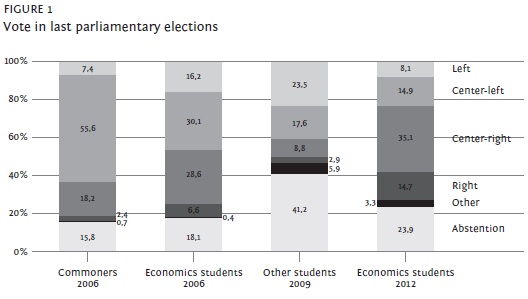
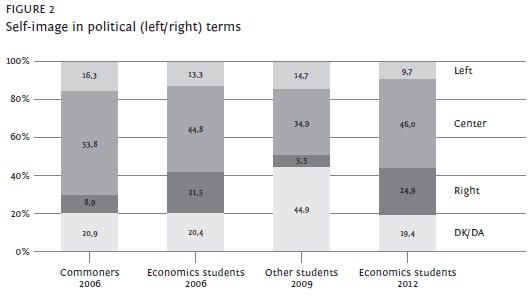
Starting with two political variables, “Vote in last parliamentary elections” and “Self-image in political (left/right) terms” (Figures 1 and 2), we can easily conclude that economics students are more right-wing leaning (to the center-right, PSD4, and right, CDS5, sections of the spectrum of the Portuguese political system), both in actual vote and concerning self-image. Notice that both “economists” and other students have a vote orientation less focused on what we may designate as the “Big Center” (PS+PSD), and indeed considerably more prone to “extreme”, or “radical” options, but whereas “economists” lean to the right, other students lean to the left6 or choose not to respond. Moreover, the right-wing leaning of “economists” has clearly grown from 2006 to 2012, in terms of both vote and self-perception.
]]>
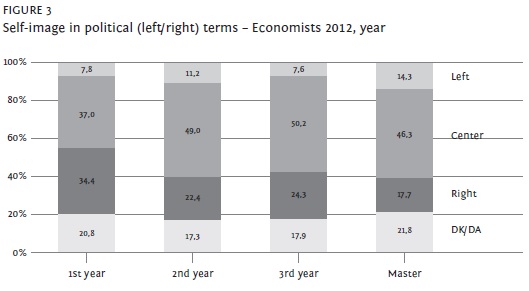
Regarding students’ academic progression, a trend is also identifiable for the diminishing importance of “right” and the growing weight of “center”. This is quite easily detectable comparing first and second years. The “left” exhibits a crescent tendency that disappears in the third year. As to Master students (a very different group regarding life-cycle and professional integration, the decreasing tendency of the “right” and the growing trend for “left” are both confirmed.
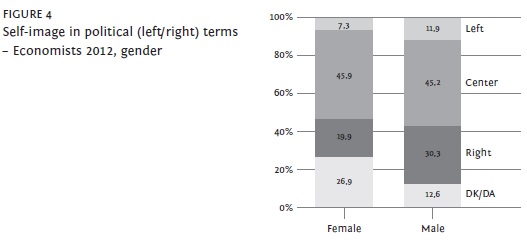
Still concerning political self-perception in left-right terms, another noticeable feature is a gender bias that is detectable within “economists”, with female respondents more inclined to not respond and/or more prone to the center, whereas male respondents are simultaneously more assertive and more “radical”.
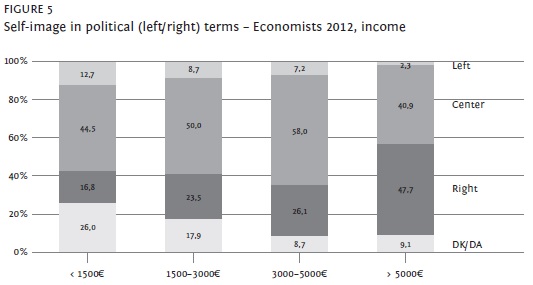
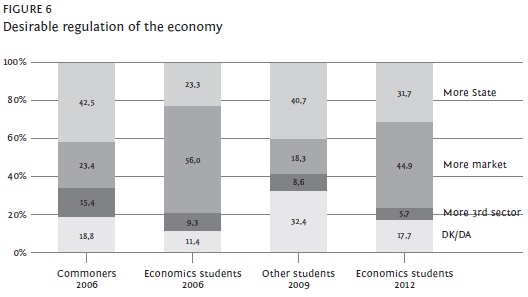
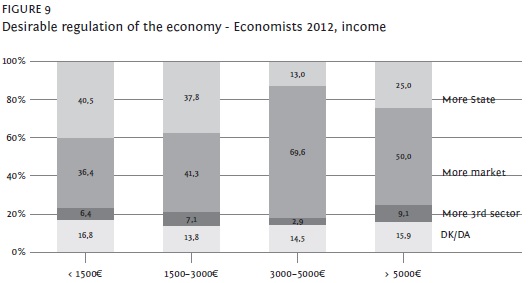
]]> A clear bias is easily perceptible regarding income distribution as well: in lower levels, comparatively higherpropension is seen to decline responding and also to a left perception. Both the center and the right grow proportionately in wealthier segments, with the center having a maximum in 3000-5000 euros band and the right in the group of “more than 5000 euros”. Non-respondents are also considerably less important in wealthier segments: 8-9 per cent, vis-à-vis 18-26 per cent in poorer echelons.The third variable considered in this study is the opinion of respondents concerning the desirable regulation of the economy (Figure 6) and, as we might expect, “economists” are clearly much more pro-market. However, interestingly enough, the other students are much more pro-state and less pro-market; indeed, even less pro-market than commoners (relatively old people). The generic pattern of responses is valid for “economists” in both 2006 and 2012, setting them quite apart from the remaining population: they are comparatively free-marketeer and anti-state, yet still with these characteristics being greatly attenuated in the last inquiry (which ought to be considered in perspective, taking into account the possible effects of the economic crisis, namely including the public bail-out of private banks after 2008). Another important feature is the fact that all groups of students show a markedly lower inclination for third-sector than do commoners.
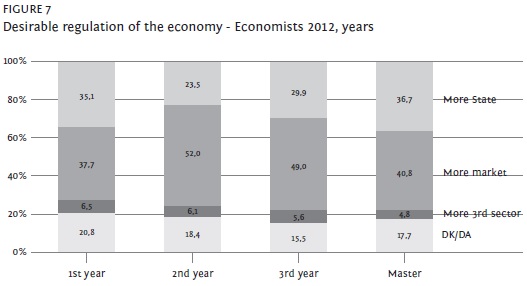
Regarding academic progression, it is worth noting that pro-market and anti-state leanings grow considerably from the first to the second year, this tendency being partially reversed in the third year, and more fully so at the Master level. If taken globally, the Master group shows tendencies rather close to those of first year students, both being closer to commoners and other students. Even so, these comparatively moderate economists are clearly more pro-market and anti-state than the remaining population.
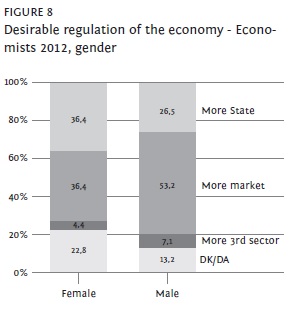
A gender bias is equally perceptible within “economists”, with male respondents much more pro-market than women. As a matter of fact, these are simultaneously more pro-state and also more inclined to avoid answering. Men, however, lean more to reliance on the third sector.
An important bias is also easily detectable regarding income distribution. From the first to the third level of income a steady growth of pro-market inclinations is apparent, in parallel with diminishing pro-state attitudes. Also, the third sector suffers a decline. These tendencies are, however, contradicted in the level of higher income, with both pro-state and pro-third sector showing strong recoveries: more than fully for the third sector, only partially regarding the state.
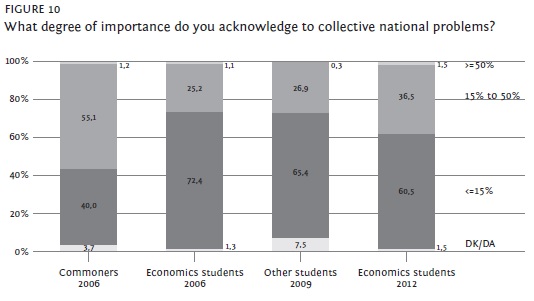
Concerning the importance acknowledged to collective national problems, the single most important trait to be highlighted is the fact that all categories of students routinely tend to recognize a lesser importance to those than what is admitted by commoners. This is very likely an element to be considered in close relationship with an age-bias: young people simply tend to have a more carefree attitude vis-à-vis national problems. There are no significant differences to be noticed between economist and other students, except for the fact that the economists queried in 2012, with a large segment of older (Master) students, display an intermediate pattern.
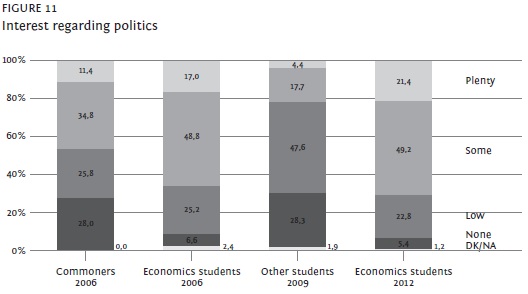
In a clear-cut difference with the patterns identified for the previous question, if we consider now the interest regarding politics, the most important trait to be noticed is the fact that, whereas other students declare an average interest that is considerably below the level of commoners, economists in their turn reveal a comparatively high percentage of those answering “plenty” or “some”. These categories total 65.8 per cent in 2006, further growing to 70.6 per cent in 2012, as opposed to 46.2 for commoners and 22.1 for other students. In the opposite extreme, those answering “none” drop from values close to 28 per cent referring to commoners and other students, to roughly 6 per cent for economists in both years. This trend of answers by economics students has a clear contrast, and is worth being emphasized, with the importance recognized for national problems (previous question, Figure 10). There may be a widespread, strictly utilitarian interest in politics among economists, seen in a greater-than-average appetite for politics that does not match any possible genuine concern for the respublica. Instead, such an appetite likely stems from a more or less subliminal notion of being more-than-average gifted for political positions coupled with a belief that economists may be more likely to benefit personally from political decisions and positions (see also comments on Figure 15). This high inclination by economists to political life ought to be considered in close connection with a tendency of political agents to increasingly reproduce mental devices and rhetorical resources originally from the realm of economics, and with a possible cumulative circular causation: as politics are “colonized” by an economics-inspired variety of modus operandi, the more economists understandably find politics attractive, and reciprocally their abundance in political circles tends to further induce the ways of thinking and the ways of doing into models drawn from economics.
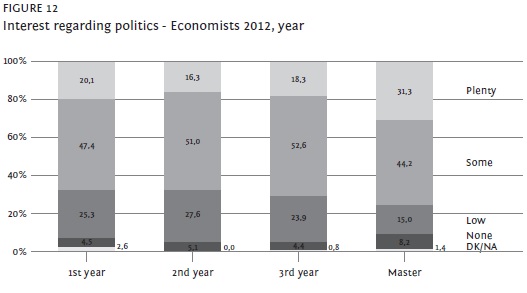
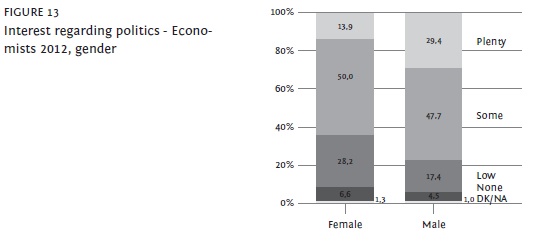
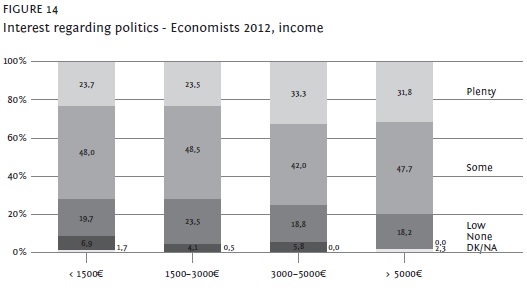
It is important to note that the interest in politics grows throughout the educational process, slowly during undergraduate studies, more clearly during the Master: the aggregate of “plenty” and “some” is close to 67 per cent in the first two years, 71 in the third year, almost 76 in Master students.
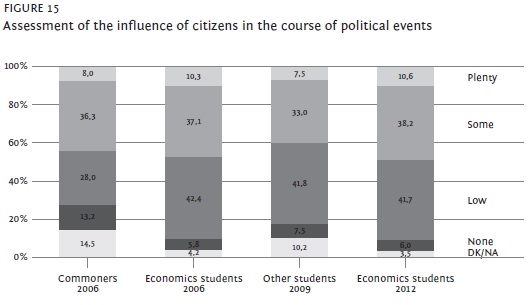
]]> This variable also has a clear gender bias, and an income bias as well. Male-respondents produce 77 per cent of answers corresponding to “plenty” and/or “some”, whereas the total of these categories is close to 64 for women. Regarding income, the aggregate of “plenty” and “some” is close to 72 per cent in the two groups below 3000 euros, growing to roughly 75 per cent in the 3000-5000 euros echelon, and close to 80 per cent in the levels above 5000 euros.Answers to the question “What is the real influence of Portuguese citizens in the course of political events in Portugal?” also reveal interesting patterns, with the aggregate of “plenty” and “some” categories going from 40.5 in other students and 44.3 per cent in commoners to 47.4 in 2006 economists and 48.8 in 2012 economists. This variable ought to be confronted with the importance acknowledged regarding collective national problems (Figure 10) and the interest in politics (Figure 11). Economists have no greater-than-average interest in national problems, but they exhibit a higher interest in politics perhaps due to the fact that they have utilitarian motives for that, among other things because they very probably believe themselves to be more qualified than common citizens, and also that they can influence the course of events.
The next variable indicates a possible strong age effect: students, mostly young people, on average claim to generally “expect the worst” rather less than do commoners. Indeed, this last group, mostly composed of aged people, overwhelmingly declares to expect the worst: 80 per cent, against values between 50 and 60 per cent for all students. Another important element is the fact that economists are considerably more prone to trust than all of the other groups: 19.7 per cent for commoners and 23.3 per cent for other students, against values close to 31 per cent for economists in both years. It is important to note that this evidence may be prima facie interpreted as contrary to the self-interest model of indoctrination implicit in mainstream economics, but we should also consider with more detail the real meaning referred to by respondents to “trust”, which very likely comes mostly associated with feelings and notions stemming out of self-reliance. Economists may well be considered to be less of a trust-prone group, rather more inclined to self-reliance, indeed considerably more self-reliant than other students: see Figure 16. This interpretation seems fully consistent, for instance, with the assessment of a greater influence of citizens over the course of political events, as noted above (see Figure 15).
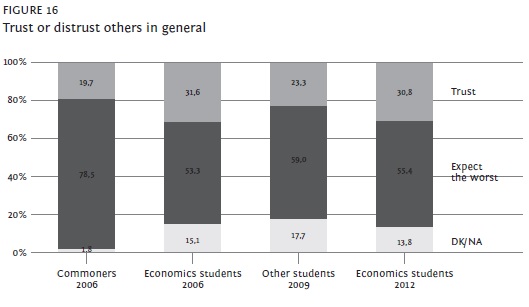
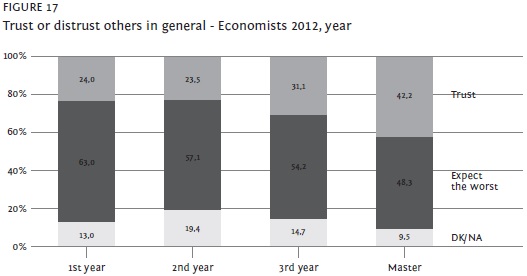
The tendency to declare trusting others increases with the educational process, with “expect the worst” falling steadily from 63 to roughly 48 per cent, whereas “trust” grows from 24 per cent to 42.2 per cent. There are, however, no perceptible biases regarding either gender or income levels.
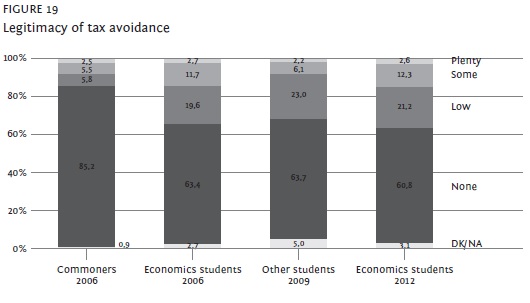
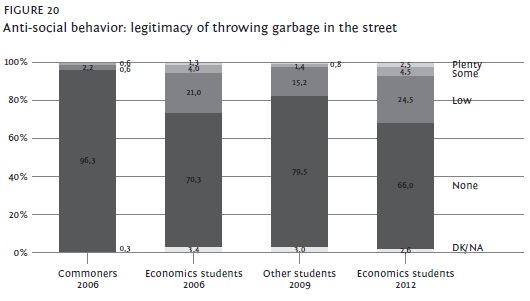
There is also strong empirical evidence of more selfish behavior by economics students, which is consistent with most earlier literature. In fact, responses are more supportive of the legitimacy of: free-riding in social benefits (Figure 18), tax avoidance (Figure 19), and throwing garbage in the street (Figure 20).
]]>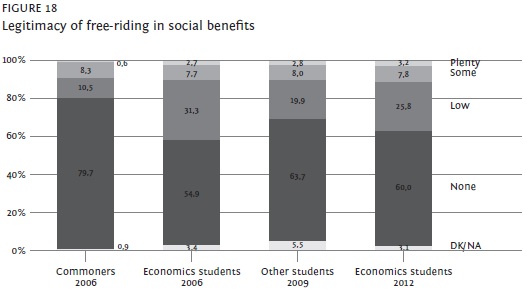
Regarding the legitimacy recognized for free-riding in social benefits, economists are clearly more indulgent than other categories: the aggregate values of “plenty”, “some” and “low” are 41.7 per cent and 36.8 per cent in 2006 and 2012 economists, respectively, to be compared with 19.4 for commoners and 30.7 per cent for other students. Besides the factor associated with studying economics, an age element is probably present in this case, inducing other students to occupy an intermediate position.
Concerning the legitimacy acknowledged for tax avoidance, economists exhibit a pattern that clearly sets them aside from everybody else. Whereas commoners have an aggregate of 8 per cent for “plenty” and “some” legitimacy, and other students score 8.3 per cent for the same categories, economists respond with 14.4 and 14.9 per cent, in 2006 and 2012, respectively. In this case, therefore, the divisive factor of studying economics seems to emerge even more strongly than in the previous question.
As to the alleged legitimacy of throwing garbage in the street, again economists form a different cluster, aggregate values of “plenty”, “some” and “low” producing 26.3 per cent in 2006 respondents, growing further to 31.5 per cent in 2012. Commoners, in a strong contrast, score only 3.4 per cent, whereas other students occupy an intermediate position, with 17.4 per cent. Attributing this intermediate position of other students to an age factor seems problematic, however, given the fact that 2012 economists include (Master) older students, and are nevertheless even more tolerant vis-à-vis an obviously anti-social behavior.
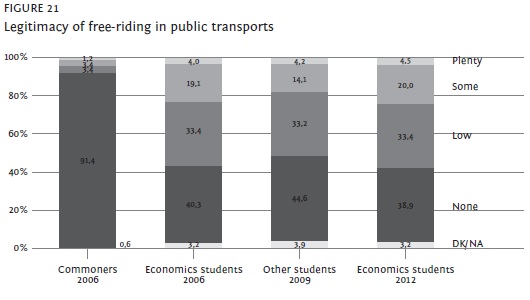
]]> The last variable is again a good indicator that age is probably, but not surely, an important element that may in some cases eclipse the presumable indoctrination effects of studying economics. Indeed, a significant portion of both economics students and other students recognize some legitimacy to free-riding in public transports, probably a typically defiant attitude of youth, more than a strictly selfish or anti-social behavior. However, partially contradicting that trend, older 2012 economists are even more free-riding inclined than those of 2006: aggregate values of “plenty”, “some” and “low” legitimacy are 8 per cent for commoners, with other students scoring 51.5 per cent, much closer to economists, who in 2006 score 56.5 per cent. Still, on average, older 2012 economists are even more tolerant, with 57.9 per cent (Figure 21).
It should be noted that in the above analysis in this section the survey data are treated essentially by appealing to univariate methods, with the purpose of highlighting the main differences among the various groups. We have chosen this strategy primarily because the groups are well defined from the start,i.e. economists versus non-economists (students of other disciplines and “commoners”), and thus need not be searched or constructed by appealing to multivariate methods (discriminant function and cluster analysis). All the variables are intrinsically interesting, and the frequency (count) tables presented and commented on are likely enough to capture the main characteristics and peculiarities of each group, without introducing the unnecessary complexity of sophisticated multivariate techniques, namely principal components and factor analysis. Sometimes, and we assume this to be the case, multivariate analysis may result in a less clear understanding of the data, precisely because of containing several layers to examine (see Harlow, p. 7) and therefore the group differences are more easily interpreted in a univariate sense. This is not meant to dispute the intrinsic validity of multivariate analysis, of which an elementary form was, indeed, used by us in the case of the “economics students – 2012” group, with a number of cross-tabulations aimed at uncovering gender and income effects, as well as the effect of the number of frequency-years in economics studies, in order to provide an easy test of the “indoctrination versus self-selection” hypothesis. All in all, it is worth mentioning, however, that the descriptive results of this paper could and should be complemented with more sophisticated econometric techniques (least squares multiple regression and structural equation modelling), a task we intend to perform in future research.
CONCLUSIONS
The main purpose of this paper was to contribute to the extensive literature on the possible indoctrinating effects of economics teaching. These indoctrinating effects are conceptualized here as a crucial element within the global process of the social building of trust and are thus processed based on empirical evidence collected from a survey on trust-building in Portugal.
Eleven variables were used in order to assess social and political behavior of four samples with particular characteristics and queried at different moments: 376 initial economics students, 312 commoners, mostly elderly, 361 students of other disciplines, and 650 additional economics students. Some of these variables refer to more than one figure, depending on the existence of a clear bias in answers regarding gender, year in the education process, and levels of income, or the lack of such bias.
]]> This enquiry allows the conclusion that economics students are in political terms generally more right-wing leaning, in both actual vote and self-image, and have a more pro-market set of beliefs, as expected. In these cases we probably also face the existence of an age-factor inducing less “center” inclination among youth, along with greater importance of both political “extremes”. However, economics apparently propitiates the right-wing in political orientations, whereas other academic courses correspond to a greater weight of left-wing political choices. Economics also induces a clear pro-market attitude, as opposed to what happens with strongly pro-statist “other students”.Other variables were subsequently considered, namely the importance acknowledged to collective national problems, the interest in politics, and also the perceived influence of citizens in political events. Broadly speaking, economics students show no more interest in public affairs than other citizens, and yet they consistently tend to perceive the existence of a considerable influence of citizens over the course of politics, which most probably contributes to a greater-than-average interest in politics by these students. This is a trend very likely correlated with the growing prevalence in political discourse of mental dispositions and rhetorical devices that are originally from economics, and is possibly also accompanied by a markedly utilitarian approach by economists to this subject matter. If confirmed, these patterns may also be something worth examining with more attention, namely regarding the prevalence of strictly utilitarian attitudes and indeed the possibility of crescent inclination toward free-riding among political agents.
Economics students are also clearly more inclined than average people to declare having trust in others in general, which is an aspect to be considered potentially in contradiction with the self-interest model of indoctrination by mainstream economics. At the same time, though, they tend to have a clearly more selfish behavior in strictly free-riding problems (abusive claim of social benefits, tax avoidance, throwing garbage in the streets, free-riding on public transportation), which is essentially consistent with most of the findings reported in the literature. This fact suggests that the “confident” attitude of economists is mostly an expression of self-reliance: the kind of belief in the virtues of self-help that young age propitiates and that economics tends to reinforce.
Indeed, in some of the cases we are probably facing the dominance of an age factor, as opposed to strict indoctrination effects, namely concerning the generalized morally conservative and pessimistic attitudes prevailing among the elderly (“expect the worst” rather than trusting in others and “avoid breaking the rules”), versus a “radical”, risk-loving behavior among youth (trust in others “whatever may come”, and admit free-riding on public transportation: “we will manage to get away with it”). Therefore, it is imperative to recognize that inclination for free-riding and risk-love are entangled in most of these questions, producing a quite peculiar blend. Note especially the fact that other students routinely occupy an intermediate position between common citizens and economics students in the cases of items regarding measurement of declared trust in others and proclivity for free-riding.
Opposed to that, however, in the cases of more directly political issues, other students diverge from common citizens in the opposite direction of the economists’ path: they are more oriented toward the left-wing and coherently lean to greater state-intervention in the economy, but significantly they also have less interest in politics than even the commoners do. This seems to confirm the tendency for political life to increasingly mimic the mental devices and rhetorical resources of economics, which may be even further reinforced by the fact that in many of these items the upper income strata, male as opposed to female-respondents, and also senior students as opposed to freshmen, apparently feel both more at ease with and more inclined to political matters.
Finally, it is important to be conscious of the limitations of studies such as ours. First is the difficulty of in-depth testing of the “self-selection” versus “indoctrination” hypotheses (self-selection assuming “natural-born-economists”, indoctrination the idea that “economists are made”), or in other terms, of continuing with the classic discussion of the issue of “nature-versus-nurture”. In order to check this we used the method of comparing results in successive years of the education process, with trends clearly identifiable regarding certain items, but not in most cases. Second, the usual problems of survey results are present: do people mean what they say? Do people do what they mean?
It was partly in order to overcome these limitations that we extended our initial research, producing the 2012 version of the enquiry. Regardless of many reasonable doubts possibly still remaining, one aspect unquestionably stands out as clear: the remarkable coherence revealed by the economists’ pattern of answers. Globally considered, the economics students form a well-defined cluster, easily distinguishable from all other respondents. Furthermore, separating 2012 from 2006 we have witnessed the effects of the economic crisis, with severe repercussions on many features of Portuguese society. In most cases, however, this crisis seems to have further reinforced the economists’ group of idiosyncrasies, rather than lessened them.
REFERENCES
]]>
BAUMAN, Y., ROSE, E. (2011), “Selection or indoctrination: why do economics students donate less than the rest?”. Journal of Economic Behavior and Organization, 79, pp. 318-327. [ Links ]
BAIL, R., LABAND, D. (1996), “The American Economic Association Dues Structure”. Journal of Economic Perspectives, 10 (4), pp. 179-186. [ Links ]
CAPPELEN, A., SØRENSEN, E., TUNGODDDEN, B. (2010), “Responsibility for what? Fairness and individual responsibility”. European Economic Review, 54, pp. 429-441. [ Links ]
CAPLAN, B. (2002), “Systematically biased beliefs about economics: robust evidence ofjudgemental anomalies from the survey of Americans and economists on the economy”. Economic Journal, 112, pp. 433-458. [ Links ]
CARTER, J., IRONS, M. (1991), “Are economists different, and if so, why?”. Journal of Economic Perspectives, 5, pp. 171-177. [ Links ]
]]>CIPRIANI, P., LUBIAN, D., ZAGO, A. (2009), “Natural born economists?”. Journal of EconomicPsycology, 30, pp. 455-468. [ Links ]
COLANDER, D., et al. (2009), “The financial crisis and the systemic failure of the economics profession”. Critical Review, 21, pp. 240-267. [ Links ]
FARAVELLI, M., (2007), “How context matters: a survey based experiment on distributive justice”. Journal of Public Economics, 91 (7-8), pp. 1399-1422. [ Links ]
FRANK, B., SCHULTZE, G. (2000), “Does economics make citizens corrupt?”. Journal of Economic Behavior and Organization, 43, pp. 101-113. [ Links ]
FRANK, R., GILOVICH, T., REGAN, D. (1993), “Does studying economics inhibit cooperation?”. Journal of Economic Perspectives, 7, pp. 159-171. [ Links ]
]]>FRANK, R., GILOVICH, T., REGAN, D. (1996), “Do economists make bad citizens?”. Journal of Economic Perspectives, 10, pp. 187-192. [ Links ]
FREY, B. (1986), “Economistsfavour the price system – who else does?”. Kyklos, 39, pp. 537-563. [ Links ]
FREY, B., POMMEREHNE, W., GYGI, B. (1993), “Economics indoctrination or selection? some empirical results”. Journal of Economic Education, 24, pp. 271-281. [ Links ]
FREY, B., MEIER, S. (2003), “Are political economists selfish and indoctrinated? Evidence from a natural experiment”.Economic Inquiry,41, pp. 448-462. [ Links ]
FREY, B., MEIER, S. (2004), “Pro-social behavior in a natural setting”. Journal of Economic Behavior and Organization, 54, pp. 65-88. [ Links ]
]]>FREY, B., MEIER, S. (2005), “Selfish and indoctrinated economists?”. European Journal of Law and Economics, 19, pp. 165-171. [ Links ]
GANDAL, N., et al. (2005), “Personal value priorities of economists”.HumanRelations, 58, pp. 1227-1252. [ Links ]
GRAÇA, J.C. (2012), “Acerca da instabilidade da condição da sociologia económica”. Análise Social, 202, XLVII (1.º), pp. 4-27. [ Links ]
HARLOW, L. (2014), The Essence of Multivariate Thinking: Basic Themes and Methods, 2nd edition, New York and London, Routledge. [ Links ]
HAUCAP, J., JUST, T. (2004), “Not guilty? Another look at the nature and nurture of economics students”. European Journal of Law and Economics, 29, pp. 239-254. [ Links ]
]]>HELLMICH, S. (2012), “State of the art: are economists selfish and rational? And if so, why?”. Working Paper No 4,Universität Bielefeld,FakultätfürSoziologie,Didaktik derSozialwissenschaften. [ Links ]
HODGSON, G.M. (2004), “Opportunism is not the only reason why firms exist: why an explanatory emphasis on opportunism may mislead management strategy”. Industrial and Corporate Change, 13 (2), pp. 401-418. [ Links ]
HOLE, A. (2013), “How do economists differ from others in distributive situations?”. Nordic Journal of Political Economy, 38 (4), pp. 1-30. [ Links ]
KAHNEMAN, D., KNETSCH, J., THALER, R. (1986), “Fairness and the assumptions of economics”. Journal of Business, 59, pp. S286-S300. [ Links ]
KEARL, J., et al. (1979), “A confusion of economists?”. American Economic Review, 69, pp. 29-37. [ Links ]
]]>KIRCHGÄSSNER, G. (2005), “(Why) Are economists different?”. European Journal of Political Economy, 21, pp. 543-562. [ Links ]
KIRCHGÄSSNER, G. (2014), “On self-interest and greed”. Discussion Paper n.º 2014-16, School of Economics and Political Science, University of St.Gallen. [ Links ]
KIRMAN, A. (2010), “The economic crisis is a crisis for economic theory”.CESifo Economic Studies, 56, pp. 498-535. [ Links ]
KONOW, J. (2014), “Can economic ethics be taught?”. Discussion Paper, August 2014, University of Kiel. [ Links ]
LABAND, D., BAIL, R.O. (1999), “Are economists more selfish than other ‘social’ scientists?”. Public Choice, 100, pp. 85-101. [ Links ]
]]>LANTERI, A. (2008), “(Why) do selfish people self-select in Economics?”. Erasmus Journal for Philosophy and Economics, 1 (1), pp. 1-23. [ Links ]
LAWSON, T. (2009), “The current economic crisis: its nature and the course of academic Economics”. Cambridge Journal of Economics, 33, pp. 759-777. [ Links ]
LAZEAR, E. (2000), “Economic imperialism”. Quarterly Journal of Economics, 115, pp. 99-146. [ Links ]
LI, C., WANG, J. (2013), “The Influence of greed and fear onfunds performance”. International Journal of Business and Finance Research, 7, pp. 47-59. [ Links ]
MCDONALD, I. (2009), “The global financial crisis andbehavioural economics”.EconomicPapers, 28, pp. 149-154. [ Links ]
]]>MARQUES, R. (2003), “Introdução, os trilhos da nova sociologia económica”. In R. Marquesand J. Peixoto (orgs.), A Nova Sociologia Económica, Oeiras, Celta Editora, pp. 1-67. [ Links ]
MARWELL, G., AMES, R. (1981), “Economists free ride, does anyone else?: Experiments on the provision of public goods, IV”. Journal of Public Economics, 15, pp. 295-310. [ Links ]
MEYER, S., FREY, B. (2004), “Do business students make good citizens?”. International Journal of the Economics of Business, 11, pp. 141-163. [ Links ]
NIJHAWAN, I., ELLIS, R. (2003), “The economic attitudes and values of young Americans: a case study of future business leaders of America”. Journal for Economics and Economic Education Research, 4, pp. 11-21. [ Links ]
RUBINSTEIN, A. (2006), “A sceptic’s comment on the study of economics”.The Economic Journal, 116, pp. C1-C9. [ Links ]
]]>SCOTT, J., ROTHMAN, M. (1975), “The effect of an introductory economics course on student political attitudes”. Journal of Economic Education, 6, pp. 107-112. [ Links ]
SELTEN, R., OCKENFELS, A. (1998), “An experimental solidarity game”. Journal of Economic Behavior & Organization, 34, pp. 517-539. [ Links ]
SIMON, H. (1993), “Altruism and economics”. American Economic Review, 83, pp. 156-161. [ Links ]
STIGLER, G. (1959), “The politics of political economists”. Quarterly Journal of Economics, 73, pp. 522-532. [ Links ]
STIGLER, G. (1984), “Economics – the imperial science?”. Scandinavian Journal of Economics, 86, pp. 301-313. [ Links ]
]]>WANG, L., MALHOTRA, D., MURNIGHAN, J.K. (2011),“Economics education and greed”.Academy of Management Learning & Education, 10, pp. 643-660. [ Links ]
WILLIAMSON, O.E. (1975), Markets and Hierarchies: Analysis and Anti-trust Implications: a Study in the Economics of Internal Organization, New York, Free Press. [ Links ]
YEZER, A., GOLDFARB, R., POPEN, P. (1996), “Does studying economics discourage cooperation? Watch what we do, not what we say or how we play”. Journal of Economic Perspectives, 10, pp. 117-186. [ Links ]
Received 06-02-2015. Accepted for publication 23-10-2015.
NOTES
]]> 1 The financial support of Fundação para a Ciência e a Tecnologia (FCT), Portugal, within the ambit of Project PEST-OE/SADG/UI0428/2013, is gratefully acknowledged.2There is a vast number of contributions available proceeding to the discussion of this subject-matter in officially sociological terms, namely concerning the debates within the ambit of the so-called “New Economic Sociology”, but for the purpose of this article we deem it unnecessary to go further into the discussion of that cluster of issues (for further information, see Marques 2003,Graça 2012). Suffice it to mention that although strict “trust in others” is directly addressed only in a small number of queries, trust is indeed the overall background that supported the entirety of the original questionnaire.
3The two former groups were those corresponding to the survey on the ‘Social Building of Trust in Portugal’. Questionnaires were directed to ISEG students mostly out of practical convenience, given the fact that SOCIUS, the research-center promoting the survey, belongs to this same school. Non-economists were initially addressed in two parishes, one being rural (Vila Verde dos Francos, Alenquer), according to a usual demographic criterion, and another one urban (Sé, Lisbon). Naturally, this group corresponds to a pool much different from students in terms of age, but in the parish ofSé the population addressed was especially aged, not so much the same as in the case of Vila Verde dos Francos. Globally considered, “civilians” were still somewhat older than the average of the Portuguese population. “Other students” in 2009 studied in the Architecture School of the University of Lisbon, in the Music High School, and/or in the High School of Health Technologies (both pertaining to Lisbon’s Polytechnic Institute). In 2012 the questionnaire was again directed to ISEG students, still partly out of practical convenience, given the continued support of SOCIUS, but also according to a ceteris paribus principle, aiming at checking the effects of the economic crisis that in the meantime had arisen.
4Partido Social Democrata, Social Democrat Party, which is a relatively “conservative” or free-marketeering party, despite the name.
5 Centro Democrático Social, Social and Democratic Center, a clearly “conservative” party.
6The political left is here defined as corresponding to Coligação Democrática Unitária (CDU), a coalition having the Portuguese Communist Party (PCP) as its most important member, and Bloco de Esquerda, Left Block, stemming from the merger of a number of far left parties. The Socialist Party is taken in this paper as corresponding to center-left.
]]>