Gone with the crisis? A multilevel analysis of economy, welfare, and national identity in Europe
Desaparecido com a crise? Uma análise estratificada da economia, segurança social e identidade nacional na Europa
Antonia María Ruiz Jiménez*, José M. Echavarren**, Nieves Aquino Llinares**
*Department of Sociology, Universidad Pablo de Olavide de Sevilla. Carretera de Utrera, km 1 - 41013 Sevilla, España. amruiz@upo.es.
**Department of Sociology, Universidad Pablo de Olavide de Sevilla. Carretera de Utrera, km 1 - 41013 Sevilla, España. jmechavarren@upo.es.
*** Department of Economy, Quantitative Methods and Economic History, Universidad Pablo de Olavide de Sevilla. Carretera de Utrera, km 1 - 41013 Sevilla, España. naqulli@upo.es
ABSTRACT
Gone with the Crisis? A multilevel analysis of economy, welfare, and national identity in Europe. The development of the modern welfare state has been accompanied by an extension of economic, political, and social rights that created a sense of group belonging that then led to national solidarity. Our results show that the impact of the Great Recession cannot be rejected, and therefore that there is a rational-instrumental dimension to national identities that should not however be taken independently of cultural and political dimensions, and that must also be understood from a sociological point of view.
]]> Keywords: National identity; welfare nationalism; welfare chauvinism; economic crisis; Europe; multilevel logistic regression.
RESUMO
Desaparecido com a crise? Uma análise estratificada da economia, segurança social e identidade nacional na Europa. O desenvolvimento do estado social moderno tem sido acompanhado por um alargamento dos direitos económicos, políticos e sociais que gera um sentido de pertença grupal conducente à solidariedade nacional. Centramo-nos nesta hipótese de identidade instrumental relacionada com o bem-estar, tendo em conta o possível impacto da crise económica nas identidades nacionais. Os nossos resultados mostram que o impacto da Grande Recessão não pode ser rejeitado e que, consequentemente, existe uma dimensão racional-instrumental nas identidades nacionais que não deve, ainda assim, ser considerada isoladamente das dimensões culturais e políticas, e que necessitam também de ser consideradas sob um ponto de vista sociológico.
Palavras-chave: identidade nacional; nacionalismo socio-securitário; chauvinismo socio-securitário; Europa; regressão logística estratificada.
Introduction
Several authors have suggested that the development of the modern welfare state after WWII was accompanied by an extension of economic, political and social rights that created a sense of group belonging and eventually led to the development of national solidarity among citizens (Keating, 2001, p. 51; McEwen, 2006, p. 51; Brown, 1998, p. 13; Shulman, 2003, p. 24). However, there is not much evidence regarding whether and to what extent economic crisis and welfare erosion affect attachment to the nation. In fact, it remains true that the literature on nationalism is weak in terms of testing hypotheses against empirical evidence, and the economic and crisis hypothesis thus remains largely untested (Solt, 2011, p. 823) in spite of its political importance.
David and Bar-Tal (2009, pp. 361-367) note that feelings of belonging and closeness are central for triggering and fostering social and political activities. A variety of authors have emphasized how the feeling of attachment or belonging to a national group (national identity) lend political communities diffuse support that has been considered central for the political stability and continuity of states (Easton, 1965, p. 187; Henderson & McEwen, 2005, p. 188; Linz & Stepan, 1996, pp. 7, 21). Moreover, empirical studies have shown that those citizens who are highly attached to their nations are more politically involved than those who are not (Huddy & Khatib, 2007, pp. 72-73; Straughn & Andriot, 2011, pp. 563, 571). There is further evidence that national attachment is even more vital for democratic states (Elkins & Sides, 2007, p. 694). That is, the existence of clusters of detachment and disloyalty may lead from distortions on political participation and representation, to the violent rejection of the state - particularly in multi-ethnic societies (Kymlicka, 1996, p. 105).[1] As Linz and Stepan (1996, p. 27) point out, democracies need to build compliance with the state through national identity because they cannot use fear and violence to force acceptance, as authoritarian states would do; they suggest that democratization depends on national unity insofar as constituent groups need to agree on the need and desirability of the collective before opening the arena to groups’ competition.
The remainder of this article is organized as follows. First we present a review on the definition of national identity as a collective identity. Then we move on to the discussion of welfare nationalism (and welfare chauvinism) from which we derive our main hypotheses. After that, we discuss some alternative explanations that are also included in our empirical models. Next, we operationalize those different theories using a number of variables at the individual and country levels, and explain the method we followed to test our hypotheses. An added valued of the article is precisely this operationalization of country-level variables derived from different streams of nationalist literature. The economic crisis actually has a country-level dimension that is not captured by the ISSP questionnaire used for our analysis. We then present the results of both our partial and final models. The article closes with a discussion of those results and their implications and our conclusion.
]]> DEFINING NATIONAL IDENTITYIn this article national identity is understood as a social identity (David & Bar-Tal, 2009, p. 356). It is hereby defined as the individual feeling of belonging and attachment to a group of people with whom one believes to have something in common: a state of mind or an act of consciousness as understood by Kohn (1945, p. 10). Although a sense of belonging or attachment usually refers to an objective territory, such as the country or region, the process of identification itself is a subjective and relational process.
We acknowledge the complex nature of national identity. In the first place, due to its twofold dimension: one, as the strength of (territorial) attachment; and, second, as the meaning of such attachment (McEwen, 2006, p. 30); in the second place, due to its relational component and its possible compatibility or incompatibility with other territorial identities (Hadler et al., 2012, pp. 395-397); and, in third place, due to its dynamic nature (Westle & Segatti, 2016, p. 20). However, our analysis here is limited regarding the dimensions of national identity that it can take into account. That is, we will pay attention only to the strength of (territorial) attachment, in just one territorial level (the country, taken as representing the nation-state), and just one moment in time (2013). Further developments of this research will attempt more complex approximation to this matter.
As pointed out by Huddy (2013, p. 746) group behavior is heavily dependent on gradation in identity strength, which therefore needs to be well measured. The strength of attachment has been measured in many different ways. Among the most well known and used is the Linz bi-polar scale (also known as Moreno, or Moreno-Linz scale), although it has been recently questioned if it can really measure strength of attachment (Cussó, García, and Grande, 2018; Guinjoan and Rodon, 2016; Ruiz Jiménez, 2007). Alternatively asking citizens about the extent to which they feel close to different territorial units taking the country as representing the nation-state is quite popular. Despite being unidimensional, this type of Bogardus scale of social distance allows measuring the strength of (territorial) attachment to the country and does not impose any type of assumption on the respondent regarding his/her national identities (Ruiz Jiménez, 2007, pp. 167, 174). Closeness is also well suited to measure the strength of (territorial) attachment because it can reflect the two-fold dimension of social identity: place identity and place attachment (Hadler, Tsutsui, & Chin, 2012, pp. 401-402). Furthermore, it has been extensively used by researchers of territorial identity (for a review of different questions’ wording see Irsenia, Fikey, Serricchio, & Westle, 2012, pp. 115-118; and Ruiz Jiménez, 2007).
Although the meaning attributed by citizens to national identity is not an object of analysis, a brief summary is presented here, if only to be certain what our article is not about (it will also be useful for the understanding of some of the alternative explanations presented below). A traditional distinction has been established between ethnic and civic understandings of the nation (Maiz, 2003, pp. 259-261; Wright, 2011, p. 838; Smith 2010, pp. 42-46). Items such as common ancestry, language, religion, culture, etc. would belong to the ethnic-cultural understanding of identity, while things such as common legal system, constitution, rule of law, etc., are said to be of a civic nature. However, some of these items would not clearly fall within the civic or the ethnic categories or would be mixed within the conception of a single identity, both theoretically and empirically (McEwen, 2006, pp. 28-29). Therefore some alternatives distinguish between ascribed and achieved identities (Wright, 2011, p. 839). While ascribed identities are assigned upon birth (having citizen parents, country of birth, etc.), achieved identities can be reached over time (speaking the language or sharing cultural traditions, for example).
The strength and meaning of national identity are complementary to each other, so, for example, someone can hold a strong cultural identity or a weak cultural identity, as well as strong or weak civic national identity.
NATIONAL IDENTITY AND THE ECONOMY: WELFARE NATIONALISM AND WELFARE CHOUVINISM
General theories on national identity formation do not pay much attention to the role of the economy. To be sure, none of the classifications mentioned above is explicit about how or where to classify those people who feel attached to their country because they are doing well, or perceive their country to be doing well, in economic terms. Some hints, pointing toward a rational-instrumental understanding of social identity formation can be found within political psychology, which stresses that identities include cognitive as well as symbolic comparison of in-groups and out-groups. Within these theories, both the Theory of Realistic Interest and the Social Identity Theory will be relevant to understand the impact of economy on identity. As Shayo (2009, pp. 150-151)explains, people will adopt particular national identities when such identity improves the perception about their position in society vis-à-vis other social identities. Economy will play, to be sure, an important role in the formation of such perceptions.[2]
Apart from that, welfare nationalism is among the most important theories linking economy and national identity. It can be defined as the “discourses and ideologies in which welfare and national identity are intertwined and welfare provision is based on national membership” (Keskinen, 2016, p. 355). As Keskinen et al. (2016, p. 323) argue, “economic issues and welfare benefits are closely connected to questions of culture and national identity”. Thus, several authors have pointed out that the self-portrayal of modern states (mainly democracies) as agents of equitable development has been the most important way in which countries have fostered national identities as a legitimatory ideology after WWII (Brown, 1998, p. 2). This same idea is present in the writings of Deutsch (1964) when he argues that by creating good living conditions, government creates attachment with the state. He furthermore asserts that not only maintaining well-being is necessary but also is assuring wide distribution of benefits throughout the population (Deutsch, 1964, p. 143). In this same line, McEwen (2006, p. 51) claims that the transformation of nation-states into welfare states has been among the most significant processes across advanced capitalist democracies, a change by which states have secured the consent of national minorities and accommodate their territorial identities within the framework of the nation-state (see also Brown, 1998, p. 13; Shulman, 2003, p. 24).[3]
If good economic performance of the state, redistribution, and more generally speaking the growth of welfare have strengthened the state as a political community of solidarity, what are the effects of the Great Recession and the retrenchment of the welfare state? Our article examines this question within the realm of the effects on the strength of (territorial) attachment. When reviewing previous research, however, we find that many works are theoretical, while among those that are empirical many focus on just political elites, and only a few are clearly centered on lay people. Focusing on citizens’ feelings, Deutsch (1964, p. 146) suggests that economic crisis or inequality may affect the strength of (territorial) attachment. He defends that social conflict and disintegrative tendencies emerge where the (re)distribution of wealth is too skewed. From a psychological point of view, Brown (1998, pp. 10-11) suggests changes on the meaning of identity, although it is not clear if such changes would lead to a stronger or weaker sense of (territorial) attachment. He points out that the existence of inequalities can be interpreted as the absence or incompleteness of nationhood. Usually, in the context of crisis, this implies the redefinition of the understandings of insiders and outsiders, favoring more restrictive interpretations of membership (Brubaker, 2011, pp. 94-95). In other words, inequality creates insecurity, and that leads individuals to closure and to be less tolerant toward minority groups within the state (Andersen & Fetner, 2008, pp. 10-11), thus rejecting the idea of the social justice community. We do not know, however, if these authors understand that a more restrictive interpretation of national identity means stronger or weaker (territorial) attachment.
]]> From a different perspective, the literature on welfare chauvinism points in the same direction, regarding the consequences of economic crisis on the understanding of national identity[4] Welfare chauvinism is the claim that welfare benefits should be reserved for those belonging to the “native” population, drawing a clear distinction between “us” and “them”, linked not only to immigration but also to those “deemed to be undeserving in the revised normative logic of welfare provision” (Keskinen, 2016, p. 326; see also Norocel, 2016, p. 373). Although not directly targeted, the idea of welfare chauvinism points to an effect of the Great Recession on the meaning of identity, as suggested also by Brubaker (2011, pp. 94-95) and Andersen and Fetner (2008, pp. 10-11).In summary, following the theory of welfare nationalism, which for us speaks more clearly about the strength of national identity, we could expect that the Great Recession has led to a weaker sense of (territorial) attachment. However, it is not completely evident for us what the welfare chauvinism’s reflection on the strength of national identity would be. We suspect that, besides a change in meaning, it could lead to the strength of national identity as an exclusionary artefact against those outside the re-defined national in-group: that is, mainly, immigrants.
Despite being a central feature within welfare nationalism and welfare chauvinism theories, neither of these is very explicit in defining welfare state, its characteristics, or the differences that dissimilar configurations may play on identity. To our understanding this is mainly due to the particular group of countries they focus on, which is limited to a particular type of welfare state within each theory. There is a lack of variability in the types of welfare states that they take into account: Welfare nationalism has focused on Anglo-Saxon countries, and welfare chauvinism in Northern European countries. However, to properly test the hypotheses derived from this literature, we in fact need variability in the types of welfare states included in our analysis (Castles, 1998). Furthermore, they are different in the way they have responded to the economic crisis (Taylor-Gooby et al., 2017).
It might be pointed out, on the other hand, that welfare retreat has been taking place since at least the 1970s, and therefore we could think that there is nothing special to be noted about the Great Recession period. However, we may argue that those long-term trends to greater inequality and precarity have intensified during the recession (Taylor-Gooby et al., 2017, p. 4). Therefore, if changes were visible before (Wright, 2011), and if economic crises do in fact have a role on national identities, they might be even more noticeable during the Great Recession period.
NATIONAL IDENTITY, CULTURE, AND POLITICAL ENTEPRENERSHIP
Of course, we cannot think that national identities are purely instrumental. To be sure, nationalist mobilization by political elites makes use of alternative anchors that are less volatile than economy. This section presents some strong alternative explanations to welfare nationalism and welfare chauvinism that we think must be taken into account in our models. First, we consider ethnic and cultural elements as anchors of national identities. Second, we take into account how political elites handle and mobilize national identity.
In terms of ethnic nationalism, people who share an ethnic origin and/or cultural characteristics are typically understood as a nation; for primordialists and essentialists the nation pre-existed and explains the creation of the state. Modernist and constructivist theories reject this explanation, arguing that nations are collectively imagined after - and as a consequence of - the invention of the state (Smith, 2010, pp. 47-65). In between these two traditions, ethno-symbolism argues that even if nations are to some extent re-created by political elites, they cannot be deliberatively invented out of the blue; on the contrary, nations grow from the reinterpretation of pre-existing cultural traits and the reconstruction of previous ethnic links and feelings (Smith, 2010, pp. 115-128). Thus, different authors argue that the ethnic and/or cultural homogeneity of a people, which is typically understood through shared blood linkages, common ancestors, language, religion, myths, and/or symbols, lies at the base of nationalism and nationalist sentiments. Following this reasoning, recent empirical studies, using multilevel methods, have shown that people belonging to ethnic majorities feel more attached to the nation than do those citizens who are ethnic minorities (Elkins & Sides, 2007, pp. 701-705; Hadler et al., 2012, pp. 395-397, 406-409; Staerklé et al., 2010, pp. 503-505). Furthermore, coming back to our main focus of interest in the Great Recession, it is likely that in periods of economic crisis people can still maintain strong national identities anchored in these other kinds of ethnic and cultural considerations. Thus, this is a contending explanation that needs to be modeled in our analysis.
Most constructivist scholars would agree that a collective understanding of the meaning of “being national” is required to anchor the individual feeling of belonging to a nation. Political elites reinforce those meanings, developing and promoting definitions about who the people are and what it is that “we” represents (Dekker et al., 2003, pp. 351-352; Gellner, 2008, pp. 44, 48-51; Smith, 2010, pp. 77-82; Petersoo, 2007, pp. 419-420). And thus, the politicization of identities has often become a basis for nationalism (Breuilly, 1993, pp. 19-20; Hroch, 2000, pp. 8, 13; Linz, 1973, pp. 364-365; Hechter, 2001, pp. 31, 62, 93). However, the extent to which elites are willing or able to mobilize citizens’ nationalist sentiments is variable.[5] In this sense, we believe that the existence of sub-state nationalist or regionalist parties, especially when they represent a criticism of the central state or demand more autonomy for regions or localities (Libbrecht et al., 2011; Pallarés & Keating, 2003, pp. 239, 22-243), is probably more important for the contemporary politicization of identities than the left-right leaning of citizens. Additionally, decentralization has also been related to the development of regional identities and has come at the cost of state-wide national identities (Mota Consejero, 1998, p. 5; 2008; Martínez-Herrera, 2002, pp. 424-426). However, the effect of delegating central authority is not evident: it might have the effect of strengthening loyalty to the state by ameliorating the discontent of empowered groups but it might also weaken such loyalty by reinforcing group identity and giving groups more resources to use to put pressure on the state (Elkins and Sides, 2007, p. 693)[6].
In summary, in relation to the economic dimension, we expect that attachment to the nation is stronger in countries that have greater levels of social protection and economic equality than it is in those countries with lower levels of social protection or higher levels of inequality (H1). Concurrently, we expect that erosion of social protection and increased social inequality negatively affect attachment to the nation (H2). Taking culture into account, we expect that a greater homogeneity of people living in a country will result in greater attachment to the nation (H3). In relation to politics, we expect that ideology is not relevant for explaining attachment to the nation (H4). On the contrary, we expect that those countries in which identities are more politicized - and in which political decentralization is greater - will be characterized by weaker attachment to the nation (H5 and H6). Finally, we expect that economic and crisis variables will remain statistically significant after controlling for the influence of cultural and political factors (H7).
DATA AND METHOD
]]> METHODBecause the data collected in this study have mainly a hierarchical structure and as the result of our focus on country variables, a multilevel model has been used to analyze the data. Multilevel analysis is quite useful when interclass correlation is on a middle rank (Gorard, 2007), which is 0.21 in our data.[7] Multilevel techniques have been used only rarely to analyze national identities, with some recent exceptions such as Hadler et al. (2012), Flaherty and Brown (2010), Staerklé et al. (2010), and Solt (2011). Thus, whereas most of the investigation of national identities has been limited to studies addressing only the individual level, there is evidence to suggest that country-level variables also play a role in confirming attitudes and attachment to the nation.
In this study the dependent variable is dichotomous (after transformation from four original values). A multilevel mixed-effects logistic regression model (Goldstein, 1991) has been applied, containing both fixed effects and random effects.
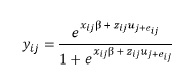
Under the assumption of nested data, with a dichotomous dependent variable, the model is:
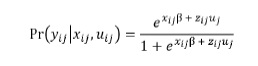
where the probability estimate is
]]>
for j = 1, …, M clusters (countries), with cluster j consisting of i = 1, …, nj observations (individual).
The responses are the binary-valued yij, and treating yij = 1 if the dependent variable is different from 0, and treating yij = 0 otherwise.
The 1xp row vector xij is the covariates for the fixed effects, analogous to the covariates that would be found in a standard logistic regression model with regression coefficients (fixed effects) β.
The 1xq vector zij is the covariates corresponding to the random effects and can be used to represent both random intercepts and random coefficients, and eij is the residual term.
We proceed in several steps. First, we compute the empty model with no explanatory variables (model zero), which shows us how much variance is to be found at the individual and aggregate levels. Model one includes individual-level variables and allows us to see how much country-level variance is due to the differential distribution of individual characteristics among the population of each country. Later, we enter our aggregate variables into different partial models to systematically test our hypotheses. Models two and three focus on the hypothesis related to the economic dimension. Models four and five examine the importance of cultural and political characterization of countries. Finally, models six and seven are full models including economic, cultural, and political hypotheses together. While model six consists of the static comparison across countries, model seven takes into account the economic changes experienced during the previous five years.
DATA
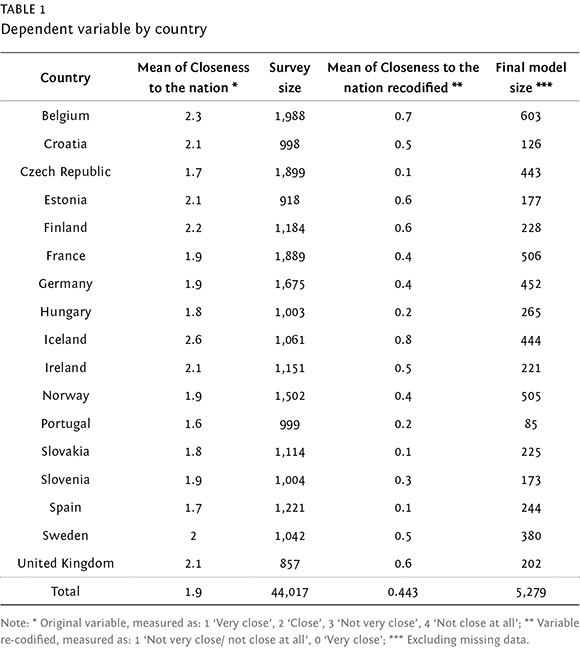
Our individual data samples come from the International Social Survey Program (ISSP), which has conducted a series of studies on national identity since 1995. The analyses in this article use the 2013 release - study za5950 (ISSP Research Group, 2015). Although this database includes samples from 33 countries, we limited our analysis to the countries of Europe. The absence of some variables at the individual level (ethnic group for Switzerland for example) or the aggregate level further reduced our country sample to 17 countries: Belgium, Croatia, Czech Republic, Estonia, Finland, France, Germany, Hungary, Iceland, Ireland, Norway, Portugal, Slovakia, Slovenia, Spain, Sweden, and the United Kingdom. We analyzed 5,279 respondents who fit our operationalization of the dependent variable.
Regarding sample size, some authors suggest that multilevel analysis is effective with more than 10 groups (Snijders & Bosker, 1999, p. 44), whereas others suggest that 30 is the smallest acceptable number (Kreft and de Leeuw, 1998). Various simulations have shown, on the one hand, that the coefficients’ estimations do not change much with a small number of groups. On the other hand, the smaller the number of groups, the smaller is the estimation of standard errors of those coefficients (Maas and Hox, 2005). With ten groups of five cases each, the standard errors are too small for regression coefficients and for variances. With a higher number of groups and cases within each group, we consider it safe to keep to the standard 95 % confidence interval in our analysis.
DEPENDENT VARIABLE
]]> Following modernist and constructivist scholars, we define national identity as the individual feeling of belonging to an imagined political community (Anderson, 1993). ISSP 2013 on national identity offers unidimensional as well as multidimensional measures of our dependent variable. As mentioned above, among these we choose the question that asks how close the interviewee feels to different geographic units, in which the country is taken as representing the concept of the nation-state in our analysis.
The original variable has four response categories: “very close”, “close”, “not quite close”, and “not close at all” (and “cannot choose”). Is has been re-codified into two categories in our multilevel logit regression model. Due to social desirability on the positive responses to this question, we opted for a recodification that maximized the differentiation of groups within the variable. Thus, we coded as 1 those “feeling not quite close” and “not close at all” (23 percent of respondents), and as zero those “feeling very close” (30 percent). All other cases are missing in our analysis. Although this decision omitted a high percentage of respondents (approximately 50 percent of the sample), it is acceptable since our main interest in this article is not to generalize results to the population but to test if there might be a mechanism that leads people from attachment to dis-attachment and the specific role that economic crisis might play in that process.
EXPLANATORY AND CONTROL VARIABLES: INDIVIDUAL LEVEL
We used household income as our measure for the economic situation of the respondent. A new variable was constructed harmonizing the original variable in our database in the national currency of each country. We created a new standardized variable for each country by dividing income into deciles and then summing up the countries in a single variable. Afterwards, we again standardized the aggregate variable by subtracting the mean of the distribution from each value in the new variable.
Within the cultural dimension, we selected the ethnic group of belonging. In its original format this variable had different category responses for each country. We created a new variable with a value of 1 for the ethnic group with the higher frequency, and zero for all other ethnic groups. Therefore, independently of which the majoritarian group is in each country, this variables capture the fact that the respondent belongs (1) or does not belong (0) to the majority ethnic group. Since length of residence has been related to community attachment (Flaherty and Brown, 2010), we included a variable measuring naturalization, that is, if both parents were citizens of the country (1), or not (0).
In relation to the political dimension, we considered ideology. This variable is not included in the ISSP 2013 questionnaire. Instead, the variable deriving left-right scale based on the party voted in last elections had to be used. We collapsed its original five values into three categories: left, center, and right. This variable has a considerable percentage of missing values. However, as it stands out as statistically significant, we maintained it in our models.
]]> Finally, we included a number of individual variables as controls: sex, age (for which we computed the grand mean), and education, recoded as: 1, primary or lower education; 2, secondary education; and 3, higher education.EXPLANATORY AND CONTROL VARIABLES: COUNTRY LEVEL
All the second-level explanatory and context control variables refer to the same year in which the individual data were collected from each country, or the closest data for which there is information available. Trend variables refer to a period of five years prior to individual data collection (see appendix).
Welfare state typology and GDP, in the first place, are operationalized as context control variables,[8] since they might mediate the effect of the economic crisis in our cases. The categorization of our countries within welfare typologies is not an easy task, since such classification is not without ambiguity: only 6 out of 17 countries do plainly belong to a clear-cut category in different classifications; countries such as Belgium, Ireland, and Finland are classified under different types of welfare countries by different authors (Arts & Gelissen, 2002, p. 149); and all post-communist countries has been included within the same category (“post-soviet”), since we have not been able to find any finer classification or differentiation for these cases.[9] Additionally, we operationalized GDP per capita based on purchasing power parity (World Bank International Comparison Program Database).
Besides these two context control variables, we included two measures of the major spending programs within welfare states (Castles, 1998, p. 10): general government expenditures on education, expressed as a percentage of GDP (World Bank and UNESCO Institute for Statistics); and social security transfers as a percentage of GDP (social assistance grants and welfare benefits paid by the general government, including benefits for sickness, old-age, family allowances, etc.), taken from Armingeon et al. (2015). We also included the Gini index,[10] measuring deviation in the distribution of income from a perfectly equal distribution ranging from 0, perfectly equal, to 100 (World Bank Development Research Group); and the unemployment and labor activity rates (International Labor Organization). For all these explanatory variables, we also calculated the previous 5-year trend to measure the extent to which each country suffered as a result of the economic crisis and any erosion in social protection. This last measure is calculated as the percentage of change from the first to the last year, except for the trend in Gini, which is computed by simply subtracting the current value from the value five years prior.
For the cultural dimension we considered two variables: the percentage of the population belonging to the wider ethnic group, taken from Pan and Pfeil (2003), and the international migrant stock as a percentage of the total population in each country, as measured by the UN. Within the political dimension, the level of politicization of the center-periphery cleavage considers the percentage of the discourse in electoral programs devoted to issues that are related to this cleavage. This measure is calculated using the Manifestos Data Collection (Volkens et al., 2015). The level of political decentralization of countries is measured by the Regional Authority Index (Hooghe et al., 2016).
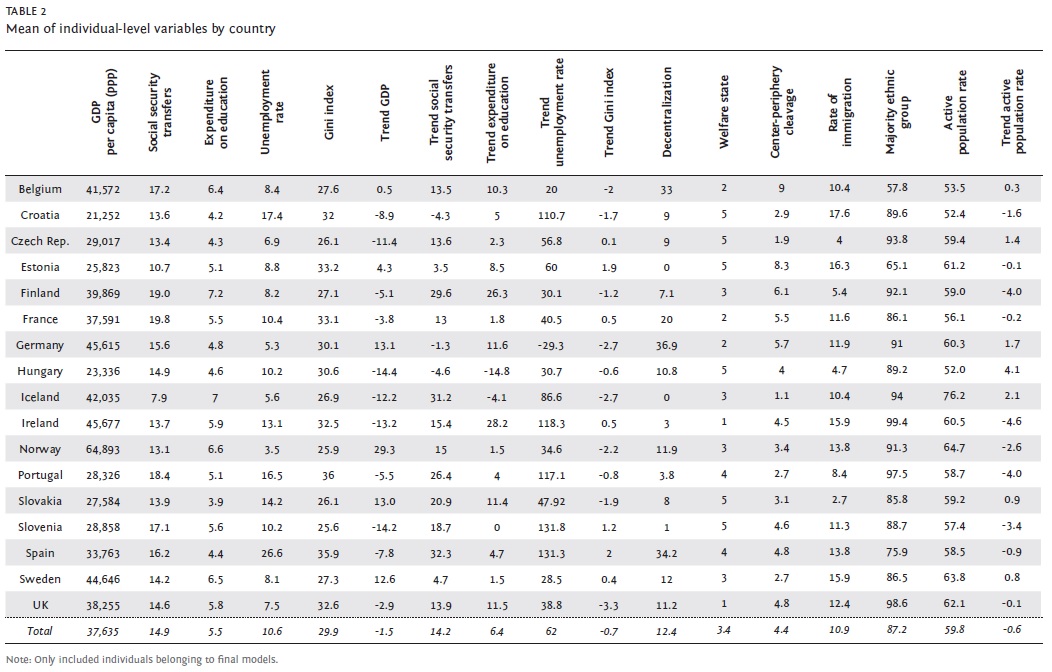
(clique para ampliar ! click to enlarge)
RESULTS
]]> Model number zero, the null or empty model (not shown here), indicates how much of the variance in our dependent variable is caused by the individual and aggregate levels. The variance among countries is smaller than the variance among individuals. The value of icc (0.21) also points to a significant difference in distance to the nation between countries. Our models look to explain this variance by means of individual and aggregate variables.Model one in Table 3 tests how much of the between-country variance can be explained through individual variables. As shown in Table 3, males (in comparison to females), and citizens with secondary or higher education (as compared to those with lower education) have a higher probability of feeling aloof regarding the nation.[11] In addition, those on the left and right have a higher probability of feeling far from the nation than citizens at the ideological center. By contrast, as age increases the probability of detachment from the nation decreases. Belonging to the largest ethnic group also diminishes the probability of not feeling attached to the nation. Household income and naturalization are not significant at the established 95% confidence interval.

(clique para ampliar ! click to enlarge)
Models two to seven test the importance of contextual variables, holding constant the compositional differences (Table 3 and Table 4). When countries’ economic information for 2013 is added to individual variables (model two in Table 3), both countries’ GDP and type of welfare state are relevant control context variables. After taking them into account, we see that spending in social transfer as well as in education stand out as significant explanatory variables. But while citizens in countries with larger percentage of social transfer have a lower probability of feeling detached from their national identity as compared to citizens in less generous countries, the contrary is true for those countries with larger percentage of GDP directed to education. The effect of spending on education is consistent with the effect it had at the individual level in model 2, and also with previous research findings. It should be noted, also, that in countries whose labor activity rate is higher, the probability of citizens’ detachment is lower. When we look at the dynamic change in economic indicators instead (change between 2008 and 2013 on average, as shown in model three in Table 3), only welfare typology stands out as an important control variable. In this model the increasing trend in the percentage of unemployment is the one to become statistically significant. Thus, in those countries in which the percentage of unemployment has increased more, their citizens are more likely to become aloof from the country (compared to countries where unemployment has experienced smaller growth). In summary, model two seems to back the hypothesis behind welfare nationalism, in the sense that on average there are more citizens attached to their countries when those countries have more generous social protection (H1); while model three suggests an impact of the economic crisis - but in much more general terms that those suggested by our H3.
Model four in Table 3 analyzes the effect of cultural variables. We see in model four that both the GDP and welfare states’ typology are significant mediating factors. After taking them into account, it can be noticed that in those countries where the percentage of population belonging to the wider ethnic group is larger, there is on average less detachment from the country. This finding is also in line with the effect of belonging to the larger ethnic group on the individual model (model one in Table 3); and both give support to H4. In the same line, larger rates of immigration also correlate with higher probabilities of detachment from the nation.
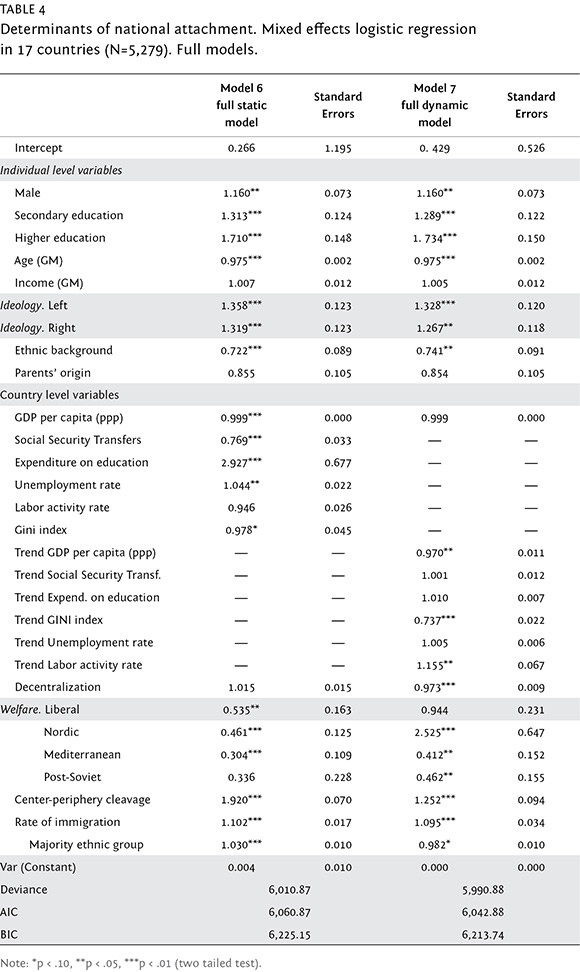
]]> Our last model in Table 3 takes into account the political factors. Again, both GDP and welfare states’ typology are relevant context factors. Taking them into account, it is just the politicization of the center-periphery dimension that stands out as statistically significant, backing hypothesis H5. In summary, we see that the higher the politicization on this identity dimension within the political discourses, the higher the probability of citizens’ detachment from their countries.Table 4 includes the information from the partial models, taking all the different hypotheses into account. Model six shows the static comparison in 2013 among countries, and there is little change against the partial models shown in Table 3. The most noticeable differences are that the Gini index appears as significant and the size of the largest ethnic majority has changed sign; at the same time it is now the rate of unemployment instead of the labor force rate that is significant. To summarize changes: in countries with higher unemployment rates and larger majority ethnic groups the probability of detachment is higher, while more unequal redistribution of income makes it more likely that people will feel attached to their countries. All this reveals a very complex set of relationships among this set of variables that points toward welfare chauvinism, especially when the crisis or dynamic model (model seven in Table 4) is also taken into account.
Model seven takes into account the political, cultural, and crisis models together; that is, the change in our economic indicators during the previous five years, and keeps GDP and welfare typologies as control variables. Here the increasing trend on unequal redistribution of income over the last five years is clearly related to decreasing levels of detachment from the nation, therefore suggesting the use of national identity as a resource to gain access to social protection services for “nationals”. This is coherent with the new change of sign for the variable measuring the size of the majoritarian ethic group, which is again negative, and the importance of the rate of immigration. To summarize, detachment from the nation is lower where Gini has increased over the last five years, where the size of the ethnic majority is larger, and in countries with lower rates of immigration. Especially regarding ethnicity, we may notice that at the individual level, those belonging to the largest ethnic group in each country are always less likely to feel detached from their country. Other than that, it can be seen that in countries where the labor force has increased (probably as a consequence of increasing unemployment rates) detachment is higher. In model seven both the level of political decentralizations, as well as the politicization of the center-periphery are substantial. Where decentralization is higher, and where politicisation is lower, the percentage of citizens attached to the country is higher.
DISCUSSION AND CONCLUSION
Our first hypothesis regarding the positive effects of living in countries with high levels of social protection and economic equality on national attachment finds mixed support in our data (H1): within model two in Table 3, countries with larger social security transfers have smaller percentages of citizens detached from the nation. This relationship remains in place within model six (in Table 4), taking into account alternative explanations for the national identification of citizens, therefore also supporting H7 (that is, that economic variables remain relevant after taking into account alternative hypotheses). However, contrary to our first hypothesis, models six and seven show that inequality in the redistribution of income makes people feel closer to the nation, not more detached. All these findings together give more support to welfare chauvinism than to welfare nationalism. It is also interesting to note that the personal economic situation of the respondents’ household is not relevant at the individual level. This suggests that it is more the subjective perception of the national group than the personal objective situation that influences citizens’ feelings in this regard.[12]
Our second hypothesis spoke directly about the effect of the economic crisis on national identity. Model three in Table 3 suggests such an influence, but limited to the increase in the percentage of unemployment, so where unemployment had increased over the previous five years the percentage of citizens not feeling very close to nation is higher. Model seven, taking into account alternative explanations, makes the impact of the economic crisis even more apparent. Gini trend and trend in labor activity rate are statistically significant. However, the sign of the relationship is not the one predicted in our H2. In line with welfare nationalism theory, we expected that less generous social policies as well as increasing levels of inequality in the redistribution of wealth will result in higher percentages of detachment from the nation. But our findings are more in line with welfare chauvinism than welfare nationalism. They tend to agree also with the empirical analyses by Solt (2011) and Stearklé et al. (2010). Solt (2011, p. 829) relates increasing levels of nationalism within unequal economic contexts to the manipulation of political elites, which is also relevant in our analysis as we shall comment below. From a political-psychological point of view, Shayo (2009) has also suggested this effect when (as a product of the economic deterioration) the self-esteem that can be derived from the membership in one’s social-class is lower than the self-esteem than can be derived from being a member of the national group.
In third place, we have taken ethno-cultural elements into consideration in H3. This hypothesis is clearly confirmed at the individual level. Model one in Table 3, as well as all other models, shows that citizens who belong to the majoritarian ethnic group in the country feel less detached from their national identity than citizens who belong to an ethnic minority. However, the contextual effect of the size of the majoritarian group within a country is more difficult to interpret. When the comparison is static among countries (models three in Table 3 and six in Table 4), in those states with larger size of the majoritarian group the probability of citizens’ detachment from the nation is larger than in countries where the size is smaller. However, when we take into account the economic impact of the crisis, detachment from the nation is lower in countries with larger majoritarian ethnic group. This again suggests that when the economic impact is taken into account national identity might be used instrumentally, especially by members of the ethnic majority, to gain access to a range of services. Furthermore, this is also supported by the rate of immigration. In all models the higher the rate of immigration the higher the detachment from the nation. In general, we find support for our H3, although more investigation is needed to see how the majoritarian ethnic group functions at the contextual level in different economic situations.
Our hypotheses four to six refer to the importance of political factors. While we disregard the importance of ideology in H4, our findings at the individual level show its statistical significance (model one in Table 3). Our fifth and sixth hypotheses refer to the importance of both politicization of identities (measured in our model with the percentage of political discourse devoted to the center-periphery cleavage) H5, and the level of political decentralization respectively (H6). Supporting H5, the level of politicization of identities shows a consistent role in all models. In all of them the higher the percentage of political discourse devoted to this center-periphery cleavage the lower the feeling of citizens’ attachment to their countries. When this cleavage is activated, citizens are confronted with alternative identities that demand loyalty, and the net effect of which seems to be the depression of closeness with their countries, as suggested by Kymlicka (1996). Regarding H6, only in model seven in
Table 4, taking into account the effects of the economic crisis, have we found that the level of decentralization is statistically significant. In countries where the level of decentralization is higher citizens’ detachment from their country is lower. Therefore, we must reject our hypothesis.
Our last hypothesis (H7) posited that economic and crisis variables should remain significant after controlling for the influence of cultural and political factors, which we have confirmed. We may conclude, therefore, that there is an economic-instrumental dimension of identity, although we should not try to understand it separately from cultural and political determinants of national identities.
]]> Some further observations are also appropriate. First, the conclusion that the Great Recession has had an impact on the national identities of citizens cannot be rejected given the correlations found in this research; particularly the fact that the inclusion of alternative (cultural and political) explanations do not remove the statistical relevance of economic and crisis variables in our full models. Second, we stress the idea that the framework posited by particular types of welfare states needs to be taken into account in any further comparative analysis on this topic, since it has emerged as an important context control variable. Our analyses, however, do not have enough cases in some categories to say much about it. Therefore, future research within clusters of welfare states seems promising. Third, we have not been able to establish a univocal influence of economic variables on national identities: different patterns emerge when countries are compared in a static way than when we take into account their dynamic changes on economic indicators. The effect of the increasing level of inequality in the redistribution of income on national identities points to the idea of welfare chauvinism (which our models have not taken into account fully, since we have centered on strength instead of the meaning of identity). New complementary research on the effect that the Great Recession has played on changing meanings of identity is therefore much needed. Fourth, as suggested by Brubaker (2011, pp. 94-95), our models seem to also back his idea that economic crises do not translate directly into nationalism, or national identity in this case. Responses to economic distress situations depend on how those economic problems are framed and interpreted, and therefore the politicization of the center-periphery dimension is consistently important across different models. Identity entrepreneurship and the politicization of identities need to be taken into account in future related research (Saxton & Benson, 2008, p. 63; Hechter, 2001, p. 62; Westle & Segatti, 2016, p. 8).A central conclusion in this article is the idea that research on national identities needs to take into account the contextual level. As we have clearly shown, there are many country-level variables relevant to the understanding of citizens’ national identities beyond their individual characteristics and circumstances.
Before closing, it is important to note the limitations of our study. These limitations include the use of single-item measures for different complex variables (such as national identity or ethnicity), the modest number of level-2 groups, and the missing values in our dependent variable due to recodification. Although we are convinced that ISSP is the most appropriate international survey to investigate national identity from a nomothetic point of view, findings should be treated with some caution, especially when seeking to generalize them to a global population. But that was not our main interest. It was instead to test if a general correlation does in fact exist between the Great Recession and changes in the strength of national identity, taking into account simultaneous alternative explanations. Therefore, it should also be noted that our findings cannot work as ideographic explanations in any of the cases included in the analysis. Nevertheless, we think that these limitations in our particular research design not only qualify our conclusions, they also suggest interesting opportunities for new research.
Notwithstanding these limitations, this article is among the rare attempts to test the impact of economic variables on national identity, and to our knowledge, is the only one that systematically integrates variables from three strong branches of theories about nationalism. We must stress that variables from the three different theories are relevant for explaining variance in our sample, empirically confirming the multidimensionality and complexity of the concept and also suggesting, as already noted, that national identity must be explained not only at the psychological level (as a personal attitude) but also at the sociological level.[13]
REFERENCES
ANDERSEN, R., Fetner, T. (2008), “Economic inequality and intolerance: attitudes toward homosexuality in 35 democracies”. American Journal of Political Science, 52(4), pp. 942-958.
ANDERSON, B. (1993), Comunidades Imaginadas. Reflexiones Sobre El Origen y La Difusión Del Nacionalismo, London, Verso. Retrieved from http://clio.110mb.com/AndersonIntro.pdf. [ Links ]
ARMINGEON, K. et al. (2015), Comparative Political Data Set 1960-2013, Berne, Institute of Political Science, University of Berne. Retrieved from http://www.cpds-data.org/. [ Links ]
ARTS, W., Gelissen, J. (2002), “Article three worlds of welfare capitalism or more ? A state-of-the-art report”. Journal of European Social Policy, 12(2), pp. 137-158.
BREUILLY, J. (1993), Nationalism and the State, Manchester, Manchester University Press. [ Links ]
BROWN, D. (1998), “Why is the nation-state so vulnerable to ethnic nationalism?”. Nations and Nationalism, 4(l), pp. 1-15. Retrieved from http://doi.wiley.com/10.1111/j.1354-5078.1998.00001.x.
BRUBAKER, R. (2011), “Economic crisis, nationalism and politicized ethnicity”. In C. Calhoun and G. Derluguian (eds.), The Deepening Crisis. Governance Challenges after Neoliberalism, New York, New York University Press, pp. 93-109.
CASTLES, F. G. (1998), Comparative Public Policy : Patterns of Post-War Transformation. Edward Elgar Publ. Retrieved from https://books.google.co.uk/books/about/Comparative_Public_Policy.html?id=SDywDdlcKqMC&redir_esc=y. [ Links ]
COHEN, A. P. (2000), Signifying Identities, London, Rogutledge. [ Links ]
]]> CRANE, G. T. (1998), “Economic nationalism: bringing the nation back in”. Millennium - Journal of International Studies, 27(1), pp. 55-75. Retrieved from http://mil.sagepub.com/cgi/doi/10.1177/03058298980270011001.CUSSÓ, R., García, L. and Grande, I. (2018), “The meaning and limitations of the subjective national identity scale: the case of Spain”. Ethnopolitics, 17(2), pp. 165-80. Retrieved from http://www.tandfonline.com/action/journalInformation?journalCode=reno20.
DALTON, R. J. (2004), Democratic Challenges, Democratic Choices: The Erosion of Political Support in Advanced Industrial Democracies, UK, Oxford University Press. [ Links ]
DAVID, O., Bar-Tal, D. (2009), “A sociopsychological conception of collective identity: the case of national identity as an example”. Personality and Social Psychology Review, 13(4), pp. 354-379.
DEKKER, H., Malova, D. and Hoogendoorn, S. (2003), “Nationalism and its explanations”. Political Psychology, 24(2), pp. 345-376. Retrieved from http://links.jstor.org/sici?sici=0162-89 5X(200306)24:2%3C345:NAIE%3E2.0.CO;2-I.
DEUTSCH, K. W. (1964), “The price of integration”. In P. E. Jacob and J. V. Toscano (eds.), The Integration of Political Communities, Philadelphia, Lippincott, pp. 143-178
EASTON, D. (1965), A System Analysis of Political Life, New York, Wiley. [ Links ]
ELKINS, Z., Sides, J. (2007), “Can institutions build unity in multiethnic states”. The Amercian Political Science Review, 101(4), pp. 693-708.
]]> FLAHERTY, J., Brown, R. B. (2010). “A multilevel systemic model of community attachment: Assessing the relative importance of the community and individual levels”. American Journal of Sociology, 116(2), pp. 503-542.GELLNER, E. (2008), Nations and Nationalism, Ithaca, New York, Cornell University Press. [ Links ]
GORARD, S. (2007), “The dubious benefits of multilevel modeling.” International Journal of Research & Method in Education, 30(2), pp. 221-236. Retrieved from http://www.tandfonline.com/doi/abs/10.1080/17437270701383560.
GUINJOAN, M., Rodon, T. (2016), “A scrutiny of the Linz-Moreno question”. Publius: The Journal of Federalism, 46(1), pp. 128-142. Retrieved from http://web.b.ebscohost.com/ehost/pdfviewer/pdfviewer?vid=12&sid=6f1439bb-616e-4ed6-bbea-cdef03c877ff%40sessionmgr101.
HADLER, M., Tsutsui, K. and Chin, L. G. (2012), “Conflicting and reinforcing identities in expanding Europe: individual- and country-level factors shaping national and European identities, 1995-2003 1995-2003”. Sociological Forum, 27(2), pp. 392-418.
HECHTER, M. (2001), Containing Nationalism, Oxford, Oxford University Press. [ Links ]
HELD, D. (1995), Democracy and the Global Era, Cambridge, Polity Press. [ Links ]
]]> HENDERSON, A., McEwen, N. (2005), “Do shared values underpin national identity? Examining the role of values in national identity in Canada and the United Kingdom”. National Identities, 7(2), pp. 173-191.HETTNE, B. (1993), “Ethnicity and development - An elusive relationship”. Contemporary South Asia 2(2), pp. 123-149. Retrieved from http://www.tandfonline.com/doi/abs/10.1080/09584939308719709.
HIERRO, M. J., Rico, G. (2018), “Economic crisis and nationalist attitudes: experimental evidence from Spain”. Ethnic and Racial Studies, pp. 1-24. https://doi.org/10.1080/01419870.2018.1432873.
HOOGHE, L. et al. (2016), Measuring Regional Authority, Oxford, Oxford University Press. Retrieved from http://www.oxfordscholarship.com/view/10.1093/acprof:oso/9780198728870.001.0001/acprof-9780198728870. [ Links ]
HROCH, M. (2000), Social Preconditions of National Revival in Europe, New York, Columbia University Press. [ Links ]
HUDDY, L., Khatib, N. (2007), “American patriotism, national identity, and political involvement”. American Journal of Political Science, 51(1), pp. 63-77.
HUDDY, L. (2013), “From group identity to political cohesion and commitment.” In L. Huddy, D. O. Sears, and J. S. Levy (eds.),The Oxford Handbook of Politcal Psychology, Oxford, Oxford University Press. Retrieved from http://oxfordhandbooks.com/view/10.1093/oxfordhb/9780199760107.001.0001/oxfordhb-9780199760107-e-023, pp. 737-773.
ISERNIA, P. et al. (2012), “But still it does not move: functional and identity-based determinants of European identity.” In D. Sanders, C. Magalhaes, and G. Tóka (eds.), Citizens and the European Polity: Mass Attiudes towards the European and National Polities, Oxford, Oxford University Press, pp. 110-139.
]]> JONES, F. L., Smith, A. (2001), “Diversity and commonality in national identities: an exploratory analysis of cross-national patterns”. Journal of Sociology, 37, pp. 45-63.KEATING, M. (2001), Nations Against the State. The New Politics of Nationalism in Quebec, Catalonia and Scotland, New York, MacMillan Press. [ Links ]
KESKINEN, S. (2016), “From welfare nationalism to welfare chauvinism: economic rhetoric, the welfare state and changing asylum policies in Finland”. Critical Social Policy, 36(3), pp. 352-370. Retrieved from http://0-journals.sagepub.com.athenea.upo.es/doi/pdf/10.1177/0261018315624170.
KESKINEN, S., Norocel, O. C. and Jorgersen, M. B. (2016), “The politics and policies of welfare chauvinism under the economic crisis”. Critical Social Policy 36(3), pp. 321-329. Retrieved from http://0-journals.sagepub.com.athenea.upo.es/doi/pdf/10.1177/0261018315624168.
KOHN, H. (1945), The Idea of Nationalism: a Study in its Origins and Background, New York, MacMillan Press. [ Links ]
KREFT, I., de Leeuw, J. (1998), Introducing Multilevel Modeling, London, Sage. Retrieved from http://methods.sagepub.com/book/introducing-multilevel-modeling. [ Links ]
KYMLICKA, W. (1996), “Social unity in a liberal state”. Social Philosophy and Policy, 13(1), pp. 105-136.
]]> LIBBRECHT, L., Maddens, B. and Swenden, W. (2011), “Party competition in regional elections: the strategies of state-wide parties in Spain and the United Kingdom”. Party Politics, 19(4), pp. 624-640.LINZ, J. J. (1973), “Early state-building and late peripheral nationalisms against the state: the case of Spain”. In S. N. Eisenstadt, S. Rokkan (eds.), Building States and Nation: Analysis by Region, Beverly Hills, Sage, pp. 32-116.
LINZ, J. J., Stepan, A. (1996), Problems of Democratic Transition and Consolidation, Baltimore, Maryland, Johns Hopkins University Press. [ Links ]
MAAS, C. J., Hox, J. (2005), “Sufficient sample sizes for multilevel modeling”. Methodology, 1(3), pp. 86-92. Retrieved from http://ovidsp.ovid.com/ovidweb.cgi?T=JS&CSC=Y&NEWS=N&PAGE=fulltext&D=psyc4&AN=2005-10055-001.
MAIZ, R. (2003), “Framing the nation: three rival versions of contemporary nationalist ideology”. Journal of Political Ideologies, 8(3), pp. 251-267. Retrieved from http://www.tandfonline.com/doi/abs/10.1080/1356931032000131165.
MARTÍNEZ-HERRERA, E. (2002), “From nation-building to building identification with political communities: consequences of political decentralisation in Spain, the Basque Country, Catalonia and Galicia, 1978-2001”. European Journal of Political Research, 41(4), pp. 421-453. Retrieved from http://onlinelibrary.wiley.com/doi/10.1111/1475-6765.00018/abstract.
MCEWEN, N. (2006), Nationalism and the State, Brussels, Belgium, P. I. E. - Peter Lang. [ Links ]
MOTA CONSEJERO, F. (2008), Capital Social y Gobernabilidad: El Rendimiento Político de Las Comunidades Autónomas, Centro de Estudios Políticos y Constitucionales. Retrieved from https://dialnet.unirioja.es/servlet/libro?codigo=447691. [ Links ]
MOTA CONSEJERO, F. (1998), “Cultura política y opinión pública en las cc. aa.: un examen del sistema político autonómico en España”. Working Paper (153), pp. 1-63. Retrieved from http://www.icps.cat/archivos/WorkingPapers/WP_I_153.pdf?noga=1.
NOROCEL, O. C. (2016), “Populist radical right protectors of the Folkhem: Welfare Chauvinism in Sweden.” Critical Social Policy, 36(3), pp. 371-390. Retrieved from http://0-journals.sagepub.com.athenea.upo.es/doi/pdf/10.1177/0261018315621991.
PALLARÉS, F., Keating, M. (2003), “Multi-level electoral competition”. European Urban and Regional Studies, 10(3), pp. 239-255. Retrieved from http://eur.sagepub.com/content/10/3/239.abstract.
PAN, C., Pfeil, B. S. (2003), National Minorities in Europe Handbook, Wien, Braumüller. [ Links ]
PETERSOO, P. (2007), “What does ‘we’ mean?: national deixis in the media”. Journal of Language and Politics, 6(3), pp. 419-436. Retrieved from http://web.b.ebscohost.com.ezproxy.is.ed.ac.uk/ehost/pdfviewer/pdfviewer?vid=2&sid=07d3b971-9864-416d-9eb1-780dd83c3afb% 40sessionmgr102.
RUIZ JIMÉNEZ, A. M. (2007), “Los instrumentos de medida de las identidades en los estudios del cis y el Eurobarómetro: problemas de la escala moreno y posibles alternativas”. Revista Española de Investigaciones Sociológicas, 117, pp. 161-182. Retrieved from http://www.jstor.org/stable/40184757?origin=JSTOR-pdf.
SAXTON, G., Benson, M. (2008), “Means, motives and opportunities in ethno-nationalist mobilization”. International Interactions, 34(1), pp. 53-83.
SHAYO, M. (2009), “A model of social identity with an application to political economy: nation, class, and redistribution.” American Political Science Review, 103(2), pp. 147-174.
]]> SHULMAN, S. (2003), “Exploring the economic basis of nationhood”. Nationalism and Ethnic Politics, 9(2), 23-49. Retrieved from http://www.tandfonline.com/doi/abs/10.1080/13537110412331301405.SMITH, A. (1991), National Identity, London, Penguin Books. [ Links ]
SMITH, A. (2010), Nationalism, Cambridge, UK, Polity Press. [ Links ]
SNIJDERS, T. A. B., Bosker, R. J. (1999), Multilevel Analysis: an Introduction to Basic and Advanced Multilevel Modeling, London, Sage Publications. [ Links ]
SOLT, F. (2011), “Diversionary nationalism: economic inequality and the formation of national pride.” The Journal of Politics, 73(3), pp. 821-830.
STAERKLÉ, C., et al. (2010), “Ethnic minority-majority asymmetry in national attitudes around the world: a multilevel analysis”. Political Psychology, 31(4), 491-519. http://doi.wiley.com/10.1111/j.1467-9221.2010.00766.x
STRAUGHN, J. B., Andriot, A. L. (2011), “Education, civic patriotism, and democratic citizenship: unpacking the education effect on political involvement”. Sociological Forum 26(3), pp. 556-580.
]]>TAYLOR-GOOBY, P. et al. (2017), After Austerity: Welfare State Transformation in Europe after the Great Recession, Oxford, Oxford University Press. Retrieved from http://www.oxfordscholarship.com/view/10.1093/oso/9780198790266.001.0001/oso-9780198790266. [ Links ]
VOLKENS, A. et al. (2015), The Manifesto Data Collection. Manifesto Project (mrg/cmp/marpor). Version 2015a. Berlin, Wissenschaftszentrum Berlin für Sozialforschung (wzb). Retrieved from https://manifesto-project.wzb.eu/. [ Links ]
WESTLE, B., Segatti, P. (2016), European Identity in the Context of National Identity. Questions of Identity in Sixteen European Countries in the Wake of the Financial Crisis of 2007 and 2009, Oxford, Oxford University Press. [ Links ]
WRIGHT, M. (2011), “Diversity and the imagined community: immigrant diversity and conceptions of national identity”. Political Psychology, 32, pp. 837-862.
Received at 06-11-2017.
Accepted for publication at 02-11-2018.
]]>[1] By no means does this imply that the result of the process of a state’s breakdown is undemocratic, for the new states emerging from the previous can be perfectly democratic. However, we maintain that those new states would also need the compliance of their political communities, and therefore it might be somehow self-evident why peripheral nationalist elites put so much effort into developing national identities among citizens as the legitimatory argument to advance their demands for political powers, decentralization, or independence. These elites have been labeled as ethnic, cultural, or political entrepreneurs by different authors (Saxton & Benson, 2008, p. 63; Hechter, 2001, p. 62; Westle & Segatti, 2016, p. 8).
[2] In a similar vein, from the school of liberal nationalism scholars such as Tom Nairn, David McCrone and Linsay Paterson has being arguing since the 1990s that material interests, whether they be economic, political or ethnic, are gaining interest as the dynamic of contemporary Western nationalism (Cohen, 2000, p. 159).
[3] Although not directly addressed, it is suggested then that welfare nationalism is related to both the strength of national identity and its meaning, in this sense diminishing the importance of the ethnic dimension.
[4] Still it must be stressed that these analyses rest mostly on discursive analysis of political elite messages, lacking empirical analysis of their effects on citizens’ attitudes.
[5] And so, for example, the right and left have progressed through different nationalist paths with differing success.
[6] Elkins and Sides’ findings support the second option.
[7] 95 percent confidence interval values range between 0.12 and 0.35. Given the lower bound in the confidence interval, we also run simple logit regressions with robust errors to test consistency in our results.
[8] Particularly in relation to Welfare States’ typologies we treat it as a context control variable, first because it is not among our objectives to investigate how different types of welfare state lead to differences in the strength of identities, but also because some of our categories have just too few cases (only two in the case of Southern European and Liberal models) to make much about the interpretation of coefficients. The type of welfare state, however, plays an important mediating role, and so we think it is important to keep it in our model as control. In summary, the impact of the crisis on citizens’ identity in different countries will be mediated by both the wellbeing (GDP) and the welfare of the country.
[9] We also thank Richard Parry and Lindsay Patterson for their useful suggestions regarding classification.
]]> [10] Gini was favored instead of 80/20 index due to their strong correlation and the fact that Gini had fewer missing cases.[11] Several empirical analyses have shown a diminishing effect of education on identity (Elkins & Sides, 2007; Hadler et al., 2012), particularly in countries with long democratic traditions, since their education systems tend to disseminate cosmopolitan ideas of tolerance and pluralism.
[12] A recent survey experiment in Spain by Hierro and Rico (2018), following Shayo (2009)suggests that this might be the case, though the effect is mediated by respondents’ self-classification on the social-class scale.
[13] This work was supported by the Spanish Ministry of Science and Innovation under Grant cso2008-01182cpol. Part of this work has been carried out within the Center for Constitutional Change in Edinburgh University, to which we express our gratitude here. We are thankful to the two anonymous reviewers of Análise Social for the valuable comments and criticism. Previous drafts of this paper have been presented an discussed at the 24th International Congress on Political Science (ipsa) - Poznan 2016, and the vii Conference of Doctores Miembro of the Juan March Institute held in Madrid in 2016. We are equally thankful for those participants’ comments and suggestions and particularly to Maria José Hierro.
]]>