Raynal and the defence of the Portuguese colonization of Brazil: diplomacy and the Memoirs of the Visconde de Balsemão
Raynal e a defesa da colonização portuguesa do Brasil: a diplomacia e as memórias do Visconde de Balsemão.
Junia Ferreira Furtado*, Nuno Gonçalo Monteiro**
* Universidade Federal de Minas Gerais. Av. Pres. Antônio Carlos, 6627, Pampulha - CEP 31270-901, Belo Horizonte, MG, Brasil. juniaf@ufmg.br.
** Instituto de Ciências Sociais, Universidade de Lisboa. Av. Professor Aníbal de Bettencourt, 9 - 1600-189 Lisboa, Portugal. nuno.monteiro@ics.ulisboa.pt.
ABSTRACT
This article addresses and discusses the Memoirs of Luís Pinto de Sousa Coutinho (1735-1804), 1st Viscount of Balsemão, which were used as sources for the production of the 1780 edition of the Histoire des deux Indes, in respect of Brazil. The Memoirs offer a singular and exceptional portrait of the Portuguese empire - in the most precise and well-informed manner known for the time -, and represent a substantive addition to Abbé Raynal’s text and, in particular, a reorientation of its rather uncritical and even apologetic view of the Portuguese colonial administration and of slavery in Brazil.
Keywords: Raynal; Brazil; colonialism; diplomacy; Viscount Balsemão.
RESUMO
Este artigo apresenta e discute duas Memórias de autoria de Luís Pinto de Sousa Coutinho (1735-1804), 1.º Visconde de Balsemão, que foram utilizadas como fonte para a elaboração da edição da Histoire des deux Indes, de 1780, no que diz respeito ao Brasil. As Memórias constituem um retrato singular e excecional do império português - as mais precisas e informadas que se conhecem para aquela data -, permitindo um substantivo acrescentamento do texto do Abade Raynal e, em particular, uma reorientação do mesmo, da qual resultou numa visão pouco crítica e até apologética da administração portuguesa e da escravidão no Brasil.
Palavras-chave: Raynal; Brasil; colonialismo; diplomacia; visconde de Balsemão.
By all accounts, the Histoire des deux Indes of Abbé Raynal (1713-1796) was the most widely disseminated multi-volume work in the 18th century. Often seen at the time and in the early decades of the 19th century as a weapon in the fight against European colonization, a close reading of it shows that it is a complex assembly of texts, sometimes offering contradictory judgments, which underwent successive corrections and additions by Diderot and various anonymous authors, which the Abbé compiled as he went along. Even though an ample bibliography seeks to lend the text a strongly subversive and unitary character (Israel, 2011; Pagden, 2013), a detailed analysis reveals the dissonances in the different contributions. In particular, some authors have emphasized the contrast between the radical passages attributed to Diderot and the much more reform-minded and conciliatory positions of Raynal himself (Villaverde Rico, 2015, pp. 107-140; Goggi, 2018, pp. 569-595), who was in certain moments payed by the French government and worked with Spanish and Portuguese diplomats. It seems fairly certain therefore that the possibility, both today and in the past, of multiple and divergent interpretations of the work, were major constraints on its success as a publication.
The aim of this article, which delves deeper into ideas put forward in an earlier one (Furtado and Monteiro, 2016, pp. 731-777), is to address and discuss some of the new sources used to produce the 1780 edition of the book on Portuguese America (Book 9 in Volume 5). [1] These sources represent a major addition to the text and, in particular, a reorientation of its somewhat uncritical and even flattering view of the Portuguese administration in Brazil “which, running counter to the ideas disseminated by current historiography regarding the most read eighteenth century work at the time (…), gradually ceases to be (…) like a ‘war machine’” (Furtado and Monteiro, 2016, p. 772). [2] In fact, we detected in the first edition of 1770 several complacent judgements of Portuguese colonization, especially when compared to the Spanish, which the writers sought to vilify. And in the definitive edition of 1780 in particular, we noticed extensive additions on Brazil which combined notable thoroughness and detail with the aim of painting it in a positive light.
The 1780 edition contains negative judgments on the Indians, previously regarded as being pure in their natural state, with criticism directed in particular at their acts of cannibalism. This new interpretation is linked to praise for the Diretório dos Índios (a new set of regulations regarding the organization of the Amerindian peoples under State rule in the context of conflicts with the Jesuits), the regenerative potential of which would allegedly bring out the civilizing nature of natives and settlers. It also contains a surprisingly benign interpretation of the way slavery was organized in Brazil, in which manumissions were said to be frequent, and a rather uncritical and almost apologetic view of the Portuguese administration, with special emphasis on the measures implemented under Pombal’s ministry, even though he is never mentioned by name. Amongst other things, it is asserted that, “the governors of the captaincies were not corrupt, that the city councils could contest their measures, and that the captaincies’ finances were well supervised (…) nearly everything but the clergy appears to be included in that idealized outlook” (Furtado and Monteiro, 2016, p. 772)
In order to reach a more favourable judgement of Portuguese colonization, Raynal by his own account relied on information supplied by Portuguese officials. As was later established, his contacts included several important diplomats in post at the main European courts. Among them were D. Rodrigo de Sousa Coutinho (1755-1812), recently appointed as a diplomat in Turin, who met twice with the Abbé in Paris en route to his appointment, and gave him a map, in addition to oral and written information (which will be covered in another article) (Diniz Silva, 2002, pp. 79-80 and 2006, pp. 99, note 4); his father, D. Francisco Inocêncio de Sousa Coutinho (1726-1780), who at the time was ambassador in Madrid, and had previously been Governor in Angola (from 1764 to 1772), and wrote a Memoir on that African colony (Goggi, 2010, pp. 288-296); and the medical doctor Antônio Nunes Ribeiro Sanches (1699-1783). [3]
In the earlier publication, doubts remained as to whether one of them might have been the “Portuguese subject, with extensive knowledge of these governments” (Bonne, 1780, p. 15), who provided information on Brazil. Meanwhile, information provided by various authors helped to confirm that that source was Luís Pinto de Sousa Coutinho (1735-1804), former Governor and Captain General of Mato Grosso, at that time Portugal’s Ambassador in London and later Secretary of State of the Navy and Foreign Affairs (1788-1801) and 1st Viscount Balsemão. [4] Better still, we were able to identify copies of two excerpts from the Memoirs he gave the Abbé and which are a singular early portrait of the Portuguese empire around 1780, the most precise and informed descriptions known for that epoch. [5]
]]> This short essay on Raynal’s Portuguese sources on Brazil will focus essentially on the connections between the 1780 edition and the Memoir which the author requested of Viscount Balsemão.“MONSIEUR LE CHEVALIER DE PINTO”
Like many of the colonial governors and diplomats in the Pombal era [6] , Luís Pinto de Sousa Coutinho was the second son of a prominent family of the highest provincial nobility, generally referenced by lineage (Pinto), by the entail of Balsemão in the judicial district (comarca) of Lamego, and by its close links to the Knights of Malta and their respective Portuguese grand masters. Given there is no systematic monograph, much of the known biographical information on him is heavily skewed by his later activity as Secretary of State and by the eventual Miguelist position of his successors and heirs, and thus needs to be confirmed (Pereira and Rodrigues, 1904/1915; Borralho, 2008, pp. 40-87). He escaped the ecclesiastical life which was formerly the usual career path for second sons, before his first-born brother renounced the house and entail in his favour in 1759, but there is no confirmation that he went to Coimbra. [7] During the conflicts between Portugal and Spain as a result of the Seven Years’ War (1756-1763), “in the year (17)61 he provided at his own expense a company of horses, and once peace was proclaimed, he became a Sergeant Major and then Lieutenant-Colonel in the Artillery, and later Colonel of the Chaves Infantry Regiment” (Gaio, 1992). [8]
In 1767, he was appointed governor of Cuiabá and Mato Grosso and, as it used to be, was awarded the rank of Captain General, holding the position from 1769 to 1772. Here he stood out by reason of his collecting of chorographic and statistical data, on which he based his economic memoirs and, in the light of various border disputes, drew several maps of the region, starting a valuable cartographic collection (Garcia, 2011). His period in office was marked by intense conflicts with Portugal’s Iberian neighbour, especially the Spanish Jesuit missions, with whom Portugal fought over the new indigenous “subjects” who, in the Portuguese case, were governed by the Diretório dos Índios (1755/1757). He established small towns, often just giving a Portuguese form to the names of existing settlements, and set up a line of defence along the border by building forts and prisons, but he had to deal with various indigenous “nations” which continuously attacked the Portuguese (Carvalho, 1996). He shared the large volume of information he gathered on the area with ministers of state and with his successor in office, revealing the depth of knowledge he acquired as an administrator (Mendonça, 1985, pp. 106-122 and Carvalho, 1996, t. 2). On his early return home because of alleged problems with his eyesight, he was attached to the then assistant minister to the Marquis of Pombal, José Seabra da Silva, and managed to escape the disgrace whereby the latter, shortly afterwards, was deported to Angola (Borralho, 2008, p. 46). In contrast, Balsemão was appointed to the Portuguese embassy in London, where he arrived with his wife in 1774, as Envoy Extraordinary and Minister Plenipotentiary, holding the post until 1788 (Silva, 2002, pp. 187-312 and Borralho, 2008, pp. 51-56).
Appointment to one of the main embassies with full diplomatic representation (personal status as “minister plenipotentiary”), had since the earliest days of the Bragança dynasty been the main way of eventually becoming a Secretary of State. Contact with the major centres of European politics provided the knowledge and connections lacking among the Portuguese social and political elites of the time, who were much more frequently seen in digressions through colonial lands. But the ambassador in London, like his poetess wife, stood out by reason of belonging to the powerful networks of sociability and new forms of cultural production, based on modern practices, which were also beginning to proliferate in Portugal. He put together a significant library collection (Silva, 2012, pp. 131-158) and was elected to the Royal Society.
Moreover, in his personal career trajectory, he held a colonial governorship and then a diplomatic appointment, a pattern which became more common from the middle of the eighteenth century onwards. With greater or lesser support from their secretaries [9] , colonial governors were required to maintain regular correspondence and draw up reports. Diplomats, who had to communicate with their governments, with the representatives of other courts and with various foreign agents, were well aware that what they wrote would be widely circulated and could end up in the newspapers and gazettes (Furtado, 2012, pp. 106-113). There were without a doubt “public spheres” in the second half of eighteenth-century Europe, and in them news circulated and affected those who spread it and those who absorbed it. Only in this way, seeing it as an element in diplomatic activity and in questioning “opinion”, can we understand the cooperation which Portuguese and Spanish diplomats gave to a character like Abbé Raynal who was the object of so many formal charges and so much suspicion.
“I WILL INTERROGATE THE LIVING AND THE DEAD”
In the preface to the 1780 edition, Raynal gives a breakdown of his working methods, which involved not only using bibliographical references, but also a network of informers (Feugère, 1970, pp. 175-200): “I called for help the learned men of all nations. I questioned the living and the dead: the living whose voice is soft at my side” [10] (1780, L. 1.o, p. 2). In fact, “On one point there is little doubt: Raynal tries to establish relationships with people in positions of leadership - ministers, administrators, traders” [11] , as a way of keeping himself up to date with news of the different European colonial possessions. “A contemporary source records his weekly ‘philosophical lunches’, attended by the most illustrious in Paris society of ambassadors and travellers who were then in the capital.” [12] (Mackinlay, 2011, p. 802).
In 1777 he began work on a new edition, the initial purpose of which was merely to correct a few errors, but which ended up producing a significant shift in the text’s orientation. To this end he used the network of illustrious personages he had built up from the Paris salons to provide him with up to date information, distributing a series of questionnaires on a great variety of topics and places, a strategy which he had already adopted around 1765. [13] The script is more or less the same, he asks for data on population, trade, maritime transport, agriculture, main products and crops. In the questionnaire on British America he warns his interlocutor: “If it is not possible to obtain all this knowledge with geometric precision, we will have to content ourselves with having it by approximation” [14] (Mackinlay, 2011, pp. 909-910), resigning himself to not always being able to achieve the exactness he wanted.
Still in 1777, between May and July, Raynal visited Britain and then Holland, to collect material for the new edition. [15] In London he frequented the salons of the élite at the time, and made contact with various local personages, like Horace Walpole, Samuel Johnson, William Hunter and Edmund Burke. [16] He also met up with Balsemão, who had already provided information to the English historian William Robertson, at the time preparing the third volume of his History of America (1777). [17] According to the latter, “I have received information of great utility and importance. M. Le Chevalier de Pinto, the minister from Portugal to the court of Great Britain, who commanded for several years at Matagrosso (sic), a settlement of the Portuguese in the interior part of Brazil, where the Indians are numerous, and their original manners little altered by intercourse with Europeans, was pleased to send me very full answers to some queries concerning the character and institutions of the natives of America, which his polite reception of an application made to him in my name, encouraged me to propose”. [18]
]]> It may have been the success of that collaboration which led Raynal to seek out Balsemão, because the Englishman’s book had just come out and was a topic of wise men’s conversations. It is known that Raynal met up with him - “the Portuguese Minister” - around July 20th, because he took the Frenchman to dinner at the house of his friend Fanny, widow of admiral Boscawen. [19] The abbé and writer, in handing him a questionnaire on Brazil, was impressed with the diplomat, stating that he was “One of the most enlightened men who ever lived in Brazil” [20] (1780, L. 9.o, 413).As was to be expected, Balsemão asked the Lisbon Court for permission to answer the questionnaire, and it was granted him in May 1778, when he was instructed by the Secretary of State, Aires de Sá e Melo, to the effect that, “Your Excellency will open the Memoir with details of what occurred between our court and the London court when Portuguese and Spanish troops began to contest the land in America, particularly in the neighbourhood and at the mouth of the Rio Grande de São Pedro, recalling how it was as a result of these successes and the military preparations which were taking place in Spain that the approaches Your Excellency made to ministers of that Court for assistance originally arose”. [21]
In order to understand the reasons why the Portuguese Crown authorized its ambassadors to provide information on their colonial empire which had been so closely guarded in the past, a brief summary of the prevailing diplomatic context is in order. The aim was to use Raynal’s book as a tool for turning the governments of the European courts, particularly England and France, into the arbiters of diplomatic impartiality, and to create in public opinion in general a positive image of Portuguese colonialism, merging that image with the State’s interest in finding a definitive solution to the disputes with Spain.
THE POLITICAL AND DIPLOMATIC CONTEXT
Two major issues mobilized Portuguese ambassadors at the courts of London, Paris and Madrid at the end of the 1770s. First, the question of borders between the two Crowns in America, particularly in the South of Brazil, and the wars which had dragged on there since 1763, when D. Pedro Cevallos, commander of the Spanish army, conquered a large part of the Portuguese territory of the Rio Grande de São Pedro. Secondly, the United States’ War of Independence, which threatened to drag other European nations into the conflict after France’s entry on the side of the rebels, an issue on which Portugal sought to maintain neutrality at all costs. [22]
Events came to ahead towards the end of 1775 [23] when the Portuguese offensive against the Spanish forces in southern Brazil began, with the conquest of the forts of São Martinho (1775) and Santa Tecla and the town of Rio Grande (1776). When the news reached England at the beginning of the following year, they provoked surprise in the government and in public opinion, because the two Iberian Crowns had agreed to suspend all belligerent acts in Americ. [24] Balsemão wrote to his two fellow ambassadors, D. Vicente de Sousa Coutinho, in Paris, and D. Francisco de Sousa Coutinho, in Madrid, so that they would tell the same story: that the royal peace ordinance had arrived too late because of bad weather in the Atlantic crossing. [25] The Spanish reaction was violent. A large expedition was sent from Europe and, in February 1777, when D. José I was dying, they took the Island of Santa Catarina, almost without resistance, and in June the Colony of Sacramento (Colónia do Sacramento). [26]
In the early months of 1777, the Portuguese ambassadors sought to convince the French and English courts of the legitimacy of their claims and requested that both act as intermediaries in reaching a definitive border agreement with Spain. [27] However, Balsemão complained that “The present government in England has adopted the principle of being indifferent to all foreign affairs; and to confine itself to its own affairs”, contradicting the mutual aid agreed in treaties. [28]
The refusal of the British [29] led the new queen D. Maria I to decide to negotiate secretly and directly with Madrid a new, separate Border Treaty for America. [30] The sparse reports reaching London in connection with those negotiations disturbed the British government [31] , which feared that Portugal would first be required to agree defensive alliances with Spain which, as a result of the Family Compact of 1733, would put it on the side of France and against England at a time of increasing hostilities. [32] The Border Treaty of Santo Ildefonso was signed on 1st October 1777. It was ratified by the New Treaty of El Pardo in March of the following year, and this also included a non-aggression treaty between the Iberian nations. As we shall see, these issues affected Raynal’s text.
THE DISPUTES BETWEEN PORTUGAL AND SPAIN IN THE HISTOIRE DES DEUX INDES
While Portugal was moving to take political advantage of the new edition of the Abbé’s book, so too was Spain. In analysing the three editions, Manfred Tiez concluded that the first two (1770 and 1774) were very unfavourable to Spain, unlike the last (1780), in which many criticisms were withdrawn or shaded (Tiez, 1995, pp. 251-26). This occurred, in part, thanks to the secretary of the Spanish embassy in Paris, Ignacio de Heredia, who suggested various changes to Raynal. Some of these had been sent directly from Madrid by the Duke of Almodovar [33] , others supplied by the Spanish ambassador himself, the Duke of Aranda. [34] Heredia started to attend informal literary meetings to which Raynal went and took advantage of that friendship to start “some discussions” with him “on the injustice with which we had been treated in his Histoire des deux Indes” [35] (Mackinlay, 2011, pp. 925). In March 1777, for example, he read excerpts from the book with the aim of making corrections for the new edition; Raynal, in turn, gave him a questionnaire on the Spanish colonies (Villaverde Rico, 2015, p. 118). The major Spanish concern, it should be noted, was the extremely negative image of the origins of colonization and the very violent portrait of the conquistadores which the book reproduced [36] , part of the so-called Spanish “black legend”.
]]> In fact, Spain had made earlier attempts to mobilize scholarly opinion in the dispute with Portugal. They were not confined to the pages of the Histoire des deux Indes. In 1776, D. Vicente Sousa Coutinho, the Portuguese ambassador in Paris, sent home a manuscript copy of “a pedantific (sic) and sophistic Book or Manifesto which the Count of Aranda had had printed in Paris on the Demarcation of the Domains of the Two Monarchies”. [37] This was the Dissertation historique et Géographique sur le Méridien de Démarcation entre les Domaines d’Espagne et de Portugal, penned by the Spaniard Antonio de Ulloa (Ulloa, 1776), yet another chapter in the war between the diplomats of the two kingdoms aimed at convincing the French and English courts and public opinion of the relevance of their position in the border conflicts in America.The Portuguese diplomats were concerned with the success of the book with a fickle public opinion. In Paris, Aranda “raised his voice” against the atrocities committed by the Luso-Brazilian troops in the south. [38] In England, in November 1776, Balsemão commented that “I can only add that in recent days I have observed the public in a state of great agitation regarding Us, and that in spite of the improprieties against Portugal which have been sown in the Gazettes, to alienate minds from Our Cause will be a hard task to accomplish without major consequences”. [39] He feared the rumours which circulated from person to person, and which provided him with a “thermometer which presages bad weather”, [40] because “there are many who are spreading it about in that Court that the hostilities are continuing in southern Brazil”. [41] It is in this context of fighting for hegemony of the discourse that the Portuguese Crown authorised its ambassadors to provide information to Raynal [42] , even after the fall of the Marquis of Pombal on 4 March 1777. It seems doubtful whether the obsessions of the Portuguese diplomats were the same as those of the Spanish, in that the work, since its first edition, had been considerably more favourable to Portuguese colonization. Maybe for that very reason, the former were more effective in influencing Raynal. It is true that Portugal was too unimportant an actor, limited to a small number of objectives, excessively to worry the other European nations.
The French journal, Correspondance Littéraire, in announcing the launch of the new edition of the Histoire des deux Indes, emphasized that “the historical part is infinitely more accurate, particularly as far as everything relating to the Portuguese and Spanish colonies is concerned, on which the writer has been given excellent memoranda by the Count of Aranda and M. de Souza.” [43] (Tourneux, 1880, t. XII, p. 499). The endorsement of those ministers as informants gave credence to the information conveyed but, in addition to reflecting the state of empirical knowledge of the New World and the illustrated political agenda of the groups centred around Diderot and Raynal [44] , they revealed the political interference carried on by the Iberian Crowns. In Portugal’s case, this was effected through its diplomatic network in England, Spain and France. It is to those ambassadors that we owe the new information documents, drafted from the questionnaires which Raynal sent them, and which gave the new tone which the book took on in 1780. In Balsemão’s case, that influence is visible in the part relating to Brazil, which will be analysed below, based on a collation of the documents he gave to the Abbé. The topics covered go beyond the diplomatic disputes, in that his assertions regarding slavery in Brazil are the most thought-provoking and long-lived.
BALSEMÃO’S MÉMOIRES SUR LES CONTESTATIONS ENTRE LES COURONNES D’ESPAGNE ET PORTUGAL AND THE EXTRAIT DES NOTES SUR LES COLONIES PORTUGAISES
As soon as orders from the Portuguese court arrived, on 2nd May 1778 [45] , Balsemão ceased answering Raynal’s questionnaire on Brazil and attached to it a preface on the history of the border disputes between Portugal and Spain, in a clearly pro-Portuguese tone. Even though he had been instructed to place a critical emphasis on England’s inertia in the negotiations, the ambassador did not do so in his document. This suggests that it was already finished when he received the Court’s permission to send it. It is possible, however, that he may have attached a letter with such a complaint, because in the section of the Histoire des deux Indes which reflects the information he provided, Raynal includes the comment, not found in the ambassador’s text, that in the recent negotiations Portugal had been “deprived of England’s assistance” (privé du secours de l’Angleterre) (Raynal, 1780, L. 9.o, p. 404).
A copy of Balsemão’s answers is to be found in the Ajuda Library in Portugal, divided into two sections of an archive. A first text, in French with 10 folios, is entitled Mémoires de son Excellence Mr. Louis Pinto de Sousa Coutinho, Vicomte de Balsemão. Sur les contestations entre les Couronnes d’Espagne et Portugal, relatives à ses possessions dans l’Amérique Méridionale, selon les époques et les traités. [46] In the Introduction, Balsemão starts by contesting the Spanish interpretation of the border disputes, as contained in Ulloa’s book (Ulloa, 1776), which argued that the delimitation of borders should be based on astronomical calculations, as stipulated in the Treaty of Tordesillas. Balsemão reflects the Portuguese perspective, which rejects that argument, and argues that subsequent treaties between the two Crowns, which effectively annulled that which had been agreed in the treaty of Tordesillas, should be respected. [47] His key point is that in 1668, when they sealed the peace which ended the Iberian Union, Portugal and Spain renounced all preceding treaties and agreed that each Crown would keep the possessions which they held at that moment in time. For this reason, paragraphs 1, 2 and 3 of the Memoir are devoted to a chronology of the discoveries, conquests, disputes and agreements signed between the two Crowns between the year 1593, in the reign of D. João II and 1668, during the regency of D. Pedro II. The Conclusion describes the disputes which occurred after the founding of the Colony of Sacramento, in 1680, up to the signature of recent treaties, finalizing with the Treaty of Santo Ildefonso and the new Treaty of El Pardo. In a somewhat forceful and ambitious manner, the ambassador concludes with what was his favourite plan (“projet favori”) which would put an end to the disputes once and for all. The plan involved ceding the southern edge of Amazonas province, from the river Napo up to the Madeira river, in exchange for the whole of the southern and eastern bank of the Prata and Paraguai rivers, with shared navigation rights on those rivers; and the ceding of Macao to the Spanish, facilitating their trade with the Philippines - possibilities which had never been put forward by Portugal. Comparison of this content with part of Book 9, in which Raynal expounds on the border disputes in South America [48] makes it quite clear that the final version of the text incorporates information from the Memoir which Balsemão submitted to the Abbé. [49]
The second and longer text, also in French, bears the title Extrait des Notes fournie à Mr. L’Abbé Raynal par S. Excellce. Mr. Le Vicomte de Balsemão sur les Colonies Portugaises, avec ses observations critiques sur l’histoire Philosophique des deux Indes. [50] It begins with section II (in Roman numerals), suggesting continuity with the earlier text (§I ?), and comprises various headings up to section §XIX and some sub-headings, in addition to notes in the margins, for a total of 36 folios (72 pp.) sequentially numbered. The ordering and organization of the two documents are the same, both being in the hand of the same calligrapher (the secretary to the London embassy?), reinforcing the connection between the two. In responding to Raynal’s questionnaire, Balsemão allowed himself a certain liberty to address what he considered to be criticism of information contained in the earlier editions. His text is the most systematic, concise, rigorous and subtly opinionated description of the domains of the Portuguese Crown produced up to that time. It includes quantitative information, and at the same time comments on the opinions of different writers, like La Condamine, Robertson and Raynal himself. It begins with a first heading “De l’Etablissement Civil et Militaire au Brésil” (Of the Civil and Military Forces in Brazil), and dwells on the administration, the “Military State” and the ecclesiastical state, amongst other topics.
In dealing with Brazil’s agriculture and products (§VI), the text sets out information for each captaincy government, ordering them from North to South, from Pará to São Paulo, and then moving to the interior, to Minas Gerais and from there towards the West. At the end of several parts there is a recapitulation of the topic, with appendices in between, and there is a description of the geography of Brazil and its borders following the Treaties of 1777/78. Pages 17 to 21 include a detailed characterization “Des possessions Portugaises aux Indes Orientales” (Of the Portuguese Possessions in the East Indies), before reverting to Brazil. Pages 30v and 31v include an assessment of the receipts of the Portuguese Crown, the population of Portugal and an unusual estimate of the population of all the “Portuguese Dominions”. [51] In fact, amongst the numerous tables accompanying the text there is one, among others, giving an account of the military strength of Brazil and the respective captaincies, of the assets and liabilities of each, detailed information on its various agricultural products, and on trade with the various territories of the Portuguese Crown, concluding with an evaluation of the slave trade and its distribution throughout the ports of Brazil and inland. Although the information relates to past and mostly unspecified years, it is always put together in tables, denoting an evident concern with statistics, clearly typical of that time, and which Raynal did not reproduce in the same form, but rather spread throughout his text, combining it with the information on each captaincy. The exception is the “Table of Types, Quantity and Value which Brazil sends annually to Portugal, calculated according to a common five-year term, from 1770 to 1775” [52] , where the Abbé combines some of the numbers supplied by Balsemão (p. 29) with data on Portugal remitted by the French consul in Lisbon, François-Philippe Brochier (Labourdette, 1988, pp. 297-298) in response to another of Raynal’s questionnaires. [53]
The content of the two Memoirs undoubtedly allows us to identify Balsemão as the above-mentioned Portuguese scholar who briefed Raynal on Brazil, being knowledgeable about the “respective limits of the Spanish and Portuguese possessions” [54] (Bonne, 1780, p. 15), central themes of the two texts found in the Ajuda Library. It is now appropriate to discuss how Raynal incorporated the information provided by one who was said to be one of the most enlightened men who had ever lived in Brazil (1780, Book 9, 413).
PLAGIARISM, COMPILATION, POLYPHONY OR NETWORK?
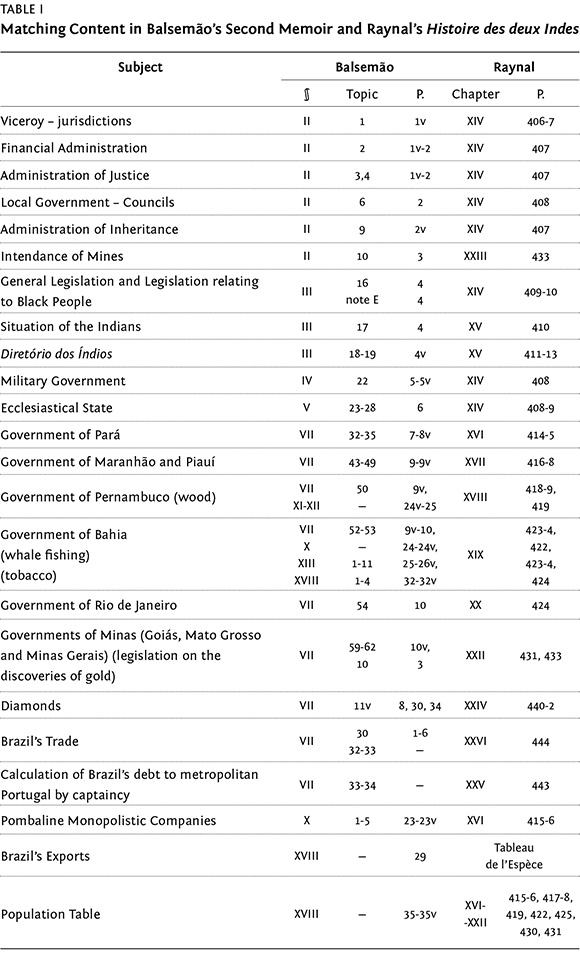
]]> There has been much discussion of the meaning of others’ contributions incorporated in the pages of the Histoire des deux Indes (Courtney and Mander, 2015, pp. 1-18), whether these be books, responses to questionnaires or entire sections redrafted, with Raynal publicly posing as their author. [55] Do such appropriations constitute plagiarism, as was asserted at the time and as was suggested by one who knew the Abbé’s work very well [56] ? To answer this question, we must take into account the forms of writing which were current at the time, based as they were on notions of authorship different from those which would prevail in the nineteenth century, with the borderlines between individual and collective contributions being substantially more fluid. It is accordingly a work of compilation which incorporates different contributions in a particular way, often giving them new meanings and interpretations. This can be seen in the case of Balsemão’s papers.Balsemão’s two texts transformed, and were transformed, on being incorporated in the 1780 edition. The second text at least was produced directly in response to Raynal’s requests and, even though it was rewritten, was used almost in its entirety, increasing the number of chapters (from 17 to 31) in the new edition by comparison with the previous [57] , profoundly altering their structure and, above all, the nature of the topics covered. As we have highlighted earlier, in the first edition of 1770 the Amerindians were in the front line of topics covered, with almost 87 % of the total number of pages, that percentage drops to around 40 % in the 1780 edition. [58] The sequence of the topics covered, previously more chronological-historical, became markedly thematic, adopting to a considerable extent the organization of Balsemão’s chapter titles, starting with the government and then expounding on each captaincy. The incorporation of the ambassador’s texts is the main difference between the editions and is sufficient to transform the whole work. In the final version of the Histoire des deux Indes, most of the text on Brazil is a copy or version of the information supplied by Balsemão, as shown in Table I.
As far as the first Memoir is concerned, questions relating to the borders between Portugal and Spain are mentioned in the three editions of Raynal’s Book 9, grosso modo being given the same amount of space, even if it is slightly less in the final edition. [59] The historical theme linking and starting the discussion is also the same in all three. It is the Jesuit missions, which are seen as a factor in the protection of the natives against the greed of the colonists, both in Amazônia, and in the southern region of Brazil. It is the mention of the latter which introduces the border disputes, focusing especially on the Colony of Sacramento, and bringing the Spanish in as actors in that conflict. These coincidences do not occur in connection with the interpretation of the events mentioned, even though they are mostly the same.
Between the first two editions, on the one hand, and the last, on the other, there is a clearly perceptible distinction, with changes in the tone of the interpretation. In terms of content, the 1780 edition advances the chronology beyond the Treaty of El Pardo, in 1761, to the recent negotiations of 1777 and 1778, thanks to Balsemão’s information. In the first two editions, the text opposes the Jesuits to the natives, on the one hand, and to the Portuguese on the other, also outlining the opposition between the Portuguese and the Spanish, with a clear preference for the latter in describing the treaties made and the conflicts which followed. For example, the Indians are described as “braves” (warriors); the war which united the two powers against the Jesuits and the Indians “gave rise to a large number of cabals, in which the Jesuits were regarded as instigators or actors”, [60] producing resentment against the Jesuits in both Kingdoms which threatened the missions; the handing over of the Colony of Sacramento to the Portuguese at the Treaty of Utrecht “demanded great sacrifice of Spain” and opposition to the Treaty of Madrid “found censors in both courts”, [61] holding the two Crowns responsible for its failure (Raynal, 1770, pp. 370-373 and 1774, pp. 366-370). The 1780 edition has less detail, although it takes up the theme of the Amerindians resisting the Iberian powers. It also corrects some references on the basis of Balsemão’s arguments in his Memoir concerning the territorial disputes with the Spanish in southern Brazil, even though not clearly taking one side or the other. First, he backdates the settling of the Luso-Brazilians on the south bank of the river Plate to the middle of the sixteenth century (1553) rather than 1679, as was stated in earlier editions, in this way reinforcing their right of occupation vis-à-vis the Spanish. He now presents the arguments of both sides and not just the Spanish, mentioning the Portuguese allegations that the subsequent treaties annulled Tordesillas. He argues that during the War of the Spanish Succession, “the Portuguese were again expelled from Saint-Sacramento in 1705” [62] , but that the treaty of Utrecht granted them exclusive rights over the territory of the Colony. He highlights the resistance of the Guarani Indians and the subsequent impossibility of handing over to the Portuguese the territories agreed on in the Treaty of Madrid, leading to its cancellation in 1761, when “everything reverted to the earlier confusion”. [63] Lastly, he argues that the treaties of 1777 and 1778, without England’s help, dispossessed the Portuguese of the Colony of Sacramento, but restored to them the Rio Grande de São Pedro (Raynal, 1780, pp. 401-404).
Balsemão’s Second Memoir, on Brazil, opens with a remarkably well summarized, precise and discreetly apologetic description of the organization of the government of Brazil, which is adopted almost literally by the Abbé, occupying a fair number of pages in which, as we have mentioned above, even the corruption proverbially attributed to the governors of the captaincies is a thing of the past (Furtado and Monteiro 2016, pp. 761-765). The language used by both of them includes references to “colony” and “metrópole (mother country)”. The ambassador’s text asserts that the laws applied in Brazil were the same as those applied in metropolitan Portugal”, including those applying to the slaves, because “we have no Code for Blacks at all” [64] (p. 2), information which is repeated by Raynal.
What follows, in both, is probably the first known defence of the specific type of slavery existing in Brazil: black slaves could buy their freedom, and a request to do so was rarely refused by their masters (p. 4), in which circumstance they were allowed to work on Sundays and holidays on land ceded by the master (p. 4, note e) - an early description of that which later came to be called by the Luso-Brazilian Historiography as the Brecha Camponesa (Peasant Breach); the law was said to protect them, and even if the domestic rule of the masters was very rough and sometimes tyrannical, it was not as bad as in the French and British (Caribbean) islands, according to information the Portuguese ambassador had received on them. At the end of Balsemão’s Memoir, where he submits figures on Brazil’s population, excepting the “savage” Indians, whose numbers almost doubled it, negroes and mulattos were estimated to represent around 43 % of the total, but he adds that most of these would have been free, especially the women. It seems legitimate to conclude that this information on Brazil, disseminated by Raynal, had an impact on all future generations who read it and who at least in part reproduced it. [65]
In fact, Raynal’s comments on the governing of the “Indians” are equally suggestive, although much less unilinear in comparison to the ambassador’s Memoir, since the latter is clearly critical of the Diretório dos Índios, cooling the open enthusiasm expressed for that Pombaline creation (although it was never explicitly identified as such, and Pombal never named) in the Abbé’s earlier editions. All things considered, Balsemão had a none too happy experience with that system. While he was in office he made several raids, and brought Indians into the Portuguese settlements, in a total of 9 villages of domesticated Indians (Carvalho, 1996, v. 1, pp. 121-122). Despite his care “in not allowing them to be annihilated”, he concluded that “in our experience these colonies hold out little promise of increase when the Indians are transported far from their natural homes” (Carvalho, 1996, v. 2, pp. 197-200). [66]
]]> Promoted to London by Pombal after his experience in Mato Grosso, Balsemão ensured his positions after the fall of Pombal were discreetly contained, but he never emphatically rejected his legacy (Silva, 2002, pp. 188-189). In this connection his critical view of the Diretório dos Índios is as surprising as it is remarkable. As far as he was concerned, settlers had the same privileges, freedoms and concessions as the inhabitants of the kingdom (“reinícolas”) and were entitled to the same access as the latter to military and civilian positions. But the Diretório, which operated mainly in the government of Pará, where settlements were more numerous, by reason of “a residual prejudice which the Jesuits had introduced” [67] prolonged their subjection in the person of the Director of the Indians. He pointed out that “this kind of guardianship makes them incapable of governing by themselves” He concluded, based on his own experience, that those who were not subject to “this barbarous supervision”, [68] became more industrious, learned the rudiments of property, and were better qualified to become civilized (f. 4v)! At a time when Portuguese politics was undoubtedly in the balance (how much would remain of the legacy of the reign of D. José, who had supported Pombal?), this was a reasonably ambivalent position. But his value judgement might have detracted from Raynal’s flattering discourse on these matters, which derived from the earlier editions (Furtado and Monteiro, 2016, pp. 766-772).Nevertheless, the Histoire des deux Indes kept up this laudatory discourse on the Diretório and, as far as the Indians are concerned, announced that “the government at this time declared them to be citizens”, [69] which occurred after 1755, when “all Brazilians [70] became truly free”, concluding that this was “a revolution favouring humanity”. [71] (Raynal, 1780, p. 411). There can be no doubt that one of his sources for this reversal of his opinion was Letter 9 of the Letters from Portugal (1777), from which he borrows information and expressions, even though he does not name the minister. It reads that Pombal “passed a decree, declaring every native of Brazil to be as free as a native of Portugal”. And, like Raynal after him, the author celebrates that “humane act, by which thousands of mankind were restored to the enjoyment of the privileges of human nature” [72] . Praise for the Diretório, on this point, distances Raynal’s text from the negative impressions of the disillusioned ex-governor of Mato Grosso.
On one very significant point, Balsemão did not change, nor did he intend to change, Raynal’s opinions: this is the question of the monopoly trading companies of Brazil. From the outset the Abbé had been strongly influenced by the ideas of the so-called “Gournay School” circle and in particular by Véron de Forbonnais: he was opposed to the trading companies and in favour of free trade between merchants of each power, without however questioning the exclusivity of trade between the mother country and the colony. [73] Now when Balsemão writes his Memoirs it had already been known for some time in diplomatic circles that the Brazilian companies were going to be abolished [74] , although the Grão Pará and Maranhão companies were only abolished in January 1778 and the Pernambuco and Paraíba in 1780, when their exclusive rights expired. Balsemão paints a very critical picture of the impact of the first of these, stating that trade had fallen off after it had been established and that “the company has not set up any useful establishment there” [75] (fl. 23). But he did not announce its abolition. Thus the new 1780 edition of the Histoire des deux Indes leaves unaltered the earlier chapter which violently condemned those Pombaline monopoly trading companies, and he attacked them in the name of free trade.
Three excerpts from the Histoire des deux Indes are representative of how objective, apparently neutral and even laudatory information in Balsemão’s Memoir was used to express value judgments favoured by the group of enlightened men around him: in section §V, “Of the Ecclesiastical State of Brazil”, [76] item 27, the ambassador explains, with no sign of condemnation, that in Minas Gerais it is customary for priests to receive more for the same functions performed in other captaincies. On the basis of that statement, Raynal records that “The greed of the priests went so far as to double this shameful salary in the mining region” [77] (Raynal, 1780, p. 409). This mention of the priests’ greed, not found in the original text, echoed the critiques, much loved by Diderot and his group, of the Catholic church and the clergy.
In his description of the products and wealth of the Piauí captaincy, Balsemão makes positive references to the significant horse trade as the engine of the local economy, its animals being sent in troops to the Maranhão, Bahia and mainly Minas Gerais (p. 9, item 46). He explains, however, that they leave before the hot season, because at that time the heat and drought in the country kill the grasses and, if they were to stay there, the animals would die in large numbers. Raynal rewrites these notes, repeating most of the expressions used, but changes their meaning by asserting that on account of the dryness of the land, entire troops of horses and beasts frequently die “when care is not taken to drive them in time to far-off pastures”. “As in the rest of Brazil”, [78] even sheep degenerate, a phenomenon not observed only in Curitiba, in the far south, a region with a colder climate (Raynal, 1780, p. 417). This echoes the ideas of Count Buffon who, in De la dégénération des animaux (1766) (Rico, 2015, pp. 137-138), argues that the world is divided into temperate and torrid zones, holding that, in the latter, animals and plants degenerate, a view not shared by the ambassador, who sought to reveal a colony rich in its natural products.
Finally, Balsemão offers a “Calculation of the debts of Brazil to the mother country and vice-versa”, and analyses the financial situation in each captaincy (pp. 33-34). His figures reveal that Brazil’s debts to metropolitan Portugal were almost equal to the amount of Portugal’s debts to Brazil, for which he blames the high costs of defending the extreme South and West (against Indians - the Guaranitic War - and the Spanish) and the North (against the French) for once again draining the wealth produced in the colony. Raynal offers the same data and even similar observations on the financial burden of those wars. However, his main purpose is to condemn the exorbitant taxes, exclaiming that “the vexations have been taken even further in America” [79] ! He echoes the central thesis of the Histoire des deux Indes on the unjust exploitation of the colonies by the metropolitan powers, in what was read as a libel in favour of their independence.
FINAL NOTES
Luís Pinto the minister plenipotentiary at the London court was no doubt far more concerned with the frontiers, maps and borders of Brazil and with relations with the neighbouring Spanish, topics he had addressed in the first Memoir and in long passages of the second, than with any other issues. On other matters, the main features of the notes he sent to Raynal to inform and influence him, after receiving express permission to do so from his Secretary of State, were that they matched the Abbé’s questions, revealed a propensity for the “statistics” appropriate to the time, as found in other Portuguese diplomats who collaborated with the Abbé, and were intended to generate a positive impression of the Portuguese dominions by a means of communication which was known to reach many European publics and governments. The writings he submitted on slavery and manumission, on the freedom of the Indians and on the government of Brazil were guided by the aim of conveying, with the widest possible array of figures and plausible information, the image of a well “policed” territory, that is to say, in the sense of the term at the time, a properly ordered one. As far as we know, Balsemão had no systematic ideas for reform in these areas and never subsequently revealed what had aroused in a Secretary of State such consistent concern with these matters. Unlike relations with neighbouring Spain, which pursued him to the end of his days.
Meanwhile the Histoire des deux Indes, beyond the argument over the borders of Brazil, ended up ensuring a diffuse but significant future life to the most systematic, well-argued and apologetic description of Portuguese government in America produced in the eighteenth century. A few pages written by the Portuguese ambassador in London were very widely disseminated thereafter, particularly in connection with the alleged mildness of slavery and the benign nature of the governing of colonial Brazil. Even though they had been submitted in French [80] , those views were “translated”, that is to say, appropriated and disseminated in a variety of public spaces then undergoing major expansion. [81]
]]> REFERENCES
ABRANTES, M. (1736), “Lista dos fogos e almas que há nas terras de Portugal, no ano de 1732, pelo Marquês de Abrantes, censor e diretor da Academia Real, e julgada por ele a mais exata”. In L. C. de Lima, Geografia Histórica de todos os Estados Soberanos de Europa, Lisboa, Na Oficina de Joseph Antonio da Sylva, vol. II, pp. 475-710.
ALIMENTO, A. (2015), “Entre rivalité d’émulation et liberté comerciale: la presence de l’école de Gournay dans l´Histoire des deux Indes”. In C. Courtney, J. Mander (eds.), Raynal’s “Histoire des deux Indes”: Colonialism, Networks and Global Exchange, Oxford, Oxford University Studies in the Enlightenment, pp. 59-71.
ALMODOVAR, D. de (1784), Historia politica de los establecimientos ultramarinos de las naciones europeas, Madrid, Imprenta de Sancha, vol. I. [ Links ]
ASPINALL-OGLANDER, C. (1942), Admiral’s Widow, being Life and Letters of the Hon. Edward Boscawen from 1761 to 1805, London.
BOMBELLES, M. de. (1979), R.Kann (ed.), Journal d’un ambassadeur de France au Portugal, 1786-1788, Paris, PUF.
BONNE, R. (1780), “Analyse succinct de cet Atlas”. In Atlas de toutes les parties connues du globe terrestre: dressé pour l’histoire philosophique et politique des établissements et du commerce des Européens dans les deux Indes de Guillaume Thomas Raynal, Genève, J.-L. Pellet, pp. 5-25.
BORRALHO, M. L. (2008), “Por acaso hum viajante”: a Vida e a Obra de Catarina de Lencastre, 1.a Viscondessa de Balsemão (1749-1824), Lisbon, Imprensa Nacional.
BOSCHI, C. C. (2007), “Estudo introdutório”. In J. J. T. Coelho, Instrução para o Governo da Capitania de Minas Gerais (1782), Belo Horizonte, Secretaria de Estado de Cultura/Arquivo Público Mineiro and Instituto Histórico e Geográfico Brasileiro, pp. 21-150.
]]> BOXER, C. (ed.) (1983), “Descriptive list of the state papers Portugal 1661-1780”. In The Public Record Office London, vol. III (1759-1780), Lisbon, Academia da Ciências de Lisboa.BROWN, A., LÜSEBRINK, H. J. (dirs.) (2018), Guillaume-Thomas Raynal, Histoire philosophique et politique des établissements et du commerce des Européens dans les deux Indes. Édition critique, vol. II, Paris, Centre International d’Étude du XVIII.e Siècle.
CARDIM, P., MONTEIRO, N. G., FELISMINO, D. (2005), “A diplomacia portuguesa no Antigo Regime. Perfil sociológico e trajetórias”. In N. Monteiro, P. Cardim, M. S. da Cunha (eds.), Optima Pars, pp. 277-337.
CARVALHO, M. L. M. M de (1996), A Capitania de Mato Grosso durante o Governo de Luís Pinto de Sousa (1769/1772), 2 vols., Lisboa, Faculdade de Letras da Universidade de Lisboa. [ Links ]
CESAR, G. (1970), História do Rio Grande do Sul, Porto Alegre, Ed. Globo. [ Links ]
COURTNEY, C., MANDER, J. (2015), “Introduction”. In Raynal’s ‘Histoire des Deux Indes’: Colonialism, Networks and Global Exchange, Oxford, Oxford University Studies in the Enlightenment, pp. 1-18.
DINIZ SILVA, A. M. (2002), Portrait d’un homme d’État D. Rodrigo de Souza Coutinho, Comte de Linhares (1755-1812), vol. 1, Lisbon, Fundação Calouste Gulbenkian.
DINIZ SILVA, A. M. (2006), Portrait d’un homme d’État: Dom Rodrigo de Souza Coutinho, Comte de Linhares (1755-1812), vol. II, Lisbon, Fundação Calouste Gulbenkian.
]]> DU ROZOIR, C. (1824), “Raynal”. In L. G. Michaud (ed.), Biographie Universelle, Ancienne et Moderne, t. 37, Paris, Michaud, pp. 168-183.ETTE, O. (1995), “Diderot et Raynal: l’œ, l’oreille et le lieu de l’écriture dans l’histoire des deux Indes”. In H.-J. Lüsebrink, A. Strugnell (eds.), L’Histoire des deux Indes: réécriture et polygraphie, Oxford, Voltaire Foundation, pp. 385-407.
FEUGÈRE, A. (1922), “L’art d’utiliser les livres: Plagiat et fantaisie”. In Un précurseur de la révolution, l’abbé Raynal, 1773-1796: documents inédits- Primary Source Edition, Angouléme, Impremerie Ouvrière, pp. 201-231.
FEUGÈRE, A. (1970), “L’art d’utiliser les homes: Raynal et ses collaborateurs”. In L’abbé Raynal: un précurseur de la Révolution, Genève, Slatkine Reprints, pp. 175-200.
FORTES, G. J. B. F. (1941), Rio Grande de São Pedro (Povoamento e Conquista), Rio de Janeiro, Gráficos Bloch. [ Links ]
FURTADO, J. F. (2012), Oráculos da Geografia Iluminista: D. Luís da Cunha e Jean Baptiste Bourguignon D’Anville na Construção da Cartografia do Brasil, Belo Horizonte, Ed. UFMG.
FURTADO, J. F., MONTEIRO, N. G. (2016), “Os Brasis na Histoire des Deux Indes do Abade Raynal” / “The Different Brazils in Abbé Raynal’s Histoire des Deux Indes”. Varia Historia, 32(60), pp. 731-777.
GAIO, M. J. da C. F. (1992), Nobiliário das Famílias de Portugal, Braga, Carvalho do Basto, vol.VIII, n.º 17. [ Links ]
]]>GARCIA, J. C. (ed.) (2011), Cartografia do Brasil na Biblioteca Pública Municipal do Porto, Porto, Biblioteca Pública Municipal do Porto and Departamento de Geografia da Faculdade de Letras da Universidade do Porto (CD-Rom). [ Links ]
GODINHO, V. M. (1955), Prix et monnaies au Portugal, Paris, Armand Colin. [ Links ]
GOGGI, G. (1987), “Voyage de Raynal en Angleterre et en Hollande”. Recherches sur Diderot et sur l’Encyclopédie, 3, pp. 86-117.
GOGGI, G. (2000), “Autour du Voyage de Raynal en Angleterre et en Hollande: la troisième édition de l’Histoire des Deux Indes”. In G. Bancarel, G. Goggi (eds.), Raynal: de la polémique à l’histoire, Oxford, Voltaire Foundation, pp. 371-425.
GOGGI, G. (2010), “L’abbé Raynal et un questionnaire sur le Portugal et sur le Brésil”. Studi Settecenteschi, 27-28, pp. 285-316.
GOGGI, G. (2018), “L’exemplaire Hornoy de H80 in-quarto et les contributions de Diderot délimitées para Mme de Vandeul”. In A. Alimento, G. Goggi (eds.), Autour de l’abbé Raynal: genèse et enjeux politiques de l’Histoire des deux Indes, Paris, Centre International d’étude du XVIIIe Siècle, pp. 569-595.
ISRAEL, J. (2011), Democratic Enlightenment. Philosophy, Revolution, and Human Rights (1750-1790), Oxford, Oxford University Press. [ Links ]
]]>LABOURDETTE, J.-F. (1988), La nation française à Lisbonne de 1669 a 1790: entre Colbertisme et Liberalisme, Paris, Fondation Calouste Gulbenkian. [ Links ]
MACKINLAY, A. (2011), El best-seller que cambió el mundo. Globalización, colonialismo y poder en el Siglo de las Luces, Amazon for Kindle. [ Links ]
MAXWELL, K. (1973), “The generation of the 1790s and the idea of the Luso-Brazilian empire”. In D. Alden (ed.), Colonial Roots of Modern Brazil. Papers of the Newberry Library Conference, Berkeley, University of California Press.
MATOS, P. T. de (2016), “Counting Portuguese colonial populations, 1776-1875: a research note”. The History of Family, 21(2), pp. 267-280.
MENDES, J. M. Amado (1980), “Memória sobre a província do Minho pelo 2.º Visconde de Balsemão”. Revista Portuguesa de História, 18(31), p. 105.
MENDONÇA, M. C. de (1985), Rios Guaporé e Paraguai: Primeiras Fronteiras Definitivas do Brasil, Rio de Janeiro, Xerox do Brasil. [ Links ]
MONTEIRO, N. G., CARDIM, P., CUNHA, M. S. da (eds) (2005), Optima Pars: Elites Ibero-Americanas do Antigo Regime, Lisboa, ICS. [ Links ]
PAGDEN, A. (2013), The Enlightenment and Why it Matters, Oxford, Oxford University Press. [ Links ]
PAQUETTE, G. B. (2007), “Enlightened narratives and imperial rivalry in Bourbon Spain: The case of Almodóvar’s historia politica de los estabelecimentos ultramarinos de las naciones Europeas (1784-1790)”. The Eighteenth Century, 48(1), pp. 66-67.
PEREIRA, E., RODRIGUES, G. (1904/1915), “Balsemão (Luís Pinto de Sousa Coutinho, 1.° visconde de)”. In J. R. Torres (ed.), Portugal - Dicionário Histórico, Corográfico, Heráldico, Biográfico, Bibliográfico, Numismático e Artístico, Lisboa.
PUNTONI, P. (2004), “Bernardo Vieira Ravasco, secretário do Estado do Brasil: poder e elites na Bahia do século XVII”. Novos Estudos, CEBRAP, 68, pp. 107-126.
QUÉRARD, J. M. (1835), La France littéraire ou dictionnaire bibliographique des savants, Paris, Firmin Didot, volume VII. [ Links ]
RAYNAL, G. (1770), Histoire philosophique des établissements et du commerce des Européens dans les deux Indes, Amsterdam, s. e., 9 volumes. [ Links ]
]]>RAYNAL, G. (1780), Histoire philosophique des établissements et du commerce des Européens dans les deux Indes, vol. 9, Genève, J.-L. Pellet. [ Links ]
ROBERTSON, W. (1817), “The history of America”. In Works of William Robertson, vol. 9, London, Cadell and Davis.
SILVA, J. J. da C. R. da (2002), “Luís Pinto de Sousa Coutinho: ‘an English gentleman’”. In Ideário Político de uma Elite de Estado: Corpo Diplomático (1777/1793), Lisboa, Calouste Gulbenkian, pp. 187-312.
SILVA, J. J. da C. R. da (2006), “A guerra da independência dos EUA e os diplomatas portugueses. Luís Pinto De Sousa Coutinho e os primórdios do conflito (1774-1776)”. In Actas do XV Colóquio de História Militar -Portugal Militar nos Séculos XVII e XVIII até às Vésperas das Invasões Francesas, Lisboa, Comissão Portuguesa de História Militar, pp. 913-928.
SILVA, J. J. da C. R. da (2012), “Alguns livros científicos (sécs. XVI e XVII) no ‘Inventário’ da Livraria dos Viscondes de Balsemão”. Ágora, Estudos Clássicos em Debate, 14(1), pp. 131-158.
SILVEIRA, M. A. (2016), “Um olhar ilustrado sobre os domínios coloniais: as notas do visconde de Balsemão endereçadas ao abade Raynal”. Apresentação oral no Colóquio A Globalização das Luzes, Belo Horizonte / Ouro Preto, UFMG/UFOP.
STRUGNELL, A. (1991), “La réception de l’HDI en Angleterre au XVIIIe siècle”. In H.-J. Lüsenbrink, M. Tiez (eds.), Lectures de Raynal: l’Histoire des deux Indes en Europe et en Amérique au XVIIIe siècle, Oxford, Voltaire Foundation, pp. 253-263.
TIEZ, M. (1995), “La vision corrélative de l’Espagne et du Portugal dans les trois versions de l’Histoire des deux Indes”. In H.-J. Lüsenbrink, A. Strugnell (eds.), L’Histoire des deux Indes: réécriture et polygraphie, Oxford, Voltaire Foundation, pp. 263-267.
TOURNEUX, M. (1880), Correspondance Littéraire, Philosophique et Critique par Grimm, Diderot, Raynal, Meister, etc., vol. XII, Paris, Garnier. [ Links ]
ULLOA, A. de (1776), Dissertation historique et géographique sur le méridien de démarcation entre les domaines d’Espagne et de Portugal, Paris, A. Boudet.
VILLAVERDE RICO, M. J. (2015), “La conquista y colonización de la América española, según la historia de las dos Indias del abade Raynal”. In F. C. Urbano (ed.), Visiones de la conquista y la colonización de las Américas, Alcalá, Universidade de Alcalá, pp. 107-140.
WOLPE, H. (1957), Raynal et sa machine de guerre: l’histoire des deux Indes et ses perfectionnements, Stanford, Stanford University Press.
Received at 02-04-2018.
Accepted for publication at 06-07-2018.
[1] See the critical edition of the volume (Brown, Lüsebrink, 2018), published after acceptance of this article.
[2] The term was used by Wolpe (1957).
]]> [3] Cf. Goggi (2010, pp. 296-297), who describes various episodes in the relationship between the two.[4] “In Britain he [Luís Pinto de Sousa Coutinho] had provided William Robertson with information of South America for Robertson’s famous history, a service he had also provided for Abbé Raynal some years earlier” (Maxwell, 1973, pp. 107-144; Goggi, 2010, pp. 298-299). In fact, as Goggi also suspected, his collaboration with Robertson precedes that which he had with Raynal.
[5] Both of these are in the Ajuda Library. The location of one of them was given to us by Marco Antônio Silveira, whom we thank (Silveira, nov. 2016). However, this document had already been cited by Borralho, 2008, p. 58, note 79. We are grateful to the Library Director, Cristina Pinto Basto, for the prompt reproduction of these documents.
[6] Cf. Cunha, Monteiro (2005) and Cardim, Monteiro, Felismino (2005) in Monteiro, Cardim and Cunha (2005, pp. 191-252 and pp. 277-337).
[7] Many of the biographical notes mention that he studied mathematics at Coimbra, but this is not confirmed by the records consulted; in fact, it was his son and heir Luís Máximo, later the 2nd Viscount and a notable scholar sometimes confused with his father, who attended those classes (PT/AUC/ELU/UC-AUC/B/001-001/C/014067) (cf. Mendes, 1980, 105).
[8] Based on contemporary records, which are sometimes slanderous, but are more credible than the anachronisms of later sources.
[9] Following on from the pioneering works of Puntoni (2004) and Boschi (2007), the topic has been much researched in historiography on Brazil.
[10] “J’ai appelé à mon secours les hommes instruits de toutes les nations. J’ai interrogé les vivants et les morts: les vivants dont la voix se fait tendre à mes côtes”.
[11] “(…) sobre un punto hay pocas dudas: Raynal intenta establecer relaciones con personas en posición de liderazgo - ministros, administradores, comerciantes”.
[12] “Una fuente contemporánea registra sus ‘almuerzos filosóficos’ semanales, a los cuales ‘asistía todo lo que había de más ilustre en París entre embajadores y viajeros que se encontraban en la capital”.
]]> [13] Cf. Ette (1995, p. 393). The first known Questionnaire from Raynal was sent to Benjamin Franklin, in 1773, and concerned the United States of America (Mackinlay, 2011, position 909).[14] “Si no es posible obtener todos esos conocimientos con seguridad geométrica, habrá que contentarse con tenerlos por aproximación”.
[15] Cf. Goggi (1987, pp. 86-117; 2000, pp. 371-425). “This new edition, moreover, offers some precise articles, full of interest, which had been provided on the British colonies and on China during a journey he had made earlier to Holland and England / Cette nouvelle édition, du reste, offre quelques articles exactes et pleins d’intérêt qui avaient été fournis sur les colonies anglaises, hollandaises et sur la Chine dans un voyage qu’il avait fait précédemment en Hollande et en Angleterre.” (Quérard, 1835, t. VII, pp. 60-61). “During the journey he made to London to put the finishing touches to his work / Pendant le voyage qu’il avait fait à Londres pour perfectionner son ouvrage.” (Du rozoir, 1824, t. 37, p. 175 and Goggi, 2000, p. 372).
[16] Cf. Goggi (2000, pp. 371-385) and Strugnell (1991, pp. 253-263).
[17] Cf. Goggi (2000, pp. 298-302).
[18] Robertson (1817, v. 9, pp. XIV-XV); “M. le Chevalier de Pinto, who resided several years in a part of America which Ulloa never visited, gives a sketch of the general aspect of the Indians there”; “M. le Chevalier de Pinto observes, that in the interior parts of Brazil, he had been informed that some persons resembling the white people of Darien have been found”; “M. le Cheval. De Pinto, MS. penes me”. “Actual possession (says a missionary who resided several years among the Indians of the Five Nations) gives a right to the soil, but, whenever a possessor sees fit to quit it, another has as good right to take it as he who left it” (Robertson, 1817, v. 9, pp. 373, 380, 396).
[19] Cf. Aspinall-oglander, 1942, pp. 87-88. Reported in a letter from Mrs Chapone to Mrs Carter dated 30 July (Goggi, 2010, pp. 300-301 and Goggi, 2000, pp. 380).
[20] “Un des hommes le plus éclairées qui aient jamais vécu dans le Brésil”.
[21] Arquivos Nacionais da Torre do Tombo (ANTT), Ministério dos Negócios Estrangeiros (MNE). Legação de Londres (LL). Livro 703, 02-05-1778.
[22] Cf. Silva (2002, pp. 196-204) and Cesar (1970, pp. 168-199); and Silva ( 2002, pp. 216-234; 2006, pp. 913-928).
]]> [23] On 26-04-1775, Pombal gave the Marquis of Lavradio, commander of the Portuguese forces, the order for the offensive, and this led to “a new and more urgent Order, with which our Master (King) orders Your Excellency without delay to seek to expel and throw the Castillians out of the fortresses on the south side of the Rio de São Pedro and the town of the same name / resultou a nova, e mais urgente Ordem, com que o mesmo Senhor [Rei] manda por esta participar a V. Exa., que sem a menor perda de tempo procure V. Exa. expugnar e Lançar os Castelhanos fora das Fortalezas do Lado Meridional do Rio de São Pedro e da Villa do mesmo nome” (Cf. Fortes, 1941, p. 98).[24] D. Vicente de Sousa Coutinho from Paris and Horace Walpole in London told him that “it became known in France that the Portuguese troops laid waste to the fort of Santa Tecla in southern Brazil and that the hostilities continued from the Portuguese side despite the order to suspend them / na França soube-se que as tropas portuguesas arrasaram no sul do Brasil o forte de Santa Tecla e que as hostilidades continuaram sempre da parte portuguesa a despeito das ordens suspensivas”. He replied that the lack of dates made it difficult to know who was in the right, but that destruction of a Spanish fort which had been built in the Portuguese part was justified. Walpole in turn responded with a lengthy reflection that this could lead to war in America and Europe. ANTT. MNE. LL. Livro 702, 14-01-1777.
[25] “(…) I planted obstacles in every way possible, so as to bring the time periods together and save appearances / Semei por todos os modos os obstáculos para aproximar as épocas e poder salvar as aparências”. ANTT. MNE. LL. Livro 702, 30-07-1776.
[26] Balsemão was astonished that the conquest of Santa Catarina took place “with the most unusual and most extraordinary ease, which not even the Spanish expected, and which not even we here had reason to fear /com a mais rara e extraordinária facilidade, que nem os espanhóis esperavam, nem aqui havia motivo de recear”. ANTT. MNE. LL. Livro 702, 15/8/1777.
[27] Balsemão told the English minister Weymouth that Portugal would never restore by indecorous means the least part of its Dominions, which have been uncontested possessions for centuries, that a definitive treaty had restored them, and “that my Court has acquired an irrevocable jus publico in the eyes of the whole of Europe / que a minha Corte tinha adquirido um jus publico e inderrogável na face de toda a Europa”. ANTT. MNE. LL. Livro 702, 20-05-1777.
[28] “Inglaterra tem adotado no ministério presente a máxima geral de olhar com indiferença a todos os negócios externos; e de se cingir unicamente aos próprios”. ANTT. MNE. LL. Livro 702, 08-04-1777.
[29] Balsemão comments: “The [English] minister said that the recent disputes were the result of mutual jealousy and should cease, and that England could not help in that quarrel in which Portugal had secured the opposite of what it practised / O ministro [inglês] disse que as disputas recentes eram resultantes de um ciúme reciproco e que deviam se extinguir e que a Inglaterra não nos podia socorrer naquela querela na qual tinha segurado o contrário daquilo que praticamos”. ANTT. MNE. LL. Livro 702, 08-02-1777.
[30] First secret reports sent to Balsemão in ANTT. MNE. LL. Livro 702, 17-06-1777; 15-08-1777. “Carta do reino anunciando que o Tratado de Limites foi assinado com a Espanha e que devido ao desprezo da Inglaterra alguns pontos que a desagradarão foram assinados / Letter from the King announcing that the Border Treaty with Spain had been signed and that due to England’s contemptuous neglect some points which would displease it had been signed” ANTT. MNE. LL. Livro 702, 08-10-1777.
[31] In fact it seems certain that reports of the fall of the Colony of Sacramento reached the British government almost at the same time as those which gave news of the treaty between Spain and Portugal, in other words, at the end (27) of September and the beginning (8) of October 1777 (cf. Boxer, 1983, v. III, pp. 226 ff.), in the latter case at the same time as the Portuguese minister received them.
[32] According to Balsemão: “The English Court is showing signs of mistrust over the border negotiations, and it is generally felt that Portugal will sign the Family Compact beforehand / a Corte da Inglaterra mostra desconfiança com as negociações de limites e é língua geral que Portugal irá previamente aceder ao Pacto de Família”. ANTT. MNE. LL. Livro 702, 08-07-1777.
]]> [33] “Pedro Francisco Jiménez de Góngora y Luján (1727-1796), later elevated to title of the Duke of Almodóvar, was director of the Royal Academy of History from 1791 until his death in 1796” (Paquette, 2007, pp. 66-67).[34] “Des documents sur les possessions espagnoles, lui avaient été aussi communiqué par M. d’Aranda, ministre du roi d’Espagne / Documents on the Spanish possessions had also been transmitted to him by M. d’Aranda, minister of the king of Spain” (Quérard, volume VII, p. 474).
[35] “(…) algunos debates (…) sobre la injusticia con que nos había tratado en su Historia de las Indias”.
[36] As can be seen in the introduction to the Spanish translation and adaptation of Raynal made under his auspices (Almodovar, 1784).
[37] “(…) um pedantífico (sic) e sofístico Livro ou Manifesto que o Conde de Aranda tinha feito estampar em Paris sobre a Demarcação dos Domínios das Duas Monarquias”. ANTT. MNE. Paris Legation. Livro 699.
[38] “levantava a voz”. ANTT. MNE. LL. Livro 702, 30-07-1776.
[39] “Só posso acrescentar que observo o público há dias em grande agitação a Nosso respeito, e que não obstante os impropérios que se têm semeado nas Gazetas contra Portugal, para alienar os espíritos da Nossa Causa será uma obra muito árdua de se conseguir sem grandes consequências”. ANTT. MNE. LL. Livro 702, 12-11-1776.
[40] “(…) termômetro que não anuncia bom tempo”. “The ministry fears that the news which may come from Brazil and that Portugal may demonstrate to the pubic the rightfulness of its position / O ministério teme as notícias que podem chegar do Brasil e que Portugal venha a manifestar ao público as razões de sua justiça” ANTT. MNE. LL. Livro 702, 08-02-1777.
[41] “muitas pessoas vão espalhando nessa Corte que as hostilidades continuam sempre no sul do Brasil”. ANTT. MNE. LL. Livro 702, 04-02-1777.
[42] Balsemão on 2/5/78 (ANTT. MNE. LL. Livro 703). D. Francisco Inocêncio, in Madrid, requested permission in ANTT. MNE. Madrid Legation. Livro 631, n.º 49, Aranjuez, 08-06-1779.
]]> [43] “La partie historique est infiniment plus exacte, particulièrement dans tout ce qui concerne les colonies d’Espagne et du Portugal, sur lesquelles l’auteur a eu d’excellents mémoires qui lui ont été communiqués par M. le comte d’Aranda et par M. de Souza”.[44] In fact, unlike Diderot’s, Raynal’s ideas on empire and economic relations between the metropolitan powers and their colonies were clearly derived from the so-called “Gournay school” and, in the final analysis, assumed the possibility of reconciling the two sides of the equation (Alimento, 2015, pp. 59-71).
[45] ANTT. MNE. LL. Livro 703, 02-05-1778.
[46] Ajuda Library (Biblioteca da Ajuda) (BA). 54-XI-27 (11). It is made up of 10 unnumbered folios (cover and 17 pages of text), which were subsequently allocated numbers 85 to 100. It is divided into 4 parts: Introduction, paragraphs 1, 2, 3 (in Arabic numbers) and Conclusion. It can be dated to the first quarter of 1778, since the most recent event mentioned in it, the new Treaty of El Pardo, had taken place on “11 Mars 1778” (11 March 1778). That date, and the order to send out the memoir allow us to draw the conclusion that it was finished and sent sometime in May of that year.
[47] This argument was set out by ambassador D. Luís da Cunha, in the first half of the century, taking into account the reflections of the French geographer Jean Baptiste Bourguignon D’Anville on the position of Tordesillas according to recent measures of longitude (Furtado, 2012, pp. 325-333).
[48] Entitled “Les Portugais veulent s’ établir sur la rivière de la Plata. Leurs démêlés avec l’Espagne. Accommodement entre les deux puissances / The Portuguese want to settle on the river Plate. Their troubles with Spain. Accommodation between the two powers”, part XII, pp. 401-404.
[49] This appropriation is evidenced in specific details and particularities of style. Among other things, both texts erroneously point to the year 1553 as the moment when the Portuguese first settled in the River Plate and not around 1535 (BA, 54-XI-27 (11), p. 93; 1780, Livro 9, 401); both mention the recent Border Treaties by their dates, 1 October 1777 and 11 March 1778, (BA, 54-XI-27 (11), p. 99; 1780, Livro 9, 408); both give information in a similar form on the reactions of Buenos Aires residents to the founding of the Colony of Sacramento (1780, Livro 9, 401), which is drawn from note 9, page 93 of Balsemão’s text, and refer to the fields of Uruguay which the Spanish handed over in exchange for the Colony as “these deserts / ces désertes” and their people as “dispersed / dispersés”. Lastly, they atribute the “first confusion / la première confusion” of diplomacy to the Treaty of 1750 (BA, 54-XI-27 (11), p. 97; 1780, Livro 9, 403).
[50] BA. 54-XI-26 (7).
[51] Balsemão states that this census was “in the enumeration of M. D’Abrantes / dans le dénombrement de Mr. D’Abrantes” (f. 31v). His figures for Portugal are based on the “Lista dos Fogos e Almas que há nas Terras de Portugal, de D. João V no ano de 1732 / List of Households and Souls in the lands of Portugal, in the reign of D. João V in the year 1732”, known as the Census of the Marquês de Abrantes, because he organized it in his capacity as Director of the Royal Historical Academy. However, the data for the Atlantic Islands Africa and Brazil, as supplied by Balsemão, are not part of that census (Abrantes, 1736, pp. 475-710). In 1790, Dom Rodrigo de Sousa Coutinho criticized that census for being out of date and calls for another one (ANTT. MNE. Turin Legation. Box 865, 05-01-1790). Meanwhile, however, Portugal sent out instructions in 1776, 1796 and 1797 for drawing up lists of the populations of its territories, and these effectively began in 1777. It is not known whether Balsemão had access to these numbers, or if they were added up (Matos, 2016, pp. 267-80). What is interesting is that in his table he separates the “Indian savages” from the population of Brazil.
[52] Tableau de l’Espèce, de la Quantité & de la valeur que le Brésil envoie annuellement au Portugal, calculé d’après un terme commun de cinq ans, depuis 1770 jusqu’en 1775.
]]> [53] “§2. State of Portugal in 1778 - Responses of the Consul of France in Lisbon to questions remitted from Paris.” Located in Paris. Archives des Affaires Etrangères (Foreign Affairs Archives). B/III/385, published in Godinho (1955, pp. 336-341); cf. Goggi (2010, pp. 311-316).[54] “(…) limites respectives des possessions Espagnoles & Portugaises”.
[55] It should not be forgotten that it was only in the 1780 edition that his name appeared explicitly as author, accompanied by his portrait, even though one 1773 edition had his name on the cover (See Furtado and Monteiro, 2016, p. 736).
[56] The French ambassador in Lisbon, M. de Bombelles, confesses in his notable diary, in October 1787, that he drowned out his disappointments by reading “old Rousseau / ancien Rousseau”, Racine and also the “Histoire philosophique of abbé Raynal, but the continual exaggerations of this plagiarist, his perpetual and useless diatribes against the Roman Catholic Church and the power of kings do not please me so much / Histoire philosophique de l’abbé Raynal mais les exagérations continuelles de ce plagiaire, ses perpétuelles et inutiles diatribes contre l‘Eglise romaine et la puissance des rois ne me plaise pas autant”. He warned that the reader had to be on the lookout for his inaccuracies, despite his work being full of “excellent things / d’excellentes choses” (Bombelles, 1979, p. 188). Noteworthy in the subsequent imputation of plagiarism to the Abbé was the work of Feugère (1922, pp. 201-231).
[57] The 1770 edition is not divided into chapters. This format was adopted in 1774 and maintained in the 1780 edition.
[58] As a result of an error, which is here rectified, the total number of pages on Brazil is given in that edition as 188 pages, which however, corresponds to the Geneva edition of 1781 and not the 1780 edition, which totals 110 pp. The text is the same in both the final editions (Furtado and Monteiro, 2016, p. 771).
[59] They take up 5 pages in the first edition (Raynal, 1770, pp. 369-374), 5 and a half pages in the second (Raynal, 1774, pp. 364-370) and 4 in the third (Raynal, 1780, pp. 401-404).
[60] “(…) fait naître une infinité de cabales dont les Jésuites furent regardés comme auteurs ou acteurs”.
[61] “exigea de l’Espagne ce grand sacrifice”, “trouva des censeurs dans les deux cours”.
[62] “les Portugais furent encore chassés, en 1705, du Saint-Sacramento”.
]]> [63] “tout retomba dans la première confusion”.[64] “nous n’avons point un Code Noir”.
[65] From G. W. F. Hegel and José Bonifácio de Andrada to Gilberto Freyre.
[66] “em não deixar aniquila-las”, “estas colónias, porém, prometem, por experiência, muy pouco aumento nestes Países quando os índios são transportados longe dos seus naturais domicílios”.
[67] “un reste de préjuge que les jésuites ont introduit”.
[68] “cette espèce de tutelle permanente les rend incapable de se gouverner par eux meme”, “cette tutelle barbare”.
[69] “le gouvernement les déclara citoyens, à cette époque”.
[70] For Raynal, the term “Brazilians” always meant the Amerindian peoples.
[71] “tous les Brésiliens furent réellement libres”, “une révolution favorable à l’humanité”.
[72] Blanket, John. Letters from Portugal, on the late and present state of that King D.. London: J. Almon, 1777, p. 34-35.
]]> [73] Cf. note 44 and Le cercle de Vincent de Gournay: savoirs économiques et pratiques administratives en France au milieu du XVIIIe siècle (dir. Loïc Charles, Frédéric Lefebvre, Christine Théré), INED, 2011.[74] The British government was informed of this fact on 9 August 1777 (cf. Charles Boxer, ed., Descriptive list…, p. 224).
[75] “la compagnie n’y a pas fait aucun établissement utile”.
[76] “De l’État Ecclésiastique au Brésil”.
[77] “L’ avidité des prêtes s’est même portée jusqu’à doubler ce honteux salaire dans la région des mines”.
[78] “lorsqu’on n’a pas l’attention de les conduire à temps dans des pâturages éloignés”, “comme dans le reste du Brésil”.
[79] “Les vexations ont étés poussées plus loin encore en Amérique”.
[80] On the major languages of the time, which of course do not include Portuguese, cf. Raynal’s comments (Geneva, 1780, volume 4, pp. 676 ff.).
[81] Translation by Richard Wall.
]]>