<?xml version="1.0" encoding="ISO-8859-1"?><article xmlns:mml="http://www.w3.org/1998/Math/MathML" xmlns:xlink="http://www.w3.org/1999/xlink" xmlns:xsi="http://www.w3.org/2001/XMLSchema-instance">
<front>
<journal-meta>
<journal-id>0254-0223</journal-id>
<journal-title><![CDATA[Ciência e Técnica Vitivinícola]]></journal-title>
<abbrev-journal-title><![CDATA[Ciência Téc. Vitiv.]]></abbrev-journal-title>
<issn>0254-0223</issn>
<publisher>
<publisher-name><![CDATA[INIAV - DOIS PORTOS (Ex-Estação Vitivinícola Nacional)]]></publisher-name>
</publisher>
</journal-meta>
<article-meta>
<article-id>S0254-02232012000100001</article-id>
<title-group>
<article-title xml:lang="en"><![CDATA[Acceptance of national and store brands of wine by supermarket consumers in the South of Chile]]></article-title>
<article-title xml:lang="pt"><![CDATA[Aceitação de vinhos de marcas nacionais e de marcas próprias pelos consumidores em supermercados no sul do Chile]]></article-title>
</title-group>
<contrib-group>
<contrib contrib-type="author">
<name>
<surname><![CDATA[Schnettler]]></surname>
<given-names><![CDATA[Berta]]></given-names>
</name>
<xref ref-type="aff" rid="A01"/>
</contrib>
<contrib contrib-type="author">
<name>
<surname><![CDATA[Miranda]]></surname>
<given-names><![CDATA[Horacio]]></given-names>
</name>
<xref ref-type="aff" rid="A01"/>
</contrib>
<contrib contrib-type="author">
<name>
<surname><![CDATA[Sepúlveda]]></surname>
<given-names><![CDATA[José]]></given-names>
</name>
<xref ref-type="aff" rid="A01"/>
</contrib>
<contrib contrib-type="author">
<name>
<surname><![CDATA[Mills]]></surname>
<given-names><![CDATA[Nataly]]></given-names>
</name>
<xref ref-type="aff" rid="A01"/>
</contrib>
<contrib contrib-type="author">
<name>
<surname><![CDATA[González]]></surname>
<given-names><![CDATA[María José]]></given-names>
</name>
<xref ref-type="aff" rid="A01"/>
</contrib>
<contrib contrib-type="author">
<name>
<surname><![CDATA[Mora]]></surname>
<given-names><![CDATA[Marcos]]></given-names>
</name>
<xref ref-type="aff" rid="A02"/>
</contrib>
<contrib contrib-type="author">
<name>
<surname><![CDATA[Lobos]]></surname>
<given-names><![CDATA[Germán]]></given-names>
</name>
<xref ref-type="aff" rid="A03"/>
</contrib>
</contrib-group>
<aff id="A01">
<institution><![CDATA[,Universidad de La Frontera Facultad de Ciencias Agropecuarias y Forestales ]]></institution>
<addr-line><![CDATA[Temuco ]]></addr-line>
<country>Chile</country>
</aff>
<aff id="A02">
<institution><![CDATA[,Universidad de Chile Facultad de Ciencias Agronómicas ]]></institution>
<addr-line><![CDATA[Santiago ]]></addr-line>
<country>Chile</country>
</aff>
<aff id="A03">
<institution><![CDATA[,Universidad de Talca Escuela de Ingeniería Comercial ]]></institution>
<addr-line><![CDATA[Talca ]]></addr-line>
<country>Chile</country>
</aff>
<pub-date pub-type="pub">
<day>00</day>
<month>00</month>
<year>2012</year>
</pub-date>
<pub-date pub-type="epub">
<day>00</day>
<month>00</month>
<year>2012</year>
</pub-date>
<volume>27</volume>
<numero>1</numero>
<fpage>3</fpage>
<lpage>15</lpage>
<copyright-statement/>
<copyright-year/>
<self-uri xlink:href="http://scielo.pt/scielo.php?script=sci_arttext&amp;pid=S0254-02232012000100001&amp;lng=en&amp;nrm=iso"></self-uri><self-uri xlink:href="http://scielo.pt/scielo.php?script=sci_abstract&amp;pid=S0254-02232012000100001&amp;lng=en&amp;nrm=iso"></self-uri><self-uri xlink:href="http://scielo.pt/scielo.php?script=sci_pdf&amp;pid=S0254-02232012000100001&amp;lng=en&amp;nrm=iso"></self-uri><abstract abstract-type="short" xml:lang="en"><p><![CDATA[The relative importance of brand (traditional national, new or emerging national and store brand), packaging (bottle and tetra-pack) and price on the choice of red wine were evaluated through consumers in Temuco, and consumer segments were also identified in terms of their preferences. 400 direct surveys were applied in September 2010. Of all those surveyed, 79.8% said they drank wine, predominantly occasionally. Brand (60.4%) was more important than price (21.8%) and packaging (17.8%). Three segments were identified: the largest (81.5%) said brand was most important; the second (11%) attributed similar relevance to packaging and price; the third (7.5%) said price was the most important. The groups differed according to socio-demographic characteristics, influences on the decision to purchase and the motives for choosing the brand. Independently of the importance given to brand, consumers preferred the widely known national brands at the lowest price, and rejected the store-brand wine.]]></p></abstract>
<abstract abstract-type="short" xml:lang="pt"><p><![CDATA[A importância relativa da marca (nacionais tradicionais, nacionais novas ou nacionais e marcas próprias), embalagens (garrafa e tetra-pack) e preço na escolha de vinho tinto foi avaliada através de consumidores em Temuco, e foram também identificados segmentos de consumidores em termos de suas preferências. 400 questionários foram aplicados em setembro de 2010. De todos os inquiridos, 79,8% disseram que bebiam vinho, ocasionalmente. Conclui-se que a marca (60,4%) foi mais importante do que o preço (21,8%) e embalagens (17,8%). Três segmentos foram identificados: o maior segmento (81,5%) referiu a marca como mais importante, o segundo (11%) atribuiu relevância semelhante à embalagem e ao preço; o terceiro (7,5%) referiu o preço como o mais importante. Os grupos diferiram de acordo com características sócio-demográficas, as influências na decisão de compra e os motivos para a escolha da marca. Independentemente da importância dada à marca, os consumidores preferiram as marcas nacionais amplamente conhecidas com o menor preço, e rejeitaram o vinho com marcas próprias.]]></p></abstract>
<kwd-group>
<kwd lng="en"><![CDATA[national brands]]></kwd>
<kwd lng="en"><![CDATA[store brands]]></kwd>
<kwd lng="en"><![CDATA[market segmentation]]></kwd>
<kwd lng="pt"><![CDATA[marcas nacionais]]></kwd>
<kwd lng="pt"><![CDATA[marcas próprias]]></kwd>
<kwd lng="pt"><![CDATA[segmentação de mercado]]></kwd>
</kwd-group>
</article-meta>
</front><body><![CDATA[ 
    <p><b>Acceptance of national and store brands of wine by supermarket consumers in the South of Chile</b></p>

    <p><b>Aceitação de vinhos de marcas nacionais e de marcas próprias pelos consumidores em supermercados no sul do 
Chile</b></p>

    <p>&nbsp;</p>

    <p><b>Berta Schnettler<sup>1<a name="top0"></a><a href="#0">*</a></sup>, Horacio Miranda<sup>1</sup>, Jos&eacute; Sep&uacute;lveda<sup>1</sup>, Nataly 
Mills<sup>1</sup>, Mar&iacute;a Jos&eacute; Gonz&aacute;lez<sup>1</sup>, Marcos Mora<sup>2</sup>, Germ&aacute;n Lobos<sup>3</sup></b></p>

    <p><sup>1</sup> Universidad de La Frontera, Facultad de Ciencias Agropecuarias y Forestales. Avenida Francisco Salazar 01145,
 4780000 Temuco, Chile.</p>
    <p><sup>2</sup> Universidad de Chile, Facultad de Ciencias Agron&oacute;micas. Casilla 1004, Santiago, Chile.</p>
    <p><sup>3</sup> Universidad de Talca, Escuela de Ingenier&iacute;a Comercial, 2 Norte 685, 3465548 Talca, Chile.</p>

    <p>&nbsp;</p>

    <p><b>SUMMARY</b></p>

    ]]></body>
<body><![CDATA[<p>The relative importance of brand (traditional national, new or emerging national and store brand), packaging (bottle and 
tetra&#45;pack) and price on the choice of red wine were evaluated through consumers in Temuco, and consumer segments were 
also identified in terms of their preferences. 400 direct surveys were applied in September 2010. Of all those surveyed, 
79.8% said they drank wine, predominantly occasionally. Brand (60.4%) was more important than price (21.8%) and packaging 
(17.8%). Three segments were identified: the largest (81.5%) said brand was most important; the second (11%) attributed 
similar relevance to packaging and price; the third (7.5%) said price was the most important. The groups differed according
 to socio&#45;demographic characteristics, influences on the decision to purchase and the motives for choosing the brand. 
 Independently of the importance given to brand, consumers preferred the widely known national brands at the lowest price, 
 and rejected the store&#45;brand wine.</p>
    <p><b>Key words</b>: national brands, store brands, market segmentation.</p>
    <p>&nbsp;</p>

    <p><b>RESUMO</b></p>

    <p>A import&acirc;ncia relativa da marca (nacionais tradicionais, nacionais novas ou nacionais e marcas pr&oacute;prias),
 embalagens (garrafa e tetra&#45;pack) e pre&ccedil;o na escolha de vinho tinto foi avaliada atrav&eacute;s de consumidores em
 Temuco, e foram tamb&eacute;m identificados segmentos de consumidores em termos de suas prefer&ecirc;ncias. 400 
 question&aacute;rios foram aplicados em setembro de 2010. De todos os inquiridos, 79,8% disseram que bebiam vinho, 
 ocasionalmente. Conclui&#45;se que a marca (60,4%) foi mais importante do que o pre&ccedil;o (21,8%) e embalagens (17,8%). 
 Tr&ecirc;s segmentos foram identificados: o maior segmento (81,5%) referiu a marca como mais importante, o segundo (11%) 
 atribuiu relev&acirc;ncia semelhante &agrave; embalagem e ao pre&ccedil;o; o terceiro (7,5%) referiu o pre&ccedil;o como o 
 mais importante. Os grupos diferiram de acordo com caracter&iacute;sticas s&oacute;cio&#45;demogr&aacute;ficas, as 
 influ&ecirc;ncias na decis&atilde;o de compra e os motivos para a escolha da marca. Independentemente da import&acirc;ncia 
 dada &agrave; marca, os consumidores preferiram as marcas nacionais amplamente conhecidas com o menor pre&ccedil;o, e 
 rejeitaram o vinho com marcas pr&oacute;prias.</p>
    <p><b>Palavras&#45;chave</b>: marcas nacionais; marcas pr&oacute;prias, segmenta&ccedil;&atilde;o de mercado.</p>
    <p>&nbsp;</p>
    <p><b>INTRODUCTION</b></p>

    <p>During the last few years world wine industry has experienced a large growth. In particular, the Chilean wine industry is
 now one of the most dynamic and important sectors of the country&rsquo;s economy (Duarte&#45;Mermoud <i>et al</i>., 2010). 
 The wine production increased from approximately 642 to 915 million litres between 2000 and 2010, according to the Agriculture
 and Livestock Service (SAG, 2011), representing an increase of 42.5%. In the same period exports increased from approximately
 267 to 733 million litres (Wines of Chile, 2011), i.e., an increase of 174.5%. In relation to the wine&#45;producing market 
 worldwide, in 2009 Chile was in tenth place among wine producers, representing approximately 3.4% of international shipments. 
 It should be noted that the group of "six new exporters" (Argentina, Australia, Chile, the United States, New Zealand and 
 South Africa) are continuing to improve their market position, reaching a participation close to 30% in 2008. The main 
 destinations of Chilean exports in 2009 were the United Kingdom, the United States, Holland and Brazil. However, despite the
 importance of exports, the domestic market continues to be of interest because Chile is the country that spends the most 
 dollars per capita on wines in Latin America (Jim&eacute;nez <i>et al</i>., 2010). In this respect, attention is called to
 the paucity of studies that deal with the wine preferences of Chilean consumers (Schnettler and Rivera, 2003; Melo <i>et 
 al</i>., 2005; Zamora and Bravo, 2005; Troncoso and Aguirre, 2006; Gonz&aacute;lez and Melo, 2008; Cerda <i>et al</i>., 2010; 
 Mora <i>et al</i>., 2010), which have concentrated mainly on the prices, the acceptance of organic wine and the 
 differentiation associated with tourism.</p>

    <p>In Chile wine consumption dropped from 68 to 13 litres per capita between 1962 and 1993, recovering up to almost 20 litres 
per capita by the end of the 1990s, although the current average is approximately 15 litres per capita per year 
(Jim&eacute;nez <i>et al</i>., 2010). This trend is similar to the one observed in the main EU producing countries, France, 
Italy, Spain (Smith and Miltry, 2007) and Portugal (Duarte <i>et al</i>., 2010). Many different factors may contribute to 
explain this trend, like growing consumer health concerns, changes in population lifestyles, legal constraints related to 
alcohol consumption, as well as aggressive marketing strategies from the beer and non&#45;alcoholic drink industries, based
 on innovation and the development of new products (Duarte <i>et al</i>., 2010). Also, the function of wine has been changing
 from nutrition to pleasure (Hetzberg and Malorgio, 2008; Barrena and Sanchez, 2009), being consumed on special occasions and
 representing a sort of status symbol, which leads to more occasional drinking (Schnettler and Rivera, 2003; Hertzberg and 
 Malorgio, 2008).</p>

    ]]></body>
<body><![CDATA[<p>The wine market presents the consumer with a vast array of products and product attributes to consider when making a
 purchase decision (Dood <i>et al</i>., 2005). There are thousands of brand names, dozens of grape varieties, regions, labels, 
 wine styles and a large range of prices to choose from (Johnson and Bruwer, 2004). Chile is also in this situation: the 
 country has around 180 vineyards with different brand names.</p>

    <p>However, a small group of traditional vineyards controls most of the domestic market: Concha y Toro (31%), Santa Rita (29%)
 and San Pedro Tarapac&aacute; (23%), while the remaining 17% is largely spread over vineyards of varying sizes, some of them 
 recently established (Jim&eacute;nez <i>et al</i>., 2010). In addition, wine has recently been offered as store brands in the 
 country&rsquo;s main supermarket chains (Jumbo and L&iacute;der). The store brands or private labels are generally brands 
 created for, controlled by, and/or sold to retailers (Narasimhan and Wilcox, 1998; Sethuraman and Cole, 1999), while a brand 
 product sold by the manufacturer through retailers is called a national brand (Narasimhan and Wilcox, 1998).</p>

    <p>In the decision to purchase, wine is in fact a complex product with different intrinsic and extrinsic attributes playing a 
role in consumers&rsquo; perception of quality (Lockshin and Hall, 2003) and preferences: taste (Lockshin and Hall, 2003, 
Goodman, 2009; Mueller and Szolnoki, 2010), price (AESBUC, 2003; Plasssmann <i>et al</i>., 2008; Ribeiro and Santos, 2008; 
Mueller and Szolnoki, 2010), region or designation of origin (AESBUC, 2003; Mart&iacute;nez&#45;Carrasco <i>et al.</i> 2006; 
Mtimet and Albisu, 2006; Ribeiro and Santos, 2008), brand (AESBUC, 2003; Perrouty <i>et al</i>., 2006; Hertzberg and Malorgio,
 2008; Ribeiro and Santos, 2008), packaging (Batt and Dean, 2000; Lockshin and Hall, 2003), aging (Mart&iacute;nez&#45;Carrasco
 <i>et al.</i> 2006; Mtimet and Albisu, 2006), harvest year (AESBUC, 2003), labelling (Batt and Dean, 2000), among others. 
 However, extrinsic cues play a critical role in the sale of sensory products such as wine since they enable the increase of 
 hedonic pleasure without additional effort or expenditure. These cues have been shown to be the principal evaluative criteria
 used by consumers during the buying process (Priilaid, 2006; Siegrist and Cousin, 2009; Mueller <i>et al</i>., 2010ab). This 
 is especially true since wine consumers are characterised by low levels of predetermination and thus typically decide on their
 purchase only when in the store (Seghieri <i>et al</i>., 2007).</p>

    <p>Nevertheless, the importance of the attributes differs from country to country. For traditional producers, like Italy and 
France, the provenance of the wine is considerably more important than brand names or grape varieties (Hertzberg and Malorgio, 
2008; Goodman, 2009). Wine brands dominate in markets that are less inclined to employ terroir&#45;units as markers of quality.
 These so&#45;called new world territories include most of the English&#45;speaking world as well as certain countries in 
 South America and Asia (Jarvis <i>et al.</i>, 2003; Robinson, 2006).</p>

    <p>Previous research suggests that brands are particularly important for food and drink items because food purchasing decisions
 are made frequently, and often under time pressure (Bredahl, 2004). Keller (2003) suggests that brands reduce the risks that 
 consumers face when they purchase a product, given that brand helps signal to consumers the level of quality inherent in a 
 product. However, new and unfamiliar brands are riskier than tried and trusted brand names (Varela <i>et al</i>., 2010). 
 Mowle and Merrilees (2005) observe in the main, "despite the vital role that brands play in the successful marketing of wine,
 there appears to be a paucity of empirical research into branding in the wine industry". Lockshin <i>et al</i>. (2000) 
 highlight the fact that the brand name acts a surrogate for a number of attributes including quality and acts as a short cut 
 in dealing with risk and providing product cues. However, Lockshin <i>et al.</i> (2006) found that brand effect is more 
 important at low prices. By contrast, other authors indicate that the importance of brand in the wine market seems to be 
 lower than in the case of other goods, possibly due to the large number of attributes that define the product (Jarvis <i>et
 al.</i>, 2003). With respect to store brands, Hertzberg and Malorgio (2008) found private labels are not appreciated in the 
 Italian wine market.</p>

    <p>Price is perceived by consumers as the most salient attribute in product choice in general (Quester and Smart, 1998) and 
serves as the most important cue for the quality perception of wine in particular (Mitchell and Greatorex, 1988; Spawton and 
Lockshin, 2001; Myers, 2003). Previous studies (Lockshin <i>et al</i>., 2006; Lockshin <i>et al</i>., 2009) have identified 
price as a key driver of wine choice. Price is particularly significant when intrinsic cues such as wine fl avour are not 
available in the pre&#45;purchase stage (Mitchell and Greatorex, 1988) and is utilised by consumers as part of their risk 
reduction strategies. Higher prices tend to represent a cue for product quality (Schnettler and Rivera, 2003; Lockshin <i>et
 al</i>., 2006; Priilaid and van Rensburg; 2010). Oczkowski (2001) suggested that wine prices depend on quality, reputation 
 and objective characteristics. Plasssmann <i>et al</i>. (2008) found a direct impact of wine price on liking. Hollebeek <i>et
 al.</i> (2007) suggested that consumers who tend to undertake relatively extensive wine brand selection processes would be 
 more likely to be willing to pay higher wine prices compared to those who choose their wines relatively casually.</p>

    <p>Both industry and academic research suggest that wine appearance and packaging play important roles in consumer perceptions 
and choices, especially as the first taste is almost always with the eye (Mueller <i>et al</i>., 2010c). Wine researchers have
 recently begun to study packaging (Barber <i>et al</i>., 2006; Orth and Malkewitz, 2008). In general, packaging attributes 
 provide consumers with social and aesthetic utility and strongly influence expectations of sensory perception (Lange <i>et 
 al</i>., 2002; Jaeger, 2006). Despite research that suggests that packaging affects product evaluations (Batt and Dean, 2000, 
 Orth and Malkewitz, 2008), findings about the relative importance of wine packaging compared with other extrinsic product 
 cues like brand name, region, country of origin and price offer contradictory evidence about its influence. For example, 
 Goodman (2009) and Mueller <i>et al</i>. (2007) each directly measured the importance of wine attributes and concluded that
 wine packaging design was relatively unimportant. In a previous study in Chile, Schnettler and Rivera (2003) found that 
 packaging was less important than grape variety and price. In Chile today the most pervasive packaging in the internal market
 is the tetrapack (57%) due to the advantages that it presents regarding asepsis, easy recycling, low weight, maximisation of 
 the space required for storage and transfer, and its increased shock robustness. In glass (37%) there are three formats on 
 the market, small half&#45;litre bottles, 5&#45;litre bottles and 0.75&#45;litre bottles. It should be pointed out that 
 recently economic packaging has appeared, such as plastic (6%) (Jim&eacute;nez <i>et al</i>., 2010).</p>

    <p>Another aspect to consider in the decision to purchase wine is that the importance of the attributes differs according to 
the characteristics of the consumer. These include age and gender, which affect the importance of the brand (AESBUC, 2003; 
Mueller and Szolnoki, 2010; Mueller <i>et al</i>., 2010c), the region of origin (AESBUC, 2003), the packaging (Mueller and 
Szolnoki, 2010) and the price (Schnettler and Rivera, 2003; Mueller <i>et al</i>., 2010c) in the decision to purchase. In 
Turkey Guris <i>et al</i>. (2007) found six important factors influencing wine brand preferences: consumers&rsquo; reasons for 
changing brands, occupation, marital status, birthplace, income and gender. In addition, the reasons for buying and consumption
 behaviour are associated with the consumer&rsquo;s age (Olsen <i>et al</i>., 2007; Hetzberg and Malorgio, 2008; Barrena and 
 Sanchez, 2009; Duarte <i>et al</i>., 2010).</p>

    <p>Based on the above information, the objectives of the present work were: 1) to evaluate the relative importance of brand, 
packaging and price on the choice of red wine, 2) to determine preferences for traditional national brands, new or emerging 
national brands and store brands and 3) to distinguish consumer segments by their preferences in Temuco, Araucan&iacute;a 
Region, in southern Chile. The study was conducted with red wine because previous studies have indicated that the Chilean 
consumer prefers red over white wines (Schnettler and Rivera, 2003).</p>

    <p><b>MATERIAL AND METHODS</b></p>
    ]]></body>
<body><![CDATA[<p><b>Sample</b></p>

    <p>A personal survey was carried out on a sample of 400 people, aged over eighteen, who were responsible for buying food and 
drinks for their households in Temuco (Araucan&iacute;a Region, 38&ordm;45&rsquo; S, 73&ordm;03&rsquo;W), Chile. The number of 
people surveyed was obtained using the simple random sample formula for non&#45;finite populations (N&gt; 100,000; Temuco: 
245,347 inhabitants, Census 2002), considering 95% confi dence, 5% of error of estimation and a maximum dispersion 
(p = q = 0.5), which implies expecting the greatest level of variation of opinion from the total collective on the analyzed 
theme with respect to the mean value (Fern&aacute;ndez, 2002).</p>

    <p><b>Information collection instrument.</b></p>

    <p>The questionnaire used contained closed questions about wine consumption habits in the household, factors that influence the
 decision to purchase wine, the place where it is decided that the brand will be bought, the reasons that explain the brand 
 choice and post&#45;purchase reaction in the event of dissatisfaction with the product. In relation to store brands, 
 respondents were asked if they knew what it means if a product has the supermarket brand where they buy it. After reading the 
 following definition of store brands: "the store brands or private labels are generally brands created for, controlled by, 
 and/or sold to retailers, but the products are made by companies that package and label with the supermarket brand, even 
 though they may have competing brands on the shelf", they were then asked if they had previously bought store&#45;brand foods
 or drinks.</p>

    <p>Classification questions were included to establish gender, age, family size, area of residence, self&#45;declared lifestyle,
 occupation and level of education of the head of the household, and ownership of ten domestic goods. The combination of these 
 two latter variables in a matrix allows the socio&#45;economic level to be determined, classified as ABC1 (high and upper 
 middle), C2 (middle&#45;middle), C3 (lower middle), D (low) and E (very low). These variables are conceptually related to 
 income, cultural level and with the stock of wealth accumulated by the family group, allowing a simple but adequate estimate 
 to be made of the socio&#45;economic level of Chilean households (Adimark, 2004).</p>

    <p>A conjoint analysis (CA) was employed to evaluate the relative importance of brand, packaging and price on the choice of 
red wine. CA is a decompositional method that allows the relative importance of the attributes of a product to be estimated, 
as well as the partial utility values for each level of an attribute. The estimated partial utility indicates how infl uential
 each level of an attribute is in the formation of consumer preferences for a particular combination, i.e. they represent the 
 degree of preference for each level of an attribute (Hair <i>et al</i>., 1999). The levels established for the attribute 
 "brand" was a traditional long&#45;time, well known brand in Chile (Santa Rita, vineyard founded in 1880), a new or emerging 
 national brand from a more recently established vineyard (Morand&eacute;, vineyard founded in 1996) and a store brand was 
 from one of Chile&rsquo;s main supermarket chains (L&iacute;der). For the attribute packaging the levels established were 750 
 cc bottles and 1&#45;litre tetrapack, since these are the most frequently used packages in the country. The levels for the 
 attribute price were: less than US$</p>

    <p>3.9 per package and more than US$ 3.9 per package, since the wines priced under US$ 3.9 are related to lower quality and the
 wines over this price are considered of better quality. The national currency values (Chilean pesos) were converted to dollars
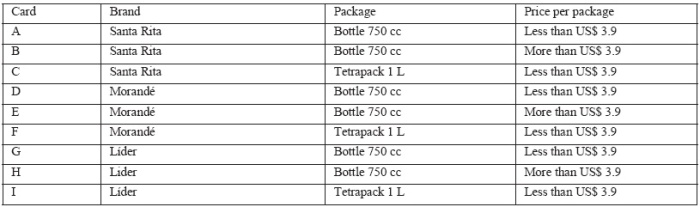
 using the average 2010 value (Ch$510.25/US$). From these attributes and levels a total of 12 combinations (3 x 2 x 2) were 
 obtained; however because wines are not sold in 1 L tetrapacks for more than US$ 3.9 per package, the alternatives considered 
 for this combination were eliminated. This allowed the number of stimuli to be reduced to nine with one specification for each
 attribute (Table I). Each respondent ordered the cards with the combination of attributes from most to least preferred, on a 
 scale of 1 to 9, where 1 = most preferred; 9 = least preferred.</p>

    <p>&nbsp;</p>
    <p><b>TABLE I</b></p>

    <p>Design of the conjoint experiment.</p>
    ]]></body>
<body><![CDATA[<p><i>Conce&ccedil;&atilde;o da experi&ecirc;ncia conjunta.</i></p>
    <p><img src="/img/revistas/ctv/v27n1/27n1a01t1.jpg"></p>
     
<p>&nbsp;</p>

    <p><b>Procedure</b></p>

    <p>The survey was applied personally by two previously trained surveyors (fifth year students in the Agronomy programme, 
Universidad de La Frontera, Temuco, Chile), at the exit of two supermarkets in Temuco in September 2010, the time when wine 
consumption increases due to the celebration of the national holiday. The choice of the supermarkets to apply the surveys was
 due to the fact that they constitute the main distribution channel for this product in Chile, concentrating 48% of the volume
 of wine consumed in litres (Gonz&aacute;lez and Melo, 2008). The supermarkets where the surveys were carried out are in the 
 category of "big supermarkets" in Chile (3,000 to 6,000 m<sup>2</sup>, 1,500 to 10,000 products, 20 tills on average) and 
 attract all types of shoppers. One of the supermarkets selected belonged to one of Chile&rsquo;s two principal supermarket 
 chains, while the other was a company with a regional presence. The surveyors intercepted people as they were coming out of 
 the supermarkets, explained to them the objectives of the survey and the strictly confi dential treatment of the information 
 obtained, and then asked if they were prepared to answer the questionnaire (mall intercept type). Prior to the application of 
 the survey, the questionnaire was validated by a preliminary test with 10% of the survey sample. As the validation of the 
 instrument was satisfactory, no changes were required in either the questionnaire or the interview procedure. The participants
 signed informed consent statements before responding. The execution of the study was approved by the Bioethics Committee of 
 the Faculty of Farming, Livestock and Forestry Sciences of the Universidad de La Frontera.</p>

    <p><b>Statistical analysis</b></p>

    <p>A conjoint analysis was carried out using the SAS TRANSREG procedure (SAS Institute Inc., Cary, NC, USA). The relative 
importance that consumers gave to the different attributes and the utility values obtained for each level of the selected 
factors were determined. A hierarchical cluster analysis was chosen to determine consumer segments according to the importance
 of the attributes and partial utility scores of the levels of the attributes. Ward&rsquo;s procedure, which calculates the 
 squared Euclidean distance, was carried out with the SAS CLUSTER procedure. The number of clusters was taken on the basis of 
 the R<sup>2</sup> obtained and from a strong increase produced in the Cubic Criterion of Clustering and Pseudo&#45;F values. 
 To describe the segments, a Chi&#45;square test was applied for the discrete variables and a single&#45;factor analysis of 
 variance for the continuous variables. Because the Levene&rsquo;s statistic indicated non&#45;homogeneous variances in all 
 the continuous variables analysed, the variables for which the analysis of variance resulted in significant differences 
 (P &lt; 0.001) were subjected to Dunnett&rsquo;s T3 Multiple Comparisons test.</p>

    <p><b>RESULTS</b></p>

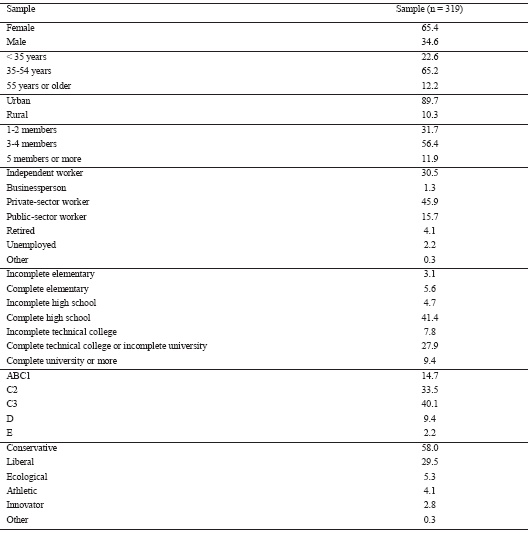
    <p>Of all the surveys applied (n = 400), only 79.8% of respondents indicated that they consume wine (n = 319), so it was 
decided to work with this sample size. Table II presents a description of this sample. The largest proportion of the sample 
consisted of women (65.4%), aged between 35 and 54 years (65.2%), resident in urban areas (89.7%), with family groups 
consisting of three to four people (56.4%), independent worker (30,5%) and private&#45;sector worker (30.5%), with complete 
secondary education (41.4%), belonging to the middle&#45;low (40.1%) and middle&#45;middle (33.5%) socioeconomic level and 
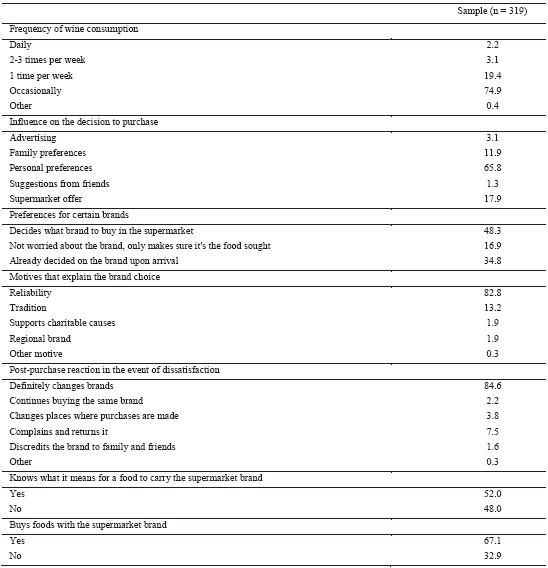
with a conservative lifestyle (58.0%). The greatest proportion of participants consume wine occasionally (74.9%, 
Table III, choose the purchase based on personal preferences (65.8%), decide what brand 
to buy in the supermarket (48.3%) and choose the brand that they trust (82.8%). In case of non&#45;conformity with the product
 acquired, a high proportion reacts definitively by changing brands (84.6%). Only 52% know what it means that a product has 
 store brand,</p>

    <p>&nbsp;</p>
    ]]></body>
<body><![CDATA[<p><b>TABLE II</b></p>

    <p>Characteristics (%) of the sample. Temuco, Chile. September 2010.</p>
    <p><i>Caracter&iacute;sticas (%) da amostra. Temuco, Chile. Setembro de 2010.</i></p>
    <p><img src="/img/revistas/ctv/v27n1/27n1a01t2.jpg"></p>
    
<p>&nbsp;</p>
    <p><b>TABLE III</b></p>
    <p>Consumption behavior and decision making process characteristics (%) of the sample. Temuco, Chile. September 2010.</p>
    <p><i>Comportamento de consumo e caracter&iacute;sticas do processo de tomada de decis&atilde;o (%) da amostra. Temuco, Chile.
 Setembro de 2010.</i></p>
     <p><img src="/img/revistas/ctv/v27n1/27n1a01t3.jpg"></p>

    
<p>&nbsp;</p>
    ]]></body>
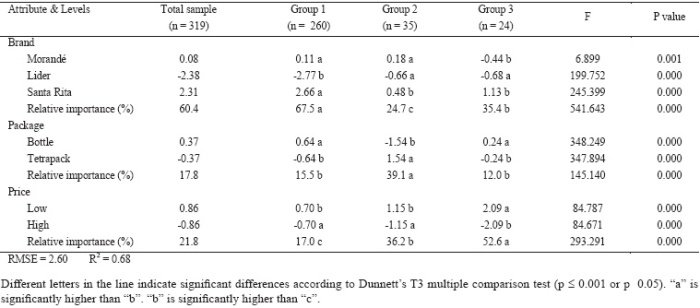
<body><![CDATA[<p>In the total sample, the results of the conjoint analysis indicate that the consumer&rsquo;s choice is dominated by the 
brand of wine. The importance given to price (21.8%) was slightly higher than that given to packaging (17.8%). The signs of 
the utility of the traditional national brand and new or emerging one indicate consumer preference for these; however, the 
higher number corresponding to the traditional national brand (Santa Rita) indicates greater preference for it. The negative 
utility towards the store brand (L&iacute;der) indicates a lower preference for or rejection of it. At the same time there was
 evidence of a preference for bottled wine at the lowest price (Table IV).
    <p>&nbsp;</p>
    <p><b><a name="t4"></a><a href="#topt4">TABLE IV</a></b></p>

    <p>Distribution and relative importance for the three clusters and overall sample based on preferences for wines and monthly
 expenditure on food.</p>
    <p><i>Distribui&ccedil;&atilde;o e import&acirc;ncia relativa para os tr&ecirc;s grupos e amostra global com base nas 
prefer&ecirc;ncias para os vinhos e as despesas mensais com alimenta&ccedil;&atilde;o.</i></p>
    <p><img src="/img/revistas/ctv/v27n1/27n1a01t4.jpg"></p>
    
<p>&nbsp;</p>

    <p>Using cluster analysis three groups of consumers could be distinguished, presenting statistically significant differences
 in the importance of the attributes and preferences for all attribute levels (P &le; 0.001) (Table IV). In addition, the 
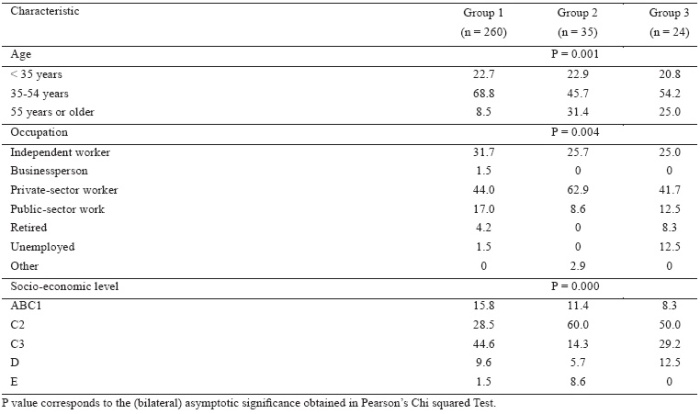
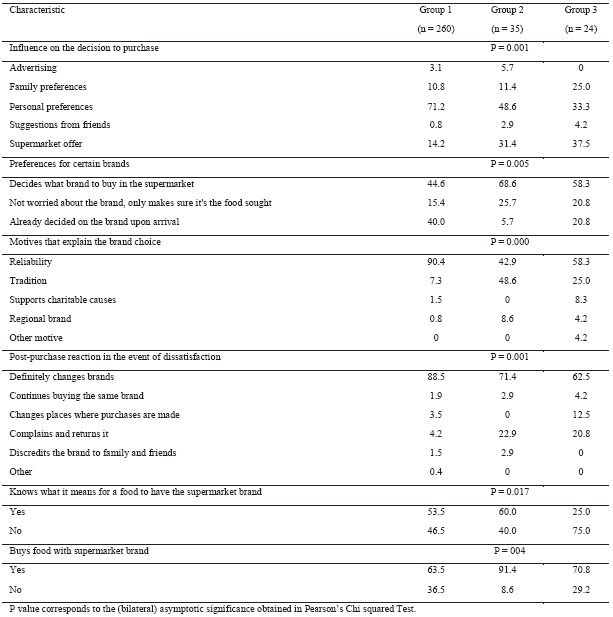
 groups presented significant differences according to age, socioeconomic level, influences on the decision to purchase, 
 reasons to explain brand choice, post&#45;purchase reaction in the event of non&#45;conformity (P &#8804; 0.001), occupation,
 the place where it is decided that the brand will be bought, knowledge about what it means that a food has a store brand and 
 if store&#45;brand products are  purchased regularly (P &#8804; 0.05) (Tables V and VI).</p>

    <p>&nbsp;</p>
    <p><b><a name="t5"></a><a href="#topt5">TABLE V</a></b></p>	
    ]]></body>
<body><![CDATA[<p>Demographic and consumption behavior characteristics with significant differences in the groups of buyers identified by 
cluster analysis in Temuco. Chile. September 2010.</p>
    <p><i>Caracter&iacute;sticas demogr&aacute;ficas e de comportamento de consumo com diferen&ccedil;as significativas entre os
 grupos de compradores identificados por an&aacute;lise de <i>cluster</i> em Temuco. Chile. Setembro de 2010.</i></p>
    <p><img src="/img/revistas/ctv/v27n1/27n1a01t5.jpg"></p>
    
<p>&nbsp;</p>
    <p><b><a name="t6"></a><a href="#topt6">TABLE VI</a></a></b></p>		

    <p>Consumption behavior characteristics with significant differences in the groups of buyers identified by cluster analysis in 
Temuco. Chile. September 2010.</p>
    <p><i>Caracter&iacute;sticas de comportamento de consumo com diferen&ccedil;as significativas entre os grupos de compradores 
identificados por an&aacute;lise de <i>cluster</i> em Temuco. Chile. Setembro de 2010.</i></p>
    <p><img src="/img/revistas/ctv/v27n1/27n1a01t6.jpg"></p>
    
<p>&nbsp;</p>

    <p>The composition of each group is detailed below.</p>

    ]]></body>
<body><![CDATA[<p><b>Brand Sensitive</b> (Group 1, n = 260, 81.5% of the sample): This group assigned greater importance to the brand (67.5%)
 and showed the greatest preference for the traditional national brand, both significantly higher than in the other groups
 (P &le; 0.001). At the same time, the value of the utility towards the store brand was the most negative, which implies a 
 greater rejection (<a href="#t4">Table IV</a><a name="topt4"></a>). The "brand sensitive" group presented the highest proportion of people aged between 35 and 54 
 (68.8%) and belonging to lower middle socioeconomic level (C3, 44.6%) (Table V). The people in this group mostly decided on 
 the drinks they will buy based on personal preference (71.2%), buy products with predetermined brands (40.0%), their main 
 reason for brand choice relates to trust (24.0%), in the event of dissatisfaction with the product purchased they react 
 definitively by changing brands (88.5%) and do not buy store&#45;brand foods and drinks (36.5%) (Table VI).</p>

    <p><b>Sensitive to packaging and price</b> (Group 2, n = 35, 11.0%): This group assigned the greatest importance to packaging
 (39.1%) and was the only segment that preferred wine in tetrapacks, both with significantly higher than the rest of the groups
 (P &le; 0,001). At the same time, this segment assigned moderate importance to price (36.2%), differing signifi cantly from 
 the rest of the groups (P &le; 0.001) (<a href="#t4">Table IV</a>). The "sensitive to packaging and price" group presented the greatest 
 proportion of people over 55 years of age (31.4%), independent workers (62.9%) and belonging to the middle&#45;middle 
 socioeconomic level (C2, 60%) (<a href="#t5">Table V</a><a name="topt5"></a>). The people in this group decide what product they will buy based on what is on the
 shelf in the supermarket (31.4%) and also choose the brand in the supermarket (68.6%). In spite of this, the consumers in 
 this group choose brands based on what they customarily consume (48.6%). In case of dissatisfaction with the product 
 purchased, they react by complaining and returning the product to the store it (22.9%). Unlike Group 1, a high proportion of 
 the consumers in this group (91.4%) indicated that they buy store&#45;brand foods and drinks (<a href="#t6">Table VI</a><a name="topt6"></a>).</p>

    <p><b>Sensitive to price</b> (Group 3, n = 24, 7.5%): the purchase decision of these consumers was dominated by the 
price (52.6%), with the greater preference towards the lowest price being significantly higher than the other groups 
(p &le; 0.001). The second attribute in importance was brand (35.4%), which stands out because it is the only group 
that rejected the new or emerging national brand. The negative utility towards store brand did not differ from Group 
2, but was significantly higher than Group 1, which implies less rejection (<a href="#t4">Table IV</a>). The 
"sensitive to price" group presented a higher proportion of people who were unemployed (12.5%) 
(<a href="#t5">Table V</a>). Most people in this segment decide what product they will buy according to the supply in 
the supermarket (37.5%), prefer brands that support beneficial causes (8.6%), in case of dissatisfaction react by 
changing the supplier (12.5%) and complaining at the store and returning the product (20.8%). This group stands out 
for the high proportion of people who indicated not knowing it what means that a product has its own brand (75.0%) 
(<a href="#t6">Table VI</a>).</p>

    <p><b>DISCUSSION AND CONCLUSIONS</b></p>

    <p>The present investigation focussed on evaluating the relative importance of brand, packaging and price on the choice of red
 wine in southern Chile, an important country in the production and export of wine from the Southern Hemisphere. In contrast to
 what happens in the traditional wine&#45;producing countries (Hertzberg and Malorgio, 2008; Goodman, 2009) but consistent with
 the situation in the so&#45;called new world territories (Jarvis <i>et al.</i>, 2003; Robinson, 2006), the results of this 
 study indicate that brand dominated consumer preferences in the choice of red wine, confi rming the vital role that brands 
 play in the successful marketing of wine (Mowle and Merrilees, 2005; Guris <i>et al</i>., 2007). Therefore, in both the total
 sample and in the most numerous consumer segment (Group 1, 81.5%), brand was the most relevant attribute in the choice, which
 is in line with the results of Hertzberg and Malorgio (2008) in Italy, who concluded that the most relevant attribute for 
 consumer choices is the firm&rsquo;s reputation, represented by the producer&rsquo;s brand. In addition, they partially agree
 with the results obtained by AESBUC (2003) and Ribeiro and Santos (2008) in Portugal and by Perrouty <i>et al.</i> (2006) in 
 four European countries, who determined that brand is among the most important choice criteria. It must, however, be pointed 
 out that in these latter three studies brand was less important than the region of origin of the wine, an attribute not 
 evaluated in the present study, but which will have to be included in future investigations. In this respect, it should be 
 emphasised that the designation of origin is a relatively new attribute in the Chilean wine market. While the first 
 regulations on the matter in Europe date from the beginning of the twentieth century, in Chile it was only in 1995 that 
 Ministry of Agriculture Decree N&ordm; 464 established vineyard zoning the country and distinguished wines with designation
 of origin (Peralta, 2008). Contrary to the results of this study, Jarvis <i>et al.</i> (2003) indicated that brand seems to 
 be less important in the wine market than for other goods, possibly due to the small concentration in the wine sector. The 
 great importance placed on brand in this study can be explained by the great concentration of the domestic wine market, since 
 although as in other countries there are many brands available in the market (Johnson and Bruwer, 2004), in Chile 83% of the 
 domestic market is dominated by three vineyards (Concha y Toro, Santa Rita, San Pedro Tarapac&aacute;). Nevertheless, it must 
 be made clear that the marked relevance of brand in the consumer choice might be associated with the price levels used in the 
 stimuli of the conjoint analysis. Lockshin <i>et al.</i> (2006) found that brand effect is more important at low prices, which
 occurs in this study because US$3.9 per bottle is a low price in the Chilean market. As a result, new research will be 
 required to evaluate the relative importance of price and brand at higher prices.</p>

    <p>The almost total preference for national or manufacturer&rsquo;s brands (only Group 3, 7.5%, rejected the new or emerging 
national brand) and the complete rejection of store brands is consistent with the behaviour previously observed in studies 
conducted in Chile with milk (Schnettler <i>et al</i>., 2008ab) and tomato sauce (Schnettler <i>et al</i>., 2008b), and with 
wine in Italy (Hertzberg and Malorgio, 2008). This points to the respondents having used the brand (and not the price) as a 
sign of quality in order to reduce the risk associated with making an unsatisfactory purchase (Lockshin <i>et al</i>., 2000; 
Keller, 2003), since private labels or store brands are generally perceived as being of lower quality than national brands 
(Richardson <i>et al.</i>, 1994; Sprott and Shimp, 2004). At the same time, the greatest preference for the traditional 
national brand (Santa Rita) over the newer national brand (Morand&eacute;) is in line with the results of Mueller <i>et al.</i>
 (2010b), who determined that consumers preferred a known brand to an unknown name. This confirms the results of Varela <i>et 
 al.</i> (2010), who indicated that new and unfamiliar brands reduce risk less than tried and trusted brand names. This is also
 consistent with the high proportion of participants who indicated that they choose the brands they trust (82.2%).</p>

    <p>In the total sample the relative importance of price and packaging was similar, which according to Baker and Burnham (2002) 
indicates that none of the attributes dominated the consumers&rsquo; preferences. This is contrary to the results of several 
studies that report on the relevance of price as an attribute in the selection of wine (Batt and Dean, 2000; Tustin and 
Lockshin, 2001; AESBUC, 2003; Schnettler and Ribera, 2003; Perrouty <i>et al</i>., 2006; Lockshin <i>et al.</i>, 2006; Ribeiro
 and Santos, 2008; Lockshin <i>et al.</i>, 2009), which has often been identified as one of the main signs of quality in wine 
 (Mitchell and Greatorex, 1988; Oczkowski, 2001; Spawton and Lockshin, 2001; Ling and Lockshin, 2003; Myers, 2003; Schnettler 
 and Rivera, 2003; Lockshin <i>et al</i>., 2006; Priilaid and van Rensburg, 2010), directly influencing wine preference and 
 purchase (Plassman <i>et al</i>., 2008; Mueller and Szlnoki, 2010). However, the low importance assigned to price in the 
 total sample and the largest segment (Group 1, 81.5%) is consistent with the results obtained by Hertzberg and Malorgio (2008)
 in Italy. They are also in line with the reports by Mtimet and Albisu (2006) and Mart&iacute;nez&#45;Carrasco <i>et al.</i> 
 (2006) in Spain, and by AESBUC (2003) and Ribeiro and Santos (2008) in Portugal, who found that price was much less important 
 than other attributes such as region of origin, brand and ageing. Considering the high proportion of respondents who claimed 
 to consumer wine only occasionally (74.9%) in the present study, it is possible to suggest that the low importance assigned 
 to price must be due to the cost to consume wine not being a significant part of the family budget, and therefore price 
 becomes a secondary attribute in the choice of purchase. The results of the VI Family Budget Survey (INE, 2008) indicated 
 that the monthly expenditure on food (US$ 321) represents on average 22.08% of the total monthly cost in Chilean homes, of 
 which only 0.34% is spent cost on wine (approximately US$ 1). Another possible explanation lies in Chilean wines being 
 recognised nationally and internationally for its good price/quality ratio (ProChile, 2008). This might also explain why the
 consumers in the total sample and the three identified segments preferred the lower price, indicating in this case that a 
 higher price was not associated with higher quality. The preference for lower price may also be associated with the 
 socioeconomic composition of the sample, comprising mainly middle&#45;middle and lower&#45;middle class (73.6% altogether).</p>

    <p>In the total sample as well as in Groups 1 and 2 (92.5%) the relative importance of price and packaging had similar values, 
which is consistent with those authors who suggest that packaging affects product evaluations (Batt and Dean, 2000; Orth and 
Malkewitz, 2008), but runs contrary to reports by Goodman (2009) and Mueller <i>et al</i>. (2007), who concluded that wine 
packaging design was relatively unimportant, which was only seen in the smallest segment (Group 3, 7.5%). The greatest 
preference for bottled wine (Groups 1 and 3, 89%) concurs with a previous study in Chile, probably because the bottle is 
associated with greater quality (Schnettler and Rivera, 2003). Nevertheless, it should be pointed out that the behaviour of 
Group 2, the one that gave greatest importance to packaging (over price) and preferred wine in tetrapacks is contrary to the 
reports by Schnettler and Rivera (2003), indicating the emergence of a niche market that clearly prefers this type of 
packaging. However, if it is considered that in Chile the packaging with the greatest presence in the domestic market is the 
tetrapack (Jim&eacute;nez <i>et al.,</i> 2010), it can be suggested that although the consumers in Groups 1 and 3 prefer 
bottled wine, they very likely buy wine in tetrapacks depending on the occasion. Hall and Lochshin (2000) found that the 
importance of the attributes and the wine chosen are related to the situation where the consumer intends to drink the wine. 
For example, high price was important when a consumer was purchasing wine in order to impress a business associate or to 
celebrate a special anniversary. Low price was important when the situation was to relax at home alone, or for entertaining at 
an informal party or BBQ. This might be perfectly be valid for the choice of packaging and brand, considering also that for 
certain drinks made with wine in Chile (e.g. red or white wine with strawberries, melon with wine, hot wine with oranges, 
among others) a low&#45;priced wine is normally used, most probably in tetrapack and, if we were to speculate, a store brand. 
A cluster analysis made it possible to distinguish three market segments with different preferences and a different 
demographic profile and purchasing behaviour. However, if it is considered that Group 1 represents 81.5% of the sample that 
claimed to consume wine, it can be suggested that the wine market in Temuco is quite homogeneous with respect to the variables
 evaluated, and consistent with the results of a previous study (Schnettler and Rivera, 2003). As a result, we have chosen to 
 discuss only the characteristics of the largest segment. From the demographic point of view it was possible to confirm that 
 there is a relation between the importance assigned to brand and the age of the consumer (AESBUC, 2003; Mueller and Szolnoki,
 2010; Mueller <i>et al</i>., 2010c), but not with gender, as had been determined by Guris <i>et al</i>. (2007) and Mueller 
 <i>et al</i>. (2010c). The composition of Group 1 is therefore "brand sensitive" with a greater proportion of people between
 35 and 54 years, which is consistent with the results obtained by AESBUC (2003) in Portugal, where it was determined that 
 brand was less valued by younger people. It is also in line with what was reported by Mueller and Szolnoki (2010) in Germany
 regarding older wine consumers being influenced most strongly by brand. Although the differences found in the socioeconomic
 composition of Group 1 confirm that there is a connection between the income level of the consumer and the preferences for 
 wine brands as determined by Guris <i>et al</i>. (2007) in Turkey, the results of the two studies are not comparable, and 
 therefore new investigations will be required that delve more deeply into this connection. From the point of view of 
 purchasing behaviour, the greatest proportion of people in this group that decide which brand to buy based on trust is c
 onsistent with the high importance assigned to this attribute according to the results of the conjoint analysis. So it is 
 possible to infer that they trust the brand to reduce the associated risk of making an unsatisfactory purchase, which also 
 explains the greater preference for the traditional national brand (Santa Rita) together with the greater rejection of the 
 wine with the private label (L&iacute;der). The latter point is in line with the smaller proportion of people who indicated 
 that they generally do not buy store&#45;brand products. Another interesting aspect of this group was the high proportion of 
 participants who indicated that they go to the supermarket to buy with the brand already in mind, contrary to what Seghieri
 <i>et al.</i> (2007) found. This points to the existence of loyalty for certain brands, with the high proportion that chooses
 the brand based on personal preference being worthy of note. At the same time, Group 1 had fewer people who decide which 
 product to buy on the basis of the existing supply in the store, which would partly explain the low importance assigned to 
 price in the decision to purchase. The high proportion of people in this group who, in the event of non&#45;conformity with 
 the product acquired, react definitively by changing brands implies an active attitude to dissatisfaction on the part of the 
 buyer, who takes the private action to stop buying the product or brand. This can also go together with negative communication
 with the market (Varela, 1991). This implies fewer opportunities for feedback with respect to customer dissatisfaction and 
 poor options for an adequate after&#45;sales service to keep the consumer buying the brand. This is a great challenge for the
 domestic wine industry because, unlike most food products, the taste of the wine can vary due to the specific vintage, even if
 the brand and other extrinsic information remains the same (Lockshin <i>et al</i>., 2006).</p>

    <p>Finally, the principal limitation of the study is that the sample is not representative of the country&rsquo;s population 
distribution, mainly with respect to gender. However, it should be stressed that the sample consisted of people who were 
responsible for buying foods and drinks for their households, which is consistent with the higher proportion of women surveyed.
 This reflects the fact that in Chile women are more likely to purchase food than are men, just as in developed countries. If 
 it is considered that wine is a complex product with different intrinsic and extrinsic attributes playing a role on 
 consumers&rsquo; quality perception (Lockshin and Hall, 2003), another limitation of the present study lies in the evaluation 
 of only three product attributes. Therefore, new research is needed to evaluate Chilean consumers&rsquo; preferences 
 considering more attributes.</p>

    <p>&nbsp;</p>	

    ]]></body>
<body><![CDATA[<p><b>REFERENCES</b></p>
     <!-- ref --><p>Adimark, 2004. Mapa Socioecon&oacute;mico de Chile. Adimark, Investigaci&oacute;n de Mercados y Opini&oacute;n 
 P&uacute;blica. Santiago, Chile. (<a href="http://www.adimark.cl" target="_blank">http://www.adimark.cl</a>).    &nbsp;&nbsp;&nbsp;&nbsp;&nbsp;&nbsp;&nbsp;&nbsp;[&#160;<a href="javascript:void(0);" onclick="javascript: window.open('/scielo.php?script=sci_nlinks&ref=000094&pid=S0254-0223201200010000100001&lng=','','width=640,height=500,resizable=yes,scrollbars=1,menubar=yes,');">Links</a>&#160;]<!-- end-ref --></p>

    <!-- ref --><p>AESBUC, 2003. Estudo do consumidor portugu&ecirc;s de vinhos. Associa&ccedil;&atilde;o para a Escola Superior de 
Biotecnologia da Universidade Cat&oacute;lica (AESBUC).    &nbsp;&nbsp;&nbsp;&nbsp;&nbsp;&nbsp;&nbsp;&nbsp;[&#160;<a href="javascript:void(0);" onclick="javascript: window.open('/scielo.php?script=sci_nlinks&ref=000096&pid=S0254-0223201200010000100002&lng=','','width=640,height=500,resizable=yes,scrollbars=1,menubar=yes,');">Links</a>&#160;]<!-- end-ref --></p>

    <!-- ref --><p>Baker G., Burnham T., 2002. The market for genetically modified foods: consumer characteristics and policy implications.
 <i>Int. Food Agribus. Manag. Rev.</i>, <b>4</b>, 351&#45;360.    &nbsp;&nbsp;&nbsp;&nbsp;&nbsp;&nbsp;&nbsp;&nbsp;[&#160;<a href="javascript:void(0);" onclick="javascript: window.open('/scielo.php?script=sci_nlinks&ref=000098&pid=S0254-0223201200010000100003&lng=','','width=640,height=500,resizable=yes,scrollbars=1,menubar=yes,');">Links</a>&#160;]<!-- end-ref --></p>

    <!-- ref --><p>Barber N., Almanza B.A., Donovan J., 2006. Motivational factors of gender, income and age on selecting a bottle of wine.
 <i>Int. J. Wine Bus. Res.</i>, <b>18</b>, 218&#45;232.    &nbsp;&nbsp;&nbsp;&nbsp;&nbsp;&nbsp;&nbsp;&nbsp;[&#160;<a href="javascript:void(0);" onclick="javascript: window.open('/scielo.php?script=sci_nlinks&ref=000100&pid=S0254-0223201200010000100004&lng=','','width=640,height=500,resizable=yes,scrollbars=1,menubar=yes,');">Links</a>&#160;]<!-- end-ref --></p>

    <!-- ref --><p>Barrena R., Sanchez M., 2009. Connecting product attributes with emotional benefits, analysis of a Mediterranean product 
across consumer age segments. <i>Br. Food J.</i>, <b>111</b>, 120&#45;137.    &nbsp;&nbsp;&nbsp;&nbsp;&nbsp;&nbsp;&nbsp;&nbsp;[&#160;<a href="javascript:void(0);" onclick="javascript: window.open('/scielo.php?script=sci_nlinks&ref=000102&pid=S0254-0223201200010000100005&lng=','','width=640,height=500,resizable=yes,scrollbars=1,menubar=yes,');">Links</a>&#160;]<!-- end-ref --></p>

    <p>Batt P.J., Dean A., 2000. Factors influencing the consumer&rsquo;s decision. <i>Aust. NZ. Wine Ind. J. Mark. Suppl.</i>, 
<b>15</b>(4), 34&#150;41.</p>

    <!-- ref --><p>Bredahl L., 2004. Cue utilization and quality perception with regard to branded beef. <i>Food Qual. Prefer.</i>, <b>15</b>,
 65&#150;75.    &nbsp;&nbsp;&nbsp;&nbsp;&nbsp;&nbsp;&nbsp;&nbsp;[&#160;<a href="javascript:void(0);" onclick="javascript: window.open('/scielo.php?script=sci_nlinks&ref=000105&pid=S0254-0223201200010000100007&lng=','','width=640,height=500,resizable=yes,scrollbars=1,menubar=yes,');">Links</a>&#160;]<!-- end-ref --></p>

    <!-- ref --><p>Cerda A., Torres M.J., Garc&iacute;a L. 2010. Preferencias y Disposici&oacute;n a pagar por vinos ecol&oacute;gicos de parte
 de los consumidores de la Regi&oacute;n del Maule, Chile. <i>Pan. Socioec.</i>, <b>40</b>, 60&#45;71.    &nbsp;&nbsp;&nbsp;&nbsp;&nbsp;&nbsp;&nbsp;&nbsp;[&#160;<a href="javascript:void(0);" onclick="javascript: window.open('/scielo.php?script=sci_nlinks&ref=000107&pid=S0254-0223201200010000100008&lng=','','width=640,height=500,resizable=yes,scrollbars=1,menubar=yes,');">Links</a>&#160;]<!-- end-ref --></p>

    <!-- ref --><p>Dodd T.H., Laverie D.A., Wilcox J.F., Duhan D.F., 2005. Differential effects of experience subjective knowledge, and 
objective knowledge on sources of information used in consumer wine purchasing. <i>J. Hosp.Tourism Res.</i>, <b>29</b>,
 3&#45;19.    &nbsp;&nbsp;&nbsp;&nbsp;&nbsp;&nbsp;&nbsp;&nbsp;[&#160;<a href="javascript:void(0);" onclick="javascript: window.open('/scielo.php?script=sci_nlinks&ref=000109&pid=S0254-0223201200010000100009&lng=','','width=640,height=500,resizable=yes,scrollbars=1,menubar=yes,');">Links</a>&#160;]<!-- end-ref --></p>

    <p>Duarte F., Madeira J., Barreira M.M., 2010. Wine purchase and consumption in Portugal &#45; an exploratory analysis of 
young adults&rsquo; motives/attitudes and purchase attributes. <i>Ci&ecirc;ncia T&eacute;c. Vitiv.</i>, <b>25</b>, 63&#45;73.</p>

    <!-- ref --><p>Duarte&#45;Mermoud M., Beltr&aacute;n N., Bustos M., 2010. Chilean wine varietal classification using quadratic Fisher 
transformation. <i>Pattern An. Appl.</i>, <b>13</b>, 181&#45;188.    &nbsp;&nbsp;&nbsp;&nbsp;&nbsp;&nbsp;&nbsp;&nbsp;[&#160;<a href="javascript:void(0);" onclick="javascript: window.open('/scielo.php?script=sci_nlinks&ref=000112&pid=S0254-0223201200010000100011&lng=','','width=640,height=500,resizable=yes,scrollbars=1,menubar=yes,');">Links</a>&#160;]<!-- end-ref --></p>

    <!-- ref --><p>Fern&aacute;ndez A., 2002. <i>Investigaci&oacute;n y t&eacute;cnicas de mercado</i>. 292 p. Editorial Esic, Madrid.    &nbsp;&nbsp;&nbsp;&nbsp;&nbsp;&nbsp;&nbsp;&nbsp;[&#160;<a href="javascript:void(0);" onclick="javascript: window.open('/scielo.php?script=sci_nlinks&ref=000114&pid=S0254-0223201200010000100012&lng=','','width=640,height=500,resizable=yes,scrollbars=1,menubar=yes,');">Links</a>&#160;]<!-- end-ref --></p>

    <!-- ref --><p>Gonz&aacute;lez J., Melo O., 2008. Uso de modelos hed&oacute;nicos y de b&uacute;squeda para el an&aacute;lisis de precios 
de vinos en supermercados. <i>Econ. Agrar.</i>, <b>12</b>, 1&#45;14.    &nbsp;&nbsp;&nbsp;&nbsp;&nbsp;&nbsp;&nbsp;&nbsp;[&#160;<a href="javascript:void(0);" onclick="javascript: window.open('/scielo.php?script=sci_nlinks&ref=000116&pid=S0254-0223201200010000100013&lng=','','width=640,height=500,resizable=yes,scrollbars=1,menubar=yes,');">Links</a>&#160;]<!-- end-ref --></p>

    <!-- ref --><p>Goodman S., 2009. An international comparison of retail consumer wine choice. <i>Int. J. Wine Bus. Res.</i>, <b>21</b>, 
41&#45;49.    &nbsp;&nbsp;&nbsp;&nbsp;&nbsp;&nbsp;&nbsp;&nbsp;[&#160;<a href="javascript:void(0);" onclick="javascript: window.open('/scielo.php?script=sci_nlinks&ref=000118&pid=S0254-0223201200010000100014&lng=','','width=640,height=500,resizable=yes,scrollbars=1,menubar=yes,');">Links</a>&#160;]<!-- end-ref --></p>

    <!-- ref --><p>Guris S., Metin N., Caglayan E., 2007. The Brand Choice Model of Wine Consumers: A Multinomial Logit Model. <i>Qual. Quan.</i>, 
<b>41</b>, 447&#45;460.    &nbsp;&nbsp;&nbsp;&nbsp;&nbsp;&nbsp;&nbsp;&nbsp;[&#160;<a href="javascript:void(0);" onclick="javascript: window.open('/scielo.php?script=sci_nlinks&ref=000120&pid=S0254-0223201200010000100015&lng=','','width=640,height=500,resizable=yes,scrollbars=1,menubar=yes,');">Links</a>&#160;]<!-- end-ref --></p>

    <!-- ref --><p>Hall J., Lockshin L., 2000. Using means&#45;end chains for analyzing occasions&#150;not buyers. <i>Australas. Market. J.</i>,
 <b>8</b>, 45&#45;54.    &nbsp;&nbsp;&nbsp;&nbsp;&nbsp;&nbsp;&nbsp;&nbsp;[&#160;<a href="javascript:void(0);" onclick="javascript: window.open('/scielo.php?script=sci_nlinks&ref=000122&pid=S0254-0223201200010000100016&lng=','','width=640,height=500,resizable=yes,scrollbars=1,menubar=yes,');">Links</a>&#160;]<!-- end-ref --></p>

    <!-- ref --><p>Hair J., Anderson R., Tatham R., Black W., 1999. <i>An&aacute;lisis Multivariante</i>. 832 p. Prentice Hall Internacional. 
Inc., Madrid.    &nbsp;&nbsp;&nbsp;&nbsp;&nbsp;&nbsp;&nbsp;&nbsp;[&#160;<a href="javascript:void(0);" onclick="javascript: window.open('/scielo.php?script=sci_nlinks&ref=000124&pid=S0254-0223201200010000100017&lng=','','width=640,height=500,resizable=yes,scrollbars=1,menubar=yes,');">Links</a>&#160;]<!-- end-ref --></p>

    <!-- ref --><p>Hertzberg A., Malorgio M., 2008. Wine demand in Italy: an analysis of consumer preferences. <i>New Medit.</i>, <b>4</b>, 
40&#45;46.    &nbsp;&nbsp;&nbsp;&nbsp;&nbsp;&nbsp;&nbsp;&nbsp;[&#160;<a href="javascript:void(0);" onclick="javascript: window.open('/scielo.php?script=sci_nlinks&ref=000126&pid=S0254-0223201200010000100018&lng=','','width=640,height=500,resizable=yes,scrollbars=1,menubar=yes,');">Links</a>&#160;]<!-- end-ref --></p>

    <!-- ref --><p>Hollebeek L., Jaeger S., Brodie R., Balemi A., 2007. The influence of involvement on purchase intention for new world wine.
 <i>Food Qual. Prefer.</i>, <b>18</b>, 1033&#45;1049.    &nbsp;&nbsp;&nbsp;&nbsp;&nbsp;&nbsp;&nbsp;&nbsp;[&#160;<a href="javascript:void(0);" onclick="javascript: window.open('/scielo.php?script=sci_nlinks&ref=000128&pid=S0254-0223201200010000100019&lng=','','width=640,height=500,resizable=yes,scrollbars=1,menubar=yes,');">Links</a>&#160;]<!-- end-ref --></p>

    <!-- ref --><p>INE. 2008. Metodolog&iacute;a VI Encuesta de presupuestos familiares 2006&#45;2007. Resultados Encuestas de Presupuestos 
familiares. Noviembre 2006 &#45; Octubre 2007. (<a href="http://www.ine.cl/canales/chile_estadistico/encuestas_presupuestos_familiares/2008/resultados_EPF_2006_2007_080708a.pdf" target="_blank">http://www.ine.cl/canales/ chile_estadistico/encuestas_presupuestos_familiares/2008/resultados_EPF_2006_2007_080708a.pdf</a>).    &nbsp;&nbsp;&nbsp;&nbsp;&nbsp;&nbsp;&nbsp;&nbsp;[&#160;<a href="javascript:void(0);" onclick="javascript: window.open('/scielo.php?script=sci_nlinks&ref=000130&pid=S0254-0223201200010000100020&lng=','','width=640,height=500,resizable=yes,scrollbars=1,menubar=yes,');">Links</a>&#160;]<!-- end-ref --></p>


    <!-- ref --><p>Jaeger S.R., 2006. Non&#45;sensory factors in sensory science research. <i>Food Qual. Prefer.</i>, <b>17</b>, 132&#45;144.    &nbsp;&nbsp;&nbsp;&nbsp;&nbsp;&nbsp;&nbsp;&nbsp;[&#160;<a href="javascript:void(0);" onclick="javascript: window.open('/scielo.php?script=sci_nlinks&ref=000132&pid=S0254-0223201200010000100021&lng=','','width=640,height=500,resizable=yes,scrollbars=1,menubar=yes,');">Links</a>&#160;]<!-- end-ref --></p>

    <!-- ref --><p>Jarvis W., Rungie C., Lockshin L., 2003. Analysing Wine Behavioural Loyalty, International Wine Marketing Colloquium, 
Adelaide, July 2003. 
(<a href="http://academyofwinebusiness.com/wp-content/uploads/2010/05/File-015.pdf" target="_blank">http://academyofwinebusiness.com/wp-content/uploads/2010/05/File-015.pdf</a>).    &nbsp;&nbsp;&nbsp;&nbsp;&nbsp;&nbsp;&nbsp;&nbsp;[&#160;<a href="javascript:void(0);" onclick="javascript: window.open('/scielo.php?script=sci_nlinks&ref=000134&pid=S0254-0223201200010000100022&lng=','','width=640,height=500,resizable=yes,scrollbars=1,menubar=yes,');">Links</a>&#160;]<!-- end-ref --></p>

    <!-- ref --><p>Jim&eacute;nez A., Garc&iacute;a&#45;Uriburu P., Selman S., 2010. Informe sectorial vitivin&iacute;cola abril 2010. 
(<a href="http://www.fitchratings.cl/Upload/Sectorial%20Vitivinicola%20ABR.2010%20FINAL.pdf" target="_blank">http://www.fitchratings.cl/Upload/Sectorial%20Vitivinicola%20ABR.2010%20FINAL.pdf</a>).    &nbsp;&nbsp;&nbsp;&nbsp;&nbsp;&nbsp;&nbsp;&nbsp;[&#160;<a href="javascript:void(0);" onclick="javascript: window.open('/scielo.php?script=sci_nlinks&ref=000136&pid=S0254-0223201200010000100023&lng=','','width=640,height=500,resizable=yes,scrollbars=1,menubar=yes,');">Links</a>&#160;]<!-- end-ref --></p>

    <!-- ref --><p>Johnson T., Bruwer J., 2004. Generic consumer risk&#45;reduction strategies (RRS) in wine&#45;related lifestyle segments of 
the Australian wine market. <i>Int. J. Wine Mark.</i>, <b>16</b>, 5&#45;35.    &nbsp;&nbsp;&nbsp;&nbsp;&nbsp;&nbsp;&nbsp;&nbsp;[&#160;<a href="javascript:void(0);" onclick="javascript: window.open('/scielo.php?script=sci_nlinks&ref=000138&pid=S0254-0223201200010000100024&lng=','','width=640,height=500,resizable=yes,scrollbars=1,menubar=yes,');">Links</a>&#160;]<!-- end-ref --></p>

    <!-- ref --><p>Keller K.L., 2003. <i>Strategic Brand Management: Building, Measuring, and Managing Brand Equity</i>. 784 p. Prentice Hall, 
New Jersey.    &nbsp;&nbsp;&nbsp;&nbsp;&nbsp;&nbsp;&nbsp;&nbsp;[&#160;<a href="javascript:void(0);" onclick="javascript: window.open('/scielo.php?script=sci_nlinks&ref=000140&pid=S0254-0223201200010000100025&lng=','','width=640,height=500,resizable=yes,scrollbars=1,menubar=yes,');">Links</a>&#160;]<!-- end-ref --></p>

    <!-- ref --><p>Lange C., Martin C., Chabanet C., Combris P., Issanchou, S., 2002. Impact of the information provided to consumers on their
 willingness to pay for Champagne: comparison with hedonic scores. <i>Food Qual. Prefer.</i>, <b>13</b>, 597&#45;608.    &nbsp;&nbsp;&nbsp;&nbsp;&nbsp;&nbsp;&nbsp;&nbsp;[&#160;<a href="javascript:void(0);" onclick="javascript: window.open('/scielo.php?script=sci_nlinks&ref=000142&pid=S0254-0223201200010000100026&lng=','','width=640,height=500,resizable=yes,scrollbars=1,menubar=yes,');">Links</a>&#160;]<!-- end-ref --></p>

    <!-- ref --><p>Ling B.H., Lockshin L., 2003. Components of wine prices for Australian wine: How winery reputation. Wine quality, region, 
vintage, and winery size contribute to the price of varietal wines. <i>Australas. Mark. J.</i>, <b>11</b>(3), 19&#45;32.    &nbsp;&nbsp;&nbsp;&nbsp;&nbsp;&nbsp;&nbsp;&nbsp;[&#160;<a href="javascript:void(0);" onclick="javascript: window.open('/scielo.php?script=sci_nlinks&ref=000144&pid=S0254-0223201200010000100027&lng=','','width=640,height=500,resizable=yes,scrollbars=1,menubar=yes,');">Links</a>&#160;]<!-- end-ref --></p>

    <!-- ref --><p>Lockshin L., Rasmussen M., Cleary F., 2000. The nature and roles of a wine brand. <i>Aust. NZ. Wine Ind. J.</i>, <b>15</b>, 
17&#45;24.    &nbsp;&nbsp;&nbsp;&nbsp;&nbsp;&nbsp;&nbsp;&nbsp;[&#160;<a href="javascript:void(0);" onclick="javascript: window.open('/scielo.php?script=sci_nlinks&ref=000146&pid=S0254-0223201200010000100028&lng=','','width=640,height=500,resizable=yes,scrollbars=1,menubar=yes,');">Links</a>&#160;]<!-- end-ref --></p>

    <!-- ref --><p>Lockshin L., Hall J., 2003. Consumer purchasing behaviour for wine: what we know and where we are going. <i>Proceedings of 
the International Wine Marketing Colloquium</i>. Adelaide. 
(<a href="http://www.unisa.edu.au/winemarketing/conferences/proceedings.asp" target="_blank">http://www.unisa.edu.au/winemarketing/conferences/proceedings.asp</a>).    &nbsp;&nbsp;&nbsp;&nbsp;&nbsp;&nbsp;&nbsp;&nbsp;[&#160;<a href="javascript:void(0);" onclick="javascript: window.open('/scielo.php?script=sci_nlinks&ref=000148&pid=S0254-0223201200010000100029&lng=','','width=640,height=500,resizable=yes,scrollbars=1,menubar=yes,');">Links</a>&#160;]<!-- end-ref --></p>

    <p>Lockshin L., Jarvis W., d&rsquo;Hauteville F., Perrouty J.P., 2006. Simulations from discrete choice experiments to measure
 consumer sensitivity to brand, region, price, and awards in wine choice. <i>Food Qual. Prefer.</i>, <b>17</b>, 166&#45;178.</p>

    <!-- ref --><p>Lockshin L., Mueller S., Louviere J., Francis L., Osidacz P., 2009. Development of a new method to measure how consumers 
choose wine. <i>Aust. NZ. Wine Ind. J.</i>, <b>24</b>, 35&#45;40.    &nbsp;&nbsp;&nbsp;&nbsp;&nbsp;&nbsp;&nbsp;&nbsp;[&#160;<a href="javascript:void(0);" onclick="javascript: window.open('/scielo.php?script=sci_nlinks&ref=000151&pid=S0254-0223201200010000100031&lng=','','width=640,height=500,resizable=yes,scrollbars=1,menubar=yes,');">Links</a>&#160;]<!-- end-ref --></p>

    ]]></body>
<body><![CDATA[<!-- ref --><p>Mart&iacute;nez&#45;Carrasco L., Brugarolas M., Del Campo F.J., Mart&iacute;nez A., 2006. Influence of purchase place and 
consumption frequency over quality wine preferences. <i>Food Qual. Prefer.</i>, <b>17</b>, 315&#45;327.    &nbsp;&nbsp;&nbsp;&nbsp;&nbsp;&nbsp;&nbsp;&nbsp;[&#160;<a href="javascript:void(0);" onclick="javascript: window.open('/scielo.php?script=sci_nlinks&ref=000153&pid=S0254-0223201200010000100032&lng=','','width=640,height=500,resizable=yes,scrollbars=1,menubar=yes,');">Links</a>&#160;]<!-- end-ref --></p>

    <!-- ref --><p>Melo O., Buzeta J.E., Marshall M.B., 2005. Determinantes del precio del vino en el mercado chileno: un estudio de precios 
hed&oacute;nicos. <i>Econ. Agrar.</i>, <b>9</b>, 58&#45;73.    &nbsp;&nbsp;&nbsp;&nbsp;&nbsp;&nbsp;&nbsp;&nbsp;[&#160;<a href="javascript:void(0);" onclick="javascript: window.open('/scielo.php?script=sci_nlinks&ref=000155&pid=S0254-0223201200010000100033&lng=','','width=640,height=500,resizable=yes,scrollbars=1,menubar=yes,');">Links</a>&#160;]<!-- end-ref --></p>

    <!-- ref --><p>Mitchell V.W., Greatorex M., 1988. Consumer risk perception in the UK wine market. <i>Eur. J. Mark.</i>, <b>22</b>,
 5&#45;15.    &nbsp;&nbsp;&nbsp;&nbsp;&nbsp;&nbsp;&nbsp;&nbsp;[&#160;<a href="javascript:void(0);" onclick="javascript: window.open('/scielo.php?script=sci_nlinks&ref=000157&pid=S0254-0223201200010000100034&lng=','','width=640,height=500,resizable=yes,scrollbars=1,menubar=yes,');">Links</a>&#160;]<!-- end-ref --></p>

    <!-- ref --><p>Mora M., Magner N., Marchant R., 2010. Segmentaci&oacute;n de Mercado de acuerdo a estilos de vida de consumidores de vino 
org&aacute;nico de la Regi&oacute;n Metropolitana de Chile. <i>Idesia</i>, <b>28</b>(3), 25-33.    &nbsp;&nbsp;&nbsp;&nbsp;&nbsp;&nbsp;&nbsp;&nbsp;[&#160;<a href="javascript:void(0);" onclick="javascript: window.open('/scielo.php?script=sci_nlinks&ref=000159&pid=S0254-0223201200010000100035&lng=','','width=640,height=500,resizable=yes,scrollbars=1,menubar=yes,');">Links</a>&#160;]<!-- end-ref --> &#91;In Spanish&#93;.</p>

    <p>Mowle J., Merrilees B., 2005. &lsquo;A functional and symbolic perspective to branding Australian SME wineries&rsquo;. 
<i>J. Prod. Brand Manage.</i>, <b>14</b>, 220&#45;227.</p>

    <!-- ref --><p>Mtimet N., Albisu L.M., 2006. Spanish wine consumer behavior: A choice experiment approach. <i>Agribusiness,</i> <b>22</b>, 
343&#45;362.    &nbsp;&nbsp;&nbsp;&nbsp;&nbsp;&nbsp;&nbsp;&nbsp;[&#160;<a href="javascript:void(0);" onclick="javascript: window.open('/scielo.php?script=sci_nlinks&ref=000162&pid=S0254-0223201200010000100037&lng=','','width=640,height=500,resizable=yes,scrollbars=1,menubar=yes,');">Links</a>&#160;]<!-- end-ref --></p>

    <!-- ref --><p>Mueller S., Lockshin L., Louviere J., Hackman D., 2007. Do respondents use extra information provided in online 
Best&#150;Worst choice experiments? <i>Proceedings of the Xth Australian and New Zealand Marketing Academy</i> (ANZMAC) 
Conference, Dunedin, New Zealand, 3&#150;5 December 2007, 3486&#150;3493.    &nbsp;&nbsp;&nbsp;&nbsp;&nbsp;&nbsp;&nbsp;&nbsp;[&#160;<a href="javascript:void(0);" onclick="javascript: window.open('/scielo.php?script=sci_nlinks&ref=000164&pid=S0254-0223201200010000100038&lng=','','width=640,height=500,resizable=yes,scrollbars=1,menubar=yes,');">Links</a>&#160;]<!-- end-ref --></p>

    <!-- ref --><p>Mueller S., Szolnoki G., 2010. The relative influence of packaging, labelling, branding and sensory attributes on liking
 and purchase intent: Consumers differ in their responsiveness. <i>Food Qual. Prefer.</i>, <b>21</b>, 774&#45;783.    &nbsp;&nbsp;&nbsp;&nbsp;&nbsp;&nbsp;&nbsp;&nbsp;[&#160;<a href="javascript:void(0);" onclick="javascript: window.open('/scielo.php?script=sci_nlinks&ref=000166&pid=S0254-0223201200010000100039&lng=','','width=640,height=500,resizable=yes,scrollbars=1,menubar=yes,');">Links</a>&#160;]<!-- end-ref --></p>

    <!-- ref --><p>Mueller S., Lockshin L., Saltman Y., Blanford J., 2010a. Message on a bottle: The relative influence of wine back label 
information on wine choice. <i>Food Qual. Prefer.</i>, <b>21</b>, 22&#45;23.    &nbsp;&nbsp;&nbsp;&nbsp;&nbsp;&nbsp;&nbsp;&nbsp;[&#160;<a href="javascript:void(0);" onclick="javascript: window.open('/scielo.php?script=sci_nlinks&ref=000168&pid=S0254-0223201200010000100040&lng=','','width=640,height=500,resizable=yes,scrollbars=1,menubar=yes,');">Links</a>&#160;]<!-- end-ref --></p>

    <!-- ref --><p>Mueller S., Osidacz P., Francis I.L., Lockshin, L., 2010b. Combining discrete choice and informed sensory testing to 
determine consumer response to extrinsic and intrinsic wine attributes. <i>Food Qual. Prefer.</i>, <b>21</b>, 741&#45;754.    &nbsp;&nbsp;&nbsp;&nbsp;&nbsp;&nbsp;&nbsp;&nbsp;[&#160;<a href="javascript:void(0);" onclick="javascript: window.open('/scielo.php?script=sci_nlinks&ref=000170&pid=S0254-0223201200010000100041&lng=','','width=640,height=500,resizable=yes,scrollbars=1,menubar=yes,');">Links</a>&#160;]<!-- end-ref --></p>

    <!-- ref --><p>Mueller S., Lockshin L., Louviere J., 2010c. What you see may not be what you get: Asking consumers what matters may not 
reflect what they choose. <i>Mark. Lett.</i>, <b>21</b>, 335&#45;350.    &nbsp;&nbsp;&nbsp;&nbsp;&nbsp;&nbsp;&nbsp;&nbsp;[&#160;<a href="javascript:void(0);" onclick="javascript: window.open('/scielo.php?script=sci_nlinks&ref=000172&pid=S0254-0223201200010000100042&lng=','','width=640,height=500,resizable=yes,scrollbars=1,menubar=yes,');">Links</a>&#160;]<!-- end-ref --></p>

    <!-- ref --><p>Myers C., 2003. Managing brand equity: A look at the impact of attributes. <i>J. Prod. Brand Manag</i>, <b>12</b>(1), 
39&#45;51.    &nbsp;&nbsp;&nbsp;&nbsp;&nbsp;&nbsp;&nbsp;&nbsp;[&#160;<a href="javascript:void(0);" onclick="javascript: window.open('/scielo.php?script=sci_nlinks&ref=000174&pid=S0254-0223201200010000100043&lng=','','width=640,height=500,resizable=yes,scrollbars=1,menubar=yes,');">Links</a>&#160;]<!-- end-ref --></p>

    <!-- ref --><p>Narasimhan Ch., Wilcox R., 1998. Private Labels and the Channel Relationships: a Cross&#45;category Analysis. <i>J. Bus.</i>,
 71, 573&#45;600.    &nbsp;&nbsp;&nbsp;&nbsp;&nbsp;&nbsp;&nbsp;&nbsp;[&#160;<a href="javascript:void(0);" onclick="javascript: window.open('/scielo.php?script=sci_nlinks&ref=000176&pid=S0254-0223201200010000100044&lng=','','width=640,height=500,resizable=yes,scrollbars=1,menubar=yes,');">Links</a>&#160;]<!-- end-ref --></p>

    <!-- ref --><p>Oczkowski E., 2001. Hedonic wine price functions and measurement error. <i>Econ. Rec.</i>, <b>77</b>, 374&#45;382.    &nbsp;&nbsp;&nbsp;&nbsp;&nbsp;&nbsp;&nbsp;&nbsp;[&#160;<a href="javascript:void(0);" onclick="javascript: window.open('/scielo.php?script=sci_nlinks&ref=000178&pid=S0254-0223201200010000100045&lng=','','width=640,height=500,resizable=yes,scrollbars=1,menubar=yes,');">Links</a>&#160;]<!-- end-ref --></p>

    <!-- ref --><p>Olsen J., Thach L., Nowak L., 2007. Wine for my generation: exploring how US consumers are socialized to wine. <i>J. Wine 
Res.</i>, <b>18</b>, 1&#45;18.    &nbsp;&nbsp;&nbsp;&nbsp;&nbsp;&nbsp;&nbsp;&nbsp;[&#160;<a href="javascript:void(0);" onclick="javascript: window.open('/scielo.php?script=sci_nlinks&ref=000180&pid=S0254-0223201200010000100046&lng=','','width=640,height=500,resizable=yes,scrollbars=1,menubar=yes,');">Links</a>&#160;]<!-- end-ref --></p>

    <!-- ref --><p>Orth U.R., Malkewitz K., 2008. Holistic packaging design and consumer brand impression. <i>J. Mark.</i>, <b>72</b>, 
64&#45;81.    &nbsp;&nbsp;&nbsp;&nbsp;&nbsp;&nbsp;&nbsp;&nbsp;[&#160;<a href="javascript:void(0);" onclick="javascript: window.open('/scielo.php?script=sci_nlinks&ref=000182&pid=S0254-0223201200010000100047&lng=','','width=640,height=500,resizable=yes,scrollbars=1,menubar=yes,');">Links</a>&#160;]<!-- end-ref --></p>

    <!-- ref --><p>Peralta R., 2008. Diagn&oacute;stico de las legislaciones sobre indicaciones geogr&aacute;ficas y denominaciones de origen 
de Centroam&eacute;rica, Panam&aacute; y Rep&uacute;blica Dominicana. 
(<a href="http://www.iica.org.gt/promecafe/publicaciones_archivos/DIGANOSTICO%20DE%20 LAS%20LEGISLACIONES.pdf" target="_blank">http://www.iica.org.gt/promecafe/publicaciones_archivos/DIGANOSTICO%20DE%20 LAS%20LEGISLACIONES.pdf</a>).    &nbsp;&nbsp;&nbsp;&nbsp;&nbsp;&nbsp;&nbsp;&nbsp;[&#160;<a href="javascript:void(0);" onclick="javascript: window.open('/scielo.php?script=sci_nlinks&ref=000184&pid=S0254-0223201200010000100048&lng=','','width=640,height=500,resizable=yes,scrollbars=1,menubar=yes,');">Links</a>&#160;]<!-- end-ref --></p>

    <p>Perrouty J.P., D&rsquo;Hauteville F., Lockshin L., 2006. The Influence of Wine attributes on region of origin equity: An 
analysis of the moderating effect of consumer&rsquo;s perceived expertise. <i>Agribusiness</i>, <b>22</b>, 323&#45;341.</p>

    <p>Plassmann H., O&rsquo;Doherty J., Shiv B., Rangel, A., 2008. Marketing actions can modulate neural representations of 
experienced pleasantness. <i>Proc. Natl. Acad. Sci.</i>, <b>105</b>, 1050&#45;1054.</p>

    <!-- ref --><p>Priilaid D., van Rensburg P., 2010. Symbolic and functional brand effects in the hedonic assessment of South African wines.
 <i>S. Afr. J. Bus. Manage.</i>, <b>41</b>, 47&#45;69.    &nbsp;&nbsp;&nbsp;&nbsp;&nbsp;&nbsp;&nbsp;&nbsp;[&#160;<a href="javascript:void(0);" onclick="javascript: window.open('/scielo.php?script=sci_nlinks&ref=000188&pid=S0254-0223201200010000100051&lng=','','width=640,height=500,resizable=yes,scrollbars=1,menubar=yes,');">Links</a>&#160;]<!-- end-ref --></p>

    <!-- ref --><p>PROCHILE., 2008. Estudio de mercado vino embotellado Estados Unidos. 
(<a href="http://www.amchamchile.cl/sites/default/files/vino.pdf" target="_blank">http://www.amchamchile.cl/sites/default/files/vino.pdf</a>).    &nbsp;&nbsp;&nbsp;&nbsp;&nbsp;&nbsp;&nbsp;&nbsp;[&#160;<a href="javascript:void(0);" onclick="javascript: window.open('/scielo.php?script=sci_nlinks&ref=000190&pid=S0254-0223201200010000100052&lng=','','width=640,height=500,resizable=yes,scrollbars=1,menubar=yes,');">Links</a>&#160;]<!-- end-ref --></p>

    <p>Quester PG., Smart J., 1998. The influence of consumption situation and product involvement over consumer&rsquo;s use of 
product attribute. <i>J. Consum. Mark.</i>, 15, 220&#45;238.</p>

    ]]></body>
<body><![CDATA[<p>Ribeiro J., Santos J., 2008. Portuguese wine and the region of origin effect: consumers&rsquo; and retailers&rsquo; perceptions.
 <i>Working Paper Series</i>, N&uacute;cleo de Investiga&ccedil;&atilde;o em Pol&iacute;ticas Econ&oacute;micas Universidade do
 Minho (NIPE WP 11/2008).</p>

    <!-- ref --><p>Richardson P.S., Dick A.S., Jain A.K., 1994. Extrinsic and intrinsic cue effects on perceptions of store brand quality.
 <i>J. Mark.</i>, <b>58</b>, 28&#45;36.    &nbsp;&nbsp;&nbsp;&nbsp;&nbsp;&nbsp;&nbsp;&nbsp;[&#160;<a href="javascript:void(0);" onclick="javascript: window.open('/scielo.php?script=sci_nlinks&ref=000194&pid=S0254-0223201200010000100055&lng=','','width=640,height=500,resizable=yes,scrollbars=1,menubar=yes,');">Links</a>&#160;]<!-- end-ref --></p>

    <!-- ref --><p>Robinson J., 2006. <i>The Oxford companion to wine</i>. 800 p. Oxford University Press, Oxford.    &nbsp;&nbsp;&nbsp;&nbsp;&nbsp;&nbsp;&nbsp;&nbsp;[&#160;<a href="javascript:void(0);" onclick="javascript: window.open('/scielo.php?script=sci_nlinks&ref=000196&pid=S0254-0223201200010000100056&lng=','','width=640,height=500,resizable=yes,scrollbars=1,menubar=yes,');">Links</a>&#160;]<!-- end-ref --></p>

    <!-- ref --><p>Schnettler B., Rivera A., 2003. Caracter&iacute;sticas del proceso de decisi&oacute;n de compra de vino en la IX 
Regi&oacute;n de La Araucan&iacute;a. <i>Cien. Investig. Agrar.</i>, <b>30</b>, 1&#45;14.    &nbsp;&nbsp;&nbsp;&nbsp;&nbsp;&nbsp;&nbsp;&nbsp;[&#160;<a href="javascript:void(0);" onclick="javascript: window.open('/scielo.php?script=sci_nlinks&ref=000198&pid=S0254-0223201200010000100057&lng=','','width=640,height=500,resizable=yes,scrollbars=1,menubar=yes,');">Links</a>&#160;]<!-- end-ref --></p>

    <!-- ref --><p>Schnettler B., Vi&ntilde;uela J.M., Sep&uacute;lveda N., 2008a. Attitude and Willingness to Pay for National and Store 
Brands of Milk in the South of Chile. <i>J. Food Prod. Mark.</i>, <b>14</b>(4), 76&#45;94.    &nbsp;&nbsp;&nbsp;&nbsp;&nbsp;&nbsp;&nbsp;&nbsp;[&#160;<a href="javascript:void(0);" onclick="javascript: window.open('/scielo.php?script=sci_nlinks&ref=000200&pid=S0254-0223201200010000100058&lng=','','width=640,height=500,resizable=yes,scrollbars=1,menubar=yes,');">Links</a>&#160;]<!-- end-ref --></p>

    <!-- ref --><p>Schnettler B., Sep&uacute;lveda O., Ruiz D., 2008b. Aceptaci&oacute;n diferenciada de alimentos transg&eacute;nicos de 
origen vegetal y animal en la Regi&oacute;n de La Araucan&iacute;a, Chile. <i>Cien. Investig. Agrar.</i>, <b>35</b>, 
169&#45;180.    &nbsp;&nbsp;&nbsp;&nbsp;&nbsp;&nbsp;&nbsp;&nbsp;[&#160;<a href="javascript:void(0);" onclick="javascript: window.open('/scielo.php?script=sci_nlinks&ref=000202&pid=S0254-0223201200010000100059&lng=','','width=640,height=500,resizable=yes,scrollbars=1,menubar=yes,');">Links</a>&#160;]<!-- end-ref --></p>

    <p>Seghieri C., Casini L., Torrisi F., 2007. &lsquo;The wine consumer&rsquo;s behaviour in selected stores of Italian major 
retailing chains&rsquo;. <i>Int. J. Wine Bus. Res.</i>, <b>19</b>, 139&#45;151.</p>

    <!-- ref --><p>Servicio Agr&iacute;cola y Ganadero (SAG), 2011. Informe Ejecutivo. Producci&oacute;n de vinos 2011. 
(<a href="http://svyv.sag.gob.cl/dec_cos/inf_ej/INFORME_PRODUCCION_2011.pdf" target="_blank">http://svyv.sag.gob.cl/dec_cos/inf_ej/INFORME_PRODUCCION_2011.pdf</a>).    &nbsp;&nbsp;&nbsp;&nbsp;&nbsp;&nbsp;&nbsp;&nbsp;[&#160;<a href="javascript:void(0);" onclick="javascript: window.open('/scielo.php?script=sci_nlinks&ref=000205&pid=S0254-0223201200010000100061&lng=','','width=640,height=500,resizable=yes,scrollbars=1,menubar=yes,');">Links</a>&#160;]<!-- end-ref --></p>

    <!-- ref --><p>Sethuraman R., Cole C., 1999. Factors influencing the price premiums that consumers pay for national brands over store 
brands. <i>J. Prod. Brand Manage.</i>, <b>8</b>, 340&#45;351.    &nbsp;&nbsp;&nbsp;&nbsp;&nbsp;&nbsp;&nbsp;&nbsp;[&#160;<a href="javascript:void(0);" onclick="javascript: window.open('/scielo.php?script=sci_nlinks&ref=000207&pid=S0254-0223201200010000100062&lng=','','width=640,height=500,resizable=yes,scrollbars=1,menubar=yes,');">Links</a>&#160;]<!-- end-ref --></p>

    <!-- ref --><p>Siegrist M., Cousin M E., 2009. Expectations influence sensory experience in a wine tasting. <i>Appetite</i>, <b>52</b>, 762&#45;765.    &nbsp;&nbsp;&nbsp;&nbsp;&nbsp;&nbsp;&nbsp;&nbsp;[&#160;<a href="javascript:void(0);" onclick="javascript: window.open('/scielo.php?script=sci_nlinks&ref=000209&pid=S0254-0223201200010000100063&lng=','','width=640,height=500,resizable=yes,scrollbars=1,menubar=yes,');">Links</a>&#160;]<!-- end-ref --></p>

    <!-- ref --><p>Smith D., Miltry D., 2007. Cultural convergence: consumer behavioral changes in the European wine market. <i>J. Wine Res.</i>,
 <b>18</b>, 107&#45;112.    &nbsp;&nbsp;&nbsp;&nbsp;&nbsp;&nbsp;&nbsp;&nbsp;[&#160;<a href="javascript:void(0);" onclick="javascript: window.open('/scielo.php?script=sci_nlinks&ref=000211&pid=S0254-0223201200010000100064&lng=','','width=640,height=500,resizable=yes,scrollbars=1,menubar=yes,');">Links</a>&#160;]<!-- end-ref --></p>

    ]]></body>
<body><![CDATA[<!-- ref --><p>Spawton T., Lockshin L., 2001. Using involvement and brand equity to develop a wine tourism strategy. <i>Int. J. Wine 
Market</i>., <b>13</b>(1), 72&#45;82.    &nbsp;&nbsp;&nbsp;&nbsp;&nbsp;&nbsp;&nbsp;&nbsp;[&#160;<a href="javascript:void(0);" onclick="javascript: window.open('/scielo.php?script=sci_nlinks&ref=000213&pid=S0254-0223201200010000100065&lng=','','width=640,height=500,resizable=yes,scrollbars=1,menubar=yes,');">Links</a>&#160;]<!-- end-ref --></p>

    <!-- ref --><p>Sprott D.E., Shimp T.A., 2004. Using product sample to augment the perceived quality of store brands. <i>J. Retail.</i>,
 <b>80</b>, 305&#45;315.    &nbsp;&nbsp;&nbsp;&nbsp;&nbsp;&nbsp;&nbsp;&nbsp;[&#160;<a href="javascript:void(0);" onclick="javascript: window.open('/scielo.php?script=sci_nlinks&ref=000215&pid=S0254-0223201200010000100066&lng=','','width=640,height=500,resizable=yes,scrollbars=1,menubar=yes,');">Links</a>&#160;]<!-- end-ref --></p>

    <!-- ref --><p>Thach E., Olsen J., 2006. Market segment analysis to target young adult wine drinkers. <i>Agribusiness</i>, <b>22</b>, 
307&#45;322.    &nbsp;&nbsp;&nbsp;&nbsp;&nbsp;&nbsp;&nbsp;&nbsp;[&#160;<a href="javascript:void(0);" onclick="javascript: window.open('/scielo.php?script=sci_nlinks&ref=000217&pid=S0254-0223201200010000100067&lng=','','width=640,height=500,resizable=yes,scrollbars=1,menubar=yes,');">Links</a>&#160;]<!-- end-ref --></p>

    <!-- ref --><p>Troncoso J.L., Agruirre M., 2006. Demanda y oferta de vino en el per&iacute;odo 1980&#45;2004: un an&aacute;lisis 
econom&eacute;trico. <i>Pan. Socioec.</i>, <b>33</b>, 26&#45;32.    &nbsp;&nbsp;&nbsp;&nbsp;&nbsp;&nbsp;&nbsp;&nbsp;[&#160;<a href="javascript:void(0);" onclick="javascript: window.open('/scielo.php?script=sci_nlinks&ref=000219&pid=S0254-0223201200010000100068&lng=','','width=640,height=500,resizable=yes,scrollbars=1,menubar=yes,');">Links</a>&#160;]<!-- end-ref --></p>

    <!-- ref --><p>Tustin M., Lockshin, L., 2001. Region of origin: Does it really count? <i>Aust. NZ. Wine Ind. J.</i>, <b>16</b>, 
139&#45;143.    &nbsp;&nbsp;&nbsp;&nbsp;&nbsp;&nbsp;&nbsp;&nbsp;[&#160;<a href="javascript:void(0);" onclick="javascript: window.open('/scielo.php?script=sci_nlinks&ref=000221&pid=S0254-0223201200010000100069&lng=','','width=640,height=500,resizable=yes,scrollbars=1,menubar=yes,');">Links</a>&#160;]<!-- end-ref --></p>

    ]]></body>
<body><![CDATA[<!-- ref --><p>Varela J.A., 1991. Satisfacci&oacute;n/Insatisfacci&oacute;n de los consumidores y comportamientos postconsumo derivados. 
<i>Est. Consumo.</i>, <b>9</b>, 65&#45;79.    &nbsp;&nbsp;&nbsp;&nbsp;&nbsp;&nbsp;&nbsp;&nbsp;[&#160;<a href="javascript:void(0);" onclick="javascript: window.open('/scielo.php?script=sci_nlinks&ref=000223&pid=S0254-0223201200010000100070&lng=','','width=640,height=500,resizable=yes,scrollbars=1,menubar=yes,');">Links</a>&#160;]<!-- end-ref --></p>

    <p>Varela P., Ares G., Gim&eacute;nez A., G&aacute;mbaro A., 2010. Influence of brand information on consumers&rsquo; expectations
 and liking of powdered drinks in central location tests. <i>Food Qual. Prefer.</i>, <b>21</b>, 873&#45;880.</p>

    <!-- ref --><p>Vinos de Chile, 2011. Informaci&oacute;n y estad&iacute;sticas. 
(<a href="http://www.vinasdechile.cl/pagina/informacion-y-estadisticas/17" target="_blank">http://www.vinasdechile.cl/pagina/informacion-y-estadisticas/17</a>).    &nbsp;&nbsp;&nbsp;&nbsp;&nbsp;&nbsp;&nbsp;&nbsp;[&#160;<a href="javascript:void(0);" onclick="javascript: window.open('/scielo.php?script=sci_nlinks&ref=000226&pid=S0254-0223201200010000100072&lng=','','width=640,height=500,resizable=yes,scrollbars=1,menubar=yes,');">Links</a>&#160;]<!-- end-ref --></p>

    <!-- ref --><p>Zamora J., Bravo M., 2005. Wine, product differentiation and tourism: exploring the case of Chile and the Maule Region. 
<i>Universum</i>, <b>20</b>, 298&#45;315.    &nbsp;&nbsp;&nbsp;&nbsp;&nbsp;&nbsp;&nbsp;&nbsp;[&#160;<a href="javascript:void(0);" onclick="javascript: window.open('/scielo.php?script=sci_nlinks&ref=000228&pid=S0254-0223201200010000100073&lng=','','width=640,height=500,resizable=yes,scrollbars=1,menubar=yes,');">Links</a>&#160;]<!-- end-ref --></p>

    <p>&nbsp;</p>
    <p><b>ACKNOWLEDGEMENTS</b></p>

    <p>The results presented are part of Fondecyt Project 1100611.</p>
    ]]></body>
<body><![CDATA[<p>&nbsp;</p>	
    <p><a name="0"></a><a href="#top0"><Sup>*</Sup></a>Corresponding author: Tel: 56 45 325655, e&#45;mail: <a href="mailto:bschnett@ufro.cl"> bschnett@ufro.cl </a></p>
    <p>&nbsp;</p>
    <p><i>(Manuscrito recebido em 21.12.2011. Aceite para publica&ccedil;&atilde;o em 25.01.2012)</i></p>	
	
     ]]></body><back>
<ref-list>
<ref id="B1">
<nlm-citation citation-type="book">
<collab>Adimark</collab>
<source><![CDATA[Mapa Socioeconómico de Chile]]></source>
<year>2004</year>
<publisher-loc><![CDATA[Santiago ]]></publisher-loc>
<publisher-name><![CDATA[Adimark, Investigación de Mercados y Opinión Pública]]></publisher-name>
</nlm-citation>
</ref>
<ref id="B2">
<nlm-citation citation-type="book">
<collab>AESBUC</collab>
<source><![CDATA[Estudo do consumidor português de vinhos]]></source>
<year>2003</year>
<publisher-name><![CDATA[Associação para a Escola Superior de Biotecnologia da Universidade Católica (AESBUC).]]></publisher-name>
</nlm-citation>
</ref>
<ref id="B3">
<nlm-citation citation-type="journal">
<person-group person-group-type="author">
<name>
<surname><![CDATA[Baker]]></surname>
<given-names><![CDATA[G.]]></given-names>
</name>
<name>
<surname><![CDATA[Burnham]]></surname>
<given-names><![CDATA[T.]]></given-names>
</name>
</person-group>
<article-title xml:lang="en"><![CDATA[The market for genetically modified foods: consumer characteristics and policy implications]]></article-title>
<source><![CDATA[Int. Food Agribus. Manag. Rev.]]></source>
<year>2002</year>
<volume>4</volume>
<page-range>351-360</page-range></nlm-citation>
</ref>
<ref id="B4">
<nlm-citation citation-type="journal">
<person-group person-group-type="author">
<name>
<surname><![CDATA[Barber]]></surname>
<given-names><![CDATA[N.]]></given-names>
</name>
<name>
<surname><![CDATA[Almanza]]></surname>
<given-names><![CDATA[B.A.]]></given-names>
</name>
<name>
<surname><![CDATA[Donovan]]></surname>
<given-names><![CDATA[J.]]></given-names>
</name>
</person-group>
<article-title xml:lang="en"><![CDATA[Motivational factors of gender, income and age on selecting a bottle of wine]]></article-title>
<source><![CDATA[Int. J. Wine Bus. Res.]]></source>
<year>2006</year>
<volume>18</volume>
<page-range>218-232</page-range></nlm-citation>
</ref>
<ref id="B5">
<nlm-citation citation-type="journal">
<person-group person-group-type="author">
<name>
<surname><![CDATA[Barrena]]></surname>
<given-names><![CDATA[R.]]></given-names>
</name>
<name>
<surname><![CDATA[Sanchez]]></surname>
<given-names><![CDATA[M.]]></given-names>
</name>
</person-group>
<article-title xml:lang="en"><![CDATA[Connecting product attributes with emotional benefits, analysis of a Mediterranean product across consumer age segments]]></article-title>
<source><![CDATA[Br. Food J.]]></source>
<year>2009</year>
<volume>111</volume>
<page-range>120-137</page-range></nlm-citation>
</ref>
<ref id="B6">
<nlm-citation citation-type="journal">
<person-group person-group-type="author">
<name>
<surname><![CDATA[Batt]]></surname>
<given-names><![CDATA[P.J.]]></given-names>
</name>
<name>
<surname><![CDATA[Dean]]></surname>
<given-names><![CDATA[A]]></given-names>
</name>
</person-group>
<article-title xml:lang="en"><![CDATA[Factors influencing the consumer’s decision]]></article-title>
<source><![CDATA[Aust. NZ. Wine Ind. J. Mark. Suppl.]]></source>
<year>2000</year>
<volume>15</volume>
<numero>4</numero>
<issue>4</issue>
<page-range>34-41</page-range></nlm-citation>
</ref>
<ref id="B7">
<nlm-citation citation-type="journal">
<person-group person-group-type="author">
<name>
<surname><![CDATA[Bredahl]]></surname>
<given-names><![CDATA[L.]]></given-names>
</name>
</person-group>
<article-title xml:lang="en"><![CDATA[Cue utilization and quality perception with regard to branded beef]]></article-title>
<source><![CDATA[Food Qual. Prefer.]]></source>
<year>2004</year>
<volume>15</volume>
<page-range>65-75</page-range></nlm-citation>
</ref>
<ref id="B8">
<nlm-citation citation-type="journal">
<person-group person-group-type="author">
<name>
<surname><![CDATA[Cerda]]></surname>
<given-names><![CDATA[A.]]></given-names>
</name>
<name>
<surname><![CDATA[Torres]]></surname>
<given-names><![CDATA[M.J.]]></given-names>
</name>
<name>
<surname><![CDATA[García]]></surname>
<given-names><![CDATA[L.]]></given-names>
</name>
</person-group>
<article-title xml:lang="es"><![CDATA[Preferencias y Disposición a pagar por vinos ecológicos de parte de los consumidores de la Región del Maule, Chile]]></article-title>
<source><![CDATA[Pan. Socioec.]]></source>
<year>2010</year>
<volume>40</volume>
<page-range>60-71</page-range></nlm-citation>
</ref>
<ref id="B9">
<nlm-citation citation-type="journal">
<person-group person-group-type="author">
<name>
<surname><![CDATA[Dodd]]></surname>
<given-names><![CDATA[T.H.]]></given-names>
</name>
<name>
<surname><![CDATA[Laverie]]></surname>
<given-names><![CDATA[D.A.]]></given-names>
</name>
<name>
<surname><![CDATA[Wilcox]]></surname>
<given-names><![CDATA[J.F.]]></given-names>
</name>
<name>
<surname><![CDATA[Duhan]]></surname>
<given-names><![CDATA[D.F.]]></given-names>
</name>
</person-group>
<article-title xml:lang="en"><![CDATA[Differential effects of experience subjective knowledge, and objective knowledge on sources of information used in consumer wine purchasing]]></article-title>
<source><![CDATA[J. Hosp.Tourism Res.]]></source>
<year>2005</year>
<volume>29</volume>
<page-range>3-19</page-range></nlm-citation>
</ref>
<ref id="B10">
<nlm-citation citation-type="journal">
<person-group person-group-type="author">
<name>
<surname><![CDATA[Duarte]]></surname>
<given-names><![CDATA[F.]]></given-names>
</name>
<name>
<surname><![CDATA[Madeira]]></surname>
<given-names><![CDATA[J.]]></given-names>
</name>
<name>
<surname><![CDATA[Barreira]]></surname>
<given-names><![CDATA[M.M.]]></given-names>
</name>
</person-group>
<article-title xml:lang="en"><![CDATA[Wine purchase and consumption in Portugal: an exploratory analysis of young adults’ motives/attitudes and purchase attributes]]></article-title>
<source><![CDATA[Ciência Téc. Vitiv.]]></source>
<year>2010</year>
<volume>25</volume>
<page-range>63-73</page-range></nlm-citation>
</ref>
<ref id="B11">
<nlm-citation citation-type="journal">
<person-group person-group-type="author">
<name>
<surname><![CDATA[Duarte-Mermoud]]></surname>
<given-names><![CDATA[M.]]></given-names>
</name>
<name>
<surname><![CDATA[Beltrán]]></surname>
<given-names><![CDATA[N.]]></given-names>
</name>
<name>
<surname><![CDATA[Bustos]]></surname>
<given-names><![CDATA[M.]]></given-names>
</name>
</person-group>
<article-title xml:lang="en"><![CDATA[Chilean wine varietal classification using quadratic Fisher transformation.]]></article-title>
<source><![CDATA[Pattern An. Appl.]]></source>
<year>2010</year>
<volume>13</volume>
<page-range>181-188</page-range></nlm-citation>
</ref>
<ref id="B12">
<nlm-citation citation-type="book">
<person-group person-group-type="author">
<name>
<surname><![CDATA[Fernández]]></surname>
<given-names><![CDATA[A.]]></given-names>
</name>
</person-group>
<source><![CDATA[Investigación y técnicas de mercado]]></source>
<year>2002</year>
<publisher-loc><![CDATA[Madrid ]]></publisher-loc>
<publisher-name><![CDATA[Editorial Esic]]></publisher-name>
</nlm-citation>
</ref>
<ref id="B13">
<nlm-citation citation-type="journal">
<person-group person-group-type="author">
<name>
<surname><![CDATA[González]]></surname>
<given-names><![CDATA[J.]]></given-names>
</name>
<name>
<surname><![CDATA[Melo]]></surname>
<given-names><![CDATA[O.]]></given-names>
</name>
</person-group>
<article-title xml:lang="es"><![CDATA[Uso de modelos hedónicos y de búsqueda para el análisis de precios de vinos en supermercados]]></article-title>
<source><![CDATA[Econ. Agrar.]]></source>
<year>2008</year>
<volume>12</volume>
<page-range>1-14</page-range></nlm-citation>
</ref>
<ref id="B14">
<nlm-citation citation-type="journal">
<person-group person-group-type="author">
<name>
<surname><![CDATA[Goodman]]></surname>
<given-names><![CDATA[S.]]></given-names>
</name>
</person-group>
<article-title xml:lang="en"><![CDATA[An international comparison of retail consumer wine choice.]]></article-title>
<source><![CDATA[Int. J. Wine Bus. Res.]]></source>
<year>2009</year>
<volume>21</volume>
<page-range>41-49</page-range></nlm-citation>
</ref>
<ref id="B15">
<nlm-citation citation-type="journal">
<person-group person-group-type="author">
<name>
<surname><![CDATA[Guris]]></surname>
<given-names><![CDATA[S.]]></given-names>
</name>
<name>
<surname><![CDATA[Metin]]></surname>
<given-names><![CDATA[N.]]></given-names>
</name>
<name>
<surname><![CDATA[Caglayan]]></surname>
<given-names><![CDATA[E.]]></given-names>
</name>
</person-group>
<article-title xml:lang="en"><![CDATA[The Brand Choice Model of Wine Consumers: A Multinomial Logit Model]]></article-title>
<source><![CDATA[Qual. Quan.]]></source>
<year>2007</year>
<volume>41</volume>
<page-range>447-460</page-range></nlm-citation>
</ref>
<ref id="B16">
<nlm-citation citation-type="journal">
<person-group person-group-type="author">
<name>
<surname><![CDATA[Hall]]></surname>
<given-names><![CDATA[J.]]></given-names>
</name>
<name>
<surname><![CDATA[Lockshin]]></surname>
<given-names><![CDATA[L.]]></given-names>
</name>
</person-group>
<article-title xml:lang="en"><![CDATA[Using means-end chains for analyzing occasions-not buyers]]></article-title>
<source><![CDATA[Australas. Market. J.]]></source>
<year>2000</year>
<volume>8</volume>
<page-range>45-54</page-range></nlm-citation>
</ref>
<ref id="B17">
<nlm-citation citation-type="book">
<person-group person-group-type="author">
<name>
<surname><![CDATA[Hair]]></surname>
<given-names><![CDATA[J.]]></given-names>
</name>
<name>
<surname><![CDATA[Anderson]]></surname>
<given-names><![CDATA[R]]></given-names>
</name>
<name>
<surname><![CDATA[Tatham]]></surname>
<given-names><![CDATA[R]]></given-names>
</name>
<name>
<surname><![CDATA[Black]]></surname>
<given-names><![CDATA[W.]]></given-names>
</name>
</person-group>
<source><![CDATA[Análisis Multivariante]]></source>
<year>1999</year>
<publisher-loc><![CDATA[Madrid ]]></publisher-loc>
<publisher-name><![CDATA[Prentice Hall Internacional]]></publisher-name>
</nlm-citation>
</ref>
<ref id="B18">
<nlm-citation citation-type="journal">
<person-group person-group-type="author">
<name>
<surname><![CDATA[Hertzberg]]></surname>
<given-names><![CDATA[A.]]></given-names>
</name>
<name>
<surname><![CDATA[Malorgio]]></surname>
<given-names><![CDATA[M.]]></given-names>
</name>
</person-group>
<article-title xml:lang="en"><![CDATA[Wine demand in Italy: an analysis of consumer preferences.]]></article-title>
<source><![CDATA[New Medit]]></source>
<year>2008</year>
<volume>4</volume>
<page-range>40-46</page-range></nlm-citation>
</ref>
<ref id="B19">
<nlm-citation citation-type="journal">
<person-group person-group-type="author">
<name>
<surname><![CDATA[Hollebeek]]></surname>
<given-names><![CDATA[L.]]></given-names>
</name>
<name>
<surname><![CDATA[Jaeger]]></surname>
<given-names><![CDATA[S.]]></given-names>
</name>
<name>
<surname><![CDATA[Brodie]]></surname>
<given-names><![CDATA[R.]]></given-names>
</name>
<name>
<surname><![CDATA[Balemi]]></surname>
<given-names><![CDATA[A.]]></given-names>
</name>
</person-group>
<article-title xml:lang="en"><![CDATA[The influence of involvement on purchase intention for new world wine.]]></article-title>
<source><![CDATA[Food Qual. Prefer.]]></source>
<year>2007</year>
<volume>18</volume>
<page-range>1033-1049</page-range></nlm-citation>
</ref>
<ref id="B20">
<nlm-citation citation-type="">
<collab>INE</collab>
<source><![CDATA[Metodología VI Encuesta de presupuestos familiares 2006-2007. Resultados Encuestas de Presupuestos familiares. Noviembre 2006 - Octubre 2007.]]></source>
<year>2008</year>
</nlm-citation>
</ref>
<ref id="B21">
<nlm-citation citation-type="journal">
<person-group person-group-type="author">
<name>
<surname><![CDATA[Jaeger]]></surname>
<given-names><![CDATA[S.R.]]></given-names>
</name>
</person-group>
<article-title xml:lang="en"><![CDATA[Non-sensory factors in sensory science research.]]></article-title>
<source><![CDATA[Food Qual. Prefer.]]></source>
<year>2006</year>
<volume>17</volume>
<page-range>132-144</page-range></nlm-citation>
</ref>
<ref id="B22">
<nlm-citation citation-type="confpro">
<person-group person-group-type="author">
<name>
<surname><![CDATA[Jarvis]]></surname>
<given-names><![CDATA[W.]]></given-names>
</name>
<name>
<surname><![CDATA[Rungie]]></surname>
<given-names><![CDATA[C.]]></given-names>
</name>
<name>
<surname><![CDATA[Lockshin]]></surname>
<given-names><![CDATA[L.]]></given-names>
</name>
</person-group>
<article-title xml:lang="en"><![CDATA[Analysing Wine Behavioural Loyalty]]></article-title>
<source><![CDATA[]]></source>
<year>2003</year>
<conf-name><![CDATA[ International Wine Marketing Colloquium]]></conf-name>
<conf-date>July 2003</conf-date>
<conf-loc>Adelaide </conf-loc>
</nlm-citation>
</ref>
<ref id="B23">
<nlm-citation citation-type="">
<person-group person-group-type="author">
<name>
<surname><![CDATA[Jiménez]]></surname>
<given-names><![CDATA[A.]]></given-names>
</name>
<name>
<surname><![CDATA[García-Uriburu]]></surname>
<given-names><![CDATA[P.]]></given-names>
</name>
<name>
<surname><![CDATA[Selman]]></surname>
<given-names><![CDATA[S.]]></given-names>
</name>
</person-group>
<source><![CDATA[Informe sectorial vitivinícola abril 2010]]></source>
<year>2010</year>
</nlm-citation>
</ref>
<ref id="B24">
<nlm-citation citation-type="journal">
<person-group person-group-type="author">
<name>
<surname><![CDATA[Johnson]]></surname>
<given-names><![CDATA[T.]]></given-names>
</name>
<name>
<surname><![CDATA[Bruwer]]></surname>
<given-names><![CDATA[J.]]></given-names>
</name>
</person-group>
<article-title xml:lang="en"><![CDATA[Generic consumer risk-reduction strategies (RRS) in wine-related lifestyle segments of the Australian wine market.]]></article-title>
<source><![CDATA[Int. J. Wine Mark.]]></source>
<year>2004</year>
<volume>16</volume>
<page-range>5-35</page-range></nlm-citation>
</ref>
<ref id="B25">
<nlm-citation citation-type="book">
<person-group person-group-type="author">
<name>
<surname><![CDATA[Keller]]></surname>
<given-names><![CDATA[K.L.]]></given-names>
</name>
</person-group>
<source><![CDATA[Strategic Brand Management: Building, Measuring, and Managing Brand Equity]]></source>
<year>2003</year>
<publisher-loc><![CDATA[New Jersey ]]></publisher-loc>
<publisher-name><![CDATA[Prentice Hall]]></publisher-name>
</nlm-citation>
</ref>
<ref id="B26">
<nlm-citation citation-type="journal">
<person-group person-group-type="author">
<name>
<surname><![CDATA[Lange]]></surname>
<given-names><![CDATA[C.]]></given-names>
</name>
<name>
<surname><![CDATA[Martin]]></surname>
<given-names><![CDATA[C.]]></given-names>
</name>
<name>
<surname><![CDATA[Chabanet]]></surname>
<given-names><![CDATA[C.]]></given-names>
</name>
<name>
<surname><![CDATA[Combris]]></surname>
<given-names><![CDATA[P.]]></given-names>
</name>
<name>
<surname><![CDATA[Issanchou]]></surname>
<given-names><![CDATA[S.]]></given-names>
</name>
</person-group>
<article-title xml:lang="en"><![CDATA[Impact of the information provided to consumers on their willingness to pay for Champagne: comparison with hedonic scores.]]></article-title>
<source><![CDATA[Food Qual. Prefer.]]></source>
<year>2002</year>
<volume>13</volume>
<page-range>597-608</page-range></nlm-citation>
</ref>
<ref id="B27">
<nlm-citation citation-type="journal">
<person-group person-group-type="author">
<name>
<surname><![CDATA[Ling]]></surname>
<given-names><![CDATA[B.H.]]></given-names>
</name>
<name>
<surname><![CDATA[Lockshin]]></surname>
<given-names><![CDATA[L.]]></given-names>
</name>
</person-group>
<article-title xml:lang="en"><![CDATA[Components of wine prices for Australian wine: How winery reputation.: Wine quality, region, vintage, and winery size contribute to the price of varietal wines.]]></article-title>
<source><![CDATA[Australas. Mark. J.]]></source>
<year>2003</year>
<volume>11</volume>
<numero>3</numero>
<issue>3</issue>
<page-range>19-32</page-range></nlm-citation>
</ref>
<ref id="B28">
<nlm-citation citation-type="journal">
<person-group person-group-type="author">
<name>
<surname><![CDATA[Lockshin]]></surname>
<given-names><![CDATA[L.]]></given-names>
</name>
<name>
<surname><![CDATA[Rasmussen]]></surname>
<given-names><![CDATA[M.]]></given-names>
</name>
<name>
<surname><![CDATA[Cleary]]></surname>
<given-names><![CDATA[F.]]></given-names>
</name>
</person-group>
<article-title xml:lang="en"><![CDATA[The nature and roles of a wine brand.]]></article-title>
<source><![CDATA[Aust. NZ. Wine Ind. J.]]></source>
<year>2000</year>
<volume>15</volume>
<page-range>17-24</page-range></nlm-citation>
</ref>
<ref id="B29">
<nlm-citation citation-type="confpro">
<person-group person-group-type="author">
<name>
<surname><![CDATA[Lockshin]]></surname>
<given-names><![CDATA[L.]]></given-names>
</name>
<name>
<surname><![CDATA[Hall]]></surname>
<given-names><![CDATA[J.]]></given-names>
</name>
</person-group>
<article-title xml:lang="en"><![CDATA[Consumer purchasing behaviour for wine: what we know and where we are going]]></article-title>
<source><![CDATA[]]></source>
<year>2003</year>
<conf-name><![CDATA[ International Wine Marketing Colloquium]]></conf-name>
<conf-loc>Adelaide </conf-loc>
</nlm-citation>
</ref>
<ref id="B30">
<nlm-citation citation-type="journal">
<person-group person-group-type="author">
<name>
<surname><![CDATA[Lockshin]]></surname>
<given-names><![CDATA[L.]]></given-names>
</name>
<name>
<surname><![CDATA[Jarvis]]></surname>
<given-names><![CDATA[W.]]></given-names>
</name>
<name>
<surname><![CDATA[d’Hauteville]]></surname>
<given-names><![CDATA[F.]]></given-names>
</name>
<name>
<surname><![CDATA[Perrouty]]></surname>
<given-names><![CDATA[J.P.]]></given-names>
</name>
</person-group>
<article-title xml:lang="en"><![CDATA[Simulations from discrete choice experiments to measure consumer sensitivity to brand, region, price, and awards in wine choice]]></article-title>
<source><![CDATA[Food Qual. Prefer.]]></source>
<year>2006</year>
<volume>17</volume>
<page-range>166-178</page-range></nlm-citation>
</ref>
<ref id="B31">
<nlm-citation citation-type="journal">
<person-group person-group-type="author">
<name>
<surname><![CDATA[Lockshin]]></surname>
<given-names><![CDATA[L.]]></given-names>
</name>
<name>
<surname><![CDATA[Mueller]]></surname>
<given-names><![CDATA[S.]]></given-names>
</name>
<name>
<surname><![CDATA[Louviere]]></surname>
<given-names><![CDATA[J.]]></given-names>
</name>
<name>
<surname><![CDATA[Francis]]></surname>
<given-names><![CDATA[L.]]></given-names>
</name>
<name>
<surname><![CDATA[Osidacz]]></surname>
<given-names><![CDATA[P.]]></given-names>
</name>
</person-group>
<article-title xml:lang="en"><![CDATA[Development of a new method to measure how consumers choose wine]]></article-title>
<source><![CDATA[Aust. NZ. Wine Ind. J.]]></source>
<year>2009</year>
<volume>24</volume>
<page-range>35-40</page-range></nlm-citation>
</ref>
<ref id="B32">
<nlm-citation citation-type="journal">
<person-group person-group-type="author">
<name>
<surname><![CDATA[Martínez-Carrasco]]></surname>
<given-names><![CDATA[L.]]></given-names>
</name>
<name>
<surname><![CDATA[Brugarolas]]></surname>
<given-names><![CDATA[M.]]></given-names>
</name>
<name>
<surname><![CDATA[Del Campo]]></surname>
<given-names><![CDATA[F.J.]]></given-names>
</name>
<name>
<surname><![CDATA[Martínez]]></surname>
<given-names><![CDATA[A.]]></given-names>
</name>
</person-group>
<article-title xml:lang="en"><![CDATA[Influence of purchase place and consumption frequency over quality wine preferences]]></article-title>
<source><![CDATA[Food Qual. Prefer.]]></source>
<year>2006</year>
<volume>17</volume>
<page-range>315-327</page-range></nlm-citation>
</ref>
<ref id="B33">
<nlm-citation citation-type="journal">
<person-group person-group-type="author">
<name>
<surname><![CDATA[Melo]]></surname>
<given-names><![CDATA[O.]]></given-names>
</name>
<name>
<surname><![CDATA[Buzeta]]></surname>
<given-names><![CDATA[J.E.]]></given-names>
</name>
<name>
<surname><![CDATA[Marshall]]></surname>
<given-names><![CDATA[M.B.]]></given-names>
</name>
</person-group>
<article-title xml:lang="es"><![CDATA[Determinantes del precio del vino en el mercado chileno: un estudio de precios hedónicos]]></article-title>
<source><![CDATA[Econ. Agrar.]]></source>
<year>2005</year>
<volume>9</volume>
<page-range>58-73</page-range></nlm-citation>
</ref>
<ref id="B34">
<nlm-citation citation-type="journal">
<person-group person-group-type="author">
<name>
<surname><![CDATA[Mitchell]]></surname>
<given-names><![CDATA[V.W.]]></given-names>
</name>
<name>
<surname><![CDATA[Greatorex]]></surname>
<given-names><![CDATA[M.]]></given-names>
</name>
</person-group>
<article-title xml:lang="en"><![CDATA[Consumer risk perception in the UK wine market]]></article-title>
<source><![CDATA[Eur. J. Mark.]]></source>
<year>1988</year>
<volume>22</volume>
<page-range>5-15</page-range></nlm-citation>
</ref>
<ref id="B35">
<nlm-citation citation-type="journal">
<person-group person-group-type="author">
<name>
<surname><![CDATA[Mora]]></surname>
<given-names><![CDATA[M.]]></given-names>
</name>
<name>
<surname><![CDATA[Magner]]></surname>
<given-names><![CDATA[N.]]></given-names>
</name>
<name>
<surname><![CDATA[Marchant]]></surname>
<given-names><![CDATA[R.]]></given-names>
</name>
</person-group>
<article-title xml:lang="es"><![CDATA[Segmentación de Mercado de acuerdo a estilos de vida de consumidores de vino orgánico de la Región Metropolitana de Chile]]></article-title>
<source><![CDATA[Idesia]]></source>
<year>2010</year>
<volume>28</volume>
<numero>3</numero>
<issue>3</issue>
<page-range>25-33</page-range></nlm-citation>
</ref>
<ref id="B36">
<nlm-citation citation-type="journal">
<person-group person-group-type="author">
<name>
<surname><![CDATA[Mowle]]></surname>
<given-names><![CDATA[J.]]></given-names>
</name>
<name>
<surname><![CDATA[Merrilees]]></surname>
<given-names><![CDATA[B.]]></given-names>
</name>
</person-group>
<article-title xml:lang="en"><![CDATA[A functional and symbolic perspective to branding Australian SME wineries]]></article-title>
<source><![CDATA[J. Prod. Brand Manage.]]></source>
<year>2005</year>
<volume>14</volume>
<page-range>220-227</page-range></nlm-citation>
</ref>
<ref id="B37">
<nlm-citation citation-type="journal">
<person-group person-group-type="author">
<name>
<surname><![CDATA[Mtimet]]></surname>
<given-names><![CDATA[N.]]></given-names>
</name>
<name>
<surname><![CDATA[Albisu]]></surname>
<given-names><![CDATA[L.M.]]></given-names>
</name>
</person-group>
<article-title xml:lang="en"><![CDATA[Spanish wine consumer behavior: A choice experiment approach]]></article-title>
<source><![CDATA[Agribusiness]]></source>
<year>2006</year>
<volume>22</volume>
<page-range>343-362</page-range></nlm-citation>
</ref>
<ref id="B38">
<nlm-citation citation-type="confpro">
<person-group person-group-type="author">
<name>
<surname><![CDATA[Mueller]]></surname>
<given-names><![CDATA[S.]]></given-names>
</name>
<name>
<surname><![CDATA[Lockshin]]></surname>
<given-names><![CDATA[L.]]></given-names>
</name>
<name>
<surname><![CDATA[Louviere]]></surname>
<given-names><![CDATA[J.]]></given-names>
</name>
<name>
<surname><![CDATA[Hackman]]></surname>
<given-names><![CDATA[D.]]></given-names>
</name>
</person-group>
<article-title xml:lang="en"><![CDATA[Do respondents use extra information provided in online Best-Worst choice experiments?]]></article-title>
<source><![CDATA[]]></source>
<year>2007</year>
<conf-name><![CDATA[X Australian and New Zealand Marketing Academy (ANZMAC) Conference]]></conf-name>
<conf-date>3-5 December 2007</conf-date>
<conf-loc>Dunedin </conf-loc>
</nlm-citation>
</ref>
<ref id="B39">
<nlm-citation citation-type="journal">
<person-group person-group-type="author">
<name>
<surname><![CDATA[Mueller]]></surname>
<given-names><![CDATA[S.]]></given-names>
</name>
<name>
<surname><![CDATA[Szolnoki]]></surname>
<given-names><![CDATA[G.]]></given-names>
</name>
</person-group>
<article-title xml:lang="en"><![CDATA[The relative influence of packaging, labelling, branding and sensory attributes on liking and purchase intent: Consumers differ in their responsiveness]]></article-title>
<source><![CDATA[Food Qual. Prefer.]]></source>
<year>2010</year>
<volume>21</volume>
<page-range>774-783</page-range></nlm-citation>
</ref>
<ref id="B40">
<nlm-citation citation-type="journal">
<person-group person-group-type="author">
<name>
<surname><![CDATA[Mueller]]></surname>
<given-names><![CDATA[S.]]></given-names>
</name>
<name>
<surname><![CDATA[Lockshin]]></surname>
<given-names><![CDATA[L.]]></given-names>
</name>
<name>
<surname><![CDATA[Saltman]]></surname>
<given-names><![CDATA[Y.]]></given-names>
</name>
<name>
<surname><![CDATA[Blanford]]></surname>
<given-names><![CDATA[J.]]></given-names>
</name>
</person-group>
<article-title xml:lang="en"><![CDATA[Message on a bottle: The relative influence of wine back label information on wine choice]]></article-title>
<source><![CDATA[Food Qual. Prefer.]]></source>
<year>2010</year>
<volume>21</volume>
<page-range>22-23</page-range></nlm-citation>
</ref>
<ref id="B41">
<nlm-citation citation-type="journal">
<person-group person-group-type="author">
<name>
<surname><![CDATA[Mueller]]></surname>
<given-names><![CDATA[S.]]></given-names>
</name>
<name>
<surname><![CDATA[Osidacz]]></surname>
<given-names><![CDATA[P.]]></given-names>
</name>
<name>
<surname><![CDATA[Francis]]></surname>
<given-names><![CDATA[I.L.]]></given-names>
</name>
<name>
<surname><![CDATA[Lockshin]]></surname>
<given-names><![CDATA[L.]]></given-names>
</name>
</person-group>
<article-title xml:lang="en"><![CDATA[Combining discrete choice and informed sensory testing to determine consumer response to extrinsic and intrinsic wine attributes]]></article-title>
<source><![CDATA[Food Qual. Prefer.]]></source>
<year>2010</year>
<volume>21</volume>
<page-range>741-754</page-range></nlm-citation>
</ref>
<ref id="B42">
<nlm-citation citation-type="journal">
<person-group person-group-type="author">
<name>
<surname><![CDATA[Mueller]]></surname>
<given-names><![CDATA[S.]]></given-names>
</name>
<name>
<surname><![CDATA[Lockshin]]></surname>
<given-names><![CDATA[L.]]></given-names>
</name>
<name>
<surname><![CDATA[Louviere]]></surname>
<given-names><![CDATA[J.]]></given-names>
</name>
</person-group>
<article-title xml:lang="en"><![CDATA[What you see may not be what you get: Asking consumers what matters may not reflect what they choose]]></article-title>
<source><![CDATA[Mark. Lett.]]></source>
<year>2010</year>
<volume>21</volume>
<page-range>335-350</page-range></nlm-citation>
</ref>
<ref id="B43">
<nlm-citation citation-type="journal">
<person-group person-group-type="author">
<name>
<surname><![CDATA[Myers]]></surname>
<given-names><![CDATA[C.]]></given-names>
</name>
</person-group>
<article-title xml:lang="en"><![CDATA[Managing brand equity: A look at the impact of attributes]]></article-title>
<source><![CDATA[J. Prod. Brand Manag]]></source>
<year>2003</year>
<volume>12</volume>
<numero>1</numero>
<issue>1</issue>
<page-range>39-51</page-range></nlm-citation>
</ref>
<ref id="B44">
<nlm-citation citation-type="journal">
<person-group person-group-type="author">
<name>
<surname><![CDATA[Narasimhan]]></surname>
<given-names><![CDATA[Ch.]]></given-names>
</name>
<name>
<surname><![CDATA[Wilcox]]></surname>
<given-names><![CDATA[R.]]></given-names>
</name>
</person-group>
<article-title xml:lang="en"><![CDATA[Private Labels and the Channel Relationships: a Cross-category Analysis]]></article-title>
<source><![CDATA[J. Bus.]]></source>
<year>1998</year>
<volume>71</volume>
<page-range>573-600</page-range></nlm-citation>
</ref>
<ref id="B45">
<nlm-citation citation-type="journal">
<person-group person-group-type="author">
<name>
<surname><![CDATA[Oczkowski]]></surname>
<given-names><![CDATA[E.]]></given-names>
</name>
</person-group>
<article-title xml:lang="en"><![CDATA[Hedonic wine price functions and measurement error]]></article-title>
<source><![CDATA[Econ. Rec.]]></source>
<year>2001</year>
<volume>77</volume>
<page-range>374-382</page-range></nlm-citation>
</ref>
<ref id="B46">
<nlm-citation citation-type="journal">
<person-group person-group-type="author">
<name>
<surname><![CDATA[Olsen]]></surname>
<given-names><![CDATA[J.]]></given-names>
</name>
<name>
<surname><![CDATA[Thach]]></surname>
<given-names><![CDATA[L.]]></given-names>
</name>
<name>
<surname><![CDATA[Nowak]]></surname>
<given-names><![CDATA[L.]]></given-names>
</name>
</person-group>
<article-title xml:lang="en"><![CDATA[Wine for my generation: exploring how US consumers are socialized to wine]]></article-title>
<source><![CDATA[J. Wine Res.]]></source>
<year>2007</year>
<volume>18</volume>
<page-range>1-18</page-range></nlm-citation>
</ref>
<ref id="B47">
<nlm-citation citation-type="journal">
<person-group person-group-type="author">
<name>
<surname><![CDATA[Orth]]></surname>
<given-names><![CDATA[U.R.]]></given-names>
</name>
<name>
<surname><![CDATA[Malkewitz]]></surname>
<given-names><![CDATA[K.]]></given-names>
</name>
</person-group>
<article-title xml:lang="en"><![CDATA[Holistic packaging design and consumer brand impression]]></article-title>
<source><![CDATA[J. Mark.]]></source>
<year>2008</year>
<volume>72</volume>
<page-range>64-81</page-range></nlm-citation>
</ref>
<ref id="B48">
<nlm-citation citation-type="">
<person-group person-group-type="author">
<name>
<surname><![CDATA[Peralta]]></surname>
<given-names><![CDATA[R.]]></given-names>
</name>
</person-group>
<source><![CDATA[Diagnóstico de las legislaciones sobre indicaciones geográficas y denominaciones de origen de Centroamérica, Panamá y República Dominicana]]></source>
<year>2008</year>
</nlm-citation>
</ref>
<ref id="B49">
<nlm-citation citation-type="journal">
<person-group person-group-type="author">
<name>
<surname><![CDATA[Perrouty]]></surname>
<given-names><![CDATA[J.P.]]></given-names>
</name>
<name>
<surname><![CDATA[D’Hauteville]]></surname>
<given-names><![CDATA[F.]]></given-names>
</name>
<name>
<surname><![CDATA[Lockshin]]></surname>
<given-names><![CDATA[L.]]></given-names>
</name>
</person-group>
<article-title xml:lang="en"><![CDATA[The Influence of Wine attributes on region of origin equity: An analysis of the moderating effect of consumer’s perceived expertise]]></article-title>
<source><![CDATA[Agribusiness]]></source>
<year>2006</year>
<volume>22</volume>
<page-range>323-341</page-range></nlm-citation>
</ref>
<ref id="B50">
<nlm-citation citation-type="journal">
<person-group person-group-type="author">
<name>
<surname><![CDATA[Plassmann]]></surname>
<given-names><![CDATA[H.]]></given-names>
</name>
<name>
<surname><![CDATA[O’Doherty]]></surname>
<given-names><![CDATA[J.]]></given-names>
</name>
<name>
<surname><![CDATA[Shiv]]></surname>
<given-names><![CDATA[B.]]></given-names>
</name>
<name>
<surname><![CDATA[Rangel]]></surname>
<given-names><![CDATA[A.]]></given-names>
</name>
</person-group>
<article-title xml:lang="en"><![CDATA[Marketing actions can modulate neural representations of experienced pleasantness]]></article-title>
<source><![CDATA[Proc. Natl. Acad. Sci.]]></source>
<year>2008</year>
<volume>105</volume>
<page-range>1050-1054</page-range></nlm-citation>
</ref>
<ref id="B51">
<nlm-citation citation-type="journal">
<person-group person-group-type="author">
<name>
<surname><![CDATA[Priilaid]]></surname>
<given-names><![CDATA[D.]]></given-names>
</name>
<name>
<surname><![CDATA[van Rensburg]]></surname>
<given-names><![CDATA[P.]]></given-names>
</name>
</person-group>
<article-title xml:lang="en"><![CDATA[Symbolic and functional brand effects in the hedonic assessment of South African wines]]></article-title>
<source><![CDATA[S. Afr. J. Bus. Manage.]]></source>
<year>2010</year>
<volume>41</volume>
<page-range>47-69</page-range></nlm-citation>
</ref>
<ref id="B52">
<nlm-citation citation-type="">
<collab>PROCHILE</collab>
<source><![CDATA[Estudio de mercado vino embotellado Estados Unidos]]></source>
<year>2008</year>
</nlm-citation>
</ref>
<ref id="B53">
<nlm-citation citation-type="journal">
<person-group person-group-type="author">
<name>
<surname><![CDATA[Quester]]></surname>
<given-names><![CDATA[PG.]]></given-names>
</name>
<name>
<surname><![CDATA[Smart]]></surname>
<given-names><![CDATA[J.]]></given-names>
</name>
</person-group>
<article-title xml:lang="en"><![CDATA[The influence of consumption situation and product involvement over consumer’s use of product attribute]]></article-title>
<source><![CDATA[J. Consum. Mark.]]></source>
<year>1998</year>
<volume>15</volume>
<page-range>220-238</page-range></nlm-citation>
</ref>
<ref id="B54">
<nlm-citation citation-type="book">
<person-group person-group-type="author">
<name>
<surname><![CDATA[Ribeiro]]></surname>
<given-names><![CDATA[J.]]></given-names>
</name>
<name>
<surname><![CDATA[Santos]]></surname>
<given-names><![CDATA[J.]]></given-names>
</name>
</person-group>
<article-title xml:lang="en"><![CDATA[Portuguese wine and the region of origin effect: consumers’ and retailers’ perceptions]]></article-title>
<source><![CDATA[]]></source>
<year>2008</year>
<month>20</month>
<day>08</day>
<numero>11</numero>
<issue>11</issue>
<publisher-name><![CDATA[Núcleo de Investigação em Políticas Económicas Universidade do Minho]]></publisher-name>
</nlm-citation>
</ref>
<ref id="B55">
<nlm-citation citation-type="journal">
<person-group person-group-type="author">
<name>
<surname><![CDATA[Richardson]]></surname>
<given-names><![CDATA[P.S.]]></given-names>
</name>
<name>
<surname><![CDATA[Dick]]></surname>
<given-names><![CDATA[A.S.]]></given-names>
</name>
<name>
<surname><![CDATA[Jain]]></surname>
<given-names><![CDATA[A.K.]]></given-names>
</name>
</person-group>
<article-title xml:lang="en"><![CDATA[Extrinsic and intrinsic cue effects on perceptions of store brand quality]]></article-title>
<source><![CDATA[J. Mark.]]></source>
<year>1994</year>
<volume>58</volume>
<page-range>28-36</page-range></nlm-citation>
</ref>
<ref id="B56">
<nlm-citation citation-type="book">
<person-group person-group-type="author">
<name>
<surname><![CDATA[Robinson]]></surname>
<given-names><![CDATA[J.]]></given-names>
</name>
</person-group>
<source><![CDATA[The Oxford companion to wine]]></source>
<year>2006</year>
<publisher-loc><![CDATA[Oxford ]]></publisher-loc>
<publisher-name><![CDATA[Oxford University Press]]></publisher-name>
</nlm-citation>
</ref>
<ref id="B57">
<nlm-citation citation-type="journal">
<person-group person-group-type="author">
<name>
<surname><![CDATA[Schnettler]]></surname>
<given-names><![CDATA[B.]]></given-names>
</name>
<name>
<surname><![CDATA[Rivera]]></surname>
<given-names><![CDATA[A.]]></given-names>
</name>
</person-group>
<article-title xml:lang="es"><![CDATA[Características del proceso de decisión de compra de vino en la IX Región de La Araucanía]]></article-title>
<source><![CDATA[Cien. Investig. Agrar.]]></source>
<year>2003</year>
<volume>30</volume>
<page-range>1-14</page-range></nlm-citation>
</ref>
<ref id="B58">
<nlm-citation citation-type="journal">
<person-group person-group-type="author">
<name>
<surname><![CDATA[Schnettler]]></surname>
<given-names><![CDATA[B.]]></given-names>
</name>
<name>
<surname><![CDATA[Viñuela]]></surname>
<given-names><![CDATA[J.M.]]></given-names>
</name>
<name>
<surname><![CDATA[Sepúlveda]]></surname>
<given-names><![CDATA[N.]]></given-names>
</name>
</person-group>
<article-title xml:lang="en"><![CDATA[Attitude and Willingness to Pay for National and Store Brands of Milk in the South of Chile]]></article-title>
<source><![CDATA[J. Food Prod. Mark.]]></source>
<year>2008</year>
<volume>14</volume>
<numero>4</numero>
<issue>4</issue>
<page-range>76-94</page-range></nlm-citation>
</ref>
<ref id="B59">
<nlm-citation citation-type="journal">
<person-group person-group-type="author">
<name>
<surname><![CDATA[Schnettler]]></surname>
<given-names><![CDATA[B.]]></given-names>
</name>
<name>
<surname><![CDATA[Sepúlveda]]></surname>
<given-names><![CDATA[O.]]></given-names>
</name>
<name>
<surname><![CDATA[Ruiz]]></surname>
<given-names><![CDATA[D.]]></given-names>
</name>
</person-group>
<article-title xml:lang="es"><![CDATA[Aceptación diferenciada de alimentos transgénicos de origen vegetal y animal en la Región de La Araucanía, Chile]]></article-title>
<source><![CDATA[Cien. Investig. Agrar.]]></source>
<year>2008</year>
<volume>35</volume>
<page-range>169-180</page-range></nlm-citation>
</ref>
<ref id="B60">
<nlm-citation citation-type="journal">
<person-group person-group-type="author">
<name>
<surname><![CDATA[Seghieri]]></surname>
<given-names><![CDATA[C.]]></given-names>
</name>
<name>
<surname><![CDATA[Casini]]></surname>
<given-names><![CDATA[L.]]></given-names>
</name>
<name>
<surname><![CDATA[Torrisi]]></surname>
<given-names><![CDATA[F.]]></given-names>
</name>
</person-group>
<article-title xml:lang="en"><![CDATA[The wine consumer’s behaviour in selected stores of Italian major retailing chains]]></article-title>
<source><![CDATA[Int. J. Wine Bus. Res.]]></source>
<year>2007</year>
<volume>19</volume>
<page-range>139-151</page-range></nlm-citation>
</ref>
<ref id="B61">
<nlm-citation citation-type="">
<collab>Servicio Agrícola y Ganadero (SAG)</collab>
<source><![CDATA[Producción de vinos 2011]]></source>
<year>2011</year>
</nlm-citation>
</ref>
<ref id="B62">
<nlm-citation citation-type="journal">
<person-group person-group-type="author">
<name>
<surname><![CDATA[Sethuraman]]></surname>
<given-names><![CDATA[R.]]></given-names>
</name>
<name>
<surname><![CDATA[Cole]]></surname>
<given-names><![CDATA[C.]]></given-names>
</name>
</person-group>
<article-title xml:lang="en"><![CDATA[Factors influencing the price premiums that consumers pay for national brands over store brands]]></article-title>
<source><![CDATA[J. Prod. Brand Manage.]]></source>
<year>1999</year>
<volume>8</volume>
<page-range>340-351</page-range></nlm-citation>
</ref>
<ref id="B63">
<nlm-citation citation-type="journal">
<person-group person-group-type="author">
<name>
<surname><![CDATA[Siegrist]]></surname>
<given-names><![CDATA[M.]]></given-names>
</name>
<name>
<surname><![CDATA[Cousin]]></surname>
<given-names><![CDATA[M E.]]></given-names>
</name>
</person-group>
<article-title xml:lang="en"><![CDATA[Expectations influence sensory experience in a wine tasting]]></article-title>
<source><![CDATA[Appetite]]></source>
<year>2009</year>
<volume>52</volume>
<page-range>762-765</page-range></nlm-citation>
</ref>
<ref id="B64">
<nlm-citation citation-type="journal">
<person-group person-group-type="author">
<name>
<surname><![CDATA[Smith]]></surname>
<given-names><![CDATA[D.]]></given-names>
</name>
<name>
<surname><![CDATA[Miltry]]></surname>
<given-names><![CDATA[D.]]></given-names>
</name>
</person-group>
<article-title xml:lang="en"><![CDATA[Cultural convergence: consumer behavioral changes in the European wine market]]></article-title>
<source><![CDATA[J. Wine Res.]]></source>
<year>2007</year>
<volume>18</volume>
<page-range>107-112</page-range></nlm-citation>
</ref>
<ref id="B65">
<nlm-citation citation-type="journal">
<person-group person-group-type="author">
<name>
<surname><![CDATA[Spawton]]></surname>
<given-names><![CDATA[T.]]></given-names>
</name>
<name>
<surname><![CDATA[Lockshin]]></surname>
<given-names><![CDATA[L.]]></given-names>
</name>
</person-group>
<article-title xml:lang="en"><![CDATA[Using involvement and brand equity to develop a wine tourism strategy]]></article-title>
<source><![CDATA[Int. J. Wine Market.]]></source>
<year>2001</year>
<volume>13</volume>
<numero>1</numero>
<issue>1</issue>
<page-range>72-82</page-range></nlm-citation>
</ref>
<ref id="B66">
<nlm-citation citation-type="journal">
<person-group person-group-type="author">
<name>
<surname><![CDATA[Sprott]]></surname>
<given-names><![CDATA[D.E.]]></given-names>
</name>
<name>
<surname><![CDATA[Shimp]]></surname>
<given-names><![CDATA[T.A.]]></given-names>
</name>
</person-group>
<article-title xml:lang="en"><![CDATA[Using product sample to augment the perceived quality of store brands]]></article-title>
<source><![CDATA[J. Retail.]]></source>
<year>2004</year>
<volume>80</volume>
<page-range>305-315</page-range></nlm-citation>
</ref>
<ref id="B67">
<nlm-citation citation-type="journal">
<person-group person-group-type="author">
<name>
<surname><![CDATA[Thach]]></surname>
<given-names><![CDATA[E.]]></given-names>
</name>
<name>
<surname><![CDATA[Olsen]]></surname>
<given-names><![CDATA[J.]]></given-names>
</name>
</person-group>
<article-title xml:lang="en"><![CDATA[Market segment analysis to target young adult wine drinkers]]></article-title>
<source><![CDATA[Agribusiness]]></source>
<year>2006</year>
<volume>22</volume>
<page-range>307-322</page-range></nlm-citation>
</ref>
<ref id="B68">
<nlm-citation citation-type="journal">
<person-group person-group-type="author">
<name>
<surname><![CDATA[Troncoso]]></surname>
<given-names><![CDATA[J.L.]]></given-names>
</name>
<name>
<surname><![CDATA[Agruirre]]></surname>
<given-names><![CDATA[M.]]></given-names>
</name>
</person-group>
<article-title xml:lang="es"><![CDATA[Demanda y oferta de vino en el período 1980-2004: un análisis econométrico]]></article-title>
<source><![CDATA[Pan. Socioec.]]></source>
<year>2006</year>
<volume>33</volume>
<page-range>26-32</page-range></nlm-citation>
</ref>
<ref id="B69">
<nlm-citation citation-type="journal">
<person-group person-group-type="author">
<name>
<surname><![CDATA[Tustin]]></surname>
<given-names><![CDATA[M.]]></given-names>
</name>
<name>
<surname><![CDATA[Lockshin]]></surname>
<given-names><![CDATA[L.]]></given-names>
</name>
</person-group>
<article-title xml:lang="es"><![CDATA[Region of origin: Does it really count?]]></article-title>
<source><![CDATA[Aust. NZ. Wine Ind. J.]]></source>
<year>2001</year>
<volume>16</volume>
<page-range>139-143</page-range></nlm-citation>
</ref>
<ref id="B70">
<nlm-citation citation-type="journal">
<person-group person-group-type="author">
<name>
<surname><![CDATA[Varela]]></surname>
<given-names><![CDATA[J.A.]]></given-names>
</name>
</person-group>
<article-title xml:lang="es"><![CDATA[Satisfacción/Insatisfacción de los consumidores y comportamientos postconsumo derivados]]></article-title>
<source><![CDATA[Est. Consumo.]]></source>
<year>1991</year>
<volume>9</volume>
<page-range>65-79</page-range></nlm-citation>
</ref>
<ref id="B71">
<nlm-citation citation-type="journal">
<person-group person-group-type="author">
<name>
<surname><![CDATA[Varela]]></surname>
<given-names><![CDATA[P.]]></given-names>
</name>
<name>
<surname><![CDATA[Ares]]></surname>
<given-names><![CDATA[G.]]></given-names>
</name>
<name>
<surname><![CDATA[Giménez]]></surname>
<given-names><![CDATA[A.]]></given-names>
</name>
<name>
<surname><![CDATA[Gámbaro]]></surname>
<given-names><![CDATA[A.]]></given-names>
</name>
</person-group>
<article-title xml:lang="en"><![CDATA[Influence of brand information on consumers’ expectations and liking of powdered drinks in central location tests]]></article-title>
<source><![CDATA[Food Qual. Prefer.]]></source>
<year>2010</year>
<volume>21</volume>
<page-range>873-880</page-range></nlm-citation>
</ref>
<ref id="B72">
<nlm-citation citation-type="">
<collab>Vinos de Chile</collab>
<source><![CDATA[Información y estadísticas]]></source>
<year>2011</year>
</nlm-citation>
</ref>
<ref id="B73">
<nlm-citation citation-type="journal">
<person-group person-group-type="author">
<name>
<surname><![CDATA[Zamora]]></surname>
<given-names><![CDATA[J.]]></given-names>
</name>
<name>
<surname><![CDATA[Bravo]]></surname>
<given-names><![CDATA[M.]]></given-names>
</name>
</person-group>
<article-title xml:lang="en"><![CDATA[Wine, product differentiation and tourism: exploring the case of Chile and the Maule Region]]></article-title>
<source><![CDATA[Universum]]></source>
<year>2005</year>
<volume>20</volume>
<page-range>298-315</page-range></nlm-citation>
</ref>
</ref-list>
</back>
</article>