<?xml version="1.0" encoding="ISO-8859-1"?><article xmlns:mml="http://www.w3.org/1998/Math/MathML" xmlns:xlink="http://www.w3.org/1999/xlink" xmlns:xsi="http://www.w3.org/2001/XMLSchema-instance">
<front>
<journal-meta>
<journal-id>0254-0223</journal-id>
<journal-title><![CDATA[Ciência e Técnica Vitivinícola]]></journal-title>
<abbrev-journal-title><![CDATA[Ciência Téc. Vitiv.]]></abbrev-journal-title>
<issn>0254-0223</issn>
<publisher>
<publisher-name><![CDATA[INIAV - DOIS PORTOS (Ex-Estação Vitivinícola Nacional)]]></publisher-name>
</publisher>
</journal-meta>
<article-meta>
<article-id>S0254-02232012000100002</article-id>
<title-group>
<article-title xml:lang="en"><![CDATA[Phenolic compounds released from oak, cherry, chestnut and robinia chips into a synthetic wine: influence of toasting level]]></article-title>
<article-title xml:lang="pt"><![CDATA[Compostos fenólicos cedidos a um vinho sintético por aparas de carvalho, cerejeira, castanheiro e robinia: influência do nível de queima]]></article-title>
</title-group>
<contrib-group>
<contrib contrib-type="author">
<name>
<surname><![CDATA[Soares]]></surname>
<given-names><![CDATA[Bruno]]></given-names>
</name>
<xref ref-type="aff" rid="A01"/>
<xref ref-type="aff" rid="A02"/>
</contrib>
<contrib contrib-type="author">
<name>
<surname><![CDATA[Garcia]]></surname>
<given-names><![CDATA[Raquel]]></given-names>
</name>
<xref ref-type="aff" rid="A01"/>
<xref ref-type="aff" rid="A02"/>
</contrib>
<contrib contrib-type="author">
<name>
<surname><![CDATA[Freitas]]></surname>
<given-names><![CDATA[Ana Maria Costa]]></given-names>
</name>
<xref ref-type="aff" rid="A01"/>
<xref ref-type="aff" rid="A02"/>
</contrib>
<contrib contrib-type="author">
<name>
<surname><![CDATA[Cabrita]]></surname>
<given-names><![CDATA[Maria João]]></given-names>
</name>
<xref ref-type="aff" rid="A01"/>
<xref ref-type="aff" rid="A02"/>
</contrib>
</contrib-group>
<aff id="A01">
<institution><![CDATA[,Universidade de Évora Instituto de Ciências Agrárias e Ambientais Mediterrânicas ]]></institution>
<addr-line><![CDATA[Évora ]]></addr-line>
<country>Portugal</country>
</aff>
<aff id="A02">
<institution><![CDATA[,Universidade de Évora Escola de Ciências e Tecnologia Departamento de Fitotecnia]]></institution>
<addr-line><![CDATA[Évora ]]></addr-line>
<country>Portugal</country>
</aff>
<pub-date pub-type="pub">
<day>00</day>
<month>00</month>
<year>2012</year>
</pub-date>
<pub-date pub-type="epub">
<day>00</day>
<month>00</month>
<year>2012</year>
</pub-date>
<volume>27</volume>
<numero>1</numero>
<fpage>17</fpage>
<lpage>26</lpage>
<copyright-statement/>
<copyright-year/>
<self-uri xlink:href="http://scielo.pt/scielo.php?script=sci_arttext&amp;pid=S0254-02232012000100002&amp;lng=en&amp;nrm=iso"></self-uri><self-uri xlink:href="http://scielo.pt/scielo.php?script=sci_abstract&amp;pid=S0254-02232012000100002&amp;lng=en&amp;nrm=iso"></self-uri><self-uri xlink:href="http://scielo.pt/scielo.php?script=sci_pdf&amp;pid=S0254-02232012000100002&amp;lng=en&amp;nrm=iso"></self-uri><abstract abstract-type="short" xml:lang="en"><p><![CDATA[Advantages and drawbacks from the use of oak chips in oenology are well documented; wood oenological value is primarily related to cooperage potential, and not addressed from the oenologist view; for this reason other woods did not had similar attention. Polyphenols release is determinant to recognize the oenological value. Untoasted, light, medium and heavy toasted chips from oak, cherry, robinia and chestnut woods were add, to a model wine solution. Total polyphenolic content using Folin Ciocalteau reagent, absorbance at 280nm, identi&#64257;cation and quanti&#64257;cation of low molecular weight phenolic compounds were determined. Oak and chestnut released high amounts of phenolic compounds whilst cherry presented different behaviour. Robinia had the poorest performance, regarding low molecular weight phenolic compounds; the high values of absorbance and total polyphenolic found suggest the release of different phenolics. To our knowledge, this is the &#64257;rst study reporting toasting in&#64258;uence on the release of phenolic compounds from other kinds of wood species than oak.]]></p></abstract>
<abstract abstract-type="short" xml:lang="pt"><p><![CDATA[As vantagens e as limitações do uso de aparas de carvalho em enologia encontram-se bem documentadas; o potencial que as madeiras apresentam para a tanoaria, tem sido mais importante que o seu impacto nos vinhos, e por isso outras espécies botânicas receberam menos atenção. Os polifenois que as madeiras cedem ao vinho são muito importantes do ponto de vista enológico. Aparas de carvalho, cerejeira, robinia e acácia com diferentes níveis de queima foram adicionadas a soluções hidroalcoólicas, e nelas foram determinados o teor em polifenois totais, a absorvancia a 280nm e os compostos fenólicos de baixo peso molecular. Os resultados mostram que o carvalho e o castanheiro libertam teores elevados de compostos fenólicos, ao contrário da cerejeira. Para a robinia, os resultados sugerem a libertação de outos compostos fenólicos para além dos de baixo peso molecular. De acordo com o nosso conhecimento, este é o primeiro trabalho que descreve a in&#64258;uência do nível de queima das aparas na libertação de compostos fenólicos, em outras espécies botânicas para além do carvalho.]]></p></abstract>
<kwd-group>
<kwd lng="en"><![CDATA[oak]]></kwd>
<kwd lng="en"><![CDATA[chestnut]]></kwd>
<kwd lng="en"><![CDATA[robinia]]></kwd>
<kwd lng="en"><![CDATA[cherry]]></kwd>
<kwd lng="en"><![CDATA[toasting level]]></kwd>
<kwd lng="en"><![CDATA[phenolic compounds]]></kwd>
<kwd lng="pt"><![CDATA[carvalho]]></kwd>
<kwd lng="pt"><![CDATA[castanheiro]]></kwd>
<kwd lng="pt"><![CDATA[robinia]]></kwd>
<kwd lng="pt"><![CDATA[cerejeira]]></kwd>
<kwd lng="pt"><![CDATA[nível de queima]]></kwd>
<kwd lng="pt"><![CDATA[compostos fenólicos]]></kwd>
</kwd-group>
</article-meta>
</front><body><![CDATA[ <P><B>Phenolic compounds released from oak, cherry, chestnut and robinia chips into a synthetic wine: influence of  toasting level</B></P>      <P><B>Compostos fenólicos cedidos a um vinho sintético por aparas de carvalho, cerejeira, castanheiro e robinia:  influência do nível de queima</B></P>     <p>&nbsp;</p>        <P><B>Bruno Soares, Raquel Garcia, Ana Maria Costa Freitas, Maria Jo&atilde;o Cabrita<a name="top0"></a><a href="#0">*</a></B></P>     <P><Sup>1</Sup>Instituto de Ci&ecirc;ncias Agr&aacute;rias e Ambientais Mediterr&acirc;nicas (ICAAM), Departamento de  Fitotecnia, Escola de Ci&ecirc;ncias e Tecnologia, Universidade de &Eacute;vora, Ap. 94 7002-554 &Eacute;vora, Portugal.</P>     <p>&nbsp;</p>      <P ><B>SUMMARY </B></P>     <P >Advantages and drawbacks from the use of oak chips in oenology are well documented; wood oenological value is primarily  related to cooperage potential, and not addressed from the oenologist view; for this reason other woods did not had similar  attention. Polyphenols release is determinant to recognize the oenological value. Untoasted, light, medium and heavy toasted   chips from oak, cherry, robinia and chestnut woods were add, to a model wine solution. Total polyphenolic content using Folin   Ciocalteau reagent, absorbance at 280nm, identi&#64257;cation and quanti&#64257;cation of low molecular weight phenolic   compounds were determined. Oak and chestnut released high amounts of phenolic compounds whilst cherry presented different  behaviour. Robinia had the poorest performance, regarding low molecular weight phenolic compounds; the high values of   absorbance and total polyphenolic found suggest the release of different phenolics. To our knowledge, this is the &#64257;rst   study reporting toasting in&#64258;uence on the release of phenolic compounds from other kinds of wood species than oak. </P>     <P><B>Key words</B>: oak, chestnut, robinia, cherry, toasting level, phenolic compounds. </P>     <p>&nbsp;</p>      ]]></body>
<body><![CDATA[<P><B>RESUMO </B></P>     <P>As vantagens e as limita&ccedil;&otilde;es do uso de aparas de carvalho em enologia encontram-se bem documentadas; o  potencial que as madeiras apresentam para a tanoaria, tem sido mais importante que o seu impacto nos vinhos, e por isso outras  esp&eacute;cies bot&acirc;nicas receberam menos aten&ccedil;&atilde;o. Os polifenois que as madeiras cedem ao vinho   s&atilde;o muito importantes do ponto de vista enol&oacute;gico. Aparas de carvalho, cerejeira, robinia e ac&aacute;cia com  diferentes n&iacute;veis de queima foram adicionadas a solu&ccedil;&otilde;es hidroalco&oacute;licas, e nelas foram   determinados o teor em polifenois totais, a absorvancia a 280nm e os compostos fen&oacute;licos de baixo peso molecular. Os   resultados mostram que o carvalho e o castanheiro libertam teores elevados de compostos fen&oacute;licos, ao contr&aacute;rio   da cerejeira. Para a robinia, os resultados sugerem a liberta&ccedil;&atilde;o de outos compostos fen&oacute;licos para  al&eacute;m dos de baixo peso molecular. De acordo com o nosso conhecimento, este &eacute; o primeiro trabalho que descreve a   in&#64258;u&ecirc;ncia do n&iacute;vel de queima das aparas na liberta&ccedil;&atilde;o de compostos fen&oacute;licos, em   outras esp&eacute;cies bot&acirc;nicas para al&eacute;m do carvalho. </P>      <P><B>Palavras-chave</B>: carvalho, castanheiro, robinia, cerejeira, n&iacute;vel de queima, compostos fen&oacute;licos </P>      <p>&nbsp;</p>        <P><B>INTRODUCTION </B>      <P>Wood has been used in alcoholic beverages for centuries, mainly as material for storage and by their role on the aging   process. In 2005, OIV (Organization International de la Vigne et du Vin) approved the use of chips and staves (Resolution  oeno 3/2005) as alternatives for barrels. However, this authorization is restricted to oak and chestnut wood species. The   increased used of these alternatives are mainly related to low investments, similar sensorial results obtained in shorter  time, simplicity of use and the possibility of avoiding contamination and off-&#64258;avours, too-often related to aged   or contaminated barrels (Natali <I>et al.</I>, 2006, Fern&aacute;ndez de Sim&oacute;n <I>et al.</I>, 2009).</P>     <P> Besides oak, other woods are being look at for oenological purposes, such as robinia, cherry, chestnut,  mulberry, alder,  ash, and beech (Madrera <I>et al.</I>, 2010). Their characteristics are commonly compared to oak. In the  past, chestnut (<I>Castanea sativa </I>Mill) was widely used in the Mediterranean area, because of its availability   and its cheap price. Chestnut wood has higher porosity than oak. Cherry wood (<I>Prunus avium </I>L.,<I> Prunus cerasus </I>L.)  has a high porosity and oxygen permeation, and is usually use for short aging times. Robinia wood (<I>Robinia   pseudoacacia</I> L.) is hard, with low porosity (Citron, 2005). In literature,<I>Robinia pseudoacacia</I> is often refer as   acacia, but its proper name is robinia. However, the use of some type of wood species for cooperage was declined due to  the lack of physic- chemical properties. Nowadays, the use of staves or chips opens different perspectives and the study of  the oenological properties of several botanical species potentially useful for wine aging process should be restarted. </P>        <P>All woods are composed of cellulose, hemicellulose, lignin, ash-forming minerals, and extractives formed into a cellular  structure. The characteristics and amounts of these compounds and differences in cellular structures give each wood its   speci&#64257;c characteristics. Extractives, from different wood species, comprise several substances, which belong to an   extremely wide range of chemical families, characteristics of each wood. </P>      <P>When heat is applied, during toasting process, chemical bonds are disrupted within biopolymers such as cellulose,   hemicelluloses, lignin, polyphenols and lipids, resulting in degradation or compositional changes by pyrolisis and thermolysis  (Fern&aacute;ndez de Sim&oacute;n <I>et al.</I>, 2009; Van Jaarsveld <I>et al.</I>, 2009), which induce a notable   modi&#64257;cation on wood chemical composition. Phenolic aldehydes are mainly formed from lignin thermo degradation while  degradation of polyosides leads to the production of furanic aldehydes. </P>      <P>The intensity and length of the applied heat in toasting process determine the toasting level, affecting, indubitably,   the &#64257;nal wood chemical composition. Despite the scienti&#64257;c works made in order to optimize the heat treatment  of the woods, designations like untoasted, light, medium and heavy toast are common, but there is no industry common standard   for toast level. </P>      ]]></body>
<body><![CDATA[<P >The response of a wood to a particular seasoning and toasting conditions is also determined by size, as it affects their  structural properties, and hence, the &#64257;nal &#64258;avour characteristics. Moreover, each type of piece size shows   different extraction kinetics when in contact with wines (Fern&aacute;ndez de Sim&oacute;n <I>et al.</I>, 2010). </P>      <P >Aiming to evaluate the release of phenolic compounds from chips into simple model matrices, namely hydroalcoholic   solutions, chips from four different wood species and with four levels of toasting were use, in order to compare the effect   of botanical species (oak, robinia, cherry and chestnut) and the toasting level. </P>       <p>&nbsp;</p>        <P><B>MATERIAL AND METHODS </b></P>      <P><B>Chemicals </B></p>     <P>The water employed was previously puri&#64257;ed in a Mili-Q system (Millipore, Bedford, MA, USA). HPLC grade methanol and  formic acid was purchase from Merck (Darmstadt, Germany). Extrasynthese (Genay, France) supplied gallic acid, protocatechuic   aldehyde, syringic acid, and vanillic acid. Coniferaldehyde and sinapaldehyde were from Sigma-Aldrich (St Louis, MO). Furfural  was from Merck (Darmstadt, Germany). 5-methylfurfural, 5-hydroxymethylfurfural, syringaldehyde and ellagic acid dehydrate   were purchased from Acr&oacute;s Organics (New Jersey, USA). 5-hydroxymethylfurfural was quanti&#64257;ed as furfural. </P>       <P><B>Samples </B></P>     <P>Wood samples from robinia, chestnut, oak and cherry were provided as chips, with four different toasting levels: untoasted  (UT), light toast (LT, 2 hours at 160&ordm;C), medium toast (MT, 2 hours at 200&ordm;C) and heavy toast (HT, 2 hours at  240&ordm;C), by JM Gon&ccedil;alves Cooperage industry. Woods were seasoned in the open air during 25 months for cherry and  robinia, 22 month for chestnut and 32 month for oak. Botanical species were: oak (<I>Quercus robur </I>L.) chestnut  (<I>Castanea sativa </I>Mill), robinia (unknown specie), and cherry (<I>Prunus cerasus </I>L.). Robinia is usually   <I>Robinia pseudoacacia</I> L., false acacia or black locust, commonly and wrongly named acacia instead of robinia.   Chestnut and oak woods are from North of Portugal, robinia and cherry woods are from Central France. </P>        <p><B>Wood extraction </B></P>     <P>Hydroalcoholic solutions (model wine) were prepared in order to have a &#64257;nal solution with 12% (v/v), ethanol, and  a pH of 3,2 (tartarate buffer). Twelve grams of each type of wood, in the shape of chips, were extracted with 250 mL of the  synthetic wine during 35 days, in the dark at room temperature, based on De Rosso <I>et al.</I> (2009). Extraction solutions   were &#64257;ltered through a nylon &#64257; lter 0.45&mu;m (Whatman, Schleicher &amp; Schuell, England) and stored at   3&ordm;C. Extractions were performed in duplicate. </P>        ]]></body>
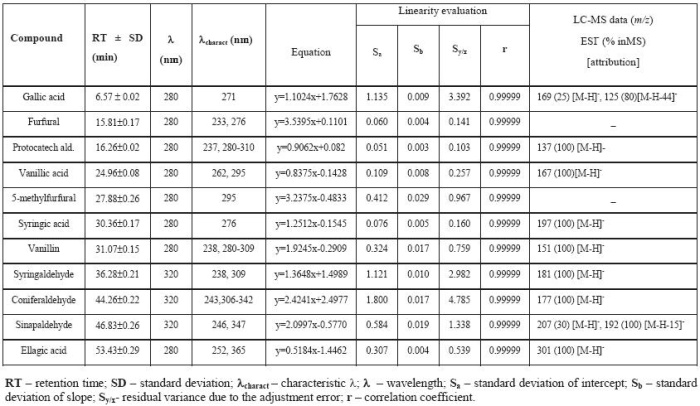
<body><![CDATA[<p><B>HPLC Methods </B></p>      <P>For HPLC analysis, samples were &#64257;ltered through a nylon &#64257; lter 0.45&mu;m (Whatman, Schleicher &amp; Schuell,   England), into a vial before injection. Analyses were performed in duplicate. </P>     <P>The HPLC system UltiMate 3000 (Dionex Corp., Sunnyvale, C.A.) comprises a quaternary pump, a column oven, a DAD detector and  an autosampler. Chromeleon 7.0 software was used for acquisition and data treatment. The column was a LiChrosphere RP18,  5&mu;m, 250x4mm (Merck, Darmstadt, Germany) and was kept isothermal, at 40&ordm;C, during analysis. Eluent A was water:   formic acid (98:2 (v/v)) and B was methanol: water: formic acid (70:28:2 (v/v/v)). The &#64258;ow rate: 1 mLmin<Sup>-1</Sup>,   injection volume was 25 &mu;L and the elution program used was as follow: from 0% to 40% of solvent B in 45 minutes; 40% to  60% of solvent B in 25 minutes (Canas <I>et al.</I>, 2003). </P>     <P ><B>LC-DAD/ESI-MS method </B></P>     <P>Liquid Chromatography was performed using a Surveyor Thermo Finnigan HPLC system with autosampler and PDA detector. MS  analysis was carried out in an LCQ Fleet mass spectrometer (Thermo Finnigan &ndash; San Jose, CA, USA) equipped with  electrospray ionization (ESI) source and an ion trap mass analyzer. The column used was a Grace Smart RPC18, 150 mm &times;   2.1 mm ID, 3.0 &mu;m. Mobile phase was a binary and consisted on solvents A (water- formic acid (99.9:0.1 (v/v)) and B   (methanol) as follows: 5-45% B from 0-35 min; then 70% B from 35-40 min and 70% B from 40-50 min. The &#64258;ow rate was  &#64257;xed at 0.2mLmin-1 during the entire run. Column oven was kept isothermal at 30&deg;C.Sample tray was set at   24 &deg;C. Injection volume was 10 &mu;L, and PDA detection was set between 200-600 nm to monitor the UV-Vis absorption. The  conditions for MS analysis were: capillary temperature of 300&deg;C, source voltage of 5.0 kV, source current of 100.0 &mu;A  and capillary voltage of -20.0 V in negative ion mode. Dry temperature was set to 300&ordm;C and the &#64258;ow of the drying  gas as 50.0 arbitrary units. </P>        <P>Analytes were detected in full MS scan mode (m/z 100&ndash;1200). The source fragmentation impact was set at 30V whenever  additional fragmentation was needed for compound identi&#64257;cation. </P>        <P>The identi&#64257;cation of chromatographic peaks was made by comparing their retention HPLC times with those of the   external standards, as well as by ESI-MS and UV spectra analysis. </P>       <p><B>Spectrophotometric methods </B></p>     <P>For total polyphenols and spectrophotometric analyses, extracts were diluted 20 folds with deionised water and  &#64257;ltered. Total polyphenols were determined by the Folin-Ciocalteau method applied to wines (Singleton and   Rossi, 1965). Absorbance spectra were recorded in the 250-450 nm range, with a 1 cm pathway cell against water, in a   Cadas 100 spectrophotometer. All analysis was performed in duplicate. </P>        <P><B>Calibration curves </B></P>      ]]></body>
<body><![CDATA[<P>Standards were prepared in water except for elagic acid which was prepared in absolute ethanol. Calibration curves were  obtained by injection of a series of standards diluted with a hydroalcoholic solution of 12% v/v, from a stock solution,   according to the calibration data in Table I. All curves were obtained with at least six   points. Injections were performed in duplicate. </P>     <p>&nbsp;</p>       <p><b><a name="t1"></a><a href="#topt1">Table I</a></b></p>      <p>Parameters for the calibration, spectroscopic and spectrometric data of low molecular weight phenolic compounds</p>     <P><i>Par&acirc;metros de calibra&ccedil;&atilde;o, dados espectrosc&oacute;picos e espectrofotom&eacute;tricos dos compostos  fen&oacute;licos de baixo peso molecular</i></P>      <p><img src="/img/revistas/ctv/v27n1/27n1a02t1.jpg"></p>      
<p>&nbsp;</p>        <P><B>Statistical methods </B></P>      <P>Differences in the phenolic composition of wood chips were assessed by one-way analysis of variance (ANOVA), considering   toasting level as a factor; mean comparisons were performed using Tukey-Kramer Multiple-Comparison Test at the 95%   con&#64257;dence level. Analyses were accomplished using NCSS 6.0 software (Statistical &amp; Power Analysis Software,   Kaysville, UT, USA). </P>      <p>&nbsp;</p>     ]]></body>
<body><![CDATA[<P><B>RESULTS AND DISCUSSION </B></P>     <P>Figure 1 shows the absorbance spectra of the hydroalcoholic extracts, recorded from 250  to 450 nm. Chestnut and oak present a very similar spectra regardless toasting level, with a maximum absorption around 300nm,  more highlighted with increasing toast level. Spectra from cherry and robinia present a maximum absorption at 280 nm,   diminishing with toasting level. Cherry extracts are the ones with lower absorbances. Cherry and robinia spectra&rsquo;s   seem to indicate toasting in&#64258;uence on wood ability to release compounds into a hydroalcoholic solution. </P>        <p>&nbsp;</p>      <p><a name="f1"></a></p>      <p><img src="/img/revistas/ctv/v27n1/27n1a02f1.jpg"></p>      
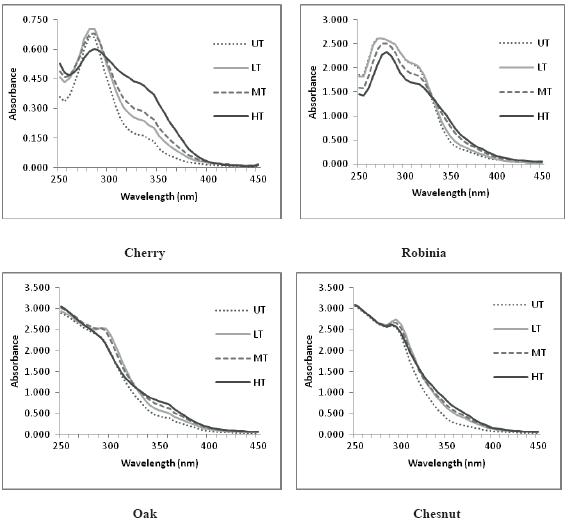
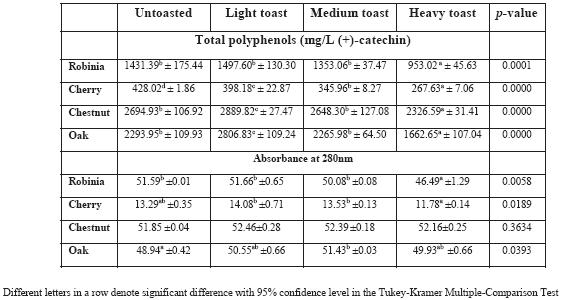
<p><b><a href="#topf1">Figure 1</a></b> Absorbance spectra (250-450nm) of hydroalcoholic extracts of the  four wood types subjected to different toasting levels.<B> UT &ndash; </B>untoasted;<B> TL &ndash; </B>light toast;<B> MT   </B>&ndash; medium toast<B>; HT </B>&ndash; heavy toast </P>      <P><i>Espectros de absorv&acirc;ncia (250-450nm) dos extratos hidroalco&oacute;licos das quatro esp&eacute;cies sujeitas a   diferentes n&iacute;veis de queima. <B>UT &ndash; </B>n&atilde;o queimada;<B> TL </B>&ndash; queima ligeira;<B>  MT </B>&ndash; queima m&eacute;dia<B>; HT </B>&ndash; queima forte </i></P>      <p>&nbsp;</p>        <P>Regarding total polyphenol contents of the four wood species  hydroalcoholic extracts (Table II)   it seems clear that chestnut and oak woods are the richest, while cherry is the poorest. This pro&#64257; le is not  in&#64258;uenced by toasting  process. It was already reported (De Rosso <I>et al.</I>, 2009) that the highest amounts of polyphenols released from woods   into alcoholic solutions miming wine, were from chestnut wood. The same study also referred robinia to be the poorest one,   regarding polyphenols release measured by Folin Ciocalteau reagent. Looking into toasting effect, the results show that heavy  toast is clearly the main responsible for reducing the amount of phenolic	compounds released into synthetic wine solutions.</P>      <p>&nbsp;</p>     ]]></body>
<body><![CDATA[<p><b>TABLE II</b></p>     <P>Total polyphenols and absorbance at 280 nm of hydroalcoholic extracts of the four wood species subjected to different  toasting levels</p>      <p><i>Polifenois totais e absorv&acirc;ncia a 280nm dos extratos hidroalco&oacute;licos das quatro esp&eacute;cies sujeitas   a diferentes n&iacute;veis de queima</i></P>      <p><img src="/img/revistas/ctv/v27n1/27n1a02t2.jpg"></p>      
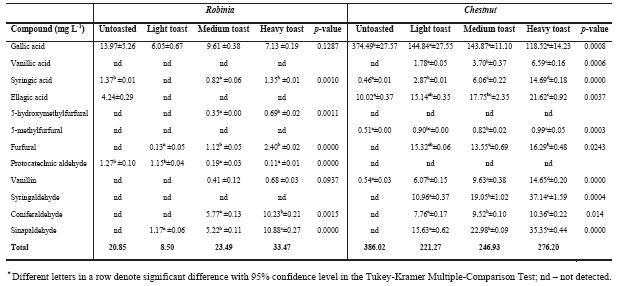
<p>&nbsp;</p>        <P>Table II also lists the absorbance of hydroalcoholic extracts measured at a wavelength of 280nm. Values obtained for   absorbance at 280nm are in accordance with values of polyphenols determined by oxidation with Folin Ciocalteau  reagent. Cherry presents smaller values for absorbance at 280 nm and chestnut presents the highest values. The total phenolic   compounds in enology are often measured by these two methods: absorbance at 280nm and/or the Folin Ciocalteau reaction.  Both methods are used to provide information regarding the polyphenol content of the matrix but should be aware that both  methods are not speci&#64257;c for phenolic compounds. In particular, for the measurement of the absorbance at 280 nm will   contribute all the compounds, phenolics or not, that absorb at this wavelength. However, polyphenols   which maxima absorbance is not 280 nm will not be  measured using this method (Derkyi <I>et al.</I>, 2011). In the case of    Folin Ciocalteau method, which takes into account all hydroxyl aromatic compounds, commonly used to determine the content    of phenolics, namely soluble phenolics (such as anthocyanins) as well as complex phenolics (such as hydrolysable and    condensed tannins), the phenolic contents values are over- or underestimation when compared to other methods (Vermerris    and Nicholson, 2006). This could explain the differences between phenolic contents obtained using the two methods described    above. However, those differences re&#64258;ect the impact of the wood composition which is in&#64258; uenced by botanical   species.</p>     Phenolic compounds extracted to the hydroalcoholic solutions by the different types of wood are presented  in Tables   III and Table IV. When ANOVA was applied  to these data signi&#64257;cant differences were observed, which are closely related with the toasting level. </P >     <p>&nbsp;</p>     <p><b>TABLE III</b></p>     <P>Phenolic compounds in hydroalcoholic solution with Robinia and Chestnut chips*</P>     <p><i>Compostos fen&oacute;licos nos extratos hidroalco&oacute;licos com aparas de Robinia e Castanheiro</I></P>      ]]></body>
<body><![CDATA[<p><img src="/img/revistas/ctv/v27n1/27n1a02t3.jpg"></p>     
<p>&nbsp;</p>         <p>&nbsp;</p>     <p><b>TABLE IV</b></p>      <P>Phenolic compounds in hydroalcoholic solution with cherry and oak chips*</p>     <p><i>Compostos fen&oacute;licos nos extratos hidroalco&oacute;licos com aparas de cerejeira e carvalho </i></P>       <p><img src="/img/revistas/ctv/v27n1/27n1a02t4.jpg"></p>     
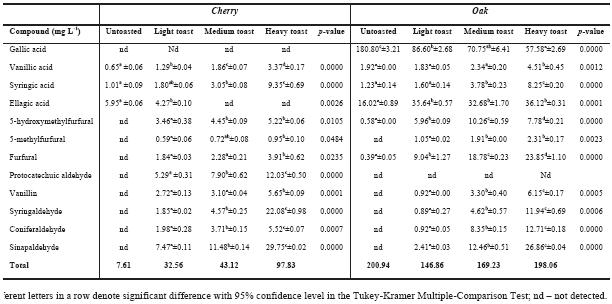
<p>&nbsp;</p>      <P>Among the extractable substances, some of the oenological important compounds are the gallotaninns and ellagitannins.  Heat treatments (seasoning and toasting) can cause decomposition of these tannins giving rise to gallic and ellagic acid,   respectively while vanillic and syringic acids come from lignin degradation (Puech <I>et al.</I>, 1989). For hydroalcoholic  extracts of chestnut, oak and cherry chips, there is a signi&#64257;cant increase of these phenolic acids with the rise of  toasting level, except for gallic acid. Gallic acid presents its highest value in untoasted oak and chestnut chips, meaning   that with high temperature gallic acid is degraded. Similar result has been described by others authors (Gimenez-Martinez  <I>et al.</I>, 1996; Canas <I>et al.</I>, 2003). According to our results, gallic acid is absent in the hydroalcoholic   solutions of cherry chips. In particular for robinia extracts, our results seems to be inconclusive concerning the   in&#64258;uence of the toasting level on the phenolic acids contents since this type of wood posseses a lack of these   compounds. We can also conclude that ellagic acid presents a more erratic behaviour among samples. Concerning ellagic acid   contents, the increment observed in oak and chestnut does not occur with cherry and robinia. It can be linked to different   contents of gallotannins and elagitannins, as these woods have released very small amounts of gallic acid. Regarding phenolic  compounds, so important in oak wood, the absence of hydrolysable tannins in cherry heartwood was already noticed (Sanz <I>et  al.</I>, 2010). </P>       <P>The presence of furanic aldehydes in woods is link to sugar thermo-degradation. 5-hydroxymethylfurfural and 5-methylfurfural  come mainly from hexoses, existing in cellulose, and furfural comes from pentoses, main constituents of hemicelluloses (Hodge,  1967). </P>        ]]></body>
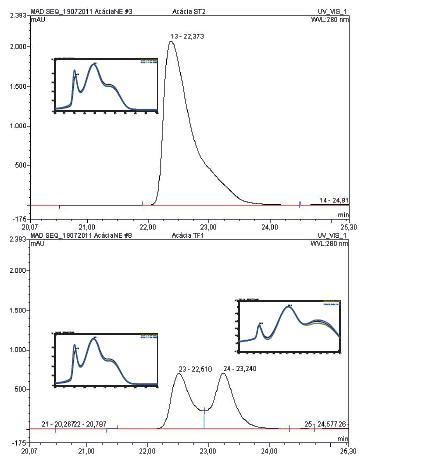
<body><![CDATA[<P>Several authors refer that untoasted oak wood present small amounts or furfural, 5-methylfurfural (Nabeta <I>et al.</I>,   1986; Marsal and Sarre, 1987; Chatonnet <I>et al.</I>, 1989; Marco <I>et al.</I>, 1994; G&eacute;taz <I>et al.</I>, 1996;   Garcia-Romero <I>et al.</I>, 1998; P&eacute;rez-Coello <I>et al.</I>, 1999) and 5-hydroxymethylfurfural (Artajona, 1991;  Masson <I>et al.</I>, 2000). Seasoning seems to play a role in hexoses and pentoses degradation, but toasting effect is   stronger. </P>        <P>Previous studies already suggested (Chatonnet <I>et al.</I>, 1989; Masson <I>et al.</I>, 2000; Bourgois and Guyonnet, 1988)  that furfural is dominant in toasted oak wood due to the fact that hemicelluloses are highly thermo unstable. Controversy   seems to be related to the impact of toasting levels in the &#64257;nal amounts of furfural, some (Chatonnet <I>et al.</I>,   1989) reported reaching the highest levels at medium toast while others clearly relate the increasing levels related to the   increase in toasting levels (Nomdedeu <I>et al.</I>, 1988; Artajona, 1991; Canas <I>et al.</I>, 2003). These different   statements are, most likely, because toasting temperatures is not unanimously related to a toasting level de&#64257;nition.</P>      <P>In our case, except with cherry chips, furfural was, as well, the furanic derivative present in higher amounts after  toasting. </P>     <P>Untoasted wood types release low contents of phenolic aldehydes (vanillin, syringaldehyde, coniferaldehyde and sinapaldehyde)  into alcoholic solutions; toasting originates the increment of these compounds (Chatonnet <I>et al.</I>, 1989; Artajona, 1991;  Nomdedeu <I>et al.</I>, 1988; Nishimura <I>et al.</I>, 1983; Dubois, 1989; Sarni <I>et al.</I>, 1990a; Mosedale and Ford,   1996; Canas <I>et al.</I>, 2003). In our alcoholic solutions, regardless the wood species, we can observe a signi&#64257; cant  increase in these compounds with toasting level. These compounds come from lignin degradation (Puech <I>et al.</I>, 1989;   Puech <I>et al.</I>, 1990) during thermal processing of woods. Heat treatment during the toasting process leads to a   decarboxilation and cleavage of the aryl-alkyl-ether bondages of terminal units of lignin, with formation of cinnamic   aldehydes, like coniferaldehyde and sinapaldehyde. When using higher temperature, to obtain heavy toast chips, oxidative   cleavage on C-C skeleton of these aldehydes may occur, leading to the corresponding benzoic aldehydes, vanillin and   syringaldehyde (Sarni <I>et al.</I>, 1990b; Chatonnet, 1995). Phenolic aldehydes can also be thermo degraded into phenolic  acids or volatile phenols (Chatonnet, 1995). Our results show a continuous increase in phenolic aldehydes released from woods  into alcoholic solution, regardless wood species; it seems that temperature applied, in heavy toast, was not enough to promote  cinnamic aldehydes degradation. </P>     <P>Syringaldehyde and sinapaldehyde in hydroalcoholic solutions, with toasted woods, are more abundant than vanillin and  coniferaldeyde, except for robinia. This seems to be related to the structure of these phenolic aldehydes. The former have   a syringylpropane structure that has a higher thermal stability than the latter, which presents a guaiacylpropane structure  (Canas <I>et al.</I>, 2011). </P>      <P >Protocatechuic aldehyde was only found in hydroalcoholic solution from robinia and cherry woods presenting a different   behaviour. In the case of robinia, a slight decrease with the increase of toasting level was observed while for cherry a   dramatic increase occurred. The formation of protocatechuic aldehyde, during toasting, is explained by heat degradation of   quercetin producing the correspondent acid as a cleavage reaction product (Buchner <I>et al.</I>, 2006); further heat   reduction will result in aldehyde formation (Sanz <I>et al.</I>, 2010). In spite the presence of both acid and aldehyde   protocatechuic in cherry heartwood seasoned and toasted that were found by Sanz <I>et al.</I>, (2010) in our work no   protocatechuic acid was found. </P>      <P >Comparing these four wood species, we might conclude that some main compounds are common to all of them, namely gallic   and ellagic acids and the aldehydes vanillin, syringaldehyde, coniferaldehyde, sinapaldehyde, as well as the furanic   derivatives furfural, 5-hydroxymethylfurfural and 5-methylfurfural. Furanic derivatives were only identi&#64257;ed by means   of their UV&ndash;Vis spectra and retention times. Except for these furanic derivatives, the respective [M-H]<Sup>-</Sup>  deprotonated molecule was the base peak in the MS pattern. Gallic acid also gave [M-H-44]<Sup>-</Sup>fragment ion via loss of   a CO<Sub>2</Sub> group from the carboxylic acid moiety (<a href="#t1">table 1</a><a name="topt1"></a>). For the methoxylated aldehydes (vanillin, syringaldehyde  and coniferaldehyde) the mass spectrum shows the respective deprotonated molecules at <I>m/z</I> 151, 181 and 177,   respectively. The mass spectrum of the more retained hydroxycinnamic aldehyde (sinapaldehyde) gave also a deprotonated  molecule [M-H]<Sup>-</Sup>at <I>m/z </I>207, although the main fragment present is due to the loss of a methyl group.   Fragmentations were con&#64257;rmed with the authentic standards. </P>        <P>Considering the above &#64257;ndings, it seems that attention should be drawn to the kinetics of release and trace   compounds identi&#64257;cations. Oak and chestnut release higher amounts of low molecular weight phenolic compounds into  model solutions. These two wood species show an absorbance spectra and polyphenols content very similar. Cherry and robinia   have different behaviour. Cherry released the lowest amount of compounds into the model solution presenting, after extraction,  the smaller amounts of phenolic compounds and the lower absorption at 250-450 nm. Data found for robinia wood is rather   different: very small amounts of phenolic compounds were identi&#64257;ed but absorbance at 280nm may suggest the presence of   other phenolic compounds in the extracts (<a href="#f1">Fig. 1</a><a name="topf1"></a>). In fact, Figure 2 depicted a selected region of LC-DAD chromatogram of   robinia extracts, showing a peak at 22,38 minutes in untoasted sample (A), that could be assigned to dihydrorobinetin,   according to spectroscopic (&lambda; <Sub>max </Sub>(nm): 276, 312sh) and spectrometric data: <I>m/z </I>(%) [attribution]  303 (80) [M- H]<Sup>-</Sup>, 285 (20) [M-HH<Sub>2</Sub>O]<Sup>-</Sup>. Same selected region for heavy toast sample (B) shows  the appearance of another peak at 23,24 minutes. Based on spectroscopic (&lambda; <Sub>max</Sub> (nm): 282, 325sh) and   spectrometric data: <I>m/z</I> (%) [attribution] 303 (100) [M- H]<Sup>-</Sup>, 285 (20) [M-H-H<Sub>2</Sub>O]<Sup>-</Sup>,   this compound, having a similar structure may be assigned to a dihydro&#64258;avonol analog. Roux and Paulus (1962)  &#64257;rst reported Dihydrorobinetin in non toasted robinia heartwood using paper chromatography. Recently, Cerezo et al.  (2009) also reported this compound in wine vinegar aged in acacia wood and Sanz et al. (2011) reported it in acacia heartwood.  According to these authors and our own results, it seems to be more characteristic of untoasted robinia wood.</P>      <p>&nbsp;</p>     <p><img src="/img/revistas/ctv/v27n1/27n1a02f2.jpg"></p>      
]]></body>
<body><![CDATA[<p><b>Figure 2</b> – LC-DAD chromatogram at 280 nm from a robinia extract: A untosted   chips, B heavy toasted chips</P>     <p><i>Cromatograma LC- DAD a 280 nm de extratos de robinis: A aparas não queimadas, B aparas com nível de queima forte</I></P>      <p>&nbsp;</p>       <P><B> CONCLUSIONS</b></P>     <P>Chip size and wood structure affect the release of compounds from wood into synthetic wine. As we used similar chip sizes  it seems that wood structure rather then size affect extraction efficiency. Eachwood species has a different profile regarding  phenolic acids, phenolic aldehydes and furanic derivatives, but it is also clear that the effect of toasting is similar.   Increasing toasting levels lead to an increase of phenolic aldehydes and phenolic acids such as 996.13syringic and vanillic  acids. More studies are need regarding robinia phenolic composition, as it seems to have other phenolic compounds, which   explain the high values obtained for absorbance measures and total polyphenolic content. The optimization of the amount of   chips used may, eventually, allow achievingresults similar to the oak chip application.</P>     <p>&nbsp;</p>       <P><B>REFERENCES</B>    <P>     <!-- ref --><P >Artajona J., 1991. Caracterisation del roble seg&uacute;n su origen y grado de tostado, mediante la utilizacion de GC y  HPLC. <I>Viticultura/ Enologia Profesional</I>, <B>14</B>, 61-72.    &nbsp;&nbsp;&nbsp;&nbsp;&nbsp;&nbsp;&nbsp;&nbsp;[&#160;<a href="javascript:void(0);" onclick="javascript: window.open('/scielo.php?script=sci_nlinks&ref=000101&pid=S0254-0223201200010000200001&lng=','','width=640,height=500,resizable=yes,scrollbars=1,menubar=yes,');">Links</a>&#160;]<!-- end-ref --> </P>     ]]></body>
<body><![CDATA[<!-- ref --><P>Bourgois J., Guyonnet R., 1988. Caracterization and analysis of torre&#64257; ed wood. <I>Wood Science and Technology</I>,  <B>22</B>, 143-155.    &nbsp;&nbsp;&nbsp;&nbsp;&nbsp;&nbsp;&nbsp;&nbsp;[&#160;<a href="javascript:void(0);" onclick="javascript: window.open('/scielo.php?script=sci_nlinks&ref=000103&pid=S0254-0223201200010000200002&lng=','','width=640,height=500,resizable=yes,scrollbars=1,menubar=yes,');">Links</a>&#160;]<!-- end-ref --> </P>     <!-- ref --><P>Buchner N., Krumbein A., Rohn S., Kroh L.H., 2006. Effect of hermal processing on the &#64258;avonols rutin and quercitin. <I>Rapid. Communications in Mass Spectrometry</I>,<B> 20</B>, 3229-3235.    &nbsp;&nbsp;&nbsp;&nbsp;&nbsp;&nbsp;&nbsp;&nbsp;[&#160;<a href="javascript:void(0);" onclick="javascript: window.open('/scielo.php?script=sci_nlinks&ref=000105&pid=S0254-0223201200010000200003&lng=','','width=640,height=500,resizable=yes,scrollbars=1,menubar=yes,');">Links</a>&#160;]<!-- end-ref --> </P>     <!-- ref --><P>Canas S., Belchior A.P., Spranger M. I., Bruno-de-Sousa R., 2003. High performance liquid chromatography method for  analysis of phenolic acids, phenolic aldehydes and furanic derivatives in brandies. Development and validation. <I>Journal  of Separation Science</I>, <B>26</B>, 496-502.    &nbsp;&nbsp;&nbsp;&nbsp;&nbsp;&nbsp;&nbsp;&nbsp;[&#160;<a href="javascript:void(0);" onclick="javascript: window.open('/scielo.php?script=sci_nlinks&ref=000107&pid=S0254-0223201200010000200004&lng=','','width=640,height=500,resizable=yes,scrollbars=1,menubar=yes,');">Links</a>&#160;]<!-- end-ref --> </P>     <!-- ref --><P>Canas S., Belchior A.P., Spranger M.I., Bruno-de-Sousa R., 2011. HPLC method for the quanti&#64257;cation of phenolic   acids, phenolic aldehydes, coumarins and furanic derivatives in different kinds of toasted wood used for the ageing of   brandies. <I>Analytical Methods</I>, <B>3</B>, 186-191.    &nbsp;&nbsp;&nbsp;&nbsp;&nbsp;&nbsp;&nbsp;&nbsp;[&#160;<a href="javascript:void(0);" onclick="javascript: window.open('/scielo.php?script=sci_nlinks&ref=000109&pid=S0254-0223201200010000200005&lng=','','width=640,height=500,resizable=yes,scrollbars=1,menubar=yes,');">Links</a>&#160;]<!-- end-ref --> </P>     <!-- ref --><P>Cerezo A.B., Espartero J.L., Winterhalter P., Garcia-Parrilla M.C., Troncoso A.M., 2009. (+)-Dihydrorobinetin: a marker  of vinegar aging in acacia (<I>Robinia pseudoacacia</I>) wood. <I>Journal of Agricultural and Food Chemistry </I><B>57,  </B>9551-9554.    &nbsp;&nbsp;&nbsp;&nbsp;&nbsp;&nbsp;&nbsp;&nbsp;[&#160;<a href="javascript:void(0);" onclick="javascript: window.open('/scielo.php?script=sci_nlinks&ref=000111&pid=S0254-0223201200010000200006&lng=','','width=640,height=500,resizable=yes,scrollbars=1,menubar=yes,');">Links</a>&#160;]<!-- end-ref --> </P>     ]]></body>
<body><![CDATA[<!-- ref --><P>Chatonnet P., Boidron J.N., Pons M., 1989. Incidence du traitement thermique du bois de ch&ecirc;ne sur sa composition  chimique. 2&ordm;partie: &Eacute;volution de certains compos&eacute;s en fonction de l&acute;intensit&eacute; de  br&ucirc;lage. <I>Connaissance de la Vigne et du Vin</I>,<B> 23</B>, 223-250.    &nbsp;&nbsp;&nbsp;&nbsp;&nbsp;&nbsp;&nbsp;&nbsp;[&#160;<a href="javascript:void(0);" onclick="javascript: window.open('/scielo.php?script=sci_nlinks&ref=000113&pid=S0254-0223201200010000200007&lng=','','width=640,height=500,resizable=yes,scrollbars=1,menubar=yes,');">Links</a>&#160;]<!-- end-ref --> </P>      <!-- ref --><P >Chatonnet P., 1995. <I>In</I><I>&#64258;</I><I>uence des proc&eacute;d&eacute;s de tonnellerie et des conditions   d&acute;&eacute;levage sur la composition et la qualit&eacute; des vins &eacute;l&eacute;v&eacute;s en f&ucirc;t de   ch&ecirc;ne</I>. Pp. 268. Th&egrave;se Doctorat. UFR Institut d&acute;Oenologie, Universit&eacute; de Bordeaux II,   Bord&eacute;us.    &nbsp;&nbsp;&nbsp;&nbsp;&nbsp;&nbsp;&nbsp;&nbsp;[&#160;<a href="javascript:void(0);" onclick="javascript: window.open('/scielo.php?script=sci_nlinks&ref=000115&pid=S0254-0223201200010000200008&lng=','','width=640,height=500,resizable=yes,scrollbars=1,menubar=yes,');">Links</a>&#160;]<!-- end-ref --> </P>      <P >Citron G., 2005. Uso del legno in enologia: specie botaniche utilizzate, anatomia e classi&#64257;cazione.   <I>L&rsquo;Informatore Agrario</I>, <B>59</B>, 69-72. </P>      <!-- ref --><P >Derkyi N.S.A., Adu-Amankwai B., Sekyere D., Darkwa N.A., 2011. Rapid prediction of extractives and polyphenolic contents  in <I>Pinus caribara</I> bark using near infrared re&#64258; ectance spectroscopy. <I>International Journal of Applied   Sciences</I>, <B>1</B>, 1- 11.    &nbsp;&nbsp;&nbsp;&nbsp;&nbsp;&nbsp;&nbsp;&nbsp;[&#160;<a href="javascript:void(0);" onclick="javascript: window.open('/scielo.php?script=sci_nlinks&ref=000118&pid=S0254-0223201200010000200010&lng=','','width=640,height=500,resizable=yes,scrollbars=1,menubar=yes,');">Links</a>&#160;]<!-- end-ref --> </P>      <!-- ref --><P >De Rosso M., Cancian D., Panighel A., Vedova A.D., Flamini R., 2009. Chemical compounds released from five different   woods used to make barrels for aging wines and spirits: volatile compounds and polyphenols. <I>Wood Science and   Technology</I>, <B>43</B>, 375-385.    &nbsp;&nbsp;&nbsp;&nbsp;&nbsp;&nbsp;&nbsp;&nbsp;[&#160;<a href="javascript:void(0);" onclick="javascript: window.open('/scielo.php?script=sci_nlinks&ref=000120&pid=S0254-0223201200010000200011&lng=','','width=640,height=500,resizable=yes,scrollbars=1,menubar=yes,');">Links</a>&#160;]<!-- end-ref --> </P>      <P>Dubois P., 1989. Apport du f&ucirc;t de ch&ecirc;ne neuf &agrave; l&rsquo;ar&ocirc;me des vins. <I>Revue Fran&ccedil;aise  d&rsquo;Oenologie</I>, <B>120</B>, 19-24. </P>      ]]></body>
<body><![CDATA[<!-- ref --><P >Fern&aacute;ndez de Sim&oacute;n B., Cadah&iacute;a E., Del &Aacute;lamo M., Nevares I., 2009. Volatile compounds in   acacia, chestnut, cherry ash and oak woods, with a view to their use in cooperage. <I>Journal of Agricultural and Food   Chemistry</I>, <B>57</B>, 3217-3227.    &nbsp;&nbsp;&nbsp;&nbsp;&nbsp;&nbsp;&nbsp;&nbsp;[&#160;<a href="javascript:void(0);" onclick="javascript: window.open('/scielo.php?script=sci_nlinks&ref=000123&pid=S0254-0223201200010000200013&lng=','','width=640,height=500,resizable=yes,scrollbars=1,menubar=yes,');">Links</a>&#160;]<!-- end-ref --> </P>      <!-- ref --><P >Fern&aacute;ndez de Sim&oacute;n B., Cadah&iacute;a E., Mui&ntilde;o I., Del &Aacute;lamo M., Nevares I., 2010. Volatile  composition of toasted oak chips and staves and of red wine aged with them. <I>American Journal of Enology and Viticulture</I>  , <B>61</B>, 157-165.    &nbsp;&nbsp;&nbsp;&nbsp;&nbsp;&nbsp;&nbsp;&nbsp;[&#160;<a href="javascript:void(0);" onclick="javascript: window.open('/scielo.php?script=sci_nlinks&ref=000125&pid=S0254-0223201200010000200014&lng=','','width=640,height=500,resizable=yes,scrollbars=1,menubar=yes,');">Links</a>&#160;]<!-- end-ref --> </P>      <!-- ref --><P>Garcia-Romero E., P&eacute;rez-Coello M.S., Sanz J., Cabezudo M.S., 1998. Quantitative analysis of the principal volatile  compounds in oak wood by direct thermal desorption (DTD) and GC/MS. <I>Analusis</I>, <B>26</B>, 33-35.    &nbsp;&nbsp;&nbsp;&nbsp;&nbsp;&nbsp;&nbsp;&nbsp;[&#160;<a href="javascript:void(0);" onclick="javascript: window.open('/scielo.php?script=sci_nlinks&ref=000127&pid=S0254-0223201200010000200015&lng=','','width=640,height=500,resizable=yes,scrollbars=1,menubar=yes,');">Links</a>&#160;]<!-- end-ref --> </P>      <P>G&eacute;taz J., Canetti J., Lebedeff J., Horisberger D., 1996. Utilisation de ch&ecirc;nes indig&egrave;nes pour la   construction de barriques: une solution d&acute;avenir. <I>Revue suisse de viticulture, d&rsquo;arboriculture et   d&rsquo;horticulture</I>, <B>28</B>, 183-194. </P>      <!-- ref --><P >Gimenez-Martinez R., De La Serrana H.L.G., Mir M.V., Granados J.Q., Martinez M.C.L., 1996. In&#64258;uence of wood heat  treatment, temperature and maceration time on vanillin, syringaldehyde, and gallic acid contents in oak wood and wine spirit   mixtures. <I>American Journal of Enology and Viticulture</I>, <B>47</B>, 441-446.    &nbsp;&nbsp;&nbsp;&nbsp;&nbsp;&nbsp;&nbsp;&nbsp;[&#160;<a href="javascript:void(0);" onclick="javascript: window.open('/scielo.php?script=sci_nlinks&ref=000130&pid=S0254-0223201200010000200017&lng=','','width=640,height=500,resizable=yes,scrollbars=1,menubar=yes,');">Links</a>&#160;]<!-- end-ref --> </P>      <!-- ref --><P>Hodge J.E., 1967. Non-enzymatic browning reaction. In W. Schultz, E. A. Day &amp; L. M. Libbey (Eds.), <I>Symposium on   Foods. Chemistry and Physiology of </I><I>&#64258;</I><I>avors</I>. (pp. 465-491). Westport, USA: AVI Publishing.    &nbsp;&nbsp;&nbsp;&nbsp;&nbsp;&nbsp;&nbsp;&nbsp;[&#160;<a href="javascript:void(0);" onclick="javascript: window.open('/scielo.php?script=sci_nlinks&ref=000132&pid=S0254-0223201200010000200018&lng=','','width=640,height=500,resizable=yes,scrollbars=1,menubar=yes,');">Links</a>&#160;]<!-- end-ref --> </P>      <!-- ref --><P >Madrera R.R., Valles B.S., Garc&iacute;a Y.D. Arg&uuml;elles P., Lobo A.P., 2010. Alternative woods for aging   distillates-an insight into their phenolic pro&#64257;les and antioxidant activities. <I>Food Science and Biotechnology</I>,  <B>19</B>, 1129-1134.    &nbsp;&nbsp;&nbsp;&nbsp;&nbsp;&nbsp;&nbsp;&nbsp;[&#160;<a href="javascript:void(0);" onclick="javascript: window.open('/scielo.php?script=sci_nlinks&ref=000134&pid=S0254-0223201200010000200019&lng=','','width=640,height=500,resizable=yes,scrollbars=1,menubar=yes,');">Links</a>&#160;]<!-- end-ref --> </P>      <!-- ref --><P >Marco J., Artajona J., Larrechi M.S., Rius F.X., 1994. Relationship between geographical origin and chemical composition  of wood for oak barrels. <I>American Journal of Enology and Viticulture</I>, <B>45</B>, 192-200.    &nbsp;&nbsp;&nbsp;&nbsp;&nbsp;&nbsp;&nbsp;&nbsp;[&#160;<a href="javascript:void(0);" onclick="javascript: window.open('/scielo.php?script=sci_nlinks&ref=000136&pid=S0254-0223201200010000200020&lng=','','width=640,height=500,resizable=yes,scrollbars=1,menubar=yes,');">Links</a>&#160;]<!-- end-ref --> </P>      <!-- ref --><P >Marsal F., Sarre C., 1987. &Eacute;tude par chromatographie en phase gaseuse de substances volatiles issues du bois de  ch&ecirc;ne. <I>Connaissance de la Vigne et du Vin</I>, <B>21</B>, 71-80.    &nbsp;&nbsp;&nbsp;&nbsp;&nbsp;&nbsp;&nbsp;&nbsp;[&#160;<a href="javascript:void(0);" onclick="javascript: window.open('/scielo.php?script=sci_nlinks&ref=000138&pid=S0254-0223201200010000200021&lng=','','width=640,height=500,resizable=yes,scrollbars=1,menubar=yes,');">Links</a>&#160;]<!-- end-ref --> </P>      <!-- ref --><P >Masson E., Baumes R., Moutounet M., Puech J.L., 2000. The effect of kiln-drying on the levels of ellagitannins and   volatile compounds of European oak (<I>Quercus petraea</I> Liebl.) stave wood. <I>American Journal of Enology and   Viticulture</I>, <B>51</B>, 201-214.    &nbsp;&nbsp;&nbsp;&nbsp;&nbsp;&nbsp;&nbsp;&nbsp;[&#160;<a href="javascript:void(0);" onclick="javascript: window.open('/scielo.php?script=sci_nlinks&ref=000140&pid=S0254-0223201200010000200022&lng=','','width=640,height=500,resizable=yes,scrollbars=1,menubar=yes,');">Links</a>&#160;]<!-- end-ref --> </P>      <!-- ref --><P >Mosedale J.R., Ford A., 1996. Variation of the &#64258;avour and extractives of european oak wood from two french forests.  <I>Journal of the science of food and agriculture</I>,<B> 70</B>, 273-287.    &nbsp;&nbsp;&nbsp;&nbsp;&nbsp;&nbsp;&nbsp;&nbsp;[&#160;<a href="javascript:void(0);" onclick="javascript: window.open('/scielo.php?script=sci_nlinks&ref=000142&pid=S0254-0223201200010000200023&lng=','','width=640,height=500,resizable=yes,scrollbars=1,menubar=yes,');">Links</a>&#160;]<!-- end-ref --> </P>      <!-- ref --><P >Nabeta K., Yonekubo J., Miyake M., 1986. Analysis of volatile constituents of european and japanese oaks. <I>Mokuzai   Gakkaishi</I>, <B>32</B>, 921-927.    &nbsp;&nbsp;&nbsp;&nbsp;&nbsp;&nbsp;&nbsp;&nbsp;[&#160;<a href="javascript:void(0);" onclick="javascript: window.open('/scielo.php?script=sci_nlinks&ref=000144&pid=S0254-0223201200010000200024&lng=','','width=640,height=500,resizable=yes,scrollbars=1,menubar=yes,');">Links</a>&#160;]<!-- end-ref --> </P>      <!-- ref --><P >Natali N., Chinnici F., Riponi C., 2006. Characterization of vola-tiles in extracts from oak chips obtained by   accelerated solvent extraction (ASE). <I>Journal of Agricultural Food Chemistry</I>, <B>54</B>, 8190-8198 &nbsp;&nbsp;&nbsp;&nbsp;&nbsp;&nbsp;&nbsp;&nbsp;[&#160;<a href="javascript:void(0);" onclick="javascript: window.open('/scielo.php?script=sci_nlinks&ref=000146&pid=S0254-0223201200010000200025&lng=','','width=640,height=500,resizable=yes,scrollbars=1,menubar=yes,');">Links</a>&#160;]<!-- end-ref --><!-- ref --><P >Nishimura K., Ohnishi M., Masuda M., Koga K., Matsuyama R., 1983. Reactions of wood components during maturation. In J. R.  Piggott (Eds) <I>Flavour of distilled beverages: origin and development</I> (pp. 241-255). Chichester, UK: Ellis Horwood.    &nbsp;&nbsp;&nbsp;&nbsp;&nbsp;&nbsp;&nbsp;&nbsp;[&#160;<a href="javascript:void(0);" onclick="javascript: window.open('/scielo.php?script=sci_nlinks&ref=000147&pid=S0254-0223201200010000200026&lng=','','width=640,height=500,resizable=yes,scrollbars=1,menubar=yes,');">Links</a>&#160;]<!-- end-ref --> </P>      <!-- ref --><P >Nomdedeu L., Leaute R., GrandChamp B., Bonnichon C., Laurichesse D., Trichet P., 1988. Br&ucirc;lage des barriques de   ch&ecirc;ne et qualit&eacute; des vins de M&eacute;doc. <I>Progr&egrave;s Agricole et Viticole</I>, <B>105</B>, 505-556.    &nbsp;&nbsp;&nbsp;&nbsp;&nbsp;&nbsp;&nbsp;&nbsp;[&#160;<a href="javascript:void(0);" onclick="javascript: window.open('/scielo.php?script=sci_nlinks&ref=000149&pid=S0254-0223201200010000200027&lng=','','width=640,height=500,resizable=yes,scrollbars=1,menubar=yes,');">Links</a>&#160;]<!-- end-ref --> </P>      <!-- ref --><P >Organisation Internationale de la Vigne et du Vin. 2005. Morceaux de bois de ch&ecirc;ne. R&eacute;solution N&deg;3 du 20   juillet 2005, OENO 3/2005.    &nbsp;&nbsp;&nbsp;&nbsp;&nbsp;&nbsp;&nbsp;&nbsp;[&#160;<a href="javascript:void(0);" onclick="javascript: window.open('/scielo.php?script=sci_nlinks&ref=000151&pid=S0254-0223201200010000200028&lng=','','width=640,height=500,resizable=yes,scrollbars=1,menubar=yes,');">Links</a>&#160;]<!-- end-ref --> </P>      ]]></body>
<body><![CDATA[<!-- ref --><P >P&eacute;rez-Coello M.S., Sanz J., Cabezudo M.D., 1999. Determination of volatile compounds in hydroalcoholic extracts of   french and american oak wood. <I>American Journal of Enology and Viticulture</I>, <B>50</B>, 162-165.    &nbsp;&nbsp;&nbsp;&nbsp;&nbsp;&nbsp;&nbsp;&nbsp;[&#160;<a href="javascript:void(0);" onclick="javascript: window.open('/scielo.php?script=sci_nlinks&ref=000153&pid=S0254-0223201200010000200029&lng=','','width=640,height=500,resizable=yes,scrollbars=1,menubar=yes,');">Links</a>&#160;]<!-- end-ref --> </P>      <P >Puech J.L., Robert A., Mouttet B., 1989. Evolution of oak wood lignin subjected to &#64258; ash hydrolysis. <I>  Holzforschung</I>, <B>43</B>, 235-238. </P>      <P >Puech J.L., Sarni F., Labidi A., Mouttet B., Robert A., 1990. Deligni&#64257;cation of oak wood with an ethanol-water  solution in a &#64258; ow-through reactor. <I>Holzforschung</I>, <B>44</B>, 367-371. </P>      <!-- ref --><P >Roux D.G., Paulus E., 1962. Condensed tannins: 13. Interrelationships of &#64258;anonoid components from the heartwood   of <I>Robinia pseudacacia</I>. <I>Biochemistry Journal</I>, <B>82</B>, 324-330.    &nbsp;&nbsp;&nbsp;&nbsp;&nbsp;&nbsp;&nbsp;&nbsp;[&#160;<a href="javascript:void(0);" onclick="javascript: window.open('/scielo.php?script=sci_nlinks&ref=000157&pid=S0254-0223201200010000200032&lng=','','width=640,height=500,resizable=yes,scrollbars=1,menubar=yes,');">Links</a>&#160;]<!-- end-ref --> </P>      <P >Sarni F., Rabier P., Moutounet M., 1990a. Fabrication des barriques et thermotraitements: relev&eacute; des   temp&eacute;ratures. <I>Revue Fran&ccedil;aise d&rsquo;Oenologie</I>, <B>123</B>, 53-58. </P>      <!-- ref --><P >Sarni F., Moutounet M., Puech J.L., Rabier P., 1990b. Effect of heat treatment of oak wood extractable compounds. <I>  Holzforschnung</I>, <B>44</B>, 461-466.    &nbsp;&nbsp;&nbsp;&nbsp;&nbsp;&nbsp;&nbsp;&nbsp;[&#160;<a href="javascript:void(0);" onclick="javascript: window.open('/scielo.php?script=sci_nlinks&ref=000160&pid=S0254-0223201200010000200034&lng=','','width=640,height=500,resizable=yes,scrollbars=1,menubar=yes,');">Links</a>&#160;]<!-- end-ref --> </P>      <!-- ref --><P >Sanz M., Cadah&iacute;a E., Esteruelas E., Munoz A.M., de Simon B.F., Hern&aacute;ndez T., Estrella, I.J., 2010. Phenolic  Compounds in Chestnut (<I>Castanea sativa</I> Mill.) Heartwood. Effect of Toasting at Cooperage. <I>Journal of Agricultural   and Food Chemistry</I>,<B> 58</B>, 9631- 9640.    &nbsp;&nbsp;&nbsp;&nbsp;&nbsp;&nbsp;&nbsp;&nbsp;[&#160;<a href="javascript:void(0);" onclick="javascript: window.open('/scielo.php?script=sci_nlinks&ref=000162&pid=S0254-0223201200010000200035&lng=','','width=640,height=500,resizable=yes,scrollbars=1,menubar=yes,');">Links</a>&#160;]<!-- end-ref --> </P>      <!-- ref --><P >Sanz M., de Simon B.F., Esteruelas E., Munoz A.M., Cadah&iacute;a E., Hern&aacute;ndez T., Estrella I.J., Pinto E., 2011.   Effect of toasting intensity at cooperage on phenolic compounds in acacia (<I>Robinia pseudoacacia</I>) heartwood.  <I>Journal of Agricultural and Food Chemistry, </I><B>59</B>, 3135-3145.    &nbsp;&nbsp;&nbsp;&nbsp;&nbsp;&nbsp;&nbsp;&nbsp;[&#160;<a href="javascript:void(0);" onclick="javascript: window.open('/scielo.php?script=sci_nlinks&ref=000164&pid=S0254-0223201200010000200036&lng=','','width=640,height=500,resizable=yes,scrollbars=1,menubar=yes,');">Links</a>&#160;]<!-- end-ref --> </P>      <!-- ref --><P>Singleton V.L., Rossi J.A., 1965. Colorimetry of total phenolics with phosphomolybdic-phosphotungstic acid reagents.   <I>American Journal of Enology and Viticulture</I>,<B> 16</B>, 144-158.    &nbsp;&nbsp;&nbsp;&nbsp;&nbsp;&nbsp;&nbsp;&nbsp;[&#160;<a href="javascript:void(0);" onclick="javascript: window.open('/scielo.php?script=sci_nlinks&ref=000166&pid=S0254-0223201200010000200037&lng=','','width=640,height=500,resizable=yes,scrollbars=1,menubar=yes,');">Links</a>&#160;]<!-- end-ref --> </P>      <P >Van Jaarsveld F.P., Hattingh S., Minnaar P., 2009. Rapid induction of ageing character in brandy products &ndash; Part   III. In&#64258;uence of toasting. <I>South African Journal of Enology and Viticulture</I>,<B> 30</B>, 24-37. </P>      <!-- ref --><P >Vermerris W., Nicholson R., 2006. Isolation and identi&#64257; cation of phenolic compounds - A practical guide. In W.   Vermerris &amp; R. Nicholson (Eds.), <I>Phenolic Compound Biochemistry</I> (pp. 151-196). Dordrecht, Netherlands: Springer.    &nbsp;&nbsp;&nbsp;&nbsp;&nbsp;&nbsp;&nbsp;&nbsp;[&#160;<a href="javascript:void(0);" onclick="javascript: window.open('/scielo.php?script=sci_nlinks&ref=000169&pid=S0254-0223201200010000200039&lng=','','width=640,height=500,resizable=yes,scrollbars=1,menubar=yes,');">Links</a>&#160;]<!-- end-ref --></P>      <p>&nbsp;</p>     <P><B>ACKNOWLEDGEMENTS</B></P>     ]]></body>
<body><![CDATA[<P>This work is funded by FEDER Funds through the Operational Programme for Competitiveness Factors - COMPETE and National  Funds through FCT - Foun-dation for Science and Technology under the StrategicProject PEst-C/AGR/UI0115/2011. Authors wish   to thanks the Cooperage J.M. Gonçalves Tanoaria, Lda (Palaçoulo, Portugal) for supplying the wood chips</P>     <p>&nbsp;</p>     <P><a name="0"></a><a href="#top0">*</a> Corresponding author: T. 351 266 769869; F. 351 266 769828, e-mail:  <a href="mailto:mjbc@uevora.pt">mjbc@uevora.pt </a></P>     <p>&nbsp;</p>     <P><I>(Manuscrito recebido em 24.04.2012. Aceite para publica&ccedil;&atilde;o em 12.06.2012) </I></P>      ]]></body><back>
<ref-list>
<ref id="B1">
<nlm-citation citation-type="journal">
<person-group person-group-type="author">
<name>
<surname><![CDATA[Artajona]]></surname>
<given-names><![CDATA[J.]]></given-names>
</name>
</person-group>
<article-title xml:lang="es"><![CDATA[Caracterisation del roble según su origen y grado de tostado, mediante la utilizacion de GC y HPLC]]></article-title>
<source><![CDATA[Viticultura/ Enologia Profesional]]></source>
<year>1991</year>
<volume>14</volume>
<page-range>61-72</page-range></nlm-citation>
</ref>
<ref id="B2">
<nlm-citation citation-type="journal">
<person-group person-group-type="author">
<name>
<surname><![CDATA[Bourgois]]></surname>
<given-names><![CDATA[J.]]></given-names>
</name>
<name>
<surname><![CDATA[Guyonnet]]></surname>
<given-names><![CDATA[R.]]></given-names>
</name>
</person-group>
<article-title xml:lang="en"><![CDATA[Caracterization and analysis of torre&#64257; ed wood]]></article-title>
<source><![CDATA[Wood Science and Technology]]></source>
<year>1988</year>
<volume>22</volume>
<page-range>143-155</page-range></nlm-citation>
</ref>
<ref id="B3">
<nlm-citation citation-type="journal">
<person-group person-group-type="author">
<name>
<surname><![CDATA[Buchner]]></surname>
<given-names><![CDATA[N.]]></given-names>
</name>
<name>
<surname><![CDATA[Krumbein]]></surname>
<given-names><![CDATA[A.]]></given-names>
</name>
<name>
<surname><![CDATA[Rohn]]></surname>
<given-names><![CDATA[S.]]></given-names>
</name>
<name>
<surname><![CDATA[Kroh]]></surname>
<given-names><![CDATA[L.H.]]></given-names>
</name>
</person-group>
<article-title xml:lang="en"><![CDATA[Effect of hermal processing on the &#64258;avonols rutin and quercitin]]></article-title>
<source><![CDATA[Rapid. Communications in Mass Spectrometry]]></source>
<year>2006</year>
<volume>20</volume>
<page-range>3229-3235</page-range></nlm-citation>
</ref>
<ref id="B4">
<nlm-citation citation-type="journal">
<person-group person-group-type="author">
<name>
<surname><![CDATA[Canas]]></surname>
<given-names><![CDATA[S.]]></given-names>
</name>
<name>
<surname><![CDATA[Belchior]]></surname>
<given-names><![CDATA[A.P.]]></given-names>
</name>
<name>
<surname><![CDATA[Spranger]]></surname>
<given-names><![CDATA[M. I.]]></given-names>
</name>
<name>
<surname><![CDATA[Bruno-de-Sousa]]></surname>
<given-names><![CDATA[R.]]></given-names>
</name>
</person-group>
<article-title xml:lang="en"><![CDATA[High performance liquid chromatography method for analysis of phenolic acids, phenolic aldehydes and furanic derivatives in brandies: Development and validation]]></article-title>
<source><![CDATA[Journal of Separation Science]]></source>
<year>2003</year>
<volume>26</volume>
<page-range>496-502</page-range></nlm-citation>
</ref>
<ref id="B5">
<nlm-citation citation-type="journal">
<person-group person-group-type="author">
<name>
<surname><![CDATA[Canas]]></surname>
<given-names><![CDATA[S.]]></given-names>
</name>
<name>
<surname><![CDATA[Belchior]]></surname>
<given-names><![CDATA[A.P.]]></given-names>
</name>
<name>
<surname><![CDATA[Spranger]]></surname>
<given-names><![CDATA[M.I.]]></given-names>
</name>
<name>
<surname><![CDATA[Bruno-de-Sousa]]></surname>
<given-names><![CDATA[R.]]></given-names>
</name>
</person-group>
<article-title xml:lang="en"><![CDATA[HPLC method for the quanti&#64257;cation of phenolic acids, phenolic aldehydes, coumarins and furanic derivatives in different kinds of toasted wood used for the ageing of brandies]]></article-title>
<source><![CDATA[Analytical Methods]]></source>
<year>2011</year>
<volume>3</volume>
<page-range>186-191</page-range></nlm-citation>
</ref>
<ref id="B6">
<nlm-citation citation-type="journal">
<person-group person-group-type="author">
<name>
<surname><![CDATA[Cerezo]]></surname>
<given-names><![CDATA[A.B.]]></given-names>
</name>
<name>
<surname><![CDATA[Espartero]]></surname>
<given-names><![CDATA[J.L.]]></given-names>
</name>
<name>
<surname><![CDATA[Winterhalter]]></surname>
<given-names><![CDATA[P.]]></given-names>
</name>
<name>
<surname><![CDATA[Garcia-Parrilla]]></surname>
<given-names><![CDATA[M.C.]]></given-names>
</name>
<name>
<surname><![CDATA[Troncoso]]></surname>
<given-names><![CDATA[A.M.]]></given-names>
</name>
</person-group>
<article-title xml:lang="en"><![CDATA[(+)-Dihydrorobinetin: a marker of vinegar aging in acacia (Robinia pseudoacacia) wood]]></article-title>
<source><![CDATA[Journal of Agricultural and Food Chemistry]]></source>
<year>2009</year>
<volume>57</volume>
<page-range>9551-9554</page-range></nlm-citation>
</ref>
<ref id="B7">
<nlm-citation citation-type="journal">
<person-group person-group-type="author">
<name>
<surname><![CDATA[Chatonnet]]></surname>
<given-names><![CDATA[P.]]></given-names>
</name>
<name>
<surname><![CDATA[Boidron]]></surname>
<given-names><![CDATA[J.N.]]></given-names>
</name>
<name>
<surname><![CDATA[Pons]]></surname>
<given-names><![CDATA[M.]]></given-names>
</name>
</person-group>
<article-title xml:lang="fr"><![CDATA[Incidence du traitement thermique du bois de chêne sur sa composition chimique: Évolution de certains composés en fonction de l´intensité de brûlage]]></article-title>
<source><![CDATA[Connaissance de la Vigne et du Vin]]></source>
<year>1989</year>
<volume>23</volume>
<page-range>223-250</page-range></nlm-citation>
</ref>
<ref id="B8">
<nlm-citation citation-type="">
<person-group person-group-type="author">
<name>
<surname><![CDATA[Chatonnet]]></surname>
<given-names><![CDATA[P.]]></given-names>
</name>
</person-group>
<source><![CDATA[In&#64258;uence des procédés de tonnellerie et des conditions d´élevage sur la composition et la qualité des vins élévés en fût de chêne]]></source>
<year>1995</year>
</nlm-citation>
</ref>
<ref id="B9">
<nlm-citation citation-type="journal">
<person-group person-group-type="author">
<name>
<surname><![CDATA[Citron]]></surname>
<given-names><![CDATA[G.]]></given-names>
</name>
</person-group>
<article-title xml:lang="it"><![CDATA[Uso del legno in enologia: specie botaniche utilizzate, anatomia e classi&#64257;cazione]]></article-title>
<source><![CDATA[L’Informatore Agrario]]></source>
<year>2005</year>
<volume>59</volume>
<page-range>69-72</page-range></nlm-citation>
</ref>
<ref id="B10">
<nlm-citation citation-type="journal">
<person-group person-group-type="author">
<name>
<surname><![CDATA[Derkyi]]></surname>
<given-names><![CDATA[N.S.A.]]></given-names>
</name>
<name>
<surname><![CDATA[Adu-Amankwai]]></surname>
<given-names><![CDATA[B.]]></given-names>
</name>
<name>
<surname><![CDATA[Sekyere]]></surname>
<given-names><![CDATA[D.]]></given-names>
</name>
<name>
<surname><![CDATA[Darkwa]]></surname>
<given-names><![CDATA[N.A.]]></given-names>
</name>
</person-group>
<article-title xml:lang="en"><![CDATA[Rapid prediction of extractives and polyphenolic contents in Pinus caribara bark using near infrared re&#64258; ectance spectroscopy]]></article-title>
<source><![CDATA[International Journal of Applied Sciences]]></source>
<year>2011</year>
<volume>1</volume>
<page-range>1-11</page-range></nlm-citation>
</ref>
<ref id="B11">
<nlm-citation citation-type="journal">
<person-group person-group-type="author">
<name>
<surname><![CDATA[De Rosso]]></surname>
<given-names><![CDATA[M.]]></given-names>
</name>
<name>
<surname><![CDATA[Cancian]]></surname>
<given-names><![CDATA[D.]]></given-names>
</name>
<name>
<surname><![CDATA[Panighel]]></surname>
<given-names><![CDATA[A.]]></given-names>
</name>
<name>
<surname><![CDATA[Vedova]]></surname>
<given-names><![CDATA[A.D.]]></given-names>
</name>
<name>
<surname><![CDATA[Flamini]]></surname>
<given-names><![CDATA[R.]]></given-names>
</name>
</person-group>
<article-title xml:lang="en"><![CDATA[Chemical compounds released from five different woods used to make barrels for aging wines and spirits: volatile compounds and polyphenols]]></article-title>
<source><![CDATA[Wood Science and Technology]]></source>
<year>2009</year>
<volume>43</volume>
<page-range>375-385</page-range></nlm-citation>
</ref>
<ref id="B12">
<nlm-citation citation-type="journal">
<person-group person-group-type="author">
<name>
<surname><![CDATA[Dubois]]></surname>
<given-names><![CDATA[P.]]></given-names>
</name>
</person-group>
<article-title xml:lang="fr"><![CDATA[Apport du fût de chêne neuf à l’arôme des vins.]]></article-title>
<source><![CDATA[Revue Française d’Oenologie]]></source>
<year>1989</year>
<volume>120</volume>
<page-range>19-24.</page-range></nlm-citation>
</ref>
<ref id="B13">
<nlm-citation citation-type="journal">
<person-group person-group-type="author">
<name>
<surname><![CDATA[Fernández de Simón]]></surname>
<given-names><![CDATA[B.]]></given-names>
</name>
<name>
<surname><![CDATA[Cadahía]]></surname>
<given-names><![CDATA[E.]]></given-names>
</name>
<name>
<surname><![CDATA[Del Álamo]]></surname>
<given-names><![CDATA[M.]]></given-names>
</name>
<name>
<surname><![CDATA[Nevares]]></surname>
<given-names><![CDATA[I.]]></given-names>
</name>
</person-group>
<article-title xml:lang="en"><![CDATA[Volatile compounds in acacia, chestnut, cherry ash and oak woods, with a view to their use in cooperage.]]></article-title>
<source><![CDATA[Journal of Agricultural and Food Chemistry]]></source>
<year>2009</year>
<volume>57</volume>
<page-range>3217-3227</page-range></nlm-citation>
</ref>
<ref id="B14">
<nlm-citation citation-type="journal">
<person-group person-group-type="author">
<name>
<surname><![CDATA[Fernández de Simón]]></surname>
<given-names><![CDATA[B.]]></given-names>
</name>
<name>
<surname><![CDATA[Cadahía]]></surname>
<given-names><![CDATA[E.]]></given-names>
</name>
<name>
<surname><![CDATA[Muiño]]></surname>
<given-names><![CDATA[I.]]></given-names>
</name>
<name>
<surname><![CDATA[Del Álamo]]></surname>
<given-names><![CDATA[M.]]></given-names>
</name>
<name>
<surname><![CDATA[Nevares]]></surname>
<given-names><![CDATA[I.]]></given-names>
</name>
</person-group>
<article-title xml:lang="en"><![CDATA[Volatile composition of toasted oak chips and staves and of red wine aged with them.]]></article-title>
<source><![CDATA[American Journal of Enology and Viticulture]]></source>
<year>2010</year>
<volume>61</volume>
<page-range>157-165</page-range></nlm-citation>
</ref>
<ref id="B15">
<nlm-citation citation-type="journal">
<person-group person-group-type="author">
<name>
<surname><![CDATA[Garcia-Romero]]></surname>
<given-names><![CDATA[E.]]></given-names>
</name>
<name>
<surname><![CDATA[Pérez-Coello]]></surname>
<given-names><![CDATA[M.S.]]></given-names>
</name>
<name>
<surname><![CDATA[Sanz]]></surname>
<given-names><![CDATA[J.]]></given-names>
</name>
<name>
<surname><![CDATA[Cabezudo]]></surname>
<given-names><![CDATA[M.S.]]></given-names>
</name>
</person-group>
<article-title xml:lang="en"><![CDATA[Quantitative analysis of the principal volatile compounds in oak wood by direct thermal desorption (DTD) and GC/MS]]></article-title>
<source><![CDATA[Analusis]]></source>
<year>1998</year>
<volume>26</volume>
<page-range>33-35</page-range></nlm-citation>
</ref>
<ref id="B16">
<nlm-citation citation-type="journal">
<person-group person-group-type="author">
<name>
<surname><![CDATA[Gétaz]]></surname>
<given-names><![CDATA[J.]]></given-names>
</name>
<name>
<surname><![CDATA[Canetti]]></surname>
<given-names><![CDATA[J.]]></given-names>
</name>
<name>
<surname><![CDATA[Lebedeff]]></surname>
<given-names><![CDATA[J.]]></given-names>
</name>
<name>
<surname><![CDATA[Horisberger]]></surname>
<given-names><![CDATA[D.]]></given-names>
</name>
</person-group>
<article-title xml:lang="fr"><![CDATA[Utilisation de chênes indigènes pour la construction de barriques: une solution d´avenir]]></article-title>
<source><![CDATA[Revue suisse de viticulture, d’arboriculture et d’horticulture]]></source>
<year>1996</year>
<volume>28</volume>
<page-range>183-194</page-range></nlm-citation>
</ref>
<ref id="B17">
<nlm-citation citation-type="journal">
<person-group person-group-type="author">
<name>
<surname><![CDATA[Gimenez-Martinez]]></surname>
<given-names><![CDATA[R.]]></given-names>
</name>
<name>
<surname><![CDATA[De La Serrana]]></surname>
<given-names><![CDATA[H.L.G.]]></given-names>
</name>
<name>
<surname><![CDATA[Mir]]></surname>
<given-names><![CDATA[M.V.]]></given-names>
</name>
<name>
<surname><![CDATA[Granados]]></surname>
<given-names><![CDATA[J.Q.]]></given-names>
</name>
<name>
<surname><![CDATA[Martinez]]></surname>
<given-names><![CDATA[M.C.L.]]></given-names>
</name>
</person-group>
<article-title xml:lang="en"><![CDATA[In&#64258;uence of wood heat treatment, temperature and maceration time on vanillin, syringaldehyde, and gallic acid contents in oak wood and wine spirit mixtures]]></article-title>
<source><![CDATA[American Journal of Enology and Viticulture]]></source>
<year>1996</year>
<volume>47</volume>
<page-range>441-446</page-range></nlm-citation>
</ref>
<ref id="B18">
<nlm-citation citation-type="book">
<person-group person-group-type="author">
<name>
<surname><![CDATA[Hodge]]></surname>
<given-names><![CDATA[J.E.]]></given-names>
</name>
</person-group>
<article-title xml:lang="en"><![CDATA[Non-enzymatic browning reaction]]></article-title>
<person-group person-group-type="editor">
<name>
<surname><![CDATA[Schultz]]></surname>
<given-names><![CDATA[W.]]></given-names>
</name>
<name>
<surname><![CDATA[Day]]></surname>
<given-names><![CDATA[E. A.]]></given-names>
</name>
<name>
<surname><![CDATA[Libbey]]></surname>
<given-names><![CDATA[L. M.]]></given-names>
</name>
</person-group>
<source><![CDATA[Symposium on Foods: Chemistry and Physiology of &#64258;avors]]></source>
<year>1967</year>
<page-range>465-491</page-range><publisher-loc><![CDATA[Westport ]]></publisher-loc>
<publisher-name><![CDATA[AVI Publishing]]></publisher-name>
</nlm-citation>
</ref>
<ref id="B19">
<nlm-citation citation-type="journal">
<person-group person-group-type="author">
<name>
<surname><![CDATA[Madrera]]></surname>
<given-names><![CDATA[R.R.]]></given-names>
</name>
<name>
<surname><![CDATA[Valles]]></surname>
<given-names><![CDATA[B.S.]]></given-names>
</name>
<name>
<surname><![CDATA[García]]></surname>
<given-names><![CDATA[Y.D.]]></given-names>
</name>
<name>
<surname><![CDATA[Argüelles]]></surname>
<given-names><![CDATA[P.]]></given-names>
</name>
<name>
<surname><![CDATA[Lobo]]></surname>
<given-names><![CDATA[A.P.]]></given-names>
</name>
</person-group>
<article-title xml:lang="en"><![CDATA[Alternative woods for aging distillates-an insight into their phenolic pro&#64257;les and antioxidant activities]]></article-title>
<source><![CDATA[Food Science and Biotechnology]]></source>
<year>2010</year>
<volume>19</volume>
<page-range>1129-1134</page-range></nlm-citation>
</ref>
<ref id="B20">
<nlm-citation citation-type="journal">
<person-group person-group-type="author">
<name>
<surname><![CDATA[Marco]]></surname>
<given-names><![CDATA[J.]]></given-names>
</name>
<name>
<surname><![CDATA[Artajona]]></surname>
<given-names><![CDATA[J.]]></given-names>
</name>
<name>
<surname><![CDATA[Larrechi]]></surname>
<given-names><![CDATA[M.S.]]></given-names>
</name>
<name>
<surname><![CDATA[Rius]]></surname>
<given-names><![CDATA[F.X.]]></given-names>
</name>
</person-group>
<article-title xml:lang="en"><![CDATA[Relationship between geographical origin and chemical composition of wood for oak barrels]]></article-title>
<source><![CDATA[American Journal of Enology and Viticulture]]></source>
<year>1994</year>
<volume>45</volume>
<page-range>192-200</page-range></nlm-citation>
</ref>
<ref id="B21">
<nlm-citation citation-type="journal">
<person-group person-group-type="author">
<name>
<surname><![CDATA[Marsal]]></surname>
<given-names><![CDATA[F.]]></given-names>
</name>
<name>
<surname><![CDATA[Sarre]]></surname>
<given-names><![CDATA[C.]]></given-names>
</name>
</person-group>
<article-title xml:lang="fr"><![CDATA[Étude par chromatographie en phase gaseuse de substances volatiles issues du bois de chêne.]]></article-title>
<source><![CDATA[Connaissance de la Vigne et du Vin]]></source>
<year>1987</year>
<volume>21</volume>
<page-range>71-80</page-range></nlm-citation>
</ref>
<ref id="B22">
<nlm-citation citation-type="journal">
<person-group person-group-type="author">
<name>
<surname><![CDATA[Masson]]></surname>
<given-names><![CDATA[E.]]></given-names>
</name>
<name>
<surname><![CDATA[Baumes]]></surname>
<given-names><![CDATA[R.]]></given-names>
</name>
<name>
<surname><![CDATA[Moutounet]]></surname>
<given-names><![CDATA[M.]]></given-names>
</name>
<name>
<surname><![CDATA[Puech]]></surname>
<given-names><![CDATA[J.L.]]></given-names>
</name>
</person-group>
<article-title xml:lang="en"><![CDATA[The effect of kiln-drying on the levels of ellagitannins and volatile compounds of European oak (Quercus petraea Liebl.) stave wood.]]></article-title>
<source><![CDATA[American Journal of Enology and Viticulture]]></source>
<year>2000</year>
<volume>51</volume>
<page-range>201-214</page-range></nlm-citation>
</ref>
<ref id="B23">
<nlm-citation citation-type="journal">
<person-group person-group-type="author">
<name>
<surname><![CDATA[Mosedale]]></surname>
<given-names><![CDATA[J.R.]]></given-names>
</name>
<name>
<surname><![CDATA[Ford]]></surname>
<given-names><![CDATA[A.]]></given-names>
</name>
</person-group>
<article-title xml:lang="en"><![CDATA[Variation of the &#64258;avour and extractives of european oak wood from two french forests.]]></article-title>
<source><![CDATA[Journal of the science of food and agriculture]]></source>
<year>1996</year>
<volume>70</volume>
<page-range>273-287</page-range></nlm-citation>
</ref>
<ref id="B24">
<nlm-citation citation-type="journal">
<person-group person-group-type="author">
<name>
<surname><![CDATA[Nabeta]]></surname>
<given-names><![CDATA[K.]]></given-names>
</name>
<name>
<surname><![CDATA[Yonekubo]]></surname>
<given-names><![CDATA[J.]]></given-names>
</name>
<name>
<surname><![CDATA[Miyake]]></surname>
<given-names><![CDATA[M.]]></given-names>
</name>
</person-group>
<article-title xml:lang="en"><![CDATA[Analysis of volatile constituents of european and japanese oaks.]]></article-title>
<source><![CDATA[Mokuzai Gakkaishi]]></source>
<year>1986</year>
<volume>32</volume>
<page-range>921-927</page-range></nlm-citation>
</ref>
<ref id="B25">
<nlm-citation citation-type="journal">
<person-group person-group-type="author">
<name>
<surname><![CDATA[Natali]]></surname>
<given-names><![CDATA[N.]]></given-names>
</name>
<name>
<surname><![CDATA[Chinnici]]></surname>
<given-names><![CDATA[F.]]></given-names>
</name>
<name>
<surname><![CDATA[Riponi]]></surname>
<given-names><![CDATA[C.]]></given-names>
</name>
</person-group>
<article-title xml:lang="en"><![CDATA[Characterization of vola-tiles in extracts from oak chips obtained by accelerated solvent extraction (ASE)]]></article-title>
<source><![CDATA[Journal of Agricultural Food Chemistry]]></source>
<year>2006</year>
<volume>54</volume>
<page-range>8190-8198</page-range></nlm-citation>
</ref>
<ref id="B26">
<nlm-citation citation-type="book">
<person-group person-group-type="author">
<name>
<surname><![CDATA[Nishimura]]></surname>
<given-names><![CDATA[K.]]></given-names>
</name>
<name>
<surname><![CDATA[Ohnishi]]></surname>
<given-names><![CDATA[M.]]></given-names>
</name>
<name>
<surname><![CDATA[Masuda]]></surname>
<given-names><![CDATA[M.]]></given-names>
</name>
<name>
<surname><![CDATA[Koga]]></surname>
<given-names><![CDATA[K.]]></given-names>
</name>
<name>
<surname><![CDATA[Matsuyama]]></surname>
<given-names><![CDATA[R.]]></given-names>
</name>
</person-group>
<article-title xml:lang="en"><![CDATA[Reactions of wood components during maturation]]></article-title>
<person-group person-group-type="editor">
<name>
<surname><![CDATA[Piggott]]></surname>
<given-names><![CDATA[J. R.]]></given-names>
</name>
</person-group>
<source><![CDATA[Flavour of distilled beverages: origin and development]]></source>
<year>1983</year>
<page-range>241-255</page-range><publisher-loc><![CDATA[Chichester ]]></publisher-loc>
<publisher-name><![CDATA[Ellis Horwood]]></publisher-name>
</nlm-citation>
</ref>
<ref id="B27">
<nlm-citation citation-type="journal">
<person-group person-group-type="author">
<name>
<surname><![CDATA[Nomdedeu]]></surname>
<given-names><![CDATA[L.]]></given-names>
</name>
<name>
<surname><![CDATA[Leaute]]></surname>
<given-names><![CDATA[R.]]></given-names>
</name>
<name>
<surname><![CDATA[GrandChamp]]></surname>
<given-names><![CDATA[B.]]></given-names>
</name>
<name>
<surname><![CDATA[Bonnichon]]></surname>
<given-names><![CDATA[C.]]></given-names>
</name>
<name>
<surname><![CDATA[Laurichesse]]></surname>
<given-names><![CDATA[D.]]></given-names>
</name>
<name>
<surname><![CDATA[Trichet]]></surname>
<given-names><![CDATA[P.]]></given-names>
</name>
</person-group>
<article-title xml:lang="fr"><![CDATA[Brûlage des barriques de chêne et qualité des vins de Médoc]]></article-title>
<source><![CDATA[Progrès Agricole et Viticole]]></source>
<year>1988</year>
<volume>105</volume>
<page-range>505-556</page-range></nlm-citation>
</ref>
<ref id="B28">
<nlm-citation citation-type="book">
<collab>Organisation Internationale de la Vigne et du Vin</collab>
<article-title xml:lang="fr"><![CDATA[Morceaux de bois de chêne]]></article-title>
<source><![CDATA[]]></source>
<year>2005</year>
<numero>3</numero>
<issue>3</issue>
<publisher-name><![CDATA[OENO]]></publisher-name>
</nlm-citation>
</ref>
<ref id="B29">
<nlm-citation citation-type="journal">
<person-group person-group-type="author">
<name>
<surname><![CDATA[Pérez-Coello]]></surname>
<given-names><![CDATA[M.S.]]></given-names>
</name>
<name>
<surname><![CDATA[Sanz]]></surname>
<given-names><![CDATA[J.]]></given-names>
</name>
<name>
<surname><![CDATA[Cabezudo]]></surname>
<given-names><![CDATA[M.D.]]></given-names>
</name>
</person-group>
<article-title xml:lang="en"><![CDATA[Determination of volatile compounds in hydroalcoholic extracts of french and american oak wood.]]></article-title>
<source><![CDATA[American Journal of Enology and Viticulture]]></source>
<year>1999</year>
<volume>50</volume>
<page-range>162-165</page-range></nlm-citation>
</ref>
<ref id="B30">
<nlm-citation citation-type="journal">
<person-group person-group-type="author">
<name>
<surname><![CDATA[Puech]]></surname>
<given-names><![CDATA[J.L.]]></given-names>
</name>
<name>
<surname><![CDATA[Robert]]></surname>
<given-names><![CDATA[A.]]></given-names>
</name>
<name>
<surname><![CDATA[Mouttet]]></surname>
<given-names><![CDATA[B.]]></given-names>
</name>
</person-group>
<article-title xml:lang="en"><![CDATA[Evolution of oak wood lignin subjected to &#64258; ash hydrolysis.]]></article-title>
<source><![CDATA[Holzforschnung]]></source>
<year>1989</year>
<volume>43</volume>
<page-range>235-238</page-range></nlm-citation>
</ref>
<ref id="B31">
<nlm-citation citation-type="journal">
<person-group person-group-type="author">
<name>
<surname><![CDATA[Puech]]></surname>
<given-names><![CDATA[J.L.]]></given-names>
</name>
<name>
<surname><![CDATA[Sarni]]></surname>
<given-names><![CDATA[F.]]></given-names>
</name>
<name>
<surname><![CDATA[Labidi]]></surname>
<given-names><![CDATA[A.]]></given-names>
</name>
<name>
<surname><![CDATA[Mouttet]]></surname>
<given-names><![CDATA[B.]]></given-names>
</name>
<name>
<surname><![CDATA[Robert]]></surname>
<given-names><![CDATA[A.]]></given-names>
</name>
</person-group>
<article-title xml:lang="en"><![CDATA[Deligni&#64257;cation of oak wood with an ethanol-water solution in a &#64258; ow-through reactor.]]></article-title>
<source><![CDATA[Holzforschnung]]></source>
<year>1990</year>
<volume>44</volume>
<page-range>367-371</page-range></nlm-citation>
</ref>
<ref id="B32">
<nlm-citation citation-type="journal">
<person-group person-group-type="author">
<name>
<surname><![CDATA[Roux]]></surname>
<given-names><![CDATA[D.G.]]></given-names>
</name>
<name>
<surname><![CDATA[Paulus]]></surname>
<given-names><![CDATA[E.]]></given-names>
</name>
</person-group>
<article-title xml:lang="en"><![CDATA[Condensed tannins: 13. Interrelationships of &#64258;anonoid components from the heartwood of Robinia pseudacacia]]></article-title>
<source><![CDATA[Biochemistry Journal]]></source>
<year>1962</year>
<volume>82</volume>
<page-range>324-330</page-range></nlm-citation>
</ref>
<ref id="B33">
<nlm-citation citation-type="journal">
<person-group person-group-type="author">
<name>
<surname><![CDATA[Sarni]]></surname>
<given-names><![CDATA[F.]]></given-names>
</name>
<name>
<surname><![CDATA[Rabier]]></surname>
<given-names><![CDATA[P.]]></given-names>
</name>
<name>
<surname><![CDATA[Moutounet]]></surname>
<given-names><![CDATA[M.]]></given-names>
</name>
</person-group>
<article-title xml:lang="fr"><![CDATA[Fabrication des barriques et thermotraitements: relevé des températures]]></article-title>
<source><![CDATA[Revue Française d’Oenologie]]></source>
<year>1990</year>
<volume>123</volume>
<page-range>53-58</page-range></nlm-citation>
</ref>
<ref id="B34">
<nlm-citation citation-type="journal">
<person-group person-group-type="author">
<name>
<surname><![CDATA[Sarni]]></surname>
<given-names><![CDATA[F.]]></given-names>
</name>
<name>
<surname><![CDATA[Moutounet]]></surname>
<given-names><![CDATA[M.]]></given-names>
</name>
<name>
<surname><![CDATA[Puech]]></surname>
<given-names><![CDATA[J.L.]]></given-names>
</name>
<name>
<surname><![CDATA[Rabier]]></surname>
<given-names><![CDATA[P.]]></given-names>
</name>
</person-group>
<article-title xml:lang="en"><![CDATA[Effect of heat treatment of oak wood extractable compounds]]></article-title>
<source><![CDATA[Holzforschnung]]></source>
<year>1990</year>
<volume>44</volume>
<page-range>461-466</page-range></nlm-citation>
</ref>
<ref id="B35">
<nlm-citation citation-type="journal">
<person-group person-group-type="author">
<name>
<surname><![CDATA[Sanz]]></surname>
<given-names><![CDATA[M.]]></given-names>
</name>
<name>
<surname><![CDATA[Cadahía]]></surname>
<given-names><![CDATA[E.]]></given-names>
</name>
<name>
<surname><![CDATA[Esteruelas]]></surname>
<given-names><![CDATA[E.]]></given-names>
</name>
<name>
<surname><![CDATA[Munoz]]></surname>
<given-names><![CDATA[A.M.]]></given-names>
</name>
<name>
<surname><![CDATA[de Simon]]></surname>
<given-names><![CDATA[B.F.]]></given-names>
</name>
<name>
<surname><![CDATA[Hernández]]></surname>
<given-names><![CDATA[T.]]></given-names>
</name>
<name>
<surname><![CDATA[Estrella]]></surname>
<given-names><![CDATA[I.J.]]></given-names>
</name>
</person-group>
<article-title xml:lang="en"><![CDATA[Phenolic Compounds in Chestnut (Castanea sativa Mill.) Heartwood.: Effect of Toasting at Cooperage]]></article-title>
<source><![CDATA[Journal of Agricultural and Food Chemistry]]></source>
<year>2010</year>
<volume>58</volume>
<page-range>9631- 9640</page-range></nlm-citation>
</ref>
<ref id="B36">
<nlm-citation citation-type="journal">
<person-group person-group-type="author">
<name>
<surname><![CDATA[Sanz]]></surname>
<given-names><![CDATA[M.]]></given-names>
</name>
<name>
<surname><![CDATA[de Simon]]></surname>
<given-names><![CDATA[B.F.]]></given-names>
</name>
<name>
<surname><![CDATA[Esteruelas]]></surname>
<given-names><![CDATA[E.]]></given-names>
</name>
<name>
<surname><![CDATA[Munoz]]></surname>
<given-names><![CDATA[A.M.]]></given-names>
</name>
<name>
<surname><![CDATA[Cadahía]]></surname>
<given-names><![CDATA[E.]]></given-names>
</name>
<name>
<surname><![CDATA[Hernández]]></surname>
<given-names><![CDATA[T.]]></given-names>
</name>
<name>
<surname><![CDATA[Estrella]]></surname>
<given-names><![CDATA[I.J.]]></given-names>
</name>
<name>
<surname><![CDATA[Pinto]]></surname>
<given-names><![CDATA[E.]]></given-names>
</name>
</person-group>
<article-title xml:lang="en"><![CDATA[Effect of toasting intensity at cooperage on phenolic compounds in acacia (Robinia pseudoacacia) heartwood.]]></article-title>
<source><![CDATA[Journal of Agricultural and Food Chemistry]]></source>
<year>2011</year>
<volume>59</volume>
<page-range>3135-3145</page-range></nlm-citation>
</ref>
<ref id="B37">
<nlm-citation citation-type="journal">
<person-group person-group-type="author">
<name>
<surname><![CDATA[Singleton]]></surname>
<given-names><![CDATA[V.L.]]></given-names>
</name>
<name>
<surname><![CDATA[Rossi]]></surname>
<given-names><![CDATA[J.A.]]></given-names>
</name>
</person-group>
<article-title xml:lang="en"><![CDATA[Colorimetry of total phenolics with phosphomolybdic-phosphotungstic acid reagents.]]></article-title>
<source><![CDATA[American Journal of Enology and Viticulture]]></source>
<year>1965</year>
<volume>16</volume>
<page-range>144-158</page-range></nlm-citation>
</ref>
<ref id="B38">
<nlm-citation citation-type="journal">
<person-group person-group-type="author">
<name>
<surname><![CDATA[Van Jaarsveld]]></surname>
<given-names><![CDATA[F.P.]]></given-names>
</name>
<name>
<surname><![CDATA[Hattingh]]></surname>
<given-names><![CDATA[S.]]></given-names>
</name>
<name>
<surname><![CDATA[Minnaar]]></surname>
<given-names><![CDATA[P.]]></given-names>
</name>
</person-group>
<article-title xml:lang="en"><![CDATA[Rapid induction of ageing character in brandy products: In&#64258;uence of toasting.]]></article-title>
<source><![CDATA[South African Journal of Enology and Viticulture]]></source>
<year>2009</year>
<volume>30</volume>
<page-range>24-37</page-range></nlm-citation>
</ref>
<ref id="B39">
<nlm-citation citation-type="book">
<person-group person-group-type="author">
<name>
<surname><![CDATA[Vermerris]]></surname>
<given-names><![CDATA[W.]]></given-names>
</name>
<name>
<surname><![CDATA[Nicholson]]></surname>
<given-names><![CDATA[R.]]></given-names>
</name>
</person-group>
<article-title xml:lang="en"><![CDATA[Isolation and identi&#64257; cation of phenolic compounds: A practical guide]]></article-title>
<person-group person-group-type="editor">
<name>
<surname><![CDATA[Vermerris]]></surname>
<given-names><![CDATA[W.]]></given-names>
</name>
<name>
<surname><![CDATA[Nicholson]]></surname>
<given-names><![CDATA[R.]]></given-names>
</name>
</person-group>
<source><![CDATA[Phenolic Compound Biochemistry]]></source>
<year>2006</year>
<page-range>151-196</page-range><publisher-loc><![CDATA[Dordrecht ]]></publisher-loc>
<publisher-name><![CDATA[Springer]]></publisher-name>
</nlm-citation>
</ref>
</ref-list>
</back>
</article>