<?xml version="1.0" encoding="ISO-8859-1"?><article xmlns:mml="http://www.w3.org/1998/Math/MathML" xmlns:xlink="http://www.w3.org/1999/xlink" xmlns:xsi="http://www.w3.org/2001/XMLSchema-instance">
<front>
<journal-meta>
<journal-id>0254-0223</journal-id>
<journal-title><![CDATA[Ciência e Técnica Vitivinícola]]></journal-title>
<abbrev-journal-title><![CDATA[Ciência Téc. Vitiv.]]></abbrev-journal-title>
<issn>0254-0223</issn>
<publisher>
<publisher-name><![CDATA[INIAV - DOIS PORTOS (Ex-Estação Vitivinícola Nacional)]]></publisher-name>
</publisher>
</journal-meta>
<article-meta>
<article-id>S0254-02232012000100003</article-id>
<title-group>
<article-title xml:lang="en"><![CDATA[Soil management: introduction of tillage in a vineyard with a long-term natural cover]]></article-title>
<article-title xml:lang="pt"><![CDATA[Manutenção do solo: introdução de mobilização do solo numa vinha com enrelvamento natural de longa duração]]></article-title>
</title-group>
<contrib-group>
<contrib contrib-type="author">
<name>
<surname><![CDATA[Cruz]]></surname>
<given-names><![CDATA[Amândio]]></given-names>
</name>
<xref ref-type="aff" rid="A01"/>
</contrib>
<contrib contrib-type="author">
<name>
<surname><![CDATA[Botelho]]></surname>
<given-names><![CDATA[Manuel]]></given-names>
</name>
<xref ref-type="aff" rid="A01"/>
</contrib>
<contrib contrib-type="author">
<name>
<surname><![CDATA[Silvestre]]></surname>
<given-names><![CDATA[José]]></given-names>
</name>
<xref ref-type="aff" rid="A02"/>
</contrib>
<contrib contrib-type="author">
<name>
<surname><![CDATA[Castro]]></surname>
<given-names><![CDATA[Rogério de]]></given-names>
</name>
<xref ref-type="aff" rid="A01"/>
</contrib>
</contrib-group>
<aff id="A01">
<institution><![CDATA[,Universidade Técnica de Lisboa Instituto Superior de Agronomia ]]></institution>
<addr-line><![CDATA[Lisboa ]]></addr-line>
<country>Portugal</country>
</aff>
<aff id="A02">
<institution><![CDATA[,Instituto Nacional de Investigação Agrária e Veterinária, I.P. Instituto Nacional de Investigação Agrária ]]></institution>
<addr-line><![CDATA[Dois Portos ]]></addr-line>
<country>Portugal</country>
</aff>
<pub-date pub-type="pub">
<day>00</day>
<month>00</month>
<year>2012</year>
</pub-date>
<pub-date pub-type="epub">
<day>00</day>
<month>00</month>
<year>2012</year>
</pub-date>
<volume>27</volume>
<numero>1</numero>
<fpage>27</fpage>
<lpage>38</lpage>
<copyright-statement/>
<copyright-year/>
<self-uri xlink:href="http://scielo.pt/scielo.php?script=sci_arttext&amp;pid=S0254-02232012000100003&amp;lng=en&amp;nrm=iso"></self-uri><self-uri xlink:href="http://scielo.pt/scielo.php?script=sci_abstract&amp;pid=S0254-02232012000100003&amp;lng=en&amp;nrm=iso"></self-uri><self-uri xlink:href="http://scielo.pt/scielo.php?script=sci_pdf&amp;pid=S0254-02232012000100003&amp;lng=en&amp;nrm=iso"></self-uri><abstract abstract-type="short" xml:lang="en"><p><![CDATA[A study was carried out during two years (2004 and 2005) at Bairrada Delimited Region (littoral/centre of Portugal) with the white cultivar “Fernão Pires” for the evaluation of the effects of tillage application in a non-irrigated commercial vineyard with a long term natural cover crop. In the two years of the experiment, during the growing season the climate was dry, especially in 2005. Consequently, a moderate to severe water stress was observed during ripening, although little differences between natural grass covered and tilled treatments were found, according to predawn leaf water potential evolution. Vine nutritional status was also improved by tillage and, therefore, higher net photosynthetic rates were veri&#64257;ed. Tillage induced higher vegetative growth, particularly on lateral shoots that led to a denser and more shaded canopy. Hence bunch rot (Botrytis cinerea Pers.) intensity was signi&#64257;cantly higher in the tilled treatment in 2004 due to important rainfall events in summer. However, in hot and dry summers, as in 2005, higher vigour induced by tillage was crucial to reduce bunch sunburn injuries. The yield was signi&#64257;cantly increased in 2005 in tilled treatment (around 100%) because of higher fertility index, which result from the better nutritional status and vigour of previous year, bunch and berry weight, and also from the decrease of sunburn injuries. Lower effects of treatments were observed in the must composition. In 2005, even with a strong yield increase caused by tillage, the soil management techniques did not in&#64258;uenced the nutritional must composition]]></p></abstract>
<abstract abstract-type="short" xml:lang="pt"><p><![CDATA[Para a avaliação dos efeitos da mobilização do solo numa vinha comercial não regada com enrelvamento natural de longa duração foi efetuado um estudo durante os anos de 2004 e 2005, na Região Demarcada da Bairrada (Litoral-Centro de Portugal) na casta Fernão Pires.Durante os dois anos de ensaio, o clima foi seco ao longo do ciclo vegetativo, especialmente em 2005. Consequentemente foram veri&#64257;cadas intensidades moderadas a severas de stress hídrico durante o período de maturação. Contudo, de acordo com a evolução do potencial hídrico foliar de base, apenas foram veri&#64257;cadas diferenças ligeiras entre os tratamentos enrelvado e mobilizado. O estado nutricional da vinha foi também melhorado pela realização da mobilização do solo e, como consequência, veri&#64257;caram-se taxas fotossintéticas líquidas superiores.A mobilização do solo induziu um crescimento vegetativo mais elevado, particularmente ao nível das netas, o que conduziu a um copado mais denso e ensombrado. Como consequência, em 2004 e devido à precipitação ocorrida no verão, os níveis de podridão das uvas (Botrytis cinerea Pers.) foram signi&#64257;cativamente mais elevados no tratamento mobilizado. Pelo contrário, num verão quente e seco, como o de 2005, o vigor induzido pela mobilização do solo foi fundamental na redução do escaldão dos cachos. O rendimento aumentou signi&#64257;cativamente em 2005 no tratamento mobilizado (cerca de 100%) devido ao maior índice de fertilidade, conse-quência do melhor estado nutricional e do vigor no ano anterior, ao maior peso do bago e do cacho e também devido à redução do escaldão dos cachos. Apenas ligeiras diferenças foram veri&#64257;cadas na composição dos mostos. Em 2005 e apesar do forte aumento do rendimento induzido pela mobilização do solo, a composição nutricional do mosto não foi afetada pelas técnicas de manutenção do solo.]]></p></abstract>
<kwd-group>
<kwd lng="en"><![CDATA[soil management]]></kwd>
<kwd lng="en"><![CDATA[cover crops]]></kwd>
<kwd lng="en"><![CDATA[tillage]]></kwd>
<kwd lng="en"><![CDATA[canopy structure]]></kwd>
<kwd lng="en"><![CDATA[yield]]></kwd>
<kwd lng="en"><![CDATA[fruit composition]]></kwd>
<kwd lng="pt"><![CDATA[manutenção do solo]]></kwd>
<kwd lng="pt"><![CDATA[culturas de cobertura]]></kwd>
<kwd lng="pt"><![CDATA[mobilização]]></kwd>
<kwd lng="pt"><![CDATA[estrutura do coberto]]></kwd>
<kwd lng="pt"><![CDATA[rendimento]]></kwd>
<kwd lng="pt"><![CDATA[composição das uvas]]></kwd>
</kwd-group>
</article-meta>
</front><body><![CDATA[ <P><B>Soil management: introduction of tillage in a vineyard with a long-term natural cover</B></P>      <P><B>Manutenção do solo: introdução de mobilização do solo numa vinha com enrelvamento natural de longa duração</b></P>     <p>&nbsp;</p>      <P><B>Am&acirc;ndio Cruz<Sup>1<a name="top0"></a><a href="#0">*</a></Sup>, Manuel Botelho<Sup>1</Sup>, Jos&eacute; Silvestre<Sup>2</Sup> and Rog&eacute;rio de  Castro<Sup>1 </Sup></B></P>     <P><Sup>1</Sup>Instituto Superior de Agronomia, Tapada da Ajuda, 1349-017 Lisboa, Portugal, e-mail: <a href="mailto:rcastro@isa.utl.pt">rcastro@isa.utl.pt </a></P>     <P><Sup>2</Sup> INIAV, I.P., INIA - Dois Portos, Quinta da Almo&iacute;nha, 2565-191 Dois Portos, Portugal, e-mail: <a href="mailto:jose.silvestre@iniav.pt">jose.silvestre@inrb.pt </a></P>      <p>&nbsp;</p>      <P><B>SUMMARY </B></P>     <P>A study was carried out during two years (2004 and 2005) at Bairrada Delimited Region (littoral/centre of Portugal) with  the white cultivar &ldquo;Fern&atilde;o Pires&rdquo; for the evaluation of the effects of tillage application in a   non-irrigated commercial vineyard with a long term natural cover crop. In the two years of the experiment, during the growing  season the climate was dry, especially in 2005. Consequently, a moderate to severe water stress was observed during ripening,   although little differences between natural grass covered and tilled treatments were found, according to predawn leaf water   potential evolution. Vine nutritional status was also improved by tillage and, therefore, higher net photosynthetic rates    were veri&#64257;ed. Tillage induced higher vegetative growth, particularly on lateral shoots that led to a denser and more    shaded canopy. Hence bunch rot (<I>Botrytis cinerea</I> Pers.) intensity was signi&#64257;cantly higher in the tilled    treatment in 2004 due to important rainfall events in summer. However, in hot and dry summers, as in 2005, higher vigour    induced by tillage was crucial to reduce bunch sunburn injuries. The yield was signi&#64257;cantly increased in 2005 in    tilled treatment (around 100%) because of higher fertility index, which result from the better nutritional status and vigour   of previous year, bunch and berry weight, and also from the decrease of sunburn injuries. Lower effects of treatments were    observed in the must composition. In 2005, even with a strong yield increase caused by tillage, the soil management   techniques did not in&#64258;uenced the nutritional must composition. </P>         <P><B>Key words</B>: soil management, cover crops, tillage, canopy structure, yield, fruit composition. </p>      ]]></body>
<body><![CDATA[<p>&nbsp;</p>          <p><B>RESUMO </B></P>     <P>Para a avalia&ccedil;&atilde;o dos efeitos da mobiliza&ccedil;&atilde;o do solo numa vinha comercial n&atilde;o regada  com enrelvamento natural de longa dura&ccedil;&atilde;o foi efetuado um estudo durante os anos de 2004 e 2005, na   Regi&atilde;o Demarcada da Bairrada (Litoral-Centro de Portugal) na casta Fern&atilde;o Pires.Durante os dois anos de ensaio,   o clima foi seco ao longo do ciclo vegetativo, especialmente em 2005. Consequentemente foram veri&#64257;cadas intensidades  moderadas a severas de stress h&iacute;drico durante o per&iacute;odo de matura&ccedil;&atilde;o. Contudo, de acordo com a  evolu&ccedil;&atilde;o do potencial h&iacute;drico foliar de base, apenas foram veri&#64257;cadas diferen&ccedil;as ligeiras   entre os tratamentos enrelvado e mobilizado. O estado nutricional da vinha foi tamb&eacute;m melhorado pela   realiza&ccedil;&atilde;o da mobiliza&ccedil;&atilde;o do solo e, como consequ&ecirc;ncia, veri&#64257;caram-se taxas   fotossint&eacute;ticas l&iacute;quidas superiores.A mobiliza&ccedil;&atilde;o do solo induziu um crescimento vegetativo   mais elevado, particularmente ao n&iacute;vel das netas, o que conduziu a um copado mais denso e ensombrado. Como   consequ&ecirc;ncia, em 2004 e devido &agrave; precipita&ccedil;&atilde;o ocorrida no ver&atilde;o, os n&iacute;veis de   podrid&atilde;o das uvas (<I>Botrytis cinerea</I> Pers.) foram signi&#64257;cativamente mais elevados no tratamento  mobilizado. Pelo contr&aacute;rio, num ver&atilde;o quente e seco, como o de 2005, o vigor induzido pela   mobiliza&ccedil;&atilde;o do solo foi fundamental na redu&ccedil;&atilde;o do escald&atilde;o dos cachos. O rendimento   aumentou signi&#64257;cativamente em 2005 no tratamento mobilizado (cerca de 100%) devido ao maior &iacute;ndice de   fertilidade, conse-qu&ecirc;ncia do melhor estado nutricional e do vigor no ano anterior, ao maior peso do bago e do cacho  e tamb&eacute;m devido &agrave; redu&ccedil;&atilde;o do escald&atilde;o dos cachos. Apenas ligeiras diferen&ccedil;as   foram veri&#64257;cadas na composi&ccedil;&atilde;o dos mostos. Em 2005 e apesar do forte aumento do rendimento induzido   pela mobiliza&ccedil;&atilde;o do solo, a composi&ccedil;&atilde;o nutricional do mosto n&atilde;o foi afetada pelas   t&eacute;cnicas de manuten&ccedil;&atilde;o do solo.</P>      <P><B>Palavras-chave</B>: manuten&ccedil;&atilde;o do solo, culturas de cobertura, mobiliza&ccedil;&atilde;o, estrutura do  coberto, rendimento, composi&ccedil;&atilde;o das uvas.</P>       <p>&nbsp;</p>     <P><B>INTRODUCTION </B></P>     <P>Vineyard cover cropping is a practice that had a growing development in recent decades, aiming at reducing soil erosion,  maintain or improving soil fertility, control the vegetative vigour and excessive yield, often associated with phytosanitary   problems and low quality. </P>      <P>The bene&#64257;ts of cover cropping are not yet fully proven. The results are often controversial and dif&#64257;cult to  extrapolate due to the soil type&rsquo;s variability, the climatic conditions and the cover crops composition and/or  management. In recent years the effects of cover crops in vineyards have been evaluated at several levels. </P>      <P>One of the most relevant effect of cover crops is the mitigation of soil erosion, particularly in hill slopes. Indeed,   these crops can contribute to reduce the impact of raindrops, to improve soil organic matter, structure and   in&#64257;ltration rates and also to reduce runoff (Battany and Grismer, 2000; Hartwig and Ammon, 2002; Ruiz-Colmenero <I>et  al.</I>, 2011). These effects are most evident in Mediterranean climates owing to the rainfall concentration in winter, when   the soil surface is more exposed. </P>     <P>Several studies have been performed on the availability of nutrients, namely grass cover nitrogen (N) competition  (Rodriguez-Lovelle <I>et al.</I>, 2000; Celette, 2007; Celette <I>et al.</I>, 2009), legume N &#64257; xation (King and Berry,  2005; Ovalle <I>et al.</I>, 2010) and winter N scavenging (Sainju <I>et al.</I>, 1998; Tournebize, 2001). According to Keller  (1997) and Morlat and Jacquet (1993) the grass cover can contribute to an increase of the permutable potassium. </P>     ]]></body>
<body><![CDATA[<P>The most problematic issue associated with the cover application in vineyards is the competition for water. The importance of  appropriate cover crops species and the control of some weed species was emphasize by Lopes <I>et al.</I> (2004). These  authors estimated potential transpiration rates between 1 and 5 mm day<Sup>-1</Sup> for different cover species. Also for  spontaneous cover crops, the actual maximum evapotranspiration can vary between 3 and 4.5 mm day<Sup>-1</Sup> according to the  year (Tournebize, 2001). Monteiro and Lopes (2007) found an increase in vineyard&rsquo;s water consumption of 0.5 mm  day<Sup>-1</Sup> due to cover crops when compared with soil tillage. Cover crops with adequate moisture control can regulate  vine growth and contribute to optimize the quality of wine. Afonso <I>et al.</I> (2003) veri&#64257;ed a 20% reduction in the  vine vigour due to the application of cover crops in a region with an annual rainfall of 1200 mm, during a three years study.  Improvements in grape and wine quality resulting from cover crops use were also found in other works (Celette, 2007; Monteiro  and Lopes, 2007; Xi <I>et al.</I>, 2011). </P>      <P>According to Howell <I>et al.</I> (2007), the soil compaction due to continued machinery traf&#64257;c in the vineyard,  associated with non-tilling, inhibits the root growth in the mid row, reducing plant ability to explore water resources and,  consequently, presents a negative effect on yield and quality. </P>     <P>In spite of many works performed on the effect of cover crops in vineyards, there is a lack of long-term studies on this  subject. Moreover, very little research has been done to investigate the conversion of cover crop to tillage. Thus, the  purpose of this study was to determine the effects on the ecophysiology, canopy microclimate, yield and fruit composition   of tillage application to a vineyard submitted to a long period with natural cover crop. This study was done at Bairrada   region (Central Portugal), were traditionally vineyards are strongly and deeply tilled (Castro <I>et al.</I>, 1999), with   the cultivar Fern&atilde;o Pires (syn. Maria Gomes), the most cultivated Portuguese white vine variety. This cultivar is   very productive, with a downward position and has an early budburst, making it very sensible to late spring frosts. It is   resistant to powdery mildew, but sensible to downy mildew and bunch rot (Eiras-Dias <I>et al.</I>, 2011). </P>     <p>&nbsp;</p>     <P><B>MATERIAL AND METHODS </b></P>     <P><b>Experimental site </B></P>     <P>The trial took place at a vineyard that belongs to the company Sogrape Vinhos, SA, located in Bairrada Delimited Region  (40&ordm;25&rsquo;41&rsquo;&rsquo;N; 8&ordm;30&rsquo;05&rsquo;&rsquo;W), during 2004 and 2005. The grapevines (<I>Vitis   vinifera</I> L. cv Fern&atilde;o Pires, grafted on SO4 (<I>Vitis berlandieri</I> x <I>Vitis riparia</I>) were planted in   1987 and spaced 1.25 m within rows and 2.5 m between rows (i.e. 3200 vines ha<Sup>-1</Sup>). Row orientation is North-South.  Vines are trained on a spur pruned bilateral Royat Cordon, with vertical shoot positioning and a crop load of 20 buds per  vine. The soil has a permanent natural grass cover (resident &#64258;ora), which composition is described on Table I, and  wasn&rsquo;t tilled for more than 10 years. </P>      <p>&nbsp;</p>      <p><b><a name="t1"></a><a href="#topt1">TABLE I</a></b></p>      <P>Frequency distribution of cover crop species, on three dates, during the 2005 vegetative cycle. </P >     ]]></body>
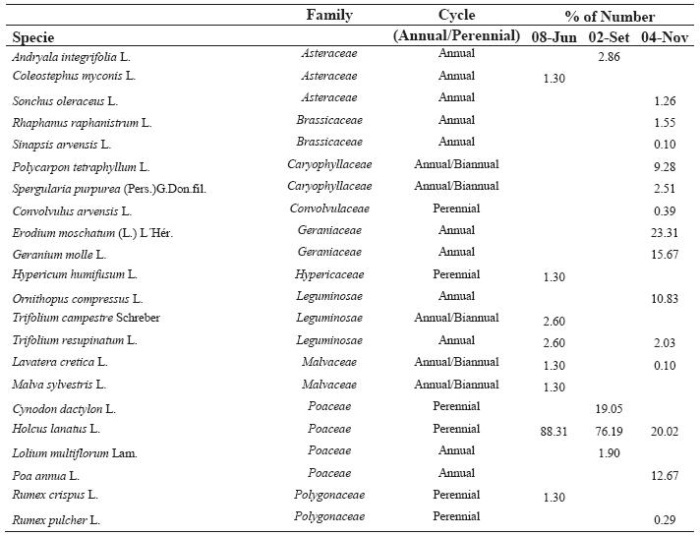
<body><![CDATA[<P><I>Percentagem de biomassa das esp&eacute;cies constituintes do enrelvamento natural, em tr&ecirc;s datas, durante o  ciclo vegetativo de 2005. </I></P >     <p><img src="/img/revistas/ctv/v27n1/27n1a03t1.jpg"></p>      
<p>&nbsp;</p>     <P>According to Thornthwaite hydric balance, the climate in this region, is fairly humid, mesothermic, with a moderate lack of  water in summer and meanly tempered and rainy in the winter (Castro <I>et al.</I>, 1999), and according to K&ouml;ppen-Geiger  climate classi&#64257;cation (Kottek <I>et al.</I>, 2006) is Csb (warm temperate with dry and warm summer). The annual  rainfall average is 1010 mm. </P>     <P>The weather data was collected from an automatic meteorological station, placed in the vineyard, which assessed data from  temperature, atmospheric relative humidity, wind speed and rainfall. </P>     <P>According to Cardoso (1974) the vineyard is planted in a litholic non-humic soil and has an AhBwC pedologic pro&#64257;le.  The soil has a sandy-loam texture, is neutral (pH H<Sub>2</Sub>O = 7) at the 0-20 cm level and moderately acid at 20-50 cm  (pH H<Sub>2</Sub>O = 6) and the organic matter content is medium (3.5%). This assessment has been done immediately before  the trial. </P>     <P>The experimental design was a randomized complete block with two treatments and two replications per treatment. Each  experimental unit had four rows with 100 vines each, and all the data was collected on the two inner rows. </P>     <P><B>Soil Management Treatments </B></P>     <P>Two soil management techniques were tested: Soil Tillage (TIL) &ndash; three times along the cycle (early April, middle  May and end of June) with a scari&#64257;er at 20 cm depth; Natural Grass Cover (NGC) &ndash; where the permanent natural  grass cover was mowed twice a year (early May and end of June) with a &#64258; ail mower. </P>     <P>To weed control on the row, a foliage systemic herbicide was applied in both treatments. The application on each side  of the row on 40 cm strip (gliphosate, 360 g.L<Sup>-1</Sup>, 2.5 L.ha<Sup>-1</Sup>) was done before budburst, by a tractor  with an herbicide bar. </P>     ]]></body>
<body><![CDATA[<P><B>Floristic survey </B></P>     <P>Throughout the cycle of 2005 three &#64258; oristic surveys were assessed only at NGC, on April 8th, September 2th and  November 4th. The biomass above ground from each plant species was harvested by cutting plants at soil surface level inside a circular 0.5 m2 area (6 samples per replication). </P>     <P>After &#64257;eld sampling, each plant was identi&#64257; ed and catalogued. Plants were counted to determine its  relative frequency. </P>     <P><B>Nutritional analysis </B></P>     <P>A nutritional characterization of vines was made at full-bloom in both years. Two petioles samples (50 petioles) were  taken from each treatment replication. One leaf per vine was collected from the opposite side of the lower cluster of a   central spur of cordon, according to the procedure proposed by Pacheco <I>et al.</I> (2001). </P>     <P>At the harvest of 2005, a sample of 50 clusters (1 per plant) from each treatment was collected to perform the nutritional  characterization of grapes. </P>     <P><B>Gas exchanges and leaf water potential measurements </B></P>     <P>Vine leaf temperature and photosynthesis rate were carried out near and during the ripening in both years, with a portable  gas exchange system (model ADC-LCA4). Measurements were done three times a day (10 am, 2 pm and 6 pm) in 12 principal exposed  leaves, from the middle part of the canopy, per soil management technique (six per replication). </P>     <P>Leaf water potential measurements (&psi;f) were done with a pressure chamber (Manofr&iacute;gido, Lda.), as described by  Scholander <I>et al.</I> (1965) at predawn, 10 am, solar noon and 6 pm. In each treatment were measured 12 principal exposed  leaves (6 per replication), from the middle part of the canopy. </P>     <P><B>Canopy Structure </B></P>     ]]></body>
<body><![CDATA[<P>Close to veraison, 24 shoots per treatment (one normal, average and fruitful shoot per vine) have been selected to assess  leaf area, using the methodology proposed by Lopes and Pinto (2005). </P>     <P>The canopy density was assessed by the leaf layer number, according to the method &ldquo;Point Quadrat&rdquo; proposed by  Smart and Robinson (1991), making 120 insertions at the cluster height, in each treatment. The evaluation of the canopy  density was done during ripening. </P>     <P>The evaluation of the interception of Photosynthetic Active Radiation (PAR) by the canopy, was performed using a ceptometer  (SunScan Ceptometertype SS1 - Delta-T Devices) inside the cover, in the cluster zone, during ripening. The ceptometer was  inserted into the canopy, parallel to the row and to the ground, 100 times per treatment. </P>     <P><B>Fertility, yield and vigour </B></P >     <P>The total shoot number per vine and the number of clusters from each shoot were counted in 120 vines (60 per treatment) in  the spring of 2005, in order to assess fertility. </P>     <P>To evaluate the yield, it was assessed the number of clusters per vine and their weight in 100 vines per treatment at harvest.</P>     <P>To assess the vine vigour, the shoots number and their weight per vine was registered in the same 100 vines per treatment  used to calculate the yield. </P>     <P><B>Bunch-rot and sunburn evaluation </B></P>     <P>To evaluate bunch rot (<I>Botrytis cinerea</I> Pers.) intensity, one bunch per vine (120 vines per treatment) was  observed at harvest to determine the incidence (infected bunch number) and the severity (destroyed portion of the bunch)   of the infection, using the methodology purposed by Amaro and Raposo (2001). </P>     <P>At harvest, in each of the selected vines (120 per treatment), all the sunburned clusters were counted to assess sunburn  damage proportion. </P>     ]]></body>
<body><![CDATA[<P><B>Data analysis </B></P>     <P>The analysis of results related to the behaviour and ecophysiological behaviour (predawn leaf water potential,  photosynthesis and transpiration rate) were corrected by the average standard error with M.O. Excel. Statistical analysis  was done by analysis of variance using Statistica 6.0 software. </P>     <p>&nbsp;</p>     <P><B>RESULTS AND DISCUSSION </b></P>     <P><b>Climate </B></P>     <P>The climatic conditions along the two years of the experiment were quite different (Fig. 1). The monthly average  temperature during 2004 was normal for the region, and only in June it has been signi&#64257;cantly higher than the 30 years  average (1967-1996). In 2005 and during the vine vegetative cycle, the mean temperature was higher than the 30 years average. </P>     <p>&nbsp;</p>     <p><img src="/img/revistas/ctv/v27n1/27n1a03f1.jpg"></p>     
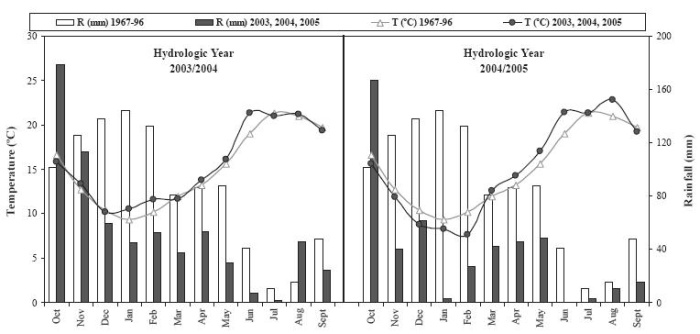
<p>    <p><b>Figure 1</b>&ndash; Rainfall and average temperature during the 2 hydrological  years trial compared with the average of 30 years (1967-1996). </P>     ]]></body>
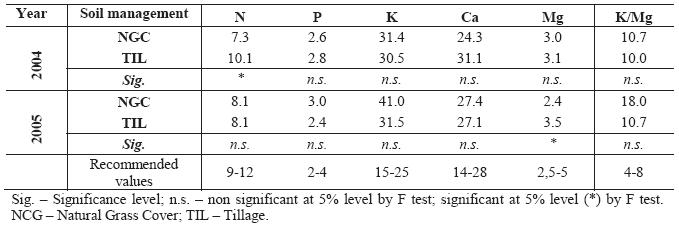
<body><![CDATA[<P><I>Precipita&ccedil;&atilde;o e temperatura m&eacute;dias de 2004 e 2005 em compara&ccedil;&atilde;o com m&eacute;dia de 30  anos (1967-1996). </I></P>     <p>&nbsp;</p>     <P>Concerning the rainfall, in both years, October had higher relative precipitation than the average (70 mm above), while  the other months were less rainy than it. In the winter of both years the rainfall was signi&#64257;cantly lower than the  average, and the total volume of precipitation before bud burst (between October and March) was 485 mm in 2004 and 340 mm in  2005, both of them less than the average (722 mm). During the growing season, similar values of rainfall (137 mm in 2004 and  108 mm in 2005) were observed in both years. However, spring rainfall was around 120 mm below the average in both years. </P>     <P><B>Natural grass cover characterization </B></P>     <P><a href="#t1">Table I</a><a name="topt1"></a> presents the frequency distribution of each species on natural grass cover  during 2005. In all data collection the dominant specie is <I>Holcus lanatus </I>L. This gramineous is a rhizomatous and perennial species, which  forms a grass cover that dif&#64257; cult the development of other species. Although, in this trial &#64257;eld this is a  spontaneous species, Amaro <I>et al.</I> (2001) referred it as a preferential species to install grass covering on vineyards. </P >     <P>It can also be observed that, in the &#64257;rst two evaluations, the soil dry conditions inhibited germination and  establishment of legumes, herefore, grasses had better emergence rates (perennial grasses were 88% and 97% in the &#64257;rst  and in the second assessments, respectively). After the &#64257;rst rainfalls in autumn, the proportion of other families,  including legumes, strongly increased up to 67% of cover crop. Similar results were found by Olmstead <I>et al.</I> (2001). </P>     <P>The almost complete absence of legumes in the &#64257;rst evaluations can also be associated with the soil management system  effects on species frequency distribution (Gago <I>et al.</I>, 2007). In this case study, <I>Holcus lanatus</I> L. and  <I>Cynodon dactylon</I> L. were privileged for the reason they tolerate mowing due to their basal buds or underground   regeneration organs (Beuret and Neury, 1987). </P>     <P><B>Nutritional characterization </B></P>     <P>The vineyard nutritional characterization was made at full bloom (Table II). The interactions between cover crop and  soil/plant nutritional status are complex and dynamic due to the diversity of cover crop types and management. The effects  of tillage on nutritional status was evaluated every year at full bloom, by the analysis of leaf petioles (Table II) that  is more useful and reliable than soil analysis because the results represent the concentration of nutrients that grapevines  are able to remove from soil (Hirschfelt, 1998). </P>     <p>&nbsp;</p>     ]]></body>
<body><![CDATA[<p><b>TABLE II</b></p>     <P>In&#64258;uence of soil management on leaves nutritional composition, at full bloom in 2004 and 2005. Values are expressed  in g by kg of dry matter. </P>     <P><I>In&#64258;u&ecirc;ncia da manuten&ccedil;&atilde;o do solo na composi&ccedil;&atilde;o nutricional das folhas, &agrave;  plena &#64258;ora&ccedil;&atilde;o em 2004 e 2005. Valores expressos em g por kg de mat&eacute;ria seca. </I></P>     <p><img src="/img/revistas/ctv/v27n1/27n1a03t2.jpg"></p>      
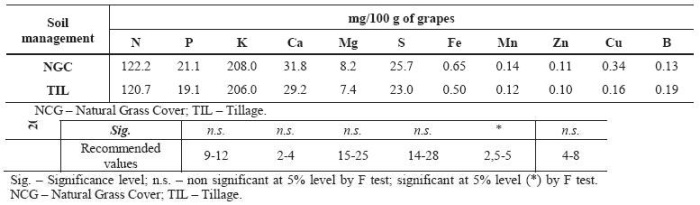
<p>&nbsp;</p>      <P>A signi&#64257;cant effect on nitrogen (N) petioles concentration was veri&#64257;ed only in the &#64257;rst year, with  an increase of N concentration due to tillage. We could expect from the decomposition of cover crop (non legume) residues with  a probably high C/N ratio, an immobilization of soil N for several weeks to months after incorporation on soil (Hirschfelt,   1998). However, in this case, at full bloom (one month after the &#64257;rst tillage), N levels were already different  between soil management options, due to the intense mineralization of the soil stable organic matter in upper layers of the   soil, right after tillage (Steenwerth and Belina, 2008; Curtin <I>et al.</I>, 2010). On the other hand, the release of N from   cover crop depends on species, growth stage, management and climate (Dabney <I>et al.</I>, 2001). Also, non legume cover crop  competition for N with the main crop is a well know phenomenon and was veri&#64257;ed in vines in Mediterranean climates   (Celette <I>et al.</I>, 2009). </P>     <P>In 2005 similar N levels were found in the two treatments. According to Curtin <I>et al.</I> (2010), the N mineralization  increase, due to tillage on traditionally non-tilled soils, only in the early stages after the intervention. After this  &#64257;rst phase, the mineralization rate tends to decrease and equalize to that of non-tilled soils. In general, in 2005,   the nutrient levels are within the range of recommended values (Cavaco <I>et al.</I>, 2005). We can highlight the nitrogen   (N) and magnesium (Mg) contents, which are close to the lower limits in both treatments. On the other hand, potassium </P>     <P>(K) is above the recommended values in both treatments, especially in NGC. Higher levels of K in this treatment suggest a  low absorption of Mg due to antagonism phenomenon between these nutrients (Quelhas-dos-Santos, 1996), which is shown by the   unbalanced K/Mg relationship. </P>     <P>In spite of the few works on the effects of cover crop on the status of other grapevine nutrients, the increase of K  availability in the soil with cover crop has been referred by Morlat and Jacquet (1993) and Baumgartner <I>et al.</I> (2008).  Tesic <I>et al.</I> (2007) also veri&#64257;ed a signi&#64257;cantly reduction of Mg uptake due to cover crops. Although not   statistically signi&#64257;cant, there appeared to have a similar trend in this study that led to a greater unbalance in the   K/Mg relationship in natural grass cover treatment in 2005. </P>     <P>At harvest, contrarily to what was observed by other authors (Geoffrion, 1999; Chantelot <I>et al.</I>, 2001; Celette,  2007), no significant differences on the nutritional composition of grapes were found as a consequence of different soil  management techniques, (Table III), in spite of the differences in the grape yield. </P >     ]]></body>
<body><![CDATA[<p>&nbsp;</p>       <p><b>TABLE III</b></p>     <P>Influence of soil management on grapes nutritional composition at harvest in 2005. </P>     <P><I>Influ&ecirc;ncia da manuten&ccedil;&atilde;o do solo na composi&ccedil;&atilde;o nutricional &agrave; vindima em 2005. </I></P>     <p><img src="/img/revistas/ctv/v27n1/27n1a03t3.jpg"></p>     
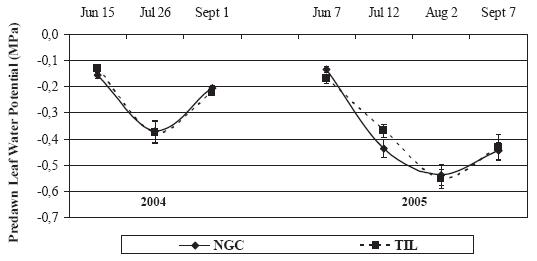
<p>&nbsp;</p>      <P><B>Leaf water potential and gas exchanges </B></P>     <P>The in&#64258;uence of soil management techniques on vineyard water status was evaluated by the predawn leaf water  potential (&#936;<Sub>pd</Sub>). For this variable, which re&#64258;ects the water potential of the whole soil volume  exploited by the vineyard roots, there are consistent and robust threshold values (Carbonneau, 2001; Ojeda, 2001; Riou and   Payan, 2001; Deloire <I>et al.</I>, 2003). </P>     <P>Thus, the evolution of &#936;<Sub>pd</Sub> is presented in Figure 2 for the period between bloom and harvest in both  years. The differences between years can be partially explained by the meteorological conditions occurred, namely the  rainfall during August 2004 and the warmer temperatures during 2005.</p>        <p>&nbsp;</p>      ]]></body>
<body><![CDATA[<p><img src="/img/revistas/ctv/v27n1/27n1a03f2.jpg"></p>      
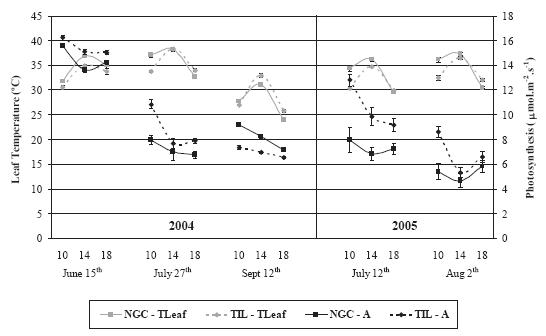
<p><b>Figure 2</b>&ndash; Seasonal predawn leaf water potential evolution in 2004 and   2005. Average of 12 leaves &plusmn; SE. NCG &ndash; Natural Grass Cover; TIL &ndash; Tillage </P>     <P><I>Evolu&ccedil;&atilde;o sazonal do potencial h&iacute;drico foliar de base, em 2004 e 2005. M&eacute;dia de 12  folhas </I>&plusmn; <I>EPM. NCG </I>&ndash; <I>Natural Grass Cover; TIL </I><I>&ndash;</I><I> Tillag</I>e</P>      <p>&nbsp;</p>        <p>It can be seen that in 2004 no differences were found between the two treatments. Similar results were reported by   Afonso <i>et al</i>. (2003) with Alvarinho cultivar in an Atlantic climate region (Vinhos Verdes). It is also observed   that &#936;<Sub>pd</Sub> never reached values of severe water stress, &#936;<Sub>pd</Sub> decreased from the middle   of June to the end of July, and no water stress was verified at the end of the maturation period due to the rainfall   occurred in August (about 50 mm). </P>          <P>In 2005, small differences were found in mid-July. At this time, NGC treatment showed a more intense water stress due  to the NGC transpiration. Similar results were reported by Monteiro and Lopes (2007) that veri&#64257;ed a bigger reduction  on soil water content pro&#64257;le (0 &ndash; 1.0 m) from budbreak to veraison due to the CC water use. However, at veraison  both treatments reached similar moderate to severe water stress levels. This fact is remarkable since Fern&atilde;o Pires is   a very aromatic cultivar and known by its sensibility to water stress (Eiras-Dias <I>et al.</I>, 2011). The rainfall occurred   in early September (around 8 mm) allowed some recovery of plant water status. </P>      <P>The small differences found were surprising because tillage induced higher vine vigour (almost twice in 2005) and total  leaf area (almost 50% more in both years) and, consequently, higher vine transpiration. </P>     <P>In spite of the vine ability to adapt the root system in order to access deeper water resources in deep soils due to the  CC competition (Cellete <I>et al.</I>, 2008), as is the case of this study, were tillage was introduced after a long term   NGC, tillage also improve vine water use, eliminating weed transpiration and creating macro and mesoporosity in the top soil   layer while breaking pore continuity below (Cameira <I>et al.</I>, 2003) with the consequent decrease of soil evaporation.</P>      <P>Tillage signi&#64257;cantly in&#64258;uenced the net photosynthetic rate (A) - Figure 3. It is evident that in both   years, except for September 12<Sup>th</Sup> of 2004, the leaves from natural grass cover treatment presented higher   temperature and lower photosynthetic rate In general, during 2004, differences between the two treatments were   signi&#64257;cant but not as high as in 2005. It can also be observed a trend to the decline of photosynthetic rate along   the vegetative cycle, which can be partially ascribed to the age of leaves and the stage of the growing season (Zuffery <I>et  al.</I>, 2000).</P>        <p>&nbsp;</p>      ]]></body>
<body><![CDATA[<p><img src="/img/revistas/ctv/v27n1/27n1a03f3.jpg"></p>      
<p><b>Figure 3</b>&ndash; Diurnal and seasonal evolution of net photosynthesis and leaf  temperature, in 2004 and 2005. Average of 12 leaves &plusmn; SE. NCG &ndash; Natural Grass Cover; TIL &ndash; Tillage</P>      <P><I>Evolu&ccedil;&atilde;o diurna e sazonal da taxa fotossint&eacute;tica e da temperatura das folhas, em 2004 e 2005.  M&eacute;dia de 12 folhas &plusmn; EPM. NCG </I><I>&ndash;</I><I> Enrelvamento natural; TIL </I><I>&ndash;</I><I> Mobilizado </I></P>      <p>&nbsp;</p>        <p> Except for June 15<Sup>th</Sup> of 2004, photosynthetic rate was in the same range veri&#64257;ed by Chaumont <I>et  al.</I> (1997) and Lopes (1999) with the same grape cultivar. However, A rate observed by Lopes (1999) in an irrigation  trial was lower, although similar predawn leaf water potential levels. </p>     <p>The highest differences between soil management treatments occurred in July 12<Sup>th</Sup> (2005). This is in agreement  with &#936;<Sub>pd</Sub> evolution. Moreover, different trends for leaf water potential were found (Figure 4). At July  12<Sup>th</Sup>, the minimum &#936; (&#936;<Sub>min</Sub>) occurred in the tillage treatment at solar noon. However, for  August 2<Sup>nd</Sup>, &#936;<Sub>min</Sub> occurred sooner and remained constant until late afternoon, suggesting a   strong stomatal control due to water stress. At this date differences between A for the soil treatments were smaller   and photosynthetic rate reached relative low value, although leaves present similar temperature. </P>       <p>&nbsp;</p>      <p><img src="/img/revistas/ctv/v27n1/27n1a03f4.jpg"></p>      
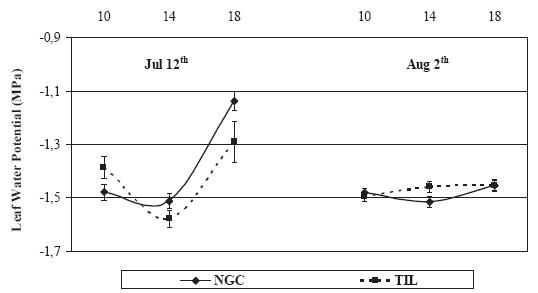
<p><b>Figure 4</b>&ndash; Diurnal leaf water potential evolution in 2005. Average  of 12 leaves &plusmn; SE. NCG &ndash; Natural Grass Cover; TIL &ndash; Tillage </P>      <P><i>Evolu&ccedil;&atilde;o diurna do potencial h&iacute;drico foliar, em 2005. M&eacute;dia de 12 folhas </I>&plusmn;<I>EPM.  NCG </I>&ndash; <I>Enrelvamento natural; TIL </I><I>&ndash;</I><I> Mobilizado</I></P>        ]]></body>
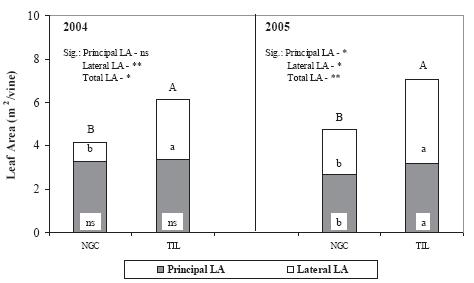
<body><![CDATA[<p>&nbsp;</p>      <P>The small differences in &Psi;<Sub>pd</Sub> suggest that the nutritional unbalance may also contribute to the differences  veri&#64257;ed on photosynthetic rate. In addition, the lower photosynthetic rates, as is the case of NGC, can be attributed  to a limitation caused by an inadequate demand for photosynthates (Petri <I>et al.</I>, 2000). </P>      <P><B>Canopy Structure </B></P>     <P>Data analysis of whole plant leaf area in 2004 and 2005 (Figure 5) shows that total  leaf area was increased by tillage (plus 1.97 m<Sup>2</Sup> of leaf area per vine in 2004 and 2.32 m<Sup>2</Sup> in 2005).  In 2004 this increase was essentially due to the secondary leaf area (plus 1.89 m<Sup>2</Sup> of lateral leaf area per vine).  In 2005 the principal leaf area have also contributed for it (plus 0.51 m<Sup>2 </Sup>of principal leaf area per vine),   although the major role played by the lateral leaf area (plus 1.81 m<Sup>2</Sup> of lateral leaf area per vine). Maigre and   Aerny (2000) have also observed that lateral leaf area played a main role in the differences of total leaf area between soil  management techniques in the cultivar Gamay.</P>      <p>&nbsp;</p>     <p><a name="f5"></a></p>      <p><img src="/img/revistas/ctv/v27n1/27n1a03f5.jpg"></p>      
<p><b><a href="#topf5">Figura 5</a></b>&ndash; Leaf area (principal, lateral and total) in 2004 and 2005.  Average of 24 shoots. Sig. &ndash; Significance level; n.s. &ndash; non significant at 5% level by F test; significant  at 5% (*), 1% (**) and 01% (***) by Tukey HSD test. NCG &ndash; Natural Grass Cover; TIL &ndash; Tillage. </P>      <P><I>&Aacute;rea foliar (principal, secund&aacute;ria e total) em 2004 e 2005. M&eacute;dia de 24 folhas. Sig.   </I><I>&ndash;</I><I> N&iacute;vel de signific&acirc;ncia; n.s. </I><I>&ndash;</I><I> n&atilde;o significativo ao  n&iacute;vel de 5% pelo teste de F; significativo a 5% (*), 1% (**) e 0,1% (***) pelo teste de Tukey HSD.   NCG </I><I>&ndash;</I><I> Enrelvamento natural; TIL </I><I>&ndash;</I><I> Mobilizado </I></P>     <p>&nbsp;</p>         ]]></body>
<body><![CDATA[<P>The contribution of lateral leaf area for whole plant leaf area was higher on tilled soils in two growing seasons.   Similar results were observed by Celete (2007) with the white variety Aranel in Mediterranean conditions. </P>      <p>The results of &ldquo;Point Quadrat&rdquo; method determined during the ripening in the 2005 growing season are shown  in the Table IV. The soil tillage signi&#64257;cantly increased the leaf layer number (LLN) and consequently reduced the   light interception at cluster zone. Other authors found a minor canopy density (lower LLN) in a permanent cover cropped  soil when compared to a bare soil (Celete, 2007; Tesic <I>et al</I>., 2007). The main cause for these differences was the  general increase of the vigour provoked by the tillage, especially due to the greater development of laterals, as reported   above. In fact, many authors (Morlat and Jacquet, 1993; Morlat and Geoffrion, 2000), some of which Portuguese (Afonso <I>et   al.</I>, 2003; Monteiro and Lopes, 2007) observed a decline in the vine vigour with the introduction of cover crops when   compared with tilled soils, probably due to the competition for the water and nutrients by the cover crop.</P>      <p>&nbsp;</p>     <p><b><a name="t4"></a><a href="#topt4">TABLE IV</a></b></p>     <P>Influence of soil management on canopy structure and microclimate during the ripening in 2005. </P>     <P><I>Influ&ecirc;ncia da manuten&ccedil;&atilde;o do solo na estrutura e no microclima do coberto durante a  matura&ccedil;&atilde;o em 2005. </I></P>      <p><img src="/img/revistas/ctv/v27n1/27n1a03t4.jpg"></p>     
<p>&nbsp;</p>      <P> In this year, extreme maximum temperatures above 40&ordm; C occurred between August 4<Sup>th</Sup> and 6<Sup>th</Sup>  associated with the recognised susceptibility of &lsquo;Fern&atilde;o Pires&rsquo; to hot and dry conditions (Castro and Lopes,  1990) caused high levels of sunburn injuries in leaves and clusters. Great differences in sunburn injuries were found between  the two soil management techniques, once the NGC presented 40.7% and 34.6% of sunburn leaves and clusters, respectively,   against 31.1% and 19.9% observed on the tilled soil. The higher canopy density (LLN) and the minor sunlight interception   resulting from the highest vigour (laterals leaf area) observed on the tilled soil seems to be the major cause for these  discrepancies.</p>      <P><B>Agronomic results </B>     ]]></body>
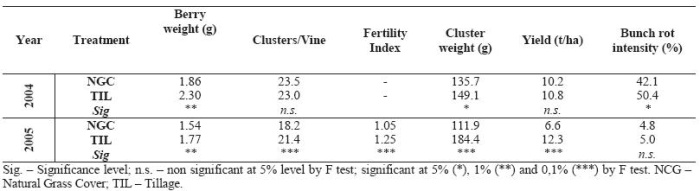
<body><![CDATA[<p>Yield components in the two years of the trial are presented in Table V. The ANOVA results related to 2004 show  signi&#64257;cant differences in berry and cluster weight and in the bunch rot intensity. In fact, the introduction of soil  tillage induces higher berry and cluster weight. In Portugal similar results for cluster weight were observed by Afonso <I>et  al. </I>(2003) with the white variety &lsquo;Alvarinho&rsquo;, but differences among berry weight were not found. Tesic <I>et  al.</I> (2007) have also found lower berry weight in cover cropped vineyard.</P>       <p>&nbsp;</p>     <p><b>TABLE V</b></p>     <P>Influence of soil management on yield, exposable surface area and on their relation, in 2004 and 2005. </P>     <P><I>Influ&ecirc;ncia da manuten&ccedil;&atilde;o do solo no rendimento, superf&iacute;cie foliar exposta e sua  rela&ccedil;&atilde;o, em 2004 e 2005. </I></P>      <p><img src="/img/revistas/ctv/v27n1/27n1a03t5.jpg"></p>     
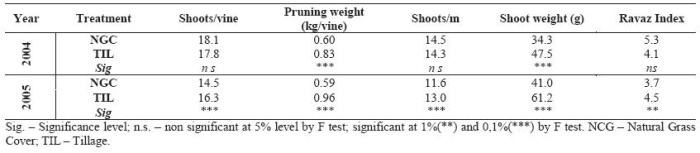
<p>&nbsp;</p>        <P>The rainfall that occurred during the second half of August (32.7 mm) was the major factor for bunch rot intensity in  both treatments, with 42.1% and 50.4% for NGC and TIL, respectively. The differences can be justi&#64257;ed by the vigour   increase promoted by the soil tillage, expressed by lateral leaf area of the vines (<a href="#f5">Fig. 5</a><a name="topf5"></a>) and by the shoots weight   (Table VI) that lead to a denser canopy. The long-term soil cover crop induced a decrease of canopy density and improves  the fruit zone microclimate, conducing to a decrease of bunch rot incidence as observed by Morlat and Geoffrion (2000).</P>      <p>&nbsp;</p>     <p><b><a name="t6"></a><a href="#topt6">TABLE VI</a></b></p>     ]]></body>
<body><![CDATA[<P>Influence of soil management on vigour and vegetative growth. </P>     <P><I>Influ&ecirc;ncia da manuten&ccedil;&atilde;o do solo no vigor e express&atilde;o vegetativa. </I></P>      <p><img src="/img/revistas/ctv/v27n1/27n1a03t6.jpg"></p>     
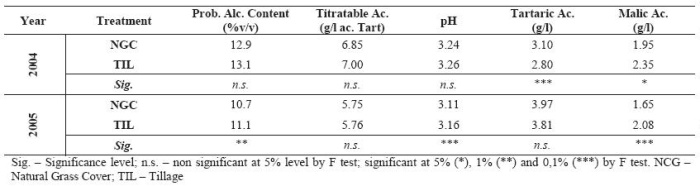
<p>&nbsp;</p>        <P>In 2005, differences in all the yield parameters were observed between the two soil management strategies. The highest  number of clusters on tilled soil was due to higher fertility index, probably due to a better N nutrition and higher shoot   weight in 2004. The huge differences between tilled soil and cover cropped soil were veri&#64257;ed in the cluster weight   and total yield per hectare. The soil tillage leads to an increase of 65% and 86% in cluster weight and yield per hectare,  respectively. The sunburn injury of the clusters (<a href="#t4">Table IV</a><a name="topt4"></a>) was one of the main factors for these results. </P >     <P>The soil tillage induced an increase in most of the variables related to vigour and vegetative growth (<a href="#t6">Table VI</a><a name="topt6"></a>).  Indeed, other authors (Le Goff-Guillou <I>et al</I>, 2000; Morlat and Geoffrion, 2000) have found similar results, namely  a marked decrease of the vegetative growth and vigour with cover crop. In 2004, differences were observed in total pruning  and shoot weight, in spite of the non signi&#64257;cant effect on the Ravaz index. </P >     <P>In 2005, the dry and hot climatic conditions lead to higher differences in pruning weight, shoot number and weight. The  Ravaz index was significantly reduced due to the signi&#64257;cant loss of yield by sunburn injuries on cover cropped soil.  An unexpected increase in shoot weight was observed from 2004 to 2005 (a hotter and driest year). </P >     <P>The effects of vineyard soil management on yield and vigour are dependent of the year and are more pronounced in the hot  and dry years, as was also noticed by Tesic <I>et al</I>. (2007) and Le Goff-Guillou <I>et al.</I> (2000). </P>       <P><B>Must composition </B></P >     <P>The analysis of must composition, presented on Table VII, shows that, in 2005, the lower soil water content and  photosynthetic rates decreased the must sugar content and the higher temperatures in this year conduced to lower must  acidity. </P>      ]]></body>
<body><![CDATA[<p>&nbsp;</p>     <p><b>TABLE VII</b></p>     <P><B>Influence of basal leaf removal and soil management on must composition, in 2004 and 2005. </b></P>     <P><I>Influ&ecirc;ncia da desfolha da manuten&ccedil;&atilde;o do solo na composi&ccedil;&atilde;o do mosto, em 2004 e 2005.</I></P>      <p><img src="/img/revistas/ctv/v27n1/27n1a03t7.jpg"></p>     
<p>&nbsp;</p>          <p>Soil tillage induced a slight increase of probable alcoholic content (PAC) in 2005 and, in 2004, the same tendency was  observed, although with no statistical signi&#64257;cance. These results are different from those observed by Howell <I>et  al.</I> (2007), Monteiro and Lopes (2007) and Xi <I>et al. </I>(2011) and derive, probably, from the differences in  photosynthetic rates registered in this treatment in both years that was even more expressive in 2005. </P>     <P>Titratable acidity and pH were not signi&#64257; cantly affected by the soil management, which are different from the  results obtained by Monteiro and Lopes (2007) and Xi <I>et al. </I>(2011), except for the pH in 2005 that had a slight  increase with soil tillage treatment (but without oenological relevance). The concentrations of the two most important  acids of the must were changed according to the soil management: a decrease in tartaric acid and an increase in malic acid  were veri&#64257;ed in tilled soil. This relationship can be relevant since it can promote more balanced and fresh wines. </P>      <P><B>CONCLUSIONS </B></P>     <P>In spite of the bene&#64257;cial effects of cover crops, its use in vineyards is still controversial mainly due to their  competition with the vines. In this study, developed in a vineyard with a long term natural cover crop, tillage application  induced an increase in vine vigour and yield, as well as a better nutritional grapevine status, higher photosynthetic rate  and better must quality. </P>     ]]></body>
<body><![CDATA[<P>The effects of tillage can be ascribed to a better soil water availability, to the decrease of nutritional competition and  to the higher soil organic matter mineralisation, which was quickly enough to improve nitrogen levels in the &#64257;rst year  and to promote better magnesium nutrition in the second year. This allowed a higher photosynthetic activity when compared  with the natural cover crop treatment. The remarkable responses of vegetative growth and yield to tillage treatment   contributed to differences in the canopy structure, berry and cluster weight and must composition. </P>     <P>It is important to emphasize that the meteorological conditions occurred in the two years of experiment were atypical.  Both years were characterize by a dry spring, but the rainy events occurred in the summer of the &#64257;rst year caused   high bunch rot levels, which were more pronounced in the tilled treatment. On the other hand, a heat wave occurred in the   second year causing yield losses much higher in the cover crop treatment. </P>     <P>Therefore, soil management strategies should be appropriate to the climatic conditions of the year. This issue should be  taken into account in the future face to climate change scenarios expected for Iberian Peninsula and in other Mediterranean   climates. In fact, since the future climate scenarios point to an increasing number of years similar to 2005 or even more   severe (heat waves, heavy rainfall concentrated in winter and prolonged drought), the soil tillage in spring on a   non-irrigated viticulture can be a strategic tool to mitigate these stress conditions. </P>      <p>&nbsp;</p>      <P><B>REFERENCES </B></P>     <P>Afonso J.M., Monteiro A., Lopes C.M., Louren&ccedil;o J., 2003. Enrelvamento do solo em vinha na regi&atilde;o dos Vinhos  Verdes. Tr&ecirc;s anos de estudo na casta &lsquo;Alvarinho&rsquo;.<I> Ci&ecirc;ncia T&eacute;c. Vitiv</I>., <B>18</B>,  47-63. </P>     <!-- ref --><P>Amaro P., Raposo M.E., 2001. <I>Relat&oacute;rio </I><I>&#64257;</I><I>nal do campo de demonstra&ccedil;&atilde;o de  protec&ccedil;&atilde;o integrada da vinha da regi&atilde;o vitivin&iacute;cola de Palmela (1996-2000)</I>. Instituto  Superior de Agronomia/S.A.P.I., 25pp.    &nbsp;&nbsp;&nbsp;&nbsp;&nbsp;&nbsp;&nbsp;&nbsp;[&#160;<a href="javascript:void(0);" onclick="javascript: window.open('/scielo.php?script=sci_nlinks&ref=000179&pid=S0254-0223201200010000300002&lng=','','width=640,height=500,resizable=yes,scrollbars=1,menubar=yes,');">Links</a>&#160;]<!-- end-ref --> </P>     <!-- ref --><P>Amaro P., Ribeiro J.A., Ramadas I., 2001. <I>Infestantes</I>. In A Protec&ccedil;&atilde;o Integrada da Vinha na  Regi&atilde;o Norte. Pedro Amaro (eds.). Edi&ccedil;&atilde;o ISA/PRESS, Lisboa, 68-81.    &nbsp;&nbsp;&nbsp;&nbsp;&nbsp;&nbsp;&nbsp;&nbsp;[&#160;<a href="javascript:void(0);" onclick="javascript: window.open('/scielo.php?script=sci_nlinks&ref=000181&pid=S0254-0223201200010000300003&lng=','','width=640,height=500,resizable=yes,scrollbars=1,menubar=yes,');">Links</a>&#160;]<!-- end-ref --> </P>     ]]></body>
<body><![CDATA[<P>Barbeau G., Riou C., Cl&eacute;m&eacute;nt C., Cornillet A., Marsault J., 1999. Modi&#64257;cations du micro-climat thermique  et radiatif de la vigne par l&rsquo;enherbement dans trios terroirs du Val de Loire: in&#64258;uence sur la composition des  vendanges de Cabernet Franc. <I>11</I><Sup><I>th</I></Sup><I> Meeting</I>, <I>GESCO</I>, Sicily, pp. 880-884. </P>     <!-- ref --><P>Battany M.C., Grismer M.E., 2000. Rainfall runoff and erosion in Napa Valley vineyards: effects of slope, cover and surface  roughness. <I>Hydro. Proc.</I>, <B>14</B>, 1289-1304.    &nbsp;&nbsp;&nbsp;&nbsp;&nbsp;&nbsp;&nbsp;&nbsp;[&#160;<a href="javascript:void(0);" onclick="javascript: window.open('/scielo.php?script=sci_nlinks&ref=000184&pid=S0254-0223201200010000300005&lng=','','width=640,height=500,resizable=yes,scrollbars=1,menubar=yes,');">Links</a>&#160;]<!-- end-ref --> </P>     <!-- ref --><P>Baumgartner K., Steenwerth K.L., Veilleux L., 2008. Cover-crop systems affect weed communities in a California vineyard.  <I>Weed Science</I>, <B>56</B>(4), 596-605.    &nbsp;&nbsp;&nbsp;&nbsp;&nbsp;&nbsp;&nbsp;&nbsp;[&#160;<a href="javascript:void(0);" onclick="javascript: window.open('/scielo.php?script=sci_nlinks&ref=000186&pid=S0254-0223201200010000300006&lng=','','width=640,height=500,resizable=yes,scrollbars=1,menubar=yes,');">Links</a>&#160;]<!-- end-ref --> </P>     <!-- ref --><P>Beuret E., Neury G., 1987. D&eacute;sherbage et entretien du sol en viticulture. <I>Rev. Suisse Vitic. Arboric. Hortic.</I>,  <B>19</B>(1), 48-52.    &nbsp;&nbsp;&nbsp;&nbsp;&nbsp;&nbsp;&nbsp;&nbsp;[&#160;<a href="javascript:void(0);" onclick="javascript: window.open('/scielo.php?script=sci_nlinks&ref=000188&pid=S0254-0223201200010000300007&lng=','','width=640,height=500,resizable=yes,scrollbars=1,menubar=yes,');">Links</a>&#160;]<!-- end-ref --> </P>     <!-- ref --><P>Cameira M.R., Fernando R.M., Pereira L.S., 2003. Soil macropore dynamics affected by tillage and irrigation for a silty loam  alluvial soil in southern Portugal. <I>Soil &amp; Tillage Research</I>, <B>70</B>, 131-140.    &nbsp;&nbsp;&nbsp;&nbsp;&nbsp;&nbsp;&nbsp;&nbsp;[&#160;<a href="javascript:void(0);" onclick="javascript: window.open('/scielo.php?script=sci_nlinks&ref=000190&pid=S0254-0223201200010000300008&lng=','','width=640,height=500,resizable=yes,scrollbars=1,menubar=yes,');">Links</a>&#160;]<!-- end-ref --> Carbonneau A., 2001. Gestion   de l&rsquo;eau dans le vignoble: Th&eacute;orie et pratique. In: <I>12&egrave;mes Journ&eacute;es GESCO, Journ&eacute;e   professionnelle: </I>&rdquo;<I>Gestion de l&rsquo;eau dans le vignoble</I>&rdquo;. AGRO Montpellier, Montpellier, pp. 3-21. </P>     <!-- ref --><P>Cardoso J.C., 1974. A classi&#64257;ca&ccedil;&atilde;o dos solos de Portugal. <I>Boletim de Solos</I>, <B>17</B>, 14-46.    &nbsp;&nbsp;&nbsp;&nbsp;&nbsp;&nbsp;&nbsp;&nbsp;[&#160;<a href="javascript:void(0);" onclick="javascript: window.open('/scielo.php?script=sci_nlinks&ref=000192&pid=S0254-0223201200010000300010&lng=','','width=640,height=500,resizable=yes,scrollbars=1,menubar=yes,');">Links</a>&#160;]<!-- end-ref --> </P>     <P>Castro R., Almeida C., Cruz A., Frade P., Ribeiro F., Aires A., 1999. Cepage &lsquo;Baga&rsquo; &ndash; Region Bairrada. De  la conduite traditionelle jusqu&rsquo;au systeme &lsquo;LYS&rsquo;. <I>11&eacute;mes Journ&eacute;es GESCO</I>, Sicile, pp.  689-694. </P>     <!-- ref --><P>Castro R., Lopes C., 1990. In&#64258;u&ecirc;ncia do sistema de poda e de condu&ccedil;&atilde;o da vegeta&ccedil;&atilde;o  sobre a fertilidade e produ&ccedil;&atilde;o na casta Fern&atilde;o Pires. In: <I>I Congresso Ib&eacute;rico de Ci&ecirc;ncias  Hort&iacute;colas</I>, Actas de Horticultura. Vol. IV. Lisboa. 314-319.    &nbsp;&nbsp;&nbsp;&nbsp;&nbsp;&nbsp;&nbsp;&nbsp;[&#160;<a href="javascript:void(0);" onclick="javascript: window.open('/scielo.php?script=sci_nlinks&ref=000195&pid=S0254-0223201200010000300012&lng=','','width=640,height=500,resizable=yes,scrollbars=1,menubar=yes,');">Links</a>&#160;]<!-- end-ref --> </P>     <!-- ref --><P>Cavaco M., Calouro F., Cl&iacute;maco P., 2005. <I>Produ&ccedil;&atilde;o integrada da cultura da vinha</I>.  Direc&ccedil;&atilde;o-Geral de Protec&ccedil;&atilde;o das Culturas, 146p.    &nbsp;&nbsp;&nbsp;&nbsp;&nbsp;&nbsp;&nbsp;&nbsp;[&#160;<a href="javascript:void(0);" onclick="javascript: window.open('/scielo.php?script=sci_nlinks&ref=000197&pid=S0254-0223201200010000300013&lng=','','width=640,height=500,resizable=yes,scrollbars=1,menubar=yes,');">Links</a>&#160;]<!-- end-ref --></p>     <p> Celette F., 2007. <I>Dynamique des fonctionnements hydrique et azot&eacute; au sein d&rsquo;une vigne enherb&eacute;e  sous le climat m&eacute;diterran&eacute;en</I>. Ph.D. Thesis, SupAgro, Montpellier, 200 pp. </P>     <!-- ref --><P>Celette F., Findeling A., Gary C., 2009. Competition for nitrogen in an unfertilized intercropping system: The case of an  association of grapevine and grass cover in a Mediterranean climate. <I>Europ. J. Agronomy</I>, <B>30</B>, 41-51.    &nbsp;&nbsp;&nbsp;&nbsp;&nbsp;&nbsp;&nbsp;&nbsp;[&#160;<a href="javascript:void(0);" onclick="javascript: window.open('/scielo.php?script=sci_nlinks&ref=000200&pid=S0254-0223201200010000300015&lng=','','width=640,height=500,resizable=yes,scrollbars=1,menubar=yes,');">Links</a>&#160;]<!-- end-ref --> </P>     <!-- ref --><P>Celette F., Gaudin R., Gary C., 2008.Spatial and temporal changes to the water regime of a Mediterranean vineyard due to the  adoption of cover cropping. <I>Europ. J. Agronomy</I>, <B>29</B>, 153-162.    &nbsp;&nbsp;&nbsp;&nbsp;&nbsp;&nbsp;&nbsp;&nbsp;[&#160;<a href="javascript:void(0);" onclick="javascript: window.open('/scielo.php?script=sci_nlinks&ref=000202&pid=S0254-0223201200010000300016&lng=','','width=640,height=500,resizable=yes,scrollbars=1,menubar=yes,');">Links</a>&#160;]<!-- end-ref --> </P>     <P>Chantelot E., Carsoulle J., Legoff I., 2001. Maitrise de la teneur en azote des mo&ucirc;ts en syst&egrave;me enherbement  permanent par pulv&eacute;risation foliaire d&acute;azote. GESCO. <I>Compte Rendu</I>, <B>16</B>, 465-472. </P>     <!-- ref --><P>Chaumont M., Os&oacute;rio M.L, Chaves M.M, Vanacker H., Morot-Gaudry J.-F., Foyer C.H., 1997. The absence of photoinhibition  during the mid-morning depression of photosynthesis in <I>Vitis vinifera</I> grown in semi-arid and temperate climates.   <I>J. Plant Physiol.</I>, <B>150</B>(6), 743-751.    &nbsp;&nbsp;&nbsp;&nbsp;&nbsp;&nbsp;&nbsp;&nbsp;[&#160;<a href="javascript:void(0);" onclick="javascript: window.open('/scielo.php?script=sci_nlinks&ref=000205&pid=S0254-0223201200010000300018&lng=','','width=640,height=500,resizable=yes,scrollbars=1,menubar=yes,');">Links</a>&#160;]<!-- end-ref --> </P>     <!-- ref --><P>Curtin D., Beare H.M., Fraser P.M., Gillespie R., Harrison-Kirk T., 2010. Soil organic matter loss following land use change  from long-term pasture to arable cropping: Pool size changes and effects on some biological and chemical functions. In:  <I>19th World Congress of Soil Science, Soil Solutions for a Changing World</I>, Brisbane (Australia). pp 213-216.    &nbsp;&nbsp;&nbsp;&nbsp;&nbsp;&nbsp;&nbsp;&nbsp;[&#160;<a href="javascript:void(0);" onclick="javascript: window.open('/scielo.php?script=sci_nlinks&ref=000207&pid=S0254-0223201200010000300019&lng=','','width=640,height=500,resizable=yes,scrollbars=1,menubar=yes,');">Links</a>&#160;]<!-- end-ref --> </P>     <!-- ref --><P>Dabney S.M., Delgado J.A., Reeves D.W., 2001. Using winter cover crops to improve soil andwater quality. <I>Commun. Soil Sci.  Plant Anal.</I>, <B>32</B>(7&amp;8), 1221-1250.    &nbsp;&nbsp;&nbsp;&nbsp;&nbsp;&nbsp;&nbsp;&nbsp;[&#160;<a href="javascript:void(0);" onclick="javascript: window.open('/scielo.php?script=sci_nlinks&ref=000209&pid=S0254-0223201200010000300020&lng=','','width=640,height=500,resizable=yes,scrollbars=1,menubar=yes,');">Links</a>&#160;]<!-- end-ref --> </P>     <P>Deloire A, Carbonneau A., Federspiel B., Ojeda H., Wang Z., Costanze P., 2003. La vigne et l&rsquo;eau. <I>Progr&eacute;s  Agricole et Viticole</I>, <B>120</B> (4), 79-90. </P>     <!-- ref --><P>Eiras-Dias J., Faustino R., Cl&iacute;maco P., Fernandes P., Cruz A., Cunha J., Veloso M., Castro R., 2011. <I>Cat&aacute;logo  das castas para vinho cultivadas em Portugal</I>. 1&ordm; Volume, 109 pp.    &nbsp;&nbsp;&nbsp;&nbsp;&nbsp;&nbsp;&nbsp;&nbsp;[&#160;<a href="javascript:void(0);" onclick="javascript: window.open('/scielo.php?script=sci_nlinks&ref=000212&pid=S0254-0223201200010000300022&lng=','','width=640,height=500,resizable=yes,scrollbars=1,menubar=yes,');">Links</a>&#160;]<!-- end-ref --> </P>     <!-- ref --><P>Gago P., Cabaleiro C., Garcia J., 2007. Preliminary study of the effect of soil management systems on the adventitious  &#64258;ora of a vineyard in northwestern Spain. <I>Crop Protection</I>, <B>26</B>, 584-591.    &nbsp;&nbsp;&nbsp;&nbsp;&nbsp;&nbsp;&nbsp;&nbsp;[&#160;<a href="javascript:void(0);" onclick="javascript: window.open('/scielo.php?script=sci_nlinks&ref=000214&pid=S0254-0223201200010000300023&lng=','','width=640,height=500,resizable=yes,scrollbars=1,menubar=yes,');">Links</a>&#160;]<!-- end-ref --> </P>     <!-- ref --><P>Geoffrion R. ,1999. L&acute;enherbement permanent, 40 ans apr&egrave;s. <I>Phytoma</I>, <B>519</B>, 25-27.    &nbsp;&nbsp;&nbsp;&nbsp;&nbsp;&nbsp;&nbsp;&nbsp;[&#160;<a href="javascript:void(0);" onclick="javascript: window.open('/scielo.php?script=sci_nlinks&ref=000216&pid=S0254-0223201200010000300024&lng=','','width=640,height=500,resizable=yes,scrollbars=1,menubar=yes,');">Links</a>&#160;]<!-- end-ref --> </P>     <!-- ref --><P>Hartwig N.L., Ammon H.V., 2002. Cover crops and living mulches. <I>Weed science</I>, <B>50</B>(6), 688-699.    &nbsp;&nbsp;&nbsp;&nbsp;&nbsp;&nbsp;&nbsp;&nbsp;[&#160;<a href="javascript:void(0);" onclick="javascript: window.open('/scielo.php?script=sci_nlinks&ref=000218&pid=S0254-0223201200010000300025&lng=','','width=640,height=500,resizable=yes,scrollbars=1,menubar=yes,');">Links</a>&#160;]<!-- end-ref --> </P>     <P>Hirschfelt D.J., 1998. Soil fertility and vine nutrition. <I>In</I>: <I>Cover Cropping in Vineyards. A Grower&rsquo;s  Handbook. </I>61-68. Ingels C.A., Bugg R.L., McGourty G.T., Christensen L.P. (eds.), University of California. Publication 3338. Oakland. USA. </P>     <!-- ref --><P>Howell C.L., Lanyon D.M., McCarthy M., 2007. Effect of vineyard traf&#64257;c and soil management practices on berry growth,  grape juice parameters and yield of Shiraz in the Barossa Valley (poster). In: <I>13th Australian Wine Industry Technical  Conference</I>, Adelaide.    &nbsp;&nbsp;&nbsp;&nbsp;&nbsp;&nbsp;&nbsp;&nbsp;[&#160;<a href="javascript:void(0);" onclick="javascript: window.open('/scielo.php?script=sci_nlinks&ref=000221&pid=S0254-0223201200010000300027&lng=','','width=640,height=500,resizable=yes,scrollbars=1,menubar=yes,');">Links</a>&#160;]<!-- end-ref --> </P>     ]]></body>
<body><![CDATA[<!-- ref --><P>Keller M., 1997. Can Soil management replace nitrogen fertilisation? - A European perspective. <I>The Australian Grapegrower  &amp; Winemaker</I>. <B>408</B>, 23-28.    &nbsp;&nbsp;&nbsp;&nbsp;&nbsp;&nbsp;&nbsp;&nbsp;[&#160;<a href="javascript:void(0);" onclick="javascript: window.open('/scielo.php?script=sci_nlinks&ref=000223&pid=S0254-0223201200010000300028&lng=','','width=640,height=500,resizable=yes,scrollbars=1,menubar=yes,');">Links</a>&#160;]<!-- end-ref --> </P>     <P>King A.P., Berry A.M., 2005. Vineyard &delta;<Sup>15</Sup>N, nitrogen and water status in perennial clover and bunch grass  cover crop systems of California&rsquo;s central valley. <I>Agriculture, Ecosystems and Environment</I>, <B>109</B>, 262-272. </P>     <!-- ref --><P>Kottek M., Grieser J., Beck C., Rudolf R., Rubel F., 2006. World map of the K&ouml;ppen-Geiger climate classi&#64257; cation  updated. <I>Meteorologische Zeitschrift</I>, <B>15</B>(3), 259-263.    &nbsp;&nbsp;&nbsp;&nbsp;&nbsp;&nbsp;&nbsp;&nbsp;[&#160;<a href="javascript:void(0);" onclick="javascript: window.open('/scielo.php?script=sci_nlinks&ref=000226&pid=S0254-0223201200010000300030&lng=','','width=640,height=500,resizable=yes,scrollbars=1,menubar=yes,');">Links</a>&#160;]<!-- end-ref --> </P>     <!-- ref --><P>Le Goff-Guillou I., Marsault J., Riou C., 2000. Impacts de l`enherbement sur le fonctionnement de la vigne, la composition  des mo&ucirc;ts, les dur&eacute;es de fermentation et la qualit&eacute; des vins. <I>Progr&egrave;s Agricole et Viticole</I>,  <B>5</B>, 103-110.    &nbsp;&nbsp;&nbsp;&nbsp;&nbsp;&nbsp;&nbsp;&nbsp;[&#160;<a href="javascript:void(0);" onclick="javascript: window.open('/scielo.php?script=sci_nlinks&ref=000228&pid=S0254-0223201200010000300031&lng=','','width=640,height=500,resizable=yes,scrollbars=1,menubar=yes,');">Links</a>&#160;]<!-- end-ref --> </P>     <!-- ref --><P>Lopes C.M.A., 1999. Relationships between leaf water potential and photosynthetic activity of &#64257;eld-grown grapevines  under a Mediterranean environment. <I>Acta Hort.</I>,<B> 493</B>, 287-292.    &nbsp;&nbsp;&nbsp;&nbsp;&nbsp;&nbsp;&nbsp;&nbsp;[&#160;<a href="javascript:void(0);" onclick="javascript: window.open('/scielo.php?script=sci_nlinks&ref=000230&pid=S0254-0223201200010000300032&lng=','','width=640,height=500,resizable=yes,scrollbars=1,menubar=yes,');">Links</a>&#160;]<!-- end-ref --> </P>     <P>Lopes C., Monteiro A., R&uuml;ckert F.E., Gruber B., Steinberg B., Schultz H.R., 2004.Transpiration of grapevines and  co-habitating cover crop and weed species in a vineyard. A &ldquo;snapshot&rdquo; at diurnal trends. <I>Vitis</I>, <B>43</B>,  111-117. </P>     ]]></body>
<body><![CDATA[<!-- ref --><P>Lopes C.M., Pinto P.A., 2005. Easy and accurate estimation of grapevine leaf area with simple mathematical models.  <I>Vitis</I>, <B>44</B>(2), 55-61.    &nbsp;&nbsp;&nbsp;&nbsp;&nbsp;&nbsp;&nbsp;&nbsp;[&#160;<a href="javascript:void(0);" onclick="javascript: window.open('/scielo.php?script=sci_nlinks&ref=000233&pid=S0254-0223201200010000300034&lng=','','width=640,height=500,resizable=yes,scrollbars=1,menubar=yes,');">Links</a>&#160;]<!-- end-ref --> </P>     <P>Maigre D., Aerny J., 2000. Essai d&rsquo;enherbement et de fumure azot&eacute;e sur Gamay dans le bassin l&eacute;manique  &ndash; 1. R&eacute;sultats agronomiques. <I>Revue Suisse Vitic. Arboric. Hortic.</I>, <B>32</B>(3), 145-151. </P>     <!-- ref --><P>Monteiro A., Lopes C.M., 2007. In&#64258;uence of cover crop on water use and performance of vineyard in Mediterranean  Portugal. <I>Agriculture, Ecosystems and Environment</I>, <B>121</B>, 336-342.    &nbsp;&nbsp;&nbsp;&nbsp;&nbsp;&nbsp;&nbsp;&nbsp;[&#160;<a href="javascript:void(0);" onclick="javascript: window.open('/scielo.php?script=sci_nlinks&ref=000236&pid=S0254-0223201200010000300036&lng=','','width=640,height=500,resizable=yes,scrollbars=1,menubar=yes,');">Links</a>&#160;]<!-- end-ref --> </P>     <P>Morlat R. 2001. L&rsquo;enherbement permanent contr&ocirc;l&eacute; des sols viticoles. <I>Phytoma</I>. <B>530</B>: 28-31. </P>     <!-- ref --><P>Morlat R., Geoffrion R., 2000. L&acute;enherbement permanent contr&ocirc;l&eacute; des sols viticoles. Vint ans de recherches  sur le terrain en Anjou. <I>Phytoma</I>, <B>530</B>, 28-31.    &nbsp;&nbsp;&nbsp;&nbsp;&nbsp;&nbsp;&nbsp;&nbsp;[&#160;<a href="javascript:void(0);" onclick="javascript: window.open('/scielo.php?script=sci_nlinks&ref=000239&pid=S0254-0223201200010000300038&lng=','','width=640,height=500,resizable=yes,scrollbars=1,menubar=yes,');">Links</a>&#160;]<!-- end-ref --> </P>     <!-- ref --><P>Morlat R., Jacquet A., 1993. The soil effects on the grapevine root system in several vineyards of the Loire Valley (France).  <I>Vitis</I>, <B>32</B>, 35-42.    &nbsp;&nbsp;&nbsp;&nbsp;&nbsp;&nbsp;&nbsp;&nbsp;[&#160;<a href="javascript:void(0);" onclick="javascript: window.open('/scielo.php?script=sci_nlinks&ref=000241&pid=S0254-0223201200010000300039&lng=','','width=640,height=500,resizable=yes,scrollbars=1,menubar=yes,');">Links</a>&#160;]<!-- end-ref --> </P>     ]]></body>
<body><![CDATA[<P>Ojeda H., 2001. Bases ecophysiologiques et choix techniques dans la gestion de l&rsquo;eau dans les vignobles  d&rsquo;Argentine. <I>GESCO XI journ&eacute;es du groupe d&rsquo;&eacute;tude des syst&egrave;mes de conduite de la vigne</I>,  Montpellier, France, <B>1</B>, 75-86. </P>     <!-- ref --><P>Olmstead M.A., Wample R.L., Greene S.L., Tarara J.M., 2001. Evaluation of potential cover crops for inland Paci&#64257;c  Northwest vineyards. <I>Am. J. Enol. Vitic.</I>, <B>52</B>, 292-303.    &nbsp;&nbsp;&nbsp;&nbsp;&nbsp;&nbsp;&nbsp;&nbsp;[&#160;<a href="javascript:void(0);" onclick="javascript: window.open('/scielo.php?script=sci_nlinks&ref=000244&pid=S0254-0223201200010000300041&lng=','','width=640,height=500,resizable=yes,scrollbars=1,menubar=yes,');">Links</a>&#160;]<!-- end-ref --> </P>     <!-- ref --><P>Ovalle C., Pozo A., Peoples M.B., Lav&iacute;n A., 2010. Estimating the contribution of nitrogen from legume cover crops to  the nitrogen nutrition of grapevines using a 15N dilution technique. <I>Plant Soil</I>, <B>334</B>, 247-259.    &nbsp;&nbsp;&nbsp;&nbsp;&nbsp;&nbsp;&nbsp;&nbsp;[&#160;<a href="javascript:void(0);" onclick="javascript: window.open('/scielo.php?script=sci_nlinks&ref=000246&pid=S0254-0223201200010000300042&lng=','','width=640,height=500,resizable=yes,scrollbars=1,menubar=yes,');">Links</a>&#160;]<!-- end-ref --> </P>     <!-- ref --><P>Petrie P.R., Trought M.C.T., Howell G.S., 2000. In&#64258;uence of leaf ageing, leaf area and crop load on photosynthesis,  stomatal conductance and senescence of grapevine (<I>Vitis vinifera</I> L. cv. Pinot noir) leaves. <I>Vitis</I>, <B>39</B>(1), 31-36.    &nbsp;&nbsp;&nbsp;&nbsp;&nbsp;&nbsp;&nbsp;&nbsp;[&#160;<a href="javascript:void(0);" onclick="javascript: window.open('/scielo.php?script=sci_nlinks&ref=000248&pid=S0254-0223201200010000300043&lng=','','width=640,height=500,resizable=yes,scrollbars=1,menubar=yes,');">Links</a>&#160;]<!-- end-ref --> </P>     <!-- ref --><P>Quelhas-dos-Santos J., 1996. <I>Fertiliza&ccedil;&atilde;o. Fundamentos da utiliza&ccedil;&atilde;o dos adubos e correctivos </I>. Publica&ccedil;&otilde;es Europa-Am&eacute;rica (ed.).Lisboa, 441pp.    &nbsp;&nbsp;&nbsp;&nbsp;&nbsp;&nbsp;&nbsp;&nbsp;[&#160;<a href="javascript:void(0);" onclick="javascript: window.open('/scielo.php?script=sci_nlinks&ref=000250&pid=S0254-0223201200010000300044&lng=','','width=640,height=500,resizable=yes,scrollbars=1,menubar=yes,');">Links</a>&#160;]<!-- end-ref --> </P>     <P>Riou C., Payan J.C., 2001. Outils de gestion de l&rsquo;eau en vignoble m&eacute;diterran&eacute;en. Application du bilan  hydrique au diagnostique du stress hydrique de la vigne. In: <I>12&egrave;mes Journ&eacute;es GESCO, Jour-n&eacute;e   professionnelle: &laquo;Gestion de l&rsquo;eau dans le vignoble&raquo;</I>, AGRO Montpellier, Montpellier, pp. 125-133. </P>     ]]></body>
<body><![CDATA[<!-- ref --><P>Rodriguez-Lovelle B., Soyer J., Molot C., 2000. Nitrogen availability in vineyard soils according to soil management  practices. Effects on vine. <I>Acta Hort.</I>, <B>526</B>, 277-286.    &nbsp;&nbsp;&nbsp;&nbsp;&nbsp;&nbsp;&nbsp;&nbsp;[&#160;<a href="javascript:void(0);" onclick="javascript: window.open('/scielo.php?script=sci_nlinks&ref=000253&pid=S0254-0223201200010000300046&lng=','','width=640,height=500,resizable=yes,scrollbars=1,menubar=yes,');">Links</a>&#160;]<!-- end-ref --> </P>     <!-- ref --><P>Ruiz-Colmenero M., Bienes R., Marques M.J., 2011. Soil and water conservation dilemmas associated with the use of green  cover in steep vineyards. <I>Soil and Tillage Research</I>, <B>117</B>, 211-223.    &nbsp;&nbsp;&nbsp;&nbsp;&nbsp;&nbsp;&nbsp;&nbsp;[&#160;<a href="javascript:void(0);" onclick="javascript: window.open('/scielo.php?script=sci_nlinks&ref=000255&pid=S0254-0223201200010000300047&lng=','','width=640,height=500,resizable=yes,scrollbars=1,menubar=yes,');">Links</a>&#160;]<!-- end-ref --> </P>     <!-- ref --><P>Sainju U.M., Singh B.P., Whitehead W.F., 1998. Cover crop root distribution and its effects on soil nitrogen cycling.  <I>Agron. J.</I>, <B>90</B>, 511-518.    &nbsp;&nbsp;&nbsp;&nbsp;&nbsp;&nbsp;&nbsp;&nbsp;[&#160;<a href="javascript:void(0);" onclick="javascript: window.open('/scielo.php?script=sci_nlinks&ref=000257&pid=S0254-0223201200010000300048&lng=','','width=640,height=500,resizable=yes,scrollbars=1,menubar=yes,');">Links</a>&#160;]<!-- end-ref --> </P>     <!-- ref --><P>Scholander P.F., Hammel H.T., Bradstreet E.D., Hemmingser E.A., 1965. Sap pressure in vascular plants: negative hydrostatic  pressure can be measured in plants. <I>Science</I>, <B>148</B>, 339-346.    &nbsp;&nbsp;&nbsp;&nbsp;&nbsp;&nbsp;&nbsp;&nbsp;[&#160;<a href="javascript:void(0);" onclick="javascript: window.open('/scielo.php?script=sci_nlinks&ref=000259&pid=S0254-0223201200010000300049&lng=','','width=640,height=500,resizable=yes,scrollbars=1,menubar=yes,');">Links</a>&#160;]<!-- end-ref --> </P>     <!-- ref --><P>Smart R.E., Robinson M., 1991. <I>Sunlight into wine. A Handbook for winegrape canopy management</I>. Winetitles, Adelaide,  88 pp.    &nbsp;&nbsp;&nbsp;&nbsp;&nbsp;&nbsp;&nbsp;&nbsp;[&#160;<a href="javascript:void(0);" onclick="javascript: window.open('/scielo.php?script=sci_nlinks&ref=000261&pid=S0254-0223201200010000300050&lng=','','width=640,height=500,resizable=yes,scrollbars=1,menubar=yes,');">Links</a>&#160;]<!-- end-ref --><!-- ref --> Steenwerth K., Belina K.M., 2008. Cover crops enhance soil organic matter, carbon dynamics and microbiological   function in a vineyard agroecosystem. <I>Applied Soil Ecology</I>, <B>40</B>, 359-369.    &nbsp;&nbsp;&nbsp;&nbsp;&nbsp;&nbsp;&nbsp;&nbsp;[&#160;<a href="javascript:void(0);" onclick="javascript: window.open('/scielo.php?script=sci_nlinks&ref=000262&pid=S0254-0223201200010000300051&lng=','','width=640,height=500,resizable=yes,scrollbars=1,menubar=yes,');">Links</a>&#160;]<!-- end-ref --> </P>     <!-- ref --><P>Tesic D., Keller M., Hutton R., 2007. In&#64258;uence of vineyard &#64258;oor management practices on grapevine vegetative  growth, yield, and fruit composition. <I>American Journal of Enology and Viticulture</I>, <B>58</B>(1), 1-11.    &nbsp;&nbsp;&nbsp;&nbsp;&nbsp;&nbsp;&nbsp;&nbsp;[&#160;<a href="javascript:void(0);" onclick="javascript: window.open('/scielo.php?script=sci_nlinks&ref=000264&pid=S0254-0223201200010000300052&lng=','','width=640,height=500,resizable=yes,scrollbars=1,menubar=yes,');">Links</a>&#160;]<!-- end-ref --> </P>     <P>Tournebize J., 2001. <I>Impact de l&rsquo;enherbement du vignoble alsacien sur le transfert des nitrates</I>. Ph.D. Thesis,  Universit&eacute; Louis Pasteur, Strasbourg, 306 pp. </P>     <!-- ref --><P>Xi Z-M., Tao Y-S., Zhang L., Li H., 2011. Impact of cover crops in vineyard on the aroma compounds of <I>Vitis vinifera</I> L.  cv Cabernet Sauvignon wine. <I>Food Chemistry</I>, <B>127</B>, 516-522.    &nbsp;&nbsp;&nbsp;&nbsp;&nbsp;&nbsp;&nbsp;&nbsp;[&#160;<a href="javascript:void(0);" onclick="javascript: window.open('/scielo.php?script=sci_nlinks&ref=000267&pid=S0254-0223201200010000300054&lng=','','width=640,height=500,resizable=yes,scrollbars=1,menubar=yes,');">Links</a>&#160;]<!-- end-ref --> </P>     <!-- ref --><P>Zuffery V., Murisier F. Schultz H.R., 2000. A model analysis of the photosynthetic response of <I>Vitis vinifera</I> L. cvs  Riesling and Chasselas leaves in the &#64257;eld: I. Interaction of age, light and temperature. <I>Vitis</I>, <B>39</B>(1),  19-26.    &nbsp;&nbsp;&nbsp;&nbsp;&nbsp;&nbsp;&nbsp;&nbsp;[&#160;<a href="javascript:void(0);" onclick="javascript: window.open('/scielo.php?script=sci_nlinks&ref=000269&pid=S0254-0223201200010000300055&lng=','','width=640,height=500,resizable=yes,scrollbars=1,menubar=yes,');">Links</a>&#160;]<!-- end-ref --> </P>      <p>&nbsp;</p>     <P><B>ACKNOWLEDGEMENTS </B></P>     ]]></body>
<body><![CDATA[<P>The present study was funded by the &ldquo;Plano de Ac&ccedil;&atilde;o para a Vitivinicultura Bairradina&rdquo;,  supported by the &ldquo;Direc&ccedil;&atilde;o Regional de Agricultura da Beira Litoral&rdquo; and by the  &ldquo;Comiss&atilde;o Vitivin&iacute;cola da Bairrada&rdquo;. We also acknowledge Sogrape Vinhos, S.A. and all  the students that contributed to the data collection. </P>     <p>&nbsp;</p>     <p><a name="0"></a><a href="#top0"><sup>*</sup></a>Corresponding author: Am&acirc;ndio Cruz. Instituto Superior de Agronomia, Tapada da Ajuda, 1349-017 Lisboa,  Portugal, Tel.; 213653100, e-mail: <a href="mailto:rcastro@isa.utl.pt">rcastro@isa.utl.pt </a></P>      <P><I>(Manuscrito recebido em 24.05.2012. Aceite para publica&ccedil;&atilde;o em 19.06.2012) </I></P>      ]]></body><back>
<ref-list>
<ref id="B1">
<nlm-citation citation-type="journal">
<person-group person-group-type="author">
<name>
<surname><![CDATA[Afonso]]></surname>
<given-names><![CDATA[J.M.]]></given-names>
</name>
<name>
<surname><![CDATA[Monteiro]]></surname>
<given-names><![CDATA[A.]]></given-names>
</name>
<name>
<surname><![CDATA[Lopes]]></surname>
<given-names><![CDATA[C.M.]]></given-names>
</name>
<name>
<surname><![CDATA[Lourenço]]></surname>
<given-names><![CDATA[J.]]></given-names>
</name>
</person-group>
<article-title xml:lang="pt"><![CDATA[Enrelvamento do solo em vinha na região dos Vinhos Verdes.: Três anos de estudo na casta ‘Alvarinho’]]></article-title>
<source><![CDATA[Ciência Téc. Vitiv.]]></source>
<year>2003</year>
<volume>18</volume>
<page-range>47-63</page-range></nlm-citation>
</ref>
<ref id="B2">
<nlm-citation citation-type="book">
<person-group person-group-type="author">
<name>
<surname><![CDATA[Amaro]]></surname>
<given-names><![CDATA[P.]]></given-names>
</name>
<name>
<surname><![CDATA[Raposo]]></surname>
<given-names><![CDATA[M.E.]]></given-names>
</name>
</person-group>
<source><![CDATA[Relatório &#64257;nal do campo de demonstração de protecção integrada da vinha da região vitivinícola de Palmela (1996-2000)]]></source>
<year>2001</year>
<publisher-name><![CDATA[Instituto Superior de Agronomia/S.A.P.I.]]></publisher-name>
</nlm-citation>
</ref>
<ref id="B3">
<nlm-citation citation-type="book">
<person-group person-group-type="author">
<name>
<surname><![CDATA[Amaro]]></surname>
<given-names><![CDATA[P.]]></given-names>
</name>
<name>
<surname><![CDATA[Ribeiro]]></surname>
<given-names><![CDATA[J.A.]]></given-names>
</name>
<name>
<surname><![CDATA[Ramadas]]></surname>
<given-names><![CDATA[I.]]></given-names>
</name>
</person-group>
<article-title xml:lang="pt"><![CDATA[Infestantes]]></article-title>
<person-group person-group-type="editor">
<name>
<surname><![CDATA[Amaro]]></surname>
<given-names><![CDATA[Pedro]]></given-names>
</name>
</person-group>
<source><![CDATA[A Protecção Integrada da Vinha na Região Norte]]></source>
<year>2001</year>
<page-range>68-81</page-range><publisher-loc><![CDATA[Lisboa ]]></publisher-loc>
<publisher-name><![CDATA[ISA/PRESS]]></publisher-name>
</nlm-citation>
</ref>
<ref id="B4">
<nlm-citation citation-type="confpro">
<person-group person-group-type="author">
<name>
<surname><![CDATA[Barbeau]]></surname>
<given-names><![CDATA[G.]]></given-names>
</name>
<name>
<surname><![CDATA[Riou]]></surname>
<given-names><![CDATA[C.]]></given-names>
</name>
<name>
<surname><![CDATA[Clémént]]></surname>
<given-names><![CDATA[C.]]></given-names>
</name>
<name>
<surname><![CDATA[Cornillet]]></surname>
<given-names><![CDATA[A.]]></given-names>
</name>
<name>
<surname><![CDATA[Marsault]]></surname>
<given-names><![CDATA[J.]]></given-names>
</name>
</person-group>
<article-title xml:lang="fr"><![CDATA[Modi&#64257;cations du micro-climat thermique et radiatif de la vigne par l’enherbement dans trios terroirs du Val de Loire: in&#64258;uence sur la composition des vendanges de Cabernet Franc]]></article-title>
<source><![CDATA[]]></source>
<year>1999</year>
<conf-name><![CDATA[11 Meeting, GESCO]]></conf-name>
<conf-loc>Sicily </conf-loc>
<page-range>880-884</page-range></nlm-citation>
</ref>
<ref id="B5">
<nlm-citation citation-type="journal">
<person-group person-group-type="author">
<name>
<surname><![CDATA[Battany]]></surname>
<given-names><![CDATA[M.C.]]></given-names>
</name>
<name>
<surname><![CDATA[Grismer]]></surname>
<given-names><![CDATA[M.E.]]></given-names>
</name>
</person-group>
<article-title xml:lang="en"><![CDATA[Rainfall runoff and erosion in Napa Valley vineyards: effects of slope, cover and surface roughness]]></article-title>
<source><![CDATA[Hydro. Proc.]]></source>
<year>2000</year>
<volume>14</volume>
<page-range>1289-1304</page-range></nlm-citation>
</ref>
<ref id="B6">
<nlm-citation citation-type="journal">
<person-group person-group-type="author">
<name>
<surname><![CDATA[Baumgartner]]></surname>
<given-names><![CDATA[K.]]></given-names>
</name>
<name>
<surname><![CDATA[Steenwerth]]></surname>
<given-names><![CDATA[K.L.]]></given-names>
</name>
<name>
<surname><![CDATA[Veilleux]]></surname>
<given-names><![CDATA[L.]]></given-names>
</name>
</person-group>
<article-title xml:lang="en"><![CDATA[Cover-crop systems affect weed communities in a California vineyard.]]></article-title>
<source><![CDATA[Weed Science]]></source>
<year>2008</year>
<volume>56</volume>
<numero>4</numero>
<issue>4</issue>
<page-range>596-605</page-range></nlm-citation>
</ref>
<ref id="B7">
<nlm-citation citation-type="journal">
<person-group person-group-type="author">
<name>
<surname><![CDATA[Beuret]]></surname>
<given-names><![CDATA[E.]]></given-names>
</name>
<name>
<surname><![CDATA[Neury]]></surname>
<given-names><![CDATA[G.]]></given-names>
</name>
</person-group>
<article-title xml:lang="fr"><![CDATA[Désherbage et entretien du sol en viticulture]]></article-title>
<source><![CDATA[Rev. Suisse Vitic. Arboric. Hortic.]]></source>
<year>1987</year>
<volume>19</volume>
<numero>1</numero>
<issue>1</issue>
<page-range>48-52</page-range></nlm-citation>
</ref>
<ref id="B8">
<nlm-citation citation-type="journal">
<person-group person-group-type="author">
<name>
<surname><![CDATA[Cameira]]></surname>
<given-names><![CDATA[M.R.]]></given-names>
</name>
<name>
<surname><![CDATA[Fernando]]></surname>
<given-names><![CDATA[R.M.]]></given-names>
</name>
<name>
<surname><![CDATA[Pereira]]></surname>
<given-names><![CDATA[L.S.]]></given-names>
</name>
</person-group>
<article-title xml:lang="en"><![CDATA[Soil macropore dynamics affected by tillage and irrigation for a silty loam alluvial soil in southern Portugal]]></article-title>
<source><![CDATA[Soil & Tillage Research]]></source>
<year>2003</year>
<volume>70</volume>
<page-range>131-140</page-range></nlm-citation>
</ref>
<ref id="B9">
<nlm-citation citation-type="confpro">
<person-group person-group-type="author">
<name>
<surname><![CDATA[Carbonneau]]></surname>
<given-names><![CDATA[A.]]></given-names>
</name>
</person-group>
<article-title xml:lang="fr"><![CDATA[Gestion de l’eau dans le vignoble: Théorie et pratique]]></article-title>
<source><![CDATA[]]></source>
<year>2001</year>
<conf-name><![CDATA[12 Journées GESCO, Journée professionnelle: ”Gestion de l’eau dans le vignoble]]></conf-name>
<conf-loc> </conf-loc>
<page-range>3-21</page-range><publisher-loc><![CDATA[Montpellier ]]></publisher-loc>
</nlm-citation>
</ref>
<ref id="B10">
<nlm-citation citation-type="journal">
<person-group person-group-type="author">
<name>
<surname><![CDATA[Cardoso]]></surname>
<given-names><![CDATA[J.C.]]></given-names>
</name>
</person-group>
<article-title xml:lang="pt"><![CDATA[A classi&#64257;cação dos solos de Portugal.]]></article-title>
<source><![CDATA[Boletim de Solos]]></source>
<year>1974</year>
<volume>17</volume>
<page-range>14-46</page-range></nlm-citation>
</ref>
<ref id="B11">
<nlm-citation citation-type="confpro">
<person-group person-group-type="author">
<name>
<surname><![CDATA[Castro]]></surname>
<given-names><![CDATA[R.]]></given-names>
</name>
<name>
<surname><![CDATA[Almeida]]></surname>
<given-names><![CDATA[C.]]></given-names>
</name>
<name>
<surname><![CDATA[Cruz]]></surname>
<given-names><![CDATA[A.]]></given-names>
</name>
<name>
<surname><![CDATA[Frade]]></surname>
<given-names><![CDATA[P.]]></given-names>
</name>
<name>
<surname><![CDATA[Ribeiro]]></surname>
<given-names><![CDATA[F.]]></given-names>
</name>
<name>
<surname><![CDATA[Aires]]></surname>
<given-names><![CDATA[A.]]></given-names>
</name>
</person-group>
<article-title xml:lang="fr"><![CDATA[Cepage ‘Baga’ - Region Bairrada: De la conduite traditionelle jusqu’au systeme ‘LYS’]]></article-title>
<source><![CDATA[]]></source>
<year>1999</year>
<conf-name><![CDATA[11 Journées GESCO]]></conf-name>
<conf-loc>Sicile </conf-loc>
<page-range>689-694</page-range></nlm-citation>
</ref>
<ref id="B12">
<nlm-citation citation-type="confpro">
<person-group person-group-type="author">
<name>
<surname><![CDATA[Castro]]></surname>
<given-names><![CDATA[R.]]></given-names>
</name>
<name>
<surname><![CDATA[Lopes]]></surname>
<given-names><![CDATA[C.]]></given-names>
</name>
</person-group>
<article-title xml:lang="pt"><![CDATA[In&#64258;uência do sistema de poda e de condução da vegetação sobre a fertilidade e produção na casta Fernão Pires]]></article-title>
<source><![CDATA[]]></source>
<year>1990</year>
<volume>IV</volume>
<conf-name><![CDATA[I Congresso Ibérico de Ciências Hortícolas]]></conf-name>
<conf-loc> </conf-loc>
<page-range>314-319</page-range><publisher-loc><![CDATA[Lisboa ]]></publisher-loc>
</nlm-citation>
</ref>
<ref id="B13">
<nlm-citation citation-type="book">
<person-group person-group-type="author">
<name>
<surname><![CDATA[Cavaco]]></surname>
<given-names><![CDATA[M.]]></given-names>
</name>
<name>
<surname><![CDATA[Calouro]]></surname>
<given-names><![CDATA[F.]]></given-names>
</name>
<name>
<surname><![CDATA[Clímaco]]></surname>
<given-names><![CDATA[P.]]></given-names>
</name>
</person-group>
<source><![CDATA[Produção integrada da cultura da vinha]]></source>
<year>2005</year>
<publisher-name><![CDATA[Direcção-Geral de Protecção das Culturas]]></publisher-name>
</nlm-citation>
</ref>
<ref id="B14">
<nlm-citation citation-type="">
<person-group person-group-type="author">
<name>
<surname><![CDATA[Celette]]></surname>
<given-names><![CDATA[F.]]></given-names>
</name>
</person-group>
<source><![CDATA[Dynamique des fonctionnements hydrique et azoté au sein d’une vigne enherbée sous le climat méditerranéen]]></source>
<year>2007</year>
</nlm-citation>
</ref>
<ref id="B15">
<nlm-citation citation-type="journal">
<person-group person-group-type="author">
<name>
<surname><![CDATA[Celette]]></surname>
<given-names><![CDATA[F.]]></given-names>
</name>
<name>
<surname><![CDATA[Findeling]]></surname>
<given-names><![CDATA[A.]]></given-names>
</name>
<name>
<surname><![CDATA[Gary]]></surname>
<given-names><![CDATA[C.]]></given-names>
</name>
</person-group>
<article-title xml:lang="en"><![CDATA[Competition for nitrogen in an unfertilized intercropping system.: The case of an association of grapevine and grass cover in a Mediterranean climate]]></article-title>
<source><![CDATA[Europ. J. Agronomy]]></source>
<year>2009</year>
<volume>30</volume>
<page-range>41-51</page-range></nlm-citation>
</ref>
<ref id="B16">
<nlm-citation citation-type="journal">
<person-group person-group-type="author">
<name>
<surname><![CDATA[Celette]]></surname>
<given-names><![CDATA[F.]]></given-names>
</name>
<name>
<surname><![CDATA[Gaudin]]></surname>
<given-names><![CDATA[R.]]></given-names>
</name>
<name>
<surname><![CDATA[Gary]]></surname>
<given-names><![CDATA[C.]]></given-names>
</name>
</person-group>
<article-title xml:lang="en"><![CDATA[Spatial and temporal changes to the water regime of a Mediterranean vineyard due to the adoption of cover cropping.]]></article-title>
<source><![CDATA[Europ. J. Agronomy]]></source>
<year>2008</year>
<volume>29</volume>
<page-range>153-162</page-range></nlm-citation>
</ref>
<ref id="B17">
<nlm-citation citation-type="">
<person-group person-group-type="author">
<name>
<surname><![CDATA[Chantelot]]></surname>
<given-names><![CDATA[E.]]></given-names>
</name>
<name>
<surname><![CDATA[Carsoulle]]></surname>
<given-names><![CDATA[J.]]></given-names>
</name>
<name>
<surname><![CDATA[Legoff]]></surname>
<given-names><![CDATA[I.]]></given-names>
</name>
</person-group>
<article-title xml:lang="fr"><![CDATA[Maitrise de la teneur en azote des moûts en système enherbement permanent par pulvérisation foliaire d´azote]]></article-title>
<source><![CDATA[]]></source>
<year>2001</year>
<volume>16</volume>
<page-range>465-472</page-range></nlm-citation>
</ref>
<ref id="B18">
<nlm-citation citation-type="journal">
<person-group person-group-type="author">
<name>
<surname><![CDATA[Chaumont]]></surname>
<given-names><![CDATA[M.]]></given-names>
</name>
<name>
<surname><![CDATA[Osório]]></surname>
<given-names><![CDATA[M.L.]]></given-names>
</name>
<name>
<surname><![CDATA[Chaves]]></surname>
<given-names><![CDATA[M.M.]]></given-names>
</name>
<name>
<surname><![CDATA[Vanacker]]></surname>
<given-names><![CDATA[H.]]></given-names>
</name>
<name>
<surname><![CDATA[Morot-Gaudry]]></surname>
<given-names><![CDATA[J.-F.]]></given-names>
</name>
<name>
<surname><![CDATA[Foyer]]></surname>
<given-names><![CDATA[C.H.]]></given-names>
</name>
</person-group>
<article-title xml:lang="en"><![CDATA[The absence of photoinhibition during the mid-morning depression of photosynthesis in Vitis vinifera grown in semi-arid and temperate climates.]]></article-title>
<source><![CDATA[J. Plant Physiol.]]></source>
<year>1997</year>
<volume>150</volume>
<page-range>743-751</page-range></nlm-citation>
</ref>
<ref id="B19">
<nlm-citation citation-type="confpro">
<person-group person-group-type="author">
<name>
<surname><![CDATA[Curtin]]></surname>
<given-names><![CDATA[D.]]></given-names>
</name>
<name>
<surname><![CDATA[Beare]]></surname>
<given-names><![CDATA[H.M.]]></given-names>
</name>
<name>
<surname><![CDATA[Fraser]]></surname>
<given-names><![CDATA[P.M.]]></given-names>
</name>
<name>
<surname><![CDATA[Gillespie]]></surname>
<given-names><![CDATA[R.]]></given-names>
</name>
<name>
<surname><![CDATA[Harrison-Kirk]]></surname>
<given-names><![CDATA[T.]]></given-names>
</name>
</person-group>
<article-title xml:lang="en"><![CDATA[Soil organic matter loss following land use change from long-term pasture to arable cropping: Pool size changes and effects on some biological and chemical functions]]></article-title>
<source><![CDATA[]]></source>
<year>2010</year>
<conf-name><![CDATA[19 World Congress of Soil Science, Soil Solutions for a Changing World]]></conf-name>
<conf-loc>Brisbane </conf-loc>
<page-range>213-216</page-range></nlm-citation>
</ref>
<ref id="B20">
<nlm-citation citation-type="journal">
<person-group person-group-type="author">
<name>
<surname><![CDATA[Dabney]]></surname>
<given-names><![CDATA[S.M.]]></given-names>
</name>
<name>
<surname><![CDATA[Delgado]]></surname>
<given-names><![CDATA[J.A.]]></given-names>
</name>
<name>
<surname><![CDATA[Reeves]]></surname>
<given-names><![CDATA[D.W.]]></given-names>
</name>
</person-group>
<article-title xml:lang="en"><![CDATA[Using winter cover crops to improve soil andwater quality.]]></article-title>
<source><![CDATA[Commun. Soil Sci. Plant Anal.]]></source>
<year>2001</year>
<volume>32</volume>
<numero>7</numero><numero>8</numero>
<issue>7</issue><issue>8</issue>
<page-range>1221-1250</page-range></nlm-citation>
</ref>
<ref id="B21">
<nlm-citation citation-type="journal">
<person-group person-group-type="author">
<name>
<surname><![CDATA[Deloire]]></surname>
<given-names><![CDATA[A.]]></given-names>
</name>
<name>
<surname><![CDATA[Carbonneau]]></surname>
<given-names><![CDATA[A.]]></given-names>
</name>
<name>
<surname><![CDATA[Federspiel]]></surname>
<given-names><![CDATA[B.]]></given-names>
</name>
<name>
<surname><![CDATA[Ojeda]]></surname>
<given-names><![CDATA[H.]]></given-names>
</name>
<name>
<surname><![CDATA[Wang]]></surname>
<given-names><![CDATA[Z.]]></given-names>
</name>
<name>
<surname><![CDATA[Costanze]]></surname>
<given-names><![CDATA[P.]]></given-names>
</name>
</person-group>
<article-title xml:lang="fr"><![CDATA[La vigne et l’eau.]]></article-title>
<source><![CDATA[Progrés Agricole et Viticole]]></source>
<year>2003</year>
<volume>120</volume>
<numero>4</numero>
<issue>4</issue>
<page-range>79-90</page-range></nlm-citation>
</ref>
<ref id="B22">
<nlm-citation citation-type="">
<person-group person-group-type="author">
<name>
<surname><![CDATA[Eiras-Dias]]></surname>
<given-names><![CDATA[J.]]></given-names>
</name>
<name>
<surname><![CDATA[Faustino]]></surname>
<given-names><![CDATA[R.]]></given-names>
</name>
<name>
<surname><![CDATA[Clímaco]]></surname>
<given-names><![CDATA[P.]]></given-names>
</name>
<name>
<surname><![CDATA[Fernandes]]></surname>
<given-names><![CDATA[P.]]></given-names>
</name>
<name>
<surname><![CDATA[Cruz]]></surname>
<given-names><![CDATA[A.]]></given-names>
</name>
<name>
<surname><![CDATA[Cunha]]></surname>
<given-names><![CDATA[J.]]></given-names>
</name>
<name>
<surname><![CDATA[Veloso]]></surname>
<given-names><![CDATA[M.]]></given-names>
</name>
<name>
<surname><![CDATA[Castro]]></surname>
<given-names><![CDATA[R.]]></given-names>
</name>
</person-group>
<source><![CDATA[Catálogo das castas para vinho cultivadas em Portugal]]></source>
<year>2011</year>
<volume>1</volume>
</nlm-citation>
</ref>
<ref id="B23">
<nlm-citation citation-type="journal">
<person-group person-group-type="author">
<name>
<surname><![CDATA[Gago]]></surname>
<given-names><![CDATA[P.]]></given-names>
</name>
<name>
<surname><![CDATA[Cabaleiro]]></surname>
<given-names><![CDATA[C.]]></given-names>
</name>
<name>
<surname><![CDATA[Garcia]]></surname>
<given-names><![CDATA[J.]]></given-names>
</name>
</person-group>
<article-title xml:lang="en"><![CDATA[Preliminary study of the effect of soil management systems on the adventitious &#64258;ora of a vineyard in northwestern Spain]]></article-title>
<source><![CDATA[Crop Protection]]></source>
<year>2007</year>
<volume>26</volume>
<page-range>584-591</page-range></nlm-citation>
</ref>
<ref id="B24">
<nlm-citation citation-type="journal">
<person-group person-group-type="author">
<name>
<surname><![CDATA[Geoffrion]]></surname>
<given-names><![CDATA[R.]]></given-names>
</name>
</person-group>
<article-title xml:lang="fr"><![CDATA[L´enherbement permanent, 40 ans après.]]></article-title>
<source><![CDATA[Phytoma]]></source>
<year>1999</year>
<volume>519</volume>
<page-range>25-27</page-range></nlm-citation>
</ref>
<ref id="B25">
<nlm-citation citation-type="journal">
<person-group person-group-type="author">
<name>
<surname><![CDATA[Hartwig]]></surname>
<given-names><![CDATA[N.L.]]></given-names>
</name>
<name>
<surname><![CDATA[Ammon]]></surname>
<given-names><![CDATA[H.V.]]></given-names>
</name>
</person-group>
<article-title xml:lang="en"><![CDATA[Cover crops and living mulches.]]></article-title>
<source><![CDATA[Weed science]]></source>
<year>2002</year>
<volume>50</volume>
<numero>6</numero>
<issue>6</issue>
<page-range>688-699</page-range></nlm-citation>
</ref>
<ref id="B26">
<nlm-citation citation-type="book">
<person-group person-group-type="author">
<name>
<surname><![CDATA[Hirschfelt]]></surname>
<given-names><![CDATA[D.J.]]></given-names>
</name>
</person-group>
<article-title xml:lang="en"><![CDATA[Soil fertility and vine nutrition]]></article-title>
<person-group person-group-type="editor">
<name>
<surname><![CDATA[Ingels]]></surname>
<given-names><![CDATA[C.A.]]></given-names>
</name>
<name>
<surname><![CDATA[Bugg]]></surname>
<given-names><![CDATA[R.L.]]></given-names>
</name>
<name>
<surname><![CDATA[McGourty]]></surname>
<given-names><![CDATA[G.T.]]></given-names>
</name>
<name>
<surname><![CDATA[Christensen]]></surname>
<given-names><![CDATA[L.P.]]></given-names>
</name>
</person-group>
<source><![CDATA[Cover Cropping in Vineyards: A Grower’s Handbook]]></source>
<year>1998</year>
<page-range>61-68</page-range><publisher-loc><![CDATA[Oakland ]]></publisher-loc>
<publisher-name><![CDATA[University of California]]></publisher-name>
</nlm-citation>
</ref>
<ref id="B27">
<nlm-citation citation-type="confpro">
<person-group person-group-type="author">
<name>
<surname><![CDATA[Howell]]></surname>
<given-names><![CDATA[C.L.]]></given-names>
</name>
<name>
<surname><![CDATA[Lanyon]]></surname>
<given-names><![CDATA[D.M.]]></given-names>
</name>
<name>
<surname><![CDATA[McCarthy]]></surname>
<given-names><![CDATA[M.]]></given-names>
</name>
</person-group>
<article-title xml:lang="en"><![CDATA[Effect of vineyard traf&#64257;c and soil management practices on berry growth, grape juice parameters and yield of Shiraz in the Barossa Valley]]></article-title>
<source><![CDATA[]]></source>
<year>2007</year>
<conf-name><![CDATA[13 Australian Wine Industry Technical Conference]]></conf-name>
<conf-loc>Adelaide </conf-loc>
</nlm-citation>
</ref>
<ref id="B28">
<nlm-citation citation-type="journal">
<person-group person-group-type="author">
<name>
<surname><![CDATA[Keller]]></surname>
<given-names><![CDATA[M.]]></given-names>
</name>
</person-group>
<article-title xml:lang="en"><![CDATA[Can Soil management replace nitrogen fertilisation?: A European perspective.]]></article-title>
<source><![CDATA[The Australian Grapegrower & Winemaker.]]></source>
<year>1997</year>
<volume>408</volume>
<page-range>23-28</page-range></nlm-citation>
</ref>
<ref id="B29">
<nlm-citation citation-type="journal">
<person-group person-group-type="author">
<name>
<surname><![CDATA[King]]></surname>
<given-names><![CDATA[A.P.]]></given-names>
</name>
<name>
<surname><![CDATA[Berry]]></surname>
<given-names><![CDATA[A.M.]]></given-names>
</name>
</person-group>
<article-title xml:lang="en"><![CDATA[Vineyard &#948;15N, nitrogen and water status in perennial clover and bunch grass cover crop systems of California’s central valley.]]></article-title>
<source><![CDATA[Agriculture, Ecosystems and Environment,]]></source>
<year>2005</year>
<volume>109</volume>
<page-range>262-272</page-range></nlm-citation>
</ref>
<ref id="B30">
<nlm-citation citation-type="journal">
<person-group person-group-type="author">
<name>
<surname><![CDATA[Kottek]]></surname>
<given-names><![CDATA[M.]]></given-names>
</name>
<name>
<surname><![CDATA[Grieser]]></surname>
<given-names><![CDATA[J.]]></given-names>
</name>
<name>
<surname><![CDATA[Beck]]></surname>
<given-names><![CDATA[C.]]></given-names>
</name>
<name>
<surname><![CDATA[Rudolf]]></surname>
<given-names><![CDATA[R.]]></given-names>
</name>
<name>
<surname><![CDATA[Rubel]]></surname>
<given-names><![CDATA[F.]]></given-names>
</name>
</person-group>
<article-title xml:lang="en"><![CDATA[World map of the Köppen-Geiger climate classi&#64257; cation updated.]]></article-title>
<source><![CDATA[Meteorologische Zeitschrift]]></source>
<year>2006</year>
<volume>15</volume>
<numero>3</numero>
<issue>3</issue>
<page-range>259-263</page-range></nlm-citation>
</ref>
<ref id="B31">
<nlm-citation citation-type="journal">
<person-group person-group-type="author">
<name>
<surname><![CDATA[Le Goff-Guillou]]></surname>
<given-names><![CDATA[I.]]></given-names>
</name>
<name>
<surname><![CDATA[Marsault]]></surname>
<given-names><![CDATA[J.]]></given-names>
</name>
<name>
<surname><![CDATA[Riou]]></surname>
<given-names><![CDATA[C.]]></given-names>
</name>
</person-group>
<article-title xml:lang="fr"><![CDATA[Impacts de l`enherbement sur le fonctionnement de la vigne, la composition des moûts, les durées de fermentation et la qualité des vins.]]></article-title>
<source><![CDATA[Progrès Agricole et Viticole]]></source>
<year>2000</year>
<volume>5</volume>
<page-range>103-110</page-range></nlm-citation>
</ref>
<ref id="B32">
<nlm-citation citation-type="journal">
<person-group person-group-type="author">
<name>
<surname><![CDATA[Lopes]]></surname>
<given-names><![CDATA[C.M.A.]]></given-names>
</name>
</person-group>
<article-title xml:lang="en"><![CDATA[Relationships between leaf water potential and photosynthetic activity of &#64257;eld-grown grapevines under a Mediterranean environment.]]></article-title>
<source><![CDATA[Acta Hort.]]></source>
<year>1999</year>
<volume>493</volume>
<page-range>287-292</page-range></nlm-citation>
</ref>
<ref id="B33">
<nlm-citation citation-type="journal">
<person-group person-group-type="author">
<name>
<surname><![CDATA[Lopes]]></surname>
<given-names><![CDATA[C.]]></given-names>
</name>
<name>
<surname><![CDATA[Monteiro]]></surname>
<given-names><![CDATA[A.]]></given-names>
</name>
<name>
<surname><![CDATA[Rückert]]></surname>
<given-names><![CDATA[F.E.]]></given-names>
</name>
<name>
<surname><![CDATA[Gruber]]></surname>
<given-names><![CDATA[B.]]></given-names>
</name>
<name>
<surname><![CDATA[Steinberg]]></surname>
<given-names><![CDATA[B.]]></given-names>
</name>
<name>
<surname><![CDATA[Schultz]]></surname>
<given-names><![CDATA[H.R.]]></given-names>
</name>
</person-group>
<article-title xml:lang="en"><![CDATA[Transpiration of grapevines and co-habitating cover crop and weed species in a vineyard.: A “snapshot” at diurnal trends.]]></article-title>
<source><![CDATA[Vitis]]></source>
<year>2004</year>
<volume>43</volume>
<page-range>111-117</page-range></nlm-citation>
</ref>
<ref id="B34">
<nlm-citation citation-type="journal">
<person-group person-group-type="author">
<name>
<surname><![CDATA[Lopes]]></surname>
<given-names><![CDATA[C.M.]]></given-names>
</name>
<name>
<surname><![CDATA[Pinto]]></surname>
<given-names><![CDATA[P.A.]]></given-names>
</name>
</person-group>
<article-title xml:lang="en"><![CDATA[Easy and accurate estimation of grapevine leaf area with simple mathematical models.]]></article-title>
<source><![CDATA[Vitis]]></source>
<year>2005</year>
<volume>44</volume>
<numero>2</numero>
<issue>2</issue>
<page-range>55-61</page-range></nlm-citation>
</ref>
<ref id="B35">
<nlm-citation citation-type="journal">
<person-group person-group-type="author">
<name>
<surname><![CDATA[Maigre]]></surname>
<given-names><![CDATA[D.]]></given-names>
</name>
<name>
<surname><![CDATA[Aerny]]></surname>
<given-names><![CDATA[J.]]></given-names>
</name>
</person-group>
<article-title xml:lang="fr"><![CDATA[Essai d’enherbement et de fumure azotée sur Gamay dans le bassin lémanique: 1. Résultats agronomiques.]]></article-title>
<source><![CDATA[Revue Suisse Vitic. Arboric. Hortic.]]></source>
<year>2000</year>
<volume>32</volume>
<numero>3</numero>
<issue>3</issue>
<page-range>145-151</page-range></nlm-citation>
</ref>
<ref id="B36">
<nlm-citation citation-type="journal">
<person-group person-group-type="author">
<name>
<surname><![CDATA[Monteiro]]></surname>
<given-names><![CDATA[A.]]></given-names>
</name>
<name>
<surname><![CDATA[Lopes]]></surname>
<given-names><![CDATA[C.M.]]></given-names>
</name>
</person-group>
<article-title xml:lang="en"><![CDATA[In&#64258;uence of cover crop on water use and performance of vineyard in Mediterranean Portugal.]]></article-title>
<source><![CDATA[Agriculture, Ecosystems and Environment]]></source>
<year>2007</year>
<volume>121</volume>
<page-range>336-342</page-range></nlm-citation>
</ref>
<ref id="B37">
<nlm-citation citation-type="journal">
<person-group person-group-type="author">
<name>
<surname><![CDATA[Morlat]]></surname>
<given-names><![CDATA[R.]]></given-names>
</name>
</person-group>
<article-title xml:lang="fr"><![CDATA[L’enherbement permanent contrôlé des sols viticoles.]]></article-title>
<source><![CDATA[Phytoma]]></source>
<year>2001</year>
<volume>530</volume>
<page-range>28-31</page-range></nlm-citation>
</ref>
<ref id="B38">
<nlm-citation citation-type="journal">
<person-group person-group-type="author">
<name>
<surname><![CDATA[Morlat]]></surname>
<given-names><![CDATA[R.]]></given-names>
</name>
<name>
<surname><![CDATA[Geoffrion]]></surname>
<given-names><![CDATA[R]]></given-names>
</name>
</person-group>
<article-title xml:lang="fr"><![CDATA[L´enherbement permanent contrôlé des sols viticoles: Vint ans de recherches sur le terrain en Anjou]]></article-title>
<source><![CDATA[Phytoma]]></source>
<year>2000</year>
<volume>530</volume>
<page-range>28-31</page-range></nlm-citation>
</ref>
<ref id="B39">
<nlm-citation citation-type="journal">
<person-group person-group-type="author">
<name>
<surname><![CDATA[Morlat]]></surname>
<given-names><![CDATA[R.]]></given-names>
</name>
<name>
<surname><![CDATA[Jacquet]]></surname>
<given-names><![CDATA[A.]]></given-names>
</name>
</person-group>
<article-title xml:lang="en"><![CDATA[The soil effects on the grapevine root system in several vineyards of the Loire Valley (France).]]></article-title>
<source><![CDATA[Vitis]]></source>
<year>1993</year>
<volume>32</volume>
<page-range>35-42</page-range></nlm-citation>
</ref>
<ref id="B40">
<nlm-citation citation-type="confpro">
<person-group person-group-type="author">
<name>
<surname><![CDATA[Ojeda]]></surname>
<given-names><![CDATA[H.]]></given-names>
</name>
</person-group>
<article-title xml:lang="fr"><![CDATA[Bases ecophysiologiques et choix techniques dans la gestion de l’eau dans les vignobles d’Argentine]]></article-title>
<source><![CDATA[]]></source>
<year>2001</year>
<volume>1</volume>
<conf-name><![CDATA[XI journées du groupe d’étude des systèmes de conduite de la vigne]]></conf-name>
<conf-loc>Montpellier </conf-loc>
<page-range>75-86</page-range></nlm-citation>
</ref>
<ref id="B41">
<nlm-citation citation-type="journal">
<person-group person-group-type="author">
<name>
<surname><![CDATA[Olmstead]]></surname>
<given-names><![CDATA[M.A.]]></given-names>
</name>
<name>
<surname><![CDATA[Wample]]></surname>
<given-names><![CDATA[R.L.]]></given-names>
</name>
<name>
<surname><![CDATA[Greene]]></surname>
<given-names><![CDATA[S.L.]]></given-names>
</name>
<name>
<surname><![CDATA[Tarara]]></surname>
<given-names><![CDATA[J.M.]]></given-names>
</name>
</person-group>
<article-title xml:lang="en"><![CDATA[Evaluation of potential cover crops for inland Paci&#64257;c Northwest vineyards.]]></article-title>
<source><![CDATA[Am. J. Enol. Vitic.]]></source>
<year>2001</year>
<volume>52</volume>
<page-range>292-303</page-range></nlm-citation>
</ref>
<ref id="B42">
<nlm-citation citation-type="journal">
<person-group person-group-type="author">
<name>
<surname><![CDATA[Ovalle]]></surname>
<given-names><![CDATA[C.]]></given-names>
</name>
<name>
<surname><![CDATA[Pozo]]></surname>
<given-names><![CDATA[A.]]></given-names>
</name>
<name>
<surname><![CDATA[Peoples]]></surname>
<given-names><![CDATA[M.B.]]></given-names>
</name>
<name>
<surname><![CDATA[Lavín]]></surname>
<given-names><![CDATA[A.]]></given-names>
</name>
</person-group>
<article-title xml:lang="en"><![CDATA[Estimating the contribution of nitrogen from legume cover crops to the nitrogen nutrition of grapevines using a 15N dilution technique.]]></article-title>
<source><![CDATA[Plant Soil]]></source>
<year>2010</year>
<volume>334</volume>
<page-range>247-259</page-range></nlm-citation>
</ref>
<ref id="B43">
<nlm-citation citation-type="journal">
<person-group person-group-type="author">
<name>
<surname><![CDATA[Petrie]]></surname>
<given-names><![CDATA[P.R.]]></given-names>
</name>
<name>
<surname><![CDATA[Trought]]></surname>
<given-names><![CDATA[M.C.T.]]></given-names>
</name>
<name>
<surname><![CDATA[Howell]]></surname>
<given-names><![CDATA[G.S.]]></given-names>
</name>
</person-group>
<article-title xml:lang="en"><![CDATA[In&#64258;uence of leaf ageing, leaf area and crop load on photosynthesis, stomatal conductance and senescence of grapevine (Vitis vinifera L. cv. Pinot noir) leaves.]]></article-title>
<source><![CDATA[Vitis]]></source>
<year>2000</year>
<volume>39</volume>
<numero>1</numero>
<issue>1</issue>
<page-range>31-36</page-range></nlm-citation>
</ref>
<ref id="B44">
<nlm-citation citation-type="book">
<person-group person-group-type="author">
<name>
<surname><![CDATA[Quelhas-dos-Santos]]></surname>
<given-names><![CDATA[J.]]></given-names>
</name>
</person-group>
<source><![CDATA[Fertilização: Fundamentos da utilização dos adubos e correctivos]]></source>
<year>1996</year>
<publisher-loc><![CDATA[Lisboa ]]></publisher-loc>
<publisher-name><![CDATA[Publicações Europa-América]]></publisher-name>
</nlm-citation>
</ref>
<ref id="B45">
<nlm-citation citation-type="confpro">
<person-group person-group-type="author">
<name>
<surname><![CDATA[Riou]]></surname>
<given-names><![CDATA[C.]]></given-names>
</name>
<name>
<surname><![CDATA[Payan]]></surname>
<given-names><![CDATA[J.C.]]></given-names>
</name>
</person-group>
<article-title xml:lang="fr"><![CDATA[Outils de gestion de l’eau en vignoble méditerranéen: Application du bilan hydrique au diagnostique du stress hydrique de la vigne]]></article-title>
<source><![CDATA[]]></source>
<year>2001</year>
<conf-name><![CDATA[12 Journées GESCO, Jour-née professionnelle: «Gestion de l’eau dans le vignoble]]></conf-name>
<conf-loc> </conf-loc>
<page-range>125-133</page-range><publisher-loc><![CDATA[Montpellier ]]></publisher-loc>
</nlm-citation>
</ref>
<ref id="B46">
<nlm-citation citation-type="journal">
<person-group person-group-type="author">
<name>
<surname><![CDATA[Rodriguez-Lovelle]]></surname>
<given-names><![CDATA[B.]]></given-names>
</name>
<name>
<surname><![CDATA[Soyer]]></surname>
<given-names><![CDATA[J.]]></given-names>
</name>
<name>
<surname><![CDATA[Molot]]></surname>
<given-names><![CDATA[C.]]></given-names>
</name>
</person-group>
<article-title xml:lang="en"><![CDATA[Nitrogen availability in vineyard soils according to soil management practices: Effects on vine]]></article-title>
<source><![CDATA[Acta Hort.]]></source>
<year>2000</year>
<volume>526</volume>
<page-range>277-286</page-range></nlm-citation>
</ref>
<ref id="B47">
<nlm-citation citation-type="journal">
<person-group person-group-type="author">
<name>
<surname><![CDATA[Ruiz-Colmenero]]></surname>
<given-names><![CDATA[M.]]></given-names>
</name>
<name>
<surname><![CDATA[Bienes]]></surname>
<given-names><![CDATA[R.]]></given-names>
</name>
<name>
<surname><![CDATA[Marques]]></surname>
<given-names><![CDATA[M.J.]]></given-names>
</name>
</person-group>
<article-title xml:lang="en"><![CDATA[Soil and water conservation dilemmas associated with the use of green cover in steep vineyards.]]></article-title>
<source><![CDATA[Soil and Tillage Research]]></source>
<year>2011</year>
<volume>117</volume>
<page-range>211-223</page-range></nlm-citation>
</ref>
<ref id="B48">
<nlm-citation citation-type="journal">
<person-group person-group-type="author">
<name>
<surname><![CDATA[Sainju]]></surname>
<given-names><![CDATA[U.M.]]></given-names>
</name>
<name>
<surname><![CDATA[Singh]]></surname>
<given-names><![CDATA[B.P.]]></given-names>
</name>
<name>
<surname><![CDATA[Whitehead]]></surname>
<given-names><![CDATA[W.F.]]></given-names>
</name>
</person-group>
<article-title xml:lang="en"><![CDATA[Cover crop root distribution and its effects on soil nitrogen cycling.]]></article-title>
<source><![CDATA[Agron. J.]]></source>
<year>1998</year>
<volume>90</volume>
<page-range>511-518</page-range></nlm-citation>
</ref>
<ref id="B49">
<nlm-citation citation-type="journal">
<person-group person-group-type="author">
<name>
<surname><![CDATA[Scholander]]></surname>
<given-names><![CDATA[P.F.]]></given-names>
</name>
<name>
<surname><![CDATA[Hammel]]></surname>
<given-names><![CDATA[H.T.]]></given-names>
</name>
<name>
<surname><![CDATA[Bradstreet]]></surname>
<given-names><![CDATA[E.D.]]></given-names>
</name>
<name>
<surname><![CDATA[Hemmingser]]></surname>
<given-names><![CDATA[E.A.]]></given-names>
</name>
</person-group>
<article-title xml:lang="en"><![CDATA[Sap pressure in vascular plants: negative hydrostatic pressure can be measured in plants]]></article-title>
<source><![CDATA[Science]]></source>
<year>1965</year>
<volume>148</volume>
<page-range>339-346</page-range></nlm-citation>
</ref>
<ref id="B50">
<nlm-citation citation-type="book">
<person-group person-group-type="author">
<name>
<surname><![CDATA[Smart]]></surname>
<given-names><![CDATA[R.E.]]></given-names>
</name>
<name>
<surname><![CDATA[Robinson]]></surname>
<given-names><![CDATA[M.]]></given-names>
</name>
</person-group>
<source><![CDATA[Sunlight into wine: A Handbook for winegrape canopy management]]></source>
<year>1991</year>
<publisher-loc><![CDATA[Adelaide ]]></publisher-loc>
<publisher-name><![CDATA[Winetitles]]></publisher-name>
</nlm-citation>
</ref>
<ref id="B51">
<nlm-citation citation-type="journal">
<person-group person-group-type="author">
<name>
<surname><![CDATA[Steenwerth]]></surname>
<given-names><![CDATA[K.]]></given-names>
</name>
<name>
<surname><![CDATA[Belina]]></surname>
<given-names><![CDATA[K.M.]]></given-names>
</name>
</person-group>
<article-title xml:lang="en"><![CDATA[Cover crops enhance soil organic matter, carbon dynamics and microbiological function in a vineyard agroecosystem]]></article-title>
<source><![CDATA[Applied Soil Ecology]]></source>
<year>2008</year>
<volume>40</volume>
<page-range>359-369</page-range></nlm-citation>
</ref>
<ref id="B52">
<nlm-citation citation-type="journal">
<person-group person-group-type="author">
<name>
<surname><![CDATA[Tesic]]></surname>
<given-names><![CDATA[D.]]></given-names>
</name>
<name>
<surname><![CDATA[Keller]]></surname>
<given-names><![CDATA[M.]]></given-names>
</name>
<name>
<surname><![CDATA[Hutton]]></surname>
<given-names><![CDATA[R.]]></given-names>
</name>
</person-group>
<article-title xml:lang="en"><![CDATA[In&#64258;uence of vineyard &#64258;oor management practices on grapevine vegetative growth, yield, and fruit composition.]]></article-title>
<source><![CDATA[American Journal of Enology and Viticulture]]></source>
<year>2007</year>
<volume>58</volume>
<numero>1</numero>
<issue>1</issue>
<page-range>1-11</page-range></nlm-citation>
</ref>
<ref id="B53">
<nlm-citation citation-type="">
<person-group person-group-type="author">
<name>
<surname><![CDATA[Tournebize]]></surname>
<given-names><![CDATA[J.]]></given-names>
</name>
</person-group>
<source><![CDATA[Impact de l’enherbement du vignoble alsacien sur le transfert des nitrates]]></source>
<year>2001</year>
<page-range>306</page-range></nlm-citation>
</ref>
<ref id="B54">
<nlm-citation citation-type="journal">
<person-group person-group-type="author">
<name>
<surname><![CDATA[Xi]]></surname>
<given-names><![CDATA[Z-M.]]></given-names>
</name>
<name>
<surname><![CDATA[Tao]]></surname>
<given-names><![CDATA[Y-S.]]></given-names>
</name>
<name>
<surname><![CDATA[Zhang]]></surname>
<given-names><![CDATA[L.]]></given-names>
</name>
<name>
<surname><![CDATA[Li]]></surname>
<given-names><![CDATA[H.]]></given-names>
</name>
</person-group>
<article-title xml:lang="en"><![CDATA[Impact of cover crops in vineyard on the aroma compounds of Vitis vinifera L. cv Cabernet Sauvignon wine.]]></article-title>
<source><![CDATA[Food Chemistry]]></source>
<year>2011</year>
<volume>127</volume>
<page-range>516-522</page-range></nlm-citation>
</ref>
<ref id="B55">
<nlm-citation citation-type="journal">
<person-group person-group-type="author">
<name>
<surname><![CDATA[Zuffery]]></surname>
<given-names><![CDATA[V.]]></given-names>
</name>
<name>
<surname><![CDATA[Murisier]]></surname>
<given-names><![CDATA[F.]]></given-names>
</name>
<name>
<surname><![CDATA[Schultz]]></surname>
<given-names><![CDATA[H.R.]]></given-names>
</name>
</person-group>
<article-title xml:lang="en"><![CDATA[A model analysis of the photosynthetic response of Vitis vinifera L. cvs Riesling and Chasselas leaves in the &#64257;eld: I. Interaction of age, light and temperature.]]></article-title>
<source><![CDATA[Vitis]]></source>
<year>2000</year>
<volume>39</volume>
<numero>1</numero>
<issue>1</issue>
<page-range>19-26</page-range></nlm-citation>
</ref>
</ref-list>
</back>
</article>