<?xml version="1.0" encoding="ISO-8859-1"?><article xmlns:mml="http://www.w3.org/1998/Math/MathML" xmlns:xlink="http://www.w3.org/1999/xlink" xmlns:xsi="http://www.w3.org/2001/XMLSchema-instance">
<front>
<journal-meta>
<journal-id>0254-0223</journal-id>
<journal-title><![CDATA[Ciência e Técnica Vitivinícola]]></journal-title>
<abbrev-journal-title><![CDATA[Ciência Téc. Vitiv.]]></abbrev-journal-title>
<issn>0254-0223</issn>
<publisher>
<publisher-name><![CDATA[INIAV - DOIS PORTOS (Ex-Estação Vitivinícola Nacional)]]></publisher-name>
</publisher>
</journal-meta>
<article-meta>
<article-id>S0254-02232012000100004</article-id>
<title-group>
<article-title xml:lang="en"><![CDATA[Climate change projections for the Portuguese viticulture using a multi-model ensemble]]></article-title>
<article-title xml:lang="pt"><![CDATA[Projeção das alterações climáticas para a viticultura Portuguesa utilizando um conjunto de modelos]]></article-title>
</title-group>
<contrib-group>
<contrib contrib-type="author">
<name>
<surname><![CDATA[Fraga]]></surname>
<given-names><![CDATA[Helder]]></given-names>
</name>
<xref ref-type="aff" rid="A01"/>
</contrib>
<contrib contrib-type="author">
<name>
<surname><![CDATA[Santos]]></surname>
<given-names><![CDATA[João A.]]></given-names>
</name>
<xref ref-type="aff" rid="A01"/>
</contrib>
<contrib contrib-type="author">
<name>
<surname><![CDATA[Malheiro]]></surname>
<given-names><![CDATA[Aureliano C.]]></given-names>
</name>
<xref ref-type="aff" rid="A01"/>
</contrib>
<contrib contrib-type="author">
<name>
<surname><![CDATA[Moutinho-Pereira]]></surname>
<given-names><![CDATA[José]]></given-names>
</name>
<xref ref-type="aff" rid="A01"/>
</contrib>
</contrib-group>
<aff id="A01">
<institution><![CDATA[,Universidade de Trás-os-Montes e Alto Douro Centro de Investigação e de Tecnologias Agro-Alimentares e Biológicas ]]></institution>
<addr-line><![CDATA[Vila Real ]]></addr-line>
<country>Portugal</country>
</aff>
<pub-date pub-type="pub">
<day>00</day>
<month>00</month>
<year>2012</year>
</pub-date>
<pub-date pub-type="epub">
<day>00</day>
<month>00</month>
<year>2012</year>
</pub-date>
<volume>27</volume>
<numero>1</numero>
<fpage>39</fpage>
<lpage>48</lpage>
<copyright-statement/>
<copyright-year/>
<self-uri xlink:href="http://scielo.pt/scielo.php?script=sci_arttext&amp;pid=S0254-02232012000100004&amp;lng=en&amp;nrm=iso"></self-uri><self-uri xlink:href="http://scielo.pt/scielo.php?script=sci_abstract&amp;pid=S0254-02232012000100004&amp;lng=en&amp;nrm=iso"></self-uri><self-uri xlink:href="http://scielo.pt/scielo.php?script=sci_pdf&amp;pid=S0254-02232012000100004&amp;lng=en&amp;nrm=iso"></self-uri><abstract abstract-type="short" xml:lang="en"><p><![CDATA[Portuguese vitiviniculture represents an extremely important economic activity for the agricultural sector, particularly for some renowned winemaking regions, such as Alentejo, Dão, Douro, and Minho. Viticultural zoning allows tying the suitability of a given grapevine variety to the local soil and climatic conditions. Given the existing climate variability in the Portuguese territory and its likely changes in the future, this zoning is thus of utmost interest. In this study, the current viticultural zoning in Portugal is discussed, as well as changes induced by climate change in the period 2011-2070. For this purpose, daily temperatures and precipitation rates were used to calculate the Huglin, cool night, dryness and hydrothermal indices. A composite index based on the previous indices was also calculated. For the assessment of the recent past conditions (1961-2000), an observational dataset (E-OBS) was used, while for future climate projections, a dataset comprising 16 simulations of regional climate models (produced by the ENSEMBLES project) was considered. In the future climate, statistically signi&#64257;cant increases in the thermal indices are projected to occur in the next decades, while for the precipitation-based indices decreases might be expected, particularly over the south and innermost regions of Portugal. A reshaping of the main Portuguese winemaking regions is likely to occur in the upcoming decades, therefore emphasizing the need for the development of appropriate measures for the adaptation to or mitigation of these climatic changes at the level of varieties and rootstocks used, as well as at the implemented cultural practices, keeping the typicity and wine styles.]]></p></abstract>
<abstract abstract-type="short" xml:lang="pt"><p><![CDATA[A vitivinicultura portuguesa representa uma atividade económica de extrema importância para o sector agrícola nacional, nomeadamente para algumas regiões de renome, como as Regiões Demarcadas do Alentejo, Dão, Douro ou Vinhos Verdes. A zonagem vitícola permite avaliar a adaptabilidade de uma dada casta às condições climáticas locais. Dada a diversidade climática existente no território português, esta zonagem é assim de particular interesse para a &#64257;leira vitivinícola nacional. Sabe-se ainda que alterações no clima futuro poderão ter impactos importantes sobre essa zonagem. No presente estudo é discutida a zonagem vitícola atual em Portugal, bem como as variações induzidas pelas alterações climáticas no período 2011-2070. Para o efeito, a partir de temperaturas e precipitações diárias, foram calculados os índices de Huglin, de frescura das noites, de secura, um índice hidrotérmico e um índice composto, baseado nos índices anteriores. Para a avaliação das condições no passado-recente (1961-2000) foi utilizada uma base de dados observacionais (E-OBS), enquanto para as projeções climáticas foi considerada uma base de dados composta por 16 simulações de modelos climáticos (projeto ENSEMBLES). No clima futuro são projetados aumentos signi&#64257;cativos nos índices térmicos, enquanto nos índices de base pluviométrica são projetadas diminuições, em particular sobre o interior sul de Portugal. Pelo exposto, é previsível que nas próximas décadas ocorra uma redistribuição das regiões vitivinícolas portuguesas, destacando-se, por conseguinte, a necessidade de desenvolver atempadamente medidas adequadas de adaptação/mitigação ao nível das castas e dos porta-enxertos recomendados, bem como ao nível das práticas culturais, para ajudar a manter a tipicidade dos vinhos.]]></p></abstract>
<kwd-group>
<kwd lng="en"><![CDATA[climate change]]></kwd>
<kwd lng="en"><![CDATA[Portuguese viticulture]]></kwd>
<kwd lng="en"><![CDATA[climate models]]></kwd>
<kwd lng="en"><![CDATA[viticultural zoning]]></kwd>
<kwd lng="en"><![CDATA[bioclimatic indices]]></kwd>
<kwd lng="pt"><![CDATA[alterações climáticas]]></kwd>
<kwd lng="pt"><![CDATA[viticultura portuguesa]]></kwd>
<kwd lng="pt"><![CDATA[modelos climáticos]]></kwd>
<kwd lng="pt"><![CDATA[zonagem vitícola]]></kwd>
<kwd lng="pt"><![CDATA[índices bioclimáticos]]></kwd>
</kwd-group>
</article-meta>
</front><body><![CDATA[ <P><B>Climate change projections for the Portuguese viticulture using a multi-model ensemble</B></P>      <P><B>Projeção das alterações climáticas para a viticultura Portuguesa utilizando um conjunto de modelos</B></P>     <p>&nbsp;</p>     <P><B>Helder Fraga<Sup>1<a name="top0"></a><a href="#0">*</a></Sup>, Jo&atilde;o A. Santos<Sup>1</Sup>, Aureliano C. Malheiro<Sup>1</Sup>, Jos&eacute;  Moutinho-Pereira<Sup>1 </Sup></B></P>     <P><Sup>1 </Sup>CITAB, Universidade de Tr&aacute;s-os-Montes e Alto Douro, Vila Real, Portugal      <p>&nbsp;</p>      <P><B>SUMMARY</B> </P>     <P>Portuguese vitiviniculture represents an extremely important economic activity for the agricultural sector, particularly  for some renowned winemaking regions, such as Alentejo, D&atilde;o, Douro, and Minho. Viticultural zoning allows tying the  suitability of a given grapevine variety to the local soil and climatic conditions. Given the existing climate variability in  the Portuguese territory and its likely changes in the future, this zoning is thus of utmost interest. In this study, the  current viticultural zoning in Portugal is discussed, as well as changes induced by climate change in the period 2011-2070.  For this purpose, daily temperatures and precipitation rates were used to calculate the Huglin, cool night, dryness and  hydrothermal indices. A composite index based on the previous indices was also calculated. For the assessment of the recent  past conditions (1961-2000), an observational dataset (E-OBS) was used, while for future climate projections, a dataset  comprising 16 simulations of regional climate models (produced by the ENSEMBLES project) was considered. In the future climate,  statistically signi&#64257;cant increases in the thermal indices are projected to occur in the next decades, while for the   precipitation-based indices decreases might be expected, particularly over the south and innermost regions of Portugal. A   reshaping of the main Portuguese winemaking regions is likely to occur in the upcoming decades, therefore emphasizing the   need for the development of appropriate measures for the adaptation to or mitigation of these climatic changes at the level   of varieties and rootstocks used, as well as at the implemented cultural practices, keeping the typicity and wine styles. </P>      <P><B>Key words</B>: climate change; Portuguese viticulture; climate models; viticultural zoning; bioclimatic indices. </P>     <p>&nbsp;</p>       ]]></body>
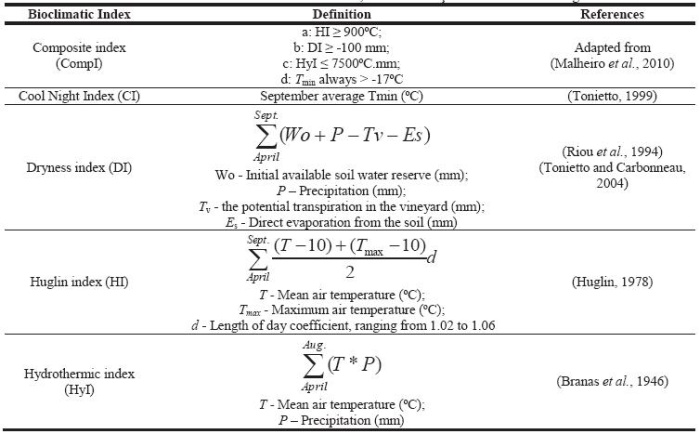
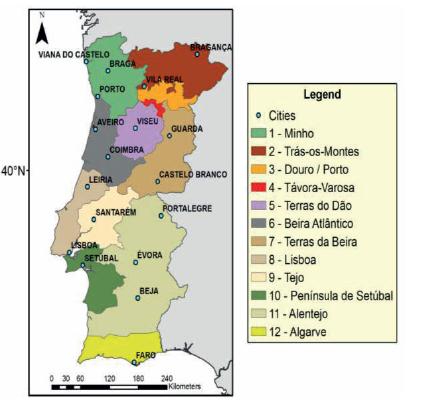
<body><![CDATA[<P><B>RESUMO </B></P >     <P>A vitivinicultura portuguesa representa uma atividade econ&oacute;mica de extrema import&acirc;ncia para o sector  agr&iacute;cola nacional, nomeadamente para algumas regi&otilde;es de renome, como as Regi&otilde;es Demarcadas do Alentejo,  D&atilde;o, Douro ou Vinhos Verdes. A zonagem vit&iacute;cola permite avaliar a adaptabilidade de uma dada casta &agrave;s   condi&ccedil;&otilde;es clim&aacute;ticas locais. Dada a diversidade clim&aacute;tica existente no territ&oacute;rio   portugu&ecirc;s, esta zonagem &eacute; assim de particular interesse para a &#64257;leira vitivin&iacute;cola nacional.   Sabe-se ainda que altera&ccedil;&otilde;es no clima futuro poder&atilde;o ter impactos importantes sobre essa zonagem. No   presente estudo &eacute; discutida a zonagem vit&iacute;cola atual em Portugal, bem como as varia&ccedil;&otilde;es induzidas  pelas altera&ccedil;&otilde;es clim&aacute;ticas no per&iacute;odo 2011-2070. Para o efeito, a partir de temperaturas e   precipita&ccedil;&otilde;es di&aacute;rias, foram calculados os &iacute;ndices de Huglin, de frescura das noites, de secura,   um &iacute;ndice hidrot&eacute;rmico e um &iacute;ndice composto, baseado nos &iacute;ndices anteriores. Para a   avalia&ccedil;&atilde;o das condi&ccedil;&otilde;es no passado-recente (1961-2000) foi utilizada uma base de dados   observacionais (E-OBS), enquanto para as proje&ccedil;&otilde;es clim&aacute;ticas foi considerada uma base de dados composta  por 16 simula&ccedil;&otilde;es de modelos clim&aacute;ticos (projeto ENSEMBLES). No clima futuro s&atilde;o projetados   aumentos signi&#64257;cativos nos &iacute;ndices t&eacute;rmicos, enquanto nos &iacute;ndices de base pluviom&eacute;trica   s&atilde;o projetadas diminui&ccedil;&otilde;es, em particular sobre o interior sul de Portugal. Pelo exposto, &eacute;   previs&iacute;vel que nas pr&oacute;ximas d&eacute;cadas ocorra uma redistribui&ccedil;&atilde;o das regi&otilde;es   vitivin&iacute;colas portuguesas, destacando-se, por conseguinte, a necessidade de desenvolver atempadamente medidas   adequadas de adapta&ccedil;&atilde;o/mitiga&ccedil;&atilde;o ao n&iacute;vel das castas e dos porta-enxertos recomendados,   bem como ao n&iacute;vel das pr&aacute;ticas culturais, para ajudar a manter a tipicidade dos vinhos. </P>      <P><B>Palavras-chave</B>: altera&ccedil;&otilde;es clim&aacute;ticas; viticultura portuguesa, modelos clim&aacute;ticos; zonagem vit&iacute;cola; &iacute;ndices bioclim&aacute;ticos. </P>     <p>&nbsp;</p>     <P><B>INTRODUCTION </B></p>      <p>Climate is widely acknowledged as one of the major factors affecting vine physiology, phenology and wine parameters (Jones  and Davis 2000; Santos <I>et al.</I>, 2011). In fact, the most worldwide renowned wine regions are located within relatively  narrow latitude belts that provide very speci&#64257;c climatic conditions for high-quality wine production (Spellman 1999;  Jones 2006). Although other factors, such as soils, winegrape varieties, agricultural and oenological practices might also  play a crucial role on the entire winemaking process, climate and weather represent the most challenging factors (van   Leeuwen <I>et al.</I>, 2004), as they cannot  be directly controlled by producers (we can only predict them and take measures  to adapt and/or mitigate their effects) and vary signi&#64257;cantly on relatively short time scales. Hence, viticultural  zoning based on climatic factors has been applied as a &#64257;rst approach to delineate areas where climate is (nearly)   optimal to winegrape growing, thus allowing the development of a sustainable winemaking sector, providing that the other  factors are also reasonably suitable. </P>     <P>Specialized bioclimatic indices can be used not only in evaluating the climatic suitability of a speci&#64257;ed region to  winegrape growth and wine production (Malheiro <I>et al.</I>, 2010), but also in assessing some wine quality parameters, such  as the balance between acidity and alcoholic content (Huglin 1978; Magalh&atilde;es 2008). The Huglin index (HI; Huglin 1978)  is a degree day index that also accounts for day length during the vine growing season. It is used for assessing the basic  thermal and radiative demands of the grapevine so as to complete its phenological stages, including full and adequate grape   maturation. In fact, the HI classes show strong correlations with some grapevine phenological events (Jones <I>et al.</I>,  2005b), also linking a speci&#64257;c grapevine variety to a given climatic region. The Cool night index (Tonietto and   Carbonneau 2004), another thermal index, accounts for night temperatures (minimum temperatures) during the maturation stage   (September). Some studies argue that, at this stage, moderately low nocturnal temperatures combined with diurnal high   temperatures tend to be advantageous for the production of high quality wines, promoting the synthesis of anthocyanins and   other phenolic compounds (Kliewer and Torres 1972; Mori <I>et al.</I>, 2005). </P>     <P>Besides assessing the thermal conditions for grapevine development, it is also important to take into account the soil and  atmospheric water conditions. The Hydrothermal index (HyI; Branas <I>et al.</I>, 1946) combines the effect of air humidity  (using precipitation) and temperature during the growing season to assess the risk of grapevine exposure to certain diseases,  such as downy mildew. On the other hand, the Dryness index (DI; Riou <I>et al.</I>, 1994) accounts for the soil water   availability, thus providing information about the water stress conditions. The Composite index (CompI; Malheiro   <I>et al.</I>, 2010) is useful in depicting regions with suitable climatic conditions for winegrape growth by combining   critical thresholds in the previous indices. In this context, by allowing the assessment of climate suitability for winegrape  growth, the bioclimatic indices are a widely used tool in viticultural zoning. </P>     <P>The awareness of a potential climate change is fundamental in order to raise adaptive capacity (Metzger <I>et al.</I>, 2008).  Therefore, the assessment of regional climate projections is of high pertinence for the wine industry by enabling the  development of adequate measures for both mitigating their impacts and adapting to the new climatic conditions. Under the A1B  International Panel on Climate Change (IPCC) &ndash; Synthesis Report on Emission Scenarios (SRES) scenario include a global  temperature rise within the range 2.2-5.1&ordm;C (Naki&#263;enovi&#263; <I>et al.</I>, 2000). More speci&#64257;cally, climate  in Portugal (typically Mediterranean, with temperature increasing and precipitation decreasing southwards and inwards) is   expected to undergo some signi&#64257;cant changes under anthropogenic forcing, including changes in temperature and   precipitation (Meehl <I>et al.</I>, 2007), as well as in their extremes (Costa <I>et al.</I>, 2012). </P>      <P>Vineyards in Portugal are virtually grown over almost all of the country (globally about 238.000 ha for aprox. 6 millions hl  of wine production; IVV 2011), which is divided in large wine regions throughout the country (Fig. 1). However, the most  important wine-making regions are localized within legally bounded controlled appellations (e.g. from north to south: Vinhos  Verdes, Douro, D&atilde;o and Alentejo). These winemaking areas are quite diverse in their climates, geomorphological   features, soil characteristics, and grown grapevine varieties (Magalh&atilde;es, 2008). As an illustration, while Alentejo   (southeast) is mostly &#64258;atland with a relatively homogenous climate, the Douro Valley (northeast) is very mountainous  and presents a large diversity of mesoclimates. Taking into account the important incomes the winemaking sector brings to the  Portuguese economy, amounting nearly 2% of the total national exportation revenue (IVV 2011), the present study is devoted to   the understanding of the climatic viticultural zoning in Portugal and the future implication of the climate change in this  sector. The current climatic zoning and its likely changes under future climates are discussed using the aforementioned  &#64257;ve bioclimatic indices. As such, this study aims at contributing to a better planning of the measures that need to be   taken by producers (grape-growers and winemakers), associations and organizations across the Portuguese wine industry in order  to cope with climate change. </p>      ]]></body>
<body><![CDATA[<p>&nbsp;</p>       <p><img src="/img/revistas/ctv/v27n1/27n1a04f1.jpg"></p>     
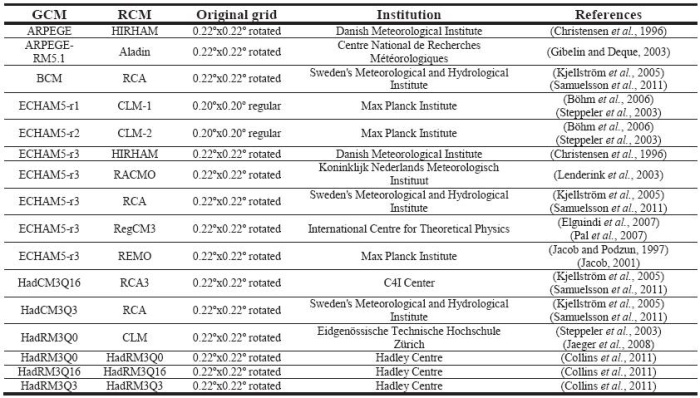
<p>    <p><b>Figure 1</b>&ndash; The wine regions of mainland Portugal (IGP- Protected  geographical indication).</p>     <p><i>Regi&otilde;es vit&iacute;colas de Portugal continental (IGP &ndash; Indica&ccedil;&atilde;o geogr&aacute;&#64257;ca  protegida).</I></P>     <p>&nbsp;</p>       <P><B>MATERIAL AND METHODS </B></p>      <p>Five bioclimatic indices, speci&#64257;cally 1) Huglin Index (HI), 2) Cool Night Index (CI), 3) Hydrothermic Index (HyI), 4)  Dryness Index (DI) and 5) a Composite Index (CompI) were calculated over Portugal, using the mathematical de&#64257;nitions  found in Table I. For assessing climate change impacts, two periods were considered in this study. The baseline period   representing current-past condition (1961-2000) was calculated using data from an observational dataset (E-OBS, version-5,   Haylock <I>et al.</I>, 2008), while for the future conditions (2041-2070) data from a 16-member ensemble, produced by the  ENSEMBLES project (Table II), was considered. The future period (2041-2070) was chosen to better characterize mid-century   climatic conditions under the A1B IPCC-SRES scenario, a moderate anthropogenic radiative forcing scenario, but with already   high emission levels (Naki&#263;enovi&#263;<I>et al.</I>, 2000). Additionally, differences in the number of days with extreme  temperatures (above 40&ordm;C) and in the growing-season precipitations between future and current climates are also   discussed.</P>        <p>&nbsp;</p>      <p><b>TABLE I</b></p>      ]]></body>
<body><![CDATA[<P></B>List of all the bioclimatic indices used in this study, their definitions and references. </P >     <P><i>Lista dos &iacute;ndices bioclim&aacute;ticos usados neste estudo, as suas defini&ccedil;&otilde;es e refer&ecirc;ncias  bibliogr&aacute;ficas. </i></P>     <p><img src="/img/revistas/ctv/v27n1/27n1a04t1.jpg"></p>      
<p>&nbsp;</p>      <p><b>TABLE II</b></p>      <P>Summary of all GCM / RCM model chains, original grid resolutions, institutions and references used in this study.</p>     <p><i>Resumo de todos os GCM / RCM usados neste estudo, as suas resolu&ccedil;&otilde;es originais, institui&ccedil;&otilde;es  e refer&ecirc;ncias bibliogr&aacute;ficas.</i></P>      <p><img src="/img/revistas/ctv/v27n1/27n1a04t2.jpg"></p>      
<p>&nbsp;</p>     <P>All data &#64257;elds, from each model run, were bilinearly interpolated from their original resolution (Table II) onto  a 0.25&ordm; &times; 0.25&ordm; grid, the same grid as in the observational dataset. This interpolation allowed applying a   statistical error correction to the model-derived indices (model output statistics; MOS). The application of MOS to the  calculated bioclimatic indices resulted in some losses of data along coastal areas of Portugal, where E-OBS grid-cells have  missing data (cf. Fig. 2). Due to the low representativeness of these littoral areas to the national wine production, this is  not an important shortcoming and no other statistical approach was thereby applied to estimate the indices in the blank cells   (e.g. nearest neighbour with values). </P>        ]]></body>
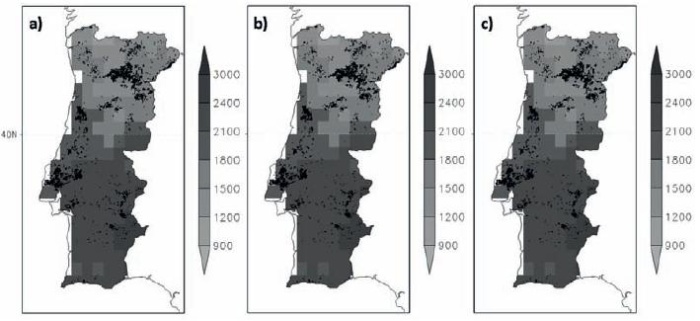
<body><![CDATA[<p>&nbsp;</p>      <p><a name="f2"></a></p>      <p><img src="/img/revistas/ctv/v27n1/27n1a04f2.jpg"></p>     
<p><b><a href="#topf2">Figure 2</a></b>&ndash; Huglin Index (HI; in &ordm;C) for a) the baseline period  (1961-2000), b) the future time period (2041-2070), and c) overall differences in 20412070 minus 1961-2000 (under the A1B  IPCC-SRES scenario). Black areas represent the current vineyard land cover. </P>     <P><i>&Iacute;ndice de Huglin (HI; em &ordm;C) para a) o per&iacute;odo de refer&ecirc;ncia (1961-2000), b) o per&iacute;odo  futuro (2041-2070), e c) diferen&ccedil;as entre 2041-2070 menos 19612000 (sob o cen&aacute;rio A1B IPCC-SRES). &Aacute;reas a  preto representam o atual coberto vegetal de vinha. </i></P>      <p>&nbsp;</p>      <P>For the model calibration, since the calculated bioclimatic indices are normally distributed (according to the Lilliefors  test; not shown), adjustments (transfer-functions) using multiple linear regressions were carried out. The same linear   transformations were then applied to all future indices. This type of statistical model error correction has been used in  previous studies (Alexandrov and Hoogenboom 2000) and can be used to provide reliable climate change scenarios (Jakob Theme&szlig;l <I>et al.</I>, 2011). The use of a 16-member  ensemble in the assessment of viticultural zoning in the future is an innovative methodology, by taking into account model   uncertainties. Due to the large amount of outcomes, the results shown in this  study are only focused on the 16-member  ensemble  mean patterns. </P>     <P>In order to better analyse the spatial distribution of the resulting bioclimatic indices, an overlay of the current vineyard  land cover was applied, using the Corine Land Cover Map (CLC 2000; EEA 2002; B&uuml;ttner <I>et al.</I>, 2006). This dataset  provides an inventory of the land cover over Europe and has proven to have high accuracy in representing the cartography over  mainland Portugal (Caetano <I>et al.</I>, 2006). </P>     <p>&nbsp;</p>     <P><B>RESULTS </B></P>     ]]></body>
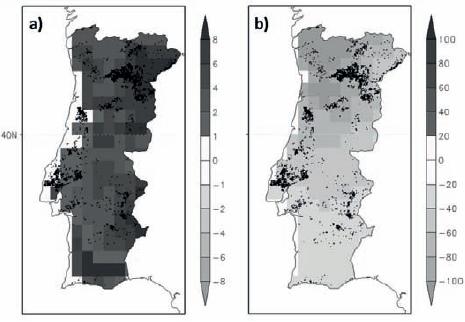
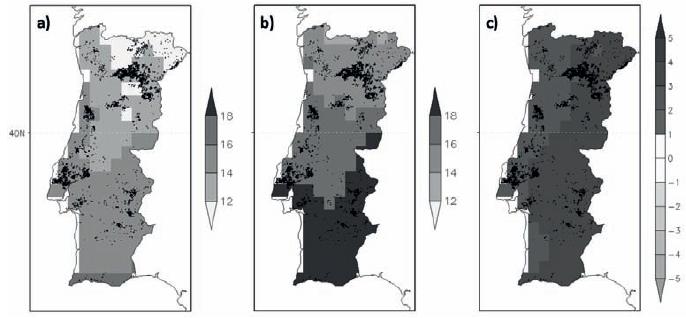
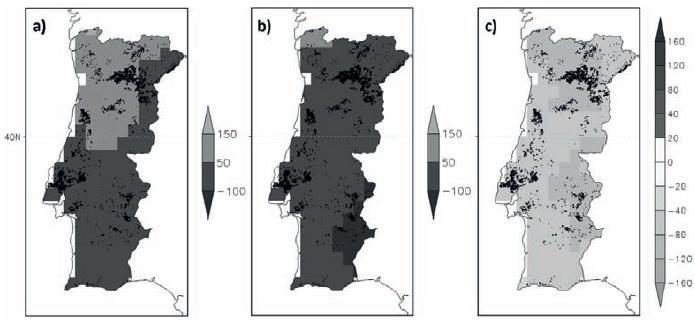
<body><![CDATA[<P>The 16-member ensemble mean pattern of the HI (<a href="#f2">Fig. 2a</a><a name="topf2"></a>), for the baseline period, shows relatively high values in the  central and southern regions of Portugal (1800-3000&ordm;C), while in the northern regions it reveals much lower values  (900-1800&ordm;C), which highlights the strong north-south contrast in the climatic conditions over Portugal. Similar   results were reported by Magalh&atilde;es (2008) using weather station data. For the future period (<a href="#f2">Fig. 2b</a>), an overall  increase in these values is expected (<a href="#f2">Fig. 2c</a>), especially in the innermost regions, reaching values above 3000&ordm;C   (highest HI class). This pattern is in clear agreement with Malheiro <I>et al.</I>, (2010) in a study for Europe and using  a single model (COSMO-CLM). In fact, these increases will indeed lead to shifts to higher classes in the HI throughout  Portugal. </P>     <P>This warming is also apparent in the night temperatures, as is suggested by the CI patterns. The CI (Fig.  3a) mean ensemble pattern shows a clear difference between south and coastal regions (warmer nights) and  north and innermost regions (cooler nights). The CI future pattern shows a clearer distinction between southern  (&gt;18&ordm;C), central (16-18&ordm;C) and northern (12-16&ordm;C) Portugal (Fig. 3b); increases of 2-4&ordm;C are expected  to occur, particularly over inland Portugal (Fig. 3c). This overall warming is also attested by an increase in the frequency  of occurrence of extreme temperatures in the future. In fact, for some regions of the Douro Valley and Alentejo, projected   changes include a signi&#64257;cant rise in the number of days with maximum daily temperature above or equal to 40&ordm;C   (up to 8 days, Fig. 4a). </P>     <p>&nbsp;</p>      <p><a name="f3"></a></p>      <p><img src="/img/revistas/ctv/v27n1/27n1a04f3.jpg"></p>     
<p><b><a href="#topf3">Figure 3</a></b>&ndash; Cool night Index (CI; in &ordm;C) for a) the baseline  period (1961-2000), b) the future time period (2041-2070), and c) overall differences in 2041-2070 minus 1961-2000 (under  the A1B IPCC-SRES scenario). Black areas represent the current vineyard land cover. </P>     <P><i>&Iacute;ndice de frescura das noites (CI; em &ordm;C) para a) o per&iacute;odo de refer&ecirc;ncia (1961-2000), b) o  per&iacute;odo futuro (2041-2070), e c) diferen&ccedil;as entre 2041-2070 menos 1961-2000 (sob o cen&aacute;rio A1B  IPCC-SRES). &Aacute;reas a preto representam o atual coberto vegetal de vinha. </i></P>      <p>&nbsp;</p>      <p><a name="f4"></a></p>      <p><img src="/img/revistas/ctv/v27n1/27n1a04f4.jpg"></p>     
]]></body>
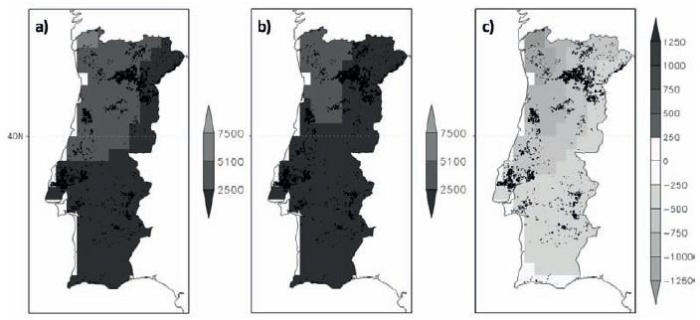
<body><![CDATA[<p><b><a href="#topf4">Figure 4</a></b>&ndash; a) Differences in the number of days with maximum daily  temperature equal to or above 40&ordm;C (2041-2070 minus 1961-2000). b) Differences in the precipitation totals (in mm)  during the growing season (2041-2070 minus 1961-2000). </P>      <P>a) Diferen&ccedil;a no n&uacute;mero de dias com temperatura m&aacute;xima di&aacute;ria igual a superior a 40&ordm;C   (2041-2070 menos 1961-2000). b) Diferen&ccedil;as no total de precipita&ccedil;&atilde;o acumulada (em mm) durante a  &eacute;poca de crescimento vegetativo (2041-2070 menos 1961-2000). </P>     <p>&nbsp;</p>     <P>In addition to the overall warming in both the mean temperature and its extremes, a decrease in precipitation is also  projected to occur, particularly in the northern and coastal areas (Fig. 4b). This drying leads to changes in the DI mean  pattern (Fig. 5a), where southern Portugal already shows moderate dryness under current  climatic conditions (-100 to -50 mm). Changes in this index thereby suggest an important threat or challenge to the   viticultural sector owing to the severe dryness that is likely to occur in the future (Fig. 5b), particularly in the   innermost southern regions (Fig. 5c). This excessive dryness is in effect considered unsuitable for winegrape growth   without irrigation (Koundouras <I>et al.</I>, 1999). Conversely, the mean pattern of the HyI (Fig. 6a) for the baseline period shows low to moderate risk of downy mildew disease in most of the Portuguese   mainland, and high risk in a small region in north-western Portugal (Alto Minho). The combined effect of the projected  future warming and drying will yield a decrease in the HyI (Fig. 6b, c), leading to lower risks of crop contamination,  which may have bene&#64257;cial impacts on the sector. </P>     <p>&nbsp;</p>     <p><a name="f5"></a></p>      <p><img src="/img/revistas/ctv/v27n1/27n1a04f5.jpg"></p>     
<p><b><a href="#topf5">Figure 5</a></b>&ndash; Dryness Index (DI; in mm) for a) the baseline period  (1961-2000), b) the future time period (2041-2070), and c) overall differences in 2041-2070 minus 1961-2000 (under the A1B  IPCC-SRES scenario). Black areas represent the current vineyard land cover. </P>      <P><i>&Iacute;ndice de secura (DI; em mm) para a) o per&iacute;odo de refer&ecirc;ncia (1961-2000), b) o per&iacute;odo   futuro (2041-2070), e c) diferen&ccedil;as entre 2041-2070 menos 1961-2000 (sob o cen&aacute;rio A1B IPCC-SRES). &Aacute;reas   a preto representam o atual coberto vegetal de vinha. </i></P>        <p>&nbsp;</p>      ]]></body>
<body><![CDATA[<p><a name="f6"></a></p>      <p><img src="/img/revistas/ctv/v27n1/27n1a04f6.jpg"></p>     
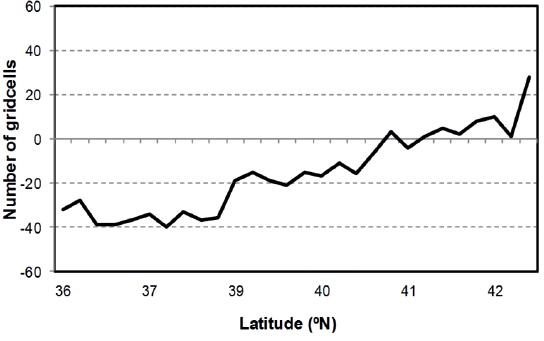
<p><b><a href="#topf6">Figure 6</a></b>&ndash; Hydrothermal Index (HyI; in &ordm;C.mm) for a) the  baseline period (1961-2000), b) the future time period (2041-2070), and c) overall differences in 2041-2070 minus 1961-2000  (under the A1B IPCC-SRES scenario). Black areas represent the current vineyard land cover. </P>     <P><i>&Iacute;ndice hidrot&eacute;rmico (HyI; em &ordm;C.mm) para a) o per&iacute;odo de refer&ecirc;ncia (1961-2000), b) o  per&iacute;odo futuro (2041-2070), e c) diferen&ccedil;as entre 20412070 menos 1961-2000 (sob o cen&aacute;rio A1B IPCC-SRES).  &Aacute;reas a preto representam o atual coberto vegetal de vinha. </i></P>      <p>&nbsp;</p>      <P>The CompI has proven to be effective in detecting the most suitable European regions for winegrape growth and wine production  (Santos <I>et al.</I>, 2012). For the baseline period, its mean pattern over Portugal highlights that most of Portugal has a  very high suitability for viticulture (values above 0.99; Fig. 7a). However, in the future period, a tendency for lower values  is depicted (Fig. 7b). In fact, the excessive dryness underlies this decrease (Fig. 7c) and may represent a detrimental impact  on viticulture. Further, some regions in south-eastern Portugal (e.g. Alentejo) will have CompI values that suggest   unsuitability for viticulture if mitigation measures (e.g. irrigation) are not implemented. From Fig. 8  it is clear that over most of Portugal (36-41 &ordm;N) a decrease in the area of suitable climate (CompI above 0.5) is  expected to occur in the future, while over north-western Portugal (polewards of 41&ordm;N) small increases in suitability   are projected instead. </P>     <p>&nbsp;</p>     <p><a name="f7"></a></p>     <p><img src="/img/revistas/ctv/v27n1/27n1a04f7.jpg"></p>     
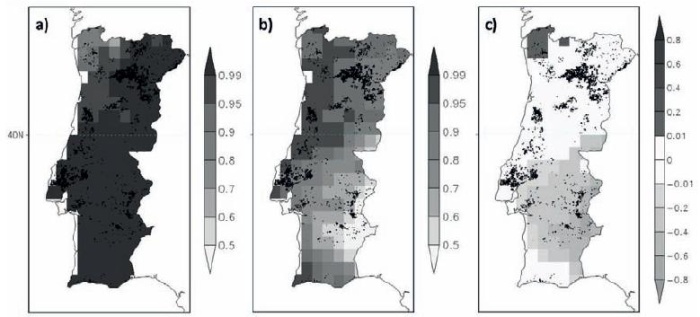
<p><b><a href="#topf7">Figure 7</a></b>&ndash; Composite Index (CompI) for a) the baseline period  (1961-2000), b) the future time period (2041-2070), and c) overall differences in 2041-2070 minus 1961-2000 (under the A1B  IPCC-SRES scenario). Black areas represent the current vineyard land cover. Not statistically signi&#64257;cant differences  at the 99% con&#64257;dence level are grey shaded. </P>      ]]></body>
<body><![CDATA[<P><i>&Iacute;ndice composto (CompI) para a) o per&iacute;odo de refer&ecirc;ncia (1961-2000), b) o per&iacute;odo futuro   (2041-2070), e c) diferen&ccedil;as entre 2041-2070 me-nos 1961-2000 (sob o cen&aacute;rio A1B IPCC-SRES). &Aacute;reas a   preto representam o atual coberto vegetal de vinha. Diferen&ccedil;as estatisticamente n&atilde;o signi&#64257;cativas, com   um n&iacute;vel de con&#64257;an&ccedil;a 99%, s&atilde;o marcadas a cinzento. </i></P>       <p>&nbsp;</p>     <p><a name="f8"></a></p>      <p><img src="/img/revistas/ctv/v27n1/27n1a04f8.jpg"></p>     
<p><b><a href="#topf8">Figure 8</a></b>&ndash; Latitudinal differences between the periods 2041-2070 and  1961-2000 in the number of grid cells equal to or above 0.5 in the composite index (CompI). </P>     <P><i>Diferen&ccedil;as latitudinais entre os per&iacute;odos 2041-2070 e 1961-2000 no n&uacute;mero de pontos da grelha, com  valor igual ou superior a 0.5 no &iacute;ndice composto (CompI). </i></P >     <p>&nbsp;</p>     <P><B>DISCUSSION AND CONCLUSIONS</B></P>     <P>Aiming at analysing the climatic viticultural zoning in Portugal, &#64257;ve bioclimatic indices (HI, CI, HyI, DI and CompI)  were computed and mapped over mainland Portugal. Their recent-past spatial patterns allow the isolation of the most suitable  regions for winegrape growth and high-quality wine production. On the other hand, their changes under human-driven climate  change (A1B SRES scenario) suggest a reshaping of the suitability throughout the country in the next few decades (until 2070),  shedding some light onto the measures that can be adopted to adapt to or mitigate climate change impacts on the Portuguese   wine industry. </P>     <P>The HI pattern reveals a signi&#64257;cant increase in the values of this index, particularly over the inland and southern  areas of the country (<a href="#f2">Fig. 2</a>). Increases in the HI have already been reported in other European countries, such as for Germany  (Stock <I>et al.</I>, (2005); Neumann and Matzarakis (2011) and for France (Duchene and Schneider (2005). This is indeed a  clear manifestation of the expected warming under the A1B emission scenario, which is more accentuated in continental rather  than coastal areas (Meehl <I>et al.</I>, 2007; Knutti <I>et al.</I>, 2008). Since HI values are largely tied to grapevine  thermal demands, including strong correlations with some phenological events which are projected to be brought forward into  warmer periods of the year (Jones <I>et al.</I>, 2005b; Bock <I>et al.</I>, 2011), this shift may have important impacts on  the Portuguese viticultural sector. A careful selection of the winegrape varieties to be grown at a given location in the  future, based on the new HI classes, is certainly one important adaptation measure. </P>     ]]></body>
<body><![CDATA[<P>The CI pattern clearly shows a warming of the nights in September, which may have important implications on the wine quality  that must be taken into full consideration, particularly in southern Portugal (e.g. Alentejo), where average minimum  temperatures are currently already above 18&ordm;C (<a href="#f3">Fig. 3</a><a name="topf3"></a>). This projected night-time warming is also supported by previous  &#64257;ndings of Malheiro and Santos (2011; for the Iberian Peninsula) and expected to yield altered negatively wine typicity  and quality (Bock <I>et al.</I>, 2011). Furthermore, the CI values should be even higher in regions where the harvest is   usually done in August (e.g. Alentejo). Additionally, the frequencies of occurrence of extremely high maximum temperatures  (over 40&ordm;C) will also increase (<a href="#f4">Fig. 4</a><a name="topf4"></a>), which enhance thermal stresses and may eventually result in severe damages or  even sunburns in leaves and berries. Grape harvest dates may also be affected by these extreme heat events, resulting from   the high sensitivity of this crop to summer temperatures (Chuine <I>et al.</I>, 2004; Menzel <I>et al.</I>, 2011). </P>     <P>Despite the changes in the thermal conditions, changes in rainfall patterns can also strongly impact on the winegrapes.  In particular, the overall decrease in the growing season precipitation, mainly in the northern half of Portugal (e.g. Douro  Wine Region, Vinhos Verdes Wine Region), may substantially increase water stress symptoms (<a href="#f4">Fig. 4</a>). In effect, the lack of  rain may require compensation measures through irrigation. This idea is supported by the DI pattern that displays values below  the minimum threshold of -100 mm over south-eastern Portugal (<a href="#f5">Fig. 5</a><a name="topf5"></a>). Such decrease in the DI values can thus lead to great  reductions in grapevine productivity, caused by damaging water stress (Moutinho-Pereira <I>et al.</I>, 2004). In contrast, the  decrease in the HyI values, accompanied by the lowering of the rainfall during the growing season, mainly in north-western   Portugal (Vinhos Verdes controlled appellation), suggests a weakening of the risks of some pests and diseases in the vineyards,  as the downy mildew disease, among others (<a href="#f6">Fig. 6</a><a name="topf6"></a>). </P>     <P>The CompI summarizes the main changes in the previous indices and shows high agreement with the current distribution of the  wine types in Portugal (Fig. <a href="#f7">7</a><a name="topf7"></a> and Fig. <a href="#f8">8</a><a name="topf8"></a>). In the current climate, most of mainland Portugal tends to present optimal   conditions for winegrape growth, whereas in the future large areas of south-eastern (e.g. Alentejo) will become less suitable.  This outcome is supported by previous &#64257;ndings (Jones <I>et al.</I>, 2005a; Stock <I>et al.</I>, 2005; Malheiro   <I>et al.</I>, 2010). This climatic unsuitability is largely tied to the excessively dryness that can, however, be widely  overcome by implementing both short and long term measures. Amongst the short term measures, it is worth highlighting   agronomic practices such as soil (e.g. cover cropping and minimum tillage), organic fertilization and irrigation management  and use of chemical sunscreens for leaf protection. With respect to the long term measures, just to mention, adjustments in   the training systems (e.g. by optimizing canopy geometry), changes in the altitude or solar exposure of the vineyards   (vineyard microclimatic conditions), rootstocks and winegrape varieties of each region and genetic breeding of new varieties,   necessarily less sensitive to water and thermal stresses, can be carried out. Furthermore, it is also important to emphasize  the genetic pool given by a vast range of autochthonous/indigenous and international varieties (341 legally used varieties;   Veloso <I>et al.</I>, 2010), which can provide a key tool for climate change adaptation. These measures need to be thoroughly   evaluated for each speci&#64257;c region, since some can be more easily implemented in southern Portugal (plain areas more  prone to irrigation) and others in northern Portugal (e.g. changes in altitude and solar exposure). Altogether, these measures  can effectively mitigate the potentially adverse impacts of climate change on the wine production sector in Portugal and can  decisively contribute to its sustainable development in the next decades. Hence, the present study provides some insight into  future strategies for the maintenance of a highly competitive wine industry despite climate change threats. </P>     <p>&nbsp;</p>    <P    ><B>REFERENCES </B></P>     <!-- ref --><P>Alexandrov V. A., Hoogenboom G., 2000. The impact of climate variability and change on crop yield in Bulgaria. <I>Agric.  For. Meteorol</I>., <B>104</B>, 315-327.    &nbsp;&nbsp;&nbsp;&nbsp;&nbsp;&nbsp;&nbsp;&nbsp;[&#160;<a href="javascript:void(0);" onclick="javascript: window.open('/scielo.php?script=sci_nlinks&ref=000098&pid=S0254-0223201200010000400001&lng=','','width=640,height=500,resizable=yes,scrollbars=1,menubar=yes,');">Links</a>&#160;]<!-- end-ref --> </P>     <!-- ref --><P>Bock A., Sparks T., Estrella N., Menzel A., 2011. Changes in the phenology and composition of wine from Franconia, Germany.  <I>Clim. Res.</I>, <B>50</B>, 69-81.    &nbsp;&nbsp;&nbsp;&nbsp;&nbsp;&nbsp;&nbsp;&nbsp;[&#160;<a href="javascript:void(0);" onclick="javascript: window.open('/scielo.php?script=sci_nlinks&ref=000100&pid=S0254-0223201200010000400002&lng=','','width=640,height=500,resizable=yes,scrollbars=1,menubar=yes,');">Links</a>&#160;]<!-- end-ref --> </P>     <!-- ref --><P>B&ouml;hm U., K&uuml;cken M., Ahrens W., Block A., Hauffe D., Keuler K., Rockel B., Will A., 2006. CLM- The Climate Version  of LM: Brief Description and Long- Term Applications. <I>COSMO Newsletter</I>, <B>6</B>, 225-235.    &nbsp;&nbsp;&nbsp;&nbsp;&nbsp;&nbsp;&nbsp;&nbsp;[&#160;<a href="javascript:void(0);" onclick="javascript: window.open('/scielo.php?script=sci_nlinks&ref=000102&pid=S0254-0223201200010000400003&lng=','','width=640,height=500,resizable=yes,scrollbars=1,menubar=yes,');">Links</a>&#160;]<!-- end-ref --> </P>     <!-- ref --><P>Branas J., Bernon G., Levadoux L., 1946. <I>&Eacute;l&eacute;ments de viticulture g&eacute;n&eacute;rale</I>. impr. Delmas,  Montpellier, France.    &nbsp;&nbsp;&nbsp;&nbsp;&nbsp;&nbsp;&nbsp;&nbsp;[&#160;<a href="javascript:void(0);" onclick="javascript: window.open('/scielo.php?script=sci_nlinks&ref=000104&pid=S0254-0223201200010000400004&lng=','','width=640,height=500,resizable=yes,scrollbars=1,menubar=yes,');">Links</a>&#160;]<!-- end-ref --> </P>     <!-- ref --><P>B&uuml;ttner G., Feranec G., Jaffrain G., 2006. EEA CORINE Land Cover Nomenclature Illustrated Guide- Addendum 2006.    &nbsp;&nbsp;&nbsp;&nbsp;&nbsp;&nbsp;&nbsp;&nbsp;[&#160;<a href="javascript:void(0);" onclick="javascript: window.open('/scielo.php?script=sci_nlinks&ref=000106&pid=S0254-0223201200010000400005&lng=','','width=640,height=500,resizable=yes,scrollbars=1,menubar=yes,');">Links</a>&#160;]<!-- end-ref --> </P>     <!-- ref --><P>Caetano M., Mata F., Freire S., 2006. Accuracy assessment of the Portuguese CORINE land cover map. <I>Global Developments in  Environmental Earth Observation from Space</I>, 459-467.    &nbsp;&nbsp;&nbsp;&nbsp;&nbsp;&nbsp;&nbsp;&nbsp;[&#160;<a href="javascript:void(0);" onclick="javascript: window.open('/scielo.php?script=sci_nlinks&ref=000108&pid=S0254-0223201200010000400006&lng=','','width=640,height=500,resizable=yes,scrollbars=1,menubar=yes,');">Links</a>&#160;]<!-- end-ref --> </P>     <!-- ref --><P>Christensen J.H., Christensen O.B., Lopez P., van Meijgaard E., Botzet M., 1996. <I>The HIRHAM 4 regional atmospheric climate  model</I>. DMI Scienti&#64257;c Report 96-4.    &nbsp;&nbsp;&nbsp;&nbsp;&nbsp;&nbsp;&nbsp;&nbsp;[&#160;<a href="javascript:void(0);" onclick="javascript: window.open('/scielo.php?script=sci_nlinks&ref=000110&pid=S0254-0223201200010000400007&lng=','','width=640,height=500,resizable=yes,scrollbars=1,menubar=yes,');">Links</a>&#160;]<!-- end-ref --> </P>     <!-- ref --><P>Chuine I., Yiou P., Viovy N., Seguin B., Daux V., Ladurie E.L.R., 2004. Historical phenology: Grape ripening as a past climate  indicator. <I>Nature</I>, <B>432</B>, 289-290.    &nbsp;&nbsp;&nbsp;&nbsp;&nbsp;&nbsp;&nbsp;&nbsp;[&#160;<a href="javascript:void(0);" onclick="javascript: window.open('/scielo.php?script=sci_nlinks&ref=000112&pid=S0254-0223201200010000400008&lng=','','width=640,height=500,resizable=yes,scrollbars=1,menubar=yes,');">Links</a>&#160;]<!-- end-ref --> </P>     <!-- ref --><P>Collins M., Booth B.B., Bhaskaran B., Harris G.R., Murphy J.M., Sexton D.M.H., Webb M.J., 2011. Climate model errors,  feedbacks and forcings: a comparison of perturbed physics and multi-model ensembles. <I>Clim. Dynam.</I>, <B>36</B>,  1737-1766.    &nbsp;&nbsp;&nbsp;&nbsp;&nbsp;&nbsp;&nbsp;&nbsp;[&#160;<a href="javascript:void(0);" onclick="javascript: window.open('/scielo.php?script=sci_nlinks&ref=000114&pid=S0254-0223201200010000400009&lng=','','width=640,height=500,resizable=yes,scrollbars=1,menubar=yes,');">Links</a>&#160;]<!-- end-ref --> </P>     <!-- ref --><P>Costa A.C., Santos J.A., Pinto J.G., 2012.: Climate change scenarios for precipitation extremes in Portugal. <I>Theor. Appl.  Clim.</I>, 108, 217-234.    &nbsp;&nbsp;&nbsp;&nbsp;&nbsp;&nbsp;&nbsp;&nbsp;[&#160;<a href="javascript:void(0);" onclick="javascript: window.open('/scielo.php?script=sci_nlinks&ref=000116&pid=S0254-0223201200010000400010&lng=','','width=640,height=500,resizable=yes,scrollbars=1,menubar=yes,');">Links</a>&#160;]<!-- end-ref --> </P>     <!-- ref --><P>Duchene E., Schneider C., 2005. Grapevine and climatic changes: a glance at the situation in Alsace. <I>Agronomy for  Sustainable Development</I>, <B>25</B>, 93-99.    &nbsp;&nbsp;&nbsp;&nbsp;&nbsp;&nbsp;&nbsp;&nbsp;[&#160;<a href="javascript:void(0);" onclick="javascript: window.open('/scielo.php?script=sci_nlinks&ref=000118&pid=S0254-0223201200010000400011&lng=','','width=640,height=500,resizable=yes,scrollbars=1,menubar=yes,');">Links</a>&#160;]<!-- end-ref --> </P>     <!-- ref --><P>EEA-ETC/TE, 2002. CORINE Land Cover update, I&amp;CLC2000 project, Technical Guidelines.    &nbsp;&nbsp;&nbsp;&nbsp;&nbsp;&nbsp;&nbsp;&nbsp;[&#160;<a href="javascript:void(0);" onclick="javascript: window.open('/scielo.php?script=sci_nlinks&ref=000120&pid=S0254-0223201200010000400012&lng=','','width=640,height=500,resizable=yes,scrollbars=1,menubar=yes,');">Links</a>&#160;]<!-- end-ref --> </P>     <P>Elguindi N., Bi X., Giorgi F., Nagarajan B., Pal J., Solmon F., Rauscher S., Zakey A., 2007. <I>RegCM version 3.1  user&rsquo;s guide</I>. PWCG Abdus Salam ICTP. </P>     ]]></body>
<body><![CDATA[<!-- ref --><P>Gibelin A.L., Deque M., 2003. Anthropogenic climate change over the Mediterranean region simulated by a global variable  resolution model. <I>Clim. Dynam.</I>, <B>20</B>, 327-339.    &nbsp;&nbsp;&nbsp;&nbsp;&nbsp;&nbsp;&nbsp;&nbsp;[&#160;<a href="javascript:void(0);" onclick="javascript: window.open('/scielo.php?script=sci_nlinks&ref=000123&pid=S0254-0223201200010000400014&lng=','','width=640,height=500,resizable=yes,scrollbars=1,menubar=yes,');">Links</a>&#160;]<!-- end-ref --> </P>     <P>Haylock M.R., Hofstra N., Klein Tank A.M.G., Klok E.J., Jones P.D., New M., 2008. A European daily high-resolution gridded  data set of surface temperature and precipitation for 1950&ndash;2006. <I>J. Geophys. Res.</I>, <B>113</B>, D20119. </P>     <P>Huglin P., 1978. <I>Nouveau mode d&rsquo;&eacute;valuation des possibilit&eacute;s h&eacute;liothermiques d&rsquo;un milieu  viticole. Comptes Rendus de l&rsquo;Acad&eacute;mie d&rsquo;Agriculture. </I>Acad&eacute;mie d&rsquo;agriculture de France.   </P>     <!-- ref --><P>IVV, 2011. <I>Vinhos e Aguardentes de Portugal, Anu&aacute;rio 2010/2011</I>. Minist&eacute;rio da Agricultura, do  Desenvolvimento Rural e das Pescas: Instituto da Vinha e do Vinho, Lisboa.    &nbsp;&nbsp;&nbsp;&nbsp;&nbsp;&nbsp;&nbsp;&nbsp;[&#160;<a href="javascript:void(0);" onclick="javascript: window.open('/scielo.php?script=sci_nlinks&ref=000127&pid=S0254-0223201200010000400017&lng=','','width=640,height=500,resizable=yes,scrollbars=1,menubar=yes,');">Links</a>&#160;]<!-- end-ref --> </P>     <!-- ref --><P>Jacob D., 2001. A note to the simulation of the annual and inter-annual variability of the water budget over the Baltic Sea  drainage basin. <I>Meteorol. Atmos. Phys.</I>, <B>77</B>, 61-73.    &nbsp;&nbsp;&nbsp;&nbsp;&nbsp;&nbsp;&nbsp;&nbsp;[&#160;<a href="javascript:void(0);" onclick="javascript: window.open('/scielo.php?script=sci_nlinks&ref=000129&pid=S0254-0223201200010000400018&lng=','','width=640,height=500,resizable=yes,scrollbars=1,menubar=yes,');">Links</a>&#160;]<!-- end-ref --> </P>     <!-- ref --><P>Jacob D., Podzun R., 1997. Sensitivity studies with the regional climate model REMO. <I>Meteorol. Atmos. Phys</I>., <B>63</B>,  119-129.    &nbsp;&nbsp;&nbsp;&nbsp;&nbsp;&nbsp;&nbsp;&nbsp;[&#160;<a href="javascript:void(0);" onclick="javascript: window.open('/scielo.php?script=sci_nlinks&ref=000131&pid=S0254-0223201200010000400019&lng=','','width=640,height=500,resizable=yes,scrollbars=1,menubar=yes,');">Links</a>&#160;]<!-- end-ref --> </P>     ]]></body>
<body><![CDATA[<!-- ref --><P>Jaeger E.B., Anders I., Luthi D., Rockel B., Schar C., Seneviratne S.I., 2008. Analysis of ERA40-driven CLM simulations for  Europe. <I>Meteorol. Z.</I>, <B>17</B>, 349-367.    &nbsp;&nbsp;&nbsp;&nbsp;&nbsp;&nbsp;&nbsp;&nbsp;[&#160;<a href="javascript:void(0);" onclick="javascript: window.open('/scielo.php?script=sci_nlinks&ref=000133&pid=S0254-0223201200010000400020&lng=','','width=640,height=500,resizable=yes,scrollbars=1,menubar=yes,');">Links</a>&#160;]<!-- end-ref --> </P>     <!-- ref --><P>Jakob Theme&szlig;l M., Gobiet A., Leuprecht A., 2011. Empirical-statistical downscaling and error correction of daily  precipitation from regional climate models. <I>Int. J. Clim.</I>, <B>31</B>, 1530-1544.    &nbsp;&nbsp;&nbsp;&nbsp;&nbsp;&nbsp;&nbsp;&nbsp;[&#160;<a href="javascript:void(0);" onclick="javascript: window.open('/scielo.php?script=sci_nlinks&ref=000135&pid=S0254-0223201200010000400021&lng=','','width=640,height=500,resizable=yes,scrollbars=1,menubar=yes,');">Links</a>&#160;]<!-- end-ref --> </P>     <P>Jones G., 2006. <I>Climate and Terroir: Impacts of Climate Variability and Change on Wine In Fine Wine and Terroir - The  Geoscience Perspective.</I> Macqueen, R.W., and Meinert, L.D., (eds.).  Geoscience Canada, Geological Association of Canada,  St. John&rsquo;s, Newfoundland, Canada. </P>     <!-- ref --><P>Jones G.V., Davis R.E., 2000. Climate in&#64258;uences on grapevine phenology, grape composition, and wine production and  quality for Bordeaux, France. <I>Am. J. Enol. Vitic.</I>, <B>51</B>, 249-261.    &nbsp;&nbsp;&nbsp;&nbsp;&nbsp;&nbsp;&nbsp;&nbsp;[&#160;<a href="javascript:void(0);" onclick="javascript: window.open('/scielo.php?script=sci_nlinks&ref=000138&pid=S0254-0223201200010000400023&lng=','','width=640,height=500,resizable=yes,scrollbars=1,menubar=yes,');">Links</a>&#160;]<!-- end-ref --> </P>     <!-- ref --><P>Jones G.V., White M.A., Cooper O.R., Storchmann K., 2005a. Climate Change and Global Wine Quality. <I>Clim. Change</I>,  <B>73</B>, 319-343.    &nbsp;&nbsp;&nbsp;&nbsp;&nbsp;&nbsp;&nbsp;&nbsp;[&#160;<a href="javascript:void(0);" onclick="javascript: window.open('/scielo.php?script=sci_nlinks&ref=000140&pid=S0254-0223201200010000400024&lng=','','width=640,height=500,resizable=yes,scrollbars=1,menubar=yes,');">Links</a>&#160;]<!-- end-ref --> </P>     <!-- ref --><P>Jones G.V., Duch&ecirc;ne E., Tomasi D., Yuste J., Braslavska O., Schultz H.R., Martinez C., Boso S., Langellier F.,  Perruchot C., Guimberteau G., 2005b. Changes in European winegrape phenology and relationships with climate. <I>Proc. XIV  GESCO Symposium</I>, 54-61<I>.    &nbsp;&nbsp;&nbsp;&nbsp;&nbsp;&nbsp;&nbsp;&nbsp;[&#160;<a href="javascript:void(0);" onclick="javascript: window.open('/scielo.php?script=sci_nlinks&ref=000142&pid=S0254-0223201200010000400025&lng=','','width=640,height=500,resizable=yes,scrollbars=1,menubar=yes,');">Links</a>&#160;]<!-- end-ref --> </I></P>     <!-- ref --><P>Kjellstr&ouml;m E., B&auml;rring L., Gollvik S., Hansson U., Jones C., Samuelsson P., Rummukainen M., Ullerstig A.,  Will&Oslash;n U., Wyser K., 2005. <I>A 140-year simulation of European climate with the new version of the Rossby Centre  regional atmospheric climate model (RCA3).</I> SMHI, 54 pp.    &nbsp;&nbsp;&nbsp;&nbsp;&nbsp;&nbsp;&nbsp;&nbsp;[&#160;<a href="javascript:void(0);" onclick="javascript: window.open('/scielo.php?script=sci_nlinks&ref=000144&pid=S0254-0223201200010000400026&lng=','','width=640,height=500,resizable=yes,scrollbars=1,menubar=yes,');">Links</a>&#160;]<!-- end-ref --> </P>     <!-- ref --><P>Kliewer W.M., Torres R.E., 1972. Effect of Controlled Day and Night Temperatures on Grape Coloration. <I>Am. J. Enol.  Vitic.</I>, <B>23</B>, 71-77.    &nbsp;&nbsp;&nbsp;&nbsp;&nbsp;&nbsp;&nbsp;&nbsp;[&#160;<a href="javascript:void(0);" onclick="javascript: window.open('/scielo.php?script=sci_nlinks&ref=000146&pid=S0254-0223201200010000400027&lng=','','width=640,height=500,resizable=yes,scrollbars=1,menubar=yes,');">Links</a>&#160;]<!-- end-ref --> </P>     <!-- ref --><P>Knutti R., Allen M.R., Friedlingstein P., Gregory J.M., Hegerl G.C., Meehl G.A., Meinshausen M., Murphy J.M., Plattner G.K.,  Raper S.C.B., Stocker T.F., Stott P.A., Teng H., Wigley T.M.L., 2008. A review of uncertainties in global temperature   projections over the twenty-&#64257; rst century. <I>J. Clim.</I>, <B>21</B>, 2651-2663.    &nbsp;&nbsp;&nbsp;&nbsp;&nbsp;&nbsp;&nbsp;&nbsp;[&#160;<a href="javascript:void(0);" onclick="javascript: window.open('/scielo.php?script=sci_nlinks&ref=000148&pid=S0254-0223201200010000400028&lng=','','width=640,height=500,resizable=yes,scrollbars=1,menubar=yes,');">Links</a>&#160;]<!-- end-ref --> </P>     <!-- ref --><P>Koundouras S., van Leeuwen C., Seguin G., Glories Y., 1999. In&#64258;uence of water status on vine vegetative growth, berry  ripening and wine characteristics in mediterranean zone (example of Nemea, Greece, variety Saint-George, 1997). <I>J. Int.  Sci. Vigne Vin</I>, <B>33</B>, 149-160.    &nbsp;&nbsp;&nbsp;&nbsp;&nbsp;&nbsp;&nbsp;&nbsp;[&#160;<a href="javascript:void(0);" onclick="javascript: window.open('/scielo.php?script=sci_nlinks&ref=000150&pid=S0254-0223201200010000400029&lng=','','width=640,height=500,resizable=yes,scrollbars=1,menubar=yes,');">Links</a>&#160;]<!-- end-ref --> </P>     <!-- ref --><P>Lenderink G., van den Hurk B.,. van Meijgaard E, van Ulden A., Cuijpers H., 2003. <I>Simulation of present-day climate in  RACMO2: </I><I>&#64257;</I><I>rst results and model developments.</I> Ministerie van Verkeer en Waterstaat, Koninklijk  Nederlands Meteorologisch Instituut.    &nbsp;&nbsp;&nbsp;&nbsp;&nbsp;&nbsp;&nbsp;&nbsp;[&#160;<a href="javascript:void(0);" onclick="javascript: window.open('/scielo.php?script=sci_nlinks&ref=000152&pid=S0254-0223201200010000400030&lng=','','width=640,height=500,resizable=yes,scrollbars=1,menubar=yes,');">Links</a>&#160;]<!-- end-ref --> </P>     <!-- ref --><P>Magalh&atilde;es N., 2008. <I>Tratado de viticultura: a videira, a vinha e o terroir.</I> Chaves Ferreira  Publica&ccedil;&otilde;es, Lisboa, Portugal.    &nbsp;&nbsp;&nbsp;&nbsp;&nbsp;&nbsp;&nbsp;&nbsp;[&#160;<a href="javascript:void(0);" onclick="javascript: window.open('/scielo.php?script=sci_nlinks&ref=000154&pid=S0254-0223201200010000400031&lng=','','width=640,height=500,resizable=yes,scrollbars=1,menubar=yes,');">Links</a>&#160;]<!-- end-ref --> </P>     <!-- ref --><P>Malheiro A.C., Santos J.A., 2011. Macrozonagem vitivin&iacute;cola da Pen&iacute;nsula Ib&eacute;rica face a cen&aacute;rio  de altera&ccedil;&atilde;o clim&aacute;tica. <I>Atlas das castas da Pen&iacute;nsula Ib&eacute;rica - hist&oacute;ria,  terroir, ampelogra</I><I>&#64257;</I><I>a</I>. Coordenador Jorge B&ouml;hm, Dinalivro., 155 -159.    &nbsp;&nbsp;&nbsp;&nbsp;&nbsp;&nbsp;&nbsp;&nbsp;[&#160;<a href="javascript:void(0);" onclick="javascript: window.open('/scielo.php?script=sci_nlinks&ref=000156&pid=S0254-0223201200010000400032&lng=','','width=640,height=500,resizable=yes,scrollbars=1,menubar=yes,');">Links</a>&#160;]<!-- end-ref --> </P>     <!-- ref --><P>Malheiro A.C., Santos J.A., Fraga H., Pinto J.G., 2010. Climate change scenarios applied to viticultural zoning in Europe.  <I>Clim. Res.</I>, <B>43</B>, 163-177.    &nbsp;&nbsp;&nbsp;&nbsp;&nbsp;&nbsp;&nbsp;&nbsp;[&#160;<a href="javascript:void(0);" onclick="javascript: window.open('/scielo.php?script=sci_nlinks&ref=000158&pid=S0254-0223201200010000400033&lng=','','width=640,height=500,resizable=yes,scrollbars=1,menubar=yes,');">Links</a>&#160;]<!-- end-ref --> </P>     <P>Meehl G.A., Stocker T.F., Collins W.D., Friedlingstein P., Gaye A.T., Gregory J.M., Kitoh A., Knutti R., Murphy J.M., Noda A.,  Raper S.C.B., Watterson I.G., Weaver A.J., Zhao Z.-C., 2007. Global Climate Projections. <I>In: Climate Change 2007: The   Physical Science Basis. Contribution of Working Group I to the Fourth Assessment Report of the Intergovernmental Panel on   Climate Change</I> [Solomon, S., D. Qin, M. Manning, Z. Chen, M. Marquis, K.B. Averyt, M. Tignor and H.L. Miller (eds.)].   Cambridge University Press, Cambridge, United Kingdom and New York, NY, USA. </P>     <!-- ref --><P>Menzel A., Seifert H., Estrella N., 2011. Effects of recent warm and cold spells on European plant phenology. <I>Int. J.  Biometeorol.</I>, <B>55</B>, 921-932.    &nbsp;&nbsp;&nbsp;&nbsp;&nbsp;&nbsp;&nbsp;&nbsp;[&#160;<a href="javascript:void(0);" onclick="javascript: window.open('/scielo.php?script=sci_nlinks&ref=000161&pid=S0254-0223201200010000400035&lng=','','width=640,height=500,resizable=yes,scrollbars=1,menubar=yes,');">Links</a>&#160;]<!-- end-ref --> </P>     ]]></body>
<body><![CDATA[<!-- ref --><P>Metzger M.J., Schroter D., Leemans R., Cramer W., 2008. A spatially explicit and quantitative vulnerability assessment of  ecosystem service change in Europe. <I>Reg. Environ. Change</I>, <B>8</B>, 91-107.    &nbsp;&nbsp;&nbsp;&nbsp;&nbsp;&nbsp;&nbsp;&nbsp;[&#160;<a href="javascript:void(0);" onclick="javascript: window.open('/scielo.php?script=sci_nlinks&ref=000163&pid=S0254-0223201200010000400036&lng=','','width=640,height=500,resizable=yes,scrollbars=1,menubar=yes,');">Links</a>&#160;]<!-- end-ref --> </P>     <!-- ref --><P>Mori K., Sugaya S., Gemma H., 2005. Decreased anthocyanin biosynthesis in grape berries grown under elevated night  temperature condition. <I>Sci. Hort.</I>, <B>105</B>, 319-330.    &nbsp;&nbsp;&nbsp;&nbsp;&nbsp;&nbsp;&nbsp;&nbsp;[&#160;<a href="javascript:void(0);" onclick="javascript: window.open('/scielo.php?script=sci_nlinks&ref=000165&pid=S0254-0223201200010000400037&lng=','','width=640,height=500,resizable=yes,scrollbars=1,menubar=yes,');">Links</a>&#160;]<!-- end-ref --> </P>     <!-- ref --><P>Moutinho-Pereira J.M., Correia C.M., Gon&ccedil;alves B.M., Bacelar E.A., Torres-Pereira J.M., 2004. Leaf gas exchange and  water relations of grapevines grown in three different conditions. <I>Photosynthetica</I>, <B>42</B>, 81-86.    &nbsp;&nbsp;&nbsp;&nbsp;&nbsp;&nbsp;&nbsp;&nbsp;[&#160;<a href="javascript:void(0);" onclick="javascript: window.open('/scielo.php?script=sci_nlinks&ref=000167&pid=S0254-0223201200010000400038&lng=','','width=640,height=500,resizable=yes,scrollbars=1,menubar=yes,');">Links</a>&#160;]<!-- end-ref --> </P>     <!-- ref --><P>Naki&#263;enovi&#263; N., Alcamo J., Davis G., de Vries H.J.M., Fenhann J., Gaf&#64257;n S., Gregory K., Grubler A.,  Jung T.Y., Kram T., La Rovere E.L., Michaelis L., Mori S., Morita T., Papper W., Pitcher H., Price L., Riahi K., Roehrl A.,  Rogner H.-H., Sankovski A., Schlesinger M., Shukla P., Smith S., Swart R., van Rooijen S., Victor N., Dadi Z., 2000.  <I>Emissions scenarios. A special report of Working Group III of the Intergovernmental Panel on Climate Change</I>. Cambridge  University Press, Cambridge, United Kingdom and New York, NY, USA.    &nbsp;&nbsp;&nbsp;&nbsp;&nbsp;&nbsp;&nbsp;&nbsp;[&#160;<a href="javascript:void(0);" onclick="javascript: window.open('/scielo.php?script=sci_nlinks&ref=000169&pid=S0254-0223201200010000400039&lng=','','width=640,height=500,resizable=yes,scrollbars=1,menubar=yes,');">Links</a>&#160;]<!-- end-ref --> </P>     <!-- ref --><P>Neumann P. A., Matzarakis A., 2011. Viticulture in southwest Germany under climate change conditions. <I>Clim. Res.</I>,  <B>47</B>, 161-169.    &nbsp;&nbsp;&nbsp;&nbsp;&nbsp;&nbsp;&nbsp;&nbsp;[&#160;<a href="javascript:void(0);" onclick="javascript: window.open('/scielo.php?script=sci_nlinks&ref=000171&pid=S0254-0223201200010000400040&lng=','','width=640,height=500,resizable=yes,scrollbars=1,menubar=yes,');">Links</a>&#160;]<!-- end-ref --> </P>     ]]></body>
<body><![CDATA[<!-- ref --><P>Pal J.S., Giorgi F., Bi X.Q., Elguindi N., Solmon F., Gao X.J., Rauscher S.A., Francisco R., Zakey A., Winter J., Ashfaq M.,  Syed F.S., Bell J.L., Diffenbaugh N.S., Karmacharya J., Konare A., Martinez D., da Rocha R.P., Sloan L.C., Steiner A.L. 2007.  Regional climate modeling for the developing world - The ICTP RegCM3 and RegCNET. <I>Bull. Am. Met. Soc.</I>, <B>88</B>,   1395-1409.    &nbsp;&nbsp;&nbsp;&nbsp;&nbsp;&nbsp;&nbsp;&nbsp;[&#160;<a href="javascript:void(0);" onclick="javascript: window.open('/scielo.php?script=sci_nlinks&ref=000173&pid=S0254-0223201200010000400041&lng=','','width=640,height=500,resizable=yes,scrollbars=1,menubar=yes,');">Links</a>&#160;]<!-- end-ref --> </P>     <!-- ref --><P>Riou C., Carbonneau A., Becker N., Cal&oacute; A., Costacurta A., Castro R.,. Pinto P.A, Carneiro L.C., Lopes C.,  Cl&iacute;maco P., Panagiotou M.M., Sotez V., Beaumond H.C., Burril A., Maes J., Vossen P., 1994. <I>Le determinisme  climatique de la maturation du raisin: Application au zonage de la teneur en sucre dans la Communaut&eacute;  Europ&eacute;enne.</I> Of&#64257;ce des Publications Of&#64257;cielles des Communaut&eacute;s Europ&eacute;ennes,  Luxembourg, 319 pp.    &nbsp;&nbsp;&nbsp;&nbsp;&nbsp;&nbsp;&nbsp;&nbsp;[&#160;<a href="javascript:void(0);" onclick="javascript: window.open('/scielo.php?script=sci_nlinks&ref=000175&pid=S0254-0223201200010000400042&lng=','','width=640,height=500,resizable=yes,scrollbars=1,menubar=yes,');">Links</a>&#160;]<!-- end-ref --> </P>     <!-- ref --><P>Samuelsson P., Jones C. G., Willen U., Ullerstig A., Gollvik S., Hansson U., Jansson C., Kjellstrom E., Nikulin G., Wyser K.,  2011. The Rossby Centre Regional Climate model RCA3: model description and performance. <I>Tellus A.</I>, <B>63</B>, 4-23.    &nbsp;&nbsp;&nbsp;&nbsp;&nbsp;&nbsp;&nbsp;&nbsp;[&#160;<a href="javascript:void(0);" onclick="javascript: window.open('/scielo.php?script=sci_nlinks&ref=000177&pid=S0254-0223201200010000400043&lng=','','width=640,height=500,resizable=yes,scrollbars=1,menubar=yes,');">Links</a>&#160;]<!-- end-ref --> </P>     <!-- ref --><P>Santos J.A., Malheiro A.C., Karremann M.K., Pinto J.G., 2011. Statistical modelling of grapevine yield in the Port Wine  region under present and future climate conditions. <I>Int. J. Biometeorol.</I>, <B>55</B>, 119-131.    &nbsp;&nbsp;&nbsp;&nbsp;&nbsp;&nbsp;&nbsp;&nbsp;[&#160;<a href="javascript:void(0);" onclick="javascript: window.open('/scielo.php?script=sci_nlinks&ref=000179&pid=S0254-0223201200010000400044&lng=','','width=640,height=500,resizable=yes,scrollbars=1,menubar=yes,');">Links</a>&#160;]<!-- end-ref --> </P>     <!-- ref --><P>Santos J.A., Malheiro A.C., Pinto J.G., Jones G.V., 2012. Macroclimate and viticultural zoning in Europe: observed trends  and atmospheric forcing. <I>Clim. Res.</I>, <B>51</B>, 89-103.    &nbsp;&nbsp;&nbsp;&nbsp;&nbsp;&nbsp;&nbsp;&nbsp;[&#160;<a href="javascript:void(0);" onclick="javascript: window.open('/scielo.php?script=sci_nlinks&ref=000181&pid=S0254-0223201200010000400045&lng=','','width=640,height=500,resizable=yes,scrollbars=1,menubar=yes,');">Links</a>&#160;]<!-- end-ref --> </P>     ]]></body>
<body><![CDATA[<!-- ref --><P>Spellman G., 1999. Wine, weather and climate. <I>Weather</I>, <B>54</B>, 230-239.    &nbsp;&nbsp;&nbsp;&nbsp;&nbsp;&nbsp;&nbsp;&nbsp;[&#160;<a href="javascript:void(0);" onclick="javascript: window.open('/scielo.php?script=sci_nlinks&ref=000183&pid=S0254-0223201200010000400046&lng=','','width=640,height=500,resizable=yes,scrollbars=1,menubar=yes,');">Links</a>&#160;]<!-- end-ref --> </P>     <!-- ref --><P>Steppeler J., Doms G., Schattler U., Bitzer H.W., Gassmann A., Damrath U., Gregoric G. 2003. Meso-gamma scale forecasts using  the nonhydrostatic model LM. <I>Meteorol. Atmos. Phys.</I>, <B>82</B>, 75-96.    &nbsp;&nbsp;&nbsp;&nbsp;&nbsp;&nbsp;&nbsp;&nbsp;[&#160;<a href="javascript:void(0);" onclick="javascript: window.open('/scielo.php?script=sci_nlinks&ref=000185&pid=S0254-0223201200010000400047&lng=','','width=640,height=500,resizable=yes,scrollbars=1,menubar=yes,');">Links</a>&#160;]<!-- end-ref --> </P>     <!-- ref --><P>Stock M., Gerstengarbe F.W., Kartschall T., Werner P.C., 2005. Reliability of climate change impact assessments for  viticulture. <I>Acta Hortic.</I>, <B>689</B>, 29-39.    &nbsp;&nbsp;&nbsp;&nbsp;&nbsp;&nbsp;&nbsp;&nbsp;[&#160;<a href="javascript:void(0);" onclick="javascript: window.open('/scielo.php?script=sci_nlinks&ref=000187&pid=S0254-0223201200010000400048&lng=','','width=640,height=500,resizable=yes,scrollbars=1,menubar=yes,');">Links</a>&#160;]<!-- end-ref --> </P>     <P>Tonietto J., 1999. Les macroclimats viticoles mondiaux et l&rsquo;in&#64258;uence du m&eacute;soclimat sur la  typicit&eacute; de la Syrah et du Muscat de Hambourg dans le sud de la France: m&eacute;thodologie de caract&eacute;risation,  PhD Dissertation, Ecole Nationale Sup&eacute;rieure Agronomique, Montpellier, France. </P>     <!-- ref --><P>Tonietto J., Carbonneau A., 2004. A multicriteria climatic classi&#64257;cation system for grape-growing regions worldwide.  <I>Agric. For. Meteorol.</I>, <B>124</B>, 81-97.    &nbsp;&nbsp;&nbsp;&nbsp;&nbsp;&nbsp;&nbsp;&nbsp;[&#160;<a href="javascript:void(0);" onclick="javascript: window.open('/scielo.php?script=sci_nlinks&ref=000190&pid=S0254-0223201200010000400050&lng=','','width=640,height=500,resizable=yes,scrollbars=1,menubar=yes,');">Links</a>&#160;]<!-- end-ref --> </P>     <!-- ref --><P>van Leeuwen C., Friant P., Chon&eacute; X., Tregoat O., Koundouras S., Dubordieu D., 2004. In&#64258;uence of climate, soil,  and cultivar on terroir. <I>Am. J. Enol. Vitic.</I>, <B>55</B>, 207-217.    &nbsp;&nbsp;&nbsp;&nbsp;&nbsp;&nbsp;&nbsp;&nbsp;[&#160;<a href="javascript:void(0);" onclick="javascript: window.open('/scielo.php?script=sci_nlinks&ref=000192&pid=S0254-0223201200010000400051&lng=','','width=640,height=500,resizable=yes,scrollbars=1,menubar=yes,');">Links</a>&#160;]<!-- end-ref --> </P>     <!-- ref --><P>Veloso M.M., Almandanim M.C., Baleiras-Couto M., Pereira H.S., Carneiro L.C., Fevereiro P., Eiras-Dias J., 2010.  Microsatellite database of grapevine (<I>Vitis vinifera</I> L.) cultivars used for wine production in Portugal.  <I>Ci&ecirc;ncia T&eacute;c. Vitiv.</I>, <B>25</B>, 53-61.    &nbsp;&nbsp;&nbsp;&nbsp;&nbsp;&nbsp;&nbsp;&nbsp;[&#160;<a href="javascript:void(0);" onclick="javascript: window.open('/scielo.php?script=sci_nlinks&ref=000194&pid=S0254-0223201200010000400052&lng=','','width=640,height=500,resizable=yes,scrollbars=1,menubar=yes,');">Links</a>&#160;]<!-- end-ref --> </P>      <p>&nbsp;</p>      <P><B>ACKNOWLEDGEMENTS</B></P>     <P>The authors acknowledge the European Commission funded ENSEMBLES project (GOCECT-2003-505539) for providing the model  datasets (<a href="http://ensembles-eu.metoffice.com/" target="_blank">http://ensembles-eu.metoffice.com/</a>) and the ECA&amp;D project (<a href="http://eca.knmi.nl" target="_blank">http://eca.knmi.nl</a>) for providing the E-OBS dataset.  We also thank Dr. Joaquim Pinto, at the University of Cologne, the German Federal Environment Agency and the COSMO-CLM  consortium for supplying the COSMO-CLM data. We also acknowledge the European Environmental Agency for providing the Corine  Land Cover data. This study was undertaken under the FCT (Portuguese Foundation for Science and Technology) funded  ClimVine-Safe project (PTDC/AGR-ALI/110877/2009). This work is also supported by European Union Funds (FEDER/COMPETE -  Operational Competitiveness Programme) and by national funds (FCT) - under the project FCOMP-01-0124-FEDER-022696. </P>     <p>&nbsp;</p>     <p><a name="0"></a><a href="#top0">*</a> Corresponding author: Helder Fraga, Centre for the Research and Technology of  Agro-Environmental and Biological Sciences, University of Tr&aacute;s-os-Montes e Alto Douro, P. O. Box 1013, 5001-801  Vila Real, Portugal, Fax: +351 259 350 480, e-mail:<a href="mailto:hfraga@utad.pt">hfraga@utad.pt</a></P>      <p>&nbsp;</p>     <P><I>(Manuscrito recebido em 08.05.2012. Aceite para publica&ccedil;&atilde;o em 22.06.2012) </I></P>       ]]></body>
<body><![CDATA[ ]]></body><back>
<ref-list>
<ref id="B1">
<nlm-citation citation-type="journal">
<person-group person-group-type="author">
<name>
<surname><![CDATA[Alexandrov]]></surname>
<given-names><![CDATA[V. A.]]></given-names>
</name>
<name>
<surname><![CDATA[Hoogenboom]]></surname>
<given-names><![CDATA[G.]]></given-names>
</name>
</person-group>
<article-title xml:lang="en"><![CDATA[The impact of climate variability and change on crop yield in Bulgaria]]></article-title>
<source><![CDATA[Agric. For. Meteorol.]]></source>
<year>2000</year>
<volume>104</volume>
<page-range>315-327</page-range></nlm-citation>
</ref>
<ref id="B2">
<nlm-citation citation-type="journal">
<person-group person-group-type="author">
<name>
<surname><![CDATA[Bock]]></surname>
<given-names><![CDATA[A.]]></given-names>
</name>
<name>
<surname><![CDATA[Sparks]]></surname>
<given-names><![CDATA[T.]]></given-names>
</name>
<name>
<surname><![CDATA[Estrella]]></surname>
<given-names><![CDATA[N.]]></given-names>
</name>
<name>
<surname><![CDATA[Menzel]]></surname>
<given-names><![CDATA[A.]]></given-names>
</name>
</person-group>
<article-title xml:lang="en"><![CDATA[Changes in the phenology and composition of wine from Franconia, Germany]]></article-title>
<source><![CDATA[Clim. Res.]]></source>
<year>2011</year>
<volume>50</volume>
<page-range>69-81</page-range></nlm-citation>
</ref>
<ref id="B3">
<nlm-citation citation-type="journal">
<person-group person-group-type="author">
<name>
<surname><![CDATA[Böhm]]></surname>
<given-names><![CDATA[U.]]></given-names>
</name>
<name>
<surname><![CDATA[Kücken]]></surname>
<given-names><![CDATA[M]]></given-names>
</name>
<name>
<surname><![CDATA[Ahrens]]></surname>
<given-names><![CDATA[W.]]></given-names>
</name>
<name>
<surname><![CDATA[Block]]></surname>
<given-names><![CDATA[A.]]></given-names>
</name>
<name>
<surname><![CDATA[Hauffe]]></surname>
<given-names><![CDATA[D.]]></given-names>
</name>
<name>
<surname><![CDATA[Keuler]]></surname>
<given-names><![CDATA[K.]]></given-names>
</name>
<name>
<surname><![CDATA[Rockel]]></surname>
<given-names><![CDATA[B.]]></given-names>
</name>
<name>
<surname><![CDATA[Will]]></surname>
<given-names><![CDATA[A.]]></given-names>
</name>
</person-group>
<article-title xml:lang="en"><![CDATA[CLM- The Climate Version of LM: Brief Description and Long- Term Applications]]></article-title>
<source><![CDATA[COSMO Newsletter]]></source>
<year>2006</year>
<volume>6</volume>
<page-range>225-235</page-range></nlm-citation>
</ref>
<ref id="B4">
<nlm-citation citation-type="book">
<person-group person-group-type="author">
<name>
<surname><![CDATA[Branas]]></surname>
<given-names><![CDATA[J.]]></given-names>
</name>
<name>
<surname><![CDATA[Bernon]]></surname>
<given-names><![CDATA[G.]]></given-names>
</name>
<name>
<surname><![CDATA[Levadoux]]></surname>
<given-names><![CDATA[L.]]></given-names>
</name>
</person-group>
<source><![CDATA[Éléments de viticulture générale]]></source>
<year>1946</year>
<publisher-loc><![CDATA[Montpellier ]]></publisher-loc>
<publisher-name><![CDATA[Delmas]]></publisher-name>
</nlm-citation>
</ref>
<ref id="B5">
<nlm-citation citation-type="">
<person-group person-group-type="author">
<name>
<surname><![CDATA[Büttner]]></surname>
<given-names><![CDATA[G.]]></given-names>
</name>
<name>
<surname><![CDATA[Feranec]]></surname>
<given-names><![CDATA[G.]]></given-names>
</name>
<name>
<surname><![CDATA[Jaffrain]]></surname>
<given-names><![CDATA[G.]]></given-names>
</name>
</person-group>
<source><![CDATA[EEA CORINE Land Cover Nomenclature Illustrated Guide- Addendum 2006]]></source>
<year>2006</year>
</nlm-citation>
</ref>
<ref id="B6">
<nlm-citation citation-type="">
<person-group person-group-type="author">
<name>
<surname><![CDATA[Caetano]]></surname>
<given-names><![CDATA[M.]]></given-names>
</name>
<name>
<surname><![CDATA[Mata]]></surname>
<given-names><![CDATA[F.]]></given-names>
</name>
<name>
<surname><![CDATA[Freire]]></surname>
<given-names><![CDATA[S.]]></given-names>
</name>
</person-group>
<article-title xml:lang="en"><![CDATA[Accuracy assessment of the Portuguese CORINE land cover map]]></article-title>
<source><![CDATA[Global Developments in Environmental Earth Observation from Space]]></source>
<year>2006</year>
<page-range>459-467</page-range></nlm-citation>
</ref>
<ref id="B7">
<nlm-citation citation-type="">
<person-group person-group-type="author">
<name>
<surname><![CDATA[Christensen]]></surname>
<given-names><![CDATA[J.H.]]></given-names>
</name>
<name>
<surname><![CDATA[Christensen]]></surname>
<given-names><![CDATA[O.B.]]></given-names>
</name>
<name>
<surname><![CDATA[Lopez]]></surname>
<given-names><![CDATA[P.]]></given-names>
</name>
<name>
<surname><![CDATA[van Meijgaard]]></surname>
<given-names><![CDATA[E.]]></given-names>
</name>
<name>
<surname><![CDATA[Botzet]]></surname>
<given-names><![CDATA[M.]]></given-names>
</name>
</person-group>
<source><![CDATA[The HIRHAM 4 regional atmospheric climate model: DMI Scienti&#64257;c Report 96-4]]></source>
<year>1996</year>
</nlm-citation>
</ref>
<ref id="B8">
<nlm-citation citation-type="journal">
<person-group person-group-type="author">
<name>
<surname><![CDATA[Chuine]]></surname>
<given-names><![CDATA[I.]]></given-names>
</name>
<name>
<surname><![CDATA[Yiou]]></surname>
<given-names><![CDATA[P.]]></given-names>
</name>
<name>
<surname><![CDATA[Viovy]]></surname>
<given-names><![CDATA[N.]]></given-names>
</name>
<name>
<surname><![CDATA[Seguin]]></surname>
<given-names><![CDATA[B.]]></given-names>
</name>
<name>
<surname><![CDATA[Daux]]></surname>
<given-names><![CDATA[V.]]></given-names>
</name>
<name>
<surname><![CDATA[Ladurie]]></surname>
<given-names><![CDATA[E.L.R.]]></given-names>
</name>
</person-group>
<article-title xml:lang="en"><![CDATA[Historical phenology: Grape ripening as a past climate indicator]]></article-title>
<source><![CDATA[Nature]]></source>
<year>2004</year>
<volume>432</volume>
</nlm-citation>
</ref>
<ref id="B9">
<nlm-citation citation-type="journal">
<person-group person-group-type="author">
<name>
<surname><![CDATA[Collins]]></surname>
<given-names><![CDATA[M.]]></given-names>
</name>
<name>
<surname><![CDATA[Booth]]></surname>
<given-names><![CDATA[B.B.]]></given-names>
</name>
<name>
<surname><![CDATA[Bhaskaran]]></surname>
<given-names><![CDATA[B.]]></given-names>
</name>
<name>
<surname><![CDATA[Harris]]></surname>
<given-names><![CDATA[G.R.]]></given-names>
</name>
<name>
<surname><![CDATA[Murphy]]></surname>
<given-names><![CDATA[J.M]]></given-names>
</name>
<name>
<surname><![CDATA[Sexton]]></surname>
<given-names><![CDATA[D.M.H.]]></given-names>
</name>
<name>
<surname><![CDATA[Webb]]></surname>
<given-names><![CDATA[M.J.]]></given-names>
</name>
</person-group>
<article-title xml:lang="en"><![CDATA[Climate model errors, feedbacks and forcings: a comparison of perturbed physics and multi-model ensembles]]></article-title>
<source><![CDATA[Clim. Dynam.]]></source>
<year>2011</year>
<volume>36</volume>
<page-range>1737-1766</page-range></nlm-citation>
</ref>
<ref id="B10">
<nlm-citation citation-type="journal">
<person-group person-group-type="author">
<name>
<surname><![CDATA[Costa]]></surname>
<given-names><![CDATA[A.C.]]></given-names>
</name>
<name>
<surname><![CDATA[Santos]]></surname>
<given-names><![CDATA[J.A.]]></given-names>
</name>
<name>
<surname><![CDATA[Pinto]]></surname>
<given-names><![CDATA[J.G.]]></given-names>
</name>
</person-group>
<article-title xml:lang="en"><![CDATA[Climate change scenarios for precipitation extremes in Portugal]]></article-title>
<source><![CDATA[Theor. Appl. Clim.]]></source>
<year>2012</year>
<volume>108</volume>
<page-range>217-234</page-range></nlm-citation>
</ref>
<ref id="B11">
<nlm-citation citation-type="journal">
<person-group person-group-type="author">
<name>
<surname><![CDATA[Duchene]]></surname>
<given-names><![CDATA[E.]]></given-names>
</name>
<name>
<surname><![CDATA[Schneider]]></surname>
<given-names><![CDATA[C.]]></given-names>
</name>
</person-group>
<article-title xml:lang="en"><![CDATA[Grapevine and climatic changes: a glance at the situation in Alsace]]></article-title>
<source><![CDATA[Agronomy for Sustainable Development]]></source>
<year>2005</year>
<volume>25</volume>
<page-range>93-99</page-range></nlm-citation>
</ref>
<ref id="B12">
<nlm-citation citation-type="">
<collab>EEA^dETC/TE</collab>
<source><![CDATA[CORINE Land Cover update, I&CLC2000 project, Technical Guidelines]]></source>
<year>2002</year>
</nlm-citation>
</ref>
<ref id="B13">
<nlm-citation citation-type="book">
<person-group person-group-type="author">
<name>
<surname><![CDATA[Elguindi]]></surname>
<given-names><![CDATA[N.]]></given-names>
</name>
<name>
<surname><![CDATA[Bi]]></surname>
<given-names><![CDATA[X.]]></given-names>
</name>
<name>
<surname><![CDATA[Giorgi]]></surname>
<given-names><![CDATA[F.]]></given-names>
</name>
<name>
<surname><![CDATA[Nagarajan]]></surname>
<given-names><![CDATA[B.]]></given-names>
</name>
<name>
<surname><![CDATA[Pal]]></surname>
<given-names><![CDATA[J.]]></given-names>
</name>
<name>
<surname><![CDATA[Solmon]]></surname>
<given-names><![CDATA[F.]]></given-names>
</name>
<name>
<surname><![CDATA[Rauscher]]></surname>
<given-names><![CDATA[S.]]></given-names>
</name>
<name>
<surname><![CDATA[Zakey]]></surname>
<given-names><![CDATA[A.]]></given-names>
</name>
</person-group>
<source><![CDATA[RegCM version 3.1 user’s guide]]></source>
<year>2007</year>
<publisher-name><![CDATA[PWCG Abdus Salam ICTP]]></publisher-name>
</nlm-citation>
</ref>
<ref id="B14">
<nlm-citation citation-type="journal">
<person-group person-group-type="author">
<name>
<surname><![CDATA[Gibelin]]></surname>
<given-names><![CDATA[A.L.]]></given-names>
</name>
<name>
<surname><![CDATA[Deque]]></surname>
<given-names><![CDATA[M.]]></given-names>
</name>
</person-group>
<article-title xml:lang="en"><![CDATA[Anthropogenic climate change over the Mediterranean region simulated by a global variable resolution model]]></article-title>
<source><![CDATA[Clim. Dynam.]]></source>
<year>2003</year>
<volume>20</volume>
<page-range>327-339</page-range></nlm-citation>
</ref>
<ref id="B15">
<nlm-citation citation-type="journal">
<person-group person-group-type="author">
<name>
<surname><![CDATA[Haylock]]></surname>
<given-names><![CDATA[M.R.]]></given-names>
</name>
<name>
<surname><![CDATA[Hofstra]]></surname>
<given-names><![CDATA[N.]]></given-names>
</name>
<name>
<surname><![CDATA[Klein Tank]]></surname>
<given-names><![CDATA[A.M.G.]]></given-names>
</name>
<name>
<surname><![CDATA[Klok]]></surname>
<given-names><![CDATA[E.J.]]></given-names>
</name>
<name>
<surname><![CDATA[Jones]]></surname>
<given-names><![CDATA[P.D.]]></given-names>
</name>
<name>
<surname><![CDATA[New]]></surname>
<given-names><![CDATA[M.]]></given-names>
</name>
</person-group>
<article-title xml:lang="en"><![CDATA[A European daily high-resolution gridded data set of surface temperature and precipitation for 1950-2006]]></article-title>
<source><![CDATA[J. Geophys. Res.]]></source>
<year>2008</year>
<volume>113</volume>
</nlm-citation>
</ref>
<ref id="B16">
<nlm-citation citation-type="journal">
<person-group person-group-type="author">
<name>
<surname><![CDATA[Huglin]]></surname>
<given-names><![CDATA[P.]]></given-names>
</name>
</person-group>
<article-title xml:lang="fr"><![CDATA[Nouveau mode d’évaluation des possibilités héliothermiques d’un milieu viticole]]></article-title>
<source><![CDATA[Comptes Rendus de l’Académie d’Agriculture]]></source>
<year>1978</year>
<publisher-name><![CDATA[Académie d’agriculture de France]]></publisher-name>
</nlm-citation>
</ref>
<ref id="B17">
<nlm-citation citation-type="book">
<collab>IVV</collab>
<source><![CDATA[Vinhos e Aguardentes de Portugal: Anuário 2010/2011]]></source>
<year>2011</year>
<publisher-loc><![CDATA[Lisboa ]]></publisher-loc>
<publisher-name><![CDATA[Ministério da Agricultura, do Desenvolvimento Rural e das Pescas: Instituto da Vinha e do Vinho]]></publisher-name>
</nlm-citation>
</ref>
<ref id="B18">
<nlm-citation citation-type="journal">
<person-group person-group-type="author">
<name>
<surname><![CDATA[Jacob]]></surname>
<given-names><![CDATA[D.]]></given-names>
</name>
</person-group>
<article-title xml:lang="en"><![CDATA[A note to the simulation of the annual and inter-annual variability of the water budget over the Baltic Sea drainage basin]]></article-title>
<source><![CDATA[Meteorol. Atmos. Phys.]]></source>
<year>2001</year>
<volume>77</volume>
<page-range>61-73</page-range></nlm-citation>
</ref>
<ref id="B19">
<nlm-citation citation-type="journal">
<person-group person-group-type="author">
<name>
<surname><![CDATA[Jacob]]></surname>
<given-names><![CDATA[D.]]></given-names>
</name>
<name>
<surname><![CDATA[Podzun]]></surname>
<given-names><![CDATA[R.]]></given-names>
</name>
</person-group>
<article-title xml:lang="en"><![CDATA[Sensitivity studies with the regional climate model REMO]]></article-title>
<source><![CDATA[Meteorol. Atmos. Phys.]]></source>
<year>1997</year>
<volume>63</volume>
<page-range>119-129</page-range></nlm-citation>
</ref>
<ref id="B20">
<nlm-citation citation-type="journal">
<person-group person-group-type="author">
<name>
<surname><![CDATA[Jaeger]]></surname>
<given-names><![CDATA[E.B.]]></given-names>
</name>
<name>
<surname><![CDATA[Anders]]></surname>
<given-names><![CDATA[I.]]></given-names>
</name>
<name>
<surname><![CDATA[Luthi]]></surname>
<given-names><![CDATA[D.]]></given-names>
</name>
<name>
<surname><![CDATA[Rockel]]></surname>
<given-names><![CDATA[B.]]></given-names>
</name>
<name>
<surname><![CDATA[Schar]]></surname>
<given-names><![CDATA[C.]]></given-names>
</name>
<name>
<surname><![CDATA[Seneviratne]]></surname>
<given-names><![CDATA[S.I.]]></given-names>
</name>
</person-group>
<article-title xml:lang="en"><![CDATA[Analysis of ERA40-driven CLM simulations for Europe]]></article-title>
<source><![CDATA[Meteorol. Z.]]></source>
<year>2008</year>
<volume>17</volume>
<page-range>349-367</page-range></nlm-citation>
</ref>
<ref id="B21">
<nlm-citation citation-type="journal">
<person-group person-group-type="author">
<name>
<surname><![CDATA[Jakob Themeßl]]></surname>
<given-names><![CDATA[M.]]></given-names>
</name>
<name>
<surname><![CDATA[Gobiet]]></surname>
<given-names><![CDATA[A.]]></given-names>
</name>
<name>
<surname><![CDATA[Leuprecht]]></surname>
<given-names><![CDATA[A.]]></given-names>
</name>
</person-group>
<article-title xml:lang="en"><![CDATA[Empirical-statistical downscaling and error correction of daily precipitation from regional climate models]]></article-title>
<source><![CDATA[Int. J. Clim.]]></source>
<year>2011</year>
<volume>31</volume>
<page-range>1530-1544</page-range></nlm-citation>
</ref>
<ref id="B22">
<nlm-citation citation-type="book">
<person-group person-group-type="author">
<name>
<surname><![CDATA[Jones]]></surname>
<given-names><![CDATA[G.]]></given-names>
</name>
<name>
<surname><![CDATA[Macqueen]]></surname>
<given-names><![CDATA[R.W.]]></given-names>
</name>
<name>
<surname><![CDATA[Meinert]]></surname>
<given-names><![CDATA[L.D.]]></given-names>
</name>
</person-group>
<source><![CDATA[Climate and Terroir: Impacts of Climate Variability and Change on Wine In Fine Wine and Terroir - The Geoscience Perspective]]></source>
<year>2006</year>
<publisher-loc><![CDATA[St. John’s^eNewfoundland Newfoundland]]></publisher-loc>
<publisher-name><![CDATA[Geoscience Canada, Geological Association of Canada]]></publisher-name>
</nlm-citation>
</ref>
<ref id="B23">
<nlm-citation citation-type="journal">
<person-group person-group-type="author">
<name>
<surname><![CDATA[Jones]]></surname>
<given-names><![CDATA[G.V.]]></given-names>
</name>
<name>
<surname><![CDATA[Davis]]></surname>
<given-names><![CDATA[R.E.]]></given-names>
</name>
</person-group>
<article-title xml:lang="en"><![CDATA[Climate in&#64258;uences on grapevine phenology, grape composition, and wine production and quality for Bordeaux, France]]></article-title>
<source><![CDATA[Am. J. Enol. Vitic.]]></source>
<year>2000</year>
<volume>51</volume>
<page-range>249-261</page-range></nlm-citation>
</ref>
<ref id="B24">
<nlm-citation citation-type="journal">
<person-group person-group-type="author">
<name>
<surname><![CDATA[Jones]]></surname>
<given-names><![CDATA[G.V.]]></given-names>
</name>
<name>
<surname><![CDATA[White]]></surname>
<given-names><![CDATA[M.A.]]></given-names>
</name>
<name>
<surname><![CDATA[Cooper]]></surname>
<given-names><![CDATA[O.R.]]></given-names>
</name>
<name>
<surname><![CDATA[Storchmann]]></surname>
<given-names><![CDATA[K.]]></given-names>
</name>
</person-group>
<article-title xml:lang="en"><![CDATA[Climate Change and Global Wine Quality]]></article-title>
<source><![CDATA[Clim. Change]]></source>
<year>2005</year>
<volume>73</volume>
<page-range>319-343</page-range></nlm-citation>
</ref>
<ref id="B25">
<nlm-citation citation-type="confpro">
<person-group person-group-type="author">
<name>
<surname><![CDATA[Jones]]></surname>
<given-names><![CDATA[G.V.]]></given-names>
</name>
<name>
<surname><![CDATA[Duchêne]]></surname>
<given-names><![CDATA[E.]]></given-names>
</name>
<name>
<surname><![CDATA[Tomasi]]></surname>
<given-names><![CDATA[D.]]></given-names>
</name>
<name>
<surname><![CDATA[Yuste]]></surname>
<given-names><![CDATA[J.]]></given-names>
</name>
<name>
<surname><![CDATA[Braslavska]]></surname>
<given-names><![CDATA[O.]]></given-names>
</name>
<name>
<surname><![CDATA[Schultz]]></surname>
<given-names><![CDATA[H.R.]]></given-names>
</name>
<name>
<surname><![CDATA[Martinez]]></surname>
<given-names><![CDATA[C.]]></given-names>
</name>
<name>
<surname><![CDATA[Boso]]></surname>
<given-names><![CDATA[S.]]></given-names>
</name>
<name>
<surname><![CDATA[Langellier]]></surname>
<given-names><![CDATA[F.]]></given-names>
</name>
<name>
<surname><![CDATA[Perruchot]]></surname>
<given-names><![CDATA[C.]]></given-names>
</name>
<name>
<surname><![CDATA[Guimberteau]]></surname>
<given-names><![CDATA[G.]]></given-names>
</name>
</person-group>
<source><![CDATA[Changes in European winegrape phenology and relationships with climate]]></source>
<year>2005</year>
<conf-name><![CDATA[XIV GESCO Symposium]]></conf-name>
<conf-loc> </conf-loc>
<page-range>54-61</page-range></nlm-citation>
</ref>
<ref id="B26">
<nlm-citation citation-type="">
<person-group person-group-type="author">
<name>
<surname><![CDATA[Kjellström]]></surname>
<given-names><![CDATA[E.]]></given-names>
</name>
<name>
<surname><![CDATA[Bärring]]></surname>
<given-names><![CDATA[L.]]></given-names>
</name>
<name>
<surname><![CDATA[Gollvik]]></surname>
<given-names><![CDATA[S.]]></given-names>
</name>
<name>
<surname><![CDATA[Hansson]]></surname>
<given-names><![CDATA[U.]]></given-names>
</name>
<name>
<surname><![CDATA[Jones]]></surname>
<given-names><![CDATA[C.]]></given-names>
</name>
<name>
<surname><![CDATA[Samuelsson]]></surname>
<given-names><![CDATA[P.]]></given-names>
</name>
<name>
<surname><![CDATA[Rummukainen]]></surname>
<given-names><![CDATA[M.]]></given-names>
</name>
<name>
<surname><![CDATA[Ullerstig]]></surname>
<given-names><![CDATA[A.]]></given-names>
</name>
<name>
<surname><![CDATA[WillØn]]></surname>
<given-names><![CDATA[U.]]></given-names>
</name>
<name>
<surname><![CDATA[Wyser]]></surname>
<given-names><![CDATA[K.]]></given-names>
</name>
</person-group>
<source><![CDATA[A 140-year simulation of European climate with the new version of the Rossby Centre regional atmospheric climate model (RCA3)]]></source>
<year>2005</year>
</nlm-citation>
</ref>
<ref id="B27">
<nlm-citation citation-type="journal">
<person-group person-group-type="author">
<name>
<surname><![CDATA[Kliewer]]></surname>
<given-names><![CDATA[W.M.]]></given-names>
</name>
<name>
<surname><![CDATA[Torres]]></surname>
<given-names><![CDATA[R.E.]]></given-names>
</name>
</person-group>
<article-title xml:lang="en"><![CDATA[Effect of Controlled Day and Night Temperatures on Grape Coloration]]></article-title>
<source><![CDATA[Am. J. Enol. Vitic.]]></source>
<year>1972</year>
<volume>23</volume>
<page-range>71-77</page-range></nlm-citation>
</ref>
<ref id="B28">
<nlm-citation citation-type="journal">
<person-group person-group-type="author">
<name>
<surname><![CDATA[Knutti]]></surname>
<given-names><![CDATA[R.]]></given-names>
</name>
<name>
<surname><![CDATA[Allen]]></surname>
<given-names><![CDATA[M.R.]]></given-names>
</name>
<name>
<surname><![CDATA[Friedlingstein]]></surname>
<given-names><![CDATA[P.]]></given-names>
</name>
<name>
<surname><![CDATA[Gregory]]></surname>
<given-names><![CDATA[J.M.]]></given-names>
</name>
<name>
<surname><![CDATA[Hegerl]]></surname>
<given-names><![CDATA[G.C.]]></given-names>
</name>
<name>
<surname><![CDATA[Meehl]]></surname>
<given-names><![CDATA[G.A.]]></given-names>
</name>
<name>
<surname><![CDATA[Meinshausen]]></surname>
<given-names><![CDATA[M.]]></given-names>
</name>
<name>
<surname><![CDATA[Murphy]]></surname>
<given-names><![CDATA[J.M.]]></given-names>
</name>
<name>
<surname><![CDATA[Plattner]]></surname>
<given-names><![CDATA[G.K.]]></given-names>
</name>
<name>
<surname><![CDATA[Raper]]></surname>
<given-names><![CDATA[S.C.B.]]></given-names>
</name>
<name>
<surname><![CDATA[Stocker]]></surname>
<given-names><![CDATA[T.F.]]></given-names>
</name>
<name>
<surname><![CDATA[Stott]]></surname>
<given-names><![CDATA[P.A.]]></given-names>
</name>
<name>
<surname><![CDATA[Teng]]></surname>
<given-names><![CDATA[H.]]></given-names>
</name>
<name>
<surname><![CDATA[Wigley]]></surname>
<given-names><![CDATA[T.M.L.]]></given-names>
</name>
</person-group>
<article-title xml:lang="en"><![CDATA[A review of uncertainties in global temperature projections over the twenty-&#64257; rst century]]></article-title>
<source><![CDATA[J. Clim.]]></source>
<year>2008</year>
<volume>21</volume>
<page-range>2651-2663</page-range></nlm-citation>
</ref>
<ref id="B29">
<nlm-citation citation-type="journal">
<person-group person-group-type="author">
<name>
<surname><![CDATA[Koundouras]]></surname>
<given-names><![CDATA[S.]]></given-names>
</name>
<name>
<surname><![CDATA[van Leeuwen]]></surname>
<given-names><![CDATA[C.]]></given-names>
</name>
<name>
<surname><![CDATA[Seguin]]></surname>
<given-names><![CDATA[G.]]></given-names>
</name>
<name>
<surname><![CDATA[Glories]]></surname>
<given-names><![CDATA[Y.]]></given-names>
</name>
</person-group>
<article-title xml:lang="en"><![CDATA[In&#64258;uence of water status on vine vegetative growth, berry ripening and wine characteristics in mediterranean zone (example of Nemea, Greece, variety Saint-George, 1997)]]></article-title>
<source><![CDATA[J. Int. Sci. Vigne Vin]]></source>
<year>1999</year>
<volume>33</volume>
<page-range>149-160</page-range></nlm-citation>
</ref>
<ref id="B30">
<nlm-citation citation-type="book">
<person-group person-group-type="author">
<name>
<surname><![CDATA[Lenderink]]></surname>
<given-names><![CDATA[G.]]></given-names>
</name>
<name>
<surname><![CDATA[van den Hurk]]></surname>
<given-names><![CDATA[B.]]></given-names>
</name>
<name>
<surname><![CDATA[van Meijgaard]]></surname>
<given-names><![CDATA[E.]]></given-names>
</name>
<name>
<surname><![CDATA[van Ulden]]></surname>
<given-names><![CDATA[A.]]></given-names>
</name>
<name>
<surname><![CDATA[Cuijpers]]></surname>
<given-names><![CDATA[H.]]></given-names>
</name>
</person-group>
<source><![CDATA[Simulation of present-day climate in RACMO2: &#64257;rst results and model developments]]></source>
<year>2003</year>
<publisher-name><![CDATA[Ministerie van Verkeer en Waterstaat, Koninklijk Nederlands Meteorologisch Instituut]]></publisher-name>
</nlm-citation>
</ref>
<ref id="B31">
<nlm-citation citation-type="book">
<person-group person-group-type="author">
<name>
<surname><![CDATA[Magalhães]]></surname>
<given-names><![CDATA[N.]]></given-names>
</name>
</person-group>
<source><![CDATA[Tratado de viticultura: a videira, a vinha e o terroir]]></source>
<year>2008</year>
<publisher-loc><![CDATA[Lisboa ]]></publisher-loc>
<publisher-name><![CDATA[Chaves Ferreira Publicações]]></publisher-name>
</nlm-citation>
</ref>
<ref id="B32">
<nlm-citation citation-type="book">
<person-group person-group-type="author">
<name>
<surname><![CDATA[Malheiro]]></surname>
<given-names><![CDATA[A.C.]]></given-names>
</name>
<name>
<surname><![CDATA[Santos]]></surname>
<given-names><![CDATA[J.A.]]></given-names>
</name>
</person-group>
<article-title xml:lang="pt"><![CDATA[Macrozonagem vitivinícola da Península Ibérica face a cenário de alteração climática]]></article-title>
<person-group person-group-type="editor">
<name>
<surname><![CDATA[Böhm]]></surname>
<given-names><![CDATA[Jorge]]></given-names>
</name>
</person-group>
<source><![CDATA[Atlas das castas da Península Ibérica: história, terroir, ampelogra&#64257;a]]></source>
<year>2011</year>
<page-range>155 -159</page-range><publisher-name><![CDATA[Dinalivro]]></publisher-name>
</nlm-citation>
</ref>
<ref id="B33">
<nlm-citation citation-type="journal">
<person-group person-group-type="author">
<name>
<surname><![CDATA[Malheiro]]></surname>
<given-names><![CDATA[A.C.]]></given-names>
</name>
<name>
<surname><![CDATA[Santos]]></surname>
<given-names><![CDATA[J.A.]]></given-names>
</name>
<name>
<surname><![CDATA[Fraga]]></surname>
<given-names><![CDATA[H.]]></given-names>
</name>
<name>
<surname><![CDATA[Pinto]]></surname>
<given-names><![CDATA[J.G.]]></given-names>
</name>
</person-group>
<article-title xml:lang="en"><![CDATA[Climate change scenarios applied to viticultural zoning in Europe]]></article-title>
<source><![CDATA[Clim. Res.]]></source>
<year>2010</year>
<volume>43</volume>
<page-range>163-177</page-range></nlm-citation>
</ref>
<ref id="B34">
<nlm-citation citation-type="book">
<person-group person-group-type="author">
<name>
<surname><![CDATA[Meehl]]></surname>
<given-names><![CDATA[G.A.]]></given-names>
</name>
<name>
<surname><![CDATA[Stocker]]></surname>
<given-names><![CDATA[T.F.]]></given-names>
</name>
<name>
<surname><![CDATA[Collins]]></surname>
<given-names><![CDATA[W.D.]]></given-names>
</name>
<name>
<surname><![CDATA[Friedlingstein]]></surname>
<given-names><![CDATA[P.]]></given-names>
</name>
<name>
<surname><![CDATA[Gaye]]></surname>
<given-names><![CDATA[A.T.]]></given-names>
</name>
<name>
<surname><![CDATA[Gregory]]></surname>
<given-names><![CDATA[J.M.]]></given-names>
</name>
<name>
<surname><![CDATA[Kitoh]]></surname>
<given-names><![CDATA[A.]]></given-names>
</name>
<name>
<surname><![CDATA[Knutti]]></surname>
<given-names><![CDATA[R.]]></given-names>
</name>
<name>
<surname><![CDATA[Murphy]]></surname>
<given-names><![CDATA[J.M.]]></given-names>
</name>
<name>
<surname><![CDATA[Noda]]></surname>
<given-names><![CDATA[A.]]></given-names>
</name>
<name>
<surname><![CDATA[Raper]]></surname>
<given-names><![CDATA[S.C.B.]]></given-names>
</name>
<name>
<surname><![CDATA[Watterson]]></surname>
<given-names><![CDATA[I.G.]]></given-names>
</name>
<name>
<surname><![CDATA[Weaver]]></surname>
<given-names><![CDATA[A.J.]]></given-names>
</name>
<name>
<surname><![CDATA[Zhao]]></surname>
<given-names><![CDATA[Z.-C.]]></given-names>
</name>
</person-group>
<article-title xml:lang="en"><![CDATA[Global Climate Projections]]></article-title>
<person-group person-group-type="editor">
<name>
<surname><![CDATA[Solomon]]></surname>
<given-names><![CDATA[S.]]></given-names>
</name>
<name>
<surname><![CDATA[Qin]]></surname>
<given-names><![CDATA[D.]]></given-names>
</name>
<name>
<surname><![CDATA[Manning]]></surname>
<given-names><![CDATA[M.]]></given-names>
</name>
<name>
<surname><![CDATA[Chen]]></surname>
<given-names><![CDATA[Z.]]></given-names>
</name>
<name>
<surname><![CDATA[Marquis]]></surname>
<given-names><![CDATA[M.]]></given-names>
</name>
<name>
<surname><![CDATA[Averyt]]></surname>
<given-names><![CDATA[K.B.]]></given-names>
</name>
<name>
<surname><![CDATA[Tignor]]></surname>
<given-names><![CDATA[M.]]></given-names>
</name>
<name>
<surname><![CDATA[Miller]]></surname>
<given-names><![CDATA[H.L.]]></given-names>
</name>
</person-group>
<source><![CDATA[Climate Change 2007: The Physical Science Basis]]></source>
<year>2007</year>
<publisher-loc><![CDATA[Cambridge^eNew YorkNY New York]]></publisher-loc>
<publisher-name><![CDATA[Cambridge University Press]]></publisher-name>
</nlm-citation>
</ref>
<ref id="B35">
<nlm-citation citation-type="journal">
<person-group person-group-type="author">
<name>
<surname><![CDATA[Menzel]]></surname>
<given-names><![CDATA[A.]]></given-names>
</name>
<name>
<surname><![CDATA[Seifert]]></surname>
<given-names><![CDATA[H.]]></given-names>
</name>
<name>
<surname><![CDATA[Estrella]]></surname>
<given-names><![CDATA[N.]]></given-names>
</name>
</person-group>
<article-title xml:lang="en"><![CDATA[Effects of recent warm and cold spells on European plant phenology]]></article-title>
<source><![CDATA[Int. J. Biometeorol.]]></source>
<year>2011</year>
<volume>55</volume>
<page-range>921-932</page-range></nlm-citation>
</ref>
<ref id="B36">
<nlm-citation citation-type="journal">
<person-group person-group-type="author">
<name>
<surname><![CDATA[Metzger]]></surname>
<given-names><![CDATA[M.J.]]></given-names>
</name>
<name>
<surname><![CDATA[Schroter]]></surname>
<given-names><![CDATA[D.]]></given-names>
</name>
<name>
<surname><![CDATA[Leemans]]></surname>
<given-names><![CDATA[R.]]></given-names>
</name>
<name>
<surname><![CDATA[Cramer]]></surname>
<given-names><![CDATA[W.]]></given-names>
</name>
</person-group>
<article-title xml:lang="en"><![CDATA[A spatially explicit and quantitative vulnerability assessment of ecosystem service change in Europe]]></article-title>
<source><![CDATA[Reg. Environ. Change]]></source>
<year>2008</year>
<volume>8</volume>
<page-range>91-107</page-range></nlm-citation>
</ref>
<ref id="B37">
<nlm-citation citation-type="journal">
<person-group person-group-type="author">
<name>
<surname><![CDATA[Mori]]></surname>
<given-names><![CDATA[K.]]></given-names>
</name>
<name>
<surname><![CDATA[Sugaya]]></surname>
<given-names><![CDATA[S.]]></given-names>
</name>
<name>
<surname><![CDATA[Gemma]]></surname>
<given-names><![CDATA[H.]]></given-names>
</name>
</person-group>
<article-title xml:lang="en"><![CDATA[Decreased anthocyanin biosynthesis in grape berries grown under elevated night temperature condition]]></article-title>
<source><![CDATA[Sci. Hort.]]></source>
<year>2005</year>
<volume>105</volume>
<page-range>319-330</page-range></nlm-citation>
</ref>
<ref id="B38">
<nlm-citation citation-type="journal">
<person-group person-group-type="author">
<name>
<surname><![CDATA[Moutinho-Pereira]]></surname>
<given-names><![CDATA[J.M.]]></given-names>
</name>
<name>
<surname><![CDATA[Correia]]></surname>
<given-names><![CDATA[C.M.]]></given-names>
</name>
<name>
<surname><![CDATA[Gonçalves]]></surname>
<given-names><![CDATA[B.M.]]></given-names>
</name>
<name>
<surname><![CDATA[Bacelar]]></surname>
<given-names><![CDATA[E.A.]]></given-names>
</name>
<name>
<surname><![CDATA[Torres-Pereira]]></surname>
<given-names><![CDATA[J.M.]]></given-names>
</name>
</person-group>
<article-title xml:lang="en"><![CDATA[Leaf gas exchange and water relations of grapevines grown in three different conditions]]></article-title>
<source><![CDATA[Photosynthetica]]></source>
<year>2004</year>
<volume>42</volume>
<page-range>81-86</page-range></nlm-citation>
</ref>
<ref id="B39">
<nlm-citation citation-type="book">
<person-group person-group-type="author">
<name>
<surname><![CDATA[Naki&#263;enovi&#263;]]></surname>
<given-names><![CDATA[N.]]></given-names>
</name>
<name>
<surname><![CDATA[Alcamo]]></surname>
<given-names><![CDATA[J.]]></given-names>
</name>
<name>
<surname><![CDATA[Davis]]></surname>
<given-names><![CDATA[G.]]></given-names>
</name>
<name>
<surname><![CDATA[de Vries]]></surname>
<given-names><![CDATA[H.J.M.]]></given-names>
</name>
<name>
<surname><![CDATA[Fenhann]]></surname>
<given-names><![CDATA[J.]]></given-names>
</name>
<name>
<surname><![CDATA[Gaf&#64257;n]]></surname>
<given-names><![CDATA[S.]]></given-names>
</name>
<name>
<surname><![CDATA[Gregory]]></surname>
<given-names><![CDATA[K.]]></given-names>
</name>
<name>
<surname><![CDATA[Grubler]]></surname>
<given-names><![CDATA[A.]]></given-names>
</name>
<name>
<surname><![CDATA[Jung]]></surname>
<given-names><![CDATA[T.Y.]]></given-names>
</name>
<name>
<surname><![CDATA[Kram]]></surname>
<given-names><![CDATA[T.]]></given-names>
</name>
<name>
<surname><![CDATA[La Rovere]]></surname>
<given-names><![CDATA[E.L.]]></given-names>
</name>
<name>
<surname><![CDATA[Michaelis]]></surname>
<given-names><![CDATA[L.]]></given-names>
</name>
<name>
<surname><![CDATA[Mori]]></surname>
<given-names><![CDATA[S.]]></given-names>
</name>
<name>
<surname><![CDATA[Morita]]></surname>
<given-names><![CDATA[T.]]></given-names>
</name>
<name>
<surname><![CDATA[Papper]]></surname>
<given-names><![CDATA[W.]]></given-names>
</name>
<name>
<surname><![CDATA[Pitcher]]></surname>
<given-names><![CDATA[H.]]></given-names>
</name>
<name>
<surname><![CDATA[Price]]></surname>
<given-names><![CDATA[L.]]></given-names>
</name>
<name>
<surname><![CDATA[Riahi]]></surname>
<given-names><![CDATA[K.]]></given-names>
</name>
<name>
<surname><![CDATA[Roehrl]]></surname>
<given-names><![CDATA[A.]]></given-names>
</name>
<name>
<surname><![CDATA[Rogner]]></surname>
<given-names><![CDATA[H.-H.]]></given-names>
</name>
<name>
<surname><![CDATA[Sankovski]]></surname>
<given-names><![CDATA[A.]]></given-names>
</name>
<name>
<surname><![CDATA[Schlesinger]]></surname>
<given-names><![CDATA[M.]]></given-names>
</name>
<name>
<surname><![CDATA[Shukla]]></surname>
<given-names><![CDATA[P.]]></given-names>
</name>
<name>
<surname><![CDATA[Smith]]></surname>
<given-names><![CDATA[S.]]></given-names>
</name>
<name>
<surname><![CDATA[Swart]]></surname>
<given-names><![CDATA[R.]]></given-names>
</name>
<name>
<surname><![CDATA[van Rooijen]]></surname>
<given-names><![CDATA[S.]]></given-names>
</name>
<name>
<surname><![CDATA[Victor]]></surname>
<given-names><![CDATA[N.]]></given-names>
</name>
<name>
<surname><![CDATA[Dadi]]></surname>
<given-names><![CDATA[Z.]]></given-names>
</name>
</person-group>
<source><![CDATA[Emissions scenarios]]></source>
<year>2000</year>
<publisher-loc><![CDATA[Cambridge^eNew YorkNY New York]]></publisher-loc>
<publisher-name><![CDATA[Cambridge University Press]]></publisher-name>
</nlm-citation>
</ref>
<ref id="B40">
<nlm-citation citation-type="journal">
<person-group person-group-type="author">
<name>
<surname><![CDATA[Neumann]]></surname>
<given-names><![CDATA[P. A.]]></given-names>
</name>
<name>
<surname><![CDATA[Matzarakis]]></surname>
<given-names><![CDATA[A.]]></given-names>
</name>
</person-group>
<article-title xml:lang="en"><![CDATA[Viticulture in southwest Germany under climate change conditions]]></article-title>
<source><![CDATA[Clim. Res.]]></source>
<year>2011</year>
<volume>47</volume>
<page-range>161-169</page-range></nlm-citation>
</ref>
<ref id="B41">
<nlm-citation citation-type="journal">
<person-group person-group-type="author">
<name>
<surname><![CDATA[Pal]]></surname>
<given-names><![CDATA[J.S.]]></given-names>
</name>
<name>
<surname><![CDATA[Giorgi]]></surname>
<given-names><![CDATA[F.]]></given-names>
</name>
<name>
<surname><![CDATA[Bi]]></surname>
<given-names><![CDATA[X.Q.]]></given-names>
</name>
<name>
<surname><![CDATA[Elguindi]]></surname>
<given-names><![CDATA[N.]]></given-names>
</name>
<name>
<surname><![CDATA[Solmon]]></surname>
<given-names><![CDATA[F.]]></given-names>
</name>
<name>
<surname><![CDATA[Gao]]></surname>
<given-names><![CDATA[X.J.]]></given-names>
</name>
<name>
<surname><![CDATA[Rauscher]]></surname>
<given-names><![CDATA[S.A.]]></given-names>
</name>
<name>
<surname><![CDATA[Francisco]]></surname>
<given-names><![CDATA[R.]]></given-names>
</name>
<name>
<surname><![CDATA[Zakey]]></surname>
<given-names><![CDATA[A.]]></given-names>
</name>
<name>
<surname><![CDATA[Winter]]></surname>
<given-names><![CDATA[J.]]></given-names>
</name>
<name>
<surname><![CDATA[Ashfaq]]></surname>
<given-names><![CDATA[M.]]></given-names>
</name>
<name>
<surname><![CDATA[Syed]]></surname>
<given-names><![CDATA[F.S.]]></given-names>
</name>
<name>
<surname><![CDATA[Bell]]></surname>
<given-names><![CDATA[J.L.]]></given-names>
</name>
<name>
<surname><![CDATA[Diffenbaugh]]></surname>
<given-names><![CDATA[N.S.]]></given-names>
</name>
<name>
<surname><![CDATA[Karmacharya]]></surname>
<given-names><![CDATA[J.]]></given-names>
</name>
<name>
<surname><![CDATA[Konare]]></surname>
<given-names><![CDATA[A.]]></given-names>
</name>
<name>
<surname><![CDATA[Martinez]]></surname>
<given-names><![CDATA[D.]]></given-names>
</name>
<name>
<surname><![CDATA[da Rocha]]></surname>
<given-names><![CDATA[R.P.]]></given-names>
</name>
<name>
<surname><![CDATA[Sloan]]></surname>
<given-names><![CDATA[L.C.]]></given-names>
</name>
<name>
<surname><![CDATA[Steiner]]></surname>
<given-names><![CDATA[A.L.]]></given-names>
</name>
</person-group>
<article-title xml:lang="en"><![CDATA[Regional climate modeling for the developing world: The ICTP RegCM3 and RegCNET]]></article-title>
<source><![CDATA[Bull. Am. Met. Soc.]]></source>
<year>2007</year>
<volume>88</volume>
<page-range>1395-1409</page-range></nlm-citation>
</ref>
<ref id="B42">
<nlm-citation citation-type="book">
<person-group person-group-type="author">
<name>
<surname><![CDATA[Riou]]></surname>
<given-names><![CDATA[C.]]></given-names>
</name>
<name>
<surname><![CDATA[Carbonneau]]></surname>
<given-names><![CDATA[A.]]></given-names>
</name>
<name>
<surname><![CDATA[Becker]]></surname>
<given-names><![CDATA[N.]]></given-names>
</name>
<name>
<surname><![CDATA[Caló]]></surname>
<given-names><![CDATA[A.]]></given-names>
</name>
<name>
<surname><![CDATA[Costacurta]]></surname>
<given-names><![CDATA[A.]]></given-names>
</name>
<name>
<surname><![CDATA[Castro]]></surname>
<given-names><![CDATA[R.]]></given-names>
</name>
<name>
<surname><![CDATA[Pinto]]></surname>
<given-names><![CDATA[P.A.]]></given-names>
</name>
<name>
<surname><![CDATA[Carneiro]]></surname>
<given-names><![CDATA[L.C.]]></given-names>
</name>
<name>
<surname><![CDATA[Lopes]]></surname>
<given-names><![CDATA[C.]]></given-names>
</name>
<name>
<surname><![CDATA[Clímaco]]></surname>
<given-names><![CDATA[P.]]></given-names>
</name>
<name>
<surname><![CDATA[Panagiotou]]></surname>
<given-names><![CDATA[M.M.]]></given-names>
</name>
<name>
<surname><![CDATA[Sotez]]></surname>
<given-names><![CDATA[V.]]></given-names>
</name>
<name>
<surname><![CDATA[Beaumond]]></surname>
<given-names><![CDATA[H.C.]]></given-names>
</name>
<name>
<surname><![CDATA[Burril]]></surname>
<given-names><![CDATA[A.]]></given-names>
</name>
<name>
<surname><![CDATA[Maes]]></surname>
<given-names><![CDATA[J.]]></given-names>
</name>
<name>
<surname><![CDATA[Vossen]]></surname>
<given-names><![CDATA[P.]]></given-names>
</name>
</person-group>
<source><![CDATA[Le determinisme climatique de la maturation du raisin: Application au zonage de la teneur en sucre dans la Communauté Européenne]]></source>
<year>1994</year>
<publisher-name><![CDATA[Of&#64257;ce des Publications Of&#64257;cielles des Communautés Européennes]]></publisher-name>
</nlm-citation>
</ref>
<ref id="B43">
<nlm-citation citation-type="journal">
<person-group person-group-type="author">
<name>
<surname><![CDATA[Samuelsson]]></surname>
<given-names><![CDATA[P.]]></given-names>
</name>
<name>
<surname><![CDATA[Jones]]></surname>
<given-names><![CDATA[C. G.]]></given-names>
</name>
<name>
<surname><![CDATA[Willen]]></surname>
<given-names><![CDATA[U.]]></given-names>
</name>
<name>
<surname><![CDATA[Ullerstig]]></surname>
<given-names><![CDATA[A.]]></given-names>
</name>
<name>
<surname><![CDATA[Gollvik]]></surname>
<given-names><![CDATA[S.]]></given-names>
</name>
<name>
<surname><![CDATA[Hansson]]></surname>
<given-names><![CDATA[U.]]></given-names>
</name>
<name>
<surname><![CDATA[Jansson]]></surname>
<given-names><![CDATA[C.]]></given-names>
</name>
<name>
<surname><![CDATA[Kjellstrom]]></surname>
<given-names><![CDATA[E.]]></given-names>
</name>
<name>
<surname><![CDATA[Nikulin]]></surname>
<given-names><![CDATA[G.]]></given-names>
</name>
<name>
<surname><![CDATA[Wyser]]></surname>
<given-names><![CDATA[K.]]></given-names>
</name>
</person-group>
<article-title xml:lang="en"><![CDATA[The Rossby Centre Regional Climate model RCA3: model description and performance]]></article-title>
<source><![CDATA[Tellus A.]]></source>
<year>2011</year>
<volume>63</volume>
<page-range>4-23</page-range></nlm-citation>
</ref>
<ref id="B44">
<nlm-citation citation-type="journal">
<person-group person-group-type="author">
<name>
<surname><![CDATA[Santos]]></surname>
<given-names><![CDATA[J.A.]]></given-names>
</name>
<name>
<surname><![CDATA[Malheiro]]></surname>
<given-names><![CDATA[A.C.]]></given-names>
</name>
<name>
<surname><![CDATA[Karremann]]></surname>
<given-names><![CDATA[M.K.]]></given-names>
</name>
<name>
<surname><![CDATA[Pinto]]></surname>
<given-names><![CDATA[J.G.]]></given-names>
</name>
</person-group>
<article-title xml:lang="en"><![CDATA[Statistical modelling of grapevine yield in the Port Wine region under present and future climate conditions]]></article-title>
<source><![CDATA[Int. J. Biometeorol.]]></source>
<year>2011</year>
<volume>55</volume>
<page-range>119-131</page-range></nlm-citation>
</ref>
<ref id="B45">
<nlm-citation citation-type="journal">
<person-group person-group-type="author">
<name>
<surname><![CDATA[Santos]]></surname>
<given-names><![CDATA[J.A.]]></given-names>
</name>
<name>
<surname><![CDATA[Malheiro]]></surname>
<given-names><![CDATA[A.C.]]></given-names>
</name>
<name>
<surname><![CDATA[Pinto]]></surname>
<given-names><![CDATA[J.G.]]></given-names>
</name>
<name>
<surname><![CDATA[Jones]]></surname>
<given-names><![CDATA[G.V.]]></given-names>
</name>
</person-group>
<article-title xml:lang="en"><![CDATA[Macroclimate and viticultural zoning in Europe: observed trends and atmospheric forcing]]></article-title>
<source><![CDATA[Clim. Res.]]></source>
<year>2012</year>
<volume>51</volume>
<page-range>89-103</page-range></nlm-citation>
</ref>
<ref id="B46">
<nlm-citation citation-type="journal">
<person-group person-group-type="author">
<name>
<surname><![CDATA[Spellman]]></surname>
<given-names><![CDATA[G.]]></given-names>
</name>
</person-group>
<article-title xml:lang="en"><![CDATA[Wine, weather and climate]]></article-title>
<source><![CDATA[Weather]]></source>
<year>1999</year>
<volume>54</volume>
<page-range>230-239</page-range></nlm-citation>
</ref>
<ref id="B47">
<nlm-citation citation-type="journal">
<person-group person-group-type="author">
<name>
<surname><![CDATA[Steppeler]]></surname>
<given-names><![CDATA[J.]]></given-names>
</name>
<name>
<surname><![CDATA[Doms]]></surname>
<given-names><![CDATA[G.]]></given-names>
</name>
<name>
<surname><![CDATA[Schattler]]></surname>
<given-names><![CDATA[U.]]></given-names>
</name>
<name>
<surname><![CDATA[Bitzer]]></surname>
<given-names><![CDATA[H.W.]]></given-names>
</name>
<name>
<surname><![CDATA[Gassmann]]></surname>
<given-names><![CDATA[A.]]></given-names>
</name>
<name>
<surname><![CDATA[Damrath]]></surname>
<given-names><![CDATA[U.]]></given-names>
</name>
<name>
<surname><![CDATA[Gregoric]]></surname>
<given-names><![CDATA[G.]]></given-names>
</name>
</person-group>
<article-title xml:lang="en"><![CDATA[Meso-gamma scale forecasts using the nonhydrostatic model LM]]></article-title>
<source><![CDATA[Meteorol. Atmos. Phys]]></source>
<year>2003</year>
<volume>82</volume>
<page-range>75-96</page-range></nlm-citation>
</ref>
<ref id="B48">
<nlm-citation citation-type="journal">
<person-group person-group-type="author">
<name>
<surname><![CDATA[Stock]]></surname>
<given-names><![CDATA[M.]]></given-names>
</name>
<name>
<surname><![CDATA[Gerstengarbe]]></surname>
<given-names><![CDATA[F.W.]]></given-names>
</name>
<name>
<surname><![CDATA[Kartschall]]></surname>
<given-names><![CDATA[T.]]></given-names>
</name>
<name>
<surname><![CDATA[Werner]]></surname>
<given-names><![CDATA[P.C.]]></given-names>
</name>
</person-group>
<article-title xml:lang="en"><![CDATA[Reliability of climate change impact assessments for viticulture]]></article-title>
<source><![CDATA[Acta Hortic.]]></source>
<year>2005</year>
<volume>689</volume>
<page-range>29-39</page-range></nlm-citation>
</ref>
<ref id="B49">
<nlm-citation citation-type="">
<person-group person-group-type="author">
<name>
<surname><![CDATA[Tonietto]]></surname>
<given-names><![CDATA[J.]]></given-names>
</name>
</person-group>
<source><![CDATA[Les macroclimats viticoles mondiaux et l’in&#64258;uence du mésoclimat sur la typicité de la Syrah et du Muscat de Hambourg dans le sud de la France: méthodologie de caractérisation]]></source>
<year>1999</year>
</nlm-citation>
</ref>
<ref id="B50">
<nlm-citation citation-type="journal">
<person-group person-group-type="author">
<name>
<surname><![CDATA[Tonietto]]></surname>
<given-names><![CDATA[J.]]></given-names>
</name>
<name>
<surname><![CDATA[Carbonneau]]></surname>
<given-names><![CDATA[A.]]></given-names>
</name>
</person-group>
<article-title xml:lang="en"><![CDATA[A multicriteria climatic classi&#64257;cation system for grape-growing regions worldwide]]></article-title>
<source><![CDATA[Agric. For. Meteorol.]]></source>
<year>2004</year>
<volume>124</volume>
<page-range>81-97</page-range></nlm-citation>
</ref>
<ref id="B51">
<nlm-citation citation-type="journal">
<person-group person-group-type="author">
<name>
<surname><![CDATA[van Leeuwen]]></surname>
<given-names><![CDATA[C.]]></given-names>
</name>
<name>
<surname><![CDATA[Friant]]></surname>
<given-names><![CDATA[P.]]></given-names>
</name>
<name>
<surname><![CDATA[Choné]]></surname>
<given-names><![CDATA[X.]]></given-names>
</name>
<name>
<surname><![CDATA[Tregoat]]></surname>
<given-names><![CDATA[O.]]></given-names>
</name>
<name>
<surname><![CDATA[Koundouras]]></surname>
<given-names><![CDATA[S.]]></given-names>
</name>
<name>
<surname><![CDATA[Dubordieu]]></surname>
<given-names><![CDATA[D.]]></given-names>
</name>
</person-group>
<article-title xml:lang="en"><![CDATA[In&#64258;uence of climate, soil, and cultivar on terroir]]></article-title>
<source><![CDATA[Am. J. Enol. Vitic.]]></source>
<year>2004</year>
<volume>55</volume>
<page-range>207-217</page-range></nlm-citation>
</ref>
<ref id="B52">
<nlm-citation citation-type="journal">
<person-group person-group-type="author">
<name>
<surname><![CDATA[Veloso]]></surname>
<given-names><![CDATA[M.M.]]></given-names>
</name>
<name>
<surname><![CDATA[Almandanim]]></surname>
<given-names><![CDATA[M.C.]]></given-names>
</name>
<name>
<surname><![CDATA[Baleiras-Couto]]></surname>
<given-names><![CDATA[M.]]></given-names>
</name>
<name>
<surname><![CDATA[Pereira]]></surname>
<given-names><![CDATA[H.S.]]></given-names>
</name>
<name>
<surname><![CDATA[Carneiro]]></surname>
<given-names><![CDATA[L.C.]]></given-names>
</name>
<name>
<surname><![CDATA[Fevereiro]]></surname>
<given-names><![CDATA[P.]]></given-names>
</name>
<name>
<surname><![CDATA[Eiras-Dias]]></surname>
<given-names><![CDATA[J.]]></given-names>
</name>
</person-group>
<article-title xml:lang="en"><![CDATA[Microsatellite database of grapevine (Vitis vinifera L.) cultivars used for wine production in Portugal]]></article-title>
<source><![CDATA[Ciência Téc. Vitiv.]]></source>
<year>2010</year>
<volume>25</volume>
<page-range>53-61</page-range></nlm-citation>
</ref>
</ref-list>
</back>
</article>