<?xml version="1.0" encoding="ISO-8859-1"?><article xmlns:mml="http://www.w3.org/1998/Math/MathML" xmlns:xlink="http://www.w3.org/1999/xlink" xmlns:xsi="http://www.w3.org/2001/XMLSchema-instance">
<front>
<journal-meta>
<journal-id>0254-0223</journal-id>
<journal-title><![CDATA[Ciência e Técnica Vitivinícola]]></journal-title>
<abbrev-journal-title><![CDATA[Ciência Téc. Vitiv.]]></abbrev-journal-title>
<issn>0254-0223</issn>
<publisher>
<publisher-name><![CDATA[INIAV - DOIS PORTOS (Ex-Estação Vitivinícola Nacional)]]></publisher-name>
</publisher>
</journal-meta>
<article-meta>
<article-id>S0254-02232012000100005</article-id>
<title-group>
<article-title xml:lang="en"><![CDATA[Volatile compounds from oak, cherry, chestnut and acacia chips: influence of toasting level]]></article-title>
<article-title xml:lang="pt"><![CDATA[Composição volátil de aparas de carvalho, cerejeira, castanheiro e acácia: influência do nível de queima]]></article-title>
</title-group>
<contrib-group>
<contrib contrib-type="author">
<name>
<surname><![CDATA[Martins]]></surname>
<given-names><![CDATA[Nuno]]></given-names>
</name>
<xref ref-type="aff" rid="A01"/>
</contrib>
<contrib contrib-type="author">
<name>
<surname><![CDATA[Garcia]]></surname>
<given-names><![CDATA[Raquel]]></given-names>
</name>
<xref ref-type="aff" rid="A01"/>
</contrib>
<contrib contrib-type="author">
<name>
<surname><![CDATA[Silva]]></surname>
<given-names><![CDATA[Marco Gomes da]]></given-names>
</name>
<xref ref-type="aff" rid="A03"/>
<xref ref-type="aff" rid="A04"/>
</contrib>
<contrib contrib-type="author">
<name>
<surname><![CDATA[Cabrita]]></surname>
<given-names><![CDATA[Maria João]]></given-names>
</name>
<xref ref-type="aff" rid="A01"/>
<xref ref-type="aff" rid="A02"/>
</contrib>
</contrib-group>
<aff id="A01">
<institution><![CDATA[,Universidade de Évora Instituto de Ciências Agrárias e Ambientais Mediterrânicas ]]></institution>
<addr-line><![CDATA[ ]]></addr-line>
<country>Portugal</country>
</aff>
<aff id="A02">
<institution><![CDATA[,Universidade de Évora Escola de Ciências e Tecnologia Departamento de Fitotecnia]]></institution>
<addr-line><![CDATA[Évora ]]></addr-line>
<country>Portugal</country>
</aff>
<aff id="A03">
<institution><![CDATA[,REQUIMTE  ]]></institution>
<addr-line><![CDATA[ ]]></addr-line>
</aff>
<aff id="A04">
<institution><![CDATA[,Universidade Nova de Lisboa Faculdade de Ciências e Tecnologia Departamento de Química]]></institution>
<addr-line><![CDATA[Caparica ]]></addr-line>
<country>Portugal</country>
</aff>
<pub-date pub-type="pub">
<day>00</day>
<month>00</month>
<year>2012</year>
</pub-date>
<pub-date pub-type="epub">
<day>00</day>
<month>00</month>
<year>2012</year>
</pub-date>
<volume>27</volume>
<numero>1</numero>
<fpage>49</fpage>
<lpage>57</lpage>
<copyright-statement/>
<copyright-year/>
<self-uri xlink:href="http://scielo.pt/scielo.php?script=sci_arttext&amp;pid=S0254-02232012000100005&amp;lng=en&amp;nrm=iso"></self-uri><self-uri xlink:href="http://scielo.pt/scielo.php?script=sci_abstract&amp;pid=S0254-02232012000100005&amp;lng=en&amp;nrm=iso"></self-uri><self-uri xlink:href="http://scielo.pt/scielo.php?script=sci_pdf&amp;pid=S0254-02232012000100005&amp;lng=en&amp;nrm=iso"></self-uri><abstract abstract-type="short" xml:lang="en"><p><![CDATA[In the present study, the volatile composition of wood chips from several botanical species potentially relevant for oenological purposes, namely acacia (unknown specie), chestnut (Castanea sativa), cherry (Prunus cerasus) and oak (Quercus robur) was studied by GC/MS. In order to evaluate the effect of the toasting process on volatile compounds contents we have extended our study to wood chips from the botanical species described above, subjected to different toasting levels, such as untoasted and medium toast. To achieve this goal, a preliminary step comprising the extraction of the volatile compounds by pressurized liquid extraction (PLE) has been performed followed by the analysis and identi?cation of those compounds by GC/MS. The identi?cation was tentatively achieved attending to the characteristic fragmentation patterns of these compounds and by comparison with those reported in the literature. The determination of linear retention indexes has allowed the con?rmation of those attributions. Within this study, we were able to identify 45 compounds, arising from polysaccharides, lipids, lignin and polyphenols degradation. Additionally, 16 other compounds were identi?ed in the different wood species under study although their origin is not fully known. In general, our results showed differences among the volatile composition of the different botanical species studied in this work and the in?uence of toasting degree was also observed in this study]]></p></abstract>
<abstract abstract-type="short" xml:lang="pt"><p><![CDATA[No presente estudo, os compostos voláteis de aparas de madeira de diferentes espécies botânicas potencialmente relevantes em enologia, acácia (espécie desconhecida), castanheiro (Castanea sativa), cerejeira (Prunus cerasus) e carvalho (Quercus robur) foram estudados por GC/MS. De forma a se poder avaliar o efeito da queima no teor em compostos voláteis, este estudo foi também efectuado em aparas de madeira das espécies acima indicadas, sujeitas a diferentes níveis de queima: não queimadas e queima média. A primeira etapa deste estudo consistiu na obtenção dos compostos voláteis das amostras em estudo por extracção com solvente pressurizado (PLE), seguida da análise dos extractos obtidos por GC/MS. A identi?cação dos compostos foi efectuada por comparação com os padrões de fragmentação dos compostos em estudo, por comparação com os referidos na literatura. A determinação dos índices de retenção linear permitiu a con?rmação da identi?cação. Foram identi?cados 45 compostos, provenientes da degradação dos polissacarídeos, lipídos, lignina e polifenóis. Foram ainda identi?cados 16 compostos, embora a sua origem não seja totalmente conhecida. Os resultados demonstram que as diferentes espécies botânicas em estudo apresentam diferenças na composição volátil. O efeito da queima na composição volátil foi também observado]]></p></abstract>
<kwd-group>
<kwd lng="en"><![CDATA[wood chips]]></kwd>
<kwd lng="en"><![CDATA[volatile compounds]]></kwd>
<kwd lng="en"><![CDATA[PLE]]></kwd>
<kwd lng="en"><![CDATA[GC/MS]]></kwd>
<kwd lng="pt"><![CDATA[aparas de madeira]]></kwd>
<kwd lng="pt"><![CDATA[compostos voláteis]]></kwd>
<kwd lng="pt"><![CDATA[PLE]]></kwd>
<kwd lng="pt"><![CDATA[GC/MS]]></kwd>
</kwd-group>
</article-meta>
</front><body><![CDATA[ <P><B>Volatile compounds from oak, cherry, chestnut and acacia chips: influence of toasting level</B></P>      <P><b>Composi&ccedil;&atilde;o vol&aacute;til de aparas de carvalho, cerejeira, castanheiro e ac&aacute;cia: influ&ecirc;ncia do n&iacute;vel de queima</B></p>     <p>&nbsp;</p>      <P><B>Nuno Martins<Sup>1</Sup>, Raquel Garcia<Sup>1</Sup>, Marco Gomes Da Silva<Sup>3</Sup>, Maria Jo&atilde;o  Cabrita<Sup>1,2<a name="top0"></a><a href="#0">*</a></Sup></b></P>       <p><Sup>1 </Sup>Instituto de Ci&ecirc;ncias Agr&aacute;rias e Ambientais Mediterr&acirc;nicas (ICAAM), Universidade de &Eacute;vora, Portugal. </p>     <p><Sup>2 </Sup>Departamento de Fitotecnia, Escola de Ci&ecirc;ncias e Tecnologia, Universidade de &Eacute;vora, Ap 94 7002-554, &Eacute;vora, Portugal. </p>     <p><Sup>3</Sup> REQUIMTE, Departamento de Qu&iacute;mica, Faculdade de Ci&ecirc;ncias e Tecnologia, Universidade Nova de Lisboa, 2829-516 Caparica, Portugal.</P>     <p>&nbsp;</p>       <P><B>SUMMARY </b></P>     <P>In the present study, the volatile composition of wood chips from several botanical species potentially relevant for  oenological purposes, namely acacia (unknown specie), chestnut (<I>Castanea sativa</I>), cherry (<I>Prunus cerasus</I>) and  oak (<I>Quercus robur</I>) was studied by GC/MS. In order to evaluate the effect of the toasting process on volatile compounds  contents we have extended our study to wood chips from the botanical species described above, subjected to different toasting  levels, such as untoasted and medium toast. To achieve this goal, a preliminary step comprising the extraction of the volatile  compounds by pressurized liquid extraction (PLE) has been performed followed by the analysis and identi&#64257;cation of   those compounds by GC/MS. The identi&#64257;cation was tentatively achieved attending to the characteristic fragmentation   patterns of these compounds and by comparison with those reported in the literature. The determination of linear retention   indexes has allowed the con&#64257;rmation of those attributions. Within this study, we were able to identify 45 compounds,   arising from polysaccharides, lipids, lignin and polyphenols degradation. Additionally, 16 other compounds were   identi&#64257;ed in the different wood species under study although their origin is not fully known. In general, our results   showed differences among the volatile composition of the different botanical species studied in this work and the   in&#64258;uence of toasting degree was also observed in this study. </P>        ]]></body>
<body><![CDATA[<p><b>Key words</b>: wood chips, volatile compounds, PLE, GC/MS.</p>     <p>&nbsp;</p>       <p><b>RESUMO</b></P>     <P>No presente estudo, os compostos vol&aacute;teis de aparas de madeira de diferentes esp&eacute;cies bot&acirc;nicas  potencialmente relevantes em enologia, ac&aacute;cia (esp&eacute;cie desconhecida), castanheiro (<I>Castanea sativa</I>),  cerejeira (<I>Prunus cerasus</I>) e carvalho (<I>Quercus robur</I>) foram estudados por GC/MS. De forma a se poder avaliar  o efeito da queima no teor em compostos vol&aacute;teis, este estudo foi tamb&eacute;m efectuado em aparas de madeira das  esp&eacute;cies acima indicadas, sujeitas a diferentes n&iacute;veis de queima: n&atilde;o queimadas e queima m&eacute;dia.   A primeira etapa deste estudo consistiu na obten&ccedil;&atilde;o dos compostos vol&aacute;teis das amostras em estudo por  extrac&ccedil;&atilde;o com solvente pressurizado (PLE), seguida da an&aacute;lise dos extractos obtidos por GC/MS. A   identi&#64257;ca&ccedil;&atilde;o dos compostos foi efectuada por compara&ccedil;&atilde;o com os padr&otilde;es de   fragmenta&ccedil;&atilde;o dos compostos em estudo, por compara&ccedil;&atilde;o com os referidos na literatura. A   determina&ccedil;&atilde;o dos &iacute;ndices de reten&ccedil;&atilde;o linear permitiu a con&#64257;rma&ccedil;&atilde;o da   identi&#64257;ca&ccedil;&atilde;o. Foram identi&#64257;cados 45 compostos, provenientes da degrada&ccedil;&atilde;o dos   polissacar&iacute;deos, lip&iacute;dos, lignina e polifen&oacute;is. Foram ainda identi&#64257;cados 16 compostos, embora a   sua origem n&atilde;o seja totalmente conhecida. Os resultados demonstram que as diferentes esp&eacute;cies bot&acirc;nicas   em estudo apresentam diferen&ccedil;as na composi&ccedil;&atilde;o vol&aacute;til. O efeito da queima na   composi&ccedil;&atilde;o vol&aacute;til foi tamb&eacute;m observado.</P>     <P><b>Palavras-chave</b>: aparas de madeira, compostos vol&aacute;teis, PLE, GC/MS. </P>     <p>&nbsp;</p>        <P><b>INTRODUCTION</b></P>       <P>After an extensive research on volatile compounds of oak, researchers are now interested in other wood species, namely  chestnut, acacia and cherry. The increasing interest on other woods than oak are linked to the possible use of wood fragments  instead of barrels. </P>     <P>Botanical species and technological treatments during cooperage such as seasoning and toasting, plays a relevant role in  &#64257;nal volatile composition of woods (Chatonnet and Dubourdieu, 1998; Canas <I>et al.</I>, 1999; Cadah&iacute;a <I>et  al</I>., 2001; Doussot <I>et al</I>., 2002; P&eacute;rez-Prieto <I>et al</I>., 2002; Cadah&iacute;a <I>et al</I>., 2003;   Arfelli <I>et al.</I>, 2007; Canas <I>et al.</I>, 2011; Ala&ntilde;&oacute;n <I>et al.</I>, 2012). The main botanical species  used in cooperage is oak (genus <I>Quercus</I>) and in a lesser extension, chestnut (genus <I>Castanea</I>). The oak species  more used in cooperage are <I>Quercus alba</I> (American oak), <I>Quercus patraea</I> Liebl. (sessili oak), <I>Quercus   robur</I> L. (pedunculate oak) and <I>Quercus pyrenaica</I>. In 2005, OIV approved (Resolution Oeno 3/2005) the use of oak   and chestnut wood fragments, like chips and staves. Then, researchers were looking into other kind of woods which were   abandoned in the past due to the lack of cooperage properties. The chemical compounds released from acacia, chestnut,   cherry, mulberry and oak untoasted woods into alcoholic extracts, shows that each wood has a different and characteristic   volatile compound pro&#64257; les (Flamini <I>et al</I>., 2007, Rosso <I>et al</I>., 2009, Fern&aacute;ndez de Sim&oacute;n   <I>et al</I>., 2009b).</P>       <P>Among all variables that can in&#64258;uence wood characteristics and their impact on wine or spirits sensory changes, heating  is the most important. Toasting has a signi&#64257; cant in&#64258;uence on wood&rsquo;s chemical compounds, modifying both   the quantity and the quality of the extractable substances (Cutzach <I>et al</I>., 1997; Chatonnet, 1999). The toasting   process drastically enhances the gain in volatile compounds arising from the thermal degradation of oak wood (Cutzach <I>et   al</I>., 1997; Chatonnet, 1999; Doussot <I>et al</I>., 2002), so it is expectable the same in&#64258;uence on other wood   species. The extent of the chemical changes during thermal treatment depends considerably on the chemical structure of the   wood species apart from many other factors, such as the type and the duration of thermal treatment (Windeisen and Wegener,   2008).</P>       ]]></body>
<body><![CDATA[<P>When heat is applied to wood during toasting process, chemical bonds are disrupted within biopolymers such as cellulose,  hemicellulose, lignin, polysaccharides, polyphenols and lipids, resulting in degradation or compositional changes by pyrolisis  and thermolysis (Fern&aacute;ndez de Sim&oacute;n <I>et al</I>., 2009b; van Jaarsveld <I>et al</I>., 2008), which induce a   notable modi&#64257; cation of wood chemical composition.  </P>       <P>Volatile phenols, phenolic aldehydes, phenyl ketones and some phenyl alcohols are mainly formed from lignin thermodegradation.  In particular, high levels of mono and dimethoxylated phenols, benzoic and cinnamic aldehydes were identi&#64257;ed in toasted  wood. Lignin is a complex polymer synthesized from phenylpropanoid monomers, and with thermal processing yields a range of  products, of which the most characteristic ones are methoxy phenols (Asghari and Yoshida, 2010).</P>       <P>Heat degradation of polyosides leads to the production of furanic aldehydes, pentacyclic and hexacyclic ketones. Lactones,  formed from wood lipids, increase their concentration at the beginning of toasting, although they can be destroyed by a  lengthy toasting process (Gim&eacute;nez-Mart&iacute;nez <I>et al</I>., 1996; Chatonnet, 1999; Cadah&iacute;a <I>et al</I>.,  2003). This thermo degradation process leads to the formation of several compounds that can be transferred to wine and   spirits during aging or maturation, hence, extensive information about the volatile composition of wood used in cooperage  would be of great interest to the wine industry.</P>       <P>In order to study volatile fraction of wood species and the in&#64258;uence of the toasting process in a very complete way,  three approaches should be considered: the volatiles existing in wood itself, the volatile that are extracted into an  hydroalcoholic solution in order to avoid matrix effect, and &#64257;nally the volatiles of wines fermented or maturated with these woods. </P>        <P>Sample preparation methods and chromatography techniques within this purposed has been recently reviewed by Cabrita <I>et  al</I>. (2012).  </P>       <P>In this work the volatile fraction from woods were studied by GC/MS in acacia (unknown specie), chestnut (<I>Castanea sativa</I>) , cherry (<I>Prunus cerasus</I>) and oak (<I>Quercus robur</I>) chips, subjected to different toasting levels, in order to  compare untoasted and medium toasted woods. </P>       <P>To achieve that goal we have used a method based on Pressurized Liquid Extraction (PLE) for the extraction of volatile  compounds from wood samples. The PLE, also known as &ldquo;Accelerated Solvent Extraction&rdquo; (ASE) was introduced in   1996 (Richter <I>et al</I>., 1996) and is one of the most useful techniques for extraction of non-polar and medium polar  solutes from solid and semi-solid samples. Among the extraction methods that use organic solvents, PLE has been proposed  as an improved exhaustive extraction method that requires only small volumes of solvents and allows faster and systematic  extractions of compounds. </P>      <p>&nbsp;</p>     <P><b>MATERIAL AND METHODS</b></P>     <P><b>Chemicals </B></P>     ]]></body>
<body><![CDATA[<P>Dichloromethane, chromatographic grade, and anhydrous sodium sulphate were from Panreac (Barcelon, Spain), diatomaceous earth  (ASE&reg; Prep DE) was from Dionex and 3-Octanol was purchased from Extrasyntese (Genay, France). The alcanes mixture, from   C7 to C30 was from Supelco Analytical (Bellefonte, USA).</P>       <P><b>Samples</b></P>     <P>Wood samples from acacia, chestnut, oak and cherry were provided as chips, untoasted (UT) and medium toast (MT, 2 hours at  200&ordm;C) by JM Gon&ccedil;alves Cooperage industry. Woods were seasoned in the open air during 25 months for cherry and  acacia, 22 month for chestnut and 32 month for oak. Toasting characteristics are protected by industry secret. Botanical  species were: oak (<I>Quercus robur</I>) chestnut (<I>Castanea sativa</I>), acacia (unknown specie), and cherry (<I>Prunus  cerasus</I>). Acacia is usually <I>Robinia pseudoacacia </I>L., False Acacia or Black Locust, commonly named acacia instead  of robinia. </P>       <P><b>Sample Extraction </b></P>     <P>Extraction of oak chips was performed by using an Accelerated Solvent Extractor ASE 100 (Dionex, ASE 100). About 3g of exactly  weighed wood chips, dispersed in 1.5g of diatomaceous earth, was placed into the sample cell, which was &#64257;lled with  dichloromethane and raised to 150&deg;C. After the selected temperature had been reached, a three times pressurized static  extraction phase (7 min) at 20 MPa were carried out. </P>      <P>The obtained extracts (ca 30 mL) were added to sodium sulfate, &#64257;ltered, and concentrated to approximately 2 mL in an  evaporative rotavapor (BUCHI Rotavapor R-114). 3-Octanol (1 mL of 0.08mg/ mL solution) was added as internal standard before  concentration. Extraction procedure was based on Natali <I>et al.</I> (2006).</P>      <P>The chips wood samples were previously grounded in a coffee mill into powder, and after this procedure, were extracted as  described above. Samples were prepared in triplicate.</P>      <P><b>GC/MS analysis </b></P>     <P>A Thermo Finnigan Trace GC gas chromatograph (Thermo Finnigan, Austin, TX), equipped with a Thermo Finnigan Polaris Q mass  selective detector was used. Samples (1 &mu;L) were injected in the split-less mode and volatiles were separated using a fused  silica capillary column, ZB-Wax 30 m, 0,25 mm i.d and 0,25 &mu;m &#64257;lm thickness (Zebron Capillary GC column; Phenomenex  USA) under the following working conditions: GC grade helium as carrier gas at a &#64258;ow rate (constant &#64258;ow) of   1.0 mL/ min; column temperature program, 40&deg;C (held 1 min) heated at 4 &deg;C/ min to 100 &deg;C and then heated at   8 &deg;C/min to 250&deg;C (held for 10 min). The injection temperature was 250&deg;C. Detection was carried out by positive   ion electron impact (EI) mass spectrometry in the full scan mode, using an ionization energy of 70 eV and a transfer line   temperature of 250&deg;C. </P>        <P>The mass acquisition range was m/z 40-450 and the scanning rate 1 scan s<Sup>-1</Sup>. Chromatographic peaks were  identi&#64257;ed by comparing their mass spectra with those reported in the literature and in commercial libraries  NIST 2.0 and Wiley 7. The linear retention index values were calculated in the polar column described and also in a apolar  column, Rtx-5 (Crossbond 5% diphenil &ndash; 95% dimetil polysiloxane) 30 m, 0.25 mm i.d and 0.25 &mu;m &#64257;lm thickness  (RESTEK, USA). For each compound, the linear retention indexes calculated were compared with that reported by other authors.   Semi-quantitation was carried out from total ion current peak areas according to the internal standard method. Results were  expressed as mg of 3-octanol per 100 grams of wood.</P>       ]]></body>
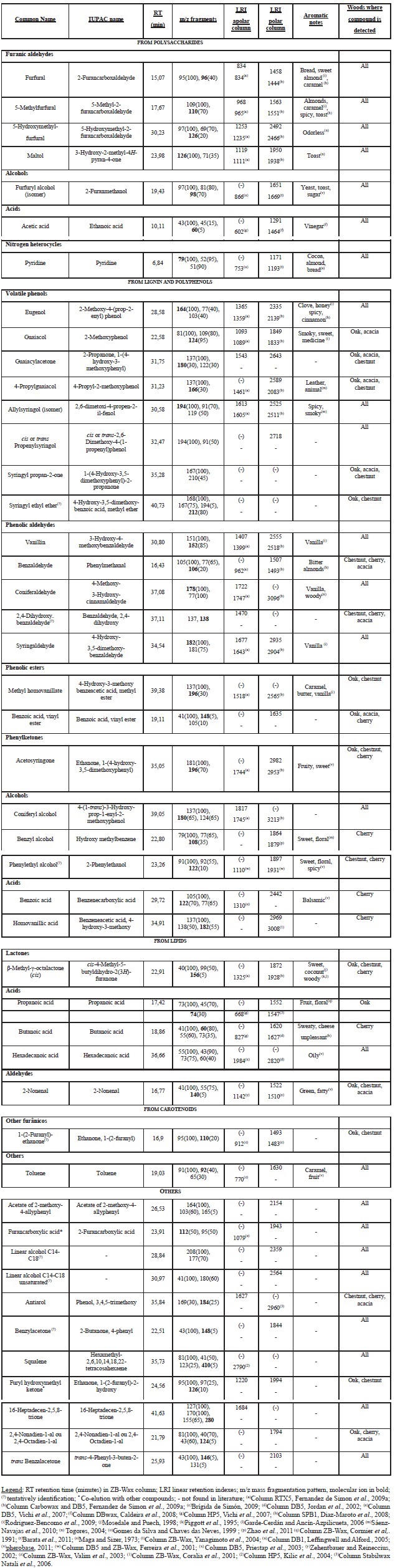
<body><![CDATA[<p>&nbsp;</p>        <P><b>RESULTS AND DISCUSSION</b></P>     <P><b>Identi?cation of volatile compounds </b></P>     <P>The GC/MS analysis of wood extracts revealed the presence in these woods of several molecules already described in literature.  But some compounds not usually referred in literature were also identi&#64257; ed. Table I   gives the compounds that were identi&#64257;ed in at least one sample under study, together with the retention index for   columns, their fragmentation pattern and the aromatic notes usually associated with these compounds. </P>      <p>&nbsp;</p>      <p><b><a name="t1"></a><a href="#topt1">TABLE I</a></b></p>      <p>Volatile and semi-volatile compounds found in at least one wood sample</p>     <P><i>Compostos vol&aacute;teis e semi-vol&aacute;teis encontrados em, pelo menos, uma das amostra de madeira.</i></P>     <p><img src="/img/revistas/ctv/v27n1/27n1a05t1.jpg"></p>     
<p>&nbsp;</p>       ]]></body>
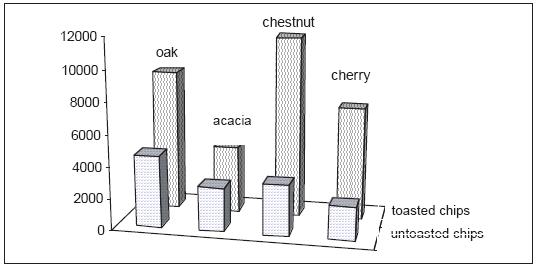
<body><![CDATA[<P>The chromatograms obtained are very complex and it was observed a series of co-elution, making dif&#64257;cult the  identi&#64257;cation process, thus resulting in several compounds that remained unidenti&#64257; ed. Unequivocally we were  able to identi&#64257;ed 45 compounds, by comparing their mass fragmentation with those in commercial libraries, and with  those reported in literature, also taking into account their retention indexes, structure and molecular weight. Arising from  polysaccharides we identi&#64257;ed 7 compounds, mainly furanic aldehydes (furfural, 5-methylfurfural, 5-hydroxymethylfurfural  and maltol) also reported by several authors (Natali <I>et al</I>., 2006; Vichi <I>et al</I>., 2007). HMF is produced by   dehydration of 6-carbon sugars obtained from the hydrolysis of cellulose, while furfural is a result of the dehydration of   5-carbon sugars resulting from the hydrolysis of the hemicellulosic part of woods (Asghari and Yoshide, 2010).</P>        <P>According to Caldeira (2004) there is a positive correlation between furanic aldehydes content and the aromatic descriptors  caramel, vanilla and nuts. Hidalgo (2003) and Mar&iacute;n (2005) pointed out almond and toasty notes. Pyridine, not usually  mentioned, was also identi&#64257;ed, in all samples, although in small amounts. Maga (1985), Nabeta <I>et al.</I> (1986) and  Chatonnet (1995) also have mentioned this aromatic nitrogenated compound.</P>       <P>From lignin and polyphenols degradation, we have identi&#64257;ed 15 compounds belonging to several chemical families:  volatile phenols, phenolic aldehydes, alcohols, phenylketones, phenolic esters and acids, which contribute to vanilla, spicy  and smoky notes (Aiken <I>et al.</I>, 1984). </P>       <P>Lipids degradation during wood thermal treatments originated lactones, acids and aldehydes. &beta;-metil-&gamma;octalactone  is probably the most studied compound in oak woods, with coconut notes attributed to <I>cis</I> and woody notes attributed to  <I>trans</I> isomers. Propanoic acid was mentioned by Caldeira <I>et al</I>. (2005) and butanoic and hexadecanoic acids were  mentioned by Flamini <I>et al</I>. (2010) for oak wood. </P>      <P>Sixteen other compounds were identi&#64257; ed, although their origin is not fully known.</P>      <P>Almost all compounds listed in <a href="#t1">Table I</a><a name="topt1"></a> were already described in literature by several authors, but some compounds are not  usually referred such as toluene and pyridine that we were able to identi?ed in all samples. </P>       <P><B>Influence of the toasting on volatile compounds </B></P>     <P>Although 45 compounds were identi&#64257;ed and additionally 54 compounds were semi quanti&#64257;ed. Untoasted oak  presented the higher amount of total volatile compounds (4556.66 mg/100g wood, expressed as 3-Octanol), follow by chestnut  (3199.46 mg /100 g wood), acacia (2773.10 mg /100 g wood) and &#64257;nally cherry (2138.28 mg /100 g wood)  (Figure 1). When performing a Tukey-Kramer Multiple Comparison Test for p&lt;0.05, all  samples are signi&#64257; cantly different before and after toasting, and for toasted samples cherry and acacia are  signi&#64257;cantly different from oak and chestnut. For untoasted samples chestnut and cherry are different from oak. </P>      <p>&nbsp;</p>     <p><img src="/img/revistas/ctv/v27n1/27n1a05f1.jpg"></p>     
]]></body>
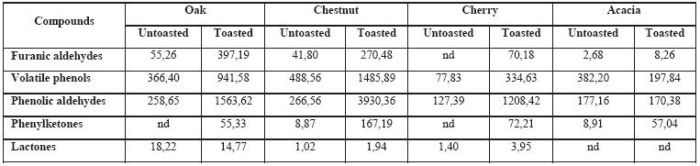
<body><![CDATA[<p><b>Figure 1</b>&ndash;Total volatile compounds (mg/100g wood, expressed as 3-octanol);  Different letters denote signi&#64257;cant difference with 95% con&#64257;dence level in the Tukey-Kramer Multiple-Comparison  Test. </P>     <P><i>Composi&ccedil;&atilde;o vol&aacute;til total (mg/100g de madeira, expresso em 3-octanol); Letras diferentes mostram  diferen&ccedil;a signi</I><I>&#64257;</I><I>cativas para um n&iacute;vel de con</I><I>&#64257;</I><I> an&ccedil;a de 95% no  teste de compara&ccedil;&atilde;o de m&eacute;dias de Tukey-Kramer Multiple-Comparison.</i></P>      <p>&nbsp;</p>       <P>The in&#64258;uence of toasting on the total volatile compounds was very signi&#64257;cant in chestnut and cherry samples with  an increment of over 200%, while in oak we observed an increment of 96% and only of 52% in acacia wood chips. In spite of this  differences, all toasted samples are signi&#64257;cantly richer on total volatile compounds when compared with untoasted   samples by Tukey-Kramer Multiple Comparison Test for p&lt;0.05. </P>       <P>Acetic acid, furfural, 5-methylfurfural, vinyl ester of benzoic acid, maltol, eugenol, vanillin, conyferaldehyde,  syringaldehyde, 4-propylguaiacol, acetosyringone, benzyl ketone, guaiacyl ketone, methyl ether of  4-hydroxy-3,5-dimethoxy-benzoic acid, and 16-heptadecen-2,5,8 trione contents increased in all sample submitted to a  toasting treatment. Table II shows key chemical families of compounds characterized  by GC/MS from oak, acacia, chestnut and cherry wood samples. The results seem to indicate that the botanical species as  well as the toasting level in&#64258;uenced the contents of those compounds. </P>        <p>&nbsp;</p>     <p><b>TABLE II</b></p>      <P>Key chemical families of compounds characterized by GC/MS from oak, acacia, chestnut and cherry wood samples (mg/100g wood,  expressed as 3-octanol)  </P>     <P><i>Fam&iacute;lias de compostos qu&iacute;micos caracterizados por GC/MS de amostras de madeira de carvalho, ac&aacute;cia,  castanheiro e cerejeira (mg/100g wood, expresso como 3-octanol)</i></P>      <p><img src="/img/revistas/ctv/v27n1/27n1a05t2.jpg"></p>      
]]></body>
<body><![CDATA[<p>&nbsp;</p>     <P>Untoasted woods presented small amounts of furfural, 5-methylfurfural and 5-hydroxymethylfurfural but according to Canas <I>et  al</I>. (1999), Caldeira <I>et al</I>. (2006), Jord&atilde;o <I>et al.</I> (2006), Nonier <I>et al</I>. (2006) and   Fernand&eacute;z de Simon <I>et al</I>. (2009b) the content increase with toasting. Furfural is the most abundant compound   because hemicelluloses are preferentially degradated (Fernandez de Simon <I>et al</I>. 2009a). We could also observed an   increase of maltol content with the toasting process for oak and chestnut, in accordance to Fernandez de Simon <I>et al</I>.   (2009a). Maltol arises from hexoses degradation in the presence of nitrogen that usually is present, although in small  amounts, in woods (Bourgois and Guyonnet, 1988). </P>      <P>Squalene appears to exist in higher amounts in oak chips, while antiarol seems to be characteristic of cherry wood. Although  not very often reported in literature, squalene was also found by Ala&ntilde;&oacute;n <I>et al</I>. (2009) in dichloromethane  extracts from oak chips obtained by miniaturised PLE. </P>      <p>&nbsp;</p>      <P><B>CONCLUSIONS </b></P>      <P>In order to use fragments of woods alternatively to oak it is mandatory to know their chemical composition, namely volatile  fraction. The knowledge of the richness of speci&#64257;c wood specie and the in&#64258;uence of the toasting process on its  characteristics may be very useful for winemakers when choosing the kind of wood to be used in winemaking or wine maturation.  Although this is a &#64257;rst step toward the fully knowledge of these woods, results shows that oak and chestnut are richer  than cherry and acacia woods, and that the modi&#64257;cations induced by toasting are the same regardless the wood species.   These results are important because although the majority of the compounds are the same, some differences regarding quantity  and relative compositions were found, imparting different &#64258;avour characteristics to the woods and, hopefully to wines   made with them.</P>     <p>&nbsp;</p>       <P><B>REFERENCES</b></P>      <!-- ref --><P>Aiken J.W., Noble A.C., 1984. Comparison of the aroma of oak and glass-aged wines. <I>Am. J. Agric. Food Chem.,  </I><B>35</B>, 196-199.    &nbsp;&nbsp;&nbsp;&nbsp;&nbsp;&nbsp;&nbsp;&nbsp;[&#160;<a href="javascript:void(0);" onclick="javascript: window.open('/scielo.php?script=sci_nlinks&ref=000081&pid=S0254-0223201200010000500001&lng=','','width=640,height=500,resizable=yes,scrollbars=1,menubar=yes,');">Links</a>&#160;]<!-- end-ref --> </P>     ]]></body>
<body><![CDATA[<!-- ref --><P>Ala&ntilde;&oacute;n M.E., Castro-V&aacute;zquez L., D&iacute;az-Maroto M.C., P&eacute;rez-Coello M.S. 2012. Aromatic  potential of <I>Castanea sativa </I>Mill. compared to <I>Quercus </I>species to be used in cooperage. <I>Food Chemistry, </I>  <B>130</B>: 875-881.    &nbsp;&nbsp;&nbsp;&nbsp;&nbsp;&nbsp;&nbsp;&nbsp;[&#160;<a href="javascript:void(0);" onclick="javascript: window.open('/scielo.php?script=sci_nlinks&ref=000083&pid=S0254-0223201200010000500002&lng=','','width=640,height=500,resizable=yes,scrollbars=1,menubar=yes,');">Links</a>&#160;]<!-- end-ref --> </P>     <!-- ref --><P>Ala&ntilde;&oacute;n M.E., Ramos L., D&iacute;az-Maroto M.C., P&eacute;rez-Coello M.S., Sanz J., 2009. Extraction of  volatile and semi-volatile components from oak wood used for aging wine by miniaturised pressurised liquid technique. <I>Int.  J. Food Sci. Tech., </I><B>44</B>, 1825-1835.    &nbsp;&nbsp;&nbsp;&nbsp;&nbsp;&nbsp;&nbsp;&nbsp;[&#160;<a href="javascript:void(0);" onclick="javascript: window.open('/scielo.php?script=sci_nlinks&ref=000085&pid=S0254-0223201200010000500003&lng=','','width=640,height=500,resizable=yes,scrollbars=1,menubar=yes,');">Links</a>&#160;]<!-- end-ref --> </P>     <!-- ref --><P>Arfelli G., Sartini E., Corzani C., Fabiani A., Natali N. 2007. Impact of wooden barrel storage on the volatile composition  and sensorial pro&#64257;le of red wine. <I>Food Science and Technology International</I>; <B>13</B>; 293-299.    &nbsp;&nbsp;&nbsp;&nbsp;&nbsp;&nbsp;&nbsp;&nbsp;[&#160;<a href="javascript:void(0);" onclick="javascript: window.open('/scielo.php?script=sci_nlinks&ref=000087&pid=S0254-0223201200010000500004&lng=','','width=640,height=500,resizable=yes,scrollbars=1,menubar=yes,');">Links</a>&#160;]<!-- end-ref --> </P>     <!-- ref --><P>Asghari F.S., Yoshida H., 2010. Conversion of Japanese red pine wood (<I>Pinus densi</I><I>&#64258;</I><I>ora</I>) into  valuable chemicals under subcritical water conditions. <I>Carbohydr. Res., </I><B>345</B>, 124-131.    &nbsp;&nbsp;&nbsp;&nbsp;&nbsp;&nbsp;&nbsp;&nbsp;[&#160;<a href="javascript:void(0);" onclick="javascript: window.open('/scielo.php?script=sci_nlinks&ref=000089&pid=S0254-0223201200010000500005&lng=','','width=640,height=500,resizable=yes,scrollbars=1,menubar=yes,');">Links</a>&#160;]<!-- end-ref --> </P>     <!-- ref --><P>Barata A., Campo E., Malfeito-Ferreira M., Loureiro V., Cacho J., Ferreira V., 2011. Analytical and sensorial characterization  of the aroma of wines produced with sour rotten grapes using GC-O and GC-MS: Identi&#64257;cation of key aroma compounds. <I>J.  Agric. Food Chem</I>., <B>59</B>, 2543-2553.    &nbsp;&nbsp;&nbsp;&nbsp;&nbsp;&nbsp;&nbsp;&nbsp;[&#160;<a href="javascript:void(0);" onclick="javascript: window.open('/scielo.php?script=sci_nlinks&ref=000091&pid=S0254-0223201200010000500006&lng=','','width=640,height=500,resizable=yes,scrollbars=1,menubar=yes,');">Links</a>&#160;]<!-- end-ref --> </P>     ]]></body>
<body><![CDATA[<!-- ref --><P>Bourgois J., Guyonnet R., 1988. Caracterization and analysis of torre&#64257; ed wood. <I>Wood Sci. Tech., </I><B>22</B>,  143-155.    &nbsp;&nbsp;&nbsp;&nbsp;&nbsp;&nbsp;&nbsp;&nbsp;[&#160;<a href="javascript:void(0);" onclick="javascript: window.open('/scielo.php?script=sci_nlinks&ref=000093&pid=S0254-0223201200010000500007&lng=','','width=640,height=500,resizable=yes,scrollbars=1,menubar=yes,');">Links</a>&#160;]<!-- end-ref --> </P>     <P>Br&iacute;gida de Sim&oacute;n, Esteruelas E., Mu&ntilde;oz A.M., Cadah&iacute;a E., Sanz M., 2009. Volatile compounds in  acacia, chestnut, cherry, ash, and oak woods, with a view to their use in cooperage. <I>J. Agric. Food Chem</I>., <B>57</B>,  3217&ndash;3227. </P>     <!-- ref --><P>Cabrita M.J.B., Garcia R., Martins N., Gomes Da Silva M., Freitas A.M.C., 2012. Gas chromatography in analysis of  compounds released from wood into wine. In: <I>Advanced Gas Chromatography - Progress in Agricultural, Biomedical and Industrial  Applications</I>, pp 185-298.    &nbsp;&nbsp;&nbsp;&nbsp;&nbsp;&nbsp;&nbsp;&nbsp;[&#160;<a href="javascript:void(0);" onclick="javascript: window.open('/scielo.php?script=sci_nlinks&ref=000096&pid=S0254-0223201200010000500009&lng=','','width=640,height=500,resizable=yes,scrollbars=1,menubar=yes,');">Links</a>&#160;]<!-- end-ref --></P>     <!-- ref --><P>Cadah&iacute;a E., Mu&ntilde;oz L., Fern&aacute;ndez de Sim&oacute;n B., Garc&iacute;a-VallejoM.C., 2001. Changes in low  molecular weight phenolic compounds in Spanish, French, and American oak woods during natural seasoning and toasting.   <I>J. Agric. Food Chem</I>., <B>49</B>(4), 1790-8.    &nbsp;&nbsp;&nbsp;&nbsp;&nbsp;&nbsp;&nbsp;&nbsp;[&#160;<a href="javascript:void(0);" onclick="javascript: window.open('/scielo.php?script=sci_nlinks&ref=000098&pid=S0254-0223201200010000500010&lng=','','width=640,height=500,resizable=yes,scrollbars=1,menubar=yes,');">Links</a>&#160;]<!-- end-ref --></P>     <!-- ref --><P>Cadah&iacute;a E., De Sim&oacute;n B.F., Jalocha, J., 2003. Volatile compounds in Spanish, French, and American oak woods  after natural seasoning and toasting. <I>J. Agric. Food Chem</I>., <B>51</B>, 5923-5932.    &nbsp;&nbsp;&nbsp;&nbsp;&nbsp;&nbsp;&nbsp;&nbsp;[&#160;<a href="javascript:void(0);" onclick="javascript: window.open('/scielo.php?script=sci_nlinks&ref=000100&pid=S0254-0223201200010000500011&lng=','','width=640,height=500,resizable=yes,scrollbars=1,menubar=yes,');">Links</a>&#160;]<!-- end-ref --> </P>     <!-- ref --><P>Caldeira I., 2004. <I>O aroma de aguardentes v&iacute;nicas Envelhecidas em madeira. Import&acirc;ncia da tecnologia de  tanoria</I>. Tese de doutoramento. Universidade T&eacute;cnica de Lisboa. Instituto Superior de Agronomia.    &nbsp;&nbsp;&nbsp;&nbsp;&nbsp;&nbsp;&nbsp;&nbsp;[&#160;<a href="javascript:void(0);" onclick="javascript: window.open('/scielo.php?script=sci_nlinks&ref=000102&pid=S0254-0223201200010000500012&lng=','','width=640,height=500,resizable=yes,scrollbars=1,menubar=yes,');">Links</a>&#160;]<!-- end-ref --> </P>     <!-- ref --><P>Caldeira I., Bruno de Sousa R., Belchior A.P., Cl&iacute;maco M.C., 2008. Sensory and chemical approach to the aroma of  wooden aged Lourinha wine brandy. <I>J. Agric. Food Chem</I>., <B>23</B>, 97-110.    &nbsp;&nbsp;&nbsp;&nbsp;&nbsp;&nbsp;&nbsp;&nbsp;[&#160;<a href="javascript:void(0);" onclick="javascript: window.open('/scielo.php?script=sci_nlinks&ref=000104&pid=S0254-0223201200010000500013&lng=','','width=640,height=500,resizable=yes,scrollbars=1,menubar=yes,');">Links</a>&#160;]<!-- end-ref --> </P>     <!-- ref --><P>Caldeira I., Cl&iacute;maco M.C., Bruno de Sousa R., Belchior A.P., 2006. Volatile composition of oak and chestnut woods  used in brandy ageing: Modi&#64257;cation induced by heat treatment. <I>J. Food Eng.,</I><B> 76</B><I>,</I> 202-211.    &nbsp;&nbsp;&nbsp;&nbsp;&nbsp;&nbsp;&nbsp;&nbsp;[&#160;<a href="javascript:void(0);" onclick="javascript: window.open('/scielo.php?script=sci_nlinks&ref=000106&pid=S0254-0223201200010000500014&lng=','','width=640,height=500,resizable=yes,scrollbars=1,menubar=yes,');">Links</a>&#160;]<!-- end-ref --> </P>     <!-- ref --><P>Caldeira I., Mateus A.M., Belchior A.P., 2005. Flavour and odour pro&#64257; le modi&#64257;cations during the &#64257;rst  &#64257;ve years of Lourinh&atilde; brandy maturation on different wooden barrels. <I>Anal. Chim. Acta</I>, <B>563</B>, 264-273.    &nbsp;&nbsp;&nbsp;&nbsp;&nbsp;&nbsp;&nbsp;&nbsp;[&#160;<a href="javascript:void(0);" onclick="javascript: window.open('/scielo.php?script=sci_nlinks&ref=000108&pid=S0254-0223201200010000500015&lng=','','width=640,height=500,resizable=yes,scrollbars=1,menubar=yes,');">Links</a>&#160;]<!-- end-ref --> </P>     <P>Canas S., Caldeira I., Belchior A.P., Spranger M.I., Climaco M.C., Bruno-de-Sousa R. 2011. <I>Chestnut wood: a sustainable  alternative for the aging of wine brandies in: </I>Daniel A. Medina D.A. and Laine A.M. (eds.) Food quality: Control,   analysis and consumer concerns ISBN<B>: </B>978-1-61122-917-2 Nova Science Publishers, Inc. </P>     <!-- ref --><P>Canas S., Concei&ccedil;&atilde;o M.L., Spranger L.I., Belchior A.P., 1999. Low molecular weight organic compounds of  chestnut wood (<I>Castanea sativa L</I>.) and corresponding aged brandies. <I>J. Agric. Food Chem</I>., <B>47</B>, 5023-5030.    &nbsp;&nbsp;&nbsp;&nbsp;&nbsp;&nbsp;&nbsp;&nbsp;[&#160;<a href="javascript:void(0);" onclick="javascript: window.open('/scielo.php?script=sci_nlinks&ref=000111&pid=S0254-0223201200010000500017&lng=','','width=640,height=500,resizable=yes,scrollbars=1,menubar=yes,');">Links</a>&#160;]<!-- end-ref --> </P>     ]]></body>
<body><![CDATA[<!-- ref --><P>Chatonnet P., 1995. <I>In</I><I>&#64258;</I><I>uence des proc&eacute;d&eacute;s de tonnellerie et des conditions  d&acute;&eacute;levage sur la composition et la qualit&eacute; des vins &eacute;l&eacute;v&eacute;s en f&ucirc;t de  ch&ecirc;ne</I>. 268 p. Th&egrave;se Doctorat. UFR Institut d&acute;Oenologie, Universit&eacute; de Bordeaux II,  Bord&eacute;us.    &nbsp;&nbsp;&nbsp;&nbsp;&nbsp;&nbsp;&nbsp;&nbsp;[&#160;<a href="javascript:void(0);" onclick="javascript: window.open('/scielo.php?script=sci_nlinks&ref=000113&pid=S0254-0223201200010000500018&lng=','','width=640,height=500,resizable=yes,scrollbars=1,menubar=yes,');">Links</a>&#160;]<!-- end-ref --> </P>     <!-- ref --><P>Chatonnet P., 1999. Discrimination and control of toasting intensity and quality of oak barrels. <I>Am. J. Enol. Vitic.</I> , <B>50</B>, 479-494.    &nbsp;&nbsp;&nbsp;&nbsp;&nbsp;&nbsp;&nbsp;&nbsp;[&#160;<a href="javascript:void(0);" onclick="javascript: window.open('/scielo.php?script=sci_nlinks&ref=000115&pid=S0254-0223201200010000500019&lng=','','width=640,height=500,resizable=yes,scrollbars=1,menubar=yes,');">Links</a>&#160;]<!-- end-ref --> </P>     <P>Chatonnet P., Dubourdieu D., 1998. Identi&#64257;cation of substances responsible for the &ldquo;sawdust&rdquo; aroma in  oak wood. <I>J. Sci. Food Agric</I>., <B>76</B>, 179-188. </P>     <!-- ref --><P>Coralia V.G., Siew-Young Q., Ralph J.S., Robert A.W., 2001. Characterization of the bound volatile extract from baby kiwi.  <I>J. Agric. Food Chem</I>., <B>10</B>, 1021-1469c.    &nbsp;&nbsp;&nbsp;&nbsp;&nbsp;&nbsp;&nbsp;&nbsp;[&#160;<a href="javascript:void(0);" onclick="javascript: window.open('/scielo.php?script=sci_nlinks&ref=000118&pid=S0254-0223201200010000500021&lng=','','width=640,height=500,resizable=yes,scrollbars=1,menubar=yes,');">Links</a>&#160;]<!-- end-ref --> </P>     <P>Cormier F., Raymond Y., Champagne C.P., Morin A., 1991. Analysis of odor-active volatiles from Pseudomonas fragi grown in  milk. <I>J. Agric. Food Chem.</I>, <B>39</B>, 159&ndash;161. </P>     <P>Cutzach I., Chatonnet P., Henry R., Dubourdieu D., 1997. Identi&#64257;cation of volatile compounds with a  &ldquo;toasty&rdquo; aroma in heated oak used in barrelmaking. <I>J. Agric. Food Chem</I>., <B>45</B>, 2217-2224. </P>     <!-- ref --><P>Diaz-Maroto M.C., Castro-V&aacute;rzquez L., De Torres C., P&eacute;rez-Coelho M.S., 2008. Aroma-active compounds of  American, French, Hungarian and Russian oak woods, studied by GC-MS and GC-O. <I>Flavour Frag. J</I>., <B>23</B>, 93-98.    &nbsp;&nbsp;&nbsp;&nbsp;&nbsp;&nbsp;&nbsp;&nbsp;[&#160;<a href="javascript:void(0);" onclick="javascript: window.open('/scielo.php?script=sci_nlinks&ref=000122&pid=S0254-0223201200010000500024&lng=','','width=640,height=500,resizable=yes,scrollbars=1,menubar=yes,');">Links</a>&#160;]<!-- end-ref --> </P>     <!-- ref --><P>Doussot F., De Jeso B., Quideau S., Pardon P., 2002. Extractives content in cooperage oak wood during natural seasoning  and toasting; in&#64258;uence of tree species, geographic location and single tree effects. <I>J. Agric. Food Chem</I>., <B>50</B>, 5955-5961.    &nbsp;&nbsp;&nbsp;&nbsp;&nbsp;&nbsp;&nbsp;&nbsp;[&#160;<a href="javascript:void(0);" onclick="javascript: window.open('/scielo.php?script=sci_nlinks&ref=000124&pid=S0254-0223201200010000500025&lng=','','width=640,height=500,resizable=yes,scrollbars=1,menubar=yes,');">Links</a>&#160;]<!-- end-ref --> </P>     <!-- ref --><P>Flamini R., Traldi P., 2010. Compounds released in wine from wood. <I>In: Mass spectrometry in grape and wine chemistry,  </I>226240p, John Wiley e Sons, Inc.    &nbsp;&nbsp;&nbsp;&nbsp;&nbsp;&nbsp;&nbsp;&nbsp;[&#160;<a href="javascript:void(0);" onclick="javascript: window.open('/scielo.php?script=sci_nlinks&ref=000126&pid=S0254-0223201200010000500026&lng=','','width=640,height=500,resizable=yes,scrollbars=1,menubar=yes,');">Links</a>&#160;]<!-- end-ref --> </P>     <!-- ref --><P>Flamini R., Vedova A.D., Cancian D., Pannighel A., Rosso M., 2007. GS/MS- positive ion chemical ionization and MS/MS study  of volatile benzene compounds in &#64257;ve different woods used in barrel making. <I>J. Mass Spectrometry</I>, <B>42</B>,   641-646.    &nbsp;&nbsp;&nbsp;&nbsp;&nbsp;&nbsp;&nbsp;&nbsp;[&#160;<a href="javascript:void(0);" onclick="javascript: window.open('/scielo.php?script=sci_nlinks&ref=000128&pid=S0254-0223201200010000500027&lng=','','width=640,height=500,resizable=yes,scrollbars=1,menubar=yes,');">Links</a>&#160;]<!-- end-ref --> </P>     <!-- ref --><P>Fernandez de Sim&oacute;n B., Cadah&iacute;a E., &Aacute;lamo M., Nevares I., 2009a. Effect of size, seasoning and toasting  in the volatile compounds in toasted oak wood and in a red wine treated with them. <I>Anal. Chim. Acta</I>, <B>660</B>, 211-220.    &nbsp;&nbsp;&nbsp;&nbsp;&nbsp;&nbsp;&nbsp;&nbsp;[&#160;<a href="javascript:void(0);" onclick="javascript: window.open('/scielo.php?script=sci_nlinks&ref=000130&pid=S0254-0223201200010000500028&lng=','','width=640,height=500,resizable=yes,scrollbars=1,menubar=yes,');">Links</a>&#160;]<!-- end-ref --> </P>     <!-- ref --><P>Fernandez de Sim&oacute;n B., Esteruelas E., Mu&ntilde;oz A.M., Cadah&iacute;a E., Sanz M., 2009b. Volatile Compounds in  Acacia, Chestnut, Cherry, Ash, and Oak Woods, with a View to Their Use in Cooperage. <I>J. Agric. Food Chem</I>., <B>57</B>,  3217-3227.    &nbsp;&nbsp;&nbsp;&nbsp;&nbsp;&nbsp;&nbsp;&nbsp;[&#160;<a href="javascript:void(0);" onclick="javascript: window.open('/scielo.php?script=sci_nlinks&ref=000132&pid=S0254-0223201200010000500029&lng=','','width=640,height=500,resizable=yes,scrollbars=1,menubar=yes,');">Links</a>&#160;]<!-- end-ref --> </P>     <!-- ref --><P>Ferreira V., Aznar M., Lopez, R., Cacho J., 2001. Quantitative gas chromatography-olfactometry carried out at different  dilutions of an extract. Key differences in the odor pro&#64257;les of four high-quality Spanish aged red wines. <I>J. Agric.  Food Chem.</I>, <B>49</B>, 4818-4824.    &nbsp;&nbsp;&nbsp;&nbsp;&nbsp;&nbsp;&nbsp;&nbsp;[&#160;<a href="javascript:void(0);" onclick="javascript: window.open('/scielo.php?script=sci_nlinks&ref=000134&pid=S0254-0223201200010000500030&lng=','','width=640,height=500,resizable=yes,scrollbars=1,menubar=yes,');">Links</a>&#160;]<!-- end-ref --> </P>     <!-- ref --><P>Garde-Cerd&aacute;n T., Anc&iacute;n-Azpilicueta C., 2006. Review of quality factors on wine ageing in oak barrels.  <I>Trends in Food Scien. Technol</I>., <B>17</B>, 438-447.    &nbsp;&nbsp;&nbsp;&nbsp;&nbsp;&nbsp;&nbsp;&nbsp;[&#160;<a href="javascript:void(0);" onclick="javascript: window.open('/scielo.php?script=sci_nlinks&ref=000136&pid=S0254-0223201200010000500031&lng=','','width=640,height=500,resizable=yes,scrollbars=1,menubar=yes,');">Links</a>&#160;]<!-- end-ref --> </P>     <!-- ref --><P>Gim&eacute;nez-Mart&iacute;nez R., Garcia de la Serrana H.L., Villalon Mir M., Granados J.Q., Martinez M.C.L., 1996.  In&#64258;uence of wood heat treatment, temperature and maceration time on vanillin, syringaldehyde, and gallic acid contents  in oak wood and wine spirit mixtures. <I>Am. J. Enol. Vitic</I>., <B>47</B>, 441-446.    &nbsp;&nbsp;&nbsp;&nbsp;&nbsp;&nbsp;&nbsp;&nbsp;[&#160;<a href="javascript:void(0);" onclick="javascript: window.open('/scielo.php?script=sci_nlinks&ref=000138&pid=S0254-0223201200010000500032&lng=','','width=640,height=500,resizable=yes,scrollbars=1,menubar=yes,');">Links</a>&#160;]<!-- end-ref --> </P>     <!-- ref --><P>Gomes da Silva M.D.R., Chaves das Neves H.J., 1999. Complementary use of hyphenated purge-and-trap gas chromatography  techniques and sensory analysis in the aroma pro&#64257;ling of strawberries (<I>Fragaria ananassa</I>). <I>J. Agric. Food  Chem</I>., <B>47</B>, 4568-4573.    &nbsp;&nbsp;&nbsp;&nbsp;&nbsp;&nbsp;&nbsp;&nbsp;[&#160;<a href="javascript:void(0);" onclick="javascript: window.open('/scielo.php?script=sci_nlinks&ref=000140&pid=S0254-0223201200010000500033&lng=','','width=640,height=500,resizable=yes,scrollbars=1,menubar=yes,');">Links</a>&#160;]<!-- end-ref --> </P>     <!-- ref --><P>Hidalgo J. T., 2003. <I>Tratado de enologia</I> (2&ordm; vol). 1&ordf; edi&ccedil;&atilde;o. S.A. Mundi-prensa libros.  Madrid.    &nbsp;&nbsp;&nbsp;&nbsp;&nbsp;&nbsp;&nbsp;&nbsp;[&#160;<a href="javascript:void(0);" onclick="javascript: window.open('/scielo.php?script=sci_nlinks&ref=000142&pid=S0254-0223201200010000500034&lng=','','width=640,height=500,resizable=yes,scrollbars=1,menubar=yes,');">Links</a>&#160;]<!-- end-ref --> </P>     <!-- ref --><P>Jordan M.J., Margaria C.A., Shaw P.E., Goodner K.L., 2002. Aroma active components in aqueous Kiwi fruit essence and Kiwi  fruit puree by GC-MS and multidimensional GC/GC-O. <I>J. Agric. Food Chem</I>., <B>50</B>, 5386-5390.    &nbsp;&nbsp;&nbsp;&nbsp;&nbsp;&nbsp;&nbsp;&nbsp;[&#160;<a href="javascript:void(0);" onclick="javascript: window.open('/scielo.php?script=sci_nlinks&ref=000144&pid=S0254-0223201200010000500035&lng=','','width=640,height=500,resizable=yes,scrollbars=1,menubar=yes,');">Links</a>&#160;]<!-- end-ref --> </P>     <!-- ref --><P>Jord&atilde;o A.M., Ricardo-da-Silva R.M., Laureano O., Adams A., Demyttenaere J.R.V., De Kimpe V., 2006. Volatile  composition analysis by solid-phase microextraction applied to oak wood used in cooperage (<I>Quercus pyrenaica</I> and <I>Quercus petraea</I>): effect of botanical species and toasting process. <I>J. Wood Sci</I>., <B>52</B>, 514-521.    &nbsp;&nbsp;&nbsp;&nbsp;&nbsp;&nbsp;&nbsp;&nbsp;[&#160;<a href="javascript:void(0);" onclick="javascript: window.open('/scielo.php?script=sci_nlinks&ref=000146&pid=S0254-0223201200010000500036&lng=','','width=640,height=500,resizable=yes,scrollbars=1,menubar=yes,');">Links</a>&#160;]<!-- end-ref --> </P>     <!-- ref --><P>Kilic A., Ha&#64257;zoglu H., Kollmannsberger H.E., Nitz S., 2004. Volatile constituents and key odorants in leaves, buds,  &#64258; owers, and fruits of Laurus nobilis L. <I>J. Agric. Food Chem</I>., <B>52</B>, 1601-1606.    &nbsp;&nbsp;&nbsp;&nbsp;&nbsp;&nbsp;&nbsp;&nbsp;[&#160;<a href="javascript:void(0);" onclick="javascript: window.open('/scielo.php?script=sci_nlinks&ref=000148&pid=S0254-0223201200010000500037&lng=','','width=640,height=500,resizable=yes,scrollbars=1,menubar=yes,');">Links</a>&#160;]<!-- end-ref --> </P>     <!-- ref --><P>Lef&#64257;ngwell J.C.E, Alford E.D., 2005. Volatile constituents of perique tobacco. <I>J. Agric. Food Chem</I>.,  <B>4</B>, 899-915.    &nbsp;&nbsp;&nbsp;&nbsp;&nbsp;&nbsp;&nbsp;&nbsp;[&#160;<a href="javascript:void(0);" onclick="javascript: window.open('/scielo.php?script=sci_nlinks&ref=000150&pid=S0254-0223201200010000500038&lng=','','width=640,height=500,resizable=yes,scrollbars=1,menubar=yes,');">Links</a>&#160;]<!-- end-ref --> </P>     <P>Maga J.A., 1985. Flavor contribution of wood in alcoholic beverages. <I>In: Progress in </I><I>&#64258;</I><I> avour  research</I>. Elsevier, 1984, pp. 409-416. </P>     ]]></body>
<body><![CDATA[<!-- ref --><P>Maga J.A., Sizer C.E., 1973. Pyrazines in foods: a review. <I>J. Agric. Food Chem</I>., <B>21</B>, 22-30.    &nbsp;&nbsp;&nbsp;&nbsp;&nbsp;&nbsp;&nbsp;&nbsp;[&#160;<a href="javascript:void(0);" onclick="javascript: window.open('/scielo.php?script=sci_nlinks&ref=000153&pid=S0254-0223201200010000500040&lng=','','width=640,height=500,resizable=yes,scrollbars=1,menubar=yes,');">Links</a>&#160;]<!-- end-ref --> </P>     <!-- ref --><P>Mar&iacute;n F.Z., 2005. <I>Los aromas que el roble aporta al vino; in</I><I>&#64258;</I><I>uencia del grado de tostado  de las duelas.</I> Unidad de Enolog&iacute;a del Centro de Referencia en Tecnolog&iacute;a (CeRTA) Departamento de  Bioqu&iacute;mica y Biotecnolog&iacute;a Facultad de Enolog&iacute;a de Tarragona. Universidad Rovira i Virgili.    &nbsp;&nbsp;&nbsp;&nbsp;&nbsp;&nbsp;&nbsp;&nbsp;[&#160;<a href="javascript:void(0);" onclick="javascript: window.open('/scielo.php?script=sci_nlinks&ref=000155&pid=S0254-0223201200010000500041&lng=','','width=640,height=500,resizable=yes,scrollbars=1,menubar=yes,');">Links</a>&#160;]<!-- end-ref --> </P>     <!-- ref --><P>Mosedale J.R., Puech J-L., 1998. Wood maturation of distilled beverages. <I>Trends in Food Scienc. Technol</I>., <B>9</B>,  95-101.    &nbsp;&nbsp;&nbsp;&nbsp;&nbsp;&nbsp;&nbsp;&nbsp;[&#160;<a href="javascript:void(0);" onclick="javascript: window.open('/scielo.php?script=sci_nlinks&ref=000157&pid=S0254-0223201200010000500042&lng=','','width=640,height=500,resizable=yes,scrollbars=1,menubar=yes,');">Links</a>&#160;]<!-- end-ref --> </P>     <!-- ref --><P>Nabeta K., Yonekubo J., Miyake M., 1986. Analysis of volatile constituents of european and japanese oaks. <I>Mokuzai  Gakkaishi</I>, <B>32</B>, 921-927.    &nbsp;&nbsp;&nbsp;&nbsp;&nbsp;&nbsp;&nbsp;&nbsp;[&#160;<a href="javascript:void(0);" onclick="javascript: window.open('/scielo.php?script=sci_nlinks&ref=000159&pid=S0254-0223201200010000500043&lng=','','width=640,height=500,resizable=yes,scrollbars=1,menubar=yes,');">Links</a>&#160;]<!-- end-ref --> </P>     <!-- ref --><P>Natali N., Chinnici F., Riponi C., 2006. Characterization of vola-tiles in extracts from oak chips obtained by accelerated  solvent extraction (ASE). <I>J. Agric. Food Chem</I>., <B>54</B>, 8190-8198.    &nbsp;&nbsp;&nbsp;&nbsp;&nbsp;&nbsp;&nbsp;&nbsp;[&#160;<a href="javascript:void(0);" onclick="javascript: window.open('/scielo.php?script=sci_nlinks&ref=000161&pid=S0254-0223201200010000500044&lng=','','width=640,height=500,resizable=yes,scrollbars=1,menubar=yes,');">Links</a>&#160;]<!-- end-ref --> </P>     ]]></body>
<body><![CDATA[<!-- ref --><P>Nonier M.F., Vivas N., Vivas de Gaulejac N., Absalon C., Souli&egrave;, Ph., Fouquet E., 2006. Pyrolysis-gas  chromatography/mass spectrometry of <I>Quercus</I> sp. wood. Application to structural elucidation of macromolecules and  aromatic pro&#64257;les of different species. <I>J. Anal. Appl. Pyrol</I>., <B>75</B>, 181-193.    &nbsp;&nbsp;&nbsp;&nbsp;&nbsp;&nbsp;&nbsp;&nbsp;[&#160;<a href="javascript:void(0);" onclick="javascript: window.open('/scielo.php?script=sci_nlinks&ref=000163&pid=S0254-0223201200010000500045&lng=','','width=640,height=500,resizable=yes,scrollbars=1,menubar=yes,');">Links</a>&#160;]<!-- end-ref --> </P>     <!-- ref --><P>P&eacute;rez-Prieto L.J., L&oacute;pez-Roca J.M., Mart&iacute;nez-Cutillas A., Pardo-Minguez F., G&oacute;mez-Plaza E.,  2002. Maturing wine in oak barrels. Effects of origin, volume, and age of the barrel on the wine volatile composition. <I>J.  Agric. Food Chem., </I><B>50</B>, 3272-3276.    &nbsp;&nbsp;&nbsp;&nbsp;&nbsp;&nbsp;&nbsp;&nbsp;[&#160;<a href="javascript:void(0);" onclick="javascript: window.open('/scielo.php?script=sci_nlinks&ref=000165&pid=S0254-0223201200010000500046&lng=','','width=640,height=500,resizable=yes,scrollbars=1,menubar=yes,');">Links</a>&#160;]<!-- end-ref --> </P>     <!-- ref --><P>Piggott J.R., Conner J.M., Paterson A., 1995. Flavour development in whisky maturation. <I>in Food Flavors: Generation,  Analysis and Process In</I><I>&#64258;</I><I>uence</I>, G. Charalambous (Ed.), 1731-1751.    &nbsp;&nbsp;&nbsp;&nbsp;&nbsp;&nbsp;&nbsp;&nbsp;[&#160;<a href="javascript:void(0);" onclick="javascript: window.open('/scielo.php?script=sci_nlinks&ref=000167&pid=S0254-0223201200010000500047&lng=','','width=640,height=500,resizable=yes,scrollbars=1,menubar=yes,');">Links</a>&#160;]<!-- end-ref --> </P>     <!-- ref --><P>Priestap H.A., Van Baren, C.M., Di Leo-Lira P., Coussio J.D.E., Bandoni A.L., 2003. Volatile constituents of  <I>Aristolochia argentina</I>. <I>Phytochem</I>., <B>63</B>, 221-225.    &nbsp;&nbsp;&nbsp;&nbsp;&nbsp;&nbsp;&nbsp;&nbsp;[&#160;<a href="javascript:void(0);" onclick="javascript: window.open('/scielo.php?script=sci_nlinks&ref=000169&pid=S0254-0223201200010000500048&lng=','','width=640,height=500,resizable=yes,scrollbars=1,menubar=yes,');">Links</a>&#160;]<!-- end-ref --> </P>     <!-- ref --><P>Richter B.E., Jones B.A., Ezzel J.L., 1996. Accelerated solvent extraction: a technique for sample preparation. <I>Anal.  Chem</I>., <B>68</B>, 1033-1039.    &nbsp;&nbsp;&nbsp;&nbsp;&nbsp;&nbsp;&nbsp;&nbsp;[&#160;<a href="javascript:void(0);" onclick="javascript: window.open('/scielo.php?script=sci_nlinks&ref=000171&pid=S0254-0223201200010000500049&lng=','','width=640,height=500,resizable=yes,scrollbars=1,menubar=yes,');">Links</a>&#160;]<!-- end-ref --> </P>     ]]></body>
<body><![CDATA[<!-- ref --><P>Rodr&iacute;guez-Bencomo J.J., Ortega-Heras M., P&eacute;rez-Magari&ntilde;o S., G&oacute;nzalez-Huerta, 2009. Volatile  compounds of red wines macerated with Spanish, American, and French oak chips. <I>J. Agric. Food Chem., </I><B>57</B>, 6383-6391.    &nbsp;&nbsp;&nbsp;&nbsp;&nbsp;&nbsp;&nbsp;&nbsp;[&#160;<a href="javascript:void(0);" onclick="javascript: window.open('/scielo.php?script=sci_nlinks&ref=000173&pid=S0254-0223201200010000500050&lng=','','width=640,height=500,resizable=yes,scrollbars=1,menubar=yes,');">Links</a>&#160;]<!-- end-ref --> </P>     <!-- ref --><P>Rosso M., Panighel A., Vedova A.D., Stella L., Flamini R., 2009. Changes in chemical composition of red wine aged in  acacia, cherry, chestnut, mulberry, and oak wood barrels. <I>J. Agric. Food Chem.</I>, <B>57</B>, 1915-1920.    &nbsp;&nbsp;&nbsp;&nbsp;&nbsp;&nbsp;&nbsp;&nbsp;[&#160;<a href="javascript:void(0);" onclick="javascript: window.open('/scielo.php?script=sci_nlinks&ref=000175&pid=S0254-0223201200010000500051&lng=','','width=640,height=500,resizable=yes,scrollbars=1,menubar=yes,');">Links</a>&#160;]<!-- end-ref --> </P>     <!-- ref --><P>S&aacute;enz-Navajas M.P., Campo E., Fern&aacute;ndez-Zurbano P., Valentin D., Ferreira V., 2010. An assessment of the  effects of wine volatiles on the perception of taste and astringency in wine. <I>Food Chem</I>., <B>121</B>, 1139-1149.    &nbsp;&nbsp;&nbsp;&nbsp;&nbsp;&nbsp;&nbsp;&nbsp;[&#160;<a href="javascript:void(0);" onclick="javascript: window.open('/scielo.php?script=sci_nlinks&ref=000177&pid=S0254-0223201200010000500052&lng=','','width=640,height=500,resizable=yes,scrollbars=1,menubar=yes,');">Links</a>&#160;]<!-- end-ref --> </P>     <!-- ref --><P>Togores J.H., 2004. Tratado de enologia Tomo 2. Mundiprensa Ed.    &nbsp;&nbsp;&nbsp;&nbsp;&nbsp;&nbsp;&nbsp;&nbsp;[&#160;<a href="javascript:void(0);" onclick="javascript: window.open('/scielo.php?script=sci_nlinks&ref=000179&pid=S0254-0223201200010000500053&lng=','','width=640,height=500,resizable=yes,scrollbars=1,menubar=yes,');">Links</a>&#160;]<!-- end-ref --> </P>     <!-- ref --><P>Valim M.F., Rouseff R.L., Lin J., 2003. Gas chromatographic-olfactometric characterization of aroma compounds in two types  of cashew apple nectar. <I>J. Agric. Food Chem</I>., <B>51</B>, 1010-1015.    &nbsp;&nbsp;&nbsp;&nbsp;&nbsp;&nbsp;&nbsp;&nbsp;[&#160;<a href="javascript:void(0);" onclick="javascript: window.open('/scielo.php?script=sci_nlinks&ref=000181&pid=S0254-0223201200010000500054&lng=','','width=640,height=500,resizable=yes,scrollbars=1,menubar=yes,');">Links</a>&#160;]<!-- end-ref --> </P>     ]]></body>
<body><![CDATA[<!-- ref --><P>Van Jaarsveld F.P., Hattingh S., Minnaar P., Blom M., 2008. Rapid induction of ageing character in brandy - effects of  extraction media and preparation conditions. <I>S. Afr. J. Enol. Vitic</I>., <B>30</B>, 1-15.    &nbsp;&nbsp;&nbsp;&nbsp;&nbsp;&nbsp;&nbsp;&nbsp;[&#160;<a href="javascript:void(0);" onclick="javascript: window.open('/scielo.php?script=sci_nlinks&ref=000183&pid=S0254-0223201200010000500055&lng=','','width=640,height=500,resizable=yes,scrollbars=1,menubar=yes,');">Links</a>&#160;]<!-- end-ref --> </P>     <P>Vichi S., Santini C., Natali N., Riponi C., Tamames E.L., Buxaderas S., 2007. Volatile and semi-volatile components of oak  wood chips analysed by Accelerated Solvent Extraction (ASE) coupled to gas chromatography-mass spectrometry (GC&ndash;MS).  <I>Food Chem</I>., <B>102</B>, 1260-1269. </P>     <!-- ref --><P>Windeisen E., Wegener G., 2008. Behaviour of lignin during thermal treatments of wood. <I>Industrial Crops and  Products</I>, <B>27</B>, 157-162.    &nbsp;&nbsp;&nbsp;&nbsp;&nbsp;&nbsp;&nbsp;&nbsp;[&#160;<a href="javascript:void(0);" onclick="javascript: window.open('/scielo.php?script=sci_nlinks&ref=000186&pid=S0254-0223201200010000500057&lng=','','width=640,height=500,resizable=yes,scrollbars=1,menubar=yes,');">Links</a>&#160;]<!-- end-ref --> </P>     <!-- ref --><P>Yanagimoto K., Ochi H., Lee K.G., Shibamoto T., 2004. Antioxidative activities of fractions obtained from brewed coffee.  <I>J. Agric. Food Chem.</I>, <B>52</B>, 92-596.    &nbsp;&nbsp;&nbsp;&nbsp;&nbsp;&nbsp;&nbsp;&nbsp;[&#160;<a href="javascript:void(0);" onclick="javascript: window.open('/scielo.php?script=sci_nlinks&ref=000188&pid=S0254-0223201200010000500058&lng=','','width=640,height=500,resizable=yes,scrollbars=1,menubar=yes,');">Links</a>&#160;]<!-- end-ref --> </P>     <!-- ref --><P>Zhao Y.P., Wang L., Li J.M., Pei G.R., Liu Q.S., 2011. Comparison of volatile compounds in two brandies using HS-SPME  Coupled with GC-O, GC-MS and sensory evaluation. <I>S. Afric. J. Enol. Vitic</I>., <B>32</B>, 9-20.    &nbsp;&nbsp;&nbsp;&nbsp;&nbsp;&nbsp;&nbsp;&nbsp;[&#160;<a href="javascript:void(0);" onclick="javascript: window.open('/scielo.php?script=sci_nlinks&ref=000190&pid=S0254-0223201200010000500059&lng=','','width=640,height=500,resizable=yes,scrollbars=1,menubar=yes,');">Links</a>&#160;]<!-- end-ref --> </P>     <!-- ref --><P>Zehentbauer G.E., Reineccius G.A., 2002. Determination of key aroma components of Cheddar cheese using dynamic headspace  dilution assay. <I>Flavour Fragr</I>. <B>17</B>, 300-305.    &nbsp;&nbsp;&nbsp;&nbsp;&nbsp;&nbsp;&nbsp;&nbsp;[&#160;<a href="javascript:void(0);" onclick="javascript: window.open('/scielo.php?script=sci_nlinks&ref=000192&pid=S0254-0223201200010000500060&lng=','','width=640,height=500,resizable=yes,scrollbars=1,menubar=yes,');">Links</a>&#160;]<!-- end-ref --> </P>     <P>(<a href="http://www.pherobase.com" target="_blank">http://www.pherobase.com</a>) </P>      <p>&nbsp;</p>      <P><B>ACKNOWLEDGEMENTS </b></P>     <P>This work is funded by FEDER Funds through the Operational Programme for Competitiveness Factors - COMPETE and National  Funds through FCT - Foundation for Science and Technology under the Strategic Project PEst-C/AGR/UI0115/2011. </P>     <p>&nbsp;</p>      <p><a name="0"></a><a href="#top0"><Sup>*</Sup></a>  Corresponding author: T. 351 266 769869; F. 351 266 769828, e-mail: <a href="mailto:mjbc@uevora.pt">mjbc@uevora.pt </a></P>     <p>&nbsp;</p>     <p><i>(Manuscrito recebido em 24.04.2012. Aceite para publica&ccedil;&atilde;o em 25.06.2012) </I></P>       ]]></body><back>
<ref-list>
<ref id="B1">
<nlm-citation citation-type="journal">
<person-group person-group-type="author">
<name>
<surname><![CDATA[Aiken]]></surname>
<given-names><![CDATA[J.W.]]></given-names>
</name>
<name>
<surname><![CDATA[Noble]]></surname>
<given-names><![CDATA[A.C.]]></given-names>
</name>
</person-group>
<article-title xml:lang="en"><![CDATA[Comparison of the aroma of oak and glass-aged wines.]]></article-title>
<source><![CDATA[Am. J. Agric. Food Chem.]]></source>
<year>1984</year>
<volume>35</volume>
<page-range>196-199</page-range></nlm-citation>
</ref>
<ref id="B2">
<nlm-citation citation-type="journal">
<person-group person-group-type="author">
<name>
<surname><![CDATA[Alañón]]></surname>
<given-names><![CDATA[M.E.]]></given-names>
</name>
<name>
<surname><![CDATA[Castro-Vázquez]]></surname>
<given-names><![CDATA[L.]]></given-names>
</name>
<name>
<surname><![CDATA[Díaz-Maroto]]></surname>
<given-names><![CDATA[M.C.]]></given-names>
</name>
<name>
<surname><![CDATA[Pérez-Coello]]></surname>
<given-names><![CDATA[M.S.]]></given-names>
</name>
</person-group>
<article-title xml:lang="en"><![CDATA[Aromatic potential of Castanea sativa Mill. compared to Quercus species to be used in cooperage.]]></article-title>
<source><![CDATA[Food Chemistry]]></source>
<year>2012</year>
<volume>130</volume>
<page-range>875-881</page-range></nlm-citation>
</ref>
<ref id="B3">
<nlm-citation citation-type="journal">
<person-group person-group-type="author">
<name>
<surname><![CDATA[Alañón]]></surname>
<given-names><![CDATA[M.E.]]></given-names>
</name>
<name>
<surname><![CDATA[Ramos]]></surname>
<given-names><![CDATA[L.]]></given-names>
</name>
<name>
<surname><![CDATA[Díaz-Maroto]]></surname>
<given-names><![CDATA[M.C.]]></given-names>
</name>
<name>
<surname><![CDATA[Pérez-Coello]]></surname>
<given-names><![CDATA[M.S.]]></given-names>
</name>
<name>
<surname><![CDATA[Sanz]]></surname>
<given-names><![CDATA[J.]]></given-names>
</name>
</person-group>
<article-title xml:lang="en"><![CDATA[Extraction of volatile and semi-volatile components from oak wood used for aging wine by miniaturised pressurised liquid technique.]]></article-title>
<source><![CDATA[Int. J. Food Sci. Tech.]]></source>
<year>2009</year>
<volume>44</volume>
<page-range>1825-1835</page-range></nlm-citation>
</ref>
<ref id="B4">
<nlm-citation citation-type="journal">
<person-group person-group-type="author">
<name>
<surname><![CDATA[Arfelli]]></surname>
<given-names><![CDATA[G.]]></given-names>
</name>
<name>
<surname><![CDATA[Sartini]]></surname>
<given-names><![CDATA[E.]]></given-names>
</name>
<name>
<surname><![CDATA[Corzani]]></surname>
<given-names><![CDATA[C.]]></given-names>
</name>
<name>
<surname><![CDATA[Fabiani]]></surname>
<given-names><![CDATA[A.]]></given-names>
</name>
<name>
<surname><![CDATA[Natali]]></surname>
<given-names><![CDATA[N.]]></given-names>
</name>
</person-group>
<article-title xml:lang="en"><![CDATA[Impact of wooden barrel storage on the volatile composition and sensorial pro?le of red wine]]></article-title>
<source><![CDATA[Food Science and Technology International]]></source>
<year>2007</year>
<volume>13</volume>
<page-range>293-299</page-range></nlm-citation>
</ref>
<ref id="B5">
<nlm-citation citation-type="journal">
<person-group person-group-type="author">
<name>
<surname><![CDATA[Asghari]]></surname>
<given-names><![CDATA[F.S]]></given-names>
</name>
<name>
<surname><![CDATA[Yoshida]]></surname>
<given-names><![CDATA[H.]]></given-names>
</name>
</person-group>
<article-title xml:lang="en"><![CDATA[Conversion of Japanese red pine wood (Pinus densi?ora) into valuable chemicals under subcritical water conditions.]]></article-title>
<source><![CDATA[Carbohydr. Res.]]></source>
<year>2010</year>
<volume>345</volume>
<page-range>124-131</page-range></nlm-citation>
</ref>
<ref id="B6">
<nlm-citation citation-type="journal">
<person-group person-group-type="author">
<name>
<surname><![CDATA[Barata]]></surname>
<given-names><![CDATA[A.]]></given-names>
</name>
<name>
<surname><![CDATA[Campo]]></surname>
<given-names><![CDATA[E.]]></given-names>
</name>
<name>
<surname><![CDATA[Malfeito-Ferreira]]></surname>
<given-names><![CDATA[M.]]></given-names>
</name>
<name>
<surname><![CDATA[Loureiro]]></surname>
<given-names><![CDATA[V.]]></given-names>
</name>
<name>
<surname><![CDATA[Cacho]]></surname>
<given-names><![CDATA[J.]]></given-names>
</name>
<name>
<surname><![CDATA[Ferreira]]></surname>
<given-names><![CDATA[V.]]></given-names>
</name>
</person-group>
<article-title xml:lang="en"><![CDATA[Analytical and sensorial characterization of the aroma of wines produced with sour rotten grapes using GC-O and GC-MS: Identi?cation of key aroma compounds.]]></article-title>
<source><![CDATA[J. Agric. Food Chem.]]></source>
<year>2011</year>
<volume>59</volume>
<page-range>2543-2553.</page-range></nlm-citation>
</ref>
<ref id="B7">
<nlm-citation citation-type="journal">
<person-group person-group-type="author">
<name>
<surname><![CDATA[Bourgois]]></surname>
<given-names><![CDATA[J.]]></given-names>
</name>
<name>
<surname><![CDATA[Guyonnet]]></surname>
<given-names><![CDATA[R.]]></given-names>
</name>
</person-group>
<article-title xml:lang="en"><![CDATA[Caracterization and analysis of torre?ed wood.]]></article-title>
<source><![CDATA[Wood Sci. Tech.]]></source>
<year>1988</year>
<volume>22</volume>
<page-range>143-155</page-range></nlm-citation>
</ref>
<ref id="B8">
<nlm-citation citation-type="journal">
<person-group person-group-type="author">
<name>
<surname><![CDATA[Simón]]></surname>
<given-names><![CDATA[Brígida de]]></given-names>
</name>
<name>
<surname><![CDATA[Esteruelas]]></surname>
<given-names><![CDATA[E.]]></given-names>
</name>
<name>
<surname><![CDATA[Muñoz]]></surname>
<given-names><![CDATA[A.M.]]></given-names>
</name>
<name>
<surname><![CDATA[Cadahía]]></surname>
<given-names><![CDATA[E.]]></given-names>
</name>
<name>
<surname><![CDATA[Sanz]]></surname>
<given-names><![CDATA[M.]]></given-names>
</name>
</person-group>
<article-title xml:lang="en"><![CDATA[Volatile compounds in acacia, chestnut, cherry, ash, and oak woods, with a view to their use in cooperage]]></article-title>
<source><![CDATA[J. Agric. Food Chem.]]></source>
<year>2009</year>
<volume>57</volume>
<page-range>3217-3227</page-range></nlm-citation>
</ref>
<ref id="B9">
<nlm-citation citation-type="">
<person-group person-group-type="author">
<name>
<surname><![CDATA[Cabrita]]></surname>
<given-names><![CDATA[M.J.B]]></given-names>
</name>
<name>
<surname><![CDATA[Garcia]]></surname>
<given-names><![CDATA[R.]]></given-names>
</name>
<name>
<surname><![CDATA[Martins]]></surname>
<given-names><![CDATA[N.]]></given-names>
</name>
<name>
<surname><![CDATA[Gomes Da Silva]]></surname>
<given-names><![CDATA[M.]]></given-names>
</name>
<name>
<surname><![CDATA[Freitas]]></surname>
<given-names><![CDATA[A.M.C.]]></given-names>
</name>
</person-group>
<article-title xml:lang="en"><![CDATA[Gas chromatography in analysis of compounds released from wood into wine]]></article-title>
<source><![CDATA[Advanced Gas Chromatography - Progress in Agricultural, Biomedical and Industrial Applications]]></source>
<year>2012</year>
<page-range>185-298</page-range></nlm-citation>
</ref>
<ref id="B10">
<nlm-citation citation-type="journal">
<person-group person-group-type="author">
<name>
<surname><![CDATA[Cadahía]]></surname>
<given-names><![CDATA[E.]]></given-names>
</name>
<name>
<surname><![CDATA[Muñoz]]></surname>
<given-names><![CDATA[L.]]></given-names>
</name>
<name>
<surname><![CDATA[Fernández de Simón]]></surname>
<given-names><![CDATA[B.]]></given-names>
</name>
<name>
<surname><![CDATA[García-Vallejo]]></surname>
<given-names><![CDATA[M.C.]]></given-names>
</name>
</person-group>
<article-title xml:lang="en"><![CDATA[Changes in low molecular weight phenolic compounds in Spanish, French, and American oak woods during natural seasoning and toasting]]></article-title>
<source><![CDATA[J. Agric. Food Chem.]]></source>
<year></year>
<volume>49</volume>
<numero>4</numero>
<issue>4</issue>
<page-range>2001</page-range><page-range>1790-8</page-range></nlm-citation>
</ref>
<ref id="B11">
<nlm-citation citation-type="journal">
<person-group person-group-type="author">
<name>
<surname><![CDATA[Cadahía]]></surname>
<given-names><![CDATA[E.]]></given-names>
</name>
<name>
<surname><![CDATA[De Simón]]></surname>
<given-names><![CDATA[B.F.]]></given-names>
</name>
<name>
<surname><![CDATA[Jalocha]]></surname>
<given-names><![CDATA[J.]]></given-names>
</name>
</person-group>
<article-title xml:lang="en"><![CDATA[Volatile compounds in Spanish, French, and American oak woods after natural seasoning and toasting]]></article-title>
<source><![CDATA[J. Agric. Food Chem.]]></source>
<year>2003</year>
<volume>51</volume>
<page-range>5923-5932</page-range></nlm-citation>
</ref>
<ref id="B12">
<nlm-citation citation-type="">
<person-group person-group-type="author">
<name>
<surname><![CDATA[Caldeira]]></surname>
<given-names><![CDATA[I.]]></given-names>
</name>
</person-group>
<source><![CDATA[O aroma de aguardentes vínicas Envelhecidas em madeira. Importância da tecnologia de tanoria]]></source>
<year>2004</year>
</nlm-citation>
</ref>
<ref id="B13">
<nlm-citation citation-type="journal">
<person-group person-group-type="author">
<name>
<surname><![CDATA[Caldeira]]></surname>
<given-names><![CDATA[I.]]></given-names>
</name>
<name>
<surname><![CDATA[Bruno de Sousa]]></surname>
<given-names><![CDATA[R.]]></given-names>
</name>
<name>
<surname><![CDATA[Belchior]]></surname>
<given-names><![CDATA[A.P.]]></given-names>
</name>
<name>
<surname><![CDATA[Clímaco]]></surname>
<given-names><![CDATA[M.C.]]></given-names>
</name>
</person-group>
<article-title xml:lang="en"><![CDATA[Sensory and chemical approach to the aroma of wooden aged Lourinha wine brandy]]></article-title>
<source><![CDATA[J. Agric. Food Chem.]]></source>
<year>2008</year>
<volume>23</volume>
<page-range>97-110</page-range></nlm-citation>
</ref>
<ref id="B14">
<nlm-citation citation-type="journal">
<person-group person-group-type="author">
<name>
<surname><![CDATA[Caldeira]]></surname>
<given-names><![CDATA[I.]]></given-names>
</name>
<name>
<surname><![CDATA[Clímaco]]></surname>
<given-names><![CDATA[M.C.]]></given-names>
</name>
<name>
<surname><![CDATA[Bruno de Sousa]]></surname>
<given-names><![CDATA[R.]]></given-names>
</name>
<name>
<surname><![CDATA[Belchior]]></surname>
<given-names><![CDATA[A.P.]]></given-names>
</name>
</person-group>
<article-title xml:lang="en"><![CDATA[Volatile composition of oak and chestnut woods used in brandy ageing: Modi?cation induced by heat treatment]]></article-title>
<source><![CDATA[J. Food Eng.]]></source>
<year>2006</year>
<volume>76</volume>
<page-range>202-211</page-range></nlm-citation>
</ref>
<ref id="B15">
<nlm-citation citation-type="journal">
<person-group person-group-type="author">
<name>
<surname><![CDATA[Caldeira]]></surname>
<given-names><![CDATA[I.]]></given-names>
</name>
<name>
<surname><![CDATA[Mateus]]></surname>
<given-names><![CDATA[A.M]]></given-names>
</name>
<name>
<surname><![CDATA[Belchior]]></surname>
<given-names><![CDATA[A.P.]]></given-names>
</name>
</person-group>
<article-title xml:lang="en"><![CDATA[Flavour and odour pro? le modi?cations during the ?rst ?ve years of Lourinhã brandy maturation on different wooden barrels]]></article-title>
<source><![CDATA[Anal. Chim. Acta]]></source>
<year>2005</year>
<volume>563</volume>
<page-range>264-273</page-range></nlm-citation>
</ref>
<ref id="B16">
<nlm-citation citation-type="book">
<person-group person-group-type="author">
<name>
<surname><![CDATA[Canas]]></surname>
<given-names><![CDATA[S.]]></given-names>
</name>
<name>
<surname><![CDATA[Caldeira]]></surname>
<given-names><![CDATA[I.]]></given-names>
</name>
<name>
<surname><![CDATA[Belchior]]></surname>
<given-names><![CDATA[A.P.]]></given-names>
</name>
<name>
<surname><![CDATA[Spranger]]></surname>
<given-names><![CDATA[M.I.]]></given-names>
</name>
<name>
<surname><![CDATA[Climaco]]></surname>
<given-names><![CDATA[M.C.]]></given-names>
</name>
<name>
<surname><![CDATA[Bruno-de-Sousa]]></surname>
<given-names><![CDATA[R.]]></given-names>
</name>
</person-group>
<article-title xml:lang="en"><![CDATA[Chestnut wood: a sustainable alternative for the aging of wine brandies]]></article-title>
<person-group person-group-type="editor">
<name>
<surname><![CDATA[Daniel]]></surname>
<given-names><![CDATA[A.]]></given-names>
</name>
<name>
<surname><![CDATA[Medina]]></surname>
<given-names><![CDATA[D.A]]></given-names>
</name>
<name>
<surname><![CDATA[Laine]]></surname>
<given-names><![CDATA[A.M.]]></given-names>
</name>
</person-group>
<source><![CDATA[Food quality: Control, analysis and consumer concerns]]></source>
<year>2011</year>
<publisher-name><![CDATA[Nova Science Publishers]]></publisher-name>
</nlm-citation>
</ref>
<ref id="B17">
<nlm-citation citation-type="journal">
<person-group person-group-type="author">
<name>
<surname><![CDATA[Canas]]></surname>
<given-names><![CDATA[S.]]></given-names>
</name>
<name>
<surname><![CDATA[Conceição]]></surname>
<given-names><![CDATA[M.L.]]></given-names>
</name>
<name>
<surname><![CDATA[Spranger]]></surname>
<given-names><![CDATA[L.I.]]></given-names>
</name>
<name>
<surname><![CDATA[Belchior]]></surname>
<given-names><![CDATA[A.P.]]></given-names>
</name>
</person-group>
<article-title xml:lang="en"><![CDATA[Low molecular weight organic compounds of chestnut wood (Castanea sativa L.) and corresponding aged brandies]]></article-title>
<source><![CDATA[J. Agric. Food Chem.]]></source>
<year>1999</year>
<volume>47</volume>
<page-range>5023-5030</page-range></nlm-citation>
</ref>
<ref id="B18">
<nlm-citation citation-type="">
<person-group person-group-type="author">
<name>
<surname><![CDATA[Chatonnet]]></surname>
<given-names><![CDATA[P.]]></given-names>
</name>
</person-group>
<source><![CDATA[In?uence des procédés de tonnellerie et des conditions d´élevage sur la composition et la qualité des vins élévés en fût de chêne]]></source>
<year>1995</year>
</nlm-citation>
</ref>
<ref id="B19">
<nlm-citation citation-type="journal">
<person-group person-group-type="author">
<name>
<surname><![CDATA[Chatonnet]]></surname>
<given-names><![CDATA[P.]]></given-names>
</name>
</person-group>
<article-title xml:lang="en"><![CDATA[Discrimination and control of toasting intensity and quality of oak barrels]]></article-title>
<source><![CDATA[Am. J. Enol. Vitic.]]></source>
<year>1999</year>
<volume>50</volume>
<page-range>479-494</page-range></nlm-citation>
</ref>
<ref id="B20">
<nlm-citation citation-type="journal">
<person-group person-group-type="author">
<name>
<surname><![CDATA[Chatonnet]]></surname>
<given-names><![CDATA[P.]]></given-names>
</name>
<name>
<surname><![CDATA[Dubourdieu]]></surname>
<given-names><![CDATA[D.]]></given-names>
</name>
</person-group>
<article-title xml:lang="en"><![CDATA[Identi?cation of substances responsible for the “sawdust” aroma in oak wood]]></article-title>
<source><![CDATA[J. Sci. Food Agric.]]></source>
<year>1998</year>
<volume>76</volume>
<page-range>179-188</page-range></nlm-citation>
</ref>
<ref id="B21">
<nlm-citation citation-type="journal">
<person-group person-group-type="author">
<name>
<surname><![CDATA[Coralia]]></surname>
<given-names><![CDATA[V.G.]]></given-names>
</name>
<name>
<surname><![CDATA[Siew-Young]]></surname>
<given-names><![CDATA[Q.]]></given-names>
</name>
<name>
<surname><![CDATA[Ralph]]></surname>
<given-names><![CDATA[J.S.]]></given-names>
</name>
<name>
<surname><![CDATA[Robert]]></surname>
<given-names><![CDATA[A.W.]]></given-names>
</name>
</person-group>
<article-title xml:lang="en"><![CDATA[Characterization of the bound volatile extract from baby kiwi]]></article-title>
<source><![CDATA[J. Agric. Food Chem.]]></source>
<year>2001</year>
<volume>10</volume>
<page-range>1021-1469c</page-range></nlm-citation>
</ref>
<ref id="B22">
<nlm-citation citation-type="journal">
<person-group person-group-type="author">
<name>
<surname><![CDATA[Cormier]]></surname>
<given-names><![CDATA[F.]]></given-names>
</name>
<name>
<surname><![CDATA[Raymond]]></surname>
<given-names><![CDATA[Y.]]></given-names>
</name>
<name>
<surname><![CDATA[Champagne]]></surname>
<given-names><![CDATA[C.P.]]></given-names>
</name>
<name>
<surname><![CDATA[Morin]]></surname>
<given-names><![CDATA[A.]]></given-names>
</name>
</person-group>
<article-title xml:lang="en"><![CDATA[Analysis of odor-active volatiles from Pseudomonas fragi grown in milk]]></article-title>
<source><![CDATA[J. Agric. Food Chem.]]></source>
<year>1991</year>
<volume>39</volume>
<page-range>159-161</page-range></nlm-citation>
</ref>
<ref id="B23">
<nlm-citation citation-type="journal">
<person-group person-group-type="author">
<name>
<surname><![CDATA[Cutzach]]></surname>
<given-names><![CDATA[I.]]></given-names>
</name>
<name>
<surname><![CDATA[Chatonnet]]></surname>
<given-names><![CDATA[P.]]></given-names>
</name>
<name>
<surname><![CDATA[Henry]]></surname>
<given-names><![CDATA[R.]]></given-names>
</name>
<name>
<surname><![CDATA[Dubourdieu]]></surname>
<given-names><![CDATA[D.]]></given-names>
</name>
</person-group>
<article-title xml:lang="en"><![CDATA[Identi?cation of volatile compounds with a “toasty” aroma in heated oak used in barrelmaking]]></article-title>
<source><![CDATA[J. Agric. Food Chem.]]></source>
<year>1997</year>
<volume>45</volume>
<page-range>2217-2224</page-range></nlm-citation>
</ref>
<ref id="B24">
<nlm-citation citation-type="journal">
<person-group person-group-type="author">
<name>
<surname><![CDATA[Diaz-Maroto]]></surname>
<given-names><![CDATA[M.C.]]></given-names>
</name>
<name>
<surname><![CDATA[Castro-Várzquez]]></surname>
<given-names><![CDATA[L.]]></given-names>
</name>
<name>
<surname><![CDATA[De Torres]]></surname>
<given-names><![CDATA[C.]]></given-names>
</name>
<name>
<surname><![CDATA[Pérez-Coelho]]></surname>
<given-names><![CDATA[M.S.]]></given-names>
</name>
</person-group>
<article-title xml:lang="en"><![CDATA[Aroma-active compounds of American, French, Hungarian and Russian oak woods, studied by GC-MS and GC-O]]></article-title>
<source><![CDATA[Flavour Frag. J.]]></source>
<year>2008</year>
<volume>23</volume>
<page-range>93-98</page-range></nlm-citation>
</ref>
<ref id="B25">
<nlm-citation citation-type="journal">
<person-group person-group-type="author">
<name>
<surname><![CDATA[Doussot]]></surname>
<given-names><![CDATA[F.]]></given-names>
</name>
<name>
<surname><![CDATA[De Jeso]]></surname>
<given-names><![CDATA[B.]]></given-names>
</name>
<name>
<surname><![CDATA[Quideau]]></surname>
<given-names><![CDATA[S.]]></given-names>
</name>
<name>
<surname><![CDATA[Pardon]]></surname>
<given-names><![CDATA[P.]]></given-names>
</name>
</person-group>
<article-title xml:lang="en"><![CDATA[Extractives content in cooperage oak wood during natural seasoning and toasting; in?uence of tree species, geographic location and single tree effects]]></article-title>
<source><![CDATA[J. Agric. Food Chem.]]></source>
<year>2002</year>
<volume>50</volume>
<page-range>5955-5961</page-range></nlm-citation>
</ref>
<ref id="B26">
<nlm-citation citation-type="book">
<person-group person-group-type="author">
<name>
<surname><![CDATA[Flamini]]></surname>
<given-names><![CDATA[R.]]></given-names>
</name>
<name>
<surname><![CDATA[Traldi]]></surname>
<given-names><![CDATA[P.]]></given-names>
</name>
</person-group>
<article-title xml:lang="en"><![CDATA[Compounds released in wine from wood]]></article-title>
<source><![CDATA[Mass spectrometry in grape and wine chemistry]]></source>
<year>2010</year>
<page-range>226-240</page-range><publisher-name><![CDATA[John Wiley e Sons, Inc]]></publisher-name>
</nlm-citation>
</ref>
<ref id="B27">
<nlm-citation citation-type="journal">
<person-group person-group-type="author">
<name>
<surname><![CDATA[Flamini]]></surname>
<given-names><![CDATA[R.]]></given-names>
</name>
<name>
<surname><![CDATA[Vedova]]></surname>
<given-names><![CDATA[A.D.]]></given-names>
</name>
<name>
<surname><![CDATA[Cancian]]></surname>
<given-names><![CDATA[D.]]></given-names>
</name>
<name>
<surname><![CDATA[Pannighel]]></surname>
<given-names><![CDATA[A.]]></given-names>
</name>
<name>
<surname><![CDATA[Rosso]]></surname>
<given-names><![CDATA[M.]]></given-names>
</name>
</person-group>
<article-title xml:lang="en"><![CDATA[GS/MS- positive ion chemical ionization and MS/MS study of volatile benzene compounds in ?ve different woods used in barrel making]]></article-title>
<source><![CDATA[J. Mass Spectrometry]]></source>
<year>2007</year>
<volume>42</volume>
<page-range>641-646</page-range></nlm-citation>
</ref>
<ref id="B28">
<nlm-citation citation-type="journal">
<person-group person-group-type="author">
<name>
<surname><![CDATA[Fernandez de Simón]]></surname>
<given-names><![CDATA[B.]]></given-names>
</name>
<name>
<surname><![CDATA[Cadahía]]></surname>
<given-names><![CDATA[E.]]></given-names>
</name>
<name>
<surname><![CDATA[Álamo]]></surname>
<given-names><![CDATA[M.]]></given-names>
</name>
<name>
<surname><![CDATA[Nevares]]></surname>
<given-names><![CDATA[I.]]></given-names>
</name>
</person-group>
<article-title xml:lang="en"><![CDATA[Effect of size, seasoning and toasting in the volatile compounds in toasted oak wood and in a red wine treated with them]]></article-title>
<source><![CDATA[Anal. Chim. Acta]]></source>
<year>2009</year>
<volume>660</volume>
<page-range>211-220</page-range></nlm-citation>
</ref>
<ref id="B29">
<nlm-citation citation-type="journal">
<person-group person-group-type="author">
<name>
<surname><![CDATA[Fernandez de Simón]]></surname>
<given-names><![CDATA[B.]]></given-names>
</name>
<name>
<surname><![CDATA[Esteruelas]]></surname>
<given-names><![CDATA[E.]]></given-names>
</name>
<name>
<surname><![CDATA[Muñoz]]></surname>
<given-names><![CDATA[A.M.]]></given-names>
</name>
<name>
<surname><![CDATA[Cadahía]]></surname>
<given-names><![CDATA[E.]]></given-names>
</name>
<name>
<surname><![CDATA[Sanz]]></surname>
<given-names><![CDATA[M.]]></given-names>
</name>
</person-group>
<article-title xml:lang="en"><![CDATA[Volatile Compounds in Acacia, Chestnut, Cherry, Ash, and Oak Woods, with a View to Their Use in Cooperage]]></article-title>
<source><![CDATA[J. Agric. Food Chem.]]></source>
<year>2009</year>
<volume>57</volume>
<page-range>3217-3227</page-range></nlm-citation>
</ref>
<ref id="B30">
<nlm-citation citation-type="journal">
<person-group person-group-type="author">
<name>
<surname><![CDATA[Ferreira]]></surname>
<given-names><![CDATA[V.]]></given-names>
</name>
<name>
<surname><![CDATA[Aznar]]></surname>
<given-names><![CDATA[M.]]></given-names>
</name>
<name>
<surname><![CDATA[Lopez]]></surname>
<given-names><![CDATA[R.]]></given-names>
</name>
<name>
<surname><![CDATA[Cacho]]></surname>
<given-names><![CDATA[J.]]></given-names>
</name>
</person-group>
<article-title xml:lang="en"><![CDATA[Quantitative gas chromatography-olfactometry carried out at different dilutions of an extract. Key differences in the odor pro?les of four high-quality Spanish aged red wines]]></article-title>
<source><![CDATA[J. Agric. Food Chem.]]></source>
<year>2001</year>
<volume>49</volume>
<page-range>4818-4824</page-range></nlm-citation>
</ref>
<ref id="B31">
<nlm-citation citation-type="journal">
<person-group person-group-type="author">
<name>
<surname><![CDATA[Garde-Cerdán]]></surname>
<given-names><![CDATA[T.]]></given-names>
</name>
<name>
<surname><![CDATA[Ancín-Azpilicueta]]></surname>
<given-names><![CDATA[C.]]></given-names>
</name>
</person-group>
<article-title xml:lang="en"><![CDATA[Review of quality factors on wine ageing in oak barrels]]></article-title>
<source><![CDATA[Trends in Food Scien. Technol.]]></source>
<year>2006</year>
<volume>17</volume>
<page-range>438-447</page-range></nlm-citation>
</ref>
<ref id="B32">
<nlm-citation citation-type="journal">
<person-group person-group-type="author">
<name>
<surname><![CDATA[Giménez-Martínez]]></surname>
<given-names><![CDATA[R.]]></given-names>
</name>
<name>
<surname><![CDATA[Garcia de la Serrana]]></surname>
<given-names><![CDATA[H.L.]]></given-names>
</name>
<name>
<surname><![CDATA[Villalon Mir]]></surname>
<given-names><![CDATA[M.]]></given-names>
</name>
<name>
<surname><![CDATA[Granados]]></surname>
<given-names><![CDATA[J.Q.]]></given-names>
</name>
<name>
<surname><![CDATA[Martinez]]></surname>
<given-names><![CDATA[M.C.L.]]></given-names>
</name>
</person-group>
<article-title xml:lang="en"><![CDATA[In?uence of wood heat treatment, temperature and maceration time on vanillin, syringaldehyde, and gallic acid contents in oak wood and wine spirit mixtures]]></article-title>
<source><![CDATA[Am. J. Enol. Vitic.]]></source>
<year>1996</year>
<volume>47</volume>
<page-range>441-446</page-range></nlm-citation>
</ref>
<ref id="B33">
<nlm-citation citation-type="journal">
<person-group person-group-type="author">
<name>
<surname><![CDATA[Gomes da Silva]]></surname>
<given-names><![CDATA[M.D.R.]]></given-names>
</name>
<name>
<surname><![CDATA[Chaves das Neves]]></surname>
<given-names><![CDATA[H.J.]]></given-names>
</name>
</person-group>
<article-title xml:lang="en"><![CDATA[Complementary use of hyphenated purge-and-trap gas chromatography techniques and sensory analysis in the aroma pro?ling of strawberries (Fragaria ananassa)]]></article-title>
<source><![CDATA[J. Agric. Food Chem.]]></source>
<year>1999</year>
<volume>47</volume>
<page-range>4568-4573</page-range></nlm-citation>
</ref>
<ref id="B34">
<nlm-citation citation-type="book">
<person-group person-group-type="author">
<name>
<surname><![CDATA[Hidalgo]]></surname>
<given-names><![CDATA[J. T.]]></given-names>
</name>
</person-group>
<source><![CDATA[Tratado de enologia]]></source>
<year>2003</year>
<volume>2</volume>
<edition>1</edition>
<publisher-loc><![CDATA[Madrid ]]></publisher-loc>
<publisher-name><![CDATA[Mundi-prensa libros]]></publisher-name>
</nlm-citation>
</ref>
<ref id="B35">
<nlm-citation citation-type="journal">
<person-group person-group-type="author">
<name>
<surname><![CDATA[Jordan]]></surname>
<given-names><![CDATA[M.J.]]></given-names>
</name>
<name>
<surname><![CDATA[Margaria]]></surname>
<given-names><![CDATA[C.A.]]></given-names>
</name>
<name>
<surname><![CDATA[Shaw]]></surname>
<given-names><![CDATA[P.E.]]></given-names>
</name>
<name>
<surname><![CDATA[Goodner]]></surname>
<given-names><![CDATA[K.L.]]></given-names>
</name>
</person-group>
<article-title xml:lang="en"><![CDATA[Aroma active components in aqueous Kiwi fruit essence and Kiwi fruit puree by GC-MS and multidimensional GC/GC-O]]></article-title>
<source><![CDATA[J. Agric. Food Chem.]]></source>
<year>2002</year>
<volume>50</volume>
<page-range>5386-5390</page-range></nlm-citation>
</ref>
<ref id="B36">
<nlm-citation citation-type="journal">
<person-group person-group-type="author">
<name>
<surname><![CDATA[Jordão]]></surname>
<given-names><![CDATA[A.M.]]></given-names>
</name>
<name>
<surname><![CDATA[Ricardo-da-Silva]]></surname>
<given-names><![CDATA[R.M.]]></given-names>
</name>
<name>
<surname><![CDATA[Laureano]]></surname>
<given-names><![CDATA[O.]]></given-names>
</name>
<name>
<surname><![CDATA[Adams]]></surname>
<given-names><![CDATA[A.]]></given-names>
</name>
<name>
<surname><![CDATA[Demyttenaere]]></surname>
<given-names><![CDATA[J.R.V.]]></given-names>
</name>
<name>
<surname><![CDATA[De Kimpe]]></surname>
<given-names><![CDATA[V.]]></given-names>
</name>
</person-group>
<article-title xml:lang="en"><![CDATA[Volatile composition analysis by solid-phase microextraction applied to oak wood used in cooperage (Quercus pyrenaica and Quercus petraea): effect of botanical species and toasting process]]></article-title>
<source><![CDATA[J. Wood Sci.]]></source>
<year>2006</year>
<volume>52</volume>
<page-range>514-521</page-range></nlm-citation>
</ref>
<ref id="B37">
<nlm-citation citation-type="journal">
<person-group person-group-type="author">
<name>
<surname><![CDATA[Kilic]]></surname>
<given-names><![CDATA[A.]]></given-names>
</name>
<name>
<surname><![CDATA[Ha?zoglu]]></surname>
<given-names><![CDATA[H.]]></given-names>
</name>
<name>
<surname><![CDATA[Kollmannsberger]]></surname>
<given-names><![CDATA[H.E.]]></given-names>
</name>
<name>
<surname><![CDATA[Nitz]]></surname>
<given-names><![CDATA[S.]]></given-names>
</name>
</person-group>
<article-title xml:lang="en"><![CDATA[Volatile constituents and key odorants in leaves, buds, ?owers, and fruits of Laurus nobilis L]]></article-title>
<source><![CDATA[J. Agric. Food Chem.]]></source>
<year>2004</year>
<volume>52</volume>
<page-range>1601-1606</page-range></nlm-citation>
</ref>
<ref id="B38">
<nlm-citation citation-type="journal">
<person-group person-group-type="author">
<name>
<surname><![CDATA[Lef?ngwell]]></surname>
<given-names><![CDATA[J.C.E]]></given-names>
</name>
<name>
<surname><![CDATA[Alford]]></surname>
<given-names><![CDATA[E.D.]]></given-names>
</name>
</person-group>
<article-title xml:lang="en"><![CDATA[Volatile constituents of perique tobacco]]></article-title>
<source><![CDATA[J. Agric. Food Chem.]]></source>
<year>2005</year>
<volume>4</volume>
<page-range>899-915</page-range></nlm-citation>
</ref>
<ref id="B39">
<nlm-citation citation-type="book">
<person-group person-group-type="author">
<name>
<surname><![CDATA[Maga]]></surname>
<given-names><![CDATA[J.A.]]></given-names>
</name>
</person-group>
<article-title xml:lang="en"><![CDATA[Flavor contribution of wood in alcoholic beverages]]></article-title>
<source><![CDATA[Progress in fl avour research]]></source>
<year>1985</year>
<month>19</month>
<day>84</day>
<page-range>409-416</page-range><publisher-name><![CDATA[Elsevier]]></publisher-name>
</nlm-citation>
</ref>
<ref id="B40">
<nlm-citation citation-type="journal">
<person-group person-group-type="author">
<name>
<surname><![CDATA[Maga]]></surname>
<given-names><![CDATA[J.A]]></given-names>
</name>
<name>
<surname><![CDATA[Sizer]]></surname>
<given-names><![CDATA[C.E.]]></given-names>
</name>
</person-group>
<article-title xml:lang="en"><![CDATA[Pyrazines in foods: a review]]></article-title>
<source><![CDATA[J. Agric. Food Chem.]]></source>
<year>1973</year>
<volume>21</volume>
<page-range>22-30</page-range></nlm-citation>
</ref>
<ref id="B41">
<nlm-citation citation-type="book">
<person-group person-group-type="author">
<name>
<surname><![CDATA[Marín]]></surname>
<given-names><![CDATA[F.Z.]]></given-names>
</name>
</person-group>
<source><![CDATA[Los aromas que el roble aporta al vino; in?uencia del grado de tostado de las duelas]]></source>
<year>2005</year>
<publisher-name><![CDATA[Unidad de Enología del Centro de Referencia en Tecnología (CeRTA) Departamento de Bioquímica y Biotecnología Facultad de Enología de Tarragona. Universidad Rovira i Virgili]]></publisher-name>
</nlm-citation>
</ref>
<ref id="B42">
<nlm-citation citation-type="journal">
<person-group person-group-type="author">
<name>
<surname><![CDATA[Mosedale]]></surname>
<given-names><![CDATA[J.R.]]></given-names>
</name>
<name>
<surname><![CDATA[Puech]]></surname>
<given-names><![CDATA[J-L.]]></given-names>
</name>
</person-group>
<article-title xml:lang="en"><![CDATA[Wood maturation of distilled beverages]]></article-title>
<source><![CDATA[Trends in Food Scienc. Technol.]]></source>
<year>1998</year>
<volume>9</volume>
<page-range>95-101</page-range></nlm-citation>
</ref>
<ref id="B43">
<nlm-citation citation-type="journal">
<person-group person-group-type="author">
<name>
<surname><![CDATA[Nabeta]]></surname>
<given-names><![CDATA[K.]]></given-names>
</name>
<name>
<surname><![CDATA[Yonekubo]]></surname>
<given-names><![CDATA[J.]]></given-names>
</name>
<name>
<surname><![CDATA[Miyake]]></surname>
<given-names><![CDATA[M.]]></given-names>
</name>
</person-group>
<article-title xml:lang="en"><![CDATA[Analysis of volatile constituents of european and japanese oaks]]></article-title>
<source><![CDATA[Mokuzai Gakkaishi]]></source>
<year>1986</year>
<volume>32</volume>
<page-range>921-927</page-range></nlm-citation>
</ref>
<ref id="B44">
<nlm-citation citation-type="journal">
<person-group person-group-type="author">
<name>
<surname><![CDATA[Natali]]></surname>
<given-names><![CDATA[N.]]></given-names>
</name>
<name>
<surname><![CDATA[Chinnici]]></surname>
<given-names><![CDATA[F.]]></given-names>
</name>
<name>
<surname><![CDATA[Riponi]]></surname>
<given-names><![CDATA[C.]]></given-names>
</name>
</person-group>
<article-title xml:lang="en"><![CDATA[Characterization of vola-tiles in extracts from oak chips obtained by accelerated solvent extraction (ASE)]]></article-title>
<source><![CDATA[J. Agric. Food Chem.]]></source>
<year>2006</year>
<volume>54</volume>
<page-range>8190-8198</page-range></nlm-citation>
</ref>
<ref id="B45">
<nlm-citation citation-type="journal">
<person-group person-group-type="author">
<name>
<surname><![CDATA[Nonier]]></surname>
<given-names><![CDATA[M.F]]></given-names>
</name>
<name>
<surname><![CDATA[Vivas]]></surname>
<given-names><![CDATA[N.]]></given-names>
</name>
<name>
<surname><![CDATA[Vivas de Gaulejac]]></surname>
<given-names><![CDATA[N.]]></given-names>
</name>
<name>
<surname><![CDATA[Absalon]]></surname>
<given-names><![CDATA[C.]]></given-names>
</name>
<name>
<surname><![CDATA[Souliè]]></surname>
<given-names><![CDATA[Ph.]]></given-names>
</name>
<name>
<surname><![CDATA[Fouquet]]></surname>
<given-names><![CDATA[E.]]></given-names>
</name>
</person-group>
<article-title xml:lang="en"><![CDATA[Pyrolysis-gas chromatography/mass spectrometry of Quercus sp. wood: Application to structural elucidation of macromolecules and aromatic pro?les of different species]]></article-title>
<source><![CDATA[J. Anal. Appl. Pyrol.]]></source>
<year>2006</year>
<volume>75</volume>
<page-range>181-193</page-range></nlm-citation>
</ref>
<ref id="B46">
<nlm-citation citation-type="journal">
<person-group person-group-type="author">
<name>
<surname><![CDATA[Pérez-Prieto]]></surname>
<given-names><![CDATA[L.J.]]></given-names>
</name>
<name>
<surname><![CDATA[López-Roca]]></surname>
<given-names><![CDATA[J.M.]]></given-names>
</name>
<name>
<surname><![CDATA[Martínez-Cutillas]]></surname>
<given-names><![CDATA[A.]]></given-names>
</name>
<name>
<surname><![CDATA[Pardo -Minguez]]></surname>
<given-names><![CDATA[F.]]></given-names>
</name>
<name>
<surname><![CDATA[Gómez-Plaza]]></surname>
<given-names><![CDATA[E.]]></given-names>
</name>
</person-group>
<article-title xml:lang="en"><![CDATA[Maturing wine in oak barrels. Effects of origin, volume, and age of the barrel on the wine volatile composition]]></article-title>
<source><![CDATA[J. Agric. Food Chem.]]></source>
<year>2002</year>
<volume>50</volume>
<page-range>3272-3276</page-range></nlm-citation>
</ref>
<ref id="B47">
<nlm-citation citation-type="">
<person-group person-group-type="author">
<name>
<surname><![CDATA[Piggott]]></surname>
<given-names><![CDATA[J.R.]]></given-names>
</name>
<name>
<surname><![CDATA[Conner]]></surname>
<given-names><![CDATA[J.M.]]></given-names>
</name>
<name>
<surname><![CDATA[Paterson]]></surname>
<given-names><![CDATA[A.]]></given-names>
</name>
</person-group>
<article-title xml:lang="en"><![CDATA[Flavour development in whisky maturation]]></article-title>
<person-group person-group-type="editor">
<name>
<surname><![CDATA[Charalambous]]></surname>
<given-names><![CDATA[G.]]></given-names>
</name>
</person-group>
<source><![CDATA[Food Flavors: Generation, Analysis and Process In?uence]]></source>
<year>1995</year>
<page-range>1731-1751</page-range></nlm-citation>
</ref>
<ref id="B48">
<nlm-citation citation-type="journal">
<person-group person-group-type="author">
<name>
<surname><![CDATA[Priestap]]></surname>
<given-names><![CDATA[H.A.]]></given-names>
</name>
<name>
<surname><![CDATA[Van Baren]]></surname>
<given-names><![CDATA[C.M.]]></given-names>
</name>
<name>
<surname><![CDATA[Di Leo-Lira]]></surname>
<given-names><![CDATA[P.]]></given-names>
</name>
<name>
<surname><![CDATA[Coussio]]></surname>
<given-names><![CDATA[J.D.E.]]></given-names>
</name>
<name>
<surname><![CDATA[Bandoni]]></surname>
<given-names><![CDATA[A.L.]]></given-names>
</name>
</person-group>
<article-title xml:lang="en"><![CDATA[Volatile constituents of Aristolochia argentina]]></article-title>
<source><![CDATA[Phytochem.]]></source>
<year>2003</year>
<volume>63</volume>
<page-range>221-225</page-range></nlm-citation>
</ref>
<ref id="B49">
<nlm-citation citation-type="journal">
<person-group person-group-type="author">
<name>
<surname><![CDATA[Richter]]></surname>
<given-names><![CDATA[B.E.]]></given-names>
</name>
<name>
<surname><![CDATA[Jones]]></surname>
<given-names><![CDATA[B.A.]]></given-names>
</name>
<name>
<surname><![CDATA[Ezzel]]></surname>
<given-names><![CDATA[J.L.]]></given-names>
</name>
</person-group>
<article-title xml:lang="en"><![CDATA[Accelerated solvent extraction: a technique for sample preparation]]></article-title>
<source><![CDATA[Anal. Chem.]]></source>
<year>1996</year>
<volume>68</volume>
<page-range>1033-1039</page-range></nlm-citation>
</ref>
<ref id="B50">
<nlm-citation citation-type="journal">
<person-group person-group-type="author">
<name>
<surname><![CDATA[Rodríguez-Bencomo]]></surname>
<given-names><![CDATA[J.J.]]></given-names>
</name>
<name>
<surname><![CDATA[Ortega-Heras]]></surname>
<given-names><![CDATA[M.]]></given-names>
</name>
<name>
<surname><![CDATA[Pérez-Magariño]]></surname>
<given-names><![CDATA[S.]]></given-names>
</name>
<name>
<surname><![CDATA[Gónzalez-Huerta]]></surname>
</name>
</person-group>
<article-title xml:lang="en"><![CDATA[Volatile compounds of red wines macerated with Spanish, American, and French oak chips]]></article-title>
<source><![CDATA[J. Agric. Food Chem.]]></source>
<year>2009</year>
<volume>57</volume>
<page-range>6383-6391</page-range></nlm-citation>
</ref>
<ref id="B51">
<nlm-citation citation-type="journal">
<person-group person-group-type="author">
<name>
<surname><![CDATA[Rosso]]></surname>
<given-names><![CDATA[M.]]></given-names>
</name>
<name>
<surname><![CDATA[Panighel]]></surname>
<given-names><![CDATA[A.]]></given-names>
</name>
<name>
<surname><![CDATA[Vedova]]></surname>
<given-names><![CDATA[A.D.]]></given-names>
</name>
<name>
<surname><![CDATA[Stella]]></surname>
<given-names><![CDATA[L.]]></given-names>
</name>
<name>
<surname><![CDATA[Flamini]]></surname>
<given-names><![CDATA[R.]]></given-names>
</name>
</person-group>
<article-title xml:lang="en"><![CDATA[Changes in chemical composition of red wine aged in acacia, cherry, chestnut, mulberry, and oak wood barrels]]></article-title>
<source><![CDATA[J. Agric. Food Chem.]]></source>
<year>2009</year>
<volume>57</volume>
<page-range>1915-1920</page-range></nlm-citation>
</ref>
<ref id="B52">
<nlm-citation citation-type="journal">
<person-group person-group-type="author">
<name>
<surname><![CDATA[Sáenz-Navajas]]></surname>
<given-names><![CDATA[M.P.]]></given-names>
</name>
<name>
<surname><![CDATA[Campo]]></surname>
<given-names><![CDATA[E.]]></given-names>
</name>
<name>
<surname><![CDATA[Fernández-Zurbano]]></surname>
<given-names><![CDATA[P.]]></given-names>
</name>
<name>
<surname><![CDATA[Valentin]]></surname>
<given-names><![CDATA[D.]]></given-names>
</name>
<name>
<surname><![CDATA[Ferreira]]></surname>
<given-names><![CDATA[V.]]></given-names>
</name>
</person-group>
<article-title xml:lang="en"><![CDATA[An assessment of the effects of wine volatiles on the perception of taste and astringency in wine]]></article-title>
<source><![CDATA[Food Chem.]]></source>
<year>2010</year>
<volume>121</volume>
<page-range>1139-1149</page-range></nlm-citation>
</ref>
<ref id="B53">
<nlm-citation citation-type="book">
<person-group person-group-type="author">
<name>
<surname><![CDATA[Togores]]></surname>
<given-names><![CDATA[J.H.]]></given-names>
</name>
</person-group>
<source><![CDATA[Tratado de enologia]]></source>
<year>2004</year>
<volume>2</volume>
<publisher-name><![CDATA[Mundiprensa Ed]]></publisher-name>
</nlm-citation>
</ref>
<ref id="B54">
<nlm-citation citation-type="journal">
<person-group person-group-type="author">
<name>
<surname><![CDATA[Valim]]></surname>
<given-names><![CDATA[M.F.]]></given-names>
</name>
<name>
<surname><![CDATA[Rouseff]]></surname>
<given-names><![CDATA[R.L.]]></given-names>
</name>
<name>
<surname><![CDATA[Lin]]></surname>
<given-names><![CDATA[J.]]></given-names>
</name>
</person-group>
<article-title xml:lang="en"><![CDATA[Gas chromatographic-olfactometric characterization of aroma compounds in two types of cashew apple nectar]]></article-title>
<source><![CDATA[J. Agric. Food Chem.]]></source>
<year>2003</year>
<volume>51</volume>
<page-range>1010-1015</page-range></nlm-citation>
</ref>
<ref id="B55">
<nlm-citation citation-type="journal">
<person-group person-group-type="author">
<name>
<surname><![CDATA[Van Jaarsveld]]></surname>
<given-names><![CDATA[F.P.]]></given-names>
</name>
<name>
<surname><![CDATA[Hattingh]]></surname>
<given-names><![CDATA[S.]]></given-names>
</name>
<name>
<surname><![CDATA[Minnaar]]></surname>
<given-names><![CDATA[P.]]></given-names>
</name>
<name>
<surname><![CDATA[Blom]]></surname>
<given-names><![CDATA[M.]]></given-names>
</name>
</person-group>
<article-title xml:lang="en"><![CDATA[Rapid induction of ageing character in brandy: effects of extraction media and preparation conditions]]></article-title>
<source><![CDATA[S. Afr. J. Enol. Vitic.]]></source>
<year>2008</year>
<volume>30</volume>
<page-range>1-15</page-range></nlm-citation>
</ref>
<ref id="B56">
<nlm-citation citation-type="journal">
<person-group person-group-type="author">
<name>
<surname><![CDATA[Vichi]]></surname>
<given-names><![CDATA[S.]]></given-names>
</name>
<name>
<surname><![CDATA[Santini]]></surname>
<given-names><![CDATA[C.]]></given-names>
</name>
<name>
<surname><![CDATA[Natali]]></surname>
<given-names><![CDATA[N.]]></given-names>
</name>
<name>
<surname><![CDATA[Riponi]]></surname>
<given-names><![CDATA[C.]]></given-names>
</name>
<name>
<surname><![CDATA[Tamames]]></surname>
<given-names><![CDATA[E.L.]]></given-names>
</name>
<name>
<surname><![CDATA[Buxaderas]]></surname>
<given-names><![CDATA[S.]]></given-names>
</name>
</person-group>
<article-title xml:lang="en"><![CDATA[Volatile and semi-volatile components of oak wood chips analysed by Accelerated Solvent Extraction (ASE) coupled to gas chromatography-mass spectrometry (GC-MS)]]></article-title>
<source><![CDATA[Food Chem.]]></source>
<year>2007</year>
<volume>102</volume>
<page-range>1260-1269</page-range></nlm-citation>
</ref>
<ref id="B57">
<nlm-citation citation-type="journal">
<person-group person-group-type="author">
<name>
<surname><![CDATA[Windeisen]]></surname>
<given-names><![CDATA[E.]]></given-names>
</name>
<name>
<surname><![CDATA[Wegener]]></surname>
<given-names><![CDATA[G]]></given-names>
</name>
</person-group>
<article-title xml:lang="en"><![CDATA[Behaviour of lignin during thermal treatments of wood]]></article-title>
<source><![CDATA[Industrial Crops and Products]]></source>
<year>2008</year>
<volume>27</volume>
<page-range>157-162</page-range></nlm-citation>
</ref>
<ref id="B58">
<nlm-citation citation-type="journal">
<person-group person-group-type="author">
<name>
<surname><![CDATA[Yanagimoto]]></surname>
<given-names><![CDATA[K.]]></given-names>
</name>
<name>
<surname><![CDATA[Ochi]]></surname>
<given-names><![CDATA[H.]]></given-names>
</name>
<name>
<surname><![CDATA[Lee]]></surname>
<given-names><![CDATA[K.G.]]></given-names>
</name>
<name>
<surname><![CDATA[Shibamoto]]></surname>
<given-names><![CDATA[T.]]></given-names>
</name>
</person-group>
<article-title xml:lang="en"><![CDATA[Antioxidative activities of fractions obtained from brewed coffee]]></article-title>
<source><![CDATA[J. Agric. Food Chem.]]></source>
<year>2004</year>
<volume>52</volume>
<page-range>92-596</page-range></nlm-citation>
</ref>
<ref id="B59">
<nlm-citation citation-type="journal">
<person-group person-group-type="author">
<name>
<surname><![CDATA[Zhao]]></surname>
<given-names><![CDATA[Y.P.]]></given-names>
</name>
<name>
<surname><![CDATA[Wang]]></surname>
<given-names><![CDATA[L.]]></given-names>
</name>
<name>
<surname><![CDATA[Li]]></surname>
<given-names><![CDATA[J.M.]]></given-names>
</name>
<name>
<surname><![CDATA[Pei]]></surname>
<given-names><![CDATA[G.R.]]></given-names>
</name>
<name>
<surname><![CDATA[Liu]]></surname>
<given-names><![CDATA[Q.S.]]></given-names>
</name>
</person-group>
<article-title xml:lang="en"><![CDATA[Comparison of volatile compounds in two brandies using HS-SPME Coupled with GC-O, GC-MS and sensory evaluation]]></article-title>
<source><![CDATA[S. Afric. J. Enol. Vitic.]]></source>
<year>2011</year>
<volume>32</volume>
<page-range>9-20</page-range></nlm-citation>
</ref>
<ref id="B60">
<nlm-citation citation-type="journal">
<person-group person-group-type="author">
<name>
<surname><![CDATA[Zehentbauer]]></surname>
<given-names><![CDATA[G.E.]]></given-names>
</name>
<name>
<surname><![CDATA[Reineccius]]></surname>
<given-names><![CDATA[G.A.]]></given-names>
</name>
</person-group>
<article-title xml:lang="en"><![CDATA[Determination of key aroma components of Cheddar cheese using dynamic headspace dilution assay]]></article-title>
<source><![CDATA[Flavour Fragr.]]></source>
<year>2002</year>
<volume>17</volume>
<page-range>300-305</page-range></nlm-citation>
</ref>
</ref-list>
</back>
</article>