<?xml version="1.0" encoding="ISO-8859-1"?><article xmlns:mml="http://www.w3.org/1998/Math/MathML" xmlns:xlink="http://www.w3.org/1999/xlink" xmlns:xsi="http://www.w3.org/2001/XMLSchema-instance">
<front>
<journal-meta>
<journal-id>0254-0223</journal-id>
<journal-title><![CDATA[Ciência e Técnica Vitivinícola]]></journal-title>
<abbrev-journal-title><![CDATA[Ciência Téc. Vitiv.]]></abbrev-journal-title>
<issn>0254-0223</issn>
<publisher>
<publisher-name><![CDATA[INIAV - DOIS PORTOS (Ex-Estação Vitivinícola Nacional)]]></publisher-name>
</publisher>
</journal-meta>
<article-meta>
<article-id>S0254-02232012000200001</article-id>
<title-group>
<article-title xml:lang="en"><![CDATA[Phenolic composition of Bobal red wines elaborated with prefermentative cold maceration]]></article-title>
<article-title xml:lang="pt"><![CDATA[Composição fenólica dos vinhos tintos da casta Bobal feitos com maceração pré-fermentativa em frio]]></article-title>
</title-group>
<contrib-group>
<contrib contrib-type="author">
<name>
<surname><![CDATA[Aleixandre]]></surname>
<given-names><![CDATA[J.L.]]></given-names>
</name>
<xref ref-type="aff" rid="A01"/>
</contrib>
<contrib contrib-type="author">
<name>
<surname><![CDATA[Sánchez]]></surname>
<given-names><![CDATA[N.]]></given-names>
</name>
<xref ref-type="aff" rid="A01"/>
</contrib>
<contrib contrib-type="author">
<name>
<surname><![CDATA[Aleixandre-Tudó]]></surname>
<given-names><![CDATA[J.L.]]></given-names>
</name>
<xref ref-type="aff" rid="A01"/>
</contrib>
<contrib contrib-type="author">
<name>
<surname><![CDATA[Lizama]]></surname>
<given-names><![CDATA[V.]]></given-names>
</name>
<xref ref-type="aff" rid="A01"/>
</contrib>
<contrib contrib-type="author">
<name>
<surname><![CDATA[García]]></surname>
<given-names><![CDATA[M.J.]]></given-names>
</name>
<xref ref-type="aff" rid="A01"/>
</contrib>
<contrib contrib-type="author">
<name>
<surname><![CDATA[Alvarez]]></surname>
<given-names><![CDATA[I.]]></given-names>
</name>
<xref ref-type="aff" rid="A01"/>
</contrib>
</contrib-group>
<aff id="A01">
<institution><![CDATA[,Universidad Politécnica de Valencia Departamento de Tecnología de Alimentos ]]></institution>
<addr-line><![CDATA[Valencia ]]></addr-line>
<country>Spain</country>
</aff>
<pub-date pub-type="pub">
<day>00</day>
<month>12</month>
<year>2012</year>
</pub-date>
<pub-date pub-type="epub">
<day>00</day>
<month>12</month>
<year>2012</year>
</pub-date>
<volume>27</volume>
<numero>2</numero>
<fpage>61</fpage>
<lpage>72</lpage>
<copyright-statement/>
<copyright-year/>
<self-uri xlink:href="http://scielo.pt/scielo.php?script=sci_arttext&amp;pid=S0254-02232012000200001&amp;lng=en&amp;nrm=iso"></self-uri><self-uri xlink:href="http://scielo.pt/scielo.php?script=sci_abstract&amp;pid=S0254-02232012000200001&amp;lng=en&amp;nrm=iso"></self-uri><self-uri xlink:href="http://scielo.pt/scielo.php?script=sci_pdf&amp;pid=S0254-02232012000200001&amp;lng=en&amp;nrm=iso"></self-uri><abstract abstract-type="short" xml:lang="en"><p><![CDATA[The technique called pre-fermentative cold maceration is used to enhance the anthocyanins diffusion from the skins to the must, increasing the pigments extraction. In this study, the influence of the pre-fermentative cold maceration treatments (3 and 5 days) and the time of maceration (7 or 14 days) on color characteristics and phenolic composition of Bobal red wines made from grapes harvested at different phenolic maturity was studied. The results showed the higher the phenolic maturity the higher polymerized tannins, ethanol index and the lower astringency. The prefermentative cold maceration enhanced berry compounds extractability, but led to wines with less polymerized anthocyanins and tannins. Moreover wines with higher tannin concentration, total polyphenols and polymerization degrees were produced with longer maceration times. On the contrary a decrease in colour and anthocyanin concentration was observed. Regarding sensory analysis, it has been highlighted the importance of grape maturity and pre-fermentative cold maceration length on the wine quality.]]></p></abstract>
<abstract abstract-type="short" xml:lang="pt"><p><![CDATA[A técnica de vinificação chamada de maceração pré-fermentativa em frio é utilizada para aumentar a difusão de antocianinas das peliculas da uva para o mosto, aumentando por sua vez a extração de pigmentos. Neste trabalho pretendeu-se estudar a influência da maceração pré-fermentativa em frio (3 e 5 dias) e o tempo de maceração (7 ou 14 dias) sobre as características da cor e da composição fenólica dos vinhos tintos de casta Bobal feitos a partir de uvas colhidas em maturação fenólica diferente. Os resultados mostraram que quanto maior a maturação fenólica, maior a quantidade de taninos polimerizados, maior índice de etanol e menor adstringência. Esta técnica permitiu aumentar consideravelmente o extração dos compostos fenólicos da uva; contudo pode levar a que haja menor grau de antocianinas e taninos polimerizados nos vinhos. Além disso os vinhos com maior concentração de taninos, polifenóistotais e graus de polimerização foram produzidos com maior tempo de maceração. Por outro lado foi observada uma diminuição da cor e da concentração de antocianina. Em relação à análise sensorial, destaca-se a importância da maturação da uva e da duração da maceração pré-fermentativa em frio na qualidade do vinho.]]></p></abstract>
<kwd-group>
<kwd lng="en"><![CDATA[grape maturity]]></kwd>
<kwd lng="en"><![CDATA[cold maceration]]></kwd>
<kwd lng="en"><![CDATA[phenolic composition]]></kwd>
<kwd lng="en"><![CDATA[Bobal red wines]]></kwd>
<kwd lng="pt"><![CDATA[maturação da uva]]></kwd>
<kwd lng="pt"><![CDATA[maceração em frio]]></kwd>
<kwd lng="pt"><![CDATA[composição fenólica]]></kwd>
<kwd lng="pt"><![CDATA[vinhos tintos da casta Boba]]></kwd>
</kwd-group>
</article-meta>
</front><body><![CDATA[ <p><b>Phenolic composition of Bobal red wines elaborated with prefermentative cold maceration</b></p>     <p><b>Composição fenólica dos vinhos tintos da casta Bobal feitos com maceração pré-fermentativa em frio</b></p>      <p>&nbsp;</p>      <p><b>J.L. Aleixandre<sup>*</sup>, N. Sánchez, J.L. Aleixandre-Tudó, V. Lizama,  M.J. García and I. Alvarez</b></p>      <p>Departamento de Tecnología de Alimentos, Universidad Politécnica de Valencia, Camino de Vera, s/n, 46022 Valencia, Spain.</p>     <p><sup><a href="#0">*</a></sup><a name="top0"></a><b>Corresponding author:</b></p>     <p>&nbsp;</p>     <p><b>SUMMARY</b></p>       <p>The technique called pre-fermentative cold maceration is used to enhance the anthocyanins diffusion from the skins to the  must, increasing the pigments extraction. In this study, the influence of the pre-fermentative cold maceration treatments (3  and 5 days) and the time of maceration (7 or 14 days) on color characteristics and phenolic composition of Bobal red wines  made from grapes harvested at different phenolic maturity was studied. The results showed the higher the phenolic maturity the  higher polymerized tannins, ethanol index and the lower astringency. The prefermentative cold maceration enhanced berry  compounds extractability, but led to wines with less polymerized anthocyanins and tannins. Moreover wines with higher tannin  concentration, total polyphenols and polymerization degrees were produced with longer maceration times. On the contrary a   decrease in colour and anthocyanin concentration was observed. Regarding sensory analysis, it has been highlighted the   importance of grape maturity and pre-fermentative cold maceration length on the wine quality.</p>       <p><b>Key words</b>: grape maturity, cold maceration, phenolic composition, Bobal red wines</p>     ]]></body>
<body><![CDATA[<p>&nbsp;</p>       <p><b>RESUMO</b></p>      <p>A técnica de vinificação chamada de maceração pré-fermentativa em frio é utilizada para aumentar a difusão de antocianinas  das peliculas da uva para o mosto, aumentando por sua vez a extração de pigmentos. Neste trabalho pretendeu-se estudar a   influência da maceração pré-fermentativa em frio (3 e 5 dias) e o tempo de maceração (7 ou 14 dias) sobre as características  da cor e da composição fenólica dos vinhos tintos de casta Bobal feitos a partir de uvas colhidas em maturação fenólica   diferente. Os resultados mostraram que quanto maior a maturação fenólica, maior a quantidade de taninos polimerizados, maior   índice de etanol e menor adstringência. Esta técnica permitiu aumentar consideravelmente o extração dos compostos fenólicos   da uva; contudo pode levar a que haja menor grau de antocianinas e taninos polimerizados nos vinhos. Além disso os vinhos com   maior concentração de taninos, polifenóistotais e graus de polimerização foram produzidos com maior tempo de maceração. Por  outro lado foi observada uma diminuição da cor e da concentração de antocianina. Em relação à análise sensorial, destaca-se a   importância da maturação da uva e da duração da maceração pré-fermentativa em frio na qualidade do vinho. </p>      <p><b>Palavras-chave</b>: maturação da uva, maceração em frio, composição fenólica, vinhos tintos da casta Bobal</p>      <p>&nbsp;</p>      <p><b>INTRODUCTION</b></p>      <p>The grape maturation is a complex process which involves biosynthesis, transport, storage and transformations of different  components. Compounds such as sugars and organic acids or phenols and flavor precursors are involved in grape quality. Therefore it is important to understand the grape development during ripening in order to define the date of harvest  (Diaz-Plaza <i>et al.</i>, 2000; Rodriguez-Vila, 2000; Souquet<i>et al.</i>, 2000; Brenon <i>et al.</i>, 2005;  Ribereau-Gayon <i>et al.</i>, 2006). </p>      <p>The prefermentative maceration is defined as the period of time from the filling into tanks with the crushed grapes to the  beginning of the alcoholic fermentation. This technique, also known as cold soaking or cryomaceration, is being increasingly  used by enologists worldwide in order to improve some important quality characteristics of wines, such us color and aroma  (Blouin <i>et al.</i>, 2000; Gómez-Plaza <i>et al.</i>, 2001; Parenti <i>et al.</i>, 2004; Koyama <i>et al.</i>, 2007; Gómez-Miguez <i>et al.</i>, 2007; Gil-Muñoz <i>et al.</i>, 2009). During the prefermentative period the extraction of  polyphenols from the skins to the must take place in the absence of ethanol (Feuillat, 1996). The cold needed to achieve the  low temperature can be obtained in diverse manners, being probably the most widely the addition of dry ice (solid carbon   dioxide) (Heredia <i>et al.</i>, 2010).</p>      <p>Traditionally made in Burgundy due to the low harvest temperatures, this technique has a considerable effect on the wine  quality, enhancing the aromatic fraction of Pinot noir wines. Retali (2004) noted that prefermetative cold maceration in  Nielluccio grapes led to wines with greater aromatic expression and quality, where the anthocyanins are mainly extracted at  this step. However when the alcohol content increases a slightly decrease by degradation, absorption or structure modification  was observed.</p>      <p>It is well known that this technique was designed to improve the extraction of pigments, tannins and aromas from grape  skins to the wine. The underlying idea is that aqueous extraction should improve wine color although previous studies have  provided contradictory results. The results obtained in several studies have shown that a cold soak alone has either no  effect or a negative effect on the phenolic composition (Watson <i>et al.</i>, 1995;  Feuillat, 1996; Heatherbell <i>et al.</i>, 1997; Okubo <i>et al.</i>, 2003; Marais, 2003 a,b). Moreover several authors note the positive influence if this technique on  the final composition and sensory quality (Parenti <i>et al.</i>, 2004; Álvarez <i>et al.</i>, 2006; Gómez-Miguez <i>et al.</i>,  2007; Koyama <i>et al.</i>, 2007; Gil-Miñoz <i>et al.</i>, 2009; Gordillo <i>et al.</i>, 2010; Heredia <i>et al.</i>, 2010).</p>      ]]></body>
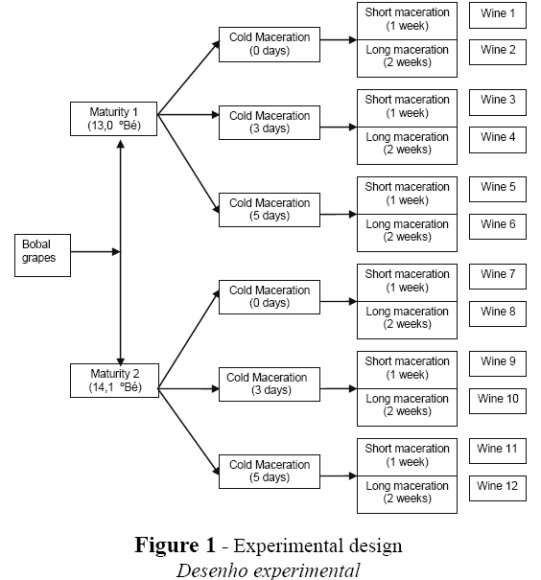
<body><![CDATA[<p>One of the main features in the red wine making process is the presence of skins and seeds. Red winemaking is thus a very  complex process where an overlapping between alcoholic fermentation and maceration take place. This phenomenon, which is responsible for wine color, is not simply an extraction procedure, as numerous reactions in the grape phenolics also occur  that deeply influence the color intensity and stability of the wine (Sims and Bates, 1994). The length of skin maceration is  the first factor that affects this phenomenon, although maceration affects the extraction not only of phenolic compounds but  also of other compounds (proteins, polysaccharides) that may participate in condensation reactions (Glories, 2001; Gómez-Plaza  <i>et al.</i>, 2001; Gónzalez-Neves <i>et al.</i>, 2003).</p>      <p>In recent years, some winemaking techniques have also being tested in order to elaborate red wines (Sacchi <i>et al.</i>,  2005). However the knowledge of the influence of these techniques on the final Bobal red wines composition and sensory quality has not been well studied yet, so only a few data can be found in the literature. For instance Gómez Gallego  <i>et al.</i> (2012a) stated that wines made with Moravia agria or Bobal, two red single cultivars in danger of extinction in  Castilla-La Mancha, are a viable alternative to traditional grape varieties, increasing the offer to the consumer, when the  phenolic composition, chromatic characteristics, antioxidant activities and sensory profile were tested. Gómez  García-Carpintero <i>et al.</i> (2011) also demonstrate that Bobal wines present a complex chemical profile with a wealth of  aromas in its aromatic composition. Gómez-Gallego <i>et al.</i> (2012b) studied the phenolic composition and sensory properties  of five minor red grape varieties from Castilla-La Mancha region (Bobal, Moravia agria, Moravia dulce, Rojal y Tortosí). The  study suggested that, in order to see how the compounds studied in these grapes are transferred to the elaborated wines and   affects their sensory properties; future work verifying the effect of the wine making process will be needed.</p>      <p>The Bobal grape variety was selected, on the one hand, because it is the most widely used in the Designation of Origin  Utiel-Requena (Valencia, Spain) with more than 70% of the total grapevine area of this region and, on the other hand, because   despite being used traditionally in the production of rosé and red “doble pasta” wines and being sold mostly in bulk during   the last few years Bobal grapes have been used to produce high quality aged wines shown the high potential of the grapes   (Méndez, 2005; Sánchez, 2008; Gómez-García Carpintero <i>et al.</i>, 2011). The main objective of this study was to assess   the prefermentative cold maceration influence on the color and phenolic composition of Bobal red wines. In this sense the   definition of chemical and phenolic characteristics of the wines produced by two maceration times and at different grape   maturity levels has been studied. The knowledge of the most important phenolic parameters may profit from the selection of   the best winemaking procedure and the optimum date of harvest in order to increase wine quality.</p>      <p>&nbsp;</p>      <p><b>MATERIAL AND METHODS</b></p>      <p>Grapes of <i>Vitis Vinifera</i> cv. Bobal were harvested in 2008 from 40 years old vines at the Coloraos experimental  vineyard located in Requena (Valencia, Spain) at two different maturity levels, spaced one week. Grapes were carefully  harvested into 15 kg boxes and transported to an experimental wine production center. </p>      <p>The grapes were destemmed and crushed, and the must was homogenized and distributed to 50 L stainless steel tanks. Sulfur  dioxide was added (5 g/hL) prior to carry out the different vinification methods. Alcoholic fermentation was induced by  inoculation with <i>Saccharomyces cerevisiae</i> (2056 Uvaferm Rhone) at the rate of 20 g/hL. To ensure the development of  malolactic fermentation selected <i>Oenococcus oeni</i> lactic acid bacteria (Starin 31 ITV France Lallemand) were inoculated  at the end of alcoholic fermentation.</p>      <p>Cold prefermentative maceration process consisted of two stages: a first stage where the refrigeration of the grapes takes place in a cold storage-room at 10 ºC for 3 or 5 days, followed by 7 or 14 days of traditional maceration-fermentation  (between 20-25 ºC) - <a href="#f1">Figure 1</a>. After the cold maceration period was completed the temperature of the tanks was rapidly brought  to 20 ºC to allow the starting of alcoholic fermentation. Punching was carried out once a day during the fermentation process.  For the wine conservation 30 mg/L sulfur dioxide was added. At the end of fermentation the wines were raked and stored in a   cold room at 5 ºC for two months. All wines were elaborated in triplicate.</p>      <p>&nbsp;</p> <a name="f1"> <img src="/img/revistas/ctv/v27n2/27n2a01f1.jpg">     
<p>&nbsp;</p>        ]]></body>
<body><![CDATA[<p><b> Analytical essays</b></p>      <p>Enological parameters such as degree Beaumé (ºBé), pH or total acidity (mg/L tartaric acid) or alcohol (% v/v) were  determined according to official EU methods (Regulamento 440/2003).</p>      <p>Color intensity (CI) and total polyphenol index (TPI) was determined by spectophotometric methods (Blouin 1992).  Quantification of anthocyanins was done by high performance liquid chromatography (HPLC) using the modified method as  described by Boido <i>et al.</i> (2006). Concentrations were determined using the external standard method and their factor  responses were deduced from their respective calibration curves. Quantification of condensed tannins were done by precipitation with methyl cellulose (Sarneckis <i>et al.</i>, 2006). Polyvinylpolipyrrolidone (PVPP) and astringency was  estimated by the method referenced by Llaudy <i>et al.</i> (2004). Hdrochloridric (HCl), ethanol (EtOH), polymerization,  dyalisis, and ionization (Glories, 1984), and DMACH (Vivas <i>et al.</i>, 1994) indexes were determined. Each analysis was  performed in triplicate.</p>      <p><b> Sensory analysis</b></p>      <p>The sensory panel consisted in 9 judges with considerable experience in sensory analysis. Sensory profile was determined  using six descriptors (color, aroma intensity and aroma quality, taste intensity and taste quality and final assessment).  The panelists used a 10-point scale to rate the intensity of each attribute. Assessment took place in a standard sensory  analysis chamber, equipped with separate booths and wine tasting glasses.</p>      <p><b> Statistical analysis</b></p>      <p>To study the influence of the several factors analysis of variance (ANOVA) was performed. Principal Component Analysis (PCA)  was carried out and was applied to discriminate among the means of phenolic and traditional parameters in the wines according   to the different winemaking techniques.</p>      <p>Analysis of variance (ANOVA) and Principal Component Analysis (PCA) were applied, in order to evaluate whether significant  differences among the samples exist as well as to select the variable that most influence the differences between them. LSD  test was used to separate the means (P-value &lt; 0.01) when the ANOVA test was significant. For the statistical treatment of  the data the Statgraphics Plus 5.1 software was used.</p>      <p>&nbsp;</p>      <p><b>RESULTS AND DISCUSSION</b></p>      ]]></body>
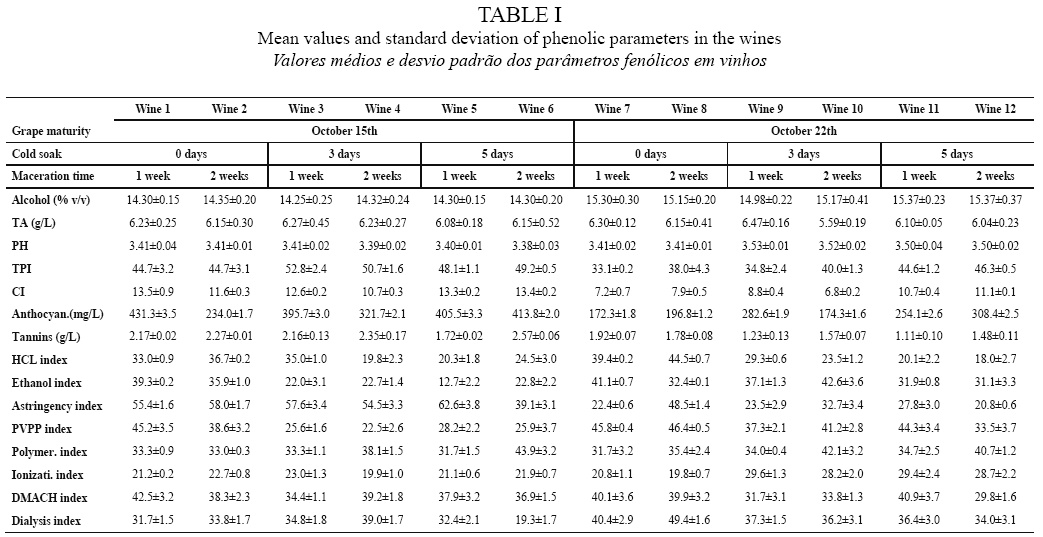
<body><![CDATA[<p><b> General composition of must</b></p>      <p>Means values of must standard parameters for maturity 1 (October 15th) and maturity 2 (22th October) respectively are: degree Beaumé (13.0±0.05 and 14.1±0.07), pH (3.40 ± 0.02 and 3.48 ± 0.03), total acidity (6.18 ± 0.20 and 6.10 ± 0.15 g/L  tartaric acid). The data obtained was concordant with previous studies carried out in Bobal grapes (Gómez García-Carpintero  <i>et al.</i>, 2011). These analyses revealed that the grapes were in good conditions to be harvested and elaborated. As was to be expected total acidity and pH of musts was higher and lower, respectively, in the grapes harvested first (Blouin and Gimberteau, 2004). With regards to the results it should be pointed out that, despite the high degree Beaumé observed in  both dates of harvest, the cultivar is able to keep higher values of acidity displaying the great results of this variety in  the Utile-Requena region edaphoclimatic conditions.</p>      <p><b> Composition of the wines</b></p>      <p><a href="/img/revistas/ctv/v27n2/27n2a01t1.jpg">Table I</a> shown the results obtained for the enological parameters of the different wines elaborated. Three conventional parameters and twelve spectral phenolic parameters were quantified due to their significance in red wines (Spranger <i>et  al.</i>, 2004).</p>      
<p>&nbsp;</p> <a href ="/img/revistas/ctv/v27n2/27n2a01t1.jpg">TABLE I</a>     
<p>&nbsp;</p>       <p>Generally speaking the higher TPI, CI, anthocyanins and tannin concentration values were observed for the wines elaborated  with grapes from maturity 1 (Wines 1-6). These results are not in agreement with other studies (Bautista <i>et al.</i>, 2003;  Llaudy <i>et al.</i>, 2005) where better results were observed at higher maturity grapes level. An overall view of these data  indicates probably overripened grapes where the harvest was carried out in the latest date (maturity 2).</p>      <p>In addition wines where prefermentative cold maceration (PCM) was applied for 3 days shown the higher phenolic concentration  (TPI), however wines that reach the highest colour intensity and anthcyanin concentration were those cold soaked for 5 days.   In previous studies this technique (PCM) has been successfully tested and has resulted in an improved CI (Gómez-Plaza <i>et al.</i>, 2001; Parenti <i>et al.</i>, 2004; Koyama <i>et al.</i>, 2007; Gil-Muñoz <i>et al.</i>, 2009) and anthocyanin concentration (Gómez-Míguez <i>et al.</i>, 2007; Álvarez <i>et al.</i>, 2009; Gordillo <i>et al.</i>, 2010).</p>      <p>The prefermentative cold maceration for 3 or 5 days increase the anthocyanin concentration between 13% and 33% respectively,  in concordance with other studies (Cuasnon, 1999a; Zamora-Marín, 2003) where an increase between 52% and 17% respectively was  observed, although dry ice was used in the prefermentative step.</p>      <p>On the other hand the tannin concentration remains unaffected in the cold soaked wines, being the not cold soaked, the wines  that show the highest tannin content. In red wines the target of cold prefermentative maceration is to enhance the    water-soluble compounds in the absence of ethanol, since as the cap has not been formed the contact between the solid parts   and the must is better (Gómez-Miguez <i>et al.</i>, 2007), therefore a tannin, alcohol soluble compounds, extraction should   not be expected (Sacchi <i>et al.</i>, 2005).</p>      ]]></body>
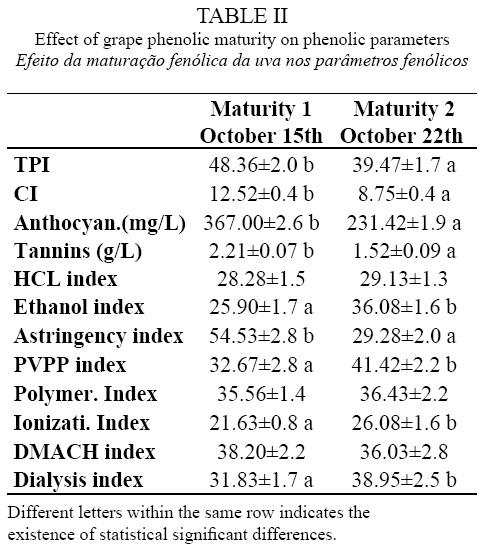
<body><![CDATA[<p>Proanthocyanidins in grape berry are located in skin and seeds. The skin proanthocyanidins are located in the vacuoles of  skin cells, then the extraction during the prefermentative maceration process, requires the cells walls to be broken, to   allow their vacuole content to be extracted or to diffuse into the wine. Moreover the extraction of the proanthocyanidins of   the seed needs longer maceration time, because the lipids present in the seed must be eliminated first, which is normally   done by the increasing content of ethanol (Glories and Saucier, 2000). In conclusion skin tannins are early extracted and give volume and smoothness, but in the presence of alcohol, seed tannins are also extracted which provide rougness and  astringency (Ribereau-Gayon <i>et al.</i>, 2006).</p>      <p>The contradictory results obtained shown the extraction of the phenolic compounds in the prefermentative step was highly  dependent on several factors such as grape variety and maturity, soil, climate and vinification techniques (Auw <i>et al.</i>, 1996), as well as by the proanthocyanidin concentration, the composition of the berry cell walls, and the processing method (Busse-Valverde <i>et al.</i>, 2010).</p>      <p>The wines elaborated with higher grape maturity and cold soaked shown the higher proportion of anthocyanins in colored forms  (flavilium cation), measured by the ionisation index. In addition the higher grape maturity wines have higher  tannin-polysaccharide molecules (ethanol index), decreasing considerably their concentration in prefermentative macerated   wines.</p>      <p>In terms of stability, the higher grape maturity wines shown a higher percentage of anthocyanins linked with tannins (A-T),  determined by the PVPP index, being found the highest values in the not cold soaked wines. The higher anthocyanin extraction  in the cold soaked wines led to less anthocyanin-tannin molecules. The ratio between these compounds did not allow to achieve  a good anthocyanin stabilization. Otherwise the higher maceration time the higher anthocyanins mean degree of polimerysation,  measured by the polymerization index, showing the cold macerated wines the highest values, as has been reported by several  authors (Gordillo <i>et al.</i>, 2010; Heredia <i>et al.</i>, 2010).</p>      <p>The wines made with more mature grapes shown higher dialysis index, stating higher proportion of, anthocyanin or  polysaccharide, linked tannins molecules, suggesting polymerization reaction during ripening. These results were particularly  relevant in the non prefermentative macerated wines. On the other hand these wines led to a higher tannin mean degree of  polimerysation, measured by the HCL index. Finally the most astringent wines are those made with the less mature grapes.</p>      <p><b> Effect of grape maturation</b></p>      <p>Mean and standard deviation values of the phenolic parameters according to the different date of harvest appear in the <a href="#t2">Table II</a>. The statistical analysis was realized considering all the wines made from grapes harvested in both dates tested.  Independent of the vinification technology used the effect of the grape maturity in wine composition was assessed. In these  wines, the effect of the grape ripeness produces a significant increase in TPI, CI, anthocyanin and tannin concentration and  gelatin index in wines harvested first. The results show that the maturation level has a great impact on the phenolic composition of Bobal wines. Saint Cricq de Gaulejac <i>et al.</i>, (1998) mentioned that the optimal grape maturity level  occurs when the anthocyanins decrease start i.e. at the beginning of the overripening period when the degradation of the berry cells starts.</p>      <p>&nbsp;</p> <a name="t2"> <img src="/img/revistas/ctv/v27n2/27n2a01t2.jpg">     
<p>&nbsp;</p>       <p>Anthocyanins synthesis starts during veraison and remains active throughout grape ripening. For this reason anthocyanins  accumulate in the skins during ripening (Fernández-López <i>et al.</i>, 1992; Lanaridis and Bena-Tzourou, 1997). However   anthocyanin concentration may decrease slightly during overripening (González-San José <i>et al.</i>, 1990; Cacho <i>et   al.</i>, 1992). The concentration of some anthocyanin monoglucosides such as malvidin-3-glucoside and peonidin-3-glucoside   usually increase during maturation, while the others anthocyanins monoglucosides tend to decrease during ripening.   Simultaneously acylated anthocyanins tend to increase throughout ripening, although in some cases they decrease at the end of  the process (Canals <i>et al.</i>, 2005). Theoretically wines obtained from well-ripened grapes have more color and are   richer in anthocyanins than those obtained from unripened grapes.</p>      ]]></body>
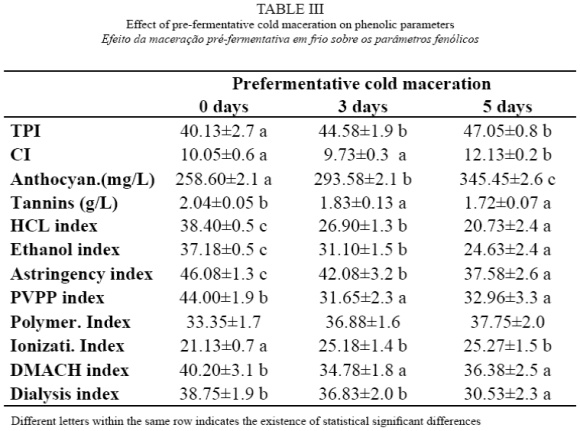
<body><![CDATA[<p>Generally speaking the proanthocyanidin concentration is highest at veraison. Later, proanthocyanidin concentration decrease  after some time before complete ripeness, when it remains relatively constant. At the same time the main degree of   polymerization increases throughout ripening (Canals <i>et al.</i>, 2005). The significant differences obtained in the wines   made from second harvested grapes could be due by a varietal factor where overripened grapes were used, although the evolution  of the phenolic composition of Bobal grapes has not been researched yet. The decrease in the anthocyanin and tannin   concentration led to a decrease in the TPI and therefore to the CI, parameter highly related to the phenolic composition of   the elaborated wines.</p>      <p>No significant difference in the HCL, polymerization and DMACH indexes was found between both dates of harvest. Otherwise higher anthocyanins that contribute to the wine color (Ionisation index), and linked anthocyanin-tannin compounds  (PVPP index) were found in the wines from more mature grapes. It has been well reported that the higher A-T  molecules the   higher color stability, keeping the anthocyanins in solution, avoiding precipitation phenomenon (Boulton, 2001), but several  studies have recently questioned the stability of this reactions (Cheynier <i>et al.</i>, 2006). Ethyl linked anthocyanins  are less stable than anthocyanins in aqueous solution at wine pH because of acid-catalyzed cleavage of their ethyl bounds.   Reactions of the cleavage products led to flavanyl-pyranoanthocyanins, which change color from red to tawny and increase   resistant to sulfite bleaching.</p>      <p>The more mature grapes have shown the higher dialysis and ethanol indexes values. As was to be expected greater amounts of high polymerized tannins were observed in the wines made from grapes harvested last. Polysaccharides are present in  concentrations ranging from 0.5 to 1.5 g/L. Wine polysaccharides play an important role in mouthfeel properties of wine even  by providing increased viscosity or by modulating astringency. More specifically there is evidence that polysaccharide   fractions are likely to contribute a fullness sensation to wine inducing a greater decrease on the attributes associated with   astringency (Vidal <i>et al.</i>, 2004).</p>      <p><b> Effect of pre-fermentative cold maceration</b></p>      <p>The use of prefermentative cold maceration allows better structured wines, richer in phenolic and aromatic compounds, thus  preventing a strong connection with the area of production (Álvarez <i>et al.</i>, 2006). Moreover this technique can  potentially promote a selective and significant extraction of phenols, these results in a less aggressive taste and reduces de  use of sulphur dioxide as anti-microbic and anti-oxidant (Amati <i>et al.</i>, 1992).</p>      <p>Mean and standard deviation values of the phenolic parameters according to the prefermentative cold maceration treatment  appear in the <a href="#t3">Table III</a>. Independent of the vinification technology used the effect of prefermentative cold maceration   technique in wine composition was assessed. Two different maceration periods were assayed: 3 and 5 days. A wine elaborated   following the traditional vinification method, as a control, was also carried out. The influence of this technique on the final phenolic composition led to significant changes in most of the parameters studied. According to these variables,  wines were affected in general by the prefermentative treatment used. These results are similar to those found by several  authors (Cuasnon, 1999b; Zamora, 2004; Casassa <i>et al.</i>, 2005).</p>      <p>&nbsp;</p> <a name="t3"> <img src="/img/revistas/ctv/v27n2/27n2a01t3.jpg">     
<p>&nbsp;</p>       <p>The TPI and the anthocyanin concentration shown the higher content in wines after 5 days of skin maceration, where  significant differences between both cold maceration treatments appeared for the anhtocyanin content. Moreover the CI only  shown significant differences where the prefermentative treatment is extended to 5 days. Otherwise the cold soaked wines shown  lower values for the tannin concentration where the not macerated wines have significant differences displaying the higher  amounts of these compounds. These results are in concordance with Retali (2004), who found no differences between the tannin  concentration in cold soaked Niellucio wines, while an increase in CI, anthocyanin concentration and TPI was detected.</p>      <p>During the vinification of red grapes, the length of the maceration step, together with the effect of other parameters,  such as temperature, stirring of the fermentative medium and wine making process have a considerable influence of the final  phenolic content of the wine. Moreover it is known that the maceration temperature greatly affects the transfer of polyphenols   from the skins to must (Gil-Muñoz <i>et al.</i>, 1999). The results suggest higher maceration temperatures are needed in  Bobal wines on order to obtain higher tannins concentration.</p>      ]]></body>
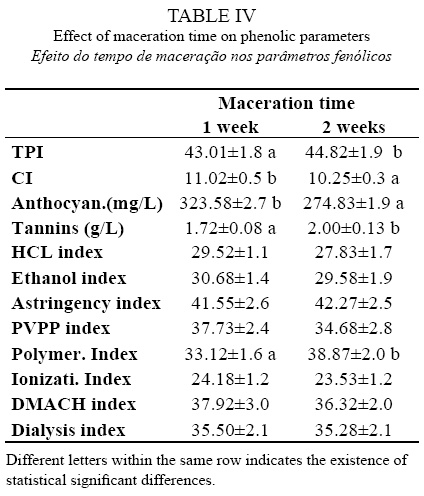
<body><![CDATA[<p>It is well known that wine color is not only due to free monomeric anthocyanins. New pigments formed after condensation or  copigmentation reactions between anthocyanins and other polyphenols are also responsible for the color of young wines  (Francia-Aricha <i>et al.</i>, 1997; Darias-Martín <i>et al.</i>, 2001). Only in the 5 days cold macerated wines, where the  anthocyanin concentration is higher, the CI has significant differences, stating that a long prefermentative period is  required in order to decisively influence the Bobal wines chromatic characteristics. As it was reported above several authors  found better color where prefermentative maceration was applied, being probably one of the most important features of this  vinification technique.</p>      <p>In the prefermentative step the extraction of the phenolic compounds takes place in the absence of ethanol because this low  maceration temperature prevent yeast from starting the fermentation process. Anthocyanins and tannins are the compound most   directly responsible for the color in red wine. Anthocyanins are easily soluble in water and are dissolved from the moment   maceration begins, whereas tannins are more soluble in alcohol so, their extraction depends on fermentation. Therefore, the longer cold prefermentative maceration treatment the higher anthocyanin concentration. Five days cold maceration led to wines  with better chromatic characteristics.</p>      <p>A significant negative effect was found in the prefermentative macerated wines. The control wines have shown higher ethanol,  gelatin, PVPP and dialysis indexes, where an increase in the cold maceration length led to wines with significant lower values. By contrast the cold soak gives wines where highly colored anthocyanins concentration was present. A higher mean degree of tannin polymerisation, determined by the DMACH index, was also detected.</p>      <p>Unlike it was observed by several authors, who found a better phenolic interaction when prefermentative techniques were  assayed (Álvarez <i>et al.</i>, 2009, Gordillo <i>et al.</i>, 2010; Heredia <i>et al.</i>, 2010), in the  Bobal wines   elaborated this technique did not provide an increase in the interactions between the compounds that decisively influence the chromatic and sensory wine properties. This behavior could be done by the low tannin concentration observed in the  prefermentative cold macerated wines. An optimum ratio between anthocyanins and tannins is needed in order to achieve a better  color stability (Zamora, 2003).</p>      <p>During storage and ageing, wine color changes from bright red to a reddish brown hue. This is attributed to the formation  of new, more stable, polymeric pigments proceeding from reaction between anthocyanins and other phenolic compounds, including, flavan-3-ol monomers and polymers (Castillo-Sánchez <i>et al.</i>, 2008). It is well known that the formation of polymeric  pigments between anthocyanins and flavanols allow the preservation of wine color (Thorngate and Singleton, 1994; Rivas Gonzalo  <i>et al.</i>, 1995; Bakker and Timberlake, 1997). Accordingly the low tannin concentration observed in the wines do not led to high anthocyanin stabilization. The longer the prefermentative cold maceration period the lower anthocyanin-tannin interaction.</p>      <p><b> Effect of the maceration time</b></p>      <p>The phenolic compounds present in the grape berry are transferred to the must during alcoholic fermentation process. Not only an extraction procedure takes place, as a numerous reactions in the grape phenolics also occur that deeply influence the  color intensity and stability of the wine. The length of skin maceration is the first factor that affects this phenomenon,  although maceration affects the extraction not only of phenolic compounds but also of other compounds (proteins and  polysaccharides) that may participate in condensation reactions.</p>      <p>The concentration of phenolic compounds and spectral data of the wines where different maceration times were tested are shown in <a href="#t4">Table IV</a>. The increase of the maceration time from 1 week to 2 weeks allowed to wines with significant higher TPI  and tannin concentration, but otherwise a significant decrease in the color and anthocyanin concentration was observed in the  longer macerated wines. Moreover no significant differences were found in the parameters which determine the reactions between  the main wine phenolic compounds. As it was expected only the 2 weeks macerated wines shown a higher polymerisation index,   stating a polymeric pigments increase due to the anthocyanin reactions, with other structures since anthocyanins are   implicated in copigmentation complexes, chemical reactions (oxidation, covalent linking) and polymerization reactions of that transform the monomeric anthocyanins into polymeric pigments (Álvarez <i>et al.</i>, 2009).</p>      <p>&nbsp;</p> <a name="t4"> <img src="/img/revistas/ctv/v27n2/27n2a01t4.jpg">     
<p>&nbsp;</p>      ]]></body>
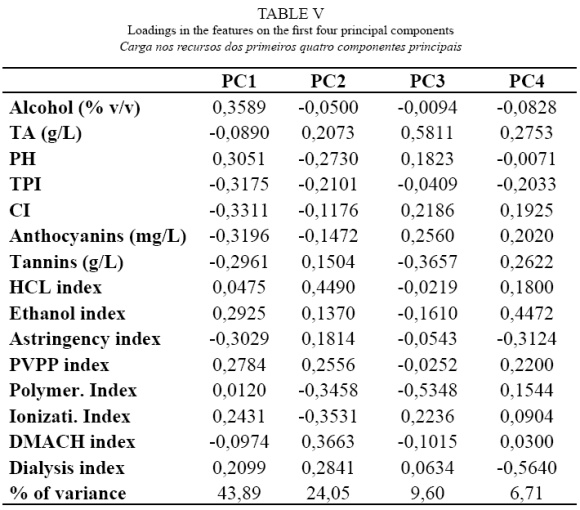
<body><![CDATA[<p>Longer contact time is related to a greater concentration of anthocyanins in wines, although some studies have found no  direct relationship between the length of maceration and the final anthocyanin content, as a part of the anthocyanins may be  fixed in the solids or maybe reduced to a colorless forms. Flavan-3-ol and tannin concentration also increase during skin fermentation, and it has been found that tannins continue to be extracted after anthocyanin extraction has reached a  maximum (Gómez-Plaza <i>et al.</i>, 2001)</p>      <p><b> Principal Component Analysis</b></p>      <p>In order to verify the results obtained a Principal Component Analysis (PCA) was tested. This procedure extracts the dominant patterns in the data matrix in terms of a complementary set of scores and loading plots. This treatment permits us a  reduction of dimensionality, a data exploration finding relationships between objects, estimating the correlation structure of  the variables and investigating how many components are necessary to explain the greater part of variance with a minimum loss  of information. When PCA is performed on auto-scaled matrix data the principal component loading are eigenvectors of the   correlation matrix.</p>      <p>PCA was performed on the autoscaled data (8 samples and 15 variables) using the Statgraphics software package in order to  provide partial visualization of the data set in a reduced dimension, and four principal components with eigenvalues higher than one accounting for 84.24% of total variance were obtained. From the loadings of the variables (<a href="#t5">Table V</a>) mainly  alcohol (%v/v), pH, ethanol and PVPP index are the positive dominant featuresin the PC1, by contrast TPI, CI and anthocyanin  and tannin concentration are the main negative ones, accounting for 43.89% of the total variability. HCL, PVPP, DMACH and  Dialysis indexes dominate in the PC2, being pH, polymerization and ionization indexes the dominant in the negative side, accounting the second component for 24.05%.</p>      <p>&nbsp;</p> <a name="t5"> <img src="/img/revistas/ctv/v27n2/27n2a01t5.jpg">     
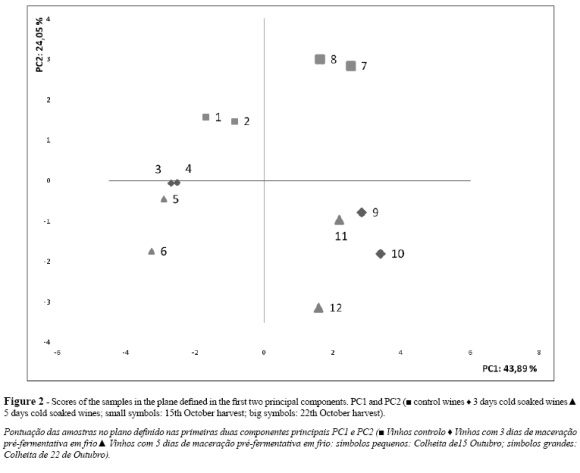
<p>&nbsp;</p>      <p>In <a href="#f2">Figure 2</a>, where the scores of each wine samples were examined in a two dimensional plot of the two first principal components (67.93% of the total variability) a complete separation of samples into two groups was found according to different  date of harvest. The first group, in the positive part of the PC1 is mainly composed by samples from the earliest date of  harvest. The second group in the negative part of the graph is made up of samples where grapes were harvested last.</p>      <p>&nbsp;</p> <a name="f2"> <img src="/img/revistas/ctv/v27n2/27n2a01f2.jpg">     
<p>&nbsp;</p>      <p>The PCA shown a better phenolic concentration in the wines harvested first, where the presence of the main phenolic compounds were significantly higher and also a deeply increase in the wine color was found. Moreover higher astringency was detected in  these wines. Is needed to be pointed out the importance of the date of harvest in the phenolic composition and chromatic  characteristics of Bobal red wines, being the overripening a potential wine quality key factor. On the other hand due to the  varietal factor complementary enological techniques might be needed in other to reduce the wine astringency and make wines well accepted by the consumers. It is well known by the Utiel-Requena enologists the unripe, aggressive, harsh tannins  that Bobal grapes usually shown even in a perfect phenolic maturity conditions.</p>      ]]></body>
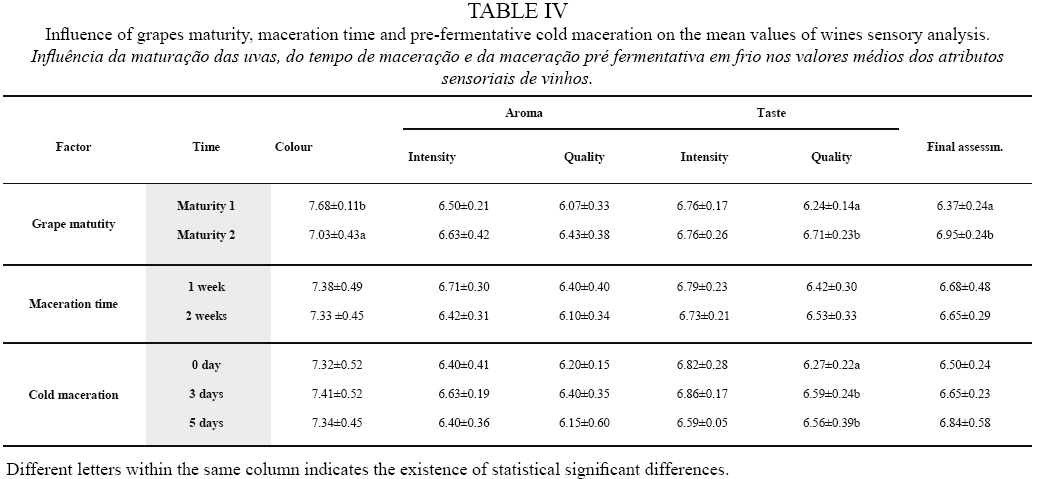
<body><![CDATA[<p>In addition a complete separation of samples into two groups was found according to prefermentative maceration technique.  The first group, in the positive part of the PC2 is composed by the not cold macerated control wines. The second group in the negative part of the PC2 is made up of samples where the prefermentative cold maceration was applied for 3 or 5 days. The PCA  do not let to a separation between the length of the prefermentative step.</p>      <p>From the loading of the variables (<a href="#t5">Table V</a>) the PCA shown a better phenolic interaction in the not cold soaked wines, where the HCL, PVPP, DMACH and Dialysis indexes are the main dominant features. Otherwise pH and ionization and polymerization indexes  are the main dominant features in the cold soaked wines. These results indicate the higher anthocyanin extraction in the cold   soaked wines which led to an increase in the anthocyanins, which contributes to the wine color, with an increase in the reactions involving these compounds.</p>      <p>Better tannin extraction is required in cold soaked Bobal wines in order to increase the optimum ratio tannin-anhtocyanin.  The higher anthocyanin concentration reached needs a higher tannin presence when better color stabilization was desirable.  High tannin levels may stabilize the anthocyanins and wine color but on the other hand may contribute to excessive astringency  (Sims and Bates, 1994; Gómez-Plaza <i>et al.</i>, 2001).</p>      <p>Finally the PCA do not allow to separate the wines according to the length of the skin maceration. No separation of the  samples was found; therefore it has no sense to extend the maceration step, avoiding future problems in wine quality. On the other hand higher tannin concentration was observed when samples were subjected to analysis of variance (ANOVA). Suggesting  better tannin concentration obtained by extending the maceration length with probably future better anthocyanin stabilization.  Bobal variety is characterized in the Utiel-Requena wine region by their high amount of anthocyanins that led to good   chromatic characteristics, and then even losing some anchocyanins content, greater color stability could be accomplished by   extending the maceration period.</p>      <p><b> Sensory evaluation of wines</b></p>      <p>The sensory panel did not observe significant differences in the wines after malolactic fermentation for sensorial aroma  intensity and quality and taste intensity, where wines from two different dates of harvest were assessed (<a href="/img/revistas/ctv/v27n2/27n2a01t6.jpg">Table VI</a>). Wines from grapes harvested first achieved a significant greater score for the sensory color as was observed above. Otherwise wines  from grapes harvested last obtained better scores for the attributes taste quality and final assessment where better phenolic  interactions took place. Finally, we suggest that a slightly phenolic concentration loose could be assumed in order to obtain  wines better rated by the consumers.</p>      
<p>&nbsp;</p> <a href ="/img/revistas/ctv/v27n2/27n2a01t6.jpg">TABLE VI</a>     
<p>&nbsp;</p>      <p>Not significant differences in wines macerated for 1 or 2 weeks were observed by the sensory panel. As we reported above better tannin concentration can be achieved in order to increase phenolic stability, although it has no sense increase the  maceration time in wines that are not going to be aged, because wines with shorter maceration time led to better chromatic   characteristics.</p>      <p>Only the attribute taste quality shown significant higher values when the prefermentative cold maceration was applied for  5 days. Moreover the cold macerated wines shown the highest values for the final assessment, where the longer the  prefermentative step the higher the scores achieved. No differences in the sensory wine color were observed, despite the   higher antchocyanin concentration in the cold soaked wines.  Blouin <i>et al.</i> (2000) reported not differences between the   prefermentative macerated and the control in a sensory evaluation of Merlot and Cabernet Sauvignon wines, stating that this   technique does not always achieve good  results in the sensory evaluations.</p>      ]]></body>
<body><![CDATA[<p>&nbsp;</p>      <p><b>CONCLUSIONS</b></p>      <p>The maturation level has a significant impact on the phenolic composition of Bobal wines. Higher phenolic concentration and  wine color was observed in wines harvested earlier, moreover these wines shown higher astringency. Otherwise better   interactions between polyphenols were also found in the wines from more mature grapes. An overripenes should be taken into account in order to avoid phenolic material decrease, and an additional enological treatment may be necessary with the  objective to reduce wine astringency. Prefermentative maceration technique led to wines with lower tannin concentration  although an increase in total polyphenols and wine color was also observed. A significant negative effect was found in the  parameters that state the phenolic reactions in the cold soaked wines. The results suggest higher maceration temperatures are  needed in Bobal wines on order to obtain higher tannins concentration which probably increase the reaction between polyphenols.  The maceration length did not highly affect the polyphenol interaction, moreover an increase on the tannin concentration was   also observed in the 2 weeks macerated wines. If a slight decrease in the anthocyanin concentration can be assumed an extended  maceration could be done in order to improve tannin concentration and future possible phenolic stability. The wines better   valued by the sensory panelist were those from grapes harvested last and pre-fermentative cold macerated.</p>      <p>&nbsp;</p>      <p><b>REFERENCES</b></p>      <!-- ref --><p>Álvarez I., Aleixandre J., García M.J., Lizama V., 2006. Impact of prefermentative maceration on the phenolic and volatile  compounds in the Monastrell red wines. <i>Analytica Chimica Acta</i> , <b>563</b>, 109-115.    &nbsp;&nbsp;&nbsp;&nbsp;&nbsp;&nbsp;&nbsp;&nbsp;[&#160;<a href="javascript:void(0);" onclick="javascript: window.open('/scielo.php?script=sci_nlinks&ref=000108&pid=S0254-0223201200020000100001&lng=','','width=640,height=500,resizable=yes,scrollbars=1,menubar=yes,');">Links</a>&#160;]<!-- end-ref --></p>      <!-- ref --><p>Álvarez I., Aleixandre J.L., García M.J., Lizama V., Aleixandre-Tudó J.L., 2009. Effect of the prefermentative addition of  copigments on the phenolic composition of Tempranillo wines after malolactic fermentation. <i>Eur. Food Res. Technol.</i>,  <b>228</b>, 501-510.    &nbsp;&nbsp;&nbsp;&nbsp;&nbsp;&nbsp;&nbsp;&nbsp;[&#160;<a href="javascript:void(0);" onclick="javascript: window.open('/scielo.php?script=sci_nlinks&ref=000110&pid=S0254-0223201200020000100002&lng=','','width=640,height=500,resizable=yes,scrollbars=1,menubar=yes,');">Links</a>&#160;]<!-- end-ref --> </p>      <!-- ref --><p>Amati A., Carnicini A., Monti R., Zironi R., 1992. Vinificazione per macerazione delle vinacce e temperatura controllata  influenza del tempo e della temperatura in impianto pilota. <i>Vignevini</i>, <b>9</b>, 29.    &nbsp;&nbsp;&nbsp;&nbsp;&nbsp;&nbsp;&nbsp;&nbsp;[&#160;<a href="javascript:void(0);" onclick="javascript: window.open('/scielo.php?script=sci_nlinks&ref=000112&pid=S0254-0223201200020000100003&lng=','','width=640,height=500,resizable=yes,scrollbars=1,menubar=yes,');">Links</a>&#160;]<!-- end-ref --> </p>      <!-- ref --><p>Auw J.M., Blanco V., O’Keefe S.F., Sims, C.A., 1996. Effect of processing on the phenolics and color of Cabernet Sauvignon: Chambourcin and Noble wines and juices. <i>Am. J. Enol. Vitic.</i>, <b>47</b>, 279-286.    &nbsp;&nbsp;&nbsp;&nbsp;&nbsp;&nbsp;&nbsp;&nbsp;[&#160;<a href="javascript:void(0);" onclick="javascript: window.open('/scielo.php?script=sci_nlinks&ref=000114&pid=S0254-0223201200020000100004&lng=','','width=640,height=500,resizable=yes,scrollbars=1,menubar=yes,');">Links</a>&#160;]<!-- end-ref --></p>      <!-- ref --><p>Bakker J., Timberlake C.F., 1997. Isolation, identification, and characterization of new color-stable anthocyanins  occurring in some red wines. <i>J. Agric. Food Chem.</i>, <b>45</b>, 35.    &nbsp;&nbsp;&nbsp;&nbsp;&nbsp;&nbsp;&nbsp;&nbsp;[&#160;<a href="javascript:void(0);" onclick="javascript: window.open('/scielo.php?script=sci_nlinks&ref=000116&pid=S0254-0223201200020000100005&lng=','','width=640,height=500,resizable=yes,scrollbars=1,menubar=yes,');">Links</a>&#160;]<!-- end-ref --></p>      <p>Bautista A.B., Perez L.J., Romero I., Fernández J.I., López J.M., Gómez, E., 2003. Influencia del estado de maduración de  la uva de variedad Monastrell en el color de los vinos. In: <i>II Congreso Nacional de Ciencia y Tecnología de Alimentos</i>.</p>      <!-- ref --><p>Blouin J., Gimberteau G., 2004. <i>Maduración y madurez de la uva.</i> Ed. Mundi Prensa, Madrid.    &nbsp;&nbsp;&nbsp;&nbsp;&nbsp;&nbsp;&nbsp;&nbsp;[&#160;<a href="javascript:void(0);" onclick="javascript: window.open('/scielo.php?script=sci_nlinks&ref=000119&pid=S0254-0223201200020000100007&lng=','','width=640,height=500,resizable=yes,scrollbars=1,menubar=yes,');">Links</a>&#160;]<!-- end-ref --></p>      <!-- ref --><p>Blouin J., 1992. Manuel pratique d´analyse des mouts et des vins. Chambre d´Agriculture de la Girone, France.    &nbsp;&nbsp;&nbsp;&nbsp;&nbsp;&nbsp;&nbsp;&nbsp;[&#160;<a href="javascript:void(0);" onclick="javascript: window.open('/scielo.php?script=sci_nlinks&ref=000121&pid=S0254-0223201200020000100008&lng=','','width=640,height=500,resizable=yes,scrollbars=1,menubar=yes,');">Links</a>&#160;]<!-- end-ref --> </p>      ]]></body>
<body><![CDATA[<!-- ref --><p>Blouin J., Papet N., Stonestreet E., 2000. Étude de la structure poli phénolique des vins rouges par analyses  physico-chimiques et sensorielles. <i>J. Int. Sci. Vigne Vin</i>, <b>34</b> (1), 33-40.    &nbsp;&nbsp;&nbsp;&nbsp;&nbsp;&nbsp;&nbsp;&nbsp;[&#160;<a href="javascript:void(0);" onclick="javascript: window.open('/scielo.php?script=sci_nlinks&ref=000123&pid=S0254-0223201200020000100009&lng=','','width=640,height=500,resizable=yes,scrollbars=1,menubar=yes,');">Links</a>&#160;]<!-- end-ref --></p>      <!-- ref --><p>Boido E., Alcalde-Eon C., Carrau F., Dellacassa E., Rivas Gonzalo J.C., 2006. Aging effect on the pigment composition and  color of <i>Vitis vinífera</i> L. Cv. Tannat wines. Contribution of the main pigment families to wine color. <i>J. Agric. Food  Chem.</i>, <b>54</b>, 6692-6704.    &nbsp;&nbsp;&nbsp;&nbsp;&nbsp;&nbsp;&nbsp;&nbsp;[&#160;<a href="javascript:void(0);" onclick="javascript: window.open('/scielo.php?script=sci_nlinks&ref=000125&pid=S0254-0223201200020000100010&lng=','','width=640,height=500,resizable=yes,scrollbars=1,menubar=yes,');">Links</a>&#160;]<!-- end-ref --> </p>      <!-- ref --><p>Boulton R., 2001. The copigmentation of anhocyanins and its role in the color of red wine. A Critical Review. <i>Am. J.  Enol. Vitic.</i>, <b>52</b>, 67-87.    &nbsp;&nbsp;&nbsp;&nbsp;&nbsp;&nbsp;&nbsp;&nbsp;[&#160;<a href="javascript:void(0);" onclick="javascript: window.open('/scielo.php?script=sci_nlinks&ref=000127&pid=S0254-0223201200020000100011&lng=','','width=640,height=500,resizable=yes,scrollbars=1,menubar=yes,');">Links</a>&#160;]<!-- end-ref --></p>      <!-- ref --><p>Brenon E., Bernard N., Zebic, O., Deloire, A., 2005. Maturité du raisin: Propopositión d´une méthode utilisant le volume  des baies comme indicateur. <i>Rev. Œnolog. Techniq. Vitivinic.</i>, <b>117</b>, 52-54.    &nbsp;&nbsp;&nbsp;&nbsp;&nbsp;&nbsp;&nbsp;&nbsp;[&#160;<a href="javascript:void(0);" onclick="javascript: window.open('/scielo.php?script=sci_nlinks&ref=000129&pid=S0254-0223201200020000100012&lng=','','width=640,height=500,resizable=yes,scrollbars=1,menubar=yes,');">Links</a>&#160;]<!-- end-ref --></p>      <!-- ref --><p>Busse-Valverde N., Gómez-Plaza E., López-Roca J.M., Gil-Muñoz R., Fernández-Fernández J.I., Bautista-Ortín A., 2010. Effect  of different enological practices on skin and sees proanthicyanidins in three varietal wines. <i>J. Agric. Food Chem.</i>,  <b>58</b>, 11333-11339.    &nbsp;&nbsp;&nbsp;&nbsp;&nbsp;&nbsp;&nbsp;&nbsp;[&#160;<a href="javascript:void(0);" onclick="javascript: window.open('/scielo.php?script=sci_nlinks&ref=000131&pid=S0254-0223201200020000100013&lng=','','width=640,height=500,resizable=yes,scrollbars=1,menubar=yes,');">Links</a>&#160;]<!-- end-ref --></p>      ]]></body>
<body><![CDATA[<!-- ref --><p>Cacho J., Fernandez P., Ferreira V., Castells J.E., 1992. Evolution of five anthocyanidin-3-glucosides in the skin of the  Tempranillo, Moristel, and Garnacha grape varieties and influence of climatological variables. <i>Am. J. Enol. Vitic.</i>,   <b>43</b>, 244-248.    &nbsp;&nbsp;&nbsp;&nbsp;&nbsp;&nbsp;&nbsp;&nbsp;[&#160;<a href="javascript:void(0);" onclick="javascript: window.open('/scielo.php?script=sci_nlinks&ref=000133&pid=S0254-0223201200020000100014&lng=','','width=640,height=500,resizable=yes,scrollbars=1,menubar=yes,');">Links</a>&#160;]<!-- end-ref --></p>      <!-- ref --><p>Canals R., Llaudy M.C., Valls J., Canals J.M., Zamora F., 2005. Influence of ethanol concentration on the extraction of  color and phenolic compounds from the skin and seeds of Tempranillo grapes at different stages of ripening. <i>J. Agric. Food  Chem.</i> , <b>53</b>, 4019-4025.    &nbsp;&nbsp;&nbsp;&nbsp;&nbsp;&nbsp;&nbsp;&nbsp;[&#160;<a href="javascript:void(0);" onclick="javascript: window.open('/scielo.php?script=sci_nlinks&ref=000135&pid=S0254-0223201200020000100015&lng=','','width=640,height=500,resizable=yes,scrollbars=1,menubar=yes,');">Links</a>&#160;]<!-- end-ref --></p>      <!-- ref --><p>Casassa F., Sari S., Avagnina S., Diaz M., Jofré V., Fanzone M., Catania C., 2005. Influencia de técnicas de maceración  sobre la composición polifenólica, aromática y las características organolépticas de vinos cv. Merlot. In: <i>X Congreso  Latinoamericano de Viticultura y Enología</i> (Actas p. 3089). Bento Gonçalves. Brasil.    &nbsp;&nbsp;&nbsp;&nbsp;&nbsp;&nbsp;&nbsp;&nbsp;[&#160;<a href="javascript:void(0);" onclick="javascript: window.open('/scielo.php?script=sci_nlinks&ref=000137&pid=S0254-0223201200020000100016&lng=','','width=640,height=500,resizable=yes,scrollbars=1,menubar=yes,');">Links</a>&#160;]<!-- end-ref --></p>      <!-- ref --><p>Castillo-Sánchez J.X., García-Falcón M.S., Garrido J., Martínez-Carballo E., Martins-Dias L.R., Mejuto X.C., 2009. Phenolic  compounds and color stability of Vinhão wines: Influence of wine making protocol and fining agents. <i>Food Chemistry</i>,  <b>106</b>, 18-26.    &nbsp;&nbsp;&nbsp;&nbsp;&nbsp;&nbsp;&nbsp;&nbsp;[&#160;<a href="javascript:void(0);" onclick="javascript: window.open('/scielo.php?script=sci_nlinks&ref=000139&pid=S0254-0223201200020000100017&lng=','','width=640,height=500,resizable=yes,scrollbars=1,menubar=yes,');">Links</a>&#160;]<!-- end-ref --> </p>      <p>Cheynier V., Dueñas-Paton M., Salas E,, Maury C., Souquet J., Sanni Machado P., Fulcrand H., 2006. Structure and properties  of wine pigments and tannins. <i>Am. J. Enol. Vitic.</i>, <b>57</b> (3), 298-305.</p>      <!-- ref --><p>Cuasnon M., 1999a. Une nouvelle technique: La macération prefermentaire à froid- Extraction à la niège carbonique. 1ª  partie. <i>Rev. Œnolog. Techniq. Vitivinic.</i>, <b>92</b>, 26-30.    &nbsp;&nbsp;&nbsp;&nbsp;&nbsp;&nbsp;&nbsp;&nbsp;[&#160;<a href="javascript:void(0);" onclick="javascript: window.open('/scielo.php?script=sci_nlinks&ref=000142&pid=S0254-0223201200020000100019&lng=','','width=640,height=500,resizable=yes,scrollbars=1,menubar=yes,');">Links</a>&#160;]<!-- end-ref --></p>      <!-- ref --><p>Cuasnon M., 1999b. Une nouvelle technique: La macération prefermentaire à froid- Extraction à la niège carbonique. 2ª  partie. <i>Rev. Œnolog. Techniq. Vitivinic.</i>, <b>93</b>, 28-30.    &nbsp;&nbsp;&nbsp;&nbsp;&nbsp;&nbsp;&nbsp;&nbsp;[&#160;<a href="javascript:void(0);" onclick="javascript: window.open('/scielo.php?script=sci_nlinks&ref=000144&pid=S0254-0223201200020000100020&lng=','','width=640,height=500,resizable=yes,scrollbars=1,menubar=yes,');">Links</a>&#160;]<!-- end-ref --></p>      <!-- ref --><p>Darias-Martín J., Carrillo M., Díaz E., Boulton R.B., 2001. Enhancement of wine colour by prefermentation addition of  copigments. <i>Food Chemistry</i>, <b>73</b>, 217–220.    &nbsp;&nbsp;&nbsp;&nbsp;&nbsp;&nbsp;&nbsp;&nbsp;[&#160;<a href="javascript:void(0);" onclick="javascript: window.open('/scielo.php?script=sci_nlinks&ref=000146&pid=S0254-0223201200020000100021&lng=','','width=640,height=500,resizable=yes,scrollbars=1,menubar=yes,');">Links</a>&#160;]<!-- end-ref --></p>      <!-- ref --><p>Díaz-Plaza M., Lorente E.M., Reyero J.M., Pardo F., Salinas M.R., 2000. Aportación al estudio de la maduración de varias  viníferas tintas cultivadas en la D.O. Jumilla. <i>Viticultura-Enología Profesional</i>, <b>68</b>, 37-46.    &nbsp;&nbsp;&nbsp;&nbsp;&nbsp;&nbsp;&nbsp;&nbsp;[&#160;<a href="javascript:void(0);" onclick="javascript: window.open('/scielo.php?script=sci_nlinks&ref=000148&pid=S0254-0223201200020000100022&lng=','','width=640,height=500,resizable=yes,scrollbars=1,menubar=yes,');">Links</a>&#160;]<!-- end-ref --></p>      <!-- ref --><p>Fernández-López J. A., Hidalgo V., Almela L., López Roca J. M., 1992. Quantitative changes in anthocyanin pigments of  <i>Vitis Vinifera</i> cv Monastrell during maturation. <i>J. Sci. Food Agric.</i>, <b>58</b>, 153-155.    &nbsp;&nbsp;&nbsp;&nbsp;&nbsp;&nbsp;&nbsp;&nbsp;[&#160;<a href="javascript:void(0);" onclick="javascript: window.open('/scielo.php?script=sci_nlinks&ref=000150&pid=S0254-0223201200020000100023&lng=','','width=640,height=500,resizable=yes,scrollbars=1,menubar=yes,');">Links</a>&#160;]<!-- end-ref --></p>      <!-- ref --><p>Feuillat M., 1996. Vinification du Pinot noir en Bourgogne par macération préfermentaire à froid. <i>Rev. Franç. Oenol.</i>,  <b>82</b>, 29-31.    &nbsp;&nbsp;&nbsp;&nbsp;&nbsp;&nbsp;&nbsp;&nbsp;[&#160;<a href="javascript:void(0);" onclick="javascript: window.open('/scielo.php?script=sci_nlinks&ref=000152&pid=S0254-0223201200020000100024&lng=','','width=640,height=500,resizable=yes,scrollbars=1,menubar=yes,');">Links</a>&#160;]<!-- end-ref --></p>      <!-- ref --><p>Francia-Aricha E. M., Guerra M., Rivas-Gonzalo J.C., Santos-Buelga C., 1997. New anthocyanin pigment formed after  condensation with flavanols. <i>J. Agric. Food. Chem.</i>, <b>45</b>, 2262-2266.    &nbsp;&nbsp;&nbsp;&nbsp;&nbsp;&nbsp;&nbsp;&nbsp;[&#160;<a href="javascript:void(0);" onclick="javascript: window.open('/scielo.php?script=sci_nlinks&ref=000154&pid=S0254-0223201200020000100025&lng=','','width=640,height=500,resizable=yes,scrollbars=1,menubar=yes,');">Links</a>&#160;]<!-- end-ref --></p>      <!-- ref --><p>Gil-Muñoz R., Gómez-Plaza E., Martínez A., López-Roca J.M., 1999. Evolution of phenolic compounds during wine fermentation  and post-fermentation: Influence of grape temperature. <i>Journal of Food composition and Analyis</i>, <b>12</b>, 259-272.    &nbsp;&nbsp;&nbsp;&nbsp;&nbsp;&nbsp;&nbsp;&nbsp;[&#160;<a href="javascript:void(0);" onclick="javascript: window.open('/scielo.php?script=sci_nlinks&ref=000156&pid=S0254-0223201200020000100026&lng=','','width=640,height=500,resizable=yes,scrollbars=1,menubar=yes,');">Links</a>&#160;]<!-- end-ref --></p>      <!-- ref --><p>Gil-Muñoz R., Moreno-Pérez A., Fernández-Fernández J. I., Martínez-Cutillas A., Gómez-Plaza E., 2009. Influence of low  temperature prefermentative techniques on chromatic and phenolic characteristics of Syrah and Cabernet Sauvignon wines.  <i>Eur. Food Res Technol.</i>, <b>228</b>, 777–788.    &nbsp;&nbsp;&nbsp;&nbsp;&nbsp;&nbsp;&nbsp;&nbsp;[&#160;<a href="javascript:void(0);" onclick="javascript: window.open('/scielo.php?script=sci_nlinks&ref=000158&pid=S0254-0223201200020000100027&lng=','','width=640,height=500,resizable=yes,scrollbars=1,menubar=yes,');">Links</a>&#160;]<!-- end-ref --></p>      <!-- ref --><p>Glories Y., 1984. La couleur des vins rouges. Mesure, origine et interpretation. <i>Connais. Vigne Vin</i>, <b>18</b>,  253-271.    &nbsp;&nbsp;&nbsp;&nbsp;&nbsp;&nbsp;&nbsp;&nbsp;[&#160;<a href="javascript:void(0);" onclick="javascript: window.open('/scielo.php?script=sci_nlinks&ref=000160&pid=S0254-0223201200020000100028&lng=','','width=640,height=500,resizable=yes,scrollbars=1,menubar=yes,');">Links</a>&#160;]<!-- end-ref --> </p>      <!-- ref --><p >Glories Y., 2001. Caracterization du potenciel phenolique: adaptation a la vinification. <i>Prog. Agric. Viticol.</i>,  <b>118</b>, 347-350.    &nbsp;&nbsp;&nbsp;&nbsp;&nbsp;&nbsp;&nbsp;&nbsp;[&#160;<a href="javascript:void(0);" onclick="javascript: window.open('/scielo.php?script=sci_nlinks&ref=000162&pid=S0254-0223201200020000100029&lng=','','width=640,height=500,resizable=yes,scrollbars=1,menubar=yes,');">Links</a>&#160;]<!-- end-ref --></p>      <!-- ref --><p >Glories Y.; Saucier C., 2000. Tannin evolution from grape to wine. Effects on wine taste. In <i>The ASEV 50th Anniversary  Annual Meeting</i>; Ratz, J., Ed., ASEV, Davis, CA.    &nbsp;&nbsp;&nbsp;&nbsp;&nbsp;&nbsp;&nbsp;&nbsp;[&#160;<a href="javascript:void(0);" onclick="javascript: window.open('/scielo.php?script=sci_nlinks&ref=000164&pid=S0254-0223201200020000100030&lng=','','width=640,height=500,resizable=yes,scrollbars=1,menubar=yes,');">Links</a>&#160;]<!-- end-ref --> </p>      <p>Gómez Gallego M.A., Gómez García-Carpintero E., Sánchez-Palomo E., Hermosin Gutierrez I., González Viñas M.A., 2012a.  Study of phenolic composition and sensory properties of red grape varieties in danger of extinction from the Spanish region of  Castilla-La Mancha. <i>Eur. Food Res Technol.</i>, <b>234</b>, 295-303.</p>      <!-- ref --><p>Gómez Gallego M.A., Gómez García-Carpintero E., Sánchez-Palomo E., González Viñas, M.A., Hermosin Gutierrez I. 2012b.  Oenological potential, phenolic composition, chromatic characteristics and antoixidant activity of red-single cultivar wines  from Castilla-La Mancha. <i>Food Research International</i>, <b>48</b>, 7-15.    &nbsp;&nbsp;&nbsp;&nbsp;&nbsp;&nbsp;&nbsp;&nbsp;[&#160;<a href="javascript:void(0);" onclick="javascript: window.open('/scielo.php?script=sci_nlinks&ref=000167&pid=S0254-0223201200020000100032&lng=','','width=640,height=500,resizable=yes,scrollbars=1,menubar=yes,');">Links</a>&#160;]<!-- end-ref --></p>      <!-- ref --><p>Gómez.Míguez M., González-Miret M.L., Heredia F.J., 2007. Evolution of colour and anthocyanin composition of Syrah wines  elaborated with pre-fermentative cold maceration. <i>Journal of Food Engineering</i>, <b>79</b>, 271-278.    &nbsp;&nbsp;&nbsp;&nbsp;&nbsp;&nbsp;&nbsp;&nbsp;[&#160;<a href="javascript:void(0);" onclick="javascript: window.open('/scielo.php?script=sci_nlinks&ref=000169&pid=S0254-0223201200020000100033&lng=','','width=640,height=500,resizable=yes,scrollbars=1,menubar=yes,');">Links</a>&#160;]<!-- end-ref --></p>      <!-- ref --><p>Gómez-García Carpintero E., Sánchez-Palomo E., González-Viñas M.A., 2011. Aroma characterization of red wines from cv. Bobal  grape variety grown in la Mancha region. <i>Food Research International</i>, <b>44</b>, 61-70.    &nbsp;&nbsp;&nbsp;&nbsp;&nbsp;&nbsp;&nbsp;&nbsp;[&#160;<a href="javascript:void(0);" onclick="javascript: window.open('/scielo.php?script=sci_nlinks&ref=000171&pid=S0254-0223201200020000100034&lng=','','width=640,height=500,resizable=yes,scrollbars=1,menubar=yes,');">Links</a>&#160;]<!-- end-ref --></p>      ]]></body>
<body><![CDATA[<!-- ref --><p>Gómez-Plaza E., Gil-Muñoz R., López-Roca J.M., Martínez-Cutillas A., Fernández-Fernández J.I., 2001. Phenolic compounds and  colour stability of red wines : Effect of skin maceration time. <i>Am. J. Enol. Vitic.</i>, <b>52</b>, 266-270.    &nbsp;&nbsp;&nbsp;&nbsp;&nbsp;&nbsp;&nbsp;&nbsp;[&#160;<a href="javascript:void(0);" onclick="javascript: window.open('/scielo.php?script=sci_nlinks&ref=000173&pid=S0254-0223201200020000100035&lng=','','width=640,height=500,resizable=yes,scrollbars=1,menubar=yes,');">Links</a>&#160;]<!-- end-ref --></p>      <!-- ref --><p>González Neves G., Ferrer M., Carbonneau A., Moutounet M., 2003. Adaptación de la vinificación en tinto en función del  potencial polifenólico de las uvas. <i>Agrociencia</i>, <b>1</b>, 59-67.    &nbsp;&nbsp;&nbsp;&nbsp;&nbsp;&nbsp;&nbsp;&nbsp;[&#160;<a href="javascript:void(0);" onclick="javascript: window.open('/scielo.php?script=sci_nlinks&ref=000175&pid=S0254-0223201200020000100036&lng=','','width=640,height=500,resizable=yes,scrollbars=1,menubar=yes,');">Links</a>&#160;]<!-- end-ref --></p>      <!-- ref --><p>Gonzalez-SanJose M. L.; Barron L. J. R., Diez C., 1990. Evolution of anthocyanins during maturation of Tempranillo grape  variety, Vitis Vinifera, using polynomial regression models. <i>J. Sci. Food. Agric.</i>, <b>51</b>, 337-343.    &nbsp;&nbsp;&nbsp;&nbsp;&nbsp;&nbsp;&nbsp;&nbsp;[&#160;<a href="javascript:void(0);" onclick="javascript: window.open('/scielo.php?script=sci_nlinks&ref=000177&pid=S0254-0223201200020000100037&lng=','','width=640,height=500,resizable=yes,scrollbars=1,menubar=yes,');">Links</a>&#160;]<!-- end-ref --></p>      <!-- ref --><p>Gordillo B., Lopez-Infante M.I., Ramirez-Pérez P., Gonzalez-Miret M., Heredia F., 2010. Influence of prefermentative cold  maceration on the color and anthocyanin copigmentation of organic tempranillo wines elaborated in warm climate. <i>J. Agric.  Food Chem.</i>, <b>58</b>, 6797-6803.    &nbsp;&nbsp;&nbsp;&nbsp;&nbsp;&nbsp;&nbsp;&nbsp;[&#160;<a href="javascript:void(0);" onclick="javascript: window.open('/scielo.php?script=sci_nlinks&ref=000179&pid=S0254-0223201200020000100038&lng=','','width=640,height=500,resizable=yes,scrollbars=1,menubar=yes,');">Links</a>&#160;]<!-- end-ref --></p>      <!-- ref --><p>Heatherbell D., Dicey M., Goldsworthy S., Vanhanen L., 1997. Effect of prefermentation cold maceration on the composition,  colour and flavor of Pinot noir wine. <i>Proceedings of the 4th International Symposium on Cool Climate Viticulture and  Enology</i>. VI: 10-17. New York State Agricultural Experimental Station, Geneva, New York.    &nbsp;&nbsp;&nbsp;&nbsp;&nbsp;&nbsp;&nbsp;&nbsp;[&#160;<a href="javascript:void(0);" onclick="javascript: window.open('/scielo.php?script=sci_nlinks&ref=000181&pid=S0254-0223201200020000100039&lng=','','width=640,height=500,resizable=yes,scrollbars=1,menubar=yes,');">Links</a>&#160;]<!-- end-ref --> </p>      ]]></body>
<body><![CDATA[<p>Heredia F, J., Escudero-Gilete M.L., Hernanz D., Gordillo B., Melendez-Martinez A.J., Vicario, I.M., Gonzalez-Miret M.L.,  2010. Influence of the refrigeration technique on the color and phenolic composition of Syrah wines obtained with  pre-fermentative cold maceration. <i>Food Chemistry</i>, <b>118</b>, 377-383.</p>      <!-- ref --><p>Koyama K., Goto-Yamamoto N., Hashizume K., 2007. Influence of maceration temperature in red wine vinification on extraction  of phenolics from berry skins and seeds of grape (<i>Vitis vinifera</i>). <i>Biosci. Biotechnol. Biochem.</i>, <b>71</b>,   958–965.    &nbsp;&nbsp;&nbsp;&nbsp;&nbsp;&nbsp;&nbsp;&nbsp;[&#160;<a href="javascript:void(0);" onclick="javascript: window.open('/scielo.php?script=sci_nlinks&ref=000184&pid=S0254-0223201200020000100041&lng=','','width=640,height=500,resizable=yes,scrollbars=1,menubar=yes,');">Links</a>&#160;]<!-- end-ref --></p>      <!-- ref --><p>Lanaridis P., Bena-Tzourou I., 1997. Etude des variations des anthocyanes pendant la maturation des raisins de cinq cépages rouges, cultivés en Grèce. <i>J. Int. Sci. Vigne Vin</i>, <b >31</b> (4), 205-212.    &nbsp;&nbsp;&nbsp;&nbsp;&nbsp;&nbsp;&nbsp;&nbsp;[&#160;<a href="javascript:void(0);" onclick="javascript: window.open('/scielo.php?script=sci_nlinks&ref=000186&pid=S0254-0223201200020000100042&lng=','','width=640,height=500,resizable=yes,scrollbars=1,menubar=yes,');">Links</a>&#160;]<!-- end-ref --></p>      <!-- ref --><p>Llaudy M.C., Canals R., Canals J., Rozés N, Zamora F. (2004). New method for evaluating astringency in red wines. <i>J.  Agric. Food Chem.</i> <b>52</b>, 742-746.    &nbsp;&nbsp;&nbsp;&nbsp;&nbsp;&nbsp;&nbsp;&nbsp;[&#160;<a href="javascript:void(0);" onclick="javascript: window.open('/scielo.php?script=sci_nlinks&ref=000188&pid=S0254-0223201200020000100043&lng=','','width=640,height=500,resizable=yes,scrollbars=1,menubar=yes,');">Links</a>&#160;]<!-- end-ref --></p>      <!-- ref --><p>LLaudy M.C., Canals R., Cabanillas P., Canals J.M., Zamora F., 2005. La maceración prefermentativa en frío. Efectos en la  extracción de color y los compuestos fenólicos, e influencia del nivel de maduración de la uva. <i>ACE. Revista de Enología   Artículos Científicos</i>, 60.    &nbsp;&nbsp;&nbsp;&nbsp;&nbsp;&nbsp;&nbsp;&nbsp;[&#160;<a href="javascript:void(0);" onclick="javascript: window.open('/scielo.php?script=sci_nlinks&ref=000190&pid=S0254-0223201200020000100044&lng=','','width=640,height=500,resizable=yes,scrollbars=1,menubar=yes,');">Links</a>&#160;]<!-- end-ref --></p>      <!-- ref --><p>Marais J., 2003 a. Effect of different wine-making techniques on the composition and quality of Pinotage wine. I.  Low-temperature skin contact prior to fermentation. <i>S. Afr. J. Enol. Vitic.</i>, <b>24</b>, 70-75.    &nbsp;&nbsp;&nbsp;&nbsp;&nbsp;&nbsp;&nbsp;&nbsp;[&#160;<a href="javascript:void(0);" onclick="javascript: window.open('/scielo.php?script=sci_nlinks&ref=000192&pid=S0254-0223201200020000100045&lng=','','width=640,height=500,resizable=yes,scrollbars=1,menubar=yes,');">Links</a>&#160;]<!-- end-ref --></p>      <p>Marais J., 2003 b. Effect of different wine-making techniques on the composition and quality of Pinotage wine. II.  Juice/skin mixing practices. <i>S. Afr. J. Enol. Vitic.</i>, <b>24</b>, 76-79.</p>      <!-- ref --><p>Méndez J.V., 2005. <i>Estudio de la maduración fenólica y antocianica en uvas tintas de Bobal para diferentes condiciones agrológicas</i>. Tesis Doctoral. Universidad Politécnica de Valencia, Spain.    &nbsp;&nbsp;&nbsp;&nbsp;&nbsp;&nbsp;&nbsp;&nbsp;[&#160;<a href="javascript:void(0);" onclick="javascript: window.open('/scielo.php?script=sci_nlinks&ref=000195&pid=S0254-0223201200020000100047&lng=','','width=640,height=500,resizable=yes,scrollbars=1,menubar=yes,');">Links</a>&#160;]<!-- end-ref --></p>      <!-- ref --><p>Okubo K., Goto-Yamamoto N., Okazaki N., 2003. Effect of prefermentation cold soak on extraction of anthocyanin during red  wine making. <i>J. Brew. Soc. Japan.</i>, <b>98</b>, 193-200.    &nbsp;&nbsp;&nbsp;&nbsp;&nbsp;&nbsp;&nbsp;&nbsp;[&#160;<a href="javascript:void(0);" onclick="javascript: window.open('/scielo.php?script=sci_nlinks&ref=000197&pid=S0254-0223201200020000100048&lng=','','width=640,height=500,resizable=yes,scrollbars=1,menubar=yes,');">Links</a>&#160;]<!-- end-ref --></p>      <!-- ref --><p>Parenti A., Spugnoli P., Calamai L., Ferrari S., Gori C., 2004. Effects of cold maceration on red wine quality from Tuscan  Sangiovese grape. <i>Eur Food Res Technol.</i>, <b>218</b>, 360–366.    &nbsp;&nbsp;&nbsp;&nbsp;&nbsp;&nbsp;&nbsp;&nbsp;[&#160;<a href="javascript:void(0);" onclick="javascript: window.open('/scielo.php?script=sci_nlinks&ref=000199&pid=S0254-0223201200020000100049&lng=','','width=640,height=500,resizable=yes,scrollbars=1,menubar=yes,');">Links</a>&#160;]<!-- end-ref --></p>      <!-- ref --><p>Retali E., 2004. Macération préfermentaire à froid: application à une vendange de Nielluccio. <i>Rev Fran. Œnol.</i>,  <b>209</b>, 16-18.    &nbsp;&nbsp;&nbsp;&nbsp;&nbsp;&nbsp;&nbsp;&nbsp;[&#160;<a href="javascript:void(0);" onclick="javascript: window.open('/scielo.php?script=sci_nlinks&ref=000201&pid=S0254-0223201200020000100050&lng=','','width=640,height=500,resizable=yes,scrollbars=1,menubar=yes,');">Links</a>&#160;]<!-- end-ref --></p>      ]]></body>
<body><![CDATA[<!-- ref --><p>Ribéreau-Gayon P., Glories Y., Maujean A., Dubourdieu D., 2006. <i>Phenolic compounds. Handbook of Enology : Vol. 2. The  chemistry of wine, stabilization and treatments.</i> Chichester : Jhon Wiley and Soons, Ltd., p. 141-204.    &nbsp;&nbsp;&nbsp;&nbsp;&nbsp;&nbsp;&nbsp;&nbsp;[&#160;<a href="javascript:void(0);" onclick="javascript: window.open('/scielo.php?script=sci_nlinks&ref=000203&pid=S0254-0223201200020000100051&lng=','','width=640,height=500,resizable=yes,scrollbars=1,menubar=yes,');">Links</a>&#160;]<!-- end-ref --></p>      <!-- ref --><p>Rivas Gonzalo J.C., Bravo-Haro S., Santos-Buelga C., 1995. Detection of compounds formed through the reaction of  malvidin-3-monoglucoside. <i>J Agric Food Chem</i>., <b>43</b>, 1444–1449.    &nbsp;&nbsp;&nbsp;&nbsp;&nbsp;&nbsp;&nbsp;&nbsp;[&#160;<a href="javascript:void(0);" onclick="javascript: window.open('/scielo.php?script=sci_nlinks&ref=000205&pid=S0254-0223201200020000100052&lng=','','width=640,height=500,resizable=yes,scrollbars=1,menubar=yes,');">Links</a>&#160;]<!-- end-ref --></p>      <!-- ref --><p>Rodríguez Villa J.C., 2000. Buenos vinos: comencemos por la uva madura. <i>Viticultura-Enología Profesional</i>, <b>66</b>,  6-11.    &nbsp;&nbsp;&nbsp;&nbsp;&nbsp;&nbsp;&nbsp;&nbsp;[&#160;<a href="javascript:void(0);" onclick="javascript: window.open('/scielo.php?script=sci_nlinks&ref=000207&pid=S0254-0223201200020000100053&lng=','','width=640,height=500,resizable=yes,scrollbars=1,menubar=yes,');">Links</a>&#160;]<!-- end-ref --></p>      <!-- ref --><p>Sacchi K., Bisson L., Adams D., 2005. A review of the effect of winemaking techniques on phenolic interaction in red wines.  <i>Am. J. Enol. Vitic.</i>, <b>53</b> (3), 197-206.    &nbsp;&nbsp;&nbsp;&nbsp;&nbsp;&nbsp;&nbsp;&nbsp;[&#160;<a href="javascript:void(0);" onclick="javascript: window.open('/scielo.php?script=sci_nlinks&ref=000209&pid=S0254-0223201200020000100054&lng=','','width=640,height=500,resizable=yes,scrollbars=1,menubar=yes,');">Links</a>&#160;]<!-- end-ref --></p>      <p>Saint-Cricq de Gaulejac N., Vivas N., Glories Y., 1998. Maturité phénolique: définition et contrôle. <i>Rev. Fran. Œnol.</i> , <b>173</b>, 22-25.</p>      <!-- ref --><p>Sánchez N., 2008.<i>Influencia de diferentes factores agrológicos y tecnológicos sobre la mejora de la calidad de los vinos  tintos de Bobal</i>. Tesis Doctoral, Universidad Politécnica de Valencia, Spain.    &nbsp;&nbsp;&nbsp;&nbsp;&nbsp;&nbsp;&nbsp;&nbsp;[&#160;<a href="javascript:void(0);" onclick="javascript: window.open('/scielo.php?script=sci_nlinks&ref=000212&pid=S0254-0223201200020000100056&lng=','','width=640,height=500,resizable=yes,scrollbars=1,menubar=yes,');">Links</a>&#160;]<!-- end-ref --></p>      <!-- ref --><p>Sarneckis C.J., Dambergs R.G., Jones P., Mercurio M., Herderich M.J., Smith P.A., 2006. Quantification of condensed tannins by precipitation with methyl cellulose: development and validation of an optimized tool for grape and wine analysis.  <i>Aust. J. Grape Wine Res.</i>, <b>12</b>, 39-49.    &nbsp;&nbsp;&nbsp;&nbsp;&nbsp;&nbsp;&nbsp;&nbsp;[&#160;<a href="javascript:void(0);" onclick="javascript: window.open('/scielo.php?script=sci_nlinks&ref=000214&pid=S0254-0223201200020000100057&lng=','','width=640,height=500,resizable=yes,scrollbars=1,menubar=yes,');">Links</a>&#160;]<!-- end-ref --> </p>      <!-- ref --><p>Sims C.A., Bates R.P., 1994. Effects of skin fermentation time on the phenols, ellagic acid sediment and sensory  characteristics of a red Vitis rotundifolia wine. <i>Am. J. Enol. Vitic.</i>, <b>45</b>, 56-62.    &nbsp;&nbsp;&nbsp;&nbsp;&nbsp;&nbsp;&nbsp;&nbsp;[&#160;<a href="javascript:void(0);" onclick="javascript: window.open('/scielo.php?script=sci_nlinks&ref=000216&pid=S0254-0223201200020000100058&lng=','','width=640,height=500,resizable=yes,scrollbars=1,menubar=yes,');">Links</a>&#160;]<!-- end-ref --></p>      <!-- ref --><p>Souquet J.M., Cheynier V., Moutounet M., 2000. Les proanthocyanidines du raisin. <i>Bull. OIV</i>, <b>73</b>, 835-836, 601-609.    &nbsp;&nbsp;&nbsp;&nbsp;&nbsp;&nbsp;&nbsp;&nbsp;[&#160;<a href="javascript:void(0);" onclick="javascript: window.open('/scielo.php?script=sci_nlinks&ref=000218&pid=S0254-0223201200020000100059&lng=','','width=640,height=500,resizable=yes,scrollbars=1,menubar=yes,');">Links</a>&#160;]<!-- end-ref --></p>      <!-- ref --><p>Spranger M.I., Clímaco M.C., Sun B., Eiriz N., Fortunato C., Nunes A., Leandro C., Avelar M.L., Belchior A.P., 2004.  Differentiation of red winemaking technologies by phenolic and volatile composition. <i>Anal Chim Acta</i>, <b>513</b>,  151.    &nbsp;&nbsp;&nbsp;&nbsp;&nbsp;&nbsp;&nbsp;&nbsp;[&#160;<a href="javascript:void(0);" onclick="javascript: window.open('/scielo.php?script=sci_nlinks&ref=000220&pid=S0254-0223201200020000100060&lng=','','width=640,height=500,resizable=yes,scrollbars=1,menubar=yes,');">Links</a>&#160;]<!-- end-ref --></p>      <!-- ref --><p>Thorngate J. H. and Singleton V. L., 1994. Localization of procyanidins in grape seeds. <i>Am. J Enol. Vitic.</i>,  <b>45</b>, 259-262.    &nbsp;&nbsp;&nbsp;&nbsp;&nbsp;&nbsp;&nbsp;&nbsp;[&#160;<a href="javascript:void(0);" onclick="javascript: window.open('/scielo.php?script=sci_nlinks&ref=000222&pid=S0254-0223201200020000100061&lng=','','width=640,height=500,resizable=yes,scrollbars=1,menubar=yes,');">Links</a>&#160;]<!-- end-ref --> </p>      <!-- ref --><p>UE, <i>Official Methods to Wine Analyses</i>, Regulamento 440/2003.    &nbsp;&nbsp;&nbsp;&nbsp;&nbsp;&nbsp;&nbsp;&nbsp;[&#160;<a href="javascript:void(0);" onclick="javascript: window.open('/scielo.php?script=sci_nlinks&ref=000224&pid=S0254-0223201200020000100062&lng=','','width=640,height=500,resizable=yes,scrollbars=1,menubar=yes,');">Links</a>&#160;]<!-- end-ref --></p>      <p>Vidal S., Francis L., Williams P., Kwiatkowski M., Gawel R., Cheynier V., 2004. The mouth-feel properties of  polysaccharides and anthocyanins in a wine like medium. <i>Food Chemistry</i>, <b>85</b>, 519–525.</p>      <p>Vivas N., Glories Y., Lagune L., Saucier C., Agustin M., 1994. Estimation of the polymerisation level of procyanidins from  grapes and wines by use of p-dimethylaminocinnalamdehyde. <i>J. Int. Sci. Vigne Vin</i>, <b>28</b>, 319-336.</p>      <!-- ref --><p>Watson B.T., Price S.F., Valladao M., 1995. Effect of fermentation practices on anthocyanin and phenolic composition of  Pinot noir wines. Abstr. <i>Am. J. Enol. Vitic.</i>, <b>46.</b>, 404.    &nbsp;&nbsp;&nbsp;&nbsp;&nbsp;&nbsp;&nbsp;&nbsp;[&#160;<a href="javascript:void(0);" onclick="javascript: window.open('/scielo.php?script=sci_nlinks&ref=000228&pid=S0254-0223201200020000100065&lng=','','width=640,height=500,resizable=yes,scrollbars=1,menubar=yes,');">Links</a>&#160;]<!-- end-ref --> </p>      <!-- ref --><p>Zamora Marín F., 2003. <i>Elaboración y crianza del vino tinto: Aspectos científicos y prácticos</i>. Mundi Prensa AMV, Madrid.    &nbsp;&nbsp;&nbsp;&nbsp;&nbsp;&nbsp;&nbsp;&nbsp;[&#160;<a href="javascript:void(0);" onclick="javascript: window.open('/scielo.php?script=sci_nlinks&ref=000230&pid=S0254-0223201200020000100066&lng=','','width=640,height=500,resizable=yes,scrollbars=1,menubar=yes,');">Links</a>&#160;]<!-- end-ref --></p>      <!-- ref --><p >Zamora Marín F., 2004. La maceración prefermentativa en frío de la uva tinta. <i>Enólogos</i>, <b>32</b>, 36-39.    &nbsp;&nbsp;&nbsp;&nbsp;&nbsp;&nbsp;&nbsp;&nbsp;[&#160;<a href="javascript:void(0);" onclick="javascript: window.open('/scielo.php?script=sci_nlinks&ref=000232&pid=S0254-0223201200020000100067&lng=','','width=640,height=500,resizable=yes,scrollbars=1,menubar=yes,');">Links</a>&#160;]<!-- end-ref --></p>      <p>&nbsp;</p>     <p><Sup><a name="0"></a><a href="#top0">*</a></Sup><b>Corresponding author:</b></p>     <p> Tel: +34 963 87 70 53; Fax: +34 963 87 73 69, e-mail address: <a href="mailto:jaleixan@tal.upv.es">jaleixan@tal.upv.es</a></p>     <p>&nbsp;</p>      <p><i>(Manuscrito recebido em 10.07.2012. Aceite para publicação em 11.12.2012)</i></p>       ]]></body><back>
<ref-list>
<ref id="B1">
<nlm-citation citation-type="journal">
<person-group person-group-type="author">
<name>
<surname><![CDATA[Álvarez]]></surname>
<given-names><![CDATA[I.]]></given-names>
</name>
<name>
<surname><![CDATA[Aleixandre]]></surname>
<given-names><![CDATA[J.]]></given-names>
</name>
<name>
<surname><![CDATA[García]]></surname>
<given-names><![CDATA[M.J.]]></given-names>
</name>
<name>
<surname><![CDATA[Lizama]]></surname>
<given-names><![CDATA[V.]]></given-names>
</name>
</person-group>
<article-title xml:lang="en"><![CDATA[Impact of prefermentative maceration on the phenolic and volatile compounds in the Monastrell red wines]]></article-title>
<source><![CDATA[Analytica Chimica Acta]]></source>
<year>2006</year>
<volume>563</volume>
<page-range>109-115</page-range></nlm-citation>
</ref>
<ref id="B2">
<nlm-citation citation-type="journal">
<person-group person-group-type="author">
<name>
<surname><![CDATA[Álvarez]]></surname>
<given-names><![CDATA[I.]]></given-names>
</name>
<name>
<surname><![CDATA[Aleixandre]]></surname>
<given-names><![CDATA[J.L.]]></given-names>
</name>
<name>
<surname><![CDATA[García]]></surname>
<given-names><![CDATA[M.J.]]></given-names>
</name>
<name>
<surname><![CDATA[Lizama]]></surname>
<given-names><![CDATA[V.]]></given-names>
</name>
<name>
<surname><![CDATA[Aleixandre-Tudó]]></surname>
<given-names><![CDATA[J.L.]]></given-names>
</name>
</person-group>
<article-title xml:lang="en"><![CDATA[Effect of the prefermentative addition of copigments on the phenolic composition of Tempranillo wines after malolactic fermentation]]></article-title>
<source><![CDATA[Eur. Food Res. Technol.]]></source>
<year>2009</year>
<volume>228</volume>
<page-range>501-510</page-range></nlm-citation>
</ref>
<ref id="B3">
<nlm-citation citation-type="journal">
<person-group person-group-type="author">
<name>
<surname><![CDATA[Amati]]></surname>
<given-names><![CDATA[A.]]></given-names>
</name>
<name>
<surname><![CDATA[Carnicini]]></surname>
<given-names><![CDATA[A.]]></given-names>
</name>
<name>
<surname><![CDATA[Monti]]></surname>
<given-names><![CDATA[R.]]></given-names>
</name>
<name>
<surname><![CDATA[Zironi]]></surname>
<given-names><![CDATA[R.]]></given-names>
</name>
</person-group>
<article-title xml:lang="it"><![CDATA[Vinificazione per macerazione delle vinacce e temperatura controllata influenza del tempo e della temperatura in impianto pilota]]></article-title>
<source><![CDATA[Vignevini]]></source>
<year>1992</year>
<volume>9</volume>
</nlm-citation>
</ref>
<ref id="B4">
<nlm-citation citation-type="journal">
<person-group person-group-type="author">
<name>
<surname><![CDATA[Auw]]></surname>
<given-names><![CDATA[J.M.]]></given-names>
</name>
<name>
<surname><![CDATA[Blanco]]></surname>
<given-names><![CDATA[V.]]></given-names>
</name>
<name>
<surname><![CDATA[O’Keefe]]></surname>
<given-names><![CDATA[S.F.]]></given-names>
</name>
<name>
<surname><![CDATA[Sims]]></surname>
<given-names><![CDATA[C.A.]]></given-names>
</name>
</person-group>
<article-title xml:lang="en"><![CDATA[Effect of processing on the phenolics and color of Cabernet Sauvignon: Chambourcin and Noble wines and juices]]></article-title>
<source><![CDATA[Am. J. Enol. Vitic.]]></source>
<year>1996</year>
<volume>47</volume>
<page-range>279-286</page-range></nlm-citation>
</ref>
<ref id="B5">
<nlm-citation citation-type="journal">
<person-group person-group-type="author">
<name>
<surname><![CDATA[Bakker]]></surname>
<given-names><![CDATA[J.]]></given-names>
</name>
<name>
<surname><![CDATA[Timberlake]]></surname>
<given-names><![CDATA[C.F.]]></given-names>
</name>
</person-group>
<article-title xml:lang="en"><![CDATA[Isolation, identification, and characterization of new color-stable anthocyanins occurring in some red wines]]></article-title>
<source><![CDATA[J. Agric. Food Chem.]]></source>
<year>1997</year>
<volume>45</volume>
</nlm-citation>
</ref>
<ref id="B6">
<nlm-citation citation-type="confpro">
<person-group person-group-type="author">
<name>
<surname><![CDATA[Bautista]]></surname>
<given-names><![CDATA[A.B.]]></given-names>
</name>
<name>
<surname><![CDATA[Perez]]></surname>
<given-names><![CDATA[L.J.]]></given-names>
</name>
<name>
<surname><![CDATA[Romero]]></surname>
<given-names><![CDATA[I.]]></given-names>
</name>
<name>
<surname><![CDATA[Fernández]]></surname>
<given-names><![CDATA[J.I.]]></given-names>
</name>
<name>
<surname><![CDATA[López]]></surname>
<given-names><![CDATA[J.M.]]></given-names>
</name>
<name>
<surname><![CDATA[Gómez]]></surname>
<given-names><![CDATA[E.]]></given-names>
</name>
</person-group>
<article-title xml:lang="es"><![CDATA[Influencia del estado de maduración de la uva de variedad Monastrell en el color de los vinos]]></article-title>
<source><![CDATA[]]></source>
<year>2003</year>
<conf-name><![CDATA[II Congreso Nacional de Ciencia y Tecnología de Alimentos]]></conf-name>
<conf-loc> </conf-loc>
</nlm-citation>
</ref>
<ref id="B7">
<nlm-citation citation-type="book">
<person-group person-group-type="author">
<name>
<surname><![CDATA[Blouin]]></surname>
<given-names><![CDATA[J.]]></given-names>
</name>
<name>
<surname><![CDATA[Gimberteau]]></surname>
<given-names><![CDATA[G.]]></given-names>
</name>
</person-group>
<source><![CDATA[Maduración y madurez de la uva]]></source>
<year>2004</year>
<publisher-loc><![CDATA[Madrid ]]></publisher-loc>
<publisher-name><![CDATA[Mundi Prensa]]></publisher-name>
</nlm-citation>
</ref>
<ref id="B8">
<nlm-citation citation-type="book">
<person-group person-group-type="author">
<name>
<surname><![CDATA[Blouin]]></surname>
<given-names><![CDATA[J.]]></given-names>
</name>
</person-group>
<source><![CDATA[Manuel pratique d´analyse des mouts et des vins]]></source>
<year>1992</year>
<publisher-name><![CDATA[Chambre d´Agriculture de la Girone]]></publisher-name>
</nlm-citation>
</ref>
<ref id="B9">
<nlm-citation citation-type="journal">
<person-group person-group-type="author">
<name>
<surname><![CDATA[Blouin]]></surname>
<given-names><![CDATA[J.]]></given-names>
</name>
<name>
<surname><![CDATA[Papet]]></surname>
<given-names><![CDATA[N.]]></given-names>
</name>
<name>
<surname><![CDATA[Stonestreet]]></surname>
<given-names><![CDATA[E.]]></given-names>
</name>
</person-group>
<article-title xml:lang="fr"><![CDATA[Étude de la structure poli phénolique des vins rouges par analyses physico-chimiques et sensorielles]]></article-title>
<source><![CDATA[J. Int. Sci. Vigne Vin.]]></source>
<year>2000</year>
<volume>34</volume>
<numero>1</numero>
<issue>1</issue>
<page-range>33-40</page-range></nlm-citation>
</ref>
<ref id="B10">
<nlm-citation citation-type="journal">
<person-group person-group-type="author">
<name>
<surname><![CDATA[Boido]]></surname>
<given-names><![CDATA[E]]></given-names>
</name>
<name>
<surname><![CDATA[Alcalde-Eon]]></surname>
<given-names><![CDATA[C.]]></given-names>
</name>
<name>
<surname><![CDATA[Carrau]]></surname>
<given-names><![CDATA[F.]]></given-names>
</name>
<name>
<surname><![CDATA[E.]]></surname>
<given-names><![CDATA[Dellacassa]]></given-names>
</name>
<name>
<surname><![CDATA[Rivas Gonzalo]]></surname>
<given-names><![CDATA[J.C.]]></given-names>
</name>
</person-group>
<article-title xml:lang="en"><![CDATA[Aging effect on the pigment composition and color of Vitis vinífera L. Cv. Tannat wines. Contribution of the main pigment families to wine color]]></article-title>
<source><![CDATA[J. Agric. Food Chem.]]></source>
<year>2006</year>
<volume>54</volume>
<page-range>6692-6704</page-range></nlm-citation>
</ref>
<ref id="B11">
<nlm-citation citation-type="journal">
<person-group person-group-type="author">
<name>
<surname><![CDATA[Boulton]]></surname>
<given-names><![CDATA[R.]]></given-names>
</name>
</person-group>
<article-title xml:lang="en"><![CDATA[The copigmentation of anhocyanins and its role in the color of red wine: A Critical Review]]></article-title>
<source><![CDATA[Am. J. Enol. Vitic.]]></source>
<year>2001</year>
<volume>52</volume>
<page-range>67-87</page-range></nlm-citation>
</ref>
<ref id="B12">
<nlm-citation citation-type="journal">
<person-group person-group-type="author">
<name>
<surname><![CDATA[Brenon]]></surname>
<given-names><![CDATA[E.]]></given-names>
</name>
<name>
<surname><![CDATA[Bernard]]></surname>
<given-names><![CDATA[N.]]></given-names>
</name>
<name>
<surname><![CDATA[Zebic]]></surname>
<given-names><![CDATA[O.]]></given-names>
</name>
<name>
<surname><![CDATA[Deloire]]></surname>
<given-names><![CDATA[A.]]></given-names>
</name>
</person-group>
<article-title xml:lang="fr"><![CDATA[Maturité du raisin: Propopositión d´une méthode utilisant le volume des baies comme indicateur]]></article-title>
<source><![CDATA[Rev. Œnolog. Techniq. Vitivinic.]]></source>
<year>2005</year>
<volume>117</volume>
<page-range>52-54</page-range></nlm-citation>
</ref>
<ref id="B13">
<nlm-citation citation-type="journal">
<person-group person-group-type="author">
<name>
<surname><![CDATA[Busse-Valverde]]></surname>
<given-names><![CDATA[N.]]></given-names>
</name>
<name>
<surname><![CDATA[Gómez-Plaza]]></surname>
<given-names><![CDATA[E.]]></given-names>
</name>
<name>
<surname><![CDATA[López-Roca]]></surname>
<given-names><![CDATA[J.M.]]></given-names>
</name>
<name>
<surname><![CDATA[Gil-Muñoz]]></surname>
<given-names><![CDATA[R.]]></given-names>
</name>
<name>
<surname><![CDATA[Fernández-Fernández]]></surname>
<given-names><![CDATA[J.I.]]></given-names>
</name>
<name>
<surname><![CDATA[Bautista-Ortín]]></surname>
<given-names><![CDATA[A.]]></given-names>
</name>
</person-group>
<article-title xml:lang="en"><![CDATA[Effect of different enological practices on skin and sees proanthicyanidins in three varietal wines]]></article-title>
<source><![CDATA[J.Agric.Food Chem.]]></source>
<year>2010</year>
<volume>58</volume>
<page-range>11333-11339</page-range></nlm-citation>
</ref>
<ref id="B14">
<nlm-citation citation-type="journal">
<person-group person-group-type="author">
<name>
<surname><![CDATA[Cacho]]></surname>
<given-names><![CDATA[J.]]></given-names>
</name>
<name>
<surname><![CDATA[Fernandez]]></surname>
<given-names><![CDATA[P.]]></given-names>
</name>
<name>
<surname><![CDATA[Ferreira]]></surname>
<given-names><![CDATA[V.]]></given-names>
</name>
<name>
<surname><![CDATA[Castells]]></surname>
<given-names><![CDATA[J.E.]]></given-names>
</name>
</person-group>
<article-title xml:lang="en"><![CDATA[Evolution of five anthocyanidin-3-glucosides in the skin of the Tempranillo, Moristel, and Garnacha grape varieties and influence of climatological variables]]></article-title>
<source><![CDATA[Am. J. Enol. Vitic.]]></source>
<year>1992</year>
<volume>43</volume>
<page-range>244-248</page-range></nlm-citation>
</ref>
<ref id="B15">
<nlm-citation citation-type="journal">
<person-group person-group-type="author">
<name>
<surname><![CDATA[Canals]]></surname>
<given-names><![CDATA[R.]]></given-names>
</name>
<name>
<surname><![CDATA[Llaudy]]></surname>
<given-names><![CDATA[M.C.]]></given-names>
</name>
<name>
<surname><![CDATA[Valls]]></surname>
<given-names><![CDATA[J.]]></given-names>
</name>
<name>
<surname><![CDATA[Canals]]></surname>
<given-names><![CDATA[J.M.]]></given-names>
</name>
<name>
<surname><![CDATA[Zamora]]></surname>
<given-names><![CDATA[F.]]></given-names>
</name>
</person-group>
<article-title xml:lang="en"><![CDATA[Influence of ethanol concentration on the extraction of color and phenolic compounds from the skin and seeds of Tempranillo grapes at different stages of ripening]]></article-title>
<source><![CDATA[J. Agric. Food Chem.]]></source>
<year>2005</year>
<volume>53</volume>
<page-range>4019-4025</page-range></nlm-citation>
</ref>
<ref id="B16">
<nlm-citation citation-type="confpro">
<person-group person-group-type="author">
<name>
<surname><![CDATA[Casassa]]></surname>
<given-names><![CDATA[F.]]></given-names>
</name>
<name>
<surname><![CDATA[Sari]]></surname>
<given-names><![CDATA[S.]]></given-names>
</name>
<name>
<surname><![CDATA[Avagnina]]></surname>
<given-names><![CDATA[S.]]></given-names>
</name>
<name>
<surname><![CDATA[Diaz]]></surname>
<given-names><![CDATA[M.]]></given-names>
</name>
<name>
<surname><![CDATA[Jofré]]></surname>
<given-names><![CDATA[V.]]></given-names>
</name>
<name>
<surname><![CDATA[Fanzone]]></surname>
<given-names><![CDATA[M.]]></given-names>
</name>
<name>
<surname><![CDATA[Catania]]></surname>
<given-names><![CDATA[C.]]></given-names>
</name>
</person-group>
<article-title xml:lang="es"><![CDATA[Influencia de técnicas de maceración sobre la composición polifenólica, aromática y las características organolépticas de vinos cv. Merlot]]></article-title>
<source><![CDATA[]]></source>
<year>2005</year>
<conf-name><![CDATA[X Congreso Latinoamericano de Viticultura y Enología]]></conf-name>
<conf-loc> </conf-loc>
</nlm-citation>
</ref>
<ref id="B17">
<nlm-citation citation-type="journal">
<person-group person-group-type="author">
<name>
<surname><![CDATA[Castillo-Sánchez]]></surname>
<given-names><![CDATA[J.X.]]></given-names>
</name>
<name>
<surname><![CDATA[García-Falcón]]></surname>
<given-names><![CDATA[M.S.]]></given-names>
</name>
<name>
<surname><![CDATA[Garrido]]></surname>
<given-names><![CDATA[J.]]></given-names>
</name>
<name>
<surname><![CDATA[Martínez-Carballo]]></surname>
<given-names><![CDATA[E.]]></given-names>
</name>
<name>
<surname><![CDATA[Martins-Dias]]></surname>
<given-names><![CDATA[L.R.]]></given-names>
</name>
<name>
<surname><![CDATA[Mejuto]]></surname>
<given-names><![CDATA[X.C.]]></given-names>
</name>
</person-group>
<article-title xml:lang="en"><![CDATA[Phenolic compounds and color stability of Vinhão wines: Influence of wine making protocol and fining agents]]></article-title>
<source><![CDATA[Food Chemistry]]></source>
<year>2009</year>
<volume>106</volume>
<page-range>18-26</page-range></nlm-citation>
</ref>
<ref id="B18">
<nlm-citation citation-type="journal">
<person-group person-group-type="author">
<name>
<surname><![CDATA[Cheynier]]></surname>
<given-names><![CDATA[V.]]></given-names>
</name>
<name>
<surname><![CDATA[Dueñas-Paton]]></surname>
<given-names><![CDATA[M.]]></given-names>
</name>
<name>
<surname><![CDATA[Salas]]></surname>
<given-names><![CDATA[E.]]></given-names>
</name>
<name>
<surname><![CDATA[Maury]]></surname>
<given-names><![CDATA[C.]]></given-names>
</name>
<name>
<surname><![CDATA[Souquet]]></surname>
<given-names><![CDATA[J.]]></given-names>
</name>
<name>
<surname><![CDATA[Sanni Machado]]></surname>
<given-names><![CDATA[P.]]></given-names>
</name>
<name>
<surname><![CDATA[Fulcrand]]></surname>
<given-names><![CDATA[H.]]></given-names>
</name>
</person-group>
<article-title xml:lang="en"><![CDATA[Structure and properties of wine pigments and tannins]]></article-title>
<source><![CDATA[Am. J. Enol. Vitic.]]></source>
<year>2006</year>
<volume>93</volume>
<numero>3</numero>
<issue>3</issue>
<page-range>298-305</page-range></nlm-citation>
</ref>
<ref id="B19">
<nlm-citation citation-type="journal">
<person-group person-group-type="author">
<name>
<surname><![CDATA[Cuasnon]]></surname>
<given-names><![CDATA[M.]]></given-names>
</name>
</person-group>
<article-title xml:lang="fr"><![CDATA[Une nouvelle technique: La macération prefermentaire à froid- Extraction à la niège carbonique]]></article-title>
<source><![CDATA[Rev. Œnolog. Techniq. Vitivinic.]]></source>
<year>1999</year>
<volume>92</volume>
<page-range>26-30</page-range></nlm-citation>
</ref>
<ref id="B20">
<nlm-citation citation-type="journal">
<person-group person-group-type="author">
<name>
<surname><![CDATA[Cuasnon]]></surname>
<given-names><![CDATA[M.]]></given-names>
</name>
</person-group>
<article-title xml:lang="fr"><![CDATA[Une nouvelle technique: La macération prefermentaire à froid- Extraction à la niège carbonique]]></article-title>
<source><![CDATA[Rev. Œnolog. Techniq. Vitivinic.]]></source>
<year>1999</year>
<volume>93</volume>
<page-range>28-30</page-range></nlm-citation>
</ref>
<ref id="B21">
<nlm-citation citation-type="journal">
<person-group person-group-type="author">
<name>
<surname><![CDATA[Darias-Martín]]></surname>
<given-names><![CDATA[J.]]></given-names>
</name>
<name>
<surname><![CDATA[Carrillo]]></surname>
<given-names><![CDATA[M.]]></given-names>
</name>
<name>
<surname><![CDATA[Díaz]]></surname>
<given-names><![CDATA[E.]]></given-names>
</name>
<name>
<surname><![CDATA[Boulton]]></surname>
<given-names><![CDATA[R.B.]]></given-names>
</name>
</person-group>
<article-title xml:lang="en"><![CDATA[Enhancement of wine colour by prefermentation addition of copigments]]></article-title>
<source><![CDATA[Food Chemistry]]></source>
<year>2001</year>
<volume>73</volume>
<page-range>217-220</page-range></nlm-citation>
</ref>
<ref id="B22">
<nlm-citation citation-type="journal">
<person-group person-group-type="author">
<name>
<surname><![CDATA[Díaz-Plaza]]></surname>
<given-names><![CDATA[M.]]></given-names>
</name>
<name>
<surname><![CDATA[Lorente]]></surname>
<given-names><![CDATA[E.M.]]></given-names>
</name>
<name>
<surname><![CDATA[Reyero]]></surname>
<given-names><![CDATA[J.M.]]></given-names>
</name>
<name>
<surname><![CDATA[Pardo]]></surname>
<given-names><![CDATA[F.]]></given-names>
</name>
<name>
<surname><![CDATA[Salinas]]></surname>
<given-names><![CDATA[M.R.]]></given-names>
</name>
</person-group>
<article-title xml:lang="es"><![CDATA[Aportación al estudio de la maduración de varias viníferas tintas cultivadas en la D.O. Jumilla]]></article-title>
<source><![CDATA[Viticultura-Enología Profesional]]></source>
<year>2000</year>
<volume>68</volume>
<page-range>37-46</page-range></nlm-citation>
</ref>
<ref id="B23">
<nlm-citation citation-type="journal">
<person-group person-group-type="author">
<name>
<surname><![CDATA[Fernández-López]]></surname>
<given-names><![CDATA[J.A.]]></given-names>
</name>
<name>
<surname><![CDATA[Hidalgo]]></surname>
<given-names><![CDATA[V.]]></given-names>
</name>
<name>
<surname><![CDATA[Almela]]></surname>
<given-names><![CDATA[L.]]></given-names>
</name>
<name>
<surname><![CDATA[López Roca]]></surname>
<given-names><![CDATA[J.M.]]></given-names>
</name>
</person-group>
<article-title xml:lang="en"><![CDATA[Quantitative changes in anthocyanin pigments of Vitis Vinifera cv Monastrell during maturation]]></article-title>
<source><![CDATA[J. Sci. Food Agric.]]></source>
<year>1992</year>
<volume>58</volume>
<page-range>153-155</page-range></nlm-citation>
</ref>
<ref id="B24">
<nlm-citation citation-type="journal">
<person-group person-group-type="author">
<name>
<surname><![CDATA[Feuillat]]></surname>
<given-names><![CDATA[M.]]></given-names>
</name>
</person-group>
<article-title xml:lang="fr"><![CDATA[Vinification du Pinot noir en Bourgogne par macération préfermentaire à froid]]></article-title>
<source><![CDATA[Rev. Franç. Oenol]]></source>
<year>1996</year>
<volume>82</volume>
<page-range>29-31</page-range></nlm-citation>
</ref>
<ref id="B25">
<nlm-citation citation-type="journal">
<person-group person-group-type="author">
<name>
<surname><![CDATA[Francia-Aricha]]></surname>
<given-names><![CDATA[E. M.]]></given-names>
</name>
<name>
<surname><![CDATA[Guerra]]></surname>
<given-names><![CDATA[M.]]></given-names>
</name>
<name>
<surname><![CDATA[Rivas-Gonzalo]]></surname>
<given-names><![CDATA[J.C.]]></given-names>
</name>
<name>
<surname><![CDATA[Santos-Buelga]]></surname>
<given-names><![CDATA[C.]]></given-names>
</name>
</person-group>
<article-title xml:lang="en"><![CDATA[New anthocyanin pigment formed after condensation with flavanols]]></article-title>
<source><![CDATA[J. Agric. Food. Chem.]]></source>
<year>1997</year>
<volume>45</volume>
<page-range>2262-2266</page-range></nlm-citation>
</ref>
<ref id="B26">
<nlm-citation citation-type="journal">
<person-group person-group-type="author">
<name>
<surname><![CDATA[Gil-Muñoz]]></surname>
<given-names><![CDATA[R.]]></given-names>
</name>
<name>
<surname><![CDATA[Gómez-Plaza]]></surname>
<given-names><![CDATA[E.]]></given-names>
</name>
<name>
<surname><![CDATA[Martínez]]></surname>
<given-names><![CDATA[A.]]></given-names>
</name>
<name>
<surname><![CDATA[López-Roca]]></surname>
<given-names><![CDATA[J.M.]]></given-names>
</name>
</person-group>
<article-title xml:lang="en"><![CDATA[Evolution of phenolic compounds during wine fermentation and post-fermentation: Influence of grape temperature]]></article-title>
<source><![CDATA[Journal of Food composition and Analyis]]></source>
<year>1999</year>
<volume>12</volume>
<page-range>259-272</page-range></nlm-citation>
</ref>
<ref id="B27">
<nlm-citation citation-type="journal">
<person-group person-group-type="author">
<name>
<surname><![CDATA[Gil-Muñoz]]></surname>
<given-names><![CDATA[R.]]></given-names>
</name>
<name>
<surname><![CDATA[Moreno-Pérez]]></surname>
<given-names><![CDATA[A.]]></given-names>
</name>
<name>
<surname><![CDATA[Fernández-Fernández]]></surname>
<given-names><![CDATA[J. I.]]></given-names>
</name>
<name>
<surname><![CDATA[Martínez-Cutillas]]></surname>
<given-names><![CDATA[A.]]></given-names>
</name>
<name>
<surname><![CDATA[Gómez-Plaza]]></surname>
<given-names><![CDATA[E.]]></given-names>
</name>
</person-group>
<article-title xml:lang="en"><![CDATA[Influence of low temperature prefermentative techniques on chromatic and phenolic characteristics of Syrah and Cabernet Sauvignon wines]]></article-title>
<source><![CDATA[Eur. Food Res Technol.]]></source>
<year>2009</year>
<volume>228</volume>
<page-range>777-788</page-range></nlm-citation>
</ref>
<ref id="B28">
<nlm-citation citation-type="journal">
<person-group person-group-type="author">
<name>
<surname><![CDATA[Glories]]></surname>
<given-names><![CDATA[Y.]]></given-names>
</name>
</person-group>
<article-title xml:lang="fr"><![CDATA[La couleur des vins rouges: Mesure, origine et interpretation. Connais]]></article-title>
<source><![CDATA[Vigne Vin]]></source>
<year>1984</year>
<volume>18</volume>
<page-range>253-271</page-range></nlm-citation>
</ref>
<ref id="B29">
<nlm-citation citation-type="journal">
<person-group person-group-type="author">
<name>
<surname><![CDATA[Glories]]></surname>
<given-names><![CDATA[Y.]]></given-names>
</name>
</person-group>
<article-title xml:lang="fr"><![CDATA[Caracterization du potenciel phenolique: adaptation a la vinification]]></article-title>
<source><![CDATA[Prog. Agric. Viticol.]]></source>
<year>2001</year>
<volume>118</volume>
<page-range>347-350</page-range></nlm-citation>
</ref>
<ref id="B30">
<nlm-citation citation-type="confpro">
<person-group person-group-type="author">
<name>
<surname><![CDATA[Glories]]></surname>
<given-names><![CDATA[Y.]]></given-names>
</name>
<name>
<surname><![CDATA[Saucier]]></surname>
<given-names><![CDATA[C.]]></given-names>
</name>
</person-group>
<article-title xml:lang="en"><![CDATA[Tannin evolution from grape to wine: Effects on wine taste]]></article-title>
<person-group person-group-type="editor">
<name>
<surname><![CDATA[Ratz]]></surname>
<given-names><![CDATA[J.]]></given-names>
</name>
</person-group>
<collab>ASEV</collab>
<source><![CDATA[]]></source>
<year>2000</year>
<conf-name><![CDATA[ ASEV 50th Anniversary Annual Meeting]]></conf-name>
<conf-loc> </conf-loc>
<publisher-loc><![CDATA[Davis^eCA CA]]></publisher-loc>
</nlm-citation>
</ref>
<ref id="B31">
<nlm-citation citation-type="journal">
<person-group person-group-type="author">
<name>
<surname><![CDATA[Gómez Gallego]]></surname>
<given-names><![CDATA[M.A.]]></given-names>
</name>
<name>
<surname><![CDATA[Gómez García-Carpintero]]></surname>
<given-names><![CDATA[E.]]></given-names>
</name>
<name>
<surname><![CDATA[Sánchez-Palomo]]></surname>
<given-names><![CDATA[E.]]></given-names>
</name>
<name>
<surname><![CDATA[Hermosin Gutierrez]]></surname>
<given-names><![CDATA[I.]]></given-names>
</name>
<name>
<surname><![CDATA[González Viñas]]></surname>
<given-names><![CDATA[M.A.]]></given-names>
</name>
</person-group>
<article-title xml:lang="en"><![CDATA[Study of phenolic composition and sensory properties of red grape varieties in danger of extinction from the Spanish region of Castilla-La Mancha]]></article-title>
<source><![CDATA[Eur. Food Res Technol.]]></source>
<year>2010</year>
<volume>234</volume>
<page-range>295-303</page-range></nlm-citation>
</ref>
<ref id="B32">
<nlm-citation citation-type="journal">
<person-group person-group-type="author">
<name>
<surname><![CDATA[Gómez Gallego]]></surname>
<given-names><![CDATA[M.A.]]></given-names>
</name>
<name>
<surname><![CDATA[Gómez García-Carpintero]]></surname>
<given-names><![CDATA[E.]]></given-names>
</name>
<name>
<surname><![CDATA[Sánchez-Palomo]]></surname>
<given-names><![CDATA[E.]]></given-names>
</name>
<name>
<surname><![CDATA[González Viñas]]></surname>
<given-names><![CDATA[M.A.]]></given-names>
</name>
<name>
<surname><![CDATA[Hermosin Gutierrez]]></surname>
<given-names><![CDATA[I.]]></given-names>
</name>
</person-group>
<article-title xml:lang="en"><![CDATA[Oenological potential, phenolic composition, chromatic characteristics and antoixidant activity of red-single cultivar wines from Castilla-La Mancha]]></article-title>
<source><![CDATA[Food Research International]]></source>
<year>2012</year>
<volume>48</volume>
<page-range>7-15</page-range></nlm-citation>
</ref>
<ref id="B33">
<nlm-citation citation-type="journal">
<person-group person-group-type="author">
<name>
<surname><![CDATA[Gómez.]]></surname>
<given-names><![CDATA[Míguez M.]]></given-names>
</name>
<name>
<surname><![CDATA[González-Miret]]></surname>
<given-names><![CDATA[M.L.]]></given-names>
</name>
<name>
<surname><![CDATA[Heredia]]></surname>
<given-names><![CDATA[F.J.]]></given-names>
</name>
</person-group>
<article-title xml:lang="en"><![CDATA[Evolution of colour and anthocyanin composition of Syrah wines elaborated with pre-fermentative cold maceration]]></article-title>
<source><![CDATA[Journal of Food Engineering]]></source>
<year>2007</year>
<volume>79</volume>
<page-range>271-278</page-range></nlm-citation>
</ref>
<ref id="B34">
<nlm-citation citation-type="journal">
<person-group person-group-type="author">
<name>
<surname><![CDATA[Gómez-García Carpintero]]></surname>
<given-names><![CDATA[E.]]></given-names>
</name>
<name>
<surname><![CDATA[Sánchez-Palomo]]></surname>
<given-names><![CDATA[E.]]></given-names>
</name>
<name>
<surname><![CDATA[González-Viñas]]></surname>
<given-names><![CDATA[M.A.]]></given-names>
</name>
</person-group>
<article-title xml:lang="en"><![CDATA[Aroma characterization of red wines from cv. Bobal grape variety grown in la Mancha region]]></article-title>
<source><![CDATA[Food Research International]]></source>
<year>2011</year>
<volume>44</volume>
<page-range>61-70</page-range></nlm-citation>
</ref>
<ref id="B35">
<nlm-citation citation-type="journal">
<person-group person-group-type="author">
<name>
<surname><![CDATA[Gómez-Plaza]]></surname>
<given-names><![CDATA[E.]]></given-names>
</name>
<name>
<surname><![CDATA[Gil-Muñoz]]></surname>
<given-names><![CDATA[R.]]></given-names>
</name>
<name>
<surname><![CDATA[López-Roca]]></surname>
<given-names><![CDATA[J.M.]]></given-names>
</name>
<name>
<surname><![CDATA[Martínez-Cutillas]]></surname>
<given-names><![CDATA[A.]]></given-names>
</name>
<name>
<surname><![CDATA[Fernández-Fernández]]></surname>
<given-names><![CDATA[J.I.]]></given-names>
</name>
</person-group>
<article-title xml:lang="en"><![CDATA[Phenolic compounds and colour stability of red wines: Effect of skin maceration time]]></article-title>
<source><![CDATA[Am. J. Enol. Vitic.]]></source>
<year>2001</year>
<volume>52</volume>
<page-range>266-270</page-range></nlm-citation>
</ref>
<ref id="B36">
<nlm-citation citation-type="journal">
<person-group person-group-type="author">
<name>
<surname><![CDATA[González Neves]]></surname>
<given-names><![CDATA[G.]]></given-names>
</name>
<name>
<surname><![CDATA[Ferrer]]></surname>
<given-names><![CDATA[M.]]></given-names>
</name>
<name>
<surname><![CDATA[Carbonneau]]></surname>
<given-names><![CDATA[A.]]></given-names>
</name>
<name>
<surname><![CDATA[Moutounet]]></surname>
<given-names><![CDATA[M.]]></given-names>
</name>
</person-group>
<article-title xml:lang="fr"><![CDATA[Adaptación de la vinificación en tinto en función del potencial polifenólico de las uvas]]></article-title>
<source><![CDATA[Agrociencia]]></source>
<year>2003</year>
<volume>1</volume>
<page-range>59-67</page-range></nlm-citation>
</ref>
<ref id="B37">
<nlm-citation citation-type="journal">
<person-group person-group-type="author">
<name>
<surname><![CDATA[Gonzalez-SanJose]]></surname>
<given-names><![CDATA[M. L.]]></given-names>
</name>
<name>
<surname><![CDATA[Barron]]></surname>
<given-names><![CDATA[L. J. R.]]></given-names>
</name>
<name>
<surname><![CDATA[Diez]]></surname>
<given-names><![CDATA[C.]]></given-names>
</name>
</person-group>
<article-title xml:lang="en"><![CDATA[Evolution of anthocyanins during maturation of Tempranillo grape variety, Vitis Vinifera, using polynomial regression models]]></article-title>
<source><![CDATA[J. Sci. Food. Agric.]]></source>
<year>1990</year>
<volume>51</volume>
<page-range>337-343</page-range></nlm-citation>
</ref>
<ref id="B38">
<nlm-citation citation-type="journal">
<person-group person-group-type="author">
<name>
<surname><![CDATA[Gordillo]]></surname>
<given-names><![CDATA[B.]]></given-names>
</name>
<name>
<surname><![CDATA[Lopez-Infante]]></surname>
<given-names><![CDATA[M.I.]]></given-names>
</name>
<name>
<surname><![CDATA[Ramirez-Pérez]]></surname>
<given-names><![CDATA[P.]]></given-names>
</name>
<name>
<surname><![CDATA[Gonzalez-Miret]]></surname>
<given-names><![CDATA[M.]]></given-names>
</name>
<name>
<surname><![CDATA[Heredia]]></surname>
<given-names><![CDATA[F.]]></given-names>
</name>
</person-group>
<article-title xml:lang="en"><![CDATA[Influence of prefermentative cold maceration on the color and anthocyanin copigmentation of organic tempranillo wines elaborated in warm climate]]></article-title>
<source><![CDATA[J. Agric. Food Chem.]]></source>
<year>2010</year>
<volume>58</volume>
<page-range>6797-6803</page-range></nlm-citation>
</ref>
<ref id="B39">
<nlm-citation citation-type="confpro">
<person-group person-group-type="author">
<name>
<surname><![CDATA[Heatherbell]]></surname>
<given-names><![CDATA[D.]]></given-names>
</name>
<name>
<surname><![CDATA[Dicey]]></surname>
<given-names><![CDATA[M.]]></given-names>
</name>
<name>
<surname><![CDATA[Goldsworthy]]></surname>
<given-names><![CDATA[S.]]></given-names>
</name>
<name>
<surname><![CDATA[Vanhanen]]></surname>
<given-names><![CDATA[L.]]></given-names>
</name>
</person-group>
<article-title xml:lang="en"><![CDATA[Effect of prefermentation cold maceration on the composition, colour and flavor of Pinot noir wine]]></article-title>
<source><![CDATA[]]></source>
<year>1997</year>
<volume>VI</volume>
<conf-name><![CDATA[4 International Symposium on Cool Climate Viticulture and Enology]]></conf-name>
<conf-loc> </conf-loc>
<page-range>10-17</page-range><publisher-loc><![CDATA[Geneva^eNew York New York]]></publisher-loc>
<publisher-name><![CDATA[New York State Agricultural Experimental Station]]></publisher-name>
</nlm-citation>
</ref>
<ref id="B40">
<nlm-citation citation-type="journal">
<person-group person-group-type="author">
<name>
<surname><![CDATA[Heredia]]></surname>
<given-names><![CDATA[F, J.]]></given-names>
</name>
<name>
<surname><![CDATA[Escudero-Gilete]]></surname>
<given-names><![CDATA[M.L.]]></given-names>
</name>
<name>
<surname><![CDATA[Hernanz]]></surname>
<given-names><![CDATA[D.]]></given-names>
</name>
<name>
<surname><![CDATA[Gordillo]]></surname>
<given-names><![CDATA[B.]]></given-names>
</name>
<name>
<surname><![CDATA[Melendez-Martinez]]></surname>
<given-names><![CDATA[A.J.]]></given-names>
</name>
<name>
<surname><![CDATA[Vicario]]></surname>
<given-names><![CDATA[I.M.]]></given-names>
</name>
<name>
<surname><![CDATA[Gonzalez-Miret]]></surname>
<given-names><![CDATA[M.L.]]></given-names>
</name>
</person-group>
<article-title xml:lang="en"><![CDATA[Influence of the refrigeration technique on the color and phenolic composition of Syrah wines obtained with pre-fermentative cold maceration]]></article-title>
<source><![CDATA[Food Chemistry]]></source>
<year>2010</year>
<month>9</month>
<volume>118</volume>
<page-range>377-383</page-range></nlm-citation>
</ref>
<ref id="B41">
<nlm-citation citation-type="journal">
<person-group person-group-type="author">
<name>
<surname><![CDATA[Koyama]]></surname>
<given-names><![CDATA[K.]]></given-names>
</name>
<name>
<surname><![CDATA[Goto-Yamamoto]]></surname>
<given-names><![CDATA[N.]]></given-names>
</name>
<name>
<surname><![CDATA[Hashizume]]></surname>
<given-names><![CDATA[K.]]></given-names>
</name>
</person-group>
<article-title xml:lang="en"><![CDATA[Influence of maceration temperature in red wine vinification on extraction of phenolics from berry skins and seeds of grape (Vitis vinifera)]]></article-title>
<source><![CDATA[Biosci. Biotechnol. Biochem.]]></source>
<year>2007</year>
<volume>71</volume>
<page-range>958-965</page-range></nlm-citation>
</ref>
<ref id="B42">
<nlm-citation citation-type="journal">
<person-group person-group-type="author">
<name>
<surname><![CDATA[Lanaridis]]></surname>
<given-names><![CDATA[P.]]></given-names>
</name>
<name>
<surname><![CDATA[Bena-Tzourou]]></surname>
<given-names><![CDATA[I.]]></given-names>
</name>
</person-group>
<article-title xml:lang="fr"><![CDATA[Etude des variations des anthocyanes pendant la maturation des raisins de cinq cépages rouges, cultivés en Grèce]]></article-title>
<source><![CDATA[J. Int. Sci. Vigne Vin.]]></source>
<year>1997</year>
<volume>31</volume>
<numero>4</numero>
<issue>4</issue>
<page-range>205-212</page-range></nlm-citation>
</ref>
<ref id="B43">
<nlm-citation citation-type="journal">
<person-group person-group-type="author">
<name>
<surname><![CDATA[Llaudy]]></surname>
<given-names><![CDATA[M.C.]]></given-names>
</name>
<name>
<surname><![CDATA[Canals]]></surname>
<given-names><![CDATA[R.]]></given-names>
</name>
<name>
<surname><![CDATA[Canals]]></surname>
<given-names><![CDATA[J.]]></given-names>
</name>
<name>
<surname><![CDATA[Rozés]]></surname>
<given-names><![CDATA[N.]]></given-names>
</name>
<name>
<surname><![CDATA[Zamora]]></surname>
<given-names><![CDATA[F.]]></given-names>
</name>
</person-group>
<article-title xml:lang="en"><![CDATA[New method for evaluating astringency in red wines]]></article-title>
<source><![CDATA[J. Agric. Food Chem.]]></source>
<year>2004</year>
<volume>52</volume>
<page-range>742-746</page-range></nlm-citation>
</ref>
<ref id="B44">
<nlm-citation citation-type="journal">
<person-group person-group-type="author">
<name>
<surname><![CDATA[LLaudy]]></surname>
<given-names><![CDATA[M.C.]]></given-names>
</name>
<name>
<surname><![CDATA[Canals]]></surname>
<given-names><![CDATA[R.]]></given-names>
</name>
<name>
<surname><![CDATA[Cabanillas]]></surname>
<given-names><![CDATA[P.]]></given-names>
</name>
<name>
<surname><![CDATA[Canals]]></surname>
<given-names><![CDATA[J.M.]]></given-names>
</name>
<name>
<surname><![CDATA[Zamora]]></surname>
<given-names><![CDATA[F.]]></given-names>
</name>
</person-group>
<article-title xml:lang="es"><![CDATA[La maceración prefermentativa en frío: Efectos en la extracción de color y los compuestos fenólicos, e influencia del nivel de maduración de la uva]]></article-title>
<source><![CDATA[Revista de Enología Artículos Científicos.]]></source>
<year>2005</year>
<volume>60</volume>
</nlm-citation>
</ref>
<ref id="B45">
<nlm-citation citation-type="journal">
<person-group person-group-type="author">
<name>
<surname><![CDATA[Marais]]></surname>
<given-names><![CDATA[J.]]></given-names>
</name>
</person-group>
<article-title xml:lang="en"><![CDATA[Effect of different wine-making techniques on the composition and quality of Pinotage wine: Low-temperature skin contact prior to fermentation]]></article-title>
<source><![CDATA[S. Afr. J. Enol. Vitic.]]></source>
<year>2003</year>
<volume>24</volume>
<page-range>70-75</page-range></nlm-citation>
</ref>
<ref id="B46">
<nlm-citation citation-type="journal">
<person-group person-group-type="author">
<name>
<surname><![CDATA[Marais]]></surname>
<given-names><![CDATA[J.]]></given-names>
</name>
</person-group>
<article-title xml:lang="en"><![CDATA[Effect of different wine-making techniques on the composition and quality of Pinotage wine: Juice/skin mixing practices]]></article-title>
<source><![CDATA[S. Afr. J. Enol. Vitic.]]></source>
<year>2003</year>
<volume>24</volume>
<page-range>76-79</page-range></nlm-citation>
</ref>
<ref id="B47">
<nlm-citation citation-type="">
<person-group person-group-type="author">
<name>
<surname><![CDATA[Méndez]]></surname>
<given-names><![CDATA[J.V.]]></given-names>
</name>
</person-group>
<source><![CDATA[Estudio de la maduración fenólica y antocianica en uvas tintas de Bobal para diferentes condiciones agrológicas]]></source>
<year>2005</year>
</nlm-citation>
</ref>
<ref id="B48">
<nlm-citation citation-type="journal">
<person-group person-group-type="author">
<name>
<surname><![CDATA[Okubo]]></surname>
<given-names><![CDATA[K.]]></given-names>
</name>
<name>
<surname><![CDATA[Goto-Yamamoto]]></surname>
<given-names><![CDATA[N.]]></given-names>
</name>
<name>
<surname><![CDATA[Okazaki]]></surname>
<given-names><![CDATA[N.]]></given-names>
</name>
</person-group>
<article-title xml:lang="en"><![CDATA[Effect of prefermentation cold soak on extraction of anthocyanin during red wine making]]></article-title>
<source><![CDATA[J. Brew. Soc. Japan.]]></source>
<year>2003</year>
<volume>98</volume>
<page-range>193-200</page-range></nlm-citation>
</ref>
<ref id="B49">
<nlm-citation citation-type="journal">
<person-group person-group-type="author">
<name>
<surname><![CDATA[Parenti]]></surname>
<given-names><![CDATA[A.]]></given-names>
</name>
<name>
<surname><![CDATA[Spugnoli]]></surname>
<given-names><![CDATA[P.]]></given-names>
</name>
<name>
<surname><![CDATA[Calamai]]></surname>
<given-names><![CDATA[L.]]></given-names>
</name>
<name>
<surname><![CDATA[Ferrari]]></surname>
<given-names><![CDATA[S.]]></given-names>
</name>
<name>
<surname><![CDATA[Gori]]></surname>
<given-names><![CDATA[C.]]></given-names>
</name>
</person-group>
<article-title xml:lang="en"><![CDATA[Effects of cold maceration on red wine quality from Tuscan Sangiovese grape]]></article-title>
<source><![CDATA[Eur Food Res Technol.]]></source>
<year>2004</year>
<volume>218</volume>
<page-range>360-366</page-range></nlm-citation>
</ref>
<ref id="B50">
<nlm-citation citation-type="journal">
<person-group person-group-type="author">
<name>
<surname><![CDATA[Retali]]></surname>
<given-names><![CDATA[E.]]></given-names>
</name>
</person-group>
<article-title xml:lang="fr"><![CDATA[Macération préfermentaire à froid]]></article-title>
<source><![CDATA[Rev Fran. Œnol.]]></source>
<year>2004</year>
<volume>209</volume>
<page-range>16-18</page-range></nlm-citation>
</ref>
<ref id="B51">
<nlm-citation citation-type="book">
<person-group person-group-type="author">
<name>
<surname><![CDATA[Ribéreau-Gayon]]></surname>
<given-names><![CDATA[P.]]></given-names>
</name>
<name>
<surname><![CDATA[Glories]]></surname>
<given-names><![CDATA[Y.]]></given-names>
</name>
<name>
<surname><![CDATA[Maujean]]></surname>
<given-names><![CDATA[A.]]></given-names>
</name>
<name>
<surname><![CDATA[Dubourdieu]]></surname>
<given-names><![CDATA[D.]]></given-names>
</name>
</person-group>
<article-title xml:lang="en"><![CDATA[Phenolic compounds]]></article-title>
<source><![CDATA[Handbook of Enology : Vol. 2: The chemistry of wine, stabilization and treatments]]></source>
<year>2006</year>
<page-range>141-204</page-range><publisher-loc><![CDATA[Chichester ]]></publisher-loc>
<publisher-name><![CDATA[Jhon Wiley and Soons]]></publisher-name>
</nlm-citation>
</ref>
<ref id="B52">
<nlm-citation citation-type="journal">
<person-group person-group-type="author">
<name>
<surname><![CDATA[Rivas Gonzalo]]></surname>
<given-names><![CDATA[J.C.]]></given-names>
</name>
<name>
<surname><![CDATA[Bravo-Haro]]></surname>
<given-names><![CDATA[S.]]></given-names>
</name>
<name>
<surname><![CDATA[Santos-Buelga]]></surname>
<given-names><![CDATA[C.]]></given-names>
</name>
</person-group>
<article-title xml:lang="en"><![CDATA[Detection of compounds formed through the reaction of malvidin-3-monoglucoside]]></article-title>
<source><![CDATA[J Agric Food Chem.]]></source>
<year>1995</year>
<volume>43</volume>
<page-range>1444-1449</page-range></nlm-citation>
</ref>
<ref id="B53">
<nlm-citation citation-type="journal">
<person-group person-group-type="author">
<name>
<surname><![CDATA[Rodríguez Villa]]></surname>
<given-names><![CDATA[J.C.]]></given-names>
</name>
</person-group>
<article-title xml:lang="es"><![CDATA[Buenos vinos: comencemos por la uva madura]]></article-title>
<source><![CDATA[Viticultura-Enología Profesional.]]></source>
<year>2000</year>
<volume>66</volume>
<page-range>6-11</page-range></nlm-citation>
</ref>
<ref id="B54">
<nlm-citation citation-type="journal">
<person-group person-group-type="author">
<name>
<surname><![CDATA[Sacchi]]></surname>
<given-names><![CDATA[K.]]></given-names>
</name>
<name>
<surname><![CDATA[Bisson]]></surname>
<given-names><![CDATA[L.]]></given-names>
</name>
<name>
<surname><![CDATA[Adams]]></surname>
<given-names><![CDATA[D.]]></given-names>
</name>
</person-group>
<article-title xml:lang="en"><![CDATA[A review of the effect of winemaking techniques on phenolic interaction in red wines]]></article-title>
<source><![CDATA[Am. J. Enol. Vitic.]]></source>
<year>2005</year>
<volume>53</volume>
<numero>3</numero>
<issue>3</issue>
<page-range>197-206</page-range></nlm-citation>
</ref>
<ref id="B55">
<nlm-citation citation-type="journal">
<person-group person-group-type="author">
<name>
<surname><![CDATA[Saint-Cricq de Gaulejac]]></surname>
<given-names><![CDATA[N.]]></given-names>
</name>
<name>
<surname><![CDATA[Vivas]]></surname>
<given-names><![CDATA[N.]]></given-names>
</name>
<name>
<surname><![CDATA[Glories]]></surname>
<given-names><![CDATA[Y.]]></given-names>
</name>
</person-group>
<article-title xml:lang="fr"><![CDATA[Maturité phénolique: définition et contrôle]]></article-title>
<source><![CDATA[Rev. Fran. Enol.]]></source>
<year>1998</year>
<volume>173</volume>
<page-range>22-25</page-range></nlm-citation>
</ref>
<ref id="B56">
<nlm-citation citation-type="">
<person-group person-group-type="author">
<name>
<surname><![CDATA[Sánchez]]></surname>
<given-names><![CDATA[N.]]></given-names>
</name>
</person-group>
<source><![CDATA[Influencia de diferentes factores agrológicos y tecnológicos sobre la mejora de la calidad de los vinos tintos de Bobal]]></source>
<year>2008</year>
</nlm-citation>
</ref>
<ref id="B57">
<nlm-citation citation-type="journal">
<person-group person-group-type="author">
<name>
<surname><![CDATA[Sarneckis]]></surname>
<given-names><![CDATA[C.J.]]></given-names>
</name>
<name>
<surname><![CDATA[Dambergs]]></surname>
<given-names><![CDATA[R.G.]]></given-names>
</name>
<name>
<surname><![CDATA[Jones]]></surname>
<given-names><![CDATA[P.]]></given-names>
</name>
<name>
<surname><![CDATA[Mercurio]]></surname>
<given-names><![CDATA[M.]]></given-names>
</name>
<name>
<surname><![CDATA[Herderich]]></surname>
<given-names><![CDATA[M.J.]]></given-names>
</name>
<name>
<surname><![CDATA[Smith]]></surname>
<given-names><![CDATA[P.A.]]></given-names>
</name>
</person-group>
<article-title xml:lang="en"><![CDATA[Quantification of condensed tannins by precipitation with methyl cellulose: development and validation of an optimized tool for grape and wine analysis]]></article-title>
<source><![CDATA[Aust. J. Grape Wine Res.]]></source>
<year>2006</year>
<volume>12</volume>
<page-range>39-49</page-range></nlm-citation>
</ref>
<ref id="B58">
<nlm-citation citation-type="journal">
<person-group person-group-type="author">
<name>
<surname><![CDATA[Sims]]></surname>
<given-names><![CDATA[C.A.]]></given-names>
</name>
<name>
<surname><![CDATA[Bates]]></surname>
<given-names><![CDATA[R.P.]]></given-names>
</name>
</person-group>
<article-title xml:lang="en"><![CDATA[Effects of skin fermentation time on the phenols, ellagic acid sediment and sensory characteristics of a red Vitis rotundifolia wine]]></article-title>
<source><![CDATA[Am. J. Enol. Vitic.]]></source>
<year>1994</year>
<volume>45</volume>
<page-range>56-62</page-range></nlm-citation>
</ref>
<ref id="B59">
<nlm-citation citation-type="journal">
<person-group person-group-type="author">
<name>
<surname><![CDATA[Souquet]]></surname>
<given-names><![CDATA[J.M.]]></given-names>
</name>
<name>
<surname><![CDATA[Cheynier]]></surname>
<given-names><![CDATA[V.]]></given-names>
</name>
<name>
<surname><![CDATA[Moutounet]]></surname>
<given-names><![CDATA[M.]]></given-names>
</name>
</person-group>
<article-title xml:lang="fr"><![CDATA[Les proanthocyanidines du raisin]]></article-title>
<source><![CDATA[Bull. OIV]]></source>
<year>2000</year>
<volume>73</volume>
<page-range>835-836, 601-609</page-range></nlm-citation>
</ref>
<ref id="B60">
<nlm-citation citation-type="journal">
<person-group person-group-type="author">
<name>
<surname><![CDATA[Spranger]]></surname>
<given-names><![CDATA[M.I.]]></given-names>
</name>
<name>
<surname><![CDATA[Clímaco]]></surname>
<given-names><![CDATA[M.C.]]></given-names>
</name>
<name>
<surname><![CDATA[Sun]]></surname>
<given-names><![CDATA[B.]]></given-names>
</name>
<name>
<surname><![CDATA[Eiriz]]></surname>
<given-names><![CDATA[N.]]></given-names>
</name>
<name>
<surname><![CDATA[Fortunato]]></surname>
<given-names><![CDATA[C.]]></given-names>
</name>
<name>
<surname><![CDATA[Nunes]]></surname>
<given-names><![CDATA[A.]]></given-names>
</name>
<name>
<surname><![CDATA[Leandro]]></surname>
<given-names><![CDATA[C.]]></given-names>
</name>
<name>
<surname><![CDATA[Avelar]]></surname>
<given-names><![CDATA[M.L.]]></given-names>
</name>
<name>
<surname><![CDATA[Belchior]]></surname>
<given-names><![CDATA[A.P.]]></given-names>
</name>
</person-group>
<article-title xml:lang="en"><![CDATA[Differentiation of red winemaking technologies by phenolic and volatile composition]]></article-title>
<source><![CDATA[Anal Chim Acta.]]></source>
<year>2004</year>
<volume>513</volume>
<page-range>151</page-range></nlm-citation>
</ref>
<ref id="B61">
<nlm-citation citation-type="journal">
<person-group person-group-type="author">
<name>
<surname><![CDATA[Thorngate]]></surname>
<given-names><![CDATA[J. H.]]></given-names>
</name>
<name>
<surname><![CDATA[Singleton]]></surname>
<given-names><![CDATA[V. L.]]></given-names>
</name>
</person-group>
<article-title xml:lang="en"><![CDATA[Localization of procyanidins in grape seeds]]></article-title>
<source><![CDATA[Am. J Enol. Vitic.]]></source>
<year>1994</year>
<volume>45</volume>
<page-range>259-262</page-range></nlm-citation>
</ref>
<ref id="B62">
<nlm-citation citation-type="">
<collab>UE</collab>
<source><![CDATA[Official Methods to Wine Analyses]]></source>
<year></year>
</nlm-citation>
</ref>
<ref id="B63">
<nlm-citation citation-type="journal">
<person-group person-group-type="author">
<name>
<surname><![CDATA[Vidal]]></surname>
<given-names><![CDATA[S.]]></given-names>
</name>
<name>
<surname><![CDATA[Francis]]></surname>
<given-names><![CDATA[L.]]></given-names>
</name>
<name>
<surname><![CDATA[Williams]]></surname>
<given-names><![CDATA[P.]]></given-names>
</name>
<name>
<surname><![CDATA[Kwiatkowski]]></surname>
<given-names><![CDATA[M.]]></given-names>
</name>
<name>
<surname><![CDATA[Gawel]]></surname>
<given-names><![CDATA[R.]]></given-names>
</name>
<name>
<surname><![CDATA[Cheynier]]></surname>
<given-names><![CDATA[V.]]></given-names>
</name>
</person-group>
<article-title xml:lang="en"><![CDATA[The mouth-feel properties of polysaccharides and anthocyanins in a wine like medium]]></article-title>
<source><![CDATA[Food Chemistry.]]></source>
<year>2004</year>
<volume>85</volume>
<page-range>519-525</page-range></nlm-citation>
</ref>
<ref id="B64">
<nlm-citation citation-type="journal">
<person-group person-group-type="author">
<name>
<surname><![CDATA[Vivas]]></surname>
<given-names><![CDATA[N.]]></given-names>
</name>
<name>
<surname><![CDATA[Glories]]></surname>
<given-names><![CDATA[Y.]]></given-names>
</name>
<name>
<surname><![CDATA[Lagune]]></surname>
<given-names><![CDATA[L.]]></given-names>
</name>
<name>
<surname><![CDATA[Saucier]]></surname>
<given-names><![CDATA[C.]]></given-names>
</name>
<name>
<surname><![CDATA[Agustin]]></surname>
<given-names><![CDATA[M.]]></given-names>
</name>
</person-group>
<article-title xml:lang="en"><![CDATA[Estimation of the polymerisation level of procyanidins from grapes and wines by use of p-dimethylaminocinnalamdehyde]]></article-title>
<source><![CDATA[J. Int. Sci. Vigne Vin]]></source>
<year>1994</year>
<volume>28</volume>
<page-range>319-336</page-range></nlm-citation>
</ref>
<ref id="B65">
<nlm-citation citation-type="journal">
<person-group person-group-type="author">
<name>
<surname><![CDATA[Watson]]></surname>
<given-names><![CDATA[B.T.]]></given-names>
</name>
<name>
<surname><![CDATA[Price]]></surname>
<given-names><![CDATA[S.F.]]></given-names>
</name>
<name>
<surname><![CDATA[Valladao]]></surname>
<given-names><![CDATA[M.]]></given-names>
</name>
</person-group>
<article-title xml:lang="en"><![CDATA[Effect of fermentation practices on anthocyanin and phenolic composition of Pinot noir wines]]></article-title>
<source><![CDATA[Abstr. Am. J. Enol. Vitic.]]></source>
<year>1995</year>
<volume>46</volume>
<page-range>404</page-range></nlm-citation>
</ref>
<ref id="B66">
<nlm-citation citation-type="book">
<person-group person-group-type="author">
<name>
<surname><![CDATA[Zamora]]></surname>
<given-names><![CDATA[Marín F.]]></given-names>
</name>
</person-group>
<source><![CDATA[Elaboración y crianza del vino tinto: Aspectos científicos y prácticos]]></source>
<year>2003</year>
<publisher-loc><![CDATA[Madrid ]]></publisher-loc>
<publisher-name><![CDATA[Mundi Prensa AMV]]></publisher-name>
</nlm-citation>
</ref>
<ref id="B67">
<nlm-citation citation-type="journal">
<person-group person-group-type="author">
<name>
<surname><![CDATA[Zamora Marín]]></surname>
<given-names><![CDATA[F.]]></given-names>
</name>
</person-group>
<article-title xml:lang="es"><![CDATA[La maceración prefermentativa en frío de la uva tinta]]></article-title>
<source><![CDATA[Enólogos]]></source>
<year>2004</year>
<volume>32</volume>
<page-range>36-39</page-range></nlm-citation>
</ref>
</ref-list>
</back>
</article>