<?xml version="1.0" encoding="ISO-8859-1"?><article xmlns:mml="http://www.w3.org/1998/Math/MathML" xmlns:xlink="http://www.w3.org/1999/xlink" xmlns:xsi="http://www.w3.org/2001/XMLSchema-instance">
<front>
<journal-meta>
<journal-id>0254-0223</journal-id>
<journal-title><![CDATA[Ciência e Técnica Vitivinícola]]></journal-title>
<abbrev-journal-title><![CDATA[Ciência Téc. Vitiv.]]></abbrev-journal-title>
<issn>0254-0223</issn>
<publisher>
<publisher-name><![CDATA[INIAV - DOIS PORTOS (Ex-Estação Vitivinícola Nacional)]]></publisher-name>
</publisher>
</journal-meta>
<article-meta>
<article-id>S0254-02232012000200003</article-id>
<title-group>
<article-title xml:lang="en"><![CDATA[Effect of ageing system and time on the quality of wine brandy aged at industrial-scale]]></article-title>
<article-title xml:lang="pt"><![CDATA[Efeito do sistema de envelhecimento e do tempo na qualidade da aguardente vínica envelhecida à escala industrial]]></article-title>
</title-group>
<contrib-group>
<contrib contrib-type="author">
<name>
<surname><![CDATA[Cruz]]></surname>
<given-names><![CDATA[Sara]]></given-names>
</name>
<xref ref-type="aff" rid="A01"/>
</contrib>
<contrib contrib-type="author">
<name>
<surname><![CDATA[Canas]]></surname>
<given-names><![CDATA[Sara]]></given-names>
</name>
<xref ref-type="aff" rid="A01"/>
</contrib>
<contrib contrib-type="author">
<name>
<surname><![CDATA[Belchior]]></surname>
<given-names><![CDATA[A. Pedro]]></given-names>
</name>
<xref ref-type="aff" rid="A01"/>
</contrib>
</contrib-group>
<aff id="A01">
<institution><![CDATA[,Instituto Nacional de Investigação Agrária  ]]></institution>
<addr-line><![CDATA[Dois Portos ]]></addr-line>
<country>Portugal</country>
</aff>
<pub-date pub-type="pub">
<day>00</day>
<month>12</month>
<year>2012</year>
</pub-date>
<pub-date pub-type="epub">
<day>00</day>
<month>12</month>
<year>2012</year>
</pub-date>
<volume>27</volume>
<numero>2</numero>
<fpage>83</fpage>
<lpage>93</lpage>
<copyright-statement/>
<copyright-year/>
<self-uri xlink:href="http://scielo.pt/scielo.php?script=sci_arttext&amp;pid=S0254-02232012000200003&amp;lng=en&amp;nrm=iso"></self-uri><self-uri xlink:href="http://scielo.pt/scielo.php?script=sci_abstract&amp;pid=S0254-02232012000200003&amp;lng=en&amp;nrm=iso"></self-uri><self-uri xlink:href="http://scielo.pt/scielo.php?script=sci_pdf&amp;pid=S0254-02232012000200003&amp;lng=en&amp;nrm=iso"></self-uri><abstract abstract-type="short" xml:lang="en"><p><![CDATA[During the first six it was performed the analysis of dissolved oxygen dry extract polyphenol index chromatic characteristics and low molecular weight compounds of Lourinhã brandies aged in different systems 650 L wooden barrels (traditional system) and stainless steel tanks of 3000 L with wood staves (alternative system). In each system two kinds of wood were used simultaneously and arranged alternately: Portuguese chestnut (Castanea sativa Mill.) and Limousin French oak (Quercus robur L.) with medium plus toasting level. The quantity of staves was calculated in order to reproduce the surface/volume ratio of a 650 L wooden barrel. The results obtained show that the ageing system has a very significant effect on the chemical composition and colour of the aged brandies. The alternative system promotes further evolution of colour and lower oxygen consumption, while the traditional system yields higher dry extract total phenolic and low molecular weight compounds contents. These outcomes, which have been proven by an essay based on the dry extract method, indicate that the changes observed in the brandy during the ageing process are closely related to the wood shape, suggesting and the phenomena that occur in each ageing system are different. Regarding the ageing time, there is a highly significant effect on the characteristics of the aged brandies, even though the observations are made in a short period of time (minimum requested by the European legislation for the ageing of the wine brandy), with higher extraction of the wood compounds up to 90 days.]]></p></abstract>
<abstract abstract-type="short" xml:lang="pt"><p><![CDATA[Durante os primeiros seis meses de envelhecimento, procedeu-se à análise do oxigénio dissolvido, extrato seco, índice de polifenóis totais, características cromáticas e compostos de massa molecular baixa de aguardentes vínicas Lourinhã envelhecidas em diferentes sistemas: vasilhas de madeira de 650 L (sistema tradicional) e depósitos de aço inoxidável de 3000 L com aduelas de madeira (sistema alternativo). Em cada sistema foram utilizadas duas madeiras em simultâneo e dispostas alternadamente: castanheiro português (Castanea sativa Mill.) e carvalho francês Limousin (Quercus robur L.) com queima média mais. A quantidade de aduelas foi calculada de modo a reproduzir a relação superfície/volume de uma vasilha de 650 L. Os resultados obtidos revelam que a forma da madeira exerce um efeito muito significativo na composição química e na cor das aguardentes envelhecidas. O sistema alternativo promove maior evolução da cor e menor consumo de oxigénio, enquanto o sistema tradicional origina maior extrato seco, bem como maior teor de polifenóis totais e de compostos de massa molecular baixa. Estes resultados, comprovados através de um ensaio baseado no método de determinação do extrato seco, indicam que as modificações observadas na aguardente durante o processo de envelhecimento se encontram estreitamente relacionadas com a forma em que a madeira é usada, sugerindo que os constituintes e os fenómenos que ocorrem em cada sistema de envelhecimento são diferentes. Relativamente ao tempo de envelhecimento, existe um efeito altamente significativo nas características das aguardentes envelhecidas, mesmo num período curto de tempo (o mínimo requerido pela legislação europeia para o envelhecimento de aguardente vínica), verificando-se maior extração dos compostos da madeira até aos 90 dias.]]></p></abstract>
<kwd-group>
<kwd lng="en"><![CDATA[aged wine brandy]]></kwd>
<kwd lng="en"><![CDATA[ageing system]]></kwd>
<kwd lng="en"><![CDATA[ageing time]]></kwd>
<kwd lng="en"><![CDATA[physicochemical characteristics]]></kwd>
<kwd lng="en"><![CDATA[low molecular weight compounds]]></kwd>
<kwd lng="pt"><![CDATA[aguardente vínica envelhecida]]></kwd>
<kwd lng="pt"><![CDATA[sistema de envelhecimento]]></kwd>
<kwd lng="pt"><![CDATA[tempo de envelhecimento]]></kwd>
<kwd lng="pt"><![CDATA[características fisico-químicas]]></kwd>
<kwd lng="pt"><![CDATA[compostos de massa molecular baixa]]></kwd>
</kwd-group>
</article-meta>
</front><body><![CDATA[ <p><b>Effect of ageing system and time on the quality of wine brandy aged at industrial-scale</b></p>      <p><b>Efeito do sistema de envelhecimento e do tempo na qualidade da aguardente vínica envelhecida à escala industrial</b></p>      <p>&nbsp;</p>     <p><b>Sara Cruz, Sara Canas<sup>*</sup>, A. Pedro Belchior</b></p>     <p>INIAV - Dois Portos, Quinta d’Almoinha, 2565-191 Dois Portos, Portugal</p>     <p><sup><a href="#0">*</a></sup><a name="top0"></a><b>Corresponding author:</b></p>     <p>&nbsp;</p>      <p><b>SUMMARY</b></p>      <p>During the first six it was performed the analysis of dissolved oxygen dry extract polyphenol index chromatic  characteristics and low molecular weight compounds of Lourinhã brandies aged in different systems 650 L wooden barrels  (traditional system) and stainless steel tanks of 3000 L with wood staves (alternative system). In each system two kinds of  wood were used simultaneously and arranged alternately: Portuguese chestnut <i>(Castanea sativa </i>Mill.) and Limousin   French oak (<i>Quercus robur</i> L.) with medium plus toasting level. The quantity of staves was calculated in order to   reproduce the surface/volume ratio of a 650 L wooden  barrel. The results obtained show that the ageing system has a very   significant effect on the chemical composition and colour of  the aged brandies. The alternative system promotes further   evolution of colour and lower oxygen consumption, while the traditional system yields higher dry extract total phenolic and   low molecular weight compounds contents. These outcomes, which have been proven by an essay based on the dry extract method,   indicate that the changes observed in the brandy during the ageing process are closely related to the wood shape, suggesting   and the phenomena that occur in each ageing system are different. Regarding the ageing time, there is a highly significant   effect on the characteristics of the aged brandies, even though the observations are made in a short period of time (minimum   requested by the European legislation for the ageing of the wine brandy), with higher extraction of the wood compounds up to   90 days.</p>       <p><b>Key words:</b> aged wine brandy, ageing system, ageing time, physicochemical characteristics, low molecular weight compounds.</p>     ]]></body>
<body><![CDATA[<p>&nbsp;</p>       <p><b>RESUMO</b></p>      <p>Durante os primeiros seis meses de envelhecimento, procedeu-se à análise do oxigénio dissolvido, extrato seco, índice de  polifenóis totais, características cromáticas e compostos de massa molecular baixa de aguardentes vínicas Lourinhã envelhecidas  em diferentes sistemas: vasilhas de madeira de 650 L (sistema tradicional) e depósitos de aço inoxidável de 3000 L com aduelas   de madeira (sistema alternativo). Em cada sistema foram utilizadas duas madeiras em simultâneo e dispostas alternadamente:   castanheiro português (<i>Castanea sativa</i> Mill.) e carvalho francês Limousin (<i>Quercus robur</i> L.) com queima média  mais. A quantidade de aduelas foi calculada de modo a reproduzir a relação superfície/volume de uma vasilha de 650 L. Os   resultados obtidos revelam que a forma da madeira exerce um efeito muito significativo na composição química e na cor das   aguardentes envelhecidas. O sistema alternativo promove maior evolução da cor e menor consumo de oxigénio, enquanto o sistema   tradicional origina maior extrato seco, bem como maior teor de polifenóis totais e de compostos de massa molecular baixa.   Estes resultados, comprovados através de um ensaio baseado no método de determinação do extrato seco, indicam que as  modificações observadas na aguardente durante o processo de envelhecimento se encontram estreitamente relacionadas com a   forma em que a madeira é usada, sugerindo que os constituintes e os fenómenos que ocorrem em cada sistema de envelhecimento  são diferentes. Relativamente ao tempo de envelhecimento, existe um efeito altamente significativo nas características das   aguardentes envelhecidas, mesmo num período curto de tempo (o mínimo requerido pela legislação europeia para o envelhecimento   de aguardente vínica), verificando-se maior extração dos compostos da madeira até aos 90 dias. </p>       <p><b>Palavras-chave: </b>aguardente vínica envelhecida, sistema de envelhecimento, tempo de envelhecimento, características  fisico-químicas, compostos de massa molecular baixa.</p>      <p>&nbsp;</p>      <p><b>INTRODUCTION</b></p>      <p>The quality of the aged wine brandy is determined by the distillate characteristics and the transformations that occur  during the ageing process (Puech <i>et al.</i>, 1998; Canas <i>et al.</i>, 1999; Canas <i>et al.</i>, 2000a; Belchior <i>et  al</i>., 2001; Canas <i>et al.</i>, 2002; Belchior <i>et al.</i>, 2003; Patrício <i>et al.</i>, 2005; Caldeira <i>et al.</i>,  2006). According to the Regulation CE No 110/2008, six months is the minimum period of ageing in wooden barrels without which   the wine brandy cannot be sold for consumption.</p>      <p>During the ageing process in wooden barrels, complex changes such as reactions between distillate compounds, reactions  among extractable wood compounds, impregnation of brandy in the wood, as well as release of extractable compounds from the  wood into the brandy (Puech <i>et al.</i>, 1984; Singleton, 1995; Canas <i>et al.</i>, 2002) that occur in the presence of  oxygen (Belchior and San-Romão, 1982; Moutounet <i>et al.</i>, 1998), along with the evaporation and concentration phenomena  (Puech <i>et al.</i>, 1998; Canas <i> et al.</i>, 2002; Patrício <i>et al.</i>, 2005). These transformations are influenced by  the wood chemical composition, which is mainly dependent on the botanical species (Fengel and Wegener, 1989;  Mosedale, 1995; Canas <i>et al.</i>, 1999; Canas <i>et al.</i>, 2000a;  Jordão <i>et al.</i>, 2005; Prida et al.</i></span>, 2006), the  geographical origin (Canas <i> et al.</i>, 2000b; Doussout <i>et al.</i>, 2002), the seasoning and the heat treatment during  barrel making (Sarni <i>et al.</i>, 1990; Belchior <i>et al.</i>, 2001; Canas <i>et al.</i>, 2007), the barrel size (Belchior  <i>et al.</i>, 2005; Canas <i>et al.</i>, 2008), as well as the cellar environment (Mosedale, 1995; Singleton, 1995).</p>      <p>The oak species that stand out are: <i>Quercus robur </i>L. predominantly from the Limousin region (France), <i>Quercus  sessiliflora </i>Salisb., especially from the Allier region (France) and <i>Quercus alba</i>) L.(USA). However, the research  that has been performed on chestnut wood <i>Castanea sativa</i> Mill.) proved its suitability for this purpose (Canas <i>et  al.</i>, 1999; Canas <i>et al.</i>, 2000a; Belchior <i>et al.,</i> 2001; Caldeira  <i>et al.</i>, 2006; Canas <i>et al.</i>,  2011).</p>      <p>Nevertheless, the need to optimize and reduce the costs of the brandy’s ageing in the traditional system in wooden barrels,  such as the invested capital in brandy and wooden barrels for a long period, and the sustainable utilization of wood, encourage  the search for alternative ageing systems.</p>      ]]></body>
<body><![CDATA[<p>Several studies were conducted using alternative systems for the ageing of wine (Araptisas <i>et al.</i>, 2004; Eiriz, 2007;  Nevares and Del Álamo <i>et al.</i>, 2010; Cabrita <i>et al.</i>,  2011), as well as for the ageing of its derivatives: vinegar  (Morales <i>et al.</i>, 2004; Tesfaye <i>et al.</i>, 2004) and wine brandy (Belchior <i>et al.</i>, 2003; Madrera <i>et al.</i>,  2003; Canas <i>et al.</i>, 2009a,b; Caldeira <i>et al.</i>, 2010). Alternative systems for ageing other drinks such as cider,   rum, whiskey and sake have also been target of research (Martinez <i>et al.</i>, 2001; Chang <i>et al.</i>, 2004; Fan <i>et  al.</i>, 2006. It was showed that the quality of the final product in alternative ageing systems depends on the shape and size  of the wood used, the dosage, the heat treatment and the botanical species, since these factors influences the kinetics of   extraction/oxidation and diffusion of the wood extractable compounds (Afonso, 2002, Fan <i>et al.</i>, 2006), along with the   contact time between the wood and wine, and the possibility of using micro-oxygenation (Piracci <i>et al.</i>, 2001). In the  attempt to simulate similar conditions to those of the wooden barrels using stainless steel tanks, promising results were obtained in red wine namely the colour stabilization, and the  decrease of astringency and herbaceous notes (Kelly Wollan and, 2003).</p>      <p>In this context, Belchior <i>et al.</i> (2003) performed a first approach, at laboratorial-scale, of Lourinhã wine brandy  ageing with small logs and chips of Limousin oak and chestnut wood. Recently, in a project on a pilot scale, studies were  conducted to evaluate the effects of different ageing systems – wooden barrels, staves and tablets with equal surface/volume  ratio - along with the botanical species (Limousin oak and chestnut) and oxygenation, in the physicochemical characteristics  and sensory properties of a Lourinhã brandy over two years and a half of ageing (Canas <i>et al.</i>, 2009a,b; Caldeira <i>et  al.</i>, 2010). The results showed that alternative systems seem to accelerate the ageing process and originate wine brandy  with different physicochemical characteristics and sensory properties. Moreover, the close relationship found between the  ageing systems and the characteristics of wine brandies led to conclude that many constituents and phenomena governed by  several ageing factors should be involved. It was also verified that chestnut wood has great interest to brandy ageing,  whatever the ageing system. These results indicate that modifications observed in the brandies are closely related to the kind  of ageing system.</p>      <p>The present work, aims to deepen the technical and scientific knowledge about the two kinds of ageing systems in order to  obtain reliable results on their potential for the ageing of wine brandy, based on the evaluation of dry extract, total  phenolic content, chromatic characteristics, low molecular weight compounds and dissolved oxygen of a Lourinhã brandy aged in  650 L wooden barrels and in stainless steel tanks of 3000 L with wood staves.</p>      <p>&nbsp;</p>      <p><b>MATERIAL AND METHODS</b></p>      <p><b>Experimental design and brandy sampling</b></p>      <p>The same Lourinhã wine distillate (77.2 % v/v) was aged in two different ageing systems: 650 L new barrels and 3000 L  stainless steel tanks with wood staves, in duplicate. In each system two different kinds of wood were used simultaneously and  arranged alternately: Portuguese chestnut (<i>Castanea sativa</i> Mill.) and Limousin oak (<i>Quercus robur</i> L.). The   barrels and the wood staves were manufactured by J. M. Gonçalves cooperage (Palaçoulo, Portugal) with medium plus toasting   level. The barrels were heated over a fire of wood offcuts and the staves were heated in an oven. The quantity of staves (91   cm length x 5 cm width x 1.8 cm thickness) was calculated in order to reproduce the surface area to volume ratio of a 650 L   barrel. The wooden barrels and the stainless steel tanks were placed at Adega Cooperativa de Lourinhã in similar cellar   conditions. The brandies were sampled and analysed after 8, 15, 90 and 180 days of ageing; a total of 16 samples were taken.</p>      <p><b>Determination of dry extract</b></p>      <p>The dry extract of brandies was analyzed according to the usual method of OIV (OIV, 1994). </p>      <p><b>Determination of total polyphenol index</b></p>      ]]></body>
<body><![CDATA[<p>The total phenolic content of the brandies was determined by the absorbance at 280 nm (Ribéreau-Gayon, 1970). Brandies were  diluted with ethanol/water 75:25. </p>      <p><b>Determination of chromatic characteristics </b></p>      <p>The chromatic characteristics (CIELab) were determined with a Varian Cary 100 Bio spectrophotometer (Palo Alto, USA) and a  10 mm glass cell, by measuring the transmittance of the brandy every 10 nm from 380 to 770 nm, using a D65 illuminant and a 10º  standard observer. The parameters measured were: lightness (L*); saturation (C*); chromaticity coordinates (a* and b*).   Coordinate a* takes positive values for reddish colours and negative values for greenish ones, whereas coordinate b* takes   positive values for yellowish colours and negative values for bluish ones. In addition, the brown colour of the brandies was   measured by the absorbance at 470 nm (Martins and Van Boekel, 2003), which was calculated from the value of transmittance at   470 nm provided by CIELab output.</p>      <p><b>Analysis of low molecular weight phenolic compounds and furanic derivatives by High Performance Liquid Chromatography</b></p>      <p>Samples of brandies were added with an internal standard (4-hydroxybenzaldehyde, 20 mg/L), filtered through 0.45 µm membrane  (Titan) and analysed by direct injection of 20 µL. Chromatography was performed as described by Canas <i>et al.</i> (2003),   with a HPLC Lachrom Merck Hitachi system equipped with a quaternary pump L-7100, a column oven L-7350, a UV-Vis detector   L-7400, and an autosampler L-7250, coupled to a HSM D-7000 software (Merck) management, acquisition and treatment data. The   identification of chromatographic peaks was made both by retention time and UV-Vis spectra matching with standards. The   chromatographic purity of the peaks and the UV-Vis spectra (200-400 nm) were performed using a Waters system equipped with a   photodiode-array detector (Waters 996), with the same chromatographic conditions, managed by “Millennium 2010” software   (Waters, Milford, USA).</p>      <p><b>Determination of dissolved oxygen</b></p>      <p>Dissolved oxygen in brandies was determine with an Oximeter Oxi 340-b (WTW, Weilheim, Germany). Corrections for the  temperature, dry extract and alcohol content of the brandies were made according to Mourges <i>et al.</i> (1973).</p>      <p><b>Statistical analysis</b></p>      <p>The two-way analysis of variance (ANOVA) was performed to evaluate the effects of ageing system and ageing time on the  characteristics of the aged brandies, as well as on the essay based on the dry extract method. Fisher’s least significant  difference (LSD) test was applied to compare the different averages. All the calculations were carried out using Statistica  vs ’98 edition (Statsoft Inc., Tulsa, USA). The correlation analysis was performed using Statgraphic v.5 (STSC Inc.,  Rocksville, USA).</p>      <p>&nbsp;</p>      ]]></body>
<body><![CDATA[<p><b>RESULTS AND DISCUSSION </b></p>      <p><b>Effect of the ageing system</b></p>      <p>The ageing system has a highly significant effect on the dry extract, total polyphenol index, luminosity and dissolved oxygen  of the aged brandies (<a href="#t1">Table I</a>), and a significant effect on the coordinate a*. The absorbance at 470 nm that is a reliable  indicator of the melanoidins content (Martins and Van Boeckel, 2003) is very significantly influenced by this factor. </p>      <p>&nbsp;</p> <a name="t1"> <img src="/img/revistas/ctv/v27n2/27n2a03t1.jpg">     
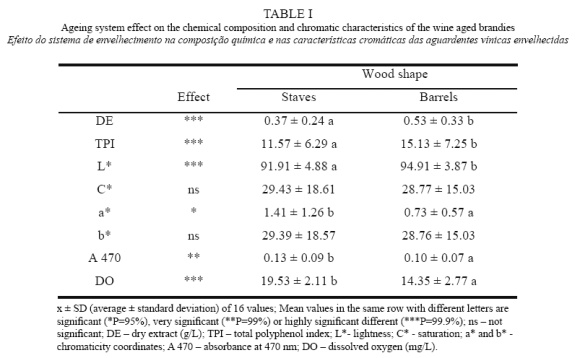
<p>&nbsp;</p>      <p>Brandies aged in wooden barrels present higher dry extract and higher total polyphenol index, but lower colour intensity (inversely proportional to luminosity), lower red hue (a*) and brown hue (A 470) than those aged in stainless steel tanks with  wood staves. Therefore, the greatest enrichment of the chemical composition of the brandies does not correspond to a greater  colour evolution, contradicting the results obtained in several essays performed on the ageing of brandies in the traditional  system (Canas <i>et al.</i>, 2000a; Belchior <i>et al.</i>, 2001; Canas, 2003).</p>      <p>During ageing the brandy is enriched in wood extractable compounds, which contribute to its dry extract. The contents of  such compounds depend both on the wood botanical species and the heat treatment of the barrel (Câmpeanu <i>et al.</i>, 1992).  The heat treatment of the wood used in the two ageing systems is theoretically the same, although it has a greater effect on  the extraction of compounds from the barrels than from the staves. This variability should be partially attributed to the  different kind of heat processes applied together with the wood shape.</p>      <p>Concerning the total phenolic content, given that the distillate has no phenolic compounds (Canas, 2003) the difference  found can be due to the influence of the ageing system. The highest total polyphenol index of brandies aged in wooden barrels  may be related to the higher extraction/diffusion rate of phenolic compounds.</p>      <p>According to Belchior and San-Romão (1982), the extraction of compounds from wood already involves some oxidation, therefore the lowest dissolved oxygen content (corresponding to higher consumption) and the highest content of phenolics  detected in the brandies aged in wooden barrels seem to be linked. </p>      <p>It should be noted that the values of dry extract and total polyphenol index show high correlation (r=0.98), which is in agreement with the results obtained by Canas <i>et al.</i> (2009b). </p>      ]]></body>
<body><![CDATA[<p>As for the chromatic characteristics, there is a faster evolution of colour in the brandies aged in stainless steel tanks,  shown by greater colour intensity and red hue. Although not significant, saturation and yellow hue behave similarly. It is  verified that the colour of the brandy aged in tanks results from a more intense red-yellow combination.</p>      <p>Belchior (1983) found a direct relationship between the total phenolic content and the colour of the aged brandy, and Bakker  <i>et al.</i> (1986) report that the luminosity is inversely related to the content of phenolic compounds. Similar results   were obtained in brandies aged in wooden barrels (Canas <i>et al.</i>, 2000a; Belchior <i>et al.</i>, 2001; Canas, 2003). In the present study, the correlations between the total polyphenol index and the chromatic characteristics, namely the brightness (r=-0.69) and the coordinate a* (r=0.51), are in accordance with the results obtained in the mentioned works.  Therefore, the lowest total phenolic content and lightness of the brandies aged in stainless steel tanks with staves may arise  from unknown reactions that can be associated with the use of two different wood species simultaneously and/or the presence of non-phenolic compounds, which have a great influence on colour, as observed by Canas <i>et al.</i> (2009b). On the other hand, the heat treatment can also be responsible for the observed effect, once the kind of heat intensity and the staves  dimension can promote higher degradation of phenolic compounds (Sarni <i>et al.</i>, 1990; Rabier and Moutounet, 1991; Canas  <i>et al.</i>, 2000c; Canas <i>et al.</i>, 2007), as well as a more intense alteration of the wood structure (Hale <i>et al.</i>,  1999). In addition, the Maillard reactions occurring during the heat treatment origin many volatile (Cutzach <i>et al.</i>,   1997) and non-volatile compounds (Alanon <i>et al.</i>, 2010) in the wood. Avakians <i>et al.</i> (1992) indicated that these  reactions have great influence on the colour of the aged brandy. It is also known that among the non-volatile compounds   resulting from the Maillard reactions, there are some key-chromophores (compounds with high impact on colour) which cause the yellow, red and brown hues (Hofmann <i>et al.</i>, 1998; Gokmen <i>et al.</i>, 2006). The melanoidins belong to this group of chromophores and are closely related to the brown colour in foods (Gokmen <i>et al.</i>, 2006). In the case of  wood, melanoidins are formed during the heat treatment (Borrelli <i>et al.</i>, 2002).</p>      <p>It is important to point out that the relationship between the chemical composition and the colour of the brandy is  different from that observed in red wines aged in different systems (Del Álamo <i>et al.</i>, 2008, De Beer <i>et al.</i>,  2009). This suggests that other compounds not quantified in the dry extract and in the total polyphenol index determine the  colour of brandies. Addict to these factors, the acetaldehyde resulting from the oxidation of ethanol during ageing (Reazin,   1981; Nishimura <i>et al.</i>, 1983), as well as some phenolic aldehydes such as vanillin (Es-Safi <i>et al.</i>, 2000) and   furanic aldehydes such as 5-hydroxymethylfurfural and 5-methylfurfural (Es-Safi <i>et al.</i>, 2000) may also act in   condensation reactions between phenolic compounds present in the brandy, particularly tannins, and influence the chromatic characteristics. </p>      <p>Comparing the absorbance at 470 nm of the brandies from the two ageing systems, there is a higher concentration of  melanoidins in the brandies aged in stainless steel tanks with staves than in those aged in wooden barrels. Thus, the results  of this study are in accordance with the hypothesis raised by Canas <i>et al.</i> (2009b), who consider melanoidins as another  type of colouring compounds formed by the Maillard reactions, which are also present in toasted wood and are likely to be  released into the brandy during the ageing process. On this basis, the highest intensity of toasting (Gokmen <i>et al</i>.,  2006) may have favoured the formation and accumulation of these compounds in the corresponding staves and brandy, whose  concentration did not affect the dry extract but considerably contributed to the colour.</p>      <p>Moreover, oxygen is a key element in the chemical changes of brandy during ageing (Avakiants, 1992; Puech and Mosedale, 1998),  and it is analyzed in order to obtain more information on the phenomena involved in the evolution of the brandy’s composition   during this process. Since there is a continuous and slow diffusion of oxygen through the bung and the wood in the barrels   (Moutounet <i>et al.</i>, 1998; Kelly and Wollan, 2003), which does not occur in stainless steel tanks during ageing, the   lowest level of dissolved oxygen found in the brandies aged in wooden barrels seems to indicate a high consumption in this   situation (Nevares <i>et al.</i>, 2008; Canas <i>et al.</i>, 2009a,b). Despite the surface/volume ratio was equal and the   same botanical species were used in both systems, the differences observed in the brandies are possibly related with the   extraction rate of compounds from the wood and their subsequent transformation in the brandy. Such transformation is associated  with the reactions that occur during ageing - oxidations, esterifications, Maillard reactions, polymerizations and   polycondensations. Puech and Mosedale (1998) state that oxidation is the most important, involving both the compounds of the   distillate and from the wood. The oxidation may be specific to each ageing system and have contributed to the differentiation   of brandies.</p>      <p>Concerning the low molecular weight compounds, the results of the analysis of variance (<a href="#t2">Table II</a>) show a highly significant  effect on the contents of 5-hydroxymethylfurfural, gallic acid, coniferaldehyde and sinapaldehyde, a very significant effect   on the contents of ellagic acid and furfural, and a significant effect for syringaldehyde and the total content of compounds   analysed. It should be noted that the total content of compounds is higher in brandies aged in wooden barrels, which can be distinguished particularly by the content of 5-hydroxymethylfurfural, gallic acid, coniferaldehyde and sinapaldehyde. </p>      <p>&nbsp;</p> <a name="t2"> <img src="/img/revistas/ctv/v27n2/27n2a03t2.jpg">     
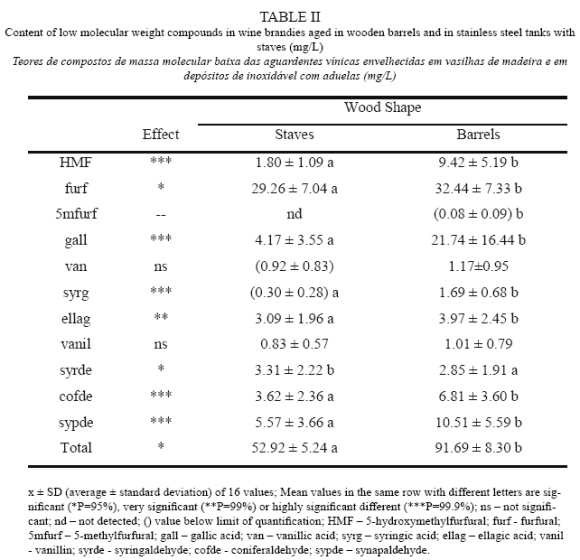
<p>&nbsp;</p>       <p>The contents of furanic aldehydes are higher in the brandies aged in barrels than in those aged in stainless steel tanks with  staves (<a href="#t2">Table II</a>). The furfural is quantitatively the most important compound of the aged brandies in both systems, not only  due to its presence in the distillate (Jeuring and Kuppers, 1980; Canas <i>et al.</i>, 2004; Caldeira <i>et al.</i>, 2010), but also because it exhibits the highest extraction/diffusion rate in the aged brandy (Canas <i>et al.</i>, 2004; Patrício <i>et  al.</i>, 2005). Moreover, furfural results from the degradation of hemicelluloses of the wood during the heat treatment. These  polymers are those with lower thermal resistance (Fengel and Wegener, 1989) and hence are preferentially degraded, contributing  to make furfural the main furanic derivative of the toasted wood (Rabier and Moutounet, 1991; Chatonnet, 1995; Canas <i>et   al.</i>, 2007) and of the corresponding brandies (Canas, 2003).</p>      <p>It is found that the content of phenolic acids is higher in brandies aged in wooden barrels (<a href="#t2">Table II</a>). For gallic acid, the great difference between the ageing systems probably derives from the kind of heat treatment performed owing to the thermal  sensitivity of this compound (Rabier and Moutounet, 1991; Canas <i>et al.</i>, 2000c, 2007), which content usually tends to   decrease from medium toast. Given that the melting point of the gallic acid is 249.9 °C, that is similar to the toasting   temperature that the wood used in both ageing systems underwent, the results obtained suggest that the wood from barrels   suffered the greatest accumulation of gallic acid. Indeed, since the surface/volume ratio is the same in both systems and   therefore did not promote differences in the extraction process, the lowest content of gallic acid in the brandies aged in   stainless steel tanks may be associated with a more intense degradation of this compound during the toasting of the staves   due to their smaller thickness. The ellagic acid proceeds from the degradation of ellagitannins (Chatonnet, 1995). The high   melting point of this acid (around 450 °C) allowing to its accumulation in the wood in the free form that can be release into   the wine brandy during ageing.</p>      ]]></body>
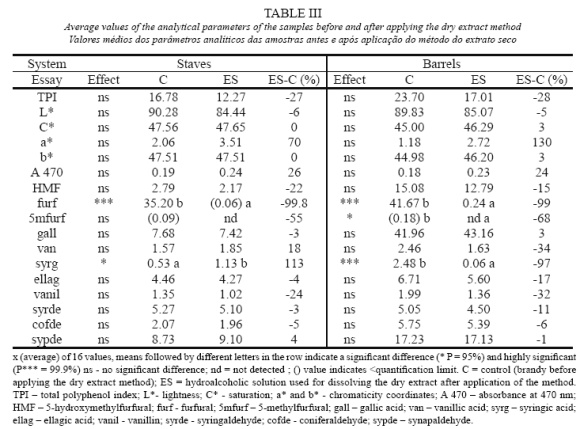
<body><![CDATA[<p>Regarding the phenolic aldehydes, despite the observed variability in the brandies aged in each system, there is a higher concentration in those aged in wooden barrels, except for syringaldehyde (<a href="#t2">Table II</a>). This fact may be related to the type of  chemical reactions that occur in each system and the probability of triggering differently. However, syringaldehyde and  vanillin have a complex profile extraction and may result from: i) very intense toasting; ii) more pronounced oxidative process  in the wood and/or brandies, according to Puech (1984).</p>      <p>To better understand the results of this study, such as the fact that the brandies aged in wooden barrels present higher dry  extract and higher total polyphenol index but less evolved chromatic  characteristics than the brandies aged in stainless steel  tanks with staves, it was performed an essay based on the dry extract method (OIV, 1984). For this purpose, it was used   samples of the brandy with 90 and 180 days of ageing in one wooden barrel and in one stainless steel tank (four modalities),   with three replications. In each modality the comparison was made between an aliquot of control brandy (C) with an aliquot of   the same brandy subjected to the dry extract method and redissolved with an hydroalcoholic solution having the same pH and   alcohol content of the control brandy (ES), in order to obtain relevant information about the possible modification of   brandy’s compounds during the application of the method and its impact on the total polyphenol index and the chromatic   characteristics. </p>      <p>The temperature of 100 °C (method conditions) does not affect significantly the majority of the extractable compounds of  the brandy (<a href="#t3">Table III</a>), although it is registered a highly significant decrease of furfural in the brandies aged in both  systems, a significant increase in syringic acid in the brandies aged in stainless steel tanks with staves and a highly significant decrease of syringic acid in the brandies aged in wooden barrels (<a href="#t3">Table III</a>). Since the furanic aldehydes are  quantified in the dry extract but also in the total polyphenol index (Canas and Belchior, 2012), the detected alteration  implies that the concentration of volatile compounds in the free form (more susceptible to evaporation, oxidation and/or  involvement in other chemical reactions) decreases and thus leads to a decrease of its contribution to the total polyphenol  index. Regarding the phenolic acids, their behaviour can be justified by oxidation and/or degradation during the essay, and  appears to contribute to the decrease of the total polyphenol index. The difference of these acids behaviour in the  hydroalcoholic solutions corresponding to each ageing system after applying the dry extract method, points out once again  that the chemical reactions are likely specific in each ageing system. The concentration of phenolic aldehydes is lower in the  hydroalcoholic solution than in the brandy after applying the dry extract method, except for sinapaldehyde. This outcome   contributes to the decrease in total polyphenol index. The decrease of the content of vanillin results from its evaporation,   as well as from some degradation phenomena, such as oxidation, that also affect the decrease of concentration of   syringaldehyde and coniferaldehyde.</p>       <p>&nbsp;</p> <a name="t3"> <img src="/img/revistas/ctv/v27n2/27n2a03t3.jpg">     
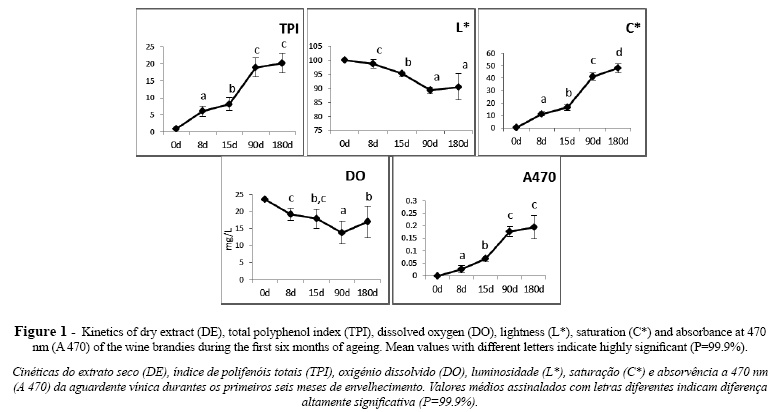
<p>&nbsp;</p>      <p>The results also demonstrate that the total polyphenol index is consistent with that obtained previously (<a href="#t1">Table I</a>), being  higher in the brandies aged in wooden barrels. After applying the dry extract method, it is verified that the total polyphenol  index decreased, in which phenolic compounds and furanic derivatives are quantified (Canas and Belchior, 2012). </p>      <p>For the chromatic characteristics, the results obtained confirm what was previously reported (<a href="#t1">Table I</a>). The increase of  colour intensity after the application of the dry extract method in the brandies can be caused by a great contribution of the  non-phenolic compounds. It is known that the combination of high values of coordinates a* and b* are associated with the topaz  hue. In this assay the coordinates a* and b* do not undergo significant changes. However, despite the slight increase in the  coordinate a* and A 470 after application of the method, it may have contributed to the evolution of the brandy’s colour towards topaz hue. This combined effect can result from the formation of non-phenolic pigments by temperature action and  possibly by oxidation, supporting the hypothesis that the colour of aged brandies in different systems depends on the  non-phenolic and/or volatile compounds.</p>       <p>&nbsp;</p>      <p><b>Effect of the ageing time</b></p>      <p>The <a href="/img/revistas/ctv/v27n2/27n2a03f1.jpg">Figure 1</a> shows that the dry extract and the total polyphenol index of the aged wine brandies present a gradual increase,  minor in the first 15 days of ageing, followed by a marked evolution between 15 and 90 days. The kinetics displayed are in   accordance with the findings of Belchior <i>et al.</i> (2001), Canas <i>et al.</i> (2002) and Patrício <i>et al.</i> (2005).   The dissolved oxygen decreases up to 90 days, followed by an increase up to 180 days of ageing. Similar results were reported   by Canas <i>et al.</i> (2009a). This behaviour can result from a higher consumption of oxygen at the beginning of ageing owing to several reactions in which oxygen participates, particularly in the extraction of wood compounds (Belchior and San-Romão, 1982). At 180 days there is a further increase in the availability of dissolved oxygen, which can be associated with the predominance of  extraction regard to oxidation.</p>      
]]></body>
<body><![CDATA[<p>&nbsp;</p> <a href ="/img/revistas/ctv/v27n2/27n2a03f1.jpg">Figure 1</a>     
<p>&nbsp;</p>      <p>Concerning the evolution of the chromatic characteristics, it is observed a continuous increase of saturation and a decrease  of lightness, thereby being consistent with that described by Canas <i>et al.</i> (2009a). It is inferred that these kinetic  may arise from the increase of phenolic and non-phenolic compounds in the brandy, and found a very strong correlation with   the content of melanoidins. As can be seen in <a href ="/img/revistas/ctv/v27n2/27n2a03f1.jpg">Figure 1</a>, the value of A 470 nm presents a gradual increase even after 90 days   of ageing, and between 90 and 180 days the increase becomes not significant, which may be partly explained by the high   standard deviation associated with the sampling carried out at 180 days. The largest standard deviation at this ageing stage  possibly reflects the influence of several factors: the wood intra-specific variability; the shape of the wood; the variability  associated with the heat treatment to which the wood was subjected. </p>      
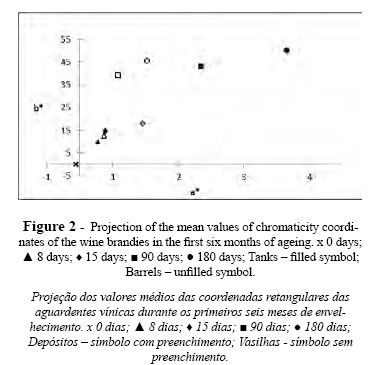
<p>Evaluating the kinetics of the chromaticity coordinates (<a href="#f2">Figure 2</a>), it is found that the raw distillate has a green colour  (corresponding to a negative value of a*), while the colour exhibit by the aged brandies result from the combination of red  (positive values of coordinate a*) and yellow (positive values of coordinate b*) hues. In the first 15 days of ageing, the evolution of red (a*) and yellow (b*) hues is higher than those of the brandies aged in wooden barrels. But after 90 days, in  the brandies aged in stainless steel tanks with staves both hues progressively increase. In the brandies aged in wooden barrels,  it is observed a gradual evolution of the coordinates a* and b* up to 15 days, but after 90 days the yellow hue becomes   predominant since the b* coordinate increase and a* coordinate has a slight variation. </p>       <p>&nbsp;</p> <a name="f2"> <img src="/img/revistas/ctv/v27n2/27n2a03f2.jpg">     
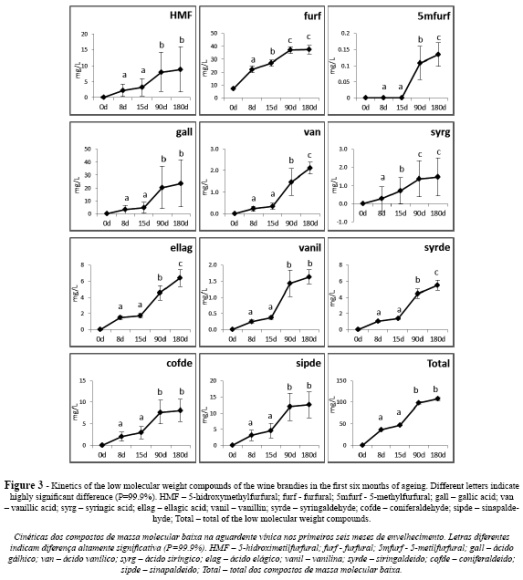
<p>&nbsp;</p>      <p>There are relevant changes in the furanic and phenolic composition of the brandies over the time, shown by the steady increase in the contents of all of the studied low molecular weight compounds (<a href="#f3">Figure 3</a>). The 5-hydroxymethylfurfural, and  especially the 5-methylfurfural, have a slow increase in the initial phase of ageing (first 15 days), whereas the furfural  increase significantly in the same period of time. When comparing the first 15 days with 90 days of ageing, it is clear that  the three furanic aldehydes have a significant increase. From 90 to 180 days the concentrations of furfural and  5-hydroxymethylfurfural not vary significantly. This behaviour may be related to the occurrence of condensation reactions  between these compounds and phenolic compounds present in the brandy (Es-Safi <i>et al.</i>, 2002). Distinctly the  5-methylfurfural continues to increase significantly from 90 to 180 days.</p>      <p>&nbsp;</p> <a name="f3"> <img src="/img/revistas/ctv/v27n2/27n2a03f3.jpg">     
<p>&nbsp;</p>       <p>In the case of phenolic acids, the evolution between 8 and 15 days is only significant for syringic acid. After this phase  vanillic and ellagic acids  increase progressively up to 180 days. The kinetics of these acids may reveal the effect of the   heat treatment of the wood in the brandy’s chemical composition (Nishimura <i>et al.</i>, 1983; Rabier and Moutounet, 1991). Gallic and syringic acids do not show a significant increase between 90 days and 180 days, probably due to the high standard deviation, as mentioned before. </p>      ]]></body>
<body><![CDATA[<p>The phenolic aldehydes show similar kinetics, except for syringaldehyde. The contents of vanillin, coniferaldehyde and  sinapaldehyde have only a significant increase from 15 to 90 days, which is consistent with the results of Belchior <i>et  al.</i> (2001) and Canas <i>et al.</i> (2004), suggesting that the extraction kinetics is more pronounced in this period of  time. The kinetics of syringaldehyde distinguishes itself by a significant increase throughout the ageing period studied.  Recalling that the benzoic aldehydes (vanillin and syringaldehyde) mainly result from the oxidation of cinnamic aldehydes  (coniferaldehyde and sinapaldehyde) proceeding from the lignin degradation during the heat treatment of the wood and/or its  hydroalcoholysis during ageing (Puech, 1984), Quaresma (2000) states that the kinetics of vanillin and coniferaldehyde and those of syringaldehyde and sinapaldehyde appear to be related, since the slower increase of coniferaldehyde and sinapaldehyde  corresponds to a continuous increase in the concentration of vanillin and syringaldehyde, respectively. </p>      <p>The analysis of interactions indicates that the kinetics of lightness and 5-hydroxymethylfurfural (highly significant),  gallic acid (very significant), and coordinate a *, dissolved oxygen, A 470, syringic acid and 5-methylfurfural (significant)  depend on the ageing system.</p>      <p>&nbsp;</p>      <p><b>CONCLUSIONS</b></p>      <p>This study provides, for the first time, specific information about the physicochemical characterization of wine brandies  aged in alternative systems at industrial-scale.</p>      <p>Under these experimental conditions, it is found that after six months of ageing the alternative system comprising stainless  steel tanks with staves in contact with the wine brandy did not allow the acquisition of the physicochemical characteristics  achieved by the same wine brandy aged in wooden barrels. However, the colour evolution is greater in the brandies aged in the alternative system, which raises issues regarding the relationship between the chemical composition and the chromatic  characteristics of the wine brandy aged in different systems.</p>      <p>The brandies aged in barrels present higher dry extract, higher total polyphenol index and higher concentration of phenolic  and furanic compounds, i.e., have the richest chemical composition, but lower chromatic evolution than the brandies aged in  stainless steel tanks with staves. This negative correlation between chemical composition and the chromatic characteristics  suggests the existence of unknown reactions that may have been caused by the use of two kinds of wood simultaneously, by  specific phenomena in each ageing system, and/or the presence of non-phenolic compounds that influence the colour of the aged  brandies.</p>      <p>The results obtained for the absorbance at 470 nm and from the dry extract essay reinforce the hypothesis of the crucial  role of some non-phenolic compounds to the colour of the aged brandies, that may explains the apparent inconsistency between  the chemical composition and the chromatic characteristics, as well as the difference to the positive correlations found in  previous studies (Canas <i>et al.</i>, 2000a; Belchior <i>et al.</i>, 2001) on the traditional ageing of wine brandies.</p>      <p>Among the low molecular weight compounds of the studied brandies, the 5-hydroxymethylfurfural, gallic acid, coniferaldehyde  and sinapaldehyde seem to be chemical markers of the ageing system.</p>      <p>Regarding the ageing time, there is a significant increase of furanic and phenolic compounds release from the wood into the  brandy, which indicates that extraction was preponderant to oxidation in both ageing systems during the first six months of  ageing.</p>      ]]></body>
<body><![CDATA[<p>The ongoing research of wine brandy ageing until the second year will provide information that may contribute to clarify  the doubts about the role of phenolic and non-phenolic compounds on the chromatic characteristics, and also about the main  related phenomena.</p>      <p>&nbsp;</p>      <p><b>ACKNOWLEDGEMENTS</b></p>      <p>This work had the financial support of Tanoaria J.M. Gonçalves, Adega Cooperativa de Lourinhã and INIAV-Dois Portos.</p>      <p>&nbsp;</p>       <p><b>REFERENCES</b></p>      <!-- ref --><p>Afonso V.L.G., 2002. Sensory descriptive analysis between white wines fermented with oak chips and in barrels. <i>J. Food  Sci. </i>, <b>67</b>, 2415-2419.    &nbsp;&nbsp;&nbsp;&nbsp;&nbsp;&nbsp;&nbsp;&nbsp;[&#160;<a href="javascript:void(0);" onclick="javascript: window.open('/scielo.php?script=sci_nlinks&ref=000099&pid=S0254-0223201200020000300001&lng=','','width=640,height=500,resizable=yes,scrollbars=1,menubar=yes,');">Links</a>&#160;]<!-- end-ref --></p>      <!-- ref --><p>Arapitsas P., Antonopoulos A., Stefanou E., Dourtoglou V.G., 2004. Artificial ageing of wines using oak chips. <i> Food  Chem.</i>, <b>86</b>, 563-570.    &nbsp;&nbsp;&nbsp;&nbsp;&nbsp;&nbsp;&nbsp;&nbsp;[&#160;<a href="javascript:void(0);" onclick="javascript: window.open('/scielo.php?script=sci_nlinks&ref=000101&pid=S0254-0223201200020000300002&lng=','','width=640,height=500,resizable=yes,scrollbars=1,menubar=yes,');">Links</a>&#160;]<!-- end-ref --></p>      ]]></body>
<body><![CDATA[<!-- ref --><p>Alañón M.E., Rubio H., Diaz-Maroto M.C., Pérez-Coello M.S., 2010. Monosaccharide anhydrides, new markers of toasted oak  wood used for ageing wines and distillates. <i>Food Chem.</i>, <b>119</b>, 505-512.    &nbsp;&nbsp;&nbsp;&nbsp;&nbsp;&nbsp;&nbsp;&nbsp;[&#160;<a href="javascript:void(0);" onclick="javascript: window.open('/scielo.php?script=sci_nlinks&ref=000103&pid=S0254-0223201200020000300003&lng=','','width=640,height=500,resizable=yes,scrollbars=1,menubar=yes,');">Links</a>&#160;]<!-- end-ref --></p>      <!-- ref --><p>Avakiants S., 1992. Régulation des processus de vieillissement des eaux-de-vie. <i>In: Élaboration et connaissance des  spiritueux</i>. 595-600, Cantagrel R. (ed.), Lavoisier - TEC &amp; DOC, Paris.    &nbsp;&nbsp;&nbsp;&nbsp;&nbsp;&nbsp;&nbsp;&nbsp;[&#160;<a href="javascript:void(0);" onclick="javascript: window.open('/scielo.php?script=sci_nlinks&ref=000105&pid=S0254-0223201200020000300004&lng=','','width=640,height=500,resizable=yes,scrollbars=1,menubar=yes,');">Links</a>&#160;]<!-- end-ref --></p>      <!-- ref --><p>Bakker J., Bridle P., Timberlake C. F., 1986. Tristimulus measurements (CIELab 76) of port wine colour. <i>Vitis</i>,  <b>25</b>, 67-78.    &nbsp;&nbsp;&nbsp;&nbsp;&nbsp;&nbsp;&nbsp;&nbsp;[&#160;<a href="javascript:void(0);" onclick="javascript: window.open('/scielo.php?script=sci_nlinks&ref=000107&pid=S0254-0223201200020000300005&lng=','','width=640,height=500,resizable=yes,scrollbars=1,menubar=yes,');">Links</a>&#160;]<!-- end-ref --></p>      <!-- ref --><p>Belchior A.P., Almeida T.G.T., Mateus A.M., Canas S., 2003. Ensaio laboratorial sobre a cinética de extracção de compostos  de baixa massa molecular da madeira pela aguardente. <i>Ciência Téc. Vitiv.</i>, <b>18</b>, 29-41.    &nbsp;&nbsp;&nbsp;&nbsp;&nbsp;&nbsp;&nbsp;&nbsp;[&#160;<a href="javascript:void(0);" onclick="javascript: window.open('/scielo.php?script=sci_nlinks&ref=000109&pid=S0254-0223201200020000300006&lng=','','width=640,height=500,resizable=yes,scrollbars=1,menubar=yes,');">Links</a>&#160;]<!-- end-ref --></p>      <!-- ref --><p>Belchior A.P, Caldeira I., Costa S., Lopes C., Tralhão G., Ferrão A.F.M., Mateus Ana M., 2001. Evolução das características  físicoquímicas e organolépticas de aguardentes Lourinhã ao longo de cinco anos de envelhecimento em madeiras de carvalho e  castanheiro. <i>Ciência Téc. Vitiv.</i>, <b>16</b>, 81-94.    &nbsp;&nbsp;&nbsp;&nbsp;&nbsp;&nbsp;&nbsp;&nbsp;[&#160;<a href="javascript:void(0);" onclick="javascript: window.open('/scielo.php?script=sci_nlinks&ref=000111&pid=S0254-0223201200020000300007&lng=','','width=640,height=500,resizable=yes,scrollbars=1,menubar=yes,');">Links</a>&#160;]<!-- end-ref --></p>      ]]></body>
<body><![CDATA[<!-- ref --><p>Belchior A.P., Mateus, A.M., Soares A.M., 2005. Comparaison du vieillissement de l’eau-de-vie Lourinhã en fûts de  châtaignier et de chêne et en deux volumes. <i>Ciência Téc. Vitiv.,</i> <b>20</b>, 91-103.    &nbsp;&nbsp;&nbsp;&nbsp;&nbsp;&nbsp;&nbsp;&nbsp;[&#160;<a href="javascript:void(0);" onclick="javascript: window.open('/scielo.php?script=sci_nlinks&ref=000113&pid=S0254-0223201200020000300008&lng=','','width=640,height=500,resizable=yes,scrollbars=1,menubar=yes,');">Links</a>&#160;]<!-- end-ref --></p>      <!-- ref --><p>Belchior A. P., San-Romão V., 1982. Influence de l’oxiygène et de la lumière sur l’evolution de la composition phenólique  des eaux-de-vie vielles en bois de chêne. <i>Bull. Liason Groupe Polyphenols</i>, <b>11</b>, 598-604.    &nbsp;&nbsp;&nbsp;&nbsp;&nbsp;&nbsp;&nbsp;&nbsp;[&#160;<a href="javascript:void(0);" onclick="javascript: window.open('/scielo.php?script=sci_nlinks&ref=000115&pid=S0254-0223201200020000300009&lng=','','width=640,height=500,resizable=yes,scrollbars=1,menubar=yes,');">Links</a>&#160;]<!-- end-ref --></p>      <!-- ref --><p>Borrelli R. C., Visconti A., Memmella C., Anese M., Fogliano V., 2002. Chemical characterization and antioxidante properties  of coffee melanoidins. <i>J. Agric. Food Chem. </i>, <b>50</b>, 6527-6533.    &nbsp;&nbsp;&nbsp;&nbsp;&nbsp;&nbsp;&nbsp;&nbsp;[&#160;<a href="javascript:void(0);" onclick="javascript: window.open('/scielo.php?script=sci_nlinks&ref=000117&pid=S0254-0223201200020000300010&lng=','','width=640,height=500,resizable=yes,scrollbars=1,menubar=yes,');">Links</a>&#160;]<!-- end-ref --></p>      <!-- ref --><p>Cabrita M.J., Barrocas Dias C., Costa Freitas A.M., 2011. Phenolic acids, phenolic aldehydes and furanic derivatives in oak chips: American vs. French Oaks. <i>S. Afr. J. Enol. Vitic.</i>, <b>32</b>, 204-211.    &nbsp;&nbsp;&nbsp;&nbsp;&nbsp;&nbsp;&nbsp;&nbsp;[&#160;<a href="javascript:void(0);" onclick="javascript: window.open('/scielo.php?script=sci_nlinks&ref=000119&pid=S0254-0223201200020000300011&lng=','','width=640,height=500,resizable=yes,scrollbars=1,menubar=yes,');">Links</a>&#160;]<!-- end-ref --></p>      <!-- ref --><p>Caldeira I., Anjos O., Portal V., Belchior A.P., Canas S., 2010. Sensory modifications of wine- brandy aged with chestnut  and oak wood fragments in comparison to wooden barrels. <i>Anal. Chim. Acta</i>, <b>660</b>, 43-52.    &nbsp;&nbsp;&nbsp;&nbsp;&nbsp;&nbsp;&nbsp;&nbsp;[&#160;<a href="javascript:void(0);" onclick="javascript: window.open('/scielo.php?script=sci_nlinks&ref=000121&pid=S0254-0223201200020000300012&lng=','','width=640,height=500,resizable=yes,scrollbars=1,menubar=yes,');">Links</a>&#160;]<!-- end-ref --></p>      ]]></body>
<body><![CDATA[<!-- ref --><p>Caldeira I., Mateus A.M., Belchior A.P., 2006. Flavour and odour profile modifications during the first five years of  Lourinhã brandy maturation on different wooden barrels. <i>Anal. Chim. Acta </i>, <b>563</b>, 264-273.    &nbsp;&nbsp;&nbsp;&nbsp;&nbsp;&nbsp;&nbsp;&nbsp;[&#160;<a href="javascript:void(0);" onclick="javascript: window.open('/scielo.php?script=sci_nlinks&ref=000123&pid=S0254-0223201200020000300013&lng=','','width=640,height=500,resizable=yes,scrollbars=1,menubar=yes,');">Links</a>&#160;]<!-- end-ref --></p>      <!-- ref --><p>Câmpeanu R., Ionescu M., Gavrilescu I., 1992. Evolution des divers constituants volatils et non volatils des eaux-de-vie de vin au cour de leur vieillissement en fûts de chêne. <i>In: Élaboration et connaissance des spiritueux</i>, 589-594,  Cantagrel R. (Ed.), Lavoisier – Tec; Doc, Paris.    &nbsp;&nbsp;&nbsp;&nbsp;&nbsp;&nbsp;&nbsp;&nbsp;[&#160;<a href="javascript:void(0);" onclick="javascript: window.open('/scielo.php?script=sci_nlinks&ref=000125&pid=S0254-0223201200020000300014&lng=','','width=640,height=500,resizable=yes,scrollbars=1,menubar=yes,');">Links</a>&#160;]<!-- end-ref --></p>      <!-- ref --><p>Canas, S. 2003. <i>Estudo dos compostos extraíveis de madeira (Carvalho e Castanheiro) e dos processos de extracção na  perspectiva do envelhecimento em Enologia.</i> 303 p. Tese de Doutouramento em Engenharia Agro-Industrial, UTL-ISA, Lisboa,  Portugal.    &nbsp;&nbsp;&nbsp;&nbsp;&nbsp;&nbsp;&nbsp;&nbsp;[&#160;<a href="javascript:void(0);" onclick="javascript: window.open('/scielo.php?script=sci_nlinks&ref=000127&pid=S0254-0223201200020000300015&lng=','','width=640,height=500,resizable=yes,scrollbars=1,menubar=yes,');">Links</a>&#160;]<!-- end-ref --></p>      <!-- ref --><p>Canas S., Belchior A.P., 2012. Effects of caramel addiction on the characteristics of wine brandies. <i>LWT</i> (in press).    &nbsp;&nbsp;&nbsp;&nbsp;&nbsp;&nbsp;&nbsp;&nbsp;[&#160;<a href="javascript:void(0);" onclick="javascript: window.open('/scielo.php?script=sci_nlinks&ref=000129&pid=S0254-0223201200020000300016&lng=','','width=640,height=500,resizable=yes,scrollbars=1,menubar=yes,');">Links</a>&#160;]<!-- end-ref --></p>      <!-- ref --><p>Canas S., Belchior A.P., Caldeira I., Spranger M.I., Bruno de Sousa R., 2000a. La couleur et son évolution dans les  eaux-de-vie <i>Lourinhã</i> pendant les trois premières années du vieillissement. <i> Ciência Téc. Vitiv.</i>, <b>15</b>, 1-14.    &nbsp;&nbsp;&nbsp;&nbsp;&nbsp;&nbsp;&nbsp;&nbsp;[&#160;<a href="javascript:void(0);" onclick="javascript: window.open('/scielo.php?script=sci_nlinks&ref=000131&pid=S0254-0223201200020000300017&lng=','','width=640,height=500,resizable=yes,scrollbars=1,menubar=yes,');">Links</a>&#160;]<!-- end-ref --></p>      ]]></body>
<body><![CDATA[<!-- ref --><p >Canas S., Belchior A.P., Falcão A., Gonçalves J.A., Spranger M.I., Bruno de Sousa R., 2007. Effect of heat treatment on  the thermal and chemical modifications of oak and chestnut wood used in brandy ageing. <i>Ciência Téc. Vitiv.</i>, <b>22</b>, 5-14.    &nbsp;&nbsp;&nbsp;&nbsp;&nbsp;&nbsp;&nbsp;&nbsp;[&#160;<a href="javascript:void(0);" onclick="javascript: window.open('/scielo.php?script=sci_nlinks&ref=000133&pid=S0254-0223201200020000300018&lng=','','width=640,height=500,resizable=yes,scrollbars=1,menubar=yes,');">Links</a>&#160;]<!-- end-ref --></p>      <!-- ref --><p>Canas S., Belchior A.P., Mateus A.M., Spranger M.I., Bruno de Sousa R., 2002. Kinetics of impregnation/evaporation and  release of phenolic compounds from wood to brandy in experimental model. <i>Ciência Téc. Vitiv.</i>, <b>17</b>, 1-14.    &nbsp;&nbsp;&nbsp;&nbsp;&nbsp;&nbsp;&nbsp;&nbsp;[&#160;<a href="javascript:void(0);" onclick="javascript: window.open('/scielo.php?script=sci_nlinks&ref=000135&pid=S0254-0223201200020000300019&lng=','','width=640,height=500,resizable=yes,scrollbars=1,menubar=yes,');">Links</a>&#160;]<!-- end-ref --></p>      <!-- ref --><p>Canas, S., Belchior, A.P., Spranger, M.I., Bruno de Sousa, R., 2003. High-performance liquid chromatography method for analysis of  phenolic acids, phenolic and furanic derivatives in brandies. Development and validation. <i>J. Sep. Sci.</i>, <b>26</b>,  496-502.    &nbsp;&nbsp;&nbsp;&nbsp;&nbsp;&nbsp;&nbsp;&nbsp;[&#160;<a href="javascript:void(0);" onclick="javascript: window.open('/scielo.php?script=sci_nlinks&ref=000137&pid=S0254-0223201200020000300020&lng=','','width=640,height=500,resizable=yes,scrollbars=1,menubar=yes,');">Links</a>&#160;]<!-- end-ref --></p>      <!-- ref --><p>Canas S., Caldeira I., Belchior A.P., 2009a. Comparison of alternative systems for the ageing of wine brandy. Oxygenation  and wood shape effect. <i>Ciência Téc. Vitiv.</i>, <b>24</b>, 33-40.    &nbsp;&nbsp;&nbsp;&nbsp;&nbsp;&nbsp;&nbsp;&nbsp;[&#160;<a href="javascript:void(0);" onclick="javascript: window.open('/scielo.php?script=sci_nlinks&ref=000139&pid=S0254-0223201200020000300021&lng=','','width=640,height=500,resizable=yes,scrollbars=1,menubar=yes,');">Links</a>&#160;]<!-- end-ref --></p>      <!-- ref --><p>Canas S., Caldeira I., Belchior A.P., 2009b. Comparison of alternative systems for the ageing of wine brandy. Wood shape and wood botanical effect.<i>Ciência Téc. Vitiv.</i>, <b>24</b>, 91-99.    &nbsp;&nbsp;&nbsp;&nbsp;&nbsp;&nbsp;&nbsp;&nbsp;[&#160;<a href="javascript:void(0);" onclick="javascript: window.open('/scielo.php?script=sci_nlinks&ref=000141&pid=S0254-0223201200020000300022&lng=','','width=640,height=500,resizable=yes,scrollbars=1,menubar=yes,');">Links</a>&#160;]<!-- end-ref --></p>      ]]></body>
<body><![CDATA[<!-- ref --><p>Canas S., Caldeira I., Belchior A.P., Spranger M.I., Clímaco M.C., Bruno de Sousa R., 2011. Chestnut wood: A sustainable  alternative for the aging of wine brandies. <i>In: Food quality: Control, Analysis and Consumer Concerns</i>, 181-229. Medina  D., Laine A.(Eds.) Nova Science Publishers, Inc., New York.    &nbsp;&nbsp;&nbsp;&nbsp;&nbsp;&nbsp;&nbsp;&nbsp;[&#160;<a href="javascript:void(0);" onclick="javascript: window.open('/scielo.php?script=sci_nlinks&ref=000143&pid=S0254-0223201200020000300023&lng=','','width=640,height=500,resizable=yes,scrollbars=1,menubar=yes,');">Links</a>&#160;]<!-- end-ref --></p>      <!-- ref --><p>Canas S., Casanova V., Belchior A.P., 2008. Antioxidant activity and phenolic content of Portuguese wine aged brandies.  <i>J. Food Compos. Anal.</i>, <b>21</b>, 626-633.    &nbsp;&nbsp;&nbsp;&nbsp;&nbsp;&nbsp;&nbsp;&nbsp;[&#160;<a href="javascript:void(0);" onclick="javascript: window.open('/scielo.php?script=sci_nlinks&ref=000145&pid=S0254-0223201200020000300024&lng=','','width=640,height=500,resizable=yes,scrollbars=1,menubar=yes,');">Links</a>&#160;]<!-- end-ref --></p>      <p>Canas S., Grazina N., Spranger M.I., Belchior A.P., 2000c. Modelisation of heat treatment of Portuguese oak wood (<i>Quercus  pyrenaica</i> Willd.). Analysis of the behaviour of low molecular weight phenolic compounds. <i>Ciência Téc. Vitiv.</i>,   <b>15</b>, 75-94.</p>      <!-- ref --><p>Canas, S., Leandro, M. C., Spranger, M. I., Belchior, A.P. 1999. Low molecular weight organic compounds of chestnut wood (<i>Castanea sativa</i>  L.) and corresponding aged brandies. <i>J. Agric. Food Chem.</i>, <b>47</b>, 5023–5030.    &nbsp;&nbsp;&nbsp;&nbsp;&nbsp;&nbsp;&nbsp;&nbsp;[&#160;<a href="javascript:void(0);" onclick="javascript: window.open('/scielo.php?script=sci_nlinks&ref=000148&pid=S0254-0223201200020000300026&lng=','','width=640,height=500,resizable=yes,scrollbars=1,menubar=yes,');">Links</a>&#160;]<!-- end-ref --></p>      <p>Canas S., Leandro M.C., Spranger M.I., Belchior A.P., 2000b. Influence of botanical species and geographical origin on the  content of low molecular weight phenolic compounds of woods used in Portuguese cooperage. <i>Holzforschung</i>, <b>54</b>,   255-261.</p>      <!-- ref --><p>Canas S., Spranger M.I., Belchior A.P., Bruno-de-Sousa R., 2004. Isolation and identification by LC-ESI-MS of hydrolyzable  tannins from <i>Quercus pyrenaica </i>Willd. and <i>Castanea sativa</i>Mill. heartwoods. <i>In: Proceedings of the 4th Tannin  Conference. </i>4. Philadelphia.    &nbsp;&nbsp;&nbsp;&nbsp;&nbsp;&nbsp;&nbsp;&nbsp;[&#160;<a href="javascript:void(0);" onclick="javascript: window.open('/scielo.php?script=sci_nlinks&ref=000151&pid=S0254-0223201200020000300028&lng=','','width=640,height=500,resizable=yes,scrollbars=1,menubar=yes,');">Links</a>&#160;]<!-- end-ref --></p>      ]]></body>
<body><![CDATA[<!-- ref --><p>Chang A., 2004. The effects of different accelerating techniques on maize wine maturation. <i>Food Chem.</i>, <b>86</b>,  61-68.    &nbsp;&nbsp;&nbsp;&nbsp;&nbsp;&nbsp;&nbsp;&nbsp;[&#160;<a href="javascript:void(0);" onclick="javascript: window.open('/scielo.php?script=sci_nlinks&ref=000153&pid=S0254-0223201200020000300029&lng=','','width=640,height=500,resizable=yes,scrollbars=1,menubar=yes,');">Links</a>&#160;]<!-- end-ref --></p>      <!-- ref --><p>Chatonnet P., 1995. <i>Influence dés procédés de tonnellerie et des conditions d’élevage sur la composition et la qualité  de vins élevé en fûts de chêne</i>. 268 p. Thèse doctorat, Université de Bordeaux II, Institut d’oenologie: Bordeaux.    &nbsp;&nbsp;&nbsp;&nbsp;&nbsp;&nbsp;&nbsp;&nbsp;[&#160;<a href="javascript:void(0);" onclick="javascript: window.open('/scielo.php?script=sci_nlinks&ref=000155&pid=S0254-0223201200020000300030&lng=','','width=640,height=500,resizable=yes,scrollbars=1,menubar=yes,');">Links</a>&#160;]<!-- end-ref --> </p>      <!-- ref --><p>Cutzach I., Chatonnet P., Henry R., Dubourdieu, 1997. Identification of volatile compounds with a “toasty” aroma in heated  oak used in barrel making. <i>J. Agric. Food Chem.</i>, <b>45</b>, 2217-2224.    &nbsp;&nbsp;&nbsp;&nbsp;&nbsp;&nbsp;&nbsp;&nbsp;[&#160;<a href="javascript:void(0);" onclick="javascript: window.open('/scielo.php?script=sci_nlinks&ref=000157&pid=S0254-0223201200020000300031&lng=','','width=640,height=500,resizable=yes,scrollbars=1,menubar=yes,');">Links</a>&#160;]<!-- end-ref --></p>      <!-- ref --><p>De Beer D., Joubert E., Marais J., du Toit W., Fourie B., ManleyM., 2009. Characterisation of pinotage wine during  maturation on different oak products. <i>S. Afr. J. Enol. Vitic.</i>, <b>29</b>, 39-49.    &nbsp;&nbsp;&nbsp;&nbsp;&nbsp;&nbsp;&nbsp;&nbsp;[&#160;<a href="javascript:void(0);" onclick="javascript: window.open('/scielo.php?script=sci_nlinks&ref=000159&pid=S0254-0223201200020000300032&lng=','','width=640,height=500,resizable=yes,scrollbars=1,menubar=yes,');">Links</a>&#160;]<!-- end-ref --></p>      <!-- ref --><p>Del Álamo M., Nevares I., Gallego L., Martin C., Merino S., 2008. Ageing markers from bottled red wine aged with chips,  staves and barrels. <i>Anal. Chim. Acta.</i>, <b>621</b>, 86-99.    &nbsp;&nbsp;&nbsp;&nbsp;&nbsp;&nbsp;&nbsp;&nbsp;[&#160;<a href="javascript:void(0);" onclick="javascript: window.open('/scielo.php?script=sci_nlinks&ref=000161&pid=S0254-0223201200020000300033&lng=','','width=640,height=500,resizable=yes,scrollbars=1,menubar=yes,');">Links</a>&#160;]<!-- end-ref --></p>      ]]></body>
<body><![CDATA[<!-- ref --><p>Del Álamo M., Nevares I., Gallego L., Simón B., Cadahía E., 2010. Micro-oxigenation strategy depends on the origin and size  of oak ships or staves durins accelerated red wine aging. <i>Anal. Chim. Acta</i>, <b>660</b>, 92-101.    &nbsp;&nbsp;&nbsp;&nbsp;&nbsp;&nbsp;&nbsp;&nbsp;[&#160;<a href="javascript:void(0);" onclick="javascript: window.open('/scielo.php?script=sci_nlinks&ref=000163&pid=S0254-0223201200020000300034&lng=','','width=640,height=500,resizable=yes,scrollbars=1,menubar=yes,');">Links</a>&#160;]<!-- end-ref --></p>      <!-- ref --><p>Doussot F., Jéso B., Quideau S., Pardon P., 2002. Extractives content in cooperage oak wood during natural seasoning and  toasting, influence of tree species, geographic location, and single-tree effects. <i>J. Agric. Food Chem.</i>, <b>50</b>, 5955-5961.    &nbsp;&nbsp;&nbsp;&nbsp;&nbsp;&nbsp;&nbsp;&nbsp;[&#160;<a href="javascript:void(0);" onclick="javascript: window.open('/scielo.php?script=sci_nlinks&ref=000165&pid=S0254-0223201200020000300035&lng=','','width=640,height=500,resizable=yes,scrollbars=1,menubar=yes,');">Links</a>&#160;]<!-- end-ref --></p>      <!-- ref --><p>Eiriz N., 2007. Fragmentos de madeira de carvalho no envelhecimento de vinhos tintos. Dissertação do curso de mestrado em  Tecnologia Alimentar/ qualidade, Faculdade de ciências e tecnologia da Universidade Nova de Lisboa.    &nbsp;&nbsp;&nbsp;&nbsp;&nbsp;&nbsp;&nbsp;&nbsp;[&#160;<a href="javascript:void(0);" onclick="javascript: window.open('/scielo.php?script=sci_nlinks&ref=000167&pid=S0254-0223201200020000300036&lng=','','width=640,height=500,resizable=yes,scrollbars=1,menubar=yes,');">Links</a>&#160;]<!-- end-ref --></p>      <!-- ref --><p>Es-Safi N., Cheynier V., Moutounet M., 2000. Study of the reactions between (+)-catechin and furfural derivatives in the  presence or absence of anthocyanins and their implication in food color change. <i>J. Agric. Food Chem.</i>, <b>48</b>, 5946-5954.    &nbsp;&nbsp;&nbsp;&nbsp;&nbsp;&nbsp;&nbsp;&nbsp;[&#160;<a href="javascript:void(0);" onclick="javascript: window.open('/scielo.php?script=sci_nlinks&ref=000169&pid=S0254-0223201200020000300037&lng=','','width=640,height=500,resizable=yes,scrollbars=1,menubar=yes,');">Links</a>&#160;]<!-- end-ref --></p>      <!-- ref --><p>Es-Safi N., Cheynier V., Moutounet M., 2002. Role of aldehydes in the condensation of phenolic compounds with emphasis on  food organoleptic properties. <i>In: Proceedings of the XXI <sup>th</sup> International Conference on Polyphenols.</i> vol.1,  217-218. El Hadrami I. (Ed.), Marrekech, Morocco.    &nbsp;&nbsp;&nbsp;&nbsp;&nbsp;&nbsp;&nbsp;&nbsp;[&#160;<a href="javascript:void(0);" onclick="javascript: window.open('/scielo.php?script=sci_nlinks&ref=000171&pid=S0254-0223201200020000300038&lng=','','width=640,height=500,resizable=yes,scrollbars=1,menubar=yes,');">Links</a>&#160;]<!-- end-ref --></p>      ]]></body>
<body><![CDATA[<!-- ref --><p>Fan W., Xu Y., Yu A., 2006. Influence of oak chips geographical origin, toast level, dosage and aging time on volatile compounds of apple cider. <i>J. Inst. Brew.</i>, <b>112</b>, 255-263.    &nbsp;&nbsp;&nbsp;&nbsp;&nbsp;&nbsp;&nbsp;&nbsp;[&#160;<a href="javascript:void(0);" onclick="javascript: window.open('/scielo.php?script=sci_nlinks&ref=000173&pid=S0254-0223201200020000300039&lng=','','width=640,height=500,resizable=yes,scrollbars=1,menubar=yes,');">Links</a>&#160;]<!-- end-ref --></p>      <!-- ref --><p>Fengel, D., Wegener, G., 1989. <i>Wood chemistry, ultrastructure, reactions.</i> 319–342. Walter de Gruyter &amp; Co, Berlin.    &nbsp;&nbsp;&nbsp;&nbsp;&nbsp;&nbsp;&nbsp;&nbsp;[&#160;<a href="javascript:void(0);" onclick="javascript: window.open('/scielo.php?script=sci_nlinks&ref=000175&pid=S0254-0223201200020000300040&lng=','','width=640,height=500,resizable=yes,scrollbars=1,menubar=yes,');">Links</a>&#160;]<!-- end-ref --></p>      <!-- ref --><p>Gokmen V. Senyuva H.Z., 2006. Study of colour and acrylamide formation in coffee, wheat flour and potato chips during  heating. <i>Food Chem.</i>, <b>99</b>, 238-243.    &nbsp;&nbsp;&nbsp;&nbsp;&nbsp;&nbsp;&nbsp;&nbsp;[&#160;<a href="javascript:void(0);" onclick="javascript: window.open('/scielo.php?script=sci_nlinks&ref=000177&pid=S0254-0223201200020000300041&lng=','','width=640,height=500,resizable=yes,scrollbars=1,menubar=yes,');">Links</a>&#160;]<!-- end-ref --></p>      <!-- ref --><p>Hale M. D., McCafferty  K., Larmie E., Newton J., Swan J. S., 1999. The influence of oak seasoning and toasting parameters  on the composition an d quality of the wine. <i>Am. J. Enol. Vit.</i>, <b>50</b>, 495-502.    &nbsp;&nbsp;&nbsp;&nbsp;&nbsp;&nbsp;&nbsp;&nbsp;[&#160;<a href="javascript:void(0);" onclick="javascript: window.open('/scielo.php?script=sci_nlinks&ref=000179&pid=S0254-0223201200020000300042&lng=','','width=640,height=500,resizable=yes,scrollbars=1,menubar=yes,');">Links</a>&#160;]<!-- end-ref --></p>      <!-- ref --><p>Hofmann T., 1998. Characterization of the most intense coloured compounds from Maillard reactions of pentoses by application  of colour dilution analysis. <i>Carbohydr Res.</i>, <b>313</b>, 203-213.    &nbsp;&nbsp;&nbsp;&nbsp;&nbsp;&nbsp;&nbsp;&nbsp;[&#160;<a href="javascript:void(0);" onclick="javascript: window.open('/scielo.php?script=sci_nlinks&ref=000181&pid=S0254-0223201200020000300043&lng=','','width=640,height=500,resizable=yes,scrollbars=1,menubar=yes,');">Links</a>&#160;]<!-- end-ref --> </p>      ]]></body>
<body><![CDATA[<!-- ref --><p> Jeuring H. J., Kuppers J.E.M., 1980. High performance liquid chromatography of furfural and hydroxymethylfurfural in  spirits and honey. <i>J. Assoc. Off. Anal. Chem.</i>, <b>63</b>, 1215-1218.    &nbsp;&nbsp;&nbsp;&nbsp;&nbsp;&nbsp;&nbsp;&nbsp;[&#160;<a href="javascript:void(0);" onclick="javascript: window.open('/scielo.php?script=sci_nlinks&ref=000183&pid=S0254-0223201200020000300044&lng=','','width=640,height=500,resizable=yes,scrollbars=1,menubar=yes,');">Links</a>&#160;]<!-- end-ref --></p>      <!-- ref --><p>Jordão A. M., Ricardo da Silva J.M., Laureano O., 2005. Comparison of volatile composition of cooperage oak wood of  different origins (<i>Quercus pyrenaica </i>vs. <i>Quercus alba</i> and <i>Quercus petraea</i>). <i>Mitteilungen Klosterneuburg</i>,  <b>55</b>, 22-31.    &nbsp;&nbsp;&nbsp;&nbsp;&nbsp;&nbsp;&nbsp;&nbsp;[&#160;<a href="javascript:void(0);" onclick="javascript: window.open('/scielo.php?script=sci_nlinks&ref=000185&pid=S0254-0223201200020000300045&lng=','','width=640,height=500,resizable=yes,scrollbars=1,menubar=yes,');">Links</a>&#160;]<!-- end-ref --></p>      <!-- ref --><p>Kelly M., Wollan D., 2003. Micro-oxygenation of wine in barrels.<i>Aust. &amp; N. Z. Grap. Wine</i>, Annual Technical Issue,  45-50.    &nbsp;&nbsp;&nbsp;&nbsp;&nbsp;&nbsp;&nbsp;&nbsp;[&#160;<a href="javascript:void(0);" onclick="javascript: window.open('/scielo.php?script=sci_nlinks&ref=000187&pid=S0254-0223201200020000300046&lng=','','width=640,height=500,resizable=yes,scrollbars=1,menubar=yes,');">Links</a>&#160;]<!-- end-ref --></p>      <!-- ref --><p>Madrera R.R., Gomis D.B., Alonso J.J.M., 2003. Influence of distillation System, oak wood type, and aging time on volatile  compounds of cider brandy. <i>J. Agric. Food Chem.</i>, <b>51</b>, 5709-5714.    &nbsp;&nbsp;&nbsp;&nbsp;&nbsp;&nbsp;&nbsp;&nbsp;[&#160;<a href="javascript:void(0);" onclick="javascript: window.open('/scielo.php?script=sci_nlinks&ref=000189&pid=S0254-0223201200020000300047&lng=','','width=640,height=500,resizable=yes,scrollbars=1,menubar=yes,');">Links</a>&#160;]<!-- end-ref --></p>      <!-- ref --><p>Martinez R. G., Serrana H. L., Mir M., Alarcón M., Herrera M., Vique C., Martínez C., 2001. Study of Vanillin,  Syringaldehyde and Gallic Acid Content in Oak Wood and Wine Spirit Mixtures: Influence of Heat Treatment and Chip Size.  <i>Wine Research</i>, <b>12</b>, 175-182.    &nbsp;&nbsp;&nbsp;&nbsp;&nbsp;&nbsp;&nbsp;&nbsp;[&#160;<a href="javascript:void(0);" onclick="javascript: window.open('/scielo.php?script=sci_nlinks&ref=000191&pid=S0254-0223201200020000300048&lng=','','width=640,height=500,resizable=yes,scrollbars=1,menubar=yes,');">Links</a>&#160;]<!-- end-ref --></p>      ]]></body>
<body><![CDATA[<!-- ref --><p>Martins S.I.F.S., Van Boekel M.A.J.S., 2003. Melanoidins extinction coefficient in the glucose/glycine Maillard reaction.  <i>Food Chem.</i>, <b>83</b>, 135-142.    &nbsp;&nbsp;&nbsp;&nbsp;&nbsp;&nbsp;&nbsp;&nbsp;[&#160;<a href="javascript:void(0);" onclick="javascript: window.open('/scielo.php?script=sci_nlinks&ref=000193&pid=S0254-0223201200020000300049&lng=','','width=640,height=500,resizable=yes,scrollbars=1,menubar=yes,');">Links</a>&#160;]<!-- end-ref --></p>      <!-- ref --><p>Morales M.L., Benitez., Troncoso A.M., 2004. Accelerated aging wine vinegars with oak chips: evaluation of wood flavour  compounds. <i>Food Chem.</i>, <b>88</b>, 305-315.    &nbsp;&nbsp;&nbsp;&nbsp;&nbsp;&nbsp;&nbsp;&nbsp;[&#160;<a href="javascript:void(0);" onclick="javascript: window.open('/scielo.php?script=sci_nlinks&ref=000195&pid=S0254-0223201200020000300050&lng=','','width=640,height=500,resizable=yes,scrollbars=1,menubar=yes,');">Links</a>&#160;]<!-- end-ref --></p>      <!-- ref --><p>Mosedale J. R., 1995. Effects of oak wood on the maturation of alcoholic beverages with particular reference to whisky. <i>Forestry</i>, <b>68</b>, 203-230.    &nbsp;&nbsp;&nbsp;&nbsp;&nbsp;&nbsp;&nbsp;&nbsp;[&#160;<a href="javascript:void(0);" onclick="javascript: window.open('/scielo.php?script=sci_nlinks&ref=000197&pid=S0254-0223201200020000300051&lng=','','width=640,height=500,resizable=yes,scrollbars=1,menubar=yes,');">Links</a>&#160;]<!-- end-ref --></p>      <!-- ref --><p>Mourgues J., Jouret C., Moutounet M., 1973. Détermination du taux d’oxygène dissous et du potentiel oxydo-réducteur des  eaux-de-vie d’armagnac au cours de leur maturation. <i>Ann. Technol. Agric.</i>, <b>22</b>, 75-90.    &nbsp;&nbsp;&nbsp;&nbsp;&nbsp;&nbsp;&nbsp;&nbsp;[&#160;<a href="javascript:void(0);" onclick="javascript: window.open('/scielo.php?script=sci_nlinks&ref=000199&pid=S0254-0223201200020000300052&lng=','','width=640,height=500,resizable=yes,scrollbars=1,menubar=yes,');">Links</a>&#160;]<!-- end-ref --></p>      <!-- ref --><p>Moutounet M., Mazauric J.P., Saint-Pierre B., Hanocq J.F., 1998. Gaseous exchange in wines stored in barrels. <i>J. Sci.  Tech. Tonnellerie</i>, <b>4</b>, 115-129.    &nbsp;&nbsp;&nbsp;&nbsp;&nbsp;&nbsp;&nbsp;&nbsp;[&#160;<a href="javascript:void(0);" onclick="javascript: window.open('/scielo.php?script=sci_nlinks&ref=000201&pid=S0254-0223201200020000300053&lng=','','width=640,height=500,resizable=yes,scrollbars=1,menubar=yes,');">Links</a>&#160;]<!-- end-ref --></p>      ]]></body>
<body><![CDATA[<!-- ref --><p>Nevares I., Del Álamo M., 2008. Measurement of dissolved oxygen during red wines tank aging with chips and micro-oxygenation.  <i>Anal. Chim. Acta</i>, <b>621</b>, 68-78.    &nbsp;&nbsp;&nbsp;&nbsp;&nbsp;&nbsp;&nbsp;&nbsp;[&#160;<a href="javascript:void(0);" onclick="javascript: window.open('/scielo.php?script=sci_nlinks&ref=000203&pid=S0254-0223201200020000300054&lng=','','width=640,height=500,resizable=yes,scrollbars=1,menubar=yes,');">Links</a>&#160;]<!-- end-ref --></p>      <!-- ref --><p>Nevares I., Del Alamo M., Cárcel M., Crespo R., Martin C., Gallego L., 2009. Measure the dissolved oxygen consumed by red wines in aging tanks. <i>Food Bioprocess Technol.</i>, <b>2</b>, 328-336.    &nbsp;&nbsp;&nbsp;&nbsp;&nbsp;&nbsp;&nbsp;&nbsp;[&#160;<a href="javascript:void(0);" onclick="javascript: window.open('/scielo.php?script=sci_nlinks&ref=000205&pid=S0254-0223201200020000300055&lng=','','width=640,height=500,resizable=yes,scrollbars=1,menubar=yes,');">Links</a>&#160;]<!-- end-ref --></p>      <!-- ref --><p>Nishimura K., Ohnishi M., Masahiro M., Kunimasa K., Ryuichi M., 1983. Reactions of wood components during maturation.  <i>In: Flavour of distilled beverages: origin and development</i>, 241-255, Piggott, J.R.,(Ed.), Ellis Horwood Limited, Chichester.    &nbsp;&nbsp;&nbsp;&nbsp;&nbsp;&nbsp;&nbsp;&nbsp;[&#160;<a href="javascript:void(0);" onclick="javascript: window.open('/scielo.php?script=sci_nlinks&ref=000207&pid=S0254-0223201200020000300056&lng=','','width=640,height=500,resizable=yes,scrollbars=1,menubar=yes,');">Links</a>&#160;]<!-- end-ref --> </p>      <!-- ref --><p>OIV, 1994. Recueil des méthodes internationales d’analyse des boissons spiritueuses, des alcools et de la fraction  aromatique des boissons. <i>OIV</i>, Paris.    &nbsp;&nbsp;&nbsp;&nbsp;&nbsp;&nbsp;&nbsp;&nbsp;[&#160;<a href="javascript:void(0);" onclick="javascript: window.open('/scielo.php?script=sci_nlinks&ref=000209&pid=S0254-0223201200020000300057&lng=','','width=640,height=500,resizable=yes,scrollbars=1,menubar=yes,');">Links</a>&#160;]<!-- end-ref --></p>      <!-- ref --><p>Patrício I., Canas S., Belchior A.P., 2005. Effect of brandies’ agitation on the kinetics of extraction/oxidation and  diffusion of wood extractable compounds in experimental model. <i>Ciência Téc. Vitiv.</i>, <b>20</b>, 1-15.    &nbsp;&nbsp;&nbsp;&nbsp;&nbsp;&nbsp;&nbsp;&nbsp;[&#160;<a href="javascript:void(0);" onclick="javascript: window.open('/scielo.php?script=sci_nlinks&ref=000211&pid=S0254-0223201200020000300058&lng=','','width=640,height=500,resizable=yes,scrollbars=1,menubar=yes,');">Links</a>&#160;]<!-- end-ref --></p>      ]]></body>
<body><![CDATA[<!-- ref --><p>Piracci A., Bucelli P., Faviere V., Giannetti F., Scalzo R., Novello E., 2001. Frammenti legnosi oak-chips e staves: contributo alla stabilizzazione del colore. <i>Oenologo</i>, <b>10</b>, 103-109.    &nbsp;&nbsp;&nbsp;&nbsp;&nbsp;&nbsp;&nbsp;&nbsp;[&#160;<a href="javascript:void(0);" onclick="javascript: window.open('/scielo.php?script=sci_nlinks&ref=000213&pid=S0254-0223201200020000300059&lng=','','width=640,height=500,resizable=yes,scrollbars=1,menubar=yes,');">Links</a>&#160;]<!-- end-ref --></p>      <!-- ref --><p>Prida A., Puech J.L., 2006. Influence of geographical origin and botanical species on the content of extractives in American,  French, and East European oak woods. <i>J. Agric. Food Chem.</i>, <b>54</b>, 8115-8126.    &nbsp;&nbsp;&nbsp;&nbsp;&nbsp;&nbsp;&nbsp;&nbsp;[&#160;<a href="javascript:void(0);" onclick="javascript: window.open('/scielo.php?script=sci_nlinks&ref=000215&pid=S0254-0223201200020000300060&lng=','','width=640,height=500,resizable=yes,scrollbars=1,menubar=yes,');">Links</a>&#160;]<!-- end-ref --></p>      <!-- ref --><p>Puech J. L., 1984. Characteristics of oak wood and biochemical aspects of Armagnac aging. <i>Am. J. Enol. Vit</i>.,  <b>32</b>,111-114.    &nbsp;&nbsp;&nbsp;&nbsp;&nbsp;&nbsp;&nbsp;&nbsp;[&#160;<a href="javascript:void(0);" onclick="javascript: window.open('/scielo.php?script=sci_nlinks&ref=000217&pid=S0254-0223201200020000300061&lng=','','width=640,height=500,resizable=yes,scrollbars=1,menubar=yes,');">Links</a>&#160;]<!-- end-ref --> </p>      <!-- ref --><p>Puech J.L., Mosedale J.R: 1998. Wood maturation of distilled beverages. <i>Food Sci. Techn.,</i> <b>9</b>, 95-101.    &nbsp;&nbsp;&nbsp;&nbsp;&nbsp;&nbsp;&nbsp;&nbsp;[&#160;<a href="javascript:void(0);" onclick="javascript: window.open('/scielo.php?script=sci_nlinks&ref=000219&pid=S0254-0223201200020000300062&lng=','','width=640,height=500,resizable=yes,scrollbars=1,menubar=yes,');">Links</a>&#160;]<!-- end-ref --></p>      <!-- ref --><p>Puech J. L., Mourges J., Mosedale J.R., Léauté R., 1998. Barriques et vieillissement des eaux-de-vie. <i>In: Œnologie.  Fondements scientifiques et technologiques</i>. 22.2, 1110-1142. Flanzy C. (Ed.) Collection Sciences et Techniques  Agroalimentaires. Lavoisier Tec&amp; Doc, Paris.    &nbsp;&nbsp;&nbsp;&nbsp;&nbsp;&nbsp;&nbsp;&nbsp;[&#160;<a href="javascript:void(0);" onclick="javascript: window.open('/scielo.php?script=sci_nlinks&ref=000221&pid=S0254-0223201200020000300063&lng=','','width=640,height=500,resizable=yes,scrollbars=1,menubar=yes,');">Links</a>&#160;]<!-- end-ref --> </p>      ]]></body>
<body><![CDATA[<!-- ref --><p>Quaresma H.C., 2000. Evolução da composição fenólica de uma aguardente <i>Lourinhã </i>ao longo dos primeiros quatro anos de envelhecimento. Estágio de fim de curso, do Curso de Bacharelato em Tecnologia do Vinho, do Instituto Politécnico de  Santarém.    &nbsp;&nbsp;&nbsp;&nbsp;&nbsp;&nbsp;&nbsp;&nbsp;[&#160;<a href="javascript:void(0);" onclick="javascript: window.open('/scielo.php?script=sci_nlinks&ref=000223&pid=S0254-0223201200020000300064&lng=','','width=640,height=500,resizable=yes,scrollbars=1,menubar=yes,');">Links</a>&#160;]<!-- end-ref --> </p>      <!-- ref --><p>Rabier Ph., Moutounet M., 1991. Évolution d‘extractibles de bois de chêne dans une eau-de-vie de vin. Incidence du  thermotraitement des barriques. <i>In: Les eaux de vie traditionelles d‘origine viticole</i>. 220-230. Bertrand A. (Ed.),  Lavoisier - Tec &amp; Doc, Paris.    &nbsp;&nbsp;&nbsp;&nbsp;&nbsp;&nbsp;&nbsp;&nbsp;[&#160;<a href="javascript:void(0);" onclick="javascript: window.open('/scielo.php?script=sci_nlinks&ref=000225&pid=S0254-0223201200020000300065&lng=','','width=640,height=500,resizable=yes,scrollbars=1,menubar=yes,');">Links</a>&#160;]<!-- end-ref --></p>      <!-- ref --><p>Reazin G.H., 1981. Chemical mechanisms of whiskey maturation. <i>Am. J. Enol. Vit.,</i> <b>32</b>, 283-289.    &nbsp;&nbsp;&nbsp;&nbsp;&nbsp;&nbsp;&nbsp;&nbsp;[&#160;<a href="javascript:void(0);" onclick="javascript: window.open('/scielo.php?script=sci_nlinks&ref=000227&pid=S0254-0223201200020000300066&lng=','','width=640,height=500,resizable=yes,scrollbars=1,menubar=yes,');">Links</a>&#160;]<!-- end-ref --></p>      <!-- ref --><p>Reg. CE nº 110/2008. Comission Regulation. <i>Off. J. Eur. Union </i>, 2008, <b>39</b>, 16-54.    &nbsp;&nbsp;&nbsp;&nbsp;&nbsp;&nbsp;&nbsp;&nbsp;[&#160;<a href="javascript:void(0);" onclick="javascript: window.open('/scielo.php?script=sci_nlinks&ref=000229&pid=S0254-0223201200020000300067&lng=','','width=640,height=500,resizable=yes,scrollbars=1,menubar=yes,');">Links</a>&#160;]<!-- end-ref --></p>      <!-- ref --><p>Ribéreau-Gayon P., 1970. Le dosage des composés phénoliques totaux dans les vins rouges. <i>Chim. Anal.,</i> <b>52</b>,  627-631.    &nbsp;&nbsp;&nbsp;&nbsp;&nbsp;&nbsp;&nbsp;&nbsp;[&#160;<a href="javascript:void(0);" onclick="javascript: window.open('/scielo.php?script=sci_nlinks&ref=000231&pid=S0254-0223201200020000300068&lng=','','width=640,height=500,resizable=yes,scrollbars=1,menubar=yes,');">Links</a>&#160;]<!-- end-ref --></p>      ]]></body>
<body><![CDATA[<!-- ref --><p>Sarni F., Moutounet M., Puech J.-L., Rabier Ph., 1990. Effect of heat treatment ok oak wood extractable compounds.  <i>Holzforschung</i>, <b>44</b>, 461-466.    &nbsp;&nbsp;&nbsp;&nbsp;&nbsp;&nbsp;&nbsp;&nbsp;[&#160;<a href="javascript:void(0);" onclick="javascript: window.open('/scielo.php?script=sci_nlinks&ref=000233&pid=S0254-0223201200020000300069&lng=','','width=640,height=500,resizable=yes,scrollbars=1,menubar=yes,');">Links</a>&#160;]<!-- end-ref --></p>      <!-- ref --><p>Singleton V.L., 1995. Maturation of wines and spirits: comparisons, facts and hypotheses. <i>Am. J. Enol. Vitic.</i>,  <b>46</b>, 98- 115.    &nbsp;&nbsp;&nbsp;&nbsp;&nbsp;&nbsp;&nbsp;&nbsp;[&#160;<a href="javascript:void(0);" onclick="javascript: window.open('/scielo.php?script=sci_nlinks&ref=000235&pid=S0254-0223201200020000300070&lng=','','width=640,height=500,resizable=yes,scrollbars=1,menubar=yes,');">Links</a>&#160;]<!-- end-ref --></p>      <!-- ref --><p>Tesfaye W., Morales M., Benítez B., Garcia-Parrilla M.C., Troncoso A.M., 2004. Evolution of wine venegar composition during  accelerated aging with oak chips. <i>Anal. Chim. Acta.,</i> <b>513</b>, 239-245.    &nbsp;&nbsp;&nbsp;&nbsp;&nbsp;&nbsp;&nbsp;&nbsp;[&#160;<a href="javascript:void(0);" onclick="javascript: window.open('/scielo.php?script=sci_nlinks&ref=000237&pid=S0254-0223201200020000300071&lng=','','width=640,height=500,resizable=yes,scrollbars=1,menubar=yes,');">Links</a>&#160;]<!-- end-ref --></p>      <p>&nbsp;</p>     <p><Sup><a name="0"></a><a href="#top0">*</a></Sup><b>Corresponding author:</b></p>     <p>Tel.: +351 261712106; Fax: +351 261712426, E-mail: e-mail address: <a href="mailto:sara.canasn@iniav.pt">sara.canas@iniav.pt</a></p>     <p>&nbsp;</p>     ]]></body>
<body><![CDATA[<p><i>(Manuscrito recebido em 15.11.2012. Aceite para publicação em 07.01.2013)</i></p>      ]]></body><back>
<ref-list>
<ref id="B1">
<nlm-citation citation-type="journal">
<person-group person-group-type="author">
<name>
<surname><![CDATA[Afonso]]></surname>
<given-names><![CDATA[V.L.G.]]></given-names>
</name>
</person-group>
<article-title xml:lang="en"><![CDATA[Sensory descriptive analysis between white wines fermented with oak chips and in barrels]]></article-title>
<source><![CDATA[J. Food Sci.]]></source>
<year>2002</year>
<volume>67</volume>
<page-range>2415-2419</page-range></nlm-citation>
</ref>
<ref id="B2">
<nlm-citation citation-type="journal">
<person-group person-group-type="author">
<name>
<surname><![CDATA[Arapitsas]]></surname>
<given-names><![CDATA[P.]]></given-names>
</name>
<name>
<surname><![CDATA[Antonopoulos]]></surname>
<given-names><![CDATA[A.]]></given-names>
</name>
<name>
<surname><![CDATA[Stefanou]]></surname>
<given-names><![CDATA[E.]]></given-names>
</name>
<name>
<surname><![CDATA[Dourtoglou]]></surname>
<given-names><![CDATA[V.G.]]></given-names>
</name>
</person-group>
<article-title xml:lang="en"><![CDATA[Artificial ageing of wines using oak chips]]></article-title>
<source><![CDATA[Food Chem.]]></source>
<year>2004</year>
<volume>86</volume>
<page-range>563-570</page-range></nlm-citation>
</ref>
<ref id="B3">
<nlm-citation citation-type="journal">
<person-group person-group-type="author">
<name>
<surname><![CDATA[Alañón]]></surname>
<given-names><![CDATA[M.E.]]></given-names>
</name>
<name>
<surname><![CDATA[Rubio]]></surname>
<given-names><![CDATA[H.]]></given-names>
</name>
<name>
<surname><![CDATA[Diaz-Maroto]]></surname>
<given-names><![CDATA[M.C.]]></given-names>
</name>
<name>
<surname><![CDATA[Pérez-Coello]]></surname>
<given-names><![CDATA[M.S.]]></given-names>
</name>
</person-group>
<article-title xml:lang="en"><![CDATA[Monosaccharide anhydrides, new markers of toasted oak wood used for ageing wines and distillates]]></article-title>
<source><![CDATA[Food Chem.]]></source>
<year>2010</year>
<volume>119</volume>
<page-range>505-512</page-range></nlm-citation>
</ref>
<ref id="B4">
<nlm-citation citation-type="book">
<person-group person-group-type="author">
<name>
<surname><![CDATA[Avakiants]]></surname>
<given-names><![CDATA[S.]]></given-names>
</name>
</person-group>
<article-title xml:lang="fr"><![CDATA[Régulation des processus de vieillissement des eaux-de-vie]]></article-title>
<person-group person-group-type="editor">
<name>
<surname><![CDATA[Cantagrel]]></surname>
<given-names><![CDATA[R.]]></given-names>
</name>
</person-group>
<source><![CDATA[Élaboration et connaissance des spiritueux]]></source>
<year>1992</year>
<page-range>595-600</page-range><publisher-loc><![CDATA[Paris ]]></publisher-loc>
<publisher-name><![CDATA[Lavoisier - TEC & DOC]]></publisher-name>
</nlm-citation>
</ref>
<ref id="B5">
<nlm-citation citation-type="journal">
<person-group person-group-type="author">
<name>
<surname><![CDATA[Bakker]]></surname>
<given-names><![CDATA[J.]]></given-names>
</name>
<name>
<surname><![CDATA[Bridle]]></surname>
<given-names><![CDATA[P.]]></given-names>
</name>
<name>
<surname><![CDATA[Timberlake]]></surname>
<given-names><![CDATA[C.F.]]></given-names>
</name>
</person-group>
<article-title xml:lang="en"><![CDATA[Tristimulus measurements (CIELab 76) of port wine colour]]></article-title>
<source><![CDATA[Vitis]]></source>
<year>1986</year>
<volume>25</volume>
<page-range>67-78</page-range></nlm-citation>
</ref>
<ref id="B6">
<nlm-citation citation-type="journal">
<person-group person-group-type="author">
<name>
<surname><![CDATA[Belchior]]></surname>
<given-names><![CDATA[A.P.]]></given-names>
</name>
<name>
<surname><![CDATA[Almeida]]></surname>
<given-names><![CDATA[T.G.T.]]></given-names>
</name>
<name>
<surname><![CDATA[Mateus]]></surname>
<given-names><![CDATA[A.M.]]></given-names>
</name>
<name>
<surname><![CDATA[Canas]]></surname>
<given-names><![CDATA[S.]]></given-names>
</name>
</person-group>
<article-title xml:lang="pt"><![CDATA[Ensaio laboratorial sobre a cinética de extracção de compostos de baixa massa molecular da madeira pela aguardente]]></article-title>
<source><![CDATA[Ciência Téc. Vitiv.]]></source>
<year>2003</year>
<volume>18</volume>
<page-range>29-41</page-range></nlm-citation>
</ref>
<ref id="B7">
<nlm-citation citation-type="journal">
<person-group person-group-type="author">
<name>
<surname><![CDATA[Belchior]]></surname>
<given-names><![CDATA[A.P]]></given-names>
</name>
<name>
<surname><![CDATA[Caldeira]]></surname>
<given-names><![CDATA[I.]]></given-names>
</name>
<name>
<surname><![CDATA[Costa]]></surname>
<given-names><![CDATA[S.]]></given-names>
</name>
<name>
<surname><![CDATA[Lopes]]></surname>
<given-names><![CDATA[C.]]></given-names>
</name>
<name>
<surname><![CDATA[Tralhão]]></surname>
<given-names><![CDATA[G.]]></given-names>
</name>
<name>
<surname><![CDATA[Ferrão]]></surname>
<given-names><![CDATA[A.F.M.]]></given-names>
</name>
<name>
<surname><![CDATA[Mateus]]></surname>
<given-names><![CDATA[Ana M.]]></given-names>
</name>
</person-group>
<article-title xml:lang="pt"><![CDATA[Evolução das características físicoquímicas e organolépticas de aguardentes Lourinhã ao longo de cinco anos de envelhecimento em madeiras de carvalho e castanheiro]]></article-title>
<source><![CDATA[Ciência Téc. Vitiv.]]></source>
<year>2001</year>
<volume>16</volume>
<page-range>81-94</page-range></nlm-citation>
</ref>
<ref id="B8">
<nlm-citation citation-type="journal">
<person-group person-group-type="author">
<name>
<surname><![CDATA[Belchior]]></surname>
<given-names><![CDATA[A.P.]]></given-names>
</name>
<name>
<surname><![CDATA[Mateus]]></surname>
<given-names><![CDATA[A.M.]]></given-names>
</name>
<name>
<surname><![CDATA[Soares]]></surname>
<given-names><![CDATA[A.M.]]></given-names>
</name>
</person-group>
<article-title xml:lang="fr"><![CDATA[Comparaison du vieillissement de l’eau-de-vie Lourinhã en fûts de châtaignier et de chêne et en deux volumes]]></article-title>
<source><![CDATA[Ciência Téc. Vitiv.]]></source>
<year>2005</year>
<volume>20</volume>
<page-range>91-103</page-range></nlm-citation>
</ref>
<ref id="B9">
<nlm-citation citation-type="journal">
<person-group person-group-type="author">
<name>
<surname><![CDATA[Belchior]]></surname>
<given-names><![CDATA[A.P.]]></given-names>
</name>
<name>
<surname><![CDATA[San-Romão]]></surname>
<given-names><![CDATA[V.]]></given-names>
</name>
</person-group>
<article-title xml:lang="fr"><![CDATA[Influence de l’oxiygène et de la lumière sur l’evolution de la composition phenólique des eaux-de-vie vielles en bois de chêne]]></article-title>
<source><![CDATA[Bull. Liason Groupe Polyphenols.]]></source>
<year>1982</year>
<volume>11</volume>
<page-range>598-604</page-range></nlm-citation>
</ref>
<ref id="B10">
<nlm-citation citation-type="journal">
<person-group person-group-type="author">
<name>
<surname><![CDATA[Borrelli]]></surname>
<given-names><![CDATA[R.C.]]></given-names>
</name>
<name>
<surname><![CDATA[Visconti]]></surname>
<given-names><![CDATA[A.]]></given-names>
</name>
<name>
<surname><![CDATA[Memmella]]></surname>
<given-names><![CDATA[C.]]></given-names>
</name>
<name>
<surname><![CDATA[Anese]]></surname>
<given-names><![CDATA[M.]]></given-names>
</name>
<name>
<surname><![CDATA[Fogliano]]></surname>
<given-names><![CDATA[V.]]></given-names>
</name>
</person-group>
<article-title xml:lang="en"><![CDATA[Chemical characterization and antioxidante properties of coffee melanoidins]]></article-title>
<source><![CDATA[J. Agric. Food Chem.]]></source>
<year>2002</year>
<volume>50</volume>
<page-range>6527-6533</page-range></nlm-citation>
</ref>
<ref id="B11">
<nlm-citation citation-type="journal">
<person-group person-group-type="author">
<name>
<surname><![CDATA[Cabrita]]></surname>
<given-names><![CDATA[M.J.]]></given-names>
</name>
<name>
<surname><![CDATA[Barrocas Dias]]></surname>
<given-names><![CDATA[C.]]></given-names>
</name>
<name>
<surname><![CDATA[Costa Freitas]]></surname>
<given-names><![CDATA[A.M.]]></given-names>
</name>
</person-group>
<article-title xml:lang="en"><![CDATA[Phenolic acids, phenolic aldehydes and furanic derivatives in oak chips: American vs. French Oaks]]></article-title>
<source><![CDATA[S. Afr. J. Enol. Vitic.]]></source>
<year>2011</year>
<volume>32</volume>
<page-range>204-211</page-range></nlm-citation>
</ref>
<ref id="B12">
<nlm-citation citation-type="journal">
<person-group person-group-type="author">
<name>
<surname><![CDATA[Caldeira]]></surname>
<given-names><![CDATA[I.]]></given-names>
</name>
<name>
<surname><![CDATA[Anjos]]></surname>
<given-names><![CDATA[O.]]></given-names>
</name>
<name>
<surname><![CDATA[Portal]]></surname>
<given-names><![CDATA[V.]]></given-names>
</name>
<name>
<surname><![CDATA[Belchior]]></surname>
<given-names><![CDATA[A.P.]]></given-names>
</name>
<name>
<surname><![CDATA[Canas]]></surname>
<given-names><![CDATA[S.]]></given-names>
</name>
</person-group>
<article-title xml:lang="en"><![CDATA[Sensory modifications of wine- brandy aged with chestnut and oak wood fragments in comparison to wooden barrels]]></article-title>
<source><![CDATA[Anal. Chim. Acta]]></source>
<year>2010</year>
<volume>660</volume>
<page-range>43-52</page-range></nlm-citation>
</ref>
<ref id="B13">
<nlm-citation citation-type="journal">
<person-group person-group-type="author">
<name>
<surname><![CDATA[Caldeira]]></surname>
<given-names><![CDATA[I.]]></given-names>
</name>
<name>
<surname><![CDATA[Mateus]]></surname>
<given-names><![CDATA[A.M.]]></given-names>
</name>
<name>
<surname><![CDATA[Belchior]]></surname>
<given-names><![CDATA[A.P.]]></given-names>
</name>
</person-group>
<article-title xml:lang="en"><![CDATA[Flavour and odour profile modifications during the first five years of Lourinhã brandy maturation on different wooden barrels]]></article-title>
<source><![CDATA[Anal. Chim. Acta]]></source>
<year>2006</year>
<volume>563</volume>
<page-range>264-273</page-range></nlm-citation>
</ref>
<ref id="B14">
<nlm-citation citation-type="book">
<person-group person-group-type="author">
<name>
<surname><![CDATA[Câmpeanu]]></surname>
<given-names><![CDATA[R.]]></given-names>
</name>
<name>
<surname><![CDATA[Ionescu]]></surname>
<given-names><![CDATA[M.]]></given-names>
</name>
<name>
<surname><![CDATA[Gavrilescu]]></surname>
<given-names><![CDATA[I.]]></given-names>
</name>
</person-group>
<article-title xml:lang="fr"><![CDATA[Evolution des divers constituants volatils et non volatils des eaux-de-vie de vin au cour de leur vieillissement en fûts de chêne]]></article-title>
<person-group person-group-type="editor">
<name>
<surname><![CDATA[Cantagrel]]></surname>
<given-names><![CDATA[R.]]></given-names>
</name>
</person-group>
<source><![CDATA[Élaboration et connaissance des spiritueux]]></source>
<year>1992</year>
<page-range>589-594</page-range><publisher-loc><![CDATA[Paris ]]></publisher-loc>
<publisher-name><![CDATA[Lavoisier - Tec; Doc]]></publisher-name>
</nlm-citation>
</ref>
<ref id="B15">
<nlm-citation citation-type="">
<person-group person-group-type="author">
<name>
<surname><![CDATA[Canas]]></surname>
<given-names><![CDATA[S.]]></given-names>
</name>
</person-group>
<source><![CDATA[Estudo dos compostos extraíveis de madeira (Carvalho e Castanheiro) e dos processos de extracção na perspectiva do envelhecimento em Enologia]]></source>
<year>2003</year>
</nlm-citation>
</ref>
<ref id="B16">
<nlm-citation citation-type="journal">
<person-group person-group-type="author">
<name>
<surname><![CDATA[Canas]]></surname>
<given-names><![CDATA[S.]]></given-names>
</name>
<name>
<surname><![CDATA[Belchior]]></surname>
<given-names><![CDATA[A.P.]]></given-names>
</name>
</person-group>
<article-title xml:lang="en"><![CDATA[Effects of caramel addiction on the characteristics of wine brandies]]></article-title>
<source><![CDATA[LWT]]></source>
<year>2012</year>
</nlm-citation>
</ref>
<ref id="B17">
<nlm-citation citation-type="journal">
<person-group person-group-type="author">
<name>
<surname><![CDATA[Canas]]></surname>
<given-names><![CDATA[S.]]></given-names>
</name>
<name>
<surname><![CDATA[Belchior]]></surname>
<given-names><![CDATA[A.P.]]></given-names>
</name>
<name>
<surname><![CDATA[Caldeira]]></surname>
<given-names><![CDATA[I.]]></given-names>
</name>
<name>
<surname><![CDATA[Spranger]]></surname>
<given-names><![CDATA[M.I.]]></given-names>
</name>
<name>
<surname><![CDATA[Bruno de Sousa]]></surname>
<given-names><![CDATA[R.]]></given-names>
</name>
</person-group>
<article-title xml:lang="fr"><![CDATA[La couleur et son évolution dans les eaux-de-vie Lourinhã pendant les trois premières années du vieillissement]]></article-title>
<source><![CDATA[Ciência Téc. Vitiv.]]></source>
<year>2000</year>
<volume>15</volume>
<page-range>1-14</page-range></nlm-citation>
</ref>
<ref id="B18">
<nlm-citation citation-type="journal">
<person-group person-group-type="author">
<name>
<surname><![CDATA[Canas]]></surname>
<given-names><![CDATA[S.]]></given-names>
</name>
<name>
<surname><![CDATA[Belchior]]></surname>
<given-names><![CDATA[A.P.]]></given-names>
</name>
<name>
<surname><![CDATA[Falcão]]></surname>
<given-names><![CDATA[A.]]></given-names>
</name>
<name>
<surname><![CDATA[Gonçalves]]></surname>
<given-names><![CDATA[J.A.]]></given-names>
</name>
<name>
<surname><![CDATA[Spranger]]></surname>
<given-names><![CDATA[M.I.]]></given-names>
</name>
<name>
<surname><![CDATA[Bruno de Sousa]]></surname>
<given-names><![CDATA[R.]]></given-names>
</name>
</person-group>
<article-title xml:lang="en"><![CDATA[Effect of heat treatment on the thermal and chemical modifications of oak and chestnut wood used in brandy ageing]]></article-title>
<source><![CDATA[Ciência Téc. Vitiv.]]></source>
<year>2007</year>
<volume>22</volume>
<page-range>5-14</page-range></nlm-citation>
</ref>
<ref id="B19">
<nlm-citation citation-type="journal">
<person-group person-group-type="author">
<name>
<surname><![CDATA[Canas]]></surname>
<given-names><![CDATA[S.]]></given-names>
</name>
<name>
<surname><![CDATA[Belchior]]></surname>
<given-names><![CDATA[A.P.]]></given-names>
</name>
<name>
<surname><![CDATA[Mateus]]></surname>
<given-names><![CDATA[A.M.]]></given-names>
</name>
<name>
<surname><![CDATA[Spranger]]></surname>
<given-names><![CDATA[M.I.]]></given-names>
</name>
<name>
<surname><![CDATA[Bruno de Sousa]]></surname>
<given-names><![CDATA[R.]]></given-names>
</name>
</person-group>
<article-title xml:lang="en"><![CDATA[Kinetics of impregnation/evaporation and release of phenolic compounds from wood to brandy in experimental model]]></article-title>
<source><![CDATA[Ciência Téc. Vitiv.]]></source>
<year>2002</year>
<volume>17</volume>
<page-range>1-14</page-range></nlm-citation>
</ref>
<ref id="B20">
<nlm-citation citation-type="journal">
<person-group person-group-type="author">
<name>
<surname><![CDATA[Canas]]></surname>
<given-names><![CDATA[S.]]></given-names>
</name>
<name>
<surname><![CDATA[Belchior]]></surname>
<given-names><![CDATA[A.P.]]></given-names>
</name>
<name>
<surname><![CDATA[Spranger]]></surname>
<given-names><![CDATA[M.I.]]></given-names>
</name>
<name>
<surname><![CDATA[Bruno de Sousa]]></surname>
<given-names><![CDATA[R.]]></given-names>
</name>
</person-group>
<article-title xml:lang="en"><![CDATA[High-performance liquid chromatography method for analysis of phenolic acids, phenolic and furanic derivatives in brandies: Development and validation]]></article-title>
<source><![CDATA[J. Sep. Sci.]]></source>
<year>2003</year>
<volume>26</volume>
<page-range>496-502</page-range></nlm-citation>
</ref>
<ref id="B21">
<nlm-citation citation-type="journal">
<person-group person-group-type="author">
<name>
<surname><![CDATA[Canas]]></surname>
<given-names><![CDATA[S.]]></given-names>
</name>
<name>
<surname><![CDATA[Caldeira]]></surname>
<given-names><![CDATA[I.]]></given-names>
</name>
<name>
<surname><![CDATA[Belchior]]></surname>
<given-names><![CDATA[A.P.]]></given-names>
</name>
</person-group>
<article-title xml:lang="en"><![CDATA[Comparison of alternative systems for the ageing of wine brandy: Oxygenation and wood shape effect]]></article-title>
<source><![CDATA[Ciência Téc. Vitiv.]]></source>
<year>2009</year>
<volume>24</volume>
<page-range>33-40</page-range></nlm-citation>
</ref>
<ref id="B22">
<nlm-citation citation-type="journal">
<person-group person-group-type="author">
<name>
<surname><![CDATA[Canas]]></surname>
<given-names><![CDATA[S.]]></given-names>
</name>
<name>
<surname><![CDATA[Caldeira]]></surname>
<given-names><![CDATA[I.]]></given-names>
</name>
<name>
<surname><![CDATA[Belchior]]></surname>
<given-names><![CDATA[A.P.]]></given-names>
</name>
</person-group>
<article-title xml:lang="en"><![CDATA[Comparison of alternative systems for the ageing of wine brandy: Wood shape and wood botanical effect]]></article-title>
<source><![CDATA[Ciência Téc. Vitiv.]]></source>
<year>2009</year>
<volume>24</volume>
<page-range>91-99</page-range></nlm-citation>
</ref>
<ref id="B23">
<nlm-citation citation-type="book">
<person-group person-group-type="author">
<name>
<surname><![CDATA[Canas]]></surname>
<given-names><![CDATA[S.]]></given-names>
</name>
<name>
<surname><![CDATA[Caldeira]]></surname>
<given-names><![CDATA[I.]]></given-names>
</name>
<name>
<surname><![CDATA[Belchior]]></surname>
<given-names><![CDATA[A.P.]]></given-names>
</name>
<name>
<surname><![CDATA[Spranger]]></surname>
<given-names><![CDATA[M.I.]]></given-names>
</name>
<name>
<surname><![CDATA[Clímaco]]></surname>
<given-names><![CDATA[M.C.]]></given-names>
</name>
<name>
<surname><![CDATA[Bruno de Sousa]]></surname>
<given-names><![CDATA[R.]]></given-names>
</name>
</person-group>
<article-title xml:lang="en"><![CDATA[Chestnut wood: A sustainable alternative for the aging of wine brandies]]></article-title>
<person-group person-group-type="editor">
<name>
<surname><![CDATA[Medina]]></surname>
<given-names><![CDATA[D.]]></given-names>
</name>
<name>
<surname><![CDATA[Laine]]></surname>
<given-names><![CDATA[A.]]></given-names>
</name>
</person-group>
<source><![CDATA[Food quality: Control, Analysis and Consumer Concerns]]></source>
<year>2011</year>
<page-range>181-229</page-range><publisher-loc><![CDATA[New York ]]></publisher-loc>
<publisher-name><![CDATA[Nova Science Publishers, Inc.]]></publisher-name>
</nlm-citation>
</ref>
<ref id="B24">
<nlm-citation citation-type="journal">
<person-group person-group-type="author">
<name>
<surname><![CDATA[Canas]]></surname>
<given-names><![CDATA[S.]]></given-names>
</name>
<name>
<surname><![CDATA[Casanova]]></surname>
<given-names><![CDATA[V.]]></given-names>
</name>
<name>
<surname><![CDATA[Belchior]]></surname>
<given-names><![CDATA[A.P.]]></given-names>
</name>
</person-group>
<article-title xml:lang="en"><![CDATA[Antioxidant activity and phenolic content of Portuguese wine aged brandies]]></article-title>
<source><![CDATA[J. Food Compos. Anal.]]></source>
<year>2008</year>
<volume>21</volume>
<page-range>626-633</page-range></nlm-citation>
</ref>
<ref id="B25">
<nlm-citation citation-type="journal">
<person-group person-group-type="author">
<name>
<surname><![CDATA[Canas]]></surname>
<given-names><![CDATA[S.]]></given-names>
</name>
<name>
<surname><![CDATA[Grazina]]></surname>
<given-names><![CDATA[N.]]></given-names>
</name>
<name>
<surname><![CDATA[Spranger]]></surname>
<given-names><![CDATA[M.I.]]></given-names>
</name>
<name>
<surname><![CDATA[Belchior]]></surname>
<given-names><![CDATA[A.P.]]></given-names>
</name>
</person-group>
<article-title xml:lang="en"><![CDATA[Modelisation of heat treatment of Portuguese oak wood (Quercus pyrenaica Willd.): Analysis of the behaviour of low molecular weight phenolic compounds]]></article-title>
<source><![CDATA[Ciência Téc. Vitiv.]]></source>
<year>2000</year>
<month>8</month>
<volume>15</volume>
<page-range>75-94</page-range></nlm-citation>
</ref>
<ref id="B26">
<nlm-citation citation-type="journal">
<person-group person-group-type="author">
<name>
<surname><![CDATA[Canas]]></surname>
<given-names><![CDATA[S.]]></given-names>
</name>
<name>
<surname><![CDATA[Leandro]]></surname>
<given-names><![CDATA[M.C.]]></given-names>
</name>
<name>
<surname><![CDATA[Spranger]]></surname>
<given-names><![CDATA[M.I.]]></given-names>
</name>
<name>
<surname><![CDATA[Belchior]]></surname>
<given-names><![CDATA[A.P.]]></given-names>
</name>
</person-group>
<article-title xml:lang="en"><![CDATA[Low molecular weight organic compounds of chestnut wood (Castanea sativa L.) and corresponding aged brandies]]></article-title>
<source><![CDATA[J. Agric. Food Chem.]]></source>
<year>1999</year>
<volume>47</volume>
<page-range>5023-5030</page-range></nlm-citation>
</ref>
<ref id="B27">
<nlm-citation citation-type="journal">
<person-group person-group-type="author">
<name>
<surname><![CDATA[Canas]]></surname>
<given-names><![CDATA[S.]]></given-names>
</name>
<name>
<surname><![CDATA[Leandro]]></surname>
<given-names><![CDATA[M.C.]]></given-names>
</name>
<name>
<surname><![CDATA[Spranger]]></surname>
<given-names><![CDATA[M.I.]]></given-names>
</name>
<name>
<surname><![CDATA[Belchior]]></surname>
<given-names><![CDATA[A.P.]]></given-names>
</name>
</person-group>
<article-title xml:lang="en"><![CDATA[Influence of botanical species and geographical origin on the content of low molecular weight phenolic compounds of woods used in Portuguese cooperage]]></article-title>
<source><![CDATA[Holzforschung]]></source>
<year>2000</year>
<volume>54</volume>
<page-range>255-261</page-range></nlm-citation>
</ref>
<ref id="B28">
<nlm-citation citation-type="confpro">
<person-group person-group-type="author">
<name>
<surname><![CDATA[Canas]]></surname>
<given-names><![CDATA[S.]]></given-names>
</name>
<name>
<surname><![CDATA[Spranger]]></surname>
<given-names><![CDATA[M.I.]]></given-names>
</name>
<name>
<surname><![CDATA[Belchior]]></surname>
<given-names><![CDATA[A.P.]]></given-names>
</name>
<name>
<surname><![CDATA[Bruno-de-Sousa]]></surname>
<given-names><![CDATA[R.]]></given-names>
</name>
</person-group>
<article-title xml:lang="en"><![CDATA[Isolation and identification by LC-ESI-MS of hydrolyzable tannins from Quercus pyrenaica Willd. and Castanea sativaMill. heartwoods]]></article-title>
<source><![CDATA[]]></source>
<year>2004</year>
<conf-name><![CDATA[4 Tannin Conference]]></conf-name>
<conf-loc>Philadelphia </conf-loc>
</nlm-citation>
</ref>
<ref id="B29">
<nlm-citation citation-type="journal">
<person-group person-group-type="author">
<name>
<surname><![CDATA[Chang]]></surname>
<given-names><![CDATA[A.]]></given-names>
</name>
</person-group>
<article-title xml:lang="en"><![CDATA[The effects of different accelerating techniques on maize wine maturation]]></article-title>
<source><![CDATA[Food Chem.]]></source>
<year>2004</year>
<volume>86</volume>
<page-range>61-68</page-range></nlm-citation>
</ref>
<ref id="B30">
<nlm-citation citation-type="">
<person-group person-group-type="author">
<name>
<surname><![CDATA[Chatonnet]]></surname>
<given-names><![CDATA[P.]]></given-names>
</name>
</person-group>
<source><![CDATA[Influence dés procédés de tonnellerie et des conditions d’élevage sur la composition et la qualité de vins élevé en fûts de chêne]]></source>
<year>1995</year>
</nlm-citation>
</ref>
<ref id="B31">
<nlm-citation citation-type="journal">
<person-group person-group-type="author">
<name>
<surname><![CDATA[Cutzach]]></surname>
<given-names><![CDATA[I.]]></given-names>
</name>
<name>
<surname><![CDATA[Chatonnet]]></surname>
<given-names><![CDATA[P.]]></given-names>
</name>
<name>
<surname><![CDATA[Henry]]></surname>
<given-names><![CDATA[R.]]></given-names>
</name>
<name>
<surname><![CDATA[Dubourdieu.]]></surname>
</name>
</person-group>
<article-title xml:lang="en"><![CDATA[Identification of volatile compounds with a “toasty” aroma in heated oak used in barrel making]]></article-title>
<source><![CDATA[J. Agric. Food Chem.]]></source>
<year>1997</year>
<volume>45</volume>
<page-range>2217-2224</page-range></nlm-citation>
</ref>
<ref id="B32">
<nlm-citation citation-type="journal">
<person-group person-group-type="author">
<name>
<surname><![CDATA[De Beer]]></surname>
<given-names><![CDATA[D.]]></given-names>
</name>
<name>
<surname><![CDATA[Joubert]]></surname>
<given-names><![CDATA[E.]]></given-names>
</name>
<name>
<surname><![CDATA[Marais]]></surname>
<given-names><![CDATA[J.]]></given-names>
</name>
<name>
<surname><![CDATA[du Toit]]></surname>
<given-names><![CDATA[W.]]></given-names>
</name>
<name>
<surname><![CDATA[Fourie]]></surname>
<given-names><![CDATA[B.]]></given-names>
</name>
<name>
<surname><![CDATA[Manley]]></surname>
<given-names><![CDATA[M.]]></given-names>
</name>
</person-group>
<article-title xml:lang="en"><![CDATA[Characterisation of pinotage wine during maturation on different oak products]]></article-title>
<source><![CDATA[S. Afr. J. Enol. Vitic.]]></source>
<year>2009</year>
<volume>29</volume>
<page-range>39-49</page-range></nlm-citation>
</ref>
<ref id="B33">
<nlm-citation citation-type="journal">
<person-group person-group-type="author">
<name>
<surname><![CDATA[Del Álamo]]></surname>
<given-names><![CDATA[M.]]></given-names>
</name>
<name>
<surname><![CDATA[Nevares]]></surname>
<given-names><![CDATA[I.]]></given-names>
</name>
<name>
<surname><![CDATA[Gallego]]></surname>
<given-names><![CDATA[L.]]></given-names>
</name>
<name>
<surname><![CDATA[Martin]]></surname>
<given-names><![CDATA[C.]]></given-names>
</name>
<name>
<surname><![CDATA[Merino]]></surname>
<given-names><![CDATA[S.]]></given-names>
</name>
</person-group>
<article-title xml:lang="en"><![CDATA[Ageing markers from bottled red wine aged with chips, staves and barrels]]></article-title>
<source><![CDATA[Anal. Chim. Acta]]></source>
<year>2008</year>
<volume>621</volume>
<page-range>86-99</page-range></nlm-citation>
</ref>
<ref id="B34">
<nlm-citation citation-type="journal">
<person-group person-group-type="author">
<name>
<surname><![CDATA[Del Álamo]]></surname>
<given-names><![CDATA[M.]]></given-names>
</name>
<name>
<surname><![CDATA[Nevares]]></surname>
<given-names><![CDATA[I.]]></given-names>
</name>
<name>
<surname><![CDATA[Gallego]]></surname>
<given-names><![CDATA[L.]]></given-names>
</name>
<name>
<surname><![CDATA[Simón]]></surname>
<given-names><![CDATA[B.]]></given-names>
</name>
<name>
<surname><![CDATA[Cadahía]]></surname>
<given-names><![CDATA[E.]]></given-names>
</name>
</person-group>
<article-title xml:lang="en"><![CDATA[Micro-oxigenation strategy depends on the origin and size of oak ships or staves durins accelerated red wine aging]]></article-title>
<source><![CDATA[Anal. Chim. Acta]]></source>
<year>2010</year>
<volume>660</volume>
<page-range>92-101</page-range></nlm-citation>
</ref>
<ref id="B35">
<nlm-citation citation-type="journal">
<person-group person-group-type="author">
<name>
<surname><![CDATA[Doussot]]></surname>
<given-names><![CDATA[F.]]></given-names>
</name>
<name>
<surname><![CDATA[Jéso]]></surname>
<given-names><![CDATA[B.]]></given-names>
</name>
<name>
<surname><![CDATA[Quideau]]></surname>
<given-names><![CDATA[S.]]></given-names>
</name>
<name>
<surname><![CDATA[Pardon]]></surname>
<given-names><![CDATA[P.]]></given-names>
</name>
</person-group>
<article-title xml:lang="en"><![CDATA[Extractives content in cooperage oak wood during natural seasoning and toasting, influence of tree species, geographic location, and single-tree effects]]></article-title>
<source><![CDATA[J. Agric. Food Chem.]]></source>
<year>2002</year>
<volume>50</volume>
<page-range>5955-5961</page-range></nlm-citation>
</ref>
<ref id="B36">
<nlm-citation citation-type="">
<person-group person-group-type="author">
<name>
<surname><![CDATA[Eiriz]]></surname>
<given-names><![CDATA[N.]]></given-names>
</name>
</person-group>
<source><![CDATA[Fragmentos de madeira de carvalho no envelhecimento de vinhos tintos]]></source>
<year>2007</year>
</nlm-citation>
</ref>
<ref id="B37">
<nlm-citation citation-type="journal">
<person-group person-group-type="author">
<name>
<surname><![CDATA[Es-Safi]]></surname>
<given-names><![CDATA[N.]]></given-names>
</name>
<name>
<surname><![CDATA[Cheynier]]></surname>
<given-names><![CDATA[V.]]></given-names>
</name>
<name>
<surname><![CDATA[Moutounet]]></surname>
<given-names><![CDATA[M.]]></given-names>
</name>
</person-group>
<article-title xml:lang="en"><![CDATA[Study of the reactions between (+)-catechin and furfural derivatives in the presence or absence of anthocyanins and their implication in food color change]]></article-title>
<source><![CDATA[J. Agric. Food Chem.]]></source>
<year>2000</year>
<volume>48</volume>
<page-range>5946-5954</page-range></nlm-citation>
</ref>
<ref id="B38">
<nlm-citation citation-type="confpro">
<person-group person-group-type="author">
<name>
<surname><![CDATA[Es-Safi]]></surname>
<given-names><![CDATA[N.]]></given-names>
</name>
<name>
<surname><![CDATA[Cheynier]]></surname>
<given-names><![CDATA[V.]]></given-names>
</name>
<name>
<surname><![CDATA[Moutounet]]></surname>
<given-names><![CDATA[M.]]></given-names>
</name>
</person-group>
<person-group person-group-type="editor">
<name>
<surname><![CDATA[El Hadrami]]></surname>
<given-names><![CDATA[I.]]></given-names>
</name>
</person-group>
<source><![CDATA[]]></source>
<year>2002</year>
<volume>1</volume>
<conf-name><![CDATA[XXI International Conference on Polyphenols]]></conf-name>
<conf-loc> </conf-loc>
<page-range>217-218</page-range><publisher-loc><![CDATA[Marrekech ]]></publisher-loc>
</nlm-citation>
</ref>
<ref id="B39">
<nlm-citation citation-type="journal">
<person-group person-group-type="author">
<name>
<surname><![CDATA[Fan]]></surname>
<given-names><![CDATA[W.]]></given-names>
</name>
<name>
<surname><![CDATA[Xu]]></surname>
<given-names><![CDATA[Y.]]></given-names>
</name>
<name>
<surname><![CDATA[Yu]]></surname>
<given-names><![CDATA[A.]]></given-names>
</name>
</person-group>
<article-title xml:lang="en"><![CDATA[Influence of oak chips geographical origin, toast level, dosage and aging time on volatile compounds of apple cider]]></article-title>
<source><![CDATA[J. Inst. Brew.]]></source>
<year>2006</year>
<volume>112</volume>
<page-range>255-263</page-range></nlm-citation>
</ref>
<ref id="B40">
<nlm-citation citation-type="book">
<person-group person-group-type="author">
<name>
<surname><![CDATA[Fengel]]></surname>
<given-names><![CDATA[D.]]></given-names>
</name>
<name>
<surname><![CDATA[Wegener]]></surname>
<given-names><![CDATA[G.]]></given-names>
</name>
</person-group>
<source><![CDATA[Wood chemistry, ultrastructure, reactions]]></source>
<year>1989</year>
<page-range>319-342</page-range><publisher-loc><![CDATA[Berlin ]]></publisher-loc>
<publisher-name><![CDATA[Walter de Gruyter & Co]]></publisher-name>
</nlm-citation>
</ref>
<ref id="B41">
<nlm-citation citation-type="journal">
<person-group person-group-type="author">
<name>
<surname><![CDATA[Gokmen]]></surname>
<given-names><![CDATA[V.]]></given-names>
</name>
<name>
<surname><![CDATA[Senyuva]]></surname>
<given-names><![CDATA[H.Z.]]></given-names>
</name>
</person-group>
<article-title xml:lang="en"><![CDATA[Study of colour and acrylamide formation in coffee, wheat flour and potato chips during heating]]></article-title>
<source><![CDATA[Food Chem.]]></source>
<year>2006</year>
<volume>99</volume>
<page-range>238-243</page-range></nlm-citation>
</ref>
<ref id="B42">
<nlm-citation citation-type="journal">
<person-group person-group-type="author">
<name>
<surname><![CDATA[Hale]]></surname>
<given-names><![CDATA[M.D.]]></given-names>
</name>
<name>
<surname><![CDATA[McCafferty]]></surname>
<given-names><![CDATA[K.]]></given-names>
</name>
<name>
<surname><![CDATA[Larmie]]></surname>
<given-names><![CDATA[E.]]></given-names>
</name>
<name>
<surname><![CDATA[Newton]]></surname>
<given-names><![CDATA[J.]]></given-names>
</name>
<name>
<surname><![CDATA[Swan]]></surname>
<given-names><![CDATA[J.S.]]></given-names>
</name>
</person-group>
<article-title xml:lang="en"><![CDATA[The influence of oak seasoning and toasting parameters on the composition and quality of the wine]]></article-title>
<source><![CDATA[Am. J. Enol. Vit.]]></source>
<year>1999</year>
<volume>50</volume>
<page-range>495-502</page-range></nlm-citation>
</ref>
<ref id="B43">
<nlm-citation citation-type="journal">
<person-group person-group-type="author">
<name>
<surname><![CDATA[Hofmann]]></surname>
<given-names><![CDATA[T.]]></given-names>
</name>
</person-group>
<article-title xml:lang="en"><![CDATA[Characterization of the most intense coloured compounds from Maillard reactions of pentoses by application of colour dilution analysis]]></article-title>
<source><![CDATA[Carbohydr Res.]]></source>
<year>1998</year>
<volume>313</volume>
<page-range>203-213</page-range></nlm-citation>
</ref>
<ref id="B44">
<nlm-citation citation-type="journal">
<person-group person-group-type="author">
<name>
<surname><![CDATA[Jeuring]]></surname>
<given-names><![CDATA[H.J.]]></given-names>
</name>
<name>
<surname><![CDATA[Kuppers]]></surname>
<given-names><![CDATA[J.E.M.]]></given-names>
</name>
</person-group>
<article-title xml:lang="en"><![CDATA[High performance liquid chromatography of furfural and hydroxymethylfurfural in spirits and honey]]></article-title>
<source><![CDATA[J. Assoc. Off. Anal. Chem.]]></source>
<year>1980</year>
<volume>63</volume>
<page-range>1215-1218</page-range></nlm-citation>
</ref>
<ref id="B45">
<nlm-citation citation-type="journal">
<person-group person-group-type="author">
<name>
<surname><![CDATA[Jordão]]></surname>
<given-names><![CDATA[A. M.]]></given-names>
</name>
<name>
<surname><![CDATA[Ricardo da Silva]]></surname>
<given-names><![CDATA[J.M.]]></given-names>
</name>
<name>
<surname><![CDATA[Laureano]]></surname>
<given-names><![CDATA[O.]]></given-names>
</name>
</person-group>
<article-title xml:lang="en"><![CDATA[Comparison of volatile composition of cooperage oak wood of different origins (Quercus pyrenaica vs. Quercus alba and Quercus petraea)]]></article-title>
<source><![CDATA[Mitteilungen Klosterneuburg]]></source>
<year>2005</year>
<volume>55</volume>
<page-range>22-31</page-range></nlm-citation>
</ref>
<ref id="B46">
<nlm-citation citation-type="journal">
<person-group person-group-type="author">
<name>
<surname><![CDATA[Kelly]]></surname>
<given-names><![CDATA[M.]]></given-names>
</name>
<name>
<surname><![CDATA[Wollan]]></surname>
<given-names><![CDATA[D.]]></given-names>
</name>
</person-group>
<article-title xml:lang="en"><![CDATA[Micro-oxygenation of wine in barrels]]></article-title>
<source><![CDATA[Aust. & N. Z. Grap. Wine]]></source>
<year>2003</year>
<page-range>45-50</page-range></nlm-citation>
</ref>
<ref id="B47">
<nlm-citation citation-type="journal">
<person-group person-group-type="author">
<name>
<surname><![CDATA[Madrera]]></surname>
<given-names><![CDATA[R.R.]]></given-names>
</name>
<name>
<surname><![CDATA[Gomis]]></surname>
<given-names><![CDATA[D.B.]]></given-names>
</name>
<name>
<surname><![CDATA[Alonso]]></surname>
<given-names><![CDATA[J.J.M.]]></given-names>
</name>
</person-group>
<article-title xml:lang="en"><![CDATA[Influence of distillation System, oak wood type, and aging time on volatile compounds of cider brandy]]></article-title>
<source><![CDATA[J. Agric. Food Chem.]]></source>
<year>2003</year>
<volume>51</volume>
<page-range>5709-5714</page-range></nlm-citation>
</ref>
<ref id="B48">
<nlm-citation citation-type="journal">
<person-group person-group-type="author">
<name>
<surname><![CDATA[Martinez]]></surname>
<given-names><![CDATA[R. G.]]></given-names>
</name>
<name>
<surname><![CDATA[Serrana]]></surname>
<given-names><![CDATA[H. L.]]></given-names>
</name>
<name>
<surname><![CDATA[Mir]]></surname>
<given-names><![CDATA[M.]]></given-names>
</name>
<name>
<surname><![CDATA[Alarcón]]></surname>
<given-names><![CDATA[M.]]></given-names>
</name>
<name>
<surname><![CDATA[Herrera]]></surname>
<given-names><![CDATA[M.]]></given-names>
</name>
<name>
<surname><![CDATA[Vique]]></surname>
<given-names><![CDATA[C.]]></given-names>
</name>
<name>
<surname><![CDATA[Martínez]]></surname>
<given-names><![CDATA[C.]]></given-names>
</name>
</person-group>
<article-title xml:lang="en"><![CDATA[Study of Vanillin, Syringaldehyde and Gallic Acid Content in Oak Wood and Wine Spirit Mixtures: Influence of Heat Treatment and Chip Size]]></article-title>
<source><![CDATA[Wine Research]]></source>
<year>2001</year>
<volume>12</volume>
<page-range>175-182</page-range></nlm-citation>
</ref>
<ref id="B49">
<nlm-citation citation-type="journal">
<person-group person-group-type="author">
<name>
<surname><![CDATA[Martins]]></surname>
<given-names><![CDATA[S.I.F.S.]]></given-names>
</name>
<name>
<surname><![CDATA[Van Boekel]]></surname>
<given-names><![CDATA[M.A.J.S.]]></given-names>
</name>
</person-group>
<article-title xml:lang="en"><![CDATA[Melanoidins extinction coefficient in the glucose/glycine Maillard reaction]]></article-title>
<source><![CDATA[Food Chem.]]></source>
<year>2003</year>
<volume>83</volume>
<page-range>135-142</page-range></nlm-citation>
</ref>
<ref id="B50">
<nlm-citation citation-type="journal">
<person-group person-group-type="author">
<name>
<surname><![CDATA[Morales]]></surname>
<given-names><![CDATA[M.L.]]></given-names>
</name>
<name>
<surname><![CDATA[Benitez]]></surname>
</name>
<name>
<surname><![CDATA[Troncoso]]></surname>
<given-names><![CDATA[A.M.]]></given-names>
</name>
</person-group>
<article-title xml:lang="en"><![CDATA[Accelerated aging wine vinegars with oak chips: evaluation of wood flavour compounds]]></article-title>
<source><![CDATA[Food Chem.]]></source>
<year>2004</year>
<volume>88</volume>
<page-range>305-315</page-range></nlm-citation>
</ref>
<ref id="B51">
<nlm-citation citation-type="journal">
<person-group person-group-type="author">
<name>
<surname><![CDATA[Mosedale]]></surname>
<given-names><![CDATA[J. R.]]></given-names>
</name>
</person-group>
<article-title xml:lang="en"><![CDATA[Effects of oak wood on the maturation of alcoholic beverages with particular reference to whisky]]></article-title>
<source><![CDATA[Forestry]]></source>
<year>1995</year>
<volume>68</volume>
<page-range>203-230</page-range></nlm-citation>
</ref>
<ref id="B52">
<nlm-citation citation-type="journal">
<person-group person-group-type="author">
<name>
<surname><![CDATA[Mourgues]]></surname>
<given-names><![CDATA[J.]]></given-names>
</name>
<name>
<surname><![CDATA[Jouret]]></surname>
<given-names><![CDATA[C.]]></given-names>
</name>
<name>
<surname><![CDATA[Moutounet]]></surname>
<given-names><![CDATA[M.]]></given-names>
</name>
</person-group>
<article-title xml:lang="fr"><![CDATA[Détermination du taux d’oxygène dissous et du potentiel oxydo-réducteur des eaux-de-vie d’armagnac au cours de leur maturation.]]></article-title>
<source><![CDATA[Ann. Technol. Agric.]]></source>
<year>1973</year>
<volume>22</volume>
<page-range>75-90</page-range></nlm-citation>
</ref>
<ref id="B53">
<nlm-citation citation-type="journal">
<person-group person-group-type="author">
<name>
<surname><![CDATA[Moutounet]]></surname>
<given-names><![CDATA[M.]]></given-names>
</name>
<name>
<surname><![CDATA[Mazauric]]></surname>
<given-names><![CDATA[J.P.]]></given-names>
</name>
<name>
<surname><![CDATA[Saint-Pierre]]></surname>
<given-names><![CDATA[B.]]></given-names>
</name>
<name>
<surname><![CDATA[Hanocq]]></surname>
<given-names><![CDATA[J.F.]]></given-names>
</name>
</person-group>
<article-title xml:lang="en"><![CDATA[Gaseous exchange in wines stored in barrels]]></article-title>
<source><![CDATA[J. Sci. Tech. Tonnellerie.]]></source>
<year>1998</year>
<volume>4</volume>
<page-range>115-129</page-range></nlm-citation>
</ref>
<ref id="B54">
<nlm-citation citation-type="journal">
<person-group person-group-type="author">
<name>
<surname><![CDATA[Nevares]]></surname>
<given-names><![CDATA[I.]]></given-names>
</name>
<name>
<surname><![CDATA[Del Álamo]]></surname>
<given-names><![CDATA[M.]]></given-names>
</name>
</person-group>
<article-title xml:lang="en"><![CDATA[Measurement of dissolved oxygen during red wines tank aging with chips and micro-oxygenation]]></article-title>
<source><![CDATA[Anal. Chim. Acta.]]></source>
<year>2008</year>
<volume>621</volume>
<page-range>68-78</page-range></nlm-citation>
</ref>
<ref id="B55">
<nlm-citation citation-type="journal">
<person-group person-group-type="author">
<name>
<surname><![CDATA[Nevares]]></surname>
<given-names><![CDATA[I.]]></given-names>
</name>
<name>
<surname><![CDATA[Del Alamo]]></surname>
<given-names><![CDATA[M.]]></given-names>
</name>
<name>
<surname><![CDATA[Cárcel]]></surname>
<given-names><![CDATA[M.]]></given-names>
</name>
<name>
<surname><![CDATA[Crespo]]></surname>
<given-names><![CDATA[R.]]></given-names>
</name>
<name>
<surname><![CDATA[Martin]]></surname>
<given-names><![CDATA[C.]]></given-names>
</name>
<name>
<surname><![CDATA[Gallego]]></surname>
<given-names><![CDATA[L.]]></given-names>
</name>
</person-group>
<article-title xml:lang="en"><![CDATA[Measure the dissolved oxygen consumed by red wines in aging tanks]]></article-title>
<source><![CDATA[Food Bioprocess Technol.]]></source>
<year>2009</year>
<volume>2</volume>
<page-range>328-336</page-range></nlm-citation>
</ref>
<ref id="B56">
<nlm-citation citation-type="book">
<person-group person-group-type="author">
<name>
<surname><![CDATA[Nishimura]]></surname>
<given-names><![CDATA[K.]]></given-names>
</name>
<name>
<surname><![CDATA[Ohnishi]]></surname>
<given-names><![CDATA[M.]]></given-names>
</name>
<name>
<surname><![CDATA[Masahiro]]></surname>
<given-names><![CDATA[M.]]></given-names>
</name>
<name>
<surname><![CDATA[Kunimasa]]></surname>
<given-names><![CDATA[K.]]></given-names>
</name>
<name>
<surname><![CDATA[Ryuichi]]></surname>
<given-names><![CDATA[M.]]></given-names>
</name>
</person-group>
<article-title xml:lang="en"><![CDATA[Reactions of wood components during maturation]]></article-title>
<person-group person-group-type="editor">
<name>
<surname><![CDATA[Piggott]]></surname>
<given-names><![CDATA[J.R.]]></given-names>
</name>
</person-group>
<source><![CDATA[Flavour of distilled beverages: origin and development]]></source>
<year>1983</year>
<page-range>241-255</page-range><publisher-loc><![CDATA[Chichester ]]></publisher-loc>
<publisher-name><![CDATA[Ellis Horwood Limited]]></publisher-name>
</nlm-citation>
</ref>
<ref id="B57">
<nlm-citation citation-type="book">
<collab>OIV</collab>
<source><![CDATA[Recueil des méthodes internationales d’analyse des boissons spiritueuses, des alcools et de la fraction aromatique des boissons]]></source>
<year>1994</year>
<publisher-loc><![CDATA[Paris ]]></publisher-loc>
<publisher-name><![CDATA[OIV]]></publisher-name>
</nlm-citation>
</ref>
<ref id="B58">
<nlm-citation citation-type="journal">
<person-group person-group-type="author">
<name>
<surname><![CDATA[Patrício]]></surname>
<given-names><![CDATA[I.]]></given-names>
</name>
<name>
<surname><![CDATA[Canas]]></surname>
<given-names><![CDATA[S.]]></given-names>
</name>
<name>
<surname><![CDATA[Belchior]]></surname>
<given-names><![CDATA[A.P.]]></given-names>
</name>
</person-group>
<article-title xml:lang="en"><![CDATA[Effect of brandies’ agitation on the kinetics of extraction/oxidation and diffusion of wood extractable compounds in experimental model]]></article-title>
<source><![CDATA[Ciência Téc. Vitiv.]]></source>
<year>2005</year>
<volume>20</volume>
<page-range>1-15</page-range></nlm-citation>
</ref>
<ref id="B59">
<nlm-citation citation-type="journal">
<person-group person-group-type="author">
<name>
<surname><![CDATA[Piracci]]></surname>
<given-names><![CDATA[A.]]></given-names>
</name>
<name>
<surname><![CDATA[Bucelli]]></surname>
<given-names><![CDATA[P.]]></given-names>
</name>
<name>
<surname><![CDATA[Faviere]]></surname>
<given-names><![CDATA[V.]]></given-names>
</name>
<name>
<surname><![CDATA[Giannetti]]></surname>
<given-names><![CDATA[F.]]></given-names>
</name>
<name>
<surname><![CDATA[Scalzo]]></surname>
<given-names><![CDATA[R.]]></given-names>
</name>
<name>
<surname><![CDATA[Novello]]></surname>
<given-names><![CDATA[E.]]></given-names>
</name>
</person-group>
<article-title xml:lang="it"><![CDATA[Frammenti legnosi oak-chips e staves: contributo alla stabilizzazione del colore]]></article-title>
<source><![CDATA[Oenologo]]></source>
<year>2001</year>
<volume>10</volume>
<page-range>103-109</page-range></nlm-citation>
</ref>
<ref id="B60">
<nlm-citation citation-type="journal">
<person-group person-group-type="author">
<name>
<surname><![CDATA[Prida]]></surname>
<given-names><![CDATA[A.]]></given-names>
</name>
<name>
<surname><![CDATA[Puech]]></surname>
<given-names><![CDATA[J.L.]]></given-names>
</name>
</person-group>
<article-title xml:lang="en"><![CDATA[Influence of geographical origin and botanical species on the content of extractives in American, French, and East European oak woods]]></article-title>
<source><![CDATA[J. Agric. Food Chem.]]></source>
<year>2006</year>
<volume>54</volume>
<page-range>8115-8126</page-range></nlm-citation>
</ref>
<ref id="B61">
<nlm-citation citation-type="journal">
<person-group person-group-type="author">
<name>
<surname><![CDATA[Puech]]></surname>
<given-names><![CDATA[J.L.]]></given-names>
</name>
</person-group>
<article-title xml:lang="en"><![CDATA[Characteristics of oak wood and biochemical aspects of Armagnac aging]]></article-title>
<source><![CDATA[Am. J. Enol. Vit.]]></source>
<year>1984</year>
<volume>32</volume>
<page-range>111-114</page-range></nlm-citation>
</ref>
<ref id="B62">
<nlm-citation citation-type="journal">
<person-group person-group-type="author">
<name>
<surname><![CDATA[Puech]]></surname>
<given-names><![CDATA[J.L.]]></given-names>
</name>
<name>
<surname><![CDATA[Mosedale]]></surname>
<given-names><![CDATA[J.R.]]></given-names>
</name>
</person-group>
<article-title xml:lang="en"><![CDATA[Wood maturation of distilled beverages]]></article-title>
<source><![CDATA[Food Sci. Techn.]]></source>
<year>1998</year>
<volume>9</volume>
<page-range>95-101</page-range></nlm-citation>
</ref>
<ref id="B63">
<nlm-citation citation-type="book">
<person-group person-group-type="author">
<name>
<surname><![CDATA[Puech]]></surname>
<given-names><![CDATA[J. L.]]></given-names>
</name>
<name>
<surname><![CDATA[Mourges]]></surname>
<given-names><![CDATA[J.]]></given-names>
</name>
<name>
<surname><![CDATA[Mosedale]]></surname>
<given-names><![CDATA[J.R.]]></given-names>
</name>
<name>
<surname><![CDATA[Léauté]]></surname>
<given-names><![CDATA[R.]]></given-names>
</name>
</person-group>
<article-title xml:lang="fr"><![CDATA[Barriques et vieillissement des eaux-de-vie]]></article-title>
<person-group person-group-type="editor">
<name>
<surname><![CDATA[Flanzy]]></surname>
<given-names><![CDATA[C.]]></given-names>
</name>
</person-group>
<source><![CDATA[Œnologie: Fondements scientifiques et technologiques]]></source>
<year>1998</year>
<volume>22.2</volume>
<page-range>1110-1142</page-range><publisher-loc><![CDATA[Paris ]]></publisher-loc>
<publisher-name><![CDATA[Lavoisier Tec& Doc]]></publisher-name>
</nlm-citation>
</ref>
<ref id="B64">
<nlm-citation citation-type="">
<person-group person-group-type="author">
<name>
<surname><![CDATA[Quaresma]]></surname>
<given-names><![CDATA[H.C.]]></given-names>
</name>
</person-group>
<source><![CDATA[Evolução da composição fenólica de uma aguardente Lourinhã ao longo dos primeiros quatro anos de envelhecimento]]></source>
<year>2000</year>
</nlm-citation>
</ref>
<ref id="B65">
<nlm-citation citation-type="book">
<person-group person-group-type="author">
<name>
<surname><![CDATA[Rabier]]></surname>
<given-names><![CDATA[Ph.]]></given-names>
</name>
<name>
<surname><![CDATA[Moutounet]]></surname>
<given-names><![CDATA[M.]]></given-names>
</name>
</person-group>
<article-title xml:lang="fr"><![CDATA[Évolution d‘extractibles de bois de chêne dans une eau-de-vie de vin: Incidence du thermotraitement des barriques]]></article-title>
<person-group person-group-type="editor">
<name>
<surname><![CDATA[Bertrand]]></surname>
<given-names><![CDATA[A.]]></given-names>
</name>
</person-group>
<source><![CDATA[Les eaux de vie traditionelles d‘origine viticole]]></source>
<year>1991</year>
<page-range>220-230</page-range><publisher-loc><![CDATA[Paris ]]></publisher-loc>
<publisher-name><![CDATA[Lavoisier - Tec & Doc]]></publisher-name>
</nlm-citation>
</ref>
<ref id="B66">
<nlm-citation citation-type="journal">
<person-group person-group-type="author">
<name>
<surname><![CDATA[Reazin]]></surname>
<given-names><![CDATA[G.H.]]></given-names>
</name>
</person-group>
<article-title xml:lang="en"><![CDATA[Chemical mechanisms of whiskey maturation]]></article-title>
<source><![CDATA[Am. J. Enol. Vit.]]></source>
<year>1981</year>
<volume>32</volume>
<page-range>283-289</page-range></nlm-citation>
</ref>
<ref id="B67">
<nlm-citation citation-type="journal">
<article-title xml:lang="en"><![CDATA[Reg. CE nº 110/2008: Comission Regulation]]></article-title>
<source><![CDATA[Off. J. Eur. Union]]></source>
<year>2008</year>
<volume>39</volume>
<page-range>16-54</page-range></nlm-citation>
</ref>
<ref id="B68">
<nlm-citation citation-type="journal">
<person-group person-group-type="author">
<name>
<surname><![CDATA[Ribéreau-Gayon]]></surname>
<given-names><![CDATA[P.]]></given-names>
</name>
</person-group>
<article-title xml:lang="fr"><![CDATA[Le dosage des composés phénoliques totaux dans les vins rouges]]></article-title>
<source><![CDATA[Chim. Anal.]]></source>
<year>1970</year>
<volume>52</volume>
<page-range>627-631</page-range></nlm-citation>
</ref>
<ref id="B69">
<nlm-citation citation-type="journal">
<person-group person-group-type="author">
<name>
<surname><![CDATA[Sarni]]></surname>
<given-names><![CDATA[F.]]></given-names>
</name>
<name>
<surname><![CDATA[Moutounet]]></surname>
<given-names><![CDATA[M.]]></given-names>
</name>
<name>
<surname><![CDATA[Puech]]></surname>
<given-names><![CDATA[J.-L.]]></given-names>
</name>
<name>
<surname><![CDATA[Rabier]]></surname>
<given-names><![CDATA[Ph.]]></given-names>
</name>
</person-group>
<article-title xml:lang="en"><![CDATA[Effect of heat treatment ok oak wood extractable compounds]]></article-title>
<source><![CDATA[Holzforschung.]]></source>
<year>1990</year>
<volume>44</volume>
<page-range>461-466</page-range></nlm-citation>
</ref>
<ref id="B70">
<nlm-citation citation-type="journal">
<person-group person-group-type="author">
<name>
<surname><![CDATA[Singleton]]></surname>
<given-names><![CDATA[V.L.]]></given-names>
</name>
</person-group>
<article-title xml:lang="en"><![CDATA[Maturation of wines and spirits: comparisons, facts and hypotheses]]></article-title>
<source><![CDATA[Am. J. Enol. Vitic.]]></source>
<year>1995</year>
<volume>46</volume>
<page-range>98- 115</page-range></nlm-citation>
</ref>
<ref id="B71">
<nlm-citation citation-type="journal">
<person-group person-group-type="author">
<name>
<surname><![CDATA[Tesfaye]]></surname>
<given-names><![CDATA[W.]]></given-names>
</name>
<name>
<surname><![CDATA[Morales]]></surname>
<given-names><![CDATA[M.]]></given-names>
</name>
<name>
<surname><![CDATA[Benítez]]></surname>
<given-names><![CDATA[B.]]></given-names>
</name>
<name>
<surname><![CDATA[Garcia-Parrilla]]></surname>
<given-names><![CDATA[M.C.]]></given-names>
</name>
<name>
<surname><![CDATA[Troncoso]]></surname>
<given-names><![CDATA[A.M.]]></given-names>
</name>
</person-group>
<article-title xml:lang="en"><![CDATA[Evolution of wine venegar composition during accelerated aging with oak chips]]></article-title>
<source><![CDATA[Anal. Chim. Acta.]]></source>
<year>2004</year>
<volume>513</volume>
<page-range>239-245</page-range></nlm-citation>
</ref>
</ref-list>
</back>
</article>