<?xml version="1.0" encoding="ISO-8859-1"?><article xmlns:mml="http://www.w3.org/1998/Math/MathML" xmlns:xlink="http://www.w3.org/1999/xlink" xmlns:xsi="http://www.w3.org/2001/XMLSchema-instance">
<front>
<journal-meta>
<journal-id>0254-0223</journal-id>
<journal-title><![CDATA[Ciência e Técnica Vitivinícola]]></journal-title>
<abbrev-journal-title><![CDATA[Ciência Téc. Vitiv.]]></abbrev-journal-title>
<issn>0254-0223</issn>
<publisher>
<publisher-name><![CDATA[INIAV - DOIS PORTOS (Ex-Estação Vitivinícola Nacional)]]></publisher-name>
</publisher>
</journal-meta>
<article-meta>
<article-id>S0254-02232012000200004</article-id>
<title-group>
<article-title xml:lang="en"><![CDATA[Evaluation of fermenting grape must yeast dynamics by SSCP profiles]]></article-title>
<article-title xml:lang="pt"><![CDATA[Avaliação da dinâmica de leveduras presentes na fermentação de mostos por perfis de SSCP]]></article-title>
</title-group>
<contrib-group>
<contrib contrib-type="author">
<name>
<surname><![CDATA[Duarte]]></surname>
<given-names><![CDATA[Filomena L.]]></given-names>
</name>
<xref ref-type="aff" rid="A01"/>
</contrib>
<contrib contrib-type="author">
<name>
<surname><![CDATA[Baleiras-Couto]]></surname>
<given-names><![CDATA[Margarida]]></given-names>
</name>
<xref ref-type="aff" rid="A01"/>
</contrib>
</contrib-group>
<aff id="A01">
<institution><![CDATA[,Instituto Nacional de Investigação Agrária e Veterinária, I.P  ]]></institution>
<addr-line><![CDATA[Dois Portos ]]></addr-line>
<country>Portugal</country>
</aff>
<pub-date pub-type="pub">
<day>00</day>
<month>12</month>
<year>2012</year>
</pub-date>
<pub-date pub-type="epub">
<day>00</day>
<month>12</month>
<year>2012</year>
</pub-date>
<volume>27</volume>
<numero>2</numero>
<fpage>95</fpage>
<lpage>101</lpage>
<copyright-statement/>
<copyright-year/>
<self-uri xlink:href="http://scielo.pt/scielo.php?script=sci_arttext&amp;pid=S0254-02232012000200004&amp;lng=en&amp;nrm=iso"></self-uri><self-uri xlink:href="http://scielo.pt/scielo.php?script=sci_abstract&amp;pid=S0254-02232012000200004&amp;lng=en&amp;nrm=iso"></self-uri><self-uri xlink:href="http://scielo.pt/scielo.php?script=sci_pdf&amp;pid=S0254-02232012000200004&amp;lng=en&amp;nrm=iso"></self-uri><abstract abstract-type="short" xml:lang="en"><p><![CDATA[Alcoholic fermentation of grape must is a dynamic process involving diverse yeast populations which play an important role in wine characteristics. In order to enable a permanent control by the oenologist rapid and low cost methodologies to identify the species of yeasts present during fermentation should be implemented. Single Strand Conformation Polymorphism technique (SSCP), targeting D1 and D2 domains of 26S rDNA, was tested to differentiate wine yeast species. SSCP profiles were produced for 17 collection strains belonging to 15 different wine related yeast species. The technique was further investigated for the identification of yeasts inoculated to sterile grape must as single or in mixtures of two different species. Identical SSCP profiles were obtained from yeasts grown in grape must and in conventional growth media. SSCP allowed obtaining species specific bands, and SSPC profiles from grape must inoculated with mixtures of two strains revealed the presence of specific bands of both species. Direct SSCP yeast analysis of a spontaneous fermenting must carried out after 48 and 192 h of fermentation, enabled to compare the yeast community at two different periods of fermentation. SSCP profiles showed the presence of bands from species associated with the beginning and the end of fermentation, respectively at 48 and 192 h of fermentation. We conclude that SSCP is a quite promising methodology to monitor yeast populations present during grape must fermentation, which revealed to be easy to implement and low-priced.]]></p></abstract>
<abstract abstract-type="short" xml:lang="pt"><p><![CDATA[A fermentação alcoólica do mosto de uva é um processo dinâmico que envolve diversas populações de leveduras que desempenham um papel importante nas características do vinho. A fim de permitir um controle permanente pelo enólogo urge implementar metodologias rápidas e de baixo custo, para identificação das espécies de leveduras envolvidas na fermentação. O método de Polimorfismo de Conformação do DNA de Cadeia Simples (SSCP) visando os domínios D1 e D2 da região 26S do rDNA foi testado para diferenciar espécies de levedura associadas ao vinho. Foram determinados perfis de SSCP para 17 estirpes de coleção pertencentes a 15 espécies diferentes associadas a ambientes vínicos. A técnica foi depois testada para a identificação de leveduras inoculadas em mosto estéril utilizando uma única espécie ou em misturas de duas espécies diferentes. Foram obtidos perfis idênticos de SSCP a partir de leveduras cultivadas em mosto de uva e em meios de cultura convencionais. A análise de SSCP permitiu a obtenção de bandas específicas de cada espécie, e os perfis de SSPC obtidos a partir de mosto de uva inoculado com misturas de duas estirpes de espécies diferentes revelou a presença de bandas específicas de ambas as espécies. A análise direta por SSCP das leveduras presentes numa fermentação espontânea, realizada após 48 horas e 192 h de fermentação, permitiu comparar a comunidade de leveduras em dois períodos diferentes de fermentação. Os perfis de SSCP revelaram a presença de bandas de espécies associadas com o início e com o fim da fermentação, respetivamente às 48 e às 192 h de fermentação. Em conclusão, a análise SSCP é uma metodologia bastante promissora para monitorizar as populações de leveduras presentes durante a fermentação, que se mostrou ser de fácil aplicação e de baixo custo.]]></p></abstract>
<kwd-group>
<kwd lng="en"><![CDATA[SSCP]]></kwd>
<kwd lng="en"><![CDATA[rDNA]]></kwd>
<kwd lng="en"><![CDATA[yeast]]></kwd>
<kwd lng="en"><![CDATA[population dynamics]]></kwd>
<kwd lng="en"><![CDATA[grape must fermentation]]></kwd>
<kwd lng="pt"><![CDATA[SSCP]]></kwd>
<kwd lng="pt"><![CDATA[rDNA]]></kwd>
<kwd lng="pt"><![CDATA[leveduras]]></kwd>
<kwd lng="pt"><![CDATA[dinâmica populacional]]></kwd>
<kwd lng="pt"><![CDATA[fermentação de mosto]]></kwd>
</kwd-group>
</article-meta>
</front><body><![CDATA[ <p><b>Evaluation of fermenting grape must yeast dynamics by SSCP profiles</b></p>     <p><b>Avaliação da dinâmica de leveduras presentes na fermentação de mostos por perfis de SSCP</b></p>      <p>&nbsp;</p>      <p><b>Filomena L. Duarte<sup>*</sup>, Margarida Baleiras-Couto </b></p>      <p>Instituto Nacional de Investigação Agrária e Veterinária, I.P (INIAV, I.P.). Quinta da Almoinha, 2565-191 Dois Portos. Portugal</p>     <p><sup><a href="#0">*</a></sup><a name="top0"></a><b>Corresponding author:</b></p>      <p>&nbsp;</p>      <p><b>SUMMARY</b></p>      <p>Alcoholic fermentation of grape must is a dynamic process involving diverse yeast populations which play an important role  in wine characteristics. In order to enable a permanent control by the oenologist rapid and low cost methodologies to   identify the species  of yeasts present during fermentation should be implemented. Single Strand Conformation Polymorphism   technique (SSCP), targeting  D1 and D2 domains of 26S rDNA, was tested to differentiate wine yeast species. SSCP profiles   were produced for 17 collection  strains belonging to 15 different wine related yeast species. The technique was further   investigated for the identification of  yeasts inoculated to sterile grape must as single or in mixtures of two different   species. Identical SSCP profiles were obtained  from yeasts grown in grape must and in conventional growth media. SSCP   allowed obtaining species specific bands, and SSPC profiles  from grape must inoculated with mixtures of two strains revealed   the presence of specific bands of both species. Direct SSCP yeast  analysis of a spontaneous fermenting must carried out   after 48 and 192 h of fermentation, enabled to compare the yeast community at  two different periods of fermentation. SSCP   profiles showed the presence of bands from species associated with the beginning and  the end of fermentation, respectively   at 48 and 192 h of fermentation. We conclude that SSCP is a quite promising methodology to  monitor yeast populations present   during grape must fermentation, which revealed to be easy to implement and low-priced.</p>       <p><b>Key words</b>: SSCP, rDNA, yeast, population dynamics, grape must fermentation.</p>      ]]></body>
<body><![CDATA[<p>&nbsp;</p>      <p><b>RESUMO</b></p>     <p>A fermentação alcoólica do mosto de uva é um processo dinâmico que envolve diversas populações de leveduras que desempenham  um papel importante nas características do vinho. A fim de permitir um controle permanente pelo enólogo urge implementar  metodologias rápidas e de baixo custo, para identificação das espécies de leveduras envolvidas na fermentação. O método de  Polimorfismo de Conformação do DNA de Cadeia Simples (SSCP) visando os domínios D1 e D2 da região 26S do rDNA foi testado   para diferenciar espécies de levedura associadas ao vinho. Foram determinados perfis de SSCP para 17 estirpes de coleção   pertencentes a 15 espécies diferentes  associadas a ambientes vínicos. A técnica foi depois testada para a identificação de   leveduras inoculadas em mosto estéril  utilizando uma única espécie ou em misturas de duas espécies diferentes. Foram obtidos  perfis idênticos de SSCP a partir de leveduras  cultivadas em mosto de uva e em meios de cultura convencionais. A análise de   SSCP permitiu a obtenção de bandas específicas de cada  espécie, e os perfis de SSPC obtidos a partir de mosto de uva  inoculado com misturas de duas estirpes de espécies diferentes  revelou a presença de bandas específicas de ambas as  espécies. A análise direta por SSCP das leveduras presentes numa fermentação  espontânea, realizada após 48 horas e 192 h   de fermentação, permitiu comparar a comunidade de leveduras em dois períodos diferentes  de fermentação. Os perfis de SSCP  revelaram a presença de bandas de espécies associadas com o início e com o fim da fermentação,  respetivamente às 48 e às   192 h de fermentação. Em conclusão, a análise SSCP é uma metodologia bastante promissora para monitorizar  as populações   de leveduras presentes durante a fermentação, que se mostrou ser de fácil aplicação e de baixo custo.</p>      <p><b>Palavras-chave</b>: SSCP, rDNA, leveduras, dinâmica populacional, fermentação de mosto.</p>      <p>&nbsp;</p>      <p><b>INTRODUCTION</b></p>      <p>Yeasts have a primordial role in wine quality. The presence of different populations of yeast species during grape must  fermentation, results in the production of different compounds or different compound proportions, which determines the sensorial characteristics of the produced wine (Ciani and Maccareli; 1998; Jolly <i>et al.</i>, 2006; Ciani and Comitini,  2011). The knowledge of which yeast species are involved, as well as their dynamics is thus a key factor to control wine quality.</p>      <p>Molecular biology based methods have been described for the rapid identification of yeast species. Most of these methods  such as RAPD, PCR fingerprinting and restriction enzyme analysis of rDNA fragments rely on PCR amplification (Baleiras Couto  <i>et al.</i>, 1995; 1996; 2005). Nevertheless, these methods require previous isolation and cultivation of single cultures   which is very laborious and time consuming. When diversity and dynamics of microbial communities are to be studied, culture independent methods are recommended (Calon <i>et al.</i>, 2006; Mounier <i>et al.</i>, 2009). Methods such as Single Strand Conformation Polymorphism (SSCP), Real Time PCR (RT-PCR), Denaturing Gradient Gel Electrophoresis (DGGE) or  Fluorescence in situ hybridization have been developed in order to allow species identification directly from natural substrates (Cocolin <i>et al.</i>, 2000; 2002; Peters <i>et al.</i>, 2000; Prakitchaiwattana <i>et al.</i>, 2004; di Maro  <i>et al.</i>, 2007; Renouf <i>et al.</i>, 2007;  Andorrà <i>et al.</i> 2008; 2012; Mounier <i>et al.</i>, 2009). </p>      <p>Compared to other methods SSCP revealed to be less expensive, does not involve complex equipment nor limits the number of  species to be identified. SSCP also enables further analysis of individual bands which can be excised for identification by sequencing or reverse transcription PCR followed by sequencing when SSCP is performed over RNA (MacGregor and Amann, 2006).  SSCP technique has shown high discriminative power in diverse types of studies, enabling the recognition of medically  important opportunistic fungi (Walsh <i>et al.</i>, 1995) the profiling of microbial communities from estuarine sediment and  hypersaline microbial mats (MacGregor and Amann, 2006) and in the differentiation of representative groups of yeast species  from ascomycetes and basidiomycetes (Wang <i>et al.</i>, 2008). Yeasts diversity and population dynamics in fermentation of  diverse food products has also been evaluated by SSCP analysis (Chamkha <i>et al.</i>, 2008; Chang <i>et al.</i>, 2008;  Mounier <i>et al.</i>, 2009). Due to the adequacy of ribosomal DNA to yeasts phylogenetic inferences, the above mentioned  works rely on fragments from rRNA gene or rRNA to perform SSCP analysis. The sequence of D1/D2 domains of 26S rDNA has been  used for yeast identification (Kurtzman and Robnett, 1998). Previous works on the identification of wine yeasts from   different environments have shown that sequencing of these domains or restriction analysis of fragments comprising these   domains was very accurate (Baleiras-Couto <i>et al.</i>, 2005; Zanol <i>et al.</i>, 2010; Baleiras-Couto <i>et al.</i>, 2012).</p>      <p>The aim of this work was to investigate the use of SSCP analysis to differentiate wine yeast species and to evaluate the  adequacy of the method to fermenting must in order to establish a rapid and inexpensive tool to survey yeast population  dynamics during fermentation. SSCP analysis of 26S rDNA amplified fragments (D1 and D2 domains) was performed to characterise  17 different collection yeast strains belonging to 15 wine associated species. SSCP analysis was also carried out directly to  grape must inoculated with cultures of one or two yeast species. Additionally the applicability of SSCP analysis was tested   in grape must after 48 and 192 h of spontaneous fermentation in order to compare the yeast community present at two different periods of fermentation.</p>      ]]></body>
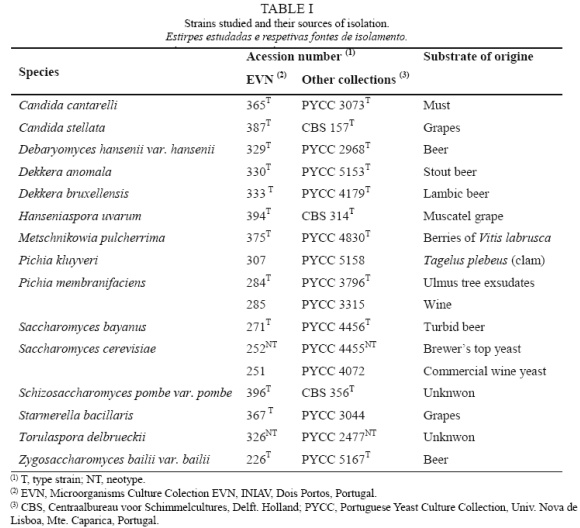
<body><![CDATA[<p>&nbsp;</p>      <p><b>MATERIAL AND METHODS</b></p>      <p><b>Yeast strains</b></p>      <p>The yeast strains used in this study are included in Coleção de Microrganismos EVN (EVN) and were obtained from other culture collections, representing 15 wine related species, as indicated in <a href="#t1">Table I</a>.</p>      <p>&nbsp;</p> <a name="t1"> <img src="/img/revistas/ctv/v27n2/27n2a04t1.jpg">     
<p>&nbsp;</p>      <p><b>Cells culture</b></p>      <p>To determine the SSCP profiles of each species in study, yeast cells were grown in conventional agar medium (YPD agar -  yeast extract, peptone, dextrose, agar) at 25 ºC.</p>      <p>For cells growth in grape must a loop full of cells was added to test-tubes with 10 ml sterile grape must and incubated at  25 ºC during 48 h without shaking. When cell numbers reached 5 x 10⁶ per ml SSCP profiles of single or mixtures of equal volumes of two cultures were determined.</p>      <p><b>DNA extraction and PCR amplification</b></p>      ]]></body>
<body><![CDATA[<p>Cells grown on YPD agar were disrupted according to Sampaio <i>et al.</i> (2001). DNA was further purified with  chlorophorm: isoamyl alcohol (24:1), precipitated with 1/10 volume of sodium acetate (3 M, pH 5.2) and two volumes of absolute  ethanol. Further incubation with RNase (100 µg/mL in TE: 10 mM tris-HCl and 1 mM EDTA, pH 8) was  performed for 30 min, at  37 ºC and additional purification and precipitation steps were carried out as described above. DNA was washed with ethanol  (70 %, v/v), dried and ressuspended in TE.</p>      <p>For DNA extraction from cells grown on grape must, 2 ml of must with approximately 5 x 10⁶ cel/ml was centrifuged at  18.200g at 4 ºC during 10 min. The pellet was washed with NaCl solution (9 g/L) and ressuspended in 500 µl lyses buffer   (Tris 1 M; EDTA 0,25 M; NaCl 5 M; CTAB 0,5 mM; pH 7,5) added with 120 µl of 5% (w/v) N-lauroylsarcosine sodium solution.   Then 200 µl glass beads (425-600 µm Ø) were added, vortexed at maximum speed for 1 min and left for 15 min at 65ºC. DNA was  purified with chlorophorm:isoamyl alcohol (24:1), precipitated with isopropanol and washed with ethanol (70 %, v/v). Incubation with RNase was also performed and the DNA was precipitated with sodium acetate and isopropanol at -20 ºC overnight. DNA was  washed with ethanol (70 %, v/v), dried and ressuspended in TE.</p>      <p>For the amplification of D1/D2 domains of 26S rDNA, PCR conditions were similar to those described by Zanol <i>et al.</i> (2010) using 1 ng of total DNA and primers NL1 (5’-GCATATCAATAAGCGGAGGAAAAG-3’) and NL4 (5’-GGTCCGTGTTTCAAGACGG-3’).</p>      <p><b>SSCP analysis</b></p>      <p>To denature the amplified fragment, 4 µl of PCR product were mixed with an equal volume of denaturing formamide solution  (containing 1 mg/ml xylene cyanol, 1 mg/ml bromophenol blue, 20 µl/ml EDTA 0,5 M). The reaction mixture was denatured by  heating at 95 ºC for 5 min in a thermocycler (T Gradient 96 cycler, Whatman-Biometra, Gottingen, Germany) and immediately  cooled on ice directly before use. Eight µl of the sample were loaded into each well of a non-denaturing 5 % acrylamide:bis  (30:1) gel containing 5 % (v/v) glycerol casted on a Mighty Small II apparatus from Hoefer/Pharmacia (8 x 7 cm and 0.75 mm   thick). DNA migration occurs from denaturing (loading solution) to non-denaturing (polyacrylamide gel) conditions. A   standard DNA non-denatured marker (1 kb DNA Ladder, MBI Fermentas) was loaded on the first and the last wells of the gel,   and used as a reference to determine the relative positioning of the SSCP bands, as well as the double stranded DNA band.</p>      <p>Electrophoresis was performed in 1x TBE (Tris-borate-EDTA) buffer, run at 150 V, at 4 ºC until migration of xylene cyanol  dye reached 0.5 cm of the bottom of the gel. The gels were silver stained and photographed. The relative position of SSCP   bands, was determined using GelCompar II software, version 5.1 (Applied Maths, Saint-Martens-Latem, Belgium). Gels were   repeated at least three times and the bands present on all the gels were attributed to the species.</p>      <p>&nbsp;</p>      <p><b>RESULTS AND DISCUSSION</b></p>      <p>Analyses of single-strand conformation polymorphism (SSCP) enable DNA fragments with similar size but different sequence to  be separated according to their configuration (secondary structure) (Hebenbrock <i>et al.</i>, 1995). Several regions of the rRNA gene have proved adequate to discriminate yeast species, namely the D1/D2 domains of 26S rDNA, which was selected to be  used in the present work (Kurtzman and Robnett, 1998; Esteve-Zarzoso <i>et al.</i>, 1999; Zanol <i>et al.</i>, 2010).</p>      <p>In order to initiate a wine yeast species SSCP profile database, 17 culture collection strains belonging to 15 yeast  species associated with wine environments were studied. A PCR amplified fragment consisting of the D1 and D2 domains of 26S  rDNA was used to perform SSCP analyses. After optimization of procedures, SSCP profiles of each strain grown in YPD agar were  generated. <a href="#f1">Figure 1</a> shows some of the profiles obtained. </p>      ]]></body>
<body><![CDATA[<p>&nbsp;</p> <a name="f1"> <img src="/img/revistas/ctv/v27n2/27n2a03f1.jpg">     
<p>&nbsp;</p>      <p>Gels were repeated at least three times from independent cultures. All gels were analyzed and the bands relative  positioning determined. <a href="#t2">Table II</a> shows the values of the SSCP specific bands attributed to each species.</p>       <p>&nbsp;</p> <a name="t2"> <img src="/img/revistas/ctv/v27n2/27n2a03t2.jpg">     
<p>&nbsp;</p>      <p>Every profile presented three bands, two of them corresponding to forward and reverse single strand DNA (ssDNA) (Callon <i>et al.</i>, 2006). The third band corresponded to double strand DNA (dsDNA) as was verified by electrophoresis of  denaturated and non-denaturated amplified DNA (<a href="#f2">Figure 2</a>). Although this third band is not ssDNA, it appears in SSCP gels (Wang <i>et al.</i>, 2008). This band was considered in the profiles since it presented species polymorphism, improving the discriminative power of this methodology.</p>      <p>&nbsp;</p> <a name="f2"> <img src="/img/revistas/ctv/v27n2/27n2a03f2.jpg">     
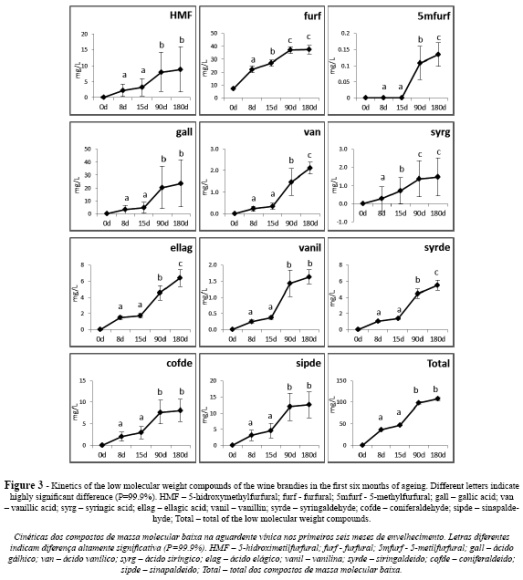
<p>&nbsp;</p>      <p>Results showed that the SSPC profiles obtained for different strains of the same species, as was tested for <i>P.  membranifaciens</i> and <i>S. cerevisiae</i>, were identical (<a href="#t2">Table II</a>). A distinct SSCP profile was obtained for the great majority  of the species evaluated. Nevertheless, <i>C. stellata</i> and <i>Starmerella bacillaris</i> presented similar profiles. These two species  were for long considered to be conspecific and only recently were clearly differentiated by the sequencing of D1/D2 domains,   presenting only 91% similarity (Duarte <i>et al.</i>, 2012). From an oenological point of view this SSCP profile similarity   is not a real problem as it has been shown that <i>C. stellata</i> is rarely found in wine fermentation unlike <i>Starmerella   bacillaris</i> which is quite common in wine associated environments (Csoma and Sipiczki, 2008; Duarte <i>et al.</i>, 2012).   Similar SSCP profiles were produced by the strains of <i>D. anomala</i> and <i>D. bruxelensis</i>, although the sequence of D1/D2 domains   of 26S rDNA of these two strains presents a similarity of only 93% (Kurtzman and Robnett, 1998). Nevertheless they could be clearly differentiated from the remaining species. Equivalent results were obtained using restriction profile analysis of 26S  rDNA (Zanol <i>et al.</i>, 2010). The SSCP showed to be quite discriminative for 11 out of 15 species, which can be clearly differentiated from each other and from the species belonging to the <i>Dekkera</i> genus and the <i>Starmerella</i>  clade, <i>C. stellata</i> and <i>Starmerella bacillaris</i> (Lachance <i>et al.</i>, 2011).</p>      <p>The applicability of the methodology was also tested upon yeast growth on grape must. Another DNA extraction procedure had  to be optimized as no PCR amplification was obtained with the previous one, due to the presence of PCR inhibiting compounds.  After optimizing the DNA extraction methodology as described in Material and Methods, SSCP analysis was performed without   further modification. The profiles obtained were identical to those obtained after growth in conventional medium (<a href="#f3">Figure 3</a>).</p>       ]]></body>
<body><![CDATA[<p>&nbsp;</p> <a name="f3"> <img src="/img/revistas/ctv/v27n2/27n2a03f3.jpg">     
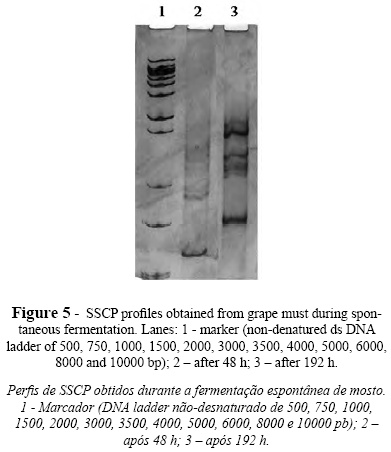
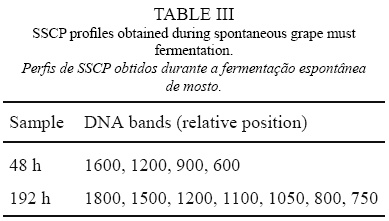
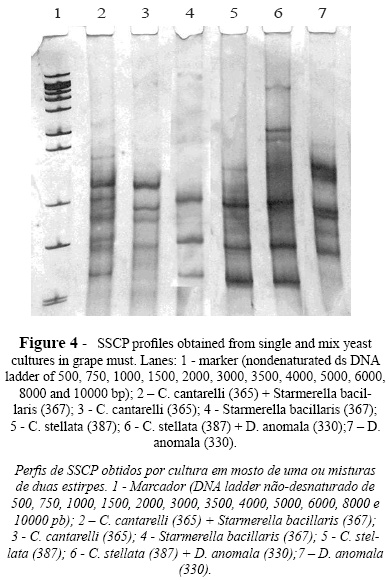
<p>&nbsp;</p>       <p>SSCP analysis of mixtures of two yeast strains independently grown in grape must was also performed and the results  analyzed using GelCompar II software. The SSCP profiles produced revealed that the assayed mixtures presented a combination of bands corresponding to the specific bands of both species. In <a href="#f4">Figure 4</a>, SSCP profiles from single and mixed cultures of <i>C. cantarelli</i>plus <i>Starmerella bacillaris</i> and <i>C. stellata</i> plus <i>D. anomala</i> are presented, and bands from both species  can be visualized. The extra bands present might be due to the use of rDNA fragments as markers (Wang <i>et al.</i>, 2008).In  order to test the applicability of this methodology to real conditions, SSCP analyses were also performed using DNA directly  extracted from grape must after 48 and 192 hours of spontaneous fermentation. The SSCP profiles showed in <a href="#f5">Figure 5</a> were compared with those presented by the culture collection strains. The relative position of the detected bands is also presented at <a href="#t3">Table III</a>. The SSCP profile of the sample collected after 48 h of fermentation showed bands associated to <i>C. stellata/Starmerella bacillaris</i> and to <i>H. uvarum</i>. After 192 h of fermentation the SSCP analysis  generated 7 bands (<a href="#t3">Table III</a>) which matched the specific bands of <i>S. cerevisiae</i>, <i>S. bayanus</i>, <i>T. delbrueckii</i>, <i>Deb.  hansenii</i> and <i>Schizo pombe</i> species. From these results, it can be inferred that grape must at the beginning of  fermentation was dominated by <i>Starmerella</i> clade and <i>Hanseniaspora</i> yeasts as observed by others (Fleet, 2003;  Baleiras-Couto <i>et al.</i>, 2005). Grape must sampling after 192 h pointed out to the presence of bands corresponding to  species associated with late grape must fermentations (Fleet, 2003; Baleiras Couto <i>et al.</i>, 2005). </p>      <p>&nbsp;</p> <a name="f4"> <img src="/img/revistas/ctv/v27n2/27n2a04f4.jpg">     
<p>&nbsp;</p>  <a name="f5"> <img src="/img/revistas/ctv/v27n2/27n2a04f5.jpg">     
<p>&nbsp;</p>   <a name="t3"> <img src="/img/revistas/ctv/v27n2/27n2a04t3.jpg">     
<p>&nbsp;</p>       <p>In view of the results obtained, the performance of SSCP to detect wine related yeast species in grape must fermentation  was appropriate, leading to its future applicability to study the diversity and dynamics of yeast communities. Likewise, other  works using SSCP have been done featuring the study of microbial diversity and population dynamics in various food products such as olive fermentation brine (Chamkha <i>et al.</i>, 2008), commercial cheeses (Mounier <i>et al.</i>, 2009), or a Korean  food fermented from vegetables (Chang <i>et al.</i>, 2008). This methodology presents the advantages of overcoming the amount  of work associated with the identification of several isolates and the potential biases inherent in microbial enrichment and  of detecting viable non-culturable microorganisms (Wang <i>et al.</i>, 2008). The SSCP can also be used to evaluate the  implantation of inoculated non-Saccharomyces yeasts which is a promising technology yet at the beginning (Ciani and Comitini, 2011).</p>      <p>&nbsp;</p>      <p><b>CONCLUSIONS</b></p>      ]]></body>
<body><![CDATA[<p>SSCP analysis targeting D1/D2 domains of 26S rDNA proved very discriminative for the yeast species in study. The  applicability of this methodology directly to fermenting grape must samples was quite good, revealing similar band definition,  thus being appropriate for studying the diversity and dynamics of wine yeasts during fermentation. To our knowledge this is   the first time that SSCP was used to compare yeast community during grape must fermentation. Future work is envisaged to   enlarge the SSCP profile database that expedites the identification process. This technique presents the advantage of   obtaining fast results with less expensive equipment required.</p>      <p>&nbsp;</p>     <p><b>ACKNOWLEDGMENTS</b></p>      <p>The authors would like to thank Joana Duarte and Maria Filomena Alemão for technical assistance.      <p>&nbsp;</p>      <p><b>REFERENCES</b></p>      <!-- ref --><p>Andorrà I., Berradre M., Mas A., Esteve-Zarzoso B., Guillamón J.M., 2012. Effect of mixed culture fermentations on yeast  populations and aroma profile. <i>LWT - Food Science Technol.</i>, <b>49</b>, 8-13.    &nbsp;&nbsp;&nbsp;&nbsp;&nbsp;&nbsp;&nbsp;&nbsp;[&#160;<a href="javascript:void(0);" onclick="javascript: window.open('/scielo.php?script=sci_nlinks&ref=000069&pid=S0254-0223201200020000400001&lng=','','width=640,height=500,resizable=yes,scrollbars=1,menubar=yes,');">Links</a>&#160;]<!-- end-ref --></p>      <!-- ref --><p>Andorrà I., Landi S., Mas A., Guillamón J.M., Esteve-Zarzoso B., 2008. Effect of oenological pratices on microbial  populations using culture-independent techniques.  <i>Food</i> <i>Microbiol.</i>, <b>25</b>, 849-856.    &nbsp;&nbsp;&nbsp;&nbsp;&nbsp;&nbsp;&nbsp;&nbsp;[&#160;<a href="javascript:void(0);" onclick="javascript: window.open('/scielo.php?script=sci_nlinks&ref=000071&pid=S0254-0223201200020000400002&lng=','','width=640,height=500,resizable=yes,scrollbars=1,menubar=yes,');">Links</a>&#160;]<!-- end-ref --></p>      ]]></body>
<body><![CDATA[<!-- ref --><p>Baleiras-Couto M.M., Gomes A.S., Casal M., Duarte F.L., 2012. Survey of yeast diversity during wine bottling processes using restriction analysis of 26S ribosomal DNA (rDNA). <i>Aust. J. Grape Wine Res.</i>, <b>18</b>, 39-42.    &nbsp;&nbsp;&nbsp;&nbsp;&nbsp;&nbsp;&nbsp;&nbsp;[&#160;<a href="javascript:void(0);" onclick="javascript: window.open('/scielo.php?script=sci_nlinks&ref=000073&pid=S0254-0223201200020000400003&lng=','','width=640,height=500,resizable=yes,scrollbars=1,menubar=yes,');">Links</a>&#160;]<!-- end-ref --></p>      <!-- ref --><p>Baleiras-Couto M.M., Hartog B.J., Huis in't Veld J.H.J., Hofstra H., van der Vossen J.M.B.M., 1996. Identification of  spoilage yeasts in a food-production chain by microsatellite polymerase chain reaction fingerprinting. <i>Food Microbiol</i>.,  <b>13</b>, 59-67.    &nbsp;&nbsp;&nbsp;&nbsp;&nbsp;&nbsp;&nbsp;&nbsp;[&#160;<a href="javascript:void(0);" onclick="javascript: window.open('/scielo.php?script=sci_nlinks&ref=000075&pid=S0254-0223201200020000400004&lng=','','width=640,height=500,resizable=yes,scrollbars=1,menubar=yes,');">Links</a>&#160;]<!-- end-ref --></p>      <!-- ref --><p>Baleiras Couto M.M., Reizinho R.G., Duarte F.L., 2005. Partial 26S rDNA restriction analysis as a tool to characterise  non-Saccharomyces yeasts present during red wine fermentations. <i>Int. J. Food Microbiol.,</i> <b>102</b>, 49-56.    &nbsp;&nbsp;&nbsp;&nbsp;&nbsp;&nbsp;&nbsp;&nbsp;[&#160;<a href="javascript:void(0);" onclick="javascript: window.open('/scielo.php?script=sci_nlinks&ref=000077&pid=S0254-0223201200020000400005&lng=','','width=640,height=500,resizable=yes,scrollbars=1,menubar=yes,');">Links</a>&#160;]<!-- end-ref --></p>      <!-- ref --><p>Baleiras-Couto M.M., Vogels J.T.W.E., Hofstra H., Huis in’t Veld J.H.J. and van der Vossen, J.M.B.M., 1995. Random  amplified polymorphic DNA and restriction enzyme analysis of PCR amplified rDNA in taxonomy: two identification techniques  for foodborne yeasts. <i>J. Appl. Bacteriol.</i>, <b>79</b>, 525–535.    &nbsp;&nbsp;&nbsp;&nbsp;&nbsp;&nbsp;&nbsp;&nbsp;[&#160;<a href="javascript:void(0);" onclick="javascript: window.open('/scielo.php?script=sci_nlinks&ref=000079&pid=S0254-0223201200020000400006&lng=','','width=640,height=500,resizable=yes,scrollbars=1,menubar=yes,');">Links</a>&#160;]<!-- end-ref --></p>      <!-- ref --><p>Callon C., Delbès C., Duthoit F., Montel M.-C., 2006. Application of SSCP–PCR fingerprinting to profile the yeast  community in raw milk Salers cheeses. <i>Syst. Applied Microbiol.,</i> <b>29</b>, 172–180.    &nbsp;&nbsp;&nbsp;&nbsp;&nbsp;&nbsp;&nbsp;&nbsp;[&#160;<a href="javascript:void(0);" onclick="javascript: window.open('/scielo.php?script=sci_nlinks&ref=000081&pid=S0254-0223201200020000400007&lng=','','width=640,height=500,resizable=yes,scrollbars=1,menubar=yes,');">Links</a>&#160;]<!-- end-ref --></p>      ]]></body>
<body><![CDATA[<!-- ref --><p>Chamkha M.; Sayadia S, Brub V., Godon J.J., 2008. Microbial diversity in Tunisian olive fermentation brine as evaluated by  small subunit rRNA - Single strand conformation polymorphism analysis. <i>Int. J. Food Microbiol.,</i> <b>122</b>, 211-215.    &nbsp;&nbsp;&nbsp;&nbsp;&nbsp;&nbsp;&nbsp;&nbsp;[&#160;<a href="javascript:void(0);" onclick="javascript: window.open('/scielo.php?script=sci_nlinks&ref=000083&pid=S0254-0223201200020000400008&lng=','','width=640,height=500,resizable=yes,scrollbars=1,menubar=yes,');">Links</a>&#160;]<!-- end-ref --></p>      <!-- ref --><p>Chang H.W., Kim K.H., Nam Y.D., Roh S.W., Kim M.S., Jeon C.O., Oh H.M., Bae J.W., 2008. Analysis of yeast and archaeal population dynamics in kimchi using denaturing gradient gel electrophoresis. <i>Int. J. Food Microbiol.,</i> <b>126</b>, 159–166.    &nbsp;&nbsp;&nbsp;&nbsp;&nbsp;&nbsp;&nbsp;&nbsp;[&#160;<a href="javascript:void(0);" onclick="javascript: window.open('/scielo.php?script=sci_nlinks&ref=000085&pid=S0254-0223201200020000400009&lng=','','width=640,height=500,resizable=yes,scrollbars=1,menubar=yes,');">Links</a>&#160;]<!-- end-ref --></p>      <!-- ref --><p>Ciani, M., Comitini, F., 2011. Non-Saccharomyces wine yeasts have a promising role in biotechnological approaches to  winemaking. <i>Ann. Microbiol.</i>, <b>61</b>, 25-32.    &nbsp;&nbsp;&nbsp;&nbsp;&nbsp;&nbsp;&nbsp;&nbsp;[&#160;<a href="javascript:void(0);" onclick="javascript: window.open('/scielo.php?script=sci_nlinks&ref=000087&pid=S0254-0223201200020000400010&lng=','','width=640,height=500,resizable=yes,scrollbars=1,menubar=yes,');">Links</a>&#160;]<!-- end-ref --></p>      <!-- ref --><p>Cocolin L., Aggio D., Manzano M., Cantoni C., Comi G., 2002. An application of PCR–DGGE analysis to profile the yeast populations in raw milk. <i>Int. Dairy J.</i>, <b>12</b>, 407–411.    &nbsp;&nbsp;&nbsp;&nbsp;&nbsp;&nbsp;&nbsp;&nbsp;[&#160;<a href="javascript:void(0);" onclick="javascript: window.open('/scielo.php?script=sci_nlinks&ref=000089&pid=S0254-0223201200020000400011&lng=','','width=640,height=500,resizable=yes,scrollbars=1,menubar=yes,');">Links</a>&#160;]<!-- end-ref --></p>      <!-- ref --><p>Cocolin L., Bisson L.F., Mills D.A., 2000. Direct profiling of the yeast dynamics in wine fermentations. <i>FEMS Microbiol.  Lett.</i>, <b>189</b>, 81-87.    &nbsp;&nbsp;&nbsp;&nbsp;&nbsp;&nbsp;&nbsp;&nbsp;[&#160;<a href="javascript:void(0);" onclick="javascript: window.open('/scielo.php?script=sci_nlinks&ref=000091&pid=S0254-0223201200020000400012&lng=','','width=640,height=500,resizable=yes,scrollbars=1,menubar=yes,');">Links</a>&#160;]<!-- end-ref --></p>      ]]></body>
<body><![CDATA[<!-- ref --><p>Csoma H., Sipiczki M., 2008. Taxonomic reclassification of <i>Candida stellata</i> strains reveals frequent occurrence of  <i>Candida zemplinina</i> in wine fermentation. <i>FEMS Yeast Res.</i>, <b>8</b>, 328–336.    &nbsp;&nbsp;&nbsp;&nbsp;&nbsp;&nbsp;&nbsp;&nbsp;[&#160;<a href="javascript:void(0);" onclick="javascript: window.open('/scielo.php?script=sci_nlinks&ref=000093&pid=S0254-0223201200020000400013&lng=','','width=640,height=500,resizable=yes,scrollbars=1,menubar=yes,');">Links</a>&#160;]<!-- end-ref --></p>      <!-- ref --><p>di Maro E., Ercolini D., Coppola S., 2007. Yeast dynamics spontaneous wine fermentation of the Catalanesca grape. <i>Int.  J. Microbiol.</i>, <b>117</b>, 201-210.    &nbsp;&nbsp;&nbsp;&nbsp;&nbsp;&nbsp;&nbsp;&nbsp;[&#160;<a href="javascript:void(0);" onclick="javascript: window.open('/scielo.php?script=sci_nlinks&ref=000095&pid=S0254-0223201200020000400014&lng=','','width=640,height=500,resizable=yes,scrollbars=1,menubar=yes,');">Links</a>&#160;]<!-- end-ref --></p>      <!-- ref --><p>Duarte F.L., Pimentel N.H., Teixeira A., Fonseca Á., 2012. <i>Saccharomyces bacillaris</i> is not a synonym of <i>Candida  stellata</i>: reinstatement as  <i>Starmerella bacillaris</i> comb. nov.. <i>Antonie van Leeuwenhoek</i>, 102, 653–658.    &nbsp;&nbsp;&nbsp;&nbsp;&nbsp;&nbsp;&nbsp;&nbsp;[&#160;<a href="javascript:void(0);" onclick="javascript: window.open('/scielo.php?script=sci_nlinks&ref=000097&pid=S0254-0223201200020000400015&lng=','','width=640,height=500,resizable=yes,scrollbars=1,menubar=yes,');">Links</a>&#160;]<!-- end-ref --></p>      <!-- ref --><p>Esteve-Zarzoso B., Belloch C., Uruburu F., Querol A., 1999. Identification of yeasts by RFLP analysis of the 5.8S rRNA gene  and the two ribosomal internal transcribed  spacers. <i>Int. J. Syst.Bacteriol.</i>, <b>49</b>, 329-337.    &nbsp;&nbsp;&nbsp;&nbsp;&nbsp;&nbsp;&nbsp;&nbsp;[&#160;<a href="javascript:void(0);" onclick="javascript: window.open('/scielo.php?script=sci_nlinks&ref=000099&pid=S0254-0223201200020000400016&lng=','','width=640,height=500,resizable=yes,scrollbars=1,menubar=yes,');">Links</a>&#160;]<!-- end-ref --></p>      <!-- ref --><p>Fleet G.H., 2003. Yeast interactions and wine flavour. <i>Int. J. Food Microbiol.,</i> <b>86</b>, 11-22.    &nbsp;&nbsp;&nbsp;&nbsp;&nbsp;&nbsp;&nbsp;&nbsp;[&#160;<a href="javascript:void(0);" onclick="javascript: window.open('/scielo.php?script=sci_nlinks&ref=000101&pid=S0254-0223201200020000400017&lng=','','width=640,height=500,resizable=yes,scrollbars=1,menubar=yes,');">Links</a>&#160;]<!-- end-ref --></p>      ]]></body>
<body><![CDATA[<!-- ref --><p>Hebenbrock K., Williams M.P., Karger L.B., 1995. Single-strand conformation polymorphism using capillary electrophoresis  with two-dye laserinduced fluorescence detection. <i>Electrophoresis</i>, <b>16</b>, 1429–1436.    &nbsp;&nbsp;&nbsp;&nbsp;&nbsp;&nbsp;&nbsp;&nbsp;[&#160;<a href="javascript:void(0);" onclick="javascript: window.open('/scielo.php?script=sci_nlinks&ref=000103&pid=S0254-0223201200020000400018&lng=','','width=640,height=500,resizable=yes,scrollbars=1,menubar=yes,');">Links</a>&#160;]<!-- end-ref --></p>      <!-- ref --><p>Jolly N., Augustyn O., Pretorius I., 2006. The role and use of non-<i>Saccharomyces</i> yeasts in wine production. <i>S.  Afr. J. Enol. Vitic.</i> <b>27</b>,15-39.    &nbsp;&nbsp;&nbsp;&nbsp;&nbsp;&nbsp;&nbsp;&nbsp;[&#160;<a href="javascript:void(0);" onclick="javascript: window.open('/scielo.php?script=sci_nlinks&ref=000105&pid=S0254-0223201200020000400019&lng=','','width=640,height=500,resizable=yes,scrollbars=1,menubar=yes,');">Links</a>&#160;]<!-- end-ref --></p>      <!-- ref --><p> Kurtzman C.P., Robnett C.J., 1998. Identification and phylogeny of ascomycetous yeasts from analysis of nuclear large  subunit (26S) ribosomal DNA partial sequences. <i>Antonie van Leeuwenhoek</i>, <b>73</b>, 331-371.    &nbsp;&nbsp;&nbsp;&nbsp;&nbsp;&nbsp;&nbsp;&nbsp;[&#160;<a href="javascript:void(0);" onclick="javascript: window.open('/scielo.php?script=sci_nlinks&ref=000107&pid=S0254-0223201200020000400020&lng=','','width=640,height=500,resizable=yes,scrollbars=1,menubar=yes,');">Links</a>&#160;]<!-- end-ref --></p>      <!-- ref --><p>Lachance M-A., Boekhout T., Scorzetti G., Fell J.W., Kurtzman C.P., 2011. <i>Candida </i>Berkhout. In: <i>The Yeasts, a taxonomic study.</i> Vol 2, 987–1278. Kurtzman C.P., Fell J.W., Boekhout T. (eds), 5th edn. Elsevier, Amsterdam.    &nbsp;&nbsp;&nbsp;&nbsp;&nbsp;&nbsp;&nbsp;&nbsp;[&#160;<a href="javascript:void(0);" onclick="javascript: window.open('/scielo.php?script=sci_nlinks&ref=000109&pid=S0254-0223201200020000400021&lng=','','width=640,height=500,resizable=yes,scrollbars=1,menubar=yes,');">Links</a>&#160;]<!-- end-ref --></p>      <!-- ref --><p>MacGregor B.J., Amann R., 2006. Single-stranded conformational polymorphism for separation of mixed rRNAS (rRNA-SSCP), a new method for profiling microbial communities. <i>Syst. Appl. Microbiol.</i>, <b>29</b>, 661–670.    &nbsp;&nbsp;&nbsp;&nbsp;&nbsp;&nbsp;&nbsp;&nbsp;[&#160;<a href="javascript:void(0);" onclick="javascript: window.open('/scielo.php?script=sci_nlinks&ref=000111&pid=S0254-0223201200020000400022&lng=','','width=640,height=500,resizable=yes,scrollbars=1,menubar=yes,');">Links</a>&#160;]<!-- end-ref --></p>      ]]></body>
<body><![CDATA[<!-- ref --><p>Mounier J, Monnet C., Jacques N., Antoinette A., Irlinger F., 2009. Assessment of the microbial diversity at the surface of  Livarot cheese using culture-dependent and independent approaches. <i>Int. J. Food Microbiol.,</i> <b>133</b>, 31–37.    &nbsp;&nbsp;&nbsp;&nbsp;&nbsp;&nbsp;&nbsp;&nbsp;[&#160;<a href="javascript:void(0);" onclick="javascript: window.open('/scielo.php?script=sci_nlinks&ref=000113&pid=S0254-0223201200020000400023&lng=','','width=640,height=500,resizable=yes,scrollbars=1,menubar=yes,');">Links</a>&#160;]<!-- end-ref --></p>      <!-- ref --><p>Peters S., Koschinsky S.F., Schwieger C., Tebbe C., 2000. Succession of microbial communities during hot composting as  detected by PCR–single-strand-conformation polymorphism-based genetic profiles of small-subunit rRNA genes. <i>Appl. Environ.  Microbiol.,</i> <b>66</b>, 930–936.    &nbsp;&nbsp;&nbsp;&nbsp;&nbsp;&nbsp;&nbsp;&nbsp;[&#160;<a href="javascript:void(0);" onclick="javascript: window.open('/scielo.php?script=sci_nlinks&ref=000115&pid=S0254-0223201200020000400024&lng=','','width=640,height=500,resizable=yes,scrollbars=1,menubar=yes,');">Links</a>&#160;]<!-- end-ref --></p>      <!-- ref --><p>Prakitchaiwattana, C.J., Fleet, G.H., Heard, G.M., 2004. Application and evaluation of denaturing gradient gel  electrophoresis to analyse the yeast ecology of wine grapes. <i>FEMS Yeast Res.</i>, <b>4</b>, 865-877.    &nbsp;&nbsp;&nbsp;&nbsp;&nbsp;&nbsp;&nbsp;&nbsp;[&#160;<a href="javascript:void(0);" onclick="javascript: window.open('/scielo.php?script=sci_nlinks&ref=000117&pid=S0254-0223201200020000400025&lng=','','width=640,height=500,resizable=yes,scrollbars=1,menubar=yes,');">Links</a>&#160;]<!-- end-ref --></p>      <!-- ref --><p>Renouf V., Claisse O., Lonvaud-Funel A., 2007. Inventory and monitoring of wine microbial consortia. Appl. Microbiol. Biotechnol.</i>, <b>75</b>, 149-164.    &nbsp;&nbsp;&nbsp;&nbsp;&nbsp;&nbsp;&nbsp;&nbsp;[&#160;<a href="javascript:void(0);" onclick="javascript: window.open('/scielo.php?script=sci_nlinks&ref=000119&pid=S0254-0223201200020000400026&lng=','','width=640,height=500,resizable=yes,scrollbars=1,menubar=yes,');">Links</a>&#160;]<!-- end-ref --></p>      <!-- ref --><p>Sampaio J.P., Gadanho M., Santos S., Duarte F.L., Pais C., Fonseca A. Fell J.W., 2001. Polyphasic taxonomy of the  basidiomycetous yeast genus <i>Rhodosporidium: Rhodosporidium kratochvilovae</i> and related anamorphic species. <i>Int. J.  Syst. Evol. Microbiol.</i>, <b>51</b>, 687-697.    &nbsp;&nbsp;&nbsp;&nbsp;&nbsp;&nbsp;&nbsp;&nbsp;[&#160;<a href="javascript:void(0);" onclick="javascript: window.open('/scielo.php?script=sci_nlinks&ref=000121&pid=S0254-0223201200020000400027&lng=','','width=640,height=500,resizable=yes,scrollbars=1,menubar=yes,');">Links</a>&#160;]<!-- end-ref --></p>      ]]></body>
<body><![CDATA[<!-- ref --><p>Walsh T.J., Francesconi A., Kasai M., Chanock S.J., 1995. PCR and single-strand conformational polymorphism for recognition  of medically important opportunistic fungi. <i>J. Clin. Microbiol.,</i> <b>33</b>, 3216-3220.    &nbsp;&nbsp;&nbsp;&nbsp;&nbsp;&nbsp;&nbsp;&nbsp;[&#160;<a href="javascript:void(0);" onclick="javascript: window.open('/scielo.php?script=sci_nlinks&ref=000123&pid=S0254-0223201200020000400028&lng=','','width=640,height=500,resizable=yes,scrollbars=1,menubar=yes,');">Links</a>&#160;]<!-- end-ref --></p>      <!-- ref --><p>Wang Q.M., Li J., Wang S.A., Bai F.Y., 2008. Rapid differentiation of phenotypically similar yeast species by single-strand  conformation polymorphism of ribosomal DNA. <i>Appl. Environ. Microbiol.,</i> <b>74</b>, 2604-2611.    &nbsp;&nbsp;&nbsp;&nbsp;&nbsp;&nbsp;&nbsp;&nbsp;[&#160;<a href="javascript:void(0);" onclick="javascript: window.open('/scielo.php?script=sci_nlinks&ref=000125&pid=S0254-0223201200020000400029&lng=','','width=640,height=500,resizable=yes,scrollbars=1,menubar=yes,');">Links</a>&#160;]<!-- end-ref --></p>      <!-- ref --><p>Zanol G., Baleiras-Couto M.M., Duarte F.L., 2010. Restriction profiles of 26S rDNA as a molecular approach for wine yeasts  identification. <i>Ciência Téc. Vitiv.,</i> <b>25</b>, 75-85.    &nbsp;&nbsp;&nbsp;&nbsp;&nbsp;&nbsp;&nbsp;&nbsp;[&#160;<a href="javascript:void(0);" onclick="javascript: window.open('/scielo.php?script=sci_nlinks&ref=000127&pid=S0254-0223201200020000400030&lng=','','width=640,height=500,resizable=yes,scrollbars=1,menubar=yes,');">Links</a>&#160;]<!-- end-ref --></p>      <p>&nbsp;</p>     <p><Sup><a name="0"></a><a href="#top0">*</a></Sup><b>Corresponding author:</b></p>     <p> Tel.: +351 261712106; Fax: +351 261712426, E-mail: <a href="mailto:filomena.duarte@iniav.pt">filomena.duarte@iniav.pt</a></p>      <p>&nbsp;</p>      ]]></body>
<body><![CDATA[<p><i>(Manuscrito recebido em 23.11.2012. Aceite para publicação em 23.01.2013)</i></p>        ]]></body><back>
<ref-list>
<ref id="B1">
<nlm-citation citation-type="journal">
<person-group person-group-type="author">
<name>
<surname><![CDATA[Andorrà]]></surname>
<given-names><![CDATA[I.]]></given-names>
</name>
<name>
<surname><![CDATA[Berradre]]></surname>
<given-names><![CDATA[M.]]></given-names>
</name>
<name>
<surname><![CDATA[Mas]]></surname>
<given-names><![CDATA[A.]]></given-names>
</name>
<name>
<surname><![CDATA[Esteve-Zarzoso]]></surname>
<given-names><![CDATA[B.]]></given-names>
</name>
<name>
<surname><![CDATA[Guillamón]]></surname>
<given-names><![CDATA[J.M.]]></given-names>
</name>
</person-group>
<article-title xml:lang="en"><![CDATA[Effect of mixed culture fermentations on yeast populations and aroma profile]]></article-title>
<source><![CDATA[LWT - Food Science Technol.]]></source>
<year>2012</year>
<volume>49</volume>
<page-range>8-13</page-range></nlm-citation>
</ref>
<ref id="B2">
<nlm-citation citation-type="journal">
<person-group person-group-type="author">
<name>
<surname><![CDATA[Andorrà]]></surname>
<given-names><![CDATA[I.]]></given-names>
</name>
<name>
<surname><![CDATA[Landi]]></surname>
<given-names><![CDATA[S.]]></given-names>
</name>
<name>
<surname><![CDATA[Mas]]></surname>
<given-names><![CDATA[A.]]></given-names>
</name>
<name>
<surname><![CDATA[Guillamón]]></surname>
<given-names><![CDATA[J.M.]]></given-names>
</name>
<name>
<surname><![CDATA[Esteve-Zarzoso]]></surname>
<given-names><![CDATA[B.]]></given-names>
</name>
</person-group>
<article-title xml:lang="en"><![CDATA[Effect of oenological pratices on microbial populations using culture-independent techniques]]></article-title>
<source><![CDATA[Food Microbiol.]]></source>
<year>2008</year>
<volume>25</volume>
<page-range>849-856</page-range></nlm-citation>
</ref>
<ref id="B3">
<nlm-citation citation-type="journal">
<person-group person-group-type="author">
<name>
<surname><![CDATA[Baleiras-Couto]]></surname>
<given-names><![CDATA[M.M.]]></given-names>
</name>
<name>
<surname><![CDATA[Gomes]]></surname>
<given-names><![CDATA[A.S.]]></given-names>
</name>
<name>
<surname><![CDATA[Casal]]></surname>
<given-names><![CDATA[M.]]></given-names>
</name>
<name>
<surname><![CDATA[Duarte]]></surname>
<given-names><![CDATA[F.L.]]></given-names>
</name>
</person-group>
<article-title xml:lang="en"><![CDATA[Survey of yeast diversity during wine bottling processes using restriction analysis of 26S ribosomal DNA (rDNA)]]></article-title>
<source><![CDATA[Aust. J. Grape Wine Res.]]></source>
<year>2012</year>
<volume>18</volume>
<page-range>39-42</page-range></nlm-citation>
</ref>
<ref id="B4">
<nlm-citation citation-type="journal">
<person-group person-group-type="author">
<name>
<surname><![CDATA[Baleiras-Couto]]></surname>
<given-names><![CDATA[M.M.]]></given-names>
</name>
<name>
<surname><![CDATA[Hartog]]></surname>
<given-names><![CDATA[B.J.]]></given-names>
</name>
<name>
<surname><![CDATA[Huis in't Veld]]></surname>
<given-names><![CDATA[J.H.J.]]></given-names>
</name>
<name>
<surname><![CDATA[Hofstra]]></surname>
<given-names><![CDATA[H.]]></given-names>
</name>
<name>
<surname><![CDATA[van der Vossen]]></surname>
<given-names><![CDATA[J.M.B.M.]]></given-names>
</name>
</person-group>
<article-title xml:lang="en"><![CDATA[Identification of spoilage yeasts in a food-production chain by microsatellite polymerase chain reaction fingerprinting]]></article-title>
<source><![CDATA[Food Microbiol.]]></source>
<year>1996</year>
<volume>13</volume>
<page-range>59-67</page-range></nlm-citation>
</ref>
<ref id="B5">
<nlm-citation citation-type="journal">
<person-group person-group-type="author">
<name>
<surname><![CDATA[Baleiras Couto]]></surname>
<given-names><![CDATA[M.M.]]></given-names>
</name>
<name>
<surname><![CDATA[Reizinho]]></surname>
<given-names><![CDATA[R.G.]]></given-names>
</name>
<name>
<surname><![CDATA[Duarte]]></surname>
<given-names><![CDATA[F.L.]]></given-names>
</name>
</person-group>
<article-title xml:lang="en"><![CDATA[Partial 26S rDNA restriction analysis as a tool to characterise non-Saccharomyces yeasts present during red wine fermentations]]></article-title>
<source><![CDATA[Int. J. Food Microbiol.]]></source>
<year>2005</year>
<volume>102</volume>
<page-range>49-56</page-range></nlm-citation>
</ref>
<ref id="B6">
<nlm-citation citation-type="journal">
<person-group person-group-type="author">
<name>
<surname><![CDATA[Baleiras-Couto]]></surname>
<given-names><![CDATA[M.M.]]></given-names>
</name>
<name>
<surname><![CDATA[Vogels]]></surname>
<given-names><![CDATA[J.T.W.E.]]></given-names>
</name>
<name>
<surname><![CDATA[Hofstra]]></surname>
<given-names><![CDATA[H.]]></given-names>
</name>
<name>
<surname><![CDATA[Huis in’t Veld]]></surname>
<given-names><![CDATA[J.H.J.]]></given-names>
</name>
<name>
<surname><![CDATA[van der Vossen]]></surname>
<given-names><![CDATA[J.M.B.M.]]></given-names>
</name>
</person-group>
<article-title xml:lang="en"><![CDATA[Random amplified polymorphic DNA and restriction enzyme analysis of PCR amplified rDNA in taxonomy: two identification techniques for foodborne yeasts]]></article-title>
<source><![CDATA[J. Appl. Bacteriol.]]></source>
<year>1995</year>
<volume>79</volume>
<page-range>525-535</page-range></nlm-citation>
</ref>
<ref id="B7">
<nlm-citation citation-type="journal">
<person-group person-group-type="author">
<name>
<surname><![CDATA[Callon]]></surname>
<given-names><![CDATA[C.]]></given-names>
</name>
<name>
<surname><![CDATA[Delbès]]></surname>
<given-names><![CDATA[C.]]></given-names>
</name>
<name>
<surname><![CDATA[Duthoit]]></surname>
<given-names><![CDATA[F.]]></given-names>
</name>
<name>
<surname><![CDATA[Montel]]></surname>
<given-names><![CDATA[M.-C.]]></given-names>
</name>
</person-group>
<article-title xml:lang="en"><![CDATA[Application of SSCP-PCR fingerprinting to profile the yeast community in raw milk Salers cheeses]]></article-title>
<source><![CDATA[Syst. Applied Microbiol.]]></source>
<year>2006</year>
<volume>29</volume>
<page-range>172-180</page-range></nlm-citation>
</ref>
<ref id="B8">
<nlm-citation citation-type="journal">
<person-group person-group-type="author">
<name>
<surname><![CDATA[Chamkha]]></surname>
<given-names><![CDATA[M.]]></given-names>
</name>
<name>
<surname><![CDATA[Sayadia]]></surname>
<given-names><![CDATA[S.]]></given-names>
</name>
<name>
<surname><![CDATA[Brub]]></surname>
<given-names><![CDATA[V.]]></given-names>
</name>
<name>
<surname><![CDATA[Godon]]></surname>
<given-names><![CDATA[J.J.]]></given-names>
</name>
</person-group>
<article-title xml:lang="en"><![CDATA[Microbial diversity in Tunisian olive fermentation brine as evaluated by small subunit rRNA: Single strand conformation polymorphism analysis]]></article-title>
<source><![CDATA[Int. J. Food Microbiol.]]></source>
<year>2008</year>
<volume>122</volume>
<page-range>211-215</page-range></nlm-citation>
</ref>
<ref id="B9">
<nlm-citation citation-type="journal">
<person-group person-group-type="author">
<name>
<surname><![CDATA[Chang]]></surname>
<given-names><![CDATA[H.W.]]></given-names>
</name>
<name>
<surname><![CDATA[Kim]]></surname>
<given-names><![CDATA[K.H.]]></given-names>
</name>
<name>
<surname><![CDATA[Nam]]></surname>
<given-names><![CDATA[Y.D.]]></given-names>
</name>
<name>
<surname><![CDATA[Roh]]></surname>
<given-names><![CDATA[S.W.]]></given-names>
</name>
<name>
<surname><![CDATA[Kim]]></surname>
<given-names><![CDATA[M.S.]]></given-names>
</name>
<name>
<surname><![CDATA[Jeon]]></surname>
<given-names><![CDATA[C.O.]]></given-names>
</name>
<name>
<surname><![CDATA[Oh]]></surname>
<given-names><![CDATA[H.M.]]></given-names>
</name>
<name>
<surname><![CDATA[Bae]]></surname>
<given-names><![CDATA[J.W.]]></given-names>
</name>
</person-group>
<article-title xml:lang="en"><![CDATA[Analysis of yeast and archaeal population dynamics in kimchi using denaturing gradient gel electrophoresis]]></article-title>
<source><![CDATA[Int. J. Food Microbiol.]]></source>
<year>2008</year>
<volume>126</volume>
<page-range>159-166</page-range></nlm-citation>
</ref>
<ref id="B10">
<nlm-citation citation-type="journal">
<person-group person-group-type="author">
<name>
<surname><![CDATA[Ciani]]></surname>
<given-names><![CDATA[M.]]></given-names>
</name>
<name>
<surname><![CDATA[Comitini]]></surname>
<given-names><![CDATA[F.]]></given-names>
</name>
</person-group>
<article-title xml:lang="en"><![CDATA[Non-Saccharomyces wine yeasts have a promising role in biotechnological approaches to winemaking]]></article-title>
<source><![CDATA[Ann. Microbiol.]]></source>
<year>2011</year>
<volume>61</volume>
<page-range>25-32</page-range></nlm-citation>
</ref>
<ref id="B11">
<nlm-citation citation-type="journal">
<person-group person-group-type="author">
<name>
<surname><![CDATA[Cocolin]]></surname>
<given-names><![CDATA[L.]]></given-names>
</name>
<name>
<surname><![CDATA[Aggio]]></surname>
<given-names><![CDATA[D.]]></given-names>
</name>
<name>
<surname><![CDATA[Manzano]]></surname>
<given-names><![CDATA[M.]]></given-names>
</name>
<name>
<surname><![CDATA[Cantoni]]></surname>
<given-names><![CDATA[C.]]></given-names>
</name>
<name>
<surname><![CDATA[Comi]]></surname>
<given-names><![CDATA[G.]]></given-names>
</name>
</person-group>
<article-title xml:lang="en"><![CDATA[An application of PCR-DGGE analysis to profile the yeast populations in raw milk]]></article-title>
<source><![CDATA[Int. Dairy J.]]></source>
<year>2002</year>
<volume>12</volume>
<page-range>407-411</page-range></nlm-citation>
</ref>
<ref id="B12">
<nlm-citation citation-type="journal">
<person-group person-group-type="author">
<name>
<surname><![CDATA[Cocolin]]></surname>
<given-names><![CDATA[L.]]></given-names>
</name>
<name>
<surname><![CDATA[Bisson]]></surname>
<given-names><![CDATA[L.F.]]></given-names>
</name>
<name>
<surname><![CDATA[Mills]]></surname>
<given-names><![CDATA[D.A.]]></given-names>
</name>
</person-group>
<article-title xml:lang="en"><![CDATA[Direct profiling of the yeast dynamics in wine fermentations]]></article-title>
<source><![CDATA[FEMS Microbiol. Lett.]]></source>
<year>2000</year>
<volume>189</volume>
<page-range>81-87</page-range></nlm-citation>
</ref>
<ref id="B13">
<nlm-citation citation-type="journal">
<person-group person-group-type="author">
<name>
<surname><![CDATA[Csoma]]></surname>
<given-names><![CDATA[H.]]></given-names>
</name>
<name>
<surname><![CDATA[Sipiczki]]></surname>
<given-names><![CDATA[M.]]></given-names>
</name>
</person-group>
<article-title xml:lang="en"><![CDATA[Taxonomic reclassification of Candida stellata strains reveals frequent occurrence of Candida zemplinina in wine fermentation]]></article-title>
<source><![CDATA[FEMS Yeast Res.]]></source>
<year>2008</year>
<volume>8</volume>
<page-range>328-336</page-range></nlm-citation>
</ref>
<ref id="B14">
<nlm-citation citation-type="journal">
<person-group person-group-type="author">
<name>
<surname><![CDATA[di Maro]]></surname>
<given-names><![CDATA[E.]]></given-names>
</name>
<name>
<surname><![CDATA[Ercolini]]></surname>
<given-names><![CDATA[D.]]></given-names>
</name>
<name>
<surname><![CDATA[Coppola]]></surname>
<given-names><![CDATA[S.]]></given-names>
</name>
</person-group>
<article-title xml:lang="en"><![CDATA[Yeast dynamics spontaneous wine fermentation of the Catalanesca grape]]></article-title>
<source><![CDATA[Int. J. Microbiol.]]></source>
<year>2007</year>
<volume>117</volume>
<page-range>201-210</page-range></nlm-citation>
</ref>
<ref id="B15">
<nlm-citation citation-type="journal">
<person-group person-group-type="author">
<name>
<surname><![CDATA[Duarte]]></surname>
<given-names><![CDATA[F.L.]]></given-names>
</name>
<name>
<surname><![CDATA[Pimentel]]></surname>
<given-names><![CDATA[N.H.]]></given-names>
</name>
<name>
<surname><![CDATA[Teixeira]]></surname>
<given-names><![CDATA[A]]></given-names>
</name>
<name>
<surname><![CDATA[Fonseca]]></surname>
<given-names><![CDATA[Á.]]></given-names>
</name>
</person-group>
<article-title xml:lang="en"><![CDATA[Saccharomyces bacillaris is not a synonym of Candida stellata: reinstatement as Starmerella bacillaris comb. nov.]]></article-title>
<source><![CDATA[Antonie van Leeuwenhoek]]></source>
<year>2012</year>
<volume>102</volume>
<page-range>653-658</page-range></nlm-citation>
</ref>
<ref id="B16">
<nlm-citation citation-type="journal">
<person-group person-group-type="author">
<name>
<surname><![CDATA[Esteve-Zarzoso]]></surname>
<given-names><![CDATA[B.]]></given-names>
</name>
<name>
<surname><![CDATA[Belloch]]></surname>
<given-names><![CDATA[C.]]></given-names>
</name>
<name>
<surname><![CDATA[Uruburu]]></surname>
<given-names><![CDATA[F.]]></given-names>
</name>
<name>
<surname><![CDATA[Querol]]></surname>
<given-names><![CDATA[A.]]></given-names>
</name>
</person-group>
<article-title xml:lang="en"><![CDATA[Identification of yeasts by RFLP analysis of the 5.8S rRNA gene and the two ribosomal internal transcribed spacers]]></article-title>
<source><![CDATA[Int. J. Syst.Bacteriol.]]></source>
<year>1999</year>
<volume>49</volume>
<page-range>329-337</page-range></nlm-citation>
</ref>
<ref id="B17">
<nlm-citation citation-type="journal">
<person-group person-group-type="author">
<name>
<surname><![CDATA[Fleet]]></surname>
<given-names><![CDATA[G.H.]]></given-names>
</name>
</person-group>
<article-title xml:lang="en"><![CDATA[Yeast interactions and wine flavour]]></article-title>
<source><![CDATA[Int. J. Food Microbiol.]]></source>
<year>2003</year>
<volume>86</volume>
<page-range>11-22</page-range></nlm-citation>
</ref>
<ref id="B18">
<nlm-citation citation-type="journal">
<person-group person-group-type="author">
<name>
<surname><![CDATA[Hebenbrock]]></surname>
<given-names><![CDATA[K.]]></given-names>
</name>
<name>
<surname><![CDATA[Williams]]></surname>
<given-names><![CDATA[M.P.]]></given-names>
</name>
<name>
<surname><![CDATA[Karger]]></surname>
<given-names><![CDATA[L.B.]]></given-names>
</name>
</person-group>
<article-title xml:lang="en"><![CDATA[Single-strand conformation polymorphism using capillary electrophoresis with two-dye laserinduced fluorescence detection]]></article-title>
<source><![CDATA[Electrophoresis]]></source>
<year>1995</year>
<volume>16</volume>
<page-range>1429-1436</page-range></nlm-citation>
</ref>
<ref id="B19">
<nlm-citation citation-type="journal">
<person-group person-group-type="author">
<name>
<surname><![CDATA[Jolly]]></surname>
<given-names><![CDATA[N.]]></given-names>
</name>
<name>
<surname><![CDATA[Augustyn]]></surname>
<given-names><![CDATA[O.]]></given-names>
</name>
<name>
<surname><![CDATA[Pretorius]]></surname>
<given-names><![CDATA[I.]]></given-names>
</name>
</person-group>
<article-title xml:lang="en"><![CDATA[The role and use of non-Saccharomyces yeasts in wine production]]></article-title>
<source><![CDATA[S. Afr. J. Enol. Vitic.]]></source>
<year>2006</year>
<volume>27</volume>
<page-range>15-39</page-range></nlm-citation>
</ref>
<ref id="B20">
<nlm-citation citation-type="journal">
<person-group person-group-type="author">
<name>
<surname><![CDATA[Kurtzman]]></surname>
<given-names><![CDATA[C.P.]]></given-names>
</name>
<name>
<surname><![CDATA[Robnett]]></surname>
<given-names><![CDATA[C.J.]]></given-names>
</name>
</person-group>
<article-title xml:lang="en"><![CDATA[Identification and phylogeny of ascomycetous yeasts from analysis of nuclear large subunit (26S) ribosomal DNA partial sequences]]></article-title>
<source><![CDATA[Antonie van Leeuwenhoek]]></source>
<year>1998</year>
<volume>73</volume>
<page-range>331-371</page-range></nlm-citation>
</ref>
<ref id="B21">
<nlm-citation citation-type="book">
<person-group person-group-type="author">
<name>
<surname><![CDATA[Lachance]]></surname>
<given-names><![CDATA[M-A.]]></given-names>
</name>
<name>
<surname><![CDATA[Boekhout]]></surname>
<given-names><![CDATA[T.]]></given-names>
</name>
<name>
<surname><![CDATA[Scorzetti]]></surname>
<given-names><![CDATA[G.]]></given-names>
</name>
<name>
<surname><![CDATA[Fell]]></surname>
<given-names><![CDATA[J.W.]]></given-names>
</name>
<name>
<surname><![CDATA[Kurtzman]]></surname>
<given-names><![CDATA[C.P.]]></given-names>
</name>
</person-group>
<article-title xml:lang="en"><![CDATA[Candida Berkhout]]></article-title>
<person-group person-group-type="editor">
<name>
<surname><![CDATA[Kurtzman]]></surname>
<given-names><![CDATA[C.P.]]></given-names>
</name>
<name>
<surname><![CDATA[Fell]]></surname>
<given-names><![CDATA[J.W.]]></given-names>
</name>
<name>
<surname><![CDATA[Boekhout]]></surname>
<given-names><![CDATA[T.]]></given-names>
</name>
</person-group>
<source><![CDATA[The Yeasts, a taxonomic study]]></source>
<year>2011</year>
<volume>2</volume>
<edition>5</edition>
<page-range>987-1278</page-range><publisher-loc><![CDATA[Amsterdam ]]></publisher-loc>
<publisher-name><![CDATA[Elsevier]]></publisher-name>
</nlm-citation>
</ref>
<ref id="B22">
<nlm-citation citation-type="journal">
<person-group person-group-type="author">
<name>
<surname><![CDATA[MacGregor]]></surname>
<given-names><![CDATA[B.J.]]></given-names>
</name>
<name>
<surname><![CDATA[Amann]]></surname>
<given-names><![CDATA[R.]]></given-names>
</name>
</person-group>
<article-title xml:lang="en"><![CDATA[Single-stranded conformational polymorphism for separation of mixed rRNAS (rRNA-SSCP), a new method for profiling microbial communities]]></article-title>
<source><![CDATA[Syst. Appl. Microbiol.]]></source>
<year>2006</year>
<volume>29</volume>
<page-range>661-670</page-range></nlm-citation>
</ref>
<ref id="B23">
<nlm-citation citation-type="journal">
<person-group person-group-type="author">
<name>
<surname><![CDATA[Mounier]]></surname>
<given-names><![CDATA[J.]]></given-names>
</name>
<name>
<surname><![CDATA[Monnet]]></surname>
<given-names><![CDATA[C.]]></given-names>
</name>
<name>
<surname><![CDATA[Jacques]]></surname>
<given-names><![CDATA[N.]]></given-names>
</name>
<name>
<surname><![CDATA[Antoinette]]></surname>
<given-names><![CDATA[A.]]></given-names>
</name>
<name>
<surname><![CDATA[Irlinger]]></surname>
<given-names><![CDATA[F.]]></given-names>
</name>
</person-group>
<article-title xml:lang="en"><![CDATA[Assessment of the microbial diversity at the surface of Livarot cheese using culture-dependent and independent approaches]]></article-title>
<source><![CDATA[Int. J. Food Microbiol.]]></source>
<year>2009</year>
<volume>133</volume>
<page-range>31-37</page-range></nlm-citation>
</ref>
<ref id="B24">
<nlm-citation citation-type="journal">
<person-group person-group-type="author">
<name>
<surname><![CDATA[Peters]]></surname>
<given-names><![CDATA[S.]]></given-names>
</name>
<name>
<surname><![CDATA[Koschinsky]]></surname>
<given-names><![CDATA[S.F.]]></given-names>
</name>
<name>
<surname><![CDATA[Schwieger]]></surname>
<given-names><![CDATA[C.]]></given-names>
</name>
<name>
<surname><![CDATA[Tebbe]]></surname>
<given-names><![CDATA[C.]]></given-names>
</name>
</person-group>
<article-title xml:lang="en"><![CDATA[Succession of microbial communities during hot composting as detected by PCR-single-strand-conformation polymorphism-based genetic profiles of small-subunit rRNA genes]]></article-title>
<source><![CDATA[Appl. Environ. Microbiol.]]></source>
<year>2000</year>
<volume>66</volume>
<page-range>930-936</page-range></nlm-citation>
</ref>
<ref id="B25">
<nlm-citation citation-type="journal">
<person-group person-group-type="author">
<name>
<surname><![CDATA[Prakitchaiwattana]]></surname>
<given-names><![CDATA[C.J.]]></given-names>
</name>
<name>
<surname><![CDATA[Fleet]]></surname>
<given-names><![CDATA[G.H.]]></given-names>
</name>
<name>
<surname><![CDATA[Heard]]></surname>
<given-names><![CDATA[G.M.]]></given-names>
</name>
</person-group>
<article-title xml:lang="en"><![CDATA[Application and evaluation of denaturing gradient gel electrophoresis to analyse the yeast ecology of wine grapes]]></article-title>
<source><![CDATA[FEMS Yeast Res.]]></source>
<year>2004</year>
<volume>4</volume>
<page-range>865-877</page-range></nlm-citation>
</ref>
<ref id="B26">
<nlm-citation citation-type="journal">
<person-group person-group-type="author">
<name>
<surname><![CDATA[Renouf]]></surname>
<given-names><![CDATA[V.]]></given-names>
</name>
<name>
<surname><![CDATA[Claisse]]></surname>
<given-names><![CDATA[O.]]></given-names>
</name>
<name>
<surname><![CDATA[Lonvaud-Funel]]></surname>
<given-names><![CDATA[A.]]></given-names>
</name>
</person-group>
<article-title xml:lang="en"><![CDATA[Inventory and monitoring of wine microbial consortia]]></article-title>
<source><![CDATA[Appl. Microbiol. Biotechnol.]]></source>
<year>2007</year>
<volume>75</volume>
<page-range>149-164</page-range></nlm-citation>
</ref>
<ref id="B27">
<nlm-citation citation-type="journal">
<person-group person-group-type="author">
<name>
<surname><![CDATA[Sampaio]]></surname>
<given-names><![CDATA[J.P.]]></given-names>
</name>
<name>
<surname><![CDATA[Gadanho]]></surname>
<given-names><![CDATA[M.]]></given-names>
</name>
<name>
<surname><![CDATA[Santos]]></surname>
<given-names><![CDATA[S.]]></given-names>
</name>
<name>
<surname><![CDATA[Duarte]]></surname>
<given-names><![CDATA[F.L.]]></given-names>
</name>
<name>
<surname><![CDATA[Pais]]></surname>
<given-names><![CDATA[C.]]></given-names>
</name>
<name>
<surname><![CDATA[Fonseca]]></surname>
<given-names><![CDATA[A.]]></given-names>
</name>
<name>
<surname><![CDATA[Fell]]></surname>
<given-names><![CDATA[J.W.]]></given-names>
</name>
</person-group>
<article-title xml:lang="en"><![CDATA[Polyphasic taxonomy of the basidiomycetous yeast genus Rhodosporidium: Rhodosporidium kratochvilovae and related anamorphic species]]></article-title>
<source><![CDATA[Int. J. Syst. Evol. Microbiol.]]></source>
<year>2001</year>
<volume>51</volume>
<page-range>687-697</page-range></nlm-citation>
</ref>
<ref id="B28">
<nlm-citation citation-type="journal">
<person-group person-group-type="author">
<name>
<surname><![CDATA[Walsh]]></surname>
<given-names><![CDATA[T.J.]]></given-names>
</name>
<name>
<surname><![CDATA[Francesconi]]></surname>
<given-names><![CDATA[A.]]></given-names>
</name>
<name>
<surname><![CDATA[Kasai]]></surname>
<given-names><![CDATA[M.]]></given-names>
</name>
<name>
<surname><![CDATA[Chanock]]></surname>
<given-names><![CDATA[S.J.]]></given-names>
</name>
</person-group>
<article-title xml:lang="en"><![CDATA[PCR and single-strand conformational polymorphism for recognition of medically important opportunistic fungi]]></article-title>
<source><![CDATA[J. Clin. Microbiol.]]></source>
<year>1995</year>
<volume>33</volume>
<page-range>3216-3220</page-range></nlm-citation>
</ref>
<ref id="B29">
<nlm-citation citation-type="journal">
<person-group person-group-type="author">
<name>
<surname><![CDATA[Wang]]></surname>
<given-names><![CDATA[Q.M.]]></given-names>
</name>
<name>
<surname><![CDATA[Li]]></surname>
<given-names><![CDATA[J.]]></given-names>
</name>
<name>
<surname><![CDATA[Wang]]></surname>
<given-names><![CDATA[S.A.]]></given-names>
</name>
<name>
<surname><![CDATA[Bai]]></surname>
<given-names><![CDATA[F.Y.]]></given-names>
</name>
</person-group>
<article-title xml:lang="en"><![CDATA[Rapid differentiation of phenotypically similar yeast species by single-strand conformation polymorphism of ribosomal DNA]]></article-title>
<source><![CDATA[Appl. Environ. Microbiol.]]></source>
<year>2008</year>
<volume>74</volume>
<page-range>2604-2611</page-range></nlm-citation>
</ref>
<ref id="B30">
<nlm-citation citation-type="journal">
<person-group person-group-type="author">
<name>
<surname><![CDATA[Zanol]]></surname>
<given-names><![CDATA[G.]]></given-names>
</name>
<name>
<surname><![CDATA[Baleiras-Couto]]></surname>
<given-names><![CDATA[M.M.]]></given-names>
</name>
<name>
<surname><![CDATA[Duarte]]></surname>
<given-names><![CDATA[F.L.]]></given-names>
</name>
</person-group>
<article-title xml:lang="en"><![CDATA[Restriction profiles of 26S rDNA as a molecular approach for wine yeasts identification]]></article-title>
<source><![CDATA[Ciência Téc. Vitiv.]]></source>
<year>2010</year>
<volume>25</volume>
<page-range>75-85</page-range></nlm-citation>
</ref>
</ref-list>
</back>
</article>