<?xml version="1.0" encoding="ISO-8859-1"?><article xmlns:mml="http://www.w3.org/1998/Math/MathML" xmlns:xlink="http://www.w3.org/1999/xlink" xmlns:xsi="http://www.w3.org/2001/XMLSchema-instance">
<front>
<journal-meta>
<journal-id>0254-0223</journal-id>
<journal-title><![CDATA[Ciência e Técnica Vitivinícola]]></journal-title>
<abbrev-journal-title><![CDATA[Ciência Téc. Vitiv.]]></abbrev-journal-title>
<issn>0254-0223</issn>
<publisher>
<publisher-name><![CDATA[INIAV - DOIS PORTOS (Ex-Estação Vitivinícola Nacional)]]></publisher-name>
</publisher>
</journal-meta>
<article-meta>
<article-id>S0254-02232013000100002</article-id>
<title-group>
<article-title xml:lang="en"><![CDATA[Effect of alternative ageing systems on the wine brandy sensory profile]]></article-title>
<article-title xml:lang="pt"><![CDATA[Efeito de sistemas alternativos de envelhecimento no perfil sensorial de aguardentes vínicas]]></article-title>
</title-group>
<contrib-group>
<contrib contrib-type="author">
<name>
<surname><![CDATA[Caldeira]]></surname>
<given-names><![CDATA[Ilda]]></given-names>
</name>
<xref ref-type="aff" rid="A01"/>
<xref ref-type="aff" rid="A02"/>
</contrib>
<contrib contrib-type="author">
<name>
<surname><![CDATA[Belchior]]></surname>
<given-names><![CDATA[A. Pedro]]></given-names>
</name>
<xref ref-type="aff" rid="A01"/>
</contrib>
<contrib contrib-type="author">
<name>
<surname><![CDATA[Canas]]></surname>
<given-names><![CDATA[Sara]]></given-names>
</name>
<xref ref-type="aff" rid="A01"/>
<xref ref-type="aff" rid="A02"/>
</contrib>
</contrib-group>
<aff id="A01">
<institution><![CDATA[,Instituto Nacional de Investigação Agrária e Veterinária, I.P. Unidade Estratégica de Investigação e Serviços de Tecnologia e Segurança Alimentar Laboratório de Enologia]]></institution>
<addr-line><![CDATA[Dois Portos ]]></addr-line>
<country>Portugal</country>
</aff>
<aff id="A02">
<institution><![CDATA[,Universidade de Évora Instituto de Ciências Agrárias e Ambientais Mediterrânicas ]]></institution>
<addr-line><![CDATA[Évora ]]></addr-line>
<country>Portugal</country>
</aff>
<pub-date pub-type="pub">
<day>30</day>
<month>06</month>
<year>2013</year>
</pub-date>
<pub-date pub-type="epub">
<day>30</day>
<month>06</month>
<year>2013</year>
</pub-date>
<volume>28</volume>
<numero>1</numero>
<fpage>09</fpage>
<lpage>18</lpage>
<copyright-statement/>
<copyright-year/>
<self-uri xlink:href="http://scielo.pt/scielo.php?script=sci_arttext&amp;pid=S0254-02232013000100002&amp;lng=en&amp;nrm=iso"></self-uri><self-uri xlink:href="http://scielo.pt/scielo.php?script=sci_abstract&amp;pid=S0254-02232013000100002&amp;lng=en&amp;nrm=iso"></self-uri><self-uri xlink:href="http://scielo.pt/scielo.php?script=sci_pdf&amp;pid=S0254-02232013000100002&amp;lng=en&amp;nrm=iso"></self-uri><abstract abstract-type="short" xml:lang="en"><p><![CDATA[The wine brandies, as other alcoholic beverages, must be kept for several months (minimum of six months according to the European legislation) in wooden barrels, in order to achieve the minimum quality, before its consumption. However, the high costs related to ageing in wooden barrels have lead to the search of alternative technologies, such as the use of wood fragments, in order to accelerate the ageing process. In this work, the same wine brandy from Lourinhã was used to fill wooden barrels and stainless steel tanks with wood tablets or wood staves. These three ageing systems were studied with Limousin oak wood (Quercus robur L.) and Portuguese chestnut wood (Castanea sativa Mill.), with two replicates of each modality. The brandies were evaluated by sensory descriptive analysis during a period of 30 months. Colour, olfactory and gustatory attributes, previously generated by the tasting panel, were analysed. The results showed a significant effect of the ageing system on few sensory attributes. However, the most discriminant factors were the wood botanical species and the ageing time, which affected significantly several sensory attributes. Concerning the ageing system, the brandies aged in the presence of wood tablets presented lower intensity of the attribute golden and higher intensities of the attributes topaz, greenish, toasted, flavour, complexity and persistence in comparison with brandies aged in wooden barrels. The brandies aged in the presence of wood staves presented an intermediate sensory profile. Nevertheless, the overall quality of the brandies is not affected by the ageing system. These results pointed out the interesting sensory attributes of the brandies obtained with the alternative ageing systems; therefore further research is needed in order to validate the use of these technologies in the ageing of wine brandy.]]></p></abstract>
<abstract abstract-type="short" xml:lang="pt"><p><![CDATA[As aguardentes vínicas envelhecidas, à semelhança de outras bebidas alcoólicas, devem permanecer durante vários meses (mínimo de seis meses de acordo com a legislação europeia) em vasilhas de madeira de modo a atingirem um mínimo de qualidade, antes de serem consumidas. Neste trabalho uma mesma aguardente vínica da Lourinhã foi submetida a um processo de envelhecimento, com três formas de madeira: em vasilha de madeira; em depósito de aço inoxidável com introdução de madeira sob a forma de dominós; em depósito de aço inoxidável com introdução de madeira sob a forma de aduelas. Estes três sistemas de envelhecimento foram estudados com duas madeiras, o carvalho francês Limousin (Quercus robur L.) e o castanho português (Castanea sativa Mill.), com duas réplicas de cada modalidade. As aguardentes vínicas envelhecidas foram avaliadas por análise sensorial descritiva durante um período de 30 meses. Foram avaliados descritores sensoriais visuais, olfativos e de sabor que foram previamente gerados pelo grupo de prova. Os resultados demostraram a existência de um efeito significativo do sistema de envelhecimento num pequeno número de descritores sensoriais. Contudo, os fatores mais discriminantes foram a espécie botânica da madeira e o tempo de envelhecimento, os quais influenciaram significativamente vários descritores sensoriais. Relativamente aos sistemas de envelhecimento, verificou-se que as aguardentes envelhecidas na presença de dominós apresentaram menor intensidade no descritor dourado e intensidades mais elevadas nos descritores topázio, esverdeado, torrado, complexidade e persistência do sabor quando em comparação com as aguardentes envelhecidas nas vasilhas. As aguardentes envelhecidas na presença de aduelas apresentaram um perfil sensorial intermédio. Todavia, a qualidade global da aguardente não foi afetada pelo sistema de envelhecimento utilizado. Estes resultados evidenciam que as aguardentes envelhecidas com sistemas alternativos apresentam um perfil sensorial interessante; no entanto, é necessário a realização de mais trabalho de investigação de modo a validar a utilização destas tecnologias.]]></p></abstract>
<kwd-group>
<kwd lng="en"><![CDATA[aged wine brandies]]></kwd>
<kwd lng="en"><![CDATA[ageing]]></kwd>
<kwd lng="en"><![CDATA[sensory profile]]></kwd>
<kwd lng="en"><![CDATA[barrel]]></kwd>
<kwd lng="en"><![CDATA[staves]]></kwd>
<kwd lng="en"><![CDATA[tablets]]></kwd>
<kwd lng="pt"><![CDATA[aguardentes vínicas envelhecidas]]></kwd>
<kwd lng="pt"><![CDATA[envelhecimento]]></kwd>
<kwd lng="pt"><![CDATA[perfil sensorial]]></kwd>
<kwd lng="pt"><![CDATA[vasilha de madeira]]></kwd>
<kwd lng="pt"><![CDATA[aduelas]]></kwd>
<kwd lng="pt"><![CDATA[dominós]]></kwd>
</kwd-group>
</article-meta>
</front><body><![CDATA[ <p><b>Effect of alternative ageing systems on the wine brandy sensory profile</b></p>     <p><b>Efeito de sistemas alternativos de envelhecimento no perfil sensorial de aguardentes vínicas</b></p>     <p>&nbsp;</p>     <p><b>Ilda Caldeira<sup>*1,2</sup>, A. Pedro Belchior<sup>1</sup>, Sara Canas<sup>1,2</sup></b></p>      <p><sup>1</sup>Instituto Nacional de Investigação Agrária e Veterinária, I.P.-Unidade Estratégica de Investigação e Serviços de Tecnologia e Segurança Alimentar - Laboratório de Enologia - Unidade de Investigação de Viticultura e Enologia.  Quinta da Almoínha 2565-191 Dois Portos. Portugal.</p>     <p><sup>2</sup>ICAAM - Instituto de Ciências Agrárias e Ambientais Mediterrânicas - Pólo da Mitra, Apartado 94,  7002-554 Évora, Portugal</p>     <p><sup><a href="#0">*</a></sup><a name="top0"></a><b>Corresponding author:</b></p>      <p>&nbsp;</p>      <p><b>SUMMARY</b></p>      <p>The wine brandies, as other alcoholic beverages, must be kept for several months (minimum of six months according to the European legislation) in wooden barrels, in order to achieve the minimum quality, before its consumption. However, the  high costs related to ageing in wooden barrels have lead to the search of alternative technologies, such as the use of wood  fragments, in order to accelerate the ageing process. In this work, the same wine brandy from Lourinhã was used to fill wooden  barrels and stainless steel tanks with wood tablets or wood staves. These three ageing systems were studied with Limousin oak   wood (<i>Quercus robur</i> L.) and Portuguese chestnut wood (<i>Castanea sativa</i> Mill.), with two replicates of each  modality. The brandies were evaluated by sensory descriptive analysis during a period of 30 months. Colour, olfactory and   gustatory attributes, previously generated by the tasting panel, were analysed. The results showed a significant effect of   the ageing system on few sensory attributes. However, the most discriminant factors were the wood botanical species and the  ageing time, which affected significantly several sensory attributes. Concerning the ageing system, the brandies aged in the   presence of wood tablets presented lower intensity of the attribute golden and higher intensities of the attributes topaz,   greenish, toasted, flavour, complexity and persistence in comparison with brandies aged in wooden barrels. The brandies aged   in the presence of wood staves presented an intermediate sensory profile. Nevertheless, the overall quality of the brandies   is not affected by the ageing system. These results pointed out the interesting sensory attributes of the brandies obtained  with the alternative ageing systems; therefore further research is needed in order to validate the use of these technologies   in the ageing of wine brandy.</p>       ]]></body>
<body><![CDATA[<p><b>Key words: </b> aged wine brandies, ageing, sensory profile, barrel, staves, tablets.</p>     <p>&nbsp;</p>      <p><b>RESUMO</b></p>     <p>As aguardentes vínicas envelhecidas, à semelhança de outras bebidas alcoólicas, devem permanecer durante vários meses (mínimo de seis meses de acordo com a legislação europeia) em vasilhas de madeira de modo a atingirem um mínimo de qualidade,  antes de serem consumidas. Neste trabalho uma mesma aguardente vínica da Lourinhã foi submetida a um processo de envelhecimento,  com três formas de madeira: em vasilha de madeira; em depósito de aço inoxidável com introdução de madeira sob a forma de  dominós; em depósito de aço inoxidável com introdução de madeira sob a forma de aduelas. Estes três sistemas de envelhecimento  foram estudados com duas madeiras, o carvalho francês Limousin (<i>Quercus robur</i> L.) e o castanho português (<i>Castanea sativa</i> Mill.), com duas réplicas de cada modalidade. As aguardentes vínicas envelhecidas foram avaliadas por análise  sensorial descritiva durante um período de 30 meses. Foram avaliados descritores sensoriais visuais, olfativos e de sabor que  foram previamente gerados pelo grupo de prova. Os resultados demostraram a existência de um efeito significativo do sistema de  envelhecimento num pequeno número de descritores sensoriais. Contudo, os fatores mais discriminantes foram a espécie botânica   da madeira e o tempo de envelhecimento, os quais influenciaram significativamente vários descritores sensoriais. Relativamente  aos sistemas de envelhecimento, verificou-se que as aguardentes envelhecidas na presença de dominós apresentaram menor   intensidade no descritor dourado e intensidades mais elevadas nos descritores topázio, esverdeado, torrado, complexidade e   persistência do sabor quando em comparação com as aguardentes envelhecidas nas vasilhas. As aguardentes envelhecidas na  presença de aduelas apresentaram um perfil sensorial intermédio. Todavia, a qualidade global da aguardente não foi afetada   pelo sistema de envelhecimento utilizado. Estes resultados evidenciam que as aguardentes envelhecidas com sistemas alternativos  apresentam um perfil sensorial interessante; no entanto, é necessário a realização de mais trabalho de investigação de modo a  validar a utilização destas tecnologias.</p>      <p><b>Palavras-chave: </b>aguardentes vínicas envelhecidas, envelhecimento, perfil sensorial, vasilha de madeira, aduelas, dominós.</p>     <p>&nbsp;</p>      <p><b>INTRODUCTION</b></p>      <p> The wine brandy is an alcoholic beverage produced from the distillation of wine. After the distillation, the freshly distilled brandy undergoes a period of maturation or ageing, which encompasses several changes. During the ageing time, the  brandy must be kept into oak barrels, although interesting results are also verified with other kinds of wood, like chestnut  (Canas <i>et al.</i>, 1999; Belchior <i>et al.</i>, 2001; Caldeira <i>et al.</i>, 2006; Canas <i>et al.</i>, 2011). During  the wood ageing, the freshly distilled brandy undergoes important physical, chemical and sensory modifications. The kind of  wood and the wood heat treatment seem to be the most determining factors for these sensory and physicochemical changes (Guymon and Crowell, 1970; Onishi <i>et al.</i>, 1977; Artajona, 1991; Rabier and Moutounet, 1991; Puech <i>et al.</i>, 1992;  Viriot <i>et al.</i>, 1993; Guichard <i>et al.</i>, 1995; Canas <i>et al.</i>, 1999; Belchior <i>et al.</i>, 2001). </p>      <p> The ageing of brandies in wooden barrels, like with other beverages, has a great influence on their composition, affecting  their sensory properties (Léauté <i>et al.</i>, 1998; Caldeira <i>et al.</i>, 2002, 2006, 2008). </p>      <p> The ageing of brandies requires a long period of time and consequently it is very costly. According to the European legislation (EC 110/2008) the wine brandies, as other alcoholic beverages, must be kept for several months (minimum of six  months) in wooden oak barrels. At present, for cost-effective reasons, alternatives to the wooden barrel are being looked to  simplify and accelerate the ageing process. One of these techniques consists of adding fragments of wood into the beverages.  For this purpose, a great variety of wood fragments can be found in the market: chips, cubes, powder, shavings, granulates,  blocks or segments, up to staves (Butticaz and Rawyler, 2007) and the effect of application of oak wood pieces has been studied in recent years for several alcoholic beverages, namely cider (Fan <i>et al.</i>, 2006) and wine (del Alamo <i>et  al.</i>, 2004; Butticaz and Rawyler, 2007; Eiriz <i>et al.</i>, 2007; Bautista-Ortin <i>et al.</i>, 2008; Rodriguez-Bencomo  <i>et al.</i>, 2009). However, there is few data about the use of wood fragments in the ageing of brandy (Belchior <i>et  al.</i>, 2003; Canas <i>et al.</i>, 2009a,b; Caldeira <i>et al.</i>, 2010; Canas <i>et al.</i>, 2013). The wood fragment size,  the botanical and geographical origin of wood, the wood toasting level and the amount of applied wood seem to be important factors on the alternative ageing systems, which influence the quality of the final product (Fan <i>et al.</i>, 2006; del  Alamo <i>et al.</i>, 2004; Eiriz <i>et al.</i>, 2007; Butticaz and Rawyler, 2007; Bautista-Ortin <i>et al.</i>, 2008;  Rodriguez-Bencomo <i>et al.</i>, 2009). Our first results on alternative ageing systems showed chemical discrimination (Canas  <i>et al.</i>, 2009a,b; Caldeira <i>et al.</i>, 2010; Canas <i>et al.</i>, 2013) between the brandies aged in wooden barrels and those aged with wood fragments (staves and tablets). The more discriminating variables were the amounts of some  wood derived compounds in the brandies, namely furanic aldehydes (5-hydroximethylfurfural and furfural) and the volatile   phenols (guaiacol, 4-methylguaiacol, syringol, 4-methylsiringol), which presented the highest levels in the brandies aged   in wooden barrels and in those brandies aged in presence of tablets, respectively. Despite the chemical discrimination of   the brandies the overall quality was not influenced by the alternative ageing system (Caldeira <i>et al.</i>, 2010). </p>      ]]></body>
<body><![CDATA[<p>Thus, this work intends to evaluate the sensory modifications in the brandy aged in the presence of two types of wood fragments in comparison with a brandy aged in wooden barrels, over an ageing time of 30 months, using the same experimental  design from our previous work (Caldeira <i>et al.</i>, 2010). </p>      <p>&nbsp;</p>      <p><b>MATERIAL AND METHODS</b></p>      <p><b>Experimental design and sampling </b></p>      <p>The brandy ageing was studied in three ageing systems: 650 L new wooden barrels (B), 40-L stainless steel tanks with wood  staves (S) and 40-L stainless steel tanks with wood tablets (T). The barrels and the stainless steels were filled with the same freshly distilled wine brandy (78.7%), from Lourinhã, Portugal. For each ageing system two different kinds of wood were  evaluated, Portuguese chestnut wood (<i>Castanea sativa</i> Mill.) - CT and French oak wood (<i>Quercus robur</i> L.) from  Limousin region – L. Two replicates of each essay modality were done and the brandies from the twelve experimental units were  studied over the time.</p>      <p>The quantity of wood staves (two staves of 40 cm length×10 cm width×3 cm thickness and one stave of 17 cm length×10cm  width×3 cm thickness) and tablets (47 tablets of 7 cm length×3 cm width×0.8 cm thickness) was calculated in order to obtain  an equivalent surface area/volume ratio of the 650 L wooden barrel (57 cm<sup>2</sup>/L).</p>      <p>The barrels and the wood fragments were manufactured by the same cooperage (Tanoaria J.M. Gonçalves, Palaçoulo, Portugal)  with a strong toasting degree. The barrels and staves toasting process was about 25 min over a fire of corresponding wood off-cuts, while the tablets were submitted to an oven toasting process.</p>      <p>The wooden barrels and the stainless steel tanks were placed in similar cellar conditions, at Adega Cooperativa de Lourinhã,  Portugal.</p>      <p>The twelve brandies were sampled after 6, 12, 18, 24 and 30 months of ageing and their sensory profile and overall quality  were evaluated by a tasting panel. The minimum of oak ageing time required in the European legislation for the wine brandies is six months but it is usual to find commercial aged brandies with more ageing time, so it is important to study the  sensory modifications of the alternative systems during an extended period. </p>      <p>The experimental design is the same that has been used in previous works (Canas <i>et al.</i>, 2009a,b; Caldeira <i>et al. </i>, 2010; Canas <i>et al.</i>, 2013).</p>      ]]></body>
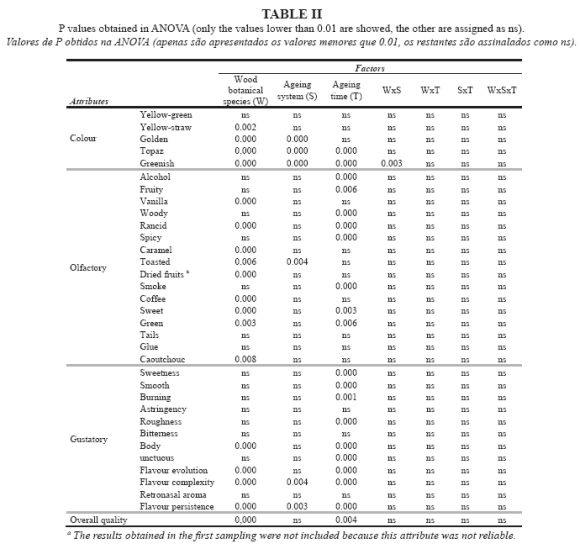
<body><![CDATA[<p><b>Tasting panel</b></p>      <p>The tasters were previously selected and trained (Caldeira <i>et al.</i>, 1999). The reliability of each taster was  evaluated by introducing blind sample replicates in all sessions, as described by Caldeira <i>et al.</i> (2002). The consistency, between repeated evaluations of the same brandy by a taster, was estimated using Pearson’s correlation coefficient, which will be  referred by ‘reliability’ according to Brien <i>et al.</i> (1987). After this preliminary analysis, seven reliable subjects  composed the average panel group.</p>      <p><b>Sensory attributes</b></p>      <p>The sensory attributes were previously generated by the tasting panel, according to Caldeira <i>et al.</i> (1999), which  included colour, olfactory and gustatory attributes. The reliability of each attribute was evaluated as proposed by Caldeira   <i>et al.</i> (2002), and only the reliable attributes were evaluated in this work.</p>      <p><b>Tasting conditions </b></p>      <p>All evaluations were carried out in a standardized tasting room with individual white boots, using standard wine-tasting  glasses (ISO 3591, 2010) filled with 30 mL of diluted brandies. Fifteen days before the tasting session, the brandy samples were diluted with water, thereby reducing the ethanol concentration to 40 % v/v and they were stored in a dark room at 20º C  until the tasting session.  </p>      <p>At the tasting session, the samples were served at room temperature. The sensory evaluations were held in the mornings  between 10:00 a.m. and 12:00 a.m. The panel evaluated the 12 brandies from each sampling time, which were randomly distributed  by two sessions. Seven samples were presented in each session, in balanced orders to eliminate first-order carryover effects  (Williams, 1949). Some replicates were introduced in all sessions in order to control the reliability of the panel. </p>      <p>All samples were spat out and water was provided for oral rinsing at the beginning of the experiments and also between  brandy tasting.</p>      <p>The tasters were asked to scoring the thirty three sensory attributes (see    <a href="#t2">Table II</a>) with a structured scale (0-no perception to 5-highest    perception). They also scored the overall quality of the brandies between 0    (without quality) and 20 (maximum quality).</p>     <p>&nbsp;</p> <a name="t1"> <img src="/img/revistas/ctv/v28n1/28n1a02t1.jpg">     
]]></body>
<body><![CDATA[<p>&nbsp;</p>      <p>&nbsp;</p> <a name="t2"> <img src="/img/revistas/ctv/v28n1/28n1a02t2.jpg">     
<p>&nbsp;</p>       <p>Between each sampling time, training sessions were done monthly, in order to maintain the taster´s performance.</p>      <p><b>Statistical analysis</b></p>      <p>The sensory attributes’ intensities of the brandies were submitted to a three-way analysis of variance (factor 1 - wood,  factor 2 – ageing system, factor 3 - ageing time; design with all interactions). For this analysis, and for each sensory attribute, it was used the average intensity of the seven reliable tasters. Calculations of the least significant difference  (LSD) were applied for the comparison of different brandy attributes (Montgomery, 1991).</p>      <p>The results were also subjected to a multivariate analysis, namely principal component analysis and linear discriminant  analysis. </p>      <p>The variance analysis and linear discriminant analysis of the data was performed using Statistica vs ’98 edition (Statsoft  Inc., USA). The principal component analysis (PCA) was carried out using NTSYS-pc package, version 2.1 (Exeter Software, USA).</p>      <p>&nbsp;</p>      <p><b>RESULTS AND DISCUSSION</b></p>      ]]></body>
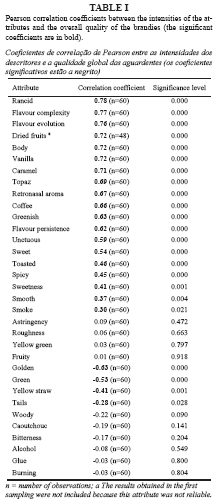
<body><![CDATA[<p>At each sampling time, several attributes of the brandies were evaluated by the tasting panel, namely five colour  attributes (yellow-green, yellow-straw, golden, topaz, and greenish), sixteen olfactory attributes (alcohol, fruity, vanilla,  woody, rancid, spicy, caramel, toasted, smoke, dried fruit, coffee, sweet, green, tails, glue, and rubber) and twelve   gustatory attributes (sweetness, smooth, burning, astringency, roughness, bitterness, body, unctuous, flavour evolution, flavour complexity, retronasal aroma, and flavour persistence), as well as the overall quality. The dried fruits attribute  was not reliable at first sampling evaluation and consequently the corresponding results were not included in the subsequent  analysis. The panel was retrained and the reliability of this attribute was attained at the other tasting sessions. </p>      <p><b>Attributes and overall quality</b></p>      <p>It was calculated the linear correlation between the attributes’ intensities, averaged across tasters and the overall  quality (<a href="#t1">Table I</a>). </p>        <p>The highest positive coefficients were found for two colour attributes (topaz, greenish), five olfactory attributes  (rancid, dried fruits, vanilla, caramel and coffee) and six gustatory attributes (flavour complexity, evolution and  persistence, retronasal aroma, body and unctuous). These attributes perception or intensity increase over the time (Caldeira  <i>et al.</i>, 2006), therefore it is expectable that they would be related with ageing process and could explain its positive influence in the overall quality of the aged wine brandy. </p>      <p>On the other hand, the attributes green, golden, yellow-straw and tails presented negative correlation with the overall  quality. Golden and yellow-straw are  colours well correlated with young brandies (Canas <i>et al.</i>, 2000), while topaz is  correlated with brandies with longer ageing, which could explain its relation with overall quality presented at <a href="#t1">Table I</a>.  Green is an important attribute of young wine brandies (Léauté <i>et al.</i>, 1998) and its intensity decreased with ageing   time in the wine brandies (Caldeira <i>et al.</i>, 2006) and in whiskies (Reazin, 1983), which explains the negative   correlation with overall quality (<a href="#t1">Table I</a>), and are in accordance with our previous results for a brandy   with longer ageing time (Caldeira <i>et al.</i>, 2006). Tails are a negative aroma associated with the last phase of the   distillation process, so it is predictable the negative correlation with overall quality that is presented in  <a href="#t1">Table I</a>. This result is also in accordance with that obtained in previous work (Caldeira <i>et al.</i>, 2006). </p>      <p>Concerning the woody attribute the results obtained are quite different from those verified in our previous studies. In  fact, it was found a negative correlation coefficient between the woody attribute, which varied between 1.0 and 2.7 (data not   shown), and the overall quality (<a href="#t1">Table I</a>), while a positive correlation was observed in other works   (Caldeira <i>et al.</i>, 2006), where the woody attribute ranged from 0.4 until 3.1. This could be probably related with the  intensity range of the attribute, which is different in this experiment. </p>      <p><b>Influence of wood, ageing system and ageing time on sensory profile of brandies</b></p>      <p>The all set of sensory results, obtained at the five samplings, were submitted to the analysis of variance (ANOVA) and the  results are presented at <a href="#t2">Table II</a>. The results pointed out that the wood botanical species and the ageing  time are the most discriminating factors concerning the sensory profile of the brandies. These outcomes are in agreement with  our previous results (Caldeira <i>et al.</i>, 2006; Caldeira <i>et al.</i>, 2010).</p>      <p>The chestnut aged brandies presented higher intensities of several attributes, like topaz, vanilla, rancid, caramel,  toasted, dried fruits, coffee, sweet, body, flavour evolution and flavour persistence than the brandies aged with French  Limousin oak (<a href="#f1">Figure 1</a>). The intensity of the majority of these attributes increase over the time (Caldeira  <i>et al.</i>, 2006), so it means that the sensory profile of the chestnut aged brandies corresponds to an older brandy when   compared with that of Limousin oak aged brandies. The vanilla attribute was positively correlated with the concentration of  vanillin (Caldeira <i>et al.</i>, 2008), tehrefore the highest intensities on vanilla attribute found in the brandies aged in chestnut wood (<a href="#t2">Table II</a> and <a href="#f1">Figure 1</a>) might be explained by the highest amount of vanillin of the brandies aged in chestnut  wood (Canas <i>et al.</i>, 2011; Canas <i>et al.</i>, 2013). Regarding the toasted attribute, it is used to describe the  odour of some volatile phenols and several unknown compounds and its intensity was related with the brandy content on volatile phenols and furanic aldehydes (Caldeira <i>et al.</i>, 2008). Thus, the high intensity of toasted attribute presented  in the brandies aged in chestnut wood (<a href="#t2">Table II</a>and <a href="#f1">Figure 1</a>) could be explained by the  highest concentration of furanic aldehydes found in the brandies aged in chestnut wood when in comparison with Limousin oak  wood (Canas <i>et al.</i>, 2011). </p>      <p>&nbsp;</p> <a name="f1"> <img src="/img/revistas/ctv/v28n1/28n1a02f1.jpg">     
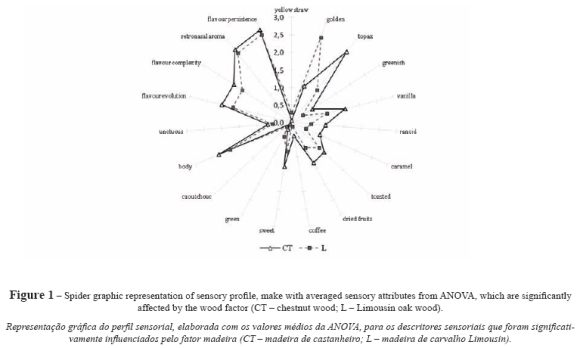
]]></body>
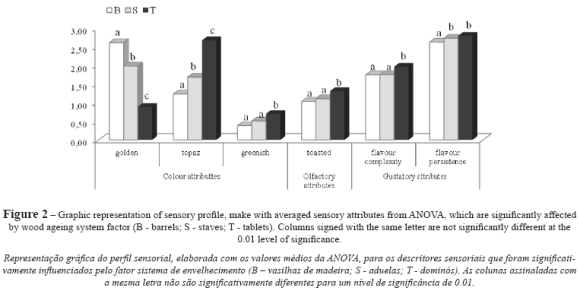
<body><![CDATA[<p>&nbsp;</p>      <p>The brandies aged with Limousin oak presented higher intensities of the attributes yellow-straw, golden and green, which  are more related to the youngest brandies (Canas <i>et al.</i>, 2000, Caldeira <i>et al.</i>, 2006).</p>      <p>These results reinforce the previous ones (Belchior <i>et al.</i>, 2001; Caldeira <i>et al.</i>, 2002; Caldeira <i>et  al.</i>, 2006; Canas <i>et al.</i>, 2011) and pointing out once more the chestnut wood as an interesting alternative for the  ageing of the wine brandies. </p>      <p>The ageing system affected significantly only six attributes, namely three colour attributes, one olfactory attribute and  two gustatory attributes (<a href="#t2">Table II</a> and <a href="#f2">Figure 2</a>). The brandies aged with tablets presented lower intensities of the attributes golden and higher intensities of the attributes topaz, greenish, toasted, flavour  complexity and flavour persistence than the brandies aged in wooden barrels. The brandies aged with staves presented an  intermediate sensory profile. Taking into account the behaviour of these attributes over the time (Canas <i>et al.</i>, 2000;  Caldeira <i>et al.</i>, 2006) it seems that the sensory profile of the brandies aged with tablets corresponds to an older   brandy. The high intensities of toasted in the brandies aged with tablets can result from higher amounts of volatile phenols   in these brandies (Caldeira <i>et al.</i>, 2010), considering the positive correlation between these features (Caldeira <i>et   al.</i>, 2008). </p>      <p>&nbsp;</p> <a name="f2"> <img src="/img/revistas/ctv/v28n1/28n1a02f2.jpg">     
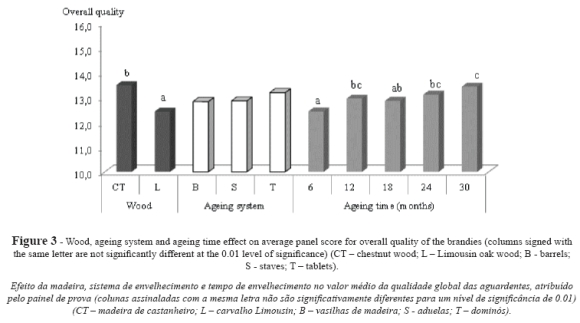
<p>&nbsp;</p>      <p>In accordance with slight sensory discrimination, the overall quality of the brandies it is not significantly affected by  the ageing system. The overall quality was only significantly influenced by the wood botanical species and by the ageing time (<a href="#t2">Table II</a> and <a href="#f3">Figure 3</a>), which is in accordance with our previous results using the  traditional ageing system in wooden barrels (Belchior <i>et al.</i>, 2001; Caldeira <i>et al.</i>, 2006). </p>      <p>&nbsp;</p> <a name="f3"> <img src="/img/revistas/ctv/v28n1/28n1a02f3.jpg">     
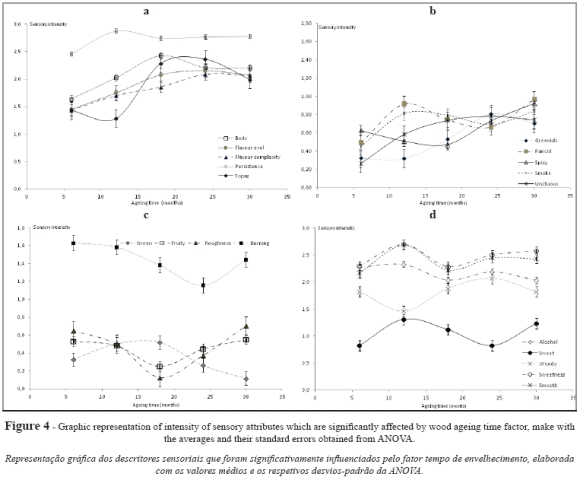
<p>&nbsp;</p>      <p>The ageing time influences significantly many sensory attributes (<a href="#t2">Table II</a>). However, their evolution pattern is variable,  as shown in <a href="#f4">Figure 4</a>. The intensity of the majority of the attributes, such as topaz, greenish, rancid, spicy, smoke, unctuous,  body, flavour, evolution and flavour persistence, increases over the time and tends to reach the equilibrium (<a href="#f4">Figure 4a,b</a>).  Similar results were found in a previous work, during an extended period of ageing, namely during five years (Caldeira <i>et   al.</i>, 2006). Taking into account the positive correlation of these attributes with overall quality (<a href="#t1">Table I</a>),  their increase can explain the raise of overall quality of the brandies over the time (<a href="#f3">Figure 3</a>). </p>      ]]></body>
<body><![CDATA[<p>&nbsp;</p> <a name="f4"> <img src="/img/revistas/ctv/v28n1/28n1a02f4.jpg">     
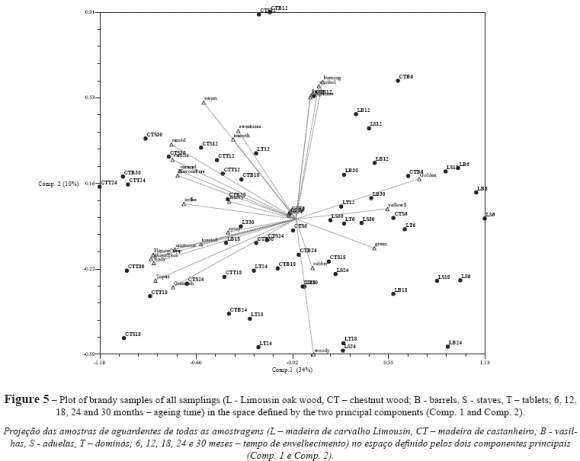
<p>&nbsp;</p>      <p>The green attribute presents a decrease over the time but that only starts after 18 months (<a href="#f4">Figure 4c</a>). This result is in accordance with our previous work although the differences found in the ageing conditions and sampling time  (Caldeira <i>et al.</i>, 2006). The fruity, roughness and burning (<a href="#f4">Figure 4c</a>) present a decrease, followed  by a sharp increase during the ageing period of 30 months. These results are not in accordance with those of the mentioned  work, in which it was detected a decrease of burning and fruity during five years of ageing.</p>      <p>Concerning the intensity of other five attributes, alcohol, sweet, woody, sweetness and smooth, they show an irregular  pattern over the time (<a href="#f4">Figure 4d</a>).</p>      <p>It was not detected a significant effect of the interaction between the factors (wood, ageing system and ageing time) on  the intensity of the sensory attributes of the brandies, with exception to the greenish (<a href="#t2">Table II</a>). It was   detected a significant interaction between the wood and the ageing system in the greenish intensity. In fact, the effect of   ageing system in the greenish intensity of the brandies was more pronounced when the chestnut wood was used in comparison with Limousin oak wood (data not shown).</p>      <p><b>Multivariate analysis</b></p>      <p>Multivariate analysis was also applied to check whether the measured variables could help to distinguish among  pre-established groups (wood botanical species, ageing system and ageing time).</p>      <p>The average intensities of the brandy’s attributes were submitted to the principal component analysis (PCA). It was  analysed a matrix composed by 60 objects (12 brandies x 5 sampling times) and 26 variables (only the attributes with significant effects shown in the <a href="#t2">Table II</a> were considered).  </p>      <p>In the PCA analysis (<a href="#f5">Figure 5</a>) the first two components are those which contribute for major variability  of the results (34 and 10%, respectively). The brandy samples are distributed across the space created by the two main   components (<a href="#f5">Figure 5</a>). Two group of attributes presented higher contribution to the first component with loadings in opposite sides. The first group is composed by yellow-straw, golden and green and the second group is  constituted by topaz, greenish, rancid, vanilla, body, flavour complexity, flavour evolution and flavour persistence. The  attributes of the first group are more related with young brandies, namely the yellow-straw and green (Canas <i>et al.</i>,  2000, Caldeira <i>et al.</i>, 2006). The attributes which influence the opposite side of the component 1 are more related with  older brandies (Canas <i>et al.</i>, 2000, Caldeira <i>et al.</i>, 2006) since their intensity increase over the time, like  topaz, vanilla, toasted, body, flavour complexity, evolution and persistence. Thus the component 1 seems to split the samples   based on its degree of maturation. Indeed, the young brandies are located in the positive side of the component while the older brandies are located in the opposite side. The brandies aged with the chestnut wood show a tendency to be located in the side more related with the attributes of  matured brandies while the brandies aged with Limousin oak tend to be located in the opposite side. Concerning the ageing  system, it seems that it is not possible to separate the samples according to this factor, which is in agreement with ANOVA  results.</p>      <p>&nbsp;</p> <a name="f5"> <img src="/img/revistas/ctv/v28n1/28n1a02f5.jpg">     
]]></body>
<body><![CDATA[<p>&nbsp;</p>      <p>It was also performed a linear discriminant analysis with all set of the results, considering the ageing system as  discriminant factor, but it was not found any significant discriminant factor, as expected based on the ANOVA results. </p>      <p>Therefore, it seems that sensory data do not permit an easy discrimination of the brandies based on the ageing system used.  On the contrary, the chemical analysis of the corresponding brandies allow the discrimination of the brandies based on the ageing system (Canas <i>et al.</i>, 2009a,b; Caldeira <i>et al.</i>, 2010; Canas <i>et al.</i>, 2013). Therefore, the  alternative ageing systems allow obtaining aged brandies with similar quality to the brandies aged in the traditional system  in wooden barrels, and it is possible to found chemical markers in order to control these technologies.</p>      <p>&nbsp;</p>      <p><b>CONCLUSIONS</b></p>      <p>The results presented in this work suggest that the use of alternative systems allow producing brandies with slightly  different sensory profile. Actually, the brandies aged with alternative systems presented an overall quality similar to those aged in wooden barrels, and the use of tablets or staves in the brandy ageing seems to be an interesting alternative. </p>      <p>These results, obtained with chestnut and oak wood during an ageing time of 30 months, reinforce that chestnut wood is  suitable for the ageing of the wine brandies. </p>      <p>Despite these outcomes, further research is needed in order to validate the use of these alternative technologies in the  brandy ageing. </p>      <p>&nbsp;</p>      <p><b>ACKNOWLEDGMENTS</b></p>      ]]></body>
<body><![CDATA[<p> The authors thank the participation of tasting panel (Francisco Carlos, João Melícias, Manuel Bento, Maria Lucinda Abrantes,  Rui Pereira, Sofia Catarino), and the financial support of INIAV-Dois Portos and Adega Cooperativa da Lourinhã.</p>      <p>&nbsp;</p>      <p><b>REFERENCES </b></p>      <!-- ref --><p>Artajona J., 1991. Caracterisation del roble según su origen y grado de tostado, mediante la utilizacion de GC y HPLC.  <i>Viticultura/Enologia Profesional</i>, <b>14</b>, 61-72.    &nbsp;&nbsp;&nbsp;&nbsp;&nbsp;&nbsp;&nbsp;&nbsp;[&#160;<a href="javascript:void(0);" onclick="javascript: window.open('/scielo.php?script=sci_nlinks&ref=000096&pid=S0254-0223201300010000200001&lng=','','width=640,height=500,resizable=yes,scrollbars=1,menubar=yes,');">Links</a>&#160;]<!-- end-ref --></p>      <!-- ref --><p>Bautista-Ortin A.B., Lencina A.G., Cano-Lopez M., Pardo-Minguez F., Lopez-Roca J.M., Gomez-Plaza E., 2008.  The use of oak  chips during the ageing of a red wine in stainless steel tanks or used barrels: effect of the contact time and size of the oak  chips on aroma compounds. <i>Aust. J. Grape Wine Res.</i>, <b>14</b>, 63-70.    &nbsp;&nbsp;&nbsp;&nbsp;&nbsp;&nbsp;&nbsp;&nbsp;[&#160;<a href="javascript:void(0);" onclick="javascript: window.open('/scielo.php?script=sci_nlinks&ref=000098&pid=S0254-0223201300010000200002&lng=','','width=640,height=500,resizable=yes,scrollbars=1,menubar=yes,');">Links</a>&#160;]<!-- end-ref --></p>      <!-- ref --><p>Belchior A.P., Almeida T.G.T., Mateus A.M., Canas S., 2003. Ensaio laboratorial sobre a cinética de extracção de compostos  de baixa massa molecular da madeira pela aguardente. <i>Ciência Téc. Vitiv.</i>, <b>18</b>, 29-41.    &nbsp;&nbsp;&nbsp;&nbsp;&nbsp;&nbsp;&nbsp;&nbsp;[&#160;<a href="javascript:void(0);" onclick="javascript: window.open('/scielo.php?script=sci_nlinks&ref=000100&pid=S0254-0223201300010000200003&lng=','','width=640,height=500,resizable=yes,scrollbars=1,menubar=yes,');">Links</a>&#160;]<!-- end-ref --></p>      <!-- ref --><p>Belchior A.P., Caldeira I., Costa S., Lopes C., Tralhão G., Ferrão A.F.M., Mateus A.M., Carvalho E., 2001. Evolução das  características físico-químicas e organolépticas de aguardentes Lourinhã ao longo de cinco anos de envelhecimento em madeiras de carvalho e castanheiro. <i>Ciência Téc. Vitiv.</i>, <b>16</b>, 81-94.    &nbsp;&nbsp;&nbsp;&nbsp;&nbsp;&nbsp;&nbsp;&nbsp;[&#160;<a href="javascript:void(0);" onclick="javascript: window.open('/scielo.php?script=sci_nlinks&ref=000102&pid=S0254-0223201300010000200004&lng=','','width=640,height=500,resizable=yes,scrollbars=1,menubar=yes,');">Links</a>&#160;]<!-- end-ref --> </p>      <!-- ref --><p>Brien C.J., May P., Mayo O., 1987. Analysis of judge performance in wine quality evaluations. <i> J. Food. Sc.</i>, <b>52</b>, 1273-1279.    &nbsp;&nbsp;&nbsp;&nbsp;&nbsp;&nbsp;&nbsp;&nbsp;[&#160;<a href="javascript:void(0);" onclick="javascript: window.open('/scielo.php?script=sci_nlinks&ref=000104&pid=S0254-0223201300010000200005&lng=','','width=640,height=500,resizable=yes,scrollbars=1,menubar=yes,');">Links</a>&#160;]<!-- end-ref --></p>      <!-- ref --><p>Butticaz S., Rawyler A., 2007. Différenciation analytique des vins élevés en fût de chêne et macérés avec des copeaux de  chêne. <i>Rev. S. Vitic. Arboric. Hortic.</i>, <b>39</b>, 367-373.    &nbsp;&nbsp;&nbsp;&nbsp;&nbsp;&nbsp;&nbsp;&nbsp;[&#160;<a href="javascript:void(0);" onclick="javascript: window.open('/scielo.php?script=sci_nlinks&ref=000106&pid=S0254-0223201300010000200006&lng=','','width=640,height=500,resizable=yes,scrollbars=1,menubar=yes,');">Links</a>&#160;]<!-- end-ref --></p>      <!-- ref --><p>Caldeira I., Anjos O., Portal V., Belchior A.P., Canas S., 2010. Sensory and chemical modifications of wine-brandy aged  with chestnut and oak wood fragments in comparison to wooden barrels. <i>Anal. Chim. Acta</i>, <b>660</b>, 43-52.    &nbsp;&nbsp;&nbsp;&nbsp;&nbsp;&nbsp;&nbsp;&nbsp;[&#160;<a href="javascript:void(0);" onclick="javascript: window.open('/scielo.php?script=sci_nlinks&ref=000108&pid=S0254-0223201300010000200007&lng=','','width=640,height=500,resizable=yes,scrollbars=1,menubar=yes,');">Links</a>&#160;]<!-- end-ref --></p>      <!-- ref --><p>Caldeira I., Belchior A.P., Clímaco M.C., Bruno de Sousa R., 2002. Aroma profile of Portuguese brandies aged in chestnut  and oak woods. <i>Anal. Chim. Acta</i>, <b>458</b>, 55-62.    &nbsp;&nbsp;&nbsp;&nbsp;&nbsp;&nbsp;&nbsp;&nbsp;[&#160;<a href="javascript:void(0);" onclick="javascript: window.open('/scielo.php?script=sci_nlinks&ref=000110&pid=S0254-0223201300010000200008&lng=','','width=640,height=500,resizable=yes,scrollbars=1,menubar=yes,');">Links</a>&#160;]<!-- end-ref --></p>      <!-- ref --><p>Caldeira I., Bruno de Sousa R., Belchior A.P., Clímaco M.C., 2008. A sensory and chemical approach to the aroma of wooden  aged Lourinhã wine brandy. <i>Ciência Téc. Vitiv.</i>, <b>23</b>, 97-110.    &nbsp;&nbsp;&nbsp;&nbsp;&nbsp;&nbsp;&nbsp;&nbsp;[&#160;<a href="javascript:void(0);" onclick="javascript: window.open('/scielo.php?script=sci_nlinks&ref=000112&pid=S0254-0223201300010000200009&lng=','','width=640,height=500,resizable=yes,scrollbars=1,menubar=yes,');">Links</a>&#160;]<!-- end-ref --> </p>      <!-- ref --><p>Caldeira I., Canas S., Costa S., Carvalho E., Belchior A. P., 1999. Formação de uma câmara de prova organoléptica de  aguardentes velhas e selecção de descritores sensoriais. <i>Ciência Téc. Vitiv.</i>, <b>14</b>, 21-30.    &nbsp;&nbsp;&nbsp;&nbsp;&nbsp;&nbsp;&nbsp;&nbsp;[&#160;<a href="javascript:void(0);" onclick="javascript: window.open('/scielo.php?script=sci_nlinks&ref=000114&pid=S0254-0223201300010000200010&lng=','','width=640,height=500,resizable=yes,scrollbars=1,menubar=yes,');">Links</a>&#160;]<!-- end-ref --></p>      <!-- ref --><p>Caldeira I., Mateus A.M., Belchior A.P., 2006. Flavour and odour profile modifications during the first five years of  Lourinhã brandy maturation on different wooden barrels. <i>Anal. Chim. Acta</i>, <b>563</b>, 264-273.    &nbsp;&nbsp;&nbsp;&nbsp;&nbsp;&nbsp;&nbsp;&nbsp;[&#160;<a href="javascript:void(0);" onclick="javascript: window.open('/scielo.php?script=sci_nlinks&ref=000116&pid=S0254-0223201300010000200011&lng=','','width=640,height=500,resizable=yes,scrollbars=1,menubar=yes,');">Links</a>&#160;]<!-- end-ref --></p>      <!-- ref --><p>Canas S., Belchior A.P., Caldeira I., Spranger M.I., Bruno de Sousa R., 2000. A cor e sua evolução em aguardentes Lourinhã  nos três primeiros anos de envelhecimento. <i>Ciência Téc. Vitiv.</i>, <b>15</b>, 1-14.    &nbsp;&nbsp;&nbsp;&nbsp;&nbsp;&nbsp;&nbsp;&nbsp;[&#160;<a href="javascript:void(0);" onclick="javascript: window.open('/scielo.php?script=sci_nlinks&ref=000118&pid=S0254-0223201300010000200012&lng=','','width=640,height=500,resizable=yes,scrollbars=1,menubar=yes,');">Links</a>&#160;]<!-- end-ref --></p>      <!-- ref --><p>Canas S., Caldeira I., Belchior A.P., 2009a. Comparação de sistemas alternativos para o envelhecimento de aguardente vínica.  Efeito da oxigenação e da forma da madeira. <i>Ciência Téc. Vitiv.</i>, <b>24</b>, 33-40.    &nbsp;&nbsp;&nbsp;&nbsp;&nbsp;&nbsp;&nbsp;&nbsp;[&#160;<a href="javascript:void(0);" onclick="javascript: window.open('/scielo.php?script=sci_nlinks&ref=000120&pid=S0254-0223201300010000200013&lng=','','width=640,height=500,resizable=yes,scrollbars=1,menubar=yes,');">Links</a>&#160;]<!-- end-ref --></p>      <!-- ref --><p>Canas S., Caldeira I., Belchior A.P., 2009b. Comparison of alternative systems for the ageing of wine brandy. Wood shape  and wood botanical species effect. <i>Ciência Téc. Vitiv.</i>, <b>24</b>, 90-99.    &nbsp;&nbsp;&nbsp;&nbsp;&nbsp;&nbsp;&nbsp;&nbsp;[&#160;<a href="javascript:void(0);" onclick="javascript: window.open('/scielo.php?script=sci_nlinks&ref=000122&pid=S0254-0223201300010000200014&lng=','','width=640,height=500,resizable=yes,scrollbars=1,menubar=yes,');">Links</a>&#160;]<!-- end-ref --></p>      <!-- ref --><p>Canas S., Caldeira I., Belchior A.P., 2013. Extraction/oxidation kinetics of low molecular weight compounds in wine brandy  produced in alternative ageing systems. <i>Food Chem.</i>, <b>138</b>, 2460-2467.    &nbsp;&nbsp;&nbsp;&nbsp;&nbsp;&nbsp;&nbsp;&nbsp;[&#160;<a href="javascript:void(0);" onclick="javascript: window.open('/scielo.php?script=sci_nlinks&ref=000124&pid=S0254-0223201300010000200015&lng=','','width=640,height=500,resizable=yes,scrollbars=1,menubar=yes,');">Links</a>&#160;]<!-- end-ref --></p>      <!-- ref --><p>Canas S., Caldeira I., Belchior A.P., Spranger M.I., Clímaco M.C., Bruno-de-Sousa R., 2011.  Chestnut wood: a sustainable  alternative for the aging of wine brandies. <i>In:</i> <i>Food quality: control, analysis and consumer concerns.</i> 181-228.  Medina D.A., Laine A.M. (eds.), Science Publishers Inc., New York.    &nbsp;&nbsp;&nbsp;&nbsp;&nbsp;&nbsp;&nbsp;&nbsp;[&#160;<a href="javascript:void(0);" onclick="javascript: window.open('/scielo.php?script=sci_nlinks&ref=000126&pid=S0254-0223201300010000200016&lng=','','width=640,height=500,resizable=yes,scrollbars=1,menubar=yes,');">Links</a>&#160;]<!-- end-ref --></p>      <!-- ref --><p>Canas S., Leandro M.C., Spranger M.I., Belchior A.P., 1999. Low molecular weight organic compounds of chestnut wood  (<i>Castanea sativa </i>L.) and corresponding aged brandies. <i>J. Agric. Food Chem.</i>, <b>47</b>, 5023-5030.    &nbsp;&nbsp;&nbsp;&nbsp;&nbsp;&nbsp;&nbsp;&nbsp;[&#160;<a href="javascript:void(0);" onclick="javascript: window.open('/scielo.php?script=sci_nlinks&ref=000128&pid=S0254-0223201300010000200017&lng=','','width=640,height=500,resizable=yes,scrollbars=1,menubar=yes,');">Links</a>&#160;]<!-- end-ref --></p>      <!-- ref --><p>del Alamo M., Nevares I., Carcel L.M., Navas L., 2004. Analysis for low molecular weight phenolic compounds in a red wine  aged in oak chips. <i>Anal. Chim. Acta</i>, <b>513</b>, 229-237.    &nbsp;&nbsp;&nbsp;&nbsp;&nbsp;&nbsp;&nbsp;&nbsp;[&#160;<a href="javascript:void(0);" onclick="javascript: window.open('/scielo.php?script=sci_nlinks&ref=000130&pid=S0254-0223201300010000200018&lng=','','width=640,height=500,resizable=yes,scrollbars=1,menubar=yes,');">Links</a>&#160;]<!-- end-ref --></p>      <!-- ref --><p>Eiriz N., Santos-Oliveira J.F., Clímaco M.C., 2007. Fragmentos de madeira de carvalho no estágio de vinhos tintos.  <i>Ciência Téc. Vitiv.</i>, <b>22</b>, 63-71.    &nbsp;&nbsp;&nbsp;&nbsp;&nbsp;&nbsp;&nbsp;&nbsp;[&#160;<a href="javascript:void(0);" onclick="javascript: window.open('/scielo.php?script=sci_nlinks&ref=000132&pid=S0254-0223201300010000200019&lng=','','width=640,height=500,resizable=yes,scrollbars=1,menubar=yes,');">Links</a>&#160;]<!-- end-ref --></p>      <!-- ref --><p>Fan W., Xu Y., Yu A., 2006. Influence of oak chips geographical origin, toast level, dosage and aging time on volatile  compounds of apple cider. <i>J. Inst. Brew.</i>, <b>112</b>, 255-263.    &nbsp;&nbsp;&nbsp;&nbsp;&nbsp;&nbsp;&nbsp;&nbsp;[&#160;<a href="javascript:void(0);" onclick="javascript: window.open('/scielo.php?script=sci_nlinks&ref=000134&pid=S0254-0223201300010000200020&lng=','','width=640,height=500,resizable=yes,scrollbars=1,menubar=yes,');">Links</a>&#160;]<!-- end-ref --></p>      <!-- ref --><p>Guichard E., Fournier N., Masson G., Puech J.-L., 1995. Stereoisomers of &#946;-methyl-&#947;-octalactone. I-Quantification in  brandies as a function of wood origin and treatment of the barrels. <i>Am. J. Enol. Vitic.</i>, <b>46</b>, 419-423.    &nbsp;&nbsp;&nbsp;&nbsp;&nbsp;&nbsp;&nbsp;&nbsp;[&#160;<a href="javascript:void(0);" onclick="javascript: window.open('/scielo.php?script=sci_nlinks&ref=000136&pid=S0254-0223201300010000200021&lng=','','width=640,height=500,resizable=yes,scrollbars=1,menubar=yes,');">Links</a>&#160;]<!-- end-ref --> </p>      <!-- ref --><p>Guymon J.F., Crowell E.A., 1970. Brandy aging. Some comparisons of American and French oak cooperage. <i>Wines &amp; Vines</i>, <b>1</b>, 23-25.    &nbsp;&nbsp;&nbsp;&nbsp;&nbsp;&nbsp;&nbsp;&nbsp;[&#160;<a href="javascript:void(0);" onclick="javascript: window.open('/scielo.php?script=sci_nlinks&ref=000138&pid=S0254-0223201300010000200022&lng=','','width=640,height=500,resizable=yes,scrollbars=1,menubar=yes,');">Links</a>&#160;]<!-- end-ref --></p>      <!-- ref --><p>ISO 3591, 2010 - Sensory analysis - Apparatus - Wine-tasting glass. International Organization for Standardization, Genève.    &nbsp;&nbsp;&nbsp;&nbsp;&nbsp;&nbsp;&nbsp;&nbsp;[&#160;<a href="javascript:void(0);" onclick="javascript: window.open('/scielo.php?script=sci_nlinks&ref=000140&pid=S0254-0223201300010000200023&lng=','','width=640,height=500,resizable=yes,scrollbars=1,menubar=yes,');">Links</a>&#160;]<!-- end-ref --> </p>      <!-- ref --><p>Léauté R., Mosedale J.R., Mourgues J., Puech J.-L., 1998. Barrique et vieillissement des eaux-de-vie. <i>In:</i> <i>Oenologie  fondements scientifiques et technologiques.</i> 1110-1142. Flanzy C. (ed.), Collection Sciences et Techniques Agroalimentaires,  Lavoisier Tec&amp;Doc, Paris.    &nbsp;&nbsp;&nbsp;&nbsp;&nbsp;&nbsp;&nbsp;&nbsp;[&#160;<a href="javascript:void(0);" onclick="javascript: window.open('/scielo.php?script=sci_nlinks&ref=000142&pid=S0254-0223201300010000200024&lng=','','width=640,height=500,resizable=yes,scrollbars=1,menubar=yes,');">Links</a>&#160;]<!-- end-ref --> </p>      <!-- ref --><p>Montgomery D.C., 1991. <i>Design and analysis of experiments.</i> Third Edition, 668p. John Wiley &amp; Sons, Singapore.    &nbsp;&nbsp;&nbsp;&nbsp;&nbsp;&nbsp;&nbsp;&nbsp;[&#160;<a href="javascript:void(0);" onclick="javascript: window.open('/scielo.php?script=sci_nlinks&ref=000144&pid=S0254-0223201300010000200025&lng=','','width=640,height=500,resizable=yes,scrollbars=1,menubar=yes,');">Links</a>&#160;]<!-- end-ref --> </p>      <!-- ref --><p>Onishi M., Guymon J.F., Crowell E.A., 1977. Changes in some volatile constituents of brandy during aging. <i>Am. J. Enol.  Vitic.</i>, <b>28</b>, 152-158.    &nbsp;&nbsp;&nbsp;&nbsp;&nbsp;&nbsp;&nbsp;&nbsp;[&#160;<a href="javascript:void(0);" onclick="javascript: window.open('/scielo.php?script=sci_nlinks&ref=000146&pid=S0254-0223201300010000200026&lng=','','width=640,height=500,resizable=yes,scrollbars=1,menubar=yes,');">Links</a>&#160;]<!-- end-ref --></p>      <!-- ref --><p>Puech J.-L., Lepoutre J.P., Baumes R., Bayonove C., Moutounet M., 1992. Influence du thermotraitement des barriques sur  l´évolution de quelques composants issus du bois de chêne dans les eaux-de-vie. <i>In:</i> <i>Elaboration et connaissance des spiritueux.</i> 583-588. Cantagrel R. (ed.), Lavoisier Tec&amp;Doc, Paris.    &nbsp;&nbsp;&nbsp;&nbsp;&nbsp;&nbsp;&nbsp;&nbsp;[&#160;<a href="javascript:void(0);" onclick="javascript: window.open('/scielo.php?script=sci_nlinks&ref=000148&pid=S0254-0223201300010000200027&lng=','','width=640,height=500,resizable=yes,scrollbars=1,menubar=yes,');">Links</a>&#160;]<!-- end-ref --> </p>      <!-- ref --><p>Rabier Ph., Moutounet M., 1991. Évolution d`extractibles de bois de chêne dans une eau-de-vie de vin. Incidence du  thermotraitement des barriques. <i>In:</i> <i>Les eaux de vie traditionnelles d`origine viticole.</i> 220-230. Bertrand A.  (Ed.), Lavoisier Tec&amp;Doc, Paris.    &nbsp;&nbsp;&nbsp;&nbsp;&nbsp;&nbsp;&nbsp;&nbsp;[&#160;<a href="javascript:void(0);" onclick="javascript: window.open('/scielo.php?script=sci_nlinks&ref=000150&pid=S0254-0223201300010000200028&lng=','','width=640,height=500,resizable=yes,scrollbars=1,menubar=yes,');">Links</a>&#160;]<!-- end-ref --></p>      <!-- ref --><p>Reazin G.H., 1983. Chemical analysis of whisky maturation. <i>In:</i> <i>Flavour of distilled beverages. Origin and  development</i>. 225-240. Piggott J.R. (ed.), Ellis Horwood Limited, West Sussex, England.    &nbsp;&nbsp;&nbsp;&nbsp;&nbsp;&nbsp;&nbsp;&nbsp;[&#160;<a href="javascript:void(0);" onclick="javascript: window.open('/scielo.php?script=sci_nlinks&ref=000152&pid=S0254-0223201300010000200029&lng=','','width=640,height=500,resizable=yes,scrollbars=1,menubar=yes,');">Links</a>&#160;]<!-- end-ref --> </p>      <!-- ref --><p>Rodriguez-Bencomo J.J., Ortega-Heras M., Perez-Magariño S., Gonzalez-Huerta C., 2009. Volatile compounds of red wines  macerated with Spanish, American and French oak chips. <i>J. Agric. Food Chem.</i>, <b>57</b>, 6383-6391.    &nbsp;&nbsp;&nbsp;&nbsp;&nbsp;&nbsp;&nbsp;&nbsp;[&#160;<a href="javascript:void(0);" onclick="javascript: window.open('/scielo.php?script=sci_nlinks&ref=000154&pid=S0254-0223201300010000200030&lng=','','width=640,height=500,resizable=yes,scrollbars=1,menubar=yes,');">Links</a>&#160;]<!-- end-ref --></p>      <!-- ref --><p>Viriot C., Scalbert A., Lapierre C., Moutounet M., 1993. Ellagitannins and lignins in aging of spirits in oak barrels. <i>J.  Agric. Food Chem.</i>, <b>41</b>, 1872-1879.    &nbsp;&nbsp;&nbsp;&nbsp;&nbsp;&nbsp;&nbsp;&nbsp;[&#160;<a href="javascript:void(0);" onclick="javascript: window.open('/scielo.php?script=sci_nlinks&ref=000156&pid=S0254-0223201300010000200031&lng=','','width=640,height=500,resizable=yes,scrollbars=1,menubar=yes,');">Links</a>&#160;]<!-- end-ref --></p>      <!-- ref --><p>Williams E.J., 1949. Experimental designs balanced for the estimation of residual effects of treatments. <i>Aust. J. Sci.  Res.</i> <b>A2</b>, 149-168.    &nbsp;&nbsp;&nbsp;&nbsp;&nbsp;&nbsp;&nbsp;&nbsp;[&#160;<a href="javascript:void(0);" onclick="javascript: window.open('/scielo.php?script=sci_nlinks&ref=000158&pid=S0254-0223201300010000200032&lng=','','width=640,height=500,resizable=yes,scrollbars=1,menubar=yes,');">Links</a>&#160;]<!-- end-ref --></p>      <p>&nbsp;</p>     <p><Sup><a name="0"></a><a href="#top0">*</a></Sup><b>Corresponding author:</b></p>     <p>Tel.:+351261712106, Fax:+351261712426, e-mail: <a href="mailto:ilda.caldeira@iniav.pt">ilda.caldeira@iniav.pt</a></p>       ]]></body>
<body><![CDATA[<p>&nbsp;</p>      <p><i>(Manuscrito recebido em 06.05.2013. Aceite para publicação em 14.08.2013)</i></p>     <p>&nbsp;</p>       ]]></body><back>
<ref-list>
<ref id="B1">
<nlm-citation citation-type="journal">
<person-group person-group-type="author">
<name>
<surname><![CDATA[Artajona]]></surname>
<given-names><![CDATA[J.]]></given-names>
</name>
</person-group>
<article-title xml:lang="es"><![CDATA[Caracterisation del roble según su origen y grado de tostado, mediante la utilizacion de GC y HPLC]]></article-title>
<source><![CDATA[Viticultura/Enologia Profesional]]></source>
<year>1991</year>
<volume>14</volume>
<page-range>61-72</page-range></nlm-citation>
</ref>
<ref id="B2">
<nlm-citation citation-type="journal">
<person-group person-group-type="author">
<name>
<surname><![CDATA[Bautista-Ortin]]></surname>
<given-names><![CDATA[A.B.]]></given-names>
</name>
<name>
<surname><![CDATA[Lencina]]></surname>
<given-names><![CDATA[A.G.]]></given-names>
</name>
<name>
<surname><![CDATA[Cano-Lopez]]></surname>
<given-names><![CDATA[M.]]></given-names>
</name>
<name>
<surname><![CDATA[Pardo-Minguez]]></surname>
<given-names><![CDATA[F.]]></given-names>
</name>
<name>
<surname><![CDATA[Lopez-Roca]]></surname>
<given-names><![CDATA[J.M.]]></given-names>
</name>
<name>
<surname><![CDATA[Gomez-Plaza]]></surname>
<given-names><![CDATA[E.]]></given-names>
</name>
</person-group>
<article-title xml:lang="en"><![CDATA[The use of oak chips during the ageing of a red wine in stainless steel tanks or used barrels: effect of the contact time and size of the oak chips on aroma compounds]]></article-title>
<source><![CDATA[Aust. J. Grape Wine Res]]></source>
<year>2008</year>
<volume>14</volume>
<page-range>63-70</page-range></nlm-citation>
</ref>
<ref id="B3">
<nlm-citation citation-type="journal">
<person-group person-group-type="author">
<name>
<surname><![CDATA[Belchior]]></surname>
<given-names><![CDATA[A.P.]]></given-names>
</name>
<name>
<surname><![CDATA[Almeida]]></surname>
<given-names><![CDATA[T.G.T.]]></given-names>
</name>
<name>
<surname><![CDATA[Mateus]]></surname>
<given-names><![CDATA[A.M.]]></given-names>
</name>
<name>
<surname><![CDATA[Canas]]></surname>
<given-names><![CDATA[S.]]></given-names>
</name>
</person-group>
<article-title xml:lang="pt"><![CDATA[Ensaio laboratorial sobre a cinética de extracção de compostos de baixa massa molecular da madeira pela aguardente]]></article-title>
<source><![CDATA[Ciência Téc. Vitiv]]></source>
<year>2003</year>
<volume>18,</volume>
<page-range>29-41</page-range></nlm-citation>
</ref>
<ref id="B4">
<nlm-citation citation-type="journal">
<person-group person-group-type="author">
<name>
<surname><![CDATA[Belchior]]></surname>
<given-names><![CDATA[A.P.]]></given-names>
</name>
<name>
<surname><![CDATA[Caldeira]]></surname>
<given-names><![CDATA[I.]]></given-names>
</name>
<name>
<surname><![CDATA[Costa]]></surname>
<given-names><![CDATA[S.]]></given-names>
</name>
<name>
<surname><![CDATA[Lopes]]></surname>
<given-names><![CDATA[C.]]></given-names>
</name>
<name>
<surname><![CDATA[Tralhão]]></surname>
<given-names><![CDATA[G.]]></given-names>
</name>
<name>
<surname><![CDATA[Ferrão]]></surname>
<given-names><![CDATA[A.F.M.]]></given-names>
</name>
<name>
<surname><![CDATA[Mateus]]></surname>
<given-names><![CDATA[A.M.]]></given-names>
</name>
<name>
<surname><![CDATA[Carvalho]]></surname>
<given-names><![CDATA[E.]]></given-names>
</name>
</person-group>
<article-title xml:lang="pt"><![CDATA[Evolução das características físico-químicas e organolépticas de aguardentes Lourinhã ao longo de cinco anos de envelhecimento em madeiras de carvalho e castanheiro]]></article-title>
<source><![CDATA[Ciência Téc. Vitiv.]]></source>
<year>2001</year>
<volume>16</volume>
<page-range>81-94</page-range></nlm-citation>
</ref>
<ref id="B5">
<nlm-citation citation-type="journal">
<person-group person-group-type="author">
<name>
<surname><![CDATA[Brien]]></surname>
<given-names><![CDATA[C.J.]]></given-names>
</name>
<name>
<surname><![CDATA[May]]></surname>
<given-names><![CDATA[P.]]></given-names>
</name>
<name>
<surname><![CDATA[Mayo]]></surname>
<given-names><![CDATA[O.]]></given-names>
</name>
</person-group>
<article-title xml:lang="en"><![CDATA[Analysis of judge performance in wine quality evaluations]]></article-title>
<source><![CDATA[J. Food. Sc.]]></source>
<year>1987</year>
<volume>52</volume>
<page-range>1273-1279</page-range></nlm-citation>
</ref>
<ref id="B6">
<nlm-citation citation-type="journal">
<person-group person-group-type="author">
<name>
<surname><![CDATA[Butticaz]]></surname>
<given-names><![CDATA[S.]]></given-names>
</name>
<name>
<surname><![CDATA[Rawyler]]></surname>
<given-names><![CDATA[A.]]></given-names>
</name>
</person-group>
<article-title xml:lang="fr"><![CDATA[Différenciation analytique des vins élevés en fût de chêne et macérés avec des copeaux de chêne]]></article-title>
<source><![CDATA[Rev. S. Vitic. Arboric. Hortic.]]></source>
<year>2007</year>
<volume>39</volume>
<page-range>367-373</page-range></nlm-citation>
</ref>
<ref id="B7">
<nlm-citation citation-type="journal">
<person-group person-group-type="author">
<name>
<surname><![CDATA[Caldeira]]></surname>
<given-names><![CDATA[I.]]></given-names>
</name>
<name>
<surname><![CDATA[Anjos]]></surname>
<given-names><![CDATA[O.]]></given-names>
</name>
<name>
<surname><![CDATA[Portal]]></surname>
<given-names><![CDATA[V.]]></given-names>
</name>
<name>
<surname><![CDATA[Belchior]]></surname>
<given-names><![CDATA[A.P.]]></given-names>
</name>
<name>
<surname><![CDATA[Canas]]></surname>
<given-names><![CDATA[S.]]></given-names>
</name>
</person-group>
<article-title xml:lang="en"><![CDATA[Sensory and chemical modifications of wine-brandy aged with chestnut and oak wood fragments in comparison to wooden barrels]]></article-title>
<source><![CDATA[Anal. Chim. Acta]]></source>
<year>2010</year>
<volume>660</volume>
<page-range>43 -52</page-range></nlm-citation>
</ref>
<ref id="B8">
<nlm-citation citation-type="journal">
<person-group person-group-type="author">
<name>
<surname><![CDATA[Caldeira]]></surname>
<given-names><![CDATA[I.]]></given-names>
</name>
<name>
<surname><![CDATA[Belchior]]></surname>
<given-names><![CDATA[A.P.]]></given-names>
</name>
<name>
<surname><![CDATA[Clímaco]]></surname>
<given-names><![CDATA[M.C.]]></given-names>
</name>
<name>
<surname><![CDATA[Bruno de Sousa]]></surname>
<given-names><![CDATA[R.]]></given-names>
</name>
</person-group>
<article-title xml:lang="en"><![CDATA[Aroma profile of Portuguese brandies aged in chestnut and oak woods]]></article-title>
<source><![CDATA[Anal. Chim. Acta]]></source>
<year>2002</year>
<volume>458</volume>
<page-range>55-62</page-range></nlm-citation>
</ref>
<ref id="B9">
<nlm-citation citation-type="journal">
<person-group person-group-type="author">
<name>
<surname><![CDATA[Caldeira]]></surname>
<given-names><![CDATA[I.]]></given-names>
</name>
<name>
<surname><![CDATA[Bruno de Sousa]]></surname>
<given-names><![CDATA[R.]]></given-names>
</name>
<name>
<surname><![CDATA[Belchior]]></surname>
<given-names><![CDATA[A.P.]]></given-names>
</name>
<name>
<surname><![CDATA[Clímaco]]></surname>
<given-names><![CDATA[M.C.]]></given-names>
</name>
</person-group>
<article-title xml:lang="en"><![CDATA[A sensory and chemical approach to the aroma of wooden aged Lourinhã wine brandy]]></article-title>
<source><![CDATA[Ciência Téc. Vitiv.]]></source>
<year>2008</year>
<volume>23</volume>
<page-range>97-110</page-range></nlm-citation>
</ref>
<ref id="B10">
<nlm-citation citation-type="journal">
<person-group person-group-type="author">
<name>
<surname><![CDATA[Caldeira]]></surname>
<given-names><![CDATA[I.]]></given-names>
</name>
<name>
<surname><![CDATA[Canas]]></surname>
<given-names><![CDATA[S.]]></given-names>
</name>
<name>
<surname><![CDATA[Costa]]></surname>
<given-names><![CDATA[S.]]></given-names>
</name>
<name>
<surname><![CDATA[Carvalho]]></surname>
<given-names><![CDATA[E.]]></given-names>
</name>
<name>
<surname><![CDATA[Belchior]]></surname>
<given-names><![CDATA[A. P.]]></given-names>
</name>
</person-group>
<article-title xml:lang="pt"><![CDATA[Formação de uma câmara de prova organoléptica de aguardentes velhas e selecção de descritores sensoriais]]></article-title>
<source><![CDATA[Ciência Téc. Vitiv.]]></source>
<year>1999</year>
<volume>14</volume>
<page-range>21-30</page-range></nlm-citation>
</ref>
<ref id="B11">
<nlm-citation citation-type="journal">
<person-group person-group-type="author">
<name>
<surname><![CDATA[Caldeira]]></surname>
<given-names><![CDATA[I.]]></given-names>
</name>
<name>
<surname><![CDATA[Mateus]]></surname>
<given-names><![CDATA[A.M.]]></given-names>
</name>
<name>
<surname><![CDATA[Belchior]]></surname>
<given-names><![CDATA[A.P.]]></given-names>
</name>
</person-group>
<article-title xml:lang="en"><![CDATA[Flavour and odour profile modifications during the first five years of Lourinhã brandy maturation on different wooden barrels]]></article-title>
<source><![CDATA[Anal. Chim. Acta]]></source>
<year>2006</year>
<volume>563</volume>
<page-range>264-273</page-range></nlm-citation>
</ref>
<ref id="B12">
<nlm-citation citation-type="journal">
<person-group person-group-type="author">
<name>
<surname><![CDATA[Canas]]></surname>
<given-names><![CDATA[S.]]></given-names>
</name>
<name>
<surname><![CDATA[Belchior]]></surname>
<given-names><![CDATA[A.P.]]></given-names>
</name>
<name>
<surname><![CDATA[Caldeira]]></surname>
<given-names><![CDATA[I.]]></given-names>
</name>
<name>
<surname><![CDATA[Spranger]]></surname>
<given-names><![CDATA[M.I.]]></given-names>
</name>
<name>
<surname><![CDATA[Bruno de Sousa]]></surname>
<given-names><![CDATA[R.]]></given-names>
</name>
</person-group>
<article-title xml:lang="pt"><![CDATA[A cor e sua evolução em aguardentes Lourinhã nos três primeiros anos de envelhecimento]]></article-title>
<source><![CDATA[Ciência Téc. Vitiv.]]></source>
<year>2000</year>
<volume>15</volume>
<page-range>1-14</page-range></nlm-citation>
</ref>
<ref id="B13">
<nlm-citation citation-type="journal">
<person-group person-group-type="author">
<name>
<surname><![CDATA[Canas]]></surname>
<given-names><![CDATA[S.]]></given-names>
</name>
<name>
<surname><![CDATA[Caldeira]]></surname>
<given-names><![CDATA[I.]]></given-names>
</name>
<name>
<surname><![CDATA[Belchior]]></surname>
<given-names><![CDATA[A.P.]]></given-names>
</name>
</person-group>
<article-title xml:lang="pt"><![CDATA[Comparação de sistemas alternativos para o envelhecimento de aguardente vínica. Efeito da oxigenação e da forma da madeira]]></article-title>
<source><![CDATA[Ciência Téc. Vitiv.]]></source>
<year>2009</year>
<volume>24</volume>
<page-range>33-40</page-range></nlm-citation>
</ref>
<ref id="B14">
<nlm-citation citation-type="journal">
<person-group person-group-type="author">
<name>
<surname><![CDATA[Canas]]></surname>
<given-names><![CDATA[S.]]></given-names>
</name>
<name>
<surname><![CDATA[Caldeira]]></surname>
<given-names><![CDATA[I.]]></given-names>
</name>
<name>
<surname><![CDATA[Belchior]]></surname>
<given-names><![CDATA[A.P.]]></given-names>
</name>
</person-group>
<article-title xml:lang="en"><![CDATA[Comparison of alternative systems for the ageing of wine brandy. Wood shape and wood botanical species effect]]></article-title>
<source><![CDATA[Ciência Téc. Vitiv.]]></source>
<year>2009</year>
<volume>24</volume>
<page-range>90-99</page-range></nlm-citation>
</ref>
<ref id="B15">
<nlm-citation citation-type="journal">
<person-group person-group-type="author">
<name>
<surname><![CDATA[Canas]]></surname>
<given-names><![CDATA[S.]]></given-names>
</name>
<name>
<surname><![CDATA[Caldeira]]></surname>
<given-names><![CDATA[I.]]></given-names>
</name>
<name>
<surname><![CDATA[Belchior]]></surname>
<given-names><![CDATA[A.P.]]></given-names>
</name>
</person-group>
<article-title xml:lang="en"><![CDATA[Extraction/oxidation kinetics of low molecular weight compounds in wine brandy produced in alternative ageing systems]]></article-title>
<source><![CDATA[Food Chem.]]></source>
<year>2013</year>
<volume>138</volume>
<page-range>2460-2467</page-range></nlm-citation>
</ref>
<ref id="B16">
<nlm-citation citation-type="book">
<person-group person-group-type="author">
<name>
<surname><![CDATA[Canas]]></surname>
<given-names><![CDATA[S.]]></given-names>
</name>
<name>
<surname><![CDATA[Caldeira]]></surname>
<given-names><![CDATA[I.]]></given-names>
</name>
<name>
<surname><![CDATA[Belchior]]></surname>
<given-names><![CDATA[A.P.]]></given-names>
</name>
<name>
<surname><![CDATA[Spranger]]></surname>
<given-names><![CDATA[M.I.]]></given-names>
</name>
<name>
<surname><![CDATA[Clímaco]]></surname>
<given-names><![CDATA[M.C.]]></given-names>
</name>
<name>
<surname><![CDATA[Bruno-de-Sousa]]></surname>
<given-names><![CDATA[R.]]></given-names>
</name>
</person-group>
<article-title xml:lang="en"><![CDATA[Chestnut wood: a sustainable alternative for the aging of wine brandies]]></article-title>
<person-group person-group-type="editor">
<name>
<surname><![CDATA[Medina]]></surname>
<given-names><![CDATA[D.A.]]></given-names>
</name>
<name>
<surname><![CDATA[Laine]]></surname>
<given-names><![CDATA[A.M.]]></given-names>
</name>
</person-group>
<source><![CDATA[Food quality: control, analysis and consumer concerns]]></source>
<year>2011</year>
<page-range>181-228</page-range><publisher-loc><![CDATA[New York ]]></publisher-loc>
<publisher-name><![CDATA[Science Publishers Inc.]]></publisher-name>
</nlm-citation>
</ref>
<ref id="B17">
<nlm-citation citation-type="journal">
<person-group person-group-type="author">
<name>
<surname><![CDATA[Canas]]></surname>
<given-names><![CDATA[S.]]></given-names>
</name>
<name>
<surname><![CDATA[Leandro]]></surname>
<given-names><![CDATA[M.C.]]></given-names>
</name>
<name>
<surname><![CDATA[Spranger]]></surname>
<given-names><![CDATA[M.I.]]></given-names>
</name>
<name>
<surname><![CDATA[Belchior]]></surname>
<given-names><![CDATA[A.P.]]></given-names>
</name>
</person-group>
<article-title xml:lang="en"><![CDATA[Low molecular weight organic compounds of chestnut wood (Castanea sativa L.) and corresponding aged brandies]]></article-title>
<source><![CDATA[J. Agric. Food Chem.]]></source>
<year>1999</year>
<volume>47</volume>
<page-range>5023-5030</page-range></nlm-citation>
</ref>
<ref id="B18">
<nlm-citation citation-type="journal">
<person-group person-group-type="author">
<name>
<surname><![CDATA[del Alamo]]></surname>
<given-names><![CDATA[M.]]></given-names>
</name>
<name>
<surname><![CDATA[Nevares]]></surname>
<given-names><![CDATA[I.]]></given-names>
</name>
<name>
<surname><![CDATA[Carcel]]></surname>
<given-names><![CDATA[L.M.]]></given-names>
</name>
<name>
<surname><![CDATA[Navas]]></surname>
<given-names><![CDATA[L.]]></given-names>
</name>
</person-group>
<article-title xml:lang="en"><![CDATA[Analysis for low molecular weight phenolic compounds in a red wine aged in oak chips]]></article-title>
<source><![CDATA[Anal. Chim. Acta]]></source>
<year>2004</year>
<volume>513</volume>
<page-range>229-237</page-range></nlm-citation>
</ref>
<ref id="B19">
<nlm-citation citation-type="journal">
<person-group person-group-type="author">
<name>
<surname><![CDATA[Eiriz]]></surname>
<given-names><![CDATA[N.]]></given-names>
</name>
<name>
<surname><![CDATA[Santos-Oliveira]]></surname>
<given-names><![CDATA[J.F.]]></given-names>
</name>
<name>
<surname><![CDATA[Clímaco]]></surname>
<given-names><![CDATA[M.C.]]></given-names>
</name>
</person-group>
<article-title xml:lang="pt"><![CDATA[Fragmentos de madeira de carvalho no estágio de vinhos tintos]]></article-title>
<source><![CDATA[Ciência Téc. Vitiv.]]></source>
<year>2007</year>
<volume>22,</volume>
<page-range>63-71</page-range></nlm-citation>
</ref>
<ref id="B20">
<nlm-citation citation-type="journal">
<person-group person-group-type="author">
<name>
<surname><![CDATA[Fan]]></surname>
<given-names><![CDATA[W.]]></given-names>
</name>
<name>
<surname><![CDATA[Xu]]></surname>
<given-names><![CDATA[Y.]]></given-names>
</name>
<name>
<surname><![CDATA[Yu]]></surname>
<given-names><![CDATA[A.]]></given-names>
</name>
</person-group>
<article-title xml:lang="en"><![CDATA[Influence of oak chips geographical origin, toast level, dosage and aging time on volatile compounds of apple cider]]></article-title>
<source><![CDATA[J. Inst. Brew.]]></source>
<year>2006</year>
<volume>112</volume>
<page-range>255-263</page-range></nlm-citation>
</ref>
<ref id="B21">
<nlm-citation citation-type="journal">
<person-group person-group-type="author">
<name>
<surname><![CDATA[Guichard]]></surname>
<given-names><![CDATA[E.]]></given-names>
</name>
<name>
<surname><![CDATA[Fournier]]></surname>
<given-names><![CDATA[N.]]></given-names>
</name>
<name>
<surname><![CDATA[Masson]]></surname>
<given-names><![CDATA[G.]]></given-names>
</name>
<name>
<surname><![CDATA[Puech]]></surname>
<given-names><![CDATA[J.-L.]]></given-names>
</name>
</person-group>
<article-title xml:lang="en"><![CDATA[Stereoisomers of &#946;-methyl-&#947;-octalactone. I-Quantification in brandies as a function of wood origin and treatment of the barrels]]></article-title>
<source><![CDATA[Am. J. Enol. Vitic.]]></source>
<year>1995</year>
<volume>46</volume>
<page-range>419-423</page-range></nlm-citation>
</ref>
<ref id="B22">
<nlm-citation citation-type="journal">
<person-group person-group-type="author">
<name>
<surname><![CDATA[Guymon]]></surname>
<given-names><![CDATA[J.F.]]></given-names>
</name>
<name>
<surname><![CDATA[Crowell]]></surname>
<given-names><![CDATA[E.A.]]></given-names>
</name>
</person-group>
<article-title xml:lang="en"><![CDATA[Brandy aging. Some comparisons of American and French oak cooperage]]></article-title>
<source><![CDATA[Wines & Vines]]></source>
<year>1970</year>
<volume>1</volume>
<page-range>23-25</page-range></nlm-citation>
</ref>
<ref id="B23">
<nlm-citation citation-type="book">
<collab>ISO</collab>
<source><![CDATA[Sensory analysis - Apparatus - Wine-tasting glass]]></source>
<year>2010</year>
<publisher-loc><![CDATA[Genève ]]></publisher-loc>
<publisher-name><![CDATA[International Organization for Standardization]]></publisher-name>
</nlm-citation>
</ref>
<ref id="B24">
<nlm-citation citation-type="book">
<person-group person-group-type="author">
<name>
<surname><![CDATA[Léauté]]></surname>
<given-names><![CDATA[R.]]></given-names>
</name>
<name>
<surname><![CDATA[Mosedale]]></surname>
<given-names><![CDATA[J.R.]]></given-names>
</name>
<name>
<surname><![CDATA[Mourgues]]></surname>
<given-names><![CDATA[J.]]></given-names>
</name>
<name>
<surname><![CDATA[Puech]]></surname>
<given-names><![CDATA[J.-L.]]></given-names>
</name>
</person-group>
<article-title xml:lang="fr"><![CDATA[Barrique et vieillissement des eaux-de-vie]]></article-title>
<person-group person-group-type="editor">
<name>
<surname><![CDATA[Flanzy]]></surname>
<given-names><![CDATA[C.]]></given-names>
</name>
</person-group>
<source><![CDATA[Oenologie fondements scientifiques et technologiques.]]></source>
<year>1998</year>
<page-range>1110-1142</page-range><publisher-loc><![CDATA[Paris ]]></publisher-loc>
<publisher-name><![CDATA[Lavoisier Tec&Doc]]></publisher-name>
</nlm-citation>
</ref>
<ref id="B25">
<nlm-citation citation-type="book">
<person-group person-group-type="author">
<name>
<surname><![CDATA[Montgomery]]></surname>
<given-names><![CDATA[D.C.]]></given-names>
</name>
</person-group>
<source><![CDATA[Design and analysis of experiments]]></source>
<year>1991</year>
<edition>Third</edition>
<publisher-loc><![CDATA[Singapore ]]></publisher-loc>
<publisher-name><![CDATA[John Wiley & Sons]]></publisher-name>
</nlm-citation>
</ref>
<ref id="B26">
<nlm-citation citation-type="journal">
<person-group person-group-type="author">
<name>
<surname><![CDATA[Onishi]]></surname>
<given-names><![CDATA[M.]]></given-names>
</name>
<name>
<surname><![CDATA[Guymon]]></surname>
<given-names><![CDATA[J.F.]]></given-names>
</name>
<name>
<surname><![CDATA[Crowell]]></surname>
<given-names><![CDATA[E.A.]]></given-names>
</name>
</person-group>
<article-title xml:lang="en"><![CDATA[Changes in some volatile constituents of brandy during aging]]></article-title>
<source><![CDATA[Am. J. Enol. Vitic.]]></source>
<year>1977</year>
<volume>28</volume>
<page-range>152-158</page-range></nlm-citation>
</ref>
<ref id="B27">
<nlm-citation citation-type="book">
<person-group person-group-type="author">
<name>
<surname><![CDATA[Puech]]></surname>
<given-names><![CDATA[J.-L.]]></given-names>
</name>
<name>
<surname><![CDATA[Lepoutre]]></surname>
<given-names><![CDATA[J.P.]]></given-names>
</name>
<name>
<surname><![CDATA[Baumes]]></surname>
<given-names><![CDATA[R.]]></given-names>
</name>
<name>
<surname><![CDATA[Bayonove]]></surname>
<given-names><![CDATA[C.]]></given-names>
</name>
<name>
<surname><![CDATA[Moutounet]]></surname>
<given-names><![CDATA[M.]]></given-names>
</name>
</person-group>
<article-title xml:lang="fr"><![CDATA[Influence du thermotraitement des barriques sur l´évolution de quelques composants issus du bois de chêne dans les eaux-de-vie]]></article-title>
<person-group person-group-type="editor">
<name>
<surname><![CDATA[Cantagrel]]></surname>
<given-names><![CDATA[R.]]></given-names>
</name>
</person-group>
<source><![CDATA[Elaboration et connaissance des spiritueux]]></source>
<year>1992</year>
<page-range>583-588</page-range><publisher-loc><![CDATA[Paris ]]></publisher-loc>
<publisher-name><![CDATA[Lavoisier Tec&Doc]]></publisher-name>
</nlm-citation>
</ref>
<ref id="B28">
<nlm-citation citation-type="book">
<person-group person-group-type="author">
<name>
<surname><![CDATA[Rabier]]></surname>
<given-names><![CDATA[Ph.]]></given-names>
</name>
<name>
<surname><![CDATA[Moutounet]]></surname>
<given-names><![CDATA[M.]]></given-names>
</name>
</person-group>
<article-title xml:lang="fr"><![CDATA[Évolution d`extractibles de bois de chêne dans une eau-de-vie de vin. Incidence du thermotraitement des barriques]]></article-title>
<person-group person-group-type="editor">
<name>
<surname><![CDATA[Bertrand]]></surname>
<given-names><![CDATA[A.]]></given-names>
</name>
</person-group>
<source><![CDATA[Les eaux de vie traditionnelles d`origine viticole]]></source>
<year>1991</year>
<page-range>220-230</page-range><publisher-loc><![CDATA[Paris ]]></publisher-loc>
<publisher-name><![CDATA[Lavoisier Tec&Doc]]></publisher-name>
</nlm-citation>
</ref>
<ref id="B29">
<nlm-citation citation-type="book">
<person-group person-group-type="author">
<name>
<surname><![CDATA[Reazin]]></surname>
<given-names><![CDATA[G.H.]]></given-names>
</name>
</person-group>
<article-title xml:lang="en"><![CDATA[Chemical analysis of whisky maturation]]></article-title>
<person-group person-group-type="editor">
<name>
<surname><![CDATA[Piggott]]></surname>
<given-names><![CDATA[J.R.]]></given-names>
</name>
</person-group>
<source><![CDATA[Flavour of distilled beverages. Origin and development]]></source>
<year>1983</year>
<page-range>225-240</page-range><publisher-loc><![CDATA[West Sussex ]]></publisher-loc>
<publisher-name><![CDATA[Ellis Horwood Limited]]></publisher-name>
</nlm-citation>
</ref>
<ref id="B30">
<nlm-citation citation-type="journal">
<person-group person-group-type="author">
<name>
<surname><![CDATA[Rodriguez-Bencomo]]></surname>
<given-names><![CDATA[J.J.]]></given-names>
</name>
<name>
<surname><![CDATA[Ortega-Heras]]></surname>
<given-names><![CDATA[M.]]></given-names>
</name>
<name>
<surname><![CDATA[Perez-Magariño]]></surname>
<given-names><![CDATA[S.]]></given-names>
</name>
<name>
<surname><![CDATA[Gonzalez-Huerta]]></surname>
<given-names><![CDATA[C.]]></given-names>
</name>
</person-group>
<article-title xml:lang="en"><![CDATA[Volatile compounds of red wines macerated with Spanish, American and French oak chips]]></article-title>
<source><![CDATA[J. Agric. Food Chem.]]></source>
<year>2009</year>
<volume>57</volume>
<page-range>6383-6391</page-range></nlm-citation>
</ref>
<ref id="B31">
<nlm-citation citation-type="journal">
<person-group person-group-type="author">
<name>
<surname><![CDATA[Viriot]]></surname>
<given-names><![CDATA[C.]]></given-names>
</name>
<name>
<surname><![CDATA[Scalbert]]></surname>
<given-names><![CDATA[A.]]></given-names>
</name>
<name>
<surname><![CDATA[Lapierre]]></surname>
<given-names><![CDATA[C.]]></given-names>
</name>
<name>
<surname><![CDATA[Moutounet]]></surname>
<given-names><![CDATA[M.]]></given-names>
</name>
</person-group>
<article-title xml:lang="en"><![CDATA[Ellagitannins and lignins in aging of spirits in oak barrels]]></article-title>
<source><![CDATA[J. Agric. Food Chem.]]></source>
<year>1993</year>
<volume>41</volume>
<page-range>1872-1879</page-range></nlm-citation>
</ref>
<ref id="B32">
<nlm-citation citation-type="journal">
<person-group person-group-type="author">
<name>
<surname><![CDATA[Williams]]></surname>
<given-names><![CDATA[E.J.]]></given-names>
</name>
</person-group>
<article-title xml:lang="en"><![CDATA[Experimental designs balanced for the estimation of residual effects of treatments]]></article-title>
<source><![CDATA[Aust. J. Sci. Res.]]></source>
<year>1949</year>
<volume>2</volume>
<page-range>149-168</page-range></nlm-citation>
</ref>
</ref-list>
</back>
</article>