<?xml version="1.0" encoding="ISO-8859-1"?><article xmlns:mml="http://www.w3.org/1998/Math/MathML" xmlns:xlink="http://www.w3.org/1999/xlink" xmlns:xsi="http://www.w3.org/2001/XMLSchema-instance">
<front>
<journal-meta>
<journal-id>0430-5027</journal-id>
<journal-title><![CDATA[Finisterra - Revista Portuguesa de Geografia]]></journal-title>
<abbrev-journal-title><![CDATA[Finisterra]]></abbrev-journal-title>
<issn>0430-5027</issn>
<publisher>
<publisher-name><![CDATA[Centro de Estudos Geográficos]]></publisher-name>
</publisher>
</journal-meta>
<article-meta>
<article-id>S0430-50272014000200004</article-id>
<title-group>
<article-title xml:lang="en"><![CDATA[Urban bioclimate and comfort assessment in the African city of Praia (Cape Verde)]]></article-title>
<article-title xml:lang="pt"><![CDATA[Avaliação do bioclima urbano e do conforto térmico da Praia (Cabo Verde)]]></article-title>
</title-group>
<contrib-group>
<contrib contrib-type="author">
<name>
<surname><![CDATA[Lopes]]></surname>
<given-names><![CDATA[António]]></given-names>
</name>
<xref ref-type="aff" rid="A01"/>
</contrib>
<contrib contrib-type="author">
<name>
<surname><![CDATA[Correia]]></surname>
<given-names><![CDATA[Ezequiel]]></given-names>
</name>
<xref ref-type="aff" rid="A01"/>
</contrib>
<contrib contrib-type="author">
<name>
<surname><![CDATA[Nascimento]]></surname>
<given-names><![CDATA[Judite M. Do]]></given-names>
</name>
<xref ref-type="aff" rid="A02"/>
</contrib>
<contrib contrib-type="author">
<name>
<surname><![CDATA[Canário]]></surname>
<given-names><![CDATA[Paulo]]></given-names>
</name>
<xref ref-type="aff" rid="A01"/>
</contrib>
</contrib-group>
<aff id="A01">
<institution><![CDATA[,Universidade de Lisboa Instituto de Geografia e Ordenamento do Território Centro de Estudos Geográficos]]></institution>
<addr-line><![CDATA[Lisboa ]]></addr-line>
<country>Portugal</country>
</aff>
<aff id="A02">
<institution><![CDATA[,Universidade de Cabo Verde Departamento de Ciência e tecnologia ]]></institution>
<addr-line><![CDATA[ ]]></addr-line>
</aff>
<pub-date pub-type="pub">
<day>00</day>
<month>12</month>
<year>2014</year>
</pub-date>
<pub-date pub-type="epub">
<day>00</day>
<month>12</month>
<year>2014</year>
</pub-date>
<numero>98</numero>
<fpage>33</fpage>
<lpage>48</lpage>
<copyright-statement/>
<copyright-year/>
<self-uri xlink:href="http://scielo.pt/scielo.php?script=sci_arttext&amp;pid=S0430-50272014000200004&amp;lng=en&amp;nrm=iso"></self-uri><self-uri xlink:href="http://scielo.pt/scielo.php?script=sci_abstract&amp;pid=S0430-50272014000200004&amp;lng=en&amp;nrm=iso"></self-uri><self-uri xlink:href="http://scielo.pt/scielo.php?script=sci_pdf&amp;pid=S0430-50272014000200004&amp;lng=en&amp;nrm=iso"></self-uri><abstract abstract-type="short" xml:lang="en"><p><![CDATA[The population of Praia (Ilha de Santiago/Cape Verde) has recently increased from 90,000 inhabitants in 2000 to 132,300 in 2012. Located in the southern part of the Santiago Island, the city has an average temperature of 22ºC and high values of humidity. The hot and rainy season occurs between July and October. according to the Cape Verde &#8220;national Climate Change adaptation&#8221; report, the temperatures increased about 1ºC in the last 15 years and scenarios indicate an annual warming between 0.7 ºC and 2.5ºC until 2060. This will lead to the deterioration of bioclimatic comfort conditions, especially in urban areas. the main goals of this research are: i) to make a first-hand assessment of bioclimatic conditions and human comfort in the city of Praia; ii) to evaluate the main microclimatic and urban factors that increase thermal stress in a &#8220;planned&#8221; neighbourhood (Palmarejo). It was shown that &#8220;moderate and strong heat stress&#8221; (PET&gt;29ºC) occurs between august and October. The rest of the year hardly any heat stress occurs (18ºC<PET<29ºC). In the Palmarejo neighbourhood, heat stress in hot days (PET&gt;40ºC) happens especially in poorly ventilated streets, well exposed to the sun.]]></p></abstract>
<abstract abstract-type="short" xml:lang="pt"><p><![CDATA[A população da cidade da Praia aumentou de 90 000 habitantes, em 2000, para 132 300 em 2012. Localizada no litoral meridional da ilha de Santiago, Praia regista todo o ano valores elevados de humidade, e temperatura média superior a 22ºC. O período mais quente do ano, entre Julho e Outubro, coincide com a estação das chuvas. De acordo com o &#8220;Plano nacional de adapta ção às Mudanças Climáticas de Cabo Verde&#8221;, a temperatura do ar aumentou cerca de 1ºC na região, nos últimos 15 anos admitindo-se uma subida da temperatura média anual entre 0,7ºC e 2,5ºC até 2060. Prevê-se, assim, que ao longo deste século se degradem as condições de conforto bioclimático, particularmente nas áreas urbanas. Os principais objectivos deste estudo são: i) fazer uma primeira avaliação das condições bioclimáticas e do conforto humano na cidade da Praia; ii) determinar os principais factores microclimáticos e de morfologia urbana, que incrementam as situações de stress térmico no bairro do Palmarejo, na parte ocidental da cidade, escolhido para este estudo microclimático. No período mais quente e húmido do ano ocorrem predominantemente as situações de stress térmico &#8220;quente e muito quente&#8221; (PET&gt; 29ºC), ao passo que o resto do ano é considerado &#8220;confortável&#8221; ou &#8220;ligeiramente quente&#8221; (18ºC <PET <29 ºC). No interior do bairro do Palmarejo, o stress térmico em dias quentes pode ser mais acentuado nas ruas bem expostas à radia ção solar directa e naquelas onde a ventilação é fraca, normalmente perpendiculares ao vento dominante de nordeste-alíseo (PET&gt; 40ºC).]]></p></abstract>
<abstract abstract-type="short" xml:lang="fr"><p><![CDATA[Evaluation du bioclimat urbain et du confort thermique a Praia (République du Cap Vert). De 2000 à 2012, la population de la ville de Praia, dans l'île de Santiago, est passée de 90 000 à 132 300 habitants. Située sur le littoral sud, la ville enregistre des valeurs élevées d'humidité et une température moyenne mensuelle toujours supé rieure à 22ºC. La période la plus chaude coïncide avec la saison des pluies, de juillet à octobre. Selon le « Plan national d'adaptation aux Changements Climatiques », la température moyenne de l'air a augmenté de près de 1ºC en 15 ans et un accroissement moyen annuel de 0,7 à 2,5ºC est prévu jusqu'en 2060. On pense donc que les conditions bioclimatiques vont se dégrader au cours du prochain siècle et surtout dans les aires urbaines. Objectifs principaux de la présente étude : i) ré aliser une évaluation provisoire des conditions bioclimatiques et du confort humain à Praia et ii) Déterminer les principaux facteurs microclimatiques et de morphologie urbaine qui accentuent les situations de stress thermique dans le quartier de Palmarejo, à l'ouest de la ville. Les situations de stress s'y produisent surtout pendant la saison la plus chaude et la plus humide (PET &gt; 29ºC). Le reste de l'ann ée, le temps est «confortable» ou «assez chaud» (18< PET< 29ºC). Dans ce quartier, le stress thermique de saison chaude est plus fort dans les rues mal ventilées, perpendiculaires au vent dominant de ne, l'alizé, et dans celles qui sont le plus exposées à la radiation solaire directe (PET &gt; 40ºC).]]></p></abstract>
<kwd-group>
<kwd lng="en"><![CDATA[Urban bioclimatology]]></kwd>
<kwd lng="en"><![CDATA[thermal patterns]]></kwd>
<kwd lng="en"><![CDATA[heat stress]]></kwd>
<kwd lng="en"><![CDATA[PET]]></kwd>
<kwd lng="en"><![CDATA[Praia]]></kwd>
<kwd lng="en"><![CDATA[Cape Verde]]></kwd>
<kwd lng="pt"><![CDATA[Bioclimatologia urbana]]></kwd>
<kwd lng="pt"><![CDATA[padrões térmicos]]></kwd>
<kwd lng="pt"><![CDATA[stress térmico]]></kwd>
<kwd lng="pt"><![CDATA[PET]]></kwd>
<kwd lng="pt"><![CDATA[Praia]]></kwd>
<kwd lng="pt"><![CDATA[Cabo Verde]]></kwd>
<kwd lng="fr"><![CDATA[Bioclimatologie urbaine]]></kwd>
<kwd lng="fr"><![CDATA[champs thermiques]]></kwd>
<kwd lng="fr"><![CDATA[stress thermique]]></kwd>
<kwd lng="fr"><![CDATA[PET]]></kwd>
<kwd lng="fr"><![CDATA[Praia]]></kwd>
<kwd lng="fr"><![CDATA[république du Cap Vert]]></kwd>
</kwd-group>
</article-meta>
</front><body><![CDATA[ <div>       <p align="right"><b>ARTIGO ORIGINAL</b></p>    <br>   <b>Urban bioclimate and comfort assessment in the African city of Praia (Cape Verde) </b>       <p>&nbsp;</p>     <b>The population of Praia (Ilha de Santiago/Cape Verde)</b>       <p>&nbsp;</p>       <p>&nbsp;</p>       <p><b>António Lopes<sup>1 </sup>Ezequiel Correia<sup>2  </sup>Judite M. Do Nascimento<sup>3 </sup>Paulo Canário<sup>4 </sup></b></p>       <p><sup>1 </sup>Researcher at  CEG-IGOT-ULisboa, research Group ZePHyrUs, Professor at IGOT, Universidade de Lisboa, edifício da faculdade de Letras, alameda da Universidade, 1600-214  Lisboa, Portugal. E-mail: <a href="mailto:antonio.lopes@campus.ul.pt">antonio.lopes@campus.ul.pt</a>&nbsp; </p>      <p><sup>2 </sup>Researcher at CEG-IGOT-ULisboa, research Group ZePHyrUs, Universidade de Lisboa, edifício da Faculdade de Letras, Alameda da Universidade,  1600-214 Lisboa, Portugal. E-mail: <a href="mailto:ezequielc@campus.ul.pt">ezequielc@campus.ul.pt</a>&nbsp; </p>      <p><sup>3 </sup>Researcher and Professor at Departamento de Ci&ecirc;ncia e tecnologia da Universidade de Cabo Verde. E-mail: <a href= "mailto:judite.nascimento@adm.unicv.edu.cv">judite.nascimento@adm.unicv.edu.cv</a>&nbsp; </p>       ]]></body>
<body><![CDATA[<p><sup>4 </sup>PhD  student and researcher at CEG-IGOT-ULisboa, research Group ZePHyrUs, Universidade de Lisboa, edifício da faculdade de Letras, alameda da Universidade,  1600-214 Lisboa, Portugal. E-mail: <a href="mailto:paulocanario@campus.ul.pt">paulocanario@campus.ul.pt</a>&nbsp; </p>      <p>&nbsp;</p>       <p>&nbsp;</p>           <p><b>ABSTRACT</b></p>       <p> Has recently increased from 90,000 inhabitants in 2000 to 132,300 in 2012. Located in the southern part of the Santiago Island, the city has an average  temperature of 22&ordm;C and high values of humidity. The hot and rainy season occurs between July and October. according to the Cape Verde &#8220;national  Climate Change adaptation&#8221; report, the temperatures increased about 1&ordm;C in the last 15 years and scenarios indicate an annual warming between 0.7 &ordm;C and 2.5&ordm;C until 2060. This will lead to the deterioration of bioclimatic comfort conditions, especially in urban areas. the main goals of this  research are: i) to make a first-hand assessment of bioclimatic conditions and human comfort in the city of Praia; ii) to evaluate the main microclimatic and  urban factors that increase thermal stress in a &#8220;planned&#8221; neighbourhood (Palmarejo). It was shown that &#8220;moderate and strong heat stress&#8221;  (PET&gt;29&ordm;C) occurs between august and October. The rest of the year hardly any heat stress occurs (18&ordm;C&lt;PET&lt;29&ordm;C). In the Palmarejo  neighbourhood, heat stress in hot days (PET&gt;40&ordm;C) happens especially in poorly ventilated streets, well exposed to the sun. </p>       <p><b>Keywords<i>:  </i></b>Urban bioclimatology, thermal patterns, heat stress, PET, Praia, Cape Verde. </p>       <p>&nbsp;</p>      <p><b>RESUMO</b></p>       <p>Avaliação do bioclima urbano e  do conforto t&eacute;rmico da Praia (cabo Verde). A população da cidade da Praia aumentou de 90 000 habitantes, em 2000, para 132 300 em 2012.  Localizada no litoral meridional da ilha de Santiago, Praia regista todo o ano valores elevados de humidade, e temperatura m&eacute;dia superior a 22&ordm;C. O  período mais quente do ano, entre Julho e Outubro, coincide com a estação das chuvas. De acordo com o &#8220;Plano nacional de adapta ção &agrave;s Mudan&ccedil;as Climáticas de Cabo Verde&#8221;, a temperatura do ar aumentou cerca de 1&ordm;C na região, nos  &uacute;ltimos 15 anos admitindo-se uma subida da temperatura m&eacute;dia anual entre 0,7<sup>o</sup>C e 2,5<sup>o</sup>C at&eacute; 2060. Prev&ecirc;-se,  assim, que ao longo deste s&eacute;culo se degradem as condi&ccedil;&otilde;es de conforto bioclimático, particularmente nas áreas urbanas. Os  principais objectivos deste estudo são: i) fazer uma primeira avaliação das condi&ccedil;&otilde;es bioclimáticas e do conforto  humano na cidade da Praia; ii) determinar os principais factores microclimáticos e de morfologia urbana, que incrementam as situa&ccedil;&otilde;es de  <i>stress </i>t&eacute;rmico no bairro do Palmarejo, na parte ocidental da cidade, escolhido para este estudo microclimático. No período mais  quente e h&uacute;mido do ano ocorrem predominantemente as situa&ccedil;&otilde;es de <i>stress</i> t&eacute;rmico &#8220;quente e muito quente&#8221; (PET&gt;  29&ordm;C), ao passo que o resto do ano &eacute; considerado &#8220;confortável&#8221; ou &#8220;ligeiramente quente&#8221; (18&ordm;C &lt;PET &lt;29 &ordm;C). No interior do bairro do Palmarejo, o <i>stress</i> t&eacute;rmico em dias quentes pode ser mais acentuado nas ruas bem expostas &agrave; radia ção solar directa e naquelas onde a ventilação &eacute; fraca, normalmente perpendiculares ao vento dominante de nordeste-alí seo (PET&gt; 40&ordm;C). </p>       <p><b>Palavras-chave:</b> Bioclimatologia urbana, padrões t&eacute;rmicos, <i>stress</i> t&eacute;rmico, PET, Praia, Cabo  Verde. </p>       ]]></body>
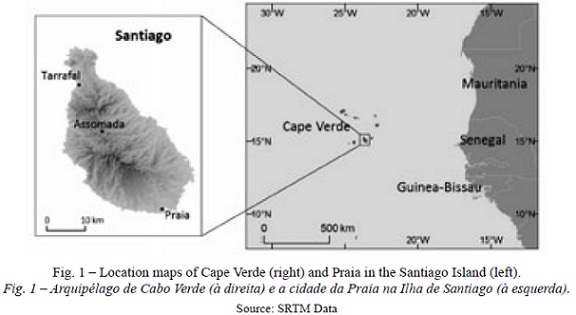
<body><![CDATA[<p>&nbsp;</p>      <p><b>RÉSUMÉ</b></p>       <p>Evaluation du bioclimat urbain et du confort thermique a Praia (R&eacute;publique du Cap Vert). De 2000 &agrave;  2012, la population de la ville de Praia, dans l&#8217;&icirc;le de Santiago, est pass&eacute;e de 90 000 &agrave; 132 300 habitants. Situ&eacute;e sur le  littoral sud, la ville enregistre des valeurs &eacute;lev&eacute;es d&#8217;humidit&eacute; et une temp&eacute;rature moyenne mensuelle toujours sup&eacute; rieure &agrave; 22&ordm;C. La p&eacute;riode la plus chaude co&iuml;ncide avec la saison des pluies, de juillet &agrave; octobre. Selon le &laquo; Plan  national d&#8217;adaptation aux Changements Climatiques &raquo;, la temp&eacute;rature moyenne de l&#8217;air a augment&eacute; de pr&egrave;s de 1&ordm;C en  15 ans et un accroissement moyen annuel de 0,7 &agrave; 2,5&ordm;C est pr&eacute;vu jusqu&#8217;en 2060. On pense donc que les conditions bioclimatiques vont  se d&eacute;grader au cours du prochain si&egrave;cle et surtout dans les aires urbaines. Objectifs principaux de la pr&eacute;sente &eacute;tude : i) r&eacute; aliser une &eacute;valuation provisoire des conditions bioclimatiques et du confort humain &agrave; Praia et ii) D&eacute;terminer les principaux facteurs  microclimatiques et de morphologie urbaine qui accentuent les situations de stress thermique dans le quartier de Palmarejo, &agrave; l&#8217;ouest de la ville.  Les situations de <i>stress</i> s&#8217;y produisent surtout pendant la saison la plus chaude et la plus humide (PET &gt; 29&ordm;C). Le reste de l&#8217;ann &eacute;e, le temps est &laquo;confortable&raquo; ou &laquo;assez chaud&raquo; (18&lt; PET&lt; 29&ordm;C). Dans ce quartier, le <i>stress</i> thermique de  saison chaude est plus fort dans les rues mal ventil&eacute;es, perpendiculaires au vent dominant de ne, l&#8217;aliz&eacute;, et dans celles qui sont le plus  expos&eacute;es &agrave; la radiation solaire directe (PET &gt; 40&ordm;C). </p>       <p><b>Mots-cl&eacute;s:</b> Bioclimatologie urbaine, champs thermiques, <i> stress</i> thermique, PET, Praia, r&eacute;publique du Cap Vert. </p>       <p>&nbsp;</p>       <p>&nbsp;</p>       <p><b>I. INTRODUCTION </b></p>       <p>The city of Praia (Santiago  Island) is the capital of Cape Verde republic, an insular country with 10 main islands located 500 km off the Senegalese western coast of Africa (<a href="#f1">fig. 1</a>).  According to the Census of 2010 (INE-CV, 2010), 491,683 people inhabit nine islands (S. Luzia is uninhabited). Out of the total population 303,673 people (61.8%)  live in  urban areas. as in other developing countries in Africa, severe droughts, soil and coastal erosion and flash floods are some of the environmental hazards that  threaten its populations. another natural hazard, such as dust storms, known locally as <i>Bruma Seca</i> or <i>Lestada</i> (i.e. the Harmatan, a Sahara flux  from the African continent towards the islands occurring from December to March) frequently have severe impacts at social (health problems and loss of life)  and economic levels, mainly due to transport (land, air and sea) shutdown. the occurrence of these episodes makes Cape Verde society very dependent on the  duration and intensity of natural hazards. </p>      <p>&nbsp;</p> <a name="f1"></a> <img src="/img/revistas/fin/n98/n98a04f1.jpg">     
<p>&nbsp;</p>     ]]></body>
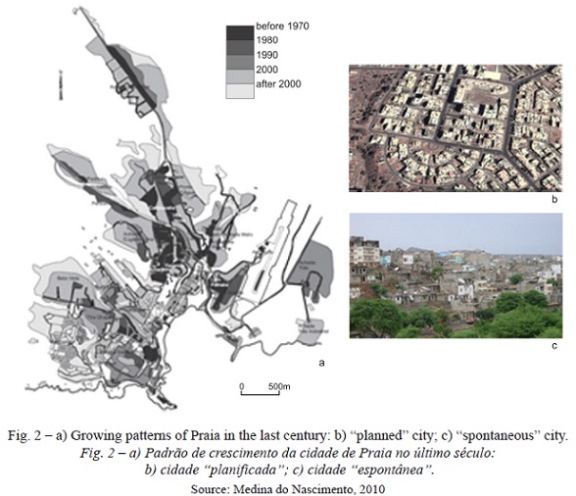
<body><![CDATA[<p>Recently, new concerns related to thermal comfort and air pollution, have arisen due to the fast urban  growth in several African cities (Liousse <i>et al.,</i> 2014). However, only a few studies have been conducted in Africa, namely in south-Africa (Becker,  2000), Algeria (Ali-Toudert <i>et al.</i>, 2005), Angola (Ferreira-Baptista and De Miguel, 2005), Morocco (Johansson, 2006), Tanzania (Ndetto and Matzarakis,  2013a; Ndetto and Matzarakis, 2013b), and Nigeria (Eludoyin <i>et al.,</i> 2014; Balogun and Balogun, 2014). Unfortunately some urban environmental hazards  (especially human thermal discomfort) have not received much attention from national and international agencies. Until now it is obvious that the major  concerns for the &#8220;underdeveloped&#8221; economies are related with primary assistance (food, health and fresh water supply) rather than with heat stress  mitigation. nevertheless, part of African population currently have access to consumption goods with strong energy impact, such as individual transportation,  massive use of air conditioning, etc. furthermore, Africa will have more urban dwellers and one of the largest population growth until 2050, with an expected  1,300 million increase (total of 2,431 million in 2050), exceeding the population-giant Asia rate (from 4,302 million in 2013 to 5,284 million in 2050, Haub  and Kaneda, 2013). According to the same source of information, Cape Verde will have a rate of natural increase of 1.5%, reaching about 700,000 inhabitants in  the middle of the century (the 2010 Cape Verdean census registered 491,683 inhabitants). </p>       <p>Along with the demographic explosion, the emissions of gases  and particulate matter from fossil fuels combustion will impoverish the air quality in the near future in many African cities (Liousse <i>et al.,</i> 2014).  This will significantly modify the chemical composition of the urban boundary layer with consequences in the thermal patterns of the cities. We should note  that the use of coal for home cooking in Cape Verde is a generalized practice nowadays; in fact, coal and wood are used by 32.1% of the dwellers in the  archipelago (9.7% in urban areas - INE-CV, 2010). </p>       <p>Biometeorological and urban climate is a rapid expanding field (Gosling <i>et al., </i>2014). In  Africa, climate studies are more focused on the impacts of heat stress on human health and livestock than on human thermal comfort in outdoor conditions, as it  was shown recently by Eludoyin <i>et al.</i> (2014). The causes are related with shortage of meteorological data in African cities and other priority needs  related with immediate daily survival (Roth, 2007). </p>       <p>The Physiological equivalent temperature (PET) is a thermal index derived from the human energy  balance (Matzarakis <i>et al., </i>1999). PET corresponds to air temperature at a typical indoor setting in which an individual with normalized characteristics  (sex, age, height, clothing, etc.) has the same physiological responses (skin temperature, core body temperature and sweating) as in a given real environment (H &ouml;ppe, 1993 and 1999). PET is used to characterize the thermal bioclimate and is also suitable to urban and regional planning, whenever a thermal  assessment is required (Matzarakis <i>et al., </i>1999). Compared to other thermal indices PET has the additional advantage of using the widely known Celsius  scale (&deg;C) that is easily understood by urban planners and decision makers. PET can be used in all year round studies in different climates (Lin and  Matzarakis, 2008; Zaninovi&#263; and </p>       <p>Matzarakis 2009; Lopes <i>et al</i>., 2011) and it has been used in several regions with hot-humid climate in  Southeast Asia (Lin and Matzarakis 2008; Nasir <i>et al.,</i> 2012) and Africa (Johansson, 2006; Ndetto and Matzarakis 2013a and 2013b; Omonijo <i>et al.,</i>  2013). The current study will show that this index is suitable to be applied in Cape Verde, although some adjustments to adapt physiological stress thresholds  should be made in the future. The use of PET allows to build ranges of thermal perception and grades of physiological stress on humans for different regions  and cli-mates enabling the comparison between different regions (Lin and Matzarakis 2008; Omonijo and 2013; Tzu-Pin <i>et al.,</i> this issue). </p>       <p>The  main objectives of this study are: i) to make a first-hand assessment of biothermal conditions and human comfort in the city of Praia (Cape Verde) and ii) to  determine the microclimatic features that act as urban climate constraints in a sprawling neighbourhood in the western part of the city. To address the first  objective, meteorological data from the Praia/airport station was used. This allowed us to show the frequency of thermal sensation classes and stress  conditions in the main Atlantic tropical seasons (rain and dry season). To achieve the second objective, a microclimatological model <i>(Envimet</i>) was used  to simulate wind speed and direction, mean radiative and air temperature and PET on a hot day. This allowed us to understand the importance of the wind, shade  and vegetation in the streets as key factors to reduce outdoor thermal stress. The geographical characteristics of the study area are described in the next  section. Details about the data and methodology used, such as the micrometeorological modelling, are presented in section III. Section IV includes the results  and discussion and the conclusion is presented in section V. </p>      <p>&nbsp;</p>     <p><b>II. STUDY AREA </b></p>   <b>1. The city of Praia: population and growing patterns  </b> <br/>      <p>Over 25% of the total population of the Cape Verde archipelago lives in the city of Praia. Its current population of 132,317 inhabitants has  increased by 32% since 1990, and the current growth is about 3% per year. Until the 1930&#8217;s, the city of Praia was confined to the <i>Plateau</i> (Medina  do Nascimento, 2009). in the middle of the XX century, the surrounding hilltops where gradually occupied (<a href="#f2">fig. 2</a>) and during the 1970&#8217;s the vacant spaces  were filled with new neighbourhoods, as a result of a spontaneous and unplanned manner, typical of many African urban sprawl processes (Medina do Nascimento,  2010). According to this author, more than 70% of the residential districts were built without proper planning or municipal licenses: 19 of the 31 residential  neighbourhoods are predominantly unlicensed and many of the considered &#8220;formal&#8221; (planned) city-districts have illegal housing patches. </p>       <p>&nbsp;</p> <a name="f2"></a> <img src="/img/revistas/fin/n98/n98a04f2.jpg">     
]]></body>
<body><![CDATA[<p>&nbsp;</p>      <p>The  traditional rectangular grid of the Plateau (introduced during the Portuguese administration) was not applied in many other areas. The new sprawling areas have  an irregular shape (with very heterogeneous urban occupation, street orientation and width), determined by the space available between the buildings. Another  urban characteristic is the scarcity of green spaces. Obviously, the natural ventilation in those areas is affected, with the impoverishment of the air quality  and thermal conditions in indoor and outdoor spaces. </p>       <p><b>2. Temperature and wind regime at the Praia/airport meteorological station </b></p>       <p> According to the updated K&ouml;ppen-Geiger climate classification (Peel <i>et al.,</i> 2007), the climate of Praia is hot and dry (<i>trockenes Passatklima</i> , BWh - K&ouml;ppen, 1936), with a wet irregular season from July to October. the minimum air temperatures during the dry season (December to June) range from  21&ordm;C to 23&ordm;C and the maximum from 25&ordm;C to 27&ordm;C. During the dry and cooler period, the lower relative humidity occurs in March with values  around 50% during the day and 70% during the night. In the wet and hot season the humidity is very high especially during the night (80 to 90%) and about 70%  around noon and late afternoon (<a href="#f3">fig. 3a</a>). it is also the hottest period of the year, with very hot nights, e.g. </p>       <p>&nbsp;</p> <a name="f3"></a> <img src="/img/revistas/fin/n98/n98a04f3.jpg">     
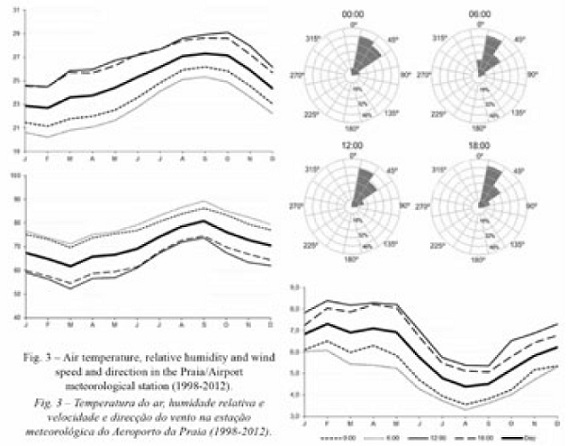
<p>&nbsp;</p>        <p>From august to October the daily mean  temperature remains above 25&ordm;C. The trade winds blow very regularly form ne all year round with high wind speeds in the dry season, especially during the  day (8 to 9 m/s - <a href="#f3">fig. 3b</a>). During the rainy season the wind speed drops to roughly 3 m/s during the night and 5 m/s during the day. The wet period from July  to October, characterized by high temperature and humidity and low wind speed values, is locally known as &#8220;<i>Azágua&#8221;</i> and probably the  most uncomfortable period of the year. The seasonality is, therefore, the main climate characteristic of Praia region, not only because of the rainfall  occurrence but also due to other main climatic elements regime. </p>      <p>According to the latest report, published by the national adaptation Programme on  Climate Change (INMG, 2010), in the last 15 years the mean annual temperature in Cape Verde increased by approximately 1&ordm;C. Projected scenarios show an  increase of 0.7 to 2.5&ordm;C by 2060 and of 1.2 and 3.7&ordm;C by the end of the century (Mcsweeney <i>et al</i>., 2010). Furthermore, until 2060, an increase  of 16 to 32% in the frequency of hot days (with temperatures exceeding the current 90<sup>th</sup> percentile) and 23 to 49% of hot nights is expected.  According to the same authors, these figures become even more severe from august to October, the warmest period of the year. An impoverishment of the  bioclimatic comfort conditions in the archipelago is expected, particularly in the urban areas that have grown significantly during this century. </p>      <p>&nbsp;</p>       <p><b>III. METHODS AND DATA </b></p>       ]]></body>
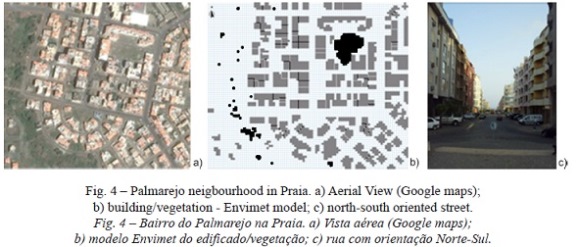
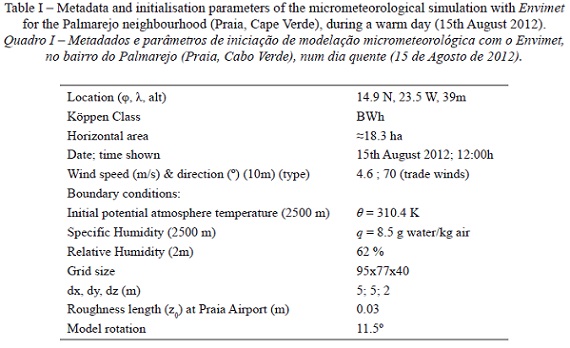
<body><![CDATA[<p>The regional thermal comfort assessment was made using PET (Physiological equivalent  temperature). The calculations were performed using the rayMan software (Matzarakis <i>et al.,</i> 1999 and 2007), which is a simple model that uses  meteorological data as input. Data registered at the meteorological station of nelson Mandela airport of Praia (about 3 km northeast of the city centre, &#966; latitude 14.9 N / &#955;longitude, 23.5 W), during the periods of 1998-2006 and 2008-2012 was obtained from the national Climatic Data Centre (NCDC) ( <a href="http://gis.ncdc.noaa.gov/" target="_blank">http://gis.ncdc.noaa.gov/</a>, last accessed in January 2014). Hourly data of air temperature, wind speed, relative humidity and cloud cover (used to estimate  radiative fluxes indirectly) at 0:00h, 06:00h, 12:00h and 18:00h UTC, were used to compute PET. The software calculates the Mean radiant temperature (MRT), the  main radiation influence on the human body that, along with the other meteorological parameters, assesses the thermal comfort. This evaluation was accomplished  by analysing the frequency of occurrence of thermal stress (PET) classes, shown in the next section (IV. 1). </p>       <p>The micrometeorological study of the  Palmarejo area, a neighbourhood in the western part of Praia (<a href="#f4">fig. 4</a>), was made using the <i>Envimet </i>software (Bruse and fleer, 1998). This tool uses  prognostic, non-hydrostatic, 3D micro-scale meteorological models with a horizontal resolution of 2 to 10 m and a vertical resolution from the surface to a few  meters above the buildings. The model covers an area of about 18.3 ha. the simulations were performed during a clear sky &#8220;warm&#8221; thermal sensation  day (maximum temperature &gt; 30&ordm;C and PET=34&ordm;C), with a north-easterly wind with a speed of 4.6 m/s. these conditions were observed in the  meteorological station of Praia airport, on the 15<sup>th </sup>august 2012 during the afternoon (12:00h, local time) (<a href="#t1">table I</a>). The upper-air sounding at  12:00h (launched in the Sal Island and published by the University of Wyoming <a href="http://weather.uwyo.edu/upperair/sounding.html" target="_blank">http://weather.uwyo.edu/upperair/sounding.html</a>, last accessed in January 2014)  was used for the initial boundary conditions at 2,500m which is the vertical limit of the model. The vegetation in Palmarejo is predominantly made up of dry  grass (with few small trees in the western part) and buildings with typically 3 to 7 stories (<a href="#f4">fig. 4</a>). </p>        <p>&nbsp;</p> <a name="f4"></a> <img src="/img/revistas/fin/n98/n98a04f4.jpg">     
<p>&nbsp;</p>       <p>&nbsp;</p> <a name="t1"></a> <img src="/img/revistas/fin/n98/n98a04t1.jpg">     
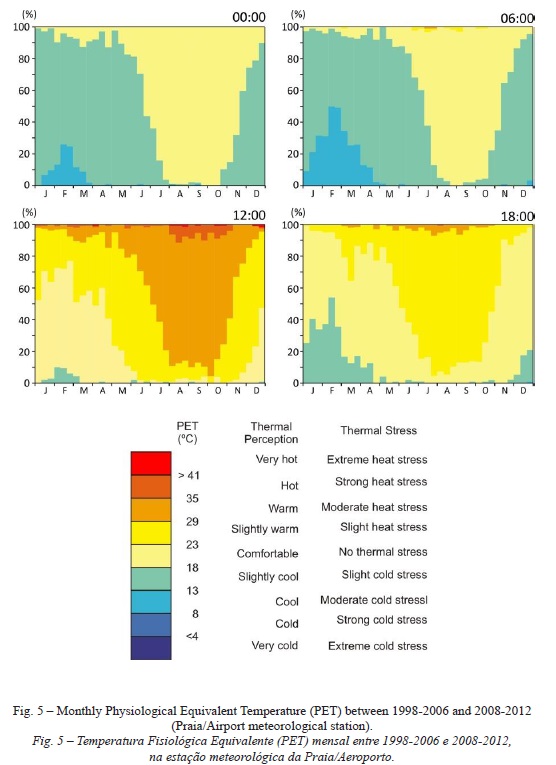
<p>&nbsp;</p>        <p>The software simulation yielded several layers  of microclimatic data (programmed for every 3 hours, starting at 03:00 am to 21:00 pm during the 15<sup>th </sup>august 2012), from which we analysed the  potential temperature (<i>&#952;</i>&ordm;C)<i>, </i>the Mean radiant temperature, the wind speed and direction and PET (the latter was calculated using the  specific module - CalcPET). The results for noon (12:00h &#8211; solar time) are presented in the next section (IV. 2). </p>       <p>&nbsp;</p>       <p><b>IV. RESULTS  AND DISCUSSION </b></p> <b>1. Thermal comfort and heat stress in the Praia region </b><br/>      <p>the regional thermal comfort in the Praia region is quite  contrasted and can be divided into two annual and two daily categories (<a href="#f5">fig. 5</a>): i) daytime (12:00h and 18:00h) of the dry season (from november to June) is  dominated by &#8220;comfortable and slightly warm&#8221; thermal perception, although January and february have a fair frequency (40/50%) of &#8220;slight cold  stress&#8221; in the beginning of the evening (18:00h); ii) during night time, a &#8220;moderate&#8221; to &#8220;slight cold stress&#8221; dominates the  bioclimatic comfort; iii) the nights during the rainy season are, in general, comfortable; iv) however, during the day &#8220;moderate&#8221; to &#8220;strong  heat stress&#8221; (PET between 29&ordm;C and 40&ordm;C) is the most common grade of physical stress perceived, with more than 90% of the occurrences from  august to October; at sunset the environment becomes much more pleasant. it should be pointed out that these conditions are based on observations at the  airport, out of town, without the effect of the city on air temperature and ventilation conditions. </p>       ]]></body>
<body><![CDATA[<p>&nbsp;</p> <a name="f5"></a> <img src="/img/revistas/fin/n98/n98a04f5.jpg">     
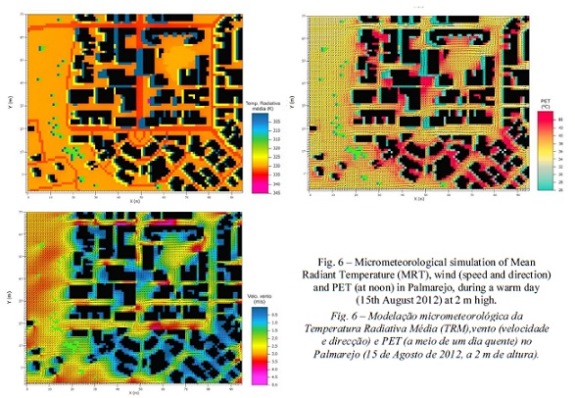
<p>&nbsp;</p>        <p><b>2. Thermal comfort and heat stress in the &#8220; planned&#8221; neighbourhood of Palmarejo </b></p>       <p>In this tropical region, thermal comfort is affected especially by solar radiation, air temperature and  ventilation. Due to the high position of the sun in august at 12:00h, the pattern of Mean radiant temperature of the surfaces in the Palmarejo neighbourhood  (<a href="#f6">fig. 6</a>) is quite uniform (between 320K and 330K), except for the asphalted roads (&gt; 330K) and shaded areas in the streets (&lt; 297K). the general ne wind  (4.6 m/s at the Praia/airport), at 2 m above ground, is less intense inside the streets (generally &lt; 2 m/s) than in the more open spaces and W/e oriented  streets (&gt; 3 m/s). therefore, poor ventilation, high Mean radiant temperature and air temperature (&#8776; 300 K) are the main features that influence  thermal comfort, that ranges from 27&ordm;C to 35&ordm;C in the sun exposed and poorly ventilated streets (the maximum PET value attains 38&ordm;C in these  spaces) and stays below 27&ordm;C in the more ventilated open spaces. according to Matzarakis <i>et al.</i> (1999) most of the spaces where PET is greater than  35&ordm;C lead to a &#8220;hot&#8221; and &#8220;very hot&#8221; thermal perception, corresponding to a &#8220;strong&#8221; and even &#8220;extreme heat&#8221;  grade of thermal physiological stress. The open spaces, even with strong MRT but well ventilated correspond to warm with moderate heat stress (PET &lt;35&ordm; C). </p>        <p>&nbsp;</p> <a name="f6"></a> <img src="/img/revistas/fin/n98/n98a04f6.jpg">     
<p>&nbsp;</p>        <p>As was pointed out by Inoc&ecirc;ncio (2012), the thermal comfort in the buildings of Cape Verdean cities can be achieved by optimizing the  exposure to the sun trajectory and taking advantage of the prevailing winds, using passive cooling techniques, including natural ventilation and the thermal  inertia of more traditional materials. as was shown in the present study, especially during daytime of the rainy season, Praia inhabitants feel a hot and humid  sensation that combined with lower wind speeds, create a very strong heat stress (PET ranging from 29&ordm;C to more than 41&ordm;C) even in the open areas  like the airport. During nigh time people feel some amelioration of thermal stress, especially in the hot and humid season. </p>       <p>In the less ventilated  streets of city quarters with no shade or vegetation the heat stress can attain &#8220;extremely heat stress&#8221; levels, especially during very hot days as  was shown in the micrometeorological simulation section. In order to avoid these extreme conditions in the urban environment the new building areas should be  planned according to the best practices. Therefore, it is strongly advisable that the main streets should be planned with NE/SW orientation in order to take  advantage of the trade winds&#8217; regularity. As was shown by Lopes <i>et al.</i> (2011) for the Atlantic subtropical island of Madeira, the best measure to  take advantage of sea breezes cooling effect in the areas near the shore, during very hot days, is to avoid the construction of buildings that act as barriers  to the air flux from the sea. In addition to good ventilation conditions, another effective way to cool down urban areas is to plant trees as they create  shaded areas and promote evapotranspiration. However, each situation should be carefully studied, because trees can obstruct the wind (probably retaining  atmospheric pollutants as recent studies have shown, Vos <i>et al., </i>2013) and can fall over people and assets during windstorms (Lopes <i>et al.,</i>  2009). </p>       <p>If the heat stress can attain extreme values in the well ventilated neighbourhoods, like the one we studied here, the situation can be even  worse in the non- planned &#8220;informal&#8220; areas, most of them in the bottom of valleys, where most of the poor population live. Urban planning that  takes into account the climate conditions is therefore of upmost importance, especially in the most populated areas of the archipelago of Cape Verde. </p>        <p>&nbsp;</p>      ]]></body>
<body><![CDATA[<p><b>V. CONCLUSIONS </b></p>       <p>This research work is a first attempt to study the urban climate of an African coastal island city and to  quantify the thermal stress that city dwellers are submitted to. Although the main research uses PET (Physiological equivalent temperature) to assess thermal  stress, with classes well tested for European regions, this method was also tested in other African cities. It must be noted that Cape Verde has the advantage  of being a well-known touristic destination and that the majority of its tourists originate from European countries. Nevertheless, our intention is to launch  inquires in Cape Verde islands in the future, in order to adapt thermal sensation classes to the local population. </p>       <p>The first results indicate an  extended period of severe heat stress from august to October, especially at noon, when 29&ordm;C to more than 40&ordm;C is the most common value of PET (more  than 90% of the occurrences). Inside the so called &#8220;planned&#8221; neighbourhoods, like the one studied here (Palmarejo), the heat stress can be &#8220; strong&#8221; and &#8220;extreme&#8221;, with PET values exceeding 40&ordm;C in the less ventilated streets with little vegetation. </p>       <p>In order to  validate 3D modelling and to know more precisely the thermal pattern distribution under thermal stress conditions near the buildings, a low cost urban  mesoscale network of thermohygrometers should be implemented, similarly to what has been done in several cities around the world. This will improve our  knowledge of the climatic changes in tropical cities. </p>       <p>As long as the lack of fine temporal and spatial resolution meteorological data persists, 3D  modelling is a good alternative to obtain results in the microclimatic scale of analysis. Other possibilities (like radiative and sky view factor models) have  to be implemented in order to ensure the improvement of urban climate studies in African cities as a tool to cope with future climatic changes. </p>       <p>As the  population in these environments becomes more urbanized, urban planning is a fundamental part for the African urban sustainability. As shown by Oliveira <i>et  al.</i> (2011 and this issue), green spaces in urban areas can create a cooling effect (park cool island) during hot and dry periods in cities with hot  climate. Therefore, street trees and green parks (even small ones) providing evapotranspiration and shade, will contribute to mitigate global warming in  cities. Furthermore, ventilation strategies, taking advantage of sea breezes and trade wind regularity, must be included in an overall assessment to improve  urban environments and alleviate the thermal stress during hot period of the year (Lopes, 2009; Lopes <i>et al</i>., 2011). These simple measures can be very  useful to diminish the adverse effects of heat in urban areas, and can be easily implemented through proper urban planning as was demonstrated by Alcoforado <i> et al.</i> (2005) and Alcoforado <i>et al.</i> (2009). </p>       <p>This preliminary analysis of the human bioclimatological assessment in Praia (Santiago island)  highlights the importance to continue with this kind of research, which will include other weather types and atmospheric conditions, namely those with sahelian  origin like the Harmatan and other extreme events. </p>       <p>In the future, new strategies to increment the quality of the urban environment in Praia, along with  the creation of a new generation of guidelines for urban planning should be our concern. These guidelines should consider: i) climatic potentialities, like the  wind to generate electricity locally to the dwellers (Lopes and Correia, 2012); ii) the risks associated with air pollution and falling elements during  windstorms. </p>     <p>&nbsp;</p>     <p><b>BIBLIOGRAPHY </b></p>       ]]></body>
<body><![CDATA[<!-- ref --><p>Alcoforado MJ, Andrade H, Lopes A, Vasconcelos J (2009) application of climatic guidelines  to urban planning. The example of Lisbon (Portugal). <i>Landscape and Urban Planning</i>, 90: 56-65. doi:10.1016/j.landurbplan.2008.10.006 &nbsp;&nbsp;&nbsp;&nbsp;&nbsp;&nbsp;&nbsp;&nbsp;[&#160;<a href="javascript:void(0);" onclick="javascript: window.open('/scielo.php?script=sci_nlinks&ref=000083&pid=S0430-5027201400020000400001&lng=','','width=640,height=500,resizable=yes,scrollbars=1,menubar=yes,');">Links</a>&#160;]<!-- end-ref --><!-- ref --><p>Alcoforado  MJ, Lopes A, Andrade H, Vasconcelos J (2005) <i>Orienta&ccedil;&otilde;es climáticas para o ordenamento em Lisboa.</i> área de investiga ção em Geo-ecologia, 4, Centro de estudos Geográficos, Lisboa.    &nbsp;&nbsp;&nbsp;&nbsp;&nbsp;&nbsp;&nbsp;&nbsp;[&#160;<a href="javascript:void(0);" onclick="javascript: window.open('/scielo.php?script=sci_nlinks&ref=000084&pid=S0430-5027201400020000400002&lng=','','width=640,height=500,resizable=yes,scrollbars=1,menubar=yes,');">Links</a>&#160;]<!-- end-ref --> </p>       <!-- ref --><p>Ali-Toudert F, Djenane M, Bensalem R, Mayer H (2005) Outdoor  thermal comfort in the old desert city of Beniisguen, Algeria. <i>Climate Research,</i> 1993: 243-256.    &nbsp;&nbsp;&nbsp;&nbsp;&nbsp;&nbsp;&nbsp;&nbsp;[&#160;<a href="javascript:void(0);" onclick="javascript: window.open('/scielo.php?script=sci_nlinks&ref=000086&pid=S0430-5027201400020000400003&lng=','','width=640,height=500,resizable=yes,scrollbars=1,menubar=yes,');">Links</a>&#160;]<!-- end-ref --> </p>       <!-- ref --><p>Balogun I, Balogun A (2014) Urban heat island  and bioclimatological conditions in a hot-humid tropical city: the example of Akure, Nigeria. <i>Die Erde</i>, <i>145</i>(1-2): 3-15. doi:10.12854/ erde-145-2  &nbsp;&nbsp;&nbsp;&nbsp;&nbsp;&nbsp;&nbsp;&nbsp;[&#160;<a href="javascript:void(0);" onclick="javascript: window.open('/scielo.php?script=sci_nlinks&ref=000088&pid=S0430-5027201400020000400004&lng=','','width=640,height=500,resizable=yes,scrollbars=1,menubar=yes,');">Links</a>&#160;]<!-- end-ref --><!-- ref --><p>Becker S (2000) Bioclimatological rating of cities and resorts in South Africa according to the Climate index. <i>International Journal of Climatology </i>, 20(12): 1403-1414. doi:10.1002/1097-0088(200010)20:12 &nbsp;&nbsp;&nbsp;&nbsp;&nbsp;&nbsp;&nbsp;&nbsp;[&#160;<a href="javascript:void(0);" onclick="javascript: window.open('/scielo.php?script=sci_nlinks&ref=000089&pid=S0430-5027201400020000400005&lng=','','width=640,height=500,resizable=yes,scrollbars=1,menubar=yes,');">Links</a>&#160;]<!-- end-ref --><!-- ref --><p>Bruse M, Fleer H (1998) Simulating surface&#8211;plant&#8211; air interactions inside urban  environments with a three dimensional numerical model. <i>Environmental Modelling &amp; Software</i>, 13(3-4): 373-384. doi:10.1016/s1364-8152(98)00042-5 &nbsp;&nbsp;&nbsp;&nbsp;&nbsp;&nbsp;&nbsp;&nbsp;[&#160;<a href="javascript:void(0);" onclick="javascript: window.open('/scielo.php?script=sci_nlinks&ref=000090&pid=S0430-5027201400020000400006&lng=','','width=640,height=500,resizable=yes,scrollbars=1,menubar=yes,');">Links</a>&#160;]<!-- end-ref --><!-- ref --><p>Eludoyin OM, Adelekan IO, Webster R, Eludoyin AO (2014) air temperature, relative humidity, climate regionalization and thermal comfort of Nigeria. <i> International Journal of Climatology</i>, 34(6): 2000-2018. doi:10.1002/ joc.3817 &nbsp;&nbsp;&nbsp;&nbsp;&nbsp;&nbsp;&nbsp;&nbsp;[&#160;<a href="javascript:void(0);" onclick="javascript: window.open('/scielo.php?script=sci_nlinks&ref=000091&pid=S0430-5027201400020000400007&lng=','','width=640,height=500,resizable=yes,scrollbars=1,menubar=yes,');">Links</a>&#160;]<!-- end-ref --><!-- ref --><p>Ferreira-Baptista L, De Miguel E (2005) Geochemistry and risk  assessment of street dust in Luanda, Angola: a tropical urban environment. <i>Atmospheric Environment</i>, 39(25): 4501-4512.  doi:10.1016/j.atmosenv.2005.03.026 &nbsp;&nbsp;&nbsp;&nbsp;&nbsp;&nbsp;&nbsp;&nbsp;[&#160;<a href="javascript:void(0);" onclick="javascript: window.open('/scielo.php?script=sci_nlinks&ref=000092&pid=S0430-5027201400020000400008&lng=','','width=640,height=500,resizable=yes,scrollbars=1,menubar=yes,');">Links</a>&#160;]<!-- end-ref --><!-- ref --><p>Gosling S, Bryce E, Dixon P, Gabriel K, Gosling E, Hanes J, Wanka E (2014) a glossary for biometeorology. <i> International Journal of Biometeorology</i>, 58: 277-308. doi:10.1007/ s00484-013-0729-9 &nbsp;&nbsp;&nbsp;&nbsp;&nbsp;&nbsp;&nbsp;&nbsp;[&#160;<a href="javascript:void(0);" onclick="javascript: window.open('/scielo.php?script=sci_nlinks&ref=000093&pid=S0430-5027201400020000400009&lng=','','width=640,height=500,resizable=yes,scrollbars=1,menubar=yes,');">Links</a>&#160;]<!-- end-ref --><!-- ref --><p>Haub C, Kaneda T (2013) <i>World Population Data Sheet</i>,  Population reference Bureau, Washington, DC.    &nbsp;&nbsp;&nbsp;&nbsp;&nbsp;&nbsp;&nbsp;&nbsp;[&#160;<a href="javascript:void(0);" onclick="javascript: window.open('/scielo.php?script=sci_nlinks&ref=000094&pid=S0430-5027201400020000400010&lng=','','width=640,height=500,resizable=yes,scrollbars=1,menubar=yes,');">Links</a>&#160;]<!-- end-ref --> </p>       <!-- ref --><p>H&ouml;ppe P (1999) The physiological equivalent temperature - a universal index for the biometeorological  assessment of the thermal environment. <i>International Journal of Biometeorology</i>, 43(2): 71&#8211;5. doi:10.1007/s004840050118 &nbsp;&nbsp;&nbsp;&nbsp;&nbsp;&nbsp;&nbsp;&nbsp;[&#160;<a href="javascript:void(0);" onclick="javascript: window.open('/scielo.php?script=sci_nlinks&ref=000096&pid=S0430-5027201400020000400011&lng=','','width=640,height=500,resizable=yes,scrollbars=1,menubar=yes,');">Links</a>&#160;]<!-- end-ref --><p>H&ouml;ppe P (1993)  Heat balance modelling. <i>Experientia</i> 49: 741-746. </p>       <!-- ref --><p>INE-CV (2010) IV recenseamento Geral da População e de Habitação -  censo 2010, instituto nacional de estatística de Cabo Verde. (Acessed on the 27 april, 2014) <a href="http://www.ine.cv/censo/censo2010.aspx" target="_blank">http://www.ine.cv/censo/censo2010.aspx</a> &nbsp;&nbsp;&nbsp;&nbsp;&nbsp;&nbsp;&nbsp;&nbsp;[&#160;<a href="javascript:void(0);" onclick="javascript: window.open('/scielo.php?script=sci_nlinks&ref=000098&pid=S0430-5027201400020000400013&lng=','','width=640,height=500,resizable=yes,scrollbars=1,menubar=yes,');">Links</a>&#160;]<!-- end-ref --><p>Inmg (2010) Segunda<i> comunicação nacional de </i>Cabo<i> Verde sobre mudan&ccedil;as clim áticas</i>. instituto nacional de Meteorologia e Geofísica, Praia. </p>       <!-- ref --><p>Inoc&ecirc;ncio D (2012) <i>Construção e arquitectura  sustentáveis em Cabo Verde. Estudo de Estrat&eacute;gias de Projecto Sustentável</i>. ist, Lisboa.    &nbsp;&nbsp;&nbsp;&nbsp;&nbsp;&nbsp;&nbsp;&nbsp;[&#160;<a href="javascript:void(0);" onclick="javascript: window.open('/scielo.php?script=sci_nlinks&ref=000100&pid=S0430-5027201400020000400015&lng=','','width=640,height=500,resizable=yes,scrollbars=1,menubar=yes,');">Links</a>&#160;]<!-- end-ref --> </p>       <!-- ref --><p>Johansson E (2006) Influence of  urban geometry on outdoor thermal comfort in a hot dry climate: a study in fez, Morocco. <i>Building and Environment</i>, 41(10): 1326-1338. doi:10.1016/j.  buildenv.2005.05.022 &nbsp;&nbsp;&nbsp;&nbsp;&nbsp;&nbsp;&nbsp;&nbsp;[&#160;<a href="javascript:void(0);" onclick="javascript: window.open('/scielo.php?script=sci_nlinks&ref=000102&pid=S0430-5027201400020000400016&lng=','','width=640,height=500,resizable=yes,scrollbars=1,menubar=yes,');">Links</a>&#160;]<!-- end-ref --><!-- ref --><p>K&ouml;ppen W (1936) <i>Das geographische System der Klimate</i>. Band I (Teil C): 44, Berlin.    &nbsp;&nbsp;&nbsp;&nbsp;&nbsp;&nbsp;&nbsp;&nbsp;[&#160;<a href="javascript:void(0);" onclick="javascript: window.open('/scielo.php?script=sci_nlinks&ref=000103&pid=S0430-5027201400020000400017&lng=','','width=640,height=500,resizable=yes,scrollbars=1,menubar=yes,');">Links</a>&#160;]<!-- end-ref --> </p>       <!-- ref --><p>Lin T-P, Matzarakis A  (2008) Tourism climate and thermal comfort in sun Moon Lake, Taiwan. <i>International Journal of Biometeorology</i>, 52(4): 281-90.  doi:10.1007/s00484-007-0122-7 &nbsp;&nbsp;&nbsp;&nbsp;&nbsp;&nbsp;&nbsp;&nbsp;[&#160;<a href="javascript:void(0);" onclick="javascript: window.open('/scielo.php?script=sci_nlinks&ref=000105&pid=S0430-5027201400020000400018&lng=','','width=640,height=500,resizable=yes,scrollbars=1,menubar=yes,');">Links</a>&#160;]<!-- end-ref --><!-- ref --><p>Liousse C, Assamoi E, Criqui P, Granier C, Rosset R (2014) Explosive growth in African combustion emissions from 2005 to  2030. <i>Environmental Research Letters</i>, 9: 1-10. doi:10.1088/1748-9326/9/3/035003 &nbsp;&nbsp;&nbsp;&nbsp;&nbsp;&nbsp;&nbsp;&nbsp;[&#160;<a href="javascript:void(0);" onclick="javascript: window.open('/scielo.php?script=sci_nlinks&ref=000106&pid=S0430-5027201400020000400019&lng=','','width=640,height=500,resizable=yes,scrollbars=1,menubar=yes,');">Links</a>&#160;]<!-- end-ref --><!-- ref --><p>Lopes A (2009) Sobreaquecimento das cidades. Causas e medidas  para a mitigação da ilha de calor de Lisboa. <i>Territorium</i>, 15: 39-52.    &nbsp;&nbsp;&nbsp;&nbsp;&nbsp;&nbsp;&nbsp;&nbsp;[&#160;<a href="javascript:void(0);" onclick="javascript: window.open('/scielo.php?script=sci_nlinks&ref=000107&pid=S0430-5027201400020000400020&lng=','','width=640,height=500,resizable=yes,scrollbars=1,menubar=yes,');">Links</a>&#160;]<!-- end-ref --> </p>       <p>Lopes A, Correia E (2012) a proposal to enhance urban climate  maps with the assessment of the wind power potential. the case of Cascais Cascais Municipality (Portugal). <i>In:</i> Hájková L (ed.) <i> International Scientific Conference &#8220;Bioclimate 2012 &#8211; Bioclimatology of Ecosystems:</i> 68-69. &Uacute;stí nad Labem. </p>       <!-- ref --><p>Lopes A,  Lopes S, Matzarakis A, Alcoforado Mj (2011) The influence of the summer sea breeze on thermal comfort in Funchal (Madeira). A contribution to tourism and urban  planning. <i>Meteorologische Zeitschrift</i>, 20(5): 553-564. doi:10.1127/0941-2948/2011/0248 &nbsp;&nbsp;&nbsp;&nbsp;&nbsp;&nbsp;&nbsp;&nbsp;[&#160;<a href="javascript:void(0);" onclick="javascript: window.open('/scielo.php?script=sci_nlinks&ref=000110&pid=S0430-5027201400020000400022&lng=','','width=640,height=500,resizable=yes,scrollbars=1,menubar=yes,');">Links</a>&#160;]<!-- end-ref --><p>Lopes A, Oliveira S, Fragoso M, Andrade JA, Pedro P  (2009) Wind risk assessment in urban environments: the case of falling trees during windstorm events in Lisbon. <i>In: </i>St&#345;elcová K, Máty ás C, Kleidon A, Lapin M, Matejka F, Bla&#382;enec M, Hol&eacute;cy J (Eds.), <i>Bioclimatology and Natural Hazards SE -:5 </i>55&#8211;74. springer  netherlands. doi:10.1007/978-1-4020-8876-6_5 </p>       <!-- ref --><p>Matzarakis A, Mayer H, Iziomon MG (1999) applications of a universal thermal index: physiological  equivalent temperature. <i>International Journal of Biometeorology</i>, 43(2): 76-84. doi:10.1007/s004840050119 &nbsp;&nbsp;&nbsp;&nbsp;&nbsp;&nbsp;&nbsp;&nbsp;[&#160;<a href="javascript:void(0);" onclick="javascript: window.open('/scielo.php?script=sci_nlinks&ref=000112&pid=S0430-5027201400020000400024&lng=','','width=640,height=500,resizable=yes,scrollbars=1,menubar=yes,');">Links</a>&#160;]<!-- end-ref --><!-- ref --><p>Matzarakis A, Rutz F, Mayer H (2007)  Modelling radiation fluxes in simple and complex environments-application of the rayMan model. <i>International Journal of Biometeorology</i>, 51(4): 323-34.  doi:10.1007/s00484-006-0061-8 &nbsp;&nbsp;&nbsp;&nbsp;&nbsp;&nbsp;&nbsp;&nbsp;[&#160;<a href="javascript:void(0);" onclick="javascript: window.open('/scielo.php?script=sci_nlinks&ref=000113&pid=S0430-5027201400020000400025&lng=','','width=640,height=500,resizable=yes,scrollbars=1,menubar=yes,');">Links</a>&#160;]<!-- end-ref --><p>Medina Do Nascimento J (2009) <i>As rela&ccedil;&otilde;es entre o crescimento urbano e os sistemas de gestão e de  planificação da cidade da Praia em Cabo Verde</i>. in, 15&ordm; Congresso da aPDr - redes e Desenvolvimento regional, Praia. </p>       <!-- ref --><p>Medina Do  Nascimento J (2010) O crescimento urbano e os sistemas de gestão e de planificação na cidade da Praia, em Cabo Verde: proposta de uma nova  abordagem na intervenção urbanística. <i>Estudos Regionais,</i> 24:5-21.    &nbsp;&nbsp;&nbsp;&nbsp;&nbsp;&nbsp;&nbsp;&nbsp;[&#160;<a href="javascript:void(0);" onclick="javascript: window.open('/scielo.php?script=sci_nlinks&ref=000115&pid=S0430-5027201400020000400027&lng=','','width=640,height=500,resizable=yes,scrollbars=1,menubar=yes,');">Links</a>&#160;]<!-- end-ref --> </p>       <!-- ref --><p>Mcsweeney C, New M, Lizcano G (2010) UNDP Climate Change  Country Profiles: Cape Verde. <a href="http://country-profiles.geog.ox.ac.uk/" target="_blank">http://country-profiles.geog.ox.ac.uk/</a> (accessed in 15 November 2013).    &nbsp;&nbsp;&nbsp;&nbsp;&nbsp;&nbsp;&nbsp;&nbsp;[&#160;<a href="javascript:void(0);" onclick="javascript: window.open('/scielo.php?script=sci_nlinks&ref=000117&pid=S0430-5027201400020000400028&lng=','','width=640,height=500,resizable=yes,scrollbars=1,menubar=yes,');">Links</a>&#160;]<!-- end-ref --> </p>       <!-- ref --><p>Nasir RA, Ahmad SS, Ahmed AZ (2012) Psychological  adaptation of outdoor thermal comfort in shaded green spaces in Malaysia. <i>Procedia-Social and Behavioral Sciences</i>, 68: 865-878.  doi:10.1016/j.sbspro.2012.12.273 &nbsp;&nbsp;&nbsp;&nbsp;&nbsp;&nbsp;&nbsp;&nbsp;[&#160;<a href="javascript:void(0);" onclick="javascript: window.open('/scielo.php?script=sci_nlinks&ref=000119&pid=S0430-5027201400020000400029&lng=','','width=640,height=500,resizable=yes,scrollbars=1,menubar=yes,');">Links</a>&#160;]<!-- end-ref --><!-- ref --><p>Ndetto E, Matzarakis A (2013a) Basic analysis of climate and urban bioclimate of Dares salaam, Tanzania. <i> Theoretical and Applied Climatology</i>, 114(1-2): 213-226. doi:10.1007/s00704012-0828-2 &nbsp;&nbsp;&nbsp;&nbsp;&nbsp;&nbsp;&nbsp;&nbsp;[&#160;<a href="javascript:void(0);" onclick="javascript: window.open('/scielo.php?script=sci_nlinks&ref=000120&pid=S0430-5027201400020000400030&lng=','','width=640,height=500,resizable=yes,scrollbars=1,menubar=yes,');">Links</a>&#160;]<!-- end-ref --><!-- ref --><p>Ndetto E, Matzarakis A (2013b) Effects of urban configuration  on human thermal conditions in a typical tropical African coastal city. <i>Advances in Meteorology</i>, article iD 549096, 2013. doi:10.1155/2013/549096.    &nbsp;&nbsp;&nbsp;&nbsp;&nbsp;&nbsp;&nbsp;&nbsp;[&#160;<a href="javascript:void(0);" onclick="javascript: window.open('/scielo.php?script=sci_nlinks&ref=000121&pid=S0430-5027201400020000400031&lng=','','width=640,height=500,resizable=yes,scrollbars=1,menubar=yes,');">Links</a>&#160;]<!-- end-ref --> </p>       ]]></body>
<body><![CDATA[<!-- ref --><p>Oliveira S, Andrade H, Vaz T (2011) the cooling effect of green spaces as a contribution to the mitigation of urban heat: a case study in Lisbon. <i> Building and Environment</i>, 46(11): 21862194. doi:10.1016/j.buildenv.2011.04.034 &nbsp;&nbsp;&nbsp;&nbsp;&nbsp;&nbsp;&nbsp;&nbsp;[&#160;<a href="javascript:void(0);" onclick="javascript: window.open('/scielo.php?script=sci_nlinks&ref=000123&pid=S0430-5027201400020000400032&lng=','','width=640,height=500,resizable=yes,scrollbars=1,menubar=yes,');">Links</a>&#160;]<!-- end-ref --><!-- ref --><p>Omonijo AG, Adeofun CO, Oguntoke O, Matzarakis A (2013) relevance of  thermal environment to human health: a case study of Ondo state, Nigeria. <i>Theoretical and Applied Climatology</i>, 113(1-2): 205-212. doi:10.1007/  s00704-012-0777-9 &nbsp;&nbsp;&nbsp;&nbsp;&nbsp;&nbsp;&nbsp;&nbsp;[&#160;<a href="javascript:void(0);" onclick="javascript: window.open('/scielo.php?script=sci_nlinks&ref=000124&pid=S0430-5027201400020000400033&lng=','','width=640,height=500,resizable=yes,scrollbars=1,menubar=yes,');">Links</a>&#160;]<!-- end-ref --><!-- ref --><p>Peel MC, Finlayson BL, Mcmahon TA (2007) Updated world map of the Koppen-Geiger cli-mate classification. <i>Hydrol. Earth Syst. Sci. </i>, 11: 1633-1644. doi:10.5194/hess-11-1633-2007 &nbsp;&nbsp;&nbsp;&nbsp;&nbsp;&nbsp;&nbsp;&nbsp;[&#160;<a href="javascript:void(0);" onclick="javascript: window.open('/scielo.php?script=sci_nlinks&ref=000125&pid=S0430-5027201400020000400034&lng=','','width=640,height=500,resizable=yes,scrollbars=1,menubar=yes,');">Links</a>&#160;]<!-- end-ref --><!-- ref --><p>Roth M (2007) Review of urban climate research in (sub) tropical regions. <i>International Journal  of Climatology</i>, 27(14): 1859-1873. doi:10.1002/joc1591 &nbsp;&nbsp;&nbsp;&nbsp;&nbsp;&nbsp;&nbsp;&nbsp;[&#160;<a href="javascript:void(0);" onclick="javascript: window.open('/scielo.php?script=sci_nlinks&ref=000126&pid=S0430-5027201400020000400035&lng=','','width=640,height=500,resizable=yes,scrollbars=1,menubar=yes,');">Links</a>&#160;]<!-- end-ref --><p>Vos PEJ, Maiheu B, Vankerkom J, Janssen S (2013) Improving local air quality in cities: to  tree or not to tree? <i>Environmental Pollution</i>, 183: 113-22. doi:10.1016/j.envpol.2012.10.021 </p>       <p>Zaninovi&#263; K, Matzarakis A (2009) The  bioclimatological leaflet as a means conveying climatological information to tourists and the tourism industry. <i>Int. Journ. of Biometeorol.</i> 53: 369-374.  doi:10.1007/s00484-009-0219-2. </p>       <p>&nbsp;</p>       <p>Received: April 2014. Accepted: October 2014. </p>       <p><b>&nbsp;</b></p>       <p><b>ACKNOWLEDGEMENTS</b> </p>       ]]></body>
<body><![CDATA[<p> The authors would like to thank the anonymous reviewers and the editor for their helpful and constructive comments that greatly contributed to improving the  final version of this paper. </p>        ]]></body><back>
<ref-list>
<ref id="B1">
<nlm-citation citation-type="journal">
<person-group person-group-type="author">
<name>
<surname><![CDATA[Alcoforado]]></surname>
<given-names><![CDATA[MJ]]></given-names>
</name>
<name>
<surname><![CDATA[Andrade]]></surname>
<given-names><![CDATA[H]]></given-names>
</name>
<name>
<surname><![CDATA[Lopes]]></surname>
<given-names><![CDATA[A]]></given-names>
</name>
<name>
<surname><![CDATA[Vasconcelos]]></surname>
<given-names><![CDATA[J]]></given-names>
</name>
</person-group>
<article-title xml:lang="en"><![CDATA[Application of climatic guidelines to urban planning]]></article-title>
<source><![CDATA[The example of Lisbon (Portugal). Landscape and Urban Planning]]></source>
<year>2009</year>
<volume>90</volume>
<page-range>56-65</page-range></nlm-citation>
</ref>
<ref id="B2">
<nlm-citation citation-type="book">
<person-group person-group-type="author">
<name>
<surname><![CDATA[Alcoforado]]></surname>
<given-names><![CDATA[MJ]]></given-names>
</name>
<name>
<surname><![CDATA[Lopes]]></surname>
<given-names><![CDATA[A]]></given-names>
</name>
<name>
<surname><![CDATA[Andrade]]></surname>
<given-names><![CDATA[H]]></given-names>
</name>
<name>
<surname><![CDATA[Vasconcelos]]></surname>
<given-names><![CDATA[J]]></given-names>
</name>
</person-group>
<source><![CDATA[Orientações climáticas para o ordenamento em Lisboa]]></source>
<year>2005</year>
<volume>4</volume>
<publisher-loc><![CDATA[Lisboa ]]></publisher-loc>
<publisher-name><![CDATA[Centro de Estudos Geográficos]]></publisher-name>
</nlm-citation>
</ref>
<ref id="B3">
<nlm-citation citation-type="journal">
<person-group person-group-type="author">
<name>
<surname><![CDATA[Ali-Toudert]]></surname>
<given-names><![CDATA[F]]></given-names>
</name>
<name>
<surname><![CDATA[Djenane]]></surname>
<given-names><![CDATA[M]]></given-names>
</name>
<name>
<surname><![CDATA[Bensalem]]></surname>
<given-names><![CDATA[R]]></given-names>
</name>
<name>
<surname><![CDATA[Mayer]]></surname>
<given-names><![CDATA[H]]></given-names>
</name>
</person-group>
<article-title xml:lang="en"><![CDATA[Outdoor thermal comfort in the old desert city of Beniisguen, Algeria]]></article-title>
<source><![CDATA[Climate Research]]></source>
<year>2005</year>
<volume>1993</volume>
<page-range>243-256</page-range></nlm-citation>
</ref>
<ref id="B4">
<nlm-citation citation-type="journal">
<person-group person-group-type="author">
<name>
<surname><![CDATA[Balogun]]></surname>
<given-names><![CDATA[I]]></given-names>
</name>
<name>
<surname><![CDATA[Balogun]]></surname>
<given-names><![CDATA[A]]></given-names>
</name>
</person-group>
<article-title xml:lang="en"><![CDATA[Urban heat island and bioclimatological conditions in a hot-humid tropical city: the example of Akure, Nigeria]]></article-title>
<source><![CDATA[Die Erde]]></source>
<year>2014</year>
<volume>145</volume>
<numero>1-2</numero>
<issue>1-2</issue>
<page-range>3-15</page-range></nlm-citation>
</ref>
<ref id="B5">
<nlm-citation citation-type="journal">
<person-group person-group-type="author">
<name>
<surname><![CDATA[Becker]]></surname>
<given-names><![CDATA[S]]></given-names>
</name>
</person-group>
<article-title xml:lang="en"><![CDATA[Bioclimatological rating of cities and resorts in South Africa according to the Climate index]]></article-title>
<source><![CDATA[International Journal of Climatology]]></source>
<year>2000</year>
<volume>20</volume>
<numero>12</numero>
<issue>12</issue>
<page-range>1403-1414</page-range></nlm-citation>
</ref>
<ref id="B6">
<nlm-citation citation-type="journal">
<person-group person-group-type="author">
<name>
<surname><![CDATA[Bruse]]></surname>
<given-names><![CDATA[M]]></given-names>
</name>
<name>
<surname><![CDATA[Fleer]]></surname>
<given-names><![CDATA[H]]></given-names>
</name>
</person-group>
<article-title xml:lang="en"><![CDATA[Simulating surface-plant- air interactions inside urban environments with a three dimensional numerical model]]></article-title>
<source><![CDATA[Environmental Modelling & Software]]></source>
<year>1998</year>
<volume>13</volume>
<numero>3-4</numero>
<issue>3-4</issue>
<page-range>373-384</page-range></nlm-citation>
</ref>
<ref id="B7">
<nlm-citation citation-type="journal">
<person-group person-group-type="author">
<name>
<surname><![CDATA[Eludoyin]]></surname>
<given-names><![CDATA[OM]]></given-names>
</name>
<name>
<surname><![CDATA[Adelekan]]></surname>
<given-names><![CDATA[IO]]></given-names>
</name>
<name>
<surname><![CDATA[Webster]]></surname>
<given-names><![CDATA[R]]></given-names>
</name>
<name>
<surname><![CDATA[Eludoyin]]></surname>
<given-names><![CDATA[AO]]></given-names>
</name>
</person-group>
<article-title xml:lang="en"><![CDATA[Air temperature, relative humidity, climate regionalization and thermal comfort of Nigeria]]></article-title>
<source><![CDATA[International Journal of Climatology]]></source>
<year>2014</year>
<volume>34</volume>
<numero>6</numero>
<issue>6</issue>
<page-range>2000-2018</page-range></nlm-citation>
</ref>
<ref id="B8">
<nlm-citation citation-type="journal">
<person-group person-group-type="author">
<name>
<surname><![CDATA[Ferreira-Baptista]]></surname>
<given-names><![CDATA[L]]></given-names>
</name>
<name>
<surname><![CDATA[De]]></surname>
<given-names><![CDATA[Miguel E]]></given-names>
</name>
</person-group>
<article-title xml:lang="en"><![CDATA[Geochemistry and risk assessment of street dust in Luanda, Angola: a tropical urban environment]]></article-title>
<source><![CDATA[Atmospheric Environment]]></source>
<year>2005</year>
<volume>39</volume>
<numero>25</numero>
<issue>25</issue>
<page-range>4501-4512</page-range></nlm-citation>
</ref>
<ref id="B9">
<nlm-citation citation-type="journal">
<person-group person-group-type="author">
<name>
<surname><![CDATA[Gosling]]></surname>
<given-names><![CDATA[S]]></given-names>
</name>
<name>
<surname><![CDATA[Bryce]]></surname>
<given-names><![CDATA[E]]></given-names>
</name>
<name>
<surname><![CDATA[Dixon]]></surname>
<given-names><![CDATA[P]]></given-names>
</name>
<name>
<surname><![CDATA[Gabriel]]></surname>
<given-names><![CDATA[K]]></given-names>
</name>
<name>
<surname><![CDATA[Gosling]]></surname>
<given-names><![CDATA[E]]></given-names>
</name>
<name>
<surname><![CDATA[Hanes]]></surname>
<given-names><![CDATA[J]]></given-names>
</name>
<name>
<surname><![CDATA[Wanka]]></surname>
<given-names><![CDATA[E]]></given-names>
</name>
</person-group>
<article-title xml:lang="en"><![CDATA[A glossary for biometeorology]]></article-title>
<source><![CDATA[International Journal of Biometeorology]]></source>
<year>2014</year>
<volume>58</volume>
<page-range>277-308</page-range></nlm-citation>
</ref>
<ref id="B10">
<nlm-citation citation-type="">
<person-group person-group-type="author">
<name>
<surname><![CDATA[Haub]]></surname>
<given-names><![CDATA[C]]></given-names>
</name>
<name>
<surname><![CDATA[Kaneda]]></surname>
<given-names><![CDATA[T]]></given-names>
</name>
</person-group>
<source><![CDATA[World Population Data Sheet, Population reference Bureau]]></source>
<year>2013</year>
<publisher-loc><![CDATA[^eWashington Washington]]></publisher-loc>
</nlm-citation>
</ref>
<ref id="B11">
<nlm-citation citation-type="journal">
<person-group person-group-type="author">
<name>
<surname><![CDATA[Höppe]]></surname>
<given-names><![CDATA[P]]></given-names>
</name>
</person-group>
<article-title xml:lang="en"><![CDATA[The physiological equivalent temperature - a universal index for the biometeorological assessment of the thermal environment]]></article-title>
<source><![CDATA[International Journal of Biometeorology]]></source>
<year>1999</year>
<volume>43</volume>
<numero>2</numero>
<issue>2</issue>
<page-range>71-5</page-range></nlm-citation>
</ref>
<ref id="B12">
<nlm-citation citation-type="journal">
<person-group person-group-type="author">
<name>
<surname><![CDATA[Höppe]]></surname>
<given-names><![CDATA[P]]></given-names>
</name>
</person-group>
<article-title xml:lang="en"><![CDATA[Heat balance modelling]]></article-title>
<source><![CDATA[Experientia]]></source>
<year>1993</year>
<volume>49</volume>
<numero>9</numero>
<issue>9</issue>
<page-range>741-746</page-range></nlm-citation>
</ref>
<ref id="B13">
<nlm-citation citation-type="">
<person-group person-group-type="author">
<name>
<surname><![CDATA[CV]]></surname>
<given-names><![CDATA[INE]]></given-names>
</name>
</person-group>
<source><![CDATA[IV recenseamento Geral da População e de Habitação - censo 2010, instituto nacional de estatística de Cabo Verde]]></source>
<year>2010</year>
</nlm-citation>
</ref>
<ref id="B14">
<nlm-citation citation-type="book">
<person-group person-group-type="author">
<name>
<surname><![CDATA[INMG]]></surname>
<given-names><![CDATA[INMG]]></given-names>
</name>
</person-group>
<source><![CDATA[Segunda comunicação nacional de Cabo Verde sobre mudanças climáticas]]></source>
<year>2010</year>
<publisher-loc><![CDATA[Praia ]]></publisher-loc>
<publisher-name><![CDATA[Instituto Nacional de Meteorologia e Geofísica]]></publisher-name>
</nlm-citation>
</ref>
<ref id="B15">
<nlm-citation citation-type="book">
<person-group person-group-type="author">
<name>
<surname><![CDATA[Inocêncio]]></surname>
<given-names><![CDATA[D]]></given-names>
</name>
</person-group>
<source><![CDATA[Construção e arquitectura sustentáveis em Cabo Verde. Estudo de Estratégias de Projecto Sustentável]]></source>
<year>2012</year>
<publisher-loc><![CDATA[Lisboa ]]></publisher-loc>
<publisher-name><![CDATA[IST]]></publisher-name>
</nlm-citation>
</ref>
<ref id="B16">
<nlm-citation citation-type="journal">
<person-group person-group-type="author">
<name>
<surname><![CDATA[Johansson]]></surname>
<given-names><![CDATA[E]]></given-names>
</name>
</person-group>
<article-title xml:lang="en"><![CDATA[Influence of urban geometry on outdoor thermal comfort in a hot dry climate: a study in Fez, Morocco]]></article-title>
<source><![CDATA[Building and Environment]]></source>
<year>2006</year>
<volume>41</volume>
<numero>10</numero>
<issue>10</issue>
<page-range>1326-1338</page-range></nlm-citation>
</ref>
<ref id="B17">
<nlm-citation citation-type="book">
<person-group person-group-type="author">
<name>
<surname><![CDATA[Köppen]]></surname>
<given-names><![CDATA[W]]></given-names>
</name>
</person-group>
<source><![CDATA[Das geographische System der Klimate]]></source>
<year>1936</year>
<volume>44</volume>
<publisher-loc><![CDATA[Berlin ]]></publisher-loc>
<publisher-name><![CDATA[Band I (Teil C)]]></publisher-name>
</nlm-citation>
</ref>
<ref id="B18">
<nlm-citation citation-type="journal">
<person-group person-group-type="author">
<name>
<surname><![CDATA[Lin]]></surname>
<given-names><![CDATA[T-P]]></given-names>
</name>
<name>
<surname><![CDATA[Matzarakis]]></surname>
<given-names><![CDATA[A]]></given-names>
</name>
</person-group>
<article-title xml:lang="en"><![CDATA[Tourism climate and thermal comfort in sun Moon Lake, Taiwan]]></article-title>
<source><![CDATA[International Journal of Biometeorology]]></source>
<year>2008</year>
<volume>52</volume>
<numero>4</numero>
<issue>4</issue>
<page-range>281-90</page-range></nlm-citation>
</ref>
<ref id="B19">
<nlm-citation citation-type="journal">
<person-group person-group-type="author">
<name>
<surname><![CDATA[Liousse]]></surname>
<given-names><![CDATA[C]]></given-names>
</name>
<name>
<surname><![CDATA[Assamoi]]></surname>
<given-names><![CDATA[E]]></given-names>
</name>
<name>
<surname><![CDATA[Criqui]]></surname>
<given-names><![CDATA[P]]></given-names>
</name>
<name>
<surname><![CDATA[Granier]]></surname>
<given-names><![CDATA[C]]></given-names>
</name>
<name>
<surname><![CDATA[Rosset]]></surname>
<given-names><![CDATA[R]]></given-names>
</name>
</person-group>
<article-title xml:lang="en"><![CDATA[Explosive growth in African combustion emissions from 2005 to 2030]]></article-title>
<source><![CDATA[Environmental Research Letters]]></source>
<year>2014</year>
<volume>9</volume>
<page-range>1-10</page-range></nlm-citation>
</ref>
<ref id="B20">
<nlm-citation citation-type="journal">
<person-group person-group-type="author">
<name>
<surname><![CDATA[Lopes]]></surname>
<given-names><![CDATA[A]]></given-names>
</name>
</person-group>
<article-title xml:lang="pt"><![CDATA[Sobreaquecimento das cidades Causas e medidas para a mitigação da ilha de calor de Lisboa]]></article-title>
<source><![CDATA[Territorium]]></source>
<year>2009</year>
<volume>15</volume>
<page-range>39-52</page-range></nlm-citation>
</ref>
<ref id="B21">
<nlm-citation citation-type="book">
<person-group person-group-type="author">
<name>
<surname><![CDATA[Lopes]]></surname>
<given-names><![CDATA[A]]></given-names>
</name>
<name>
<surname><![CDATA[Correia]]></surname>
<given-names><![CDATA[E]]></given-names>
</name>
</person-group>
<article-title xml:lang="en"><![CDATA[A proposal to enhance urban climate maps with the assessment of the wind power potential: The case of Cascais Municipality (Portugal)]]></article-title>
<person-group person-group-type="editor">
<name>
<surname><![CDATA[Hájková]]></surname>
<given-names><![CDATA[L]]></given-names>
</name>
</person-group>
<source><![CDATA[International Scientific Conference &#8220;Bioclimate 2012 - Bioclimatology of Ecosystems]]></source>
<year>2012</year>
<page-range>68-69</page-range><publisher-name><![CDATA[Ústí nad Labem]]></publisher-name>
</nlm-citation>
</ref>
<ref id="B22">
<nlm-citation citation-type="journal">
<person-group person-group-type="author">
<name>
<surname><![CDATA[Lopes]]></surname>
<given-names><![CDATA[A]]></given-names>
</name>
<name>
<surname><![CDATA[Lopes]]></surname>
<given-names><![CDATA[S]]></given-names>
</name>
<name>
<surname><![CDATA[Matzarakis]]></surname>
<given-names><![CDATA[A]]></given-names>
</name>
<name>
<surname><![CDATA[Alcoforado]]></surname>
<given-names><![CDATA[Mj]]></given-names>
</name>
</person-group>
<article-title xml:lang="en"><![CDATA[The influence of the summer sea breeze on thermal comfort in Funchal (Madeira). A contribution to tourism and urban planning]]></article-title>
<source><![CDATA[Meteorologische Zeitschrift]]></source>
<year>2011</year>
<volume>20</volume>
<numero>5</numero>
<issue>5</issue>
<page-range>553-564</page-range></nlm-citation>
</ref>
<ref id="B23">
<nlm-citation citation-type="book">
<person-group person-group-type="author">
<name>
<surname><![CDATA[Lopes]]></surname>
<given-names><![CDATA[A]]></given-names>
</name>
<name>
<surname><![CDATA[Oliveira]]></surname>
<given-names><![CDATA[S]]></given-names>
</name>
<name>
<surname><![CDATA[Fragoso]]></surname>
<given-names><![CDATA[M]]></given-names>
</name>
<name>
<surname><![CDATA[Andrade]]></surname>
<given-names><![CDATA[JA]]></given-names>
</name>
<name>
<surname><![CDATA[Pedro]]></surname>
<given-names><![CDATA[P]]></given-names>
</name>
</person-group>
<article-title xml:lang="en"><![CDATA[Wind risk assessment in urban environments: the case of falling trees during windstorm events in Lisbon]]></article-title>
<person-group person-group-type="editor">
<name>
<surname><![CDATA[Strelcová]]></surname>
<given-names><![CDATA[K]]></given-names>
</name>
<name>
<surname><![CDATA[Máty]]></surname>
<given-names><![CDATA[Ás C]]></given-names>
</name>
<name>
<surname><![CDATA[Kleidon]]></surname>
<given-names><![CDATA[A]]></given-names>
</name>
<name>
<surname><![CDATA[Lapin]]></surname>
<given-names><![CDATA[M]]></given-names>
</name>
<name>
<surname><![CDATA[Matejka]]></surname>
<given-names><![CDATA[F]]></given-names>
</name>
<name>
<surname><![CDATA[Bla&#382;enec]]></surname>
<given-names><![CDATA[M]]></given-names>
</name>
<name>
<surname><![CDATA[J]]></surname>
<given-names><![CDATA[Holécy]]></given-names>
</name>
</person-group>
<source><![CDATA[Bioclimatology and Natural Hazards SE -:5]]></source>
<year>2009</year>
<page-range>55-74</page-range><publisher-name><![CDATA[Springer]]></publisher-name>
</nlm-citation>
</ref>
<ref id="B24">
<nlm-citation citation-type="journal">
<person-group person-group-type="author">
<name>
<surname><![CDATA[Matzarakis]]></surname>
<given-names><![CDATA[A]]></given-names>
</name>
<name>
<surname><![CDATA[Mayer]]></surname>
<given-names><![CDATA[H]]></given-names>
</name>
<name>
<surname><![CDATA[Iziomon]]></surname>
<given-names><![CDATA[MG]]></given-names>
</name>
</person-group>
<article-title xml:lang="en"><![CDATA[applications of a universal thermal index: physiological equivalent temperature]]></article-title>
<source><![CDATA[International Journal of Biometeorology]]></source>
<year>1999</year>
<volume>43</volume>
<numero>2</numero>
<issue>2</issue>
<page-range>76-84</page-range></nlm-citation>
</ref>
<ref id="B25">
<nlm-citation citation-type="journal">
<person-group person-group-type="author">
<name>
<surname><![CDATA[Matzarakis]]></surname>
<given-names><![CDATA[A]]></given-names>
</name>
<name>
<surname><![CDATA[Rutz]]></surname>
<given-names><![CDATA[F]]></given-names>
</name>
<name>
<surname><![CDATA[Mayer]]></surname>
<given-names><![CDATA[H]]></given-names>
</name>
</person-group>
<article-title xml:lang="en"><![CDATA[Modelling radiation fluxes in simple and complex environments-application of the rayMan model]]></article-title>
<source><![CDATA[International Journal of Biometeorology]]></source>
<year>2007</year>
<volume>51</volume>
<numero>4</numero>
<issue>4</issue>
<page-range>323-34</page-range></nlm-citation>
</ref>
<ref id="B26">
<nlm-citation citation-type="confpro">
<source><![CDATA[]]></source>
<year></year>
<conf-name><![CDATA[15º Congresso da APDR - redes e Desenvolvimento regional]]></conf-name>
<conf-date>6 a 11 de Julho, 2009</conf-date>
<conf-loc>Cabo Verde </conf-loc>
</nlm-citation>
</ref>
<ref id="B27">
<nlm-citation citation-type="journal">
<person-group person-group-type="author">
<name>
<surname><![CDATA[Medina]]></surname>
<given-names><![CDATA[Do Nascimento J]]></given-names>
</name>
</person-group>
<article-title xml:lang="en"><![CDATA[O crescimento urbano e os sistemas de gestão e de planificação na cidade da Praia, em Cabo Verde: proposta de uma nova abordagem na intervenção urbanística]]></article-title>
<source><![CDATA[Estudos Regionais]]></source>
<year>2010</year>
<volume>24</volume>
<page-range>5-21</page-range></nlm-citation>
</ref>
<ref id="B28">
<nlm-citation citation-type="">
<person-group person-group-type="author">
<name>
<surname><![CDATA[Mcsweeney]]></surname>
<given-names><![CDATA[C]]></given-names>
</name>
<name>
<surname><![CDATA[New]]></surname>
<given-names><![CDATA[M]]></given-names>
</name>
<name>
<surname><![CDATA[Lizcano]]></surname>
<given-names><![CDATA[G]]></given-names>
</name>
</person-group>
<source><![CDATA[UNDP Climate Change Country Profiles: Cape Verde]]></source>
<year>2010</year>
</nlm-citation>
</ref>
<ref id="B29">
<nlm-citation citation-type="journal">
<person-group person-group-type="author">
<name>
<surname><![CDATA[Nasir]]></surname>
<given-names><![CDATA[RA]]></given-names>
</name>
<name>
<surname><![CDATA[Ahmad]]></surname>
<given-names><![CDATA[SS]]></given-names>
</name>
<name>
<surname><![CDATA[Ahmed]]></surname>
<given-names><![CDATA[AZ]]></given-names>
</name>
</person-group>
<article-title xml:lang="en"><![CDATA[Psychological adaptation of outdoor thermal comfort in shaded green spaces in Malaysia]]></article-title>
<source><![CDATA[Procedia-Social and Behavioral Sciences]]></source>
<year>2012</year>
<volume>68</volume>
<page-range>865-878</page-range></nlm-citation>
</ref>
<ref id="B30">
<nlm-citation citation-type="journal">
<person-group person-group-type="author">
<name>
<surname><![CDATA[Ndetto]]></surname>
<given-names><![CDATA[E]]></given-names>
</name>
<name>
<surname><![CDATA[Matzarakis]]></surname>
<given-names><![CDATA[A]]></given-names>
</name>
</person-group>
<article-title xml:lang="en"><![CDATA[Basic analysis of climate and urban bioclimate of Dares salaam, Tanzania]]></article-title>
<source><![CDATA[Theoretical and Applied Climatology]]></source>
<year>2013</year>
<month>a</month>
<volume>114</volume>
<numero>1-2</numero>
<issue>1-2</issue>
<page-range>213-226</page-range></nlm-citation>
</ref>
<ref id="B31">
<nlm-citation citation-type="journal">
<person-group person-group-type="author">
<name>
<surname><![CDATA[Ndetto]]></surname>
<given-names><![CDATA[E]]></given-names>
</name>
<name>
<surname><![CDATA[Matzarakis]]></surname>
<given-names><![CDATA[A]]></given-names>
</name>
</person-group>
<article-title xml:lang="en"><![CDATA[Effects of urban configuration on human thermal conditions in a typical tropical African coastal city]]></article-title>
<source><![CDATA[Advances in Meteorology]]></source>
<year>2013</year>
</nlm-citation>
</ref>
<ref id="B32">
<nlm-citation citation-type="journal">
<person-group person-group-type="author">
<name>
<surname><![CDATA[Oliveira]]></surname>
<given-names><![CDATA[S]]></given-names>
</name>
<name>
<surname><![CDATA[Andrade]]></surname>
<given-names><![CDATA[H]]></given-names>
</name>
<name>
<surname><![CDATA[Vaz]]></surname>
<given-names><![CDATA[T]]></given-names>
</name>
</person-group>
<article-title xml:lang="en"><![CDATA[The cooling effect of green spaces as a contribution to the mitigation of urban heat: a case study in Lisbon]]></article-title>
<source><![CDATA[Building and Environment]]></source>
<year>2011</year>
<volume>46</volume>
<numero>11</numero>
<issue>11</issue>
<page-range>21862194</page-range></nlm-citation>
</ref>
<ref id="B33">
<nlm-citation citation-type="journal">
<person-group person-group-type="author">
<name>
<surname><![CDATA[Omonijo]]></surname>
<given-names><![CDATA[AG]]></given-names>
</name>
<name>
<surname><![CDATA[Adeofun]]></surname>
<given-names><![CDATA[CO]]></given-names>
</name>
<name>
<surname><![CDATA[Oguntoke]]></surname>
<given-names><![CDATA[O]]></given-names>
</name>
<name>
<surname><![CDATA[Matzarakis]]></surname>
<given-names><![CDATA[A]]></given-names>
</name>
</person-group>
<article-title xml:lang="en"><![CDATA[Relevance of thermal environment to human health: a case study of Ondo state, Nigeria]]></article-title>
<source><![CDATA[Theoretical and Applied Climatology]]></source>
<year>2013</year>
<volume>113</volume>
<numero>1-2</numero>
<issue>1-2</issue>
<page-range>205-212</page-range></nlm-citation>
</ref>
<ref id="B34">
<nlm-citation citation-type="journal">
<person-group person-group-type="author">
<name>
<surname><![CDATA[Peel]]></surname>
<given-names><![CDATA[MC]]></given-names>
</name>
<name>
<surname><![CDATA[Finlayson]]></surname>
<given-names><![CDATA[BL]]></given-names>
</name>
<name>
<surname><![CDATA[Mcmahon]]></surname>
<given-names><![CDATA[TA]]></given-names>
</name>
</person-group>
<article-title xml:lang="en"><![CDATA[Updated world map of the Koppen-Geiger cli-mate classification]]></article-title>
<source><![CDATA[Hydrol. Earth Syst. Sci.]]></source>
<year>2007</year>
<volume>11</volume>
<page-range>1633-1644</page-range></nlm-citation>
</ref>
<ref id="B35">
<nlm-citation citation-type="journal">
<person-group person-group-type="author">
<name>
<surname><![CDATA[Roth]]></surname>
<given-names><![CDATA[M]]></given-names>
</name>
</person-group>
<article-title xml:lang="en"><![CDATA[Review of urban climate research in (sub) tropical regions]]></article-title>
<source><![CDATA[International Journal of Climatology]]></source>
<year>2007</year>
<volume>27</volume>
<numero>14</numero>
<issue>14</issue>
<page-range>1859-1873</page-range></nlm-citation>
</ref>
<ref id="B36">
<nlm-citation citation-type="journal">
<person-group person-group-type="author">
<name>
<surname><![CDATA[Vos]]></surname>
<given-names><![CDATA[PEJ]]></given-names>
</name>
<name>
<surname><![CDATA[Maiheu]]></surname>
<given-names><![CDATA[B]]></given-names>
</name>
<name>
<surname><![CDATA[Vankerkom]]></surname>
<given-names><![CDATA[J]]></given-names>
</name>
<name>
<surname><![CDATA[Janssen]]></surname>
<given-names><![CDATA[S]]></given-names>
</name>
</person-group>
<article-title xml:lang="en"><![CDATA[Improving local air quality in cities: to tree or not to tree?]]></article-title>
<source><![CDATA[Environmental Pollution]]></source>
<year>2013</year>
<volume>183</volume>
<page-range>113-122</page-range></nlm-citation>
</ref>
<ref id="B37">
<nlm-citation citation-type="journal">
<person-group person-group-type="author">
<name>
<surname><![CDATA[Zaninovic]]></surname>
<given-names><![CDATA[K]]></given-names>
</name>
<name>
<surname><![CDATA[Matzarakis]]></surname>
<given-names><![CDATA[A]]></given-names>
</name>
</person-group>
<article-title xml:lang="en"><![CDATA[The bioclimatological leaflet as a means conveying climatological information to tourists and the tourism industry]]></article-title>
<source><![CDATA[Int. Journ. of Biometeorol.]]></source>
<year>2009</year>
<volume>53</volume>
<page-range>369-374</page-range></nlm-citation>
</ref>
</ref-list>
</back>
</article>