<?xml version="1.0" encoding="ISO-8859-1"?><article xmlns:mml="http://www.w3.org/1998/Math/MathML" xmlns:xlink="http://www.w3.org/1999/xlink" xmlns:xsi="http://www.w3.org/2001/XMLSchema-instance">
<front>
<journal-meta>
<journal-id>0430-5027</journal-id>
<journal-title><![CDATA[Finisterra - Revista Portuguesa de Geografia]]></journal-title>
<abbrev-journal-title><![CDATA[Finisterra]]></abbrev-journal-title>
<issn>0430-5027</issn>
<publisher>
<publisher-name><![CDATA[Centro de Estudos Geográficos]]></publisher-name>
</publisher>
</journal-meta>
<article-meta>
<article-id>S0430-50272014000200005</article-id>
<title-group>
<article-title xml:lang="en"><![CDATA[Outdoor thermal perception in different climatic regions. Initial results from Taichung (Taiwan) and Lisbon (Portugal)]]></article-title>
<article-title xml:lang="pt"><![CDATA[Percepção térmica no exterior em diferentes regiões climáticas. Resultados iniciais para Taichung (Taiwan) e Lisboa (Portugal)]]></article-title>
</title-group>
<contrib-group>
<contrib contrib-type="author">
<name>
<surname><![CDATA[Lin]]></surname>
<given-names><![CDATA[Tzu-Ping]]></given-names>
</name>
<xref ref-type="aff" rid="A01"/>
</contrib>
<contrib contrib-type="author">
<name>
<surname><![CDATA[Andrade]]></surname>
<given-names><![CDATA[Henrique]]></given-names>
</name>
<xref ref-type="aff" rid="A02"/>
</contrib>
<contrib contrib-type="author">
<name>
<surname><![CDATA[Oliveira]]></surname>
<given-names><![CDATA[Sandra]]></given-names>
</name>
<xref ref-type="aff" rid="A03"/>
</contrib>
<contrib contrib-type="author">
<name>
<surname><![CDATA[Hwang]]></surname>
<given-names><![CDATA[Ruey-Lung]]></given-names>
</name>
<xref ref-type="aff" rid="A04"/>
</contrib>
<contrib contrib-type="author">
<name>
<surname><![CDATA[Matzarakis]]></surname>
<given-names><![CDATA[Andreas]]></given-names>
</name>
<xref ref-type="aff" rid="A05"/>
</contrib>
</contrib-group>
<aff id="A01">
<institution><![CDATA[,National Cheng Kung University Department of Architecture ]]></institution>
<addr-line><![CDATA[Taiwan ]]></addr-line>
</aff>
<aff id="A02">
<institution><![CDATA[,Universidade de Lisboa Instituto de Geografia e Ordenamento do Território Centro de Estudos Geográficos]]></institution>
<addr-line><![CDATA[Lisboa ]]></addr-line>
<country>Portugal</country>
</aff>
<aff id="A03">
<institution><![CDATA[,Universidade de Coimbra Faculdade de Letras Núcleo de Investigação Científica de Incêndios Florestais]]></institution>
<addr-line><![CDATA[Coimbra ]]></addr-line>
<country>Portugal</country>
</aff>
<aff id="A04">
<institution><![CDATA[,National United University Department of Architecture ]]></institution>
<addr-line><![CDATA[Taiwan ]]></addr-line>
</aff>
<aff id="A05">
<institution><![CDATA[,Albert-Ludwigs-University Freiburg  ]]></institution>
<addr-line><![CDATA[Freiburg ]]></addr-line>
</aff>
<pub-date pub-type="pub">
<day>00</day>
<month>12</month>
<year>2014</year>
</pub-date>
<pub-date pub-type="epub">
<day>00</day>
<month>12</month>
<year>2014</year>
</pub-date>
<numero>98</numero>
<fpage>49</fpage>
<lpage>58</lpage>
<copyright-statement/>
<copyright-year/>
<self-uri xlink:href="http://scielo.pt/scielo.php?script=sci_arttext&amp;pid=S0430-50272014000200005&amp;lng=en&amp;nrm=iso"></self-uri><self-uri xlink:href="http://scielo.pt/scielo.php?script=sci_abstract&amp;pid=S0430-50272014000200005&amp;lng=en&amp;nrm=iso"></self-uri><self-uri xlink:href="http://scielo.pt/scielo.php?script=sci_pdf&amp;pid=S0430-50272014000200005&amp;lng=en&amp;nrm=iso"></self-uri><abstract abstract-type="short" xml:lang="en"><p><![CDATA[People living in different climatic regions have adapted to specific weather conditions and their tolerance to high temperatures and wind speeds is diverse. This study analyses the effect of thermal adaptations on the thermal perception of users of outdoor spaces in two different regions: Taichung (Taiwan) and Lisbon (Portugal), by means of field surveys and measurements of weather parameters. The thermal acceptable range, representing the satisfaction of people with thermal conditions, was calculated based on the Physiological equivalent temperature (PET) and the results obtained for each region were compared. People in Lisbon are less satisfied with higher values of PET than in Taiwan, due to the adaptation of local people to higher values of air temperature and relative humidity in Taiwan. On the contrary, people in Lisbon showed a higher tolerance to strong wind, as a result of their exposure to higher average wind speeds than those in Taiwan. The results demonstrated that people's thermal perceptions vary with different climatic and cultural background. The influence of thermal adaptations in the use of outdoor spaces can contribute to improve the quality of these spaces, adapting them to the preferences of local users.]]></p></abstract>
<abstract abstract-type="short" xml:lang="pt"><p><![CDATA[As populações de diversas regiões climáticas estão adaptadas a determinados estados do tempo sendo muito diversa a sua tolerância a condições extremas, como altas temperaturas e ventos fortes. Analisa-se a importância da tolerância e da adaptação na percepção térmica dos habitantes de Taichung (Taiwan) e Lisboa (Portugal), baseada na temperatura fisiológica equivalente (PET). Verifica-se que os habitantes de Lisboa ficam mais insatisfeitos com altos valores de PET do que os de Taichung, habituados a temperatura e humidade mais altas. Pelo contrário, os lisboetas têm maior tolerância a ventos fortes, como resultado da sua elevada frequência. O conhecimento da influência da adaptação térmica em espaços exteriores permite aperfeiçoar a qualidade desses espaços e torná-los mais atractivos.]]></p></abstract>
<abstract abstract-type="short" xml:lang="fr"><p><![CDATA[Perception thermique a l'air libre sous différents climats: une comparaison entre Taiwan et le Portugal. Les gens qui vivent dans des régions climatiquement différentes sont adaptés à certains types de temps et ont un inégal degr é de tolérance aux températures élevées et à la violence des vents. On a comparé l'influence que ces types d'adaptation ont sur les habitants de Taichung (Taiwan) et de Lisbonne (Portugal). La mesure de leur tolérance thermique est basée sur l'indice de températurePhysiologique équivalente (PET). On constate que, pour des valeurs élevées de cet indice, les habitants de Lisbonne sont moins satisfaits que les Taiwanais, mieux habitués à ces valeurs. Par contre les Lisboètes supportent mieux les vents forts, fréquents pour eux. Mieux connaitre les degrés d'adaptation des usagers aux conditions thermiques à l'air libre permettra d'améliorer les caractéristiques des espaces étudiés et de les rendre ainsi plus attractifs.]]></p></abstract>
<kwd-group>
<kwd lng="en"><![CDATA[Human biometeorology]]></kwd>
<kwd lng="en"><![CDATA[thermal perception]]></kwd>
<kwd lng="en"><![CDATA[Taiwan]]></kwd>
<kwd lng="en"><![CDATA[Portugal]]></kwd>
<kwd lng="pt"><![CDATA[Biometeorologia humana]]></kwd>
<kwd lng="pt"><![CDATA[percepção térmica]]></kwd>
<kwd lng="pt"><![CDATA[Taiwan]]></kwd>
<kwd lng="pt"><![CDATA[Portugal]]></kwd>
<kwd lng="fr"><![CDATA[Biométéorologie humaine]]></kwd>
<kwd lng="fr"><![CDATA[perception thermique]]></kwd>
<kwd lng="fr"><![CDATA[Taiwan]]></kwd>
<kwd lng="fr"><![CDATA[Portugal]]></kwd>
</kwd-group>
</article-meta>
</front><body><![CDATA[ <div>       <p align="right"><b>ARTIGO ORIGINAL</b></p>    <br>      <p>&nbsp;</p>        <p><b>Outdoor thermal perception in different climatic regions.</b><b> Initial results from Taichung (Taiwan) and  Lisbon (Portugal) </b>       <p>&nbsp;</p>       <p><b>Percepção t&eacute;rmica no exterior em diferentes regiões climáticas. Resultados iniciais para  Taichung (Taiwan) e Lisboa (Portugal).</b>       <p>&nbsp;</p>       <p>&nbsp;</p>       <p><b>Tzu-Ping</b><b> Lin<sup>1 </sup>Henrique Andrade<sup>2 </sup>Sandra Oliveira<sup>3  </sup>Ruey-Lung Hwang<sup>4</sup> Andreas Matzarakis<sup>5 </sup></b></p>       ]]></body>
<body><![CDATA[<p><sup>1 </sup>Department  of architecture, national Cheng Kung University, 1 University road, Tainan 701, Taiwan. e-mail: <a href="mailto:lin678@gmail.com">lin678@gmail.com</a> &nbsp; </p>       <p><sup>2 </sup>CEG/IGOT/ULisboa, institute of Geography and spatial Planning, Universidade de  Lisboa. Portugal</p>       <p><sup>3 </sup>niCif, faculty of Letters, University of Coimbra. Largo da Porta  F&eacute;rrea, 3004-530 Coimbra, Portugal. e-mail: <a href="mailto:sisoliveira@gmail.com">sisoliveira@gmail.com</a></p>      <p><sup>4 </sup>Department of architecture, national United University, 1 Lienda, Miaoli 360, Taiwan. e-mail:  <a href="mailto:rueylung@nuu.edu.tw">rueylung@nuu.edu.tw</a> </p>      <p><sup>5 </sup> Albert-Ludwigs-University Freiburg. D-79085 Freiburg. e-mail: <a href="mailto:matzarak@uni-freiburg.de">matzarak@uni-freiburg.de</a></p>       <p>&nbsp;</p>        <p>&nbsp;</p>       <p><b>ABSTRACT</b></p>       <p>People living in different climatic regions have adapted to specific weather conditions and their tolerance to high temperatures  and wind speeds is diverse. This study analyses the effect of thermal adaptations on the thermal perception of users of outdoor spaces in two different  regions: Taichung (Taiwan) and Lisbon (Portugal), by means of field surveys and measurements of weather parameters. The thermal acceptable range, representing  the satisfaction of people with thermal conditions, was calculated based on the Physiological equivalent temperature (PET) and the results obtained for each  region were compared. People in Lisbon are less satisfied with higher values of PET than in Taiwan, due to the adaptation of local people to higher values of  air temperature and relative humidity in Taiwan. On the contrary, people in Lisbon showed a higher tolerance to strong wind, as a result of their exposure to  higher average wind speeds than those in Taiwan. The results demonstrated that people&#8217;s thermal perceptions vary with different climatic and cultural  background. The influence of thermal adaptations in the use of outdoor spaces can contribute to improve the quality of these spaces, adapting them to the  preferences of local users. </p>       <p><b>Keywords</b>: Human biometeorology, thermal perception, Taiwan, Portugal. </p>       ]]></body>
<body><![CDATA[<p>&nbsp;</p>       <p><b>RESUMO</b></p>       <p>As  popula&ccedil;&otilde;es de diversas regiões climáticas estão adaptadas a determinados estados do tempo sendo muito diversa a sua toler &acirc;ncia a condi&ccedil;&otilde;es extremas, como altas temperaturas e ventos fortes. analisa-se a import&acirc;ncia da toler&acirc;ncia e da adapta ção na percepção t&eacute;rmica dos habitantes de Taichung (Taiwan) e Lisboa (Portugal), baseada na temperatura fisiológica  equivalente (PET). Verifica-se que os habitantes de Lisboa ficam mais insatisfeitos com altos valores de PET do que os de Taichung, habituados a temperatura e  humidade mais altas. Pelo contrário, os lisboetas t&ecirc;m maior toler&acirc;ncia a ventos fortes, como resultado da sua elevada frequ&ecirc;ncia. O  conhecimento da influ&ecirc;ncia da adaptação t&eacute;rmica em espa&ccedil;os exteriores permite aperfei&ccedil;oar a qualidade desses espa &ccedil;os e torn&aacute;-los mais atractivos. </p>       <p><b>Palavras-chave:</b> Biometeorologia humana, percepção t&eacute;rmica, Taiwan,  Portugal. </p>       <p>&nbsp;</p>        <p><b>RESUME</b> </p>       <p>Perception thermique a l&#8217;air libre sous diff&eacute;rents climats: une comparaison entre Taiwan et le Portugal.  Les gens qui vivent dans des r&eacute;gions climatiquement diff&eacute;rentes sont adapt&eacute;s &agrave; certains types de temps et ont un in&eacute;gal degr &eacute; de tol&eacute;rance aux temp&eacute;ratures &eacute;lev&eacute;es et &agrave; la violence des vents. On a compar&eacute; l&#8217;influence que ces  types d&#8217;adaptation ont sur les habitants de Taichung (Taiwan) et de Lisbonne (Portugal). La mesure de leur tol&eacute;rance thermique est bas&eacute;e  sur l&#8217;indice de temp&eacute;raturePhysiologique &eacute;quivalente (PET). On constate que, pour des valeurs &eacute;lev&eacute;es de cet indice, les  habitants de Lisbonne sont moins satisfaits que les Taiwanais, mieux habitu&eacute;s &agrave; ces valeurs. Par contre les Lisbo&egrave;tes supportent mieux les  vents forts, fr&eacute;quents pour eux. Mieux connaitre les degr&eacute;s d&#8217;adaptation des usagers aux conditions thermiques &agrave; l&#8217;air libre  permettra d&#8217;am&eacute;liorer les caract&eacute;ristiques des espaces &eacute;tudi&eacute;s et de les rendre ainsi plus attractifs. </p>       <p><b>Mots-cl&eacute;s</b>: Biom&eacute;t&eacute;orologie humaine, perception thermique, Taiwan, Portugal. </p>       <p>&nbsp;</p>       <p><b>I.  INTRODUCTION </b></p>       ]]></body>
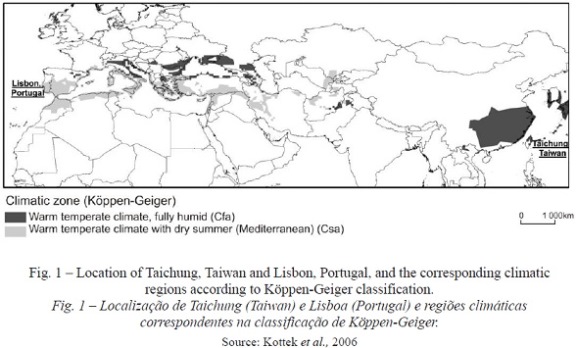
<body><![CDATA[<p>Several studies indicate that the attendance and use of outdoor spaces is significantly correlated with outdoor thermal comfort  (Eliasson <i>et al., </i>2007; Lin, 2009; Nakano and Tanabe, 2004; Nikolopoulou <i>et al., </i>2001; Thorsson <i>et al., </i>2007; Thorsson <i>et al., </i> 2004). Some studies demonstrated that these relationships are diverse in different climatic regions (Lin, 2009; Lin <i>et al., </i>2013a, 2013b). Therefore, it  is important to detect and quantify the characteristics of people&#8217;s thermal comfort in regions with different climatic conditions. For example, people  living in areas with a hot climate may be better adapted to hot weather and tolerate higher thermal conditions than those who are usually exposed to temperate  climates. This study compares the characteristics of thermal comfort by means of field surveys in Taichung (Taiwan) and Lisbon (Portugal), in order to validate  the effect of thermal adaptations on people&#8217;s thermal perceptions in different climatic regions. The main aim of this study is to verify how the  long-term regional climatic conditions influence local people&#8217;s thermal perceptions. </p>       <p>&nbsp;</p>      <p><b>II. DATA AND METHODS </b></p>       <p><b>1. Background of the  two surveyed area </b></p>       <p>In the present study, two areas in different climatic regions have been chosen for comparison: Portugal for the Mediterranean  region and Taiwan for the subtropical region. Taiwan (Taichung), located at 23&ordm; latitude n with hot-humid climate and Portugal (Lisbon), located at 38 &ordm; latitude n with hot-dry summer and mild winters, are the areas analysed (<a href="#f1">fig. 1</a>). The survey in Taiwan was conducted in 2004 and 2005 in the framework  of the FIOT project (Hwang and Lin, 2007; Lin <i>et al., </i>2011; Lin and Matzarakis, 2008), whereas the thermal comfort data in Portugal was collected in  2006 and 2007, during the four seasons, in the framework of the UrbKlim project (Oliveira and Andrade, 2007; Andrade <i>et al., </i>2011). </p>        <p>&nbsp;</p> <a name="f1"></a> <img src="/img/revistas/fin/n98/n98a05f1.jpg">     
<p>&nbsp;</p>      <p><b>2.  Meteorological measurements </b></p>       <p>In Taiwan, micro-meteorological instruments, positioned on a tripod at a height of 1.1 m above the ground, were used  for the measurements and automatic collection of data on thermal comfort parameters, including ambient air temperature, globe temperature, relative humidity,  air speed and global radiation. The accuracy of each parameter is &plusmn;0.7&ordm;C for air temperature, &plusmn;2.5% for relative humidity, &plusmn;0.1 m/s  for wind speed and &plusmn;5 W/m<sup>2</sup> for global radiation. In Lisbon, measurements of air temperature, relative humidity, wind speed, short and long  wave radiation were made in a similar way to those taken in Taiwan. Mean radiant temperature was calculated from short and long wave radiation; PET was  calculated by the rayMan model (Matzarakis <i>et al., </i>2007, 2010). </p>       <p><b>3. Questionnaire surveys </b></p>       ]]></body>
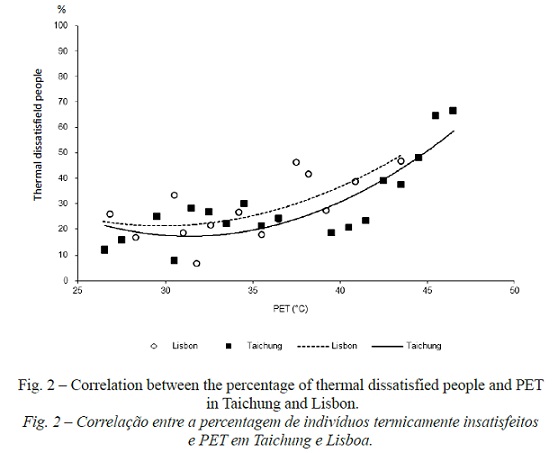
<body><![CDATA[<p>People were asked to complete  questionnaires about their perception of thermal comfort while meteorological measurements were being taken. The scope of the questionnaires was based on  appendix e of the thermal environment survey in Ashrae standard 55 (Ashrae, 2004). in Taiwan, the questionnaire comprised three sections. The first section  dealt with demographic information such as age, gender, activity level and the clothing that individuals were wearing. Activity and clothing levels are  transferred to the input format through Ashrae standard 55. </p>       <p>In the second section people were asked about their thermal comfort status at the time. The  <i>ASHRAE 7-point scales for thermal sensation vote</i> (TSV: -3: cold, -2: cool, -1: slightly cool, 0: neutrality, 1: slightly warm, 2: warm and 3: hot), the  3-point <i>McIntyre preference scales</i> (right now i &#8220;want cooler&#8221;, &#8220;want no change&#8221; or &#8220;want warmer&#8221;), and direct  assessments of thermal dissatisfaction (&#8220;satisfied&#8221; or &#8220;dissatisfied&#8221;) were used to help respondents to rate their thermal sensation  considering their environment. Respondents were also asked to indicate their sensation at the time and general preferences regarding air movement and  radiation. A 7point scale from &#8722;3 for &#8220;very weak wind/sun&#8221; to 3 for &#8220;very strong wind/sun&#8221; with 0 = &#8220;neutral&#8221; for  wind and sun are firstly evaluated. Then a 3-point scale with &#8220;i would prefer wind/sunshine weaker&#8221;, &#8220;i prefer no change in wind/sunshine &#8221; and &#8220;i would prefer wind/sunshine to be stronger.&#8221; a total of 1,644 data sets of questionnaire surveys were included in this study. </p>       <p> In Lisbon, the questionnaires were designed with equivalent questions and format in relation to Taichung, although the levels of satisfaction were aggregated  in a smaller set of classes to be consistent with terminology applied in Portugal. The questionnaires were divided in two main sections: in the first part, the  personal characteristics of the interviewees (age, gender, clothing, activity, geographical origin, among others) are described, and in the second part the  questions were related to the perception of the atmospheric conditions by the interviewees, with regards to the individual parameters (air temperature, air  humidity, wind speed, radiation) and also their overall preferences. </p>       <p>&nbsp;</p>      <p><b>III. RESULTS AND DISCUSSION </b></p>       <p>A thermal acceptable range is obtained  from the estimation of the thermal index (e.g. PET, Physiologically equivalent temperature, Mayer and H&ouml;ppe, 1987; H&ouml;ppe, 1999; Matzarakis <i>et al.,  </i>1999) and represents the satisfaction of different groups of occupants in relation to thermal conditions. To obtain this range, the dissatisfaction for  each temperature bin should be calculated. Based on previous suggestions (de Dear and fountain, 1994), the dissatisfaction can be regarded as a vote by  subjects outside the three central categories of the TSV scale: cold (-3), cool (-2), warm (2), and hot (3). </p>       <p><a href="#f2">Figure 2</a> shows the subjects&#8217;  dissatisfaction for each temperature bin to which second-degree polynomial curves were fitted. The PET on the lowest point of the curve is the temperature that  satisfied the majority of people, i.e. <i>neutral temperature</i> (tn). The same figure indicates that the TN of Taichung (31.3&ordm;C PET) is higher than the  one of Lisbon (29.7&ordm;C PET). Furthermore, subjects exposed to certain PET conditions in Lisbon were more dissatisfied with the thermal condition than those  in Taichung. For example, when people were exposed to 40&ordm;C PET, around 38% of people in Lisbon expressed dissatisfaction, whereas in Taichung this  proportion is around 30%. </p>       <p>&nbsp;</p> <a name="f2"></a> <img src="/img/revistas/fin/n98/n98a05f2.jpg">     
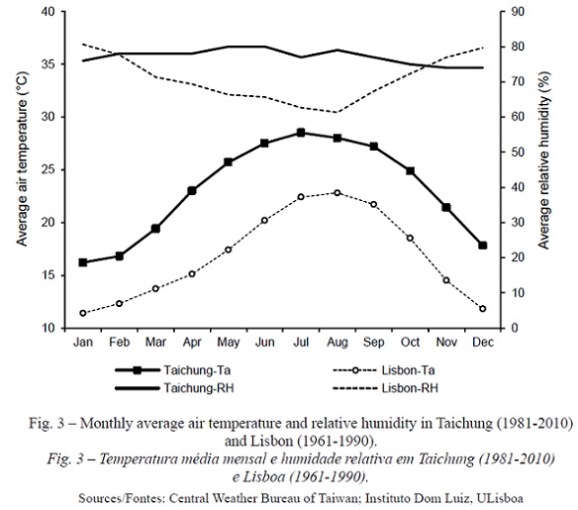
<p>&nbsp;</p>      <p>The analytical results can be explained by the following comparisons of longterm climatic conditions in Taichung and Lisbon.  Compared to Lisbon, Taichung has higher air temperature (higher than 5&ordm;C) during the hot season (<a href="#f3">fig. 3</a>). Moreover, relative humidity in summer in Taichung  is much higher than in Lisbon. The distribution of these two parameters indicates that Taichung is hotter and more humid than Lisbon. </p>       ]]></body>
<body><![CDATA[<p>&nbsp;</p> <a name="f3"></a> <img src="/img/revistas/fin/n98/n98a05f3.jpg">     
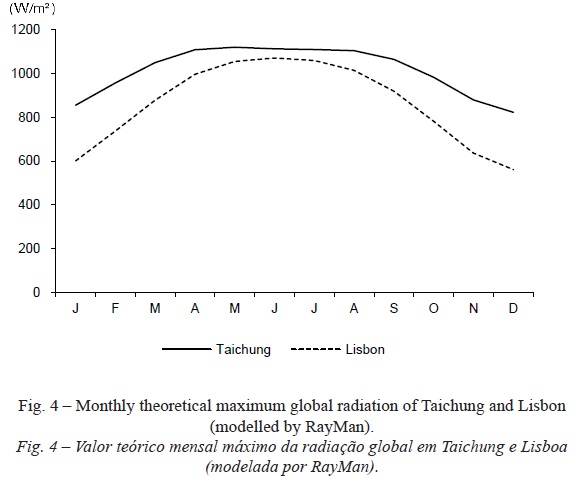
<p>&nbsp;</p>       <p>To verify how the  long-term solar radiation affects local people&#8217;s thermal perception, we calculated the average maximum global radiation of Taichung and Lisbon. This  value is, theoretically, the maximum value as modelled by rayMan (Matzarakis <i>et al., </i>2007, 2010). <a href="#f4">Figure 4</a> shows that Taichung has a higher global  radiation than Lisbon. This means that people in Taichung are exposed to higher mean radiant temperature (TMRT) values than people in Lisbon. From the  comparisons of long-term climate, the higher air temperature, air humidity, and global radiation in Taichung contribute to higher PET values than those in  Lisbon. As such, because people in Taichung usually experience higher PET values they have adapted to it, therefore they show higher tolerance to hot  conditions than the people in Lisbon. This inference can be verified from the previous thermal comfort classification comparisons between Taiwan and  Western/Middle European (Lin and Matzarakis, 2008) and between Taichung and Szeged (Hungary) (Kántor <i>et al., </i>2012a, 2012b). The adaptation  concept, taking into account the variation of individuals&#8217; comfort range with background thermal condition, has been applied in natural ventilated indoor  spaces, according to Ashrae 55 (Ashrae, 2010) and en 15251(Cen standard en15251, 2007). </p>       <p>&nbsp;</p> <a name="f4"></a> <img src="/img/revistas/fin/n98/n98a05f4.jpg">     
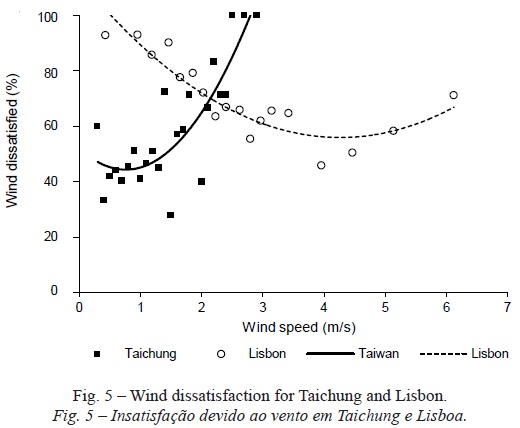
<p>&nbsp;</p>        <p>Since wind speed is also an important parameter for outdoor  thermal comfort, we further analysed people&#8217;s perception to different levels of wind speed, with the same method applied for assessing overall thermal  dissatisfaction. <a href="#f5">Figure 5</a> shows the wind dissatisfaction for both cities. Unlike what was found for PET, it is obvious that people in Lisbon have much higher  tolerance to stronger wind speeds than people in Taichung. The higher average wind speed in Lisbon (around 3.3-4.1m/s), than in Taichung (around 1.6-2.8 m/s),  may explain the results, shown in <a href="#f5">figure 5</a>. </p>        <p>&nbsp;</p> <a name="f5"></a> <img src="/img/revistas/fin/n98/n98a05f5.jpg">     
<p>&nbsp;</p>       <p>Furthermore, at the low wind speed of 1 m/s, the majority of people in Lisbon are dissatisfied, whereas  most people in Taichung are satisfied. Compared to people in Taichung, the result indicates that people in Lisbon prefer to have some wind than no wind at all  in summer. </p>       <p>&nbsp;</p>       ]]></body>
<body><![CDATA[<p><b>IV. CONCLUSION </b></p>       <p>The results of the analysis of the overall thermal comfort dissatisfaction indicate that people in Taichung  have higher tolerance to thermal comfort conditions (e.g. PET) when compared to people in Lisbon. However, people in Lisbon have higher tolerance to wind speed  than those in Taichung. These results can be explained by the long-term climatic conditions; Taichung has higher air temperature, humidity and global  radiation, while Lisbon has higher wind speeds. </p>       <p>The results display the thermal adaptation in different areas and reveal that local climate assessment  must be considered when dealing with this issue. While discussing the thermal environment in urban areas, it is important to offer the information of the  &#8216;users&#8217; thermal comfort range to understand their sensation and preferences regarding different thermal conditions. For regions with dissimilar  types of climate, different criteria for outdoor spaces should be applied, adjusted to the preferences of the local people and the long-term climatic  conditions. This study also demonstrates the importance of outdoor field survey data of the local people, to contribute for the design of more comfortable  outdoor spaces in urban areas. These issues are not only significant for general conditions, but are also relevant for facing climate change and apply suitable  adaptation strategies for humans, particularly in urban areas. </p>       <p>&nbsp;</p>       <p><b>BIBLIOGRAPHY </b></p>       <!-- ref --><p>Andrade H, Alcoforado MJ, Oliveira s (2011) Perception of  temperature and wind by users of public outdoor spaces: relationships with weather parameters and personal characteristics. <i>International Journal of  Biometeorology, </i>55(5): 665-680.    &nbsp;&nbsp;&nbsp;&nbsp;&nbsp;&nbsp;&nbsp;&nbsp;[&#160;<a href="javascript:void(0);" onclick="javascript: window.open('/scielo.php?script=sci_nlinks&ref=000068&pid=S0430-5027201400020000500001&lng=','','width=640,height=500,resizable=yes,scrollbars=1,menubar=yes,');">Links</a>&#160;]<!-- end-ref --> </p>       <p>Ashrae (2010) Ashrae standard 55-2010. Thermal environmental conditions for human occupancy. American society of  Heating, refrigerating and air-conditioning engineers, inc.: atlanta. </p>       <!-- ref --><p>CEN STANDARD EN15251 (2007) <i>Indoor environmental input parameters for design  and assessment of energy performance of buildings addressing indoor air quality, thermal environment, lighting and acoustics.</i> Brussels.    &nbsp;&nbsp;&nbsp;&nbsp;&nbsp;&nbsp;&nbsp;&nbsp;[&#160;<a href="javascript:void(0);" onclick="javascript: window.open('/scielo.php?script=sci_nlinks&ref=000071&pid=S0430-5027201400020000500003&lng=','','width=640,height=500,resizable=yes,scrollbars=1,menubar=yes,');">Links</a>&#160;]<!-- end-ref --> </p>       ]]></body>
<body><![CDATA[<!-- ref --><p>de Dear rJ,  fountain Me (1994) field experiments on occupant comfort and office thermal environments in a hot-humid climate. <i>ASHRAE Transactions</i>, 100(2): 457-474.    &nbsp;&nbsp;&nbsp;&nbsp;&nbsp;&nbsp;&nbsp;&nbsp;[&#160;<a href="javascript:void(0);" onclick="javascript: window.open('/scielo.php?script=sci_nlinks&ref=000073&pid=S0430-5027201400020000500004&lng=','','width=640,height=500,resizable=yes,scrollbars=1,menubar=yes,');">Links</a>&#160;]<!-- end-ref -->  </p>       <!-- ref --><p>Eliasson I, Knez I, Westerberg U, Thorsson S, Lindberg F (2007) Climate and behaviour in a nordic city. <i>Landscape and Urban Planning</i>, 82(1-2):  72-84.    &nbsp;&nbsp;&nbsp;&nbsp;&nbsp;&nbsp;&nbsp;&nbsp;[&#160;<a href="javascript:void(0);" onclick="javascript: window.open('/scielo.php?script=sci_nlinks&ref=000075&pid=S0430-5027201400020000500005&lng=','','width=640,height=500,resizable=yes,scrollbars=1,menubar=yes,');">Links</a>&#160;]<!-- end-ref --> </p>       <!-- ref --><p>H&ouml;ppe P (1999) The physiological equivalent temperature - a universal index for the biometeorological assessment of the thermal  environment. <i>International Journal of Biometeorology</i>, 43(2): 71-75.    &nbsp;&nbsp;&nbsp;&nbsp;&nbsp;&nbsp;&nbsp;&nbsp;[&#160;<a href="javascript:void(0);" onclick="javascript: window.open('/scielo.php?script=sci_nlinks&ref=000077&pid=S0430-5027201400020000500006&lng=','','width=640,height=500,resizable=yes,scrollbars=1,menubar=yes,');">Links</a>&#160;]<!-- end-ref --> </p>       <!-- ref --><p>Hwang RL, Lin TP (2007) Thermal comfort requirements for occupants of  semi-outdoor and outdoor environments in hot-humid regions. <i>Architectural Science Review</i>, 50(4): 60-67.    &nbsp;&nbsp;&nbsp;&nbsp;&nbsp;&nbsp;&nbsp;&nbsp;[&#160;<a href="javascript:void(0);" onclick="javascript: window.open('/scielo.php?script=sci_nlinks&ref=000079&pid=S0430-5027201400020000500007&lng=','','width=640,height=500,resizable=yes,scrollbars=1,menubar=yes,');">Links</a>&#160;]<!-- end-ref --> </p>       <!-- ref --><p>Hwang RL, Lin TP, Kuo NJ (2006) field  experiments on thermal comfort in campus classrooms in Taiwan. <i>Energy and Buildings</i>, 38(1): 53-62.    &nbsp;&nbsp;&nbsp;&nbsp;&nbsp;&nbsp;&nbsp;&nbsp;[&#160;<a href="javascript:void(0);" onclick="javascript: window.open('/scielo.php?script=sci_nlinks&ref=000081&pid=S0430-5027201400020000500008&lng=','','width=640,height=500,resizable=yes,scrollbars=1,menubar=yes,');">Links</a>&#160;]<!-- end-ref --> </p>       ]]></body>
<body><![CDATA[<!-- ref --><p>Kántor N, Egerhazi L, Unger J (2012a)  subjective estimation of thermal environment in recreational urban spaces-Part 1: investigations in Szeged, Hungary. <i>International Journal of Biometeorology </i>, 56(6): 1075-1088.    &nbsp;&nbsp;&nbsp;&nbsp;&nbsp;&nbsp;&nbsp;&nbsp;[&#160;<a href="javascript:void(0);" onclick="javascript: window.open('/scielo.php?script=sci_nlinks&ref=000083&pid=S0430-5027201400020000500009&lng=','','width=640,height=500,resizable=yes,scrollbars=1,menubar=yes,');">Links</a>&#160;]<!-- end-ref --> </p>       <!-- ref --><p>Kántor N, Unger J, Gulyas A (2012b) subjective estimations of thermal environment in recreational urban spaces-Part 2:  international comparison. <i>International Journal of Biometeorology</i>, 56(6): 1089-1101.    &nbsp;&nbsp;&nbsp;&nbsp;&nbsp;&nbsp;&nbsp;&nbsp;[&#160;<a href="javascript:void(0);" onclick="javascript: window.open('/scielo.php?script=sci_nlinks&ref=000085&pid=S0430-5027201400020000500010&lng=','','width=640,height=500,resizable=yes,scrollbars=1,menubar=yes,');">Links</a>&#160;]<!-- end-ref --> </p>       <!-- ref --><p>Kottek M, Grieser J, Beck C, Rudolf B, Rubel F (2006) World  Map of the K&ouml;ppen-Geiger cli-mate classification updated. <i>Meteorologische Zeitschrift</i>, 15(3): 259-263.    &nbsp;&nbsp;&nbsp;&nbsp;&nbsp;&nbsp;&nbsp;&nbsp;[&#160;<a href="javascript:void(0);" onclick="javascript: window.open('/scielo.php?script=sci_nlinks&ref=000087&pid=S0430-5027201400020000500011&lng=','','width=640,height=500,resizable=yes,scrollbars=1,menubar=yes,');">Links</a>&#160;]<!-- end-ref --> </p>       <!-- ref --><p>Lin Ch, Lin TP, Hwang RL  (2013a) Thermal comfort for urban parks in subtropics: understanding visitor&#8217;s perceptions, behavior and attendance. <i>Advances in Meteorology</i>,  2013. DOi: 10.1155/2013/640473 &nbsp;&nbsp;&nbsp;&nbsp;&nbsp;&nbsp;&nbsp;&nbsp;[&#160;<a href="javascript:void(0);" onclick="javascript: window.open('/scielo.php?script=sci_nlinks&ref=000089&pid=S0430-5027201400020000500012&lng=','','width=640,height=500,resizable=yes,scrollbars=1,menubar=yes,');">Links</a>&#160;]<!-- end-ref --><!-- ref --><p>Lin TP (2009) Thermal perception, adaptation and attendance in a public square in hot and humid regions. <i>Building and  Environment</i>, 44(10): 2017-2026.    &nbsp;&nbsp;&nbsp;&nbsp;&nbsp;&nbsp;&nbsp;&nbsp;[&#160;<a href="javascript:void(0);" onclick="javascript: window.open('/scielo.php?script=sci_nlinks&ref=000090&pid=S0430-5027201400020000500013&lng=','','width=640,height=500,resizable=yes,scrollbars=1,menubar=yes,');">Links</a>&#160;]<!-- end-ref --> </p>       <!-- ref --><p>Lin TP, De Dear R, Hwang RL (2011) Effect of thermal adaptation on seasonal outdoor thermal comfort. <i> International Journal of Climatology</i>, 31(2): 302-312.    &nbsp;&nbsp;&nbsp;&nbsp;&nbsp;&nbsp;&nbsp;&nbsp;[&#160;<a href="javascript:void(0);" onclick="javascript: window.open('/scielo.php?script=sci_nlinks&ref=000092&pid=S0430-5027201400020000500014&lng=','','width=640,height=500,resizable=yes,scrollbars=1,menubar=yes,');">Links</a>&#160;]<!-- end-ref --> </p>       <!-- ref --><p>Lin TP, Matzarakis A (2008) Tourism climate and thermal comfort in sun Moon Lake, Taiwan. <i> International Journal of Biometeorology</i>, 52(4): 281-290.    &nbsp;&nbsp;&nbsp;&nbsp;&nbsp;&nbsp;&nbsp;&nbsp;[&#160;<a href="javascript:void(0);" onclick="javascript: window.open('/scielo.php?script=sci_nlinks&ref=000094&pid=S0430-5027201400020000500015&lng=','','width=640,height=500,resizable=yes,scrollbars=1,menubar=yes,');">Links</a>&#160;]<!-- end-ref --> </p>       <!-- ref --><p>Lin TP, Tsai Kt, Liao CC, Huang YC (2013b) Effects of thermal comfort and adaptation on  park attendance regarding different shading levels and activity types. <i>Building and Environment</i>, 59(1): 599-611.    &nbsp;&nbsp;&nbsp;&nbsp;&nbsp;&nbsp;&nbsp;&nbsp;[&#160;<a href="javascript:void(0);" onclick="javascript: window.open('/scielo.php?script=sci_nlinks&ref=000096&pid=S0430-5027201400020000500016&lng=','','width=640,height=500,resizable=yes,scrollbars=1,menubar=yes,');">Links</a>&#160;]<!-- end-ref --> </p>       <!-- ref --><p>Matzarakis A, Mayer H, Iziomon  MG (1999) applications of a universal thermal index: physiological equivalent temperature. <i>International Journal of Biometeorology</i>, 43(2): 76-84.    &nbsp;&nbsp;&nbsp;&nbsp;&nbsp;&nbsp;&nbsp;&nbsp;[&#160;<a href="javascript:void(0);" onclick="javascript: window.open('/scielo.php?script=sci_nlinks&ref=000098&pid=S0430-5027201400020000500017&lng=','','width=640,height=500,resizable=yes,scrollbars=1,menubar=yes,');">Links</a>&#160;]<!-- end-ref --> </p>       <!-- ref --><p>Matzarakis A, Rutz F, Mayer H (2007) Modelling radiation fluxes in simple and complex environments -application of the rayMan model. <i>International  Journal of Biometeorology</i>, 51: 323-334.    &nbsp;&nbsp;&nbsp;&nbsp;&nbsp;&nbsp;&nbsp;&nbsp;[&#160;<a href="javascript:void(0);" onclick="javascript: window.open('/scielo.php?script=sci_nlinks&ref=000100&pid=S0430-5027201400020000500018&lng=','','width=640,height=500,resizable=yes,scrollbars=1,menubar=yes,');">Links</a>&#160;]<!-- end-ref --> </p>       <!-- ref --><p>Matzarakis A, Rutz F, Mayer H (2010) Modelling radiation fluxes in simple and complex environments: basics  of the rayMan model. <i>International Journal of Biometeorology</i>, 54(2): 131-139.    &nbsp;&nbsp;&nbsp;&nbsp;&nbsp;&nbsp;&nbsp;&nbsp;[&#160;<a href="javascript:void(0);" onclick="javascript: window.open('/scielo.php?script=sci_nlinks&ref=000102&pid=S0430-5027201400020000500019&lng=','','width=640,height=500,resizable=yes,scrollbars=1,menubar=yes,');">Links</a>&#160;]<!-- end-ref --> </p>       <!-- ref --><p>Mayer H, H&ouml;ppe P (1987) Thermal comfort of man in different  urban environments. The<i>oretical and Applied Climatology</i>, 38: 43-49.    &nbsp;&nbsp;&nbsp;&nbsp;&nbsp;&nbsp;&nbsp;&nbsp;[&#160;<a href="javascript:void(0);" onclick="javascript: window.open('/scielo.php?script=sci_nlinks&ref=000104&pid=S0430-5027201400020000500020&lng=','','width=640,height=500,resizable=yes,scrollbars=1,menubar=yes,');">Links</a>&#160;]<!-- end-ref --> </p>       <!-- ref --><p>Nakano J, Tanabe S (2004) Thermal comfort and adaptation in semi-outdoor  environments. <i>ASHRAE Transactions</i>, 110(2): 543-553.    &nbsp;&nbsp;&nbsp;&nbsp;&nbsp;&nbsp;&nbsp;&nbsp;[&#160;<a href="javascript:void(0);" onclick="javascript: window.open('/scielo.php?script=sci_nlinks&ref=000106&pid=S0430-5027201400020000500021&lng=','','width=640,height=500,resizable=yes,scrollbars=1,menubar=yes,');">Links</a>&#160;]<!-- end-ref --> </p>       <!-- ref --><p>Nikolopoulou M, Baker N, Steemers K (2001) Thermal comfort in outdoor urban spaces:  understanding the human parameter. <i>Solar Energy</i>, 70(3): 227-235.    &nbsp;&nbsp;&nbsp;&nbsp;&nbsp;&nbsp;&nbsp;&nbsp;[&#160;<a href="javascript:void(0);" onclick="javascript: window.open('/scielo.php?script=sci_nlinks&ref=000108&pid=S0430-5027201400020000500022&lng=','','width=640,height=500,resizable=yes,scrollbars=1,menubar=yes,');">Links</a>&#160;]<!-- end-ref --> </p>       <!-- ref --><p>Oliveira S, Andrade H (2007) An initial assessment of the bioclimatic comfort  in an outdoor public space in Lisbon. <i>International Journal of Biometeorology</i>, 52(1): 69-84.    &nbsp;&nbsp;&nbsp;&nbsp;&nbsp;&nbsp;&nbsp;&nbsp;[&#160;<a href="javascript:void(0);" onclick="javascript: window.open('/scielo.php?script=sci_nlinks&ref=000110&pid=S0430-5027201400020000500023&lng=','','width=640,height=500,resizable=yes,scrollbars=1,menubar=yes,');">Links</a>&#160;]<!-- end-ref --> </p>       <!-- ref --><p>Thorsson S, Honjo T, Lindberg F, Eliasson I, Lim EM  (2007) thermal comfort and outdoor activity in Japanese urban public places. <i>Environment and Behavior</i>, 39(5): 660-684.    &nbsp;&nbsp;&nbsp;&nbsp;&nbsp;&nbsp;&nbsp;&nbsp;[&#160;<a href="javascript:void(0);" onclick="javascript: window.open('/scielo.php?script=sci_nlinks&ref=000112&pid=S0430-5027201400020000500024&lng=','','width=640,height=500,resizable=yes,scrollbars=1,menubar=yes,');">Links</a>&#160;]<!-- end-ref --> </p>       <!-- ref --><p>Thorsson S, Lindqvist M,  Lindqvist S (2004) thermal bioclimatic conditions and patterns of behaviour in an urban park in Goteborg, Sweden. <i>International Journal of Biometeorology</i> , 48(3): 149-156.    &nbsp;&nbsp;&nbsp;&nbsp;&nbsp;&nbsp;&nbsp;&nbsp;[&#160;<a href="javascript:void(0);" onclick="javascript: window.open('/scielo.php?script=sci_nlinks&ref=000114&pid=S0430-5027201400020000500025&lng=','','width=640,height=500,resizable=yes,scrollbars=1,menubar=yes,');">Links</a>&#160;]<!-- end-ref --> </p>       <p>&nbsp;</p>       <p>Received: April 2014; Accepted<sup>:</sup> October 2014</p>       <p>&nbsp;</p>       <p><b>ACKNOWLEDGEMENTS </b></p>       <p>the survey  in Taiwan was conducted in the framework of the fiOt project (nsC-94-2211-e-150-001), whereas the thermal comfort data in Portugal was collected within the  UrbKlim project (POCi/GeO/61148/2000). Part of this research was carried out together with the late Henrique Andrade (1960-2013). thanks are due to Paulo Can ário for organizing and sending most of Henrique&#8217;s files. We also thank the referees for their suggestions on the manuscript. </p>       <p>&nbsp;</p>   </div>      ]]></body><back>
<ref-list>
<ref id="B1">
<nlm-citation citation-type="journal">
<person-group person-group-type="author">
<name>
<surname><![CDATA[Andrade]]></surname>
<given-names><![CDATA[H]]></given-names>
</name>
<name>
<surname><![CDATA[Alcoforado]]></surname>
<given-names><![CDATA[MJ]]></given-names>
</name>
<name>
<surname><![CDATA[Oliveira]]></surname>
<given-names><![CDATA[s]]></given-names>
</name>
</person-group>
<article-title xml:lang="en"><![CDATA[Perception of temperature and wind by users of public outdoor spaces: relationships with weather parameters and personal characteristics]]></article-title>
<source><![CDATA[International Journal of Biometeorology]]></source>
<year>2011</year>
<volume>55</volume>
<numero>5</numero>
<issue>5</issue>
<page-range>665-680</page-range></nlm-citation>
</ref>
<ref id="B2">
<nlm-citation citation-type="book">
<person-group person-group-type="author">
<name>
<surname><![CDATA[ASHRAE]]></surname>
<given-names><![CDATA[ASHRAE]]></given-names>
</name>
</person-group>
<source><![CDATA[ASHRAE standard 55-2010: Thermal environmental conditions for human occupancy]]></source>
<year>2010</year>
<publisher-loc><![CDATA[Atlanta ]]></publisher-loc>
<publisher-name><![CDATA[American society of Heating, refrigerating and air-conditioning engineers]]></publisher-name>
</nlm-citation>
</ref>
<ref id="B3">
<nlm-citation citation-type="">
<person-group person-group-type="author">
<name>
<surname><![CDATA[CEN]]></surname>
<given-names><![CDATA[STANDARD]]></given-names>
</name>
</person-group>
<source><![CDATA[Indoor environmental input parameters for design and assessment of energy performance of buildings addressing indoor air quality, thermal environment, lighting and acoustics]]></source>
<year>2007</year>
</nlm-citation>
</ref>
<ref id="B4">
<nlm-citation citation-type="journal">
<person-group person-group-type="author">
<name>
<surname><![CDATA[de]]></surname>
<given-names><![CDATA[Dear RJ]]></given-names>
</name>
<name>
<surname><![CDATA[Fountain]]></surname>
<given-names><![CDATA[ME]]></given-names>
</name>
</person-group>
<article-title xml:lang="en"><![CDATA[Field experiments on occupant comfort and office thermal environments in a hot-humid climate]]></article-title>
<source><![CDATA[ASHRAE Transactions]]></source>
<year>1994</year>
<volume>100</volume>
<numero>2</numero>
<issue>2</issue>
<page-range>457-474</page-range></nlm-citation>
</ref>
<ref id="B5">
<nlm-citation citation-type="journal">
<person-group person-group-type="author">
<name>
<surname><![CDATA[Eliasson]]></surname>
<given-names><![CDATA[I]]></given-names>
</name>
<name>
<surname><![CDATA[Knez]]></surname>
<given-names><![CDATA[I]]></given-names>
</name>
<name>
<surname><![CDATA[Westerberg]]></surname>
<given-names><![CDATA[U]]></given-names>
</name>
<name>
<surname><![CDATA[Thorsson]]></surname>
<given-names><![CDATA[S]]></given-names>
</name>
<name>
<surname><![CDATA[Lindberg]]></surname>
<given-names><![CDATA[F]]></given-names>
</name>
</person-group>
<article-title xml:lang="en"><![CDATA[Climate and behaviour in a nordic city]]></article-title>
<source><![CDATA[Landscape and Urban Planning]]></source>
<year>2007</year>
<volume>82</volume>
<numero>1-2</numero>
<issue>1-2</issue>
<page-range>72-84</page-range></nlm-citation>
</ref>
<ref id="B6">
<nlm-citation citation-type="journal">
<person-group person-group-type="author">
<name>
<surname><![CDATA[Höppe]]></surname>
<given-names><![CDATA[P]]></given-names>
</name>
</person-group>
<article-title xml:lang="en"><![CDATA[The physiological equivalent temperature - a universal index for the biometeorological assessment of the thermal environment]]></article-title>
<source><![CDATA[International Journal of Biometeorology]]></source>
<year>1999</year>
<volume>43</volume>
<numero>2</numero>
<issue>2</issue>
<page-range>71-75</page-range></nlm-citation>
</ref>
<ref id="B7">
<nlm-citation citation-type="journal">
<person-group person-group-type="author">
<name>
<surname><![CDATA[Hwang]]></surname>
<given-names><![CDATA[RL]]></given-names>
</name>
<name>
<surname><![CDATA[Lin]]></surname>
<given-names><![CDATA[TP]]></given-names>
</name>
</person-group>
<article-title xml:lang="en"><![CDATA[Thermal comfort requirements for occupants of semi-outdoor and outdoor environments in hot-humid regions]]></article-title>
<source><![CDATA[Architectural Science Review]]></source>
<year>2007</year>
<volume>50</volume>
<numero>4</numero>
<issue>4</issue>
<page-range>60-67</page-range></nlm-citation>
</ref>
<ref id="B8">
<nlm-citation citation-type="journal">
<person-group person-group-type="author">
<name>
<surname><![CDATA[Hwang]]></surname>
<given-names><![CDATA[RL]]></given-names>
</name>
<name>
<surname><![CDATA[Lin]]></surname>
<given-names><![CDATA[TP]]></given-names>
</name>
<name>
<surname><![CDATA[Kuo]]></surname>
<given-names><![CDATA[NJ]]></given-names>
</name>
</person-group>
<article-title xml:lang="en"><![CDATA[Field experiments on thermal comfort in campus classrooms in Taiwan]]></article-title>
<source><![CDATA[Energy and Buildings]]></source>
<year>2006</year>
<volume>38</volume>
<numero>1</numero>
<issue>1</issue>
<page-range>53-62</page-range></nlm-citation>
</ref>
<ref id="B9">
<nlm-citation citation-type="journal">
<person-group person-group-type="author">
<name>
<surname><![CDATA[Kántor]]></surname>
<given-names><![CDATA[N]]></given-names>
</name>
<name>
<surname><![CDATA[Egerhazi]]></surname>
<given-names><![CDATA[L]]></given-names>
</name>
<name>
<surname><![CDATA[Unger]]></surname>
<given-names><![CDATA[J]]></given-names>
</name>
</person-group>
<article-title xml:lang="en"><![CDATA[Subjective estimation of thermal environment in recreational urban spaces-Part 1: investigations in Szeged, Hungary]]></article-title>
<source><![CDATA[International Journal of Biometeorology]]></source>
<year>2012</year>
<month>a</month>
<volume>56</volume>
<numero>6</numero>
<issue>6</issue>
<page-range>1075-1088</page-range></nlm-citation>
</ref>
<ref id="B10">
<nlm-citation citation-type="journal">
<person-group person-group-type="author">
<name>
<surname><![CDATA[Kántor]]></surname>
<given-names><![CDATA[N]]></given-names>
</name>
<name>
<surname><![CDATA[Unger]]></surname>
<given-names><![CDATA[J]]></given-names>
</name>
<name>
<surname><![CDATA[Gulyas]]></surname>
<given-names><![CDATA[A]]></given-names>
</name>
</person-group>
<article-title xml:lang="en"><![CDATA[Subjective estimations of thermal environment in recreational urban spaces-Part 2: international comparison]]></article-title>
<source><![CDATA[International Journal of Biometeorology]]></source>
<year>2012</year>
<month>b</month>
<volume>56</volume>
<numero>6</numero>
<issue>6</issue>
<page-range>1089-1101</page-range></nlm-citation>
</ref>
<ref id="B11">
<nlm-citation citation-type="journal">
<person-group person-group-type="author">
<name>
<surname><![CDATA[Kottek]]></surname>
<given-names><![CDATA[M]]></given-names>
</name>
<name>
<surname><![CDATA[Grieser]]></surname>
<given-names><![CDATA[J]]></given-names>
</name>
<name>
<surname><![CDATA[Beck]]></surname>
<given-names><![CDATA[C]]></given-names>
</name>
<name>
<surname><![CDATA[Rudolf]]></surname>
<given-names><![CDATA[B]]></given-names>
</name>
<name>
<surname><![CDATA[Rubel]]></surname>
<given-names><![CDATA[F]]></given-names>
</name>
</person-group>
<article-title xml:lang="en"><![CDATA[World Map of the Köppen-Geiger cli-mate classification updated]]></article-title>
<source><![CDATA[Meteorologische Zeitschrift]]></source>
<year>2006</year>
<volume>15</volume>
<numero>3</numero>
<issue>3</issue>
<page-range>259-263</page-range></nlm-citation>
</ref>
<ref id="B12">
<nlm-citation citation-type="journal">
<person-group person-group-type="author">
<name>
<surname><![CDATA[Lin]]></surname>
<given-names><![CDATA[Ch]]></given-names>
</name>
<name>
<surname><![CDATA[Lin]]></surname>
<given-names><![CDATA[TP]]></given-names>
</name>
<name>
<surname><![CDATA[Hwang]]></surname>
<given-names><![CDATA[RL]]></given-names>
</name>
</person-group>
<article-title xml:lang="en"><![CDATA[Thermal comfort for urban parks in subtropics: understanding visitor's perceptions, behavior and attendance]]></article-title>
<source><![CDATA[Advances in Meteorology]]></source>
<year>2013</year>
<month>a</month>
<volume>2013</volume>
</nlm-citation>
</ref>
<ref id="B13">
<nlm-citation citation-type="journal">
<person-group person-group-type="author">
<name>
<surname><![CDATA[Lin]]></surname>
<given-names><![CDATA[TP]]></given-names>
</name>
</person-group>
<article-title xml:lang="en"><![CDATA[Thermal perception, adaptation and attendance in a public square in hot and humid regions]]></article-title>
<source><![CDATA[Building and Environment]]></source>
<year>2009</year>
<volume>44</volume>
<numero>10</numero>
<issue>10</issue>
<page-range>2017-2026</page-range></nlm-citation>
</ref>
<ref id="B14">
<nlm-citation citation-type="journal">
<person-group person-group-type="author">
<name>
<surname><![CDATA[Lin]]></surname>
<given-names><![CDATA[TP]]></given-names>
</name>
<name>
<surname><![CDATA[De]]></surname>
<given-names><![CDATA[Dear R]]></given-names>
</name>
<name>
<surname><![CDATA[Hwang]]></surname>
<given-names><![CDATA[RL]]></given-names>
</name>
</person-group>
<article-title xml:lang="en"><![CDATA[Effect of thermal adaptation on seasonal outdoor thermal comfort]]></article-title>
<source><![CDATA[International Journal of Climatology]]></source>
<year>2011</year>
<volume>31</volume>
<numero>2</numero>
<issue>2</issue>
<page-range>302-312</page-range></nlm-citation>
</ref>
<ref id="B15">
<nlm-citation citation-type="journal">
<person-group person-group-type="author">
<name>
<surname><![CDATA[Lin]]></surname>
<given-names><![CDATA[TP]]></given-names>
</name>
<name>
<surname><![CDATA[Matzarakis]]></surname>
<given-names><![CDATA[A]]></given-names>
</name>
</person-group>
<article-title xml:lang="en"><![CDATA[Tourism climate and thermal comfort in sun Moon Lake, Taiwan]]></article-title>
<source><![CDATA[International Journal of Biometeorology]]></source>
<year>2008</year>
<volume>52</volume>
<numero>4</numero>
<issue>4</issue>
<page-range>281-290</page-range></nlm-citation>
</ref>
<ref id="B16">
<nlm-citation citation-type="journal">
<person-group person-group-type="author">
<name>
<surname><![CDATA[Lin]]></surname>
<given-names><![CDATA[TP]]></given-names>
</name>
<name>
<surname><![CDATA[Tsai]]></surname>
<given-names><![CDATA[Kt]]></given-names>
</name>
<name>
<surname><![CDATA[Liao]]></surname>
<given-names><![CDATA[CC]]></given-names>
</name>
<name>
<surname><![CDATA[Huang]]></surname>
<given-names><![CDATA[YC]]></given-names>
</name>
</person-group>
<article-title xml:lang="en"><![CDATA[Effects of thermal comfort and adaptation on park attendance regarding different shading levels and activity types]]></article-title>
<source><![CDATA[Building and Environment]]></source>
<year>2013</year>
<month>b</month>
<volume>59</volume>
<numero>1</numero>
<issue>1</issue>
<page-range>599-611</page-range></nlm-citation>
</ref>
<ref id="B17">
<nlm-citation citation-type="journal">
<person-group person-group-type="author">
<name>
<surname><![CDATA[Matzarakis]]></surname>
<given-names><![CDATA[A]]></given-names>
</name>
<name>
<surname><![CDATA[Mayer]]></surname>
<given-names><![CDATA[H]]></given-names>
</name>
<name>
<surname><![CDATA[Iziomon]]></surname>
<given-names><![CDATA[MG]]></given-names>
</name>
</person-group>
<article-title xml:lang="en"><![CDATA[Applications of a universal thermal index: physiological equivalent temperature]]></article-title>
<source><![CDATA[International Journal of Biometeorology]]></source>
<year>1999</year>
<volume>43</volume>
<numero>2</numero>
<issue>2</issue>
<page-range>76-84</page-range></nlm-citation>
</ref>
<ref id="B18">
<nlm-citation citation-type="journal">
<person-group person-group-type="author">
<name>
<surname><![CDATA[Matzarakis]]></surname>
<given-names><![CDATA[A]]></given-names>
</name>
<name>
<surname><![CDATA[Rutz]]></surname>
<given-names><![CDATA[F]]></given-names>
</name>
<name>
<surname><![CDATA[Mayer]]></surname>
<given-names><![CDATA[H]]></given-names>
</name>
</person-group>
<article-title xml:lang="en"><![CDATA[Modelling radiation fluxes in simple and complex environments -application of the rayMan model]]></article-title>
<source><![CDATA[International Journal of Biometeorology]]></source>
<year>2007</year>
<volume>51</volume>
<page-range>323-334</page-range></nlm-citation>
</ref>
<ref id="B19">
<nlm-citation citation-type="journal">
<person-group person-group-type="author">
<name>
<surname><![CDATA[Matzarakis]]></surname>
<given-names><![CDATA[A]]></given-names>
</name>
<name>
<surname><![CDATA[Rutz]]></surname>
<given-names><![CDATA[F]]></given-names>
</name>
<name>
<surname><![CDATA[Mayer]]></surname>
<given-names><![CDATA[H]]></given-names>
</name>
</person-group>
<article-title xml:lang="en"><![CDATA[Modelling radiation fluxes in simple and complex environments: basics of the rayMan model]]></article-title>
<source><![CDATA[International Journal of Biometeorology]]></source>
<year>2010</year>
<volume>54</volume>
<numero>2</numero>
<issue>2</issue>
<page-range>131-139</page-range></nlm-citation>
</ref>
<ref id="B20">
<nlm-citation citation-type="journal">
<person-group person-group-type="author">
<name>
<surname><![CDATA[Mayer]]></surname>
<given-names><![CDATA[H]]></given-names>
</name>
<name>
<surname><![CDATA[Höppe]]></surname>
<given-names><![CDATA[P]]></given-names>
</name>
</person-group>
<article-title xml:lang="en"><![CDATA[Thermal comfort of man in different urban environments]]></article-title>
<source><![CDATA[Theoretical and Applied Climatology]]></source>
<year>1987</year>
<volume>38</volume>
<page-range>43-49</page-range></nlm-citation>
</ref>
<ref id="B21">
<nlm-citation citation-type="journal">
<person-group person-group-type="author">
<name>
<surname><![CDATA[Nakano]]></surname>
<given-names><![CDATA[J]]></given-names>
</name>
<name>
<surname><![CDATA[Tanabe]]></surname>
<given-names><![CDATA[S]]></given-names>
</name>
</person-group>
<article-title xml:lang="en"><![CDATA[Thermal comfort and adaptation in semi-outdoor environments]]></article-title>
<source><![CDATA[ASHRAE Transactions]]></source>
<year>2004</year>
<volume>110</volume>
<numero>2</numero>
<issue>2</issue>
<page-range>543-553</page-range></nlm-citation>
</ref>
<ref id="B22">
<nlm-citation citation-type="journal">
<person-group person-group-type="author">
<name>
<surname><![CDATA[Nikolopoulou]]></surname>
<given-names><![CDATA[M]]></given-names>
</name>
<name>
<surname><![CDATA[Baker]]></surname>
<given-names><![CDATA[N]]></given-names>
</name>
<name>
<surname><![CDATA[Steemers]]></surname>
<given-names><![CDATA[K]]></given-names>
</name>
</person-group>
<article-title xml:lang="en"><![CDATA[Thermal comfort in outdoor urban spaces: understanding the human parameter]]></article-title>
<source><![CDATA[Solar Energy]]></source>
<year>2001</year>
<volume>70</volume>
<numero>3</numero>
<issue>3</issue>
<page-range>227-235</page-range></nlm-citation>
</ref>
<ref id="B23">
<nlm-citation citation-type="journal">
<person-group person-group-type="author">
<name>
<surname><![CDATA[Oliveira]]></surname>
<given-names><![CDATA[S]]></given-names>
</name>
<name>
<surname><![CDATA[Andrade]]></surname>
<given-names><![CDATA[H]]></given-names>
</name>
</person-group>
<article-title xml:lang="en"><![CDATA[An initial assessment of the bioclimatic comfort in an outdoor public space in Lisbon]]></article-title>
<source><![CDATA[International Journal of Biometeorology]]></source>
<year>2007</year>
<volume>52</volume>
<numero>1</numero>
<issue>1</issue>
<page-range>69-84</page-range></nlm-citation>
</ref>
<ref id="B24">
<nlm-citation citation-type="journal">
<person-group person-group-type="author">
<name>
<surname><![CDATA[Thorsson]]></surname>
<given-names><![CDATA[S]]></given-names>
</name>
<name>
<surname><![CDATA[Honjo]]></surname>
<given-names><![CDATA[T]]></given-names>
</name>
<name>
<surname><![CDATA[Lindberg]]></surname>
<given-names><![CDATA[F]]></given-names>
</name>
<name>
<surname><![CDATA[Eliasson]]></surname>
<given-names><![CDATA[I]]></given-names>
</name>
<name>
<surname><![CDATA[Lim]]></surname>
<given-names><![CDATA[EM]]></given-names>
</name>
</person-group>
<article-title xml:lang="en"><![CDATA[Thermal comfort and outdoor activity in Japanese urban public places]]></article-title>
<source><![CDATA[Environment and Behavior]]></source>
<year>2007</year>
<volume>39</volume>
<numero>5</numero>
<issue>5</issue>
<page-range>660-684</page-range></nlm-citation>
</ref>
<ref id="B25">
<nlm-citation citation-type="journal">
<person-group person-group-type="author">
<name>
<surname><![CDATA[Thorsson]]></surname>
<given-names><![CDATA[S]]></given-names>
</name>
<name>
<surname><![CDATA[Lindqvist]]></surname>
<given-names><![CDATA[M]]></given-names>
</name>
<name>
<surname><![CDATA[Lindqvist]]></surname>
<given-names><![CDATA[S]]></given-names>
</name>
</person-group>
<article-title xml:lang="en"><![CDATA[Thermal bioclimatic conditions and patterns of behaviour in an urban park in Goteborg, Sweden]]></article-title>
<source><![CDATA[International Journal of Biometeorology]]></source>
<year>2004</year>
<volume>48</volume>
<numero>3</numero>
<issue>3</issue>
<page-range>149-156</page-range></nlm-citation>
</ref>
</ref-list>
</back>
</article>