<?xml version="1.0" encoding="ISO-8859-1"?><article xmlns:mml="http://www.w3.org/1998/Math/MathML" xmlns:xlink="http://www.w3.org/1999/xlink" xmlns:xsi="http://www.w3.org/2001/XMLSchema-instance">
<front>
<journal-meta>
<journal-id>0430-5027</journal-id>
<journal-title><![CDATA[Finisterra - Revista Portuguesa de Geografia]]></journal-title>
<abbrev-journal-title><![CDATA[Finisterra]]></abbrev-journal-title>
<issn>0430-5027</issn>
<publisher>
<publisher-name><![CDATA[Centro de Estudos Geográficos]]></publisher-name>
</publisher>
</journal-meta>
<article-meta>
<article-id>S0430-50272014000200011</article-id>
<title-group>
<article-title xml:lang="en"><![CDATA[Tourism and climate in Lisbon. An assessment based on weather types]]></article-title>
<article-title xml:lang="pt"><![CDATA[Turismo e clima em lisboa. Análise com base nos &#8220;tipos de tempo&#8221;]]></article-title>
</title-group>
<contrib-group>
<contrib contrib-type="author">
<name>
<surname><![CDATA[Machete]]></surname>
<given-names><![CDATA[Raquel]]></given-names>
</name>
<xref ref-type="aff" rid="A01"/>
</contrib>
<contrib contrib-type="author">
<name>
<surname><![CDATA[Lopes]]></surname>
<given-names><![CDATA[António]]></given-names>
</name>
<xref ref-type="aff" rid="A01"/>
</contrib>
<contrib contrib-type="author">
<name>
<surname><![CDATA[Gómez-Martín]]></surname>
<given-names><![CDATA[Mª Belén]]></given-names>
</name>
<xref ref-type="aff" rid="A02"/>
</contrib>
<contrib contrib-type="author">
<name>
<surname><![CDATA[Fraga]]></surname>
<given-names><![CDATA[Helder]]></given-names>
</name>
<xref ref-type="aff" rid="A03"/>
</contrib>
</contrib-group>
<aff id="A01">
<institution><![CDATA[,Universidade de Lisboa Instituto de Geografia e Ordenamento do território Centro de estudos Geográficos]]></institution>
<addr-line><![CDATA[ ]]></addr-line>
</aff>
<aff id="A02">
<institution><![CDATA[,University of Barcelona Faculty of Geography and History Department of Physical Geography and regional analysis]]></institution>
<addr-line><![CDATA[ ]]></addr-line>
</aff>
<aff id="A03">
<institution><![CDATA[,University of Trás-os-Montes e Alto Douro Centre for the research and technology of agro-environmental and Biological sciences ]]></institution>
<addr-line><![CDATA[ ]]></addr-line>
</aff>
<pub-date pub-type="pub">
<day>00</day>
<month>12</month>
<year>2014</year>
</pub-date>
<pub-date pub-type="epub">
<day>00</day>
<month>12</month>
<year>2014</year>
</pub-date>
<numero>98</numero>
<fpage>153</fpage>
<lpage>176</lpage>
<copyright-statement/>
<copyright-year/>
<self-uri xlink:href="http://scielo.pt/scielo.php?script=sci_arttext&amp;pid=S0430-50272014000200011&amp;lng=en&amp;nrm=iso"></self-uri><self-uri xlink:href="http://scielo.pt/scielo.php?script=sci_abstract&amp;pid=S0430-50272014000200011&amp;lng=en&amp;nrm=iso"></self-uri><self-uri xlink:href="http://scielo.pt/scielo.php?script=sci_pdf&amp;pid=S0430-50272014000200011&amp;lng=en&amp;nrm=iso"></self-uri><abstract abstract-type="short" xml:lang="en"><p><![CDATA[Although climate is perceived as an essential part of tourism, influencing touristic regional and seasonal distribution patterns, ideal climate conditions for tourism are often assumed, rather than demonstrated. After reviewing the distinct tools that have been applied in order to evaluate climate potential for tourism, as well as tourists' preferences, Besancenots' weather-types method was chosen. This model was adapted and applied to Lisbon, evaluating the suitability of the summer season for tourism activities. the resulting weather type pattern was then crossed with the seasonal tourist demands (visitation statistics), allowing to conclude that even when the weather is categorized as extremely hot (type 7) or unfavourable for tourism (type 8) it does not reflect in the room occupation rates of the city of Lisbon, reinforcing recent advances in tourism climatology, that defy expert based thresholds of thermal preferences and comfort. a reformulation of the weather type model with our findings can be a useful tool for future assessments of tourist potential under projected climate changes.]]></p></abstract>
<abstract abstract-type="short" xml:lang="pt"><p><![CDATA[Ainda que o clima seja visto como parte essencial das actividades turísticas, influenciando os padrões de distribuição espá cio-temporal dos fluxos de viajantes, as condições climáticas ideais para o turismo são frequentemente vistas como auto-explicativas. O método dos tipos de tempo de Besancenot foi seleccionado, após uma revisão dos vários métodos que t êm vindo a ser aplicados para calcular o potencial do clima para o turismo, bem como para avaliar as preferências dos turistas. Este método foi adaptado e aplicado a Lisboa, de modo a analisar a aptidão turística da estação estival. O padrão de tipos de tempo resultante desta análise foi, em seguida, cruzado com indicadores de procura turística (estatísticas de ocupação hoteleira), permitindo-nos concluir que, mesmo quando o estado do tempo é categorizado como extremamente quente (tipo de tempo 7) ou desfavorável para o turismo (tipo de tempo 8), não se reflecte de forma negativa nas taxas de ocupação hoteleira da cidade de Lisboa. Deste modo, o estudo vem reforçar conclusões recentes de estudos climáticos aplicados ao turismo que têm vindo a contestar os limiares de preferências e conforto térmico anteriormente definidos por peritos. Reformulado com as conclusões deste estudo, o modelo de tipos de tempo pode ser uma ferramenta útil para a análise futura do potencial turístico atendendo às alterações climáticas projectadas.]]></p></abstract>
<abstract abstract-type="short" xml:lang="fr"><p><![CDATA[Tourisme et climat à Lisbonne. Analyse de types de temps. Bien que le climat soit considéré comme un élément essentiel, à tenir en compte pour les pratiques touristiques et qu'il influence la répartition régionale et saisonnière des touristes, les climats dits favorables sont plus souvent estimés que décrits. On étudie ici la saison d'été à Lisbonne, en lui appliquant le modèle des types de temps distingués par Besancenot, adapté à Lisbonne. Or, même lors des types de temps 7 (extrêmement chaud) ou 8 (défavorable au tourisme), on n'y constate aucune diminution du taux d'occupation des chambres. Cela donne raison à certains auteurs qui mettent en doute les limites climatiques utilisées pour déterminer la préférence thermique et le confort. Les présents résultats pourront être utiles pour une reformulation du modèle des types de temps et pour l'é valuation du potentiel touristique futur tenant en compte les projections de changement climatique.]]></p></abstract>
<kwd-group>
<kwd lng="en"><![CDATA[Tourism and climate]]></kwd>
<kwd lng="en"><![CDATA[weather-types]]></kwd>
<kwd lng="en"><![CDATA[climate change]]></kwd>
<kwd lng="en"><![CDATA[Lisbon]]></kwd>
<kwd lng="en"><![CDATA[Portugal]]></kwd>
<kwd lng="pt"><![CDATA[Turismo e clima]]></kwd>
<kwd lng="pt"><![CDATA[tipos de tempo]]></kwd>
<kwd lng="pt"><![CDATA[alterações climáticas]]></kwd>
<kwd lng="pt"><![CDATA[Lisboa]]></kwd>
<kwd lng="pt"><![CDATA[Portugal]]></kwd>
<kwd lng="fr"><![CDATA[Tourisme et climat]]></kwd>
<kwd lng="fr"><![CDATA[types de temps]]></kwd>
<kwd lng="fr"><![CDATA[changement climatique]]></kwd>
<kwd lng="fr"><![CDATA[Lisbonne]]></kwd>
<kwd lng="fr"><![CDATA[Portugal]]></kwd>
</kwd-group>
</article-meta>
</front><body><![CDATA[ <div>      <p align="right"><b>ARTIGO ORIGINAL</b></p>         <p>&nbsp;</p>         <p><b>Tourism and climate in Lisbon.</b><b> An assessment based on weather types </b></p>         <p><b>&nbsp;</b></p>         <p><b>Turismo e clima em Lisboa. Análise com base nos  &#8220;tipos de tempo&#8221;</b></p>        <p>&nbsp;</p>      <p>&nbsp;</p>         <p><b>Raquel Machete<sup>1 </sup>António Lopes<sup>2 </sup>M<sup>a</sup> Bel&eacute;n Gómez-Martín<sup>3 </sup>Helder Fraga<sup>4</sup></b></p>         <p><sup>1 </sup>Researcher at the  Centro de estudos Geográficos and PhD student at the Instituto de Geografia e Ordenamento do território da Universidade de Lisboa.  E-mail: <a href="mailto:raquelmachete@gmail.com">raquelmachete@gmail.com</a> &nbsp;</p>         ]]></body>
<body><![CDATA[<p><sup>2 </sup>Coordinator  of the Zephyrus research unit of the Centro de estudos Geográficos and Professor at the Instituto de Geografia e Ordenamento do Território,  University of Lisbon. E-mail: <a href="mailto:antonio.lopes@campus.ul.pt">antonio.lopes@campus.ul.pt</a> </p>         <p><sup>3 </sup>Professor at the Department of Physical Geography and regional analysis, Faculty of Geography  and History, University of Barcelona. E-mail: <a href="mailto:bgomez@ub.edu">bgomez@ub.edu</a></p>         <p><sup>4 </sup>Researcher in the Centre for the research and technology of agro-environmental and Biological sciences, University of Trás-os-Montes e  Alto Douro. E-mail: <a href="mailto:hfraga@utad.pt">hfraga@utad.pt</a> </p>         <p>&nbsp;</p>        <p>&nbsp;</p>         <p><b>ABSTRACT</b></p>         <p>Although  climate is perceived as an essential part of tourism, influencing touristic regional and seasonal distribution patterns, ideal climate conditions for tourism  are often assumed, rather than demonstrated. After reviewing the distinct tools that have been applied in order to evaluate climate potential for tourism, as  well as tourists&#8217; preferences, Besancenots&#8217; weather-types method was chosen. This model was adapted and applied to Lisbon, evaluating the  suitability of the summer season for tourism activities. the resulting weather type pattern was then crossed with the seasonal tourist demands (visitation  statistics), allowing to conclude that even when the weather is categorized as extremely hot (type 7) or unfavourable for tourism (type 8) it does not reflect  in the room occupation rates of the city of Lisbon, reinforcing recent advances in tourism climatology, that defy expert based thresholds of thermal  preferences and comfort. a reformulation of the weather type model with our findings can be a useful tool for future assessments of tourist potential under  projected climate changes. </p>         <p><b>Keywords:</b> Tourism and climate, weather-types, climate change, Lisbon, Portugal. </p>      <p>&nbsp;</p>      <p><b>RESUMO</b></p>         ]]></body>
<body><![CDATA[<p> Ainda que o clima seja visto como parte essencial das actividades turísticas, influenciando os padrões de distribuição espá cio-temporal dos fluxos de viajantes, as condi&ccedil;&otilde;es climáticas ideais para o turismo são frequentemente vistas como  auto-explicativas. O m&eacute;todo dos tipos de tempo de Besancenot foi seleccionado, após uma revisão dos vários m&eacute;todos que t &ecirc;m vindo a ser aplicados para calcular o potencial do clima para o turismo, bem como para avaliar as prefer&ecirc;ncias dos turistas. Este m&eacute;todo  foi adaptado e aplicado a Lisboa, de modo a analisar a aptidão turística da estação estival. O padrão de tipos de tempo  resultante desta análise foi, em seguida, cruzado com indicadores de procura turística (estatísticas de ocupação hoteleira),  permitindo-nos concluir que, mesmo quando o estado do tempo &eacute; categorizado como extremamente quente (tipo de tempo 7) ou desfavorável para o  turismo (tipo de tempo 8), não se reflecte de forma negativa nas taxas de ocupação hoteleira da cidade de Lisboa. Deste modo, o estudo vem  refor&ccedil;ar conclusões recentes de estudos climáticos aplicados ao turismo que t&ecirc;m vindo a contestar os limiares de prefer&ecirc;ncias  e conforto t&eacute;rmico anteriormente definidos por peritos. Reformulado com as conclusões deste estudo, o modelo de tipos de tempo pode ser uma  ferramenta &uacute;til para a análise futura do potencial turístico atendendo &agrave;s altera&ccedil;&otilde;es climáticas projectadas.  </p>         <p><b>Palavras-chave:</b> Turismo e clima, tipos de tempo, altera&ccedil;&otilde;es climáticas, Lisboa, Portugal. </p>      <p>&nbsp;</p>      <p><b>RESUME</b> </p>         <p>Tourisme et climat &agrave; Lisbonne. Analyse de types de temps. Bien que le climat soit consid&eacute;r&eacute; comme un &eacute;l&eacute;ment essentiel,  &agrave; tenir en compte pour les pratiques touristiques et qu&#8217;il influence la r&eacute;partition r&eacute;gionale et saisonni&egrave;re des touristes,  les climats dits favorables sont plus souvent estim&eacute;s que d&eacute;crits. On &eacute;tudie ici la saison d&#8217;&eacute;t&eacute; &agrave; Lisbonne, en  lui appliquant le mod&egrave;le des types de temps distingu&eacute;s par Besancenot, adapt&eacute; &agrave; Lisbonne. Or, m&ecirc;me lors des types de temps 7  (extr&ecirc;mement chaud) ou 8 (d&eacute;favorable au tourisme), on n&#8217;y constate aucune diminution du taux d&#8217;occupation des chambres. Cela donne  raison &agrave; certains auteurs qui mettent en doute les limites climatiques utilis&eacute;es pour d&eacute;terminer la pr&eacute;f&eacute;rence thermique et  le confort. Les pr&eacute;sents r&eacute;sultats pourront &ecirc;tre utiles pour une reformulation du mod&egrave;le des types de temps et pour l&#8217;&eacute; valuation du potentiel touristique futur tenant en compte les projections de changement climatique. </p>         <p><b>Mots-cl&eacute;s:</b> Tourisme et climat,  types de temps, changement climatique, Lisbonne, Portugal. </p>      <p>&nbsp;</p>      <p>&nbsp;</p>         <p><b>I. INTRODUCTION </b></p>         <p>The importance of tourism to  the Portuguese economy and the unequivocal links the sector has with the elements of the atmosphere highlight the need to consider climate in all its aspects.  Weather and climate conditions are key elements in the majority of tourism products provided by tourist destinations in Portugal. Thus it is important to  consider the atmospheric aspects at the present moment but it is also important to consider any future changes in the atmospheric conditions (Smith, 1993; Wall  and Badke, 1994; Gómez-Martín, 2005; Hall, 2008; Becken and Hay, 2007; Becken, 2010). </p>         ]]></body>
<body><![CDATA[<p>Weather and climate have a great importance in  tourists&#8217; decision-making and in travel experience. Weather and climate experienced at the destination and at the place of origin are relevant motivators  for tourism (Eugenio-Martin and Campos-Soria, 2010; Scott <i>et al.,</i> 2012). Weather and climate at the destination play an important role in decision  making because they act as a resource that enables or deters the fulfilment of a number of tourism activities (Perry, 1997; Gom&eacute;z-Martín, 2005;  Becken and Wilson, 2013) and because they act as an attraction factor (Lohman and Kaim, 1999; Hamilton and Lau, 2004). Weather and climate in the place of  origin can determine travel motivation, timing of travel and choice of destination (Scott and Lemieux, 2009, 2010). According to Smith (1993) and Wall (2007),  there is a statistical fit between the arrival of British tourists in Portugal and the amount of rain in the previous summer in Britain. </p>         <p>Other analyses  (Agnew, 1997) have also found a correspondence between the increase in the outbound tourism following a cold winter. There are also several other factors  weighing in the selection of a destination. tourism literature has explained the motivation for travelling and destination selection as the result of two  interacting strengths, the need to travel (&#8220;push&#8221;) and the attractiveness factors (&#8220;pull&#8221;, Crompton, 1979) the latter covering elements  such as the landscape, climate and culture (static), but equally hospitality services as well as accessibility (dynamic) and current decisions (prices,  promotion and even fashion trends), whereas &#8220;push&#8221; factors are related to a set of intangible needs felt by the individual (Crompton, 1979; Chon,  1989; Lubbe, 1998; Kozak, 2002). </p>         <p>Weather is an intrinsic component of the travel experience (Scott <i>et al.,</i> 2012), and for many travellers  weather conditions at the destination can influence the degree of satisfaction (H&uuml;bner and G&ouml;ssling, 2012). In a study undertaken to assess  touristweather interactions, Becken and Wilson (2013) concluded that tourists that had to adjust their travel routes, the timing of travel or the activities  during their holiday due to adverse weather conditions were less satisfied than those that reported no changes. Climate and weather can allow tourists to enjoy  their holiday activities safely and comfortably, helping them fulfil the desires that originally brought them to the resort and, consequently, raising their  satisfaction levels (Gómez-Martín, 2005). this is significant for a number of reasons, especially the economic repercussions, since satisfaction  should influence future visits: satisfied tourists tend to return to the destination, whereas dissatisfied tourists may seek new destinations (Becken, 2010; H &uuml;bner and G&ouml;ssling, 2012) or provide negative word-of-mouth recommendations to family and friends (G&ouml;ssling <i>et al.,</i> 2006; Mansfeld <i>et  al.,</i> 2007). in a survey undertaken at the Caribbean island of Martinique during an extreme weather event (prolonged, heavy rainfall during the dry season),  17% of the inquired indicated that they were unlikely to return and 4% reported that they would not return, without a doubt, due to the experienced weather  parameters (H&uuml;bner and G&ouml;ssling, 2012).the importance that atmospheric conditions have on tourists&#8217; decision-making and in travel experience  requires the evaluation of climate-tourist potential at the destinations. The assessment of climate resources can play an important role in providing  information to tourists and operators. Climate information for long-term planned trips can determine &#8722; apart from destination choice &#8722; the time of  travel and the planning of activities. </p>         <p>Prior to the departure, climate and weather information will also be of use for packing (adequate clothing and  equipment) and scheduling the travel route. During holidays, time will most definitely mark the on-site behaviour of the tourist, and render viable or unviable  the activities that had been formerly planned. </p>         <p>Climate and weather information is just as important for the tourism supply, meaning, tourism agents and  operators, either when deciding whether to make the investment (and have a real analysis on expected returns), as for operating costs. Decisions on the  location of new resorts, building and landscape design and construction timing (Scott and Lemieux, 2010) can benefit from information on the normal values of  climatic elements such as temperature, humidity, rainfall, prevailing winds (Gom&eacute;z-Martín, 2005). The construction materials, the site,  thickness, shape, colour and orientation of the roof and fa&ccedil;ades should all take into account the historical climate in order to provide comfortable and  safe areas for leisure. Landscape planning should also be adequate to the climate requirements of the destination moderating the influence of some atmospheric  elements (Gom&eacute;z-Martín, 2005). Suited architecture can, additionally, help reduce costs with artificial heating or cooling systems. </p>         <p>The  assessment of climate resources can be a fundamental tool in the planning of tourist destinations currently and in the future. The purpose of this paper is to  assess the climate suitability of Lisbon for tourism, making use of the weather type methodology in order to establish a baseline for a future assessment of  the city&#8217;s potential under the projected climate scenarios. To achieve these aims, the paper presents the defining characteristics of tourism in the  geographical area of study and examines the vulnerability of the sector to climate change. Then it describes the methodology and data used, and the main  results and conclusions obtained. </p>         <p>&nbsp;</p>         <p><b>II. STUDY AREA </b></p>         <p><b>1. Tourism in Lisbon (Portugal) </b></p>     <p>Europe remains the most  popular holiday destination in the world, hosting over half of the total tourist arrivals, having surpassed, for the first time ever, the one billion mark in  2012 &#8211; quadrupling the arrivals registered in 1950 (UNWTO -World tourism Organization, 2013). International tourism revenue grows along with the arrivals  rate, totalling 837 billion &#8364; in 2012. Within Europe, the Mediterranean still holds a privileged position. Portugal is one of the southern European  countries that has been outdoing the sub-region, in terms of demand share (UNWTO, 2013). </p>         ]]></body>
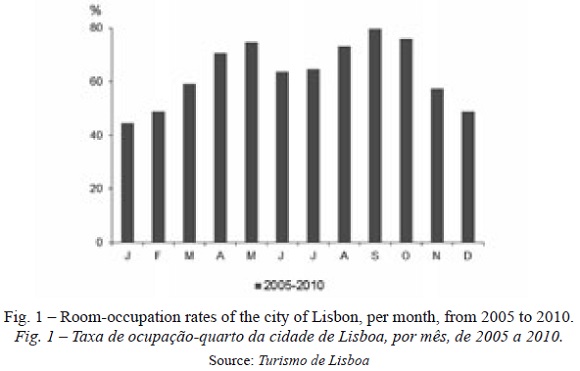
<body><![CDATA[<p>Almost 7.7 million tourists entered Portugal in 2012 (UNWTO,  2013). It is the 6<sup>th</sup> country in terms of number of international arrivals in the southern Europe/Mediterranean region, falling behind Spain, Italy,  Turkey, Greece and Croatia and 5<sup>th</sup> in terms of tourism expenditures, with 11,056 million &#8364; accounted for in 2012 (UNWTO, 2013). Adding up to  that, domestic tourism is, by no means, something to disregard (over 6 million people) (Turismo de Portugal, 2013b). </p>         <p>Lisbon has been undergoing an  increase in tourism demand for the last decades (Turismo de Lisboa, 2011; Brito Henriques, 2003). During the 1990<sup>s</sup> and the first decade of the 21 <sup>st</sup> century, several international events concurred for the boosting of the capitals&#8217; international image (European Capital of Culture in 1994,  Lisbon World exhibition 1998, UEFA European football Championship in 2004). Mega events have been widely used to attract visitors and investment (Edwards <i>et  al.,</i> 2002; Richards and Wilson, 2004). The emergence and expansion of low-cost airlines have also contributed to improve the accessibility to the region  and, hence, stimulate its growing role as a city break destination (World travel and tourism Council, 2007). </p>         <p>Lisbon is known for its warm and dry  summers (rainfall occurs predominantly between October and April). The pleasant temperatures that typify the region&#8217;s weather (maximum average  temperature in Lisbon in July is 28.1&ordm;C and the minimum average for January is 8.1&ordm;C) derive from regional geographic factors, such as latitude and  the proximity to the Atlantic Ocean. </p>         <p>The favourable natural assets can explain, to a great extent, Lisbon&#8217;s central location. Two sunny costal  lines &#8211; Estoril and Arrábida &#8211; sheltered from the frequent north and NW winds by the topographic configuration partly explain the tourist  attractiveness of the region. </p>         <p>So, after having come in third place for a very long period of time, behind the Algarve and Madeira, Lisbon is now the  second national tourism destination. from January to October 2013 the Portuguese statistics institute estimated over 4 million guests in Lisbon, totalling up  to 9.5 million overnights, most of which from foreign markets (2.78 million international guests against 1.3 million domestic tourists) (Turismo de Portugal,  2013a). </p>         <p>in the last years, the city has been awarded numerous distinctions (for instance, it was voted, repeatedly, <i>Europe&#8217;s Leading  Destination</i>, <i>Europe&#8217;s Leading City Break Destination</i> and <i>Europe&#8217;s Leading Cruise Destination</i>, by the <i>World Travel Awards</i>)  and, it has been granted many references from international media (Turismo de Lisboa, 2011). although the influence of media coverage of Lisbon&#8217;s  popularity has yet to be demonstrated, literature emphasizes the role of media regarding perceptions (H&uuml;bner and G&ouml;ssling, 2012) and as being able to  stimulate, create or reduce interest in places and activities (Butler, 1990 and 2011). </p>         <p>The tourism demand pattern in the city demonstrates some  seasonality. an analysis of Lisbon&#8217;s room occupation rates from 2005 to 2010 (<a href="#f1">fig.1</a>) shows clearly three distinctive periods: a lower demand season that  stretches from November to February, higher peeks of demand in April, May, August, September and October and some months in between &#8211; March, June and  July &#8211; that present slightly lower room occupation shares, but still around 60/70 %. </p>            <p>&nbsp;</p> <a name="f1"></a> <img src="/img/revistas/fin/n98/n98a11f1.jpg">     
<p>&nbsp;</p>               <p>According to Butler and Mao (1997) typology  for seasonality, a destination that demonstrates two time-spans of higher demand would fit under the two-peak seasonality pattern. </p>         ]]></body>
<body><![CDATA[<p>The city&#8217;s  tourism offer is quite diversified. In a recent study undertaken by the Turismo de Lisboa, tourists made reference to the local hospitality, the accessibility  of interest points, abundance of cultural heritage and architecture, quality of the gastronomy and climate as some of the determining pull factors in Lisbon.  In the evaluation of the parameters most influential for the overall satisfaction, climate and weather and monuments were the only parameters collecting an  average rating greater than 8.5 (or, alternatively, a degree of satisfaction of 85%) according to Observatório do Turismo de Lisboa (2011). </p>         <p><b> 2. Vulnerability of tourism to climate change in Lisbon (Portugal) </b></p>         <p>Studies about climate change in Portugal (using different climate scenarios)  indicate that temperature will tend to increase in the order of 3&ordm;C to 7&ordm;C for the summer season in mainland Portugal, particularly affecting the  northern and Central regions. in the area of Lisbon the temperature will increase on average 1.7 &ordm;C and 2.5&ordm;C (B2 and a2 scenarios) (Wilbanks <i>et  al.</i>, 2007) by mid XXI century, while that change could reach 2 to 4&ordm;C by mid XXI century and 5 to 9&ordm;C by the end of the century, for the maximum  summer temperatures (Santos and Miranda, 2006). </p>         <p>Different scenarios forecast a reduction in annual rainfall in mainland Portugal by 20% to 40% of  current levels, mostly due to a reduced rainy season which is expected to be more concentrated in spring and autumn. The majority of the models predict a  moderate rainfall increase in the north during the winter season for the period 2070-2099 in comparison to the baseline period of 1961-1990. Model projections  are less consistent for the Centre and south in the winter season for the same period (Santos <i>et al.</i>, 2001). According to the second report of the SIAM  project (Climate Change in Portugal - scenarios, impacts and adaptation Measures), a reduction of 150 mm in median annual rainfall is estimated until 2050,  within the four different scenarios; the reduction would be especially accentuated in the autumn (Santos and Miranda, 2006). although some global climate  models, such as coupled atmosphere&#8211;ocean general circulation model ECHAM4/OPYC3 (Semenov and Bengtsson, 2002) and the Hadley Centre model (Allen and  Ingram, 2002 and Allan and Soden, 2008) suggest that, in the future, precipitation will occur predominantly as short-term heavy rainfall events. It should be  noted that there is no evidence of an increase of heavy rainfall events in the past three decades in Lisbon (Aguiar, 2010). </p>         <p>The projected changes in  the study area could have direct and indirect impacts that may affect the tourist sector in opposing ways. Changes in climate parameters will cause significant  changes in present climate-tourism potential of the area. These could materialize in a favourable expansion of the tourist season, spreading occupancy rates  more evenly through spring, autumn and summer. However, part of the summer tourist season may suffer an important decrease in comfort levels (Amelung and  Viner, 2006; Moreno and Amelung, 2009). Rutty and Scott (2014) provide some new insights on tourist thermal preferences for beach tourism and on the number of  ideal or unacceptable months of Mediterranean beach and urban tourist destinations by early, mid and end of the XXI century. The future climate scenario could  represent an opportunity to reduce the seasonality that has traditionally characterized the tourist sector in the study region (Hein <i>et al.,</i> 2009).  According to Hadwen <i>et al.</i> (2011) places where a marked variation in climate (differences in winter and summer temperatures, or pronounced wet or dry  seasons) exists, seasonality is mainly driven by these differences. In contrast, the reduction in precipitation could lead to a reduction in the availability  of water supplies and an increase of water quality problems risks. The decreased runoff in the Spanish part of the transboundary river basins is likely to  accentuate even further the expected decrease of water availability in the Portuguese territory (Santos <i>et al</i>, 2001). that situation would oblige the  reassessing of tourism development models &#8211; especially for projects that demand great amounts of water, such as resorts with vast gardens that demand  constant irrigation (G&ouml;ssling <i>et al</i>., 2001; Brito Henriques <i>et al</i>., 2010), swimming pools, golf courses &#8722; and to reassess management  of the current hydric resources in order to deal with the future, possibly increased, demand for water (G&ouml;ssling <i>et al.,</i> 2011; EU, 2007). </p>         <p>&nbsp;</p>         <p><b>III. METHODS AND DATA </b></p>         <p><b>1. Methods to evaluate climate potential for tourism </b></p>     <p>According to Scott <i>et al.,</i>  (2008) the numerous attempts to identify most favourable or optimal climatic conditions for tourism, both in general and for specific tourism segments and  activities (Rutty and Scott, 2013) can be clustered into three types of approaches: <i>expert-based</i>, <i>revealed preference</i> and <i>stated preference</i> . </p>         <p>a) Included in the <i>expert-based approach</i> are the climate evaluating methods that several geographers have transposed from bioclimatology in  order to adequately evaluate the climate potential of regions for tourism. These methods (often indexes) classify the integrated effect of climate parameters  on people, associating a number of meteorological variables perceived as decisive for pursuing outdoor recreation. a first generation of indexes was proposed  by researchers such as Burnet (1963), Hughes (1967), Davis (1968) or Sarram&eacute;a (1980), based on arithmetical operations with climate parameters such as  sunshine hours, temperature or precipitation and number of days with occurrence of rainfall. Sarram&eacute;a&#8217;s <i>climatico-ma</i>rin index had the  particularity of incorporating water temperature, wind speed, fog, ice and snow. Notwithstanding their utility, these methods were the object of criticism. One  of the critics raised by Besancenot (1990) is the calculation of these indexes through the use of climate parameters expressed in different units of  measurement. Another recurring critic concerned the failure to use the totality of atmospheric environmental attributes important to tourism (De freitas, 2003,  2008; Gómez-Martín, 2006). Lastly, these indexes completely overlook consumer preference (Gómez-Martín, 2006). </p>         ]]></body>
<body><![CDATA[<p>In 1985  Mieczkowski developed a comprehensive approach, framed within this first generation indexes, the <i>Tourism Climate Index </i>(TCI) that combined seven  variables and is still frequently applied (Morgan <i>et al.,</i> 2000; Scott and McBoyle 2001; Scott <i>et al</i>., 2004; Amelung and Viner, 2007). The value  of each climate parameter is divided into classes and each class is ascribed an index, reflecting its adequacy for tourism. TCI was designed bearing in mind  the practice of sightseeing activities. Rates and weights were based on expert judgment and on Mieczkowski&#8217;s own opinion (Moreno, 2010). This  subjectivity is one of the criticisms directed at this index. Furthermore, as it is calculated with average climate data, instead of actual observations, it  rarely expresses weather as experienced by tourists (Besancenot, 1990). </p>         <p>Simultaneously, Besancenot <i>et al.,</i> (1978) and Besancenot (1985, 1990)  developed another tool: weather typing. Instead of using average data, this method provides a synthesis of the combination of daily climate elements.  Originally, the classification elaborated by Besancenot was developed to comprehend the demands of sea-side tourism and was adapted to mass tourism afterwards.  It encompassed nine types of weather, seven of which are favourable to the practice of outdoor recreation (even if they include a light degree of discomfort)  and two are unfavourable for outdoor leisure. In order to provide a holistic evaluation of climate, the weather type methodology combined the following daily  parameters: sunshine (hours), cloud cover (octas), precipitation (duration or quantity), maximum temperature, wind speed (m/s) and vapour pressure (hPa). The  thresholds were first drawn from the observation of vacationer&#8217;s behaviour on the European seaside (and next adapted to different world sites) and from  bioclimatological known thresholds. </p>         <p>Criticisms to this method have been raised (Scott <i>et al.,</i> 2008, 2012), particularly because weather typing  was primarily based on subjective expert opinion (like TCI). Nevertheless, this limitation can be overcome by introducing <i>stated preference </i>(see below),  as was the case with its application in Catalonia (Gómez-Martín, 2006), where thresholds were established and validated by including the results  of surveys from tourists. It can also be complemented with <i>revealed preference</i> (see below), which was the case in Alcoforado <i>et al.</i> (2004), where  the weather type classification was crossed with two types of beach attendance indicators: number of cars parked by the beach and subjective evaluation of  business by two restaurants and coffee shops. </p>         <p>The assumption that the weather type classification can be universalized has also been criticised (Scott  <i>et al.,</i> 2008). As Gómez-Martín stated (2006) nuances can be integrated in the classification, adapting the thresholds to the climatic  specificities of the region, as well as to the predominant tourism activities. </p>         <p>According to De Freitas (2003), an ideal climate index should encompass  as well a combined evaluation of the body/atmosphere energy balance, since climate parameters affect people either physically, physiologically or  psychologically (De Freitas, 2003; Andrade <i>et al., </i>2007). Individual&#8217;s response, in turn, is a result of their perception, hence, highly  subjective (Gom&eacute;z-Martín, 2006; Rutty and Scott, 2014). A second generation of indexes is being advanced by scholars such as De Freitas <i>et al.  </i>(2008), Climate Index for Tourism (CIT), surpassing previous constraints or Matzarakis (2014) who developed the Climate-Tourism-Information-Scheme (CTIS).  </p>         <p>b)<i> Revealed preferences studies</i> comprise a set of approaches that relate statistically tourism demand indicators (e.g., number of arrivals or  departures) with cli-mate. These models provide and objective indicator (actual tourist behaviour), but often include solely temperature as climatic parameter  (Hamilton and Lau, 2004; Scott <i>et al.,</i> 2008). What is more, not unusually they rely on monthly data, or use the climate of capital cities to represent  the entire nation (Scott <i>et al.,</i> 2008). Rutty and Scott (2013) also emphasize the total absence of market segment differentiation in these studies  (tourism arrivals data is aggregated, not allowing to distinguish between business and leisure tourism). </p>         <p>c) Lastly, <i>stated preference approaches</i>  refers to surveying tourists regarding their climate preferences (Mansfeld <i>et al</i>., 2004; Gómez-Martín, 2006; Scott <i>et al</i>., 2008;  Moreno, 2010; Rutty and Scott, 2010, 2014). Of course, a risk of response bias has to be considered (Scott <i>et al.</i>, 2008) in the case of <i>in situ</i>  surveys of tourist preferences. Nevertheless, <i>ex situ</i> surveys (Scott <i>et al.,</i> 2008; Moreno, 2010) often imply populations from the same country or  demographically homogeneous, preventing the generalization of the conclusions. Finally, there can be an important difference between what is stated by tourists  and how they actually behave (Moreno, 2010). </p>         <p>Climate preferences are highly subjective and are influenced by a set of factors, namely age, gender,  nationality or climatic region of origin (Moreno, 2010; Rutty and Scott, 2013). Each individual&#8217;s perception may change at different stages of life, or  according to the destination and type of activity selected (Scott <i>et al</i>., 2008). </p>         <p>Perceived optimal temperatures differ greatly for different  tourism environments (Scott <i>et al.,</i> 2008; Rutty and Scott, 2010) as does the relative importance of weather variables (Scott <i>et al., </i>2008). For  instance, in Scott <i>et al. </i>(2008) respondents rated sunshine as the most important parameter for beach tourism, temperature as the determining element  for urban tourism and, finally, rainfall as decisive for mountain tourism. Belgian and Dutch respondents flying to the Mediterranean considered precipitation,  strong winds, low temperatures and cloudiness to be more unfavourable to beach tourism than high temperatures (Moreno, 2010). In Catalonia tourists also were  shown to be more prone to tolerate high temperatures than wind or heavy rain (Gómez-Martín, 2006). </p>         <p>Studies have concluded that people &#8217;s thermal perceptions are adjusted to comfort expectations (Rutty and Scott, 2014). Tourists in the Caribbean justified their dissatisfaction with the  weather by referring the &#8220;unusual and unexpected weather situation (prolonged and heavy rainfall, during the dry season) as well as restrictions in  activities&#8221; (H&uuml;bner and G&ouml;ssling, 2012). According to Rutty and Scott (2014), additionally to expectation, perceived thermal control also  influences satisfaction. Whereas in indoor environments people have a relatively high degree of control over thermal conditions, people can merely adjust their  behaviour outdoors (fitting their clothing or their position in the sun, shade, rain, for instance) and there is a wider thermal range perceived as  satisfactory (Rutty and Scott, 2014). </p>         ]]></body>
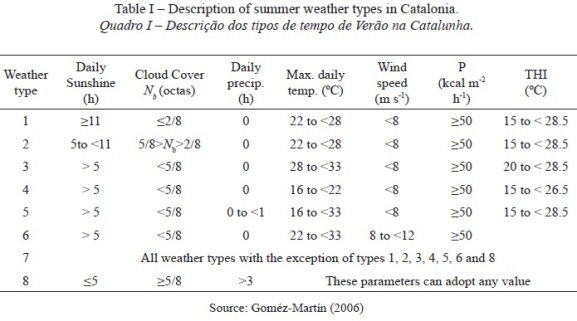
<body><![CDATA[<p>In a research project about urban tourism coordinated by H. Andrade (URBAN/AUR/0003/2008) on the consequences of  climate change in Lisbon, tourists were questioned on the temperature they found optimal for the practice of tourism in urban areas (Machete <i>et al.,</i>  2010). The bulk of the respondents (64.4%) replied that 2125&ordm;C would be ideal, whereas 25% seem to prefer 26-30&ordm;C; for the remaining interviewees,  the range 16-20&ordm;C would suit their demands the best. </p>         <p><b>2. Selected methodology: weather type model </b></p>     <p>After an evaluation of existing  approaches, we decided to implement Besancenots&#8217; weather type model (an expert-based method). The weather type methodology has been applied several times  in Iberian Peninsula by Alcoforado <i>et al. </i>(1999, 2004) and Gómez-Martín (2006), Martínez-ibarra (2011) and Gómez-Martí n and Martínez-ibarra (2012) as a means to evaluate the climate potential in the course of summer. The limitations of this index may be overcome as  explained above. Moreover, this method shows some clear advantages namely: <i>a)</i> it describes real weather conditions as experienced by the tourists as a  combination of weather parameters; <i>b)</i> it allows the inclusion of risk factors (strong winds, heat stress&#8230;) and <i>c) </i>it can be adjusted to  activities that have different climatic needs (Andrade <i>et al.</i>, 2007). </p>         <p>Most existing studies on thermal comfort and preferences are not  applicable to the present case study. Existing studies on urban outdoor comfort (Andrade <i>et al., </i>2011) focus on local residents, thus being unsuitable  for international tourists. Studies on thermal preferences about the Mediterranean (Rutty and Scott, 2010; Moreno, 2010, Blazejczyk <i>et al.</i>, this issue)  are also inadequate for this case, since they only include northern European tourists. The main issuing markets of tourists in Lisbon comprise, nonetheless,  apart from northern-European countries, Spanish, French, Italian, Brazilian and North Americans, whose perceptions and preferences on temperature may vary  considerably from the former. The findings of Rutty and Scott (2014) demonstrate clearly that the climatic region of origin is subjacent to perceptions.  Perceptions of tourists from tropical countries are quite different from those of tourists arising from temperate countries. Even within tourists from similar  climate environments, preferences can be heterogeneous according to their nationality (Scott <i>et al.,</i> 2008). </p>         <p>The catalogue of types of weather  designed for Catalonia in 2006 by Gómez-Martín (<a href="#t1">table I</a>) relied on a careful analysis of the regions&#8217; summer climate to establish frequent  weather types, and in a series of investigations to verify the preestablished weather types. It presented several adjustments in the defined thresholds,  diverging from Besancenots&#8217; catalogue of weather types for the same latitudes, as it took into account the tourists&#8217; preferences. This catalogue  was conceived for tourism in general (during summer), following the belief that tourists can pursue a variety of activities. Tourists in Lisbon also revealed  the purpose of engaging in a multitude of activities, from rest and relaxation to visiting monuments and museums, to experiencing the local culture and  gastronomy, just to list a few (Observatório do Turismo de Lisboa, 2011). Within such a diverse array of activities, avoiding unsuitable weather  conditions is certainly easier than in beach environments, or in nature based tourism, where exposure to the atmospheric events is determinant (Scott <i>et  al., </i>2008). </p>           <p>&nbsp;</p> <a name="t1"></a> <img src="/img/revistas/fin/n98/n98a11t1.jpg">     
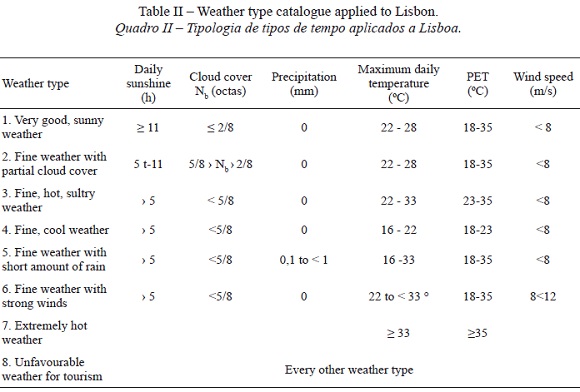
<p>&nbsp;</p>             <p><b>3. Adaptation of thresholds to Lisbon&#8217;s climate </b></p>     <p>The catalogue that had been applied  to Catalonia was used in Lisbon, with the necessary adjustments to include particularities of Lisbon&#8217;s climate and data availability. furthermore, the  thermal component of perception was introduced, by using the <i>Physiological Equivalent Temperature</i> (PET) and our results were confronted with <i>revealed  preferences</i>, by using room occupation statistics. the weather type catalogue used in the present study is presented in <a href="#t2">table II</a>. </p>           <p>&nbsp;</p> <a name="t2"></a> <img src="/img/revistas/fin/n98/n98a11t2.jpg">     
]]></body>
<body><![CDATA[<p>&nbsp;</p>               <p><b><i>3.1. Daily sunshine and cloud cover </i></b></p>     <p>Sunshine duration and visibility thresholds followed the ones defined for Catalonia,  due to its great influence on the general satisfaction of tourists (Alcoforado, 1999; Gómez-Martín, 2006). although for outdoor recreation the  absence of sun would not be a deterring factor, it is just seen as unpleasant. Along with the presence of fog and the length of the day it comprises the set of  <i>aesthetic</i> elements that influence the attractiveness of the destination (De freitas, 2003). </p>         <p><b><i>3.2. Daily precipitation </i></b></p>     <p> Although, for tourism climatology the duration, frequency and time of occurrence of rainfall are more important than the total amount of precipitation per day,  we decided to use the latter (mm). the reason is that this assessment of weather-type of Lisbon during the summer should act as a basis for an analysis of  future weather types (considering climate change projections) and precipitation series estimates, for which we will not have time of occurrence, but only the  expected quantity. </p>         <p><b><i>3.3. Temperature </i></b></p>     <p>Maximum daily air temperature definition followed Catalonia&#8217;s catalogue ranges, that  places the optimum air temperature range between 16 and 33&ordm;C (Besancenot, 1990). This is, however, a wide interval. As a result, it was subdivided into  three shorter ranges and, after surveying tourists, the temperature range 22-28&ordm;C was established as the most commonly preferred, thus figuring in the two  most favourable types of weather (Gómez-Martín, 2006). a series of interviews undertaken by Rutty and Scott (2010) on the attractiveness of the  Mediterranean placed the optimum temperature range between 20 and 26&ordm;C, with temperatures under 17&ordm;C deemed unacceptably cold and over 30&ordm;C  unacceptably hot. Nonetheless, these results have a few limitations, acknowledged by the researchers, as the sample comprises solely university students and,  what is more, all of them from northern European countries (see above debate on the importance of place of origin). </p>         <p>It is generally acknowledged from  the analysis of stated preferences studies (Gómez-Martín 2006; Moreno 2010; Rutty and Scott 2010, 2014) that maximum temperatures for beach  tourism are difficult to establish (e.g. what is the upper value of temperature that would deter tourists from going to the beach). In Gómez-Martí n (2006) the maximum air temperature range 28-33&ordm;C was preferred to 16-22&ordm;C, which was rated by tourists as the least favourable. Tourists seem more  prone to tolerate high temperatures than lower ones (Gómez-Martín, 2006). In Rutty and Scott&#8217;s (2014) assessment of thermal perceptions and  preferences of beach tourists, where surveys were carried out in Caribbean beaches and crossed with thermo physiological indexes, high temperatures also seem  to be perceived as highly satisfactory. While the temperatures recorded suggested that tourists should be under thermal stress, tourists expressed no desire of  changes in thermal conditions. Likewise, Martínez-Ibarra and Gómez-Martín (2012) found, in the course of a study of beach occupation in  several points of the Spanish coast, that the optimum Physiological equivalent temperature (PET) for beach tourism ranges between 34.5 and 38.8&ordm;C. </p>         <p> Although establishing an ideal temperature range seems a difficult task, considering the subjectivity inherent to it, there are widespread preferences  confirmed by several different studies, as seen above. </p>         <p><b><i>3.4. Physiological Equivalent Temperature </i></b></p>     ]]></body>
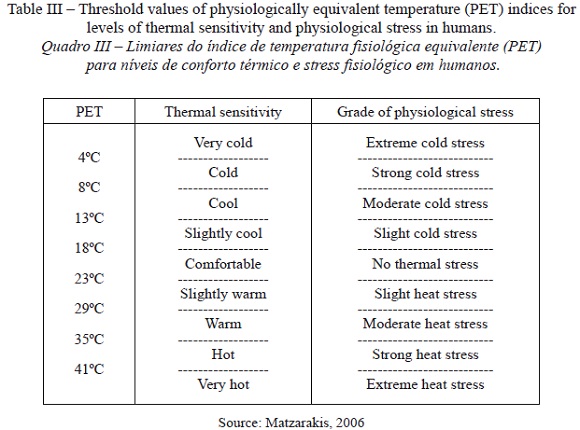
<body><![CDATA[<p>The Physiological equivalent  temperature (PET) was chosen. PET has been widely applied and provides the <i>thermal</i> component of perception (Andrade <i>et al.,</i> 2007)<a href="#t3">table III</a>. PET is  calculated using air temperature, air humidity, Wind speed and shortand long-wave radiation fluxes, combined with heat transfer resistance of clothing and  internal heat production (Matzarakis, 2006). PET had already been applied in a weather type assessment to Praia Grande (Sintra, Portugal) by Alcoforado <i>et  al. </i>(2004). PET has also the advantages of i) being expressed in &ordm;C, easily understandable to stakeholders and tourists who may not be entirely  familiar with biometeorological terminology and ii) the software package (RayMan) needed to calculate it is free and simple (Matzarakis <i>et al.,</i> 2010).  </p>       <p>&nbsp;</p> <a name="t3"></a> <img src="/img/revistas/fin/n98/n98a11t3.jpg">     
<p>&nbsp;</p>         <p><b><i>3.5. Wind </i></b></p>     <p>Wind speed has a physical effect on people. It can influence city dwellers in a positive manner by dispersing  pollutants or lowering the summer temperatures (Lopes <i>et al.</i>, 2011), but it can also compromise people&#8217;s comfort and safety. Apart from its direct  effect, wind can also introduce changes in other atmospheric elements (Lopes, 2003). We maintained the scale used for Catalonia, based on the Beaufort scale  (excluding the last classes, for they were considered a risk to tourism safety). </p>         <p>Whereas in Catalonia the summer was considered to extend from April to  November, we only considered the months of June, July, August and September. Shoulder months will be analysed according to a specific catalogue of types of  weather (following Besancenot, 1985 and Alcoforado, 1999). </p>         <p>after a pre-test with an initial catalogue (based on the one implemented in Catalonia), we  concluded that 60% of the days were classified as unfavourable (Gómez-Martín&#8217;s type 7), even though they generally had positive rates  regarding sunshine, cloud cover, precipitation and wind; however, the maximum PET values exceeded the upper threshold defined for these parameters (33 and 35 &ordm;C respectively). Nevertheless, according to data provided by <i>Statistics Portugal</i>, the city&#8217;s occupation by tourists is high during these  months. Hence, we questioned whether we could classify this type of weather as unfavourable, since the occupation rates seem to prove it fit for visiting. It  was, then, classified in 7<sup>th</sup> position as extremely hot weather (<a href="#t2">table II</a>). The types of weather are numbered in descending order from the more  favourable to the least favourable. </p>         <p>Two sources of data were used in this research: </p>         <p>1) for the assessment of weather-types in Lisbon, Daily  sunshine (h), cloud cover (octas), precipitation (mm), daily temperatures (&ordm;C), wind speed (m/s) and relative humidity (%) values were collected, in order  to calculate PET, from NCDC portal (<a href="http://www.ncdc.noaa.gov/cdo-web/" target="_blank">http://www.ncdc.noaa.gov/cdo-web/</a>) for the Lisbon/Gago Coutinho, a first  order observatory (38&deg; 46&#8217;n latitude, 9&deg; 08&#8217;W longitude and 105 m altitude). the studied period was 2000-2010 (including the latter and  excluding 2005, due to a great number of gaps). the months under analysis were, as previously referred, June to September. each day was classified separately  into one of the weather-types class of <a href="#t2">table II</a> and the frequency of the different weather types were calculated per decade. this is the most suitable temporal  scale when giving information on weather in temperate climates that have a pronounced annual cycle (Lin and Matzarakis, 2008). its adequacy for tourism and  climate information for tourists is reinforced by the fact that holidays usually last a week or a fortnight, rather than a month. </p>         <p>2) to assess the  possible climate conditions in the future, taking into account projected climate changes, minimum and maximum temperature were drawn from 9 Regional Climate  Model (RCM) simulation based on the International Panel on Climate Change (IPCC) &#8211; synthesis report on emission scenarios (SRES), a1B emission scenario  (Naki&#263;enovi&#263; <i>et al</i>., 2000) from the ensembles project (<a href="http://ensembles-eu.metoffice.com" target="_blank">http://ensembles-eu.metoffice.com</a>; van der Linden and Mitchell 2009). The datasets were  extracted over the European sector (27&ordm;n &#8211; 72&ordm;n, 22&ordm;W &#8211; 45&ordm;e) and were bilinearly interpolated from their original rotated  grids to regular grids of 0.25&ordm;&times; 0.25&ordm;. Lastly, the grid-box over Lisbon was isolated. </p>         ]]></body>
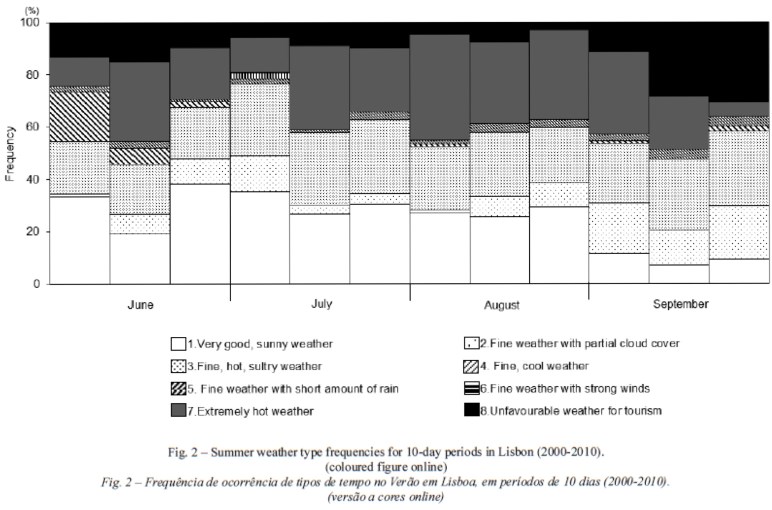
<body><![CDATA[<p>&nbsp;</p>          <p><b>IV. RESULTS AND DISCUSSION </b></p>         <p>In  summertime, 70 to 90% of the days are fit for outdoor recreation in Lisbon, if we assume type 8 as the sole weather type inadequate for tourism. even if we  exclude type 7 (extremely hot weather) from favourable types of weather, the frequency of occurrence of the types of weather 1 to 6 would always exceed 50%,  varying from 51% to 81% (which means that 5 to 8 days out of 10 are suitable for visiting). Type 7, classified by its excessive maximum air temperature or by a  situation of extreme heat stress (PET &#8805;35&ordm;C) reaches its highest frequency during August and the first ten days of September, precisely when the  cities&#8217; tourist occupation is at one of its highest points. </p>         <p>We can distinguish three different regimes of weather-types in Lisbon: i) the two  first decades of June, ii) the third decade of June, July and August and iii) September (particularly the last 20 days, although the first decade already shows  some differences) (<a href="/img/revistas/fin/n98/n98a11f2.jpg">fig. 2</a>). </p>        
<p>&nbsp;</p> <a href="/img/revistas/fin/n98/n98a11f2.jpg">fig. 2</a>     
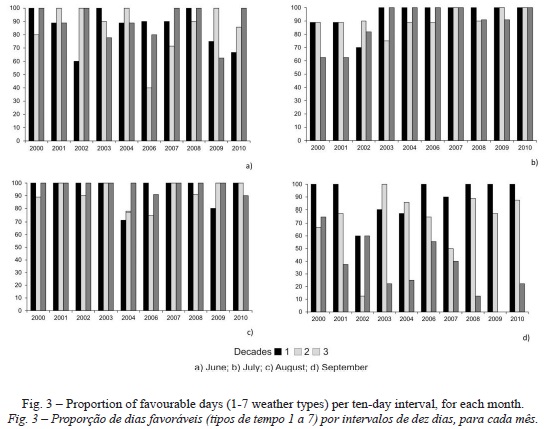
<p>&nbsp;</p>        <p>i) In June, during the first ten-day interval, the frequency of cool days (type 4) is almost  the same as hot, sultry days (type 3) but, as the month progresses, cool days become less and less frequent. the rate of unfavourable days (type 8) is superior  to the one registered on the two months ahead, but inferior to September. </p>         <p>ii) Throughout July and August the weather type pattern is quite homogeneous.  type 1 (very good, sunny weather) occurs in circa 30% of the cases (or more) and alternates with types 3 and 7 as the most frequent. Unfavourable weather  occurs in less than 10% of the days. </p>         <p>iii) In September there is a larger proportion of type 8 (unfavourable weather for tourism). in most cases, it is  justified by the occurrence of precipitation (50%), by a particularly low number of sunshine hours (28%) or by nebulosity (18%). in September there is also a  decline in the frequency of type 1, recording lower rates than in any of the other months but type 2 occurs more often than in the preceding months. </p>         <p>As  can be verified in <a href="#f3">figure 3</a>, whereas June, July and August are fairly regular, the amount of favourable days in September can be quite diverse from year to  year, usually declining as the month progresses, transitioning from summer to autumn. </p>           ]]></body>
<body><![CDATA[<p>&nbsp;</p> <a name="f3"></a> <img src="/img/revistas/fin/n98/n98a11f3.jpg">     
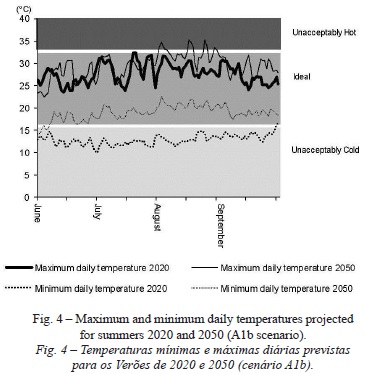
<p>&nbsp;</p>          <p>The existing ways of validating the  climatic preferences of vacationers are: a) analysis of the relation between meteorological conditions and demand behaviour (<i>revealed preference</i>); b)  conclusions deducted from surveys (<i>stated preferences</i>). The second was used in this study. Further, as it had been previously noted in the assessment of  Catalonia by Gómez-Martín (2006) or in the assessment of Rutty and Scott (2014), there seems to be a discrepancy between visitation and thermal  comfort &#8211; considering the frequency of extremely hot weather in July and August which, according to the thermo-physiological indexes, would be  unpleasant. As justified by Gómez-Martín (2006) this discrepancy may have a number of explanations. On the one hand, climate is only one of the  determinants for the period chosen for vacations. The climate experienced at the origin (Becken, 2010) or the existence of other resources (heritage, sports,  events and the like) are determinant for the demand. Seasonality depends as much on climate as on the work flexibility or school calendar. Flight and room  rates cannot be disregarded when analysing the demand pattern. there is also a distribution of the tourism demand throughout a big part of the year (excluding  the period from november to february) that relates with a new trend in travelling: diversifying the number of short length journeys (during a long weekend) as  tourists are no longer satisfied with a sole period of vacations or a single destination. This is easier nowadays thanks to lower air fares. </p>         <p> Notwithstanding the high tourist demand during periods where the occurrence of weather type 7 (<i>Extremely hot weather)</i> is frequent, we considered it as  the least acceptable weather type for tourism. Although previous studies have registered air temperature preferences that would justify pushing it to the  optimal air temperature spectrum (Martinez-Ibarra and Gómez-Martín, 2012; Rutty and Scott, 2014) and, hence, classify it within weather types  1-3, those studies reflected preferences for beach tourism. We do not exclude the 3s (sun, sea, sand) tourism as possible in Lisbon (within the Metropolitan  area there are several sea-side resorts) but it is not the primary motivation when travelling to Lisbon (Observatório do Turismo de Lisboa, 2011). In  order to understand thermal perceptions and behavioural responses we would need to question tourists and monitor their behaviour during days classified as  weather type 7. </p>         <p>Temperature thresholds that were previously defined in the weather-type catalogue were crossed with projections of summer maximum and  minimum daily temperatures for 2020 and 2050 (<a href="#f4">fig. 4</a>), under a1b scenario, in order to verify whether climate would still be ideal in Lisbon during the summer  months. Maximum temperatures for the summer of 2020 are expected to be within the ideal range at all times projected (Naki&#263;enovi&#263; <i>et al.,</i>  2000; van der Linden and Mitchell, 2009), whereas in 2050 some days are expected to be unacceptably hot (about 9% of the daily maximum temperatures during  summer are expected to be &gt;33&ordm;C) and, of course, temperature has to be related with the other climate variables. Nonetheless, we can see in <a href="#f4">figure 4</a>  that the highest increase is related to a change in minimum temperatures, rather than in the maximum temperatures. Perhaps minimum temperatures should be  included in future index formulation. </p>            <p>&nbsp;</p> <a name="f4"></a> <img src="/img/revistas/fin/n98/n98a11f4.jpg">     
<p>&nbsp;</p>          <p><b>CONCLUSIONS </b></p>         <p>The weather type model was selected and implemented to  provide in a detailed temporal scale a comprehensive interpretation of the weather conditions experienced by tourists in Lisbon during the summer. Several  helpful factors contributed to the selection of this methodology, one of which was the integration of a thermo physiological index and the other the  integration of tourist preferences in the definition of thresholds. Predominantly, we followed the ones defined for the weather type application to Catalonia  (which were based on defined biometeorological ratings and tourists perceptions and preferences). However, the observed behaviour of tourists in Lisbon leads  us to modify type 7, integrating an &#8220;<i>Extremely hot weather</i>&#8221; type. </p>         <p>Recurring to data from a first-order observatory (June-September,  for the period 2000-2010), an analysis of the weather in the summer with this typology was performed. Crossing the data with hotel occupancy, results indicate  that in September, despite the higher frequency of days classified as type 8 (unfavourable for tourism), hotel occupation registered its highest rates. </p>         ]]></body>
<body><![CDATA[<p> As previous studies had already refuted the validity of thermal comfort thresholds and ideal temperature ranges defined by experts, crossing our analysis with  tourist demand also leads us to reinforce the question of whether the assumed widespread boundaries are adequate. Assumed thermal comfort thresholds were on  the basis of projections of the Mediterranean&#8217;s declining attractiveness. </p>         <p>As mentioned previously, comfort expectations are referred to by many  authors as a decisive part of tourist thermal perceptions. Therefore, further research is needed to understand what expectations tourists have when travelling  to urban destinations in southern Europe, which air temperature spectrum is perceived as optimal, which is considered tolerable and how are perceptions and  preferences going to shape the responses of tourists to future climate scenarios. What is more, exposure to atmospheric conditions is lower in urban tourism  than in beach tourism or nature tourism and unfavourable conditions can be easier to avoid by replacing outdoor activities for indoor activities, such as  shopping, visiting museums/monuments, or dining (Lopes <i>et al.</i>, 2011). </p>         <p>Applying the weather&#8211;type model to the future, through series of  estimated temperature and precipitation, can provide information on the suitability of climate to tourism in the decades ahead. An analysis of simulated summer  temperatures (a1b scenario) demonstrates that changes are more pronounced in minimum temperatures than in maximum temperatures (maximum temperatures are  expected to exceed the optimal temperature threshold in August, but only in 2050, remaining ideal during the remaining summer months). </p>         <p>Nevertheless,  just as important as real climate and weather, or even more, is the perception of climate and weather (Becken, 2010). Further, when it comes to perceptions,  the media have a very important role to play that can both stimulate, create or reduce interest in places and activities (Butler, 2011). It is thus of the  greatest importance to make reliable climate information available for all participants in the tourism sector. </p>         <p>&nbsp;</p>         <p><b>ACKNOWLEDGEMENTS </b></p>         <p>The  project <i>Urban Tourism and Climate Change</i> (URBAN/AUR/0003/2008) was sponsored by the Fundação para a Ci&ecirc;ncia e Tecnologia (fCt); the  Portuguese team was coordinated by the late Prof. Henrique Andrade. Raquel Machete would like to express her sincerest gratitude to Professor Henrique Andrade  for his intelectual guidance, training and for his friendship. We would like to express our sincere acknowledgment to Professor João Andrade dos Santos  from school of sciences and technology &amp; CitaB, University of Trás-os-Montes and alto Douro for providing data simulated with the Regional Climate  Model (RCM), essential for this paper. We are also thankful to the anonymous referees and the editor for the suggestions that have contributed to greatly  ameliorate the manuscript. </p>          <p>&nbsp;</p>         <p><b>BIBLIOGRAPHY </b></p>         <!-- ref --><p>Aguiar R (2010)  Sector cenários climáticos. <i>In:</i> Santos FD, Cruz M J (coord.) <i>Plano Estrat&eacute;gico de Cascais face &agrave;s Altera&ccedil;&otilde; es Climáticas</i>, C&acirc;mara Municipal de Cascais.    &nbsp;&nbsp;&nbsp;&nbsp;&nbsp;&nbsp;&nbsp;&nbsp;[&#160;<a href="javascript:void(0);" onclick="javascript: window.open('/scielo.php?script=sci_nlinks&ref=000132&pid=S0430-5027201400020001100001&lng=','','width=640,height=500,resizable=yes,scrollbars=1,menubar=yes,');">Links</a>&#160;]<!-- end-ref --> </p>         <!-- ref --><p>Agnew M  (1997) Tourism. <i>In:</i> Palutikof J, Subak S, Agnew M (eds) <i>Economic impacts of the hot summer and unusually warm year of 1995</i>. Department of the  Environment, Norwich, 139-147.    &nbsp;&nbsp;&nbsp;&nbsp;&nbsp;&nbsp;&nbsp;&nbsp;[&#160;<a href="javascript:void(0);" onclick="javascript: window.open('/scielo.php?script=sci_nlinks&ref=000134&pid=S0430-5027201400020001100002&lng=','','width=640,height=500,resizable=yes,scrollbars=1,menubar=yes,');">Links</a>&#160;]<!-- end-ref --></p>         <!-- ref --><p>Alcoforado M J, Dias A, Gomes V (1999)  Bioclimatologia e Turismo. Exemplo de Aplicação ao Funchal. <i>Islenha</i>, 25: 29-37.    &nbsp;&nbsp;&nbsp;&nbsp;&nbsp;&nbsp;&nbsp;&nbsp;[&#160;<a href="javascript:void(0);" onclick="javascript: window.open('/scielo.php?script=sci_nlinks&ref=000136&pid=S0430-5027201400020001100003&lng=','','width=640,height=500,resizable=yes,scrollbars=1,menubar=yes,');">Links</a>&#160;]<!-- end-ref --></p>         <p>Alcoforado M J, Andrade H, Paulo M J (2004) Weather and recreation at the Atlantic shore near Lisbon,  Portugal. A study on applied climatology. <i>In:</i> Matzarakis A, DeFreitas CR and Scott D (eds), <i>Advances in Tourism Climatology</i>, Berichte des  Meteorologishen Institutes der Universit&auml;t Freiburg<i>, </i>12: 38-48.</p>         <!-- ref --><p>Allan RP, Soden BJ (2008) Atmospheric warming and the amplification of precipitation extremes. <i>Science</i>, 321: 1481-1494.    &nbsp;&nbsp;&nbsp;&nbsp;&nbsp;&nbsp;&nbsp;&nbsp;[&#160;<a href="javascript:void(0);" onclick="javascript: window.open('/scielo.php?script=sci_nlinks&ref=000139&pid=S0430-5027201400020001100005&lng=','','width=640,height=500,resizable=yes,scrollbars=1,menubar=yes,');">Links</a>&#160;]<!-- end-ref --></p>         <!-- ref --><p>Allen MR, Ingram WJ (2002) Constraints on future changes in climate and the hydrologic cycle.  <i>Nature,</i> 419: 224-232&nbsp;&nbsp;&nbsp;&nbsp;&nbsp;&nbsp;&nbsp;&nbsp;[&#160;<a href="javascript:void(0);" onclick="javascript: window.open('/scielo.php?script=sci_nlinks&ref=000141&pid=S0430-5027201400020001100006&lng=','','width=640,height=500,resizable=yes,scrollbars=1,menubar=yes,');">Links</a>&#160;]<!-- end-ref --><!-- ref --><p>Amelung B, Viner D (2006) Mediterranean  tourism: exploring the future with the tourism climatic index. <i>Journal of Sustainable Tourism</i>, 14(4): 349-366.    &nbsp;&nbsp;&nbsp;&nbsp;&nbsp;&nbsp;&nbsp;&nbsp;[&#160;<a href="javascript:void(0);" onclick="javascript: window.open('/scielo.php?script=sci_nlinks&ref=000142&pid=S0430-5027201400020001100007&lng=','','width=640,height=500,resizable=yes,scrollbars=1,menubar=yes,');">Links</a>&#160;]<!-- end-ref --></p>         <!-- ref --><p>Amelung B, Viner D (2007) The vulnerability to climate change of the Mediterranean as a tourist  destination. <i>In:</i> Amelung B, Blazejczyk K, Matzarakis A (eds) <i>Climate change and tourism &#8211; assessment and coping strategies</i>. Maastricht,  Warsaw, Freiburg: 41-55.    &nbsp;&nbsp;&nbsp;&nbsp;&nbsp;&nbsp;&nbsp;&nbsp;[&#160;<a href="javascript:void(0);" onclick="javascript: window.open('/scielo.php?script=sci_nlinks&ref=000144&pid=S0430-5027201400020001100008&lng=','','width=640,height=500,resizable=yes,scrollbars=1,menubar=yes,');">Links</a>&#160;]<!-- end-ref --></p>         <!-- ref --><p>Andrade H, Alcoforado MJ, Oliveira S (2011)  Perceptions of temperature and wind by users of public outdoor spaces: relationships with weather parameters and personal characteristics. <i>Int J  Biometeorol</i>, 5: 665-680.    &nbsp;&nbsp;&nbsp;&nbsp;&nbsp;&nbsp;&nbsp;&nbsp;[&#160;<a href="javascript:void(0);" onclick="javascript: window.open('/scielo.php?script=sci_nlinks&ref=000146&pid=S0430-5027201400020001100009&lng=','','width=640,height=500,resizable=yes,scrollbars=1,menubar=yes,');">Links</a>&#160;]<!-- end-ref --></p>         <!-- ref --><p>Andrade H, Alcoforado M J, Oliveira S  (2007) Methodologies to assess the effects of climate on tourism: weather type and individual perception. <i>In:</i> Matzarakis A, De Freitas CR, Scott D (eds)  <i>Developments in tourism climatology</i>. Commission on Climate, Tourism and Recreation, International Society of Biometeorology, Freiburg: 74-79.    &nbsp;&nbsp;&nbsp;&nbsp;&nbsp;&nbsp;&nbsp;&nbsp;[&#160;<a href="javascript:void(0);" onclick="javascript: window.open('/scielo.php?script=sci_nlinks&ref=000148&pid=S0430-5027201400020001100010&lng=','','width=640,height=500,resizable=yes,scrollbars=1,menubar=yes,');">Links</a>&#160;]<!-- end-ref --></p>         <!-- ref --><p>Becken S, Wilson J (2013) The impact of weather on tourist travel. <i>Tourism  Geographies: an international Journal of Tourism Space, Place and Environment,</i> 15(4): 620-639.    &nbsp;&nbsp;&nbsp;&nbsp;&nbsp;&nbsp;&nbsp;&nbsp;[&#160;<a href="javascript:void(0);" onclick="javascript: window.open('/scielo.php?script=sci_nlinks&ref=000150&pid=S0430-5027201400020001100011&lng=','','width=640,height=500,resizable=yes,scrollbars=1,menubar=yes,');">Links</a>&#160;]<!-- end-ref --> </p>         <!-- ref --><p>Becken S (2010) <i>The importance of climate and weather for tourism: literature review</i>.  Lincoln University, LEaP, Land Environment and People Miscellaneous Publications, 1-23.    &nbsp;&nbsp;&nbsp;&nbsp;&nbsp;&nbsp;&nbsp;&nbsp;[&#160;<a href="javascript:void(0);" onclick="javascript: window.open('/scielo.php?script=sci_nlinks&ref=000152&pid=S0430-5027201400020001100012&lng=','','width=640,height=500,resizable=yes,scrollbars=1,menubar=yes,');">Links</a>&#160;]<!-- end-ref --> </p>         <!-- ref --><p>Becken S, Hay J (2007) <i>Tourism and climate change &#8211; risks and opportunities</i>. Cleveland:  Channel View Pub.    &nbsp;&nbsp;&nbsp;&nbsp;&nbsp;&nbsp;&nbsp;&nbsp;[&#160;<a href="javascript:void(0);" onclick="javascript: window.open('/scielo.php?script=sci_nlinks&ref=000154&pid=S0430-5027201400020001100013&lng=','','width=640,height=500,resizable=yes,scrollbars=1,menubar=yes,');">Links</a>&#160;]<!-- end-ref --></p>         <!-- ref --><p>Besancenot JP (1985) Climat et tourisme estival sur  les c&ocirc;tes de la p&eacute;ninsule ib&eacute;rique. <i>Revue G&eacute;ographique des Pyr&eacute;n&eacute;es et du Sud-Ouest</i>, 56(4): 427-451.    &nbsp;&nbsp;&nbsp;&nbsp;&nbsp;&nbsp;&nbsp;&nbsp;[&#160;<a href="javascript:void(0);" onclick="javascript: window.open('/scielo.php?script=sci_nlinks&ref=000156&pid=S0430-5027201400020001100014&lng=','','width=640,height=500,resizable=yes,scrollbars=1,menubar=yes,');">Links</a>&#160;]<!-- end-ref --></p>         <!-- ref --><p>Besancenot JP (1990) <i>Climat et tourisme</i>. Masson, Paris.    &nbsp;&nbsp;&nbsp;&nbsp;&nbsp;&nbsp;&nbsp;&nbsp;[&#160;<a href="javascript:void(0);" onclick="javascript: window.open('/scielo.php?script=sci_nlinks&ref=000158&pid=S0430-5027201400020001100015&lng=','','width=640,height=500,resizable=yes,scrollbars=1,menubar=yes,');">Links</a>&#160;]<!-- end-ref --></p>         <!-- ref --><p>Besancenot JP, Mounier J, De Lavenne F(1978) Les conditions climatiques du tourisme  littoral: un m&eacute;thode de recherch&eacute; compr&eacute;hensive. <i>Norois,</i> 99: 357-382.    &nbsp;&nbsp;&nbsp;&nbsp;&nbsp;&nbsp;&nbsp;&nbsp;[&#160;<a href="javascript:void(0);" onclick="javascript: window.open('/scielo.php?script=sci_nlinks&ref=000160&pid=S0430-5027201400020001100016&lng=','','width=640,height=500,resizable=yes,scrollbars=1,menubar=yes,');">Links</a>&#160;]<!-- end-ref --></p>         <!-- ref --><p>Blazejczyk K, Vinogradova V (2014) Assessment of adaptation strain at tourists from central and  northern Europe traveling to Mediterranean region. <i>Finisterra &#8211; Revista Portuguesa de Geografia</i>, XLIX(98): 135-152.    &nbsp;&nbsp;&nbsp;&nbsp;&nbsp;&nbsp;&nbsp;&nbsp;[&#160;<a href="javascript:void(0);" onclick="javascript: window.open('/scielo.php?script=sci_nlinks&ref=000162&pid=S0430-5027201400020001100017&lng=','','width=640,height=500,resizable=yes,scrollbars=1,menubar=yes,');">Links</a>&#160;]<!-- end-ref --><b></b></p>         <!-- ref --><p>Brito Henriques, E (2003) Distracção, fruição e evasão: as  fun&ccedil;&otilde;es cultural e recreativa na AML. <i>In</i>: Tenedório J A (ed.). <i>Atlas da área Metropolitana de Lisboa.</i> Lisboa: Junta  da área Metropolitana de Lisboa, 189-208.    &nbsp;&nbsp;&nbsp;&nbsp;&nbsp;&nbsp;&nbsp;&nbsp;[&#160;<a href="javascript:void(0);" onclick="javascript: window.open('/scielo.php?script=sci_nlinks&ref=000164&pid=S0430-5027201400020001100018&lng=','','width=640,height=500,resizable=yes,scrollbars=1,menubar=yes,');">Links</a>&#160;]<!-- end-ref --></p>         <p>Brito Henriques E,  Sarmento J, Lousada M A (2010) When water meets tourism: an introduction.<i> In:</i> Brito Henriques E, Sarmento J and Lousada M A (eds) <i>Water and  tourism. Resources management, planning and sustainability.</i> Centro de Estudos Geográficos, Universidade de Lisboa, 13-33.</p>         <!-- ref --><p>Burnet L (1963) <i>Vill&eacute;giature et tourisme sur les c&ocirc;tes de France.</i>  Hachette, Paris, Biblioth&egrave;que des Guides Bleus.    &nbsp;&nbsp;&nbsp;&nbsp;&nbsp;&nbsp;&nbsp;&nbsp;[&#160;<a href="javascript:void(0);" onclick="javascript: window.open('/scielo.php?script=sci_nlinks&ref=000167&pid=S0430-5027201400020001100020&lng=','','width=640,height=500,resizable=yes,scrollbars=1,menubar=yes,');">Links</a>&#160;]<!-- end-ref --></p>         <!-- ref --><p>Butler R W (2011)  Tourism: past, present and future &#8211; &#8220;Plus &ccedil;a change, plus c&#8217;est la m&ecirc;me chose&#8221;. <i>1<sup>st</sup> International Conference  on Tourism &amp; Management Studies</i>. School of Management, Hospitality and Tourism, University of the Algarve, October.    &nbsp;&nbsp;&nbsp;&nbsp;&nbsp;&nbsp;&nbsp;&nbsp;[&#160;<a href="javascript:void(0);" onclick="javascript: window.open('/scielo.php?script=sci_nlinks&ref=000169&pid=S0430-5027201400020001100021&lng=','','width=640,height=500,resizable=yes,scrollbars=1,menubar=yes,');">Links</a>&#160;]<!-- end-ref --></p>         <!-- ref --><p>Butler R W, Mao B (1997) Seasonality in tourism: problems and measurement. <i>In:</i> Murphy P (ed)  <i>Quality management in urban tourism</i>. Wiley &amp; Sons, Chichester.    &nbsp;&nbsp;&nbsp;&nbsp;&nbsp;&nbsp;&nbsp;&nbsp;[&#160;<a href="javascript:void(0);" onclick="javascript: window.open('/scielo.php?script=sci_nlinks&ref=000171&pid=S0430-5027201400020001100022&lng=','','width=640,height=500,resizable=yes,scrollbars=1,menubar=yes,');">Links</a>&#160;]<!-- end-ref --></p>         ]]></body>
<body><![CDATA[<!-- ref --><p>Butler R W (1990) The influence of the media in shaping international tourist patterns. <i>Tourism Recreation Research</i>, 15(2):46-53.    &nbsp;&nbsp;&nbsp;&nbsp;&nbsp;&nbsp;&nbsp;&nbsp;[&#160;<a href="javascript:void(0);" onclick="javascript: window.open('/scielo.php?script=sci_nlinks&ref=000173&pid=S0430-5027201400020001100023&lng=','','width=640,height=500,resizable=yes,scrollbars=1,menubar=yes,');">Links</a>&#160;]<!-- end-ref --></p>         <!-- ref --><p>Chon K (1989) Understanding recreational travelers motivation, attitude and satisfaction. <i> The Tourist Review</i>, 1: 3-7.    &nbsp;&nbsp;&nbsp;&nbsp;&nbsp;&nbsp;&nbsp;&nbsp;[&#160;<a href="javascript:void(0);" onclick="javascript: window.open('/scielo.php?script=sci_nlinks&ref=000175&pid=S0430-5027201400020001100024&lng=','','width=640,height=500,resizable=yes,scrollbars=1,menubar=yes,');">Links</a>&#160;]<!-- end-ref --></p>         <!-- ref --><p>Crompton J (1979) Motivations for  pleasure vacations. <i>Annals of Tourism Research</i>, 6(4): 408-424.    &nbsp;&nbsp;&nbsp;&nbsp;&nbsp;&nbsp;&nbsp;&nbsp;[&#160;<a href="javascript:void(0);" onclick="javascript: window.open('/scielo.php?script=sci_nlinks&ref=000177&pid=S0430-5027201400020001100025&lng=','','width=640,height=500,resizable=yes,scrollbars=1,menubar=yes,');">Links</a>&#160;]<!-- end-ref --></p>         <!-- ref --><p> Davis NE (1968) An optimum summer weather index. <i>Weather</i> 23: 305-317&nbsp;&nbsp;&nbsp;&nbsp;&nbsp;&nbsp;&nbsp;&nbsp;[&#160;<a href="javascript:void(0);" onclick="javascript: window.open('/scielo.php?script=sci_nlinks&ref=000179&pid=S0430-5027201400020001100026&lng=','','width=640,height=500,resizable=yes,scrollbars=1,menubar=yes,');">Links</a>&#160;]<!-- end-ref --><!-- ref --><p>De Freitas C R, Scott D, McBoyle G (2008) A second generation index for tourism (CIT): specification and verification<i>. Int J Biometeorol, </i> 52:399-407.    &nbsp;&nbsp;&nbsp;&nbsp;&nbsp;&nbsp;&nbsp;&nbsp;[&#160;<a href="javascript:void(0);" onclick="javascript: window.open('/scielo.php?script=sci_nlinks&ref=000180&pid=S0430-5027201400020001100027&lng=','','width=640,height=500,resizable=yes,scrollbars=1,menubar=yes,');">Links</a>&#160;]<!-- end-ref --></p>         <!-- ref --><p>De Freitas C R (2003) Tourism climatology: evaluating  environmental information for decision making and business planning in the recreation and tourism sector. <i>Int J of Biometeorol</i>, 48: 45-54.    &nbsp;&nbsp;&nbsp;&nbsp;&nbsp;&nbsp;&nbsp;&nbsp;[&#160;<a href="javascript:void(0);" onclick="javascript: window.open('/scielo.php?script=sci_nlinks&ref=000182&pid=S0430-5027201400020001100028&lng=','','width=640,height=500,resizable=yes,scrollbars=1,menubar=yes,');">Links</a>&#160;]<!-- end-ref --> </p>         <p>Edwards J, Moital M, Vaughan R (2002) The impacts of Mega-events on Tourism:  the case of Expo &#8217;98 in Lisbon. <i>In Journeys of Expression: Cultural Festival/Events and Tourism</i> 7-10 February 2002 Bonn, Germany. </p>         <!-- ref --><p>Eugenio-Martin JL, Campos-Soria JA (2010) Climate in the region of origin and  destination choice in outbound tourism demand. <i>Tourism Management</i>, 31: 744-753.    &nbsp;&nbsp;&nbsp;&nbsp;&nbsp;&nbsp;&nbsp;&nbsp;[&#160;<a href="javascript:void(0);" onclick="javascript: window.open('/scielo.php?script=sci_nlinks&ref=000185&pid=S0430-5027201400020001100030&lng=','','width=640,height=500,resizable=yes,scrollbars=1,menubar=yes,');">Links</a>&#160;]<!-- end-ref --></p>         <!-- ref --><p>Gom&eacute;z Martín M B (2006) Climate potential and tourist demand in Catalonia (Spain)  during the summer season<i>. Climate Research</i>, 37:75-87.    &nbsp;&nbsp;&nbsp;&nbsp;&nbsp;&nbsp;&nbsp;&nbsp;[&#160;<a href="javascript:void(0);" onclick="javascript: window.open('/scielo.php?script=sci_nlinks&ref=000187&pid=S0430-5027201400020001100031&lng=','','width=640,height=500,resizable=yes,scrollbars=1,menubar=yes,');">Links</a>&#160;]<!-- end-ref --></p>         <!-- ref --><p>Gom&eacute; z Martín M B (2005) Weather, climate and tourism. <i>Annals of tourism research</i>, 32(2): 571-591.    &nbsp;&nbsp;&nbsp;&nbsp;&nbsp;&nbsp;&nbsp;&nbsp;[&#160;<a href="javascript:void(0);" onclick="javascript: window.open('/scielo.php?script=sci_nlinks&ref=000189&pid=S0430-5027201400020001100032&lng=','','width=640,height=500,resizable=yes,scrollbars=1,menubar=yes,');">Links</a>&#160;]<!-- end-ref --></p>         <!-- ref --><p>G&ouml;ssling S, Peeters P, Hall C M, Ceron J P, Dubois G, Lehman LV and Scott D (2011) Tourism and  water use: Supply, demand and security, and international review. <i>Tourism Management</i>, 33(1): 16-28.    &nbsp;&nbsp;&nbsp;&nbsp;&nbsp;&nbsp;&nbsp;&nbsp;[&#160;<a href="javascript:void(0);" onclick="javascript: window.open('/scielo.php?script=sci_nlinks&ref=000191&pid=S0430-5027201400020001100033&lng=','','width=640,height=500,resizable=yes,scrollbars=1,menubar=yes,');">Links</a>&#160;]<!-- end-ref --></p>         ]]></body>
<body><![CDATA[<!-- ref --><p>Go&#776;ssling S, Bredberg M, Randow A, Sandstro&#776;m E, Svensson P (2006) Tourist perceptions of  climate change: a study of international tourists in Zanzibar. <i>Current Issues in Tourism</i>, 9(4-5): 419-435.    &nbsp;&nbsp;&nbsp;&nbsp;&nbsp;&nbsp;&nbsp;&nbsp;[&#160;<a href="javascript:void(0);" onclick="javascript: window.open('/scielo.php?script=sci_nlinks&ref=000193&pid=S0430-5027201400020001100034&lng=','','width=640,height=500,resizable=yes,scrollbars=1,menubar=yes,');">Links</a>&#160;]<!-- end-ref --></p>         <!-- ref --><p>G&ouml;ssling S (2001) The consequences of tourism for sustainable water use in a tropical island:  Zanzibar, Tanzania. <i>Journal of Environmental Management</i>, 61(2):179-191.    &nbsp;&nbsp;&nbsp;&nbsp;&nbsp;&nbsp;&nbsp;&nbsp;[&#160;<a href="javascript:void(0);" onclick="javascript: window.open('/scielo.php?script=sci_nlinks&ref=000195&pid=S0430-5027201400020001100035&lng=','','width=640,height=500,resizable=yes,scrollbars=1,menubar=yes,');">Links</a>&#160;]<!-- end-ref --></p>         <!-- ref --><p>Hadwen WL, Taylor B, Arthington AH, Fellows CS, Boon PI (2011) Do climatic or institutional factors drive seasonal patterns of tourism visitation to  protected areas across diverse climate zones in eastern Australia? <i>Tourism Geographies</i> 13(2):187-208.    &nbsp;&nbsp;&nbsp;&nbsp;&nbsp;&nbsp;&nbsp;&nbsp;[&#160;<a href="javascript:void(0);" onclick="javascript: window.open('/scielo.php?script=sci_nlinks&ref=000197&pid=S0430-5027201400020001100036&lng=','','width=640,height=500,resizable=yes,scrollbars=1,menubar=yes,');">Links</a>&#160;]<!-- end-ref --></p>         <!-- ref --><p>Hall C M (2008) Tourism and climate change: knowledge gaps and issues. <i>Tourism Recreation Research </i>, 33: 339-350.    &nbsp;&nbsp;&nbsp;&nbsp;&nbsp;&nbsp;&nbsp;&nbsp;[&#160;<a href="javascript:void(0);" onclick="javascript: window.open('/scielo.php?script=sci_nlinks&ref=000199&pid=S0430-5027201400020001100037&lng=','','width=640,height=500,resizable=yes,scrollbars=1,menubar=yes,');">Links</a>&#160;]<!-- end-ref --></p>         <p>Hamilton JM, Lau MA (2004) The role of climate  information in tourist destination choice decision-making. <i>Working Paper FNU-56.Centre for Marine and Climate Research</i>, University of Hamburg.</p>         <!-- ref --><p>Hein L, Metzger M J, Moreno A (2009) Potential impacts of climate change on  tourism; a case study for Spain. <i>Current Opinion in Environmental Sustainability</i>, 1: 170-178.    &nbsp;&nbsp;&nbsp;&nbsp;&nbsp;&nbsp;&nbsp;&nbsp;[&#160;<a href="javascript:void(0);" onclick="javascript: window.open('/scielo.php?script=sci_nlinks&ref=000202&pid=S0430-5027201400020001100039&lng=','','width=640,height=500,resizable=yes,scrollbars=1,menubar=yes,');">Links</a>&#160;]<!-- end-ref --></p>         <!-- ref --><p>Hu&#776;bner A, Go&#776;ssling S (2012) Tourist perceptions of extreme weather events in Martinique.  <i>Journal of destination Marketing &amp; Management</i>, 1: 47-55.    &nbsp;&nbsp;&nbsp;&nbsp;&nbsp;&nbsp;&nbsp;&nbsp;[&#160;<a href="javascript:void(0);" onclick="javascript: window.open('/scielo.php?script=sci_nlinks&ref=000204&pid=S0430-5027201400020001100040&lng=','','width=640,height=500,resizable=yes,scrollbars=1,menubar=yes,');">Links</a>&#160;]<!-- end-ref --></p>         <!-- ref --><p> Hughes G H (1967) Summers in Manchester, <i>Weather</i>, XXII(5): 199-200.    &nbsp;&nbsp;&nbsp;&nbsp;&nbsp;&nbsp;&nbsp;&nbsp;[&#160;<a href="javascript:void(0);" onclick="javascript: window.open('/scielo.php?script=sci_nlinks&ref=000206&pid=S0430-5027201400020001100041&lng=','','width=640,height=500,resizable=yes,scrollbars=1,menubar=yes,');">Links</a>&#160;]<!-- end-ref --></p>         <!-- ref --><p>Kozak M (2002) Comparative analysis of tourist motivations by nationality and destinations. <i>Tourism Management</i>, 23: 221-232.    &nbsp;&nbsp;&nbsp;&nbsp;&nbsp;&nbsp;&nbsp;&nbsp;[&#160;<a href="javascript:void(0);" onclick="javascript: window.open('/scielo.php?script=sci_nlinks&ref=000208&pid=S0430-5027201400020001100042&lng=','','width=640,height=500,resizable=yes,scrollbars=1,menubar=yes,');">Links</a>&#160;]<!-- end-ref --></p>         <!-- ref --><p>Lin T P, Matzarakis A (2008) Tourism climate and thermal comfort on Sun Moon Lake,  Taiwan. <i>Int J Biometeorol</i>, 52: 281-290.    &nbsp;&nbsp;&nbsp;&nbsp;&nbsp;&nbsp;&nbsp;&nbsp;[&#160;<a href="javascript:void(0);" onclick="javascript: window.open('/scielo.php?script=sci_nlinks&ref=000210&pid=S0430-5027201400020001100043&lng=','','width=640,height=500,resizable=yes,scrollbars=1,menubar=yes,');">Links</a>&#160;]<!-- end-ref --></p>         <!-- ref --><p>Lohman M, Kaim E  (1999) Weather and holiday destination preferences image, attitude and experience. <i>The Tourist Review</i>, 54(2): 54-64.    &nbsp;&nbsp;&nbsp;&nbsp;&nbsp;&nbsp;&nbsp;&nbsp;[&#160;<a href="javascript:void(0);" onclick="javascript: window.open('/scielo.php?script=sci_nlinks&ref=000212&pid=S0430-5027201400020001100044&lng=','','width=640,height=500,resizable=yes,scrollbars=1,menubar=yes,');">Links</a>&#160;]<!-- end-ref --></p>         <!-- ref --><p>Lopes A, Lopes S, Matzarakis A, Alcoforado MJ (2011) Summer sea breeze influence on human comfort  during hot periods in Funchal (Madeira Island). <i>Meteorologische Zeitschrift</i>, 20(5): 553-564. (DOI: 10.1127/0941-2948/2011/0248)&nbsp;&nbsp;&nbsp;&nbsp;&nbsp;&nbsp;&nbsp;&nbsp;[&#160;<a href="javascript:void(0);" onclick="javascript: window.open('/scielo.php?script=sci_nlinks&ref=000214&pid=S0430-5027201400020001100045&lng=','','width=640,height=500,resizable=yes,scrollbars=1,menubar=yes,');">Links</a>&#160;]<!-- end-ref --><p>Lopes A (2003) <i>Modifica&ccedil;&otilde;es no clima urbano de Lisboa como consequ &ecirc;ncia do crescimento urbano. Vento, ilha de calor de superfície e balan&ccedil;o energ&eacute;tico.</i> PhD, Universidade de Lisboa.</p>         <!-- ref --><p>Lubbe B (1998) Primary image as a dimension of destination image: an empirical  assessment. <i>Journal of Travel &amp; Tourism Management</i>, 7 (4):21-43.    &nbsp;&nbsp;&nbsp;&nbsp;&nbsp;&nbsp;&nbsp;&nbsp;[&#160;<a href="javascript:void(0);" onclick="javascript: window.open('/scielo.php?script=sci_nlinks&ref=000216&pid=S0430-5027201400020001100046&lng=','','width=640,height=500,resizable=yes,scrollbars=1,menubar=yes,');">Links</a>&#160;]<!-- end-ref --></p>         <!-- ref --><p>Machete R, Ferreira C, Brito Henriques E, Andrade H, Couto J (2010) Anticipating the impacts of climate change on tourism in Lisbon Metropolitan Area -  Assessing tourist perceptions. <i>In: </i>Matzarakis A, Mayer H, Chmielewski F (eds) Berichte des Meteorologischen Instituts der Albert-Ludwigs-Universit&auml; t Freiburg Nr. 20, <i>Proceedings of the 7th Conference on Biometeorology</i>. Freiburg, Germany, 12-14 April, 2010: 346-351. (ISSN: 1435-618X)&nbsp;&nbsp;&nbsp;&nbsp;&nbsp;&nbsp;&nbsp;&nbsp;[&#160;<a href="javascript:void(0);" onclick="javascript: window.open('/scielo.php?script=sci_nlinks&ref=000218&pid=S0430-5027201400020001100047&lng=','','width=640,height=500,resizable=yes,scrollbars=1,menubar=yes,');">Links</a>&#160;]<!-- end-ref --><!-- ref --><p>Mansfeld Y, Freundlich A, Kutiel H (2007) The relationship between weather conditions  and tourists&acute;perception of comfort: the case of the Winter sun resort of Eilat. <i>In:</i> Amelung B, Blazejczyk K, Matzarakis A (eds) <i>Climate change  and tourism &#8211; assessment and coping strategies</i>. Maastricht - Warsaw - Freiburg: 116-138.    &nbsp;&nbsp;&nbsp;&nbsp;&nbsp;&nbsp;&nbsp;&nbsp;[&#160;<a href="javascript:void(0);" onclick="javascript: window.open('/scielo.php?script=sci_nlinks&ref=000219&pid=S0430-5027201400020001100048&lng=','','width=640,height=500,resizable=yes,scrollbars=1,menubar=yes,');">Links</a>&#160;]<!-- end-ref --></p>         <!-- ref --><p>Martínez-Ibarra E M, Gom&eacute;z-Martín, M B (2012) Weather, climate and tourist  behaviour: the beach tourism of the Spanish Mediterranean Coast as a Case Study. <i>European Journal of Tourism, Hospitality and Recreation</i>, 3(Special  Issue &#8211;ITC&#8217;11): 77-96.    &nbsp;&nbsp;&nbsp;&nbsp;&nbsp;&nbsp;&nbsp;&nbsp;[&#160;<a href="javascript:void(0);" onclick="javascript: window.open('/scielo.php?script=sci_nlinks&ref=000221&pid=S0430-5027201400020001100049&lng=','','width=640,height=500,resizable=yes,scrollbars=1,menubar=yes,');">Links</a>&#160;]<!-- end-ref --><u></u></p>         ]]></body>
<body><![CDATA[<!-- ref --><p>Martínez-Ibarra E M  (2011) The use of webcam images to determine tourist-climate aptitude: favourable weather types for sun and beach tourism on the Alicante coast (Spain). <i>Int  J of Biometeorol</i>, 55: 373-385.    &nbsp;&nbsp;&nbsp;&nbsp;&nbsp;&nbsp;&nbsp;&nbsp;[&#160;<a href="javascript:void(0);" onclick="javascript: window.open('/scielo.php?script=sci_nlinks&ref=000223&pid=S0430-5027201400020001100050&lng=','','width=640,height=500,resizable=yes,scrollbars=1,menubar=yes,');">Links</a>&#160;]<!-- end-ref --></p>         <!-- ref --><p>Matzarakis A (2014) Transfer  of climate data for tourism applications - The Climate -Tourism/Transfer- Information-Scheme. <i>Sustain Environ Res</i>, 24(4): 273-280.    &nbsp;&nbsp;&nbsp;&nbsp;&nbsp;&nbsp;&nbsp;&nbsp;[&#160;<a href="javascript:void(0);" onclick="javascript: window.open('/scielo.php?script=sci_nlinks&ref=000225&pid=S0430-5027201400020001100051&lng=','','width=640,height=500,resizable=yes,scrollbars=1,menubar=yes,');">Links</a>&#160;]<!-- end-ref --></p>         <!-- ref --><p>Matzarakis A (2006) Weather &#8211; and Climate-Related Information for Tourism. <i>Tourism  and Hospitality Planning and Development</i>, 3(2): 99-115.    &nbsp;&nbsp;&nbsp;&nbsp;&nbsp;&nbsp;&nbsp;&nbsp;[&#160;<a href="javascript:void(0);" onclick="javascript: window.open('/scielo.php?script=sci_nlinks&ref=000227&pid=S0430-5027201400020001100052&lng=','','width=640,height=500,resizable=yes,scrollbars=1,menubar=yes,');">Links</a>&#160;]<!-- end-ref --></p>         <!-- ref --><p>Matzarakis  A, Rutz F, Mayer H (2010) Modelling radiation fluxes in simple and complex environments: the basics of the RayMan model. <i>Int J Biometeorol</i>, 54:  131-139.    &nbsp;&nbsp;&nbsp;&nbsp;&nbsp;&nbsp;&nbsp;&nbsp;[&#160;<a href="javascript:void(0);" onclick="javascript: window.open('/scielo.php?script=sci_nlinks&ref=000229&pid=S0430-5027201400020001100053&lng=','','width=640,height=500,resizable=yes,scrollbars=1,menubar=yes,');">Links</a>&#160;]<!-- end-ref --></p>         <!-- ref --><p>European Commission (2007) <i>Mediterranean Water Scarcity and  Drought Report</i>. Mediterranean Water Scarcity and Drought Working Group.ISBN 978927906162-2.    &nbsp;&nbsp;&nbsp;&nbsp;&nbsp;&nbsp;&nbsp;&nbsp;[&#160;<a href="javascript:void(0);" onclick="javascript: window.open('/scielo.php?script=sci_nlinks&ref=000231&pid=S0430-5027201400020001100054&lng=','','width=640,height=500,resizable=yes,scrollbars=1,menubar=yes,');">Links</a>&#160;]<!-- end-ref --></p>         ]]></body>
<body><![CDATA[<!-- ref --><p>Morgan R, Gatell E, Junyent R, Micallef A, O&#776;zhan E, Williams A (2000) An improved user-based  beach climate index. <i>Journal of Coastal Conservation</i>, 6: 41-50.    &nbsp;&nbsp;&nbsp;&nbsp;&nbsp;&nbsp;&nbsp;&nbsp;[&#160;<a href="javascript:void(0);" onclick="javascript: window.open('/scielo.php?script=sci_nlinks&ref=000233&pid=S0430-5027201400020001100055&lng=','','width=640,height=500,resizable=yes,scrollbars=1,menubar=yes,');">Links</a>&#160;]<!-- end-ref --></p>         <!-- ref --><p> Moreno A (2010) Mediterranean Tourism and Climate (Change): A Survey-Based Study. <i>Tourism and Hospitality Planning and Development</i>, 7(3): 253-265.    &nbsp;&nbsp;&nbsp;&nbsp;&nbsp;&nbsp;&nbsp;&nbsp;[&#160;<a href="javascript:void(0);" onclick="javascript: window.open('/scielo.php?script=sci_nlinks&ref=000235&pid=S0430-5027201400020001100056&lng=','','width=640,height=500,resizable=yes,scrollbars=1,menubar=yes,');">Links</a>&#160;]<!-- end-ref --></p>         <!-- ref --><p>Moreno A, Amelung B (2009) Climate change and tourist comfort on europe's  beaches in summer: a reassessment. <i>Coastal Management</i>, 37(6): 550-568.    &nbsp;&nbsp;&nbsp;&nbsp;&nbsp;&nbsp;&nbsp;&nbsp;[&#160;<a href="javascript:void(0);" onclick="javascript: window.open('/scielo.php?script=sci_nlinks&ref=000237&pid=S0430-5027201400020001100057&lng=','','width=640,height=500,resizable=yes,scrollbars=1,menubar=yes,');">Links</a>&#160;]<!-- end-ref --></p>         <p>Naki&#263;enovi&#263; N, Alcamo J, Davis G, de Vries HJM, Fenhann J, Gaffin S <i>et al.</i> (2000) <i>Emissions scenarios. A special report of Working  Group III of the Intergovernmental Panel on Climate Change.</i> Cambridge University Press, Cambridge, United Kingdom and New York, NY, USA.</p>         <!-- ref --><p>Observatório do Turismo de Lisboa (2011) <i>Inqu&eacute;rito de Satisfa ção e Imagem</i>. Região de Lisboa.    &nbsp;&nbsp;&nbsp;&nbsp;&nbsp;&nbsp;&nbsp;&nbsp;[&#160;<a href="javascript:void(0);" onclick="javascript: window.open('/scielo.php?script=sci_nlinks&ref=000240&pid=S0430-5027201400020001100059&lng=','','width=640,height=500,resizable=yes,scrollbars=1,menubar=yes,');">Links</a>&#160;]<!-- end-ref --> </p>         <!-- ref --><p>Observat ório do Turismo de Lisboa (2008) <i>Infogest</i>. Junho/2008. Lisboa.    &nbsp;&nbsp;&nbsp;&nbsp;&nbsp;&nbsp;&nbsp;&nbsp;[&#160;<a href="javascript:void(0);" onclick="javascript: window.open('/scielo.php?script=sci_nlinks&ref=000242&pid=S0430-5027201400020001100060&lng=','','width=640,height=500,resizable=yes,scrollbars=1,menubar=yes,');">Links</a>&#160;]<!-- end-ref --></p>         <!-- ref --><p>Perry A H (1997) Recreation and tourism. <i>In: </i>Thompson R, Perry A (eds) <i>Applied Climatology: principles and practice</i>. Routledge, London,  240-248.    &nbsp;&nbsp;&nbsp;&nbsp;&nbsp;&nbsp;&nbsp;&nbsp;[&#160;<a href="javascript:void(0);" onclick="javascript: window.open('/scielo.php?script=sci_nlinks&ref=000244&pid=S0430-5027201400020001100061&lng=','','width=640,height=500,resizable=yes,scrollbars=1,menubar=yes,');">Links</a>&#160;]<!-- end-ref --></p>         <!-- ref --><p>Richards G, Wilson J (2004) The impact of cultural events on  city image: Rotterdam, cultural capital of Europe 2001. <i>Urban Studies</i>, 41(10): 1931-1951.    &nbsp;&nbsp;&nbsp;&nbsp;&nbsp;&nbsp;&nbsp;&nbsp;[&#160;<a href="javascript:void(0);" onclick="javascript: window.open('/scielo.php?script=sci_nlinks&ref=000246&pid=S0430-5027201400020001100062&lng=','','width=640,height=500,resizable=yes,scrollbars=1,menubar=yes,');">Links</a>&#160;]<!-- end-ref --></p>         <p>Rutty M, Scott D (2014) Bioclimatic comfort and the thermal perceptions and preferences of beach  tourists. <i>Int J Biometeorol</i>: 1-9.</p>         <!-- ref --><p>Rutty M, Scott D (2013)  Differential climate preferences of international beach tourists. <i>Climate Research</i>, 57:259-269.    &nbsp;&nbsp;&nbsp;&nbsp;&nbsp;&nbsp;&nbsp;&nbsp;[&#160;<a href="javascript:void(0);" onclick="javascript: window.open('/scielo.php?script=sci_nlinks&ref=000249&pid=S0430-5027201400020001100064&lng=','','width=640,height=500,resizable=yes,scrollbars=1,menubar=yes,');">Links</a>&#160;]<!-- end-ref --></p>         <!-- ref --><p>Rutty M, Scott D (2010) Will the Mediterranean Become &#8220;Too Hot&#8221; for Tourism? A  Reassessment, <i>Tourism and Hospitality Planning and Development</i>, 7(3): 267-281.    &nbsp;&nbsp;&nbsp;&nbsp;&nbsp;&nbsp;&nbsp;&nbsp;[&#160;<a href="javascript:void(0);" onclick="javascript: window.open('/scielo.php?script=sci_nlinks&ref=000251&pid=S0430-5027201400020001100065&lng=','','width=640,height=500,resizable=yes,scrollbars=1,menubar=yes,');">Links</a>&#160;]<!-- end-ref --></p>         ]]></body>
<body><![CDATA[<p>Santos F D, Miranda P (eds) (2006) <i>Climate Change in Portugal. Scenarios, Impacts and Adaptation  Measures &#8211; SIAM II.</i> Gradiva, Lisboa. </p>         <p>Santos F D, Forbes K,  Moita R (eds) (2001) <i>Climate Change in Portugal. Scenarios, Impacts and Adaptation Measures &#8211; SIAM.</i><i> Executive Summary and  Conclusions.</i> Gradiva: Lisboa.</p>         <!-- ref --><p>Sarram&eacute;a J (1980) Un indice  climatico-marin pour quelques stations baln&eacute;aires fran&ccedil;aises. <i>Annales de G&eacute;ographie</i>, 89(495): 588-604.    &nbsp;&nbsp;&nbsp;&nbsp;&nbsp;&nbsp;&nbsp;&nbsp;[&#160;<a href="javascript:void(0);" onclick="javascript: window.open('/scielo.php?script=sci_nlinks&ref=000255&pid=S0430-5027201400020001100066&lng=','','width=640,height=500,resizable=yes,scrollbars=1,menubar=yes,');">Links</a>&#160;]<!-- end-ref --></p>         <p>Scott D, Hall M, G&ouml;ssling S (2012) <i>Tourism and climate change. Impacts, adaptation and  mitigation.</i> UK: Routledge.</p>         <!-- ref --><p>Scott D, Lemieux C (2010) Weather and  climate information for tourism. <i>Procedia Environemntal Sciences,</i> 1: 146-183.    &nbsp;&nbsp;&nbsp;&nbsp;&nbsp;&nbsp;&nbsp;&nbsp;[&#160;<a href="javascript:void(0);" onclick="javascript: window.open('/scielo.php?script=sci_nlinks&ref=000258&pid=S0430-5027201400020001100067&lng=','','width=640,height=500,resizable=yes,scrollbars=1,menubar=yes,');">Links</a>&#160;]<!-- end-ref --></p>         <!-- ref --><p>Scott D, Lemieux C (2009) White Paper commissioned for World Climate Conference 3. Geneva and Madrid:  World Meteorological Organization and United Nations World Tourism Organization.    &nbsp;&nbsp;&nbsp;&nbsp;&nbsp;&nbsp;&nbsp;&nbsp;[&#160;<a href="javascript:void(0);" onclick="javascript: window.open('/scielo.php?script=sci_nlinks&ref=000260&pid=S0430-5027201400020001100068&lng=','','width=640,height=500,resizable=yes,scrollbars=1,menubar=yes,');">Links</a>&#160;]<!-- end-ref --></p>         <!-- ref --><p>Scott D, G&ouml;ssling S, De Freitas CR (2008) Preferred climates for tourism: case studies from  Canada, New Zealand and Sweden. <i>Climate Research</i>, 38:61-73.    &nbsp;&nbsp;&nbsp;&nbsp;&nbsp;&nbsp;&nbsp;&nbsp;[&#160;<a href="javascript:void(0);" onclick="javascript: window.open('/scielo.php?script=sci_nlinks&ref=000262&pid=S0430-5027201400020001100069&lng=','','width=640,height=500,resizable=yes,scrollbars=1,menubar=yes,');">Links</a>&#160;]<!-- end-ref --></p>         <!-- ref --><p>Scott  D, McBoyle G, Schwartzentruber M (2004) Climate change and the distribution of climate resources for tourism in North America. <i>Climate Research</i>, 27:  105-117.    &nbsp;&nbsp;&nbsp;&nbsp;&nbsp;&nbsp;&nbsp;&nbsp;[&#160;<a href="javascript:void(0);" onclick="javascript: window.open('/scielo.php?script=sci_nlinks&ref=000264&pid=S0430-5027201400020001100070&lng=','','width=640,height=500,resizable=yes,scrollbars=1,menubar=yes,');">Links</a>&#160;]<!-- end-ref --></p>         <!-- ref --><p>Scott D, McBoyle G (2001) Using a &#8220;Tourism Climate Index &#8221; to examine the implications of climate change for climate as a natural resource for tourism. <i>In:</i> Matzarakis A and De Freitas CR(eds) <i> Proceedings 1<sup>st</sup> International Workshop on Climate, Tourism and Recreation</i>, International Society of Biometeorology, Commission on Climate,  Tourism and Recreation, 5-10 October 2001, Halkidiki, Greece.    &nbsp;&nbsp;&nbsp;&nbsp;&nbsp;&nbsp;&nbsp;&nbsp;[&#160;<a href="javascript:void(0);" onclick="javascript: window.open('/scielo.php?script=sci_nlinks&ref=000266&pid=S0430-5027201400020001100071&lng=','','width=640,height=500,resizable=yes,scrollbars=1,menubar=yes,');">Links</a>&#160;]<!-- end-ref --></p>         <!-- ref --><p>Semenov  VA, Bengtsson L (2002) Secular trends in daily precipitation characteristics: greenhouse gas simulations with a coupled AOGCM. <i>Clim Dyn</i> 19:  123-140.    &nbsp;&nbsp;&nbsp;&nbsp;&nbsp;&nbsp;&nbsp;&nbsp;[&#160;<a href="javascript:void(0);" onclick="javascript: window.open('/scielo.php?script=sci_nlinks&ref=000268&pid=S0430-5027201400020001100072&lng=','','width=640,height=500,resizable=yes,scrollbars=1,menubar=yes,');">Links</a>&#160;]<!-- end-ref --></p>         <!-- ref --><p>Smith K (1993) The influence of weather and climate on  recreation and tourism. <i>Weather</i>, 48: 398-404.    &nbsp;&nbsp;&nbsp;&nbsp;&nbsp;&nbsp;&nbsp;&nbsp;[&#160;<a href="javascript:void(0);" onclick="javascript: window.open('/scielo.php?script=sci_nlinks&ref=000270&pid=S0430-5027201400020001100073&lng=','','width=640,height=500,resizable=yes,scrollbars=1,menubar=yes,');">Links</a>&#160;]<!-- end-ref --></p>         <p>Turismo de  Portugal, IP (2013a) Ocupação em empreendimentos Turísticos. <a href="http://www.turismodeportugal.pt/Portugu%C3%AAs/Pages/Homepage.aspx" target="_blank">http://www.turismodeportugal.pt/Portugu%C3%AAs/Pages/Homepage.aspx</a> </p>         ]]></body>
<body><![CDATA[<!-- ref --><p>Turismo de Portugal, IP (2013b)  <i>Os resultados do turismo-2012</i>. Direcção de Planeamento Estrat&eacute;gico/ Departamento de Estudos e Planeamento.    &nbsp;&nbsp;&nbsp;&nbsp;&nbsp;&nbsp;&nbsp;&nbsp;[&#160;<a href="javascript:void(0);" onclick="javascript: window.open('/scielo.php?script=sci_nlinks&ref=000273&pid=S0430-5027201400020001100075&lng=','','width=640,height=500,resizable=yes,scrollbars=1,menubar=yes,');">Links</a>&#160;]<!-- end-ref --></p>         <!-- ref --><p>Turismo de Lisboa (2011) Tlx 14.Summary of the 2011-2014 Strategic Marketing Plan for Turismo  de Lisboa, Lisboa.    &nbsp;&nbsp;&nbsp;&nbsp;&nbsp;&nbsp;&nbsp;&nbsp;[&#160;<a href="javascript:void(0);" onclick="javascript: window.open('/scielo.php?script=sci_nlinks&ref=000275&pid=S0430-5027201400020001100076&lng=','','width=640,height=500,resizable=yes,scrollbars=1,menubar=yes,');">Links</a>&#160;]<!-- end-ref --></p>         <!-- ref --><p>van der Linden P, Mitchell JFB (2009) <i>ENSEMBLES:  Climate Change and its Impacts: Summary of research and results from the ENSEMBLES project</i>. Met Office Hadley Centre, FitzRoy Road, Exeter EX1 3PB, UK.    &nbsp;&nbsp;&nbsp;&nbsp;&nbsp;&nbsp;&nbsp;&nbsp;[&#160;<a href="javascript:void(0);" onclick="javascript: window.open('/scielo.php?script=sci_nlinks&ref=000277&pid=S0430-5027201400020001100077&lng=','','width=640,height=500,resizable=yes,scrollbars=1,menubar=yes,');">Links</a>&#160;]<!-- end-ref --> </p>         <!-- ref --><p>Wall G (2007) The tourism industry and its adaptability and vulnerability  to climate change. <i>In:</i> Amelung B, Blazejczyk K, Matzarakis A (eds) <i>Climate Change and Tourism &#8211; Assessment and Coping Strategies</i>: 5-20.  Maastricht &#8211; Warsaw &#8211; Freiburg, 2007. ISBN: 978-00-023716-4&nbsp;&nbsp;&nbsp;&nbsp;&nbsp;&nbsp;&nbsp;&nbsp;[&#160;<a href="javascript:void(0);" onclick="javascript: window.open('/scielo.php?script=sci_nlinks&ref=000279&pid=S0430-5027201400020001100078&lng=','','width=640,height=500,resizable=yes,scrollbars=1,menubar=yes,');">Links</a>&#160;]<!-- end-ref --><!-- ref --><p> Wall G, Badke C (1994) Tourism and climate change: an international perspective. <i>Journal of Sustainable Tourism</i>, 2(4): 193-203.    &nbsp;&nbsp;&nbsp;&nbsp;&nbsp;&nbsp;&nbsp;&nbsp;[&#160;<a href="javascript:void(0);" onclick="javascript: window.open('/scielo.php?script=sci_nlinks&ref=000280&pid=S0430-5027201400020001100079&lng=','','width=640,height=500,resizable=yes,scrollbars=1,menubar=yes,');">Links</a>&#160;]<!-- end-ref --></p>         <p>Wilbanks T J, Romero Lankao P, Bao M, Berkhout F, Cairncross S, Ceron J P, Kapshe M, Muir-Wood  R and Zapata-Marti R (2007) Industry, settlement and society. <i>In:</i> Parry ML, Canziani OF, Palutikof J P, van der Linden PJ and Hanson CE (Eds.) <i> Climate Change 2007: Impacts, Adaptation and Vulnerability. Contribution of Working Group II to the Fourth Assessment Report of the Intergovernmental Panel on  Climate Change</i>, Cambridge University Press, Cambridge, UK, 357-390.</p>         ]]></body>
<body><![CDATA[<!-- ref --><p> World Travel and Tourism Council (2007) <i>Lisbon.</i><i> The impact of travel &amp; tourism on jobs and the economy.</i> London, United Kingdom.    &nbsp;&nbsp;&nbsp;&nbsp;&nbsp;&nbsp;&nbsp;&nbsp;[&#160;<a href="javascript:void(0);" onclick="javascript: window.open('/scielo.php?script=sci_nlinks&ref=000283&pid=S0430-5027201400020001100081&lng=','','width=640,height=500,resizable=yes,scrollbars=1,menubar=yes,');">Links</a>&#160;]<!-- end-ref --> </p>         <!-- ref --><p>World Tourism Organization (2013) <i>UNWTO Tourism Highlights</i>. 2013 Edition.    &nbsp;&nbsp;&nbsp;&nbsp;&nbsp;&nbsp;&nbsp;&nbsp;[&#160;<a href="javascript:void(0);" onclick="javascript: window.open('/scielo.php?script=sci_nlinks&ref=000285&pid=S0430-5027201400020001100082&lng=','','width=640,height=500,resizable=yes,scrollbars=1,menubar=yes,');">Links</a>&#160;]<!-- end-ref --></p>        <p>&nbsp;</p>      <p>&nbsp;</p>         <p>Received: May 2014 Accepted: September 2014</p>     </div>      ]]></body><back>
<ref-list>
<ref id="B1">
<nlm-citation citation-type="book">
<person-group person-group-type="author">
<name>
<surname><![CDATA[Aguiar]]></surname>
<given-names><![CDATA[R]]></given-names>
</name>
</person-group>
<article-title xml:lang="pt"><![CDATA[Sector cenários climáticos]]></article-title>
<person-group person-group-type="editor">
<name>
<surname><![CDATA[Santos]]></surname>
<given-names><![CDATA[FD]]></given-names>
</name>
<name>
<surname><![CDATA[Cruz]]></surname>
<given-names><![CDATA[M J]]></given-names>
</name>
</person-group>
<source><![CDATA[Plano Estratégico de Cascais face às Alterações Climáticas]]></source>
<year>2010</year>
<publisher-name><![CDATA[Câmara Municipal de Cascais]]></publisher-name>
</nlm-citation>
</ref>
<ref id="B2">
<nlm-citation citation-type="book">
<person-group person-group-type="author">
<name>
<surname><![CDATA[Agnew]]></surname>
<given-names><![CDATA[M]]></given-names>
</name>
</person-group>
<article-title xml:lang="en"><![CDATA[Tourism]]></article-title>
<person-group person-group-type="editor">
<name>
<surname><![CDATA[Palutikof]]></surname>
<given-names><![CDATA[J]]></given-names>
</name>
<name>
<surname><![CDATA[Subak]]></surname>
<given-names><![CDATA[S]]></given-names>
</name>
<name>
<surname><![CDATA[Agnew]]></surname>
<given-names><![CDATA[M]]></given-names>
</name>
</person-group>
<source><![CDATA[Economic impacts of the hot summer and unusually warm year of 1995]]></source>
<year>1997</year>
<page-range>139-147</page-range><publisher-loc><![CDATA[Norwich ]]></publisher-loc>
<publisher-name><![CDATA[Department of the Environment]]></publisher-name>
</nlm-citation>
</ref>
<ref id="B3">
<nlm-citation citation-type="journal">
<person-group person-group-type="author">
<name>
<surname><![CDATA[Alcoforado]]></surname>
<given-names><![CDATA[M J]]></given-names>
</name>
<name>
<surname><![CDATA[Dias]]></surname>
<given-names><![CDATA[A]]></given-names>
</name>
<name>
<surname><![CDATA[Gomes]]></surname>
<given-names><![CDATA[V]]></given-names>
</name>
</person-group>
<article-title xml:lang="pt"><![CDATA[Bioclimatologia e Turismo Exemplo de Aplicação ao Funchal]]></article-title>
<source><![CDATA[Islenha]]></source>
<year>1999</year>
<volume>25</volume>
<page-range>29-37</page-range></nlm-citation>
</ref>
<ref id="B4">
<nlm-citation citation-type="book">
<person-group person-group-type="author">
<name>
<surname><![CDATA[Alcoforado]]></surname>
<given-names><![CDATA[M J]]></given-names>
</name>
<name>
<surname><![CDATA[Andrade]]></surname>
<given-names><![CDATA[H]]></given-names>
</name>
<name>
<surname><![CDATA[Paulo]]></surname>
<given-names><![CDATA[M J]]></given-names>
</name>
</person-group>
<article-title xml:lang="en"><![CDATA[Weather and recreation at the Atlantic shore near Lisbon, Portugal: A study on applied climatology]]></article-title>
<person-group person-group-type="editor">
<name>
<surname><![CDATA[Matzarakis]]></surname>
<given-names><![CDATA[A]]></given-names>
</name>
<name>
<surname><![CDATA[DeFreitas]]></surname>
<given-names><![CDATA[CR]]></given-names>
</name>
<name>
<surname><![CDATA[Scott]]></surname>
<given-names><![CDATA[D]]></given-names>
</name>
</person-group>
<source><![CDATA[Advances in Tourism Climatology]]></source>
<year>2004</year>
<volume>12</volume>
<page-range>38-48</page-range><publisher-name><![CDATA[Berichte des Meteorologishen Institutes der Universität Freiburg]]></publisher-name>
</nlm-citation>
</ref>
<ref id="B5">
<nlm-citation citation-type="journal">
<person-group person-group-type="author">
<name>
<surname><![CDATA[Allan]]></surname>
<given-names><![CDATA[RP]]></given-names>
</name>
<name>
<surname><![CDATA[Soden]]></surname>
<given-names><![CDATA[BJ]]></given-names>
</name>
</person-group>
<article-title xml:lang="en"><![CDATA[Atmospheric warming and the amplification of precipitation extremes]]></article-title>
<source><![CDATA[Science]]></source>
<year>2008</year>
<volume>321</volume>
<page-range>1481-1494</page-range></nlm-citation>
</ref>
<ref id="B6">
<nlm-citation citation-type="journal">
<person-group person-group-type="author">
<name>
<surname><![CDATA[Allen]]></surname>
<given-names><![CDATA[MR]]></given-names>
</name>
<name>
<surname><![CDATA[Ingram]]></surname>
<given-names><![CDATA[WJ]]></given-names>
</name>
</person-group>
<article-title xml:lang="en"><![CDATA[Constraints on future changes in climate and the hydrologic cycle]]></article-title>
<source><![CDATA[Nature]]></source>
<year>2002</year>
<volume>419</volume>
<page-range>224-232</page-range></nlm-citation>
</ref>
<ref id="B7">
<nlm-citation citation-type="journal">
<person-group person-group-type="author">
<name>
<surname><![CDATA[Amelung]]></surname>
<given-names><![CDATA[B]]></given-names>
</name>
<name>
<surname><![CDATA[Viner]]></surname>
<given-names><![CDATA[D]]></given-names>
</name>
</person-group>
<article-title xml:lang="en"><![CDATA[Mediterranean tourism: exploring the future with the tourism climatic index]]></article-title>
<source><![CDATA[Journal of Sustainable Tourism]]></source>
<year>2006</year>
<volume>14</volume>
<numero>4</numero>
<issue>4</issue>
<page-range>349-366</page-range></nlm-citation>
</ref>
<ref id="B8">
<nlm-citation citation-type="">
<person-group person-group-type="author">
<name>
<surname><![CDATA[Amelung]]></surname>
<given-names><![CDATA[B]]></given-names>
</name>
<name>
<surname><![CDATA[Viner]]></surname>
<given-names><![CDATA[D]]></given-names>
</name>
</person-group>
<article-title xml:lang="en"><![CDATA[The vulnerability to climate change of the Mediterranean as a tourist destination]]></article-title>
<person-group person-group-type="editor">
<name>
<surname><![CDATA[Amelung]]></surname>
<given-names><![CDATA[B]]></given-names>
</name>
<name>
<surname><![CDATA[Blazejczyk]]></surname>
<given-names><![CDATA[K]]></given-names>
</name>
<name>
<surname><![CDATA[Matzarakis]]></surname>
<given-names><![CDATA[A]]></given-names>
</name>
</person-group>
<source><![CDATA[Climate change and tourism - assessment and coping strategies]]></source>
<year>2007</year>
<page-range>41-55</page-range><publisher-loc><![CDATA[MaastrichtWarsawFreiburg ]]></publisher-loc>
</nlm-citation>
</ref>
<ref id="B9">
<nlm-citation citation-type="journal">
<person-group person-group-type="author">
<name>
<surname><![CDATA[Andrade]]></surname>
<given-names><![CDATA[H]]></given-names>
</name>
<name>
<surname><![CDATA[Alcoforado]]></surname>
<given-names><![CDATA[MJ]]></given-names>
</name>
<name>
<surname><![CDATA[Oliveira]]></surname>
<given-names><![CDATA[S]]></given-names>
</name>
</person-group>
<article-title xml:lang="en"><![CDATA[Perceptions of temperature and wind by users of public outdoor spaces: relationships with weather parameters and personal characteristics]]></article-title>
<source><![CDATA[Int J Biometeorol]]></source>
<year>2011</year>
<volume>5</volume>
<page-range>665-680</page-range></nlm-citation>
</ref>
<ref id="B10">
<nlm-citation citation-type="book">
<person-group person-group-type="author">
<name>
<surname><![CDATA[Andrade]]></surname>
<given-names><![CDATA[H]]></given-names>
</name>
<name>
<surname><![CDATA[Alcoforado]]></surname>
<given-names><![CDATA[M J]]></given-names>
</name>
<name>
<surname><![CDATA[Oliveira]]></surname>
<given-names><![CDATA[S]]></given-names>
</name>
</person-group>
<article-title xml:lang="en"><![CDATA[Methodologies to assess the effects of climate on tourism: weather type and individual perception]]></article-title>
<person-group person-group-type="editor">
<name>
<surname><![CDATA[Matzarakis]]></surname>
<given-names><![CDATA[A]]></given-names>
</name>
<name>
<surname><![CDATA[De Freitas]]></surname>
<given-names><![CDATA[CR]]></given-names>
</name>
<name>
<surname><![CDATA[Scott]]></surname>
<given-names><![CDATA[D]]></given-names>
</name>
</person-group>
<source><![CDATA[Developments in tourism climatology]]></source>
<year>2007</year>
<page-range>74-79</page-range><publisher-name><![CDATA[Commission on Climate, Tourism and Recreation, International Society of Biometeorology]]></publisher-name>
</nlm-citation>
</ref>
<ref id="B11">
<nlm-citation citation-type="journal">
<person-group person-group-type="author">
<name>
<surname><![CDATA[Becken]]></surname>
<given-names><![CDATA[S]]></given-names>
</name>
<name>
<surname><![CDATA[Wilson]]></surname>
<given-names><![CDATA[J]]></given-names>
</name>
</person-group>
<article-title xml:lang="en"><![CDATA[The impact of weather on tourist travel]]></article-title>
<source><![CDATA[Tourism Geographies: an international Journal of Tourism Space Place and Environment]]></source>
<year>2013</year>
<volume>15</volume>
<numero>4</numero>
<issue>4</issue>
<page-range>620-639</page-range></nlm-citation>
</ref>
<ref id="B12">
<nlm-citation citation-type="book">
<person-group person-group-type="author">
<name>
<surname><![CDATA[Becken]]></surname>
<given-names><![CDATA[S]]></given-names>
</name>
</person-group>
<source><![CDATA[The importance of climate and weather for tourism: literature review]]></source>
<year>2010</year>
<page-range>1-23</page-range><publisher-name><![CDATA[Land Environment and People Miscellaneous Publications]]></publisher-name>
</nlm-citation>
</ref>
<ref id="B13">
<nlm-citation citation-type="book">
<person-group person-group-type="author">
<name>
<surname><![CDATA[Becken]]></surname>
<given-names><![CDATA[S]]></given-names>
</name>
<name>
<surname><![CDATA[Hay]]></surname>
<given-names><![CDATA[J]]></given-names>
</name>
</person-group>
<source><![CDATA[Tourism and climate change - risks and opportunities]]></source>
<year>2007</year>
<publisher-loc><![CDATA[Cleveland ]]></publisher-loc>
<publisher-name><![CDATA[Channel View Pub]]></publisher-name>
</nlm-citation>
</ref>
<ref id="B14">
<nlm-citation citation-type="journal">
<person-group person-group-type="author">
<name>
<surname><![CDATA[Besancenot]]></surname>
<given-names><![CDATA[JP]]></given-names>
</name>
</person-group>
<article-title xml:lang="en"><![CDATA[Climat et tourisme estival sur les côtes de la péninsule ibérique]]></article-title>
<source><![CDATA[Revue Géographique des Pyrénées et du Sud-Ouest]]></source>
<year>1985</year>
<volume>56</volume>
<numero>4</numero>
<issue>4</issue>
<page-range>427-451</page-range></nlm-citation>
</ref>
<ref id="B15">
<nlm-citation citation-type="book">
<person-group person-group-type="author">
<name>
<surname><![CDATA[Besancenot]]></surname>
<given-names><![CDATA[JP]]></given-names>
</name>
</person-group>
<source><![CDATA[Climat et tourisme]]></source>
<year>1990</year>
<publisher-loc><![CDATA[Paris ]]></publisher-loc>
<publisher-name><![CDATA[Masson]]></publisher-name>
</nlm-citation>
</ref>
<ref id="B16">
<nlm-citation citation-type="journal">
<person-group person-group-type="author">
<name>
<surname><![CDATA[Besancenot]]></surname>
<given-names><![CDATA[JP]]></given-names>
</name>
<name>
<surname><![CDATA[Mounier]]></surname>
<given-names><![CDATA[J]]></given-names>
</name>
<name>
<surname><![CDATA[De]]></surname>
<given-names><![CDATA[Lavenne F]]></given-names>
</name>
</person-group>
<article-title xml:lang="fr"><![CDATA[Les conditions climatiques du tourisme littoral: un méthode de recherché compréhensive]]></article-title>
<source><![CDATA[Norois]]></source>
<year>1978</year>
<volume>99</volume>
<page-range>357-382</page-range></nlm-citation>
</ref>
<ref id="B17">
<nlm-citation citation-type="journal">
<person-group person-group-type="author">
<name>
<surname><![CDATA[Blazejczyk]]></surname>
<given-names><![CDATA[K]]></given-names>
</name>
<name>
<surname><![CDATA[Vinogradova]]></surname>
<given-names><![CDATA[V]]></given-names>
</name>
</person-group>
<article-title xml:lang="en"><![CDATA[Assessment of adaptation strain at tourists from central and northern Europe traveling to Mediterranean region]]></article-title>
<source><![CDATA[Finisterra - Revista Portuguesa de Geografia]]></source>
<year>2014</year>
<volume>XLIX</volume>
<numero>98</numero>
<issue>98</issue>
<page-range>135-152</page-range></nlm-citation>
</ref>
<ref id="B18">
<nlm-citation citation-type="book">
<person-group person-group-type="author">
<name>
<surname><![CDATA[Brito Henriques]]></surname>
<given-names><![CDATA[E]]></given-names>
</name>
</person-group>
<article-title xml:lang="pt"><![CDATA[Distracção, fruição e evasão: as funções cultural e recreativa na AML]]></article-title>
<person-group person-group-type="editor">
<name>
<surname><![CDATA[Tenedório]]></surname>
<given-names><![CDATA[J A]]></given-names>
</name>
</person-group>
<source><![CDATA[Atlas da Área Metropolitana de Lisboa]]></source>
<year>2003</year>
<page-range>189-208</page-range><publisher-loc><![CDATA[Lisboa ]]></publisher-loc>
<publisher-name><![CDATA[Junta da Área Metropolitana de Lisboa]]></publisher-name>
</nlm-citation>
</ref>
<ref id="B19">
<nlm-citation citation-type="book">
<person-group person-group-type="author">
<name>
<surname><![CDATA[Brito Henriques]]></surname>
<given-names><![CDATA[E]]></given-names>
</name>
<name>
<surname><![CDATA[Sarmento]]></surname>
<given-names><![CDATA[J]]></given-names>
</name>
<name>
<surname><![CDATA[Lousada]]></surname>
<given-names><![CDATA[M A]]></given-names>
</name>
</person-group>
<article-title xml:lang="en"><![CDATA[When water meets tourism:: an introduction]]></article-title>
<person-group person-group-type="editor">
<name>
<surname><![CDATA[Brito Henriques]]></surname>
<given-names><![CDATA[E]]></given-names>
</name>
<name>
<surname><![CDATA[Sarmento]]></surname>
<given-names><![CDATA[J]]></given-names>
</name>
<name>
<surname><![CDATA[Lousada]]></surname>
<given-names><![CDATA[M A]]></given-names>
</name>
</person-group>
<source><![CDATA[Water and tourism: Resources management, planning and sustainability]]></source>
<year>2010</year>
<page-range>13-33</page-range><publisher-loc><![CDATA[Lisboa ]]></publisher-loc>
<publisher-name><![CDATA[Centro de Estudos Geográficos]]></publisher-name>
</nlm-citation>
</ref>
<ref id="B20">
<nlm-citation citation-type="book">
<person-group person-group-type="author">
<name>
<surname><![CDATA[Burnet]]></surname>
<given-names><![CDATA[L]]></given-names>
</name>
</person-group>
<source><![CDATA[Villégiature et tourisme sur les côtes de France]]></source>
<year>1963</year>
<publisher-loc><![CDATA[Paris ]]></publisher-loc>
<publisher-name><![CDATA[Bibliothèque des Guides Bleus]]></publisher-name>
</nlm-citation>
</ref>
<ref id="B21">
<nlm-citation citation-type="confpro">
<person-group person-group-type="author">
<name>
<surname><![CDATA[Butler R]]></surname>
<given-names><![CDATA[W]]></given-names>
</name>
</person-group>
<article-title xml:lang="en"><![CDATA[Tourism: past, present and future: &#8220;Plus ça change, plus c'est la même chose&#8221;]]></article-title>
<source><![CDATA[]]></source>
<year>2011</year>
<conf-name><![CDATA[1st International Conference on Tourism & Management Studies.]]></conf-name>
<conf-date>October</conf-date>
<conf-loc> </conf-loc>
</nlm-citation>
</ref>
<ref id="B22">
<nlm-citation citation-type="book">
<person-group person-group-type="author">
<name>
<surname><![CDATA[Butler]]></surname>
<given-names><![CDATA[R W]]></given-names>
</name>
<name>
<surname><![CDATA[Mao]]></surname>
<given-names><![CDATA[B]]></given-names>
</name>
</person-group>
<article-title xml:lang="en"><![CDATA[Seasonality in tourism: problems and measurement]]></article-title>
<person-group person-group-type="editor">
<name>
<surname><![CDATA[Murphy]]></surname>
<given-names><![CDATA[P]]></given-names>
</name>
</person-group>
<source><![CDATA[Quality management in urban tourism]]></source>
<year>1997</year>
<publisher-loc><![CDATA[Chichester ]]></publisher-loc>
<publisher-name><![CDATA[Wiley & Sons]]></publisher-name>
</nlm-citation>
</ref>
<ref id="B23">
<nlm-citation citation-type="journal">
<person-group person-group-type="author">
<name>
<surname><![CDATA[Butler]]></surname>
<given-names><![CDATA[R W]]></given-names>
</name>
</person-group>
<article-title xml:lang="en"><![CDATA[The influence of the media in shaping international tourist patterns]]></article-title>
<source><![CDATA[Tourism Recreation Research]]></source>
<year>1990</year>
<volume>15</volume>
<numero>2</numero>
<issue>2</issue>
<page-range>46-53</page-range></nlm-citation>
</ref>
<ref id="B24">
<nlm-citation citation-type="journal">
<person-group person-group-type="author">
<name>
<surname><![CDATA[Chon]]></surname>
<given-names><![CDATA[K]]></given-names>
</name>
</person-group>
<article-title xml:lang="en"><![CDATA[Understanding recreational travelers motivation, attitude and satisfaction]]></article-title>
<source><![CDATA[The Tourist Review]]></source>
<year>1989</year>
<volume>1</volume>
<page-range>3-7</page-range></nlm-citation>
</ref>
<ref id="B25">
<nlm-citation citation-type="journal">
<person-group person-group-type="author">
<name>
<surname><![CDATA[Crompton]]></surname>
<given-names><![CDATA[J]]></given-names>
</name>
</person-group>
<article-title xml:lang="en"><![CDATA[Motivations for pleasure vacations]]></article-title>
<source><![CDATA[Annals of Tourism Research]]></source>
<year>1979</year>
<volume>6</volume>
<numero>4</numero>
<issue>4</issue>
<page-range>408-424</page-range></nlm-citation>
</ref>
<ref id="B26">
<nlm-citation citation-type="journal">
<person-group person-group-type="author">
<name>
<surname><![CDATA[Davis]]></surname>
<given-names><![CDATA[NE]]></given-names>
</name>
</person-group>
<article-title xml:lang="en"><![CDATA[An optimum summer weather index]]></article-title>
<source><![CDATA[Weather]]></source>
<year>1968</year>
<volume>23</volume>
<page-range>305-317</page-range></nlm-citation>
</ref>
<ref id="B27">
<nlm-citation citation-type="journal">
<person-group person-group-type="author">
<name>
<surname><![CDATA[De]]></surname>
<given-names><![CDATA[Freitas C R]]></given-names>
</name>
<name>
<surname><![CDATA[Scott]]></surname>
<given-names><![CDATA[D]]></given-names>
</name>
<name>
<surname><![CDATA[McBoyle]]></surname>
<given-names><![CDATA[G]]></given-names>
</name>
</person-group>
<article-title xml:lang="en"><![CDATA[A second generation index for tourism (CIT): specification and verification]]></article-title>
<source><![CDATA[Int J Biometeorol]]></source>
<year>2008</year>
<volume>52</volume>
<page-range>399-407</page-range></nlm-citation>
</ref>
<ref id="B28">
<nlm-citation citation-type="journal">
<person-group person-group-type="author">
<name>
<surname><![CDATA[De]]></surname>
<given-names><![CDATA[Freitas C R]]></given-names>
</name>
</person-group>
<article-title xml:lang="en"><![CDATA[Tourism climatology: evaluating environmental information for decision making and business planning in the recreation and tourism sector]]></article-title>
<source><![CDATA[Int J of Biometeorol]]></source>
<year>2003</year>
<volume>48</volume>
<page-range>45-54</page-range></nlm-citation>
</ref>
<ref id="B29">
<nlm-citation citation-type="confpro">
<person-group person-group-type="author">
<name>
<surname><![CDATA[Edwards]]></surname>
<given-names><![CDATA[J]]></given-names>
</name>
<name>
<surname><![CDATA[Moital]]></surname>
<given-names><![CDATA[M]]></given-names>
</name>
<name>
<surname><![CDATA[Vaughan]]></surname>
<given-names><![CDATA[R]]></given-names>
</name>
</person-group>
<article-title xml:lang="en"><![CDATA[The impacts of Mega-events on Tourism:: the case of Expo '98 in Lisbon]]></article-title>
<source><![CDATA[]]></source>
<year>2002</year>
<conf-name><![CDATA[ Journeys of Expression: Cultural Festival/Events and Tourism]]></conf-name>
<conf-date>7-10 February 2002</conf-date>
<conf-loc>Bonn </conf-loc>
</nlm-citation>
</ref>
<ref id="B30">
<nlm-citation citation-type="journal">
<person-group person-group-type="author">
<name>
<surname><![CDATA[Eugenio-Martin]]></surname>
<given-names><![CDATA[JL]]></given-names>
</name>
<name>
<surname><![CDATA[Campos-Soria]]></surname>
<given-names><![CDATA[JA]]></given-names>
</name>
</person-group>
<article-title xml:lang="en"><![CDATA[Climate in the region of origin and destination choice in outbound tourism demand]]></article-title>
<source><![CDATA[Tourism Management]]></source>
<year>2010</year>
<volume>31</volume>
<page-range>744-753</page-range></nlm-citation>
</ref>
<ref id="B31">
<nlm-citation citation-type="journal">
<person-group person-group-type="author">
<name>
<surname><![CDATA[Goméz]]></surname>
<given-names><![CDATA[Martín M B]]></given-names>
</name>
</person-group>
<article-title xml:lang="en"><![CDATA[Climate potential and tourist demand in Catalonia (Spain) during the summer season]]></article-title>
<source><![CDATA[Climate Research]]></source>
<year>2006</year>
<volume>37</volume>
<page-range>75-87</page-range></nlm-citation>
</ref>
<ref id="B32">
<nlm-citation citation-type="journal">
<person-group person-group-type="author">
<name>
<surname><![CDATA[Gomé]]></surname>
<given-names><![CDATA[z Martín M B]]></given-names>
</name>
</person-group>
<article-title xml:lang="en"><![CDATA[Weather, climate and tourism]]></article-title>
<source><![CDATA[Annals of tourism research]]></source>
<year>2005</year>
<volume>32</volume>
<numero>2</numero>
<issue>2</issue>
<page-range>571-591</page-range></nlm-citation>
</ref>
<ref id="B33">
<nlm-citation citation-type="journal">
<person-group person-group-type="author">
<name>
<surname><![CDATA[Gössling]]></surname>
<given-names><![CDATA[S]]></given-names>
</name>
<name>
<surname><![CDATA[Peeters]]></surname>
<given-names><![CDATA[P]]></given-names>
</name>
<name>
<surname><![CDATA[Hall]]></surname>
<given-names><![CDATA[C M]]></given-names>
</name>
<name>
<surname><![CDATA[Ceron]]></surname>
<given-names><![CDATA[J P]]></given-names>
</name>
<name>
<surname><![CDATA[Dubois]]></surname>
<given-names><![CDATA[G]]></given-names>
</name>
<name>
<surname><![CDATA[Lehman]]></surname>
<given-names><![CDATA[LV and Scott D]]></given-names>
</name>
</person-group>
<article-title xml:lang="en"><![CDATA[Tourism and water use: Supply, demand and security, and international review]]></article-title>
<source><![CDATA[Tourism Management]]></source>
<year>2011</year>
<volume>33</volume>
<numero>1</numero>
<issue>1</issue>
<page-range>16-28</page-range></nlm-citation>
</ref>
<ref id="B34">
<nlm-citation citation-type="journal">
<person-group person-group-type="author">
<name>
<surname><![CDATA[Go¨ssling]]></surname>
<given-names><![CDATA[S]]></given-names>
</name>
<name>
<surname><![CDATA[Bredberg]]></surname>
<given-names><![CDATA[M]]></given-names>
</name>
<name>
<surname><![CDATA[Randow]]></surname>
<given-names><![CDATA[A]]></given-names>
</name>
<name>
<surname><![CDATA[Sandstro¨m]]></surname>
<given-names><![CDATA[E]]></given-names>
</name>
<name>
<surname><![CDATA[Svensson]]></surname>
<given-names><![CDATA[P]]></given-names>
</name>
</person-group>
<article-title xml:lang="en"><![CDATA[Tourist perceptions of climate change: a study of international tourists in Zanzibar]]></article-title>
<source><![CDATA[Current Issues in Tourism]]></source>
<year>2006</year>
<volume>9</volume>
<numero>4-5</numero>
<issue>4-5</issue>
<page-range>419-435</page-range></nlm-citation>
</ref>
<ref id="B35">
<nlm-citation citation-type="journal">
<person-group person-group-type="author">
<name>
<surname><![CDATA[Gössling]]></surname>
<given-names><![CDATA[S]]></given-names>
</name>
</person-group>
<article-title xml:lang="en"><![CDATA[The consequences of tourism for sustainable water use in a tropical island: Zanzibar, Tanzania]]></article-title>
<source><![CDATA[Journal of Environmental Management]]></source>
<year>2001</year>
<volume>61</volume>
<numero>2</numero>
<issue>2</issue>
<page-range>179-191</page-range></nlm-citation>
</ref>
<ref id="B36">
<nlm-citation citation-type="journal">
<person-group person-group-type="author">
<name>
<surname><![CDATA[Hadwen]]></surname>
<given-names><![CDATA[WL]]></given-names>
</name>
<name>
<surname><![CDATA[Taylor]]></surname>
<given-names><![CDATA[B]]></given-names>
</name>
<name>
<surname><![CDATA[Arthington]]></surname>
<given-names><![CDATA[AH]]></given-names>
</name>
<name>
<surname><![CDATA[Fellows]]></surname>
<given-names><![CDATA[CS]]></given-names>
</name>
<name>
<surname><![CDATA[Boon]]></surname>
<given-names><![CDATA[PI]]></given-names>
</name>
</person-group>
<article-title xml:lang="en"><![CDATA[Do climatic or institutional factors drive seasonal patterns of tourism visitation to protected areas across diverse climate zones in eastern Australia?]]></article-title>
<source><![CDATA[Tourism Geographies]]></source>
<year>2011</year>
<volume>13</volume>
<numero>2</numero>
<issue>2</issue>
<page-range>187-208</page-range></nlm-citation>
</ref>
<ref id="B37">
<nlm-citation citation-type="journal">
<person-group person-group-type="author">
<name>
<surname><![CDATA[Hall]]></surname>
<given-names><![CDATA[C M]]></given-names>
</name>
</person-group>
<article-title xml:lang="en"><![CDATA[Tourism and climate change: knowledge gaps and issues]]></article-title>
<source><![CDATA[Tourism Recreation Research]]></source>
<year>2008</year>
<volume>33</volume>
<page-range>339-350</page-range></nlm-citation>
</ref>
<ref id="B38">
<nlm-citation citation-type="confpro">
<person-group person-group-type="author">
<name>
<surname><![CDATA[Hamilton]]></surname>
<given-names><![CDATA[JM]]></given-names>
</name>
<name>
<surname><![CDATA[Lau]]></surname>
<given-names><![CDATA[MA]]></given-names>
</name>
</person-group>
<article-title xml:lang="en"><![CDATA[The role of climate information in tourist destination choice decision-making]]></article-title>
<source><![CDATA[]]></source>
<year>2004</year>
<conf-name><![CDATA[ Working Paper FNU-56.Centre for Marine and Climate Research]]></conf-name>
<conf-date>25 November 2004</conf-date>
<conf-loc> </conf-loc>
</nlm-citation>
</ref>
<ref id="B39">
<nlm-citation citation-type="journal">
<person-group person-group-type="author">
<name>
<surname><![CDATA[Hein]]></surname>
<given-names><![CDATA[L]]></given-names>
</name>
<name>
<surname><![CDATA[Metzger]]></surname>
<given-names><![CDATA[M J]]></given-names>
</name>
<name>
<surname><![CDATA[Moreno]]></surname>
<given-names><![CDATA[A]]></given-names>
</name>
</person-group>
<article-title xml:lang="en"><![CDATA[Potential impacts of climate change on tourism; a case study for Spain]]></article-title>
<source><![CDATA[Current Opinion in Environmental Sustainability]]></source>
<year>2009</year>
<volume>1</volume>
<page-range>170-178</page-range></nlm-citation>
</ref>
<ref id="B40">
<nlm-citation citation-type="journal">
<person-group person-group-type="author">
<name>
<surname><![CDATA[Hu¨bner]]></surname>
<given-names><![CDATA[A]]></given-names>
</name>
<name>
<surname><![CDATA[Go¨ssling]]></surname>
<given-names><![CDATA[S]]></given-names>
</name>
</person-group>
<article-title xml:lang="en"><![CDATA[Tourist perceptions of extreme weather events in Martinique]]></article-title>
<source><![CDATA[Journal of destination Marketing & Management]]></source>
<year>2012</year>
<volume>1</volume>
<page-range>47-55</page-range></nlm-citation>
</ref>
<ref id="B41">
<nlm-citation citation-type="journal">
<person-group person-group-type="author">
<name>
<surname><![CDATA[Hughes]]></surname>
<given-names><![CDATA[G H]]></given-names>
</name>
</person-group>
<article-title xml:lang="en"><![CDATA[Summers in Manchester]]></article-title>
<source><![CDATA[Weather]]></source>
<year>1967</year>
<volume>XXII</volume>
<numero>5</numero>
<issue>5</issue>
<page-range>199-200</page-range></nlm-citation>
</ref>
<ref id="B42">
<nlm-citation citation-type="journal">
<person-group person-group-type="author">
<name>
<surname><![CDATA[Kozak]]></surname>
<given-names><![CDATA[M]]></given-names>
</name>
</person-group>
<article-title xml:lang="en"><![CDATA[Comparative analysis of tourist motivations by nationality and destinations]]></article-title>
<source><![CDATA[Tourism Management]]></source>
<year>2002</year>
<volume>23</volume>
<page-range>221-232</page-range></nlm-citation>
</ref>
<ref id="B43">
<nlm-citation citation-type="journal">
<person-group person-group-type="author">
<name>
<surname><![CDATA[Lin]]></surname>
<given-names><![CDATA[T P]]></given-names>
</name>
<name>
<surname><![CDATA[Matzarakis]]></surname>
<given-names><![CDATA[A]]></given-names>
</name>
</person-group>
<article-title xml:lang="en"><![CDATA[Tourism climate and thermal comfort on Sun Moon Lake, Taiwan]]></article-title>
<source><![CDATA[Int J Biometeorol]]></source>
<year>2008</year>
<volume>52</volume>
<page-range>281-290</page-range></nlm-citation>
</ref>
<ref id="B44">
<nlm-citation citation-type="journal">
<person-group person-group-type="author">
<name>
<surname><![CDATA[Lohman]]></surname>
<given-names><![CDATA[M]]></given-names>
</name>
<name>
<surname><![CDATA[Kaim]]></surname>
<given-names><![CDATA[E]]></given-names>
</name>
</person-group>
<article-title xml:lang="en"><![CDATA[Weather and holiday destination preferences image, attitude and experience]]></article-title>
<source><![CDATA[The Tourist Review]]></source>
<year>1999</year>
<volume>54</volume>
<numero>2</numero>
<issue>2</issue>
<page-range>54-64</page-range></nlm-citation>
</ref>
<ref id="B45">
<nlm-citation citation-type="journal">
<person-group person-group-type="author">
<name>
<surname><![CDATA[Lopes]]></surname>
<given-names><![CDATA[A]]></given-names>
</name>
<name>
<surname><![CDATA[Lopes]]></surname>
<given-names><![CDATA[S]]></given-names>
</name>
<name>
<surname><![CDATA[Matzarakis]]></surname>
<given-names><![CDATA[A]]></given-names>
</name>
<name>
<surname><![CDATA[Alcoforado]]></surname>
<given-names><![CDATA[MJ]]></given-names>
</name>
</person-group>
<article-title xml:lang="en"><![CDATA[Summer sea breeze influence on human comfort during hot periods in Funchal (Madeira Island)]]></article-title>
<source><![CDATA[Meteorologische Zeitschrift]]></source>
<year>2011</year>
<volume>20</volume>
<numero>5</numero>
<issue>5</issue>
<page-range>553-564</page-range></nlm-citation>
</ref>
<ref id="B46">
<nlm-citation citation-type="journal">
<person-group person-group-type="author">
<name>
<surname><![CDATA[Lubbe]]></surname>
<given-names><![CDATA[B]]></given-names>
</name>
</person-group>
<article-title xml:lang="en"><![CDATA[Primary image as a dimension of destination image: an empirical assessment]]></article-title>
<source><![CDATA[Journal of Travel & Tourism Management]]></source>
<year>1998</year>
<volume>7</volume>
<numero>4</numero>
<issue>4</issue>
<page-range>21-43</page-range></nlm-citation>
</ref>
<ref id="B47">
<nlm-citation citation-type="confpro">
<person-group person-group-type="author">
<name>
<surname><![CDATA[Machete]]></surname>
<given-names><![CDATA[R]]></given-names>
</name>
<name>
<surname><![CDATA[Ferreira]]></surname>
<given-names><![CDATA[C]]></given-names>
</name>
<name>
<surname><![CDATA[Brito Henriques]]></surname>
<given-names><![CDATA[E]]></given-names>
</name>
<name>
<surname><![CDATA[Andrade]]></surname>
<given-names><![CDATA[H]]></given-names>
</name>
<name>
<surname><![CDATA[Couto]]></surname>
<given-names><![CDATA[J]]></given-names>
</name>
</person-group>
<article-title xml:lang="en"><![CDATA[Anticipating the impacts of climate change on tourism in Lisbon Metropolitan Area: Assessing tourist perceptions]]></article-title>
<person-group person-group-type="editor">
<name>
<surname><![CDATA[Matzarakis]]></surname>
<given-names><![CDATA[A]]></given-names>
</name>
<name>
<surname><![CDATA[Mayer]]></surname>
<given-names><![CDATA[H]]></given-names>
</name>
<name>
<surname><![CDATA[Chmielewski]]></surname>
<given-names><![CDATA[F]]></given-names>
</name>
</person-group>
<source><![CDATA[Berichte des Meteorologischen Instituts der Albert-Ludwigs-Universitä t Freiburg]]></source>
<year>2010</year>
<volume>20</volume>
<conf-name><![CDATA[ Proceedings of the 7th Conference on Biometeorology.]]></conf-name>
<conf-date>12-14 April, 2010</conf-date>
<conf-loc>Freiburg </conf-loc>
</nlm-citation>
</ref>
<ref id="B48">
<nlm-citation citation-type="">
<person-group person-group-type="author">
<name>
<surname><![CDATA[Mansfeld]]></surname>
<given-names><![CDATA[Y]]></given-names>
</name>
<name>
<surname><![CDATA[Freundlich]]></surname>
<given-names><![CDATA[A]]></given-names>
</name>
<name>
<surname><![CDATA[Kutiel]]></surname>
<given-names><![CDATA[H]]></given-names>
</name>
</person-group>
<article-title xml:lang="en"><![CDATA[The relationship between weather conditions and tourists´perception of comfort: the case of the Winter sun resort of Eilat]]></article-title>
<person-group person-group-type="editor">
<name>
<surname><![CDATA[Amelung]]></surname>
<given-names><![CDATA[B]]></given-names>
</name>
<name>
<surname><![CDATA[Blazejczyk]]></surname>
<given-names><![CDATA[K]]></given-names>
</name>
<name>
<surname><![CDATA[Matzarakis]]></surname>
<given-names><![CDATA[A]]></given-names>
</name>
</person-group>
<source><![CDATA[Climate change and tourism: assessment and coping strategies]]></source>
<year>2007</year>
<page-range>116-138</page-range><publisher-loc><![CDATA[Maastricht^eWarsawFreiburg Warsaw]]></publisher-loc>
</nlm-citation>
</ref>
<ref id="B49">
<nlm-citation citation-type="journal">
<person-group person-group-type="author">
<name>
<surname><![CDATA[Martínez-Ibarra]]></surname>
<given-names><![CDATA[E M]]></given-names>
</name>
<name>
<surname><![CDATA[Goméz-Martín,]]></surname>
<given-names><![CDATA[M B]]></given-names>
</name>
</person-group>
<article-title xml:lang="en"><![CDATA[Weather, climate and tourist behaviour: the beach tourism of the Spanish Mediterranean Coast as a Case Study]]></article-title>
<source><![CDATA[European Journal of Tourism Hospitality and Recreation]]></source>
<year>2012</year>
<volume>3</volume>
<numero>Special Issue -ITC'11</numero>
<issue>Special Issue -ITC'11</issue>
<page-range>77-96</page-range></nlm-citation>
</ref>
<ref id="B50">
<nlm-citation citation-type="journal">
<person-group person-group-type="author">
<name>
<surname><![CDATA[Martínez-Ibarra]]></surname>
<given-names><![CDATA[E M]]></given-names>
</name>
</person-group>
<article-title xml:lang="en"><![CDATA[The use of webcam images to determine tourist-climate aptitude: favourable weather types for sun and beach tourism on the Alicante coast (Spain)]]></article-title>
<source><![CDATA[Int J of Biometeorol]]></source>
<year>2011</year>
<volume>55</volume>
<page-range>373-385</page-range></nlm-citation>
</ref>
<ref id="B51">
<nlm-citation citation-type="journal">
<person-group person-group-type="author">
<name>
<surname><![CDATA[Matzarakis]]></surname>
<given-names><![CDATA[A]]></given-names>
</name>
</person-group>
<article-title xml:lang="en"><![CDATA[Transfer of climate data for tourism applications - The Climate -Tourism/Transfer- Information-Scheme]]></article-title>
<source><![CDATA[Sustain Environ Res]]></source>
<year>2014</year>
<volume>24</volume>
<numero>4</numero>
<issue>4</issue>
<page-range>273-280</page-range></nlm-citation>
</ref>
<ref id="B52">
<nlm-citation citation-type="journal">
<person-group person-group-type="author">
<name>
<surname><![CDATA[Matzarakis]]></surname>
<given-names><![CDATA[A]]></given-names>
</name>
</person-group>
<article-title xml:lang="en"><![CDATA[Weather - and Climate-Related Information for Tourism]]></article-title>
<source><![CDATA[Tourism and Hospitality Planning and Development]]></source>
<year>2006</year>
<volume>3</volume>
<numero>2</numero>
<issue>2</issue>
<page-range>99-115</page-range></nlm-citation>
</ref>
<ref id="B53">
<nlm-citation citation-type="journal">
<person-group person-group-type="author">
<name>
<surname><![CDATA[Matzarakis]]></surname>
<given-names><![CDATA[A]]></given-names>
</name>
<name>
<surname><![CDATA[Rutz]]></surname>
<given-names><![CDATA[F]]></given-names>
</name>
<name>
<surname><![CDATA[Mayer]]></surname>
<given-names><![CDATA[H]]></given-names>
</name>
</person-group>
<article-title xml:lang="en"><![CDATA[Modelling radiation fluxes in simple and complex environments: the basics of the RayMan model]]></article-title>
<source><![CDATA[Int J Biometeorol]]></source>
<year>2010</year>
<volume>54</volume>
<page-range>131-139</page-range></nlm-citation>
</ref>
<ref id="B54">
<nlm-citation citation-type="book">
<person-group person-group-type="author">
<name>
<surname><![CDATA[Commission]]></surname>
<given-names><![CDATA[European]]></given-names>
</name>
</person-group>
<source><![CDATA[Mediterranean Water Scarcity and Drought Report]]></source>
<year>2007</year>
<publisher-name><![CDATA[Mediterranean Water Scarcity and Drought Working Group]]></publisher-name>
</nlm-citation>
</ref>
<ref id="B55">
<nlm-citation citation-type="journal">
<person-group person-group-type="author">
<name>
<surname><![CDATA[Morgan]]></surname>
<given-names><![CDATA[R]]></given-names>
</name>
<name>
<surname><![CDATA[Gatell]]></surname>
<given-names><![CDATA[E]]></given-names>
</name>
<name>
<surname><![CDATA[Junyent]]></surname>
<given-names><![CDATA[R]]></given-names>
</name>
<name>
<surname><![CDATA[Micallef]]></surname>
<given-names><![CDATA[A]]></given-names>
</name>
<name>
<surname><![CDATA[O¨zhan]]></surname>
<given-names><![CDATA[E]]></given-names>
</name>
<name>
<surname><![CDATA[Williams]]></surname>
<given-names><![CDATA[A]]></given-names>
</name>
</person-group>
<article-title xml:lang="en"><![CDATA[An improved user-based beach climate index]]></article-title>
<source><![CDATA[Journal of Coastal Conservation]]></source>
<year>2000</year>
<volume>6</volume>
<page-range>41-50</page-range></nlm-citation>
</ref>
<ref id="B56">
<nlm-citation citation-type="journal">
<person-group person-group-type="author">
<name>
<surname><![CDATA[Moreno]]></surname>
<given-names><![CDATA[A]]></given-names>
</name>
</person-group>
<article-title xml:lang="en"><![CDATA[Mediterranean Tourism and Climate (Change): A Survey-Based Study]]></article-title>
<source><![CDATA[Tourism and Hospitality Planning and Development]]></source>
<year>2010</year>
<volume>7</volume>
<numero>3</numero>
<issue>3</issue>
<page-range>253-265</page-range></nlm-citation>
</ref>
<ref id="B57">
<nlm-citation citation-type="journal">
<person-group person-group-type="author">
<name>
<surname><![CDATA[Moreno]]></surname>
<given-names><![CDATA[A]]></given-names>
</name>
<name>
<surname><![CDATA[Amelung]]></surname>
<given-names><![CDATA[B]]></given-names>
</name>
</person-group>
<article-title xml:lang="en"><![CDATA[Climate change and tourist comfort on europe's beaches in summer: a reassessment]]></article-title>
<source><![CDATA[Coastal Management]]></source>
<year>2009</year>
<volume>37</volume>
<numero>6</numero>
<issue>6</issue>
<page-range>550-568</page-range></nlm-citation>
</ref>
<ref id="B58">
<nlm-citation citation-type="book">
<person-group person-group-type="author">
<name>
<surname><![CDATA[Nakicenovic]]></surname>
<given-names><![CDATA[N]]></given-names>
</name>
<name>
<surname><![CDATA[Alcamo]]></surname>
<given-names><![CDATA[J]]></given-names>
</name>
<name>
<surname><![CDATA[Davis]]></surname>
<given-names><![CDATA[G]]></given-names>
</name>
<name>
<surname><![CDATA[de Vries]]></surname>
<given-names><![CDATA[HJM]]></given-names>
</name>
<name>
<surname><![CDATA[Fenhann]]></surname>
<given-names><![CDATA[J]]></given-names>
</name>
<name>
<surname><![CDATA[Gaffin]]></surname>
<given-names><![CDATA[S]]></given-names>
</name>
</person-group>
<source><![CDATA[Emissions scenarios: A special report of Working Group III of the Intergovernmental Panel on Climate Change]]></source>
<year>2000</year>
<publisher-loc><![CDATA[CambridgeNew York ]]></publisher-loc>
<publisher-name><![CDATA[Cambridge University Press]]></publisher-name>
</nlm-citation>
</ref>
<ref id="B59">
<nlm-citation citation-type="">
<person-group person-group-type="author">
<name>
<surname><![CDATA[do Turismo de Lisboa]]></surname>
<given-names><![CDATA[Observatório]]></given-names>
</name>
</person-group>
<source><![CDATA[Inquérito de Satisfação e Imagem]]></source>
<year>2011</year>
<publisher-loc><![CDATA[Lisboa ]]></publisher-loc>
</nlm-citation>
</ref>
<ref id="B60">
<nlm-citation citation-type="">
<person-group person-group-type="author">
<name>
<surname><![CDATA[do Turismo de Lisboa]]></surname>
<given-names><![CDATA[Observatório]]></given-names>
</name>
</person-group>
<source><![CDATA[Infogest]]></source>
<year>2008</year>
<publisher-loc><![CDATA[Lisboa ]]></publisher-loc>
</nlm-citation>
</ref>
<ref id="B61">
<nlm-citation citation-type="book">
<person-group person-group-type="author">
<name>
<surname><![CDATA[Perry]]></surname>
<given-names><![CDATA[A H]]></given-names>
</name>
</person-group>
<article-title xml:lang="en"><![CDATA[Recreation and tourism]]></article-title>
<person-group person-group-type="editor">
<name>
<surname><![CDATA[Thompson]]></surname>
<given-names><![CDATA[R]]></given-names>
</name>
<name>
<surname><![CDATA[Perry]]></surname>
<given-names><![CDATA[A]]></given-names>
</name>
</person-group>
<source><![CDATA[Applied Climatology:: principles and practice]]></source>
<year>1997</year>
<page-range>240-248</page-range><publisher-loc><![CDATA[London ]]></publisher-loc>
<publisher-name><![CDATA[Routledge]]></publisher-name>
</nlm-citation>
</ref>
<ref id="B62">
<nlm-citation citation-type="journal">
<person-group person-group-type="author">
<name>
<surname><![CDATA[Richards]]></surname>
<given-names><![CDATA[G]]></given-names>
</name>
<name>
<surname><![CDATA[Wilson]]></surname>
<given-names><![CDATA[J]]></given-names>
</name>
</person-group>
<article-title xml:lang="en"><![CDATA[The impact of cultural events on city image: Rotterdam, cultural capital of Europe 2001]]></article-title>
<source><![CDATA[Urban Studies]]></source>
<year>2004</year>
<volume>41</volume>
<numero>10</numero>
<issue>10</issue>
<page-range>1931-1951</page-range></nlm-citation>
</ref>
<ref id="B63">
<nlm-citation citation-type="journal">
<person-group person-group-type="author">
<name>
<surname><![CDATA[Rutty]]></surname>
<given-names><![CDATA[M]]></given-names>
</name>
<name>
<surname><![CDATA[Scott]]></surname>
<given-names><![CDATA[D]]></given-names>
</name>
</person-group>
<article-title xml:lang="en"><![CDATA[Bioclimatic comfort and the thermal perceptions and preferences of beach tourists]]></article-title>
<source><![CDATA[Int J Biometeorol]]></source>
<year>2014</year>
<volume>5</volume>
<page-range>1-9</page-range></nlm-citation>
</ref>
<ref id="B64">
<nlm-citation citation-type="journal">
<person-group person-group-type="author">
<name>
<surname><![CDATA[Rutty]]></surname>
<given-names><![CDATA[M]]></given-names>
</name>
<name>
<surname><![CDATA[Scott]]></surname>
<given-names><![CDATA[D]]></given-names>
</name>
</person-group>
<article-title xml:lang="en"><![CDATA[Differential climate preferences of international beach tourists]]></article-title>
<source><![CDATA[Climate Research]]></source>
<year>2013</year>
<volume>57</volume>
<page-range>259-269</page-range></nlm-citation>
</ref>
<ref id="B65">
<nlm-citation citation-type="journal">
<person-group person-group-type="author">
<name>
<surname><![CDATA[Rutty]]></surname>
<given-names><![CDATA[M]]></given-names>
</name>
<name>
<surname><![CDATA[Scott]]></surname>
<given-names><![CDATA[D]]></given-names>
</name>
</person-group>
<article-title xml:lang="en"><![CDATA[Will the Mediterranean Become &#8220;Too Hot&#8221; for Tourism? A Reassessment]]></article-title>
<source><![CDATA[Tourism and Hospitality Planning and Development]]></source>
<year>2010</year>
<volume>7</volume>
<numero>3</numero>
<issue>3</issue>
<page-range>267-281</page-range></nlm-citation>
</ref>
<ref id="B66">
<nlm-citation citation-type="journal">
<person-group person-group-type="author">
<name>
<surname><![CDATA[Sarraméa]]></surname>
<given-names><![CDATA[J]]></given-names>
</name>
</person-group>
<article-title xml:lang="fr"><![CDATA[Un indice climatico-marin pour quelques stations balnéaires françaises]]></article-title>
<source><![CDATA[Annales de Géographie]]></source>
<year>1980</year>
<volume>89</volume>
<numero>495</numero>
<issue>495</issue>
<page-range>588-604</page-range></nlm-citation>
</ref>
<ref id="B67">
<nlm-citation citation-type="journal">
<person-group person-group-type="author">
<name>
<surname><![CDATA[Scott]]></surname>
<given-names><![CDATA[D]]></given-names>
</name>
<name>
<surname><![CDATA[Lemieux]]></surname>
<given-names><![CDATA[C]]></given-names>
</name>
</person-group>
<article-title xml:lang="en"><![CDATA[Weather and climate information for tourism]]></article-title>
<source><![CDATA[Procedia Environemntal Sciences]]></source>
<year>2010</year>
<volume>1</volume>
<page-range>146-183</page-range></nlm-citation>
</ref>
<ref id="B68">
<nlm-citation citation-type="book">
<person-group person-group-type="author">
<name>
<surname><![CDATA[Scott]]></surname>
<given-names><![CDATA[D]]></given-names>
</name>
<name>
<surname><![CDATA[Lemieux]]></surname>
<given-names><![CDATA[C]]></given-names>
</name>
</person-group>
<source><![CDATA[White Paper commissioned for World Climate Conference 3]]></source>
<year>2009</year>
<publisher-name><![CDATA[World Meteorological Organization and United Nations World Tourism Organization]]></publisher-name>
</nlm-citation>
</ref>
<ref id="B69">
<nlm-citation citation-type="journal">
<person-group person-group-type="author">
<name>
<surname><![CDATA[Scott]]></surname>
<given-names><![CDATA[D]]></given-names>
</name>
<name>
<surname><![CDATA[Gössling]]></surname>
<given-names><![CDATA[S]]></given-names>
</name>
<name>
<surname><![CDATA[De]]></surname>
<given-names><![CDATA[Freitas CR]]></given-names>
</name>
</person-group>
<article-title xml:lang="en"><![CDATA[Preferred climates for tourism: case studies from Canada, New Zealand and Sweden]]></article-title>
<source><![CDATA[Climate Research]]></source>
<year>2008</year>
<volume>38</volume>
<page-range>61-73</page-range></nlm-citation>
</ref>
<ref id="B70">
<nlm-citation citation-type="journal">
<person-group person-group-type="author">
<name>
<surname><![CDATA[Scott]]></surname>
<given-names><![CDATA[D]]></given-names>
</name>
<name>
<surname><![CDATA[McBoyle]]></surname>
<given-names><![CDATA[G]]></given-names>
</name>
<name>
<surname><![CDATA[Schwartzentruber]]></surname>
<given-names><![CDATA[M]]></given-names>
</name>
</person-group>
<article-title xml:lang="en"><![CDATA[Climate change and the distribution of climate resources for tourism in North America]]></article-title>
<source><![CDATA[Climate Research]]></source>
<year>2004</year>
<volume>27</volume>
<page-range>105-117</page-range></nlm-citation>
</ref>
<ref id="B71">
<nlm-citation citation-type="confpro">
<person-group person-group-type="author">
<name>
<surname><![CDATA[Scott]]></surname>
<given-names><![CDATA[D]]></given-names>
</name>
<name>
<surname><![CDATA[McBoyle]]></surname>
<given-names><![CDATA[G]]></given-names>
</name>
</person-group>
<article-title xml:lang="en"><![CDATA[Using a &#8220;Tourism Climate Index&#8221; to examine the implications of climate change for climate as a natural resource for tourism]]></article-title>
<source><![CDATA[]]></source>
<year>2001</year>
<conf-name><![CDATA[ Proceedings 1st International Workshop on Climate, Tourism and Recreation]]></conf-name>
<conf-date>5-10 October 2001</conf-date>
<conf-loc>Halkidiki </conf-loc>
</nlm-citation>
</ref>
<ref id="B72">
<nlm-citation citation-type="journal">
<person-group person-group-type="author">
<name>
<surname><![CDATA[Semenov]]></surname>
<given-names><![CDATA[VA]]></given-names>
</name>
<name>
<surname><![CDATA[Bengtsson]]></surname>
<given-names><![CDATA[L]]></given-names>
</name>
</person-group>
<article-title xml:lang="en"><![CDATA[Secular trends in daily precipitation characteristics: greenhouse gas simulations with a coupled AOGCM]]></article-title>
<source><![CDATA[Clim. Dyn.]]></source>
<year>2002</year>
<volume>19</volume>
<page-range>123-140</page-range></nlm-citation>
</ref>
<ref id="B73">
<nlm-citation citation-type="journal">
<person-group person-group-type="author">
<name>
<surname><![CDATA[Smith]]></surname>
<given-names><![CDATA[K]]></given-names>
</name>
</person-group>
<article-title xml:lang="en"><![CDATA[The influence of weather and climate on recreation and tourism]]></article-title>
<source><![CDATA[Weather]]></source>
<year>1993</year>
<volume>48</volume>
<page-range>398-404</page-range></nlm-citation>
</ref>
<ref id="B74">
<nlm-citation citation-type="">
<person-group person-group-type="author">
<name>
<surname><![CDATA[de Portugal]]></surname>
<given-names><![CDATA[Turismo]]></given-names>
</name>
</person-group>
<source><![CDATA[Ocupação em empreendimentos Turísticos]]></source>
<year>2013</year>
<month>a</month>
</nlm-citation>
</ref>
<ref id="B75">
<nlm-citation citation-type="book">
<person-group person-group-type="author">
<name>
<surname><![CDATA[de Portugal]]></surname>
<given-names><![CDATA[Turismo]]></given-names>
</name>
</person-group>
<source><![CDATA[Os resultados do turismo-2012]]></source>
<year>2013</year>
<month>b</month>
<publisher-name><![CDATA[Direcção de Planeamento Estratégico]]></publisher-name>
</nlm-citation>
</ref>
<ref id="B76">
<nlm-citation citation-type="">
<person-group person-group-type="author">
<name>
<surname><![CDATA[de Lisboa]]></surname>
<given-names><![CDATA[Turismo]]></given-names>
</name>
</person-group>
<source><![CDATA[Tlx 14. Summary of the 2011-2014 Strategic Marketing Plan for Turismo de Lisboa]]></source>
<year>2011</year>
<publisher-loc><![CDATA[Lisboa ]]></publisher-loc>
</nlm-citation>
</ref>
<ref id="B77">
<nlm-citation citation-type="book">
<person-group person-group-type="author">
<name>
<surname><![CDATA[van der Linden]]></surname>
<given-names><![CDATA[P]]></given-names>
</name>
<name>
<surname><![CDATA[Mitchell]]></surname>
<given-names><![CDATA[JFB]]></given-names>
</name>
</person-group>
<source><![CDATA[ENSEMBLES: Climate Change and its Impacts: Summary of research and results from the ENSEMBLES project]]></source>
<year>2009</year>
<publisher-name><![CDATA[Met Office Hadley Centre]]></publisher-name>
</nlm-citation>
</ref>
<ref id="B78">
<nlm-citation citation-type="">
<person-group person-group-type="author">
<name>
<surname><![CDATA[Wall]]></surname>
<given-names><![CDATA[G]]></given-names>
</name>
</person-group>
<article-title xml:lang="en"><![CDATA[The tourism industry and its adaptability and vulnerability to climate change]]></article-title>
<person-group person-group-type="editor">
<name>
<surname><![CDATA[Amelung]]></surname>
<given-names><![CDATA[B]]></given-names>
</name>
<name>
<surname><![CDATA[Blazejczyk]]></surname>
<given-names><![CDATA[K]]></given-names>
</name>
<name>
<surname><![CDATA[Matzarakis]]></surname>
<given-names><![CDATA[A]]></given-names>
</name>
</person-group>
<source><![CDATA[Climate Change and Tourism - Assessment and Coping Strategies]]></source>
<year>2007</year>
<page-range>5-20</page-range><publisher-loc><![CDATA[MaastrichtWarsawFreiburg ]]></publisher-loc>
</nlm-citation>
</ref>
<ref id="B79">
<nlm-citation citation-type="journal">
<person-group person-group-type="author">
<name>
<surname><![CDATA[Wall]]></surname>
<given-names><![CDATA[G]]></given-names>
</name>
<name>
<surname><![CDATA[Badke]]></surname>
<given-names><![CDATA[C]]></given-names>
</name>
</person-group>
<article-title xml:lang="en"><![CDATA[Tourism and climate change: an international perspective]]></article-title>
<source><![CDATA[Journal of Sustainable Tourism]]></source>
<year>1994</year>
<volume>2</volume>
<numero>4</numero>
<issue>4</issue>
<page-range>193-203</page-range></nlm-citation>
</ref>
<ref id="B80">
<nlm-citation citation-type="book">
<person-group person-group-type="author">
<name>
<surname><![CDATA[Wilbanks]]></surname>
<given-names><![CDATA[T J]]></given-names>
</name>
<name>
<surname><![CDATA[Romero Lankao]]></surname>
<given-names><![CDATA[P]]></given-names>
</name>
<name>
<surname><![CDATA[Bao]]></surname>
<given-names><![CDATA[M]]></given-names>
</name>
<name>
<surname><![CDATA[Berkhout]]></surname>
<given-names><![CDATA[F]]></given-names>
</name>
<name>
<surname><![CDATA[Cairncross]]></surname>
<given-names><![CDATA[S]]></given-names>
</name>
<name>
<surname><![CDATA[Ceron]]></surname>
<given-names><![CDATA[J P]]></given-names>
</name>
<name>
<surname><![CDATA[Kapshe]]></surname>
<given-names><![CDATA[M]]></given-names>
</name>
<name>
<surname><![CDATA[Muir-Wood]]></surname>
<given-names><![CDATA[R]]></given-names>
</name>
<name>
<surname><![CDATA[Zapata-Marti]]></surname>
<given-names><![CDATA[R]]></given-names>
</name>
</person-group>
<article-title xml:lang="en"><![CDATA[Industry, settlement and society]]></article-title>
<person-group person-group-type="editor">
<name>
<surname><![CDATA[Parry]]></surname>
<given-names><![CDATA[ML]]></given-names>
</name>
<name>
<surname><![CDATA[Canziani]]></surname>
<given-names><![CDATA[OF]]></given-names>
</name>
<name>
<surname><![CDATA[Palutikof]]></surname>
<given-names><![CDATA[J P]]></given-names>
</name>
<name>
<surname><![CDATA[van der Linden]]></surname>
<given-names><![CDATA[PJ]]></given-names>
</name>
<name>
<surname><![CDATA[Hanson]]></surname>
<given-names><![CDATA[CE]]></given-names>
</name>
</person-group>
<source><![CDATA[Climate Change 2007:: Impacts, Adaptation and Vulnerability. Contribution of Working Group II to the Fourth Assessment Report of the Intergovernmental Panel on Climate Change]]></source>
<year>2007</year>
<page-range>357-390</page-range><publisher-loc><![CDATA[Cambridge ]]></publisher-loc>
<publisher-name><![CDATA[Cambridge University Press]]></publisher-name>
</nlm-citation>
</ref>
<ref id="B81">
<nlm-citation citation-type="">
<person-group person-group-type="author">
<name>
<surname><![CDATA[Travel and Tourism Council]]></surname>
<given-names><![CDATA[World]]></given-names>
</name>
</person-group>
<source><![CDATA[Lisbon: The impact of travel & tourism on jobs and the economy]]></source>
<year>2007</year>
<publisher-loc><![CDATA[London ]]></publisher-loc>
</nlm-citation>
</ref>
<ref id="B82">
<nlm-citation citation-type="book">
<person-group person-group-type="author">
<name>
<surname><![CDATA[Tourism Organization]]></surname>
<given-names><![CDATA[World]]></given-names>
</name>
</person-group>
<source><![CDATA[UNWTO Tourism Highlights]]></source>
<year>2013</year>
<publisher-name><![CDATA[Edition]]></publisher-name>
</nlm-citation>
</ref>
</ref-list>
</back>
</article>