<?xml version="1.0" encoding="ISO-8859-1"?><article xmlns:mml="http://www.w3.org/1998/Math/MathML" xmlns:xlink="http://www.w3.org/1999/xlink" xmlns:xsi="http://www.w3.org/2001/XMLSchema-instance">
<front>
<journal-meta>
<journal-id>0430-5027</journal-id>
<journal-title><![CDATA[Finisterra - Revista Portuguesa de Geografia]]></journal-title>
<abbrev-journal-title><![CDATA[Finisterra]]></abbrev-journal-title>
<issn>0430-5027</issn>
<publisher>
<publisher-name><![CDATA[Centro de Estudos Geográficos]]></publisher-name>
</publisher>
</journal-meta>
<article-meta>
<article-id>S0430-50272017000100003</article-id>
<article-id pub-id-type="doi">10.18055/Finis6967</article-id>
<title-group>
<article-title xml:lang="en"><![CDATA[Leadership in conflict management: The case of tourism versus territory conflict]]></article-title>
<article-title xml:lang="pt"><![CDATA[Liderança na gestão de conflitos: O caso do conflito turismo vs. território]]></article-title>
<article-title xml:lang="fr"><![CDATA[Leadership dans la gestion des conflits: Le cas du conflit tourisme vs. territoire]]></article-title>
</title-group>
<contrib-group>
<contrib contrib-type="author">
<name>
<surname><![CDATA[Almeida]]></surname>
<given-names><![CDATA[Joana]]></given-names>
</name>
<xref ref-type="aff" rid="A01"/>
</contrib>
</contrib-group>
<aff id="A01">
<institution><![CDATA[,Universidade de Lisboa Instituto Superior Técnico Centro de Sistemas Urbanos e Regionais]]></institution>
<addr-line><![CDATA[Lisboa ]]></addr-line>
</aff>
<pub-date pub-type="pub">
<day>00</day>
<month>04</month>
<year>2017</year>
</pub-date>
<pub-date pub-type="epub">
<day>00</day>
<month>04</month>
<year>2017</year>
</pub-date>
<numero>104</numero>
<fpage>25</fpage>
<lpage>37</lpage>
<copyright-statement/>
<copyright-year/>
<self-uri xlink:href="http://scielo.pt/scielo.php?script=sci_arttext&amp;pid=S0430-50272017000100003&amp;lng=en&amp;nrm=iso"></self-uri><self-uri xlink:href="http://scielo.pt/scielo.php?script=sci_abstract&amp;pid=S0430-50272017000100003&amp;lng=en&amp;nrm=iso"></self-uri><self-uri xlink:href="http://scielo.pt/scielo.php?script=sci_pdf&amp;pid=S0430-50272017000100003&amp;lng=en&amp;nrm=iso"></self-uri><abstract abstract-type="short" xml:lang="en"><p><![CDATA[Conflict occurs when the parties involved have divergent interests. Spatial planning involves a high number of agents who have conflicting characteristics (public/private, central/local government, the economy/environment) and divergent objectives or interests, and therefore, face the challenge of managing conflicts that are particularly difficult to resolve. A conflict management process that seeks to promote joint and constructive action amongst the stakeholders, and arrive at mutually beneficial solutions, requires a collaborative approach. In such an approach, leadership takes on a fundamental role. In this context, proceeding from a review of the literature on collaborative leadership, the aim of this paper is to answer the following question: what are the main leadership characteristics and functions that are necessary to carry out a collaborative conflict management process? In order to arrive to a conclusion, a tourism vs. territory conflict study was carried out, in which 26 public and private stakeholders were interviewed. These people are responsible for policies and interventions that have an impact on a territory that is subject to a high tourist development pressure and, at the same time, retains a high degree of natural value, in which the existence of intractable conflicts is a constant, namely the Troia-Melides coastal region in Portugal. The results of this empirical research confirm the idea that implementing a collaborative process in Portugal is only possible if there is a leadership that has authority, legitimacy, impartiality, neutrality and the necessary communication and mobilization skills to involve the stakeholders in the process]]></p></abstract>
<abstract abstract-type="short" xml:lang="pt"><p><![CDATA[O conflito existe sempre que as partes possuem interesses incompatíveis. Ao planeamento do território, em que estão presentes um elevado número de atores com características contrastantes (público/privado, administração central/local, economia/ambiente), com objetivos ou interesses incompatíveis, cabe-lhe a tarefa de gerir conflitos de difícil resolução.Um processo de gestão de conflitos, que procura promover uma ação conjunta e construtiva entre os atores e alcançar soluções mutuamente benéficas, pressupõe o desenvolvimento de uma abordagem colaborativa. Nesta abordagem a liderança assume uma função fundamental. Neste contexto, a partir da revisão bibliográfica sobre liderança colaborativa procura-se responder à questão: Quais as principais características e funções de liderança necessárias para desenvolver um processo colaborativo de gestão de conflitos em Portugal? Para este efeito, estudou-se o conflito turismo vs. território, tendo-se entrevistado 26 atores públicos e privados responsáveis por políticas e intervenções com impacte num território sujeito a uma forte pressão imobiliário-turística e que detém, simultaneamente, um elevado valor natural, em que a presença de conflitos de difícil resolução é uma constante: o litoral Troia-Melides. Desta investigação empírica sai reforçada a ideia de que a implementação de um processo colaborativo em Portugal só é possível se existir uma liderança com autoridade e legitimidade, com imparcialidade e neutralidade e com as necessárias competências de comunicação e dinamização para envolver os atores no processo]]></p></abstract>
<abstract abstract-type="short" xml:lang="fr"><p><![CDATA[Des conflits surgissent toujours quand les parties prenantes ont des intérêts contradictoires. L’aménagement du territoire implique de nombreux agents, ayant des caractéristiques contradictoires (publics ou privés, centraux ou locaux, économiques ou sociétaux) et des intérêts incompatibles. Des conflits difficiles doivent donc être résolus. Seul un efficace processus de collaboration permet de gérer ces conflits et d’atteindre des résultats bénéfiques pour tous. Le rôle du responsable est donc fondamental. En partant de la littérature consacrée à ce thème, on a cherché quelles sont les caractéristiques du leadership permettant de le rendre efficace. L’étude est basée de forts conflits existent entre développement touristique et préservation des ressources naturelles. Les résultats de cette recherche empirique montrent que la mise en œuvre efficace d’un processus de collaboration n’est possible, au Portugal, que sous une direction à la fois légitime, impartiale, neutre et efficace, sachant informer et mobiliser les parties intéressées]]></p></abstract>
<kwd-group>
<kwd lng="en"><![CDATA[Conflict management]]></kwd>
<kwd lng="en"><![CDATA[leadership]]></kwd>
<kwd lng="en"><![CDATA[collaborative process]]></kwd>
<kwd lng="en"><![CDATA[tourism]]></kwd>
<kwd lng="en"><![CDATA[spatial planning]]></kwd>
<kwd lng="pt"><![CDATA[Gestão de conflitos]]></kwd>
<kwd lng="pt"><![CDATA[liderança]]></kwd>
<kwd lng="pt"><![CDATA[processo colaborativo]]></kwd>
<kwd lng="pt"><![CDATA[turismo]]></kwd>
<kwd lng="pt"><![CDATA[ordenamento do território]]></kwd>
<kwd lng="fr"><![CDATA[Gestion de conflits]]></kwd>
<kwd lng="fr"><![CDATA[leadership]]></kwd>
<kwd lng="fr"><![CDATA[processus de collaboration]]></kwd>
<kwd lng="fr"><![CDATA[tourisme]]></kwd>
<kwd lng="fr"><![CDATA[aménagement du territoire]]></kwd>
</kwd-group>
</article-meta>
</front><body><![CDATA[ <p align="right"><b>ARTIGO ORIGINAL</b></p>  <br/>       <p><b>&nbsp;</b></p>      <p><b>Leadership in conflict management.</b><b> The case of tourism <i>versus</i> territory  conflict</b></p>       <p><b>&nbsp;</b></p>      <p><b>Liderança na gestão de conflitos. O caso do  conflito turismo vs. território</b></p>       <p><b>&nbsp;</b></p>      <p><b>Leadership dans la  gestion des conflits. Le cas du conflit tourisme vs. territoire</b></p>       <p><b>&nbsp;</b></p>     <p><b>&nbsp;</b></p>      <p><b>Joana Almeida<sup>1</sup></b></p>       ]]></body>
<body><![CDATA[<p><sup>1</sup>Professora Auxiliar do Instituto Superior Técnico da Universidade de Lisboa (IST UL) e investigadora  do Centro de Sistemas Urbanos e Regionais (CESUR), Av. Rovisco Pais, 1,  1049-001 Lisboa. E-mail: <a href="mailto:joana.c.almeida@tecnico.ulisboa.pt">joana.c.almeida@tecnico.ulisboa.pt</a> </p>       <p><b>&nbsp;</b></p>     <p><b>&nbsp;</b></p>      <p><b>ABSTRACT</b></p>      <p>Conflict occurs when the parties involved have divergent interests. Spatial planning involves a high number of  agents who have conflicting characteristics (public/private, central/local  government, the economy/environment) and divergent objectives or interests, and therefore, face the challenge of managing conflicts that are particularly  difficult to resolve. A conflict management process that seeks to promote  joint and constructive action amongst the stakeholders, and arrive at mutually beneficial solutions, requires a collaborative approach. In such an approach,  leadership takes on a fundamental role. In this context, proceeding  from a review of the literature on collaborative leadership, the aim of this paper is to answer the following question: what are the main leadership  characteristics and functions that are necessary to carry out a collaborative  conflict management process? In order to arrive to a conclusion, a tourism vs. territory conflict study was carried out, in which 26 public and private  stakeholders were interviewed. These people are responsible for policies and  interventions that have an impact on a territory that is subject to a high tourist development pressure and, at the same time, retains a high degree of  natural value, in which the existence of intractable conflicts is a  constant, namely the Troia-Melides coastal region in Portugal. The results of this empirical research confirm the idea that implementing a collaborative  process in Portugal is only possible if there is a leadership that has  authority, legitimacy, impartiality, neutrality and the necessary communication and mobilization skills to involve the stakeholders in the process.</p>       <p><b>Keywords:</b> Conflict management; leadership; collaborative process; tourism; spatial  planning.</p>       <p><b>&nbsp;</b></p>      <p><b>RESUMO</b></p>      <p>O conflito existe sempre que as partes possuem interesses incompatíveis. Ao planeamento do  território, em que estão presentes um elevado número de atores com características contrastantes (público/privado, administração central/local,  economia/ambiente), com objetivos ou interesses incompatíveis, cabe-lhe a tarefa de  gerir conflitos de difícil resolução.Um processo de gestão de conflitos, que procura promover uma ação conjunta e construtiva entre os atores e  alcançar soluções mutuamente benéficas, pressupõe o desenvolvimento de uma abordagem colaborativa. Nesta abordagem a liderança assume uma função fundamental.  Neste contexto, a partir da revisão bibliográfica sobre liderança  colaborativa procura-se responder à questão: Quais as principais características e funções de liderança necessárias para desenvolver um processo colaborativo  de gestão de conflitos em Portugal? Para este efeito, estudou-se o conflito turismo vs. território, tendo-se entrevistado 26 atores públicos e  privados responsáveis por políticas e intervenções com impacte num território  sujeito a uma forte pressão imobiliário-turística e que detém, simultaneamente, um elevado valor natural, em que a presença de conflitos de difícil resolução  é uma constante: o litoral Troia-Melides.  Desta investigação empírica sai reforçada a ideia de que a implementação de um processo colaborativo em  Portugal só é possível se existir uma liderança com autoridade e  legitimidade, com imparcialidade e neutralidade e com as necessárias competências de comunicação e dinamização para envolver os atores no processo.</p>       <p><b>Palavras-chave:</b> Gestão de conflitos; liderança; processo colaborativo; turismo;  ordenamento do território.</p>       ]]></body>
<body><![CDATA[<p><b>&nbsp;</b></p>      <p><b>RÉSUMÉ</b></p>       <p>Des conflits surgissent toujours quand les parties prenantes ont des intérêts  contradictoires. L’aménagement du territoire implique de nombreux agents, ayant des caractéristiques contradictoires (publics ou privés, centraux ou locaux,  économiques ou sociétaux) et des intérêts incompatibles. Des conflits  difficiles doivent donc être résolus. Seul un efficace processus de collaboration permet de gérer ces conflits et d’atteindre des résultats bénéfiques pour  tous. Le rôle du responsable est donc fondamental. En partant de la  littérature consacrée à ce thème, on a cherché quelles sont les caractéristiques du leadership permettant de le rendre efficace. L’étude est basée de forts  conflits existent entre développement touristique et préservation des  ressources naturelles. Les résultats de cette recherche empirique montrent que la mise en œuvre efficace d’un processus de collaboration n’est possible, au  Portugal, que sous une direction à la fois légitime, impartiale, neutre  et efficace, sachant informer et mobiliser les parties intéressées.</p>       <p><b>Mots clés:</b> Gestion de conflits; leadership; processus de collaboration; tourisme; aménagement du  territoire.</p>       <p><b>&nbsp;</b></p>     <p><b>&nbsp;</b></p>      <p><b>I. INTRODUCTION</b></p>       <p><b>1. The context: intractable conflicts</b></p>       <p>According to Head and Alford (2008), problems that have a very high degree of complexity<a name="topi"></a><a href="#i"><sup>i</sup></a> and diversity <a name="topii"></a><a href="#ii"><sup>ii</sup></a> can further the emergence of intractable conflicts.  Intractable conflicts are conflict situations that persist over time and resist (almost) all attempts at resolution. Putnam and Wondolleck (2003) identify  the following sources of intractable conflicts: </p>      <p>- The parties involved are disorganised, dispersed, have no contact between each other,  and there is no organised structure;</p>      ]]></body>
<body><![CDATA[<p>- The social system these parties are a part  of is based on ill-defined organisational structures that do not have clear rules and procedures and have a lack of clear authority;</p>      <p>- There is a fundamental difference of values on the key issues;</p>      <p>- The conflict is continually growing: the parties are many, the number of issues increases and the  costs of resolving them also increase.</p>      <p>Taking into consideration the transversal nature of the problems involved – be it in terms  of tourist development or spatial planning, Almeida (2013) shows that the tourism vs. territory conflict is an intractable conflict, and therefore, difficult  to resolve. According to a number of authors, (Burgess &amp; Burgess,  1994; Gray, 2003; FAO, 2005; Shmueli, Elliott, &amp; Kaufman, 2006), resolving these types of conflict involves breaking them down into the various issues or  disputes involved that can then be resolved. Also taking into account, on the one hand, the characteristics of these types of  conflicts<a name="topiii"></a><a href="#iii"><sup>iii</sup></a> and, on the other, conflict management methods (Moore, 2003; Movius &amp; Susskind, 2009) and strategies (Blake &amp; Mouton, 1970;  Buller, Kohls, &amp; Anderson, 2000; Cunha, Rego, Cunha &amp;  Cardoso<i>,</i> 2007; Ferrão, 2011), the aforementioned authors conclude that the collaborative approach (negotiating mutual gains through the intervention  of a mediating agent) is the most appropriate strategy for resolving  such conflicts, provided that the decision-making deadlines are not very tight and that none of the parties have very limited powers.</p>       <p><b>2. Leadership in the collaborative process</b></p>       <p><i>2.1. Characteristics and roles of collaborative leadership</i></p>       <p>The existence of collaborative leadership is considered by a number of authors to be a  fundamental part of the collaborative process. Based on an analysis of  some of these authors’ viewpoints regarding the concept of collaborative leadership, one can highlight the following aspects when it comes to choosing the  leader with the appropriate characteristics for the role:</p>      <p><i>i</i><i>) Collaborative leadership skills</i> – amongst other things, the ability  to: motivate and mobilise stakeholders in the process; provide the  necessary knowledge and competencies, thus guaranteeing technical credibility; articulate and promote a shared vision, integrating the viewpoints of the  various stakeholders and building a consensus; help the stakeholders  negotiate on difficult issues, resolve differences and reach an agreement (Chrislip, 2002; Vangen &amp; Huxham, 2003; Bryson, Crosby, &amp; Stone, 2006;  Crosby &amp; Bryson, 2005a; 2005b; Ansell &amp; Gash, 2008; McKinney &amp;  Johnson, 2009);</p>      <p><i>ii) Neutrality</i> – the most suitable leaders should have a  high degree of influence, but a low personal interest, thus being able to focus on promoting and defending the process and not on decision-making. In other  words, they should be neutral to the contents (Chrislip, 2002; Vangen  &amp; Huxham, 2003; Lank, 2006; Ansell &amp; Gash, 2008; McKinney &amp; Johnson, 2009); </p>      <p><i>iii) Impartiality</i> – the leader should adopt a conduct that does not favour any  of the parties. In other words, the leader should be impartial in  relation to all stakeholders (Chrislip, 2002; Ansell &amp; Gash, 2008); </p>      ]]></body>
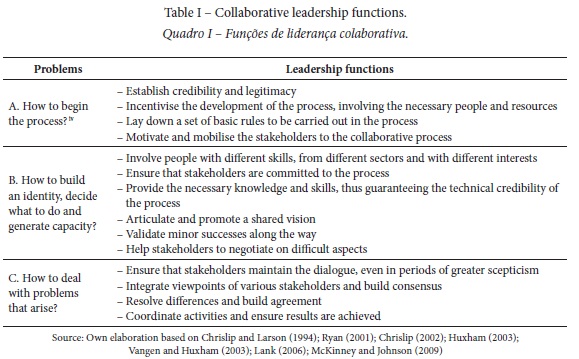
<body><![CDATA[<p><i>iv)  Credibility and legitimacy </i>– the leader should be a person or entity that has authority, prestige and sufficient human and financial resources for  ensuring that the process is carried out (Chrislip, 2002; Vangen &amp;  Huxham, 2003; Crosby &amp; Bryson, 2005a; 2005b; Bryson <i>et al</i>., 2006; Ansell &amp; Gash, 2008; McKinney &amp; Johnson, 2009);</p>      <p><i>v) Origin – </i>the leader should be an agent that represents the public interest, that is,, the  leader should have a low degree of personal interest in the process  (Chrislip, 2002; Vangen &amp; Huxham, 2003; Ansell &amp; Gash, 2008; McKinney &amp; Johnson, 2009);</p>      <p><i>vi</i><i>) Multi-leaders</i> – there may be more  than one leader, who may be accompanied by one or more mediators. If there is a good relationship of trust and a balance of powers between the stakeholders,  collaborative leadership is not necessary. It is enough to have one  mediator who ensures the peaceful development of the collaborative process. The leader, the process manager and the mediator roles can be held by one or more  people. Accordingly, the collaborative leadership can be adjusted from  case to case, depending on the situation and the personal attributes of the potential leaders and mediators (Chrislip, 2002; Huxham, 2003; Vangen &amp;  Huxham, 2003; Crosby &amp; Bryson, 2005a; 2005b; Bryson <i>et al</i>., 2006;  Lank, 2006; McKinney &amp; Johnson, 2009). </p>      <p>There is a consensus  amongst the authors mentioned above defending that leadership plays a fundamental role in the collaborative process, not only in bringing the stakeholders  into the process, but also in managing the whole process. <a href="#q1">Table I</a>  <a name="topiv"></a><a href="#iv"><sup>iv</sup></a> presents a systematization of the collaborative leadership functions, taking into consideration the three leadership goals: a) recruiting  stakeholders for the process; b) getting stakeholders to commit to the  process and achieving shared understanding of the issues; and c) resolving emergent problems.</p>       <p>&nbsp;</p> <a name="q1"></a>  <img src="/img/revistas/fin/n104/n104a03q1.jpg">     
<p>&nbsp;</p>       <p>However, these leadership functions (<a href="#q1">table I</a>) can, themselves, constitute barriers to collaboration. Here one can  highlight the following situations:</p>      <p>- <u>Active intervention in the  process vs. neutrality</u> – Vangen and Huxham (2003) establish that, if the aim is to achieve a collaborative advantage, then sometimes process leadership  requires anti-collaborative behaviour, exercising greater control over  the process (“manipulating the collaborative agenda”) and managing the relations between the stakeholders who would rather not work together, seeking ways to  exclude those who should not remain a part of the process (“playing  the politics”) so that the desired results are achieved. In this context one can quote Hardin (1968) on the <i>Tragedy of the Commons</i>. The solution  resides in mutual cohesion in which there is a mutual agreement supported by  the majority of the people involved. However, Ansell and Gash (2008) alert us to the problems that may arise from the fact that the leader’s persuasive role  in advancing with the process is not compatible with the leader’s  neutrality function.</p>      <p>- <u>Empowerment of the stakeholders vs. impartiality</u> – The  leader must not favour certain stakeholders to the detriment of others. In this context, Ansell and Gash (2008) point out the fact that some stakeholders may  question the leader’s impartiality when the latter exercises their  role of empowerment of the less prepared stakeholders with the aim of reducing imbalances, in terms of powers and resources amongst the stakeholders.</p>       <p><i>2.2. Leadership in the Portuguese spatial planning system</i></p>       ]]></body>
<body><![CDATA[<p>Some of the leadership skills and roles mentioned before are also mentioned in the Portuguese  context, such as the leader’s legitimacy and collaborative skills, among others unstated here, as is the case with the accountability issue (Queirós, 2009;  Carmo, 2014). In the Portuguese context, the question of leadership in spatial planning is addressed from the  perspective of coordination among the three levels of spatial plans (national, regional and local), and among the different sectorial plans of public  administration.</p>      <p>The Portuguese context has some structural problems, such as centralism, bureaucracy, a top-down and  sector-based organizational culture, administrative segmentation and fragmentation, system opacities, lack of network organization and excessive, dispersed  and disjointed legislation (Ferreira, 2007; Queirós, 2009; Carmo, 2014).  These factors make leadership of the planning process quite difficult. Currently, leadership problems in spatial planning tend to be even more complex and  difficult to solve regarding the transition from a traditional and linear  planning system to a collaborative planning system. This collaborative governance is characterized by new ways of communicating and sharing information,  which involve a wide range of stakeholders from central, regional and local  government, the corporate sector, the non-governmental associations, and the public as a whole, with different interests and power relations, as well as a  more pro-active management (Breda-Vásquez &amp; Oliveira, 2008; Queirós,  2009; Ferrão &amp; Mourato, 2011; Pereira, 2013). In this context, Queirós (2009) draws attention to the need for stakeholders to develop new skills.</p>      <p>Some of the difficulties in coordinating public entities have to do with the fact that there is no  coordinating body that holds the decision-making powers and the capacity to guarantee coordination among diverse entities. This lack of leadership leads to  the emergence of two types of competency conflict: i) the overlapping of  responsibilities and ii) areas where the competent authority is not clear (Oliveira, 2001). In this context, the importance of the Regional Development  Coordination Commissions (CCDRs – <i>Comissão</i><i> de Coordenação e  Desenvolvimento Regional</i>), as the responsible entities for drawing up regional spatial planning plans (PROTs - <i>Plano Regional de Ordenamento do  Território</i>) and managing community funds, must be taken into account  (Pereira, 2013), as they are universally recognised and are also seen as leaders and key stakeholders in tourism/territory relations (Fazenda<a name="topv"></a><a href="#v"><sup>v</sup></a>,  2011). However, these entities do not have the decision-making powers to  coordinate sectorial interventions or impose guidelines at the local level (Pereira, 2013; Carmo, 2014).</p>      <p>Breda-Vásquez &amp; Oliveira (2008) emphasize the fact that, given the limitations of the central administration  (and specifically the CCDRs), the role of political leadership at the  local level is crucial, promoting the involvement of local agents. But, in the planning practice, the local authorities proved to be incapable of promoting a  cooperative culture.</p>      <p>The literature review on leadership in the Portuguese spatial planning process highlights two  examples of successful leadership: the Lisbon Strategic Plan (PEL – <i>Plano Estratégico de Lisboa</i>, 1992) (Ferreira, 2007; Pereira, 2013) and the  Critical Neighbourhoods Initiative (IBC – <i>Iniciativa</i><i> Bairros  Críticos</i>) in <i>Cova da Moura</i> (2008) (Caser &amp; Vasconcelos, 2008; IHRU, 2008).</p>      <p>In the scope of the collaborative experiences carried out by PEL and IBC in <i>Cova da Moura</i>, one can  highlight as positive aspects the strong coordination and leadership of the  processes carried out by the Lisbon Mayor and the Secretary of State for Spatial Planning and Cities, the National Housing Institute/Housing and Urban  Redevelopment Institute (INH/IHRU – <i>Instituto</i><i> Nacional de  Habitação/Instituto da Habitação e Reabilitação Urbana</i>). In both cases, there was a strong degree of involvement at the highest hierarchical levels that  legitimised and gave credibility to the process. The main  leadership-related problem in these processes had to do with the volatility determined by the elections calendar, which meant that the continuity of the  successful collaborative process could not be guaranteed.</p>      <p>Given the situation described above, this research project sets out to  identify the main leadership characteristics and functions that are required in a collaborative intractable conflict management process in Portugal.</p>       <p><b>&nbsp;</b></p>      <p><b>II. METHODOLOGY</b></p>       <p>In order to achieve the objective identified at the end of the preceding section, the research methodology relied  heavily on fieldwork, which included interviews with 26 public and  private sector stakeholders. These stakeholders were involved in the elaboration of land use policies for, or the development of, a territory with a high  natural protection value (the <i>Troia-Melides</i> coast, <i>Alentejo</i>,  Portugal), which is currently subject to strong pressure from tourism-oriented development.</p>      ]]></body>
<body><![CDATA[<p>The leadership question was highlighted in the interview in order to identify the leadership problems which arise  in a collaborative process that sets out to reconcile tourist  development with the conservation and improvement of territorial heritage. In this context, the stakeholders were asked questions on the following:</p>      <p>1. In order to determine the  stakeholders’ perception of the main obstacles to developing collaborative leadership in the Portuguese context, the interviewees were asked to identify the  restrictions of carrying out a collaborative process in the Portuguese  context, like for example, whether collaborative leadership exists or not;</p>      <p>2. Subsequently, the interviewees were asked to indicate three leadership measures for improving cooperation between public and private stakeholders in  reconciling tourist development and territorial heritage conservation and  improvement in the Troia-Melides coastal region;</p>      <p>3. Aiming for a better  understanding of the leadership problems, the stakeholders were asked to identify the leader in a negotiation process that sought to reconcile tourist  development and the conservation and territorial heritage improvement of the  Troia-Melides coastal region.</p>       <p><b>&nbsp;</b></p>      <p><b>III. RESULTS AND DISCUSSION</b></p>       <p>The answers to the questions listed in the methodology section and the respective analysis are  presented in the three following sections.</p>       <p><b>1. Leadership in the Portuguese context</b></p>      <p>In the interviews, the stakeholders were asked about the importance of incorporating some functional  characteristics of collaboration into the process of reconciling tourist development  with the enhancement of territorial heritage. In Portugal, the topics regarding the existence of “collaborative leadership” are: the authority and legitimacy  to coordinate the process; focus on the long term; and, the initiative  and capacity to negotiate with the stakeholders involved in the process. The response was unanimous: <i>this is very important</i>.</p>      <p>Nevertheless, when the interviewees were asked about the applicability of such a  collaborative process to the Portuguese context, the stakeholders had  different opinions. Approximately 50% of them raised no objection to this, highlighting the fact that this is the path to be taken, regardless of existing  constraints. The other half defended that this kind of processes would be  difficult to apply in Portugal. Regarding collaborative leadership in particular, the interviewees were especially sceptical. Reasons such as the Portuguese  culture, distrust, leadership skills, and aversion to being controlled  were quoted topics: </p>       ]]></body>
<body><![CDATA[<p>- We don’t like to be led, and even less, being mediated: it is a cultural matter;</p>      <p>- Leadership depends much more on personal attributes than  those of an institution. Even if the know-how is there, it is a difficult  process due to cultural reasons and trustworthy relationships.</p>       <p><b>2. Leadership proposals for improving cooperation between tourism and territory</b></p>       <p>The three leadership measures for improving cooperation between public and private stakeholders in  reconciling tourist development and territorial heritage conservation and improvement in the <i>Troia-Melides</i> coastal region presented by the  interviewees focused on the following proposals:</p>       <p>- Regional leadership;</p>      <p>- Creation of strong leadership work groups;</p>      <p>- Centralized decision making (political  decision-making capacity);</p>      <p>- Leadership involving stakeholders;</p>      <p>- Leadership with capacity to communicate with other stakeholders;</p>      <p>- Creation of leadership structures, similar to the Monitoring and Assessment Commission for  Projects of Tourist Interest (CAA-PIN - <i>Comissão</i><i> de Avaliação e  Acompanhamento dos Projetos de Potencial Interesse Nacional</i>), which has mediated negotiation processes with relevant stakeholders.</p>       ]]></body>
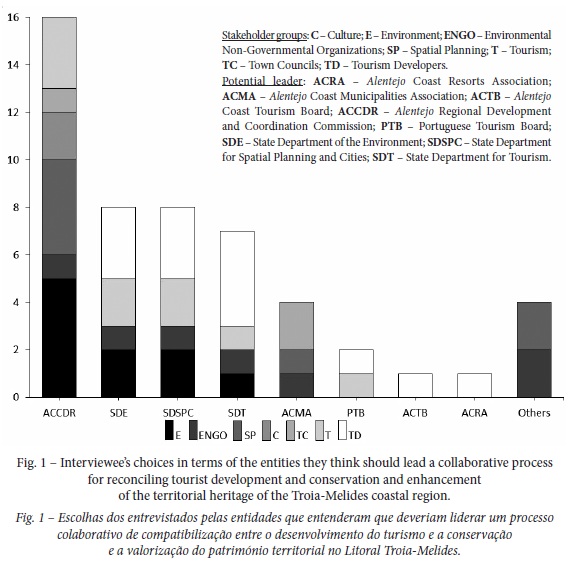
<body><![CDATA[<p><b>3. Leadership of the process</b></p>       <p>In their response to the question as to who should lead a collaborative negotiation process aimed at  reconciling tourist development and conservation and enhancement of the <i>Troia-Melides</i> coastal region, the interviewees highlighted the <i>Alentejo</i>  Regional Development Coordination Commission (ACCDR) as the ideal  entity to perform that role (<a href="#f1">fig. 1</a>). </p>       <p>&nbsp;</p> <a name="f1"></a>  <img src="/img/revistas/fin/n104/n104a03f1.jpg">     
<p>&nbsp;</p>      <p>However, an analysis of the interviewees’ comments shows that whilst this  authority was seen as the conceptually correct choice, in its actual format it is generally considered incapable of carrying out the work. As an alternative  to the <i>Alentejo</i> CCDR which lacks the authority and legitimacy to  take the leadership role, the interviewees’ second choice was centralised leadership in the Environment, Spatial Planning and Tourism State Departments.</p>      <p>As to the <i>Alentejo</i> CCDR, the interviewees highlighted as main advantages the fact that it is  the regional entity that has already been set up to coordinate the other entities, and has an impartial and comprehensive vision concerning environmental and  spatial planning issues.</p>      <p>The main constraints identified by the interviewees were: </p>      <p>- A lack of coordination powers in all sectors (coordination in environment and spatial planning  areas only); </p>      <p>- A structure lacking legitimacy and authority to lead, with no  powers to coordinate a collaborative process and maintain a long-term approach to the differing interests in the course of the process;</p>      <p>- A structure without technical competence and political power for decision-making;</p>     ]]></body>
<body><![CDATA[<p>- A heavy, ineffective structure;</p>      <p>- Lack of human and financial resources;</p>      <p>- Not dynamic or proactive;</p>      <p>- Impossible to be referee and player at the same time;</p>      <p>- Positioned on one side of the scale – close to the local government power and  developers and not correctly representing environmental interests;</p>      <p>- Not very  collaborative in other areas, namely on economic matters;</p>      <p>- Not  knowledgeable about the dynamics of the tourism industry;</p>      <p>- Hostage to political disputes. </p>      <p>On the basis of the results presented above, one can say that there is currently no legitimate  leadership propitious to the development of collaborative processes. The fact that the CCDR represents only sectorial interests related to the environment  and land use management, and not all the sectorial interests at the  regional level, compromises its ability to fulfil the role of coordination, reconciliation of interests and impartiality that is crucial for collaborative  leadership processes, as stated by Pereira (2013). </p>      <p>On the other hand, the representatives from the three ministries –  environment (SDE), tourism (SDT) and Spatial Planning and Cities (SDSPC), cooperated with each other and were able to manage conflict issues. Although they  had collaborative leadership characteristics (subsection <i>2.1.</i>),  it is not their job to resolve these kinds of problems, but their intervention is important when conflict rises to the level of expressed conflict (Ury,  2000), and this was one of those cases.</p>      ]]></body>
<body><![CDATA[<p>Finally, although the Alentejo Coast Municipalities Association (ACMA) was only chosen by four  interviewees, the local government leadership has a crucial role in the capacity to mobilize local agents and in the stability of relational networks, as  stated by Breda-Vasques and Oliveira (2008). </p>       <p><b>&nbsp;</b></p>      <p><b>IV. CONCLUSIONS</b></p>       <p>The high level of mistrust that exists regarding collaborative processes in Portugal can be fundamentally  attributed to the prevalence of a centralised decision-making culture and a  top-down spatial planning system. The lack of entities with the necessary legitimacy and leadership skills also makes it difficult to implement a  collaborative process for tourism management vs. territory conflicts. For example,  the CCDR – a potential leader – does not have the necessary powers, in terms of human and financial resources, required to carry out such a process, or in terms of legitimate authority to take on a leadership role. It also does  not have the collaborative leadership skills (defined in <a href="#q1">table I</a>).</p>      <p>Impartiality and neutrality are also fundamental attributes for leadership of the process. For example, the  interviewees value the CCDR as a leader on account of its impartiality. Even  so, the fact that it represents only the specific interests of the environment and land use management sectors, and not all sectoral interests at the  regional level, compromises its ability to fulfil the role of coordination,  reconciliation of interests and impartiality. This prevents it from assuming a leadership role in a collaborative process. The interviewees proposed a  leadership structure (along the lines of the CAA-PIN) that has no interests  in the process, and would therefore be a platform that facilitates dialogue between the stakeholders. Besides the collaborative leadership skills and other  leadership characteristics of this leadership structure, legitimacy  plays a fundamental role here, and maybe this kind of structure will be more efficient as a platform than as a leader. This not only reveals the importance  of communication competencies that leadership should have, but also the  impartiality and neutrality which give credibility to the process.</p>      <p>The fact that the interviewees opt for tripartite leadership involving the environment, tourism and spatial  planning, also reflects the concern that impartiality must prevail. In this  context, any leadership that is close to private interests, such as the local government, is rejected by the majority of the interviewees.</p>      <p>The final conclusion is that the leader, process manager and mediator roles can be taken on by one person/entity or by several people/entities, and there  may be more than one leader accompanied by more than one mediator. For this reason, collaborative leadership can be adapted from case to case, depending on  the situation and the personal attributes of the potential leaders and  mediators in the process. </p>       <p><b>&nbsp;</b></p>      <p><b>REFERENCES </b></p>       <!-- ref --><p>Almeida, J. (2013). <i>A gestão  colaborativa de conflitos entre turismo e território: o caso do litoral  Troia-Melides</i> [Collaborative management of conflicts between tourism and territory: the case of Litoral Troia-Melides]. (PhD Dissertation). Lisbon:  Universidade de Lisboa.    &nbsp;&nbsp;&nbsp;&nbsp;&nbsp;&nbsp;&nbsp;&nbsp;[&#160;<a href="javascript:void(0);" onclick="javascript: window.open('/scielo.php?script=sci_nlinks&ref=280513&pid=S0430-5027201700010000300001&lng=','','width=640,height=500,resizable=yes,scrollbars=1,menubar=yes,');">Links</a>&#160;]<!-- end-ref --></p>      <!-- ref --><p>Ansell, C., &amp; Gash, A. (2008). Collaborative Governance in Theory and Practice. <i>Journal of Public Administration Research  and Theory</i>, <i>18</i>(4), 543-571.    &nbsp;&nbsp;&nbsp;&nbsp;&nbsp;&nbsp;&nbsp;&nbsp;[&#160;<a href="javascript:void(0);" onclick="javascript: window.open('/scielo.php?script=sci_nlinks&ref=280515&pid=S0430-5027201700010000300002&lng=','','width=640,height=500,resizable=yes,scrollbars=1,menubar=yes,');">Links</a>&#160;]<!-- end-ref --></p>      <!-- ref --><p>Blake, R. R., &amp; Mouton, J. S. (1970). The Fifth Achievement. <i>The Journal of Applied Behavioral Science</i>, <i>6</i>(4),  413-426.    &nbsp;&nbsp;&nbsp;&nbsp;&nbsp;&nbsp;&nbsp;&nbsp;[&#160;<a href="javascript:void(0);" onclick="javascript: window.open('/scielo.php?script=sci_nlinks&ref=280517&pid=S0430-5027201700010000300003&lng=','','width=640,height=500,resizable=yes,scrollbars=1,menubar=yes,');">Links</a>&#160;]<!-- end-ref --></p>      <!-- ref --><p>Breda-Vásquez, I., &amp; Oliveira, C. (2008). Coalition-Building in Portuguese Spatial Planning: Is There a Southern European  Context? <i>European Planning Studies</i>, <i>16</i>(6), 761-784.    &nbsp;&nbsp;&nbsp;&nbsp;&nbsp;&nbsp;&nbsp;&nbsp;[&#160;<a href="javascript:void(0);" onclick="javascript: window.open('/scielo.php?script=sci_nlinks&ref=280519&pid=S0430-5027201700010000300004&lng=','','width=640,height=500,resizable=yes,scrollbars=1,menubar=yes,');">Links</a>&#160;]<!-- end-ref --></p>      <!-- ref --><p>Bryson, J. M., Crosby, B. C., &amp; Stone, M. M. (2006). The Design and Implementation of Cross Sector  Collaborations: Propositions from the Literature. <i>Public Administration  Review</i>, <i>66</i>, 44–55.    &nbsp;&nbsp;&nbsp;&nbsp;&nbsp;&nbsp;&nbsp;&nbsp;[&#160;<a href="javascript:void(0);" onclick="javascript: window.open('/scielo.php?script=sci_nlinks&ref=280521&pid=S0430-5027201700010000300005&lng=','','width=640,height=500,resizable=yes,scrollbars=1,menubar=yes,');">Links</a>&#160;]<!-- end-ref --></p>      <!-- ref --><p>Buller, P. F., Kohls, J. J., &amp; Anderson, K. S. (2000). When ethics  collide: Managing conflicts across cultures. <i>Organizational  Dynamics</i>, <i>28</i>(4), 52-66.    &nbsp;&nbsp;&nbsp;&nbsp;&nbsp;&nbsp;&nbsp;&nbsp;[&#160;<a href="javascript:void(0);" onclick="javascript: window.open('/scielo.php?script=sci_nlinks&ref=280523&pid=S0430-5027201700010000300006&lng=','','width=640,height=500,resizable=yes,scrollbars=1,menubar=yes,');">Links</a>&#160;]<!-- end-ref --></p>      <!-- ref --><p>Burgess, H., &amp; Burgess, G. (1994). <i>Constructive  Confrontation: A Strategy for Dealing with Intractable Environmental  Conflicts</i>. Retrieved from: <a href="http://www.colorado.edu/conflict/full_text_search/AllCRCDocs/97-1.htm" target="_blank">http://www.colorado.edu/conflict/full_text_search/AllCRCDocs/97-1.htm</a>&nbsp;&nbsp;&nbsp;&nbsp;&nbsp;&nbsp;&nbsp;&nbsp;[&#160;<a href="javascript:void(0);" onclick="javascript: window.open('/scielo.php?script=sci_nlinks&ref=280525&pid=S0430-5027201700010000300007&lng=','','width=640,height=500,resizable=yes,scrollbars=1,menubar=yes,');">Links</a>&#160;]<!-- end-ref --><!-- ref --><p>Câmara Municipal de Lisboa – CML (1992). <i>Plano Estratégico de Lisboa</i> [Strategic Plan of Lisbon]. Lisbon: Câmara Municipal  de Lisboa.    &nbsp;&nbsp;&nbsp;&nbsp;&nbsp;&nbsp;&nbsp;&nbsp;[&#160;<a href="javascript:void(0);" onclick="javascript: window.open('/scielo.php?script=sci_nlinks&ref=280526&pid=S0430-5027201700010000300008&lng=','','width=640,height=500,resizable=yes,scrollbars=1,menubar=yes,');">Links</a>&#160;]<!-- end-ref --></p>      <!-- ref --><p>Carmo, F. (2014). Planos Regionais de Ordenamento do Território e governança territorial: do discurso às evidências da prática.  [Regional Plans of Spatial Planning and territorial governance: from  discourse to evidence of practice]. <i>Revista de Geografia e Ordenamento do Território</i>, <i>5</i>, 41-65.    &nbsp;&nbsp;&nbsp;&nbsp;&nbsp;&nbsp;&nbsp;&nbsp;[&#160;<a href="javascript:void(0);" onclick="javascript: window.open('/scielo.php?script=sci_nlinks&ref=280528&pid=S0430-5027201700010000300009&lng=','','width=640,height=500,resizable=yes,scrollbars=1,menubar=yes,');">Links</a>&#160;]<!-- end-ref --></p>      <!-- ref --><p>Chrislip, D. D. (2002). <i>The Collaborative Leadership  Fieldbook</i>. San Francisco: Jossey-Bass.    &nbsp;&nbsp;&nbsp;&nbsp;&nbsp;&nbsp;&nbsp;&nbsp;[&#160;<a href="javascript:void(0);" onclick="javascript: window.open('/scielo.php?script=sci_nlinks&ref=280530&pid=S0430-5027201700010000300010&lng=','','width=640,height=500,resizable=yes,scrollbars=1,menubar=yes,');">Links</a>&#160;]<!-- end-ref --></p>      <!-- ref --><p>Crosby, B., &amp; Bryson, J. (2005a). A leadership  framework for cross-sector collaboration. <i>Public Management Review</i>,  <i>7</i>(2), 177-201.    &nbsp;&nbsp;&nbsp;&nbsp;&nbsp;&nbsp;&nbsp;&nbsp;[&#160;<a href="javascript:void(0);" onclick="javascript: window.open('/scielo.php?script=sci_nlinks&ref=280532&pid=S0430-5027201700010000300011&lng=','','width=640,height=500,resizable=yes,scrollbars=1,menubar=yes,');">Links</a>&#160;]<!-- end-ref --></p>      ]]></body>
<body><![CDATA[<!-- ref --><p>Crosby, B., &amp; Bryson, J. (2005b). <i>Leadership for the common good:  tackling public problems in a shared-power world</i> (2<sup>a</sup> ed.). San  Francisco: John Wiley &amp; Sons.    &nbsp;&nbsp;&nbsp;&nbsp;&nbsp;&nbsp;&nbsp;&nbsp;[&#160;<a href="javascript:void(0);" onclick="javascript: window.open('/scielo.php?script=sci_nlinks&ref=280534&pid=S0430-5027201700010000300012&lng=','','width=640,height=500,resizable=yes,scrollbars=1,menubar=yes,');">Links</a>&#160;]<!-- end-ref --></p>      <!-- ref --><p>Cunha, M. P., Rego, A., Cunha, R. C., &amp; Cardoso, C. C. (2007).  <i>Manual de Comportamento Organizacional e Gestão </i>[Manual of  Organizational Behavior and Management]. (6<sup>a</sup> ed.). Lisbon: Ed. RH.    &nbsp;&nbsp;&nbsp;&nbsp;&nbsp;&nbsp;&nbsp;&nbsp;[&#160;<a href="javascript:void(0);" onclick="javascript: window.open('/scielo.php?script=sci_nlinks&ref=280536&pid=S0430-5027201700010000300013&lng=','','width=640,height=500,resizable=yes,scrollbars=1,menubar=yes,');">Links</a>&#160;]<!-- end-ref --></p>      <!-- ref --><p>Fazenda, N. (2011). <i> Territorialização de uma Política Nacional de Turismo - o caso de  Portugal</i>. [Territorialization of a National Tourism Policy - the case of Portugal]. (PhD dissertation). Lisbon: Universidade de Lisboa.    &nbsp;&nbsp;&nbsp;&nbsp;&nbsp;&nbsp;&nbsp;&nbsp;[&#160;<a href="javascript:void(0);" onclick="javascript: window.open('/scielo.php?script=sci_nlinks&ref=280538&pid=S0430-5027201700010000300014&lng=','','width=640,height=500,resizable=yes,scrollbars=1,menubar=yes,');">Links</a>&#160;]<!-- end-ref --></p>      <!-- ref --><p>Ferrão, J. (2011). <i>O  Ordenamento do Território como Política Pública</i>. [Spatial planning as public policy]. Lisbon: Ed. Calouste Gulbenkian.    &nbsp;&nbsp;&nbsp;&nbsp;&nbsp;&nbsp;&nbsp;&nbsp;[&#160;<a href="javascript:void(0);" onclick="javascript: window.open('/scielo.php?script=sci_nlinks&ref=280540&pid=S0430-5027201700010000300015&lng=','','width=640,height=500,resizable=yes,scrollbars=1,menubar=yes,');">Links</a>&#160;]<!-- end-ref --></p>      <!-- ref --><p>Ferrão, J., &amp; Mourato, J. (2011). Evaluation  and Spatial Planning in Portugal: From legal requirement to source of policy-learning and institutional innovation. In J. F. Dasí (Ed.), <i>De la Evaluación  Ambiental Estratégica a la Evaluación de Impacto Territorial:  Reflexiones acerca de la tarea de evaluación </i>[From the Strategic Environmental Assessment to the Territorial Impact Assessment: Reflections on the  assessment task] (pp. 141-166). València: Ed. Publicacions de la Universitat  de València.    &nbsp;&nbsp;&nbsp;&nbsp;&nbsp;&nbsp;&nbsp;&nbsp;[&#160;<a href="javascript:void(0);" onclick="javascript: window.open('/scielo.php?script=sci_nlinks&ref=280542&pid=S0430-5027201700010000300016&lng=','','width=640,height=500,resizable=yes,scrollbars=1,menubar=yes,');">Links</a>&#160;]<!-- end-ref --> </p>      ]]></body>
<body><![CDATA[<!-- ref --><p>Ferreira, A. F. (2007). <i>Gestão Estratégica de Cidades e Regiões </i>[Strategic  Management of Cities and Regions].<i> </i>(2ª ed.). Lisbon: Ed. Calouste  Gulbenkian.    &nbsp;&nbsp;&nbsp;&nbsp;&nbsp;&nbsp;&nbsp;&nbsp;[&#160;<a href="javascript:void(0);" onclick="javascript: window.open('/scielo.php?script=sci_nlinks&ref=280544&pid=S0430-5027201700010000300017&lng=','','width=640,height=500,resizable=yes,scrollbars=1,menubar=yes,');">Links</a>&#160;]<!-- end-ref --></p>      <!-- ref --><p>Gray, B. (2003). Framing of environmental disputes. In R. J. Lewicki, B. Gray, &amp; M.  Elliott (Eds.), <i>Making sense of intractable environmental conflicts:  frames and cases </i>(pp. 11–34). Island Press.    &nbsp;&nbsp;&nbsp;&nbsp;&nbsp;&nbsp;&nbsp;&nbsp;[&#160;<a href="javascript:void(0);" onclick="javascript: window.open('/scielo.php?script=sci_nlinks&ref=280546&pid=S0430-5027201700010000300018&lng=','','width=640,height=500,resizable=yes,scrollbars=1,menubar=yes,');">Links</a>&#160;]<!-- end-ref --></p>      <!-- ref --><p>Hardin, G. (1968). The Tragedy of the Commons. <i> Science</i>, <i>162</i>(3859), 1243-1248.    &nbsp;&nbsp;&nbsp;&nbsp;&nbsp;&nbsp;&nbsp;&nbsp;[&#160;<a href="javascript:void(0);" onclick="javascript: window.open('/scielo.php?script=sci_nlinks&ref=280548&pid=S0430-5027201700010000300019&lng=','','width=640,height=500,resizable=yes,scrollbars=1,menubar=yes,');">Links</a>&#160;]<!-- end-ref --></p>      <p>Head, B., &amp; Alford, J. (2008). Wicked problems: Implications for policy and management. In <i>Australian Political Studies  Association Conference</i>. Brisbane, Australia. Retrieved from:  <a href="http://espace.library.uq.edu.au/view/UQ:197696" target="_blank">http://espace.library.uq.edu.au/view/UQ:197696</a> </p>      <!-- ref --><p>Healey, P. (1997). <i>Collaborative planning: shaping places in  fragmented societies</i>. Basingstoke: Macmillan Press.    &nbsp;&nbsp;&nbsp;&nbsp;&nbsp;&nbsp;&nbsp;&nbsp;[&#160;<a href="javascript:void(0);" onclick="javascript: window.open('/scielo.php?script=sci_nlinks&ref=280551&pid=S0430-5027201700010000300020&lng=','','width=640,height=500,resizable=yes,scrollbars=1,menubar=yes,');">Links</a>&#160;]<!-- end-ref --></p>      <!-- ref --><p>Huxham, C. (2003). Theorizing collaboration  practice. <i>Public Management Review</i>, <i>5</i>, 401-423.    &nbsp;&nbsp;&nbsp;&nbsp;&nbsp;&nbsp;&nbsp;&nbsp;[&#160;<a href="javascript:void(0);" onclick="javascript: window.open('/scielo.php?script=sci_nlinks&ref=280553&pid=S0430-5027201700010000300021&lng=','','width=640,height=500,resizable=yes,scrollbars=1,menubar=yes,');">Links</a>&#160;]<!-- end-ref --></p>      <!-- ref --><p>IHRU - Instituto da Habitação e da Reabilitação Urbana (2008). <i>A Iniciativa Bairros Críticos na Cova da  Moura. Relatório Preliminar de Avaliação Externa</i> [The Initiative  Critical Neighborhoods in Cova da Moura. Preliminary External Evaluation Report]. Lisbon: IHRU - Instituto da Habitação e da Reabilitação Urbana. Retrieved  from: <a href="http://www.portaldahabitacao.pt/pt/ibc/avaliacao_ibc.html" target="_blank">http://www.portaldahabitacao.pt/pt/ibc/avaliacao_ibc.html</a> &nbsp;&nbsp;&nbsp;&nbsp;&nbsp;&nbsp;&nbsp;&nbsp;[&#160;<a href="javascript:void(0);" onclick="javascript: window.open('/scielo.php?script=sci_nlinks&ref=280555&pid=S0430-5027201700010000300022&lng=','','width=640,height=500,resizable=yes,scrollbars=1,menubar=yes,');">Links</a>&#160;]<!-- end-ref --><!-- ref --><p>Jamal, T., &amp; Getz, D. (1999). Community  Roundtables for Tourism-related Conflicts: The Dialectics of Consensus and Process Structures. <i>Journal of Sustainable Tourism</i>, <i>7</i>(3-4), 290-313.    &nbsp;&nbsp;&nbsp;&nbsp;&nbsp;&nbsp;&nbsp;&nbsp;[&#160;<a href="javascript:void(0);" onclick="javascript: window.open('/scielo.php?script=sci_nlinks&ref=280556&pid=S0430-5027201700010000300023&lng=','','width=640,height=500,resizable=yes,scrollbars=1,menubar=yes,');">Links</a>&#160;]<!-- end-ref --> </p>      <!-- ref --><p>Lank, E.  (2006). <i>Collaborative advantage: how organizations win by working together</i>. New York: Palgrave Macmillan.    &nbsp;&nbsp;&nbsp;&nbsp;&nbsp;&nbsp;&nbsp;&nbsp;[&#160;<a href="javascript:void(0);" onclick="javascript: window.open('/scielo.php?script=sci_nlinks&ref=280558&pid=S0430-5027201700010000300024&lng=','','width=640,height=500,resizable=yes,scrollbars=1,menubar=yes,');">Links</a>&#160;]<!-- end-ref --></p>      <!-- ref --><p>McKinney, M., &amp; Johnson, S. (2009). <i>Working Across  Boundaries: People, Nature, and Regions</i>. Cambridge, Massachusetts: Lincoln Institute of Land Policy.    &nbsp;&nbsp;&nbsp;&nbsp;&nbsp;&nbsp;&nbsp;&nbsp;[&#160;<a href="javascript:void(0);" onclick="javascript: window.open('/scielo.php?script=sci_nlinks&ref=280560&pid=S0430-5027201700010000300025&lng=','','width=640,height=500,resizable=yes,scrollbars=1,menubar=yes,');">Links</a>&#160;]<!-- end-ref --></p>      <!-- ref --><p>Moore, C. W. (2003). <i>The mediation process: practical strategies  for resolving conflict</i> (3<sup>a</sup> ed.). San Francisco: Jossey-Bass.    &nbsp;&nbsp;&nbsp;&nbsp;&nbsp;&nbsp;&nbsp;&nbsp;[&#160;<a href="javascript:void(0);" onclick="javascript: window.open('/scielo.php?script=sci_nlinks&ref=280562&pid=S0430-5027201700010000300026&lng=','','width=640,height=500,resizable=yes,scrollbars=1,menubar=yes,');">Links</a>&#160;]<!-- end-ref --></p>      ]]></body>
<body><![CDATA[<!-- ref --><p>Movius, H., &amp;  Susskind, L. (2009). <i>Built to win: creating a world-class negotiating  organization</i>. Boston: Harvard Business Press.    &nbsp;&nbsp;&nbsp;&nbsp;&nbsp;&nbsp;&nbsp;&nbsp;[&#160;<a href="javascript:void(0);" onclick="javascript: window.open('/scielo.php?script=sci_nlinks&ref=280564&pid=S0430-5027201700010000300027&lng=','','width=640,height=500,resizable=yes,scrollbars=1,menubar=yes,');">Links</a>&#160;]<!-- end-ref --></p>      <!-- ref --><p>Oliveira, F. P. (2001). <i>Direito do Ordenamento  do Território.</i> [Land Use Planning Law ]. Coimbra: Ed. Almedina.    &nbsp;&nbsp;&nbsp;&nbsp;&nbsp;&nbsp;&nbsp;&nbsp;[&#160;<a href="javascript:void(0);" onclick="javascript: window.open('/scielo.php?script=sci_nlinks&ref=280566&pid=S0430-5027201700010000300028&lng=','','width=640,height=500,resizable=yes,scrollbars=1,menubar=yes,');">Links</a>&#160;]<!-- end-ref --></p>      <!-- ref --><p>Pereira, M. (2013). Da Governança à Governança Territorial Colaborativa, uma Agenda para o Futuro do  Desenvolvimento Regional [From Governance to Collaborative Territorial  Governance, an Agenda for the Future of Regional Development]. <i>DRd</i><i> – Desenvolvimento Regional em debate,</i> <i>3</i>(2), 52-65.    &nbsp;&nbsp;&nbsp;&nbsp;&nbsp;&nbsp;&nbsp;&nbsp;[&#160;<a href="javascript:void(0);" onclick="javascript: window.open('/scielo.php?script=sci_nlinks&ref=280568&pid=S0430-5027201700010000300029&lng=','','width=640,height=500,resizable=yes,scrollbars=1,menubar=yes,');">Links</a>&#160;]<!-- end-ref --></p>      <!-- ref --><p>Putnam, L. L., &amp; Wondolleck,  J. M. (2003). Intractability: Definitions, Dimensions, and Distinctions. In R. J. Lewicki, B. Gray, &amp; M. Elliott (Eds.), <i>Making sense of intractable  environmental conflicts: frames and cases </i>(pp. 35-63). Washington,  DC: Island Press.    &nbsp;&nbsp;&nbsp;&nbsp;&nbsp;&nbsp;&nbsp;&nbsp;[&#160;<a href="javascript:void(0);" onclick="javascript: window.open('/scielo.php?script=sci_nlinks&ref=280570&pid=S0430-5027201700010000300030&lng=','','width=640,height=500,resizable=yes,scrollbars=1,menubar=yes,');">Links</a>&#160;]<!-- end-ref --> </p>      <!-- ref --><p>Queirós, M. (2009). Teorias da complexidade: princípios para o ordenamento do  território [Theories of complexity: principles for spatial planning]. In J.  Bosque Sendra, V. M. Rodríguez Espinosa (Eds.), <i>La perspectiva geográfica ante los retos de la sociedad y el medio ambiente en el contexto ibérico. </i> [The geographical perspective of the challenges of society and the  environment in the Iberian context].    &nbsp;&nbsp;&nbsp;&nbsp;&nbsp;&nbsp;&nbsp;&nbsp;[&#160;<a href="javascript:void(0);" onclick="javascript: window.open('/scielo.php?script=sci_nlinks&ref=280572&pid=S0430-5027201700010000300031&lng=','','width=640,height=500,resizable=yes,scrollbars=1,menubar=yes,');">Links</a>&#160;]<!-- end-ref --><i> </i><i>Ponencias de XI Coloquio Ibérico de Geografía</i> (pp. 87-103) Madrid: Universidad de Alcalá, Servicio de  Publicaciones, Alcalá de Henares.</p>      ]]></body>
<body><![CDATA[<!-- ref --><p>Shmueli, D., Elliott, M., &amp; Kaufman, S. (2006). Frame changes and the management of intractable conflicts. <i>Conflict  Resolution Quarterly</i>, <i>24</i>(2), 207-218.    &nbsp;&nbsp;&nbsp;&nbsp;&nbsp;&nbsp;&nbsp;&nbsp;[&#160;<a href="javascript:void(0);" onclick="javascript: window.open('/scielo.php?script=sci_nlinks&ref=280574&pid=S0430-5027201700010000300032&lng=','','width=640,height=500,resizable=yes,scrollbars=1,menubar=yes,');">Links</a>&#160;]<!-- end-ref --></p>      <!-- ref --><p>Ury, W. L. (2000). <i>The Third Side</i>. Retrieved from: <a href="http://www.thirdside.org" target="_blank">http://www.thirdside.org</a> &nbsp;&nbsp;&nbsp;&nbsp;&nbsp;&nbsp;&nbsp;&nbsp;[&#160;<a href="javascript:void(0);" onclick="javascript: window.open('/scielo.php?script=sci_nlinks&ref=280576&pid=S0430-5027201700010000300033&lng=','','width=640,height=500,resizable=yes,scrollbars=1,menubar=yes,');">Links</a>&#160;]<!-- end-ref --><!-- ref --><p>Vangen, S., &amp; Huxham, C.  (2003). Enacting Leadership for Collaborative Advantage: Dilemmas of Ideology and Pragmatism in the Activities of Partnership Managers. <i>British</i><i>  Journal of Management</i>, <i>14</i>, S61-S76.    &nbsp;&nbsp;&nbsp;&nbsp;&nbsp;&nbsp;&nbsp;&nbsp;[&#160;<a href="javascript:void(0);" onclick="javascript: window.open('/scielo.php?script=sci_nlinks&ref=280577&pid=S0430-5027201700010000300034&lng=','','width=640,height=500,resizable=yes,scrollbars=1,menubar=yes,');">Links</a>&#160;]<!-- end-ref --></p>       <p><b>&nbsp;</b></p>      <p>Recebido: Maio 2015. Aceite: Outubro 2016.</p>       <p><b>&nbsp;</b></p>     <p><b>&nbsp;</b></p>      <p><b>NOTAS</b></p>   <a name="i"></a><a href="#topi"><sup>i</sup></a>Complexity refers to the difficulties in gaining knowledge on the persistent problem and identifying  the appropriate solutions. These difficulties emerge from restricted  knowledge bases, the existence of complex interdependencies in the process, uncertainties resulting from the process dynamics and social issues and the  immeasurability of the risks and potential trade-offs involved.</p>  <a name="ii"></a><a href="#topii"><sup>ii</sup></a>Diversity refers to the number and variety of stakeholders involved.</p>  <a name="iii"></a><a href="#topiii"><sup>iii</sup></a>Lack of communication and trust amongst stakeholders; the presence of environmental vs. economic  interests, public sector vs. private sector, which seem irreconcilable;  the preponderance of differing value systems and prevalence of lack of coordination among the public administration sectors and centralised decision making,  which inhibit the development of appropriate negotiation forums  (Almeida, 2013).</p>  <a name="iv"></a><a href="#topiv"><sup>iv</sup></a>The importance of leadership in the initial process phase is also reflected in the field of collaborative planning  theory. Healey (1997, p. 269) and Jamal and Getz (1999) highlight the crucial role of the leader, who, in this phase, identifies the key actors and brings  them to the negotiation table and chooses the mediators.</p>  <a name="v"></a><a href="#topv"><sup>v</sup></a>Fazenda (2011) demonstrates in his doctoral thesis that the CCDRs – as  bodies that accumulate competence in the areas of planning and regional  development, the environment and land use management, inter-sectorial coordination and structural funds management – are those that could best promote the  territorialisation of a public nationwide tourism policy and also promote  an integrated tourist planning process that would facilitate sustainable tourism.</p>      ]]></body>
<body><![CDATA[ ]]></body><back>
<ref-list>
<ref id="B1">
<nlm-citation citation-type="">
<person-group person-group-type="author">
<name>
<surname><![CDATA[Almeida]]></surname>
<given-names><![CDATA[J]]></given-names>
</name>
</person-group>
<source><![CDATA[A gestão colaborativa de conflitos entre turismo e território: o caso do litoral Troia-Melides]]></source>
<year>2013</year>
</nlm-citation>
</ref>
<ref id="B2">
<nlm-citation citation-type="journal">
<person-group person-group-type="author">
<name>
<surname><![CDATA[Ansell]]></surname>
<given-names><![CDATA[C]]></given-names>
</name>
<name>
<surname><![CDATA[Gash]]></surname>
<given-names><![CDATA[A]]></given-names>
</name>
</person-group>
<article-title xml:lang="en"><![CDATA[Collaborative Governance in Theory and Practice]]></article-title>
<source><![CDATA[Journal of Public Administration Research and Theory]]></source>
<year>2008</year>
<volume>18</volume>
<numero>4</numero>
<issue>4</issue>
<page-range>543-571</page-range></nlm-citation>
</ref>
<ref id="B3">
<nlm-citation citation-type="journal">
<person-group person-group-type="author">
<name>
<surname><![CDATA[Blake]]></surname>
<given-names><![CDATA[R. R]]></given-names>
</name>
<name>
<surname><![CDATA[Mouton]]></surname>
<given-names><![CDATA[J. S]]></given-names>
</name>
</person-group>
<article-title xml:lang="en"><![CDATA[The Fifth Achievement]]></article-title>
<source><![CDATA[The Journal of Applied Behavioral Science]]></source>
<year>1970</year>
<volume>6</volume>
<numero>4</numero>
<issue>4</issue>
<page-range>413-426</page-range></nlm-citation>
</ref>
<ref id="B4">
<nlm-citation citation-type="journal">
<person-group person-group-type="author">
<name>
<surname><![CDATA[Breda-Vásquez]]></surname>
<given-names><![CDATA[I]]></given-names>
</name>
<name>
<surname><![CDATA[Oliveira]]></surname>
<given-names><![CDATA[C]]></given-names>
</name>
</person-group>
<article-title xml:lang="en"><![CDATA[Coalition-Building in Portuguese Spatial Planning: Is There a Southern European Context?]]></article-title>
<source><![CDATA[European Planning Studies]]></source>
<year>2008</year>
<volume>16</volume>
<numero>6</numero>
<issue>6</issue>
<page-range>761-784</page-range></nlm-citation>
</ref>
<ref id="B5">
<nlm-citation citation-type="journal">
<person-group person-group-type="author">
<name>
<surname><![CDATA[Bryson]]></surname>
<given-names><![CDATA[J. M]]></given-names>
</name>
<name>
<surname><![CDATA[Crosby]]></surname>
<given-names><![CDATA[B. C]]></given-names>
</name>
<name>
<surname><![CDATA[Stone]]></surname>
<given-names><![CDATA[M. M]]></given-names>
</name>
</person-group>
<article-title xml:lang="en"><![CDATA[The Design and Implementation of Cross Sector Collaborations: Propositions from the Literature]]></article-title>
<source><![CDATA[Public Administration Review]]></source>
<year>2006</year>
<volume>66</volume>
<page-range>44-55</page-range></nlm-citation>
</ref>
<ref id="B6">
<nlm-citation citation-type="journal">
<person-group person-group-type="author">
<name>
<surname><![CDATA[Buller]]></surname>
<given-names><![CDATA[P. F]]></given-names>
</name>
<name>
<surname><![CDATA[Kohls]]></surname>
<given-names><![CDATA[J. J]]></given-names>
</name>
<name>
<surname><![CDATA[Anderson]]></surname>
<given-names><![CDATA[K. S]]></given-names>
</name>
</person-group>
<article-title xml:lang="en"><![CDATA[When ethics collide: Managing conflicts across cultures]]></article-title>
<source><![CDATA[Organizational Dynamics]]></source>
<year>2000</year>
<volume>28</volume>
<numero>4</numero>
<issue>4</issue>
<page-range>52-66</page-range></nlm-citation>
</ref>
<ref id="B7">
<nlm-citation citation-type="">
<person-group person-group-type="author">
<name>
<surname><![CDATA[Burgess]]></surname>
<given-names><![CDATA[H]]></given-names>
</name>
<name>
<surname><![CDATA[Burgess]]></surname>
<given-names><![CDATA[G]]></given-names>
</name>
</person-group>
<source><![CDATA[Constructive Confrontation: A Strategy for Dealing with Intractable Environmental Conflicts]]></source>
<year>1994</year>
</nlm-citation>
</ref>
<ref id="B8">
<nlm-citation citation-type="book">
<collab>Câmara Municipal de Lisboa</collab>
<source><![CDATA[Plano Estratégico de Lisboa]]></source>
<year>1992</year>
<publisher-loc><![CDATA[Lisbon ]]></publisher-loc>
<publisher-name><![CDATA[Câmara Municipal de Lisboa]]></publisher-name>
</nlm-citation>
</ref>
<ref id="B9">
<nlm-citation citation-type="journal">
<person-group person-group-type="author">
<name>
<surname><![CDATA[Carmo]]></surname>
<given-names><![CDATA[F]]></given-names>
</name>
</person-group>
<article-title xml:lang="pt"><![CDATA[Planos Regionais de Ordenamento do Território e governança territorial: do discurso às evidências da prática]]></article-title>
<source><![CDATA[Revista de Geografia e Ordenamento do Território]]></source>
<year>2014</year>
<volume>5</volume>
<page-range>41-65</page-range></nlm-citation>
</ref>
<ref id="B10">
<nlm-citation citation-type="book">
<person-group person-group-type="author">
<name>
<surname><![CDATA[Chrislip]]></surname>
<given-names><![CDATA[D. D]]></given-names>
</name>
</person-group>
<source><![CDATA[The Collaborative Leadership Fieldbook]]></source>
<year>2002</year>
<publisher-loc><![CDATA[San Francisco ]]></publisher-loc>
<publisher-name><![CDATA[Jossey-Bass]]></publisher-name>
</nlm-citation>
</ref>
<ref id="B11">
<nlm-citation citation-type="journal">
<person-group person-group-type="author">
<name>
<surname><![CDATA[Crosby]]></surname>
<given-names><![CDATA[B]]></given-names>
</name>
<name>
<surname><![CDATA[Bryson]]></surname>
<given-names><![CDATA[J]]></given-names>
</name>
</person-group>
<article-title xml:lang="en"><![CDATA[A leadership framework for cross-sector collaboration]]></article-title>
<source><![CDATA[Public Management Review]]></source>
<year>2005</year>
<volume>7</volume>
<numero>2</numero>
<issue>2</issue>
<page-range>177-201</page-range></nlm-citation>
</ref>
<ref id="B12">
<nlm-citation citation-type="book">
<person-group person-group-type="author">
<name>
<surname><![CDATA[Crosby]]></surname>
<given-names><![CDATA[B]]></given-names>
</name>
<name>
<surname><![CDATA[Bryson]]></surname>
<given-names><![CDATA[J]]></given-names>
</name>
</person-group>
<source><![CDATA[Leadership for the common good: tackling public problems in a shared-power world]]></source>
<year>2005</year>
<edition>2</edition>
<publisher-loc><![CDATA[San Francisco ]]></publisher-loc>
<publisher-name><![CDATA[John Wiley & Sons]]></publisher-name>
</nlm-citation>
</ref>
<ref id="B13">
<nlm-citation citation-type="book">
<person-group person-group-type="author">
<name>
<surname><![CDATA[Cunha]]></surname>
<given-names><![CDATA[M. P]]></given-names>
</name>
<name>
<surname><![CDATA[Rego]]></surname>
<given-names><![CDATA[A]]></given-names>
</name>
<name>
<surname><![CDATA[Cunha]]></surname>
<given-names><![CDATA[R. C]]></given-names>
</name>
<name>
<surname><![CDATA[Cardoso]]></surname>
<given-names><![CDATA[C. C]]></given-names>
</name>
</person-group>
<source><![CDATA[Manual de Comportamento Organizacional e Gestão]]></source>
<year>2007</year>
<edition>6</edition>
<publisher-loc><![CDATA[Lisbon ]]></publisher-loc>
<publisher-name><![CDATA[Ed. RH]]></publisher-name>
</nlm-citation>
</ref>
<ref id="B14">
<nlm-citation citation-type="">
<person-group person-group-type="author">
<name>
<surname><![CDATA[Fazenda]]></surname>
<given-names><![CDATA[N]]></given-names>
</name>
</person-group>
<source><![CDATA[Territorialização de uma Política Nacional de Turismo: o caso de Portugal]]></source>
<year>2011</year>
</nlm-citation>
</ref>
<ref id="B15">
<nlm-citation citation-type="book">
<person-group person-group-type="author">
<name>
<surname><![CDATA[Ferrão]]></surname>
<given-names><![CDATA[J]]></given-names>
</name>
</person-group>
<source><![CDATA[O Ordenamento do Território como Política Pública]]></source>
<year>2011</year>
<publisher-loc><![CDATA[Lisbon ]]></publisher-loc>
<publisher-name><![CDATA[Ed. Calouste Gulbenkian]]></publisher-name>
</nlm-citation>
</ref>
<ref id="B16">
<nlm-citation citation-type="book">
<person-group person-group-type="author">
<name>
<surname><![CDATA[Ferrão]]></surname>
<given-names><![CDATA[J]]></given-names>
</name>
<name>
<surname><![CDATA[Mourato]]></surname>
<given-names><![CDATA[J]]></given-names>
</name>
</person-group>
<article-title xml:lang="en"><![CDATA[Evaluation and Spatial Planning in Portugal: From legal requirement to source of policy-learning and institutional innovation]]></article-title>
<person-group person-group-type="editor">
<name>
<surname><![CDATA[Dasí]]></surname>
<given-names><![CDATA[J. F]]></given-names>
</name>
</person-group>
<source><![CDATA[De la Evaluación Ambiental Estratégica a la Evaluación de Impacto Territorial: Reflexiones acerca de la tarea de evaluación]]></source>
<year>2011</year>
<page-range>141-166</page-range><publisher-loc><![CDATA[València ]]></publisher-loc>
<publisher-name><![CDATA[Ed. Publicacions de la Universitat de València]]></publisher-name>
</nlm-citation>
</ref>
<ref id="B17">
<nlm-citation citation-type="book">
<person-group person-group-type="author">
<name>
<surname><![CDATA[Ferreira]]></surname>
<given-names><![CDATA[A. F]]></given-names>
</name>
</person-group>
<source><![CDATA[Gestão Estratégica de Cidades e Regiões]]></source>
<year>2007</year>
<edition>2</edition>
<publisher-loc><![CDATA[Lisbon ]]></publisher-loc>
<publisher-name><![CDATA[Ed. Calouste Gulbenkian]]></publisher-name>
</nlm-citation>
</ref>
<ref id="B18">
<nlm-citation citation-type="book">
<person-group person-group-type="author">
<name>
<surname><![CDATA[Gray]]></surname>
<given-names><![CDATA[B]]></given-names>
</name>
</person-group>
<article-title xml:lang="en"><![CDATA[Framing of environmental disputes]]></article-title>
<person-group person-group-type="editor">
<name>
<surname><![CDATA[Lewicki]]></surname>
<given-names><![CDATA[R. J]]></given-names>
</name>
<name>
<surname><![CDATA[Gray]]></surname>
<given-names><![CDATA[B]]></given-names>
</name>
<name>
<surname><![CDATA[Elliott]]></surname>
<given-names><![CDATA[M]]></given-names>
</name>
</person-group>
<source><![CDATA[Making sense of intractable environmental conflicts: frames and cases]]></source>
<year>2003</year>
<page-range>11-34</page-range><publisher-name><![CDATA[Island Press]]></publisher-name>
</nlm-citation>
</ref>
<ref id="B19">
<nlm-citation citation-type="journal">
<person-group person-group-type="author">
<name>
<surname><![CDATA[Hardin]]></surname>
<given-names><![CDATA[G]]></given-names>
</name>
</person-group>
<article-title xml:lang="en"><![CDATA[The Tragedy of the Commons]]></article-title>
<source><![CDATA[Science]]></source>
<year>1968</year>
<volume>162</volume>
<numero>3859</numero>
<issue>3859</issue>
<page-range>1243-1248</page-range></nlm-citation>
</ref>
<ref id="B20">
<nlm-citation citation-type="book">
<person-group person-group-type="author">
<name>
<surname><![CDATA[Healey]]></surname>
<given-names><![CDATA[P]]></given-names>
</name>
</person-group>
<source><![CDATA[Collaborative planning: shaping places in fragmented societies]]></source>
<year>1997</year>
<publisher-loc><![CDATA[Basingstoke ]]></publisher-loc>
<publisher-name><![CDATA[Macmillan Press]]></publisher-name>
</nlm-citation>
</ref>
<ref id="B21">
<nlm-citation citation-type="journal">
<person-group person-group-type="author">
<name>
<surname><![CDATA[Huxham]]></surname>
<given-names><![CDATA[C]]></given-names>
</name>
</person-group>
<article-title xml:lang="en"><![CDATA[Theorizing collaboration practice]]></article-title>
<source><![CDATA[Public Management Review]]></source>
<year>2003</year>
<volume>5</volume>
<page-range>401-423</page-range></nlm-citation>
</ref>
<ref id="B22">
<nlm-citation citation-type="book">
<collab>IHRU - Instituto da Habitação e da Reabilitação Urbana</collab>
<source><![CDATA[A Iniciativa Bairros Críticos na Cova da Moura: Relatório Preliminar de Avaliação Externa]]></source>
<year>2008</year>
<publisher-loc><![CDATA[Lisbon ]]></publisher-loc>
<publisher-name><![CDATA[IHRU - Instituto da Habitação e da Reabilitação Urbana]]></publisher-name>
</nlm-citation>
</ref>
<ref id="B23">
<nlm-citation citation-type="journal">
<person-group person-group-type="author">
<name>
<surname><![CDATA[Jamal]]></surname>
<given-names><![CDATA[T]]></given-names>
</name>
<name>
<surname><![CDATA[Getz]]></surname>
<given-names><![CDATA[D]]></given-names>
</name>
</person-group>
<article-title xml:lang="en"><![CDATA[Community Roundtables for Tourism-related Conflicts: The Dialectics of Consensus and Process Structures]]></article-title>
<source><![CDATA[Journal of Sustainable Tourism]]></source>
<year>1999</year>
<volume>7</volume>
<numero>3-4</numero>
<issue>3-4</issue>
<page-range>290-313</page-range></nlm-citation>
</ref>
<ref id="B24">
<nlm-citation citation-type="book">
<person-group person-group-type="author">
<name>
<surname><![CDATA[Lank]]></surname>
<given-names><![CDATA[E]]></given-names>
</name>
</person-group>
<source><![CDATA[Collaborative advantage: how organizations win by working together]]></source>
<year>2006</year>
<publisher-loc><![CDATA[New York ]]></publisher-loc>
<publisher-name><![CDATA[Palgrave Macmillan]]></publisher-name>
</nlm-citation>
</ref>
<ref id="B25">
<nlm-citation citation-type="book">
<person-group person-group-type="author">
<name>
<surname><![CDATA[McKinney]]></surname>
<given-names><![CDATA[M]]></given-names>
</name>
<name>
<surname><![CDATA[Johnson]]></surname>
<given-names><![CDATA[S]]></given-names>
</name>
</person-group>
<source><![CDATA[Working Across Boundaries: People, Nature, and Regions]]></source>
<year>2009</year>
<publisher-loc><![CDATA[Cambridge, Massachusetts ]]></publisher-loc>
<publisher-name><![CDATA[Lincoln Institute of Land Policy]]></publisher-name>
</nlm-citation>
</ref>
<ref id="B26">
<nlm-citation citation-type="book">
<person-group person-group-type="author">
<name>
<surname><![CDATA[Moore]]></surname>
<given-names><![CDATA[C. W]]></given-names>
</name>
</person-group>
<source><![CDATA[The mediation process: practical strategies for resolving conflict]]></source>
<year>2003</year>
<edition>3</edition>
<publisher-loc><![CDATA[San Francisco ]]></publisher-loc>
<publisher-name><![CDATA[Jossey-Bass]]></publisher-name>
</nlm-citation>
</ref>
<ref id="B27">
<nlm-citation citation-type="book">
<person-group person-group-type="author">
<name>
<surname><![CDATA[Movius]]></surname>
<given-names><![CDATA[H]]></given-names>
</name>
<name>
<surname><![CDATA[Susskind]]></surname>
<given-names><![CDATA[L]]></given-names>
</name>
</person-group>
<source><![CDATA[Built to win: creating a world-class negotiating organization]]></source>
<year>2009</year>
<publisher-loc><![CDATA[Boston ]]></publisher-loc>
<publisher-name><![CDATA[Harvard Business Press]]></publisher-name>
</nlm-citation>
</ref>
<ref id="B28">
<nlm-citation citation-type="book">
<person-group person-group-type="author">
<name>
<surname><![CDATA[Oliveira]]></surname>
<given-names><![CDATA[F. P]]></given-names>
</name>
</person-group>
<source><![CDATA[Direito do Ordenamento do Território]]></source>
<year>2001</year>
<publisher-loc><![CDATA[Coimbra ]]></publisher-loc>
<publisher-name><![CDATA[Ed. Almedina]]></publisher-name>
</nlm-citation>
</ref>
<ref id="B29">
<nlm-citation citation-type="journal">
<person-group person-group-type="author">
<name>
<surname><![CDATA[Pereira]]></surname>
<given-names><![CDATA[M]]></given-names>
</name>
</person-group>
<article-title xml:lang="pt"><![CDATA[Da Governança à Governança Territorial Colaborativa: uma Agenda para o Futuro do Desenvolvimento Regional]]></article-title>
<source><![CDATA[DRd – Desenvolvimento Regional em debate]]></source>
<year>2013</year>
<volume>3</volume>
<numero>2</numero>
<issue>2</issue>
<page-range>52-65</page-range></nlm-citation>
</ref>
<ref id="B30">
<nlm-citation citation-type="book">
<person-group person-group-type="author">
<name>
<surname><![CDATA[Putnam]]></surname>
<given-names><![CDATA[L. L]]></given-names>
</name>
<name>
<surname><![CDATA[Wondolleck]]></surname>
<given-names><![CDATA[J. M]]></given-names>
</name>
</person-group>
<article-title xml:lang="en"><![CDATA[Intractability: Definitions, Dimensions, and Distinctions]]></article-title>
<person-group person-group-type="editor">
<name>
<surname><![CDATA[Lewicki]]></surname>
<given-names><![CDATA[R. J]]></given-names>
</name>
<name>
<surname><![CDATA[Gray]]></surname>
<given-names><![CDATA[B]]></given-names>
</name>
<name>
<surname><![CDATA[Elliott]]></surname>
<given-names><![CDATA[M]]></given-names>
</name>
</person-group>
<source><![CDATA[Making sense of intractable environmental conflicts: frames and cases]]></source>
<year>2003</year>
<page-range>35-63</page-range><publisher-loc><![CDATA[Washington, DC ]]></publisher-loc>
<publisher-name><![CDATA[Island Press]]></publisher-name>
</nlm-citation>
</ref>
<ref id="B31">
<nlm-citation citation-type="">
<person-group person-group-type="author">
<name>
<surname><![CDATA[Queirós]]></surname>
<given-names><![CDATA[M]]></given-names>
</name>
</person-group>
<article-title xml:lang="pt"><![CDATA[Teorias da complexidade: princípios para o ordenamento do território]]></article-title>
<person-group person-group-type="editor">
<name>
<surname><![CDATA[Bosque Sendra]]></surname>
<given-names><![CDATA[J]]></given-names>
</name>
<name>
<surname><![CDATA[Rodríguez Espinosa]]></surname>
<given-names><![CDATA[V. M]]></given-names>
</name>
</person-group>
<source><![CDATA[La perspectiva geográfica ante los retos de la sociedad y el medio ambiente en el contexto ibérico]]></source>
<year>2009</year>
</nlm-citation>
</ref>
<ref id="B32">
<nlm-citation citation-type="journal">
<person-group person-group-type="author">
<name>
<surname><![CDATA[Shmueli]]></surname>
<given-names><![CDATA[D]]></given-names>
</name>
<name>
<surname><![CDATA[Elliott]]></surname>
<given-names><![CDATA[M]]></given-names>
</name>
<name>
<surname><![CDATA[Kaufman]]></surname>
<given-names><![CDATA[S]]></given-names>
</name>
</person-group>
<article-title xml:lang="en"><![CDATA[Frame changes and the management of intractable conflicts]]></article-title>
<source><![CDATA[Conflict Resolution Quarterly]]></source>
<year>2006</year>
<volume>24</volume>
<numero>2</numero>
<issue>2</issue>
<page-range>207-218</page-range></nlm-citation>
</ref>
<ref id="B33">
<nlm-citation citation-type="">
<person-group person-group-type="author">
<name>
<surname><![CDATA[Ury]]></surname>
<given-names><![CDATA[W. L]]></given-names>
</name>
</person-group>
<source><![CDATA[The Third Side]]></source>
<year>2000</year>
</nlm-citation>
</ref>
<ref id="B34">
<nlm-citation citation-type="journal">
<person-group person-group-type="author">
<name>
<surname><![CDATA[Vangen]]></surname>
<given-names><![CDATA[S]]></given-names>
</name>
<name>
<surname><![CDATA[Huxham]]></surname>
<given-names><![CDATA[C]]></given-names>
</name>
</person-group>
<article-title xml:lang="en"><![CDATA[Enacting Leadership for Collaborative Advantage: Dilemmas of Ideology and Pragmatism in the Activities of Partnership Managers]]></article-title>
<source><![CDATA[British Journal of Management]]></source>
<year>2003</year>
<volume>14</volume>
<page-range>S61-S76</page-range></nlm-citation>
</ref>
</ref-list>
</back>
</article>