<?xml version="1.0" encoding="ISO-8859-1"?><article xmlns:mml="http://www.w3.org/1998/Math/MathML" xmlns:xlink="http://www.w3.org/1999/xlink" xmlns:xsi="http://www.w3.org/2001/XMLSchema-instance">
<front>
<journal-meta>
<journal-id>0430-5027</journal-id>
<journal-title><![CDATA[Finisterra - Revista Portuguesa de Geografia]]></journal-title>
<abbrev-journal-title><![CDATA[Finisterra]]></abbrev-journal-title>
<issn>0430-5027</issn>
<publisher>
<publisher-name><![CDATA[Centro de Estudos Geográficos]]></publisher-name>
</publisher>
</journal-meta>
<article-meta>
<article-id>S0430-50272018000300004</article-id>
<article-id pub-id-type="doi">10.18055/Finis14118</article-id>
<title-group>
<article-title xml:lang="en"><![CDATA[Differential mortality and inequalities in health services access in mainland Portugal]]></article-title>
<article-title xml:lang="pt"><![CDATA[Mortalidade diferencial e desigualdades no acesso aos serviços de saúde em Portugal Continental]]></article-title>
<article-title xml:lang="fr"><![CDATA[Mortalité différentielle et inégalités a l'accès aux services de sante Portugal Péninsulaire]]></article-title>
</title-group>
<contrib-group>
<contrib contrib-type="author">
<name>
<surname><![CDATA[Vidal]]></surname>
<given-names><![CDATA[Diogo Guedes]]></given-names>
</name>
<xref ref-type="aff" rid="A01"/>
</contrib>
<contrib contrib-type="author">
<name>
<surname><![CDATA[Pontes]]></surname>
<given-names><![CDATA[Manuela]]></given-names>
</name>
<xref ref-type="aff" rid="A01"/>
<xref ref-type="aff" rid="A02"/>
</contrib>
<contrib contrib-type="author">
<name>
<surname><![CDATA[Barreira]]></surname>
<given-names><![CDATA[Esmeralda]]></given-names>
</name>
<xref ref-type="aff" rid="A01"/>
<xref ref-type="aff" rid="A02"/>
<xref ref-type="aff" rid="A03"/>
</contrib>
<contrib contrib-type="author">
<name>
<surname><![CDATA[Oliveira]]></surname>
<given-names><![CDATA[Gisela M.]]></given-names>
</name>
<xref ref-type="aff" rid="A01"/>
</contrib>
<contrib contrib-type="author">
<name>
<surname><![CDATA[Maia]]></surname>
<given-names><![CDATA[Rui Leandro]]></given-names>
</name>
<xref ref-type="aff" rid="A01"/>
<xref ref-type="aff" rid="A04"/>
<xref ref-type="aff" rid="A05"/>
</contrib>
</contrib-group>
<aff id="A01">
<institution><![CDATA[,University Fernando Pessoa Fernando Pessoa Energy, Environment and Health Research Unit ]]></institution>
<addr-line><![CDATA[Porto ]]></addr-line>
<country>Portugal</country>
</aff>
<aff id="A02">
<institution><![CDATA[,University Fernando Pessoa Faculty of Health Sciences ]]></institution>
<addr-line><![CDATA[Porto ]]></addr-line>
<country>Portugal</country>
</aff>
<aff id="A03">
<institution><![CDATA[,Instituto Português de Oncologia, E.P.E. - Clínica do Pulmão  ]]></institution>
<addr-line><![CDATA[Porto ]]></addr-line>
<country>Portugal</country>
</aff>
<aff id="A04">
<institution><![CDATA[,University Fernando Pessoa Faculty of Human and Social Sciences ]]></institution>
<addr-line><![CDATA[ ]]></addr-line>
</aff>
<aff id="A05">
<institution><![CDATA[,Centro de Investigação Transdisciplinar Cultura, Espaço e Memória  ]]></institution>
<addr-line><![CDATA[Porto ]]></addr-line>
<country>Portugal</country>
</aff>
<pub-date pub-type="pub">
<day>00</day>
<month>12</month>
<year>2018</year>
</pub-date>
<pub-date pub-type="epub">
<day>00</day>
<month>12</month>
<year>2018</year>
</pub-date>
<numero>109</numero>
<fpage>53</fpage>
<lpage>70</lpage>
<copyright-statement/>
<copyright-year/>
<self-uri xlink:href="http://scielo.pt/scielo.php?script=sci_arttext&amp;pid=S0430-50272018000300004&amp;lng=en&amp;nrm=iso"></self-uri><self-uri xlink:href="http://scielo.pt/scielo.php?script=sci_abstract&amp;pid=S0430-50272018000300004&amp;lng=en&amp;nrm=iso"></self-uri><self-uri xlink:href="http://scielo.pt/scielo.php?script=sci_pdf&amp;pid=S0430-50272018000300004&amp;lng=en&amp;nrm=iso"></self-uri><abstract abstract-type="short" xml:lang="en"><p><![CDATA[The guarantee of the right to health protection, with the priority of overcoming health inequalities, is a main goal of the Portuguese National Health Service. In this context, health care access equity in mainland Portugal continues to be a challenge for public health policies, with a littoral territory where health services are concentrated and interior depopulated zones, stripped of health services and isolated in physical and social terms. Based on 2011 data from PORDATA , the present article studies how mortality is related to the distribution of health services - namely hospital infrastructures, health centres and health professionals - and with population characteristics related to illiteracy and ageing. The results show a strong association between mortality and the distribution of health services, highlighting increasing mortality in the context of decreasing health services, worsening when related to population illiteracy and ageing. Results reveal the importance of designing public policies at the local level, focused on territorial socio-cultural specificities, which are mainly materialized in a distribution of health services closer to isolated populations according to their needs.]]></p></abstract>
<abstract abstract-type="short" xml:lang="pt"><p><![CDATA[O Serviço Nacional de Saúde português tem como objetivo principal assegurar o direito à proteção da saúde, tendo como prioridade a supressão das desigualdades em saúde. Neste sentido, a equidade no acesso aos cuidados de saúde em Portugal continental continua a ser um desafio para as políticas públicas em saúde, sendo visível um território litoral onde os serviços se encontram concentrados e um interior despovoado, despojado de serviços de saúde e condenado a um isolamento físico e social. Tendo por base dados relativos a 2011 obtidos do PORDATA este trabalho debruça-se sobre a forma como a mortalidade se encontra relacionada com a distribuição dos serviços de saúde - infraestruturas hospitalares, centros de saúde e profissionais de saúde - bem como com características da população relacionadas com a iliteracia e o envelhecimento. Os resultados alcançados demonstram uma relação de associação forte entre a mortalidade e a distribuição dos serviços de saúde, evidenciando que à medida que estes diminuem aumenta a mortalidade, ocorrendo um agravamento da vulnerabilidade à morte quando se relaciona com a iliteracia e o envelhecimento da população. Os resultados alcançados revelam a importância do desenho de políticas públicas à escala local, focadas nas especificidades socioculturais dos territórios e que se materializem, sobretudo, numa distribuição de serviços de saúde mais próximos das populações isoladas de acordo com as suas necessidades.]]></p></abstract>
<abstract abstract-type="short" xml:lang="fr"><p><![CDATA[Le Service National de Santé portugais doit avant tout garantir le droit à la protection de la santé, en supprimant les inégalités d'accès aux soins. Ceci constitue encore un défi pour les responsables. Les services sont en effet concentrés sur le Littoral, alors que l'intérieur dépeuplé en est dépourvu et est condamné à un isolement tant physique que social. À partir des données de PORDATA pour 2011, on a cherché à comprendre les rapports existants entre la mortalité et la répartition, tant des services de santé (infrastructures hospitalières, centres de santé, professionnels de santé), que des caractéristiques de la population (analphabétisme et vieillissement). Cela montre l'importance que les politiques publiques ont au niveau local, selon les spécificités socio-culturelles de celles-ci, surtout matérialisées par la répartition des services de santé et des besoins des populations les plus isolées.]]></p></abstract>
<kwd-group>
<kwd lng="en"><![CDATA[Differential mortality]]></kwd>
<kwd lng="en"><![CDATA[national health service]]></kwd>
<kwd lng="en"><![CDATA[equity]]></kwd>
<kwd lng="en"><![CDATA[inequalities]]></kwd>
<kwd lng="en"><![CDATA[territory]]></kwd>
<kwd lng="pt"><![CDATA[Mortalidade diferencial]]></kwd>
<kwd lng="pt"><![CDATA[serviço nacional de saúde]]></kwd>
<kwd lng="pt"><![CDATA[equidade]]></kwd>
<kwd lng="pt"><![CDATA[desigualdades]]></kwd>
<kwd lng="pt"><![CDATA[território]]></kwd>
<kwd lng="fr"><![CDATA[Mortalité différentielle]]></kwd>
<kwd lng="fr"><![CDATA[service national de santé]]></kwd>
<kwd lng="fr"><![CDATA[équité]]></kwd>
<kwd lng="fr"><![CDATA[inégalités]]></kwd>
<kwd lng="fr"><![CDATA[territoire]]></kwd>
</kwd-group>
</article-meta>
</front><body><![CDATA[ <p align="right"><b>ARTIGO ORIGINAL</b></p> <br/>     <p><b>Differential mortality and inequalities in health services access in mainland    Portugal </b></p>     <p ><b>&nbsp;</b></p>     <p><b>Mortalidade diferencial e desigualdades no acesso aos serviços de saúde    em Portugal Continental</b></p>     <p ><b>&nbsp;</b></p>     <p><b>Mortalité différentielle et inégalités a l'accès aux services de sante Portugal    péninsulaire</b></p>     <p ><b>&nbsp;</b></p>     <p ><b>&nbsp;</b></p>     <p><b>Diogo Guedes Vidal<sup>1</sup>; Manuela Pontes<sup>2</sup>; Esmeralda Barreira<sup>3</sup>;    Gisela M. Oliveira<sup>4</sup>; Rui Leandro Maia<sup>5</sup></b></p>     <p><sup>1</sup> PhD Student and Researcher, Fernando Pessoa Energy, Environment    and Health Research Unit., University Fernando Pessoa. Porto, Portugal. E-mail:    <u><a href="mailto:diogovidal@ufp.edu.pt">diogovidal@ufp.edu.pt</a> </u></p>     ]]></body>
<body><![CDATA[<p><sup>2</sup> Assistant Professor, Researcher, Fernando Pessoa Energy, Environment    and Health Research Unit., Faculty of Health Sciences, University Fernando Pessoa.    Porto, Portugal. E-mail: <a href="mailto:mpontes@ufp.edu.pt"> mpontes@ufp.edu.pt</a></p>     <p><sup>3</sup> Assistant Professor, Researcher, Instituto Português de Oncologia,    E.P.E. – Clínica do Pulmão, Porto, Portugal; Fernando Pessoa Energy, Environment    and Health Research Unit., Faculty of Health Sciences, University Fernando Pessoa.    Porto, Portugal. E-mail: <a href="mailto:merb@ufp.edu.pt">merb@ufp.edu.pt</a></p>     <p><sup>4</sup> PhD, Researcher, Fernando Pessoa Energy, Environment and Health    Research Unit. University Fernando Pessoa. Porto, Portugal. E-mail: <a href="mailto:gisela@ufp.edu.pt">gisela@ufp.edu.pt</a></p>     <p><sup>5</sup> Associate Professor, Researcher, Fernando Pessoa Energy, Environment    and Health Research Unit., Faculty of Human and Social Sciences, University    Fernando Pessoa, CITCEM – Centro de Investigação Transdisciplinar Cultura, Espaço    e Memória, Praça 9 de abril, 349, 4249-004, Porto, Portugal. E-mail: <a href="mailto:rlmaia@ufp.edu.pt">rlmaia@ufp.edu.pt</a></p>     <p ><b>&nbsp;</b></p>     <p ><b>&nbsp;</b></p>     <p><b>ABSTRACT</b></p>     <p>The guarantee of the right to health protection, with the priority of overcoming    health inequalities, is a main goal of the Portuguese National Health Service.    In this context, health care access equity in mainland Portugal continues to    be a challenge for public health policies, with a littoral territory where health    services are concentrated and interior depopulated zones, stripped of health    services and isolated in physical and social terms. Based on 2011 data from    PORDATA , the present article studies how mortality is related to the distribution    of health services - namely hospital infrastructures, health centres and health    professionals - and with population characteristics related to illiteracy and    ageing. The results show a strong association between mortality and the distribution    of health services, highlighting increasing mortality in the context of decreasing    health services, worsening when related to population illiteracy and ageing.    Results reveal the importance of designing public policies at the local level,    focused on territorial socio-cultural specificities, which are mainly materialized    in a distribution of health services closer to isolated populations according    to their needs.</p>     <p><b>Keywords: </b>Differential mortality; national health service; equity; inequalities;    territory.</p>     <p ><b>&nbsp;</b></p>     ]]></body>
<body><![CDATA[<p><b>RESUMO</b></p>     <p>O Serviço Nacional de Saúde português tem como objetivo principal assegurar    o direito à proteção da saúde, tendo como prioridade a supressão das desigualdades    em saúde. Neste sentido, a equidade no acesso aos cuidados de saúde em Portugal    continental continua a ser um desafio para as políticas públicas em saúde, sendo    visível um território litoral onde os serviços se encontram concentrados e um    interior despovoado, despojado de serviços de saúde e condenado a um isolamento    físico e social. Tendo por base dados relativos a 2011 obtidos do PORDATA este    trabalho debruça-se sobre a forma como a mortalidade se encontra relacionada    com a distribuição dos serviços de saúde – infraestruturas hospitalares, centros    de saúde e profissionais de saúde – bem como com características da população    relacionadas com a iliteracia e o envelhecimento. Os resultados alcançados demonstram    uma relação de associação forte entre a mortalidade e a distribuição dos serviços    de saúde, evidenciando que à medida que estes diminuem aumenta a mortalidade,    ocorrendo um agravamento da vulnerabilidade à morte quando se relaciona com    a iliteracia e o envelhecimento da população. Os resultados alcançados revelam    a importância do desenho de políticas públicas à escala local, focadas nas especificidades    socioculturais dos territórios e que se materializem, sobretudo, numa distribuição    de serviços de saúde mais próximos das populações isoladas de acordo com as    suas necessidades.</p>     <p><b>Palavras-chave: </b>Mortalidade diferencial; serviço nacional de saúde;    equidade; desigualdades; território.</p>     <p ><b>&nbsp;</b></p>     <p><b>RÉSUMÉ</b></p>     <p>Le Service National de Santé portugais doit avant tout garantir le droit à    la protection de la santé, en supprimant les inégalités d'accès aux soins. Ceci    constitue encore un défi pour les responsables. Les services sont en effet concentrés    sur le Littoral, alors que l'intérieur dépeuplé en est dépourvu et est condamné    à un isolement tant physique que social. À partir des données de PORDATA pour    2011, on a cherché à comprendre les rapports existants entre la mortalité et    la répartition, tant des services de santé (infrastructures hospitalières, centres    de santé, professionnels de santé), que des caractéristiques de la population    (analphabétisme et vieillissement). Cela montre l'importance que les politiques    publiques ont au niveau local, selon les spécificités socio-culturelles de celles-ci,    surtout matérialisées par la répartition des services de santé et des besoins    des populations les plus isolées.</p>     <p><b>Mots clés: </b>Mortalité différentielle; service national de santé; équité;    inégalités; territoire. </p>     <p ><b>&nbsp;</b></p>     <p ><b>&nbsp;</b></p>     <p><b>I. INTRODUCTION</b></p>     ]]></body>
<body><![CDATA[<p>Adequate health care services should be present in every society. It may be    assumed as the main tool to minimize amenable mortality due to their capability    to prevent, diagnose and apply treatment measures in a universal way. Health    systems have three fundamental goals: improving health, providing services responding    to the populations needs and establishing systems of fair financing (WHO, 2000).    The adequate access to health care services by everyone, independently of their    socioeconomic conditions is one of the implementation pillars of a National    Health Service and &ldquo;(&hellip;)exists when patients can get the right service at the    right time in the right place&rdquo; (Champman, Zechel, Carter, &amp; Abbott, 2004,    p. 374). Equity in health is a concept primarily defined by Margaret Whitehead    in 1992 and suggests that although health differences are unnecessary and avoidable,    they are also unfair and unjust (Whitehead, 1992). Whitehead (1992) explains    the multiple dimension of this concept and refers to the fact that equity in    health requires that everyone should have a fair opportunity to attain their    full health care potential. The same author (1992) goes further and brings to    the discussion equity in health care access related to the fact that everyone    should have &ldquo;equal access to available care for equal need, equal utilization    for equal need, and equal quality of care for all&rdquo; (Whitehead, 1992, p. 434).</p>     <p>In the present article, the concept under discussion is inequity in health    care access that is visible when resources, like health facilities and health    professionals, are unevenly distributed around the country with health services    &ldquo;clustered&rdquo; in urban areas to the detriment of rural areas (Whitehead, 1992;    Gulliford, 2002). Related with this concept is the &ldquo;Inverse Care Law&rdquo; theory,    initially developed by Julian Tudor Hart (1971) and discussed by some authors    (Hart, 2000; Furler <i>et al</i>., 2002; Watt, 2002; Dalrymple, 2012; Nambiar    &amp; Mander, 2017). The Inverse Care Law is based on the principle that &ldquo;the    availability of good medical care tends to vary inversely with the need for    it in the population served&rdquo; (Hart, 1971, p. 1). Moreover, those who require    health care the most, like the elderly, are those who receive it last due to    the absence of health services or to the physical distance to them. This theory    is in accordance with past research that shows Portugal&rsquo;s asymmetries&rsquo; (Santana    &amp; Freitas, 2015; Santana &amp; Teixeira, 2017).</p>     <p>Inequalities in health are directly associated with the way that society is    organized and, naturally, have repercussions in the uneven possibility of the    freedom to &ldquo;(&hellip;)lead a ?ourishing life and to enjoy good health(...)&rdquo; (WHO, 2008,    p. 3). Spatial and social disparities between groups continue to have a relevant    influence in health inequalities. Evaluation of the populations&rsquo; health is assumed    as an important issue to help decision makers in the design of public health    policies. This kind of study aims to identify the main concerns and strategies    to overcome the identified problems. Access to health care, based on an equity    principle, is a universal right and equity in health services access defends    that the specificities of each region, related to the health needs of the population,    should correspond to health services available (Entidade Reguladora da Saúde,    2009; Direção-Geral da Saúde, 2015) and implies the allocation of fair shares    (McCoy, 2003). According to the Graduate Medical Education National Advisory    Committee study, distance to health centres should not be greater than 30 minutes    (Remoaldo, 2003; Entidade Reguladora da Saúde, 2009; Direção-Geral da Saúde,    2012).</p>     <p>According to the World Health Organization (WHO) (2018), the health workforce    is related with four dimensions: the availability of health professionals with    competencies and skills to match population needs; the accessibility, as mentioned    previously, the equitable distribution of health professionals and infrastructures&rsquo;    taking into account the demographic composition; the equal treatment of all    patients; and quality of health services.</p>     <p>One of the main objectives of this work is to discuss results and data of the    current health care services in mainland Portugal aiming to contribute to the    analysis of the organization of the health system.</p>     <p ><b>&nbsp;</b></p>     <p><b>II. HEALTH CARE ACCESS AND MORTALITY: EUROPEAN TRENDS</b></p>     <p>In the field of health care, European countries pursue the goal to reduce inequalities    in access to health care systems (Mackenbach <i>et al.</i>, 2017), mainly fighting    against amenable mortality, defined as premature death, from multiple conditions,    that should not occur in the presence of timely and effective health care (Rutstein    <i>et al.</i>, 1976; Charlton, Hartley, &amp; Holland, 1983; Gianino, Lenzi,    Fantini, Ricciardi, &amp; Damiani, 2017). This indicator (amenable mortality)    is of the utmost importance for the evaluation of quality, effectiveness and    preventive actions of health services. Additionally, this measure allows the    combination of multiple indicators beyond classic ones: mortality, life expectancy    or potential years of life lost.</p>     <p>Although understood as a transversal phenomenon, health inequalities have multiple    impacts on people&rsquo;s lives, limiting their possibilities to act as an individual    in society. Besides the progress on the amenable mortality decline proved by    several studies (Nolte &amp; Mckee, 2008; Gay, Paris, Devaux, &amp; De Looper,    2011; Nolte &amp; Mckee, 2012) presently, there are still profound differences    between socioeconomic groups, which are translated into higher vulnerability    to death. As known, recent economic difficulties in European countries had a    huge negative impact on health services, namely in national health systems,    related to funding constraints (Gianino, Lenzi, Fantini, Ricciardi, &amp; Damiani,    2017; Watkins <i>et al.</i>, 2017). These constraints did not affect populations    equally mainly due to intrinsic factors related to:1) the likelihood of individuals    to develop a disease, 2) early diagnosis, 3) education level, 4) social class,    5) self-perceived health and concern, 6) costs of diagnosis and treatment (Nolte    &amp; Mckee, 2004).</p>     <p>In the EU, in 2014, more than 562 000 deaths (considered amenable deaths )    were related with causes that could have potentially been avoided if proper    health care services had offered timely and effective medical treatments (Eurostat,    2017). A deeper analysis shows that almost one million deaths could have been    prevented if adequate public health care had been applied according to the characteristics    of the population. Together, amenable and preventable deaths reached nearly    1.2 million in 2014 (Eurostat, 2017). A study developed in seventeen European    countries, from 1980-2010, found a dramatic decline over time of death potentially    avoidable in women and men in all education groups. In both sexes, more education    translates into less vulnerability to amenable death, however, men are more    vulnerable to this cause of death (Mackenbach <i>et al.</i>, 2017).</p>     ]]></body>
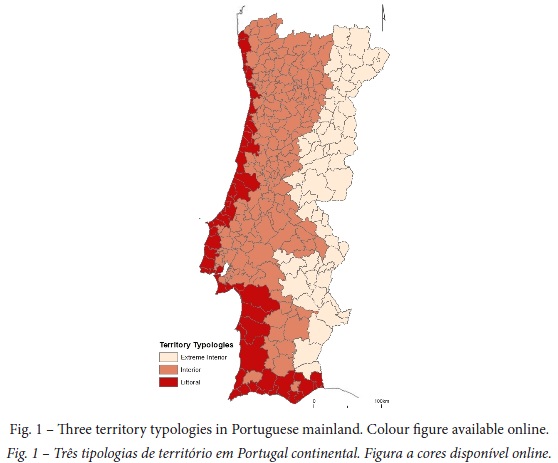
<body><![CDATA[<p>Another relevant study defines the &ldquo;Healthcare Access and Quality (HAQ) Index&rdquo;    over the period between 1990-2015. For the analysed period, some countries were    able to improve health care access and quality (such as Australia and European    countries, including Portugal), while others remain stagnant (GBD 2015 Healthcare    Access and Quality Collaborators, 2015). This study also highlights that the    geographical distribution of diseases is unequal and relates to countries&rsquo; development    levels: 1) countries&rsquo; populations with the highest socio-demographic index showed    more tendency to acquire diseases such as cancers; 2) chronic kidney disease,    diabetes, diarrhoeal diseases, and lower respiratory infections are more common    in countries with a middle socio-demographic index; 3) measles and tetanus are    more common among countries with a lower socio-demographic index (GBD 2015 Healthcare    Access and Quality Collaborators, 2015).</p>     <p ><b>&nbsp;</b></p>     <p><b>III. SOCIAL INEQUALITIES IN PORTUGAL: ACCESS TO THE NATIONAL HEALTH SERVICE    </b></p>     <p>The Portuguese National Health Service (NHS) was created in 1979 by Law n.    56/79, 15<sup>th</sup> September, with the mission to provide access to all    citizens, independent of their social and economic conditions, as well as to    foreign – in a reciprocal basis –, stateless and political refugees. The system    includes the management of integrated health care services, health promotion,    disease prevention, diagnostic and treatment means for patients and their social    and clinical rehabilitation. The Portuguese Health System Observatory (OPSS,    2003) and several studies on the evolution of the Portuguese NHS allow for an    abridged chronology (Carapinheiro &amp; Pinto, 1986; Campos, 2011; Silva, 2012):    1) 1970 to 1982 was the beginning of the NHS with its creation and expansion.    In this period, the introduction of primary health care services, namely health    centres, meant a huge advance in health promotion contributing to a more fair    and inclusive system comprising the protection of all citizens; 2) 1982 to 1995    was characterized by changing the limits between public and private services    system. Due to the integration in the Economic European Commission (UE), Portugal    benefitted from many European financing programmes that allowed significant    improvements of the NHS: better salary conditions to health professionals, creation    of health regional administrations and private health sector stimulation; 3)    From 1995 to 2002 an improvement of the public offer occurred, while the private    offer remained stagnant; 4) The establishment of a mixed system between public    and private services happened from 2002 to 2005, with the change of the original    name from National Health System to National Health Service (although the first    experience of public-private managing partnership in a public hospital in Portugal    was in 1995, in the hospital Fernando de Fonseca (Amadora-Sintra); 5) From 2005    to 2009, public policies to expand and modernize the health services with efficiency    was applied; 6) Since 2010, the NHS suffered many cuts derived from the economic    crisis, which resulted in several austerity measures.</p>     <p> Throughout its 38 years of activity, the NHS has contributed to the improvement    of services and health professionals&rsquo; quality. Despite this fact, Portugal continues    to have a mismatch between offered services and populations needs (European    Commission, 2015). In Portugal, the NHS covers all residents regardless of their    legal status. However, administrative procedures and the necessity to pay most    of the services are barriers to health care access (OECD/European Observatory    on Health Systems and Policies, 2017). The NHS foundation was based upon the    concept of the universal and general right to health protection independently    of the economic and social conditions of citizens (Assembleia da República,    2005). At present, the NHS seems to be experiencing a recovery phase, but its    fragility is visible through the analysis of the availability of services specially    related to the lack of health professionals and infrastructures serving populations    that are not living in urban areas.</p>     <p ><b>&nbsp;</b></p>     <p><b>IV. MATERIAL AND METHODS</b></p>     <p>The present article is a cross-sectional study based on statistics data from    the PORDATA database referring to the years 2001 and 2011 (census). In 2011,    the total population was registered as 10 557 560 (PORDATA, 2018a). This study&rsquo;s    target area includes the municipalities (N=278) of mainland Portugal (89 102km²),    a south-eastern European country, located on the Iberian Peninsula. The Portuguese    archipelagos of <i>Madeira</i> and <i>Açores </i> were excluded from the present    study due to scarcity of available statistical data for the selected variables.</p>     <p>Studied variables are of qualitative and quantitative type. Qualitative variables    refer to three territory typologies (<a href="#f1">fig. 1</a>): littoral, which    considered the municipalities by the sea (N=53); interior, which refers to municipalities    that do not have frontiers with the ocean (N=169); and extreme interior refers    to municipalities at the Portugal-Spain border and distant from the coastline    (N=56).</p>     <p>&nbsp;</p> <a name="f1"></a> <img src="/img/revistas/fin/n109/n109a04f1.jpg">      
]]></body>
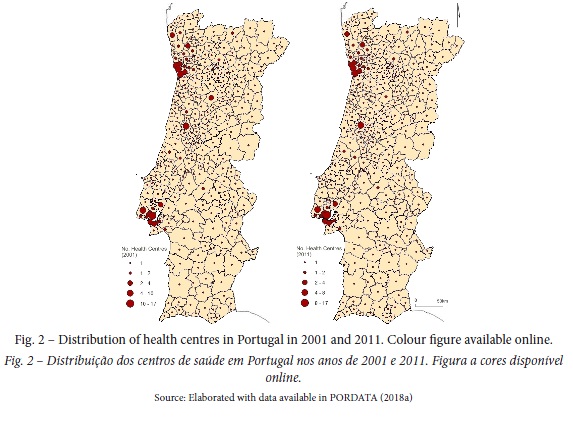
<body><![CDATA[<p>&nbsp;</p>     <p>These three territory typologies were chosen to test the association with death    vulnerability, expressed as gross death rate (number of deaths per resident    population (×1000), in each year ‰). The reason behind the choice of this variable    is related to the fact that urban and littoral territories offer more job opportunities    and easier access to education, services and health (Maia, 2001; Maia, 2014).    On the other hand, rural populations still face social barriers – especially    the elderly – related to poor health services (lack of infrastructures and human    resources), distance to education, culture, health services and vulnerable work    conditions. People living far away from urban centres, in remote and rural areas    with limited infrastructures, have less access to better health services and    also to qualified health professionals (in this case it could be interesting    to take into account, in future studies, the role of medical specialities in    appropriate and effective health care treatments applied in urgent situations)    like medical doctors and nurses (International Council of Nurses, 2011). Along    with this reality, poverty and reduced physical mobility worsens with ageing    enhancing unequal situations in these territories (Fundação Calouste Gulbenkian,    2014).</p>     <p>Independent quantitative variables are divided according to two groups. The    1<sup>st</sup> one is related to health infrastructures and human resources,    specifically: health centres density by 100km<sup>2</sup>, hospitals density    by 100km<sup>2</sup>, medical doctors and nurses working at health centres and    medical doctors and nurses working at hospitals. Taking into account the study&rsquo;s    main objective to identify the NHS conditions related to accessibility, the    first group of quantitative variables only considered public health (or NHS)    infrastructures, thus private health services are not considered. The second    group of quantitative variables relate to population characteristics: illiteracy    rate (resident population with 10 years or older who cannot read or write per    resident population with 10 years or older (× 1 000), in each year ‰) and ageing    index (population with 65 years or older per population with less than 15 years    (× 1 000), in each year ‰). In this case, it is important to continue studying    the relation between these rates and mortality due to the fact that there are    still inequalities in health services regarding life expectancy, thus revealing    that people who live in less populated regions have lower life expectancy than    urban / littoral populations (WHO, 2010). In Portugal, regions with higher vulnerability    to death are those located in <i>Centro</i> and in <i>Alentejo,</i> which are    sparsely populated, rural and interior regions. This is in accordance with reduced    health care access and higher vulnerability to preventable death (Freitas &amp;    Costa, 2015).</p>     <p>Poverty puts in evidence socioeconomic inequalities in health in both rural    and urbanpopulations, namely those who live in deprived areas in marginalized    neighbourhoods (Santana, 2017). The gap in education is known as a factor that    contributes to a poorer health condition. There is an association between better    work opportunities and better health conditions, which is related to individuals&rsquo;    quality of life, namely those who have balanced diets, physical activity practice,    economic possibilities to go on vacations and faster access to better treatments    (Alves, Correia, Barros, &amp; Azevedo, 2012; Bastos <i>et al.</i>, 2013). A    study relates jobs types (of physical or intellectual kind) to populations&rsquo;    level of education and to the occurrence of chronic back pain disease (Azevedo,    Costa-Pereira, Mendonça, Dias, &amp; Castro-Lopes, 2012). <i>ArcMap 10.5</i>    was applied to represent the spatial distribution of health services – number    of health centres and hospitals – and data was normalized by 100km<sup>2</sup>.    This option allows the understanding of which populations are most deprived    of health services and, naturally, more distant from then.</p>     <p>Statistical analyses were performed with IBM® SPSS® Statistics vs.24.0 software    and, in all comparative analyses, a confidence level of 95% or 99% (a = 0.05;    a = 0.01) was used. Data distribution was analysed by the <i> Kolmogorov-Simirnov    test </i>but normality in data distribution was not verified. Nevertheless,    parametric tests were still applied because the condition N &gt; 30 was verified    in all of the three groups of variables. Health centres density by 100km<sup>2</sup>,    hospital density by 100km<sup>2 </sup>and gross death rate comparison by territory    typology was conducted by <i>one-way ANOVA</i> of multiple comparisons with    the <i>Tukey test</i> (<i> a posteriori</i>). The <i>Spearman</i> correlation    test was applied to verify the statistic dependence between two variables. The    Paired Samples Test was performed to verify the existence of mean differences    between 2001 and 2011 for health centres and hospitals density by 100km<sup>2</sup>,    medical doctors and nurses working at health centres, medical doctors and nurses    working at hospitals, and gross death rate.</p>     <p ><b>&nbsp;</b></p>     <p><b>V. INEQUALITIES IN HEALTH SERVICES ACCESS AND RELATION WITH VULNERABILITY    TO death - RESULTS </b></p>     <p>Although Portugal is a small country, profound differences based on territorial    characteristics, in the dichotomy littoral / interior territories, were found.</p>     <p><a href="#f2">Figure 2</a> represents the distribution of Portuguese health    centres in 2001 and 2011 in mainland territory.</p>     <p>&nbsp;</p> <a name="f2"></a> <img src="/img/revistas/fin/n109/n109a04f2.jpg">      
]]></body>
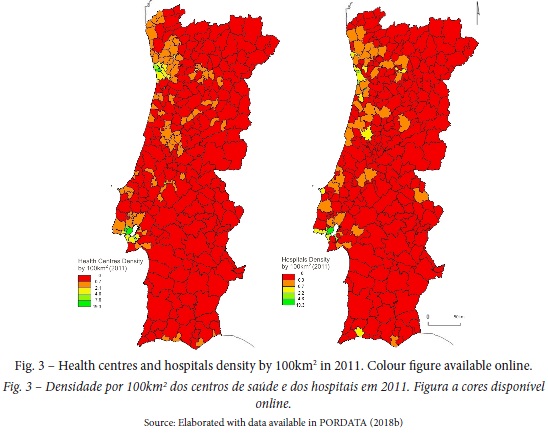
<body><![CDATA[<p>&nbsp;</p>     <p><a href="#f2">Figure 2</a> shows that the asymmetries of health services distribution    are clear, namely the number of health centres available, and suggests that    urban areas, mostly located in metropolitan areas, such as Porto and Lisboa,    are those with more services which could result in better health care access    (Simões <i>et al.</i>, 2007). Another important issue to emphasize is that in    the period analysed health services distribution did not benefit improvements,    especially in regions where only one health centre exists for each municipality.</p>     <p><a href="#f3">Figure 3</a> represents health centres and hospital density by    100km<sup>2</sup> in 2011, exhibiting a visible asymmetry of health services    distribution.</p>     <p>&nbsp;</p> <a name="f3"></a> <img src="/img/revistas/fin/n109/n109a04f3.jpg">      
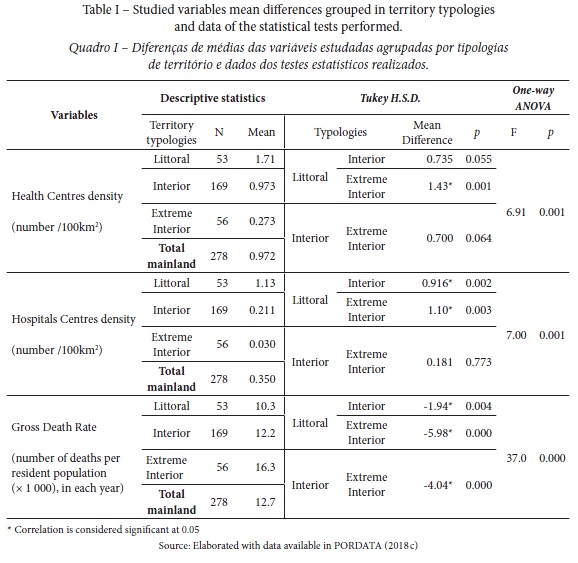
<p>&nbsp;</p>     <p>Maps show the mismatch between the availability of health services and population    in a territory, a condition that is linked to higher vulnerability of death    by preventable causes. In 2011, the municipalities with higher health centres    density per 100km<sup>2</sup> were Porto (19), Lisboa (16), Amadora (12), S.    João da Madeira (12) and Odivelas (7). The municipalities with lower health    centres density per 100km<sup>2 </sup>were Évora (0.07), Idanha<i>-</i>a-Nova    (0.07), Castelo Branco (0.06), Alcácer do Sal (0.06) and Odemira (0.05). All    the municipalities with higher health centres density are part of Porto and    Lisboa metropolitan areas. On the other hand, municipalities with lower health    centres density are all located in interior and extreme interior regions at    the centre - south mainland. These results underline the polarization of health    services and the uneven distribution of health services. Hospitals&rsquo; distribution    is similar to health centres&rsquo; distribution but, generally, the existence of    these infrastructures is reduced. According to <a href="#f2">figure 2</a>, only    municipalities that are assumed as urban areas have hospitals. Only some municipalities    of the <i>Porto</i> and <i>Lisboa</i> metropolitan areas and also <i>Algarve</i>    have more than 1 hospital per 100km<sup>2</sup><sub>. </sub>The asymmetric distribution    is visible when comparing regions that have 19 hospitals per 100km<sup>2 </sup>–    municipalities of <i>Porto</i> and <i>Lisboa</i> – and the main territory which    have 0.01 hospitals per 100km<sup>2</sup> – <i>Alentejo</i>, interior <i>Centro</i>    and interior <i>Norte</i>.</p>     <p>Health centres and hospitals distribution, and gross death rate differences    are present between territory typologies (<a href="#t1">table I</a>). From littoral    to extreme interior mean reductions of 1.4 in health centres and of 1.1 in hospitals    were found.</p>     <p>&nbsp;</p> <a name="t1"></a> <img src="/img/revistas/fin/n109/n109a04t1.jpg">      
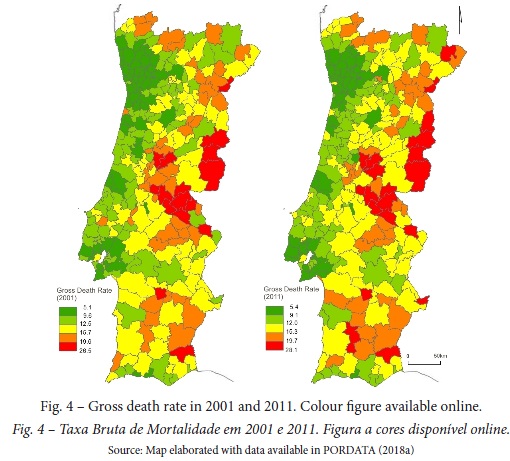
<p>&nbsp;</p>     <p> According to <a href="#f4">figure 4</a>, between 2001 to 2011, gross death    rate trend is very similar, maintaining the littoral-interior dichotomy. Extreme    interior regions, by the Spain border, exhibit the highest gross death rate    values.</p>     ]]></body>
<body><![CDATA[<p>&nbsp;</p> <a name="f4"></a> <img src="/img/revistas/fin/n109/n109a04f4.jpg">      
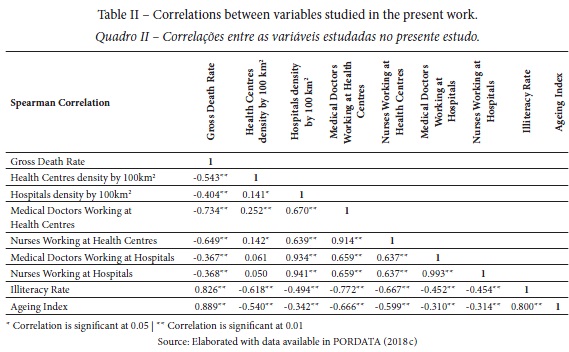
<p>&nbsp;</p>     <p>The mean gross death rate is higher (by 5.9 points) in extreme interior when    compared to littoral. In order to identify variables correlations the <i>Spearman</i>    correlation test was performed and results are presented on <a href="#t2">table    II</a>.</p>     <p>&nbsp;</p> <a name="t2"></a> <img src="/img/revistas/fin/n109/n109a04t2.jpg">      
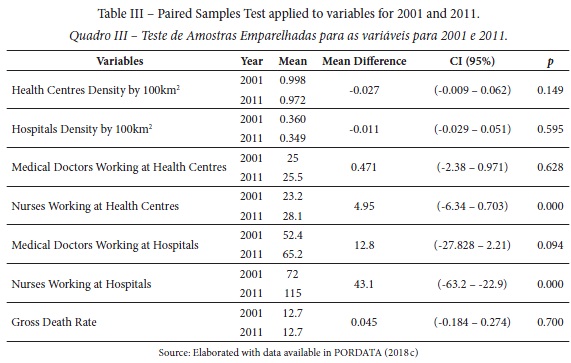
<p>&nbsp;</p>     <p>Gross death rate has a very strong association with illiteracy rate (r<sub>s</sub>    = 0.826; p &lt; 0.01) and with ageing index (r<sub>s</sub>= 0.889; p &lt; 0.01).    This suggests that in municipalities with more illiterate and aged populations,    the vulnerability to death is higher. Alongside, there is a strong negative    correlation between the number of health professionals at health centres and    the gross death rate, namely medical doctors (r<sub>s </sub>= 0.734; p &lt;    0.01) and nurses (r<sub>s</sub> = 0.649; p &lt; 0.01). Results also show a negative    correlation between the ageing index and health professionals at health centres:    number of medical doctors (r<sub>s</sub> =0.666; p &lt; 0.01) and nurses (r<sub>s</sub>    =0.599; p &lt; 0.01). A moderate correlation between health centres density    by 100km<sup>2</sup> and gross death rate (r<sub>s</sub>= 0.543; p &lt; 0.01)    was found at very significant level. <a href="#t3">Table III</a> exhibits Paired    Samples Test results in order to compare the years 2001 and 2011. Only two variables    &ldquo;nurses working at health centres&rdquo; and &ldquo;nurses working at hospitals&rdquo; show statistically    significant mean differences (<i>p</i> &lt; 0,001).</p>     <p>&nbsp;</p> <a name="t3"></a> <img src="/img/revistas/fin/n109/n109a04t3.jpg">      
<p>&nbsp;</p>     <p ><b>&nbsp;</b></p>     <p><b>VI. DISCUSSION</b></p>     ]]></body>
<body><![CDATA[<p>Health centres provide the primary answer in health promotion, such as disease    prevention and treatment, services that should be available to all citizens.    Access to an appropriate health care service should combine multiple dimensions:    good health perceiving and service response; adaptation of health services to    populations&rsquo; needs; proximity to health services; direct costs related to health    services acquisitions; indirect costs related to transports to health centres    or hospitals; quality of health service organization (Furtado &amp; Pereira,    2010). Besides, distance to health services has an important role in amenable    and preventable deaths. The number of inhabitants per health centre shows that    in 2011, in the most populated mainland regions, there are more health centres    to respond to populations needs (PORDATA, 2018b). This demographic portrait    conveys the idea that the primary health services distribution is adjusted to    the number of resident population. However, what this paper emphasizes is that    in the less populated regions, namely in the central and northern interiors,    <i>Alentejo</i> and in the most part of the <i>Algarve</i> region, ageing, depopulation    and low population density contribute to an increase in death vulnerability    in acute illness situations because the distance to reach the health centre    is not taken into account. Results of health centres and hospitals spatial distribution    reveal a clear situation of imbalance and inequity of populations living in    interior and extreme interior regions that are also aged and low density populated    areas. If equity to health care is merely accountable by the number of inhabitants    served by a health infrastructure, than the existence of fewer health infrastructures    in less populated regions would become rational. However, this criterion alone    does not take into consideration the response time to acute situations or the    availability of medical specialities that commonly exist only at principal hospitals.</p>     <p>Health centres, hospitals and gross death rate distribution are not symmetric.    The difference related to health services distribution between territories typologies    enhance the huge disparity in gross death rate distribution (F = 37.0; <i>p</i>    = 0.000). Interior and extreme interior municipalities count on only one health    centre. A recent study (Santana &amp; Teixeira, 2017), reports that, in 2016,    the number of available family doctors for a universe of 5210785 health users    was only 2936 and the distribution continues to be very asymmetric in some interior    municipalities without familiar health units. The Population Health Index (<a href="http://saudemunicipio.uc.pt/" target="_blank">http://saudemunicipio.uc.pt/</a>)    developed at the <i>Centro de Estudos em Geografia e Ordenamento do Território    (CEGOT) da Universidade de Coimbra</i> reveals that profound differences related    to primary health care access, namely the distance between patients&rsquo; residence    and health local units are still present in mainland Portugal.</p>     <p>Although lower population density is usual in these territories, their correspondent    geographical area is large, consequently, the distance from population residences    to health services is considerable. Alongside this evidence, is it visible that    the ageing index is higher in these territories, which contribute to physical    and social barriers to health care access. Results reveal differences between    littoral and interior regions: in the latter, as regions are more isolated and    apart from littoral, the lack of health professionals and infrastructures exhibits    higher values of gross death and illiteracy rates. This fact is emphasized in    the OECD Report (2016) which refers to the fact that Portugal has a higher medical    doctor&rsquo;s ratio per 1000 inhabitants (4.4) when compared to the mean European    ratio (3.5). On the other hand, nurses ratio per 1 000 inhabitants (also 4.4)    in Portugal is about half of the European mean (8.4) ranking the country in    10<sup>th</sup> position (OECD/EU, 2016). In agreement with these results, Furtado    &amp; Pereira (2010) conclude, that rural areas, particularly in interior regions,    continue to be more distant from specialized hospitals than other regions. Diverse    accessibility difficulties, namely isolation, poverty and absence of health    education, are the main intrinsic barriers to the population&rsquo;s access to health    care services (Santana, 2010). The continuous process of ageing in Portugal    contributes to the aggravation of inequalities in health care access due to    the fact of high dependency and poor mobility among the elderly. These results    also demonstrate that the lack of education contributes to higher death vulnerability    (Pereira, 2002; Pereira &amp; Pedro, 2004; Veiga, 2005). Improving access should    also take into account &ldquo;(&hellip;)the social factors influencing access&rdquo; (Ministry    of Health and Social Policy of Spain, 2010, p. 16).</p>     <p>The comparison of results between 2001 and 2011 reveals that, over a decade,    there were only significant increases in nurses both working at health centres    and at hospitals. For all the other variables – medical doctors working both    at health centres and at hospitals and health centres and hospitals density    by 100km<sup>2</sup> –, means values were not statistically different. On the    other hand, the gross death rate does not present a significant decrease, following    the trend of the other variables.</p>     <p>Some studies consider that population concentration, namely in urban and littoral    areas, is beneficial to faster access to health services (Santana, 2010). Nevertheless,    concentration of health infrastructures at urban and littoral areas also represents    an example of a unfair access to health services. Another relevant result for    the prevention of death mortality is the important role of medical doctors (r<sub>s</sub>=    0.734; p &lt; 0.01) and nurses (r<sub>s</sub>= 0.649; p &lt; 0.01) working at    health centres, when compared with the same professionals at hospitals, medical    doctors (r<sub>s</sub>= 0.367; p &lt; 0.01) and nurses (r<sub>s</sub>= 0.368;    p &lt; 0.01). Thus, the relationship between these services and the mortality    rate may be justified by health promotion activities by health centres, contributing    to health literacy and disease prevention through closer and more direct contact    with younger to older populations, aligning the transmitted content to the specific    needs of each age group.</p>     <p ><b>&nbsp;</b></p>     <p><b>VII. CONCLUSIONS</b></p>     <p>The importance of an efficient and attainable national health service is related    with its capacity to eliminate health inequalities, contributing to a more fair    and equitable society. Health protection and promotion are fundamental rights    enabling human life, health, wellbeing and life quality. In order to develop    an all-inclusive, universally attainable national health service, public investments    should be provided: health education and promotion (healthy eating habits, physical    and social mobility) in order to prevent disease and to enhance life quality    of long-morbidity patients. Health inequalities act as social inequality generators,    which require investment in health literacy at local communities, enlightenment    on health concepts and symptoms. Notwithstanding the recognized importance of    the National Health Service in Portugal, the result of this work provides evidence    for the fact that mortality is associated with the distribution of health services    – number of infrastructures and professional services – and population characteristics    related to illiteracy and ageing. Therefore, supported on these results, the    main conclusion of the present paper is related to the way that health public    policies are designed. The results show that health services are distributed    only according to population density. This reality does not take into account    population needs and is linked to the fact that in most ageing areas there is    a lack of health services, which contributes to a differential mortality. In    the health public policies field, the main conclusion is that in a decade (2001    – 2011) the distribution of health infrastructures and professionals do not    suffer a significant increase, revealing a disinvestment in the promotion of    a fair distribution of health services and fighting against inequity in health    services access.</p>     <p>These results provide knowledge about mainland health care services at the    municipality level. Another expected contribution from the present work is the    exposure of the urgent need of more in-deep research that would associate the    population&rsquo;s socioeconomic realities with health care access constraints, suggesting    the need for a health public policies reformulation, in particular by emphasizing    the specificities and needs of each region.</p>     <p ><b>&nbsp;</b></p>     ]]></body>
<body><![CDATA[<p><b>ACKNOWLEDGEMENTS</b></p>     <p>This work was part of a research project of FP-ENAS - UFP Energy, Environment    and Health Research Unit funded by FCT – <i>Fundação para a Ciência e a Tecnologia,    I.P.</i> through project UID/MULTI/4546/2016.</p>     <p>The authors would like to thank the peer review of anonymous reviewers for    their valuable comments and suggestions that contributed to the improvement    of paper.</p>     <p ><b>&nbsp;</b></p>     <p><b>REFERENCES</b></p>     <!-- ref --><p>Alves, E., Correia, S., Barros, H., &amp; Azevedo, A. (2012). Prevalence of    self-reported cardiovascular risk factors in Portuguese women: a survey after    delivery. <i>International Journal of Public Health, 57</i>(5), 837-847.    &nbsp;&nbsp;&nbsp;&nbsp;&nbsp;&nbsp;&nbsp;&nbsp;[&#160;<a href="javascript:void(0);" onclick="javascript: window.open('/scielo.php?script=sci_nlinks&ref=299402&pid=S0430-5027201800030000400001&lng=','','width=640,height=500,resizable=yes,scrollbars=1,menubar=yes,');">Links</a>&#160;]<!-- end-ref --></p>     <p>Assembleia da República. (2005). Artigo 64. º. <i>Constituição da República    Portuguesa. VII Revisão Constitucional </i>[Article 64<sup>th</sup>. Portuguese    Republic Constitution. VII Constitutional Revision].</p>     <!-- ref --><p>Azevedo, L. F., Costa-Pereira, A., Mendonça, L., Dias, C. C., &amp; Castro-Lopes,    J. M. (2012). Epidemiology of chronic pain: a population-based nationwide study    on its prevalence, characteristics and associated disability in Portugal. <i>Journal    of Pain, 13</i>(8), 773-783.    &nbsp;&nbsp;&nbsp;&nbsp;&nbsp;&nbsp;&nbsp;&nbsp;[&#160;<a href="javascript:void(0);" onclick="javascript: window.open('/scielo.php?script=sci_nlinks&ref=299405&pid=S0430-5027201800030000400002&lng=','','width=640,height=500,resizable=yes,scrollbars=1,menubar=yes,');">Links</a>&#160;]<!-- end-ref --></p>     ]]></body>
<body><![CDATA[<p>Bastos, J., Peleteiro, B., Barros, R., Alves, L., Severo, M., De Fátima Pina,    M&hellip; Lunet, N. (2013). Sociodemographic determinants of prevalence and incidence    of Helicobacter pylori infection in Portuguese adults. <i> Helicobacter, 18</i>(6),    413-422.</p>     <!-- ref --><p>Campos, A. C. (2011). <i>O Percurso da Saúde: Portugal na Europa </i>[The path    of Health: Portugal in Europe]<i>.</i> Coimbra: Almedina.    &nbsp;&nbsp;&nbsp;&nbsp;&nbsp;&nbsp;&nbsp;&nbsp;[&#160;<a href="javascript:void(0);" onclick="javascript: window.open('/scielo.php?script=sci_nlinks&ref=299408&pid=S0430-5027201800030000400004&lng=','','width=640,height=500,resizable=yes,scrollbars=1,menubar=yes,');">Links</a>&#160;]<!-- end-ref --></p>     <!-- ref --><p>Carapinheiro, G., &amp; Pinto, M. P. (1986). Políticas de saúde num país em    mudança: Portugal nos anos 70 e 80 [Health policies in a changing country: Portugal    in 70's and 80's]. <i>Sociologia, Problemas e Práticas, 1</i>, 71-109.    &nbsp;&nbsp;&nbsp;&nbsp;&nbsp;&nbsp;&nbsp;&nbsp;[&#160;<a href="javascript:void(0);" onclick="javascript: window.open('/scielo.php?script=sci_nlinks&ref=299410&pid=S0430-5027201800030000400005&lng=','','width=640,height=500,resizable=yes,scrollbars=1,menubar=yes,');">Links</a>&#160;]<!-- end-ref --></p>     <!-- ref --><p>Champman, J. L., Zechel, A., Carter, Y. H., &amp; Abbott, S. (2004). Systematic    review of recent innovation in service provision to improve access to primary    care. <i>British Journal of General Practice, 54</i>(502), 374-381.    &nbsp;&nbsp;&nbsp;&nbsp;&nbsp;&nbsp;&nbsp;&nbsp;[&#160;<a href="javascript:void(0);" onclick="javascript: window.open('/scielo.php?script=sci_nlinks&ref=299412&pid=S0430-5027201800030000400006&lng=','','width=640,height=500,resizable=yes,scrollbars=1,menubar=yes,');">Links</a>&#160;]<!-- end-ref --></p>     <!-- ref --><p>Charlton, J., Hartley, R., &amp; Holland, W. (1983). Geographical variation    in mortality from conditions amenable to medical intervention in England and    Wales. <i>The Lancet</i>, 691-696.    &nbsp;&nbsp;&nbsp;&nbsp;&nbsp;&nbsp;&nbsp;&nbsp;[&#160;<a href="javascript:void(0);" onclick="javascript: window.open('/scielo.php?script=sci_nlinks&ref=299414&pid=S0430-5027201800030000400007&lng=','','width=640,height=500,resizable=yes,scrollbars=1,menubar=yes,');">Links</a>&#160;]<!-- end-ref --></p>     <!-- ref --><p>Dalrymple, T. (2012). The inverse care law. <i>BMJ, </i>344. doi: 10.1136/bmj.e1633&nbsp;&nbsp;&nbsp;&nbsp;&nbsp;&nbsp;&nbsp;&nbsp;[&#160;<a href="javascript:void(0);" onclick="javascript: window.open('/scielo.php?script=sci_nlinks&ref=299416&pid=S0430-5027201800030000400008&lng=','','width=640,height=500,resizable=yes,scrollbars=1,menubar=yes,');">Links</a>&#160;]<!-- end-ref --><!-- ref --><p>Direção-Geral da Saúde. (2015). <i>Plano Nacional de Saúde. Revisão e Extensão    a 2020 </i>[National Health Plan. Revision and Extension to 2020]<i>. </i>Lisboa:    Direção-Geral da Saúde.    &nbsp;&nbsp;&nbsp;&nbsp;&nbsp;&nbsp;&nbsp;&nbsp;[&#160;<a href="javascript:void(0);" onclick="javascript: window.open('/scielo.php?script=sci_nlinks&ref=299417&pid=S0430-5027201800030000400009&lng=','','width=640,height=500,resizable=yes,scrollbars=1,menubar=yes,');">Links</a>&#160;]<!-- end-ref --></p>     <!-- ref --><p>Direção-Geral da Saúde. (2012). <i>Plano Nacional de Saúde 2012-2016 - 3.2.    Eixo Estratégico - Equidade e Acesso aos Cuidados de Saúde </i>[National Health    Plan 2012-2016 - 3.2. Strategic Axes - Equity and Access to Health Care]<i>.    </i>Lisboa: Direção-Geral da Saúde.    &nbsp;&nbsp;&nbsp;&nbsp;&nbsp;&nbsp;&nbsp;&nbsp;[&#160;<a href="javascript:void(0);" onclick="javascript: window.open('/scielo.php?script=sci_nlinks&ref=299419&pid=S0430-5027201800030000400010&lng=','','width=640,height=500,resizable=yes,scrollbars=1,menubar=yes,');">Links</a>&#160;]<!-- end-ref --></p>     <!-- ref --><p>Entidade Reguladora da Saúde. (2009). <i>Estudo do Acesso aos Cuidados de Saúde    Primários do </i>SNS [Access to NHS Primary Cares Study]<i>. </i>Porto: Entidade    Reguladora da Saúde.    &nbsp;&nbsp;&nbsp;&nbsp;&nbsp;&nbsp;&nbsp;&nbsp;[&#160;<a href="javascript:void(0);" onclick="javascript: window.open('/scielo.php?script=sci_nlinks&ref=299421&pid=S0430-5027201800030000400011&lng=','','width=640,height=500,resizable=yes,scrollbars=1,menubar=yes,');">Links</a>&#160;]<!-- end-ref --></p>     <!-- ref --><p>European Commission. (2015). <i>Social situation monitor - income inequality    in EU countries.</i> Brussels: European Commission.    &nbsp;&nbsp;&nbsp;&nbsp;&nbsp;&nbsp;&nbsp;&nbsp;[&#160;<a href="javascript:void(0);" onclick="javascript: window.open('/scielo.php?script=sci_nlinks&ref=299423&pid=S0430-5027201800030000400012&lng=','','width=640,height=500,resizable=yes,scrollbars=1,menubar=yes,');">Links</a>&#160;]<!-- end-ref --></p>     <!-- ref --><p>Eurostat. (2017). <i>Amenable and Preventable deaths statistics.</i> Retrieved    from <a href="http://ec.europa.eu/eurostat/statistics-explained/index.php/Amenable_and_preventable_deaths_statistics" target="_blank">    http://ec.europa.eu/eurostat/statistics-explained/index.php/Amenable_and_preventable_deaths_statistics</a>&nbsp;&nbsp;&nbsp;&nbsp;&nbsp;&nbsp;&nbsp;&nbsp;[&#160;<a href="javascript:void(0);" onclick="javascript: window.open('/scielo.php?script=sci_nlinks&ref=299425&pid=S0430-5027201800030000400013&lng=','','width=640,height=500,resizable=yes,scrollbars=1,menubar=yes,');">Links</a>&#160;]<!-- end-ref --><p>Freitas, Â., &amp; Costa, C. (2015). Resultados em Saúde e Determinantes Contextuais    [Health Results and Contextual Determinants]. In P. Santana (Ed.) <i>A Geografia    da Saúde da População. Evolução nos últimos 20 anos em Portugal Continental    </i>[Health population Geography. Last 20 years Mainland Portugal Evolution]    (pp. 15-79). Coimbra: CEGOT - Universidade de Coimra.</p>     ]]></body>
<body><![CDATA[<!-- ref --><p>Fundação Calouste Gulbenkian. (2014). <i>Um Futuro para a Saúde - todos temos    um papel a desempenhar </i>[A Future for Health – We all have a role to play].    Lisboa: Fundação Calouste Gulbenkian.    &nbsp;&nbsp;&nbsp;&nbsp;&nbsp;&nbsp;&nbsp;&nbsp;[&#160;<a href="javascript:void(0);" onclick="javascript: window.open('/scielo.php?script=sci_nlinks&ref=299427&pid=S0430-5027201800030000400015&lng=','','width=640,height=500,resizable=yes,scrollbars=1,menubar=yes,');">Links</a>&#160;]<!-- end-ref --></p>     <!-- ref --><p>Furler, J. S, Harris, E., Chondros, P., Davies, P. G. P., Harris, M. F., &amp;    Young, D. Y. (2002). The inverse care law revisited: impact of disadvantaged    location on accessing longer GP consultation times. <i>Medical Journal of Australia</i>,    <i>177</i>, 80–83. Retrieved from <a href="https://www.mja.com.au/journal/2002/177/2/inverse-care-law-revisited-impact-disadvantaged-location-accessing-longer-gp" target="_blank">    https://www.mja.com.au/journal/2002/177/2/inverse-care-law-revisited-impact-disadvantaged-location-accessing-longer-gp</a>&nbsp;&nbsp;&nbsp;&nbsp;&nbsp;&nbsp;&nbsp;&nbsp;[&#160;<a href="javascript:void(0);" onclick="javascript: window.open('/scielo.php?script=sci_nlinks&ref=299429&pid=S0430-5027201800030000400016&lng=','','width=640,height=500,resizable=yes,scrollbars=1,menubar=yes,');">Links</a>&#160;]<!-- end-ref --><!-- ref --><p>Furtado, C., &amp; Pereira, J. (2010). <i>Equidade e Acesso aos Cuidados de    Saúde </i>[Equity in Health Care Access]<i>.</i> Lisboa: Alto Comissariado da    Saúde. Retrieved from <a href=" http://www.acs.min-saude.pt/pns2011-2016/files/2010/08/EA1.pdf" target="_blank">http://www.acs.min-saude.pt/pns2011-2016/files/2010/08/EA1.pdf</a>&nbsp;&nbsp;&nbsp;&nbsp;&nbsp;&nbsp;&nbsp;&nbsp;[&#160;<a href="javascript:void(0);" onclick="javascript: window.open('/scielo.php?script=sci_nlinks&ref=299430&pid=S0430-5027201800030000400017&lng=','','width=640,height=500,resizable=yes,scrollbars=1,menubar=yes,');">Links</a>&#160;]<!-- end-ref --><!-- ref --><p>Hart, J. T. (2000). Commentary: Three decades of the Inverse Care Law. <i>British    Medical Journal</i>, <i>320</i>(1), 15-19.    &nbsp;&nbsp;&nbsp;&nbsp;&nbsp;&nbsp;&nbsp;&nbsp;[&#160;<a href="javascript:void(0);" onclick="javascript: window.open('/scielo.php?script=sci_nlinks&ref=299431&pid=S0430-5027201800030000400018&lng=','','width=640,height=500,resizable=yes,scrollbars=1,menubar=yes,');">Links</a>&#160;]<!-- end-ref --></p>     <!-- ref --><p>Hart, J. T. (1971). The Inverse Care Law. <i>The Lancet</i>, <i>297</i>, 405-412.    doi: 10.1016/S0140-6736(71)92410-X&nbsp;&nbsp;&nbsp;&nbsp;&nbsp;&nbsp;&nbsp;&nbsp;[&#160;<a href="javascript:void(0);" onclick="javascript: window.open('/scielo.php?script=sci_nlinks&ref=299433&pid=S0430-5027201800030000400019&lng=','','width=640,height=500,resizable=yes,scrollbars=1,menubar=yes,');">Links</a>&#160;]<!-- end-ref --><!-- ref --><p>Gay, J. G., Paris, V., Devaux, M., &amp; De Looper, M. (2011). <i>Mortality    amenable to health care in 31 OECD countries: estimates and methodological issues.</i>    OECD Publishing: OECD Health Working Papers - No.55.    &nbsp;&nbsp;&nbsp;&nbsp;&nbsp;&nbsp;&nbsp;&nbsp;[&#160;<a href="javascript:void(0);" onclick="javascript: window.open('/scielo.php?script=sci_nlinks&ref=299434&pid=S0430-5027201800030000400020&lng=','','width=640,height=500,resizable=yes,scrollbars=1,menubar=yes,');">Links</a>&#160;]<!-- end-ref --></p>     <!-- ref --><p>GBD 2015 Healthcare Access and Quality Collaborators. (2015). Healthcare Access    and Quality Index based on mortality from causes amenable to personal health    care in 195 countries and territories, 1990–2015: a novel analysis from the    Global Burden of Disease Study 2015. <i>The Lancet, 390</i>, 231-266.    &nbsp;&nbsp;&nbsp;&nbsp;&nbsp;&nbsp;&nbsp;&nbsp;[&#160;<a href="javascript:void(0);" onclick="javascript: window.open('/scielo.php?script=sci_nlinks&ref=299436&pid=S0430-5027201800030000400021&lng=','','width=640,height=500,resizable=yes,scrollbars=1,menubar=yes,');">Links</a>&#160;]<!-- end-ref --></p>     <!-- ref --><p>Gianino, M. M., Lenzi, J., Fantini, M. P., Ricciardi, W., &amp; Damiani, G.    (2017). Declining amenable mortality: a reflection of health care systems? <i>BMC    Health Services Research, 17</i>(735), 1-8.    &nbsp;&nbsp;&nbsp;&nbsp;&nbsp;&nbsp;&nbsp;&nbsp;[&#160;<a href="javascript:void(0);" onclick="javascript: window.open('/scielo.php?script=sci_nlinks&ref=299438&pid=S0430-5027201800030000400022&lng=','','width=640,height=500,resizable=yes,scrollbars=1,menubar=yes,');">Links</a>&#160;]<!-- end-ref --></p>     <!-- ref --><p>Gulliford, M., Figueroa-Munoz, J., Morgan, M., Hughes, D., Gibson, B., Beech,    R., &amp; Hudson, M. (2002). What does 'access to health care' mean? <i>J. Health    Serv. Res. Policy</i>, <i>7</i>, 186-188. Retrieved from <a  href="https://www.ncbi.nlm.nih.gov/pubmed/12171751" target="_blank">https://www.ncbi.nlm.nih.gov/pubmed/12171751</a>&nbsp;&nbsp;&nbsp;&nbsp;&nbsp;&nbsp;&nbsp;&nbsp;[&#160;<a href="javascript:void(0);" onclick="javascript: window.open('/scielo.php?script=sci_nlinks&ref=299440&pid=S0430-5027201800030000400023&lng=','','width=640,height=500,resizable=yes,scrollbars=1,menubar=yes,');">Links</a>&#160;]<!-- end-ref --><!-- ref --><p>International Council of Nurses. (2011). <i>Closing the gap: Increasing access    and equity.</i> Geneva: Internacional Council of Nurses.    &nbsp;&nbsp;&nbsp;&nbsp;&nbsp;&nbsp;&nbsp;&nbsp;[&#160;<a href="javascript:void(0);" onclick="javascript: window.open('/scielo.php?script=sci_nlinks&ref=299441&pid=S0430-5027201800030000400024&lng=','','width=640,height=500,resizable=yes,scrollbars=1,menubar=yes,');">Links</a>&#160;]<!-- end-ref --></p>     <p>Mackenbach, J. P., Hu, Y., Artnik, B., Bopp, M., Costa, G., Kalediene, R&hellip; Nusselder,    W. J. (2017). Trends In Inequalities In Mortality Amenable To Health Care In    17 European Countries. <i>Health Affairs, 36</i>(6), 1110-1118.</p>     <p>Maia, R. L. (2001). Descontinuidades e Permanências nas Estruturas da Economia    e da Sociedade Portuguesas nos Últimos Sessenta Anos [Discontinuities and Permanence&rsquo;s    in Portuguese Economy and Society structures in the Last Sixty Years]. <i>Actas    do IV Congresso Português de Sociologia</i> (pp. 1-22). Coimbra: Associação    Portuguesa de Sociologia.</p>     <!-- ref --><p>Maia, R. L. (2014). Competition and Complementarity: Notes on the Internacional    Projection of Europe's West Coast. In P. M. Santos &amp; P. C. Seixas (Eds.),    <i>Globalization and Metropolization: Perspectives on Europe's West Coast</i>    (pp. 27-40)<i>.</i> Berkeley: Institute of Governmental Studies.    &nbsp;&nbsp;&nbsp;&nbsp;&nbsp;&nbsp;&nbsp;&nbsp;[&#160;<a href="javascript:void(0);" onclick="javascript: window.open('/scielo.php?script=sci_nlinks&ref=299445&pid=S0430-5027201800030000400027&lng=','','width=640,height=500,resizable=yes,scrollbars=1,menubar=yes,');">Links</a>&#160;]<!-- end-ref --></p>     ]]></body>
<body><![CDATA[<!-- ref --><p>McCoy, D. (2003). <i>Health Sector Responses to HIV/AIDS and treatments access    in southern Africa: Addressing equity. </i>United Kingdom: Regional Network    for Equity in Health in Southern Africa (EQUINET) in co-operation with Oxfam    GB.    &nbsp;&nbsp;&nbsp;&nbsp;&nbsp;&nbsp;&nbsp;&nbsp;[&#160;<a href="javascript:void(0);" onclick="javascript: window.open('/scielo.php?script=sci_nlinks&ref=299447&pid=S0430-5027201800030000400028&lng=','','width=640,height=500,resizable=yes,scrollbars=1,menubar=yes,');">Links</a>&#160;]<!-- end-ref --></p>     <!-- ref --><p>Ministry of Health and Social Policy of Spain. (2010). <i>Moving forward in    Health. Monitoring Social Determinants of Health and the re-education of Health    Inequalities: An Independent Report Commissioned through the Spanish Presidency    of the EU.</i> Spain: Ministry of Health and Social Policy in Spain.    &nbsp;&nbsp;&nbsp;&nbsp;&nbsp;&nbsp;&nbsp;&nbsp;[&#160;<a href="javascript:void(0);" onclick="javascript: window.open('/scielo.php?script=sci_nlinks&ref=299449&pid=S0430-5027201800030000400029&lng=','','width=640,height=500,resizable=yes,scrollbars=1,menubar=yes,');">Links</a>&#160;]<!-- end-ref --></p>     <!-- ref --><p>Nambiar, D., &amp; Mander, H. (2017). Inverse care and the role of the state:    the health of the urban poor. <i>Bull. World Health Organization</i>, <i>95</i>(2),    152-153. doi: 10.2471/BLT.16.179325&nbsp;&nbsp;&nbsp;&nbsp;&nbsp;&nbsp;&nbsp;&nbsp;[&#160;<a href="javascript:void(0);" onclick="javascript: window.open('/scielo.php?script=sci_nlinks&ref=299451&pid=S0430-5027201800030000400030&lng=','','width=640,height=500,resizable=yes,scrollbars=1,menubar=yes,');">Links</a>&#160;]<!-- end-ref --><!-- ref --><p>Nolte, E., &amp; Mckee, C. M. (2008). Measuring the health of nations: updating    an earlier analysis. <i>Health Affairs, 27</i>, 58-71.    &nbsp;&nbsp;&nbsp;&nbsp;&nbsp;&nbsp;&nbsp;&nbsp;[&#160;<a href="javascript:void(0);" onclick="javascript: window.open('/scielo.php?script=sci_nlinks&ref=299452&pid=S0430-5027201800030000400031&lng=','','width=640,height=500,resizable=yes,scrollbars=1,menubar=yes,');">Links</a>&#160;]<!-- end-ref --></p>     <!-- ref --><p>Nolte, E., &amp; Mckee, C. M. (2012). Amenable mortality - deaths avoidable    through health care - progress in the US lags that of three European countries.    <i>Health Affairs, 31</i>, 2114-2122.    &nbsp;&nbsp;&nbsp;&nbsp;&nbsp;&nbsp;&nbsp;&nbsp;[&#160;<a href="javascript:void(0);" onclick="javascript: window.open('/scielo.php?script=sci_nlinks&ref=299454&pid=S0430-5027201800030000400032&lng=','','width=640,height=500,resizable=yes,scrollbars=1,menubar=yes,');">Links</a>&#160;]<!-- end-ref --></p>     <!-- ref --><p>Nolte, E., &amp; Mckee, M. (2004). <i>Does health care save lives? Avoidable    mortality revisited.</i> London: The Nuffield Trust.    &nbsp;&nbsp;&nbsp;&nbsp;&nbsp;&nbsp;&nbsp;&nbsp;[&#160;<a href="javascript:void(0);" onclick="javascript: window.open('/scielo.php?script=sci_nlinks&ref=299456&pid=S0430-5027201800030000400033&lng=','','width=640,height=500,resizable=yes,scrollbars=1,menubar=yes,');">Links</a>&#160;]<!-- end-ref --></p>     <!-- ref --><p>Observatório Português dos Sistemas de Saúde. (OPSS). (2003). Evolução do Sistema    de Saúde [Health System Evolution]. Retrieved from <a href="http://www.opss.pt/node/141" target="_blank">http://www.opss.pt/node/141</a>&nbsp;&nbsp;&nbsp;&nbsp;&nbsp;&nbsp;&nbsp;&nbsp;[&#160;<a href="javascript:void(0);" onclick="javascript: window.open('/scielo.php?script=sci_nlinks&ref=299458&pid=S0430-5027201800030000400034&lng=','','width=640,height=500,resizable=yes,scrollbars=1,menubar=yes,');">Links</a>&#160;]<!-- end-ref --><!-- ref --><p>European Observatory on Health Systems and Policies. (OECD). (2017). <i>Portugal:    Country Health Profile 2017.</i> Brussels: European Observatory on Health Systems    and Policies.    &nbsp;&nbsp;&nbsp;&nbsp;&nbsp;&nbsp;&nbsp;&nbsp;[&#160;<a href="javascript:void(0);" onclick="javascript: window.open('/scielo.php?script=sci_nlinks&ref=299459&pid=S0430-5027201800030000400035&lng=','','width=640,height=500,resizable=yes,scrollbars=1,menubar=yes,');">Links</a>&#160;]<!-- end-ref --></p>     <!-- ref --><p>European Observatory on Health Systems and Policies. (OECD). (2016). Health    at a Glance: Europe 2016 - State of Health in the EU Cycle. Paris: OECD Publishing&nbsp;&nbsp;&nbsp;&nbsp;&nbsp;&nbsp;&nbsp;&nbsp;[&#160;<a href="javascript:void(0);" onclick="javascript: window.open('/scielo.php?script=sci_nlinks&ref=299461&pid=S0430-5027201800030000400036&lng=','','width=640,height=500,resizable=yes,scrollbars=1,menubar=yes,');">Links</a>&#160;]<!-- end-ref --><!-- ref --><p>Pereira, J. (2002). Prestação de cuidados de acordo com as necessidades? Um    estudo empírico aplicado ao sistema português [Care giving according to needs?    an empirical study applied to Portuguese system]. In S. F. Piola &amp; S. M.    Vianna (Eds.), <i>Economia da Saúde: conceitos e contribuição para a gestão    de saúde</i> [Health Economics: concepts and contribution to health management]    (pp. 141-166). Brasília: IPEA.    &nbsp;&nbsp;&nbsp;&nbsp;&nbsp;&nbsp;&nbsp;&nbsp;[&#160;<a href="javascript:void(0);" onclick="javascript: window.open('/scielo.php?script=sci_nlinks&ref=299462&pid=S0430-5027201800030000400037&lng=','','width=640,height=500,resizable=yes,scrollbars=1,menubar=yes,');">Links</a>&#160;]<!-- end-ref --></p>     <!-- ref --><p>Pereira, J., &amp; Pedro, J. (2004). Education, income and health inequalities    in Portugal. <i>Applied Health Economics and Health Policy, 3</i>(52).    &nbsp;&nbsp;&nbsp;&nbsp;&nbsp;&nbsp;&nbsp;&nbsp;[&#160;<a href="javascript:void(0);" onclick="javascript: window.open('/scielo.php?script=sci_nlinks&ref=299464&pid=S0430-5027201800030000400038&lng=','','width=640,height=500,resizable=yes,scrollbars=1,menubar=yes,');">Links</a>&#160;]<!-- end-ref --></p>     <!-- ref --><p>PORDATA. (2018a). <i>População Residente </i>[Resident Population]<i>.</i>    Retrieved from <a href="https://www.pordata.pt/Municipios/População+residente-359" target="_blank">https://www.pordata.pt/Municipios/População+residente-359</a>.    &nbsp;&nbsp;&nbsp;&nbsp;&nbsp;&nbsp;&nbsp;&nbsp;[&#160;<a href="javascript:void(0);" onclick="javascript: window.open('/scielo.php?script=sci_nlinks&ref=299466&pid=S0430-5027201800030000400039&lng=','','width=640,height=500,resizable=yes,scrollbars=1,menubar=yes,');">Links</a>&#160;]<!-- end-ref -->  </p>     <!-- ref --><p>PORDATA. (2018b). <i>SNS: habitantes por centros de saúde e extensão </i>[NHS:    inhabitants by health center and extension]<i>. </i>Retrieved from <a href=" https://www.pordata.pt/Municipios/SNS+habitantes+por+centro+de+sa%c3%bade+e+extens%c3%a3o-499" target="_blank">https://www.pordata.pt/Municipios/SNS+habitantes+por+centro+de+sa%c3%bade+e+extens%c3%a3o-499</a>&nbsp;&nbsp;&nbsp;&nbsp;&nbsp;&nbsp;&nbsp;&nbsp;[&#160;<a href="javascript:void(0);" onclick="javascript: window.open('/scielo.php?script=sci_nlinks&ref=299468&pid=S0430-5027201800030000400040&lng=','','width=640,height=500,resizable=yes,scrollbars=1,menubar=yes,');">Links</a>&#160;]<!-- end-ref --><!-- ref --><p>Remoaldo, P. C. (2003). Acessibilidade aos cuidados primários de saúde dos    concelhos de Guimarães e de Cabeceiras de Basto [Accessibility to primary health    care in the municipalities of Guimarães and Cabeceiras de Basto]. <i>Revista    Portuguesa de Clínica Geral, 19</i>, 107-119.    &nbsp;&nbsp;&nbsp;&nbsp;&nbsp;&nbsp;&nbsp;&nbsp;[&#160;<a href="javascript:void(0);" onclick="javascript: window.open('/scielo.php?script=sci_nlinks&ref=299469&pid=S0430-5027201800030000400041&lng=','','width=640,height=500,resizable=yes,scrollbars=1,menubar=yes,');">Links</a>&#160;]<!-- end-ref --></p>     <!-- ref --><p>Rutstein, D., Berenberg, W., Chalmers, T., Child, C., Fishman, A., &amp; Perrin,    E. (1976). Measuring the quality of medical care. <i>New England Journal of    Medicine, 294</i>, 582-588.    &nbsp;&nbsp;&nbsp;&nbsp;&nbsp;&nbsp;&nbsp;&nbsp;[&#160;<a href="javascript:void(0);" onclick="javascript: window.open('/scielo.php?script=sci_nlinks&ref=299471&pid=S0430-5027201800030000400042&lng=','','width=640,height=500,resizable=yes,scrollbars=1,menubar=yes,');">Links</a>&#160;]<!-- end-ref --></p>     <!-- ref --><p>Santana, P. (2017). <i>Promoting Population Health and Equity. </i>Coimbra:    Coimbra University Press.    &nbsp;&nbsp;&nbsp;&nbsp;&nbsp;&nbsp;&nbsp;&nbsp;[&#160;<a href="javascript:void(0);" onclick="javascript: window.open('/scielo.php?script=sci_nlinks&ref=299473&pid=S0430-5027201800030000400043&lng=','','width=640,height=500,resizable=yes,scrollbars=1,menubar=yes,');">Links</a>&#160;]<!-- end-ref --></p>     <!-- ref --><p>Santana, P. (2010). Os ganhos em saúde e no acesso aos serviços de saúde. Avaliação    das últimas três décadas [Health gains and health services access. Evaluation    of the last three decades]. In J. Simões (Ed.), <i>Trinta anos do Serviço Nacional    de Saúde. Um percurso comentado </i>[Thirty years of the National Health Service.    An annotated course] (pp. 1-41). Coimbra: Almedina.    &nbsp;&nbsp;&nbsp;&nbsp;&nbsp;&nbsp;&nbsp;&nbsp;[&#160;<a href="javascript:void(0);" onclick="javascript: window.open('/scielo.php?script=sci_nlinks&ref=299475&pid=S0430-5027201800030000400044&lng=','','width=640,height=500,resizable=yes,scrollbars=1,menubar=yes,');">Links</a>&#160;]<!-- end-ref --></p>     ]]></body>
<body><![CDATA[<!-- ref --><p>Santana, P., &amp; Freitas, A. (2015). Índice de saúde da população nos últimos    20 anos. A saúde da população [Population health index over the last 20 years.    Health Popualtion]. In P. Santana (Coord.), <i>A Geografia da Saúde da População.    Evolução nos últimos 20</i> <i>anos em Portugal Continental </i>[The Health    Geography of Population. Evolution in the last 20 years in mainland Portuga]    (pp. 80-105). Porto, Coimbra: CEGOT.    &nbsp;&nbsp;&nbsp;&nbsp;&nbsp;&nbsp;&nbsp;&nbsp;[&#160;<a href="javascript:void(0);" onclick="javascript: window.open('/scielo.php?script=sci_nlinks&ref=299477&pid=S0430-5027201800030000400045&lng=','','width=640,height=500,resizable=yes,scrollbars=1,menubar=yes,');">Links</a>&#160;]<!-- end-ref --></p>     <p>Santana, P., &amp; Ferreira, P. L. (2017). Equidade em saúde. O papel das condições    socioeconómicas e dos cuidados de saúde primários [Equity in health. The role    of socio-economic conditions and primary health care]. In F. Cravidão, L. Cunha,    P. Santa &amp; N. Santos (Orgs.), Espaços e Tempos em Geografia. Homenagem a    António Gama [Spaces and Times in Geography. Tribute to António Gama] (pp. 403-424).    Imprensa da Universidade de Coimbra.</p>     <!-- ref --><p>Silva, M. V. (2012). Políticas públicas de saúde: tendências recentes [Health    public policies: recent trends]. <i>Sociologia, Problemas e Práticas, 69</i>,    121-128.    &nbsp;&nbsp;&nbsp;&nbsp;&nbsp;&nbsp;&nbsp;&nbsp;[&#160;<a href="javascript:void(0);" onclick="javascript: window.open('/scielo.php?script=sci_nlinks&ref=299480&pid=S0430-5027201800030000400047&lng=','','width=640,height=500,resizable=yes,scrollbars=1,menubar=yes,');">Links</a>&#160;]<!-- end-ref --></p>     <p>Simões, J., Teixeira, M., Barros, P., Pereira, J., Moreira, P., Ferreira, A&hellip;    Silva, S. (2007). <i>Comissão para a sustentabilidade do financiamento do Serviço    Nacional de Saúde - Relatório Final </i>[Commission for the sustainability of    the financing of the National Health Service - Final Report]<i>.</i></p>     <!-- ref --><p>Veiga, P. (2005). Income-related health inequality in Portugal. <i>Working    Paper - Universidade do Minho, 28</i>.    &nbsp;&nbsp;&nbsp;&nbsp;&nbsp;&nbsp;&nbsp;&nbsp;[&#160;<a href="javascript:void(0);" onclick="javascript: window.open('/scielo.php?script=sci_nlinks&ref=299483&pid=S0430-5027201800030000400049&lng=','','width=640,height=500,resizable=yes,scrollbars=1,menubar=yes,');">Links</a>&#160;]<!-- end-ref --></p>     <p>Watkins, J., Wullaningsih, W., Zhou, C. D., Marshall, D. C., Sylianteng, G.    D., Rosa, P. G&hellip; Maruthappu, M. (2017). Effects of health and social care spending    constraints on mortality in England: a time trend analysis. <i> BMJ Open, 7</i>,    1-9.</p>     <!-- ref --><p>Watt, G. (2002). The inverse care law today. <i>The Lancet</i>, 360, 252-254.    doi: 10.1016/S0140-6736(02)09466-7&nbsp;&nbsp;&nbsp;&nbsp;&nbsp;&nbsp;&nbsp;&nbsp;[&#160;<a href="javascript:void(0);" onclick="javascript: window.open('/scielo.php?script=sci_nlinks&ref=299486&pid=S0430-5027201800030000400051&lng=','','width=640,height=500,resizable=yes,scrollbars=1,menubar=yes,');">Links</a>&#160;]<!-- end-ref --><!-- ref --><p>Whitehead, M. (1992). The concepts and principles of equity in health. <i>International    Journal of Health Services,</i> <i>22</i>(3), 429-445.    &nbsp;&nbsp;&nbsp;&nbsp;&nbsp;&nbsp;&nbsp;&nbsp;[&#160;<a href="javascript:void(0);" onclick="javascript: window.open('/scielo.php?script=sci_nlinks&ref=299487&pid=S0430-5027201800030000400052&lng=','','width=640,height=500,resizable=yes,scrollbars=1,menubar=yes,');">Links</a>&#160;]<!-- end-ref --></p>     <!-- ref --><p>World Health Organization. (WHO). (2018). <i>What do we mean by availability,    accessibility, acceptability and quality (AAAQ) of the health workforce?</i>    Global Health Workforce Alliance, World Health Organization. Retrieved from    <a href="http://www.who.int/workforcealliance/media/qa/04/en/" target="_blank">http://www.who.int/workforcealliance/media/qa/04/en/</a>&nbsp;&nbsp;&nbsp;&nbsp;&nbsp;&nbsp;&nbsp;&nbsp;[&#160;<a href="javascript:void(0);" onclick="javascript: window.open('/scielo.php?script=sci_nlinks&ref=299489&pid=S0430-5027201800030000400053&lng=','','width=640,height=500,resizable=yes,scrollbars=1,menubar=yes,');">Links</a>&#160;]<!-- end-ref --><!-- ref --><p>World Health Organization. (WHO). (2010). <i>Portugal Health System Performance    Assessment. </i>Denmark: WHO Regional Office for Europe.    &nbsp;&nbsp;&nbsp;&nbsp;&nbsp;&nbsp;&nbsp;&nbsp;[&#160;<a href="javascript:void(0);" onclick="javascript: window.open('/scielo.php?script=sci_nlinks&ref=299490&pid=S0430-5027201800030000400054&lng=','','width=640,height=500,resizable=yes,scrollbars=1,menubar=yes,');">Links</a>&#160;]<!-- end-ref --></p>     <!-- ref --><p>World Health Organization. (WHO). (2008). <i>Commission on Social Determinants    of Health. Closing the gap in a generation: health equity through action on    the social determinants of health. </i>Final report of the Commission on Social    Determinants of Health. Retrieved from <a href="http://apps.who.int/iris/bitstream/handle/10665/43943/9789241563703_eng.pdf;jsessionid=BF9D1569579DA0D27E4890B9CEDF7BB4?sequence=1" target="_blank">    http://apps.who.int/iris/bitstream/handle/10665/43943/9789241563703_eng.pdf;jsessionid=BF9D1569579DA0D27E4890B9CEDF7BB4?sequence=1</a>&nbsp;&nbsp;&nbsp;&nbsp;&nbsp;&nbsp;&nbsp;&nbsp;[&#160;<a href="javascript:void(0);" onclick="javascript: window.open('/scielo.php?script=sci_nlinks&ref=299492&pid=S0430-5027201800030000400055&lng=','','width=640,height=500,resizable=yes,scrollbars=1,menubar=yes,');">Links</a>&#160;]<!-- end-ref --><p>World Health Organization. (WHO). (2000). <i>The World Health Report 2000.    Health systems: improving performance.</i> Geneva: World Health Organization.</p>     <p ><b>&nbsp;</b></p>     <p>Recebido: março 2018. Aceite: setembro 2018.</p>      ]]></body><back>
<ref-list>
<ref id="B1">
<nlm-citation citation-type="journal">
<person-group person-group-type="author">
<name>
<surname><![CDATA[Alves]]></surname>
<given-names><![CDATA[E.]]></given-names>
</name>
<name>
<surname><![CDATA[Correia]]></surname>
<given-names><![CDATA[S.]]></given-names>
</name>
<name>
<surname><![CDATA[Barros]]></surname>
<given-names><![CDATA[H.]]></given-names>
</name>
<name>
<surname><![CDATA[Azevedo]]></surname>
<given-names><![CDATA[A.]]></given-names>
</name>
</person-group>
<article-title xml:lang="en"><![CDATA[Prevalence of self-reported cardiovascular risk factors in Portuguese women: a survey after delivery]]></article-title>
<source><![CDATA[International Journal of Public Health]]></source>
<year>2012</year>
<volume>57</volume>
<numero>5</numero>
<issue>5</issue>
<page-range>837-847</page-range></nlm-citation>
</ref>
<ref id="B2">
<nlm-citation citation-type="journal">
<person-group person-group-type="author">
<name>
<surname><![CDATA[Azevedo]]></surname>
<given-names><![CDATA[L. F.]]></given-names>
</name>
<name>
<surname><![CDATA[Costa-Pereira]]></surname>
<given-names><![CDATA[A.]]></given-names>
</name>
<name>
<surname><![CDATA[Mendonça]]></surname>
<given-names><![CDATA[L.]]></given-names>
</name>
<name>
<surname><![CDATA[Dias]]></surname>
<given-names><![CDATA[C. C.]]></given-names>
</name>
<name>
<surname><![CDATA[Castro-Lopes]]></surname>
<given-names><![CDATA[J. M.]]></given-names>
</name>
</person-group>
<article-title xml:lang="en"><![CDATA[Epidemiology of chronic pain: a population-based nationwide study on its prevalence, characteristics and associated disability in Portugal]]></article-title>
<source><![CDATA[Journal of Pain]]></source>
<year>2012</year>
<volume>13</volume>
<numero>8</numero>
<issue>8</issue>
<page-range>773-783</page-range></nlm-citation>
</ref>
<ref id="B3">
<nlm-citation citation-type="journal">
<person-group person-group-type="author">
<name>
<surname><![CDATA[Bastos]]></surname>
<given-names><![CDATA[J.]]></given-names>
</name>
<name>
<surname><![CDATA[Peleteiro]]></surname>
<given-names><![CDATA[B.]]></given-names>
</name>
<name>
<surname><![CDATA[Barros]]></surname>
<given-names><![CDATA[R.]]></given-names>
</name>
<name>
<surname><![CDATA[Alves]]></surname>
<given-names><![CDATA[L.]]></given-names>
</name>
<name>
<surname><![CDATA[Severo]]></surname>
<given-names><![CDATA[M.]]></given-names>
</name>
<name>
<surname><![CDATA[De Fátima Pina]]></surname>
<given-names><![CDATA[M.]]></given-names>
</name>
<name>
<surname><![CDATA[Lunet]]></surname>
<given-names><![CDATA[N.]]></given-names>
</name>
</person-group>
<article-title xml:lang="en"><![CDATA[Sociodemographic determinants of prevalence and incidence of Helicobacter pylori infection in Portuguese adults]]></article-title>
<source><![CDATA[Helicobacter]]></source>
<year>2013</year>
<volume>18</volume>
<numero>6</numero>
<issue>6</issue>
<page-range>413-422</page-range></nlm-citation>
</ref>
<ref id="B4">
<nlm-citation citation-type="book">
<person-group person-group-type="author">
<name>
<surname><![CDATA[Campos]]></surname>
<given-names><![CDATA[A. C.]]></given-names>
</name>
</person-group>
<source><![CDATA[O Percurso da Saúde: Portugal na Europa [The path of Health: Portugal in Europe]]]></source>
<year>2011</year>
<publisher-loc><![CDATA[Coimbra ]]></publisher-loc>
<publisher-name><![CDATA[Almedina]]></publisher-name>
</nlm-citation>
</ref>
<ref id="B5">
<nlm-citation citation-type="journal">
<person-group person-group-type="author">
<name>
<surname><![CDATA[Carapinheiro]]></surname>
<given-names><![CDATA[G.]]></given-names>
</name>
<name>
<surname><![CDATA[Pinto]]></surname>
<given-names><![CDATA[M. P.]]></given-names>
</name>
</person-group>
<article-title xml:lang="pt"><![CDATA[Políticas de saúde num país em mudança: Portugal nos anos 70 e 80 [Health policies in a changing country: Portugal in 70's and 80's]]]></article-title>
<source><![CDATA[Sociologia, Problemas e Práticas]]></source>
<year>1986</year>
<volume>1</volume>
<page-range>71-109</page-range></nlm-citation>
</ref>
<ref id="B6">
<nlm-citation citation-type="journal">
<person-group person-group-type="author">
<name>
<surname><![CDATA[Champman]]></surname>
<given-names><![CDATA[J. L.]]></given-names>
</name>
<name>
<surname><![CDATA[Zechel]]></surname>
<given-names><![CDATA[A.]]></given-names>
</name>
<name>
<surname><![CDATA[Carter]]></surname>
<given-names><![CDATA[Y. H.]]></given-names>
</name>
<name>
<surname><![CDATA[Abbott]]></surname>
<given-names><![CDATA[S.]]></given-names>
</name>
</person-group>
<article-title xml:lang="en"><![CDATA[Systematic review of recent innovation in service provision to improve access to primary care]]></article-title>
<source><![CDATA[British Journal of General Practice]]></source>
<year>2004</year>
<volume>54</volume>
<numero>502</numero>
<issue>502</issue>
<page-range>374-381</page-range></nlm-citation>
</ref>
<ref id="B7">
<nlm-citation citation-type="journal">
<person-group person-group-type="author">
<name>
<surname><![CDATA[Charlton]]></surname>
<given-names><![CDATA[J]]></given-names>
</name>
<name>
<surname><![CDATA[Hartley]]></surname>
<given-names><![CDATA[R]]></given-names>
</name>
<name>
<surname><![CDATA[Holland]]></surname>
<given-names><![CDATA[W]]></given-names>
</name>
</person-group>
<article-title xml:lang="en"><![CDATA[Geographical variation in mortality from conditions amenable to medical intervention in England and Wales]]></article-title>
<source><![CDATA[The Lancet]]></source>
<year>1983</year>
<page-range>691-696</page-range></nlm-citation>
</ref>
<ref id="B8">
<nlm-citation citation-type="journal">
<person-group person-group-type="author">
<name>
<surname><![CDATA[Dalrymple]]></surname>
<given-names><![CDATA[T]]></given-names>
</name>
</person-group>
<article-title xml:lang="en"><![CDATA[The inverse care law]]></article-title>
<source><![CDATA[BMJ]]></source>
<year>2012</year>
<page-range>344</page-range></nlm-citation>
</ref>
<ref id="B9">
<nlm-citation citation-type="book">
<collab>Direção-Geral da Saúde.</collab>
<source><![CDATA[Plano Nacional de Saúde: Revisão e Extensão a 2020 [National Health Plan: Revision and Extension to 2020]]]></source>
<year>2015</year>
<publisher-loc><![CDATA[Lisboa ]]></publisher-loc>
<publisher-name><![CDATA[Direção-Geral da Saúde]]></publisher-name>
</nlm-citation>
</ref>
<ref id="B10">
<nlm-citation citation-type="book">
<collab>Direção-Geral da Saúde</collab>
<source><![CDATA[Plano Nacional de Saúde 2012-2016 - 3.2.: Eixo Estratégico - Equidade e Acesso aos Cuidados de Saúde]]></source>
<year>2012</year>
<publisher-loc><![CDATA[Lisboa ]]></publisher-loc>
<publisher-name><![CDATA[Direção-Geral da Saúde]]></publisher-name>
</nlm-citation>
</ref>
<ref id="B11">
<nlm-citation citation-type="book">
<collab>Entidade Reguladora da Saúde.</collab>
<source><![CDATA[Estudo do Acesso aos Cuidados de Saúde Primários do SNS [Access to NHS Primary Cares Study]]]></source>
<year>2009</year>
<publisher-loc><![CDATA[Porto ]]></publisher-loc>
<publisher-name><![CDATA[Entidade Reguladora da Saúde]]></publisher-name>
</nlm-citation>
</ref>
<ref id="B12">
<nlm-citation citation-type="book">
<collab>European Commission.</collab>
<source><![CDATA[Social situation monitor - income inequality in EU countries]]></source>
<year>2015</year>
<publisher-loc><![CDATA[Brussels ]]></publisher-loc>
<publisher-name><![CDATA[European Commission]]></publisher-name>
</nlm-citation>
</ref>
<ref id="B13">
<nlm-citation citation-type="">
<collab>Eurostat</collab>
<source><![CDATA[Amenable and Preventable deaths statistics]]></source>
<year>2017</year>
</nlm-citation>
</ref>
<ref id="B14">
<nlm-citation citation-type="book">
<person-group person-group-type="author">
<name>
<surname><![CDATA[Freitas]]></surname>
<given-names><![CDATA[Â]]></given-names>
</name>
<name>
<surname><![CDATA[Costa]]></surname>
<given-names><![CDATA[C]]></given-names>
</name>
</person-group>
<article-title xml:lang="pt"><![CDATA[Resultados em Saúde e Determinantes Contextuais]]></article-title>
<person-group person-group-type="editor">
<name>
<surname><![CDATA[Santana]]></surname>
<given-names><![CDATA[P]]></given-names>
</name>
</person-group>
<source><![CDATA[A Geografia da Saúde da População: Evolução nos últimos 20 anos em Portugal Continental]]></source>
<year>2015</year>
<page-range>15-79</page-range><publisher-loc><![CDATA[Coimbra ]]></publisher-loc>
<publisher-name><![CDATA[CEGOTUniversidade de Coimbra]]></publisher-name>
</nlm-citation>
</ref>
<ref id="B15">
<nlm-citation citation-type="book">
<collab>Fundação Calouste Gulbenkian.</collab>
<source><![CDATA[Um Futuro para a Saúde - todos temos um papel a desempenhar [A Future for Health - We all have a role to play]]]></source>
<year>2014</year>
<publisher-loc><![CDATA[Lisboa ]]></publisher-loc>
<publisher-name><![CDATA[Fundação Calouste Gulbenkian]]></publisher-name>
</nlm-citation>
</ref>
<ref id="B16">
<nlm-citation citation-type="journal">
<person-group person-group-type="author">
<name>
<surname><![CDATA[Furler]]></surname>
<given-names><![CDATA[J. S]]></given-names>
</name>
<name>
<surname><![CDATA[Harris]]></surname>
<given-names><![CDATA[E.]]></given-names>
</name>
<name>
<surname><![CDATA[Chondros]]></surname>
<given-names><![CDATA[P.]]></given-names>
</name>
<name>
<surname><![CDATA[Davies]]></surname>
<given-names><![CDATA[P. G. P.]]></given-names>
</name>
<name>
<surname><![CDATA[Harris]]></surname>
<given-names><![CDATA[M. F.]]></given-names>
</name>
<name>
<surname><![CDATA[Young]]></surname>
<given-names><![CDATA[D. Y.]]></given-names>
</name>
</person-group>
<article-title xml:lang="en"><![CDATA[The inverse care law revisited: impact of disadvantaged location on accessing longer GP consultation times]]></article-title>
<source><![CDATA[Medical Journal of Australia]]></source>
<year>2002</year>
<volume>177</volume>
<page-range>80-83</page-range></nlm-citation>
</ref>
<ref id="B17">
<nlm-citation citation-type="book">
<person-group person-group-type="author">
<name>
<surname><![CDATA[Furtado]]></surname>
<given-names><![CDATA[C.]]></given-names>
</name>
<name>
<surname><![CDATA[Pereira]]></surname>
<given-names><![CDATA[J.]]></given-names>
</name>
</person-group>
<source><![CDATA[Equidade e Acesso aos Cuidados de Saúde [Equity in Health Care Access]]]></source>
<year>2010</year>
<publisher-loc><![CDATA[Lisboa ]]></publisher-loc>
<publisher-name><![CDATA[Alto Comissariado da Saúde]]></publisher-name>
</nlm-citation>
</ref>
<ref id="B18">
<nlm-citation citation-type="journal">
<person-group person-group-type="author">
<name>
<surname><![CDATA[Hart]]></surname>
<given-names><![CDATA[J. T.]]></given-names>
</name>
</person-group>
<article-title xml:lang="en"><![CDATA[Commentary: Three decades of the Inverse Care Law]]></article-title>
<source><![CDATA[British Medical Journal]]></source>
<year>2000</year>
<volume>320</volume>
<numero>1</numero>
<issue>1</issue>
<page-range>15-19</page-range></nlm-citation>
</ref>
<ref id="B19">
<nlm-citation citation-type="journal">
<person-group person-group-type="author">
<name>
<surname><![CDATA[Hart]]></surname>
<given-names><![CDATA[J. T.]]></given-names>
</name>
</person-group>
<article-title xml:lang="en"><![CDATA[The Inverse Care Law]]></article-title>
<source><![CDATA[The Lancet]]></source>
<year>1971</year>
<volume>297</volume>
<page-range>405-412</page-range></nlm-citation>
</ref>
<ref id="B20">
<nlm-citation citation-type="book">
<person-group person-group-type="author">
<name>
<surname><![CDATA[Gay]]></surname>
<given-names><![CDATA[J. G]]></given-names>
</name>
<name>
<surname><![CDATA[Paris]]></surname>
<given-names><![CDATA[V]]></given-names>
</name>
<name>
<surname><![CDATA[Devaux]]></surname>
<given-names><![CDATA[M]]></given-names>
</name>
<name>
<surname><![CDATA[De Looper]]></surname>
<given-names><![CDATA[M]]></given-names>
</name>
</person-group>
<source><![CDATA[Mortality amenable to health care in 31 OECD countries: estimates and methodological issues]]></source>
<year>2011</year>
<publisher-name><![CDATA[OECD Publishing]]></publisher-name>
</nlm-citation>
</ref>
<ref id="B21">
<nlm-citation citation-type="journal">
<collab>GBD 2015 Healthcare Access and Quality Collaborators.</collab>
<article-title xml:lang="en"><![CDATA[Healthcare Access and Quality Index based on mortality from causes amenable to personal health care in 195 countries and territories, 1990-2015: a novel analysis from the Global Burden of Disease Study 2015]]></article-title>
<source><![CDATA[The Lancet]]></source>
<year>2015</year>
<volume>390</volume>
<page-range>231-266</page-range></nlm-citation>
</ref>
<ref id="B22">
<nlm-citation citation-type="journal">
<person-group person-group-type="author">
<name>
<surname><![CDATA[Gianino]]></surname>
<given-names><![CDATA[M. M.]]></given-names>
</name>
<name>
<surname><![CDATA[Lenzi]]></surname>
<given-names><![CDATA[J.]]></given-names>
</name>
<name>
<surname><![CDATA[Fantini]]></surname>
<given-names><![CDATA[M. P.]]></given-names>
</name>
<name>
<surname><![CDATA[Ricciardi]]></surname>
<given-names><![CDATA[W.]]></given-names>
</name>
<name>
<surname><![CDATA[Damiani]]></surname>
<given-names><![CDATA[G.]]></given-names>
</name>
</person-group>
<article-title xml:lang="en"><![CDATA[Declining amenable mortality: a reflection of health care systems?]]></article-title>
<source><![CDATA[BMC Health Services Research]]></source>
<year>2017</year>
<volume>17</volume>
<numero>735</numero>
<issue>735</issue>
<page-range>1-8</page-range></nlm-citation>
</ref>
<ref id="B23">
<nlm-citation citation-type="journal">
<person-group person-group-type="author">
<name>
<surname><![CDATA[Gulliford]]></surname>
<given-names><![CDATA[M]]></given-names>
</name>
<name>
<surname><![CDATA[Figueroa-Munoz]]></surname>
<given-names><![CDATA[J]]></given-names>
</name>
<name>
<surname><![CDATA[Morgan]]></surname>
<given-names><![CDATA[M]]></given-names>
</name>
<name>
<surname><![CDATA[Hughes]]></surname>
<given-names><![CDATA[D]]></given-names>
</name>
<name>
<surname><![CDATA[Gibson]]></surname>
<given-names><![CDATA[B]]></given-names>
</name>
<name>
<surname><![CDATA[Beech]]></surname>
<given-names><![CDATA[R]]></given-names>
</name>
<name>
<surname><![CDATA[Hudson]]></surname>
<given-names><![CDATA[M]]></given-names>
</name>
</person-group>
<article-title xml:lang="en"><![CDATA[What does 'access to health care' mean?]]></article-title>
<source><![CDATA[J. Health Serv. Res. Policy]]></source>
<year>2002</year>
<volume>7</volume>
<page-range>186-188</page-range></nlm-citation>
</ref>
<ref id="B24">
<nlm-citation citation-type="book">
<collab>International Council of Nurses.</collab>
<source><![CDATA[Closing the gap: Increasing access and equity]]></source>
<year>2011</year>
<publisher-loc><![CDATA[Geneva ]]></publisher-loc>
<publisher-name><![CDATA[Internacional Council of Nurses]]></publisher-name>
</nlm-citation>
</ref>
<ref id="B25">
<nlm-citation citation-type="journal">
<person-group person-group-type="author">
<name>
<surname><![CDATA[Mackenbach]]></surname>
<given-names><![CDATA[J. P.]]></given-names>
</name>
<name>
<surname><![CDATA[Hu]]></surname>
<given-names><![CDATA[Y.]]></given-names>
</name>
<name>
<surname><![CDATA[Artnik]]></surname>
<given-names><![CDATA[B.]]></given-names>
</name>
<name>
<surname><![CDATA[Bopp]]></surname>
<given-names><![CDATA[M.]]></given-names>
</name>
<name>
<surname><![CDATA[Costa]]></surname>
<given-names><![CDATA[G.]]></given-names>
</name>
<name>
<surname><![CDATA[Kalediene]]></surname>
<given-names><![CDATA[R.]]></given-names>
</name>
<name>
<surname><![CDATA[Nusselder]]></surname>
<given-names><![CDATA[W. J.]]></given-names>
</name>
</person-group>
<article-title xml:lang="en"><![CDATA[Trends In Inequalities In Mortality Amenable To Health Care In 17 European Countries]]></article-title>
<source><![CDATA[Health Affairs]]></source>
<year>2017</year>
<volume>36</volume>
<numero>6</numero>
<issue>6</issue>
<page-range>1110-1118</page-range></nlm-citation>
</ref>
<ref id="B26">
<nlm-citation citation-type="">
<person-group person-group-type="author">
<name>
<surname><![CDATA[Maia]]></surname>
<given-names><![CDATA[R. L]]></given-names>
</name>
</person-group>
<source><![CDATA[Descontinuidades e Permanências nas Estruturas da Economia e da Sociedade Portuguesas nos Últimos Sessenta Anos]]></source>
<year>2001</year>
</nlm-citation>
</ref>
<ref id="B27">
<nlm-citation citation-type="book">
<person-group person-group-type="author">
<name>
<surname><![CDATA[Maia]]></surname>
<given-names><![CDATA[R. L]]></given-names>
</name>
</person-group>
<article-title xml:lang="en"><![CDATA[Competition and Complementarity: Notes on the Internacional Projection of Europe's West Coast]]></article-title>
<person-group person-group-type="editor">
<name>
<surname><![CDATA[Santos]]></surname>
<given-names><![CDATA[P. M]]></given-names>
</name>
<name>
<surname><![CDATA[Seixas]]></surname>
<given-names><![CDATA[P. C]]></given-names>
</name>
</person-group>
<source><![CDATA[Globalization and Metropolization: Perspectives on Europe's West Coast]]></source>
<year>2014</year>
<page-range>27-40</page-range><publisher-loc><![CDATA[Berkeley ]]></publisher-loc>
<publisher-name><![CDATA[Institute of Governmental Studies]]></publisher-name>
</nlm-citation>
</ref>
<ref id="B28">
<nlm-citation citation-type="book">
<person-group person-group-type="author">
<name>
<surname><![CDATA[McCoy]]></surname>
<given-names><![CDATA[D.]]></given-names>
</name>
</person-group>
<source><![CDATA[Health Sector Responses to HIV/AIDS and treatments access in southern Africa: Addressing equity]]></source>
<year>2003</year>
<publisher-name><![CDATA[Oxfam GB]]></publisher-name>
</nlm-citation>
</ref>
<ref id="B29">
<nlm-citation citation-type="book">
<collab>Ministry of Health and Social Policy of Spain.</collab>
<source><![CDATA[Moving forward in Health, Monitoring Social Determinants of Health and the re-education of Health Inequalities: An Independent Report Commissioned through the Spanish Presidency of the EU]]></source>
<year>2010</year>
<publisher-name><![CDATA[Ministry of Health and Social Policy in Spain]]></publisher-name>
</nlm-citation>
</ref>
<ref id="B30">
<nlm-citation citation-type="journal">
<person-group person-group-type="author">
<name>
<surname><![CDATA[Nambiar]]></surname>
<given-names><![CDATA[D.]]></given-names>
</name>
<name>
<surname><![CDATA[Mander]]></surname>
<given-names><![CDATA[H.]]></given-names>
</name>
</person-group>
<article-title xml:lang="en"><![CDATA[Inverse care and the role of the state: the health of the urban poor]]></article-title>
<source><![CDATA[Bull. World Health Organization]]></source>
<year>2017</year>
<volume>95</volume>
<numero>2</numero>
<issue>2</issue>
<page-range>152-153</page-range></nlm-citation>
</ref>
<ref id="B31">
<nlm-citation citation-type="journal">
<person-group person-group-type="author">
<name>
<surname><![CDATA[Nolte]]></surname>
<given-names><![CDATA[E.]]></given-names>
</name>
<name>
<surname><![CDATA[Mckee]]></surname>
<given-names><![CDATA[C. M.]]></given-names>
</name>
</person-group>
<article-title xml:lang="en"><![CDATA[Measuring the health of nations: updating an earlier analysis]]></article-title>
<source><![CDATA[Health Affairs]]></source>
<year>2008</year>
<volume>27</volume>
<page-range>58-71</page-range></nlm-citation>
</ref>
<ref id="B32">
<nlm-citation citation-type="journal">
<person-group person-group-type="author">
<name>
<surname><![CDATA[Nolte]]></surname>
<given-names><![CDATA[E.]]></given-names>
</name>
<name>
<surname><![CDATA[Mckee]]></surname>
<given-names><![CDATA[C. M.]]></given-names>
</name>
</person-group>
<article-title xml:lang="en"><![CDATA[Amenable mortality - deaths avoidable through health care - progress in the US lags that of three European countries]]></article-title>
<source><![CDATA[Health Affairs]]></source>
<year>2012</year>
<volume>31</volume>
<page-range>2114-2122</page-range></nlm-citation>
</ref>
<ref id="B33">
<nlm-citation citation-type="book">
<person-group person-group-type="author">
<name>
<surname><![CDATA[Nolte]]></surname>
<given-names><![CDATA[E.]]></given-names>
</name>
<name>
<surname><![CDATA[Mckee]]></surname>
<given-names><![CDATA[M.]]></given-names>
</name>
</person-group>
<source><![CDATA[Does health care save lives? Avoidable mortality revisited]]></source>
<year>2004</year>
<publisher-loc><![CDATA[London ]]></publisher-loc>
<publisher-name><![CDATA[The Nuffield Trust]]></publisher-name>
</nlm-citation>
</ref>
<ref id="B34">
<nlm-citation citation-type="">
<collab>Observatório Português dos Sistemas de Saúde</collab>
<source><![CDATA[Evolução do Sistema de Saúde]]></source>
<year>2003</year>
</nlm-citation>
</ref>
<ref id="B35">
<nlm-citation citation-type="book">
<collab>European Observatory on Health Systems and Policies.</collab>
<source><![CDATA[Portugal: Country Health Profile 2017]]></source>
<year>2017</year>
<publisher-loc><![CDATA[Brussels ]]></publisher-loc>
<publisher-name><![CDATA[European Observatory on Health Systems and Policies]]></publisher-name>
</nlm-citation>
</ref>
<ref id="B36">
<nlm-citation citation-type="book">
<collab>European Observatory on Health Systems and Policies.</collab>
<source><![CDATA[Health at a Glance: Europe 2016 - State of Health in the EU Cycle]]></source>
<year>2016</year>
<publisher-loc><![CDATA[Paris ]]></publisher-loc>
<publisher-name><![CDATA[OECD Publishing]]></publisher-name>
</nlm-citation>
</ref>
<ref id="B37">
<nlm-citation citation-type="book">
<person-group person-group-type="author">
<name>
<surname><![CDATA[Pereira]]></surname>
<given-names><![CDATA[J]]></given-names>
</name>
</person-group>
<article-title xml:lang="pt"><![CDATA[Prestação de cuidados de acordo com as necessidades?: Um estudo empírico aplicado ao sistema português]]></article-title>
<person-group person-group-type="editor">
<name>
<surname><![CDATA[Piola]]></surname>
<given-names><![CDATA[S. F]]></given-names>
</name>
<name>
<surname><![CDATA[Vianna]]></surname>
<given-names><![CDATA[S. M]]></given-names>
</name>
</person-group>
<source><![CDATA[Economia da Saúde: conceitos e contribuição para a gestão de saúde]]></source>
<year>2002</year>
<page-range>141-166</page-range><publisher-loc><![CDATA[Brasília ]]></publisher-loc>
<publisher-name><![CDATA[IPEA]]></publisher-name>
</nlm-citation>
</ref>
<ref id="B38">
<nlm-citation citation-type="journal">
<person-group person-group-type="author">
<name>
<surname><![CDATA[Pereira]]></surname>
<given-names><![CDATA[J.]]></given-names>
</name>
<name>
<surname><![CDATA[Pedro]]></surname>
<given-names><![CDATA[J.]]></given-names>
</name>
</person-group>
<article-title xml:lang="en"><![CDATA[Education, income and health inequalities in Portugal]]></article-title>
<source><![CDATA[Applied Health Economics and Health Policy]]></source>
<year>2004</year>
<volume>3</volume>
<numero>52</numero>
<issue>52</issue>
</nlm-citation>
</ref>
<ref id="B39">
<nlm-citation citation-type="">
<collab>^dPORDATA</collab>
<source><![CDATA[População Residente]]></source>
<year>2018</year>
<month>a</month>
</nlm-citation>
</ref>
<ref id="B40">
<nlm-citation citation-type="">
<collab>^dPORDATA</collab>
<source><![CDATA[SNS: habitantes por centros de saúde e extensão]]></source>
<year>2018</year>
<month>b</month>
</nlm-citation>
</ref>
<ref id="B41">
<nlm-citation citation-type="journal">
<person-group person-group-type="author">
<name>
<surname><![CDATA[Remoaldo]]></surname>
<given-names><![CDATA[P. C.]]></given-names>
</name>
</person-group>
<article-title xml:lang="pt"><![CDATA[Acessibilidade aos cuidados primários de saúde dos concelhos de Guimarães e de Cabeceiras de Basto [Accessibility to primary health care in the municipalities of Guimarães and Cabeceiras de Basto]]]></article-title>
<source><![CDATA[Revista Portuguesa de Clínica Geral]]></source>
<year>2003</year>
<volume>19</volume>
<page-range>107-119</page-range></nlm-citation>
</ref>
<ref id="B42">
<nlm-citation citation-type="journal">
<person-group person-group-type="author">
<name>
<surname><![CDATA[Rutstein]]></surname>
<given-names><![CDATA[D.]]></given-names>
</name>
<name>
<surname><![CDATA[Berenberg]]></surname>
<given-names><![CDATA[W.]]></given-names>
</name>
<name>
<surname><![CDATA[Chalmers]]></surname>
<given-names><![CDATA[T.]]></given-names>
</name>
<name>
<surname><![CDATA[Child]]></surname>
<given-names><![CDATA[C.]]></given-names>
</name>
<name>
<surname><![CDATA[Fishman]]></surname>
<given-names><![CDATA[A.]]></given-names>
</name>
<name>
<surname><![CDATA[Perrin]]></surname>
<given-names><![CDATA[E.]]></given-names>
</name>
</person-group>
<article-title xml:lang="en"><![CDATA[Measuring the quality of medical care]]></article-title>
<source><![CDATA[New England Journal of Medicine]]></source>
<year>1976</year>
<volume>294</volume>
<page-range>582-588</page-range></nlm-citation>
</ref>
<ref id="B43">
<nlm-citation citation-type="book">
<person-group person-group-type="author">
<name>
<surname><![CDATA[Santana]]></surname>
<given-names><![CDATA[P.]]></given-names>
</name>
</person-group>
<source><![CDATA[Promoting Population Health and Equity]]></source>
<year>2017</year>
<publisher-loc><![CDATA[Coimbra ]]></publisher-loc>
<publisher-name><![CDATA[Coimbra University Press]]></publisher-name>
</nlm-citation>
</ref>
<ref id="B44">
<nlm-citation citation-type="book">
<person-group person-group-type="author">
<name>
<surname><![CDATA[Santana]]></surname>
<given-names><![CDATA[P]]></given-names>
</name>
</person-group>
<article-title xml:lang="pt"><![CDATA[Os ganhos em saúde e no acesso aos serviços de saúde: Avaliação das últimas três décadas]]></article-title>
<person-group person-group-type="editor">
<name>
<surname><![CDATA[Simões]]></surname>
<given-names><![CDATA[J]]></given-names>
</name>
</person-group>
<source><![CDATA[Trinta anos do Serviço Nacional de Saúde: Um percurso comentado]]></source>
<year>2010</year>
<page-range>1-41</page-range><publisher-loc><![CDATA[Coimbra ]]></publisher-loc>
<publisher-name><![CDATA[Almedina]]></publisher-name>
</nlm-citation>
</ref>
<ref id="B45">
<nlm-citation citation-type="book">
<person-group person-group-type="author">
<name>
<surname><![CDATA[Santana]]></surname>
<given-names><![CDATA[P]]></given-names>
</name>
<name>
<surname><![CDATA[Freitas]]></surname>
<given-names><![CDATA[A]]></given-names>
</name>
</person-group>
<article-title xml:lang="pt"><![CDATA[Índice de saúde da população nos últimos 20 anos: A saúde da população]]></article-title>
<person-group person-group-type="editor">
<name>
<surname><![CDATA[Santana]]></surname>
<given-names><![CDATA[P]]></given-names>
</name>
</person-group>
<source><![CDATA[A Geografia da Saúde da População: Evolução nos últimos 20 anos em Portugal Continental]]></source>
<year>2015</year>
<page-range>80-105</page-range><publisher-loc><![CDATA[PortoCoimbra ]]></publisher-loc>
<publisher-name><![CDATA[CEGOT]]></publisher-name>
</nlm-citation>
</ref>
<ref id="B46">
<nlm-citation citation-type="book">
<person-group person-group-type="author">
<name>
<surname><![CDATA[Santana]]></surname>
<given-names><![CDATA[P]]></given-names>
</name>
<name>
<surname><![CDATA[Ferreira]]></surname>
<given-names><![CDATA[P. L]]></given-names>
</name>
</person-group>
<article-title xml:lang="pt"><![CDATA[Equidade em saúde: O papel das condições socioeconómicas e dos cuidados de saúde primários]]></article-title>
<person-group person-group-type="editor">
<name>
<surname><![CDATA[Cravidão]]></surname>
<given-names><![CDATA[F]]></given-names>
</name>
<name>
<surname><![CDATA[Cunha]]></surname>
<given-names><![CDATA[L]]></given-names>
</name>
<name>
<surname><![CDATA[Santana]]></surname>
<given-names><![CDATA[P]]></given-names>
</name>
<name>
<surname><![CDATA[Santos]]></surname>
<given-names><![CDATA[N]]></given-names>
</name>
</person-group>
<source><![CDATA[Espaços e Tempos em Geografia: Homenagem a António Gama]]></source>
<year>2017</year>
<page-range>403-424</page-range><publisher-loc><![CDATA[Coimbra ]]></publisher-loc>
<publisher-name><![CDATA[Imprensa da Universidade de Coimbra]]></publisher-name>
</nlm-citation>
</ref>
<ref id="B47">
<nlm-citation citation-type="journal">
<person-group person-group-type="author">
<name>
<surname><![CDATA[Silva]]></surname>
<given-names><![CDATA[M. V.]]></given-names>
</name>
</person-group>
<article-title xml:lang="pt"><![CDATA[Políticas públicas de saúde: tendências recentes [Health public policies: recent trends]]]></article-title>
<source><![CDATA[Sociologia, Problemas e Práticas]]></source>
<year>2012</year>
<volume>69</volume>
<page-range>121-128</page-range></nlm-citation>
</ref>
<ref id="B48">
<nlm-citation citation-type="">
<person-group person-group-type="author">
<name>
<surname><![CDATA[Simões]]></surname>
<given-names><![CDATA[J]]></given-names>
</name>
<name>
<surname><![CDATA[Teixeira]]></surname>
<given-names><![CDATA[M]]></given-names>
</name>
<name>
<surname><![CDATA[Barros]]></surname>
<given-names><![CDATA[P]]></given-names>
</name>
<name>
<surname><![CDATA[Pereira]]></surname>
<given-names><![CDATA[J]]></given-names>
</name>
<name>
<surname><![CDATA[Moreira]]></surname>
<given-names><![CDATA[P]]></given-names>
</name>
<name>
<surname><![CDATA[Ferreira]]></surname>
<given-names><![CDATA[A]]></given-names>
</name>
<name>
<surname><![CDATA[Silva]]></surname>
<given-names><![CDATA[S]]></given-names>
</name>
</person-group>
<source><![CDATA[Comissão para a sustentabilidade do financiamento do Serviço Nacional de Saúde: Relatório Final]]></source>
<year>2007</year>
</nlm-citation>
</ref>
<ref id="B49">
<nlm-citation citation-type="journal">
<person-group person-group-type="author">
<name>
<surname><![CDATA[Veiga]]></surname>
<given-names><![CDATA[P]]></given-names>
</name>
</person-group>
<article-title xml:lang="en"><![CDATA[Income-related health inequality in Portugal]]></article-title>
<source><![CDATA[Working Paper]]></source>
<year>2005</year>
<volume>28</volume>
</nlm-citation>
</ref>
<ref id="B50">
<nlm-citation citation-type="journal">
<person-group person-group-type="author">
<name>
<surname><![CDATA[Watkins]]></surname>
<given-names><![CDATA[J.]]></given-names>
</name>
<name>
<surname><![CDATA[Wullaningsih]]></surname>
<given-names><![CDATA[W.]]></given-names>
</name>
<name>
<surname><![CDATA[Zhou]]></surname>
<given-names><![CDATA[C. D.]]></given-names>
</name>
<name>
<surname><![CDATA[Marshall]]></surname>
<given-names><![CDATA[D. C.]]></given-names>
</name>
<name>
<surname><![CDATA[Sylianteng]]></surname>
<given-names><![CDATA[G. D.]]></given-names>
</name>
<name>
<surname><![CDATA[Rosa]]></surname>
<given-names><![CDATA[P. G.]]></given-names>
</name>
<name>
<surname><![CDATA[Maruthappu]]></surname>
<given-names><![CDATA[M.]]></given-names>
</name>
</person-group>
<article-title xml:lang="en"><![CDATA[Effects of health and social care spending constraints on mortality in England: a time trend analysis]]></article-title>
<source><![CDATA[BMJ Open]]></source>
<year>2017</year>
<volume>7</volume>
<page-range>1-9</page-range></nlm-citation>
</ref>
<ref id="B51">
<nlm-citation citation-type="journal">
<person-group person-group-type="author">
<name>
<surname><![CDATA[Watt]]></surname>
<given-names><![CDATA[G.]]></given-names>
</name>
</person-group>
<article-title xml:lang="en"><![CDATA[The inverse care law today]]></article-title>
<source><![CDATA[The Lancet]]></source>
<year>2002</year>
<volume>360</volume>
<page-range>252-254</page-range></nlm-citation>
</ref>
<ref id="B52">
<nlm-citation citation-type="journal">
<person-group person-group-type="author">
<name>
<surname><![CDATA[Whitehead]]></surname>
<given-names><![CDATA[M.]]></given-names>
</name>
</person-group>
<article-title xml:lang="en"><![CDATA[The concepts and principles of equity in health]]></article-title>
<source><![CDATA[International Journal of Health Services]]></source>
<year>1992</year>
<volume>22</volume>
<numero>3</numero>
<issue>3</issue>
<page-range>429-445</page-range></nlm-citation>
</ref>
<ref id="B53">
<nlm-citation citation-type="book">
<collab>World Health Organization</collab>
<source><![CDATA[What do we mean by availability, accessibility, acceptability and quality (AAAQ) of the health workforce?]]></source>
<year>2018</year>
<publisher-name><![CDATA[Global Health Workforce AllianceWorld Health Organization]]></publisher-name>
</nlm-citation>
</ref>
<ref id="B54">
<nlm-citation citation-type="book">
<collab>World Health Organization.</collab>
<source><![CDATA[Portugal Health System Performance Assessment]]></source>
<year>2010</year>
<publisher-loc><![CDATA[Denmark ]]></publisher-loc>
<publisher-name><![CDATA[WHO Regional Office for Europe]]></publisher-name>
</nlm-citation>
</ref>
<ref id="B55">
<nlm-citation citation-type="">
<collab>World Health Organization</collab>
<source><![CDATA[Commission on Social Determinants of Health: Closing the gap in a generation: health equity through action on the social determinants of health]]></source>
<year>2008</year>
</nlm-citation>
</ref>
<ref id="B56">
<nlm-citation citation-type="book">
<collab>World Health Organization.</collab>
<source><![CDATA[The World Health Report 2000. Health systems: improving performance]]></source>
<year>2000</year>
<publisher-loc><![CDATA[Geneva ]]></publisher-loc>
<publisher-name><![CDATA[World Health Organization]]></publisher-name>
</nlm-citation>
</ref>
</ref-list>
</back>
</article>