<?xml version="1.0" encoding="ISO-8859-1"?><article xmlns:mml="http://www.w3.org/1998/Math/MathML" xmlns:xlink="http://www.w3.org/1999/xlink" xmlns:xsi="http://www.w3.org/2001/XMLSchema-instance">
<front>
<journal-meta>
<journal-id>0430-5027</journal-id>
<journal-title><![CDATA[Finisterra - Revista Portuguesa de Geografia]]></journal-title>
<abbrev-journal-title><![CDATA[Finisterra]]></abbrev-journal-title>
<issn>0430-5027</issn>
<publisher>
<publisher-name><![CDATA[Centro de Estudos Geográficos]]></publisher-name>
</publisher>
</journal-meta>
<article-meta>
<article-id>S0430-50272018000300011</article-id>
<article-id pub-id-type="doi">10.18055/Finis11806</article-id>
<title-group>
<article-title xml:lang="en"><![CDATA[The aesthetics of ruins: failure, decay, planning and poverty]]></article-title>
<article-title xml:lang="pt"><![CDATA[A estética das ruínas: fracasso, decadência, planeamento e pobreza]]></article-title>
<article-title xml:lang="fr"><![CDATA[L'esthétique des ruines: échec, décadence, planification et pauvreté]]></article-title>
</title-group>
<contrib-group>
<contrib contrib-type="author">
<name>
<surname><![CDATA[Sarmento]]></surname>
<given-names><![CDATA[João]]></given-names>
</name>
<xref ref-type="aff" rid="A01"/>
<xref ref-type="aff" rid="A02"/>
</contrib>
</contrib-group>
<aff id="A01">
<institution><![CDATA[,Universidade do Minho Instituto de Ciências Sociais Departamento de Geografia]]></institution>
<addr-line><![CDATA[ ]]></addr-line>
</aff>
<aff id="A02">
<institution><![CDATA[,Universidade do Minho Centro de Estudos de Comunicação e Sociedade ]]></institution>
<addr-line><![CDATA[Guimarães ]]></addr-line>
<country>Portugal</country>
</aff>
<pub-date pub-type="pub">
<day>00</day>
<month>12</month>
<year>2018</year>
</pub-date>
<pub-date pub-type="epub">
<day>00</day>
<month>12</month>
<year>2018</year>
</pub-date>
<numero>109</numero>
<fpage>171</fpage>
<lpage>175</lpage>
<copyright-statement/>
<copyright-year/>
<self-uri xlink:href="http://scielo.pt/scielo.php?script=sci_arttext&amp;pid=S0430-50272018000300011&amp;lng=en&amp;nrm=iso"></self-uri><self-uri xlink:href="http://scielo.pt/scielo.php?script=sci_abstract&amp;pid=S0430-50272018000300011&amp;lng=en&amp;nrm=iso"></self-uri><self-uri xlink:href="http://scielo.pt/scielo.php?script=sci_pdf&amp;pid=S0430-50272018000300011&amp;lng=en&amp;nrm=iso"></self-uri><abstract abstract-type="short" xml:lang="en"><p><![CDATA[Ruins take many shapes and result from numerous and diverse human and non-human interactions. Acknowledging their place and arrangements, considering their spatial orderings, evaluating hierarchies, patterns and significations, and unravelling their ‘performance’, role, effect and marked absences, is key to a critical and significant engagement with the politics, grammars and productive power of materials that are in place. Ruins are material sites that animate new possibilities of living: they should be perceived as dynamic and relational, as interstitial, as sites of plurality, plasticity, dismantling and destabilizing the power of endless self-invention. Schönle’s (2006, p. 652) argument that ‘we cannot leave ruins alone and let them simply exist in their mute materiality’ guides the following four examples. While ruins pose challenges to planners and to politicians, constituting threats and opportunities, they speak to us of decadence, failure, loss, beauty, change and pleasure.]]></p></abstract>
<abstract abstract-type="short" xml:lang="pt"><p><![CDATA[As ruínas têm múltiplas formas e resultam de numerosas e diversas interações humanas e não-humanas. Reconhecer o seu lugar e aparência, considerar as suas configurações espaciais, avaliar hierarquias, padrões e significados, e desvendar seu 'desempenho', papel, efeito e ausências, é fundamental para uma articulação crítica e significativa com as políticas, gramáticas e poder produtivo das substâncias em jogo. As ruínas são locais materiais que animam novas possibilidades de vida: devem ser percebidas como dinâmicas e relacionais, como intersticiais, como locais de pluralidade, plasticidade, desmantelando e desestabilizando o poder infinito da auto-invenção. O argumento de Schönle (2006, p. 652) de que "não podemos deixar as ruínas em paz e deixá-las simplesmente existir na sua materialidade muda" orienta os quatro exemplos seguintes. Enquanto as ruínas representam desafios para os planeadores e para os políticos, constituindo ameaças e oportunidades, elas apontam para a decadência, o fracasso, a perda, a beleza, a mudança e o prazer.]]></p></abstract>
<abstract abstract-type="short" xml:lang="fr"><p><![CDATA[Les ruines ont des formes multiples et résultent de nombreuses et diverses interactions humaines et non humaines. Reconnaître leur place et leur apparence, prendre en compte leurs configurations spatiales, évaluer les hiérarchies, les modèles et les significations, et découvrir leur "performance", leur rôle, leurs effets et leurs absences est essentiel pour une articulation critique et significative avec les politiques, les grammaires et le pouvoir productif de substances en jeu. Les ruines sont des lieux matériels qui animent les nouvelles possibilités de la vie: elles doivent être perçues comme dynamiques et relationnelles, comme interstitielles, comme des lieux de pluralité, de plasticité, de démantèlement et de déstabilisation du pouvoir infini de l’invention de soi. L'argument de Schönle (2006, p. 652) selon lequel "nous ne pouvons pas laisser les ruines en paix et les laisser simplement exister dans leur matérialité muette" guide les quatre exemples suivants. Alors que les ruines posent des défis aux planificateurs et aux politiciens, constituant des menaces et des opportunités, elles évoquent le délabrement, l’échec, la perte, la beauté, le changement et le plaisir.]]></p></abstract>
<kwd-group>
<kwd lng="en"><![CDATA[Ruins]]></kwd>
<kwd lng="en"><![CDATA[aesthetics]]></kwd>
<kwd lng="en"><![CDATA[performance]]></kwd>
<kwd lng="en"><![CDATA[possibilities]]></kwd>
<kwd lng="pt"><![CDATA[Ruínas]]></kwd>
<kwd lng="pt"><![CDATA[estética]]></kwd>
<kwd lng="pt"><![CDATA[performance]]></kwd>
<kwd lng="pt"><![CDATA[possibilidades]]></kwd>
<kwd lng="fr"><![CDATA[Ruines]]></kwd>
<kwd lng="fr"><![CDATA[esthétique]]></kwd>
<kwd lng="fr"><![CDATA[performance]]></kwd>
<kwd lng="fr"><![CDATA[possibilités]]></kwd>
</kwd-group>
</article-meta>
</front><body><![CDATA[ <p align=&ldquo;right&ldquo;><b>COMENTÁRIO DE AUTOR</b></p> <br/>     <p><b>&nbsp;</b></p>     <p><b>The aesthetics of ruins: failure, decay, planning and poverty</b></p>     <p><b>&nbsp;</b></p>     <p><b>A estética das ruínas: fracasso, decadência, planeamento e pobreza</b></p>     <p><b>&nbsp;</b></p>     <p><b>L'esthétique des ruines: échec, décadence, planification et pauvreté</b></p>     <p><b>&nbsp;</b></p>     <p><b>&nbsp;</b></p>     <p><b>João Sarmento<sup>1</sup></b></p>     ]]></body>
<body><![CDATA[<p><sup>1</sup>Professor Auxiliar, com Agregação, do Departamento de Geografia    do Instituto de Ciências Sociais e Investigador do Centro de Estudos de Comunicação    e Sociedade da Universidade do Minho, Campus de Azurém, 4800-058, Guimarães,    Portugal. E-mail: <a href="mailto:j.sarmento@geografia.uminho.pt">j.sarmento@geografia.uminho.pt</a></p>     <p><b>&nbsp;</b></p>     <p><b>&nbsp;</b></p>     <p><b>ABSTRACT</b></p>     <p> Ruins take many shapes and result from numerous and diverse human and non-human    interactions. Acknowledging their place and arrangements, considering their    spatial orderings, evaluating hierarchies, patterns and significations, and    unravelling their &lsquo;performance&rsquo;, role, effect and marked absences, is key to    a critical and significant engagement with the politics, grammars and productive    power of materials that are in place. Ruins are material sites that animate    new possibilities of living: they should be perceived as dynamic and relational,    as interstitial, as sites of plurality, plasticity, dismantling and destabilizing    the power of endless self-invention. Schönle&rsquo;s (2006, p. 652) argument that    &lsquo;we cannot leave ruins alone and let them simply exist in their mute materiality&rsquo;    guides the following four examples. While ruins pose challenges to planners    and to politicians, constituting threats and opportunities, they speak to us    of decadence, failure, loss, beauty, change and pleasure.</p>     <p><b>Keywords: </b>Ruins; aesthetics; performance; possibilities.</p>     <p><b>&nbsp;</b></p>     <p><b>RESUMO</b></p>     <p>As ruínas têm múltiplas formas e resultam de numerosas e diversas interações    humanas e não-humanas. Reconhecer o seu lugar e aparência, considerar as suas    configurações espaciais, avaliar hierarquias, padrões e significados, e desvendar    seu 'desempenho', papel, efeito e ausências, é fundamental para uma articulação    crítica e significativa com as políticas, gramáticas e poder produtivo das substâncias    em jogo. As ruínas são locais materiais que animam novas possibilidades de vida:    devem ser percebidas como dinâmicas e relacionais, como intersticiais, como    locais de pluralidade, plasticidade, desmantelando e desestabilizando o poder    infinito da auto-invenção. O argumento de Schönle (2006, p. 652) de que &ldquo;não    podemos deixar as ruínas em paz e deixá-las simplesmente existir na sua materialidade    muda&ldquo; orienta os quatro exemplos seguintes. Enquanto as ruínas representam desafios    para os planeadores e para os políticos, constituindo ameaças e oportunidades,    elas apontam para a decadência, o fracasso, a perda, a beleza, a mudança e o    prazer.</p>     <p><b>Palavras-chave: </b>Ruínas; estética; performance; possibilidades.</p>     ]]></body>
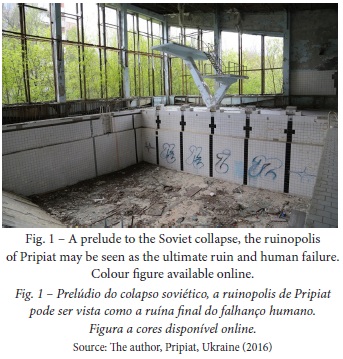
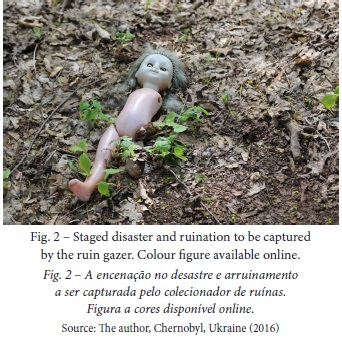
<body><![CDATA[<p><b>&nbsp;</b></p>     <p><b>RÉSUMÉ</b></p>     <p>Les ruines ont des formes multiples et résultent de nombreuses et diverses    interactions humaines et non humaines. Reconnaître leur place et leur apparence,    prendre en compte leurs configurations spatiales, évaluer les hiérarchies, les    modèles et les significations, et découvrir leur &ldquo;performance&ldquo;, leur rôle, leurs    effets et leurs absences est essentiel pour une articulation critique et significative    avec les politiques, les grammaires et le pouvoir productif de substances en    jeu. Les ruines sont des lieux matériels qui animent les nouvelles possibilités    de la vie: elles doivent être perçues comme dynamiques et relationnelles, comme    interstitielles, comme des lieux de pluralité, de plasticité, de démantèlement    et de déstabilisation du pouvoir infini de l&rsquo;invention de soi. L'argument de    Schönle (2006, p. 652) selon lequel &ldquo;nous ne pouvons pas laisser les ruines    en paix et les laisser simplement exister dans leur matérialité muette&ldquo; guide    les quatre exemples suivants. Alors que les ruines posent des défis aux planificateurs    et aux politiciens, constituant des menaces et des opportunités, elles évoquent    le délabrement, l&rsquo;échec, la perte, la beauté, le changement et le plaisir.</p>     <p><b>Most clés: </b>Ruines; esthétique; performance; possibilités.</p>     <p><b>&nbsp;</b></p>     <p><b>&nbsp;</b></p>     <p><b> I. CHERNOBYL, UKRAINE: THE ULTIMATE RUIN?</b></p>     <p>Fast ruins may result from war, hurricanes, volcanic eruptions, landslides    among others. In Chernobyl, a nuclear catastrophe produced a landscape of disaster    (<a href="#f1">fig. 1</a>). Alexievich (2013) explains well how in the weeks    and months immediately after the explosion people could not understand how the    vast area (The Chernobyl Exclusion Zone is roughly the size of Luxembourg) changed.    All was apparently the same and there was little material change. Yet, an invisible    and incomprehensible layer of radiation forced people to leave. The minute the    explosion took place the clock was set in motion. Yet it was only after some    years or even decades that we can gaze at the ruin. From a simultaneously fast    and slow ruin a dark tourism destination emerged, and in 2016, over 10 000 tourists    visited the area (<a href="#f2">fig. 2</a>). Unquestionably, Chernobyl is one    of those archetypal spectral places (Lee, 2017), which imperceptibly indicates    the presence of something. But at the same time, and perhaps more intriguingly,    the ruin slowly became a heaven for nature, a nature which cannot include humans    for more than a few hours. Wolfs, deer, horses, fish, birds, forests and plants    of all kinds thrive, although it is not clear still the magnitude of the disaster    effects on them.</p>     <p>&nbsp;</p> <a name="f1"></a> <img src="/img/revistas/fin/n109/n109a11f1.jpg">     
<p>&nbsp;</p>     ]]></body>
<body><![CDATA[<p>&nbsp;</p> <a name="f2"></a> <img src="/img/revistas/fin/n109/n109a11f2.jpg">     
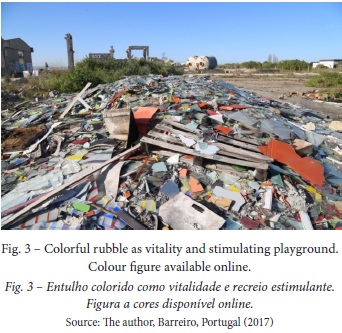
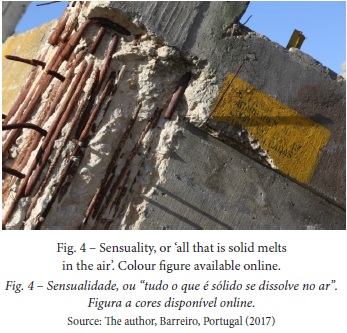
<p>&nbsp;</p>     <p><b> II. FROM INDUSTRIAL EMPIRE TO CONTAMINATED RUIN</b></p>     <p>CUF (Company Factory Union) moved to Barreiro in 1907. Producing oils, soap,    sulfur, sulphuric acid, fertilizers, etc. this large company, at one time the    largest industrial complex of Iberia, produced also a vast industrial landscape.    From the mid-1970s, nationalisation, de-nationalisation and desindustrialisation    left 214 hectares of brownfields which are now an enigma for local politicians,    a sought after site for developers, and a paradise for ruingazers (<a href="#f3">fig.    3</a>). Discourses of progress framed in neoliberal agendas envisage a gigantic    development plan connected to Lisbon by a new bridge. For now the financial    crisis postponed the mimicking of Lisbon&rsquo;s late 1990s waterfront development    on the left bank, and we can move in a transient and interstitial time and space.    Here ruins &lsquo;confound the normative spacing&rsquo;s of things, practices and people&rsquo;,    and regulated bodies may escape urban restraints, and destabilize common aesthetics,    foreground alternative aesthetics about where and how things should be situated,    and “transgress boundaries between outside and inside, and between human and    non-human spaces” (Edensor, 2005, p. 18). For a limited time we have the opportunity    to promote the experience of post-industrial nostalgia (<a href="#f4">fig. 4</a>).</p>     <p>&nbsp;</p> <a name="f3"></a> <img src="/img/revistas/fin/n109/n109a11f3.jpg">     
<p>&nbsp;</p>     <p>&nbsp;</p> <a name="f4"></a> <img src="/img/revistas/fin/n109/n109a11f4.jpg">      
<p>&nbsp;</p>     <p><b>&nbsp;</b></p>     <p><b>III. UNPREDICTABLE PLANNING: ABANDONED SITES OR BUSINESS AS USUAL</b></p>     ]]></body>
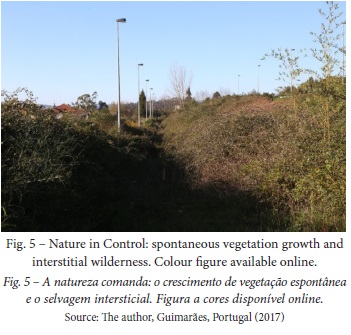
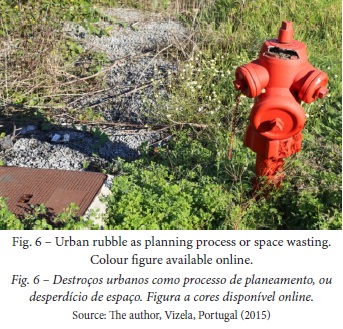
<body><![CDATA[<p>The 1976 soil classification law, which governed Portuguese planning in the    past 40 years, allowed for a disproportionate production of urban land. If the    country has an excess of housing, building all that has been approved by Portuguese    municipalities would lead to an even more unsustainable juncture. Allotment    presupposes the construction of infrastructures in a predetermined period of    time, but it does not imply the construction of what has been approved in any    set of time. The result is that it is possible to have infrastructured allotments    waiting development for an unspecified time<a name="topi"></a><a href="#i"><sup>i</sup></a>.    Understanding land and housing as an asset and commodification, absorbing surplus    capital, and fixing capital in space (Harvey, 1989), results in having finance    capital dictating growth and tempos, while planners and citizens wait undeterminably.    Regardless of looking at infrastructured sites as suspended projects or just    as &lsquo;business as usual&rsquo;, the country is overflowing with empty or half empty    projects. Some are totally vacant, others are partially completed and the odd    house or apartment block exists on its own. They certainly bear a resemblance    to Kitchin, O&rsquo;Callaghan and Gleeson (2014) new ruins, and often their signature    is the broken electricity box or lamp post, and the thriving urban wilderness    (Jorgensen &amp; Tylecote, 2007) covering idle sidewalks (<a href="#f5">figs.    5</a> and <a href="#f6">6</a>).</p>     <p>&nbsp;</p> <a name="f5"></a> <img src="/img/revistas/fin/n109/n109a11f5.jpg">     
<p>&nbsp;</p>     <p>&nbsp;</p> <a name="f6"></a> <img src="/img/revistas/fin/n109/n109a11f6.jpg">     
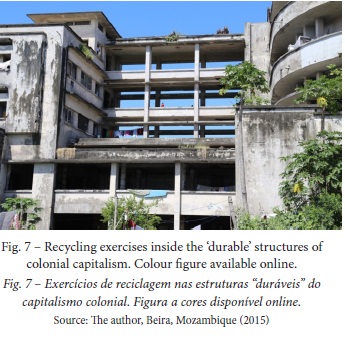
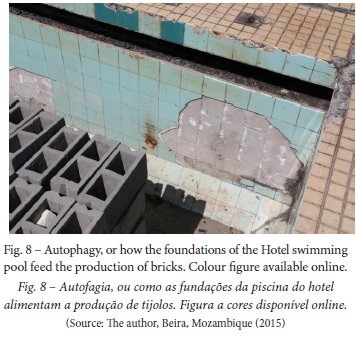
<p>&nbsp;</p>     <p><b> IV. CONCRETE SKELETON AS RUIN: THE GRANDE HOTEL OF BEIRA, MOZAMBIQUE.</b></p>     <p>Colonialism and tropical modernism imagined a <i>Grande</i> <i>Hotel</i> in    Mozambique in the early 1940s. Advertised in the 1950s as the most luxurious    hotel south of the Sahara, the unsustainable nature of the investment in Beira    and an international changing environment led to closure in 1963. Parties, balls,    swimming events, beauty contests and dinners continued, stretching routines    and a sense of harmony for the elites. The hotel was built as the inversion    of violence, a space of order and safety for romance, intimacy, sport, social    gathering and business (Sarmento &amp; Linehan, 2018). The after-life of the    Hotel reveals an enduring decay, as the site hosted the military after independence    and throughout civil war, and more recently a growing number of families. Between    2000-3000 residents live in poverty among an enormous skeleton of former luxury    (<a href="#f7">fig. 7</a>). Ruin porn, or the anesthetization of abandonment    and decline has underlined the heroic qualities of the dilapidated building,    masking the ways in which the ruin become enrolled into new networks, involving    daily rhythms and routines and flexible and mobile ways of intersection (<a href="#f8">fig.    8</a>). Ruins can, together with other material sites, inform us of the &lsquo;distinctive    historicity&rsquo; (Mbembe, 2001) of places, which are rooted in a multiplicity of    times, trajectories, and rationalities that must be conceptualised and understood    in relation to a globalised world.</p>     <p>&nbsp;</p> <a name="f7"></a> <img src="/img/revistas/fin/n109/n109a11f7.jpg">     
<p>&nbsp;</p>     <p>&nbsp;</p> <a name="f8"></a> <img src="/img/revistas/fin/n109/n109a11f8.jpg">      
]]></body>
<body><![CDATA[<p>&nbsp;</p>     <p>Although the four examples might seem disconnected, for their nature and pathos    is apparently so different, that is an illusion. Failure, decay, poverty and    nostalgia are common features embedded in our daily landscapes. Whether ghost    estates, abandoned hotels, old industrial landscapes, sites just pending redevelopment,    ruins provide us graspable materials which support reflections upon our condition.    Reflecting upon ruins help us to destabilize taken for granted assumptions.    Official and appropriate uses may inform us of our inclination to label land,    for example. Western culture has developed a clear fascination for ruins, and    the last decades have witnessed an explosion of ruin-imagery in painting, photography,    cinema, etc. The aesthetics of rubbish, of dissonances and disorder, of enchantment,    disenchantment and re-enchantment, are simultaneously related to an attraction    for pleasurable decay and to a fear for a dystopian dark side of humanity.</p>     <p><b>&nbsp;</b></p>     <p><b>ACKNOWLEDGMENTS</b></p>     <p>This research has been sponsored by Portuguese national funds through the Fundac¸a~o    para a Cie&#094;ncia e a Tecnologia (FCT), I.P. – the Portuguese national agency    for science, research and technology – under the Project PTDC/ATP-EUR/ 1180/2014    (NoVOID - Ruins and vacant lands in the Portuguese cities: Exploring hidden    life in urban derelicts and alternative planning proposals for the perforated    city).</p>     <p><b>&nbsp;</b></p>     <p><b>REFERENCES</b></p>     <!-- ref --><p>Alexievich, S. (2013). <i>Vozes de Chernobyl: história de um desastre nuclear</i>    [Voices from Chernobyl: the oral history of a nuclear disaster]. Amadora: Elsinore.    &nbsp;&nbsp;&nbsp;&nbsp;&nbsp;&nbsp;&nbsp;&nbsp;[&#160;<a href="javascript:void(0);" onclick="javascript: window.open('/scielo.php?script=sci_nlinks&ref=300840&pid=S0430-5027201800030001100001&lng=','','width=640,height=500,resizable=yes,scrollbars=1,menubar=yes,');">Links</a>&#160;]<!-- end-ref --></p>     <!-- ref --><p>Jorgensen, A., &amp; Tylecote, M. (2007). Ambivalent landscapes - wilderness    in the urban interstices. <i>Landscape Research</i>, <i>32</i>(4), 443-462.    &nbsp;&nbsp;&nbsp;&nbsp;&nbsp;&nbsp;&nbsp;&nbsp;[&#160;<a href="javascript:void(0);" onclick="javascript: window.open('/scielo.php?script=sci_nlinks&ref=300842&pid=S0430-5027201800030001100002&lng=','','width=640,height=500,resizable=yes,scrollbars=1,menubar=yes,');">Links</a>&#160;]<!-- end-ref --></p>     <!-- ref --><p>Edensor, T. (2005). <i>Industrial Ruins: Space Aesthetics and Materiality.</i>    Oxford: Berg.    &nbsp;&nbsp;&nbsp;&nbsp;&nbsp;&nbsp;&nbsp;&nbsp;[&#160;<a href="javascript:void(0);" onclick="javascript: window.open('/scielo.php?script=sci_nlinks&ref=300844&pid=S0430-5027201800030001100003&lng=','','width=640,height=500,resizable=yes,scrollbars=1,menubar=yes,');">Links</a>&#160;]<!-- end-ref --></p>     <!-- ref --><p>Harvey, D. (1989). <i>The Condition of Post-Modernity</i>. Oxford: Blackwell.    &nbsp;&nbsp;&nbsp;&nbsp;&nbsp;&nbsp;&nbsp;&nbsp;[&#160;<a href="javascript:void(0);" onclick="javascript: window.open('/scielo.php?script=sci_nlinks&ref=300846&pid=S0430-5027201800030001100004&lng=','','width=640,height=500,resizable=yes,scrollbars=1,menubar=yes,');">Links</a>&#160;]<!-- end-ref --></p>     <p>Kitchin, R., O&rsquo; Callaghan, C., &amp; Gleeson, J. (2014). The New Ruins of Ireland?    Unfinished Estates in the Post-Celtic Tiger Era. <i>International Journal of    Urban and Regional Research, </i><i>38</i>(3), 1069-1080.</p>     <!-- ref --><p>Lee, C. (Ed.) (2017). <i>Spectral Spaces and Hauntings: The Affects of Absence</i>.    New York: Routledge<b>.    &nbsp;&nbsp;&nbsp;&nbsp;&nbsp;&nbsp;&nbsp;&nbsp;[&#160;<a href="javascript:void(0);" onclick="javascript: window.open('/scielo.php?script=sci_nlinks&ref=300849&pid=S0430-5027201800030001100006&lng=','','width=640,height=500,resizable=yes,scrollbars=1,menubar=yes,');">Links</a>&#160;]<!-- end-ref --></b></p>     <!-- ref --><p>Mbembe, A. (2001). <i>On the Postcolony</i>. Berkeley: University of California    Press.    &nbsp;&nbsp;&nbsp;&nbsp;&nbsp;&nbsp;&nbsp;&nbsp;[&#160;<a href="javascript:void(0);" onclick="javascript: window.open('/scielo.php?script=sci_nlinks&ref=300851&pid=S0430-5027201800030001100007&lng=','','width=640,height=500,resizable=yes,scrollbars=1,menubar=yes,');">Links</a>&#160;]<!-- end-ref --></p>     ]]></body>
<body><![CDATA[<!-- ref --><p>Sarmento, J., &amp; Linehan, D. (2018) The Colonial Hotel: spacing violence    at the <i>Grande Hotel</i>, Beira, Mozambique. <i>Environment and Planning D:    Society and Space</i>. doi: 10.1177/0263775818800719&nbsp;&nbsp;&nbsp;&nbsp;&nbsp;&nbsp;&nbsp;&nbsp;[&#160;<a href="javascript:void(0);" onclick="javascript: window.open('/scielo.php?script=sci_nlinks&ref=300853&pid=S0430-5027201800030001100008&lng=','','width=640,height=500,resizable=yes,scrollbars=1,menubar=yes,');">Links</a>&#160;]<!-- end-ref --><!-- ref --><p>Schönle, A. (2006) Ruins and history: Observations on Russian approaches to    destruction and decay. <i>Slavic Review,</i> <i>65</i>(4), 649-669.    &nbsp;&nbsp;&nbsp;&nbsp;&nbsp;&nbsp;&nbsp;&nbsp;[&#160;<a href="javascript:void(0);" onclick="javascript: window.open('/scielo.php?script=sci_nlinks&ref=300854&pid=S0430-5027201800030001100009&lng=','','width=640,height=500,resizable=yes,scrollbars=1,menubar=yes,');">Links</a>&#160;]<!-- end-ref --></p>     <p><b>&nbsp;</b></p>     <p><b>NOTA</b></p>     <p><a name="i"></a><a href="#topi"><sup>i</sup></a>While a new law has been in    place since 2014 which significantly alters these processes, reverting the classification    of urban soils carries numerous challenges and costs.</p>     <p> </p>      ]]></body><back>
<ref-list>
<ref id="B1">
<nlm-citation citation-type="book">
<person-group person-group-type="author">
<name>
<surname><![CDATA[Alexievich]]></surname>
<given-names><![CDATA[S.]]></given-names>
</name>
</person-group>
<source><![CDATA[Vozes de Chernobyl: história de um desastre nuclear [Voices from Chernobyl: the oral history of a nuclear disaster]]]></source>
<year>2013</year>
<publisher-loc><![CDATA[Amadora ]]></publisher-loc>
<publisher-name><![CDATA[Elsinore]]></publisher-name>
</nlm-citation>
</ref>
<ref id="B2">
<nlm-citation citation-type="journal">
<person-group person-group-type="author">
<name>
<surname><![CDATA[Jorgensen]]></surname>
<given-names><![CDATA[A.]]></given-names>
</name>
<name>
<surname><![CDATA[Tylecote]]></surname>
<given-names><![CDATA[M.]]></given-names>
</name>
</person-group>
<article-title xml:lang="en"><![CDATA[Ambivalent landscapes - wilderness in the urban interstices]]></article-title>
<source><![CDATA[Landscape Research]]></source>
<year>2007</year>
<volume>32</volume>
<numero>4</numero>
<issue>4</issue>
<page-range>443-462</page-range></nlm-citation>
</ref>
<ref id="B3">
<nlm-citation citation-type="book">
<person-group person-group-type="author">
<name>
<surname><![CDATA[Edensor]]></surname>
<given-names><![CDATA[T.]]></given-names>
</name>
</person-group>
<source><![CDATA[Industrial Ruins: Space Aesthetics and Materiality]]></source>
<year>2005</year>
<publisher-loc><![CDATA[Oxford ]]></publisher-loc>
<publisher-name><![CDATA[Berg]]></publisher-name>
</nlm-citation>
</ref>
<ref id="B4">
<nlm-citation citation-type="book">
<person-group person-group-type="author">
<name>
<surname><![CDATA[Harvey]]></surname>
<given-names><![CDATA[D.]]></given-names>
</name>
</person-group>
<source><![CDATA[The Condition of Post-Modernity]]></source>
<year>1989</year>
<publisher-loc><![CDATA[Oxford ]]></publisher-loc>
<publisher-name><![CDATA[Blackwell]]></publisher-name>
</nlm-citation>
</ref>
<ref id="B5">
<nlm-citation citation-type="journal">
<person-group person-group-type="author">
<name>
<surname><![CDATA[Kitchin]]></surname>
<given-names><![CDATA[R.]]></given-names>
</name>
<name>
<surname><![CDATA[O’ Callaghan]]></surname>
<given-names><![CDATA[C.]]></given-names>
</name>
<name>
<surname><![CDATA[Gleeson]]></surname>
<given-names><![CDATA[J.]]></given-names>
</name>
</person-group>
<article-title xml:lang="en"><![CDATA[The New Ruins of Ireland? Unfinished Estates in the Post-Celtic Tiger Era]]></article-title>
<source><![CDATA[International Journal of Urban and Regional Research]]></source>
<year>2014</year>
<volume>38</volume>
<numero>3</numero>
<issue>3</issue>
<page-range>1069-1080</page-range></nlm-citation>
</ref>
<ref id="B6">
<nlm-citation citation-type="book">
<person-group person-group-type="author">
<name>
<surname><![CDATA[Lee]]></surname>
<given-names><![CDATA[C.]]></given-names>
</name>
</person-group>
<source><![CDATA[Spectral Spaces and Hauntings: The Affects of Absence]]></source>
<year>2017</year>
<publisher-loc><![CDATA[New York ]]></publisher-loc>
<publisher-name><![CDATA[Routledge]]></publisher-name>
</nlm-citation>
</ref>
<ref id="B7">
<nlm-citation citation-type="book">
<person-group person-group-type="author">
<name>
<surname><![CDATA[Mbembe]]></surname>
<given-names><![CDATA[A.]]></given-names>
</name>
</person-group>
<source><![CDATA[On the Postcolony]]></source>
<year>2001</year>
<publisher-loc><![CDATA[Berkeley ]]></publisher-loc>
<publisher-name><![CDATA[University of California Press]]></publisher-name>
</nlm-citation>
</ref>
<ref id="B8">
<nlm-citation citation-type="journal">
<person-group person-group-type="author">
<name>
<surname><![CDATA[Sarmento]]></surname>
<given-names><![CDATA[J]]></given-names>
</name>
<name>
<surname><![CDATA[Linehan]]></surname>
<given-names><![CDATA[D]]></given-names>
</name>
</person-group>
<article-title xml:lang="en"><![CDATA[The Colonial Hotel: spacing violence at the Grande Hotel, Beira, Mozambique]]></article-title>
<source><![CDATA[Environment and Planning D: Society and Space]]></source>
<year>2018</year>
</nlm-citation>
</ref>
<ref id="B9">
<nlm-citation citation-type="journal">
<person-group person-group-type="author">
<name>
<surname><![CDATA[Schönle]]></surname>
<given-names><![CDATA[A]]></given-names>
</name>
</person-group>
<article-title xml:lang="en"><![CDATA[Ruins and history: Observations on Russian approaches to destruction and decay]]></article-title>
<source><![CDATA[Slavic Review]]></source>
<year>2006</year>
<volume>65</volume>
<numero>4</numero>
<issue>4</issue>
<page-range>649-669</page-range></nlm-citation>
</ref>
</ref-list>
</back>
</article>