<?xml version="1.0" encoding="ISO-8859-1"?><article xmlns:mml="http://www.w3.org/1998/Math/MathML" xmlns:xlink="http://www.w3.org/1999/xlink" xmlns:xsi="http://www.w3.org/2001/XMLSchema-instance">
<front>
<journal-meta>
<journal-id>0430-5027</journal-id>
<journal-title><![CDATA[Finisterra - Revista Portuguesa de Geografia]]></journal-title>
<abbrev-journal-title><![CDATA[Finisterra]]></abbrev-journal-title>
<issn>0430-5027</issn>
<publisher>
<publisher-name><![CDATA[Centro de Estudos Geográficos]]></publisher-name>
</publisher>
</journal-meta>
<article-meta>
<article-id>S0430-50272019000100002</article-id>
<article-id pub-id-type="doi">10.18055/Finis14564</article-id>
<title-group>
<article-title xml:lang="en"><![CDATA[Portugal’s trees of public interest: their role in botany awareness]]></article-title>
<article-title xml:lang="pt"><![CDATA[Arvoredo de interesse público: papel na promoção da botânica]]></article-title>
<article-title xml:lang="fr"><![CDATA[Arbres de remarquable intérêt public: leur rôle dans la sensibilisation de la botanique]]></article-title>
<article-title xml:lang="es"><![CDATA[Arbolado de interés público de Portugal: su papel en la conciencia botánica]]></article-title>
</title-group>
<contrib-group>
<contrib contrib-type="author">
<name>
<surname><![CDATA[Lopes]]></surname>
<given-names><![CDATA[Raquel Pires]]></given-names>
</name>
<xref ref-type="aff" rid="A01"/>
</contrib>
<contrib contrib-type="author">
<name>
<surname><![CDATA[Reis]]></surname>
<given-names><![CDATA[Catarina Schreck]]></given-names>
</name>
<xref ref-type="aff" rid="A02"/>
</contrib>
<contrib contrib-type="author">
<name>
<surname><![CDATA[Trincão]]></surname>
<given-names><![CDATA[Paulo Renato]]></given-names>
</name>
<xref ref-type="aff" rid="A01"/>
<xref ref-type="aff" rid="A02"/>
</contrib>
</contrib-group>
<aff id="A01">
<institution><![CDATA[,University of Aveiro Education Department and Psychology Biology Department and at Didactics and Technology in Education of Trainers Research Centre]]></institution>
<addr-line><![CDATA[Aveiro ]]></addr-line>
<country>Portugal</country>
</aff>
<aff id="A02">
<institution><![CDATA[,University of Coimbra Department of Life Sciences Science Communication at the Centre for Funcional Ecology]]></institution>
<addr-line><![CDATA[Coimbra ]]></addr-line>
<country>Portugal</country>
</aff>
<pub-date pub-type="pub">
<day>00</day>
<month>04</month>
<year>2019</year>
</pub-date>
<pub-date pub-type="epub">
<day>00</day>
<month>04</month>
<year>2019</year>
</pub-date>
<numero>110</numero>
<fpage>19</fpage>
<lpage>36</lpage>
<copyright-statement/>
<copyright-year/>
<self-uri xlink:href="http://scielo.pt/scielo.php?script=sci_arttext&amp;pid=S0430-50272019000100002&amp;lng=en&amp;nrm=iso"></self-uri><self-uri xlink:href="http://scielo.pt/scielo.php?script=sci_abstract&amp;pid=S0430-50272019000100002&amp;lng=en&amp;nrm=iso"></self-uri><self-uri xlink:href="http://scielo.pt/scielo.php?script=sci_pdf&amp;pid=S0430-50272019000100002&amp;lng=en&amp;nrm=iso"></self-uri><abstract abstract-type="short" xml:lang="en"><p><![CDATA[Based on the classification processes, from 1939 to 2012, of the National Registry for Trees of Public Interest, from the Institute for Nature Conservation and Forests, it was verified that of the 278 municipalities, corresponding to the five Regions of Tourism of mainland Portugal, 130 municipalities do not have classification processes. Considering that is an environmental but also a social gap, the authors understand it is necessary to contribute to the social understanding of monumental trees through the promotion of scientific culture in botany, as an important means to emphasize its value as an endogenous differentiation element of each region. It is also intended to mobilize the general public, to identify and propose the classification of trees with monumental characteristics.]]></p></abstract>
<abstract abstract-type="short" xml:lang="pt"><p><![CDATA[Com base nos processos de classificação, compreendidos entre 1939 e 2012, do Registo Nacional do Arvoredo de Interesse Público, do Instituto da Conservação da Natureza e das Florestas, verificou-se que dos 278 municí pios, correspondentes às cinco Regiões de Turismo de Portugal Continental, 130 municípios não possuem processos de classificação. Por se considerar ser esta uma lacuna, não só em termos ambientais, como sociais, sentimos a necessidade de contribuir para a compreensão social do arvoredo monumental, através da realização de atividades de promoção da cultura científica, na área da Botânica, como um importante meio para enfatizar o seu valor como elemento de diferenciação endógena das regiões. Também se pretende mobilizar o público em geral, para identificar e propor para classificação árvores com características monumentais.]]></p></abstract>
<abstract abstract-type="short" xml:lang="fr"><p><![CDATA[Ayant comme base les processus de classification de 1939 à 2012 du Registre national d’Arbres d'Intérêt Public del'Institut de Conservation de la Nature et des Forêts, nous avons vérifié que, des 278 municipalit és correspondant aux cinq régions de Tourisme du Portugal Continental, 130 ne disposent pas de processus de classification. Une fois que nous considérons qu'il s'agit d'une lacune, non seulement environnementale mais aussi sociale, nous ressentons le besoin de contribuer à la compréhension sociale des arbres remarquables à travers des activités de promotion de la culture scientifique, dans le domaine de la botanique, comme un moyen important pour souligner sa valeur en tant qu'élément de différenciation endogène des régions.]]></p></abstract>
<abstract abstract-type="short" xml:lang="es"><p><![CDATA[Con base en los procesos de clasificación, entre 1939 y 2012, del Registro Nacional de Árboles de Interés Público, por parte del Instituto de Conservación de la Naturaleza y de los Bosques, se verificó que, de los 278 municipios, correspondientes a las cinco Regiones Turísticas de Portugal Continental, 130 municipios no cuentan con un proceso de clasificación. Considerando que esto representa una brecha ambiental y también social, los autores creen que es necesario contribuir al conocimiento social de los árboles monumentales, a través de la realización de actividades de promoción de la cultura científica en Botánica, como un importante medio para enfatizar su valor como un elemento endógeno diferenciado de cada región.]]></p></abstract>
<kwd-group>
<kwd lng="en"><![CDATA[Legislation]]></kwd>
<kwd lng="en"><![CDATA[monumental trees]]></kwd>
<kwd lng="en"><![CDATA[scientific literacy]]></kwd>
<kwd lng="pt"><![CDATA[Legislação]]></kwd>
<kwd lng="pt"><![CDATA[árvores monumentais]]></kwd>
<kwd lng="pt"><![CDATA[literacia científica]]></kwd>
<kwd lng="fr"><![CDATA[Législation]]></kwd>
<kwd lng="fr"><![CDATA[arbres remarquables]]></kwd>
<kwd lng="fr"><![CDATA[culture scientifique]]></kwd>
<kwd lng="es"><![CDATA[Legislación]]></kwd>
<kwd lng="es"><![CDATA[árboles monumentales]]></kwd>
<kwd lng="es"><![CDATA[cultura científica]]></kwd>
</kwd-group>
</article-meta>
</front><body><![CDATA[ <p align="right"><b>ARTIGO ORIGINAL</b></p> <br/>     <p>      <p><b>&nbsp;</b></p>     <p><b>Portugal&rsquo;s trees of public interest: their role in botany awareness</b></p>     <p><b>&nbsp;</b></p>     <p><b>Arvoredo de interesse p&uacute;blico: papel na promo&ccedil;&atilde;o da    bot&acirc;nica</b></p>     <p><b>&nbsp;</b></p>     <p><b>Arbres de remarquable int&eacute;r&ecirc;t public: leur r&ocirc;le dans    la sensibilisation de la botanique</b></p>     <p><b>&nbsp;</b></p>     <p><b>Arbolado de inter&eacute;s p&uacute;blico de Portugal: su papel en la conciencia    bot&aacute;nica</b></p>     ]]></body>
<body><![CDATA[<p><b>&nbsp;</b></p>     <p><b>&nbsp;</b></p>     <p><b>Raquel Pires Lopes<sup>1</sup>; Catarina Schreck Reis<sup>2</sup>; Paulo    Renato Trinc&atilde;o<sup>3</sup></b></p>     <p><sup>1</sup> PhD student in Biology Department and at Didactics and Technology    in Education of Trainers Research Centre (CIDTFF), Education Department, University    of Aveiro, University Campus, 3810-193, Aveiro, Portugal. E-mail: <a href="mailto:raquellopes@ua.pt">    raquellopes@ua.pt</a></p>     <p><sup>2</sup> Researcher in Science Communication at the Centre for Funcional    Ecology, Life Sciences Department, University of Coimbra, Coimbra, Portugal.    E-mail: <a href="mailto:catarina.reis@exploratorio.pt">catarina.reis@exploratorio.pt</a></p>     <p><sup>3</sup> Director of the &ldquo;Explorat&oacute;rio&rdquo;, Coimbra Science    Center, researcher at the Centre for Funcional Ecology, Life Sciences Department,    University of Coimbra, and at the Didactics and Technology in Education of Trainers    Centre (CIDTFF), University of Aveiro, Aveiro, Portugal. E-mail: <a href="mailto:paulo.trincao@exploratorio.pt">paulo.trincao@exploratorio.pt</a></p>     <p><b>&nbsp;</b></p>     <p><b>&nbsp;</b></p>     <p><b>ABSTRACT</b></p>     <p>Based on the classification processes, from 1939 to 2012, of the National Registry    for Trees of Public Interest, from the Institute for Nature Conservation and    Forests, it was verified that of the 278 municipalities, corresponding to the    five Regions of Tourism of mainland Portugal, 130 municipalities do not have    classification processes. Considering that is an environmental but also a social    gap, the authors understand it is necessary to contribute to the social understanding    of monumental trees through the promotion of scientific culture in botany, as    an important means to emphasize its value as an endogenous differentiation element    of each region. It is also intended to mobilize the general public, to identify    and propose the classification of trees with monumental characteristics.</p>     ]]></body>
<body><![CDATA[<p><b>Keywords: </b>Legislation; monumental trees; scientific literacy.</p>     <p><b>&nbsp;</b></p>     <p><b>RESUMO</b></p>     <p>Com base nos processos de classifica&ccedil;&atilde;o, compreendidos entre    1939 e 2012, do Registo Nacional do Arvoredo de Interesse P&uacute;blico, do    Instituto da Conserva&ccedil;&atilde;o da Natureza e das Florestas, verificou-se    que dos 278 munic&iacute; pios, correspondentes &agrave;s cinco Regi&otilde;es    de Turismo de Portugal Continental, 130 munic&iacute;pios n&atilde;o possuem    processos de classifica&ccedil;&atilde;o. Por se considerar ser esta uma lacuna,    n&atilde;o s&oacute; em termos ambientais, como sociais, sentimos a necessidade    de contribuir para a compreens&atilde;o social do arvoredo monumental, atrav&eacute;s    da realiza&ccedil;&atilde;o de atividades de promo&ccedil;&atilde;o da cultura    cient&iacute;fica, na &aacute;rea da Bot&acirc;nica, como um importante meio    para enfatizar o seu valor como elemento de diferencia&ccedil;&atilde;o end&oacute;gena    das regi&otilde;es. Tamb&eacute;m se pretende mobilizar o p&uacute;blico em    geral, para identificar e propor para classifica&ccedil;&atilde;o &aacute;rvores    com caracter&iacute;sticas monumentais.</p>     <p><b>Palavras-chave:</b> Legisla&ccedil;&atilde;o; &aacute;rvores monumentais;    literacia cient&iacute;fica.</p>     <p><b>&nbsp;</b></p>     <p><b>R&Eacute;SUM&Eacute;</b></p>     <p>Ayant comme base les processus de classification de 1939 &agrave; 2012 du Registre    national d&rsquo;Arbres d'Int&eacute;r&ecirc;t Public del'Institut de Conservation    de la Nature et des For&ecirc;ts, nous avons v&eacute;rifi&eacute; que, des    278 municipalit &eacute;s correspondant aux cinq r&eacute;gions de Tourisme    du Portugal Continental, 130 ne disposent pas de processus de classification.    Une fois que nous consid&eacute;rons qu'il s'agit d'une lacune, non seulement    environnementale mais aussi sociale, nous ressentons le besoin de contribuer    &agrave; la compr&eacute;hension sociale des arbres remarquables &agrave; travers    des activit&eacute;s de promotion de la culture scientifique, dans le domaine    de la botanique, comme un moyen important pour souligner sa valeur en tant qu'&eacute;l&eacute;ment    de diff&eacute;renciation endog&egrave;ne des r&eacute;gions.</p>     <p><b>Mots cl&eacute;s:</b> L&eacute;gislation; arbres remarquables; culture scientifique.</p>     <p><b>&nbsp;</b></p>     ]]></body>
<body><![CDATA[<p><b>RESUMEN</b></p>     <p>Con base en los procesos de clasificaci&oacute;n, entre 1939 y 2012, del Registro    Nacional de &Aacute;rboles de Inter&eacute;s P&uacute;blico, por parte del Instituto    de Conservaci&oacute;n de la Naturaleza y de los Bosques, se verific&oacute;    que, de los 278 municipios, correspondientes a las cinco Regiones Tur&iacute;sticas    de Portugal Continental, 130 municipios no cuentan con un proceso de clasificaci&oacute;n.    Considerando que esto representa una brecha ambiental y tambi&eacute;n social,    los autores creen que es necesario contribuir al conocimiento social de los    &aacute;rboles monumentales, a trav&eacute;s de la realizaci&oacute;n de actividades    de promoci&oacute;n de la cultura cient&iacute;fica en Bot&aacute;nica, como    un importante medio para enfatizar su valor como un elemento end&oacute;geno    diferenciado de cada regi&oacute;n.</p>     <p><b>Palabras claves:</b> Legislaci&oacute;n; &aacute;rboles monumentales; cultura    cient&iacute;fica.</p>     <p><b>&nbsp;</b></p>     <p><b>&nbsp;</b></p>     <p><b> I. INTRODUCTION</b></p>     <p><b> 1. Trees of Public Interest:</b> <b>national criteria</b></p>     <p>Portugal has one of the oldest laws in Europe in the field of tree protection,    with the introduction of &lsquo;Trees of Public Interest&rsquo; (Decree Law    n&ordm;.&nbsp;28/468, of 15 February 1938). This Decree-Law was repealed by    the more recent Law n&ordm; .&nbsp;53/2012 and further regulated by Ordinance    n&ordm;.&nbsp;124/2014 which determines the criteria and procedures of classification    and declassification of such trees. The <i>Instituto da Conserva&ccedil;&atilde;o    da Natureza e das Florestas</i> (ICNF) (Institute for Nature Conservation and    Forests) is responsible for managing those trees and administrating the related    online database: the National Registry for Trees of Public Interest.</p>     <p>A relevant aspect of the Law is a concern with the generalization of the classification    procedure. Anyone can propose the classification of isolated trees or arboreal    sets (e.g. tree lined avenue, arboretum, grove, garden, forest stands, woods)    as public interest. Another great scope of the Law is related to the criteria    for tree classification. It does not rely merely on dendrology parameters such    as age and size, or design aspects (e.g. beauty or unusual formation). The Law    considers other values that justify the need for careful conservation of trees.    Thus, the criteria of selection considers and includes: natural value (e.g.    conservation status, abundance, unique individual or existing in small number,    with international interest of conservation); historical value (e.g. striking    history or relevant national symbolism); cultural value (e.g. elements of belief,    memory, collective national imagination or associated with important figures    of Portuguese culture); or aesthetic value (e.g. appreciation). These constitute    an advantage and innovation in the protection of &lsquo;monumental trees&rsquo;,    another epithet used by the Institute for Nature Conservation and Forests to    refer trees that are distinguished from others of its species by size, design,    age, rarity, historical interest or aesthetic classifying them as Trees of Public    Interest (TPI). Once classified as of public interest, the grove becomes a living    monument and, as such, subject to certain constraints and benefits (Varela &amp;    Barros, 1998).</p>     <p>In the national context, trees protected by Law or other trees not yet classified    but which might potentially be valued, are designated as &lsquo;monumental trees&rsquo;.    However, other names are used (e.g., centenary trees, giant trees), as also    happens elsewhere, internationally. For example: in Spain, &lsquo;&aacute;rboles    singulares&rsquo; (Dom&iacute;nguez Lerena, Corchero De La Torre, &amp; Albano    Villar, 2012), and &lsquo;&aacute;rboles monumentales&rsquo; (Par&eacute;s Espa&ntilde;ol,    2009); in Italy, &lsquo;alberi monumentali&rsquo; (Lisa, 2011); in France, &lsquo;arbres    remarquables&rsquo; (Diraison, 2003); or in England, &lsquo;ancient trees&rsquo;    (Butler, Rose, &amp; Green, 2001), &lsquo;veteran trees&rsquo; (Nowak, 2004),    &lsquo;large old tree&rsquo; (Lindenmayer <i>et al</i>., 2013).</p>     ]]></body>
<body><![CDATA[<p>In light of the diversified terminology used in the scientific studies analysed,    we use the designation 'monumental trees' for all trees with remarkable characteristics,    regardless of whether or not they are protected by Law. However, only those    that are protected by Law have the designation "Trees of Public Interest" (TPI).</p>     <p><b> 2. Monumental trees: their value</b></p>     <p>&nbsp;Trees with notable features represent a heritage the value of which needs    to be known and protected for future generations. They have several ecological    contributions with direct implications in mitigating climate change. As Stephenson    <i>et al</i>. (2014) have shown, so called &lsquo;large, old trees&rsquo; actively    fix large amounts of carbon compared to smaller trees. Another study by Nowak    (2004) examines the high environmental and social benefits of veteran trees,    i.e., trees with longevity and significance in landscape, with special dendrometric    features. Regardless of the trees species, with ageing arise multiple decadent    features, such as cavities, dry and hollow branches, extensive ramifications    or complex crowns (Lindenmayer, Laurance, &amp; Franklin, 2012). Those features    represent crucial habitats to a large diversity of living beings and, because    of that, trees with these specifications are considered a biodiversity hotspot    (Lindenmayer <i>et al</i>., 2013). In agricultural landscapes, those trees restore    vegetation, act as a wildlife corridor, attract seed dispersers and pollinators    and increase the genetic connectivity between other populations and trees (Lindenmayer    <i>et al</i>., 2012).</p>     <p>Despite their ecological contributions, monumental trees also have important    cultural value due to their aesthetic, spiritual (Pederson, 2010) and health    quality (Tsunetsugu <i>et al</i>., 2007). They also create social benefits by    promoting economic development of rural areas (Moya, 2015) and represent a historical,    cultural and religious heritage (Dafni, 2006) that can define the identity of    a community. In recent years, this heritage is being explored for its educational    and touristic value.</p>     <p><b> 3. Monumental trees: factors of decline </b></p>     <p>&nbsp;Only in Europe, in the last 100 years, 80% of monumental trees, mature    forests and agricultural secular trees have disappeared (Moya, 2015). Several    factors explain this decline. Natural threats (Par&eacute;s Espa&ntilde;ol,    2009; Martins &amp; Travassos, 2012; Moya, 2015) but also human activities can    explain the pressure on this heritage: i) habitat fragmentation, isolation,    contamination and extinction (Butler <i>et al</i>., 2001; Lindenmayer<i> et    al</i>., 2013), resulting, for instance, in fires (San-Miguel-Ayanz <i>et al</i>.,    2012), urban renewal (Jim, 2005), and over-exploitation of natural resources    (Moya, 2015); ii) lack of legislation (Moya, 2015) and inspection (Dom&iacute;nguez    Lerena <i>et al</i>., 2012); iii) aggressions, abandonment, negligence and pruning    (Dom&iacute;nguez Lerena <i>et al</i>., 2012; Martins &amp; Travassos, 2012),    or excessive soil compaction (Moya, 2015); iv) lack of understanding of the    origin and development of these trees (Moya, 2015); and v) competition with    invasive plants <b>(</b>Marchante, Freitas, &amp; Marchante, 2008). These actions    affect not only old trees but also young, healthy trees, with implications in    the renovation of a new generation of monumental trees.</p>     <p><b> 4. The social perception of monumental trees</b></p>     <p>To deal with threats that affect plants it is important to increase the social    recognition of the value they represent. However, several studies have demonstrated    a low social interest in plants. They are forgotten (Yorek, Åžahin, &amp; Aydin,    2009) and have been underappreciated, minimized relative to other living things    such as animals (Wandersee, 1986 as cited in Sanders, 2007). This lack of interest    in plants was described by Wandersee and Schussler (2001), as <i>plant blindness</i>,    i.e., the inability to see or perceive plants in their environment and recognize    their importance.</p>     <p>However, this tendency can be contradicted with the development of actions    that contribute to changing behaviours and attitudes towards plants (FancÌŒovicÌŒov&aacute;    &amp; Prokop, 2011). Beyond an increase in scientific literacy on plants (Randler,    Osti, &amp; Hummel, 2012), it is important that public and private sector stakeholders    effectively manage actions geared towards knowledge, protection and dissemination    of their value.</p>     <p>Taking monumental trees as a starting point, to know their heterogeneity and    specificities would be an important step towards a deeper social understanding    of these plants. So, this paper aims to collect and organize information regarding    the National Registry for Trees of Public Interest. The specific goals are:    i) to quantify TPI; ii) to identify the municipalities with TPI; iii) to understand    how this heritage (native and non-native species) is distributed in the territory    and whose property they are; iv) to disseminate&nbsp;information about the Law    and the National Registry; v) to contribute to increase the scientific literacy    about monumental trees.</p>     ]]></body>
<body><![CDATA[<p>The results should be useful to provide the public with credible information    for use in advocating for improved monumental trees protection policies. Additionally,    it is hoped that these results may contribute to developing an integrated programme    on scientific communication to increase the interest in monumental trees and    the number of trees protected by Law.</p>     <p><b>&nbsp;</b></p>     <p><b> II. METHODOLOGY </b></p>     <p>The universe included in our field of research corresponds to TPI process present    in the National Registry for Trees of Public Interest, from the total of 278    municipalities, corresponding to the five regional tourism areas in mainland    Portugal, resulting from Lei n&ordm;.&nbsp;33/2013: <i>&ldquo;Norte&rdquo;</i>;    &ldquo;Centro&rdquo;; &ldquo;Lisboa&rdquo; and the &ldquo;Vale do Tejo&rdquo;;    &ldquo;Alentejo&rdquo;; and &ldquo;Algarve&rdquo;. This division excludes the    autonomous regions of Portugal (Madeira and Azores) that have their own jurisdiction.    Data analysis by regional tourism areas will provide information for later use    in a more in-depth study of the TPI's knowledge at the municipal level, through    the application of a survey of municipalities in the regional tourism area of    &ldquo;&ldquo;Centro&rdquo;&rdquo;.</p>     <p>The National Registry is an online database, at the ICNF website. This catalogue    contains qualitative data and does not show the aggregated numbers of the various    information parameters about the trees classified. Thus, it was important to    build a global database with systematic information of all mainland territory    to, more correctly, interpret the information about the Portuguese TPI. We developed    maps using Geographic Information System (GIS) to analyse the data from the    National Registry for Trees of Public Interest. Information such as, how many    and which municipalities have only isolated trees or arboreal sets, or both,    and how many and which municipalities do not have any classification procedures.    Also, quantitative descriptive analyses were made to collect various types of    information about the TPI like the total number of isolated trees and arboreal    sets, their ownership, and also if the classified tree is a native or a non-native    species). The native species were selected considering the ICNF user guide for    indigenous tree species in mainland Portugal (Do Amaral, Aguiar, Capelo, &amp;    Lopes, 2016). The research did not consider the specific number and species&rsquo;    names of the arboreal sets because they are not exhaustively described in the    National Registry. Trees mentioned as declassified were not considered in the    study.</p>     <p>The study includes all the classification procedures between 1939 (first tree    listed), to 2012 (last proposal made). The hiatus since 2012 was brought by    the establishment of Law n&ordm;.&nbsp;53/2012. In 2015, the ICNF proceeded    to an inspection of all listed trees through an intensive fieldwork maintaining    the classification or disqualifying trees that no longer met the conditions    to be classified as public interest. Thus, our study crystallizes data for a    future more in-depth analysis for different spatial scales.</p>     <p><b>&nbsp;</b></p>     <p><b>III. RESULTS AND DISCUSSION</b></p>     <p>The data analysed are presented in the following three sections.</p>     <p><b>1. National Registry for Trees of Public Interest database</b></p>     ]]></body>
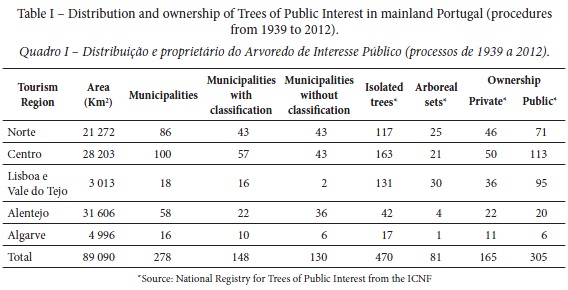
<body><![CDATA[<p>From the procedures made between 1939 and 2012 (<a href="#t1">table I</a>),    in the universe of 278 municipalities, 470 isolated trees and 81 arboreal sets    were quantified in a total of 148 municipalities (53%). The largest owner is    the State (66%), with private owners accounting for the remaining 34%. These    results reflect the importance of promoting the scientific culture of this natural    heritage, as well as the legal mechanisms available to make new classification    processes as TPI, to potentially influence in classification processes. The    first tree to be listed as public interest, in 1939, a <i>Pinus pinea</i> located    in Covilh&atilde;, was excluded from the database in 1964, with 183 years old,    for being dry.</p>     <p>&nbsp;</p> <a name="t1"></a> <img src="/img/revistas/fin/n110/n110a02t1.jpg">      
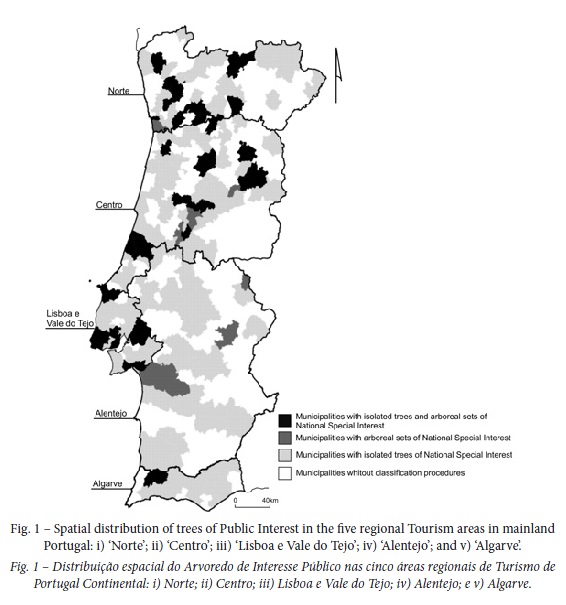
<p>&nbsp;</p>     <p>The total of municipalities with TPI can be divided in different groups, as    40% have isolated trees, 11% have both isolated trees and arboreal sets, and    2% have only arboreal sets. 47% of the municipalities have no classification    procedures (<a href="#f1">fig. 1</a>).</p>     <p>&nbsp;</p> <a name="f1"></a> <img src="/img/revistas/fin/n110/n110a02f1.jpg">      
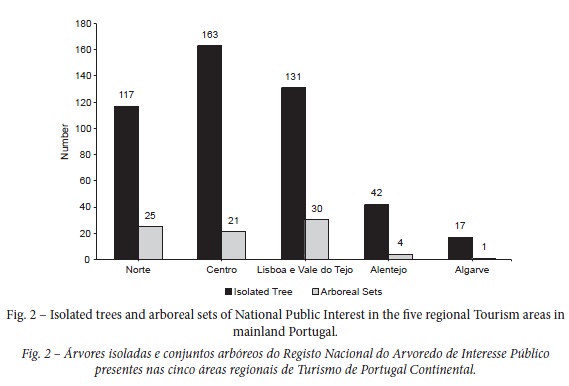
<p>&nbsp;</p>     <p>A regional comparison of municipalities shows that &ldquo;Centro&rdquo;, &ldquo;Lisboa&rdquo;    e &ldquo;Vale do Tejo&rdquo; and &ldquo;Algarve&rdquo; have more municipalities    with trees listed. The &ldquo;Alentejo&rdquo; region has more municipalities    without trees listed and in the &ldquo;Norte&rdquo; region there is no difference.    The fact that the southern regions of the country have the lowest number of    classified trees may have some ecological significance.</p>     <p>However, the results show that approximately half of the municipalities do    not have listed trees. In fact, it is important to improve general knowledge    about such trees to increase new classification procedures. This is consistent    with Costa, Sobral, Viana, Fernandes, and Barracosa, (2005), claiming that TPI    are unknown by most of the Portuguese population and it is necessary to focus    on raising their awareness.</p>     <p>In all of the territory where TPI are found, isolated trees are more abundant.    The distribution occurs essentially in the &ldquo;Centro&rdquo;, &ldquo;Lisboa&rdquo;    and &ldquo;Norte&rdquo;. The &ldquo;Lisboa&rdquo; region, despite having the    smallest area, contains the largest number of listed trees which may be related    to greater ease and access to knowledge, which makes people and institutions    better able to promote the classification of trees in this region. The &ldquo;Alentejo&rdquo;    and the &ldquo;Algarve &rdquo; regions had the lowest number of trees classified    (<a href="#f2">fig. 2</a>).</p>     <p>&nbsp;</p> <a name="f2"></a> <img src="/img/revistas/fin/n110/n110a02f2.jpg">      
]]></body>
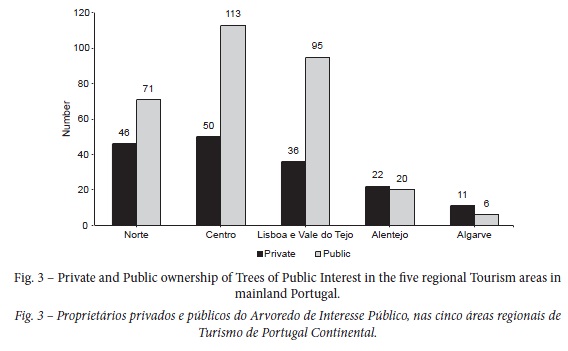
<body><![CDATA[<p>&nbsp;</p>     <p>Regarding the distribution by ownership (<a href="#f3">fig. 3</a>), it can    be seen that the larger portion of TPI belongs to the public administration,    in &ldquo;Norte&rdquo; and &ldquo;Centro&rdquo; of the territory. Private ownership    is greater in &ldquo;Alentejo&rdquo; and &ldquo;Algarve&rdquo;. This can be    related to the large&nbsp;private <i>farms</i>(<i>latifundia) existing in the    South of the country.</i></p>     <p>&nbsp;</p> <a name="f3"></a> <img src="/img/revistas/fin/n110/n110a02f3.jpg">      
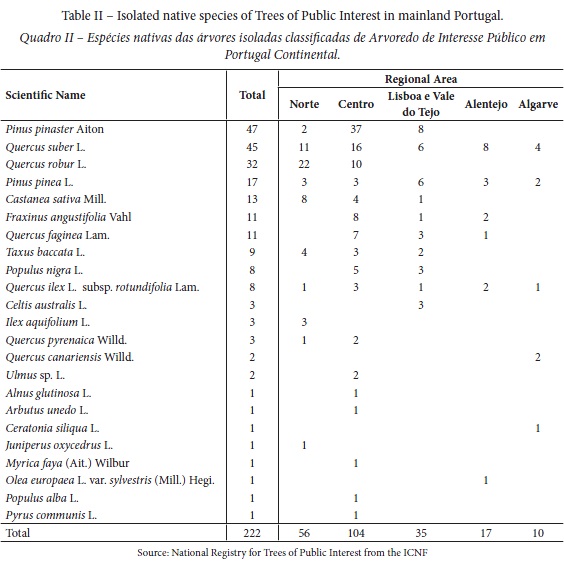
<p>&nbsp;</p>     <p>Considering the isolated native species (47%), the most frequent species were    <i>Pinus pinaster </i>(21%)<i>,</i> <i>Quercus suber</i> (20%) and <i>Quercus    robur</i> (14%). Also well represented are the species: <i>Pinus pinea </i>(8%),    <i> Castanea sativa </i>(6%), <i>Fraxinus angustifolia </i>(5%),<i> Quercus    faginea </i>(5%), <i>Taxus baccata </i>(4%), <i>Populus nigra</i> (4%) and <i>Quercus    ilex </i>subsp<i>. rotundifolia </i>(4%) ( <a href="#t2">table II</a> ). These    species are representative of the main arboreal flora in mainland Portugal that,    according to the 6th National Forest Inventory (NFI), represents 70% of the    wooded area of the country (IFN6, 2013), influenced by the Atlantic and Mediterranean    climates (Ribeiro, Lautensach, &amp; Daveau, 1991; Fabi&atilde;o &amp; Oliveira,    2006).</p>     <p>&nbsp;</p> <a name="t2"></a> <img src="/img/revistas/fin/n110/n110a02t2.jpg">      
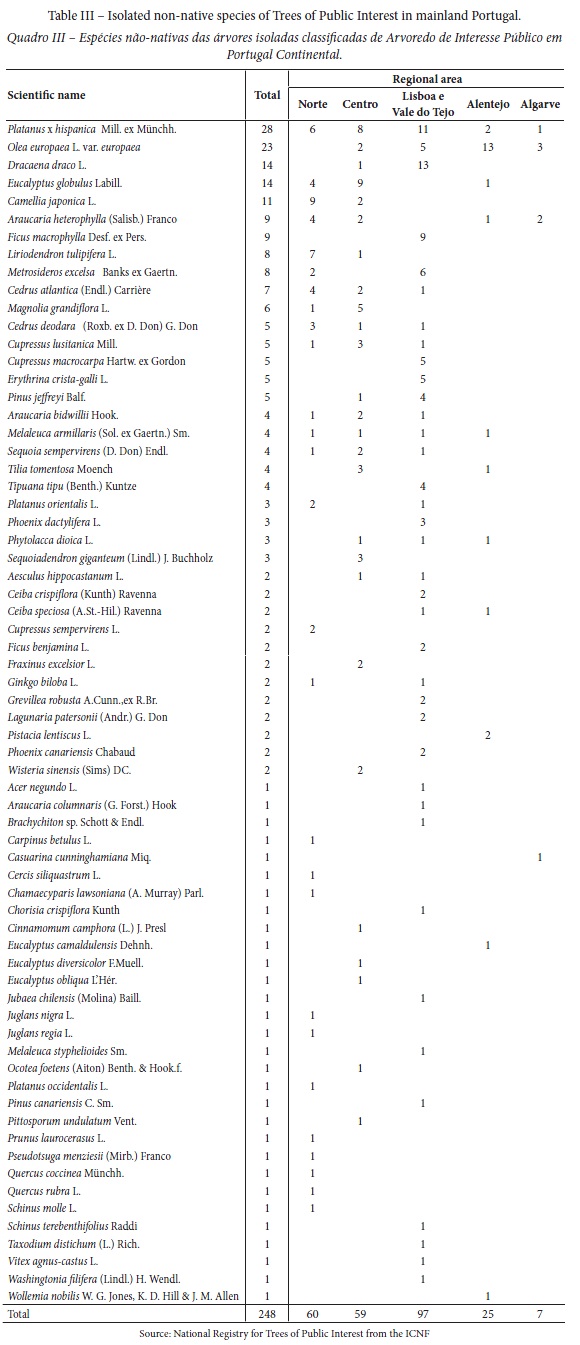
<p>&nbsp;</p>     <p>From isolated non-native species (53%), the most frequent species are <i>Platanus    x hispanica </i>(11%), <i>Olea europaea </i>var. <i>europaea </i>(9%), <i>Dracaena    draco </i>(6%), <i>Eucalyptus globulus </i>(6%), <i>Araucaria </i>spp. (5.6%)    and <i>Camellia japonica </i>(4%) ( <a href="#t3">table III</a> ). The diversity    and abundance of non-native species found denote a historical memory and the    increased ornamental exotic plant commerce through time. In fact, the transport    of the first non-native plants to Portugal took place in prehistory, and later,    in the Roman period (Vicente <i>et al</i>., 2018). However, it was during the    sixteenth century, with the maritime expansion to other continents, that non-native    species have been significantly introduced in Portugal (Ferreira, 2004; Vicente    <i>et al</i>., 2018), for studying the possibility of acclimatizing new productive    cultures in Portugal (Vandelli, 1770). Their abundance has increased during    the last two centuries, and today represent more than 15% of the Portuguese    flora (Almeida &amp; Freitas, 2001).</p>     <p>&nbsp;</p> <a name="t3"></a> <img src="/img/revistas/fin/n110/n110a02t3.jpg">      
<p>&nbsp;</p>     ]]></body>
<body><![CDATA[<p><b>2. Native species as Trees of Public Interest </b></p>     <p>From the results obtained it is possible to establish a comparison between    the distribution of native species from the Mediterranean Region, present in    the National Registry, and their natural geographical distribution in mainland    Portugal, influenced by Mediterranean and Atlantic conditions (Rego &amp; Rocha,    2014):</p>     <p>i) in Atlantic influenced areas, it is verified the presence of <i>Quercus    robur </i>(the third most abundant species listed) and the presence of<i> Quercus    pyrenaica</i>, a species that covers the transition between the Atlantic and    Mediterranean regions, North coast and, MiddleEastern, respectively, corresponding    to the &ldquo;Norte&rdquo; regional area; </p>     <p>ii) in the deciduous woods (or cork oak&nbsp;&lsquo;montado&rsquo;)the <i>    Quercus suber</i>, the second most abundant species in the National Registry.    This species, part of the natural vegetation of the Iberian Peninsula, has high    economic, cultural and ecological importance, and is the most represented native    tree of the total forested area in Portugal (737&nbsp;000ha; 23%) (Capelo &amp;    Catry, 2007; IFN6, 2013). Deciduous trees also include: <i>Quercus ilex</i>,    another species occurring in all regional areas, representing 11% of total forest    area (IFN6, 2013); <i>Arbutus unedo </i>, with only one occurrence in the &ldquo;Centro&rdquo;    region; and <i>Olea</i> <i>europaea</i> <i>sylvestris</i> (&lsquo;<i>zambujais</i>&rsquo;),    a native species, with sole presence in the &ldquo;Alentejo&rdquo;. This tree    is a spontaneous species of the cultivated non-native olive tree (<i>Olea europaea</i>    var. <i>europaea</i>);</p>     <p> iii) the marcescent woods are characterized by the presence of <i>Quercus    faginea</i> existing in the &ldquo;Centro&rdquo;, &ldquo;Lisboa&rdquo; and &ldquo;    Alentejo&rdquo; and <i>Quercus canariensis</i>, the rarest of the oak-species,    typical of humid areas of the western Mediterranean, occurring only in the &ldquo;Algarve&rdquo;    mountains;</p>     <p>iv) mediterranean forests of conifers: <i>Pinus pinaster</i>, occurring in    &ldquo;Norte&rdquo; &ndash; &ldquo;Centro&rdquo;, is the most abundant species    listed. Most of this type of classified tree occurs in the &ldquo;Centro&rdquo;,    corresponding to the &lsquo;National Forest of Leiria&rsquo;, an area of historical    pine plantations. In fact, throughout the 19th century, Portugal went through    a so-called <i>pinheiriza&ccedil;&atilde;o </i>(intensive plantation of <i>Pinus    pinaster</i>), to address an intense deforestation of the past centuries due    to: fires, slashing and burning of agricultural and pastoral areas, and also    promoted by the Portuguese Maritime Expansion, that occurred between the 16<sup>th</sup>    and 18<sup>th</sup> centuries (Devy-Vareta, 1986; Paiva, 1997; PNDFCI, 2005).    This would lead to the largest continuous patch of pine forest in Europe, which    was further promoted during the 20th century (Capelo &amp; Catry, 2007). These    facts probably contributed to the development of notable examples. Nowadays,    this species occupies the third position of the total forest area (714&nbsp;000ha;    23%) with important economic value due to the exploration of resin, wood and    pulp (Capelo &amp; Catry, 2007; IFN6, 2013). <i>Pinus pinea</i> is the fourth    most abundant species listed, represented in all regional areas. It carries    social, aesthetic and economic value, by the shape of its crown and its seed,    the pine seed (Capelo &amp; Catry, 2007). With 175&nbsp;000ha, it represents    6% of all forest area (IFN6, 2013); </p>     <p>v) riparian forests of <i>Alnus glutinosa</i>, <i>Populus </i> spp., and <i>Fraxinus    angustifolia</i> more represented in the &ldquo;Centro&rdquo; and &ldquo;Alentejo&rdquo;    (Fabi&atilde;o &amp; Oliveira, 2006; Capelo &amp; Catry, 2007; Do Amaral <i>et    al</i>., 2016).</p>     <p>Other native species analysed, despite having lower representation in the National    Registry, have, over the time, gained important economic, cultural and ecological    roles in rural communities, such as: i) <i>Castanea sativa</i>, survived from    the glaciations of the Iberian Quaternary in small sheltered areas around the    Peninsula (found in the palynological records) has been cultivated since Roman    times, now is represented in the eastern Northern and Central of the territory,    covering 1% of the forest area, 41&nbsp;000ha (Maia, 1988; Gomes-Laranjo, Anjos,    Pinto, Ferreira-Cardoso, &amp; Peixoto, 2009; IFN6, 2013); ii) <i>Ceratonia    siliqua</i>, only present in the &ldquo;Algarve&rdquo; has an important fruit    production (carob) (IFN6, 2013).</p>     <p>Other species have a unique presence in the National Registry. <i>Pyrus communis</i>,    exclusive to Ger&ecirc;s and Cabreira mountains (North Portugal), have a sole    occurrence in the &ldquo;Centro&rdquo;, which evidences an old area of cultivation.    Also, <i>Myrica faya</i>, which occurs mainly in the sandy pine forests of the    &ldquo;Centro&rdquo; regional area, and <i>Juniperus oxycedrus</i> considered    one of the most important ornamental Portuguese conifers, well adapted to hot    and dry regions of the North (Fabi&atilde;o &amp; Oliveira, 2006; Do Amaral    <i>et al</i>., 2016).</p>     <p>There are other species with a special status of protection, due to national    or European law, including: <i>Ilex aquifolium</i>, <i>Taxus baccata</i>, <i>Quercus    canariensis; Juniperus</i> spp.; <i>Quercus rotundifolia</i>; and <i>Quercus    suber </i> elected the Portuguese National Tree (Do Amaral <i>et al</i>., 2016).     ]]></body>
<body><![CDATA[<p>      <p><i>Ulmus</i> spp. was included as a native species, despite not being mentioned    in the National Registry they are specifically restrictive. According to prior    studies, <i>Ulmus</i> minor was, until a few decades ago, a very common species    in all of Portugal. Unfortunately, it has been decimated by successive new strains    of the dutch elm disease (<i>Ophiostoma</i> spp.) (Do Amaral <i>et al</i>.,    2016), and maybe these can explain the two instances, existing as isolated trees,    in the &ldquo;Centro &rdquo;.</p>     <p><b>3. Non-native species as Trees of Public Interest </b></p>     <p>&nbsp;From the results obtained of non-native trees, it is possible to understand    how the history of Portugal was important in diversifying the species existing    today in the National Registry. Several species have been introduced during    the Roman occupation (Rosa, 2013). <i>Platanus</i> spp. was one such species,    widely planted in parks and along streets in southern Europe and Asia Minor    to improve the microclimate (Pourkhabbaz <i>et al</i>., 2010). In Portugal,    its abundance - as the most frequent species in the National Registry - reflects    its ornamental use. <i>Olea europaea</i> L. var. <i>europaea</i>, the second    most abundant non-native species listed, considered one of the oldest permanently    cultivated species since Pre-history, is very common in Mediterranean regions    with an agricultural use and high economic and social impact (Bohm, Godinho,    &amp; Coelho, 2013; Moya, 2015).</p>     <p>Another frequent species, except in the &ldquo;Lisboa&rdquo; and &ldquo;Algarve&rdquo;,    is <i>Eucalyptus globulus</i>. This species has an economic value, especially    in the paper pulp industry, that makes it dominant in terms of occupation of    the total forest area in the country (812&nbsp;000ha, 26%) (Alves, Pereira,    &amp; Silva, 2007; IFN6, 2013).</p>     <p>The &ldquo;Lisboa&rdquo; regional area has a high abundance and diversity of    non-native species compared with the others areas. This can be explained by    the botanical interest during the period of maritime expansion, which led to    the creation of the first Portuguese botanical garden &ndash; the &lsquo;Ajuda    Botanical Garden&rsquo; &ndash;, to receive the new plants coming from other    continents, during the 18th century. In the 19th century, the botanical collection    was expanded to private gardens belonging to the Royal Family and then came    in use in public gardens and in the thoroughfares of cities. Later, these species    were planted in many places in the country (Rosa, 2013). So, for instance, <i>Dracaena    draco </i>is represented in the &ldquo;Centro&rdquo; and &ldquo;Lisboa&rdquo;    regional areas, although its occurs mostly in &ldquo;Lisboa&rdquo;, where <i>Ficus    </i>spp. and other non-native species have an exclusive representation.</p>     <p><i>Camellia japonica</i>, <i>Phoenix canariensis</i>, <i>Araucaria</i> sp.    and <i>Wisteria sinensis</i> are species with ornamental interest, and during    the 16th century, during the maritime expansion, an interest in exotic species    was born throughout Europe (Saraiva, 2007; Rosa, 2013). Other species, common    as gardening plants for their ornamental value, are present in our data: <i>Liriodendron    tulipifera</i>, <i>Metrosideros excelsa</i> and <i>Magnolia grandiflora</i>.</p>     <p>A few palm trees of different species were also classified as TPI. Unfortunately,    some are presently being declassified by the ICNF after the attack by the insect    <i>Rhynchophrus ferrugineus</i>, commonly known as red palm weevil.</p>     <p><b>4. National Registry for Trees of Public Interest database and tourism </b></p>     <p>Other information made by the technicians of the Institute of Nature Conservation    and Forests regards to trees with special interest to be included in tourist    routes, like for instance the champions trees, such as:</p>     ]]></body>
<body><![CDATA[<p>- in height (72m), an <i>Eucalyptus diversicolor</i>, located in Coimbra, considered    the highest specimen in Europe;</p>     <p>- in crown diameter (50.50m), an <i>Eucalyptus globulus</i>, located in Braga;</p>     <p>- in age (2&nbsp;850 years), an <i>Olea europaea</i> L. var. <i>europaea</i>,    located in Loures;</p>     <p>- in <i>trunk diameter</i>&nbsp;at breast&nbsp;<i>height</i>&nbsp;(DBH, 14.4    m), a <i>Castanea sativa</i>, located in Vila Pouca de Aguiar.</p>     <p>But also, other monumental trees have potential and are referenced to tourism    and educational exploration. This information is especially important in rural    areas, taking into account that nature tourism assumes a sustainable revitalization    activity for those territories (Lu&iacute;s, 2002; Milheiro <i>et al</i>., 2014).    The diversification of tourism, with the development of itineraries through    monumental trees, can provide an opportunity for <i>emphasizing its value, as    an endogenous differentiation element of each region by</i> renewed popular    knowledge (agricultural practices, pastoralism, forestry or gastronomy), as    well as the appreciation of local cultural curiosities (legends, religious reasons).    This is consistent with Costa <i>et al</i>.&rsquo; s (2005) study, which suggested    that tourist routes allow the trees to be preserved as living monuments, contributing    simultaneously to the tourist, economic, historical and heritage development    of the regions where they are located.</p>     <p><b>&nbsp;</b></p>     <p><b>V. CONCLUSIONS AND FURTHER RESEARCH</b></p>     <p>&nbsp;The analyses of the National Registry brought knowledge on the reality    of trees classified. The results show that public proposals for classification    of monumental trees do not occur in the whole of the mainland territory, since    almost half of municipalities have no TPI, despite the national legislation    and the fact that the largest owner is the State. Also of interest to note is    their distribution in the territory, which reflect the diversity of the Portuguese    forest, and its evolution, influenced by the introduction of non-native species.    The results obtained jointly with the lack of information, in the general population,    but also from public institutions, on tree classification, requires a careful    reflection on the importance of this heritage that is not known and not assumed    as a national strategy for promotion and differentiation of the regions. This    constitutes a gap, because the current legislation sustains guidelines for an    effective classification procedure and protection of monumental trees, where    anyone can start a new classification proposal.</p>     <p>Considering the importance of reversing these trends, a larger experimental    study is being implemented, to assess the impact of science communication projects    on increasing public awareness of monumental trees. The study is divided in    three main research areas. Firstly, collecting and analysing institutional data    (legislation), at national and European, concerning the valorisation and protection    of trees with notable features. In a second moment, identifying national actions    developed at institutional levels regarding knowledge, attitudes and opinions    on monumental trees and assess the degree of action in relation to the current    legislation, as well as diagnose the main communication strategies developed    for the promotion of the knowledge of the monumental trees to the public and    also identifying the main barriers to non-investment in this area. In this sense,    a questionnaire will be carried out in the 100 municipalities from &ldquo;Centro&rdquo;    regional area. In a third moment, developing and evaluating the impact of methodologies    to involving different target audiences in science communication programmes,    in the context of non-formal education, where botanical activities were the    focus. Some of these projects will be capitalized to promote tourist itineraries,    at the same time is promoted scientific literacy.</p>     <p>Collecting information about monumental trees was important to understand how    to emphasize their potential. By representing the living memory and identity    of a community, this heritage can be taken as a catalyst for local development    and also to be used for promotion of scientific culture <i>in botany, contributing    to counteract the plant blindness phenomenon</i>.</p>     ]]></body>
<body><![CDATA[<p><b>&nbsp;</b></p>     <p><b>ACKNOWLEDGEMENTS</b></p>     <p>Raquel Pires Lopes and Catarina Schreck Reis are financially supported by scholarships    from the <i>FCT &ndash; Funda&ccedil;&atilde;o para a Ci&ecirc;ncia e a Tecnologia,    I.P</i>., respectively SFRH/BD/91905/2012, and SFRH/BPD/101370/2014.</p>     <p>This work is financially supported by National Funds through <i>FCT &ndash;    Funda&ccedil;&atilde;o para a Ci&ecirc;ncia e a Tecnologia, I.P</i>., under    the project UID/CED/00194/2013.</p>     <p><b>&nbsp;</b></p>     <p><b>REFERENCES</b></p>     <!-- ref --><p>Almeida, J. D., &amp; Freitas, H. (2001). The Exotic and Evasive Flora of Portugal.    <i>Botanica Complutensis, 25</i>, 317-327.    &nbsp;&nbsp;&nbsp;&nbsp;&nbsp;&nbsp;&nbsp;&nbsp;[&#160;<a href="javascript:void(0);" onclick="javascript: window.open('/scielo.php?script=sci_nlinks&ref=301305&pid=S0430-5027201900010000200001&lng=','','width=640,height=500,resizable=yes,scrollbars=1,menubar=yes,');">Links</a>&#160;]<!-- end-ref --></p>     <!-- ref --><p>Alves, A., Pereira, J., &amp; Silva, J. (2007). <i>A introdu&ccedil;&atilde;o    e a expans&atilde;o do eucalipto em Portugal</i> [The introduction and expansion    of eucalyptus in Portugal]. Lisboa: Departamento de Engenharia Florestal, Instituto    Superior de Agronomia, Universidade T&eacute;cnica de Lisboa.    &nbsp;&nbsp;&nbsp;&nbsp;&nbsp;&nbsp;&nbsp;&nbsp;[&#160;<a href="javascript:void(0);" onclick="javascript: window.open('/scielo.php?script=sci_nlinks&ref=301307&pid=S0430-5027201900010000200002&lng=','','width=640,height=500,resizable=yes,scrollbars=1,menubar=yes,');">Links</a>&#160;]<!-- end-ref --></p>     ]]></body>
<body><![CDATA[<!-- ref --><p>Bohm, J., Godinho, C., &amp; Coelho, F. (2013). <i>Grande livro da oliveira    e do azeite</i> [Biggest book of olive and olive oil]. Lisboa: Dinalivro.    &nbsp;&nbsp;&nbsp;&nbsp;&nbsp;&nbsp;&nbsp;&nbsp;[&#160;<a href="javascript:void(0);" onclick="javascript: window.open('/scielo.php?script=sci_nlinks&ref=301309&pid=S0430-5027201900010000200003&lng=','','width=640,height=500,resizable=yes,scrollbars=1,menubar=yes,');">Links</a>&#160;]<!-- end-ref --></p>     <!-- ref --><p>Butler, J. E., Rose, F., &amp; Green, E. E. (2001). Ancient trees, icons of    our most important wooded landscapes in Europe<i>.</i> <i>Textbook</i>, <i>2</i>,    20-26.    &nbsp;&nbsp;&nbsp;&nbsp;&nbsp;&nbsp;&nbsp;&nbsp;[&#160;<a href="javascript:void(0);" onclick="javascript: window.open('/scielo.php?script=sci_nlinks&ref=301311&pid=S0430-5027201900010000200004&lng=','','width=640,height=500,resizable=yes,scrollbars=1,menubar=yes,');">Links</a>&#160;]<!-- end-ref --></p>     <!-- ref --><p>Capelo, J., &amp; Catry, F. (2007). A distribui&ccedil;&atilde;o do carvalho-portugu&ecirc;s    em Portugal [The distribution of oak-Portuguese in Portugal]. In J. S. Silva    (Coord.), <i>Os carvalhais - Um patrim&oacute;nio a conservar</i> [The oak trees    - A heritage to keep] (p. 83-94). Lisboa: Colec&ccedil;&atilde;o &Aacute;rvores    e Florestas de Portugal. Jornal P&uacute;blico/Funda&ccedil;&atilde;o Luso-Americana    para o Desenvolvimento/Liga para a Protec&ccedil;&atilde;o da Natureza.    &nbsp;&nbsp;&nbsp;&nbsp;&nbsp;&nbsp;&nbsp;&nbsp;[&#160;<a href="javascript:void(0);" onclick="javascript: window.open('/scielo.php?script=sci_nlinks&ref=301313&pid=S0430-5027201900010000200005&lng=','','width=640,height=500,resizable=yes,scrollbars=1,menubar=yes,');">Links</a>&#160;]<!-- end-ref --></p>     <!-- ref --><p>Costa, A., Sobral, R., Viana, H., Fernandes, M., &amp; Barracosa, P., (2005    maio).&nbsp;Valoriza&ccedil;&atilde;o do Patrim&oacute;nio Arb&oacute;reo da    Regi&atilde;o D&atilde;o-Laf&otilde;es [Valorization of the arboric heritage    of the D&atilde;o-Laf &otilde;es Region].&nbsp;In Instituto Polit&eacute;cnico    de Viseu (Eds.    &nbsp;&nbsp;&nbsp;&nbsp;&nbsp;&nbsp;&nbsp;&nbsp;[&#160;<a href="javascript:void(0);" onclick="javascript: window.open('/scielo.php?script=sci_nlinks&ref=301315&pid=S0430-5027201900010000200006&lng=','','width=640,height=500,resizable=yes,scrollbars=1,menubar=yes,');">Links</a>&#160;]<!-- end-ref -->),<i> 5&ordm; Congresso Florestal Nacional - A Floresta e as Gentes</i>    [5th National Forestry Congress - The Forest and the People]. 16 a 19 de maio    de 2005. Viseu: Instituto Polit &eacute;cnico de Viseu.</p>     <!-- ref --><p>Dafni, A. (2006). On the typology and the worship status of sacred trees with    a special reference to the Middle East. <i>Journal of Ethnobiology and Ethnomedicine</i>,    <i>2</i>(1), 26. doi: 10.1186/1746-4269-2-26&nbsp;&nbsp;&nbsp;&nbsp;&nbsp;&nbsp;&nbsp;&nbsp;[&#160;<a href="javascript:void(0);" onclick="javascript: window.open('/scielo.php?script=sci_nlinks&ref=301317&pid=S0430-5027201900010000200007&lng=','','width=640,height=500,resizable=yes,scrollbars=1,menubar=yes,');">Links</a>&#160;]<!-- end-ref --><!-- ref --><p>Devy-Vareta, N. (1986). Para uma geografia da floresta portuguesa. Do decl&iacute;nio    das matas medievais &agrave; pol&iacute;tica florestal do renascimento (s&eacute;c.    XV e XVI) [For a geography of the Portuguese forest. From the decline of the    medieval forests to the forest policy of the Renaissance (s&eacute;c. XV e XVI)].    <i>Revista da Faculdade de Letras-Geografia</i>, <i>I</i>(l), 5-37.    &nbsp;&nbsp;&nbsp;&nbsp;&nbsp;&nbsp;&nbsp;&nbsp;[&#160;<a href="javascript:void(0);" onclick="javascript: window.open('/scielo.php?script=sci_nlinks&ref=301318&pid=S0430-5027201900010000200008&lng=','','width=640,height=500,resizable=yes,scrollbars=1,menubar=yes,');">Links</a>&#160;]<!-- end-ref --></p>     <p>Diraison, A. (2003). <i>Les Droits de L&rsquo;Arbre Aide-M&eacute;moire des    Textes Juridiques</i> [The Rights of the Tree Aide-M&eacute;moire of the Legal    Texts]. Paris: Minist&egrave;re de l&rsquo;&Eacute;cologie et du D&eacute;veloppement    Durable. Retrieved from <a href="http://nature.jardin.free.fr/Droits_arbre.pdf" target="_blank">http://nature.jardin.free.fr/Droits_arbre.pdf</a></p>     <!-- ref --><p>Do Amaral, P. B., Aguiar, C., Neto, C., Capelo, J., &amp; Lopes, F. (2016).    <i>Esp&eacute;cies Arb&oacute;reas Ind&iacute;genas de Portugal Continental-Guia    de utiliza&ccedil;&atilde;o</i> [Indigenous arboreal species of continental    Portugal - User Guide]. Lisboa: Edi&ccedil;&atilde;o do ICNF.    &nbsp;&nbsp;&nbsp;&nbsp;&nbsp;&nbsp;&nbsp;&nbsp;[&#160;<a href="javascript:void(0);" onclick="javascript: window.open('/scielo.php?script=sci_nlinks&ref=301321&pid=S0430-5027201900010000200010&lng=','','width=640,height=500,resizable=yes,scrollbars=1,menubar=yes,');">Links</a>&#160;]<!-- end-ref --></p>     <!-- ref --><p>Dom&iacute;nguez Lerena, S., Corchero De La Torre S., &amp; Albano Villar,    R. (2012). <i>Manual de Buenas Pr&aacute;ticas para los &Aacute;rboles Singulares</i>    [Handbook of Best Practices for Singular Trees]<i>.</i> Ministerio de Medio    Ambiente, Medio Rural y Marino: Bosques Sin Fronteras.    &nbsp;&nbsp;&nbsp;&nbsp;&nbsp;&nbsp;&nbsp;&nbsp;[&#160;<a href="javascript:void(0);" onclick="javascript: window.open('/scielo.php?script=sci_nlinks&ref=301323&pid=S0430-5027201900010000200011&lng=','','width=640,height=500,resizable=yes,scrollbars=1,menubar=yes,');">Links</a>&#160;]<!-- end-ref --></p>     <p>Fabi&atilde;o, A. M. D., &amp; Oliveira, A. C. (2006). <i>A floresta em Portugal</i>    [The forest in Portugal]. Instituto Superior de Agronomia. Departamento de Engenharia    Florestal.</p>     <!-- ref --><p>FancÌŒovicÌŒov&aacute;, J., &amp; Prokop, P. (2011). Plants have a chance:    outdoor educational programmes alter students' knowledge and attitudes towards    plants. <i>Environmental Education Research, 17</i>(4), 537-551. doi: 10.1080/13504622.2010.545874&nbsp;&nbsp;&nbsp;&nbsp;&nbsp;&nbsp;&nbsp;&nbsp;[&#160;<a href="javascript:void(0);" onclick="javascript: window.open('/scielo.php?script=sci_nlinks&ref=301326&pid=S0430-5027201900010000200013&lng=','','width=640,height=500,resizable=yes,scrollbars=1,menubar=yes,');">Links</a>&#160;]<!-- end-ref --><!-- ref --><p>Ferreira M. (2004). Esp&eacute;cies Ex&oacute;ticas e Ornamentais [Exotic and    ornamental species]. <i>Folha Viva</i>, <i>26</i>(VII), 3-13.    &nbsp;&nbsp;&nbsp;&nbsp;&nbsp;&nbsp;&nbsp;&nbsp;[&#160;<a href="javascript:void(0);" onclick="javascript: window.open('/scielo.php?script=sci_nlinks&ref=301327&pid=S0430-5027201900010000200014&lng=','','width=640,height=500,resizable=yes,scrollbars=1,menubar=yes,');">Links</a>&#160;]<!-- end-ref --></p>     ]]></body>
<body><![CDATA[<!-- ref --><p>Gomes-Laranjo, J., Anjos, R., Pinto, T., Ferreira-Cardoso, J., &amp; Peixoto,    F. (2009). <i>Distribui&ccedil;&atilde;o do castanheiro em Portugal. Avalia&ccedil;&atilde;o    do potencial de crescimento da cultura</i> [Distribution of chestnut in Portugal.    Evaluation of the growth potential of the crop]. In J. Gomes-Laranjo, F. Peixoto    &amp; J. Ferreira-Cardoso (Eds.), <i>Castanheiros, T&eacute;cnicas e Pr&aacute;ticas</i>    [Chestnuts, Techniques and Practices] (pp. 7-24). Pulido Consulting, Ind&uacute;stria    Criativa: Universidade de Tr&aacute;s-os-Montes e Alto Doro. Invent&aacute;rio    Florestal Nacional. (IFN6). (2013). <i>Invent&aacute;rio Florestal Nacional:    &Aacute;reas dos usos do solo e das esp&eacute;cies florestais de Portugal continental    1995 | 2005 | 2010</i> [National Forest Inventory: Areas of land use and forest    species of mainland Portugal 1995 | 2005 | 2010].    &nbsp;&nbsp;&nbsp;&nbsp;&nbsp;&nbsp;&nbsp;&nbsp;[&#160;<a href="javascript:void(0);" onclick="javascript: window.open('/scielo.php?script=sci_nlinks&ref=301329&pid=S0430-5027201900010000200016&lng=','','width=640,height=500,resizable=yes,scrollbars=1,menubar=yes,');">Links</a>&#160;]<!-- end-ref --> Resultados preliminares. v1.1.</p>     <p>Jim, C. Y. (2005). Monitoring the performance and decline of heritage trees    in urban Hong Kong. <i>Journal of Environmental Management</i>, <i>74</i>(2),    161&ndash;172. doi:&nbsp;10.1016/j.jenvman.2004.08.014</p>     <!-- ref --><p>Lindenmayer, D. B., Laurance, W. F., &amp; Franklin, J. F. (2012). Global decline    in large old trees. <i>Science</i>, <i>338</i>(6112), 1305-1306. doi: 10.1126/science.1231070&nbsp;&nbsp;&nbsp;&nbsp;&nbsp;&nbsp;&nbsp;&nbsp;[&#160;<a href="javascript:void(0);" onclick="javascript: window.open('/scielo.php?script=sci_nlinks&ref=301332&pid=S0430-5027201900010000200018&lng=','','width=640,height=500,resizable=yes,scrollbars=1,menubar=yes,');">Links</a>&#160;]<!-- end-ref --><p>Lindenmayer, D. B., Laurance, W. F., Franklin, J. F., Likens, G. E., Banks,    S. C., Blanchard, W&hellip; Manning, A. D. (2013). New policies for old trees:    averting a global crisis in a keystone ecological structure. <i>Conservation    Letters</i>,<i> 7</i> (1), 61-69. doi: 10.1111/conl.12013</p>     <p>Lisa, C. (2011). Gli alberi monumentali: normative, conoscenza e tutela [Monumental    trees: regulations, knowledge and protection]. <i>L&rsquo;Italia Forestale e    Montana</i>, <i>66</i>(6), 509-519.</p>     <!-- ref --><p>Lu&iacute;s, E. (2002). Turismo no espa&ccedil;o rural em Portugal [Tourism    in rural areas in Portugal]. <i>GeoINova</i>, <i>5</i>, 139-152.    &nbsp;&nbsp;&nbsp;&nbsp;&nbsp;&nbsp;&nbsp;&nbsp;[&#160;<a href="javascript:void(0);" onclick="javascript: window.open('/scielo.php?script=sci_nlinks&ref=301335&pid=S0430-5027201900010000200021&lng=','','width=640,height=500,resizable=yes,scrollbars=1,menubar=yes,');">Links</a>&#160;]<!-- end-ref --></p>     <!-- ref --><p>Maia, M. (1988). <i>A Silvicultura do Castanheiro na Regi&atilde;o de Tr&aacute;s-os-Montes</i>.    <i>Resultados Preliminares</i> [Chestnut tree forestry in the Tr&aacute;s-os-Montes    Region. Preliminary results]. (Doctoral thesis). INIA, EFN, Bragan &ccedil;a.Marchante,    E., Freitas, H., &amp; Marchante, H. (2008). <i>Guia Pr&aacute;tico para a identifica&ccedil;&atilde;o    de Plantas Invasoras de Portugal Continental</i> [Practical guide for the identification    of Invasive Plants in <i>mainland</i> Portugal]. Coimbra: Imprensa da Universidade    de Coimbra.    &nbsp;&nbsp;&nbsp;&nbsp;&nbsp;&nbsp;&nbsp;&nbsp;[&#160;<a href="javascript:void(0);" onclick="javascript: window.open('/scielo.php?script=sci_nlinks&ref=301337&pid=S0430-5027201900010000200023&lng=','','width=640,height=500,resizable=yes,scrollbars=1,menubar=yes,');">Links</a>&#160;]<!-- end-ref --></p>     ]]></body>
<body><![CDATA[<!-- ref --><p>Martins, L., &amp; Travassos, P. (2012). <i>Fitossanidade e seguran&ccedil;a    das &aacute;rvores da Escola Francesa - Porto</i> [Phytosanitary and security    of the French School - Porto]. Bragan&ccedil;a: Universidade de Tr&aacute;s-os-Montes,    Departamento de Ci&ecirc;ncias Florestais e Arquitetura Paisagista.    &nbsp;&nbsp;&nbsp;&nbsp;&nbsp;&nbsp;&nbsp;&nbsp;[&#160;<a href="javascript:void(0);" onclick="javascript: window.open('/scielo.php?script=sci_nlinks&ref=301339&pid=S0430-5027201900010000200024&lng=','','width=640,height=500,resizable=yes,scrollbars=1,menubar=yes,');">Links</a>&#160;]<!-- end-ref --></p>     <p>Milheiro, E., Martins, A., &amp; Alaves, J. (2014). O rural como espa&ccedil;o    de empreendedorismo em turismo [The rural as a space for entrepreneurship in    tourism]. In&nbsp;Instituto Polit&eacute;cnico de Portalegre (Eds.), <i>O Futuro    do Mundo Rural em Quest&atilde;o &ndash; Atas do I Congresso de Estudos Rurais    do Norte Alentejano</i> [The Future of the Rural World in Question - Minutes    of the I Congress of Rural Studies of the North &ldquo;Alentejo&rdquo;] (pp.    53-78). Portalegre: Instituto Polit&eacute; cnico de Portalegre.</p>     <!-- ref --><p>Moya, B. (2015)<i>. Horizonte 2020, la estrat&eacute;gia para la conservaci&oacute;n    de la Biodiversidade en la Uni&oacute;n Europea: Retos y oportunidades para    los &aacute;rboles monumentales y bosques maduros</i> [Horizon 2020, the strategy    for the conservation of Biodiversity in the European Union: Challenges and opportunities    for monumental trees and mature forests]. In <i>Congreso Internacional enArbolar:    Grandes &aacute;    &nbsp;&nbsp;&nbsp;&nbsp;&nbsp;&nbsp;&nbsp;&nbsp;[&#160;<a href="javascript:void(0);" onclick="javascript: window.open('/scielo.php?script=sci_nlinks&ref=301342&pid=S0430-5027201900010000200026&lng=','','width=640,height=500,resizable=yes,scrollbars=1,menubar=yes,');">Links</a>&#160;]<!-- end-ref -->rboles para la Vida (BIGTREE4LIFE) - El valor de los &aacute;rboles    y bosques maduros en la salvaguardia de la biodiversidad</i>, Val&ecirc;ncia.</p>     <p>Nowak, D. J. (2004). Assessing environmental functions and values of veteran    trees. In&nbsp;G. Nicolotti &amp; P. Gonthier (Eds), <i>International Congress    on the Protection and Exploitation of Veteran Trees, Torino </i>(pp. 45-49)<i>.    </i>Regione Piemonte and Universita di Torino, Italy.</p>     <p>Paiva, J. (1997). Floresta: das origens aos nossos dias [Forest: from the origins    to our days]. <i>Revista Floresta e Ambiente, 37</i>.</p>     <p>Par&eacute;s Espa&ntilde;ol, E. (2009). <i>&Aacute;rboles monumentales de Catalu&ntilde;a,    21 a&ntilde;os de protecci&oacute;n</i> [Monumental trees of Catalu&ntilde;a,    21 years of protecci&oacute;n]. Actuaciones m&aacute;s frecuentes in Laliga    LS (Ed.). In <i>III Jornadas Estatales Sobre &Aacute;rboles Monumentales y Singulares,    Situaci&oacute;n actual de la conservaci&oacute;n de nuestros &Aacute;rboles</i>,    Alcoi. Retrieved from <a href=" http://parcsnaturals.gencat.cat/web/.content/home/coneix-nos/arbres_monumentals/per_saber_ne_mes/jornades_darbres_monumentals/amalcoi2008-09_es_modif_lam_vol.1.pdf" target="_blank">    http://parcsnaturals.gencat.cat/web/.content/home/coneix-nos/arbres_monumentals/per_saber_ne_mes/jornades_darbres_monumentals/amalcoi2008-09_es_modif_lam_vol.1.pdf</a></p>     <!-- ref --><p>Pederson, N. (2010). External characteristics of old trees in the Eastern Deciduous    Forest. <i>Natural Areas Journal</i>, <i>30</i>(4), 396-407.    &nbsp;&nbsp;&nbsp;&nbsp;&nbsp;&nbsp;&nbsp;&nbsp;[&#160;<a href="javascript:void(0);" onclick="javascript: window.open('/scielo.php?script=sci_nlinks&ref=301347&pid=S0430-5027201900010000200030&lng=','','width=640,height=500,resizable=yes,scrollbars=1,menubar=yes,');">Links</a>&#160;]<!-- end-ref --></p>     ]]></body>
<body><![CDATA[<p>Plano Nacional Defesa da Floresta Contra Inc&ecirc;ndios. (PNDFCI). (2005).<i>    Prespectiva Hist&oacute;rica sobre a floresta Portuguesa e a sua defesa contra    inc&ecirc;ndios</i> [History of the Portuguese forest and its fire protection].    Relat&oacute;rio Final da Proposta T&eacute;cnica de Plano Nacional Defesa Da    Floresta Contra Inc&ecirc;ndios &ndash; Anexo I. Lisboa: Instituto Superior    de Agronomia.</p>     <!-- ref --><p>Pourkhabbaz, A., Rastin, N., Olbrich, A., Langenfeld-Heyser, R., &amp; Polle,    A. (2010). Influence of environmental of pollution on leaf properties of urban    plane trees.&nbsp;<i>Platanus orientalis</i>&nbsp;L.&nbsp;<i>Bulletin of Environmental    Contamination and Toxicology</i>, <i>85</i>(3), 251-255. doi: 10.1007/s00128-010-0047-4&nbsp;&nbsp;&nbsp;&nbsp;&nbsp;&nbsp;&nbsp;&nbsp;[&#160;<a href="javascript:void(0);" onclick="javascript: window.open('/scielo.php?script=sci_nlinks&ref=301350&pid=S0430-5027201900010000200032&lng=','','width=640,height=500,resizable=yes,scrollbars=1,menubar=yes,');">Links</a>&#160;]<!-- end-ref --><!-- ref --><p>Randler, C., Osti, J., &amp; Hummel, E. (2012). Decline in Interest in Biology    among Elementary School Pupils During a Generation. <i>Eurasia Journal of Mathematics,    Science &amp; Technology Education, 8</i>(3), 201-205.    &nbsp;&nbsp;&nbsp;&nbsp;&nbsp;&nbsp;&nbsp;&nbsp;[&#160;<a href="javascript:void(0);" onclick="javascript: window.open('/scielo.php?script=sci_nlinks&ref=301351&pid=S0430-5027201900010000200033&lng=','','width=640,height=500,resizable=yes,scrollbars=1,menubar=yes,');">Links</a>&#160;]<!-- end-ref --></p>     <p>Rego, F. C., &amp; Rocha, M. S. (2014). Climatic Patterns in the Mediterranean    region. Ecologia mediterranea: Revue internationale d&rsquo;&eacute;cologie    m&eacute;diterran&eacute;enne. <i>Int. J. Mediterran Ecol., 40</i>, 49-60</p>     <p>Ribeiro, O., Lautensach, H., &amp; Daveau, S. (1991). <i>Geografia de Portugal    I &ndash; A Posi&ccedil;&atilde;o Geogr&aacute;fica e o Territ&oacute;rio</i>    [Geography of Portugal I - The Geographical Position and the Territory]. Lisboa:    Edi &ccedil;&otilde;es Jo&atilde;o S&aacute; da Costa.     <p>      <p>Rosa, M. E. F. (2013). <i>As &Aacute;rvores Ornamentais Introduzidas nos Jardins    de Lisboa: uma perspectiva hist&oacute;rica (s&eacute;c. </i><i>XVIII-XIX)</i>    [The Ornamental Trees Introduced in the Gardens of Lisbon: a historical perspective    (18th-19th century)]. (Doctoral thesis). ISA/UTL, Lisboa</p>     <p>San-Miguel-Ayanz, J., Rodrigues, M., de Oliveira, S. S., Pacheco, C. K., Moreira,    F&hellip; Camia, A. (2012). Land cover change and fire regime in the European    Mediterranean region. In&nbsp;<i>Post-fire management and restoration of southern    European forests</i>&nbsp;(pp. 21-43). Springer Netherlands.</p>     <!-- ref --><p>Sanders, D. L. (2007). Making public the private life of plants: the contribution    of informal learning environments. <i>International Journal of Science Education</i>,    <i>29</i>(10), 1209-1228.    &nbsp;&nbsp;&nbsp;&nbsp;&nbsp;&nbsp;&nbsp;&nbsp;[&#160;<a href="javascript:void(0);" onclick="javascript: window.open('/scielo.php?script=sci_nlinks&ref=301358&pid=S0430-5027201900010000200038&lng=','','width=640,height=500,resizable=yes,scrollbars=1,menubar=yes,');">Links</a>&#160;]<!-- end-ref --></p>     <!-- ref --><p>Saraiva, A. (2007). <i>Princ&iacute;pios de arquitectura paisagista e de planeamento    do territ&oacute;rio</i> [Principles of landscape architecture and territory    planning]. Mirandela: Jo&atilde;o Azevedo.    &nbsp;&nbsp;&nbsp;&nbsp;&nbsp;&nbsp;&nbsp;&nbsp;[&#160;<a href="javascript:void(0);" onclick="javascript: window.open('/scielo.php?script=sci_nlinks&ref=301360&pid=S0430-5027201900010000200039&lng=','','width=640,height=500,resizable=yes,scrollbars=1,menubar=yes,');">Links</a>&#160;]<!-- end-ref --></p>     <p>Stephenson, N., L.,&nbsp;Das, A. J., Condit., R., Russo,&nbsp;S. E., Baker,    P. J., Beckman,&nbsp;N. G&hellip; Alvarez, E. (2014). Rate of tree carbon accumulation    increases continuously with tree size. <i>Nature</i>, <i>507</i>(7490), 90-93.    doi: 10.1038/nature12914</p>     <!-- ref --><p>Tsunetsugu, Y., Park, B. J., Ishii, H., Hirano, H., Kagawa, T., &amp; Miyazaki,    Y. (2007). Physiological effects of Shinrin-yoku (taking in the atmosphere of    the forest) in an old-growth broadleaf forest in Yamagata Prefecture, Japan.    <i>Journal of Physiological Anthropology</i>, <i>26</i>(2), 135-142.    &nbsp;&nbsp;&nbsp;&nbsp;&nbsp;&nbsp;&nbsp;&nbsp;[&#160;<a href="javascript:void(0);" onclick="javascript: window.open('/scielo.php?script=sci_nlinks&ref=301363&pid=S0430-5027201900010000200041&lng=','','width=640,height=500,resizable=yes,scrollbars=1,menubar=yes,');">Links</a>&#160;]<!-- end-ref --></p>     <p>Vandelli, D. (1770). Mem&oacute;ria sobre a utilidade dos jardins bot&acirc;nicos    a respeito da agricultura e principalmente da cultiva&ccedil;&atilde;o das charnecas    &ndash; Lisboa [Memory about the usefulness of botanical gardens as regards    agriculture and mainly the cultivation of heaths &ndash; Lisbon]. Retrieved    from <a href="https://www.uc.pt/jardimbotanico/ficheiros/biblio-livros/Vandelli_memoria_pdf" target="_blank">https://www.uc.pt/jardimbotanico/ficheiros/biblio-livros/Vandelli_memoria_pdf</a></p>     <p>Varela, M., &amp; Barros, M., (1998). &Aacute;rvores de interesse p&uacute;blico.    Monumentos vivos de Portugal [Trees of Special Public Interest. Living monuments    of Portugal]. <i>Revista Florestal,</i> <i>XI</i>(29), 4-7.</p>     <p>Vicente, J. R., Queiroz, A. I., Marchante, E., Honrado, J.P., Dias, L., &amp;    Silva L. (2018). <i>As invas&otilde;es biol&oacute;gicas em Portugal:&nbsp;hist&oacute;ria,    diversidade e gest&atilde;o</i> [Biological invasions in Portugal: history,    diversity and management].&nbsp;Porto: Arte e Ci&ecirc;ncia.</p>     <!-- ref --><p>Wandersee, J. H., &amp; Schussler, E. E. (2001). Toward a theory of plant blindness.    <i>Plant Science Bulletin</i>, <i>47</i>(1), 2-9.    &nbsp;&nbsp;&nbsp;&nbsp;&nbsp;&nbsp;&nbsp;&nbsp;[&#160;<a href="javascript:void(0);" onclick="javascript: window.open('/scielo.php?script=sci_nlinks&ref=301368&pid=S0430-5027201900010000200045&lng=','','width=640,height=500,resizable=yes,scrollbars=1,menubar=yes,');">Links</a>&#160;]<!-- end-ref --></p>     <p>Yorek, N., Åžahin, M., &amp; Aydin, H. (2009). Are Animals &lsquo;More Alive&rsquo;    than Plants? Animistic-Anthropocentric Construction of Life Concept. <i>Eurasia    Journal of Mathemathics. Science &amp; Technology Education</i>, <i>5</i>(4),    369-378.</p>     <p><b>&nbsp;</b></p>     <p><b>LEGISLATION</b></p>     <p>Lei n.&ordm; 53/2012. D.R. n.&ordm; 172, S&eacute;rie I de 2012-09-05<. [PDF].    Retrieved from <a href=" https://dre.pt/application/dir/pdf1sdip/2012/09/17200/0512405126.pdf" target="_blank">https://dre.pt/application/dir/pdf1sdip/2012/09/17200/0512405126.pdf</a></p>     <p>Portaria n.&ordm; 124/2014. D.R. n.&ordm; 119, S&eacute;rie I de 2014-06-24.    [PDF]. Retrieved from <a href= "https://dre.pt/application/dir/pdf1sdip/2014/06/11900/0334603352.pdf" target="_blank">https://dre.pt/application/dir/pdf1sdip/2014/06/11900/0334603352.pdf</a></p>     <p>Lei n&ordm;.&nbsp;33/2013. D.R. n.&ordm; 94, S&eacute;rie I de 2013-05-16 [PDF].    Retrieved from <a href="https://dre.pt/pesquisa/-/search/261090/details/maximized" target="_blank">https://dre.pt/pesquisa/-/search/261090/details/maximized</a></p>     <p><b>&nbsp;</b></p>     <p>Recebido: maio 2018. Aceite: mar&ccedil;o 2019.</p>      ]]></body><back>
<ref-list>
<ref id="B1">
<nlm-citation citation-type="journal">
<person-group person-group-type="author">
<name>
<surname><![CDATA[Almeida]]></surname>
<given-names><![CDATA[J. D.]]></given-names>
</name>
<name>
<surname><![CDATA[Freitas]]></surname>
<given-names><![CDATA[H.]]></given-names>
</name>
</person-group>
<article-title xml:lang="en"><![CDATA[The Exotic and Evasive Flora of Portugal]]></article-title>
<source><![CDATA[Botanica Complutensis]]></source>
<year>2001</year>
<volume>25</volume>
<page-range>317-327</page-range></nlm-citation>
</ref>
<ref id="B2">
<nlm-citation citation-type="book">
<person-group person-group-type="author">
<name>
<surname><![CDATA[Alves]]></surname>
<given-names><![CDATA[A]]></given-names>
</name>
<name>
<surname><![CDATA[Pereira]]></surname>
<given-names><![CDATA[J]]></given-names>
</name>
<name>
<surname><![CDATA[Silva]]></surname>
<given-names><![CDATA[J]]></given-names>
</name>
</person-group>
<source><![CDATA[A introdução e a expansão do eucalipto em Portugal]]></source>
<year>2007</year>
<publisher-loc><![CDATA[Lisboa ]]></publisher-loc>
<publisher-name><![CDATA[Departamento de Engenharia Florestal, Instituto Superior de AgronomiaUniversidade Técnica de Lisboa]]></publisher-name>
</nlm-citation>
</ref>
<ref id="B3">
<nlm-citation citation-type="book">
<person-group person-group-type="author">
<name>
<surname><![CDATA[Bohm]]></surname>
<given-names><![CDATA[J.]]></given-names>
</name>
<name>
<surname><![CDATA[Godinho]]></surname>
<given-names><![CDATA[C.]]></given-names>
</name>
<name>
<surname><![CDATA[Coelho]]></surname>
<given-names><![CDATA[F.]]></given-names>
</name>
</person-group>
<source><![CDATA[Grande livro da oliveira e do azeite]]></source>
<year>2013</year>
<publisher-loc><![CDATA[Lisboa ]]></publisher-loc>
<publisher-name><![CDATA[Dinalivro]]></publisher-name>
</nlm-citation>
</ref>
<ref id="B4">
<nlm-citation citation-type="journal">
<person-group person-group-type="author">
<name>
<surname><![CDATA[Butler]]></surname>
<given-names><![CDATA[J. E.]]></given-names>
</name>
<name>
<surname><![CDATA[Rose]]></surname>
<given-names><![CDATA[F.]]></given-names>
</name>
<name>
<surname><![CDATA[Green]]></surname>
<given-names><![CDATA[E. E.]]></given-names>
</name>
</person-group>
<article-title xml:lang="en"><![CDATA[Ancient trees, icons of our most important wooded landscapes in Europe]]></article-title>
<source><![CDATA[Textbook]]></source>
<year>2001</year>
<volume>2</volume>
<page-range>20-26</page-range></nlm-citation>
</ref>
<ref id="B5">
<nlm-citation citation-type="book">
<person-group person-group-type="author">
<name>
<surname><![CDATA[Capelo]]></surname>
<given-names><![CDATA[J]]></given-names>
</name>
<name>
<surname><![CDATA[Catry]]></surname>
<given-names><![CDATA[F]]></given-names>
</name>
</person-group>
<article-title xml:lang="pt"><![CDATA[A distribuição do carvalho-português em Portugal]]></article-title>
<person-group person-group-type="editor">
<name>
<surname><![CDATA[Silva]]></surname>
<given-names><![CDATA[J. S]]></given-names>
</name>
</person-group>
<source><![CDATA[Os carvalhais - Um património a conservar]]></source>
<year>2007</year>
<page-range>83-94</page-range><publisher-loc><![CDATA[Lisboa ]]></publisher-loc>
<publisher-name><![CDATA[Jornal PúblicoFundação Luso-Americana para o DesenvolvimentoLiga para a Protecção da Natureza]]></publisher-name>
</nlm-citation>
</ref>
<ref id="B6">
<nlm-citation citation-type="">
<person-group person-group-type="author">
<name>
<surname><![CDATA[Costa]]></surname>
<given-names><![CDATA[A]]></given-names>
</name>
<name>
<surname><![CDATA[Sobral]]></surname>
<given-names><![CDATA[R]]></given-names>
</name>
<name>
<surname><![CDATA[Viana]]></surname>
<given-names><![CDATA[H]]></given-names>
</name>
<name>
<surname><![CDATA[Fernandes]]></surname>
<given-names><![CDATA[M]]></given-names>
</name>
<name>
<surname><![CDATA[Barracosa]]></surname>
<given-names><![CDATA[P]]></given-names>
</name>
</person-group>
<article-title xml:lang="pt"><![CDATA[Valorização do Património Arbóreo da Região Dão-Lafões]]></article-title>
<collab>Instituto Politécnico de Viseu</collab>
<source><![CDATA[]]></source>
<year>2005</year>
<month> m</month>
<day>ai</day>
</nlm-citation>
</ref>
<ref id="B7">
<nlm-citation citation-type="journal">
<person-group person-group-type="author">
<name>
<surname><![CDATA[Dafni]]></surname>
<given-names><![CDATA[A.]]></given-names>
</name>
</person-group>
<article-title xml:lang="en"><![CDATA[On the typology and the worship status of sacred trees with a special reference to the Middle East]]></article-title>
<source><![CDATA[Journal of Ethnobiology and Ethnomedicine]]></source>
<year>2006</year>
<volume>2</volume>
<numero>1</numero>
<issue>1</issue>
<page-range>26</page-range></nlm-citation>
</ref>
<ref id="B8">
<nlm-citation citation-type="journal">
<person-group person-group-type="author">
<name>
<surname><![CDATA[Devy-Vareta]]></surname>
<given-names><![CDATA[N.]]></given-names>
</name>
</person-group>
<article-title xml:lang="pt"><![CDATA[Para uma geografia da floresta portuguesa: Do declínio das matas medievais à política florestal do renascimento (séc. XV e XVI)]]></article-title>
<source><![CDATA[Revista da Faculdade de Letras-Geografia]]></source>
<year>1986</year>
<volume>I</volume>
<numero>l</numero>
<issue>l</issue>
<page-range>5-37</page-range></nlm-citation>
</ref>
<ref id="B9">
<nlm-citation citation-type="book">
<person-group person-group-type="author">
<name>
<surname><![CDATA[Diraison]]></surname>
<given-names><![CDATA[A]]></given-names>
</name>
</person-group>
<source><![CDATA[Les Droits de L’Arbre Aide-Mémoire des Textes Juridiques]]></source>
<year>2003</year>
<publisher-loc><![CDATA[Paris ]]></publisher-loc>
<publisher-name><![CDATA[Ministère de l’Écologie et du Développement Durable]]></publisher-name>
</nlm-citation>
</ref>
<ref id="B10">
<nlm-citation citation-type="book">
<person-group person-group-type="author">
<name>
<surname><![CDATA[Do Amaral]]></surname>
<given-names><![CDATA[P. B.]]></given-names>
</name>
<name>
<surname><![CDATA[Aguiar]]></surname>
<given-names><![CDATA[C.]]></given-names>
</name>
<name>
<surname><![CDATA[Neto]]></surname>
<given-names><![CDATA[C.]]></given-names>
</name>
<name>
<surname><![CDATA[Capelo]]></surname>
<given-names><![CDATA[J.]]></given-names>
</name>
<name>
<surname><![CDATA[Lopes]]></surname>
<given-names><![CDATA[F.]]></given-names>
</name>
</person-group>
<source><![CDATA[Espécies Arbóreas Indígenas de Portugal Continental-Guia de utilização]]></source>
<year>2016</year>
<publisher-loc><![CDATA[Lisboa ]]></publisher-loc>
<publisher-name><![CDATA[Edição do ICNF]]></publisher-name>
</nlm-citation>
</ref>
<ref id="B11">
<nlm-citation citation-type="book">
<person-group person-group-type="author">
<name>
<surname><![CDATA[Domínguez Lerena]]></surname>
<given-names><![CDATA[S]]></given-names>
</name>
<name>
<surname><![CDATA[Corchero De La Torre]]></surname>
<given-names><![CDATA[S]]></given-names>
</name>
<name>
<surname><![CDATA[Albano Villar]]></surname>
<given-names><![CDATA[R.]]></given-names>
</name>
</person-group>
<source><![CDATA[Manual de Buenas Práticas para los Árboles Singulares]]></source>
<year>2012</year>
<publisher-name><![CDATA[Bosques Sin Fronteras]]></publisher-name>
</nlm-citation>
</ref>
<ref id="B12">
<nlm-citation citation-type="book">
<person-group person-group-type="author">
<name>
<surname><![CDATA[Fabião]]></surname>
<given-names><![CDATA[A. M. D.]]></given-names>
</name>
<name>
<surname><![CDATA[Oliveira]]></surname>
<given-names><![CDATA[A. C.]]></given-names>
</name>
</person-group>
<source><![CDATA[A floresta em Portugal]]></source>
<year>2006</year>
<publisher-loc><![CDATA[Lisboa ]]></publisher-loc>
<publisher-name><![CDATA[Instituto Superior de Agronomia Departamento de Engenharia Florestal]]></publisher-name>
</nlm-citation>
</ref>
<ref id="B13">
<nlm-citation citation-type="journal">
<person-group person-group-type="author">
<name>
<surname><![CDATA[FancÌŒovicÌŒová]]></surname>
<given-names><![CDATA[J.]]></given-names>
</name>
<name>
<surname><![CDATA[Prokop]]></surname>
<given-names><![CDATA[P.]]></given-names>
</name>
</person-group>
<article-title xml:lang="en"><![CDATA[Plants have a chance: outdoor educational programmes alter students' knowledge and attitudes towards plants]]></article-title>
<source><![CDATA[Environmental Education Research]]></source>
<year>2011</year>
<volume>17</volume>
<numero>4</numero>
<issue>4</issue>
<page-range>537-551</page-range></nlm-citation>
</ref>
<ref id="B14">
<nlm-citation citation-type="journal">
<collab>Ferreira M.</collab>
<article-title xml:lang="pt"><![CDATA[Espécies Exóticas e Ornamentais]]></article-title>
<source><![CDATA[Folha Viva]]></source>
<year>2004</year>
<volume>26</volume>
<numero>VII</numero>
<issue>VII</issue>
<page-range>3-13</page-range></nlm-citation>
</ref>
<ref id="B15">
<nlm-citation citation-type="book">
<person-group person-group-type="author">
<name>
<surname><![CDATA[Gomes-Laranjo]]></surname>
<given-names><![CDATA[J]]></given-names>
</name>
<name>
<surname><![CDATA[Anjos]]></surname>
<given-names><![CDATA[R]]></given-names>
</name>
<name>
<surname><![CDATA[Pinto]]></surname>
<given-names><![CDATA[T]]></given-names>
</name>
<name>
<surname><![CDATA[Ferreira-Cardoso]]></surname>
<given-names><![CDATA[J]]></given-names>
</name>
<name>
<surname><![CDATA[Peixoto]]></surname>
<given-names><![CDATA[F]]></given-names>
</name>
</person-group>
<article-title xml:lang="pt"><![CDATA[Distribuição do castanheiro em Portugal: Avaliação do potencial de crescimento da cultura]]></article-title>
<person-group person-group-type="editor">
<name>
<surname><![CDATA[Gomes-Laranjo]]></surname>
<given-names><![CDATA[J]]></given-names>
</name>
<name>
<surname><![CDATA[Peixoto]]></surname>
<given-names><![CDATA[F]]></given-names>
</name>
<name>
<surname><![CDATA[Ferreira-Cardoso]]></surname>
<given-names><![CDATA[J]]></given-names>
</name>
</person-group>
<source><![CDATA[Castanheiros, Técnicas e Práticas]]></source>
<year>2009</year>
<page-range>7-24</page-range><publisher-name><![CDATA[Pulido Consulting, Indústria CriativaUniversidade de Trás-os-Montes e Alto Douro]]></publisher-name>
</nlm-citation>
</ref>
<ref id="B16">
<nlm-citation citation-type="">
<collab>Inventário Florestal Nacional</collab>
<source><![CDATA[Inventário Florestal Nacional: Áreas dos usos do solo e das espécies florestais de Portugal continental 1995 | 2005 | 2010]]></source>
<year>2013</year>
</nlm-citation>
</ref>
<ref id="B17">
<nlm-citation citation-type="journal">
<person-group person-group-type="author">
<name>
<surname><![CDATA[Jim]]></surname>
<given-names><![CDATA[C. Y.]]></given-names>
</name>
</person-group>
<article-title xml:lang="en"><![CDATA[Monitoring the performance and decline of heritage trees in urban Hong Kong]]></article-title>
<source><![CDATA[Journal of Environmental Management]]></source>
<year>2005</year>
<volume>74</volume>
<numero>2</numero>
<issue>2</issue>
<page-range>161-172</page-range></nlm-citation>
</ref>
<ref id="B18">
<nlm-citation citation-type="journal">
<person-group person-group-type="author">
<name>
<surname><![CDATA[Lindenmayer]]></surname>
<given-names><![CDATA[D. B.]]></given-names>
</name>
<name>
<surname><![CDATA[Laurance]]></surname>
<given-names><![CDATA[W. F.]]></given-names>
</name>
<name>
<surname><![CDATA[Franklin]]></surname>
<given-names><![CDATA[J. F.]]></given-names>
</name>
</person-group>
<article-title xml:lang="en"><![CDATA[Global decline in large old trees]]></article-title>
<source><![CDATA[Science]]></source>
<year>2012</year>
<volume>338</volume>
<numero>6112</numero>
<issue>6112</issue>
<page-range>1305-1306</page-range></nlm-citation>
</ref>
<ref id="B19">
<nlm-citation citation-type="journal">
<person-group person-group-type="author">
<name>
<surname><![CDATA[Lindenmayer]]></surname>
<given-names><![CDATA[D. B.]]></given-names>
</name>
<name>
<surname><![CDATA[Laurance]]></surname>
<given-names><![CDATA[W. F.]]></given-names>
</name>
<name>
<surname><![CDATA[Franklin]]></surname>
<given-names><![CDATA[J. F.]]></given-names>
</name>
<name>
<surname><![CDATA[Likens]]></surname>
<given-names><![CDATA[G. E.]]></given-names>
</name>
<name>
<surname><![CDATA[Banks]]></surname>
<given-names><![CDATA[S. C.]]></given-names>
</name>
<name>
<surname><![CDATA[Blanchard]]></surname>
<given-names><![CDATA[W.]]></given-names>
</name>
<name>
<surname><![CDATA[Manning]]></surname>
<given-names><![CDATA[A. D.]]></given-names>
</name>
</person-group>
<article-title xml:lang="en"><![CDATA[New policies for old trees: averting a global crisis in a keystone ecological structure]]></article-title>
<source><![CDATA[Conservation Letters]]></source>
<year>2013</year>
<volume>7</volume>
<numero>1</numero>
<issue>1</issue>
<page-range>61-69</page-range></nlm-citation>
</ref>
<ref id="B20">
<nlm-citation citation-type="journal">
<person-group person-group-type="author">
<name>
<surname><![CDATA[Lisa]]></surname>
<given-names><![CDATA[C.]]></given-names>
</name>
</person-group>
<article-title xml:lang="it"><![CDATA[Gli alberi monumentali: normative, conoscenza e tutela]]></article-title>
<source><![CDATA[L’Italia Forestale e Montana]]></source>
<year>2011</year>
<volume>66</volume>
<numero>6</numero>
<issue>6</issue>
<page-range>509-519</page-range></nlm-citation>
</ref>
<ref id="B21">
<nlm-citation citation-type="journal">
<person-group person-group-type="author">
<name>
<surname><![CDATA[Luís]]></surname>
<given-names><![CDATA[E.]]></given-names>
</name>
</person-group>
<article-title xml:lang="pt"><![CDATA[Turismo no espaço rural em Portugal]]></article-title>
<source><![CDATA[GeoINova]]></source>
<year>2002</year>
<volume>5</volume>
<page-range>139-152</page-range></nlm-citation>
</ref>
<ref id="B22">
<nlm-citation citation-type="">
<person-group person-group-type="author">
<name>
<surname><![CDATA[Maia]]></surname>
<given-names><![CDATA[M]]></given-names>
</name>
</person-group>
<source><![CDATA[A Silvicultura do Castanheiro na Região de Trás-os-Montes: Resultados Preliminares]]></source>
<year>1988</year>
</nlm-citation>
</ref>
<ref id="B23">
<nlm-citation citation-type="book">
<person-group person-group-type="author">
<name>
<surname><![CDATA[Marchante]]></surname>
<given-names><![CDATA[E.]]></given-names>
</name>
<name>
<surname><![CDATA[Freitas]]></surname>
<given-names><![CDATA[H.]]></given-names>
</name>
<name>
<surname><![CDATA[Marchante]]></surname>
<given-names><![CDATA[H.]]></given-names>
</name>
</person-group>
<source><![CDATA[Guia Prático para a identificação de Plantas Invasoras de Portugal Continental]]></source>
<year>2008</year>
<publisher-loc><![CDATA[Coimbra ]]></publisher-loc>
<publisher-name><![CDATA[Imprensa da Universidade de Coimbra]]></publisher-name>
</nlm-citation>
</ref>
<ref id="B24">
<nlm-citation citation-type="book">
<person-group person-group-type="author">
<name>
<surname><![CDATA[Martins]]></surname>
<given-names><![CDATA[L.]]></given-names>
</name>
<name>
<surname><![CDATA[Travassos]]></surname>
<given-names><![CDATA[P.]]></given-names>
</name>
</person-group>
<source><![CDATA[Fitossanidade e segurança das árvores da Escola Francesa - Porto]]></source>
<year>2012</year>
<publisher-loc><![CDATA[Bragança ]]></publisher-loc>
<publisher-name><![CDATA[Universidade de Trás-os-Montes, Departamento de Ciências Florestais e Arquitetura Paisagista]]></publisher-name>
</nlm-citation>
</ref>
<ref id="B25">
<nlm-citation citation-type="book">
<person-group person-group-type="author">
<name>
<surname><![CDATA[Milheiro]]></surname>
<given-names><![CDATA[E]]></given-names>
</name>
<name>
<surname><![CDATA[Martins]]></surname>
<given-names><![CDATA[A]]></given-names>
</name>
<name>
<surname><![CDATA[Alaves]]></surname>
<given-names><![CDATA[J]]></given-names>
</name>
</person-group>
<article-title xml:lang="pt"><![CDATA[O rural como espaço de empreendedorismo em turismo]]></article-title>
<collab>Instituto Politécnico de Portalegre</collab>
<source><![CDATA[O Futuro do Mundo Rural em Questão: Atas do I Congresso de Estudos Rurais do Norte Alentejano]]></source>
<year>2014</year>
<page-range>53-78</page-range><publisher-loc><![CDATA[Portalegre ]]></publisher-loc>
<publisher-name><![CDATA[Instituto Politécnico de Portalegre]]></publisher-name>
</nlm-citation>
</ref>
<ref id="B26">
<nlm-citation citation-type="">
<person-group person-group-type="author">
<name>
<surname><![CDATA[Moya]]></surname>
<given-names><![CDATA[B]]></given-names>
</name>
</person-group>
<article-title xml:lang="es"><![CDATA[Horizonte 2020, la estratégia para la conservación de la Biodiversidade en la Unión Europea: Retos y oportunidades para los árboles monumentales y bosques maduros]]></article-title>
<source><![CDATA[]]></source>
<year>2015</year>
</nlm-citation>
</ref>
<ref id="B27">
<nlm-citation citation-type="book">
<person-group person-group-type="author">
<name>
<surname><![CDATA[Nowak]]></surname>
<given-names><![CDATA[D. J]]></given-names>
</name>
</person-group>
<article-title xml:lang="en"><![CDATA[Assessing environmental functions and values of veteran trees]]></article-title>
<person-group person-group-type="editor">
<name>
<surname><![CDATA[Nicolotti]]></surname>
<given-names><![CDATA[G]]></given-names>
</name>
<name>
<surname><![CDATA[Gonthier]]></surname>
<given-names><![CDATA[P]]></given-names>
</name>
</person-group>
<source><![CDATA[International Congress on the Protection and Exploitation of Veteran Trees, Torino]]></source>
<year>2004</year>
<page-range>45-49</page-range><publisher-loc><![CDATA[Torino ]]></publisher-loc>
<publisher-name><![CDATA[Regione Piemonte and Universita di Torino]]></publisher-name>
</nlm-citation>
</ref>
<ref id="B28">
<nlm-citation citation-type="journal">
<person-group person-group-type="author">
<name>
<surname><![CDATA[Paiva]]></surname>
<given-names><![CDATA[J.]]></given-names>
</name>
</person-group>
<article-title xml:lang="pt"><![CDATA[Floresta: das origens aos nossos dias]]></article-title>
<source><![CDATA[Revista Floresta e Ambiente]]></source>
<year>1997</year>
<volume>37</volume>
</nlm-citation>
</ref>
<ref id="B29">
<nlm-citation citation-type="">
<person-group person-group-type="author">
<name>
<surname><![CDATA[Parés Español]]></surname>
<given-names><![CDATA[E]]></given-names>
</name>
</person-group>
<collab>Actuaciones más frecuentes in Laliga LS</collab>
<source><![CDATA[Árboles monumentales de Cataluña, 21 años de protección]]></source>
<year>2009</year>
</nlm-citation>
</ref>
<ref id="B30">
<nlm-citation citation-type="journal">
<person-group person-group-type="author">
<name>
<surname><![CDATA[Pederson]]></surname>
<given-names><![CDATA[N.]]></given-names>
</name>
</person-group>
<article-title xml:lang="en"><![CDATA[External characteristics of old trees in the Eastern Deciduous Forest]]></article-title>
<source><![CDATA[Natural Areas Journal]]></source>
<year>2010</year>
<volume>30</volume>
<numero>4</numero>
<issue>4</issue>
<page-range>396-407</page-range></nlm-citation>
</ref>
<ref id="B31">
<nlm-citation citation-type="book">
<collab>Plano Nacional Defesa da Floresta Contra Incêndios</collab>
<article-title xml:lang="pt"><![CDATA[Prespectiva Histórica sobre a floresta Portuguesa e a sua defesa contra incêndios]]></article-title>
<collab>Plano Nacional Defesa da Floresta Contra Incêndios</collab>
<source><![CDATA[Relatório Final da Proposta Técnica de Plano Nacional Defesa Da Floresta Contra Incêndios: Anexo I]]></source>
<year>2005</year>
<publisher-loc><![CDATA[Lisboa ]]></publisher-loc>
<publisher-name><![CDATA[Instituto Superior de Agronomia]]></publisher-name>
</nlm-citation>
</ref>
<ref id="B32">
<nlm-citation citation-type="journal">
<person-group person-group-type="author">
<name>
<surname><![CDATA[Pourkhabbaz]]></surname>
<given-names><![CDATA[A]]></given-names>
</name>
<name>
<surname><![CDATA[Rastin]]></surname>
<given-names><![CDATA[N]]></given-names>
</name>
<name>
<surname><![CDATA[Olbrich]]></surname>
<given-names><![CDATA[A]]></given-names>
</name>
<name>
<surname><![CDATA[Langenfeld-Heyser]]></surname>
<given-names><![CDATA[R]]></given-names>
</name>
<name>
<surname><![CDATA[Polle]]></surname>
<given-names><![CDATA[A]]></given-names>
</name>
</person-group>
<article-title xml:lang="en"><![CDATA[Influence of environmental of pollution on leaf properties of urban plane trees]]></article-title>
<source><![CDATA[Platanus orientalis L. Bulletin of Environmental Contamination and Toxicology]]></source>
<year>2010</year>
<volume>85</volume>
<numero>3</numero>
<issue>3</issue>
<page-range>251-255</page-range></nlm-citation>
</ref>
<ref id="B33">
<nlm-citation citation-type="journal">
<person-group person-group-type="author">
<name>
<surname><![CDATA[Randler]]></surname>
<given-names><![CDATA[C.]]></given-names>
</name>
<name>
<surname><![CDATA[Osti]]></surname>
<given-names><![CDATA[J.]]></given-names>
</name>
<name>
<surname><![CDATA[Hummel]]></surname>
<given-names><![CDATA[E.]]></given-names>
</name>
</person-group>
<article-title xml:lang="en"><![CDATA[Decline in Interest in Biology among Elementary School Pupils During a Generation]]></article-title>
<source><![CDATA[Eurasia Journal of Mathematics]]></source>
<year>2012</year>
<volume>Science & Technology Education, 8</volume>
<numero>3</numero>
<issue>3</issue>
<page-range>201-205</page-range></nlm-citation>
</ref>
<ref id="B34">
<nlm-citation citation-type="journal">
<person-group person-group-type="author">
<name>
<surname><![CDATA[Rego]]></surname>
<given-names><![CDATA[F. C.]]></given-names>
</name>
<name>
<surname><![CDATA[Rocha]]></surname>
<given-names><![CDATA[M. S.]]></given-names>
</name>
</person-group>
<article-title xml:lang="en"><![CDATA[Climatic Patterns in the Mediterranean region. Ecologia mediterranea: Revue internationale d’écologie méditerranéenne]]></article-title>
<source><![CDATA[Int. J. Mediterran Ecol.]]></source>
<year>2014</year>
<volume>40</volume>
<page-range>49-60</page-range></nlm-citation>
</ref>
<ref id="B35">
<nlm-citation citation-type="book">
<person-group person-group-type="author">
<name>
<surname><![CDATA[Ribeiro]]></surname>
<given-names><![CDATA[O.]]></given-names>
</name>
<name>
<surname><![CDATA[Lautensach]]></surname>
<given-names><![CDATA[H.]]></given-names>
</name>
<name>
<surname><![CDATA[Daveau]]></surname>
<given-names><![CDATA[S.]]></given-names>
</name>
</person-group>
<source><![CDATA[Geografia de Portugal I - A Posição Geográfica e o Território]]></source>
<year>1991</year>
<publisher-loc><![CDATA[Lisboa ]]></publisher-loc>
<publisher-name><![CDATA[Edições João Sá da Costa]]></publisher-name>
</nlm-citation>
</ref>
<ref id="B36">
<nlm-citation citation-type="">
<person-group person-group-type="author">
<name>
<surname><![CDATA[Rosa]]></surname>
<given-names><![CDATA[M. E. F]]></given-names>
</name>
</person-group>
<source><![CDATA[As Árvores Ornamentais Introduzidas nos Jardins de Lisboa: uma perspectiva histórica (séc. XVIII-XIX)]]></source>
<year>2013</year>
</nlm-citation>
</ref>
<ref id="B37">
<nlm-citation citation-type="book">
<person-group person-group-type="author">
<name>
<surname><![CDATA[San-Miguel-Ayanz]]></surname>
<given-names><![CDATA[J]]></given-names>
</name>
<name>
<surname><![CDATA[Rodrigues]]></surname>
<given-names><![CDATA[M]]></given-names>
</name>
<name>
<surname><![CDATA[de Oliveira]]></surname>
<given-names><![CDATA[S. S]]></given-names>
</name>
<name>
<surname><![CDATA[Pacheco]]></surname>
<given-names><![CDATA[C. K]]></given-names>
</name>
<name>
<surname><![CDATA[Moreira]]></surname>
<given-names><![CDATA[F]]></given-names>
</name>
<name>
<surname><![CDATA[Camia]]></surname>
<given-names><![CDATA[A]]></given-names>
</name>
</person-group>
<article-title xml:lang="en"><![CDATA[Land cover change and fire regime in the European Mediterranean region]]></article-title>
<source><![CDATA[Post-fire management and restoration of southern European forests]]></source>
<year>2012</year>
<page-range>21-43</page-range><publisher-name><![CDATA[Springer Netherlands]]></publisher-name>
</nlm-citation>
</ref>
<ref id="B38">
<nlm-citation citation-type="journal">
<person-group person-group-type="author">
<name>
<surname><![CDATA[Sanders]]></surname>
<given-names><![CDATA[D. L.]]></given-names>
</name>
</person-group>
<article-title xml:lang="en"><![CDATA[Making public the private life of plants: the contribution of informal learning environments]]></article-title>
<source><![CDATA[International Journal of Science Education]]></source>
<year>2007</year>
<volume>29</volume>
<numero>10</numero>
<issue>10</issue>
<page-range>1209-1228</page-range></nlm-citation>
</ref>
<ref id="B39">
<nlm-citation citation-type="book">
<person-group person-group-type="author">
<name>
<surname><![CDATA[Saraiva]]></surname>
<given-names><![CDATA[A.]]></given-names>
</name>
</person-group>
<source><![CDATA[Princípios de arquitectura paisagista e de planeamento do território]]></source>
<year>2007</year>
<publisher-loc><![CDATA[Mirandela ]]></publisher-loc>
<publisher-name><![CDATA[João Azevedo]]></publisher-name>
</nlm-citation>
</ref>
<ref id="B40">
<nlm-citation citation-type="journal">
<person-group person-group-type="author">
<name>
<surname><![CDATA[Stephenson]]></surname>
<given-names><![CDATA[N, L]]></given-names>
</name>
<name>
<surname><![CDATA[Das]]></surname>
<given-names><![CDATA[A. J.]]></given-names>
</name>
<name>
<surname><![CDATA[Condit.]]></surname>
<given-names><![CDATA[R.]]></given-names>
</name>
<name>
<surname><![CDATA[Becker]]></surname>
<given-names><![CDATA[P. J]]></given-names>
</name>
<name>
<surname><![CDATA[Beckman]]></surname>
<given-names><![CDATA[N. G.]]></given-names>
</name>
<name>
<surname><![CDATA[Alvarez]]></surname>
<given-names><![CDATA[E.]]></given-names>
</name>
</person-group>
<article-title xml:lang="en"><![CDATA[Rate of tree carbon accumulation increases continuously with tree size]]></article-title>
<source><![CDATA[Nature]]></source>
<year>2014</year>
<volume>507</volume>
<numero>7490</numero>
<issue>7490</issue>
<page-range>90-93</page-range></nlm-citation>
</ref>
<ref id="B41">
<nlm-citation citation-type="journal">
<person-group person-group-type="author">
<name>
<surname><![CDATA[Tsunetsugu]]></surname>
<given-names><![CDATA[Y.]]></given-names>
</name>
<name>
<surname><![CDATA[Park]]></surname>
<given-names><![CDATA[B. J.]]></given-names>
</name>
<name>
<surname><![CDATA[Ishii]]></surname>
<given-names><![CDATA[H.]]></given-names>
</name>
<name>
<surname><![CDATA[Hirano]]></surname>
<given-names><![CDATA[H.]]></given-names>
</name>
<name>
<surname><![CDATA[Kagawa]]></surname>
<given-names><![CDATA[T.]]></given-names>
</name>
<name>
<surname><![CDATA[Miyazaki]]></surname>
<given-names><![CDATA[Y.]]></given-names>
</name>
</person-group>
<article-title xml:lang="en"><![CDATA[Physiological effects of Shinrin-yoku (taking in the atmosphere of the forest) in an old-growth broadleaf forest in Yamagata Prefecture, Japan]]></article-title>
<source><![CDATA[Journal of Physiological Anthropology]]></source>
<year>2007</year>
<volume>26</volume>
<numero>2</numero>
<issue>2</issue>
<page-range>135-142</page-range></nlm-citation>
</ref>
<ref id="B42">
<nlm-citation citation-type="">
<person-group person-group-type="author">
<name>
<surname><![CDATA[Vandelli]]></surname>
<given-names><![CDATA[D]]></given-names>
</name>
</person-group>
<source><![CDATA[Memória sobre a utilidade dos jardins botânicos a respeito da agricultura e principalmente da cultivação das charnecas: Lisboa]]></source>
<year>1770</year>
</nlm-citation>
</ref>
<ref id="B43">
<nlm-citation citation-type="journal">
<person-group person-group-type="author">
<name>
<surname><![CDATA[Varela]]></surname>
<given-names><![CDATA[M.]]></given-names>
</name>
<name>
<surname><![CDATA[Barros]]></surname>
<given-names><![CDATA[M.,]]></given-names>
</name>
</person-group>
<article-title xml:lang="pt"><![CDATA[Árvores de interesse público, monumentos vivos de Portugal.]]></article-title>
<source><![CDATA[Revista Florestal]]></source>
<year>1998</year>
<volume>XI</volume>
<numero>29</numero>
<issue>29</issue>
<page-range>4-7</page-range></nlm-citation>
</ref>
<ref id="B44">
<nlm-citation citation-type="book">
<person-group person-group-type="author">
<name>
<surname><![CDATA[Vicente]]></surname>
<given-names><![CDATA[J. R]]></given-names>
</name>
<name>
<surname><![CDATA[Queiroz]]></surname>
<given-names><![CDATA[A. I]]></given-names>
</name>
<name>
<surname><![CDATA[Marchante]]></surname>
<given-names><![CDATA[E]]></given-names>
</name>
<name>
<surname><![CDATA[Honrado]]></surname>
<given-names><![CDATA[J. P]]></given-names>
</name>
<name>
<surname><![CDATA[Dias]]></surname>
<given-names><![CDATA[L]]></given-names>
</name>
<name>
<surname><![CDATA[Silva]]></surname>
<given-names><![CDATA[L]]></given-names>
</name>
</person-group>
<source><![CDATA[As invasões biológicas em Portugal: história, diversidade e gestão]]></source>
<year>2018</year>
<publisher-loc><![CDATA[Porto ]]></publisher-loc>
<publisher-name><![CDATA[Arte e Ciência]]></publisher-name>
</nlm-citation>
</ref>
<ref id="B45">
<nlm-citation citation-type="journal">
<person-group person-group-type="author">
<name>
<surname><![CDATA[Wandersee]]></surname>
<given-names><![CDATA[J. H.]]></given-names>
</name>
<name>
<surname><![CDATA[Schussler]]></surname>
<given-names><![CDATA[E. E.]]></given-names>
</name>
</person-group>
<article-title xml:lang="en"><![CDATA[Toward a theory of plant blindness]]></article-title>
<source><![CDATA[Plant Science Bulletin]]></source>
<year>2001</year>
<volume>47</volume>
<numero>1</numero>
<issue>1</issue>
<page-range>2-9</page-range></nlm-citation>
</ref>
<ref id="B46">
<nlm-citation citation-type="journal">
<person-group person-group-type="author">
<name>
<surname><![CDATA[Yorek]]></surname>
<given-names><![CDATA[N.]]></given-names>
</name>
<name>
<surname><![CDATA[Åžahin]]></surname>
<given-names><![CDATA[M.]]></given-names>
</name>
<name>
<surname><![CDATA[Aydin]]></surname>
<given-names><![CDATA[H.]]></given-names>
</name>
</person-group>
<article-title xml:lang="en"><![CDATA[Are Animals ‘More Alive’ than Plants? Animistic-Anthropocentric Construction of Life Concept]]></article-title>
<source><![CDATA[Eurasia Journal of Mathemathics. Science & Technology Education]]></source>
<year>2009</year>
<volume>5</volume>
<numero>4</numero>
<issue>4</issue>
<page-range>369-378</page-range></nlm-citation>
</ref>
</ref-list>
</back>
</article>